Israel Goes to War Using Anti-BDS Warriors and Smiling Tourists

by James M. Wall

Coming soon to your US tourist sites and church conferences: Israel’s two new campaign armies: Anti-BDS Warriors and Smiling Tourists.

Israel wants you to forget about the grief and suffering that continues in Gaza. They are telling us the Goldstone Report is so yesterday. Thanks to US pressure, the UN will wait another six months to act on the report.

The death of an Hamas official in Dubai?  No problem; the story created barely a ripple in the US, while European headlines quickly morphed into huffy officials calling in Israeli ambassadors to discuss stolen passports.

It is time to change the subject. Enter, stage right, Israel’s Ministry of Public Diplomacy and one of its US partners, the Los Angeles-based Simon Wiesenthal Center,

The “Israeli Ministry of Public Diplomacy” (IMPD) sounds so Orwellian that it seems almost unfair to mention it. But you decide what’s fair in the IMPD’s smiling tourists campaign to issue happy talk hasbara kits to Israelis traveling outside their homeland.

Yuli Edelstein, who runs the IMPD, calls his volunteer Israeli travelers the Tzva Hasbara LeYisrael, the Israeli Public Diplomacy Forces, a play on the Hebrew name of the IDF (Israel Defense Force) and the concept of “hasbara” or public information.

The Jerusalem Post explains:

Thousands of citizens are willing to help get across the message that Israel is a modern, democratic country with an impressive list of achievements. Now they can learn how.

The preparation runs from workshops for official delegations to pocket pamphlets distributed at Ben-Gurion Airport for regular travelers, and – as becomes the modern media age – information contained on the newly created Web site.

The new English-language site is due to go on line in April.  It will join the Hebrew site Masbirim.gov.Il, which has attracted around 150,000 “hits” since it debuted two weeks ago.

Minister Edelstein reports that training sessions have begun. A pamphlet describing “how to defend the country” is being distributed to departing passengers at Ben-Gurion Airport.

It is hard not to conclude that these pamphlet-holders will see themselves as Israel’s Good Cops on the corner, helping little old ladies across the street and patting little children on the head. Message: Your friendly policeman is here to help you.

The Good Cop Israelis will explain to the American public that all is well in Israel, with its booming economy, its beautiful new, secure, protected, highways and all those newly built housing units nestled among the West Bank’s green-covered hills.

But Public Diplomacy wars are not won by Good Cops alone. A PD army needs its Bad Cops as well. Enter the anti-BDS (Boycott, Divestment, Sanctions) warriors.

Two recent punches were thrown by the Bad Cops, aimed at Christians in particular.  Both came from the Simon Wiesenthal Center, named for the zealous Nazi hunter.

The first punch thrown appeared in the Jerusalem Post. It is a doozy. with a headline that says: “Liberal Protestant Churches Pose Growing Threat to Israel”. That’s Iran nuclear attack language. So pay attention.

Israel is facing a threat from theologians and activists in prominent Protestant churches throughout the world, in addition to the threats posed by “lawfare” and the Goldstone Report, Rabbi Abraham Cooper, the associate dean of the Simon Wiesenthal Center, charged on Tuesday.

Cooper was speaking at a plenary session of the seventh annual Jerusalem Conference in the capital.

“Theologians and activists in some prominent Protestant churches are seeking to destroy Israel from Above,” Cooper warned. “Their activities threaten to turn traditional friends into enemies and erode support for Israel in the United States…. They cast Israel as a theological mistake, conceived in the sin of the last gasp of Western colonialism.”

According to Cooper, the center of the Protestant theological war against Israel is the Geneva-based World Council of Churches, an umbrella organization of liberal church bodies, boasting a worldwide following of 380,000 members in 349 churches.

[Updated Correction: The WCC reports a membership of 560 million members in their 349 churches, denominations and church fellowships in more than 110 countries and territories throughout the world]

He said one of the most prominent denominations in the WCC is the Presbyterian Church, which was the first to call for divestment from Israel. Cooper warned that 50 members of the US Congress belonged to the Presbyterian Church and, although many of them were friends of Israel, church policy was run from the top by a tight group of activists.

[This will come as new information to Presbyterian leaders, but, you know what they say, from the Post to God’s ears.]

“Anti-Israel momentum is building,” Cooper warned. He charged that the leadership of these churches had “accepted the Arab narrative.”

Rabbi Cooper singled out three documents that trouble him: The 2007 Amman Call, the 2008 Bern Perspective and the 2009 Kairos Document.

To access the documents that trouble Rabbi Cooper, click on the name of each document, download, print and study the full texts. In web language, an H/T (hat tip) goes to Rabbi Cooper for reminding us of these three documents that should be studied in local churches.

What troubled Rabbi Cooper about the Amman Call was that it was issued at the end of a WCC Conference, and supported “a peace settlement with Israel based on a two-state solution and the right of return for Palestinian refugees.”

The second punch was thrown inside the US, with a warning issued by the Simon Wiesenthal Center in a news release sent to the media and to the Center’s mailing list, which, from what I have heard, landed in the mail boxes of not a few Presbyterian pastors and lay persons.

Leslie Scanlon, the Presbyterian Outlook’s national reporter, wrote on her magazine’s web site (February 23):

Once again, relations between the Presbyterian Church (U.S.A.) and American Jewish leaders have hit a rough spot – with criticism emerging of a not-yet-finished report on the Middle East that’s headed to next summer’s General Assembly.

The Simon Wiesenthal Center, a human rights organization, posted an alert to supporters on Feb. 22, with the headline: “Presbyterian Church (USA) Ready to Declare War Against Israel: Take Action Now.”

Now that’s the opening of a press release that is so cautious that you just know it had to have been vetted by “all sides” up and down the bureaucratic ladder.  Or maybe the writer vetted herself, knowing the team she plays on.

But, really, “relations between the Presbyterian Church (USA) and American Jewish leaders have hit a rough spot?”

Remember the scene in the movie, O Brother, Where Art Thou? what Ulysses Everett McGill (George Clooney) said when he looked down from his hiding place in the barn and saw the sheriff’s posse waiting below?

“Damn! We’re in a tight spot!”

Understatement can be an effective linguist tool, or it may reveal an urgent need to accommodate the unaccommodateable.

I do not fault my journalistic colleague who produced the release. I have spent a lifetime as part of the Church Eternal, forced to accommodate to all sorts of passionate believers, zealots,  bigots, and just plain ill-informed pew-sitters, not to know that folks who run The Church must walk with bare feet on paths littered with broken glass.

The Outlook website felt obliged to report, with far greater respect than it deserved, the distorted language of the Weisenthal alert.

For the anti-BDS warrior generals at Wiesenthal,  the “adoption of this poisonous document by the Presbyterian Church will be nothing short of a declaration of war on Israel and her supporters.”

A poisonous document? Martin Luther King’s Letter from the Birmingham Jail was called worse by defenders of racial segregation in Alabama. Declaration of war?  That is harsh language to use against Presbyterians who believe in non-violence.

The Presbyterian Church USA is, indeed, in a tight spot, besieged by members across the nation who believe God promised the Jewish people the land that was to include Judea and Samaria.

Others less biblically literal about such matters, are nevertheless obsessed with their “fragile relationship” with local rabbinical colleagues. They are the “soft” warriors, the PEPs, Progressives Except on Palestine, and the loyalists to the status quo then in effect.

When fighting on foreign soil, the Ministry of Public Diplomatic must develop local loyalists who will support smiling tourists. as they await further prodding from the more militant anti-BDS warriors.  Hasbara, in all of its forms, works best when it is supported from within, either from conviction or caution.

One day we may look back and recognize both the soft and hard anti-BDS warriors as equally guilty of denying justice for both Palestinians and Israelis, just as hard-line segregationists and “go slow” Christians, delayed racial justice in the American South.

On January 27, 1965, Atlanta’s leading citizens gathered in the Dinkler Plaza hotel dining room to honor Martin Luther King, Jr., one of their own citizens, who had recently been awarded a Nobel Peace Prize.

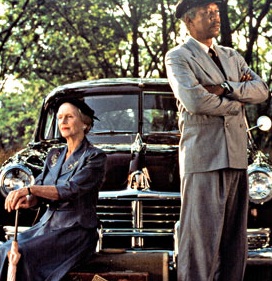
In the film, Driving Miss Daisy, we hear a portion of the speech Dr. King gave that evening. It is a scene heavy with symbolism.

Miss Daisy (Jessica Tandy) sits in the hotel dining room next to an empty chair.  Her son, Boolie Werthan (Dan Aykrord) a local business executive, had declined to join his mother at the dinner.

He said he was afraid if he attended, he would lose business, and his competitors would start calling him Martin Luther King Werthan.

As the speech continues (King’s voice is heard; he is not seen), Miss Daisy’s driver, Hoke Colburn (Morgan Freeman) sits in her car outside, listening to the car radio.  The camera cuts back and forth between Miss Daisy in the dining room, and Hoke in the car, each one listening to the speech from separate locations.

Here is the section of King’s speech heard on the film soundtrack:

We can see that the South has marvelous possibilities, yet in spite of these assets, segregation has placed the whole south socially, educationally, and economically behind the rest of the nation. Yet there are in the white south millions of people of good will whose voices are yet unheard, whose course is yet unclear, and whose courageous acts are yet unseen. .  .  .

History will have to record that the greatest tragedy of this period of social transition was not the vitriolic words and the violent actions of the bad people, but the appalling silence and indifference of the good people.

Our generation will have to repent not only for the words and acts of the children of darkness but also for the fears and apathy of the children of light.

The picture above is from the film, Driving Miss Daisy.
Posted in -Movies and Religion, Middle East Politics, Religion and politics | 11 Comments

Israel Linked to Dubai Murder: Take That, Judge Goldstone

by James M. Wall

Dubai’s The National, reported on February 17:

Interpol has issued red notices for the 11 suspects in the murder of the senior Hamas leader, Mahmoud al Mabhouh, on January 19, with Dubai’s police chief confirming that the Israeli foreign intelligence service Mossad was involved.

Paul Woodward, who writes the War in Context blog, has monitored this story since it first broke with the announcement (above) from the Dubai police chief.

Woodward’s latest posting links to a long background story on the London Times OnLine web site. It begins:

In early January two black Audi A6 limousines drove up to the main gate of a building on a small hill in the northern suburbs of Tel Aviv: the headquarters of Mossad, the Israeli secret intelligence agency, known as the “midrasha”.

Binyamin Netanyahu, the Israeli prime minister, stepped out of his car and was greeted by Meir Dagan, the 64-year-old head of the agency. Dagan, who has walked with a stick since he was injured in action as a young man, led Netanyahu and a general to a briefing room.

According to sources with knowledge of Mossad, inside the briefing room were some members of a hit squad. As the man who gives final authorisation for such operations, Netanyahu was briefed on plans to kill Mahmoud al-Mabhouh, a member of Hamas, the militant Islamic group that controls Gaza.

As evidence and strong speculation builds toward absolute certainty that Netanyahu ordered, and Mossad carried out, the murder of Mahmoud al Mabhouh, should we expect the Israeli government to apologize, as it was forced to do when then (and once again) Prime Minister Bibi Netanyahu ordered an assassination attempt on Hamas leader Mishal Khalidi in 1997?

Times have changed since 1997. Israel, the major military power in the region, now dictates the rules of engagement.

Israel does not normally respond to stories alleging misconduct by the Mossad.  The Palestinian newspaper Ma’an, reports on how Avigdor Lieberman, Israel’s foreign minister, responded to the allegations that his government is behind Mahmoud al Mabhouh’s murder.

Israeli Foreign Minister Avigdor Lieberman said that there was no definitive proof Israel’s intelligence agency carried out the assassination, although he stopped short of denying it. . . Lieberman stressed however, that he was neither confirming nor denying responsibility for the killing.

“Israel never responds, never confirms and never denies,” he said. “There is no reason for Israel to change this policy.”

You got that? Lieberman denies involvement and then says Israel never responds, confirms nor denies involvement.

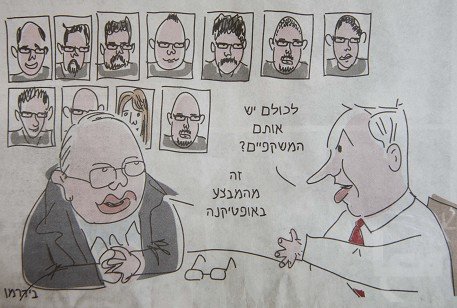
Israeli cartoonists have little patience with ambiguous denials. They simply assume it was a Mossad-orchestrated hit.

The cartoon above, which ran in Ha’aretz, depicts Israeli Prime Minister Benjamin Netanyahu (left) asking Mossad chief Meir Dagan,

“I have one question about the Mossad operation in Dubai: Why do all the agents wear the same kind of glasses?”

Dagan responds: “this operation was sponsored by Opticana Vision.”

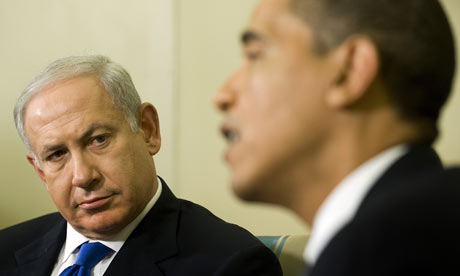
Will Barack Obama call Netanyahu, as Bill Clinton did in 1997, following the failed attempt on another Hamas leader, and force him to grovel after getting caught? Don’t count on it. Bibi is still building settlements over Obama’s objections. What’s one more assassination among friends?

Israel sets the rules of warfare against any group or nation it deems to be an enemy.

You got a problem with that?

The New York Times cautiously acknowledged the unfolding story on its blog Monday morning, linking to European news sources.  If the Times has a problem with Israel’s latest display of international arrogance, it is slow to say so.

As for Israel’s own media response, the problems that Ha’aretz finds in the Dubai murder are purely strategic. In an editorial, Ha’aretz asks, was it good for Israel’s image?

First, did the goal and outcome justify the risk of carrying out a hit in a moderate Arab country and of exposing the intelligence community’s modus operandi? Or did the operational opportunity to get rid of an individual responsible for past terror attacks and current weapons smuggling encourage those who approve and carry out such actions to waive some of the rules of caution?

Second, in a tense period in which Israel is trading threats of war with Iran and its allies in the region, should Israel be goading the enemy instead of maintaining restraint?

Third, is it right, because of this hit, to embarrass the authorities in the United Arab Emirates, who share with Israel the fear of the Iranian threat? Fourth, in preparation for the operation, were the risks of exposure and restrictions on similar future actions taken into account?

Fifth, is there justification in damaging relations with friendly European countries whose passports were used by Mabhouh’s assassins? Sixth, is it proper to place in harm’s way the Israelis whose identities were ostensibly stolen and used by the assassins?

Guy Bechor, writing a column he calls “Israel is Back”, for the Israeli news web site, Y Net, rejoices in the image the murder projects to the region. In a blaze of blatant triumphalism, Bechor writes:

According to terror groups, Israel can reach anywhere and has infiltrated every organization and each Arab state. The glory of Israel’s secret services had been restored and the fear of them has increased. So what are people in the region telling themselves? “Israel is back.”

It disappeared for about a decade and a half of “peace,” where it was perceived as weak; yet now it is back at full force.  .  .  .

The Goldstone Report, which claimed that Israel goes crazy when it is being attacked, caused us some damage (which should not be exaggerated) in the world, yet it was a blessing in our region.

If Israel goes crazy and destroys everything in its way when it’s being attacked, one should be careful. No need to mess with crazy people.

Triumphalism is a recent phenomenon in Israel, enhanced greatly by the rise of the Netanyahu hardline government.

In the US, of course, triumphalism is in our DNA. These days we are finding common ground with our Israeli cousins.

The Obama government’s triumphalism is now cruising along in its own morally repugnant and strategically unrealistic campaigns of targeted assassinations against Taliban leaders in Afghanistan.

Glenn Greenwald constantly monitors and calls out US conduct when it violates basic American values and human rights.

Recetly Greenwald was outraged by a “monstrous Op-Ed” in the New YorkTimes, which complains that “the US is being too careful to avoid civilian deaths in Afghanistan . . .”

The Op-Ed is by a “Lara M. Dadkhah,” identified only by this conspicuously vague and uninformative line:

“Lara M. Dadkhah is an intelligence analyst.” She explains further: “While I am employed by a defense consulting company, my research and opinions on air support, are my own.”

Here is a portion of  her own “research and opinions” in the Times:

So in a modern refashioning of the obvious — that war is harmful to civilian populations — the United States military has begun basing doctrine on the premise that dead civilians are harmful to the conduct of war. The trouble is, no past war has ever supplied compelling proof of that claim. . . . [A]n overemphasis on civilian protection is now putting American troops on the defensive in what is intended to be a major offensive. . . .

Of course, all this is not to say that the United States and NATO should be oblivious to civilian deaths, or wage “total” war in Afghanistan. Clearly, however, the pendulum has swung too far in favor of avoiding the death of innocents at all cost.

Greenwald finds this analysis nothing short of grotesque:

Note how her cursory, oh-so-humane caveat at the beginning (“Of course, all this is not to say that the United States and NATO should be oblivious to civilian deaths, or wage ‘total’ war in Afghanistan”) is casually dispensed with by the end, when she demands “victory in as short a time as possible, using every advantage you have.”

Does anyone need it explained to them why causing large civilian deaths through air attacks in Afghanistan is not only morally grotesque but also completely counter-productive to our stated goals?

The US kills from the air with its impersonal drones.  Israel kills in Dubai hotel rooms with trained assassins. For Israel, and now for the US, murder and assassinations of both targeted enemies and innocent civilians have become SOP (standard operating procedures), arousing only faint criticism on their respective home fronts.

The US, which has forgotten the lessons it should have learned in Vietnam, now follows the Israeli model of warfare, i.e., civilians are expendable in order to win short term military victories.

The Wall Street Journal online edition reported last week on just the latest example of how this model plays out on the Afghan front:

An errant NATO missile strike killed 12 civilians in Helmand province Sunday (February 14), the largest single loss of life of non-combatants since a massive coalition offensive began over the weekend.

Coalition commander U.S. Gen. Stanley McChrystal immediately issued an apology for the incident, and suspended use of the truck-mounted missile system used in the strike until further notice.

Seamus Milne described Israel’s assassination campaign in a recent column in the London Guardian:

Since the killing of veteran Hezbollah leader Imad Mughniyeh in Damascus in 2008, Israeli-hallmarked assassinations have multiplied in Lebanon, Syria and Iran.

Coldblooded killing isn’t only a morally repugnant crime. The lesson of colonial history is that decapitation campaigns against national resistance movements don’t work. In the short term they can disrupt and demoralise, but if the movement is socially rooted, other leaders or even organisations will take their place.

What would lead Israel and the Obama White House to abandon their common heritage of moral values and pursue such monstrous and ultimately “doomed to fail” military tactics?

Of late, I have been reading Henry James. Leon Edel, a Jamesian scholar, writes an introduction to a volume of the works of James which reproduces short works written from 1900 to 1903.

Discussing what is perhaps James’ most famous story, “The Beast in the Jungle”, Edel concludes that James writes with a “prevision” of twentieth century existential man as “disassociated, ridden by anxiety, fashioning out of his malaise, a secular and almost pathological dream of special privilege”.

This is, for me, a warning from the past.

Israel’s self destructive behavior, which the US not only condones but emulates, is driven by a dangerous anxiety and an “almost pathological dream of special privilege”.

And we should have a problem with that.

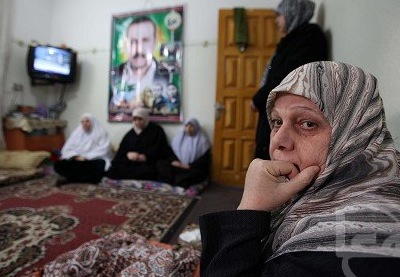
The picture at the top was taken at the home of  Mahmoud al Mabhouh, where relatives gather to mourn his death.  It is a Ma’an image and was taken by Wissam Nassar. The cartoon is from Ha’aretz.  It was reproduced in the Palestinian newspaper Ma’an.

Posted in Media, Middle East Politics | 3 Comments

The Case of Israel Versus the Ma’man Allah Cemetery

by James M. Wall

The Ma’man Allah cemetery is located within the grounds of West Jerusalem’s Independence Park.

The cemetery is of ancient vintage. It dates back to at least the 12th century. There are some archeologists who believe it may even date back to the time of the prophet Mohammed (PBUH).

Independence Park is, as its name suggests, a post-1948 addition to the city’s landscape. Modern tourist books give the cemetery only a passing glance.Ma’man Allah is disappearing, as one guide book suggests:

The chief attractive element of [Independence] park is the Lion’s cave which lies inside the park . . .  This cave lies to the east end of the park which also houses an old Islamic cemeteryin the grounds.

An “old Islamic cemetery” indeed. Ma’man Allah is much more than an “old Islamic cemetery”. It is rapidly becoming a purloined cemetery. And what does Israel’s Supreme Court have to say on the matter of the Case of the Purloined Cemetery?

On February 10, Israel’s highest Court gave final clearance to the city of Jerusalem and the Los Angeles-based Simon Wiesenthal Center, to build a complex with the grotesquely ironic name, the Center for Human Dignity-Museum of Tolerance.

Rabbi Marvin Hier. founder and dean of the Simon Wiesenthal Center, was invited by Democracy Now moderator Amy Goodman to appear on her program to discuss his organization’s museum. He declined to appear, but sent this message:

[The complex] is being built on Jerusalem’s former municipal car park, where every day for nearly half a century, thousands of Muslims, Christians and Jews parked their cars without any protest whatsoever from the Muslim community.

Columbia University professor and author Rashid Khalidi, whose ancestors are buried at Ma’man Allah, was a studio guest on Democracy Now. He has a different reading of the cemetery’s history.

RASHID KHALIDI: This is a cemetery where people have been buried since the twelfth century. People who fought with Saladin in the Crusades are buried there . . . Contrary to what Rabbi Hier said, that parking lot was built over part of a cemetery. The Israeli authorities are basically pushing ahead with the desecration of a cemetery that they have been, unfortunately, slowly nibbling away at for over three decades.

We and other families are taking action as a group of families to try and stop this, after other families failed in the Israeli Supreme Court.

AMY GOODMAN: The fact that he said this has been a parking lot that no one has protested for years?

RASHID KHALIDI: . . .many protests were made. There were protests made from the early ’60s, when the first of these desecrations started. [What Rabbi Heir said is] false. And the fact that it was desecrated in the ’60s does not mean that it is right to desecrate it further.

(To watch all of Amy Goodman’s ten minute video discussion of Ma’man Allah, click below)

After the Israeli Supreme Court rejected the appeal of the New York based Center for Constitutional Rights, to protect Ma’man Allah, the CCR filed a petition, along with several international bodies, that calls on Israel to: “halt construction of the museum; investigate human rights violations; rebury human remains; and declare the Mamilla Cemetery [the name Israelis use for Ma’man Allah] a protected antiquities site.”

The CCR filed its petition two days before Abraham Lincoln’s 201st birthday, adding a poignant historic note to the irony in the names that would adorn the new museum, “human dignity” and “tolerance”.

According to the CCR website, “the Petition was filed with the U.N. Special Rapporteurs on Freedom of Religion and Belief and on Contemporary Forms of Racism; the Independent Expert in the Field of Cultural Rights; the High Commissioner for Human Rights; and the Director General of UNESCO.

The CCR has an impressive history as “a non-profit legal and educational organization committed to the creative use of law as a positive force for social change.”, starting with the civil rights movements in the American South in the 1960s.

In her interview on Democracy Now, Amy Goodman asked Michael Ratner, the current president of the Center for Constitutional Rights, about his most recent visit.

I was really shocked by what I saw. I went into West Jerusalem, and I see a wall that’s probably twenty-five feet high, surrounded by surveillance cameras, which is where they’re building this so-called Museum of Tolerance.

Right up to the edge of it, you see Muslim graves, Palestinian graves, all around it. And within even the part of the cemetery that still exists, which is only a few acres, because the Israelis have paved over other parts or built a park, it’s been desecrated.

And every time they, Muslim people, attempt to fix it, it’s desecrated again. And within the site itself, I mean, [one] archaeologist  . . . called this an archaeological crime. This is an Israeli archaeologist.

And you see they took out bones in cardboard boxes, relatives of the descendents of the people on this petition— And they have no sense of where those people are. And the archaeologist said there’s at least 2,000 other graves under this site. So, to hear the rabbi from the Simon Wiesenthal Center talk about “there’s no bones, there’s no bodies under here” is just—it’s just a lie. That’s all I can say. That’s what it is.

Last week, London Independent columnist Robert Fisk attended the 10th annual Herziliya conference where once a year Israel’s political and governmental leaders gather for policy discussions.

We heard that Israeli officials might not be able to travel for fear of war crimes indictments against them – which suggests that Goldstone’s report is indeed biting. Israel’s leaders fear the public relations fall out and the possible legal complications looming from the Goldstone Report, but they heard reassuring words from Danny Ayalon, the Deputy Foreign Minister who preposterously ‘sofa-ed’ the Turkish ambassador last month.

Ayalon, a former Israeli ambassador to the United States, obviously smells defeat for Obama’s original Cairo message of pro-Muslim appeasement and criticism of Israel. Fisk reports that Ayalon assured the conference that the Israeli-American relationship had “never been better”.

The Conference also heard from Prime Minister Bibi Netanyahu:

I would like to speak not of disengagement, but rather of engagement: engagement with our heritage, with Zionism, with our past and with our future here in the land of our forefathers, which is also the land of our children and our grandchildren. . . our existence depends on our ability to explain the justness of our path and demonstrate our affinity for our land – first to ourselves and then to others.

On his way to the sea coast resort at Herziliya, Fisk stopped by a small Tel Aviv library, which houses 20,000 books and documents that once belonged to David Ben Gurion, Israel’s founding father and military leader in the 1946-48 war.

In the library, Fisk found notes Ben-Gurion had written on the “eternal morality of the State of Israel”, including this one:

“The fate of Israel depends on two factors: her strength and her rectitude. The State of Israel will not be tried by its riches, army or techniques, but by its moral image and human values.”

Even as he laid plans for the take over of Palestinian land for a future Israeli state, Ben Gurion was concerned to protect Israel’s status as a young nation known for “its moral image”. He issued orders, for example, as early as 1948, that no Muslim nor Christian place of worship nor sacred site was to be harmed by Israeli soldiers. He promised bodily harm to any soldier guilty of violating that order.

Saree Makdisi, a professor of English and comparative literature at UCLA, wrote an opinion piece in the Los Angeles Times, in which he traced the history of the disappearing Ma’man Allah cemetery. Makdisi concluded  his historical analysis:

Displacing living people — something Israel does every single day — is hardly any better than displacing dead ones. This disgraceful episode is only part of a much longer history of displacement and dispossession dating to 1948.

Within a few days, the Times published its inevitable “other side” rejoinder, written by Rabbi Heir.

The ever alert Philip Weiss was online the next morning with a posting on his February 13 Mondoweiss blog. Weiss attacked Heir’s shocking “falsehoods”, citing the petition that was filed by the CCR February 10:

There has never been any doubt about the centrality of the 33-acre Mamilla [Ma’man Allah] cemetery to Muslim practice in Jerusalem. Throughout the 1800s, Ottoman rulers “fastidiously” recognized the boundaries of the cemetery by surrounding it with a wall and roads.

As for the Brits who followed, in 1938 and 1944, they officially recognized cemetery as an “Islamic endowment” and an “antiquities site.”

In 1948 the Israelis took over West Jerusalem. And from the beginning of Israeli rule, Muslim authorities appealed to Israel to protect the cemetery. In 1948 the Israeli Religious Affairs Ministry said the cemetery “is considered to be one of the most prominent Muslim cemeteries,” with remains going back to the great general of the Crusades, Salah-ah-Din.

“Israel will always know to protect and respect this site.” For a few years the Israelis kept their word. And then the encroachments began. The petitioners write:

“Israel has gradually expropriated and destroyed most of the cemetery.” It began by building an “Independence Park” over half the cemetery in the 1960s. Then in 1964, it built that parking lot Hier refers to, over about three acres of the cemetery. Then it built an underground parking garage and ran cables and other infrastructure through the site.

Palestinians have never been silent about the desecration. On at least one occasion they petitioned UNESCO to stop it.

In recent years, the Israeli Antiquities Authority awarded the 3-acre parking lot site to the Simon Wiesenthal Center to build its Tolerance hall on, and an archaeologist was sent in to see what was going on.

The report of this “Chief Excavator” was emphatic: There are thousands of graves under this parking lot that date to the 12th century. They have already been disturbed by construction. Some of these bodies have been removed. The construction zone is shrouded in secrecy.

If just one of those bodies were Jewish, the petitioners demonstrate, construction would stop in a nanosecond.

And so the battle is joined. The state of Israel does what it pleases with an ancient Islamic cemetery, just as it does what it pleases in its attacks in Gaza and the West Bank.

Are there no Israel leaders who see beyond Netanyahu’s obsession with “our affinity for our land”? Are there no American political leaders with the courage to take Bibi’s keys away from him before he drives Israel over the cliff?

The picture above from Jerusalem’s Ma’man Allah cemetery was taken by Dan Balilty for the Associated Press. It ran in the Los Angeles Times. The photo of Robert Fisk is taken at the wall surrounding Abu Dis. It was taken by Quique Kierszenbaum for the London Independent.


Posted in Middle East Politics | 7 Comments

Zionism’s “Cold Logic and Deep Passion” Blocks Obama

by James M. Wall

The politics of Hope smashed into the Iron Wall that Israel continues to build to enclose Zionism in its own security blanket.

What happened when the Politics of Hope hit the Iron Wall of security?

Settler settlement growth increased; an Hamas leader died under suspicious circumstances in Dubai; more targeted Israeli Defense Force attacks struck West Bank citizens; Gaza still lies in ruins, its people unable to rebuild.

Meanwhile, the Gaza blockade is made even stronger with Egypt’s cooperation, reducing the flow of food, medicines, and building supplies into Gaza from the south.

Israel’s security blanket remains a prison wall surrounding all of Palestine.

The Goldstone Report is slowly disappearing. Once considered a serious theat to Israel, given the careful manner in which the Report was assembled under the leadership of the respected Jewish Judge Richard Goldstone, the Report languishes in UN file cabinets.

How do we know the Report is no longer a threat? We have that reassurance from a reliable source, David Horovitz, editor of the Jerusalem Post. (See spelling correction below.)

Horovitz spoke with “insider friends” in Washington, you know, those folks who are oozing with love, admiration and support for Israel (the Israel Lobby for short) and Horovitz was assured, as he wrote in a recent Post editorial, that the Goldstone threat is fading, thanks to Israel’s staunch ally, Barack Obama:

They stress that the administration has been rock solid on the Goldstone Report – voting in vain against its adoption in the United Nations Human Rights Council in October, and again in the General Assembly in November.

While countries from which we might have expected better failed to stand up for what amounted to Israel’s right to self-defense, and while certain European nations have now become no-go zones for Israeli leaders facing a genuine fear of arrest for purported war crimes, they point out, the US is firmly in Israel’s corner.

Why should readers of the Jerusalem Post worry about a little thing like the United Nations?  Ethnic cleansing continues to run rampart over every UN resolution adopted since 1948. The politics of Hope cannot touch ethnic cleansing.  It cannot even dent the Iron Wall behind which Israel lives in his secure military enclave.

True enough, the minority Republican party in Washington remains, in Time magazine’s Joe Klein’s terms,”paralyzed by cynicism and hypocrisy”, but that is just fine with Horovitz, so long as the Republican paralysis remains, again, in Klein’s words, “undergirded by inchoate ideological fervor.”

It is because of this Washington political paralysis, and the Republicans’ “inchoate ideological fervor” that Israel is able to fend off the Goldstone Report, and ignore angry world opinion outside the US.

Should Jerusalem Post readers worry about American voters who are facing “financial strains more acute than they have been for decades”?

No problem, Horovitz’ DC insiders assure him: Foreign aid to Israel will remain “untouched, secure and considerable – in the familiar region of $3 billion this year.”

Of course, Horovitz adds, there is still that pesky matter of those idealistic young protestors on American campuses.

A ferocious assault on Israel’s legitimacy is under way at innumerable American university campuses – the disease of British academia spreading across the pond. But the administration is robust. We’ve really only got one significant partner in this particular aspect of the battle against our delegitimation, they add, but if you’ve only got one ally, thank goodness it’s America.

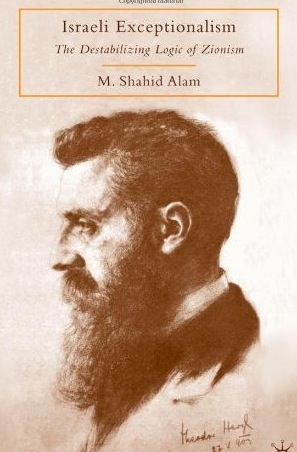
In her review of M. Shadid Alam’s new book, Israeli Exceptionalism: The Destabilizing Logic of Zionism, political analyst and author Kathleen Christison traces the changing understanding of Zionism.

Until recent years, the notion that Zionism was a benign, indeed a humanitarian, political movement designed for the noble purpose of creating a homeland and refuge for the world’s stateless, persecuted Jews was a virtually universal assumption.

In the last few years, particularly since the start of the al-Aqsa intifada in 2000, as Israel’s harsh oppression of the Palestinians has become more widely known, a great many Israelis and friends of Israel have begun to distance themselves from and criticize Israel’s occupation policies, but they remain strong Zionists and have been at pains to propound the view that Zionism began well and has only lately been corrupted by the occupation.

Christison writes that the essential point of Alam’s book is made clear in the inscription in the frontispiece.

From the Persian poet and philosopher Rumi, the quote reads, “You have the light, but you have no humanity. Seek humanity, for that is the goal.”

Alam, professor of economics at Northeastern University in Boston . . . follows this with an explicit statement of his aims in the first paragraph of the preface.

Asking and answering the obvious question, “Why is an economist writing a book on the geopolitics of Zionism, he says that he “could have written a book about the economics of Zionism, the Israeli economy, or the economy of the West Bank and Gaza, but how would any of that have helped me to understand the cold logic and the deep passions that have driven Zionism?”

Alam demonstrates clearly, through voluminous evidence and a carefully argued analysis, that Zionism was never benign, never good—that from the very beginning, it operated according to a “cold logic” and, per Rumi, had “no humanity.”  Except perhaps for Jews, which is where Israel’s and Zionism’s exceptionalism comes in.

Jerusalem Post editor David Horovitz, did not use the term exceptionalism, when he wrote that his colleagues in Washington had reassured him that one year into the Obama administration, nothing had changed  on Israel’s other “home front”.

But there is certainly something exceptional about the undying loyalty US elites and leaders feel for Israel.

Israel’s loyal teammates in the US include the Congress, the media, and the ever faithful military-industrial complex.

Essential for the US-Israel axis, carefully cultivated in each new generation, are the cautious, excessively civil and reliably timid, American churches. Lets face it, Israelis are smart. They know it never hurts to have God on your side.

Over time, this could begin to change. Increasingly of late, courageous and aggressive Protestant activists have stepped up their travel to, and personal interaction with, Palestinians. They have returned home shocked at what they have seen and experienced.

A scene at the end of the highly effective DVD produced by the Presbyterian Church (U.S.A.) is a vivid testimony from one traveler, spoken to his fellow travelers on the last day of a trip to Palestine/Israel.

The study book, which includes the DVD, is Steadfast Hope: The Palestinian Quest for Just Peace, produced by the Israel/Palestine Mission Network, part of the denomination’s education program.

The speaker is the Rev. Andrew Rosencranz, a Presbyterian pastor. With barely restrained anger and frustration, Rosencranz, says: “I did not know that I did not know”.

This, of course, is Israel’s greatest nightmare, American pastors and laity discovering the Palestinian narrative.

Among all the American denominations, and I am not revealing secrets here, it is the Presbyterians, bless their orderly Reformed hearts, who have taken the lead in the effort to push a Palestinian justice and peace agenda.

This is still a minority movement. Church leaders are especially slow to even acknowledge the issue. The harsh reality remains, as the old saying goes, “the higher the steeple, the more timid the church below will be.”

Every church member or pastor who has taken an all-expenses-paid trip to Israel knows, perhaps hidden deep inside, that Zionism has successfully targeted Protestant circles of power for a very long time.

They are still at it, of course. Look for Zionism’s representatives at judicatory meetings. They will be pushing for “fair and balanced” resolutions.

Could that be where Fox News got its operative slogan?

Then there is the silence of the American media. Forget about the overt Zionists like Friedman, Goldberg, Will, and the Fox crowd.

As in the church and the Congress, you will find an abundance of PEPs in the media. (A PEP, in case you did not get the memo, is a Progressive Except on Palestine.) You know who they are, especially if you watch MSNBC.

There will always be well meaning folks in both the media and in the churches, who will respond to earthquakes in Haiti, and hunger in America. But these same folks quickly shy away from the “complications” involved in discussing the “Palestinian issue”. These are the people who can’t afford to “offend” others or harm “fragile” relationships.

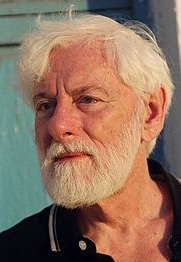
Uri Avnery, the veteran Israeli peace agitator, activist, and author,  recently called out Israelis who support worthy causes, but who have allowed themselves to become Israeli PEPs, Progressive except for Peace.

He is speaking to Israeli Jews, of couse, but if American progressives will just lift their sights a bit, they will find that the shoe fits here as well.

Avnery starts by listing the good causes that Israelis embrace, especially the younger activists.

The struggle for preserving the environment and the future of the planet.

The struggle for democracy against fascist trends.

The struggle for human rights and civil rights.

The feminist struggle.

The struggle for the rights of gays and lesbians.

The struggle for social justice and social solidarity.

The struggle for equal rights for Israel’s Arab citizens. The struggle against the discrimination of Oriental Jews.

The struggle for the separation of religion and state.

The struggle for animal rights. Etc. etc. etc.

What do all these causes have in common?

All of them belong to the liberal, “progressive” world view. Each and every one of them deserves full-hearted devotion, especially of young people. But after all, all of them serve today as substitutes for the main battle – the struggle for peace with the Palestinian people.

There is a danger that all these struggles will become something like “cities of refuge” for young idealists, who desire to devote themselves to a noble cause, but have no desire to take part in the main struggle.

Since every one of these struggles is indeed important and is for a good cause, no one can argue with these activists. Scores of organizations are now active in these fields, and thousands of wonderful people – male and female, old and young – are devoting themselves to these causes.

I, too, would willingly join every one of them, were it not – – – Were it not for the fact that all of them – all together and each of them separately – are now draining the life out of the struggle for peace.

Avnery has lived in Israel since before the modern state was created.  He was, as a young man, a soldier in the Israeli Defense Force. Later, he was active in forming a political peace party and was elected to the Knesset.

His love for Israel is that of a Jew who wants only the best for his land and his people.  So it is understandable that he sets the mark higher than an American might. But we who live on this side of the Atlantic, far from the daily struggles in Israel-Palestine, have to acknowledge the prophetic wisdom in his conclusion:

As I see it, peace stands above all other aims, not least because the success of all other struggles depends on the outcome of this fight.

The unending war creates a reality of occupation and oppression, of death and destruction, brutality and cruelty, moral degeneration and general bestiality.

Can any ideal be realized in this situation? Can feminism, for example, achieve its aims in a country that is in the throes of an unbridled chauvinist militarism?

Avnery knows all about what M. Shadid Alam describes as the “cold logic and deep passion” of Zionism. He also knows that an unchecked Zionism will be the ultimate downfall of Israel as a democratic state.

A Correction: An earlier version of this posting misspelled Post Editor’s David Horovitz‘ name as David Horowitz, leading readers to mistake him for the David Horowitz who is a well-known American conservative writer and activist who recently wrote critically of Howard Zinn.  My apologies to both Davids.

The picture at the top is by Jim Watson, an AFP/Getty image. The picture of Uri Avnery is from Wikipedia

Posted in Middle East, Middle East Politics | 15 Comments

54 House Members Risk Their Careers to Support Gaza

by James M. Wall

Fifty-four members of the US House of Representatives have sent a letter to President Obama urging him “to use diplomatic pressure to resolve the blockade affecting Gaza.”

Initially drafted by Democrats Keith Ellison, Minnesota, and Jim McDermott, Washington, the letter says, in part:

The unabated suffering of Gazan civilians highlights the urgency of reaching a resolution to the Israeli-Palestinian conflict, and we ask you to press for immediate relief for the citizens of Gaza as an urgent component of your broader Middle East peace efforts. . . . The current blockade has severely impeded the ability of aid agencies to do their work to relieve suffering.

Fifty-two other members of the House joined Ellison and McDermott in signing the letter, a dramatic increase in congressional voices defying the powerful Israel Lobby.

The Minnesota Independent‘s story on the letter from the 54 House members lists the members by their home states. Some states are notable by their absence.

In Illinois, for example, the president’s home state, no member of either party supported the resolution. California and Massachusetts, in contrast, has eleven and six members, respectively, as signees.

Former Illinois Congressman Paul Findley praised the House members for their courage.  Speaking from experience, Findley told Helene Cobban, former Middle Eastern correspondent for the Christian Science monitor, that it was “an extraordinary step for 54 House members to stand up to the Lobby.”

“We haven’t seen so many members of Congress prepared to stand together behind a resolution critical of Israel since the 1970s,”, Findley told Cobban, who now runs a blog published by the Council on the National Interest, a non profit Washington-based organization which Findley co-founded in 1989.

Findley lost his House seat as a member of the Illinois delegation in 1982, abruptly rejected by the voters after serving his district for 22 years.

Findley’s defeat came when AIPAC supported Dick Durbin, a young Springfield Democratic attorney running against him after Findley openly called on then-President Ronald Reagan to open relations with the Palestine Libration Organization.

In 1985, Findley published They Dare to Speak Out: People and Institutions Confront Israel’s Lobby, in which he described what has become a classic case study of how AIPAC targets members of Congress who fail to adhere to the Israel Lobby line.

AIPAC-inspired funds poured into Durbin’s campaign treasury.  Later elected to the US Senate. Durbin is now the Senate’s Majority Whip.

Looking back at AIPAC’s role in removing him from his seat in the House, Findley recalls that in the 1970s, he was one of only two or three members of Congress prepared to speak candidly about Palestine and Israel.

For that number to grow to at least 54 in 2010 is a measure of how slowly public perception changes. It also demonstrates that in time, light will finally dawn on the uninformed.

Few persons in public life have demonstrated and written about this “dawning experience” and what follows, with the zeal and persuasiveness of Howard Zinn, the noted radical historian whose book, A People’s History of the United States, has “changed the way we look at history in America” (Democracy Now).

Zinn died suddenly Wednesday, January 27, at the age of 87, leaving behind a legacy of support for the voiceless and the oppressed peoples of the world. Remarkably, Zinn had been slow to discover the Israeli-Palestinian issue.

He described his experience in a short essay he wrote for Tikkun magazine’s May-June, 2008 issue,  published in rememberance of modern Israel’s 60th anniversary.

I was not long out of the Air Force when in 1947 the U.N. adopted a partition plan for Palestine, and in 1948, Israel, fighting off Arab attacks, declared its independence.

Though not a religious Jew at all, indeed hostile to all organized religions, I had an indefinable feeling of satisfaction that the Jews, so long victims and wanderers, would now have a “homeland.” It did not occur to me–so little did I know about the Middle East–that the establishment of a Jewish state meant the dispossession of the Arab majority that lived on that land.

I was as ignorant of that as, when in school, I was shown a classroom map of American “Western Expansion” and assumed the white settlers were moving into empty territory. In neither case did I grasp that the advance of “civilization” involved what we would today call “ethnic cleansing.”

It was only after the “Six-Day War” of 1967 and Israel’s occupation of territories seized in that war (the West Bank, the Gaza Strip, the Golan Heights, the Sinai peninsula) that I began to see Israel not simply as a beleaguered little nation surrounded by hostile Arab states, but as an expansionist power.

In 1967 I was totally engaged in the movement against the war in Vietnam. I had long since understood that the phrases “national security” and “national defense” were used by the United States government to justify aggressive violence against other countries.

Indeed, there was a clear bond between Israel and the United States in their respective foreign polices, illustrated by the military and economic support the United States was giving to Israel, and by Israel’s tacit approval of the U.S. war in Vietnam.

True, Israel’s claim of “security,” given its geographical position, seemed to have more substance than the one made by the U.S. government, but it seemed clear to me that the occupation and subjugation of several million Palestinians in the occupied territories did not enhance Israel’s security but endangered it.

Zinn was a professor at Boston University when one afternoon he was involved in a “spirited discussion of the Israel-Palestine conflict I was having with my large lecture class.”

What erupted in that class was what many lesser mortals remember as a moment of ‘conversion” on the issue.

A number of Jewish students were fervently defending the Occupation, whereupon two young women who had been silent up to that point rose, one after the other, to say something like the following:

“We are from Israel. We served in the Israeli army. We want to say to you who love Israel that the occupation of the West Bank and Gaza will lead to the destruction of Israel, if not physically, then morally and spiritually.”

Words to ponder for the 381 members of the House who failed to sign the McDermott-Ellison letter.

The picture above of Gaza children is from the Middle East Monitor web site. Howard Zinn’s picture is from the AP.

Posted in Middle East, Politics and Elections | 10 Comments

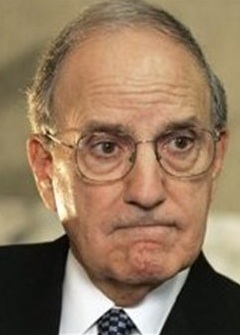
Mitchell Faces the “Intractable”: Time to Call In Henry Siegman

by James M. Wall

President Obama sent George Mitchell on another mission to the Middle East this past weekend.

After meeting with both Israeli and Palestinian leaders, Mitchell found that nothing has changed.

One full year on the job, and George Mitchell has been unable to find anything remotely resembling progress toward peace.  His latest trip to the region began, and will end, under a cloud of failure.

One British newspaper, The Guardiancommented on a Time magazine interview with Obama. According to The Guardian‘s analysis:

Barack Obama has admitted that his attempts to break the political deadlock in the Middle East by pressuring Israel to end the construction of Jewish settlements have failed.

He said he raised expectations of a breakthrough too high because he underestimated the political obstacles involved – an acknowledgement that he was unable to force the hand of the Israeli prime minister, Binyamin Netanyahu.

“The Middle East peace process has not moved forward and I think it’s fair to say, for all our efforts at early engagement, [it] is not where I want it to be,” he told Time magazine.

“This is just really hard … This is as intractable a problem as you get. If we had anticipated some of these political problems on both sides earlier, we might not have raised expectations as high.”

Should the White House have assumed Bibi Netanyahu would respond in a positive manner when the President asked him to show restraint in dealing with the Occupation?

You be the judge:

Obama: Hey, Mr. Dependable Ally in the Middle East, we are only asking you for a token show of restraint. How about a few months with no new settlements?

Israel’s response: New building permits for settlers, even more Palestinian homes demolished; a continuation of the Gaza invasion through economic oppression.

My dictionary says an intractable problem is that which is not easily governed, managed, directed, manipulated, relieved or cured. It does not say the problem is impossible to solve.

What would make this particular problem impossible to solve is for the President to continue down the road he has followed in his first year in office.

It is time for some serious policy overhauling. It is time to face the ghosts of the past. When it is time for some serious ghost busting, who you gonna call?

I suggest Mitchell try a new perspective. Call Henry Siegman.

Mitchell was an honored guest in April, 2009, at the US/Middle East Project international board meeting in New York, the organization for which Siegman currently serves as president.

Brent Scowcroft, Bush Senior’s National Security Advisor, is the group’s international board chairman.

Siegman, a German-born American citizen, is a respected Jewish journalist. He knows the region and he knows the players. His most recent Nation essay was developed from abackground document he wrote for the Norwegian Peacebuilding Centre in Oslo, Norway.

He served as executive director of the American Jewish Congress from 1978 through 1994.

Those of us who worked with him in those earlier years can attest to the importance of his presence in the Middle East dialogue.

His influence has grown considerably since those days.  In addition to running the US/Middle East Project in New York, Siegman is currently a visiting research professor at the Sir Joseph Hotung Middle East Program, School of Oriental and African Studies, University of London.

During Siegman’s time with the American Jewish Congress, that organization was often confused with the American Jewish Committee.

The two could not be further apart. The AJ Committee rigidly follows the policies of whatever political party governs Israel. Under Siegman, the AJ Congress represented American Jews; it refused to parrot Israel’s increasingly right wing policies.

As a recent example, in November, 2009,  a delegation from AJ Congress met with Jordan’s King Abdullah to discuss American Jewish involvement in peace making.

In October, 2009, Siegman wrote a column for Jerusalem’s Ha’aretz, “Hamas Is Not the Real Problem”, exposing Israel’s faux dedication to peace talks:

Israeli governments have avoided dealing with Hamas not because they fear that engaging the organization might not produce a peace agreement, but because they know they could not manipulate Hamas the way they have been able to manipulate Palestinian President Mahmoud Abbas – namely, by using content-less peace talks as a fig leaf for the continued expansion of the settlement enterprise.

His latest Nation essay,“Imposing Middle East Peace”, includes this cogent analysis:

Sooner or later the White House, Congress and the American public–not to speak of a Jewish establishment that is largely out of touch with the younger Jewish generation’s changing perceptions of Israel’s behavior–will have to face the fact that America’s “special relationship” with Israel is sustaining a colonial enterprise.

Our “special relationship” with Israel is unique in American foreign policy. We have funded and endorsed decades of illegal and immoral conduct by a nation claiming to be a democracy, while, in fact, it has hidden behind America’s protective screen, to build a racist state with policies antithetical to democratic values.

A compliant and controlled American media, a bought and paid for Congress, and a succession of presidents intimidated by both the media and the Congress, have allowed Israel to create a false image of a democracy seeking peace.

Israel’s current leaders believe they can continue to bamboozle the West into believing the state of Israel is so special that its colonialism is merely following the pioneering spirit of  western colonial powers in the 19th and early 20th centuries.

Israel just got to the party a little late. After World War II, colonialism was passe.

Before the 20th century and modern communications, colonialism was known as “expansion”.  Exploitation of indigenous populations by Western powers was viewed as a race to power. May the empire with the superior ordnance win!

The American western plains and the jungles of Africa were not exposed to a 20th century technology that sees all and tells all.

Modern Israel’s founding parents knew that modernity had created a different climate for empire building. Winning the hearts and minds of the western world, and selling the West on the Israeli narrative, has always been as important to Israel as having a powerful American sponsor for its military and economic development.

Israel established its own “don’t ask, don’t tell”, agreement with the US.  Don’t ask us, and don’t tell others, about our expansion plan and our Dimona nuclear program, and we will provide you with your very own colonial outpost in the heart of the Middle East.

Those Israeli founding parents created an ethnic cleansing plan which had to remain hidden, because after World War II, ethnic cleansing was no longer kosher.

It was not until Israel’s own New Historians, led by scholars like Ilan Pappe, began to dig into Israel’s pre-1947 plans to colonize Palestine, that outsiders could see the meticulous planning that allowed Israel to peddle itself as a new nation led by brave frontier fighters. Moshe Dayan meet Andrew Jackson.

Henry Siegman opens his Nation essay with some of that history:

Israel’s relentless drive to establish “facts on the ground” in the occupied West Bank, a drive that continues in violation of even the limited settlement freeze to which Prime Minister Benjamin Netanyahu committed himself, seems finally to have succeeded in locking in the irreversibility of its colonial project.

As a result of that “achievement,” one that successive Israeli governments have long sought in order to preclude the possibility of a two-state solution, Israel has crossed the threshold from “the only democracy in the Middle East” to the only apartheid regime in the Western world.

To describe Israel as an apartheid state, is to attack Israel at its most vulnerable spot: its image as a democracy. To identify Israel with South African apartheid was a dangerous crack in the wall of ignorance behind which Israel has conducted its oppression of the Palestinian people. Siegman again:

When a state’s denial of the individual and national rights of a large part of its population becomes permanent, it ceases to be a democracy. When the reason for that double disenfranchisement is that population’s ethnic and religious identity, the state is practicing a form of apartheid, or racism, not much different from the one that characterized South Africa from 1948 to 1994.

What Israel has become, is what its founding fathers planned from the outset. Siegman explains:

The democratic dispensation that Israel provides for its mostly Jewish citizens cannot hide its changed character. By definition, democracy reserved for privileged citizens–while all others are kept behind checkpoints, barbed-wire fences and separation walls commanded by the Israeli army–is not democracy but its opposite.

The Jewish settlements, with their supporting infrastructure spanning the West Bank from east to west and north to south, are not a wild growth, like weeds in a garden. They have been carefully planned, financed and protected by successive Israeli governments and Israel’s military.

Their purpose has been to deny the Palestinian people independence and statehood–or to put it more precisely, to retain Israeli control of Palestine “from the river to the sea,” an objective that precludes the existence of a viable and sovereign Palestinian state east of Israel’s pre-1967 border.

Colonial enterprises conquer indigenous populations and make the land their own.  Justice is not in their playbook; control is.

Facing such a formidable and intractable problem, how should Obama proceed? Henry Siegman believes:

Middle East peacemaking efforts will continue to fail, and the possibility of a two-state solution will disappear, if US policy continues to ignore developments on the ground in the occupied territories and within Israel, which now can be reversed only through outside intervention.

President Obama is uniquely positioned to help Israel reclaim Jewish and democratic ideals on which the state was founded – if he does not continue “politics as usual.”

The picture of George Mitchell is a Ma’an Image. Henry Siegman’s picture is from the Council of Foreign Relations.

Posted in Middle East | 14 Comments

The Photo Op That Failed; Israel Forced to Apologize to Turkey

by James M. Wall

This story begins with several fictional Turkish television dramas that had critical things to say about Israel.

It ends with an apology from Israel for its overreaction to that criticism.

In one episode of the Turkish television series, “The Valley of the Wolves,” BBC reported that an Israeli soldier takes aim at a smiling young girl and kills her.

Another clip from the series – which tells the story of a Palestinian family -reportedly shows a bullet fired by an Israeli soldier traveling in slow motion toward a Palestinian child.

Before these programs were aired, Turkey’s prime minister had been openly criticizing Israel for the excessiveness of its 2008-2009 military invasion of Gaza.

Israel’s foreign minister, Avigdor Lieberman, figured this was his chance to protest Turkish television programs, while, it may be assumed, exacting some revenge on an official of the Turkish government.

Lieberman instructed his deputy foreign minister, Danny Ayalon, a former ambassador to the US, to stage an especially humiliating confrontation with Ahmet Oguz Celikko, Turkey’s Ambassador to Israel.

Ayalon, an unlikely player in such a stunt, demanded that Celikko come to a meeting in the Israeli foreign ministry. Ayalon played his part too well.  He made sure photographers covering the meeting knew this was the photo op that would demonstrate to the world that nobody messes with Israel.

The AP reported that at the start of the planned humiliation meeting, Ayalon, speaking in Hebrew, instructed the Israeli photographers to capture the meeting from an angle that would show the Turkish ambassador seated on a sofa that placed him lower than Ayalon’s chair.

On the table separating the two diplomats, there was no Turkish flag, only a small Israeli flag. This staged photo op had all the insensitivity and immaturity of the sort of scene Danny Anylon might have seen in a US television drama in which a group of teenage girls deliberately humiliate the new girl in school.

Asked before the meeting if he would shake hands with the Turkish ambassador, Anylon replied, “No. That’s the point.”

The photo op was a huge success. The AP photo (above) appeared in the Israeli press.

Unfortunately, for Israel, Ayalon’s petty photo op stunt became an immediate diplomatic disaster.

Predominantly Muslim Turkey had, until now, maintained good relations with Israel, an alliance, according to a news report from MSNBC, “based on mutual fears of Iran and Syria.”

Israel has provided “hundreds of millions of dollars of military hardware to Turkey”. Israel and Turkey have conducted joint naval exercises. The Israeli air force trains over Turkish airspace.

Prime Minister Recep Tayyip Erdogan has headed Turkey’s Islamist-oriented government since 2003. When Israel invaded Gaza in late 2008, things changed, dramatically. Erdogan’s government described Israel as “a threat to world peace”. Turkey was especially angry at Israel’s use of “disproportionate force in the Gaza war.”

During a joint Ankara press conference with Lebanese Prime Minister Saad Harir on Monday (January 11), Erdogan said:

“We can never remain silent in the face of Israel’s attitude. … It has disproportionate power and it is using that at will, while refusing to abide by U.N. resolutions.”

Then came the public humiliation of the Turkish ambassador in Danny Analyon’s office.

Prime Minister Erdogan demanded an immediate apology from the Israeli government. The next day’s luke warm “sorry about that” Israeli response, angered Turkey even further.

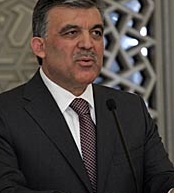
Abdjullah Gul, the Turkish president told a Turkish news channel:

“Unless they make up for it by this evening, our ambassador will return on the first plane tomorrow to hold consultations.”

Israel immediately complied.

Al Jazeera reported:

A statement from the office of the Israeli prime minister on Wednesday said: “Prime minister [Binyamin] Netanyahu, together with foreign minister Avigdor Lieberman co-ordinated the apology letter sent by deputy foreign minister Ayalon to the Turkish ambassador and hopes this would end the affair.”

Prime Minister Erdogan spoke with reporters at the Ankara airport after returning from a trip to Russia. He said that his country had received the apology it “wanted and expected” from Israel over the dressing down of its ambassador. “I was told that we received the response that we wanted and expected in diplomatic terms. The letter includes an expression of apology”.

Israel needs to maintain some semblance of good relations with Turkey, a Muslim nation with ties to both East and West. To maintain that connection, Israel forced its own Foreign Minister, and his deputy, to apologize. This was the sort of diplomatic backdown the US has been incapable of getting from the Netanyahu government.

Come to think of it,  how responsive has Israel been to US entreaties to play nice in this post-Gaza-invasion era?

A partial freeze of Israeli construction in the West Bank? Forgetaboutit. A halt to house demolitions? Ditto.

The UN Goldstone Report? The US Congress condemned it. The Obama White House was too preoccupied with compromising its health care bill to even notice.

Moment, a Jewish magazine founded by Elie Wiesel and Leonard Fein in 1975, as “The New Magazine for America’s Jew,” recently published a strong defense of Judge Goldstone.

The Obama White House has turned its back on Goldstone, but an Elie Wiesel founded publication, hasn’t forsaken him. Go figure.

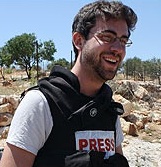
Then, there is the more recent case of a US journalist, Jared Malsin, who lives in Bethlehem. Malsin is currently scheduled to be deported from Israel this Sunday, January 17.

Malsin (pictured at left) was originally ordered deported back to the US after he was refused entry at the Tel Aviv airport when he returned to his residence in Bethlehem,  following a personal trip to Prague. Malsin’s father is Jewish. For more on Malsin’s background, click here.

He is originally from New Hampshire and is an American citizen. He is a graduate of Yale University.  He was initially questioned for eight hours by Ben Gurion officials.

He was introduced to the Israeli-Palestinian issue on an all-expenses paid Birthright Israel trip. According to Jewish Week:

In the past ten years, as many as 225,000 Jews between the ages of 18 and 26, mostly from the US, have visited Israel, courtesy of Birthright Israel, a program whose free 10-day trips are designed to deepen Jewish identity.

Malsin’s deeper Jewish identity led him in a direction which is not in Birthright Israel’s plan for its participants.

He had his own vision of what he felt his Jewish identity demanded from him. He went to work as the English-language editor of Ma’an, a highly respected Palestinian publication and online presence.

Israeli court documents indicated that Malsin’s detention was directly related to his work at Ma’an. The documents quoting airport officials as noting that Malsin authored articles “inside the territories,” among them some which “criticized the State of Israel.”

Has Malsin been critical of Israel?  You betcha. Here is a sample of his writing from November, 2007.

Here is an interesting factoid about Malsin: He was never threatened with deportation during the Bush era.  One year into Obama’s term, deportation looms. Could this be a clue to Israel’s current confidence that the Obama White House will be Bibi’s permanent good buddy?

But back to our potential American deportee:

Malsin’s original deportation date was scheduled for Thursday morning, January 14.  According to a Ma’an news report, “protests by US authorities in Tel Aviv resulted in a temporary reversal, and an injunction filed by Ma’an delayed the expulsion until an Israeli court reviews the case on Sunday, January 17.

The nameless US authorities who were involved, no doubt, included the local American embassy. Nothing has been heard from the Obama White House.

Some Amerian support did come, however, according to Ma’an,  from

The New York-based Committee to Protect Journalists, which monitors freedom of the press worldwide. [The Committee] urged Israel to refrain from taking punitive action against reporters over specific content in their work.

“Israel cannot hide behind the pretext of security to sideline journalists who have done nothing more than maintain an editorial line that the authorities dislike,” the organization said.

American media has ignored the case of Malsin, except for this video report from the ever-reliable Amy Goodman, on Democracy Now. Take a look, it is less than one minute long. Click the middle symbol to access the clip.

It is becoming distressingly evident that the Obama White House has aligned itself so closely to Israel that it has lost perspective on its partner in the Middle East.

Does Barack Obama intend to turn his Middle East policy over to a nation that has turned its collective consciousness away from the values of its Jewish tradition? Before he signs a long term contract of undying friendship, the President would do well to read Larry Derfner’s essay in the Jerusalem Post, entitled “To Be Israeli Today”.

Derfner writes, in part:

Being Israeli today is about being against. Against Palestinians. Against people who criticize the way we treat Palestinians. Against Muslims in general. That’s it.

That’s what it means to be Israeli, ever since the intifada started a decade ago and we concluded that no Arab could be trusted. Except for its hi-tech image, this is all Israel stands for anymore – being against this one, against that one and against anyone who isn’t against them, too.

That doesn’t leave many people whom we’re with. We’re with Republicans. We’re with right-wing Evangelical Christians. And that’s about all. Everybody else is against us, or they don’t know anything about us, so they’re neutral. Like the Eskimos. And maybe those Shakers.  .   .   .

When I try to explain Israel to Americans, I ask them to imagine that 80 percent of their fellow citizens were Republicans. Israel has become a one-party country – the war party.

We’re at war with the Middle East, with Europe, with liberal Jews in the Diaspora and with a pathetically small handful of dissenters at home. We trust no one. We see anti-Semites everywhere. We’d like to build an Iron Dome over this whole country to keep the world out. There’s very little oxygen around here; everyone is breathing the air that everyone else has exhaled.

This country has been stagnating for a decade. And we’ve never achieved such unity.

The picture at the top was taken by AP’s Gil Yohanan. The man in the middle is Naor Gilon, an Israeli Foreign Ministry official.

Posted in Middle East Politics | 2 Comments

Helen Thomas Rides Again; She Wants to Know, WHY Terrorism?

by James M. Wall

The scene is from  John Ford’s 1962 film, The Man Who Shot Liberty Valance. The time: the early American West,

The editor of the Shinbow Star follows Senator Ransom Stoddard (played by Jimmy Stewart), and his wife Hallie (Vera Miles), into the backroom where Tom Doniphon’s (John Wayne) body  lies in a wooden casket.

Ransome, Hallie and two old friends from the early days, sit quietly by the casket. The editor, Maxwell Scott (Carleton Young)  walks into the room.

Scott: I don’t wish to intrude, but a United States Senator is news. I’m the editor of a newspaper with a state wide circulation. I’ve got a responsibility to know why you came all the way down here to bury a man. And, you can’t just say his name was Tom Doniphon and leave it at that.

Who was Tom Doniphon?

Stoddard responds:

He was a friend, Mr. Scott. And we’d like to be left alone.

Scott:  I’m sorry, Senator, that’s not enough. I have a right to have the story.

This past week, Helen Thomas, the veteran White House reporter, confronted two White House officials in the same persistent manner as her fictional counterpart, Maxwell Scott.

Thomas has been confronting official Washington since the days of John F. Kennedy.

Her most recent White House press encounter was captured on You Tube. The conference was held to allow the media to question two officials sent by President Barack Obama to explain how two men, one on an airplane, the other in a remote CIA site in Afghanistan, infiltrated America’s defensive shield.

Everyone in that White House press room knew the basic facts of WHAT had happened in the sky over Detroit and at the CIA site. Helen Thomas was alone in demanding to know the WHY of what happened.

On his blog, Glenn Greenwald described Thomas vs. Brennan:

At a White House press conference yesterday [January 8] with [Homeland Security director] Janet Napolitano and [Deputy National Security Council advisor] John Brennan, Helen Thomas shows — yet again — that she’s one of the very few White House reporters willing to deviate from approved orthodoxy scripts. She asks the prohibited question about the motives of Terrorists, and keeps asking as she receives complete non-responses, until they all just decide to ignore her.

Brennan’s answer — they do this because they are Evil and murderous — is on the same condescending cartoon level as the “They-Hate-us-For-Our-Freedom” tripe we endured for the last eight years. . . . That Al Qaeda is evil and murderous and perverts Islam, is a judgment about what they do, not an answer as to what motivates them.

Note carefully, Greenwald links Brennan’s non-answer to the “condescending cartoon level” of the Bush White House, “They-Hate-us-For-Our-Freedom” tripe of the past eight years.

Greenwald is dead on accurate with his depiction that Brennan sounds like the Second Coming of the Bush White House.

Greenwald knows what constitutes tripe. And he wants the American public to face up to the harsh reality that the Obama White House, on this issue, is just more of the same. He is calling on us to break from the past and recognize the role motive plays in attacks on Americans.

The evidence of what motivates Terrorism when directed at the U.S. is so overwhelming and undeniable that it takes an extreme propagandist to pretend it doesn’t exist.  What is Brennan so afraid of?

It is true that religious fanaticism is a part of their collective motivation, but why can’t he just say what’s so obviously true: “they claim that the U.S. is interfering in, occupying and bringing violence to their part of the world, they cite things like civilian deaths and our support for Israel and Guantanamo and torture, and claim that their terrorism is in retaliation”?

Indeed, Brennan’s boss, the President, has often claimed that things like Guantanamo and Abu Ghraib help Al Qaeda recruitment (and it seems clear it was part of Abdulmutallab’s hatred for the U.S.), so clearly U.S. actions are part of the motivation.  Yet Brennan is afraid to acknowledge that not just past actions, but current ones, fuel the desire to target the U.S. for attacks.

Why does Helen Thomas stand virtually alone in the Washington media in confronting the “taboo” that keeps American in the media orthodoxy lockbox? Her persistent question, WHY, goes unanswered.

The “taboo” question is not one this White House wants to address. In a posting he wrote the day before the White House briefing, Greenwald addresses the “taboo” question:

If it is taboo to discuss how America’s actions in the Middle East cause Terrorism — and it generally is — that taboo is far stronger still when it comes to specifically discussing how our blind, endless enabling of Israeli actions fuels Terrorism directed at the U.S.

An article in yesterday’s New York Timesexamined the life of Humam Khalil Abu Mulal al-Balawi, the Jordanian who blew himself up, along with 7 CIA agents, in Afghanistan this week. Why would Balawi — a highly educated doctor, who was specifically recruited by Jordanian intelligence officials to infiltrate Al Qaeda on behalf of Western governments — want to blow himself up and murder as many American intelligence agents as possible? The article provides this possible answer [from Balawi’s brother]:

“He described Mr. Balawi as a “very good brother” and a “brilliant doctor,” saying that the family knew nothing of Mr. Balawi’s writings under a pseudonym on jihadi Web sites. He said, however, that his brother had been “changed” by last year’s three-week-long Israeli offensive in Gaza, which killed about 1,300 Palestinians.”

An Associated Press discussion of the possible motives of accused Christmas Day airline attacker Umar Faruk Abdulmutallab contained this quite similar passage:

“Students and administrators at the institute said Abdulmutallab was gregarious, had many Yemeni friends and was not overtly extremist. They noted, however, he was open about his sympathies toward the Palestinians and his anger over Israel’s actions in Gaza.” (emphasis added).

Two suicide bombers, one  that succeeded, and one that failed, led to the questions from Helen Thomas at that White House press conference.

It was not a difficult question, but John Brennan refused to give her a straight answer, other than to repeat the Bushian mantra,”they” are murderous. That is not enough, Mr. Brennan; that is not enough, President Obama.

What were the motives of these two bombers?  Their families and friends point to their anger over Israel’s treatment of Gazan civilians. Is it the official policy of the American government to ignore this possible motive?

Is our loyalty to the policies of Israel more important to our government than defending our own people?

The picture above, from The Man Who Shot Liberty Valance, shows Senator Ransom Stoddard talking with a young reporter from the Shinbone Star.

Posted in Media, Middle East Politics | 12 Comments

A Teachable Moment: Linking AVATAR To Gaza and Af-Pak

by James M. Wall

At a special morning New Year’s Eve screening in Hawaii, President Obama took his family to the mall to see the new 3-D movie, Avatar. Whose idea was that?

Did the leader of the Free World realize he was going to experience a “teachable moment”? Along with millions of movie-going families from Kansas to Qatar to Quebec, the Obama family found itself in Pandora, a lush jungle on a distant moon where the Na’vi tribes live in harmony with all living things.

The time is the future, 2154 to be precise, and the Na’vi live on land coveted by outsiders who have the military might to take their land from them.

Oh boy. Who among the Chicago nerds and political operatives who help the president organize his day, understood that Avatar could become a Teachable Moment for Obama, and the world.

The president likes Teachable Moments, when he recognizes them. Remember how effectively he turned all that negative publicity about his pastor into a serious discussion of race in America?

And remember how badly he missed another Teachable Moment when President Jimmy Carter came to his defense and described right-wing attacks on him as “racist”, which they were? Obama had his White House issue a statement disassociating the president from Carter’s defense.

Avatar now offers him the same opportunity. This is a Teachable Moment he should not reject. Maybe a special screening in the White House with some kind words for director James Cameron?

What viewers of Avatar discover is that the film immediately suggests the oppression of Native Americans by the US government, because the Na’vi and the land on which they live share a spiritual bond.  The film also evokes the Vietnam War because the setting of the military struggle is a lush jungle.

Gaza, Afghanistan and its neighbor Pakistan, are mountainous; there are no jungles. The dominant indigenous religion of Gaza and Af-Pak is Muslim, but like the Na’vi, the inhabitants live on land the outside invaders wish to control.

The demographics of the Avatar audience is young, the much coveted 12 to 35 age group.  It is science fiction, technologically advanced beyond anything movie-goers have seen before.  Younger viewers will see it over and over again, as they did with James Cameron’s earlier major film success, Titanic.

What an incredible Teaching Moment this film provides.  A built-in audience in which the way has been prepared to consider the foolishness of following the path to destruction which the military-industrial complex insists is necessary for human survival.

Any preacher who wants to reach her younger constituents should stop reading the latest copy of the Christian Century and race over to the mall to see Avatar.

That’s what Barack Obama did, perhaps unwittingly. Or was there a progressive staffer with access to the President, who had seen the film? God works in mysterious ways.  Why not through Avatar?

Of course, the President is already on the steady downward slope left to him by the Bush war-mongers.  He has to talk tough on terror to keep the Dick Cheney crowd at bay. Someone’s head will roll over that thankfully failed attempt to blow up a plane Christmas Day. That is to be expected.

But what if Obama starts hearing about the linkage of Avatar to Gaza, Afghanistan and its neighbor Pakistan?  He might start by reading this posting (OK, progressive White House staffer, get this posting to him!).

But rest assured, Obama is not going to hear about the linkage from the well-trained Main Stream Media (MSM) which is too lazy, indifferent, or maybe fearful of Cheney and his neo-con gang to see anything in Avatar except an exciting sci-fi love story in the jungle which ends in a video game-like battle in the jungle (and in the sky, where Pandora’s mountains are located).

A few tentative media voices have dared acknowledge the linkage between Avatar, Gaza, and Af-Pak.

Roger Ebert, who writes for Obama’s hometown newspaper, the Chicago Sun Times, correctly identified the linkage in James Cameron’s film.

[Avatar’s] story, set in the year 2154, involves a mission by [former] U. S. Armed Forces to an earth-sized moon in orbit around a massive star. This new world, Pandora, is a rich source of a mineral Earth desperately needs. Pandora represents not even a remote threat to Earth, but we nevertheless send in ex-military mercenaries to attack and conquer them.

Gung-ho warriors employ machine guns and pilot armored hover ships on bombing runs. You are free to find this an allegory about contemporary politics. Cameron obviously does.

Timesonline, of London points to a few additional clues:

With the use of such charged phrases as “shock and awe” and [Jake] Sully’s curt summation of the situation (“When people are sitting on stuff you want, you make them your enemy”) Cameron adds a thought-provoking political dimension to the story.

Richard Corliss, writing in Time magazine, alludes to colonization (leaving Gaza out, of course), in this summary of the film’s narrative.  Notice the caution he exercises as he references possible parallels.

Embrace the movie — surely the most vivid and convincing creation of a fantasy world ever seen in the history of moving pictures — as a total sensory, sensuous, sensual experience. . . . Living among these creatures is Pandora’s humanish tribe, the Na’vi, a lean, 10-ft.-tall, blue-striped people with yellow eyes, or what mankind might have been if it had evolved in harmony with, and not in opposition to, the Edenic environment that gave rise to its birth. . . .

This is not only the most elaborate public-service commercial for those of the tree-hugger persuasion; it’s also a call to save what we’ve got, environmentally, and leave indigenous people as they are — an argument applicable to the attempt of any nation (say, the US) to colonize another land (say, Iraq or Afghanistan).

Not surprisingly, however, a search of reviews written by other national and local media critics revealed that the majority of MSM critics focused on the advances in 3-D technology and the creatures and machines that clashed in the final major battle of the film. The political parallels to Gaza, Afghanistan and Pakistan were ignored.

No major critic I have read  cited a comment the American strike force commander makes when he refers to the Na’vis as “terrorists” because they resist invaders. He tells his men we must fight “terror” with “terror”.

The Commander’s cold-hearted enthusiasm in the battle recalls Robert Duvall’s classic line from Apocalypse Now, “I love the smell of napalm in the morning.”

Avatar stands on its own as a great piece of film-making. Cameron, who, in addition to Titanic,  made both of the Alien films that starred Sigourney Weaver, who is in Avatar as a tough talking scientist who wants to study the Na’vi, not kill them. (Her name in the film is Grace. Go figure.)

Cameron also possesses the artist’s ability to follow D.W. Griffith’s admonition that a director should “make people see” beyond the surface of a film.

Anyone with the slightest willingness to view our three current wars (Af-Pak directly, Gaza through our Israeli surrogates) will not miss Cameron’s vision.

Except for the above-cited, gingerly rendered signals, from Ebert, Corliss and Timesonline, most American critics ignored Avatar’s vision that indigenous populations deeply resent, and will resist all outside invaders.

You really have to experience this film to fully grasp what is at stake here. Avatar is a work of film art which is denuded of its potential power by film critics who wield considerable power over the viewing public.

Three excerpts from typical vision-deaf MSM reviews:

The New York Times’ Manohia Dargis:

If the story of a paradise found and potentially lost feels resonant, it’s because “Avatar” is as much about our Earth as the universe that Mr. Cameron has invented. But the movie’s truer meaning is in the audacity of its filmmaking.

Kenneth Turan, in the Los Angeles Times:

At one and the same time this film is a boys’ adventure tale with a major romantic element, an anti-imperialism movie that gets considerable mileage out of depicting invading armies, a neo-pagan, anti-technology film that touts the healing powers of nature but is up to its neck in the latest gizmos and gadgets.

Turan gives a passing nod to the film’s “anti-imperialism” but says nothing further on the subject.

Michael Phillip in the Chicago Tribune, another Obama hometown newspaper:

Though the Na’vi adversaries aren’t meant to be US. military personnel (they’re grunts in the employ of the mining operation), Avatar unmistakably pits the peace-loving blue-thins, who are fleet of foot and deft with bow and arrow, against Americans in uniform. Much of the battlefield imagery recalls the firefights and wrenching civilian casualties of Vietnam.

Phillip must have decided he could not totally ignore the obvious; hence, the “wrenching civilian casualities of Vietnam”.  After that passing reference, he quickly moves on with no further word on our current wars.

If Cameron’s vision could reach the general public through Teaching Moments, maybe, just maybe, that vision might register where it will do the most good, a public that knows these invasions are not really in our national best interests.

You can almost hear Cameron shouting “wake up, people”.  (If he wins an Academy Award as Best Director, he might startle America with an anti-colonial jeremiad.)

This Teachable Moment arrives on the scene as other hopeful developments unfold.

More than 1300 activists from 43 countries descended on Cairo, Egypt, during the New Year’s holidays. They were there to cross over Gaza’s southern border and march through the destruction left behind after Israel’s 23-day military invasion of Gaza one year ago.

Egypt’s President Hosni Mubarak refused to allow the international demonstrators to enter Gaza. Finally, under pressure, and with the assistance of Mubarak’s wife, a smaller delegation was allowed to enter Gaza.

None of the internationals were satisfied with this compromise. But those who joined the smaller delegation were realists, some were veterans of the American anti-war and civil rights demonstrations from the 60s, who operated from experience: Get what you can and keep fighting to get more.

The best thing to emerge from these Gaza demonstrations, in addition to letting Gazans know the world is watching (except in the US where the story received virtually no coverage from the MSM) was President Mubarak’s exposure as a US-Israeli tool, doing their bidding instead of supporting the Palestinians.

One possible explanation for Mubarak’s conduct: Egypt is second only to Israel in funds received annually from the US tax-payers.

Soon, 1300 demonstrators from 43 nations with access to blogs and the internet, will return to their home countries, more determined than ever to demand action against Israel’s occupation. The French delegation, for example, 300 of them, camped out in protest in front of their French embassy in Cairo, an action that drew considerable French media coverage.

The times, they are a’changing, and we have to believe Barack Obama knows this. Maybe he has adopted President Franklin Roosevelt’s strategy.

A group of activists came to FDR and urged him to take specific actions in support of the cause in which they deeply believed. His reply is the sign of a consummate politician: “I agree with you, I want to do it, now make me do it.”

Avatar gives us a Teachable Moment. Obama has seen the movie. He also knows the right thing to do in Gaza, Afghanistan and Pakistan. It is time to rally the public to make this consummate politician do what he knows, deep down, is the right thing to do.

The picture above is from 20th Century Fox.   Shown are Sam Worthington, as Jake Sully, a former US Marine in avatar form, and the Na’vi, Neytiri, voiced by Zoë Saldaña.

Posted in -Movies and politics | 13 Comments

“Heute Morgen ist Ron Holloway Gestorben” 1933-2009

by James M. Wall


The email brought the sad news: “Heute morgen ist Ron Holloway gestorben”.

Even without my limited grad school German, the news was clear, “Ron Holloway died this morning”.

Ron, friend to all, mentor and teacher to many, died December 16, after a long bout with cancer. During his lifetime, he provided informed coverage of all the major film festivals to a wide variety of media outlets.  He also gave his time generously by adding his personal cache to the smallest festivals.

His last festival was Cannes, 2009. He wrote to friends that he was going in for tests after Cannes. It was cancer; by November, he was dead.

Ron was 76. He is survived by his wife Dorothea Moritz, with whom, for over 30 years, he co-founded and co-edited the journal, KINO German Film.

Ron’s final posting for Wall Writings covered the 2009 Berlin Filmfestspiel.  His first review here on the 2008 Cannes festival still draws numerous visits to this site.

In that posting he introduced readers to the animated film, Waltz with Bashir, which depicts the anguish of an Israeli solider who witnessed the massacre at Sabra and Shatila.

In his 2008 review, Ron wrote of Waltz with Bashir:

This is the one film in the 2008 Cannes competition that you cannot easily forget. The traumatic journey of the filmmaker himself into his own past as a young soldier during the Lebanon Crisis, the story is told in hand-drawn comic-book fashion that spotlight confessional reports by eyewitnesses on what really happened in June of 1982, when Israeli forces invaded Lebanon.

Ron was a Catholic priest living and teaching in Chicago when I first met him. He had earned his BA and MA degrees in Chicago and was ordained as a Catholic priest by the Archdiocese of Chicago, on May 9, 1959.

He worked with Msgr. Daniel Cantwell at the Catholic Adult Education Centers, and together with Cantwell, and a lay Catholic, high school teacher Henry Herx, founded the National Center for Film Study (NCFS) in Chicago.

The NCFS evolved into a remarkable center which produced study guides for 16 mm films to be used in local parishes. These guides were largely written by Ron and Henry Herx. They were mimeographed (long before computers existed) for distribution, first to parishes, then, as word spread, to Protestant, Jewish, and secular educational outlets.

In my basement, I have a box filled with those early guides, for which I became responsible after Henry Herx moved to New York to work for the National Catholic Film Office, and Ron found his way to Germany.

Before these two Catholic teachers left Chicago, they converted the NCFS into an ecumenical center. As a Protestant editor-clergy-critic-teacher who loved film, I became the de facto NCFS president and custodian “for life”, of a significant chapter in the history of US religious film study.

Ron Holloway inspired me to “take film seriously”, which I have attempted to do as a critic and teacher since those halcyon days when official religious circles and the motion picture industry began a national creative relationship, a relationship for which Ron Holloway deserves major credit.

I was not surprised to see Ron move his film sensibility and passion to Europe and continue a teaching role there, an assignment he had carried out in Chicago.

Europe was a far more fertile field than the United States for the study of film and the interaction of religion and film. In Europe, the churches, Catholic and Protestant, take film far more “seriously” than we do in the United States. It is in this sense that Canada, with its festivals in Toronto and Montreal, is more European than North America in film outlook.

The most recent award honoring Ron’s long career in film was the Honorary Award of the German Film Critics’ Association (VDFK) during the Christmas Industry Get-Together of Medienboard Berlin-Brandenburg in Berlin. The award was announced December 9, 2009, a week before his death.

In the presentation, VDFX spokesman Hanns-Georg Rodek described Ron as a “film journalist, film historian and documentary filmmaker”. He was that and, of course, much more to the world of cinema, where his film criticism, friendship with fellow film lovers, and careful scholarship left such an imprint.

The VDFX award “honors, in particular, his tireless commitment for the international circulation of German and East European cinema.” Hanns-Georg Rodek said of the honoree, “The New German Cinema of the 70s owes its worldwide success considerably to the journalistic support from Ron Holloway.”

Ron and Dorothea have lived in Berlin since 1976, moving there from Hamburg after Ron was invited by the newly appointed Berlinale festival director, Wolf Donner, to serve on the Berlinale selection committee with a special responsibility for Russia. That work evolved into further research from which Ron originated a databank on film directors from the republics of the former USSR.

After 1976, Ron started work as the Berlin-based correspondent in film, television, and the media for Variety, the Hollywood Reporter, Moving Pictures International and International Film Guide. He wrote frequently on film, theatre and cultural affaires for the Financial Times and the Herald Tribune.

In Berlin, Ron set up the “German Films” sidebar, at Wolf Donner’s first Berlinale Festival in 1977, focusing on previously neglected German films. Dorothea served on the selection committee of the Berlinale’s Kinderfilmfest for 19 years, starting in 1976.

In the autumn of 1979, Ron and Dorothea launched a new film magazine dedicated to German cinema, KINO – German Film. A welcome sight on the festival circuit was to see Ron moving about with copies of KINO, serving as his own personal distribution agent.

In an interview that appeared in the Fall 2009 issue of KINO, Dorothea was asked to describe the launching of the magazine.

Ron had seen a number of really good German films by people like Rainer Werner Fassbinder, Reinhard Hauff and Uwe Brandner, but realized that nobody knew them in America.

He went to the late Jochen Wilke at the German Federal Film Board (FFA) to see if they could give support for a German Film Tour. Ron then put the program together and we needed a catalogue to accompany the Film Tour – and that’s how the first issue of KINO came about.

In that same KINO issue, Ron added:

The German Film Tour was the first time we broke the ice with regard to the aesthetics of German cinema in America. We knew that there were about 20-30 art houses in the States which were all hungry for German films to be shown in subtitled prints!

The first issue was dedicated to Lotte Eisner and that was very important because she was a great supporter of Werner Herzog who was also one of my favorites.

Ron has long been an important presence at the annual Montreal World Film Festival, which I regularly attend. Serge Losique, the founder of the MWFF, has a native’s European sensibility. He also had a special fondness for Ron Holloway, inviting him to attend the festival as a regular critic and advisor.

Losique has found Protestant and Catholic partners willing to provide an annual ecumenical jury presence at the MWFF. I suspect Ron Holloway encouraged him in this project.

At the 2009 MWFF, I encountered Losique in the festival hotel lobby. Together we lamented the absence of Ron Holloway from that edition of the festival. We both knew of his cancer but hoped he might eventually return to the festival circuit.

It was the absence of Ron that Losique wanted to talk about. We spent nearly an hour in a not-so-secluded corner of the lobby, he waving at passers-by, as we remembered Ron’s many years on the festival circuit.

The journey that came to an end for Ron Holloway on December 16, 2009, began 76 years ago on November 26, 1933, when he was born in his grandmother’s house, in Peoria, Illinois during a family visit.

Ron was the third in a family of six children. The family lived for Ron’s first nine years in the farming community of Momence, Illinois, 60 miles from Chicago, where Ron attended a one room rural schoolhouse.

The family moved to Chicago where Ron was baptized into his mother’s St. Michael’s Lithuanian Church. His father was a “Yankee Baptist,” a parentage which could have contributed to Ron’s ecumenical worldview.

Since moving to Germany 40 years ago, Ron has covered the film festival circuit from the major festivals in Berlin, Cannes, and Montreal, to the smallest festivals of Europe and East Asia. His presence at a festival was always a command performance.

Walking with him through a festival hotel lobby was a slow process. He would encounter directors, producers, actors and critics who needed to say just one more word to Ron, often in the strictest confidence.

He will be greatly missed by the many who knew him, or benefited from his writings and his teaching at institutions that included the University of Maryland Overseas Program. He also conducted film seminars for the Evangelische Akademien in German.

His ecumenical outreach found an outlet when for many years he was co-editor with Jan Hes, of Interfilm Reports.

His published books reflect the wide variety of his film scholarship. They include Z is for Zagreb, Beyond the Image, O is for Oberhausen, KINO SlovenianFilm, the Bulgarian Cinema, Goran Paskalkevic, the Human Tragicomedy, and KINO Macedonian Film.

The World Council of Churches (WCC), in cooperation with INTERFILM, published his book, Beyond the Image. Approaches to the religious dimension in the cinema, in 1977.

He was the first Catholic to earn a doctorate in Evangelical Theology at the University of Hamburg, writing on the films of Carl Dreyer, Ingmar Bergman and Robert Bresson.

I conclude these reflections with a personal word: Ron Holloway was my mentor, my teacher, my inspiration, my cherished friend, and a giant in the world of film as an art form. He never deviated from his belief that film was God’s way of sharing His presence with the world. For Ron, film was an incarnation of the divine.

Wall Writings will return with a new posting the week of January 5, 2010.

The picture above of Ron Holloway is from the Website, Cinema Without Borders.

This posting on Ron’s career appears through the courtesy of Media Development, a World Association of Christian Communications magazine, published in Toronto.  I wrote this tribute at the request of Media Development editor Philip Lee.  It will be published in the 1/2010 issue of Media Development.

Posted in -Movies and Religion | 5 Comments