Obama Tries to Earn His Peace Prize While Waging Three Wars

by James M. Wall

Can a wartime president earn his Nobel peace prize while waging three wars at the same time?

Accepting a peace prize while ordering even more troops into battle was an audacious act. It was certainly in keeping with the spirit of President Obama’s autobiography, The Audacity of Hope.

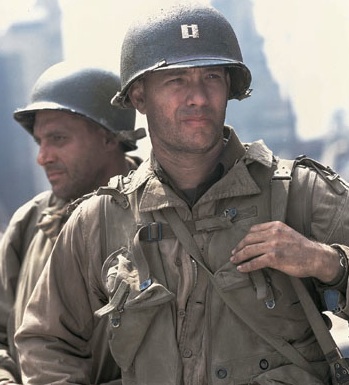
Hovering in the background of Obama’s speech was a movie moment from the 1998 film, Saving Private Ryan, the story ofa farm boy who was rescued, at great risk, from the front lines during World War II.

Private James Francis Ryan (Matt Damon) was serving with the 101st Airborne Division, when he was dropped behind enemy lines.

When US Army Chief of Staff George C. Marshall learns that Ryan’s mother is scheduled to receive notices on the same day of the earlier battlefield deaths of three other sons, he gives orders to the 2nd Ranger Battalion of the 29th Infantry Division to find Private Ryan and bring him to safety.  He is to be sent home as a comfort to his soon-to-be grieving mother.

Captain John Miller (Tom Hanks), successfully leads a squad of eight men on the rescue mission.  Before Ryan returns home, Miller places a lifetime burden on the young private when he says: “Earn this”.

As an old man, Ryan returns to the Normandy cemetery where so many of his comrades are buried. He is overcome with grief and uncertainty. He will never know if he “earned” his rescue.

President Obama tried to make his case that he understands the pain of war. He also tried to make the case that he could earn his Nobel prize while commanding troops in battle. Did he succeed?

When the Nobel committee announced the award in October, President Obama struck the right note, admitting that he did not view the award “as a recognition of my own accomplishments, but rather as an affirmation of American leadership . . . .  I will accept this award as a call to action”.

Obama’s Oslo speech acknowledged his nation’s involvement in wars in Iraq and Afghanistan. He made no reference to the US involvement in Israel’s military occupation of a predominantly Muslim population in the West Bank and Gaza, where there is also an historic, sizable Christian minority.

Leaders of that Christian community issued a call for an end to Israel’s occupation of Palestine in a document developed after a December 11 meeting in Bethlehem.

The document is referred to as “The Kairos Palestine Document” It echoes a similar summons issued by South African churches in the mid-1980s at the height of repression under the apartheid regime.

Which raises the theological question: Was the Obama speech Niebuhrian? Did it demonstrate a genuine moral grappling with the ambiguity of all the facts on all three fronts, two of which he owned up to?

Was the speech authentic to the probing analysis of politics and theology found in the thinking of Reinhold Niebuhr, the American theologian Obama appears to have studied carefully.

Since his death 38 years ago, theologians and political pundits across the spectrum have claimed to know how Niebuhr would respond to each succeeding political crisis. They see in him what they want to see.

Michael Sean Winters placed a posting on his National Catholic Reporter blog under the headline, “Niebuhr Lives in Oslo”:

President Obama’s speech this morning in Oslo was truly remarkable. A monsignor called shortly after the President finished his remarks and said it was the best speech from a politician he had ever heard.

I suspect the monsignor’s judgment was biased because the speech was, above all else, theological. And the theology was all Reinhold Niebuhr.

I asked retired Iliff School of Theology Professor William Dean, if he saw Niebuhrian realism in Obama’s speech.

Dean contributed to the 2009 anthology, Reinhold Niebuhr Revisited: Engagements with an American Original (Daniel Rice, editor). Dean’s essay was entitled, “Niebuhr and Negative Theology”, which examined Niebuhr’s “sometimes grim realism”.

Dean responded in good Niebuhrian fashion, identifying the ambiguity inherent in the speech:

Obama’s approach could be called realist because he confessed to be willing, in certain rare circumstances, to wage war even while he recognizes its tragic character; to be willing to seek justice even while he recognizes “oppression will always be with us”; and to recognize that “the non-violence practiced by men like Gandhi and King may not have been practical or possible in every circumstance.”

Obama’s approach could be called theological because he was willing to associate the “law of love” with “the purpose of [religious] faith” and to base his search for a “world that ought to be” on “that spark of the divine that still stirs within each of our souls.”   (All quotes cited are from the last few paragraphs of Obama’s speech.)

On the other hand, I have noticed that few liberal critics of the speech have asked precisely what geo-political consequences would follow if we were to stay on the current downward slope in Afghanistan.

They are right to be horrified with the evil of war, but I don’t get from them the informed estimates of the consequences of avoiding the surge, which I need to hear as I struggle for a response to Obama’s policy.

There is no easy answer to Dean’s geo-political question. So I kept looking.

One critic of the Oslo speech returned to the President’s West Point troop surge speech for a more complete examination of the additional surges the president failed to address either at West Point or in Oslo’s City Hall.

Tom Engelhardt writes in TomDispatch.com, that the president made no reference in either speech to other “surges” in Afghanistan, including, “The Contractor Surge”:

Private contractors certainly went unmentioned in his speech and, amid the flurry of headlines about troops going to Afghanistan, they remain almost unmentioned in the mainstream media.

In major pieces on the president’s tortuous “deliberations” with his key military and civilian advisors, in the New York Times, the Washington Post, and the Los Angeles Times, all produced from copious officially inspired leaks, there wasn’t a single mention of private contractors, and yet their numbers have been surging for months.

A modest-sized article by August Cole in the Wall Street Journal the day after the president’s speech gave us the basics, but you had to be looking.

Headlined “U.S. Adding Contractors at Fast Pace,” the piece barely peeked above the fold on page 7 of the paper. According to Cole: “The Defense Department’s latest census shows that the number of contractors increased about 40% between the end of June and the end of September, for a total of 104,101.

That compares with 113,731 in Iraq, down 5% in the same period… Most of the contractors in Afghanistan are locals, accounting for 78,430 of the total.” In other words, there are already more private contractors on the payroll in Afghanistan than there will be U.S. troops when the latest surge is complete.”

Engelhardt points to other Afghanistan surges omitted from the West Point speech,  including the “CIA and Special Services surge,” described by Scott Shane in the New York Times:

“The White House has authorized an expansion of the CIA’s drone program in Pakistan’s lawless tribal areas, officials said…, to parallel the president’s decision… to send 30,000 more troops to Afghanistan. American officials are talking with Pakistan about the possibility of striking in Baluchistan for the first time — a controversial move since it is outside the tribal areas — because that is where Afghan Taliban leaders are believed to hide.”

Engelhardt lists nine surges in all. (For the full Engelhardt posting, click here.)

In  the Oslo rhetoric Obama failed to give us the complete story. What is our ultimate goal in Afghanistan, where he has just stepped up American military presence?

Rick Rozoff,  writing on the website of the Center for Research on Globalization, finds in the speech embarrassing theological and biblical ignorance. Is there not a single speech writer in the White House who could have flagged this serious stumble that found its way into Obama’s speech?

“War, in one form or another, appeared with the first man.”

Oops. Rick Rozoff offered this reprimand:

Unless this unsubstantiated claim was an allusion to the account in the Book of Genesis in the Hebrew Bible of Cain murdering his brother Abel, which would hardly constitute war in any intelligible meaning of the word (nor was Cain the first man according to that source), it is unclear where Obama acquired the conviction that war is coeval with and presumably an integral part of humanity.

This really is embarrassing. (Somewhere in Indonesia there must be a retired religious teacher wondering, “what did I do wrong?”)

When Obama says he reserves “the right to act unilaterally if necessary to defend my nation” he does not make the case that a gang of terrorists hiding in caves (probably less than 100) constitute a danger of such magnitude that they are an immediate danger to United States. security.

This is Obama’s  version of the Bush era’s warning of a “mushroom cloud” hanging over America. The American people voted for change.  The return of the faux “mushroom cloud” is not change.

There are hiding places and supportive communities around the world capable of harboring what Obama calls evil.

The President used “evil” as a noun, twice in the speech. Since “evil” is lodged in the soul of every living human, terrorist tactics may be planned where there is sufficient will, means and anger to do so. Terror knows no boundaries. It will not be defeated by war waged within boundaries.

Niebuhr would  have closely examined the geo-political implications behind the rhetoric President Obama used when he spoke of a “just war”–a theological category–in Afghanistan.

The Afghanistan war was launched by George W. Bush on equally invalid religious and geo-political grounds. It should end now with our troops removed in a realistic and safe manner.

Here are three realistic arguments for rejecting the Bush war before it becomes Obama’s war.

Andrew Bacevich, author ofThe Limits of Power:

Sending U.S. troops to fight interminable wars in distant countries does more to inflame than to extinguish the resentments giving rise to violent anti-Western jihadism.

Tom Engelhardt:

Whatever the Obama administration does in Afghanistan and Pakistan, however, the American ability to mount a sustained operation of this size in one of the most difficult places on the planet, when it can’t even mount a reasonable jobs program at home, remains a strange wonder of the world.

And finally, President Dwight D. Eisenhower:

I hate war, as only a soldier who has lived it can, as one who has seen its brutality, it futility, its stupidity. Every gun that is made, every warship launched, every rocket fired, signifies in the final sense a theft from those who hunger and are not fed, those who are cold and not clothed.

The picture of Tom Hanks is from the film, Saving Private Ryan. The picture from Oslo was taken by Doug Mills, for The New York Times

Posted in Religion and politics | 8 Comments

To Avoid Old Mistakes, Obama Should Listen to New Voices

by James M. Wall

Barack Obama spent three months of intensive consultation before he arrived at a foregone conclusion: The US will have a military presence in Afghanistan for an indefinite period of time.

For what purpose?  One of the most eloquent speakers to enter the White House could not say. He could only promise us we would “start to withdraw” in July, 2011.

How did we reach this moment?

The New York Times looked back over the past three months.   During his consultation period, the president visited Arlington National Cemetery, wandering “among the chalky white tombstones of those who had fallen in the rugged mountains of Central Asia.”

The Times writes that it put together this story after interviews with many participants in the consultation, checking and cross-checking their responses.

I don’t know about you, but I see the fine hand of some skilled spinners at work in the Times defense of yet another attempt to shape others to our own pattern. Karl Rove has not gone away, he has just been reborn. A Texas Svengali has transformed into a new team of Chicago Svengalis.

For a look at some of their best work, read this piece by Peter Baker of the New York Times

How much their sacrifice weighed on [the president] that Veterans Day last month, he did not say. But his advisers say he was haunted by the human toll as he wrestled with what to do about the eight-year-old war. Just a month earlier, he had mentioned to them his visits to wounded soldiers at the Army hospital in Washington.

“I don’t want to be going to Walter Reed for another eight years,” he said then.

One participant willing to speak on the record was Secretary of State Hillary Rodham Clinton, who told one interviewer:

The president welcomed a full range of opinions and invited contrary points of view. And I thought it was a very healthy experience because people took him up on it. And one thing we didn’t want — to have a decision made and then have somebody say, ‘Oh, by the way.’ No, come forward now or forever hold your peace.

How could the average citizen come forward? This was not a wedding ceremony open to all. With the possible exception of Vice President Joe Biden, the guests were all singing pretty much from the same page.

One guest who had not been invited for consultation was Boston University History Professor Andrew Bacevich, a retired US Army colonel who also specializes in international relations.

In an essay written before the troop increase was announced, Afghanistan – the Proxy War, Bacevich warned the American public against endorsing Obama’s embrace of the Afghanistan strategy proposed by his handpicked commander, General Stanley McChrystal.

In Bacevich’s opinion, the Obama-McChrystal melding was a strategic union that promised not change, but more, much more, of the same old, same old.

On the Planetary Movement website Bacevich argues that a series of troop increases would signal Obama’s embrace of the strategy that had earlier doomed the presidencies of Lyndon Johnson and George W. Bush.

Bacevich calls that strategy, “armed nation-building”. Bacevich predicted that if Obama opted for a permanent presence in Afghanistan, which he has essentially done, he would embrace the Bush-Cheney doctrine of “open-ended war” responding to “violent jihadism”.

Like Lyndon Johnson, Obama has decided he will confront the enemy by winning “the hearts and minds” of a people in whose hearts and minds there is no longing to grant anything but trouble to foreign powers occupying their land with soldiers, drones and home invasions.

Bacevich warns that Obama is now in danger of becoming yet another warrior president. By choosing the McChrystal plan, he tells the world that the US national security policy will continue the policies employed in Vietnam and Iraq. The American global military presence will intervene any where, any time, when it decides it is in the best interest of the United States to do so.

Today’s enemy is “terrorism”.  In Vietnam, it was Communism. In Iraq it was Saddam Hussein’s terrorism. However the enemy is labeled, what we have here is the Obama-McChrystal version of the “Bush Doctrine” which Sarah Palin so famously could not explain in her campaign television interview with ABC’s Charles Gibson. (“What exactly do you mean by that, Charlie?)

In laymen’s terms, though Charles Gibson did not put it this way, we are talking about your basic American empire-maintenance project that keeps the world safe for the latest edition of the military-industrial complex President Eisenhower warned us about.

The trouble with the American empire maintenance project is that it needs the agreement and the financial support of the folks at home whose young men and women are sent to distant lands for reasons not even the eloquent Barack Obama has been able to articulate.

There is no call for a war tax; and there is no call for a military draft. As a result, the same volunteers must be sent back to third and fourth tours while back home our domestic economy tanks.

These volunteers will rotate in and out of permanent bases in Iraq and Afghanistan, which will be permanently surrounded by hostile, resentful citizens.

Are these bases really “permanent”? AP writer Charles J. Hanley asked that question about Iraq in a story printed in the Arizona Daily Star, under this headline: “Huge bases raise question: Is U.S. in Iraq to stay?”

His story begins:

BALAD AIR BASE, Iraq — The concrete vanishes into the noonday glare, 2 million cubic feet of it, a mile-long slab that’s now the home of up to 120 U.S. helicopters, a “heli-park” as good as any back in the states.

At another giant base, al-Asad in Iraq’s western desert, the 17,000 troops and workers come and go in a kind of bustling American town, with a Burger King, a Pizza Hut and a car dealership, stop signs, traffic regulations and young bikers clogging the roads.

At a third hub down south, Tallil, they’re planning a new mess hall, one that will seat 6,000 hungry airmen and soldiers for chow.

Why do we need such a presence in countries like Iraq (currently) and Afghanistan (future)? We need them because we are now operating under the McCrystal-Obama doctrine, permanent military bases designed to fight “terrorists” who would do us harm.

Are these bases examples of an American empire hunkering down for the long run? What do you think?

More from AP’s Charles J. Hanley:

In 2005-06, Washington has authorized or proposed almost $1 billion for U.S. military construction in Iraq, as American forces consolidate at Balad, known as Anaconda, and a handful of other installations, big bases under the old regime.

They have already pulled out of 34 of the 110 bases they were holding last March, said Maj. Lee English of the U.S. command’s Base Working Group, planning the consolidation.

“The coalition forces are moving outside the cities while continuing to provide security support to the Iraqi security forces,” English said. The latest budget also allots $39 million for new airfield lighting, air-traffic-control systems and upgrades allowing al-Asad to plug into the Iraqi electricity grid — a typical sign of a long-term base.”

American Empire maintenance always follows the “pacification” of an occupied land. In the case of Afghanistan this is sold to American tax payers as a vital necessity in order to find and eliminate what a senior US intelligence official recently told ABC news was approximately 100 Al Qaeda members remaining in Afghanistan.

(Think what an expenditure of that size could do to the Latin American drug cartels, whose daily shipments of illegal drugs into the US is an ongoing threat to the American public, especially the young.)

Frank Rich noted in his New York Times column (December 6, 2009) that in his speech announcing the troop increase, Obama tried to sell his decision to the American people without admitting that the action lacks the commitment of its two most essential partners,” a corrupt and illegitimate Afghan government, and the American public which has growing doubts about continuing wars in distant lands.

What possible logic led Obama to embrace McChrystalism?  Rich writes that Obama’s speech failed to provide that logic.

We face a greater danger from security breaches at home than we do from a second Al Qaeda 9/11 attack. Rich points to the White House dinner crashers who slipped by the Secret Service. Had they wanted to harm President Obama and his guests, they could have done so.

This was the second time in a month — after the infinitely more alarming bloodbath at Fort Hood — that a supposedly impregnable bastion of post-9/11 American security was easily breached. Yes, the crashers are laughable celebrity wannabes, but there was nothing funny about what they accomplished on Pennsylvania Avenue.

Their ruse wasn’t “reality” television — it was reality, period, with no quotation marks. It was a symbolic indication (and, luckily, only symbolic) of how unbridled irrationality harnessed to sheer will, whether ludicrous in the crashers’ case or homicidal in the instance of the Fort Hood gunman, can penetrate even our most secure fortifications.

We are waging a costly war in a distant land against a Taliban that is no threat to our nation, while Washington dinner crashers and a single homicidal Fort Hood army major easily penetrate our security systems.

In an essay in the Catholic publication Commonweal, Andrew Bacevich asks the question that in Washington “goes not only unanswered, but unasked: What is it about Afghanistan, a country that possesses nothing the US requires that could possibly justify such lavish attention?

Among Democrats and Republicans alike, with few exceptions, Afghanistan’s importance is simply assumed—much the way fifty years ago otherwise intelligent people simply assumed that the United States had a vital interest in ensuring the survival of South Vietnam. As then, so today, the assumption does not stand up to even casual scrutiny.

In his introduction to a 2008 edition of Reinhold Niebuhr’s The Irony of American History, Andrew Bacevich writes:

The lesson is clear. It is time for Americans to give up their Messianic dreams and cease their efforts to coerce history in a particular direction. This does not imply a policy of isolationism. It does imply attending less to the world outside of our borders and more to the circumstances within. It means ratcheting down our expectations. Americans need what Niebuhr described as:

A sense of modesty about the virtue, wisdom and power available to us for the resolution of [history’s] perplexities.” (Irony, page 174).

In his own book, The Limits of Power: The End of American Exceptionalism, Bacevich cites this passage from Niebuhr’s Moral Man and Immoral Society, p. 83:

For all nations, “The desire to gain an immediate selfish advantage always imperils their ultimate interests. If they recognize this fact, they usually recognize it too late.”

It is not yet too late for President Obama to reverse course and tell the American people that we can no longer afford to pursue the dream of American exceptionalism in a war that does not involve our ultimate interests.  Nor is it too late for him to tell us that continuing this war will bankrupt this nation, financially and morally.

The picture above of President Obama at Arlington National Cemetery is from The New York Times. The photographer is Luke Sharrett.

Posted in Religion and politics | 4 Comments

Troop Buildup Is Vietnam Redux; Not The Change Obama Promised

by James M. Wall

President Obama promised change. This current troop build up is not that change.

It is Vietnam Redux: Different time; different terrain; different goals; but the same mistake made in 1965, when, much against his own better judgment, President Lyndon Johnson was persuaded by General William C. Westmoreland  to escalate US troop levels in Vietnam from 75,000 to 125,000.

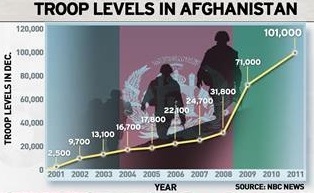
The chart below tells the current story. When Obama was elected president, the US had 31,800 troops on the ground in Afghanistan. In his speech at West Point, delivered almost a year from the day of his election, the president announced he had conferred with his generals and decided to raise the US presence in Afghanistan to 101,000 troops.

The parallel to President Lyndon Johnson’s response to requests for additional military troops in Vietnam in 1965, is unmistakable.  It should have been a warning to President Obama. The disaster of the escalation of the Vietnam War caused President Johnson not to run for reelection in 1968.

On his PBS program (November 20, 2009), Bill Moyers’ Journal, Moyers uses recorded telephone conversations, to describe what led to that escalation:

At the time, Moyers was a 30 year old White House Assistant, working on politics and domestic policy. He watched and listened as LBJ made his fateful decisions about Vietnam.

Moyers recalls:

[Johnson] had been thrust into office by the murder of President John F. Kennedy on November 22, 1963– 46 years ago this weekend. And within hours of taking the oath of office was told that the situation in South Vietnam was far worse than he knew.

Less than four weeks before Kennedy’s death, the South Vietnamese president had himself been assassinated in a coup by his generals, a coup the Kennedy Administration had encouraged. South Vietnam was in chaos, and even as President Johnson tried to calm our own grieving country, in those first weeks in office, he received one briefing after another about the deteriorating situation in Southeast Asia.

Three months after Kennedy’s death, on February 3, 1965, President Johnson speaks with an old friend, newspaper publisher John Knight.

JOHNSON: What do you think we ought to do in Vietnam?

KNIGHT: I never thought we belonged there. Now that’s a real tough one now, and I think President Kennedy thought at one time we should never, that we were overcommitted in that area.

JOHNSON: Well, I opposed it in ’54. But we’re there now, and there’s only one of three things you can do. One is run and let the dominoes start falling over. And God Almighty, what they said about us leaving China would just be warming up, compared to what they’d say now. I see Nixon is raising hell about it today. Goldwater too. You can run or you can fight, as we are doing. Or you can sit down and agree to neutralize all of it.

Nine months later, November 2, 1964, President Johnson is elected to his own full term in office, overwhelmingly defeating Republican Senator Barry Goldwater. At the time, there were 15,000 US troops on the ground in Vietnam.

Johnson begins an extensive bombing campaign against the North Vietnamese. He continues to consult with his military commanders. They tell him they need more troops.

On July 28, 1965, Johnson announced:

I have asked the Commanding General, General [William C.] Westmoreland, what more he needs to meet this mounting aggression. He has told me. We will meet his needs. I have today ordered to Vietnam the Air Mobile Division and certain other forces which will raise our fighting strength from 75,000 to 125,000 men almost immediately. Additional forces will be needed later, and they will be sent as requested.

“Sent as requested”, was Johnson’s admission that the Vietnam war was now in the hands of his generals. He had turned over power to General Westmoreland.

Tom Engelhardt is harsh in his reading of Obama’s West Point speech. He writes in TomDispatch.com that the “American war commanders” have won a major victory over this civilian president. It is a disturbing conclusion, but one that deserves careful study:

Give credit to the victors. Their campaign was nothing short of brilliant. Like the policy brigands they were, they ambushed the president, held him up with their threats, brought to bear key media players and Republican honchos, and in the end made off with the loot.

Engelhardt concludes that the campaign against Obama began in late September when Afghan War commander General Stanley McChrystal’s “grim review of the situation in that country” was leaked.  The leak included demands for sizeable troop escalations and a commitment to a counterinsurgency war.

The opposition to Obama also included strong hints of possible protest retirements by leading generals. The leak was supported by what Englehart describes as “an impressive citizen-mobilization of inside-the-Beltway former neocon or fighting liberal think-tank experts, and a helping hand from an admiring media.”

The president had tilted the struggle toward the forces who wanted to demand a troop buildup by his own campaign rhetoric, calling the Afghanistan conflict both “the right war” and a “necessary” one.

Military strategy is shaped by the military, which throughout our nation’s history, has forced civilian presidents to either yield to proposed strategic decisions, or just learned to say no to those decisions.

President Truman fired General MacArthur during the Korean conflict for insubordination. President Kennedy refused to use US troops in the ill-fated attempt to overthrow Castro, despite military pressure.

President Obama might have looked at Vietnam’s monumental failures and concluded that a reduction in troop size was a wiser and more prudent course of action.  Instead he adopted the “counterinsurgency (COIN) doctrine” which, according to Englehart:

. . . . was dusted off from the moldy Vietnam archives and made spanking new by General David Petraeus in 2006, applied in Iraq (and Washington) in 2007, and put forward for Afghanistan in late 2008.

It has now been largely endorsed, and a major escalation of the war — a new kind of military-led nation building (or, as they like to say, “good governance”) is to be cranked up and set in motion. COIN is being billed as a “population-centric,” not “enemy-centric” approach in which U.S. troops are distinctly to be “nation-builders as well as warriors.”

As we assess Engelhardt’s pessimistic reading of the Obama decision, we need to also look back at what Robert Dreyfuss described in Rolling Stone (October 20, 2009) as a “Generals’ revolt”:

In early October, as President Obama huddled with top administration officials in the White House situation room to rethink America’s failing strategy in Afghanistan, the Pentagon and top military brass were trying to make the president an offer he couldn’t refuse. They wanted the president to escalate the war — go all in by committing 40,000 more troops and another trillion dollars to a Vietnam-like quagmire — or face a full-scale mutiny by his generals.

Dreyfuss adds that Obama faced both a potential political threat in 2012, and an attack on him as “soft”, reducing troop strength and inviting another Al Qaeda attack.

Obama knew that if he rebuffed the military’s pressure, several senior officers — including Gen. David Petraeus, the ambitious head of U.S. Central Command, who is rumored to be eyeing a presidential bid of his own in 2012 — could break ranks and join forces with hawks in the Republican Party.

GOP leaders and conservative media outlets wasted no time in warning Obama that if he refused to back the troop escalation being demanded by Gen. Stanley McChrystal, the commander overseeing the eight-year-old war, he’d be putting U.S. soldiers’ lives at risk and inviting Al Qaeda to launch new assaults on the homeland.

Following the President’s West Point speech, those same “GOP leaders and conservative media outlets” knew they had gotten what they wanted from Obama, but following their anti-Obama script, they did not praise his speech.  Instead, they rushed to denounce that part of his speech which promised the start of troop withdrawals in July, 2011.

Both Engelhardt and Dreyfuss are outspoken and influential members of the progressive political base which had placed so much trust in the new president to reverse the Bush doctrine of US empire building.

They are not alone, however.

Juan Cole, author of the blog Informed Comment, wrote an essay for Salon which lamented Obama’s failure to remember Vietnam in reaching his troop build up decision.

President Barack Obama’s just-announced plan for Afghanistan seems modeled less on Lyndon Johnson’s Vietnam strategy than on George W. Bush’s Iraq exit strategy.

Or, at least it is modeled on the Washington mythology that Iraq was turned from quagmire into a face-saving qualified success by sheer indomitable will and a last-minute troop “surge.”

But Afghanistan is not very much like Iraq, and the Washington consensus about its supposed end-game success in Iraq is wrong in key respects. Are think tank fantasies about an Iraq “victory” now misleading Obama into a set of serious missteps in Afghanistan?

Stephen Walt wrote in the New Foreign Policy.com (November 30):

Tom Friedman had an especially fatuous column in Sunday’s New York Times, which is saying something given his well-established capacity for smug self-assurance.

According to Friedman, the big challenge we face in the Arab and Islamic world is “the Narrative” — his patronizing term for Muslim views about America’s supposedly negative role in the region. If Muslims weren’t so irrational, he thinks, they would recognize that “U.S. foreign policy has been largely dedicated to rescuing Muslims or trying to help free them from tyranny.” . . . .

I heard a different take on this subject at a recent conference on U.S. relations with the Islamic world. In addition to hearing a diverse set of views from different Islamic countries, one of the other participants (a prominent English journalist) put it quite simply. “If the United States wants to improve its image in the Islamic world,” he said, “it should stop killing Muslims.”

Now I don’t think the issue is quite that simple, but the comment got me thinking: How many Muslims has the United States killed in the past thirty years, and how many Americans have been killed by Muslims? Coming up with a precise answer to this question is probably impossible, but it is also not necessary, because the rough numbers are so clearly lopsided.

Walt arrived at a rough estimate of 288,000 Muslim deaths over the past thirty years. He found that roughly 10,000 Americans had been killed by Muslims in the same period.

Virtually all of those deaths occurred before Obama became president. If he had decided to pull a Truman on his military commanders. he would have demonstrated that he meant it when he said he would bring change to American conduct in world affairs.

Instead he is stuck in the demeaning position of a decision dictated to him by the military brass and their backers in the American political right. It is hard not be pessimistic when this happens.

The target date for the start of withdrawal is July, 2011. Conservative critics have seized on that “time certain” date to claim the Taliban will plan a resurgence of its own one month after July 2011.  That is just so much political double talk.  The “time certain” end date is, of course, fungible.  We know it, and the Taliban knows it.

Eugene Robinson, of the Washington Post, was an opponent of the troop increase before the President’s announcement. Robinson warns that the 20 month timeline is meaningless.

Before there can be peace in Afghanistan, there must be political institutions that can negotiate and maintain that peace. Building those institutions in a country so resistant to central authority will be, at best, a long and arduous task.

What Obama announced Tuesday was that we’re staying in Afghanistan. What he didn’t say is that U.S. troops are surely going to be there, in substantial numbers, for years to come.

The picture at the top is from a website, Afghan Pix. It shows an Afghan child in front of  destroyed Russian tank, left over from the 1980s.  It was taken in 2001. The chart above is from NBC News. It was posted on line by Rachel Maddow.


Posted in Middle East Politics, Politics and Elections | Leave a comment

Tom Friedman Sounds the Alarm; The Muslims Are Coming!

by James M. Wall

My people are into the season of Advent, when Christians throughout the world begin a year-long reflection on the saving mysteries of Christ.

My Advent weekend coincides with the end of the three day Muslim Eid ul Adha, the Celebration of Sacrifice. It is on this occasion that Muslims remember Abraham’s willingness to sacrifice his son to Allah .

The Eid ul Adha comes at the conclusion of the Hajj, the fifth pillar of Islam.

This past weekend was one of those inter-faith moments when the three Abrahamic religions shared the same Koranic and biblical moment, albeit with different interpretations.

Aware of these religious celebrations, I found it especially distressing to pick up my Sunday New York Times and discover that Thomas Friedman was once again sounding the alarm: The Muslims are coming; the Muslims are coming!

Had I been Tom’s editor, I would have spiked this column (“killed it”, in newspaper parlance), and sent him a memo: “Sorry, Tom, this one doesn’t pass the smell test, especially on the weekend of Eid ul Adha. At long last, man, show some respect!”

This Friedman column gives off the distinct smell of smoke generated from an excess of uncontrolled anger.  Tom should know anger clouds one’s judgment. His column is offensive not only to Muslims, but to Christians and Jews as well.

What prompted Friedman’s latest outburst against Muslims was the killing of 13 people at Fort Hood, Texas, presumably at the hand of US Army Major Nidal Malik Hasan.  Friedman began his column:

Major Hasan may have been mentally unbalanced — I assume anyone who shoots up innocent people is. But the more you read about his support for Muslim suicide bombers, about how he showed up at a public-health seminar with a PowerPoint presentation titled “Why the War on Terror Is a War on Islam,” and about his contacts with Anwar al-Awlaki, a Yemeni cleric famous for using the Web to support jihadist violence against America — the more it seems that Major Hasan was just another angry jihadist spurred to action by “The Narrative.”

Reread these words with your deductive reasoning cap firmly in place. What do we find? First, Friedman acknowledges that he agrees with the assumption that Major Hasan “may have been” mentally unbalanced. But then he finds, as he no doubt hoped he would, some anti-American moments in the major’s life.

What is the evidence at hand? Tom writes that Hasan “showed up” at a public-health seminar, with a Powerpoint presentation bearing the ominous title, “Why the War on Terror Is a War on Islam.” Further, Major Hasan has had “contacts” with Anwar al-Awlaki, a Yemeni cleric famous for using the Web to support “jihadist violence against America.”

Based on this evidence, Friedman concludes Hasan “was just another angry jihadist spurred to action by ‘The Narrative'”. By the end of the paragraph, Hasan is no longer just mentally unbalanced;  he is an “angry jihadist”.

Well, Tom, which is it? Mentally unstable or a jihadist? Or in your mind, are the two the same? Friedman doesn’t hang around in his column long to clarify his quick shift from mentally unstable army officer to jihadist. He races on to the real purpose of his column: His attack on The Narrative.

Friedman has adopted the latest marching orders, quite possibly issued from Israel’s spin-masters. In recent years, the word “narrative” has slowly made its way into the margins of public discourse, thanks to the insistence of the Palestinian supporters who maintain that the Zionist narrative has been, until now, the only narrative heard in public discussion of the Israeli-Palestinian conflict.

I presume Israel’s spin masters sent out the new memo, or in Tom’s case, probably gave it to him personally during some of his warm and friendly chats with high level Israeli military and political officials. The spin is this: “The Palestinians are  making the case that 1948 was actually the start of two narratives, the Palestinian and the Zionist. We must not let this succeed!”

To understand their sense of panic, consider the history of the competing narratives: The dominant Zionist narrative begins with the Holocaust and anti-semitism. Then it moves to the permanent condition of Jewish victimhood that gives Israel permission to batter the Palestinians with all the violence it needs to drive the Palestinians into walled-in villages and cities. This narrative has been so dominant that it has been, simply, The Way Things Are.

You have no doubt seen the impact of the Zionist Narrative when friends and colleagues  tell you, in amazement, they never before realized what the conflict was all about.  They grew up believing the Zionist narrative that the outnumbered  Jewish people were bravely defending their land against the mighty Arab armies that wanted to drive the Jewish people “into the sea”.

They have just seen and/or heard the Palestinian narrative. This stuns them into realizing that The Way Things Are are not really The Way Things Are.

Since 1948, the Palestinian people have experienced a different narrative.  What is that narrative?

It begins with the Nakba (the “catastrophe”), when the modern state of Israel was created on land formerly known as Palestine. Israel’s seizure of Palestinian land was followed by the carefully planned program of ethnic cleansing, a systemic program designed to drive Palestinians away from their original homeland.

Tom Friedman has shown himself to be a willing and faithful warrior in the War of Narratives. As he describes the background of Major Hasan, Friedman sounds the warning: “Be Afraid, Be Very Afraid.”

What is scary is that even though he was born, raised and educated in America, The Narrative still got to him.

You hear that, people? This guy is no foreign-born ticking time bomb. He was BORN, RAISED AND EDUCATED in America, and he succumbed to THE NARRATIVE, thanks, it appears, to the influence of a single radical cleric.

Get the children inside! Home grown narrative pushers are roaming our streets!

Friedman’s description of this dangerous Narrative is chilling, ugly and most definitely, fails the Eid ul Adha smell test. Here is Friedman again:

The Narrative is the cocktail of half-truths, propaganda and outright lies about America that have taken hold in the Arab-Muslim world since 9/11. Propagated by jihadist Web sites, mosque preachers, Arab intellectuals, satellite news stations and books — and tacitly endorsed by some Arab regimes — this narrative posits that America has declared war on Islam, as part of a grand “American-Crusader-Zionist conspiracy” to keep Muslims down.

Do you know any parents, pastors, church officials, public officials or college presidents, who have cowered before the fear tactics of the Zionist Narrative? Of course, you do; don’t try and deny it.

Have you wondered lately how best to describe what drives American foreign policy? Friedman tells us, using his best neo-con language in a remarkably distorted litany that covers 20 years of American history.

Yes, after two decades in which US foreign policy has been largely dedicated to rescuing Muslims or trying to help free them from tyranny — in Bosnia, Darfur, Kuwait, Somalia, Lebanon, Kurdistan, post-earthquake Pakistan, post-tsunami Indonesia, Iraq and Afghanistan — a narrative that says America is dedicated to keeping Muslims down is thriving.

Friedman, in case you have forgotten, was a cheer leader for the Iraqi war because he argued that WMDs were about to erupt from Iraq, first to strike Israel and then finally, the rest of the world.

Who were those institutions and individuals who drove us into our war against Iraq?  The US Congress and the Industrial-Military complex, to be sure, but the war was pushed further by major media like the Washington Post and the New York Times, with its star columnist Friedman leading the way.

Most public figures have repented of their support for the Iraq war, especially politicians who were hurt by their association with yet another unpopular war. But don’t look for repentance from our man Tom Friedman.

On May 30, 2003, Friedman appeared on the Charlie Rose PBS program. Here is an excerpt from that interview, courtesy of Glenn Greenwald’s blog:

ROSE: Now that the war is over, and there’s some difficulty with the peace, was it worth doing?

FRIEDMAN: I think it was unquestionably worth doing, Charlie. I think that, looking back, I now certainly feel I understand more what the war was about . . . . What we needed to do was go over to that part of the world, I’m afraid, and burst that bubble. We needed to go over there basically, and take out a very big stick, right in the heart of that world, and burst that bubble. . . . And what they needed to see was American boys and girls going from house to house, from Basra to Baghdad, and basically saying: which part of this sentence do you understand? You don’t think we care about our open society? . . . . Well, Suck. On. This. That, Charlie, was what this war was about.

We could have hit Saudi Arabia. It was part of that bubble. Could have hit Pakistan. We hit Iraq because we could. That’s the real truth.

In his Eid ul Adha Sunday column, Friedman concluded his tirade against Islam with a suggested speech for Barack Obama to deliver.

Whenever something like Fort Hood happens you say, ‘This is not Islam.’ I believe that. But you keep telling us what Islam isn’t. You need to tell us what it is and show us how its positive interpretations are being promoted in your schools and mosques.

If this is not Islam, then why is it that a million Muslims will pour into the streets to protest Danish cartoons of the Prophet Muhammad, but not one will take to the streets to protest Muslim suicide bombers who blow up other Muslims, real people, created in the image of God? You need to explain that to us — and to yourselves.”

Friedman started his column with a question about Major Hasan’s mental instability. He segued quickly, and throughout his column, to a discussion of a now defunct War of Civilizations, Islam against the West. It is a leap totally without evidence.

Friedman would do well to reflect back on a massacre of Muslim worshippers that took place on February 25, 1994,  when an Orthodox Jew, Baruch Goldstein, killed 29 Palestinian worshippers and injured another 125, at Hebron’s Ibrahim Mosque.

Goldstein was an Israeli-American settler who served in the Israeli army as a reservist. He was also a member of the extremist Kach movement, which openly advocated the expulsion of Arabs from Israel. He carried out his massacre with an assault rifle and four magazines of ammunition

Goldstein lived in the Kiryat Arba settlement next to Hebron. After the massacre, a memorial was erected for Baruch Goldstein at the entrance to Kiryat Arba.

Goldstein was supported by extremist forces in Israel, but in no way did he represent all of Judaism.

All religions have fanatics who act in horrendous ways contrary to the religious tradition they claim to follow. It is unworthy of an experienced journalist like Tom Friedman to elevate such a tragic event into a tirade against Islam.

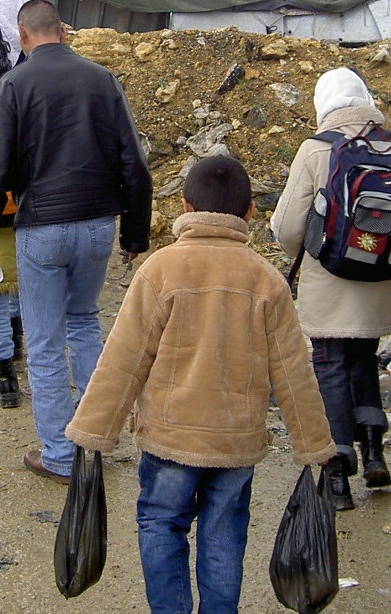
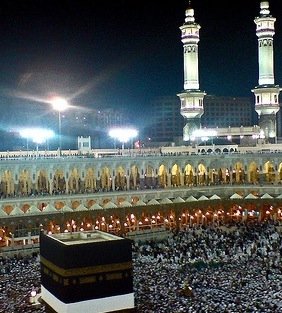
Picture above of a Palestinian family is by Connie Baker. It was taken at a back entrance to Bethlehem. The picture from Mecca is from the Los Angeles Times.


Posted in Media, Middle East Politics | 16 Comments

Talking With McGovern in a Time of Palin and Israel’s Settlements

by James M. Wall

I was fed up with the ugliness of American political dialogue. I knew it was time to call George McGovern.

I found him on St. Thomas Island, where he was attending  the funeral of an old friend, Henry Kimmelman, his campaign finance director for McGovern’s 1972 presidential race.

We set aside a longer period to talk the next day when he would be back at his winter home in St. Augustine, Florida. He spends the rest of the year in Mitchell, South Dakota, across from the new George and Eleanor McGovern Library on the campus of Dakota Wesleyan.

McGovern abruptly left elective politics in 1980, shoved aside, with four other liberal Democratic US senators who lost their seats in the political tsunami powered by Ronald Reagan’s defeat of Jimmy Carter: Frank Church (Idaho), Gaylord Nelson (Wisconsin), Birch Bayh (Indiana), and John Culver (Iowa).

I first met McGovern when we campaigned together in Illinois for his 1972 Democratic nomination for president.  I was running a futile race for Congress, and a successful one as a McGovern delegate.

In the Miami nominating convention prolonged by a needless ABM (Anybody But McGovern) last minute effort to nominate Hubert Humphrey, McGovern finally won the nomination. The old guard does not like change, as Barack Obama almost found out in 2008.

McGovern lost the general election to Richard Nixon. Eighteen months later, Nixon, facing impeachment over the Watergate matter, resigned in disgrace.

Two months after the election, I interviewed McGovern at his home in Washington. In its January 31, 1973 issue, the Christian Century magazine published that interview, Politics and Morality: A Postelection Interview with George McGovern.

At the close of the interview, I asked McGovern what he would have done in Vietnam had he won the election. He answered:

I would have ordered an end to all military operations in Indochina within minutes after I was sworn in as President. Then I would have announced that our forces were being withdrawn systematically, on the condition that our prisoners would be released. I would also have terminated any further military aid to General Thieu. . . .

I think it is conceivable that, depending on what my relationship to Nixon would have been, the war might have been terminated even before the inauguration. I would have requested him to join me in an effort to bring the war to an end. It is possible that without an electoral mandate behind him he would have been in the mood to accept that.

With Nixon, and Gerald Ford as presidents, the war lasted three more years. American Republican politics have not been the same since.

Thirty-seven years after McGovern’s defeat, the most passionately supported Republican presidential candidate for 2012, is Sarah Palin.

This month it is impossible not to encounter Palin. She is on a book tour, delighting her right-wing followers. What sort of a president might she be?  She gave a hint of her foreign policy credentials in an interview with Barbara Walters.

Palin was asked about Israel’s 900 additional housing units now under construction in Gilo, a sprawling, ugly, massive Israeli settlement that butts up against the “little town of Bethlehem” where the Christ Child was born, in case former Governor Palin and her acolytes, have forgotten. Her response:

I disagree with the Obama administration on [the settlements]. I believe that the Jewish settlements should be allowed to be expanded upon, because that population of Israel is, is going to grow.

More and more Jewish people will be flocking to Israel in the days and weeks and months ahead. And I don’t think that the Obama administration has any right to tell Israel that the Jewish settlements cannot expand.

I did not want to ask McGovern about Palin. I knew it was no point in asking him that question. George McGovern does not speak harshly of anyone. Case in point: He says about Richard Nixon:

I bear no malice toward Richard Nixon. Indeed, he governed as a moderate liberal. His administration launched the Environmental Protection Agency, he supported civil rights, he established detente with the Soviet Union and opened the door to China, he invoked wage and price controls to stabilize the economy–just to name a few of his moderate liberal steps.

What we lost when George McGovern did not make it to the White House might best be understood when we realize that McGovern not only reads and respects the work of Israeli peace activist Avraham Burg, he agrees with Burg”s statement on the conditions for a just peace, which Burg wrote in the Israeli journal, Yediot Aharonot in 2004:

We cannot keep a Palestinian majority under an Israeli boot and at the same time think ourselves the only democracy in the Middle East. . . We must remove all the settlements and draw an internationally recognized border between the Israeli national home and the Palestinian national home.

The man who should have been elected president in 1972, offers a stark contrast to the former governor of Alaska, who would like to be the Republican nominee in 2012.

When George McGovern accepted his party’s nomination in 1972, he presented the nation with a vision that says, regardless of its ambiguity, politics is the arena where we must shape hope into organized, positive, action..

I wanted to be reminded of that vision, because in Ramallah, President Abbas plans to resign, while in Tel Aviv, Bibi Netanyahu continues to insult and defy the president of the United States, (Barack Obama). the only world leader who supports him.

McGovern’s vision echoes the wisdom and eloquence of Reinhold Niebuhr, who once wrote,  “man’s capacity for justice makes democracy possible, but man’s inclination to injustice makes democracy necessary.”

McGovern frequently quotes Niebuhr; he did, after all, spend a year in seminary before he shifted to Northwestern University’s graduate school, where he earned a Master’s degree in history.

Our current political dialogue, which McGovern is well prepared to critique, is conducted in such an environment of ignorance and anger, that it is hard not to sink into a dark funk over what comes next.

Of course, periods of darkness are not uncommon in the Middle East.

When Yasir Arafat was presiding over a newly formed Palestinian Authority initially created in Oslo, I traveled to Gaza in November, 1994, with an American church delegation.

We went first to meet with Arafat’s wife, the former Suha Tawil, a member of a politically active Palestinian family.

In the delegation was a United Methodist bishop from Ohio. Before we left, she offered a prayer in the Arafat home. After the prayer, Suha said to the bishop, “Please give that same prayer when you visit my husband in his office. Something needs to be done to lift the darkness over there.”

Which is why I wanted to talk with George McGovern.

I told him I had been watching the documentary film on his life, One Bright Shining Moment. I found it inspiring.  McGovern thought it was a good film, but he felt it makes him look “too radical”.

Perhaps it does, but it also reminded me of the summer of 1972, when, in spite of all, the future looked both bright and shining.

I told McGovern I have been reading his latest book, Abraham Lincoln, which reveals that the initial campaign speech Lincoln gives from the front porch of his store in Salem, Illinois, was the same speech he used throughout a losing campaign for the legislature.

The speech is included, word for word, in John Ford’s film, Young Mr. Lincoln. I had always assumed it was the work of a script writer. McGovern’s research discovered the speech belongs to Lincoln.

I have also been reading McGovern’s superb defense of  American liberalism, The Essential America, in whichhe describes his lifelong focus on bringing  America’s policies closer to those of our founding ideals; ending the hunger of our world’s poor; and bringing peace to the troubled Middle Eastern region.

We talked on the phone about these three areas.  McGovern, now 87, is not slowing down.  He still writes books and newspaper columns, and he still travels the country to give speeches, primarily on world hunger. He is also in demand on these trips for his political opinions.

On one recent trip for a speaking engagement in San Diego, Robert Sheer, longtime Los Angeles Times political writer, interviewed him for a television segment. You may see and hear the contemporary McGovern in that interview, by clicking here.

After we concluded our telephone conversation, I went back to reread McGovern’s 1972 convention speech, “Come Home America”. He gave that speech on an early July morning, using words that remind us that the world’s problems today are essentially the same as they were then.

Read these closing lines and let them break you out of darkness. We need to be alert and ready. There is work to be done.

Together we will call America home to the ideals that nourished us from the beginning.

From secrecy and deception in high places; come home, America.

From military spending so wasteful that it weakens our nation; come home, America.

From the entrenchment of special privileges in tax favoritism; from the waste of idle lands to the joy of useful labor; from the prejudice based on race and sex; from the loneliness of the aging poor and the despair of the neglected sick — come home, America.

Come home to the affirmation that we have a dream.

Come home to the conviction that we can move our country forward.

Come home to the belief that we can seek a newer world, and let us be joyful in that homecoming, for this “is your land, this land is my land — from California to New York island, from the redwood forest to the gulf stream waters — this land was made for you and me.”

May God grant each one of us the wisdom to cherish this good land and to meet the great challenge that beckons us home.

Do words like these matter in a time of Palin and Israel’s settlements?  Yes they do, as the late Palestinian poet Mahmoud Darwish, once wrote:

I want to sing. I want a language that I can lean on and that can lean on me, that asks me to bear witness and that I can ask to bear witness, to what power there is in us to overcome this cosmic isolation…I’m screaming at a moment when screams can go nowhere. And it strikes me that language must force itself into a battle in which the voices are not equal.

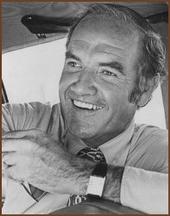
The picture of George McGovern at the top of the page was taken by Keith Robert Wessel at the 2005 dedication of the George and Eleanor McGovern Library in Mitchell, South Dakota.

Posted in Middle East, Politics and Elections | 11 Comments

Mired In Political Purgatory by Israel Lobby, Abbas Halts Election

by James M. WallAbbas Getty Images crop

Last Update, Monday, November 16

The Palestinian Election Commission has informed President Mahmoud Abbas it would be unable to carry out the January 24 election. The Commission recommended the election be postponed.

The election had been ordered earlier by President Abbas.

At a press conference in Ramallah, Elections Commission Chairman Dr. Hanna Nasser, said:

We have faced obstacles in the Gaza Strip and in Jerusalem. We’ve sat with all the political factions and the picture has become clear after these meetings: Elections are impossible to hold.

The Commission is independent of Mr. Abbas’ government. It was initially created by former PA leader Yasir Arafat. After its reappointment by President Abbas, the Commission directed the 2006 legislative elections.

Abbas Momani crop 2Dr. Nasser is president emeritus of Birzeit University, a school founded by his aunt. He holds a PhD in physics from Purdue University, in the US.

Abbas has already announced that in any future presidential election, he would not be a candidate for reelection. Why should he?  Abbas knows the reality of American politics.

Philip Weiss offers an answer in his Mondoweiss blog, which covers “American foreign policy in the Middle East, chiefly from a progressive Jewish perspective”:

When people ask why Obama has capitulated to the prime minister of a tiny state– Bibi Netanyahu– various theories are offered about Health care first, or the economy, or Afghanistan, or oil.

Few say directly: Netanyahu feels invulnerable because of the Israel lobby in the US . . .you cannot be plain about this matter without addressing the idea of Jewish influence. Israelis are often more plain about this.

Anshel Pfeffer wrote in Haaretz the other day, “the most significant joint endeavor of America’s Jews [is] six decades of unswerving support for the Israeli government of the day.” I.e., a hammerlock on U.S. policy.

It is not as though this is new information in this country.  (Think Jimmy Carter, Stephen Walt and John Mearsheimer). It is information the US Main Stream Media carefully avoids mentioning.

On a visit to the US this past summer, Former Israeli Knesset speaker Avraham Burg was interviewed by Amy Goodman on Democracy Now (definitely not part of the MSM). He was quite blunt about the Lobby’s influence.

Weiss reminds his readers that at a public event at the New York Public Library during that visit:

Burg described “two structures” built by Jews, one being Israel, the other “the semi-autonomous American Jewry, which was not here 150 years ago– powerful influence, access to the corridors of power, impact on the culture, and civilization… plus the infrastructure of the community of solidarity and fraternity and support system and education etc.”

While readers and viewers of the MSM continue to live in blissful ignorance of the realities of the situation facing Palestinians, President Abbas discovered that the hope he had placed in President Obama has been washed away by Obama’s capitulation to the Lobby and Bibi.

When his term expires in January, 2010, Abbas could resign as president, leaving the office empty. Or he could remain in office until elections are held at some indefinite point in the future.

Dweik The Palestinian Information CenterShould Abbas resign, the Palestinian Authority’s constitution calls for the office of the president to be assumed by Dr. Aziz Ad-Dweik, who earned a PhD from the University of  Pennsylvainia in regional sciences, a mixture of urban studies, sociology and economics.

Rest assured, Dr. Dweik also follows the reality of US politics very closely. Who is this man who is next-in-line to run the Palestinian Authority?

According to the right wing web site Campus Watch, which “monitors” Middle Eastern studies program on US campus for any hint of anti-Israel perfidy, Dwiek came to the US to pursue his doctorate in 1985 with a “scholarship from the American government”. In those days, Israel was promoting (and funding) Hamas as an alternative to Yasir Arafat’s PLO.

After returning home from Pennsylvania, Dweik found that the PLO had replaced Hamas and had become Israel’s new favorite political ally. He spent four months in an Israeli prison and a year as a deportee on the southern Lebanese border before he made it back to Gaza.

Dweik is currently the parliamentarian from the Hamas-affiliated Change and Reform Party.He was elected speaker of the PLC after the Palestinian elections in January 2006. Counting heavily on a Fatah victory, the US and Israel had urged Hamas and Fatah to hold the elections, which were monitored by international officials, led by former President Carter.

When Hamas won a legislative majority in the elections, (no surprise to close observers of Palestinian politics) the result was repudiated by both the US and Israel.

During a press conference reported by The Palestinian Information Center website, Dweik said he was prepared to assume the presidency, should Abbas resign.

Future elections would be impossible without the backing of both Hamas and Fatah, the two political parties that last competed in the 2006 elections. Dweik was active on the reconciliation front this week, endorsing an Egyptian plan to bring the two parties together. He expresses more optimism than exists in the Fatah camp.

In an interview with Al-Jazeera Arabic, Dweik said:

Hamas leaders had secured Egyptian guarantees that they would take into account Hamas’ reservations on the [reconciliatiion] issue, and would list them on the sidelines of the reconciliation paper, which would be signed by both parties.

He assured Al-Jazeera that political activity ensuring the end of Palestinian division was ongoing.

Meanwhile, the Palestinians’ future remains under the absolute control of Israel’s military occupation. That occupation is supported financially and politically by the US and  the Israel Lobby.  It is this control that keeps President Abbas and the government he leads,deep  in the darkness of their political Purgatory.

Searching for some way out of this Purgatory, the Palestinian Institute for Politics and Strategic Studies held a brainstorming session Tuesday to discuss the logistics involved in Prime Minister Salam Fayyad’s plan to establish a Palestinian state in two years. fayyad-two1The Fayyad plan, which he prefers to call a “program”, was released on August 25 this year.

Nabil Qassis, Principal of Birzeit University, who convened the session, described the plan as “serious agenda,” and a “turning point in the way the [Palestinian Authority] PA thinks.” No longer, he said, is the “occupation a pretext for failure.”

Attending the conference were Palestinian professionals, politicians, community officials and members of  of the Palestinian parliament. No one attended from Gaza, which remains in an indefinite lock down by the Israeli army.

Participants discussed both the possibilities and drawbacks of Fayyad’s plan, which he calls, “Palestine: Ending the Occupation, Establishing the State.”

One participant, Deputy Secretary General of the Popular Front for the Liberation of Palestine (PFLP) Abd Ar-Rahim Mallouh described the plan as the tosssing of a “big stone in the quiet political puddle”.

He saw the plan as a way to bridge the political gap in Palestinian politics. But he also noted its major drawback: There cannot be an independent Palestinian state that is under Israeli occupation. “A Palestinian state must reach an agreement with Israel” in order to lay aside the paradox, he said.

Mustafa Barghouthi, secretary-general of the Palestinian National Initiative, described the plan as essentially “national duty” in its aims to realize Palestinian freedoms, the right of return and the right to Jerusalem.

“We should be aware that statehood is not dependent on the occupation’s will; we have to adopt the same means of peaceful resistance as in the first Palestinian Intifada.

Barghouthi adds that with the plan, Palestinians must “breach our commitment to the Oslo division of the Palestinian territories into A, B, and C zones.” (Separate areas that retained Israeli control over the territories with limited or no Palestinian involvement).

“We must build foundations in all zones, and start free trade internationally,” Barghouthi said.

The author of the Fayyad Plan drew attention this week from Helen Cobban, a veteran Middle East Correspondent, formerly with the Christian Science Monitor. She has launched a new blog, ‘“Fair Policy, Fair Discussion” for the Washington-based Council for the National Interest Foundation, for which she serves as director.

Cobban is currently traveling to the region with an NIF delegation, which conducted an off the record discussion with Fayyad, whom Cobban described as “very pro American”. The group also met with Ziad Abu Amr, a political independent who was foreign minister in the PA’s short-lived national unity government in 2007.

Cobban describes Amr as “a close confidante” of President Abbas”. Both Fayyad and Amr were “extremely gloomy” and both expressed a strong sense of how they feel “the whole of the PA’s very pro-American leadership now feels deeply betrayed by the Obama administration.”

Abu Amr underscored that feeling of betrayal, telling the group:

Abu Mazen [Mahmoud Abbas] has been playing completely by the book. The PA has been killing Palestinians to prove that he is prepared to serve Israel’s security interests. What did he get in return? Only a continuation of setttlements, home demolitions, land expropriations… If this continues, he will not and should not continue in office.

Cobban writes that in the group’s discussion with Abu Amr, he concluded:

Abu Mazen feels betrayed and fooled by the Americans… There is no way the Palestinians can do any more than they have done… If Abu Mazen resigns under circumstances of crisis, then no one could replace him– or, would want to…

The problem is, the Americans have abandoned the Road Map. What Hillary Clinton said about the Israeli government having made “unprecedented concessions” was against the Road Map, against Annapolis, and against Oslo.

Political leaders in both Gaza and the West Bank are struggling to find a way out of the Political Purgatory into which their own past conduct, but more importantly their betrayal by the United States. has plunged them.  Only the president of the United States retains the power to release them from that Purgatory.  It is past time for him to act.

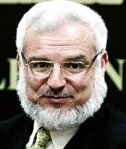
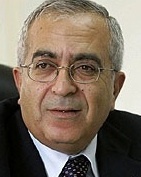
President Abbas’ picture is a Getty image. Hanna Nasser’s picture is from the AFP’s Abbas Momani. Aziz Dweik’s picture is from The Palestinian Information Center.

Posted in Middle East Politics | 3 Comments

Abbas Ends His Two State Dream; Bibi Takes His DC Victory Lap

by James M. WallAbbas at Arafat's grave cropped

Israeli Prime Minister Bibi Netanyahu came to Washington this week still glowing from the praise he received from Secretary of State Hillary Clinton.

Secretary Clinton told a joint press conference in Jerusalem, on October 31, “What the prime minister has offered in specifics on restraints on a policy of settlements … is unprecedented.”

That moment of pro-Israel flag-waving by the US Secretary of State came after two earlier blows to the political standing of Palestinian President Mahmoud Abbas.

First, there was Bibi’s defiant refusal to accept a US minimal request  to freeze settlement building. Then came that humiliating US-Israel pressure forcing Abbas to withhold support for the Goldstone Report. The Palestinian public was outraged; Abbas scrambled back, belatedly endorsing the Report.

That was followed by Clinton’s public praise for Bibi’s defiance of the President of the United States. This was too much for Abbas, who announced last week that he would not run for another term on the Fatah ticket for president of the Palestinian Authority.

Abdullah Iskandar, wrote in Dar Al Hayat, an Arab newspaper published in London:

When Palestinian President Mahmoud Abbas announced he would not run for a new term . . . he justified his decision by focusing on his frustration with the stance by the US and the Arabs on the Israeli settlement issue. . . .

[H]is justification reveals the depth of the predicament that the peace process is now in, along with the plan to establish a Palestinian state. It also reveals the depth of the predicament of Palestinian political action. . . .

Most likely, the Palestinian president is honest when it comes to this announcement. He is known for staying away from responsibility when he sees himself as unable to deliver. He said this, implicitly, in his meetings with Central Committee members of the Palestine Liberation Organization and the Central Committee of Fatah.

We can infer that the current situation prevents the establishment of a Palestinian state, which he set as a goal, due to Israeli policies and US policy stances.

Abbas’ dream of creating and leading an independent secure Palestinian state, side by side with a secure Israeli state, cannot be a possibility without strong US backing.

Smiling Bibi croppedBibi Netanyahu has demonstrated no authentic interest in “two states, living side by side in peace”. His goal is the continuation of a secure Israel next door to a collection of weak Palestinian bantustans.

Netanyahu traveled to Washington this week to speak to the General Assembly of the Jewish Federations of North America, leaders of the American Jewish community which is such a significant political base for Netanyahu.

In his address Monday afternoon, he reminded the Assembly of the importance of the US-Israel alliance, starting with this rousing version of the creation of the state:

In 1948, some 600,000 Jews, their backs against the sea, fended off the assault of much larger enemies sworn to our destruction. We were aided by many of our fellow American Jews. You gave money, arms, and most important, tremendous moral support. You helped Israel absorb waves of immigrants, you spearheaded the historic struggle to free Soviet Jewry and you have tirelessly worked to strengthen the American-Israeli alliance which is a cornerstone of Israel’s security.

Were there any gestures in the speech toward his Palestinian neighbors?  Of course not, this was a man on a victory lap who had just won the Big Settlements Race, going away. The Wall Street Journal‘s Jay Solomon reported:

Mr. Netanyahu didn’t offer any new commitment about Israeli settlements in the West Bank and East Jerusalem — which the Palestinians have demanded be fully stopped as a precondition for peace talks — or list any specific terms for holding new negotiations.

An important part of Netanyahu’s American political base is lodged in the US Congress.

The Prime Minister was reminded of just how strong that base is when last week, by a margin of 344-36, the US House of Representatives voted to protect Israel from the Goldstone UN Report which had concluded that Israel may have committed war crimes in its recent invasion of Gaza.

After four years of nothing but broken promises from the US and Israel, why would Palestinian president Abbas run for another term of office?

Saeb Erekat, the chief Palestinian peace negotiator, told the New York Times’ Ethan Bronner, that [President Abbas] realizes “he came all this way with the peace process in order to create a Palestinian state, but he sees no state coming, So he really doesn’t think there is a need to be president or to have an Authority.”

Without a unified Palestinian government, there is no two state solution. Israel’s long pretense of wanting a “partner for peace” is over. The hope vested in President Obama has been dashed against an iron wall of Israeli intransigence.

Don’t expect the New York Times or the Washington Post to notice, but the truth behind Bibi’s victory lap is out there, and it is a dark truth.

Tony Karon wrote in the National, that Obama’s “quiescence on Israel is far more devastating politically, both to Mr Abbas and to US interests in the wider Middle East, than Mr Bush’s war in Iraq.”

That is because Mr Obama had very publicly raised expectations that the US would finally balance Israel’s security concerns against the pursuit of justice for the Palestinians.

Mr Obama was seen as the Palestinians’ last hope of redress for their suffering. By refusing to hold Mr Netanyahu’s feet to the fire, Mr Obama has dashed that hope. .

London’s Financial Times was equally blunt:

. . . If Mr Netanyahu believes that he has achieved a victory by refusing to halt the settlements, he is wrong. It is more like a project of national suicide.. . .

Veteran Israeli peace activist, Avi Avenery, who has known, and worked with, President Abbas for decades, is confident that Abbas means it when he says he will give up the presidency.

If Israel thinks a few ‘political crumbs’ tossed his way will persuade Abbas to change his mind, they do not know this man.

Abbas’ self-respect will not allow him to go back, unless Obama awards him a serious political achievement. From Abbas’ point of view, the announcement of his retirement is the doomsday weapon.

Ali Jarbawi, the Palestinian Authority’s Minister of Planning and Administrative Development, and a former professor at Bir Zeit University, provided a final note of political realism for Western political powers. He posed two questions to the New York Times‘ Bronner:

“Why do we need anybody to take [Abbas’] place if the whole process is failing? If the authority is going to go on forever, who needs it?”

Do Israel and the US really understand that Abbas’ departure will signal the final act in the Two State Drama?  They do not. Instead they will do what empires always do, look for a new Palestinian leader who will join them in their dance of deception. Will they find such a leader? Probably. Will that leader be a true “peace partner”? Of course not.

The only peaceful alternative is the single state solution.

Ali Abunimah, editor of the Electronic Intafada, and author of One Country: A Bold Proposal to End the Israeli-Palestinian Impasse, has long argued for a single state solution.

In his current essay Abunimah, offers a democratic alternative to the present stalemate:

[W]ith the total collapse of the Obama Administration’s peace efforts, and relentless Israeli colonization of the occupied West Bank, the reality is dawning rapidly that the two-state solution is no more than a slogan that has no chance of being implemented or altering the reality of a de facto binational state in Palestine/Israel.

This places an obligation on all who care about the future of Palestine/Israel to seriously consider the democratic alternatives. I have long argued that the systems in post-apartheid South Africa (a unitary democratic state), and Northern Ireland (consociational democracy) — offer hopeful, real-life models.

American tax payers take note: this would be a cheaper and more moral alternative.


The picture above, of Mahmoud Abbas, is by Rina Castelnuovo of
The New York Times
. It was taken at the Arafat Memorial, in Ramallah, November 11, at a rally on the 5th Anniversary of the death of Yasir Arafat.


Posted in Middle East Politics | 6 Comments

House Condemns Goldstone 344-36, Clinton Caves on Settlements

by James M. WallAP cropped

Tuesday was a dark day. The US House of Representatives passed Resolution 867, 344-36.   HR 867 is an AIPAC-driven bill which is a litmus test for hard-core Zionist supporters.

Ha’aretz had the story Wednesday morning.

The resolution is co-sponsored by the two senior members of the House Foreign Affairs Committee, Rep. Howard L. Berman (D-Calif.) and Ileana Ros-Lehtinen (R-Fla.).

The resolution calls on the President and the Secretary of State:

. . . to continue to strongly and unequivocally oppose any endorsement of the `Report of the United Nations Fact Finding Mission on the Gaza Conflict’ in multilateral fora, including through leading opposition to any United Nations General Assembly resolution and through vetoing, if necessary, any United Nations Security Council resolution that endorses the contents of this report, seeks to act upon the recommendations contained in this report, or calls on any other international body to take further action regarding this report.

Chairman Berman has been in the Congress since 1982. He became chair of Foreign Affairs in 2008.  When he became chairman, Rep. Berman told the Jewish publication, Forward, “Even before I was a Democrat, I was a Zionist.”

Rep. Ros-Lehtinen, who was elected to her House seat from the Miami area in 1989, was the first Cuban American and the first Hispanic woman elected to the Congress.

The language of the resolution describes the report of the UN Human Rights Council, headed by South African jurist Richard Goldstone, as “irredeemably biased and unworthy of further consideration or legitimacy.”

Looking for a sign of hope in this dark moment in congressional history?  Here’s one:

BairdCongressman Brian Baird (D-Washington) was one of the 36 House members who voted against the resolution. Baird is one of the few members of the House who has actually visited Gaza, which he did on a recent fact-finding trip following the Gaza invasion.


On his Web site, he asks his colleagues a series of questions:

Why are we bringing this resolution to the floor without ever giving former South African Constitutional Court Justice Richard Goldstone a hearing to explain his findings? Have those who will vote on H.Res. 867 actually read the resolution? Have they read the Goldstone report?

Are they aware that Justice Goldstone has issued a paragraph by paragraph response to H.Res. 867, available (click here) on my web site, pointing out that many of its assertions are factually inaccurate or deeply misleading? . . .

What will it say about this Congress and our country if we so readily seek to block “any further consideration” of a human rights investigation produced by one of the most respected jurists in the world today, a man who led the investigations of abuses in South Africa, the former Yugoslavia, Rwanda, Kosovo and worked to identify and prosecute Nazi war criminals as a member of the Panel of the Commission of Enquiry into the Activities of Nazism in Argentina?

Rarely has an AIPAC-supported resolution in support of Israel been so openly denounced by a member of the House.

Philip Weiss has posted the names of the 36 no voters. This list is an honor roll of wisdom and courage of those House members who refused to be blindly led by AIPAC down a path that is harmful both to Israel and to people of Gaza. (For a complete list of the votes by states, click here.)

There are no corresponding signs of hope emanating from the White House. Is there a connection here?

This is a White House with a domestic agenda (starting with health care) which will go nowhere without strong Congressional support.

Obama was elected on a promise of change.  What he has discovered is that the Congress remains in the iron grip of a a congressional majority that is not interested in change.

While George Bush is no longer in the White House, his conservative policies remain, because a congressional majority pays greater homage to the insurance industry and AIPAC, than it does to universal health care and human rights.

President Obama began his engagement with Bibi Netanyahu after a dramatic election victory which should have allowed him to break the control Israel maintained over American policy.

Instead, Obama looked over his shoulder at the Congress, a more formidable opponent than any Israeli prime minister.

He saw the Israeli-dominated US Congress, which he needed on his side to make any progress in either health care or peace making. Instead of confronting Bibi with demands that would have reversed Bush policies, he asked Bibi, politely, to please “freeze” settlement construction.

Bibi agreed, with the usual Israeli caveat that he would continue “natural growth” construction. This was an insult to President Obama and to the Palestinian people who had looked to the new American leader to break the oppression of occupation.

Obama took the insult and then dispatched his Secretary of State, Hillary Clinton, to persuade Netanyahu to reconsider the freeze request as a gesture Obama could use to persuade Israel’s Arab neighbors to take diplomatic steps that would “bolster Israel’s confidence in its security”.

Bibi took a signal from AIPAC and refused even that polite request. Obama’s plan to exert leadership in the region, had failed.

Secretary of State Hillary Clinton retreated to a meeting of Arab leaders in Marrakesh, Morocco, where, the New York Times reported, she began “setting the stage for a new phase of Middle East diplomacy, with a more modest goal. She is trying to get the parties talking at any level to avoid a dangerous vacuum until a Plan B emerges.”

Clinton arrived in Morocco and ran into a firestorm caused by what has to be described as ill-chosen praise for Prime Minister Netanyahu’s “reasonable compromise” in which the Israeli leader “has proposed a moratorium on new housing units in the West Bank, but would allow building or finishing about 3,000 more units and would exclude East Jerusalem from any building limits.”

Praising Netanyahu to Arab leaders for being “reasonable” with Israel’s settlement projects, was hardly a Clintonian diplomatic high point.

Tony Karon, writing for Time, renders this harsh judgment on the Obama-Clinton duo’s latest Middle East misadventure:

The Obama Administration’s bid to relaunch an Israeli-Palestinian peace process is falling apart faster than you can say settlement freeze — in no small part because President Obama began his effort by saying “settlement freeze.” . . . .

Asking the Arab states to accept Israel’s offer to simply slow down construction in the West Bank and its refusal to stop building and demolishing Palestinian homes in East Jerusalem — after President Obama publicly and repeatedly demanded it — has battered the Administration’s credibility in Arab capitals.

With the Palestinian January elections looming, this was not a good time for the US to deliver twin blows to Abbas’ public image before and after he met with Secretary of State Clinton in Abu Dhabi, just before her meeting with Netanyahu in Jerusalem.

The first blow came from what Politico’s Lauren Rozen described as the “US flip-flop on the settlements freeze issue”. That blow was coupled with the public humiliation Abbas suffered after he initially blocked further consideration by the UN Human Rights Council of the Goldstone Report.

By not standing in support of the Goldstone Report with Hamas and the Gazans who had suffered great losses in life and property, Abbas was immediately subjected to swift and angry reaction from his own Palestinian public.

This reaction forced him to reverse the Goldstone decision and endorse its further consideration.

Rozen quotes one Middle East authority (unnamed), who told her that “There is no strong, capable person navigating this ship. It all seems unprofessional, a policy drifting in different directions, thus projecting weakness to a savvy and cynical region that studies and looks for signs of strength and weakness. Very dangerous and full of implications for Iran and Af-Pak policy.”

This is a harsh indictment, which most likely comes from a “Middle East authority” who is unfriendly to both Obama and Clinton. But the point is undeniable that “signs of strength and weakness” are watched closely in the region.

The Obama-Clinton team has been no help in recent weeks to a battered President Abbas. Praising Bibi for his settlement rigidity, while giving Abbas bad advice on Goldstone, is no way to run a tough-minded foreign policy.

Picture above is by Abdeljalil Bounhar, of the Associated Press.

Posted in Middle East Politics, Politics and Elections | 8 Comments

Moyers’ Tough Questions Help Goldstone Explain His Report

by James M. WallMoyer Goldstone

I have now watched Bill Moyers’ PBS interview with Judge Richard Goldstone for the third time.

I’m keeping the tape. It is historic.

During the sixty minutes of that interview, we hear more rational discussion of the Goldstone Report than we have heard from all the other Main Stream commercial major networks combined.

Moyers has a way of inviting his viewers to join him in a safe environment. Then he exposes them to some of the more progressive thinkers on the public scene. Sometimes he even talks to a judge like Richard Goldstone.

If your local PBS station carries Moyers on a regular basis, double your pledge.  If it doesn’t, send your money to a more worthy cause.

Moyers, 75,  is the most sensitive interviewer currently working on television.  He is a son of  what was once the segregated south, an Oklahoma-born, Texas-raised, seminary trained, southerner, a journalist who knows how to ask tough questions in a gentle manner.

I think of Bill as a sabra, “a thorny plant with a thick hide that conceals a sweet, soft interior”.

As Moyers talked with Goldstone on his Bill Moyers Journal (October 23), he channeled a young southern journalist throwing tough questions at a US federal judge after a particularly contentious civil rights trial.

Some progressive bloggers have worried that Bill was too much the “devil’s advocate”, making too convincing a case for Israel.

Far from it, Moyers was not advocating anything. He was giving Goldstone a platform no Main Stream journalist has provided for this dignified, articulate South African jurist.

Moyers was flashing back to his early days in the segregated American south, when a federal judge would explain to an unbelieving white public that it could not legally hold African Americans in a state of segregated bondage.

Sadly, in 2009, no network, other than PBS, has given the public a serious in depth look at the Goldstone Report.

That includes those MSNBC paragons of progressive virtue–Matthews, Olberman, and Maddow–who have  completely avoided any references to Goldstone while they wage all out war against Fox News, the insurance industry, Rush Limbaugh, and wayward members of Congress.

Moyers began his interview with Goldstone with what he called “a few basics”:

BILL MOYERS: Personally, do you have any doubt about Israel’s right to self-defense?

RICHARD GOLDSTONE: Absolutely not. And our approach to our mission and in our report the right of Israel to defend its citizens is taken as a given.

MOYERS: So the report in no way challenges Israel’s right to self-defense?

GOLDSTONE: Not at all. What we look at is how that right was used. We don’t question the right.

MOYERS: Do you consider Hamas an enemy of Israel?

GOLDSTONE: Well, anybody who’s firing many thousands of rockets and mortars into a country is, I think, in anybody’s book, an enemy.

MOYERS: Were those rocket attacks on Israel a threat to the civilians of Israel, to the population of Israel?

GOLDSTONE: Absolutely.

After that opening, Moyers hit Judge Goldstone with every criticism the Zionist Hard Right has made since the Judge started his investigation.

You can bet your last Confederate dollar that Judge Goldstone enjoyed every minute of that interview. These two men are pros. They had themselves a report to examine that dealt with Israel’s 21 day assault on Gaza, an assault Israel said was provoked by Hamas’ rocket attacks on Southern Israel.

The Judge quietly explained that his UN panel had concluded that both Israel and Hamas may be guilty of war crimes. He called on both Israel and Hamas to conduct their own internal investigations.

He was not taking sides, not this Israel-loving Zionist.  He was just reporting what his investigation discovered.

He is not new to this topic. A native of South Africa, Goldstone served as a judge of the Constitutional Court of South Africa, from July 1994 to October 2003, where he addressed the change from a white-controlled apartheid government into a black majority democracy.

He was the first chief prosecutor of the International Criminal Tribunal for the former Yugoslavia (ICTY), established by the UN Security Council in 1993. When the Security Council established the International Criminal Tribunal for Rwanda (ICTR) in late 1994, he became its chief prosecutor.

Whenever there were possible war crimes to examine after a conflict,  Judge Goldstone was the go-to guy.

Moyers asked Goldstone why he accepted such a difficult assignment.

JUDGE GOLDSTONE: It was a question of conscience really. I’ve been involved in investigating very serious violations in my own country, South Africa, and I was castigated by many in the white community for doing that. I investigated serious war crimes in the Balkans and the Serbs hated me, hated me for that.

And I was under serious death threats, both in South Africa and . . .  the Balkans. . . . I went into Rwanda, and many people hated me for doing that. . . .

I’ve been involved in this business for the last fifteen years or so, and it seemed to me that being Jewish was no reason to treat Israel exceptionally, and to say because I’m Jewish, it’s all right for me to investigate everybody else, but not Israel.

The interview and the full text are available  here.

Here are selected highlights:

BILL MOYERS: Your report, as you know, basically accuses Israel of waging war on the entire population of Gaza.

JUDGE GOLDSTONE: That’s correct.

MOYERS: There are allegations in here, some very tough allegations, of Israeli soldiers shooting unarmed civilians who pose no threat, of shooting people whose hands were shackled behind them, of shooting two teenagers who’d been ordered off a tractor that they were driving, apparently carrying wounded civilians to a hospital, of homes, hundreds, maybe thousands of homes destroyed, left in rubble, of hospitals bombed.

There are some questions about one or two of your examples here, but it’s a damning indictment of Israel’s conduct in Gaza, right?

GOLDSTONE: Well, it is outrageous, and there should have been an outrage. You know, the response has not been to deal with the substance of those allegations. I’ve really seen or read no detailed response in respect of the incidents on which we report. . . . .

MOYERS: What did you see with your own eyes when you went there?

GOLDSTONE: I saw the destruction of the only flour-producing factory in Gaza. I saw fields plowed up by Israeli tank bulldozers. I saw chicken farms, for egg production, completely destroyed. Tens of thousands of chickens killed. I met with families who lost their loved ones in homes in which they were seeking shelter from the Israeli ground forces.

I had to have the very emotional and difficult interviews with fathers whose little daughters were killed, whose family were killed. One family, over 21 members, killed by Israeli mortars. So, it was a very difficult investigation, which will give me nightmares for the rest of my life. . . .

MOYERS: What makes those acts war crimes, as you say?

GOLDSTONE: Well, humanitarian law, really fundamentally is what’s known as the “principle of distinction.” It requires all people involved, commanders, troops, all people involved in making war, it requires them to distinguish between civilians and combatants.

. . And then there’s a question of proportionality. One can, in war, target a military target. And there can be what’s euphemistically referred to as ‘collateral damage,’ but the ‘collateral damage’ must be proportionate to the military aim.

If you can take out a munitions factory in an urban area with a loss of 100 lives, or you can use a bomb twice as large and take out the same factory and kill 2000 people, the latter would be a war crime, the former wouldn’t. . . .

MOYERS: Did you find war crimes by Hamas? . . .

GOLDSTONE: We found that the firing of many thousands of rockets and mortars at a civilian population to constitute a very serious war crime.  And we said, possibly crimes against humanity.

MOYERS: But Hamas is not a party to the Geneva Convention, right?

GOLDSTONE: Well it can’t be, because it’s not a state party. . . [Hamas] is bound by customary international law and by international human rights law, and that makes it equally a war crime to do what it’s been doing.

MOYERS: Yet critics say that by focusing more on the actions of the Israelis and, then on the Palestinians, you are, in essence making it clear whom you think is the more responsible party here.

GOLDSTONE: I suppose that’s fair comment, Bill. I think it’s difficult to deal equally with a state party, with a sophisticated army, with the sort of army Israel has, with an air force and a navy, and the most sophisticated weapons that are not only in the arsenal of Israel, but manufactured and exported by Israel, on the one hand, with Hamas using really improvised, imprecise armaments.

So it’s difficult to equate their power. But that having been said, one has to look at the actions of each. And one has to judge the criminality, or the alleged criminality, of each. . . .

MOYERS: Why do you think [Israel] bombed the infrastructure so thoroughly?

GOLDSTONE: We’ve found that the only logical reason is collective punishment against the people of Gaza for voting into power, Hamas, and a form of reprisal for the rocket attacks and mortar attacks on southern Israel.

MOYERS: So that would be the explanation for why, if they were interested only in stopping the bombing, they didn’t have to destroy the land.

GOLDSTONE: . . . .This was a political decision, I think, and not a military one. I think they were telling the people of Gaza that if you support Hamas, this is what we’re going to do to you.

Until now, Israel has refused to have anything to do with the Goldstone investigation and the Report. Will this hands-off attitude change?

Don’t count on it. Two of Israel’s best-known commentators, Uri Avnery and Aluf Benn, are not optimistic.

In his weekly column Avnery, long time Israeli peace activist, writer, and former Knesset member, identifies three options available to Israeli leaders:

*Conduct a real investigation;

*Ignore the demand and proceed as if nothing has happened;

*Conduct a sham inquiry.

It is easy to dismiss the first option: it has not the slightest chance of being adopted. Except for the usual suspects (including myself) who demanded an investigation long before anyone in Israel had heard of a judge called Goldstone, nobody supports it.

Among all the members of our political, military and media establishments who are now suggesting an “inquiry”, there is no one – literally not one – who means by that a real investigation. The aim is to deceive the Goyim and get them to shut up. . . .

The second option is the one proposed by the army Chief of Staff and the Minister of Defense. In America it is called “stonewalling”. Meaning: To hell with it.

The army commanders object to any investigation and any inquiry whatsoever. They probably know why. After all, they know the facts. They know that a dark shadow lies over the very decision to go to war, over the planning of the operation, over the instructions given to the troops, and over many dozens of large and small acts committed during the operation.

In their opinion, even if their refusal has severe international repercussions, the consequences of any investigation, even a phony one, would be far worse. . . .

Option three?

The politicians who oppose (ever so quietly) the Chief of Staff’s position believe that it is impossible to withstand international pressure completely, and that some kind of an inquiry will have to be conducted.

Since not one of them intends to hold a real investigation, they propose to follow a tried and trusted Israeli method, which has worked wonderfully hundreds of times in the past: the method of sham.

A sham inquiry. Sham conclusions. Sham adherence to international law. Sham civilian control over the military.

Nothing simpler than that. An “inquiry committee” (but not a Commission of Investigation according to the law) will be set up, chaired by a suitably patriotic judge and composed of carefully chosen honorable citizens who are all “one of us”.

Testimonies will be heard behind closed doors (for considerations of security, of course). Army lawyers will prove that everything was perfectly legal, the National Whitewasher, Professor Asa Kasher, will laud the ethics of the Most Moral Army in the World.

Generals will speak about our inalienable right to self-defense. In the end, two or three junior officers or privates may be found guilty of “irregularities”.

Israel’s friends all over the world will break into an ecstatic chorus: What a lawful state! What a democracy! What morality! Western governments will declare that justice has been done and the case closed. The US veto will see to the rest.

So why don’t the army chiefs accept this proposal? Because they are afraid things might not proceed quite so smoothly. The international community will demand that at least part of the hearings be conducted in open court. There will be a demand for the presence of international observers.

And, most importantly: there will be no justifiable way to exclude the testimonies of the Gazans themselves. Things will get complicated. The world will not accept fabricated conclusions. In the end we will be in exactly the same situation. Better to stay put and brave it out, whatever the price.

Aluf Benn, an Ha’aretz columnist, has some direct questions for his government:

I want to know how and why it was decided to embark on Operation Cast Lead in the Gaza Strip and to expand it into a ground offensive.

I want to know if the decisions were affected by the Israeli election campaign then underway and the change in U.S. presidents.

I want to know if the leaders who launched the operation correctly judged the political damage it would cause Israel and what they did to minimize it.

I want to know if those who gave orders to the Israel Defense Forces assumed that hundreds of Palestinian civilians would be killed, and how they tried to prevent this.

These questions should be at the center of an investigation into Operation Cast Lead. An investigation is necessary because of the political complexities that resulted from the operation, the serious harm to Palestinian civilians, the Goldstone report and its claims of war crimes, and the limits that will be imposed on the IDF’s freedom of operation in the future. . . .

The investigations by the army and Military Police are meant to examine soldiers’ behavior on the battlefield. They are no substitute for a comprehensive examination of the activities of the political leadership and senior command, who are responsible for an operation and its results.

It’s not the company or battalion commanders who need to be investigated, but former prime minister Ehud Olmert, Defense Minister Ehud Barak, former foreign minister Tzipi Livni, Chief of Staff Gabi Ashkenazi, and the heads of the intelligence chiefs and Foreign Ministry, who were party to the decisions.

It is also important to investigate Barak and Livni’s election campaign advisers to find out if and how the campaign affected the military and diplomatic efforts.

Posted in Media, Middle East Politics | 5 Comments

A Bibi-Obama Split: Jones Speaks But Oren a J Street No-Show

By James M. Wall

Looking for a sign that President Obama and Prime Minister Netanyahu are not always singing from the same page in the Middle East hymnal?James-Jones cropped

Start your search with the three-day J Street Conference, “Driving Change: Securing Peace”, which began Sunday night in Washington, DC.  More then 1200 are expected to attend.

Obama’s National Security Advisor, retired United States Marine Corps four-star general, James Jones, will be a featured speaker.

On October 15, General Jones delivered the keynote address for the fourth annual gala of the American Task Force on Palestine (ATFP), a Washington-based pro-Palestinian organization.

Jones told ATFP the Obama administration was committed “to establishing a Palestinian state and [determined] to move forward with peace talks”, not an earth-shattering promise.

In fact, it is current White House boiler plate.  It is not, however, what Jones says, but to whom and where he says it.

In stark contrast to Jones’ friendly outreach, Michael Oren, the American-educated Israeli ambassador to the US, rejected J Street’s invitation. Ha’aretz provides the official Israeli government reasoning:

Oren croppedIn response to the question about J Street’s invitation to participate in its conference, the Embassy of Israel has been privately communicating its concerns over certain policies of the organization that may impair the interests of Israel,” the embassy said in a statement. . . [T]he embassy will send an observer to the conference and will follow its proceedings with interest.

Ambassador Oren will be, to put it boldly, a No-Show.

Israel’s Prime Minister Bibi Netanyahu has chosen sides in the battle of DC pro-Israel lobbies. What about President Obama? Within a two week time span, President Obama’s NSA chief spoke to both ATFP and the J Street Conference.

Ambassador Oren was conspicuous by his absence from both events.

These visits by Jones to the enemy camp is a blow to the prestige of the American Israel Public Affairs Committee (AIPAC), which has reason to worry about J Street’s emergence as the new kid on the pro-Israel DC lobbying front.

AIPAC has been an Israeli power base in Washington for 45 years.

So effectively has AIPAC taken control of the US Congress, that it is rare to find a Congressman or Senator who dares oppose an AIPAC-sponsored resolution favorable to Israel or any legislation not blessed by the reigning political party in Tel Aviv.

Now, with the appearance of the 18 month old J Street lobby, AIPAC’s dominance is threatened. J Street is still small, but it is young and determined to break AIPAC’s grip on American politics.

Since lobbying is a political game, J Street is also cautious. Already it has drawn fire from its own political left for yielding to pressure from political right bloggers, operating under AIPAC instructions.

The pressure led J Street to cancel a poetry session after Weekly Standard blogger Michael Goldfarb posted a video in which poet Josh Healey, a scheduled participant, talks about how, for his friends, “Anne Frank is Matthew Shepard” and “Guantanamo is Auschwitz.” For AIPAC, any parallel drawn to the Holocaust is verboten, even when applied to currrent human rights violations.

Healey’s response to J Street’s capitulation: “If you’re trying to be an alternative to AIPAC, don’t behave like AIPAC”.

Goldfarb’s campaign against J Street overreached when he tried to smear Conference participant, Helene Cobban, the former Christian Science Monitor foreign correspondent. Wrong target and wrong format.

Goldfarb assumed J Street would remove her from the Conference after he posted this blog quote, in which Cobban draws a parallel between Israel’s “security” walls inside the West Bank and Gaza, and German concentration camp prison walls:

Cobban is prone to her own Holocaust metaphors when talking about Israel. “When you see the Wall, especially the places where it goes anywhere near built-up Palestinian areas and is studded with looming concrete watch-towers, the overwhelming image that might come to your mind, as it does to mine, is that of the fence-and-watchtower system around a concentration camp.”

According to Tikun Olam blogger Richard Silverstein, the poetry segment of the Conference is on the “official” program, and thus under the control of J Street.

The bloggers’ panel, which will include both Cobban and Silverstein, is held in connection with the Conference, but is not part of the “official” program.

J Street’s leaders are, after all, Jewish in their orientation and they are trying to build for the future from a young Jewish constituency. They are well aware of the Zionist linguistic ground rules on all matters even remotely related to the Holocaust,  ground rules, of course, which were established decades ago.

Nor will Cobban’s Holocaust reference, quite appropriate in context, prevent the “bloggers panel” from enjoying a standing room response from conference attendees.

Eighteen months after its creation, J Street’s email list now exceeds 100,000. With that list and other fund raising efforts, J Street has raised more than $600,000 for congressional candidates who “share our values”,  as J Street Political Director Issac Luria told the Christian Century’s Amy Frykholm.

That total is still far less than the amount that pours annually into AIPAC’s budget. but Luria believes that J Street’s numbers will increase, thanks to the “new media” which has already “changed the political landscape:” The internet-driven Howard Dean presidential campaign, the liberal MoveOn organization, and the 2008 presidential campaigns.

AIPAC and its Washington allies are fighting back.

James Besser, Washington Correspondent for the Jewish Week, describes how the conservative Weekly Standard reacted when 160 members of Congress agreed to serve on J Street’s “host committee” for the event’s gala dinner.

Those 160 members came “under intense pressure to withdraw”.  The Standard reported that 10 already have, “including Sens. Chuck Schumer and Kirsten Gillibrand, both New York Democrats.”

When AIPAC favorite Schumer withdraws from anything, the flock usually follows. Expect more than 10 to blame poor staff work and take their names off the risky gala program.

AIPAC has ruled the Washington lobby roost since its founding in 1964. Prior to the founding, its precursor organization was laying the groundwork as a threatening and effective attack dog.

According to UCLA scholar Steven Spiegel’s The Other Israel- Arab Conflict:

The tension between the Eisenhower administration and Israeli supporters were so acute that there were rumors (unfounded as it turned out) that the administration would investigate the American Zionist Council. Therefore, an independent lobbying group was formed within the auspices of the American Zionist Committee.

AIPAC’s precursor organization also followed the lobby maxim: Develop friendly contacts within the government.

In Foreign Agents: The American Israel Public Affairs Committee from the 1963 Fulbright Hearings to the 2005 Episionage Scandal (IRMEP), Grant F. Smith uncovered this fascinating historical item in the transcript of the “US Senate Foreign Relations Committee investigation into the Activities of Agents of Foreign Principals in the United States:”

Fred Scriber, a friendly US Underseretary of Treasury, confidentially recommended dring a 1959 meeting with key Zionist organizations operating in the US that they needed to restructure themselves in order to avoid problems with the Eisenhower Administration, the IRS, and the US Department of Justice.

AIPAC was a 1964 organizational spin off from the American Zionist Council, after  Senator William J. Fulbright of Arkansas, chairman of the Committee on Foreign Relations, convened hearings on the use of Israeli funds by the American Zionist Council.  in US politics,.

But before Senator Fulbright, there was President John F. Kennedy.

Jeff Gates writes in the Iranian website, Payvand, that in June, 1963,  President Kennedy wrote a series of angry letters to Israeli Prime Minister David Ben Gurion, demanding what Israel now demands of Iran: International inspections of its nuclear facilities.

The key difference between the current US demand that Iran reveal any nuclear weapons development, was that in 1963

Kennedy knew for certain that Israel, while portraying itself a friend and ally, repeatedly lied to Kennedy about its nuclear weapons development at the Dimona reactor in the Negev Desert.

Best estimates point to sometime between 1962 and 1964 when Israel produced its first weapon in what is now [in 2009] a vast nuclear arsenal estimated at 200-400 warheads. Kennedy’s letter to Ben-Gurion was anything but friendly.

Presidents Dwight Eisenhower and John F. Kennedy were members of a dying presidential breed: They not only resisted Israeli pressure, they did so aggressively.

Under Lyndon Johnson, the executive branch turned dramatically in favor of Israel. Harsh demands of Israeli leaders disappeared. The Dimona reactor in the Negev Desert, by unofficial agreement, became a permanent secret which remains secret to this day, even as the US demands transparency from Iran.

A pattern was set. When Israel attacked the USS Liberty on June 8, 1967, killing 34 Americans, the Johnson administration refused to prosecute the guilty parties and made no effort to seek justice for the victims.

AIPAC was created as a domestic non-profit agency, which was separated from foreign funding of US political campaigns. The assignment handed to AIPAC was to build a private donor base in the US and a public donor base in the US Congress.

AIPAC was born during the Cold War. Israel was sold to the American public as a militant outpost against the Soviet Union. It was an easy sell, even to politicians who had not yet been treated to an all expenses trip to Tel Aviv.

The founder of AIPAC was Isaiah L. “Si” Kenan who served as AIPAC ‘s executive director and editor of the newsletter, the Near East Report, until his retirement in 1974.

According to Grant Smith, Kenen initially persuaded Congress to provide $15 million to Israel, despite “robust” State Department opposition.

That State Department “robust” opposition soon faded. By 1973, Kenan claimed he had boosted US aid to Israel to $1 billion a year. At the time of his death in 1988, US aid to Israel exceeded $3 billion a year, the highest amount of US aid given to any country. That same figure has been supplemented annually by loans forgiven, and special needs as requested.

The American tax-paying public–at least those who rely on the MSM (Main Stream Media) for information on money and politics–has remained surprisingly indifferent to the impact of AIPAC’s influence on US foreign policy.

That same public has also remained blissfully ignorant about J Street, an emerging voice of a competing “pro-Israel, pro-peace” lobby. That veil of ignorance could be lifted, if ever so briefly, during this week’s J Street national meeting in Washington.

#####First Update Monday########

This just in from Helen Cobban’s blog:

Our decidedly “off-Broadway” blogger’s panel took place at noon today, tucked into something slightly larger than a broom closet in the bowels of J Street’s conference hotel. There were about ten of us on the panel and three additional panelists participating remotely, via the craziest kind of phone/Skype connections.

Audience people (who also included some really cool people like Australian-Jewish blogger Antony Lowenstein) were literally pasted to the walls and would have hung from rafters had there been rafters.

At one point J Street head Jeremy Ben-Ami put in a small cameo appearance at the back of the audience. I believe he was not there when blogging superstars like Phil Weiss and Max Blumenthal were deciding whether to give J Street one thumb’s-up, one and a half, or two.

Anyway, bottom line, the panel was an independent activity. J Street did not endorse the views expressed there, and we weren’t obliged to line up like clockwork behind all of J Street’s positions, either. But all in all, huge kudos to J Street for embracing the idea of a free-speech forum like this.

*****Second Update Tuesday*****

In his welcoming address to the conference, Jeremy Ben Ami made it quite clear that J Street focuses on “a love of Israel and concern for its future”.  Here is a sample:

“. . . .Substantively, of course, we’re here because we care so deeply about changing the course of events in the Middle East. Because we know the path we are on – of endless conflict, failure to compromise, terror and bloodshed – leads only to hopelessness and despair.

We rally tonight around this simple premise: that the security and very future of the Jewish, democratic homeland in Israel is at risk without an end to the conflict and to the occupation of the Palestinian people.

The work begun in the generations before ours to build a nation in the image of our people to be the home of our people will only be complete when Israel has defined borders, a Palestinian state has been established next door and the rest of the region and the world recognizes Israel and accepts its existence.

Our presence here in such numbers and with such energy demonstrates the powerful base of political support ready to back active pursuit and achievement of comprehensive, regional peace in the Middle East – as an urgent priority not a distant, almost meaningless, aspiration.

We do not want the United States to simply be a passive facilitator of fruitless negotiation. No – as President Obama has said, we have had enough talking about talking. We want action and we want resolution. We want the United States and the international community actively at the table – and we want this conflict to end.

As I hope has been clear in the early stages of the conversation tonight – while this movement is welcoming to all who seek peace, justice and an end to the conflict – it is rooted in a love of Israel and concern for its future. . . .”

Posted in Middle East Politics, Politics and Elections | 7 Comments