A Walk On the Dark Side Of Israeli-Dominated American Politics

by James M. Wall

A once largely unknown politician has been discarded as a liability by his fellow Democrats.

I refer, of course, to former New York Congressman Anthony Weiner, not Glenn Beck (pictured here), about whom much more later.

Weiner resigned his seat in Congress because he used Twitter to depict and describe matters other than politics while indulging in behavior that was immature in the extreme.

What Weiner did was not a crime, unless, that is, an underage reader turns up. His actions did not reach anywhere near the level of illegal and immoral political conduct by politicians from both parties, some of whom survived and returned to public service. You know the names of those to whom I refer.

It was, however, Weiner’s grossly uninformed and zealous defense of all things Israeli, that in my book was more damaging than sexting.

For example, Weiner used his platform as a member of Congress to inform an audience that the West Bank is not occupied and that there are no Israeli soldiers on duty in the occupied territory. That is not only false, it is also an attack on Palestinians suffering under the iron boot of occupation.

When Weiner made these statements, he was engaged in a public debate on The Goldstone Report with former Washington state Congressman Brian Baird. The debate was moderated by the New York Times’ Roger Cohen, at the New School in New York City, March 3..  The event was videotaped, but received only limited internet exposure. 

Reporting on the debate, blogger Phillip Weiss wrote that Weiner displayed “contempt for international law and Palestinian humanity”.  The full debate is available here on line. While the visuals are a bit jerky in this tape, the audio is quite strong. 

When the Weiner Twitter story first broke two months later, Juan Cole, blogger and University of Michigan Professor of Middle Eastern History, posted on his invaluable Informed Comment blog, Top Ten Things Anthony Weiner has Said that are Worse than Sexting.  He began:

The real scandal surrounding Anthony Weiner is that he is bigoted against Palestinians and has misused his position in Congress to support punitive policies against them. Americans appear to be bored by policy, titillated by private peccadilloes. But it is the policies that are important.

Mahatma Gandhi was once kicked out of a brothel in South Africa. No one judges him by his lapses. Weiner, in contrast to Gandhi, has not worked for peace but has rather given knee-jerk support to the worst policies of the most far right wing parties in Israel toward Palestinians.

Cole’s list of Weiner’s Top Ten Things Anthony Weiner Has Said that are Worse than Sexting, began with:

1. Called for Columbia University professor Joseph Massad to be fired for being critical of Israel;

Cole’s comment: Weiner thus spearheaded a new McCarthyism.

2. On the Israeli attack, in international waters, on the Mavi Marmara relief ship, Weiner sputtered: “”If you want to instigate a conflict with the Israeli navy it isn’t hard to do. They were offered alternatives. Instead they chose to sail into the teeth of an internationally recognized blockade.”

Cole’s comment: The blockade of Gaza civilians is a breach of international law; it is not internationally recognized and has on the contrary been condemned by almost every nation and human rights organization.(For Cole’s full posting, including the Top Ten list, click here.

Weiner might eventually emerge as a Fox (where else?) television commentator, realizing a childhood ambition to perform on TV. Lord knows he has the qualifications. He is able to simplify complex issues into incoherence with remarkable glibness and a degree of reptilian charm.

With his texting bad conduct behind him, Weiner is now free to join the Glenn Beck team. Beck (shown above at his 2010 Washington Rally) is Weiner’s exact political opposite on everything but Israel, where they share a common right-wing Zionist extremism.

The liberal Weiner (PEP, “Progressive except on Palestine”) could travel with Beck to Israel for the August rally Beck is hosting in the Old City of Jerusalem:

Jerusalem Post Columnist Larry Derfner has a less than respectful advance story on the rally:,

According to Wednesday’s Yediot Aharonot, the rally has a name – “Restoring Courage.” Also a date – August 24. Also a place, or places – the Old City and Teddy Stadium. Also, tentatively, some guests of honor – Sarah Palin, Mitt Romney, Newt Gingrich, Michele Bachmann and Mike Huckabee.

It’ll be sort of a GOP/Tea Party convention, only in Jerusalem, with thousands of godly Americans expected to fly in to join tens of thousands of godly Israelis, with free admission, snacks and drinks, fireworks and pop stars. So far there’s been no word about Koran-burnings, but the program’s final touches are still a way off.

Derfner writes that he anticipates the Jerusalem rally will include “lots of  tears and solemn oaths to God, Judea and Samaria, Jerusalem, the Temple Mount and Judeo-Christendom.”

Then, Derfner, who has a good feel for American politics, offers this prediction:

Since it’s going to be televised across America, where there’s an election next year, my guess is that they’ll soft-pedal the crazy stuff – the birther business, the conspiracy theories, the comparisons with Hitler and Stalin, the really overt, ghastly expressions of Muslim-hatred.

The recent celebratory reception Prime Minister Netanyahu received from the US Congress is expected to be reciprocated by at least some members of Israel’s Knesset. According to Defner,

Likud MK Danny Danon, who chaperoned Palin on her recent visit [to Israel], and who recently remarked that “President Barack Hussein Obama adopted the phased plan of Arafat,” is handling the Israeli side of things. Beck and his friends will be welcomed by their Knesset admirers, who will be returning the favor for the way the GOP-led Congress welcomed Bibi.

. . . . Beck and Palin and Bachmann love us – but only as long as we go on fighting their enemies. If we ever make peace with them, our dear, devoted Republican friends will not be amused. Neither will the likes of Danny Danon, of course, so the American Right and Israeli Right have become the closest, most natural of allies. 

In less than a month, in what could be described as a warm-up act for Beck’s Jerusalem Rally, Beck will appear at the annual “Christians United for Israel Rally”, in Washington, DC, where he will be the keynote speaker at the national Night to Honor Israel Banquet during the CUFI Summit, Tuesday, July 19.

The CUFI Summit is described on the organization’s home page as “the premier pro-Israel event of the year”, in which

We bring together some of the most influential leaders and thinkers to update you on recent developments in Israel, the Middle East and Washington, D.C. Then we go to Congress so that you can share your support for Israel directly with your elected officials and help change the way Washington views the Jewish state.

The CUFI Summit will be held a bit too soon for former Congressman Weiner to emerge as a partcipant. But he should be ready to travel to Israel in late August.

Meanwhile, below is a short clip from the CUFI home page. Rev. John Hagee, the CUFI chairman, is seen promoting the sixth annual July 18-20 CUFI Washington Summit.

Other Washington notables, including Senator Joseph Lieberman and several Republican candidates running for president, are also prominently featured in the CUFI film.

http://youtu.be/wM3ktPVVACU

The Washington Post confirms that Senator Lieberman will be an honored guest at Glenn Beck’s Jerusalem rally. However, a report that several Republican presidential candidates would be in Jerusalem, has drawn denials from the candidates’ campaigns.

To conclude this journey into the dark side of Israeli-dominated American politics, ponder the fate of another fallen politician, former Illinois Governor Rod Blagojevich, who awaits a federal jury verdict in Chicago to determine if he broke any laws in what the prosecutors claim was his attempt to trade for cash the Governor’s appointment to fill President Obama’s US Senate seat.

The jury is to continue its deliberations in the Chicago federal building Monday morning, June 20. The first jury to consider Blagojevich’s future took 14 days to find him guilty on only one count, a disappointment to the federal prosecutor that led to the current second trial.

As this second trial made clear, there was no successful swap for appointment to the Senate seat for cash. Instead, Blagojevich appointed a retired Illinois veteran political figure, Roland Burris, who chose not to contest the general election.

Republican Representative Mark Kirk was subsequently elected to the US Senate with strong support from the Israel Lobby. 

Talking Points Memo’s Justin Elliott covered Kirk’s successful primary campaign, where he was also the Lobby’s choice among several candidates.

Republican Rep. Mark Kirk enters the Illinois Senate race as the member of the House who has consistently reaped the biggest contribution totals from pro-Israel PACs, making a name for himself through five terms in Congress as a hardline leader on legislation relating to the Israel-Palestine conflict.

Kirk, who is considered a moderate Republican on most issues, sailed to an easy victory in the GOP primary this week and goes into the general election race as a strong contender for Barack Obama’s old Senate seat.

There are plenty of members of Congress who subscribe to the same hawkish pro-Israel positions as Kirk. But the money totals (and his legislative record) show that Kirk is a particular favorite of the pro-Israel community.

In 2008, for example, Kirk got $414,000 from pro-Israel PACs, more than double the haul of the next biggest recipient in the House, and behind only Barack Obama, John McCain, and Hillary Clinton overall, according to the Center for Responsive Politics.

In the 2010 General Election, Kirk defeated his Democratic opponent, Alexi Giannoulias. Six months later, Kirk is back from his obligatory fact-finding tour of the Israeli front.

In his Foreign Policy blog, The Cable, Josh Rogin described Kirk’s report after his return to Washington.

Sen. Mark Kirk (R-IL) spent last week on what he calls “an intense fact-finding mission to Israel, the Palestinian Authority and Jordan”. 

.  .  .  .  In a soon-to-be-released report, obtained in advance by The Cable, he proposes a path forward for increased U.S.-Israeli defense cooperation and lays out his views on how Congress should deal with the thorniest issues of the U.S. approach to the Middle East. 

.  .  .  .  Kirk maintains that the United States should reaffirm President George W. Bush’s 2004 letter on borders, which somewhat contradicts Obama’s May 17 statement that borders should be based on 1967 lines with agreed swaps. . . .Kirk’s report also states that U.S. funding should not go to a Palestinian government that includes Hamas, nor should the United States give aid to the Palestinian Authority if it seeks a unilateral declaration of statehood at the United Nations in September or fails to curb anti-Israel incitement in Palestinian schools.

In a less dark political world, Governor Blagojevich could have appointed a progressive Democrat, who was not a PEP (progressive except on Palestine), to serve the final months of Obama’s term. Then he could have trusted Illinois voters to elect that appointee, who would be the incumbent, for a full six year term.

The Governor could have done that on principle, without any interest in receiving any monetary reward. His reward would have been to have filled a Senate seat with a Democrat who would not have to subsist on Israel Lobby funding.

Instead, Blagojevich let his greed overrule his good judgment. As a result AIPAC has another kept senator at its beck and call. And speaking of Beck, my hypothetical appointed progressive Democrat would have boycotted both July’s CUFI Washington Summit, and Beck’s August Jerusalem Rally.

And President Obama would have a progressive (non-PEP) Senate ally guarding his back. 

The picture of Glenn Beck is from YNet News, an Israeli website news site. Juan Cole’s picture is from his blog. The Youtube clip is from the CUFI web page.  The picture of Senator Mark Kirk is from the TPM Muckraker web page.

Posted in Media, Middle East Politics, Politics and Elections | 18 Comments

Palestinians Join The Arab Spring And Reach For UN Membership

By James M. Wall

Five years before the 2011 Arab Spring, Hamas won a decisive victory in the January 25, 2006, Palestinian parliamentary elections.

The United States and Israel had both endorsed the participation of Hamas in the 2006 elections, putting aside their usual “terrorism” rejection of Hamas. They had assumed the first election in which Hamas had ever participated, would lead to a resounding victory for Fatah. They were wrong.

Under the watchful eye of international monitors and media, Hamas won 74 seats in the 132-seat Palestinian Legislative Council, soundly defeating Fatah, which won only 45 seats. The remaining 13 seats were divided among smaller parties. Voter turnout was high, at 77.7 percent.

Writing about this surprise Hamas victory, Akiva Eldar, pointed out that the Israelis and the Bush administration should have known this was coming:

Hamas, which has not yet tasted the delights of rule, presented hands clean of corruption and a Gaza Strip clean of Israelis. Only walls of obtuseness and fences of fear could have concealed this simple truth from the eyes of the neighbor across the way.

Five years later, the Arab Spring has dramatically changed the politics of the Middle East. Israel’s Arab neighbors are rebelling against tyrants. Today, Fatah and Hamas are on a path to a unified Palestinian government, a unity reached without the backing of either the US or Israel.

In an article for the  London Independent, published June 7, Robert Fisk writes that for background on his story, he interviewed one of the principals involved in the negotiations, 75-year old Munib al-Masri.

Al-Masri was a key Palestinian figure in organizing a group of independents who were involved in healing the Fatah-Hamas split.

In a profile on al-Masri, Fisk writes that the Masri family, a respected family of Palestinian merchants, has a long history of involvement in the Palestinian resistance. Al-Masri remembers that as a small boy he demonstrated against British rule in Palestine.

Fisk begins his story:

Secret meetings between Palestinian intermediaries, Egyptian intelligence officials, the Turkish foreign minister, Palestinian President Mahmoud Abbas and Hamas leader Khaled Meshaal – the latter requiring a covert journey to Damascus with a detour round the rebellious city of Deraa – brought about the Palestinian unity which has so disturbed both Israelis and the American government. Fatah and Hamas ended four years of conflict in May with an agreement that is crucial to the Palestinian demand for a state.

A series of detailed letters, accepted by all sides, of which The Independent has copies, show just how complex the negotiations were; Hamas also sought – and received – the support of Syrian President Bashir al-Assad, the country’s vice president Farouk al-Sharaa, and its foreign minister, Walid Moallem. Among the results was an agreement by Meshaal to end Hamas rocket attacks on Israel from Gaza – since resistance would be the right only of the state and agreement that a future Palestinian state be based on Israel’s 1967 borders.

The final unity agreement was signed in Cairo, Egypt, May 4.  Seven representatives from each part of Palestine were involved in drawing up the final agreement. Fisk describes these participants as people who “will be in future Palestinian history books”.

In the two groups are:

From the West Bank, Dr Hanna Nasir (former president of Bir Zeit University and now the chair of the Palestinian central election committee); Dr Mamdouh Aker (the head of the human rights society); Mahdi Abdul-Hadi (chairman of a political society in Jerusalem); Hanni Masri (a political analyst); Iyad Masrouji (businessman in pharmacuticals); Hazem Quasmeh (runs an NGO) and Munib Masri himself.

From Gaza, Eyad Sarraj (who missed the May 4 meeting in Cairo because he was ill); Maamoun Abu Shahla (member of the board of Palestine Bank); Faysal Shawa (businessman and landowner); Mohsen Abu Ramadan (writer); Rajah Sourani (head of Arab human rights, who also did not go to Cairo); ‘Abu Hassan’ (Islamic Jihad member who was sent by Sarraj); and Sharhabil Al-Zaim (a Gaza lawyer).

Richard Silverstein expands on the agreement in his blog, “Make the World a Better Place”.

The unity agreement and the subsequent decision to to seek full recognition as a member of the United Nations in September, has generated an Israeli aggressive diplomatic campaign to block the Palestinian effort . The campaign will fail. The votes are there in the UN. Only a US veto could block recognition.

Apparently, the US is alone among nations willing to join Israel in its plot–ascribed, as usual, to “security concerns”–to keep the Palestinians from UN membership.

It is difficult not to conclude that under its current right-wing government, Israel appears to be trapped in a fear-driven mindset, the same mindset which has sustained the Zionist dream since the 19th century. Look no further for verification of this mindset than Prime Minister Benjamin Netanyahu’s speech last month before the US Congress.

Speaking to lawmakers who were enthusiastically cheering him, Netanyahu reached back to the 19th century for a quote from Zionist English novelist George Eliot, who described a future Jewish state as one that would “shine like a bright star of freedom amid the despotisms of the East.”

Israel as a haven for homeless Jews was the initial Zionist goal. But an Israel where Jews would be living “amid the despotism of the East”, is not a recipe designed to promote neighborliness.

In his article, Zionism from the Standpoint of Its Victims (reprinted in The Edward Said Reader), Edward Said identified the role of Zionism as an ideology that built a wall of separation between the “enlightened West” and the “despotic” East.

Zionism in the postindustrial West has acquired for itself an almost unchallenged hegemony in liberal “establishment” discourse.  .  .   .   [I]n keeping with one of its central ideological characteristics, Zionism has hidden, or caused to disappear, the literal historical ground of its growth, its political cost to the native inhabitants of Palestine, and its militantly oppressive discriminations between Jews and non-Jews.

The US Congress cheered repeatedly as Prime Minister Netanyahu endorsed what Edward Said described as “militantly oppressive discriminations between Jews and non-Jews”.

They should know better. Their churches and synagogues should have taught them better. But what are we to expect from a brainwashed body of elected representatives who live in a western culture that is blissfully ignorant of the Palestinian narrative.

Their brainwashing is courtesy of a Zionism which has successfully prevented Palestinians from “narrating” their history.

Nigel Parry, a co-founder, along with Ali Abunimah, of the Electronic Intifada, wrote on that website, September, 26, 2003:

When I think of Palestinian American academic and writer Edward Said, one phrase he penned comes to the fore. It was the title of a piece he wrote for The London Review of Books in February 1984, “Permission to Narrate”.

These three words described what Said felt was most denied to the Palestinians by the international media, the power to communicate their own history to a world hypnotised by a mythological Zionist narrative of an empty Palestine that would serve as a convenient homeland for Jews around the world who had endured centuries of racism, miraculously transformed by their labor from desert to a bountiful Eden.

In his article, Zionism from the Standpoint of its Victims, Said wrote of an honorary degree granted in 1978 to Menachem Begin by Northwestern University in Evanston, IL.

Said was distressed over:

.  . .  .  the symbolism of Menachem Begin, a former head of the Irgun terror organization, in whose part are numerous (and frequently admitted) acts of cold blooded murder, being honored as Israeli premier at Northwestern University in May 1978 with a doctorate of laws honoris causa; a leader whose army a scant month before had created 300,000 new refugees in South Lebanon, who spoke constantly of “Judea and Samaria” as “rightful” parts of the Jewish state (claims made on the basis of the Old Testament and without so much as a reference to the land’s actual inhabitants); and all this without-on the part of the press or the intellectual community-one sign of comprehension that Menachem Begin’s honored position came about literally at the expense of Palestinian Arab silence in the Western “marketplace of ideas,” that the entire historical duration of a Jewish state in Palestine prior to 1948 was a sixty-year period two millennia ago, that the dispersion of the Palestinians was not a fact of nature but a result of specific force and strategies.

Update: See Comments below for a discussion of Israel’s successful struggle to become a member of the UN over a 10 month period in 1948 and 1949. The process began one day after Israel declared itself to be an independent state.  

The picture at top, a street scene in Bethlehem, was taken during the 2006 Palestinian elections by James M. Wall, who was in Palestine to cover the election.

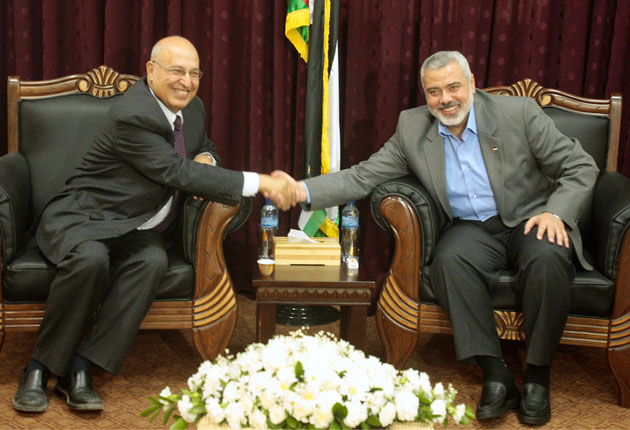
 The picture further down shows  Hamas leader Ismail Hanniyeh, right, shaking hands with senior Fatah official Nabil Shaath. It was taken during their meeting in Gaza in May. It is a Reuters picture.

Posted in Middle East, Middle East Politics | 11 Comments

Why Was This Man Standing At A Podium Before the US Congress?

by James M. Wall

This picture of Israeli Prime Minister Benjamin Netanyahu laying down the law to the US Congress is not just a portent of things to come. It is, in fact, a portrait of who really runs US foreign policy.

While many Americans were watching Oprah or worrying about steroids ruining baseball, Israel assumed control of our government. The picture (above) of Netanyahu lecturing Congress, was orchestrated by Republican House Speaker John Boehner with the help of all those other Zionist politicians we elected to office in campaigns financed by the Israel Lobby.

Two things stand out about the cheering Congressional mob that greeted the Prime Minister’s series of lies and distortions:

One, the American media accepted this insult to the current American president with barely a whimper of protest.  Their real leader had spoken and who are they to say otherwise.

Two, the Congress cheered statements about which they were either ignorant, or had been warned by leaders of both parties, not to disagree.

In case you were watching American Idol during the speech, you should know that this intruder to the podium of our Congress was actually cheered when he asserted that:

There is no occupation of Palestinian land because “in Judea and Samaria [better known except to biblical literalists, as the West Bank], Israelis are not foreign occupiers”. They are, Netanyahu obviously wants us to believe, the native inhabitants.

Would that explain Israel’s building of that Great Wall to separate Israel Proper from the land of Judea and Samaria? That wall looks biblical. Netanyahu cited Abraham in his speech to the Congress as a rationale for Israel’s claim to occupied land. Could that Wall come tumbling down with a few well placed toots on a horn?

Is Sarah Palin writing Netanyahu’s speeches? Talk about your distortion of history. Geeze. Has there ever been a surrender moment more filled with fantasy?

The sight of a right-wing Zionist leader standing at the podium normally reserved for American presidents, and harshly repudiating the current president, was sad in the extreme.

We could only hope that Barack Obama, this son of Kenya and Kansas, would respond to this insult to him and to his nation, with a repudiation of Bibi’s speech.

Alas, it was not to be.  Instead, we get this depressing report about a little-noticed new addition to the White House web site. The announcement came after the Prime Minister’s speech, not from the New York Times, but from Philip Weiss, co-founder of Mondoweiss. The White House site may be accessed here.

The Obama White House has unfurled a new web-page, it’s called “Advancing Israel’s Security and Supporting Peace.” It’s obviously geared toward appeasing the lobby.

There is one reference to the status quo being “unsustainable,” but all references to Palestinians are calls on them to advance peace and [halt] terrorism. Most of the site is about Israel’s security. Iran has a whole section. The word “settlements” is not mentioned. 1967 is mentioned.

Talk about “walking back” from the firm focus President Obama put on the 1967 borders in his recent speeches, consider how the White House’s “we love Israel” web page explains the border’s reference:

“[T]he parties themselves will negotiate a border that is different than the one that existed on June 4, 1967 to account for the changes that have taken place over the last 44 years…”

Translation: Not to worry, you holders of the big dollars we need for reelection. We love what you have done with the occupied property since you stole it 44 years ago.  We see no reason to make changes. Who’s your decorator?

It is not as though we did not know this total capitulation to Israel was coming. Many people knew and tried to warn us.

An important early warning signal is found in the work of Jewish historian Simha Flapan, who knew exactly what Israel had in mind. He gave the details in his remarkably prophetic 1987 book, The Birth of Israel: Myths and Realities.

Flapan died, in Tel Aviv, on April 13, 1987, just as his book was going to press. The book is now, unfortunately, out of print (Amazon offers a rare new paperback copy for $89.99, and a few used copies for much less). It remains one of the most significant documents to emerge from that small band of Jewish writers who labored in the 1970s and 80s to sound the alarm about Israel’s plans for the conquest of all of Palestine.

I own a treasured paperback copy of The Birth of Israel. Flapan is, for me, a mentor and a writer I often turn to when his prophecies become especially pertinent. Richard Falk wrote this on the book’s cover: “A work of extraordinary integrity and of great significance for all those who favor a humane peace in the Middle East.”

Early in his book, Flapan described the mindset of the Israeli people. Notice his reference to “atomic” capability.

Even though Israel has the most sophisticated army in the region and possesses an advanced atomic capability, it continues to regard itself in terms of the Holocaust, as the victim of an unconquerable, bloodthirsty enemy. Thus whatever Israelis do, whatever means we employ to guard our gains or to increase them, we justify as last-ditch self-defense. We can, therefore, do no wrong. The myths of Israel forged during the formation of the state have hardened into this impenetrable, and dangerous, ideological shield.

That shield, now firmly established in the US, has been so effective that when Netanyahu declared victory before the US Congress, the members stood and cheered. And the American media assumed, from behind their “ideological shield”, that the speech was nothing more than “business as usual”.

Of course, since Netanyahu is not a native-born American citizen, he cannot be elected president of the United States. (He graduated from a Pennsylvania high school, but that does not count.) There are, however, a few notable candidates from both American political parties ready to swear their dual allegiance to the US and Israel and run for the office of the Leader of the Free World.

There is Sarah Palin, who is easily manipulated by advisors. She loves Israel. And there is a more serious Democratic candidate, the newly-elected Mayor of Chicago, a fellow named Rahm Emanuel, whose parents are native-born Israelis. Emanuel, himself, has a American birth certificate, so he is good to go in 2016.

Matter of fact, Emanuel has issued his first major campaign speech for that campaign.  It was published in the Washington Post, which is working hard to replace the New York Times as the leading Zionist newspaper in the US.

Here is the start of Emanuel’s column, which praises both Obama and the native land of Emanuel’s parents, the country for which the new mayor served a brief stint as a volunteer in the Israel Defense Forces, at the time of the Iraq war.

Days into my tenure as mayor of Chicago, with my focus on keeping our city’s streets safe, our schools strong and our finances stabilized, I expected my attention to be in the Midwest, not in the Middle East. But as an American and the son of an Israeli immigrant, I have a deep, abiding commitment to the survival, security and success of the state of Israel.

I am among the many who know that the Israeli people yearn for peace. They have taken risks for peace in spite of dangers. They will again, when they have a viable partner in the process and a region that recognizes a Jewish state of Israel with secure and defensible borders.

Emanuel’s Post column was ostensibly a pean of praise for President Obama, the man whom the new Mayor served as Chief of Staff. As he wrote in the column, as a new mayor, his focus should now be on keeping the “city’s streets safe, our schools strong and our finances stabilized”.

Worthy goals, all, but then, notice that in his debut column he is writing not for his current hometown paper, but for the hometown paper of the White House.

The column will serve as a reminder to those generous donors who share his love for Israel. Those names are, no doubt, nestled safely in Emanuel’s Blackberry. It was in 1983 that I first saw an early version of those names. Rahm kept them in an ancient device we called the Rolodex.

At the time, I was Paul Simon’s campaign manager in his first US Senate primary race.  The 23-year-old Emanuel was our campaign’s resident AIPAC representative, paid, not by AIPAC (which, as a non-profit organization, does not make direct financial political contributions) nor by the Simon campaign, since I had refused to authorize payment, but by some of those generous donors whose names were in that Rolodex.

And now, just think, the journey that started in the Simon 1983-84 campaign office, could finally end with Rahm Emanuel standing where Benjamin Netanyahu stood during the 2011 surrender ceremonies.  Ain’t history grand?

The picture of  Prime Minister Netanyahu speaking to Congress is from Al Jazeera. The picture of Mayor Emanuel with President Obama is from the London Guardian, published during Emanuel’s days in the White House. 

Update note: At the suggestion of an alert reader, I have decided to stop referring to the Prime Minister of Israel by his nickname, “Bibi”. The reader pointed out that my use of the Prime Minister’s nickname implied that we were best buddies. We are not.

The changes are reflected in this update.  One caveat: In future headlines, I may be forced to utilize the shorter nickname for space purposes.  I thank the reader for calling this to my attention. 

Posted in Media, Middle East Politics | 17 Comments

Congress Becomes a Mob of Mindless, Cheering Sycophants

By James M. Wall

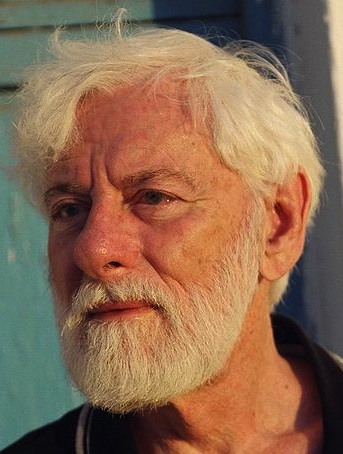
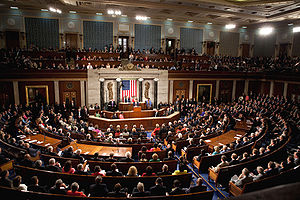
Scenes like the one above evoked veteran Jewish activist Uri Avnery to write this harsh description in his weekly Israeli-based column, Gush-Shalom:

It was all rather disgusting.

No one has said it better, nor with greater passion.  It was, most certainly, as Avnery described in painful detail, a disgusting exhibition of congressional subservience to the leader of a foreign power.

This Congress is also guilty of a despicable act of defiance of the President of the United States, who is currently engaged in delicate negotiations to find peaceful solutions to the Middle East quagmire.

The American mainstream media found nothing out of the ordinary as the US Congress enthusiastically embraced the words of Israeli Prime Minister Bibi Netanyahu, in a refutation of the long-standing American understanding that “partisanship stops at water’s edge”.

In this instance it was not a partisan deviation. It was, instead a total capitulation of both parties to a foreign leader who stood before the members of Congress and ignored the ugly and costly results his own country’s policies have brought to both the Middle East and to the United States.

It was, indeed, disgusting.

Avnery, a veteran of Israel’s Irgun who also fought in the 1948 war that created the state of Israel, watched the spectacle on television from his home in Jerusalem. This is how he expressed his disgust:

There they were, the members of the highest legislative bodies of the world’s only superpower, flying up and down like so many yo-yos, applauding wildly, every few minutes or seconds, the most outrageous lies and distortions of Binyamin Netanyahu. . . .

The sight of these hundreds of parliamentarians jumping up and clapping their hands, again and again and again and again, with the Leader graciously acknowledging with a movement of his hand, was reminiscent of other regimes. Only this time it was not the local dictator who compelled this adulation, but a foreign one.

Avnery writes that while Bibi’s speech was “finely crafted”, it can be summed up in one word, No.

NO return to the 1967 borders. NO Palestinian capital in East Jerusalem. NO to even a symbolic return of some refugees. NO military withdrawal from the Jordan River – meaning that the future Palestinian state would be completely surrounded by the Israeli armed forces. NO negotiation with a Palestinian government “supported” by Hamas, even if there are no Hamas members in the government itself. And so on – NO. NO. NO.

The aim is clearly to make sure that no Palestinian leader could even dream of entering negotiations, even in the unlikely event that he were ready to meet yet another condition: to recognize Israel as “the nation-state of the Jewish people” . . .

Netanyahu, along with his associates and political bedfellows, is determined to prevent the establishment of a Palestinian state by all and any means. That did not start with the present government – it is an aim deeply embedded in Zionist ideology and practice.

Franklin Lamb, an American retired diplomat, now working in Washington and in Beirut, Lebanon, knows the American political scene from the inside.

Lamb is a former Assistant Counsel of the US House Judiciary Committee. He has been a Professor of International Law at Northwestern College of Law in Oregon, earned his Law Degree at Boston University and his LLM, M.Phil, and PhD degrees at the London School of Economics.

He is currently the director of Americans Concerned for Middle East Peace, Beirut-Washington DC.

Lamb wrote an analysis for the Dubai-based site, My Catbird Seat, which examines the speech before the US Congress where members enthusiastically embraced Netanyahu and the policies of his right-wing Israeli government.

He also identified, however, potential signs of hope among what could be a growing number of congressional staff members who reacted quite negatively to Netanyahu’s speech.

His conclusion:

The effects of the Arab Spring are being felt in both Houses of Congress as well as in numerous support agencies such as the Congressional Research Service of the Library of Congress”.

Staffers with whom Lamb has communicated “understand that the Arab Awakening of 2011 is an historic game changer”, a change with which these staffers “are often deeply sympathetic and supportive.”

Lamb’s investigation also led him to conclude that “virtually all Congressional staffers who objected to Netanyahu’s appearance before Congress expressed rejection of his following assertions as ludicrously false”.

Those statements were applauded by those members of Congress so limited in their knowledge of the narrative Netanyahu was selling, that they believed him. Those few who did know the assertions were false, also applauded, on demand.

Here is the “ludicrously false” Netanyahu list Lamb found in his discussion with staff members:

Of 300 million Arabs in the Middle East and North Africa, only Israel’s Arab citizens enjoy real democratic rights.”

“Throughout the millennial history of the Jewish capital, the only time that Jews, Christians and Muslims could worship freely, could have unfettered access to their holy sites, has been during Israel’s sovereignty over Jerusalem.”

“In Judea and Samaria, the Jewish people are not foreign occupiers.”

“In recent years, the Palestinians twice refused generous offers by Israeli prime ministers to establish a Palestinian state on virtually all the territory won by Israel in the Six-Day War.”

“We have helped the Palestinian economic growth by removing hundreds of barriers and roadblocks to the free flow of goods and people, and the results have been nothing short of remarkable.”

“The Palestinian refugee problem will be resolved outside the borders of Israel.”

“They (Palestinians) continue to educate their children to hate.”

“A nuclear armed Iran would ignite a nuclear arms race in the Middle East.”

Lamb also found that the applause moments that “erupted” during the speech, according to two staffers who work with the House Foreign Affairs Committee, were organized by AIPAC.

AIPAC, as it always does with visiting Israeli officials, edited Netanyahu’s speech to identify points that assured “most favorable local consumption”. These points were marked as “applause lines”.

Key Members such as Eric Cantor (R-VA), Steny Hoyer (D-MD), Senator Charles Schumer (D-NY) and Harry Reid (D-NV) were designated as floor leaders and were seated in strategic locations in the Chamber.

Once Bibi began his speech, the floor leaders would leap up at the indicated cue phrases and begin to applaud enthusiastically.

Anyone who has ever been a delegate to a decision-making gathering like a national Democratic or Republican national nominating convention, knows this drill.

I have served as floor whip for several Democratic conventions. From those experiences, I can report that it works this way: the delegate chief in the trailer calls in and instructs the whip, “Lift up the signs and cheer”.

(A young man named Tom Donilon, who now has a much bigger assignment as Barack Obama’s National Security advisor, was in one of those trailers, relaying instructions to me during Jimmy Carter’s second nominating convention.)

During Bibi’s speech, the Big Four of Cantor, Hoyer, Schumer and Reid, had their carefully marked speech text. When they jumped up to cheer and applaud, all members of Congress followed their lead. Failure to do so could be costly in the next primary election.

MJ Rosenberg writes this weekend about a 1988 experience he had as a Senate staffer. The story appears on the blog, Political Correction, a “Project of Media Matters Action Network”.

(Media Matters was initially created by David Brock, the former right wing political operative, who repented of his role as the “attack dog” against Bill and Hillary Clinton. The current issue of New York magazine has the detailed account of Brock’s conversion and his repeated apologies to the Clintons.)

Rosenberg begins:

It was in 1988 and I was a foreign policy aide to Sen. Carl Levin (D-MI). One February day, Levin called me into his office to say that he was disturbed at a quote he saw in that day’s New York Times. An article quoted Israeli Prime Minister Yitzhak Shamir saying that he rejected the idea of withdrawing from any of the land Israel captured in the 1967 war:

Mr. Shamir said in a radio interview, ”It is clear that this expression of territory for peace is not accepted by me.”

Levin instantly understood what Shamir was saying. He was repudiating UN Security Council Resolutions 242 and 338 (which Israel had helped draft) which provided for “withdrawal of Israeli armed forces from territories occupied in the recent [1967] conflict” in exchange for peace and security. Those resolutions represented official U.S. and international policy then, and they still do.

But, in 1988, Shamir tried to declare them null and void. Levin asked me to draft a letter to Secretary of State George Shultz stating that it was the view of the Senate that the U.N. Resolutions remained the policy of the U.S. whether Shamir liked it or not.

In great detail, Rosenberg continues with the story of his exciting journey through the jungle warfare that is the Israel Lobby, the Congress, the media (most notably, the New York Times‘ William Safire), and the White House.

Rosenberg concludes by linking his 1988 experience to this past week’s Congressional craven conformity to Israel:

So what’s the moral? It is this: Criticizing Israel is dangerous business. On what other issue would a New York Times columnist call a Senate staffer and threaten to destroy his career? None. And why was a New York Times columnist acting as if he was working for the Israeli government? Safire wasn’t a journalist that day; he essentially was a representative of the Israeli government.

Accordingly, is it any wonder the whole Congress abased itself the other day by jumping up and down and hurling love at Netanyahu? Who wants to mess with an 800-pound gorilla? Certainly not members of Congress.

We conclude this narrative of a nation’s legislative leaders as they wander in the wilderness with a short clip of the Bibi Netanyahu performance before the US Congress. 

http://youtu.be/W0A8ySu0_xQ

The picture above of the Congress applauding for one of 29 times is from Palestine Uprooted. The picture of Franklin Lamb is from My Catbird Seat. The clip of parts of Netanyahu’s performance before Congress is from C Span and is available on Youtube.

Posted in Middle East Politics, Politics and Elections | 16 Comments

Obama Speech Mired in Zionist Rhetoric

By James M. Wall

Israeli Prime Minister Bibi Netanyahu returned to Washington this weekend for his annual love fest with AIPAC, the American Israel Public Affairs Committee, which is holding its annual Policy Committee meeting Sunday through Tuesday.

President Obama followed up his speech to his Arab Spring presentation at the State Department, Thursday, by reiterating his comments on Israel at the AIPAC conference Sunday morning.

The President’s speech Thursday provided an overview of the changes now sweeping the Arab world.  Late in that address, Obama turned to the Israeli-Palestinian conflict.

Unfortunately, in linking the changes emerging from the Arab Spring to the future of the Palestinian Territory, the President was playing with a very bad hand.

He is a man locked into the rhetoric of the past, honed over decades by Israeli propagandists and Israel’s many friends in the US.

The President is a terrific orator. But his rhetoric in this speech needs a careful exegesis to bring out its blatant contradictions. 

It is not easy to please Israel’s many friends in the US while attempting, rather desperately, to balance the suffering and the hopes of Israel and the Palestinians. He did not succeed.

Consider his first reference to the suffering of the two “sides”:

For Israelis, it has meant living with the fear that their children could get blown up on a bus or by rockets fired at their homes, as well as the pain of knowing that other children in the region are taught to hate them.

For Palestinians, it has meant suffering the humiliation of occupation, and never living in a nation of their own.

Note carefully how he illustrates the “two sides”, trying, unsuccessfully to balance the suffering of an occupier with that of the occupied. The Israeli suffering he cites is that of children who live in fear of dying. His example of Palestinian suffering is more abstract, the humiliation of occupation and the quest for nationhood.

The bombing of Israeli buses is from the past; the suffering of Palestinian children, which the president does not specifically mention, is existential, ongoing, constant and a daily threat with no end in sight.

President Obama said he would talk about “security and territory”. He would “put off” the sensitive issues of refugees and Jerusalem, the same sensitive issues negotiators have “put off” for decades.

President Obama also dutifully followed the Zionist line that the “two parties” should negotiate between themselves.  Any involvement by the United Nations is merely symbolic and is harmful to Israel. Here is his specific complaint:

For the Palestinians, efforts to delegitimize Israel will end in failure. Symbolic actions to isolate Israel at the United Nations in September won’t create an independent state. Palestinian leaders will not achieve peace or prosperity if Hamas insists on a path of terror and rejection. And Palestinians will never realize their independence by denying the right of Israel to exist.

“Delegitimize Israel”? How does recognizing a Palestinian state within the 1967 borders “delegitimize Israel?”

And what is “symbolic” about the UN recognizing a Palestinian state? It is not “symbolic”; it is a legitimizing action on behalf of the Palestinians just as much as the UN’s creation of the Israeli state in 1948 was a legitimizing action.

The President continued:

Palestinian leaders will not achieve peace or prosperity if Hamas insists on a path of terror and rejection. And Palestinians will never realize their independence by denying the right of Israel to exist.

The President was talking about UN recognition before he moved quickly into the issue of Hamas which he insists on calling a “terrorist” organization.

The trouble with tossing in the “right to exist” phrase, is that Obama ignores the fact that nations do not have the “right to exist”. They simply exist within borders that their neighbors accept as legitimate because of historical circumstances. There are no “rights” involved.

It is embarrassing for our president to allow himself to be dragged into using the Zionist “right to exist” shibboleth (See Judges 12 for the term’s origins.).

And while we are reflecting on President Obama’s embrace of traditional Israeli-American propaganda language, these two short sentences do not sound like Obama; rather, they sound like something lifted from a White House manual on “How to Speak Israeli”:

As for Israel, our friendship is rooted deeply in a shared history and shared values. Our commitment to Israel’s security is unshakeable.

What exactly is this “shared history” and what exactly are our “shared values”?

Modern Israel’s history begins in 1948.  Aside from pushing the UN to recognize the state, and selling it arms, what have we shared? OK, we did share the pragmatic belief that Israel was our bulwark against communism in the Middle East.

In his report on the White House Friday meeting between Netanyahu and Obama, Jewish blogger Richard Silverstein includes an incisive reminder of what “shared values” now mean to American politicians, from the far religious right to the Obama White House:

Obama again, in remarks after the two-hour meeting, noted that Israel was a “Jewish state” making no reference to the fact that it was also composed of a significant minority of non-Jewish citizens. It would be as if a foreign leader congratulated the US. for being a Christian nation. It sure would make John Hagee happy.

When Obama bragged, in his speech, about the US killing of Osama bin Laden, he was providing a further example of the values that Israel and the US share. Our Navy Seals killed an unarmed man who could have been sedated and delivered to the American judicial system. Was that option even considered in advance?

A trial for Osama bin Laden would have been more consistent with our American values than the practice of assassinating enemies, a standard we learned from  our Israeli friends, who have long killed their opponents by assassinations.

In his speech, Obama asserts that “every state has the right to self-defense”.

Israel must be able to defend itself – by itself – against any threat. Provisions must also be robust enough to prevent a resurgence of terrorism; to stop the infiltration of weapons; and to provide effective border security.

Makes sense. No nation wants to be without the ability to defend its own citizens. But, then Obama adds this remarkable exception:

The full and phased withdrawal of Israeli military forces should be coordinated with the assumption of Palestinian security responsibility in a sovereign, non-militarized state.

This is a convoluted sentence that could be construed to suggest that when Israel withdraws its military forces from the Occupied Palestinian Territory, it will continue to provide “security” for the new sovereign state of Palestine, which will not have its own military forces.

Or, does the sentence say that Palestine will be left with no defenses? Difficult to tell from this sentence in what was reported to be some frantic, last minute speech revisions.

Whatever it was intended to say, the defense exception for Palestine is a stunningly ugly example of Obama’s embrace of Zionist–as in, whatever is best for Israel–values.

Three days before Obama’s speech, President Mahmoud Abbas wrote a guest column for the New York Times. He began with a story:

Sixty-three years ago, a 13-year-old Palestinian boy was forced to leave his home in the Galilean city of Safed and flee with his family to Syria. He took up shelter in a canvas tent provided to all the arriving refugees.

Though he and his family wished for decades to return to their home and homeland, they were denied that most basic of human rights. That child’s story, like that of so many other Palestinians, is mine.

President Abbas linked his personal story to the decision of his government to request international recognition as a state along the 1967 borders. That request will also ask that the new state of Palestine be “admitted as a full member of the United Nations.” Abbas added:

Many are questioning what value there is to such recognition while the Israeli occupation continues. Others have accused us of imperiling the peace process. We believe, however, that there is tremendous value for all Palestinians — those living in the homeland, in exile and under occupation. . . .

Palestine’s admission to the United Nations would pave the way for the internationalization of the conflict as a legal matter, not only a political one. It would also pave the way for us to pursue claims against Israel at the United Nations, human rights treaty bodies and the International Court of Justice.

Our quest for recognition as a state should not be seen as a stunt; too many of our men and women have been lost for us to engage in such political theater.

We go to the United Nations now to secure the right to live free in the remaining 22 percent of our historic homeland because we have been negotiating with the State of Israel for 20 years without coming any closer to realizing a state of our own.

The Barack Obama who said in his May 19 speech that the US “will oppose an attempt by any group to restrict the rights of others”, is not the Barack Obama who dismisses the Palestinian appeal to the UN General Assembly as merely a “symbolic action” designed “to isolate Israel”.

The Obama speech was both a missed opportunity and a sad failure.

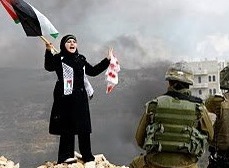
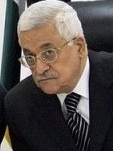
The picture of the Palestinian woman with a flag at the top of this page, and the picture of Mahmoud Abbas, are from Intifada Palestine.

Posted in Media, Middle East Politics, Politics and Elections | 15 Comments

“I Got Vision and the Rest of the World Wears Bifocals”

by James M. Wall

Butch Cassidy is talking to the Sundance Kid:  “Boy, I got vision, and the rest of the world wears bifocals.”

The line comes in one of many memorable moments in the 1967 film, Butch Cassidy and the Sundance Kid, starring Paul Newman (at left) as Butch, and Robert Redford as the Kid.

We lovers of classic films like to believe we remember most of the good lines from movies we admire, but it was not until a recent episode of NCIS* that this line returned to my consciousness.

In a flashback NCIS episode “Baltimore”, of the 2010-2011 season, Jethro Gibbs (Mark Harmon) has just enlisted a new agent for his NCIS team. 

The new guy is Tony DiNozzo (Michael Weatherly), who recognizes the line Jethro tosses him as he walks down the hall, shouting over his shoulder,  “Boy, I got vision, and the rest of the world wears bifocals.”  Tony shouts back, “Butch Cassidy and the Sundance Kid!” Tony knows his movies.

Tony proves to be a worthy addition to Jethro’s team, indicating that Gibbs is a man with a vision. Jethro is shown here, not with Tony, but with another member of the team, Ziva (Cote De Pablo).

We desperately need a few good men and women with vision in Washington this week when President Obama, AIPAC and both houses of the US Congress, prepare to receive a foreign visitor to American soil.

The visitor is Israeli Prime Minister Bibi Netanyahu, who has demonstrated again and again, that he lacks vision. Israeli leaders have governed their state since 1948 on the short term vision of paranoia, military power and fear, not a good recipe for a newcomer to bring to a neighborhood.

Focusing only on the immediate moment, Bibi was unprepared for what would happen once the Arab Spring reached Egypt. Israel’s old best buddy, Hosni Muburak, was gone from power. The new Egyptian military rulers put together an Hamas-Fatah unity meeting last week which forced Bibi to look up and discover that he no longer feels the love from his southern border.

Gone is the love he felt when Egyptian President Hosni Mubarak was a reliable one half of the oppression of Gaza.

Bibi never did feel the love from his northern border. All he, and his predessors, knew from that direction was a military standoff with Syria and ongoing military clashes with Lebanon.

A leader with vision would have known what was coming on the first Nakba Day after the the Arab uprising began. On Sunday, May 15, reality crashed into Israel’s northern borders.

Palestinian refugees descended on Israel”s borders with Syria and Lebanon. The Arab Spring had spread from North Africa into Syria, Lebanon, and briefly, into Israel. No doubt, it will be back in a yet uncertain form. 

Israel reacted to the incursion in the only way it knows how to react, with force, killing at least 15 Arab “protestors” who climbed border fences and threw stones at the Israeli soldiers. Tear gas or air attacks are usually the weapons of choice used by the IDF against civilians. Not this time. 

Reporting on these incursions, the US media, which covers the region from an Israeli perspective, demonstrated its own short-term vision by also not anticipating how Arabs along Israel’s northern border would respond to Nakba Day, 2011.

The US media might better have served its readers, viewers and hearers, and reported on what a long term vision would have told them: The days are over, thanks to the Arab uprising, when the US government could maintain the fiction that the US is an honest broker in the region.

That term lost its meaning in Bill Clinton’s first term in office.  The Arab Spring is an event which erupted from the people, armed only with cell phones linked to Facebook. These are largely young people who no longer expect any help from the democracies of the world.

This is how the Huffington Post reported the story from Majdal Shams, in the Golan Heights:

Mobilized by calls on Facebook, thousands of Arab protesters marched on Israel’s borders with Syria, Lebanon and Gaza on Sunday in an unprecedented wave of demonstrations, sparking clashes that left at least 15 people dead in an annual Palestinian mourning ritual marking the anniversary of Israel’s birth.

In a surprising turn of events, hundreds of Palestinians and supporters poured across the Syrian frontier and staged riots, drawing Israeli accusations that Damascus, and its ally Iran, orchestrated the unrest to shift attention from an uprising back home. It was a rare incursion from the usually tightly controlled Syrian side and could upset the delicate balance between the two longtime foes.

Huffington Post is displaying its own Israeli bias when it refers to Nakba Day as “an annual Palestinian mourning ritual marking the anniversary of Israel’s birth.”

That same bias is also evident later in the report:

Palestinians were marking the “nakba,” or “catastrophe” – the term they use to describe their defeat and displacement in the war that followed Israel’s founding on May 15, 1948. Hundreds of thousands of Palestinians were uprooted. Today, the surviving refugees and their descendants number several million people.

Nakba is not a day of “mourning”; it is a day when not only Palestinians, but supporters of Palestine, both Arab and non-Arab, remember the “catastrophe” when, to be more precise, not “hundreds of thousands”, but more than 750 thousand Palestinians were driven out of their villages and cities.

And they were not “uprooted”. Thousands were killed; the rest were driven away from land Israel had identified for its future state.

It was this new state which obliterated more than 475 villages from which the Palestinians were forced to leave. Nakba is not a “mourning ritual” for these events; it remembers them with an intensity that anyone with a long term vision should have anticipated.

Contrary to the Huffington Post version, the surviving refugees and their descendants number not “several million people”, but 4.7 million people, and growing, some of whom were killed on Nakba Day, 2011, by soldiers of the Israeli Defense Force.

JTC, “the global news service of the Jewish people”, described the Nakba Day events as a “breach” of Israel’s northern border”.

Uriel Heilman writing from Tel Aviv, touches on the familiar theme of hyperbolic paranoia in describing that breach.

If a single phrase could capture the sentiment that motivated thousands of Arabs to try to cross Israel’s borders on Sunday to “retake Palestine” from the Jews, it would be this: Yes, we can.

That can-do attitude had toppled regimes in Egypt and Tunisia, and threatened dictators from Tripoli to Damascus. So why not apply it toward Israel? If Arab leaders weren’t willing to send their armies to storm the Zionist state, the Arab protesters figured, well then, they’d just do it themselves.

Heilman stretches matters a bit when she sees the border protests as the start of a campaign to “storm the Zionist state”. More likely, and seen from a less paranoid vision, the Nakba protests have more to do with demanding justice and freedom than with conquest.

Prime Minister Netanyahu put the paranoid icing on the cake with this warning from the world’s fourth (at least) most powerful military force:

Let nobody be mistaken, we are determined to defend our borders and sovereignty.

JTA does not bother to ask, “which borders and which sovereignty”?  The news service for the Jewish people is content to describe the border crossings as just possibly the start of a third Palestinian intifada, “at least on Facebook”.

Uriel Heilman writes further that “For Israel, the breach of the Syria-Israel border came as something of a surprise. It marked the first major violence along the border since the May 1974 disengagement agreement that followed the 1973 Yom Kippur War.”

And there you have it. Both a government, and a news service locked into a short term vision, were surprised when Israel felt the latest wave of the Arab spring. To paraphrase Ray Bradbury, “If they didn’t see the steeple on the court house, what else has Israel missed?”

Which raises yet another question: Whatever possessed President Barack Obama to agree to “keynote” this years’s AIPAC conference?

JTA, again, has the story:

President Obama’s decision to keynote the American Israel Public Affairs Committee’s annual policy conference, rumored for days, was confirmed Monday by Jay Carney, the White House spokesman, to reporters traveling with the president aboard Air Force One. AIPAC confirmed the news.

The Associated Press quoted Carney as saying that Obama will not outline policy in his speech but instead will focus on the “deep bond” with Israel.

The AIPAC Conference runs from Sunday, May 22 through May 24.  On Thursday, May 19, Obama will deliver a “policy speech on Arab democracy”.  The next day, Friday, May 20, Obama will meet with Prime Minister Netanyahu.

A policy speech on “Arab democracy” delivered just before the President pays homage to AIPAC and sits down for a chat with Bibi?  Is there no one in the White House who might have suggested to the President that the Arab Spring is all about democracy, and Israel will have nothing to do with a genuine Palestinian or Arab democracy?

This is a president we thought would bring a vision to the White House.  Now it turns out he is wearing bifocals that see no further than the Zionist script handed him by his AIPAC hosts.

Or perhaps not, cries the eternal optimist in each of us.  The next ten days are crucial to Arab democracy. Washington will be Zionist Central for this period. Does President Obama believe he can “send a message” to the Arab people by discussing their future in such a Zionist setting?

We can only wait and see what our leader has to say. Wait, see, and, of course, pray.

* NCIS: Naval Criminal Investigative Service, which conducts criminal investigations involving the U.S. Navy and Marine Corps.

The picture at top of Gibbs and Ziva are from CBS television. The photo above of the demonstrators on Israel’s Northern border is by Hamad Almakt from Flash 90.

Posted in Middle East Politics | Comments Off on “I Got Vision and the Rest of the World Wears Bifocals”

“If You Build It, the (Palestinian) State Will Come”

by James M. Wall

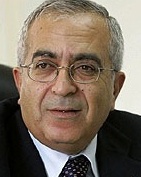
In the summer of 2009, Palestinian Authority Prime Minister Salam Fayyad (right) released a lengthy document which described plans and a program to build a future Palestinian state alongside Israel, with borders along the 1967 Green Line.

He predicted that such a state would be ready for statehood within two years.  The London Guardian greeted the announcement with the optimistic observation and with a nod to the movie, Field of Dreams, ”If you build it, the state will come.”

This coming September, 2011, the two years are up. Over the past two years, Fayyad and the Palestinian Administration, have put into place a working structure for statehood.

Right on schedule, the recognition of a Palestinian state will be voted on at the United Nations in September.

And something that was not anticipated in the Fayyad plan, there is a strong possibility that a unified Hamas-Fatah political structure will be in place.

In a Wall Writings posting, dated September 2, 2009, I reported on a Washington Post column written by former President Jimmy Carter, in which Carter discussed the Fayyad program and described the support it had received from Javier Solana, secretary general of the Council of the European Union.

Carter and the Elders, a group of distinguished world leaders, met with Fayyad in 2009 after he announced his two year plan. After that meeting, Carter wrote:

. . . Solana proposes that the United Nations recognize the pre-1967 border between Israel and Palestine, and deal with the fate of Palestinian refugees and how Jerusalem would be shared.

Palestine would become a full U.N. member and enjoy diplomatic relations with other nations, many of which would be eager to respond. Palestinian Prime Minister Salam Fayyad described to us [the Elders traveling with Carter] his unilateral plan for Palestine to become an independent state.

Fayyad’s program was published under the optimistic title, “Palestine: Ending the Occupation, Establishing the State”. It was described in the Huffington Post by Palestinian Journalist Daoud Kuttub, as ‘brilliant'”.

Kuttub explained the reason for his optimism:

Palestinians have finally started to act in a different way. Instead of cursing the occupation, the new strategy is aimed at building up the desired Palestinian state.

The idea is to force the Israelis to the negotiating table rather than beg them to come. The way to do that is to work for a state as if there were negotiations. This idea has been brilliantly developed by the Palestinian prime minister.

Salam Fayyad proposal for the de facto creation of a Palestinian state within two years is a brilliant idea that is hard to ignore or oppose it.

Fayyad’s blueprint includes plans to end the Palestinian economy’s dependence on Israel, unify the legal system and downsize the government. The idea, submitted by him after weeks of meetings with his ministers and staff, also involves building infrastructure, harnessing natural energy sources and water, and improving housing, education and agriculture.

After the Brussels meeting in April, 2011, Riyad Mansour, PA ambassador to the UN, told a UN committee that it is time to end Israel’s occupation of Palestinian land and to “allow for full membership of a Palestinian  state in the UN.”  Press TV has a clip:

http://youtu.be/XYF7Gbf7rMY

Someone who has the ability and the experience to connect the dots in developments in the Middle East is veteran American diplomat, Ambassador Chas Freeman, who delivered a major lecture on May 4, at the Palestine Center, in Washington.

Freeman was this years’s Hisham B. Sharabi Memorial Lecturer, part of a lecture series named in honor of Dr. Sharabi, who help found the Palestine Center as well as the Center for Contemporary Arab Studies at Georgetown University.

Freeman described Sharabi as a “great figure in the study of Arab politics and society” and “an indefatigable advocate of Palestinian rights. “Sharabi was born in Jaffa, Palestine. He received his undergraduate degree from American University and an MA from the University of Chicago. He died, at the age of 78 in Beirut.

Sharabi was an outspoken supporter of Palestinians, but was also known for his willingness to speak critically of Palestinian leaders when they failed to exercise strong leadership.

Ambassador Freeman fits nicely in the Sharabi tradition. After many years of service as an American diplomat, Freeman was appointed by President Barack Obama to serve as chairman of Obama’s National Intelligence Council.

Freeman, and Obama, ran into intense pressure from hardline Israeli Zionist supporters, led by New York Senator Chuck Schumer. The pressure was so intense that President Obama agreed that Freeman should withdraw from the nomination. Freeman did not go quietly. For background and more on the political infighting around this episode, click here to read my piece in the AMEU publication, The Link.

Zionists seem never to learn.  They savor small victories only to discover that they have set themselves up for future defeats.  Ben Smith covered Freeman’s departure from the National Intelligence Council for Politico:

The attacks on Freeman, in the end, hinged primarily on the question of Israel, something the Democratic senators who helped break the back of the nomination Tuesday made clear.

“His statements against Israel were way over the top and severely out of step with the administration,” said Senator Chuck Schumer in a statement. “I repeatedly urged the White House to reject him, and I am glad they did the right thing.”

Hours before the Director of National Intelligence, Dennis Blair, expressed his “regret” at Freeman’s withdrawal, Sen. Joe Lieberman (I-Conn.) told Blair he was concerned about “statements that [Freeman]’s made that appear either to be inclined to lean against Israel or too much in favor of China.”

In particular, Freeman has described “Israeli violence against Palestinians” as a key barrier to Mideast peace, and referred to violence in Tibet last year – widely seen in the United States as a revolt against Chinese occupation – as a “race riot.”

Freeman left no doubt where he places blame in a written statement after his withdrawal.

“The libels on me and their easily traceable email trails show conclusively that there is a powerful lobby determined to prevent any view other than its own from being aired, still less to factor in American understanding of trends and events in the Middle East”.

In his 2011 Sharabi lecture, delivered two years after his Zionist-inspired departure from the Obama administration, Chas Freeman spoke of the role played by Zionist forces in American politics and governance in the US. I would like to believe Hisham B. Sharabi was applauding throughout. Below are a few excerpts from the lecture.

Freeman’s lecture (38 minutes) deserves to be read and/or heard, in full, which you may do by clicking here:

As the former head of the Israeli Defense Forces’ (IDF) Legal Department has argued:

“If you do something for long enough the world will accept it. The whole of international law is now based on the notion that an act that is forbidden today becomes permissible if executed by enough countries . . . . International law progresses through violations.”

A colleague of his has extended this notion by pointing out that:

“The more often Western states apply principles that originated in Israel to their own non-traditional conflicts in places like Afghanistan and Iraq, then the greater the chance these principles have of becoming a valuable part of international law.”

These references to Iraq and Afghanistan underscore the extent to which the United States, once the principal champion of a rule-bound international order, has followed Israel in replacing legal principles with expediency as the central regulator of its interaction with foreign peoples. The expediently amoral doctrine of preemptive war is such an Israeli transplant in the American neo-conservative psyche.

Neither it nor other deliberate assaults on the rule of law have been met with concerted resistance from Palestinians, Arabs, or anyone else, including the American Bar Association. The steady displacement of traditional American values – indeed, the core doctrines of western civilization – with ideas designed to free the state of inconvenient moral constraints has debased the honor and prestige of our country as well as Israel. . . . .

Given the protracted failure of U.S. diplomacy in the Israel-Palestine arena, Palestinians and others may be forgiven for believing that it is time to entrust peacemaking to other parties who are more objective, less politically constrained and less emotionally biased. Others in Europe and elsewhere have taken alarmed note of the adverse effects of the unending conflict on Israel, on the Palestinians, on Arab politics, on regional stability, on inter-religious relations, on the moral standing of global Jewry and Islam, on Arab and Islamic relations with the West, on international law and organizations and on world order.

Media outside the United States have taken progressively more balanced and nuanced note of the human suffering in the Holy Land. Europeans and others now evidence a considerably greater sense of urgency about these problems than Americans have done. The notion that only Americans have the capacity to manage conflict resolution in the Middle East will no longer withstand scrutiny. One recalls the role of Norway in crafting the Oslo Accords. Perhaps, now that the United States has struck out, it’s someone else’s turn at bat.

Ambassador Freeman then points the way to what could, should and must happen in 2011.

A new game is clearly beginning. A self-confident, religiously tolerant but secular Turkey has emerged as a major influence on regional affairs and as an inspiration to its democrats.

Arab diplomacy is being invigorated by the aftereffects of the revolutions in Egypt and elsewhere. There is mounting pressure on all Arab governments to accord greater deference to popular opinion in both domestic and foreign policy. The Middle East will no longer allow itself to be the diplomatic playground of great powers outside it.

There will, however, be new opportunities for interested outside parties to forge diplomatic partnerships with those in the region.

Opportunities, like, a unified Fatah-Hamas government which has become a significant development in this emerging “new game”.

Nazareth-based Jonathan Cook describes this dramatic new move in CounterPunch (May 5).

Israeli officials have expressed alarm at a succession of moves by the interim Egyptian government that they fear signal an impending crisis in relations with Cairo.

The widening rift was underscored yesterday when leaders of the rival Palestinian factions Hamas and Fatah signed a reconciliation pact in the Egyptian capital. Egypt’s secret role in brokering the agreement last week caught both Israel and the United States by surprise.

The Israeli prime minister, Benjamin Netanyahu, called the deal “a tremendous blow to peace and a great victory for terrorism”.

Several other developments have added to Israeli concerns about its relations with Egypt, including signs that Cairo hopes to renew ties with Iran and renegotiate a long-standing contract to supply Israel with natural gas.

More worrying still to Israeli officials are reported plans by Egyptian authorities to open the Rafah crossing into Gaza, closed for the past four years as part of a Western-backed blockade of the enclave designed to weaken Hamas, the ruling Islamist group there.

Egypt is working out details to permanently open the border, an Egyptian foreign ministry official told the Reuters news agency on Sunday. The blockade would effectively come to an end as a result.

Finally, there is the matter of the worldwide response to the death of Osama bin Laden, a response that is sadly lacking in wisdom and insight into the human heart. 

Veteran Israeli peace activist Uri Avnery (right) understands this. He addressed the response in his weekly Gush Shalom column:

“Rejoice not when thine enemy falleth, and let not thine heart be glad when he stumbleth, / Lest the Lord see [it], and it displease him, and he turn away his wrath from him.”.

This is one of the most beautiful passages in the Bible (Proverbs 24:17-18), and indeed in the Hebrew language. It is beautiful in other languages , too, though no translation comes close to the beauty of the original.

Of course, it is natural to be glad when one’s enemy is defeated, and the thirst for revenge is a human trait. But gloating – schadenfreude – is something different altogether. An ugly thing.

Ancient Hebrew legend has it that God got very angry when the Children of Israel rejoiced as their Egyptian pursuers drowned in the Red Sea. “My creatures are drowning in the sea,” God admonished them, “And you are singing?”

These thoughts crossed my mind when I saw the TV shots of jubilant crowds of young Americans shouting and dancing in the street. Natural, but unseemly.

The contorted faces and the aggressive body language were no different from those of crowds in Sudan or Somalia. The ugly sides of human nature seem to be the same everywhere.

Posted in Middle East Politics | 12 Comments

Why Palestinian Unity is the Only Option that Works for Palestinians

By James M. Wall 

You would not know it from reading/viewing the American media, which parrots whatever Israel’s leaders say, but Bibi Netanyahu is secretly delighted that Fatah and Hamas have reached a unity agreement.

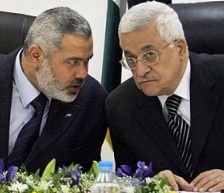
The official line, of course, is that the Israeli prime minister is outraged that the Palestinian Fatah leadership has actually embraced the Hamas leadership. Leaders of the two parties are shown here, from Hamas, Ismail Haniyeh (left) and Fatah ‘s Mahmoud Abbas.

Ha’aretz reported from Jerusalem that, upon hearing of the unity agreement, Prime Minister Benjamin Netanyahu laid down his marker: “the Palestinian Authority must choose whether it is interested in peace with Israel or reconciliation with Hamas.”

This is an empty option, one that Fatah leader Mahmoud Abbas (Abu Mazen) knows is empty.

The London Guardian explains what lies behind Fatah’s willingness to finally work for unity with Hamas:

There are three chief reasons why, after four years of bitter and violent conflict between the rivals, Fatah acceded to all of Hamas’s political conditions to form a national unity government.

The first was the publication of the Palestine papers, the secret record of the last fruitless round of talks with Israel. The extent to which Palestinian negotiators were prepared to bend over backwards to accommodate Israel surprised even hardened cynics.

The Palestinian Authority found itself haemorrhaging what little authority it had left. The second was the loss to the Palestinian president, Abu Mazen, of his closest allies in Hosni Mubarak and his henchman Omar Suleiman. While they were still around, Gaza’s back door was locked. But the third reason had little to do with either of the above:

Abu Mazen’s faith in Barack Obama finally snapped. For a man who dedicated his career to the creation of a Palestinian state through negotiation, the turning point came when the US vetoed a UN resolution condemning Israel’s settlement-building. In doing so, the US vetoed its own policy.

To make the point, the resolution was drafted out of the actual words Hillary Clinton used to condemn construction. Fatah’s frustration with all this has now taken political form.

Long-time Bibi Watcher James Zogby knows why it was time for Fatah to give up on both Bibi and Barack. Zogby, president of the Arab American Institute, wrote in Huffington Post:

What is, of course, galling, is the assumption implicit in [Netanhyahu’s] framing of the matter, namely, that peace with his government is a real possibility that the Palestinians have now rejected. In reality, the Netanyahu government has shown no interest in moving toward peace — unless on terms they dictate and the Palestinians accept.

While feigning disappointment at this Palestinian move, Netanyahu must privately be delighted. The pressure he was feeling to deliver some “concessions” to the Palestinians in his upcoming speech to the U.S. Congress has now been relieved.

This unity between Fatah and Hamas is inevitable. The problem for the US Congress and Israel is that they cannot face reality.  These two soul mates in repression continue to pretend the future belongs to them. They keep making the same mistakes. For example:

House Majority Leader Eric Cantor (R-VA) has invited Israeli Prime Minister Netanyahu to deliver a speech before a joint session of Congress while he is in Washington to address the AIPAC policy conference.

The AIPAC Policy Conference, scheduled for May 22-24, is, according to the AIPAC web page, “the pro-Israel community’s preeminent annual gathering”.

MJ Rosenberg, Senior Foreign Policy Fellow, Media Matters Action Network, writes in Huffington Post:

The Israeli response to news that Palestinian factions had achieved a unity agreement was predictably irritating. Prime Minister Benjamin Netanyahu derided the agreement in stark terms, saying that the Palestinians had a choice of either “Peace with Israel or peace with Hamas”.

The narrative that Israel is pushing is that Fatah’s embrace of Hamas will eliminate any chance for peace.  It is a false narrative. Rosenberg explains why the union of Fatah and Hamas is the only option available to the Palestinians.

Rosenberg predicts that the US Congress will fall quickly into the Bibi narrative: Condemn the Palestinians and withhold aid until they stop all this “unity” foolishness.

The problem with this old scenario, which has worked to keep the Palestinians in bondage since 1948, is that things have changed since the outbreak of the Arab Spring. Change in the Middle East is coming, slowly in some areas, more quickly in others. Some change will be violent; other changes will be relatively peaceful.

When Egypt ousted a brutal dictator, Israel lost a “reliable” neighbor to the south, a neighbor who played a major role in oppressing its fellow Arabs in Palestine. The Egyptian-Gaza border will now be opened, according to an Al Jazeera report.

Egypt’s foreign minister said in an interview with Al-Jazeera on Thursday [April 28] that preparations were underway to open the Rafah border crossing with Gaza on a permanent basis.

A unified Fatah-Hamas Palestinian government is no guarantee that Israel will retreat behind the 1967 border, tear down that obscene wall, and give up its military control of the Palestinian people. Such a radical reversal of the current reality will take time. But one thing is certain: The Arab Spring has unleashed a demand for freedom and self-government that has been dormant for far too long.

This demand for freedom extends from Ramallah to Rafah, from Cairo to Jerusalem. No AIPAC Policy Conference and no cheers for Bibi in the US Congress can hold back this demand for freedom.

Philip Weiss, who co-edits, along with Adam Horowitz, the indispensable Mondoweiss web site, sounded like a Protestant evangelist with this word on how slow his fellow Jewish journalists have been to grasp the reality of Israel’s role as an inspiration for the Arab Spring:

My theme today is denial, specifically as it involves the Arab revolutions: the failure of American media figures and Jewish leaders to recognize the huge spiritual-political effect of the Arab spring and the inevitability of that spirit coming to bear on the dire human-rights situation in Palestine.

As Issandr El Amrani said the other night at the 92d Street Y, this revolution has the promise of the French revolution, and to seek to diminish it or to caricature it (the Muslim Brotherhood is going to take over Jordan, Yossi Klein Halevi warned at the American Jewish Committee today) is a terrible mistake.

This denial is most profound inside American liberal Jewish life and in the failure of liberals to understand. Of course, Palestinians will also want their spring. And they must have it.

I will give you two instances of this denial. The first was Terry Gross interviewing Ryan Lizza of the New Yorker on Fresh Air the other day, all about the Arab revolutions and Egypt and Obama’s foreign policy. And you will see from the transcript that Israel was mentioned only once, and tangentially.

The conceit of this nearly-hour-long exchange was the idea, Well these Arab countries are finally going to try to be democratic, harrumph, and Obama must lend his hand.

With no awareness at all that (a), American support for Israel has militated against Arab democracy and the idea of Arab self-determination forever, and (b), that the thirst for democracy in the Middle East portends revolutionary change in one of the most repressive societies in the world, the Israeli occupation of Palestine.

If that is not preaching, then, gentle reader, you don’t know preaching.

Finally, Tariq Ali, editor of the New Left Review, and a frequent contributor to the London Guardian, traces the recent history that led up to the Arab Spring, the upheaval that inspired such evangelistic zeal from Weiss.

His language is poetic, uplifting and insightful:

The patchwork political landscape of the Arab world – the client monarchies, degenerated nationalist dictatorships and the imperial petrol stations known as the Gulf states – was the outcome of an intensive experience of Anglo-French colonialism.

This was followed, after the second world war, by a complex process of imperial transition to the United States. The result was a radical anti colonial Arab nationalism and Zionist expansionism within the wider framework of the cold war.

When the cold war ended, Washington took charge of the region, initially through local potentates then through military bases and direct occupation. Democracy never entered the frame, enabling the Israelis to boast that they alone were an oasis of light in the heart of Arab darkness.

Darkness in this context, however, is a relative term.  The Arab people who have walked in darkness in the colonial period, have begun to see the light. No amount of Israeli deception, nor of  US congressional blindness, will change the fact that the Arab Spring has revealed a future to the Arab people in which bondage is no longer tolerated.

Posted in Middle East Politics | 8 Comments

Turkish President Tells Bibi: Time for You to Adapt to a New Political Climate

by James M. Wall

Turkey’s President Abdullah Gul (right) has stern words of advice for Bibi Netanyahu. He told Israel’s Prime Minister that the Arab revolution in the Middle East is aimed directly at the state of Israel. The advice came in a New York Times column by President Gul:

The wave of uprisings in the Middle East and North Africa is of historic significance equal to that of the revolutions of 1848 and 1989 in Europe. The peoples of the region, without exception, revolted not only in the name of universal values but also to regain their long-suppressed national pride and dignity.

But whether these uprisings lead to democracy and peace or to tyranny and conflict will depend on forging a lasting Israeli-Palestinian peace agreement and a broader Israeli-Arab peace.

The plight of the Palestinians has been a root cause of unrest and conflict in the region and is being used as a pretext for extremism in other corners of the world. Israel, more than any other country, will need to adapt to the new political climate in the region.

But it need not fear; the emergence of a democratic neighborhood around Israel is the ultimate assurance of the country’s security.

A Muslim president of a predominantly Muslim nation, Gul also has advice for the President of the United States:

Moreover, it is my firm conviction that the United States has a long-overdue responsibility to side with international law and fairness when it comes to the Israeli-Palestinian peace process. The international community wants the United States to act as an impartial and effective mediator between Israel and the Palestinians, just as it did a decade ago. Securing a lasting peace in the Middle East is the greatest favor Washington can do for Israel.

Since Israel’s Occupation is the “root cause” of unrest in the region, Turkey wants Israel to act now to reach a peace agreement with the Palestinians.  And he expects the US to be a helpful partner in dealing with that “root cause” of unrest. 

No historical parallel is ever exact. But parallels from history are very much in Gul’s thinking.

The 1848 revolution in Europe, which began with the French Revolution, spread across Europe, taking different forms and moving at different speeds. In 1989, the uprisings in Europe began with the fall of the Berlin Wall.

The current Arab uprising began in Tunisia and Egypt.  Now it has erupted in Libya, Syria, Bahrain and Yemen. As was the case in both 1848 and 1989, the 2011 uprising is having, and will continue to have, mixed results and follow different paths.

The Syrian military, for example, was reported on Saturday to have killed more than 120 protestors, bringing harsh criticism from the US amid increased suppression by Syian authorities. In contrast, the president of Yemen agreed, under certain conditions, to step down following weeks of street protests.  A New York Times story from Cairo reported:

Yemen’s president, Ali Abdullah Saleh, agreed on Saturday to leave power after 32 years of autocratic rule, according to a top Yemeni official, but only if the opposition agrees to a list of conditions, including that he and his family be granted immunity.

Opposition leaders said they were prepared to accept most of the terms of the deal, which both they and a Yemeni official said would establish a coalition government with members of the opposition and ruling party. The president would turn over authority to the vice president.

Bruce Riedel, a former longtime CIA officer and now a senior fellow in the Saban Center at the Brookings Institution, wrote an analysis on the end of the police state in the Middle East, for The Daily Beast:

The revolutions that are sweeping across the Arab world this spring have many different causes and each will have its own outcome, but they all have one thing in common: Arabs are demanding the end of the police-state system that has misruled them for over a half century. They want freedom and accountability.

The U.S. was a big stakeholder in the police-state system, known in Arabia as the mukhabarat states (the Arabic word for secret police), but it now needs to help build legitimate accountable governments.

The Palestinian Authority has chosen its own method by which to revolt against the Israeli mukhabarat. The PA administers a people, but not as a state. The method it has chosen is to create a state governmental structure in anticipation of future statehood.

Support for a Palestinian state has swept through the member states in the United Nations General Assembly, the world body which will vote in September on whether to admit Palestine into the UN.

The Obama White House appears to be divided on how the US should proceed to cope with the impending UN vote. The New York Times Helene Cooper describes the internal US divide as “bizarre”.  For three months, she writes, White House officials have discussed the important question: Who should go first with a peace proposal: Bibi or Barack?

Apparently, according to Cooper, the President and his Secretary of State Hillary Clinton believe “the time has come for Mr. Obama to make a major address on the region’s turmoil, including the upheaval in the Arab world.”  Obama and Clinton appear to favor an Obama speech that would  “propose a new plan for peace between Israelis and Palestinians”.

That option is “opposed by Dennis B. Ross, the president’s senior adviser on the Middle East.” Ross is known to be close to AIPAC, and is also close to Bibi Netanyahu, who continues to favor “negotiations” to resolve the future status of a Palestinian state.

Republicans in the US Congress have invited Prime Minister Netanyahu to speak to the combined House and Senate membership during the week of May 22, when the Prime Minister will be in Washington to address the annual gathering of AIPAC.  He has accepted, which has caused consternation in the White House.

In speaking before friendly audiences in both the AIPAC Policy Conference and the US Congress, Netanyahu is expected to adopt a reconciling tone. At the same time, he will no doubt stick to the Israeli hard line position that the only track acceptable to Israel is the one which would resolve Israel’s differences with the Palestinians through “negotiations” between the two parties.

The trouble with the “negotiation” track is that the Palestinians have long known that “to negotiate” with Israel, is futile. The warden does not negotiate with his prisoners, except, possibly, to improve their cuisine.

Ross is supported in endorsing the “negotiations” track by former White House official Aaron David Miller. Now out of the White House and nestled inside the warmth of a Washington NGO, where he can speak more candidly, Miller wrote in the Washington Post:

In almost two decades of working on Arab-Israeli negotiations as a State Department adviser and negotiator, I’ve come up with more than my fair share of dumb ideas. But the notion Palestinians are cooking up, for U.N. action on Palestinian statehood this fall, takes dumb to a new level.

Yet another resolution won’t deliver Palestinians a state or even bring them closer to one. The result will be the opposite of what the Palestinians want: forcing the United States to oppose Palestinians’ efforts, energizing Congress to restrict much-needed assistance to Palestinian institution-building, and probably prompting Israel to do very real (and dumb) things on the ground.

The “who speaks first” debate will be an interesting one to follow. Ross and Miller are staff level operatives but they carry Bibi’s water for him, which means that they also speak for AIPAC.

Meanwhile, while the debate rages over how best to deal with the US favored ally in the Middle East, President Obama announced that he would be sending drones into Libya.  

What is a drone? The picture at right is that of a MQ-1B Predator unmanned aircraft system, called “a drone” for short. The MQ-18 is shown taking off for a training mission at Creech Air Force Base, Nevada.

Drones are sent to targeted areas halfway around the world. They receive their flying instructions from Air Force personnel sitting at computers at Creech.

On Holy Thursday, April 9, 2009, Catholic priest, peace activist, lecturer and author John Dear, and 12 of his colleagues, were arrested for trespassing while praying, on the grounds of Creech Air Force Base in a protest action against the use of drones.

Kathy Kelly, who is from Chicago, is well known as an anti-war protestor for her many years of activism in war zones. She was among the Creech 13.  For more on the work of Father John Dear, click here.

Two years later, on Holy Thursday, April 21, 2011, the 13 were found guilty of trespassing. In a posting he wrote for Truthout,  Dear explains what inspired the group to go to the Nevada base.

My friends and I have tried every legal means possible to stop our government from its terrorist, drone bombing attacks on civilians in Afghanistan, and so we journeyed to the drone headquarters at Creech AFB near Las Vegas on Holy Thursday to kneel in prayer and beg for an end to the bombings. This nonviolent intervention is determined to be criminal – not the regular drone bombing attacks on children in Afghanistan and Pakistan.

The guilty verdict was handed down as President Obama was authorizing the US Air Force to expand drone attacks into Libya.

How sensitive to civilian casualties has drone warfare been in Pakistan? The New York Times reported on Good Friday:

An American drone attack killed 23 people in North Waziristan on Friday, Pakistani military officials said, a strike against militants that appeared to signify unyielding pressure by the United States on Pakistan’s military amid increasing public and private opposition to such strikes. (emphasis added).

Further down in the story, the Times adds that among those 23 people were women and children.

Why is Obama using drones in Libya “amid increasing public and private opposition to such strikes”?

When President Obama organized the NATO air strikes to help the Libyan rebels, he cited “humanitarian grounds”. He had support from the “humanitarians” in his administration, and in the progressive media, most notably, the highly respected, Middle Eastern scholar Juan Cole.

Nevertheless, the fact remains that in any military action, the goal is to kill “the enemy”. The use of drones guarantees that many of those deaths will be civilians. 

Many Americans do not like the fact that the US is now engaged in three armed conflicts against Arab states. The protestors who were arrested at Creech AFB are part of what should become a growing tide of resentment against President Obama for his failure to take action to alleviate, in President Gul’s words, “the plight of the Palestinians”, which is the “root cause of unrest and conflict in the region”.

Before Prime Minister Netanyahu comes to Washington in May to be cheered by his friends and supporters in AIPAC and in the US Congress, President Obama should say to his Israeli counterpart, “You are running a democratic government. It is time for you to lead that government to recognize the wisdom in President Gul’s call for you to forge ‘a lasting Israeli-Palestinian peace agreement and a broader Israeli-Arab peace’.”

He should also tell Netanyahu that Israel’s present treatment of the Palestinian people is harmful not only to the Palestinians, but also to Israel and to the US.

Obama should also remind Netanyahu of the closing words of encouragement, warning and admonition, that President Gul delivered to Israel:

It will be almost impossible for Israel to deal with the emerging democratic and demographic currents in the absence of a peace agreement with the Palestinians and the rest of the Arab world. Turkey, conscious of its own responsibility, stands ready to help.

The picture at top is of Turkey’s President Abdullah Gul. It is from Getty Images. The picture of Yemen’s president, Ali Abdullah Saleh, is from the web site, Top News In Law. The picture of the drone is by Senior Airman Larry E. Reid Jr., US Air Force.

Posted in Middle East Politics | 10 Comments

Netanyahu Invited To Speak to His DC Friends at a Joint Session of Congress

by James M. Wall

US Secretary of State Hillary Clinton, speaking on April 12 at a dinner to open the US-Islamic World Forum, hosted by the Brookings Institution and the State of Qatar, had warm words of greeting to her many friends there:

It is such a pleasure for me to join you at this first U.S.-Islamic World Forum held in America. His Highness the Amir and the people of Qatar have generously hosted the Forum for years. . . . I was honored to be a guest in Doha last year. And now I am delighted to welcome you to Washington. I want to thank Martin Indyk, Ken Pollack and the Saban Center at the Brookings Institution for keeping this event going and growing.

Indyk (pictured above) and Pollack have helped to shape US foreign policy in the Middle East for decades. They are currently housed at the Saban Center, thanks to the generosity of Haim Saban, an Israeli-American media-mogul and one of the biggest contributors to the campaigns of pro-Israel politicians in the U.S.

Saban has been described by a New York Times reporter as a “tireless cheerleader for Israel.” He has also founded various centers and institutions to produce policy research favorable to Israel. In 2002 he pledged $13 million to found the Saban Center for Middle East Policy at the Brookings Institution, which is now directed by Indyk, who had earlier founded the Washington Institute for Near East Policy, an AIPAC spinoff.

This is the organization which hosted the US-Islamic Forum last week, the event at which Indyk’s good friend Hillary Clinton, was the keynote speaker. 

Haim Saban and the Clintons go way back, starting with Bill Clinton’s eight-years as president. According to a 2006 article by Ha’aretz reporter Ari Shavit:

Since [Saban] lost the hold he had in the White House through his good friends Bill and Hillary Clinton, the Saban Center at the Brookings Institution and the Saban Forum have become his levers of influence on political Washington and on Jerusalem.

Shavit writes further that “one of the achievements of which [Saban] is proud” is his ability to bring together Ariel Sharon and Bill Clinton, Shimon Peres and Henry Kissinger, Tzipi Livni and Condoleezza Rice.

Saban (pictured here) and his hardline Zionism, however, does not speak for all of his fellow business leaders in Israel. According to a Jerusalem Post analysis, Israel’s growing international isolation is seen as a threat to Israel’s economic future. A group of Israeli security and business leaders, speaking at a Tel Aviv press conference, April 13, agreed that:

 “The changing landscape of the Middle East and Israel’s declining international image demand a new Israeli peace initiative.”

At that economics and security leaders’ press conference, Israel’s former Shin Bet Director General Yaakov Perry, described the current status quo in the West Bank as “presenting a mortal threat to the state of Israel”.

Our continued presence in the [Palestinian] territories is a threat to Zionism. With every passing minute further damage is done to the state of Israel.” One thing is clear, the Middle East is changing, dramatic things are happening around us, we are witnessing historic changes towards reform, most of which are not being led by extremist groups.

It does not portend well for Israel’s enonomic future when the US Congress gives Israel’s Prime Minister Bibi Netanyahu a prestigious forum in Washington to present his “plans for peace” to the world.  That is most certainly not the “change toward reform” that Israel’s economic and security leaders were talking about. 

The event to which Bibi has been invited is in addition to his usual appearance at the AIPAC Washington Policy Forum that hears from Israeli leaders every year.

The prestigious forum before which Bibi will speak in late May is a joint session of the US Congress, a platform given to him by the new Big Dog in Washingon, House Speaker John Boehner, of Ohio.

The Speaker took time away from budget trashing to invite Netanyahu to speak to a joint session of Congress during the Prime Minister’s May 22-24 visit to Washington where his address there will be a highlight at the AIPAC Policy Conference.

Netanyahu’s appearance will be a dramatic change from joint session appearances by previous Israeli prime ministers.

On two previous occasions, when an Israeli prime minister appeared before a joint session he was not alone. He spoke in tandem with the leader of a neighboring Arab state in connection with completed peace negotiations.

On September 18, 1978, Egyptian President Anwar Sadat and Israeli Prime Minister Menachem Begin, spoke to a joint session. Then, on July 26, 1994, King Hussein of Jordan and Israeli Prime Minister Yitzhak Rabin, addressed another joint session. These occasions were related to peace efforts organized by first, President Jimmy Carter and then by President Bill Clinton.

Aaron David Miller, a long-time State Department pro-Israel operative, was around during those earlier PM appearances. He is now comfortably esconced at the Woodrow Wilson International Center for Scholars, where, among other duties, he writes pro-Israel articles for pro-Israel newspapers like the Washington Post.

His latest column for the Post, is entitled, “The Palestinians’ mistake in seeking statehood from the UN”, has the ring of a Tom Friedman New York Times column, including Friedman’s snide advice to “Arabs” and “Arab leaders”, couched in Friedmanesque faux self-deprecation. Here is one Miller example:

In almost two decades of working on Arab-Israeli negotiations as a State Department adviser and negotiator, I’ve come up with more than my fair share of dumb ideas. But the notion Palestinians are cooking up, for U.N. action on Palestinian statehood this fall, takes dumb to a new level.

And there you have the establshment Zionist line. Negotiations are the only answer. Anything else is just plain “dumb”. Tom Friedman could not have said it better.

The Palestinians have heard this before from American pro-Israeli politicians and pundits. Talk to the Israelis.  We are here to help you. Trust us.  If you will talk friendly-like, those settlements that are spreading over your land will be negotiated. Those endless checkpoints will not always be there. When Israel launches military assaults to hunt down “militants”, they do not mean to kill civilians. Trust us; we are Americans who believe in justice. 

Such nonsense no longer rings true in Ramallah, Hebron, Jenin, nor Jerusalem. Palestinians know full well that the Israel Lobby maintains its tight grip on the US Congress, the media, and the White House. They also know that Hillary Clinton, Aaron David Miller, Martin Indyk, and rich moguls like Haim Saban, have been around for a long time. They are not going away. 

For Miller, in his Washington Post column, it is “dumb” to move away from negotiation when the prison keys are locked inside the warden’s safe?

What would Miller have the Palestinians negotiate for? Extra desserts, ice cream once a week?

The Washington Post is on Miller’s side. These comments in a recent Post  editorial sing the same song with the same words.

European governments have been pressing for a new initiative by the Middle East “Quartet” — a group made up of the European Union, the United States, the United Nations and Russia — that would attempt to set the parameters for Palestinian statehood. . . .

To its credit, the [Obama] administration has been resisting these initiatives, which would probably set back rather than advance the Palestinian cause. The American position remains that Palestinians can achieve statehood only through negotiations with Israel, and that, as Ms. Clinton put it, “only the parties themselves can make the hard choices for peace.”

Only the parties themselves, Madam Secretary? The parties are the warden and the prisoner. Someone besides the warden will have to take away those keys and open those prison doors. At the moment, the Palestinian Authority is counting on world opinion to jar the United Nations into action on behalf of those who demand freedom.

So let Prime Minister Netanyahu give his speech to the joint session, and let the Congress cheer his every word. Outside those hallowed halls there are growing demands for justice which are being heard in the UN, and eventually may even be heard inside the walls of our morality-keeping, “can’t we just all get along” churches.

Posted in Media, Middle East Politics, Politics and Elections | 20 Comments