America (And Israel) Move Down The “Path To Permanent War”

by James M. Wall

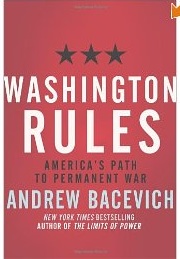
Andrew J. Bacevich’s latest book, Washington Rules: America’s Path to Permanent War, arrives in stores this week.

In what should serve as an introduction to his book, Bacevich‘s recent essay on TomDispatch.com is entitled: “The End of (Military) History?: The United States, Israel and the Failure of the Western Way of War”.

A career army officer who is now a professor of international relations at Boston University, Bacevich has, since 2005, produced four books that cover both US foreign policy and the role the military plays in that policy.

His earlier books are The Limits of Power (2008)The Long War (2007) andThe New American Militarism (2005).

Bacevich is a 1969 West Point graduate. He served in the United States Army during the Vietnam War, in 1970 to 1971.  He held posts in Germany, including the 11th Armored Cavalry Regiment, the United States, and the Persian Gulf before he retired with the rank of Colonel in the early 1990s.

He holds a doctorate in American Diplomatic History from Princeton University, and taught at West Point and Johns Hopkins University prior to joining the faculty at Boston University in 1998.

On May 13, 2007, Bacevich’s son, Andrew J. Bacevich, Jr., was killed in action in Iraq by an improvised explosive device south of Samarra in Salah ad Din Governate.

Bacevich’s essay, and his new book, are warnings to Americans, and to Israelis, that we are racing down our mutual “path to permanent war”.

This summer, Israel is acting very much like a preprogrammed Manchurian Candidate, in its determination to stay on the path toward war with Iran.

In John Frankenheimer’s 1962 film, a former Korean War POW is brainwashed by Communists into becoming a political assassin.

Only this time it is not just one soldier who has been brainwashed, but the nation of Israel which is being pushed by a radical Zionist government toward an attack on the ancient land, people and culture of Persia.

Two earlier World Wars between the “great” Western powers, which Bacevich describes as “armed conflict in the industrial age [which] reached new heights of lethality and destructiveness,”  inflicted “staggering material, psychological and moral damage.”

Wars can no longer be won. European nations know this, which accounts, in part, for their reluctant and minimum involvement in both Iraq and Afghanistan.

Only two democracies failed to grasp the reality that war is never a solution–the US and Israel, both of  which continue down their mutual path “to permanent war”.

The US and Israel pretend to pursue lofty and peaceful goals, but in the lexicon of American and Israeli politics, peace is a codeword for forcing an enemy to accept a condition of  “permanent inferiority”.

In their own special way, the US and Israel cry peace, when, as Bacevich writes, it is obvious that in both countries, the civilian and military elites “prepare obsessively for war.”

The Jewish settler movement, with government support, created “facts on the ground” with waves of Jewish settlements under the pretense that permanent settlements would enhance Israel’s security. Instead, as Bacevich points out, the settlers “succeeded chiefly in shackling Israel to a rapidly growing and resentful Palestinian population that it could neither pacify nor assimilate.

The “shock and awe” invasion by US troops in Iraq and Afghanistan, followed by what is obviously a permanent occupation of both countries are part of that permanent war, guaranteeing hostility and resistance to the presence of foreign troops.

Our presence in Iraq and Afghanistan, Bacevich writes in a Washington Post column, has proven to be enormously destructive to our all-volunteer army.
To be an American soldier today is to serve a people who find nothing amiss in the prospect of armed conflict without end. Once begun, wars continue, persisting regardless of whether they receive public support.

President Obama’s insistence to the contrary notwithstanding, this nation is not even remotely “at” war. In explaining his decision to change commanders without changing course in Afghanistan, the president offered this rhetorical flourish: “Americans don’t flinch in the face of difficult truths.”

In fact, when it comes to war, the American people avert their eyes from difficult truths. Largely unaffected by events in Afghanistan and Iraq and preoccupied with problems much closer to home, they have demonstrated a fine ability to tune out war. Soldiers (and their families) are left holding the bag.
In his TomDispatch essay, Bacevich writes:
If any overarching conclusion emerges from the Afghan and Iraq Wars (and from their Israeli equivalents), it is this: victory is a chimera.  Counting on today’s enemy to yield in the face of superior force makes about as much sense as buying lottery tickets to pay the mortgage: you better be really lucky.
As Bacevich traces recent military history, he finds:
By 2007, the  American officer corps itself gave up on victory, although without giving up on war. First in Iraq, then in Afghanistan, priorities shifted. High-ranking generals shelved their expectations of winning–at least as a Rabin or Schwarzkopf would have understood that term.  They sought instead not to lose.

In Washington, as in US military command posts, the avoidance of outright defeat emerged as the new gold standard of success. As a consequence, US troops today sally forth from their base camps not to defeat the enemy, but to “protect the people”, consistent with the latest doctrinal fashion.

Meanwhile, tea-sipping US commanders cut deals with warlords and tribal chieftains in hopes of persuading guerrillas to lay down their arms. . . For the conflicts in which the United States finds itself enmeshed, “military solutions” do not exist.

As [General David] Petraeus himself has emphasized, we cannot “kill our way out of” the fix we’re in.

In this way, he also pronounced a eulogy on the Western conception of warfare of the last two centuries.

What, exactly is the “credo” by which American foreign policy is driven?

Bacevich:

In the simplest terms, the American credo summons the United States–and the United States alone–to lead, save, liberate and ultimately transform the world.

In a celebrated manifesto issued at the dawn of what he termed ‘the American Century’, Henry R. Luce made the case for this spacious conception of global leadership. Writing in Life magazine in early 1941, the influential publisher exhorted his fellow citizens to ‘accept wholeheartedly our duty to exert on the world the full impact of our influence for which purposes as we see fit and by such means as we see fit.’

Luce’s concept of an American Century, “an age of unquestioned American global primacy, resonated, especially in Washington. It quickly found a permanent place in the lexicon of national politics.

Even today, whenever public figures allude to America’s responsibility to lead, they signal their fidelity to this creed. Along with respectful allusions to God and “the troops,” adherence to Luce’s credo has become a de facto prerequisite for high office. Question its claims and your prospects of being heard in the hubbub of national politics become nil.

The credo emphasizes “activism over example, hard power over soft, and coercion (often styled ‘negotiating from a postion of strength’) over persuasion.”

Above all, the exercise of global leadership as prescribed by the credo, obliges the United States to maintain military capabilities staggeringly in excess of those required for self-defense. After World War II, “an affinity for military might, emerged as central to the American identity”.

Looking back over the last sixty years of US military policy and practice and a continuity emerges. Bacevich calls these consistent elements:

the sacred trinity: an abiding conviction that the minimum essentials of international peace and order require the United States to maintain a global military presence, to configure its forces for global power projection, and to counter existing or anticipated thrusts by relying on a policy of global interventionism. (p. 14)

The relationship between the “credo” and the “sacred trinity” which outlines how the United States is to maintain its global expansion and international control is important. “The trinity lends plausibility to the credo’s vast claims.”

Whichever political party holds power in Washington, the credo and the trinity will always provide the basis for an enduring consensus that guarantees a consistency to US policy.

Bacevich insists “from the era of Harry Truman to the age of Barack Obama, that consensus has remained intact. It defines the rules to which Washington adheres; it determines the precepts by which Washington rules.”

In this sense, Washington is “less a geographic expression than a set of interlocking institutions headed by people who, acting officially or unofficially, are able to put a thumb on the helm of state.”

Those institutions always include the branches of the federal government, the principal components of the “national security state”, the departments of Defense, State, and more recently, Homeland Security, along with the agencies that comprise the intelligence and federal law enforcement communities.

When Senator Joe Lieberman demanded the chairmanship of Homeland Security Senate Committee; when the Israel Lobby went nuts over the thought of Charles Freeman as chair of the National Intelligence Council; and when Dennis C. Blair, who initially appointed Freeman, lasted only a year as Director of National Intelligence, the keepers of the “Washington Rules” knew what was going on.

The consensus had to be protected. The “credo” had to be secure and the US-Israel team had to be free to carry out the dictates of the “sacred trinity”, global military presence; global power projection and global interventionism. That is why Bacevich calls them sacred; they must be honored.

Did President Obama, who promised us change, know what was going on? He does now.

What other entities are involved in maintaining and protecting the “credo”? Here are a few listed by Bacevich: “select think tanks and interest groups, lawyers, lobbyists, fixers, former government officials and retired military officers who still enjoy ‘access’.”

Beyond the Beltway [outside Washington] the protectors of the “Washington Rules” Bacevich’s list includes “big banks, and other financial institutions, defense contractors and major corporations, television networks and elite publications like the New York Times, even quasi-academic entities like the Council of Foreign Relations and Harvard’s Kennedy School of Government.”

You want to enter and remain in the world that runs this nation? Know the “rules” and keep them inviolate.

Bacevich gives the reader five reasons why he wrote Washington Rules:

first to trace the origins and evolution of the Washington Rules–both the credo that inspires consensus and the trinity in which it finds expression;

second, to subject the resulting consensus to critical inspection, showing who wins and who loses and also who foots the bill;

third, to explain how the Washington rules are perpetuated, with certain views privileged while others are disreputable;

fourth, to demonstrate that the rules themselves have lost whatever utility they may once have possessed, with their implications increasingly pernicious and their costs increasingly unaffordable;

and finally, to argue for readmitting “disreputable (or ‘radical’ ) views to our national security debate, in effect legitimating alternatives to the status quo.”

It is a heavy order Bacevich has served up for us. As I read and reread his five points, I find myself no longer depressed over the state of our nation but immensely encouraged to keep moving forward. There is too much at stake to give up now.

It is time to change the system from within. Is President Obama the Change Agent we had hoped he would be? Still too soon to tell.

There are occasional signs the President knows he is trapped inside the binding chains of the Washington Rules. He needs our help if he is to break the chains which are leading us further along the “path to permanent war”.

The picture above: A US Marine patrol moves through a sand storm in March, 2009, in Qalanderabed in souhwest Afghanistan. ( by John Moore/Getty Images). Image from Boston.com.

Posted in Middle East Politics | 11 Comments

Freeman To Goldstone to Sherrod: An 18-Month Obama Nightmare

by James M. Wall

Richard Goldstone, Chas Freeman, Shirley Sherrod.

If you figure ‘Shirley” as a nickname for a first baseman, “Freeman to Goldstone to Sherrod” could be a modern day version of the celebrated double play Chicago Cubs’ combination of  “Tinkers to Evers to Chance”.

It could even be a prestigious law firm on LaSalle Street in Obama’s hometown of Chicago. It is neither.

It is, rather, a series of events that has produced an 18-month nightmare for Barack Obama.

“Freeman to Goldstone to Sherrod”, is a Washington disaster, an accumulation of three major presidential stumbles, each of which could easily have been avoided. What they have in common is poor staff work and a president overly sensitive to political calculations.

The main stream media (MSM) played a major role in helping to enable these stumbles. It did so by going for the quick and shallow headline and analysis that now permeates the 24-7 news cycle.

Two of these major stumbles involve Israel, which means the MSM did nothing to probe beneath the prevailing conventional wisdom that would have cut through pro-Israel bias and asked harder questions as to what really was happening in these two stumbles.

The Israeli media did a far better job of reporting on the Freeman and Goldstone stumbles than did any MSM outlet in the US. It was not because of ignorance that the US  media failed to cover Freeman and Goldstone.

The internet brings the Israeli and Arab media into every newsroom of every media outlet in the US. The story was there, but the media is a part of the alliance of the pro-Israel MSM media and American politics that  protect the White House from having to face the unpopular truth about Israel.  That is why it is called “enabling”.

The Sherrod stumble, however, involves race, which the MSM jumped on with vigor, once its initial part in pushing a false story was exposed by some simple research.

This stumble is the third in the “Freeman to Goldstone to Sherrod” series, but since it is the most recent stumble, it is better known than the other two.

Because the MSM has a shared belief in matters racial, the MSM quickly filled in details of the Sherrod affair and brought the distortions to the public’s attention.

The MSM reversal also brought an immediate apology from President Obama and his personal request that Sherrod “stay in” government service. The call, however, did not come until it became obvious that she had been grossly maligned.

This third White House stumble should have been an easy call for an African American president. Instead, for reasons as yet unclear, President Obama did nothing to prevent  the initial White House attack on Sherrod.

There is a common thread that connects these three Obama stumbles, “Freeman to Goldstone to Sherrod”: Atrociously bad staff advice driven by cold calculating politics, and the failure of President Obama to overrule bad advice and declare, firmly: We will do the right thing.

The right thing in the matter of Shirley Sherrod was to forget about the 24-7 news cycle and not worry that  Glenn Beck will run with the story while the White House pauses to check it out. Later, much too late, check it out is exactly what the White House finally did.

This story began on Monday, July 19. Sherrod was driving her car from Columbus, Georgia to Athens, Georgia, when she received a message that the White House wanted her to resign her position as the Georgia director of the US Department of Agriculture office of Rural Development.

The call came from the USDA’s deputy undersecretary Cheryl Cook. Sherrod told the Associated Press:

“They called me twice. The last time they asked me to pull over on the side of the road and submit my resignation on my Blackberry, and that’s what I did.”

The New York Daily News had a detailed story on Sherrod’s firing:

The controversy began after several media organizations posted a 38-second video clip of Sherrod speaking to a local Georgia chapter of the NAACP. She tells the group that she did not give a white farmer “the full force of what I could do” after he asked for assistance.   The video surfaced days after the NAACP quarreled with Tea Party members over allegations of racism.

Sherrod said her statements were taken out of context. “My point in telling that story is that working with him helped me to see that it wasn’t a black and white issue,” she said. Sherrod added that the episode took place in 1986 before she worked for the Agriculture Department. Sherrod said that she eventually became friends with the farmer and worked with him for two years to help him avoid foreclosure.
How could the first African American president allow this to happen?

Maureen Dowd’s New York Times column offers a simple explanation of how the Sherrod stumble could have been avoided.

The Obama White House is too white. It has Barack Obama, raised in the Hawaiian hood and Indonesia, and Valerie Jarrett, who spent her early years in Iran.

But unlike Bill Clinton, who never needed help fathoming Southern black culture, Obama lacks advisers who are descended from the central African-American experience, ones who understand “the slave thing,” as a top black Democrat dryly puts it.

Dowd has a simple solution.  It is time to rethink the make up of the White House staff:

The first black president should expand beyond his campaign security blanket, the smug cordon of overprotective white guys surrounding him. . . . Otherwise, this administration will keep tripping over race rather than inspiring on race.

The West Wing white guys who pushed to ditch Shirley Sherrod before Glenn Beck could pounce not only didn’t bother to Google, they weren’t familiar enough with civil rights history to recognize the name Sherrod. And they didn’t return the calls and e-mail of prominent blacks who tried to alert them that something was wrong.

Charles Sherrod, Shirley’s husband, was a Freedom Rider who, along with the civil rights hero John Lewis, was a key member of the Student Nonviolent Coordinating Committee of the ‘60s.

As Lewis, the longtime Georgia congressman, told The Atlanta Journal-Constitution, he knew immediately that something was amiss with the distorted video clip of Sherrod talking to the NAACP.

“I’ve known these two individuals — the husband for more than 50 years and the wife for at least 35, 40 — and there’s not a racist hair on their heads or anyplace else on their bodies,” Lewis said.

We may not have a “nation of cowards” on race, as Attorney General Eric Holder contended, but we may have a West Wing of cowards on race

The firing of Chas Freeman was the first White House stumble in President Obama’s 18 month nightmare. It is also one that President Obama has refused to acknowledge.  One reason: His White House “white guys” are as fixed on the Israeli side of  the Israel-Palestine issue as they are trapped in their whiteness in advising the President on racial matters.

Besides, the MSM makes no effort to understand the Palestinian side of the issue; hence no pressure from the media.

The first of his series of blunders began when, in late February, 2009, Obama appointed the veteran diplomat Chas Freeman  to serve as Chairman of the National Intelligence Council (NIC).

Ambassador Freeman came highly recommended, but he was also on record as having committed the Number One Washington Sin in all matters Israeli. He had uttered public criticism of actions by the Jewish state.

His appointment evoked an all-out smear attack which has become common place in US right wing media.  It was McCarthyism at its worst.

Freeman’s post was too far down the food chain to require Senate approval, but the right wing noise machine put together attacks from politicians and pundits to force the president to withdraw Freeman’s name on March 11, 2009.

Much credit for the success of the Freeman smear campaign goes to a well known Senate PEP (Progressive Except on Palestine), New York’s Charles Schumer. Schumer called his White House friend Rahm Emanuel, with clear instructions: The Freeman appointment must not stand.

On his blog, Informed Comment, Juan Cole has a detailed analysis of how Freeman was named and then dropped. It is must reading.

The second major stumble in the “Freeman to Goldstone to Sherrod” series quickly followed the Freeman Affair. It was the mishandling of the Goldstone Report by the White House, a huge mistake since it was clear that the evidence discovered by Goldstone would eventually be shown to be valid.

Obama has refused to acknowledge that he was wrong to reject the Goldstone Report, which was researched and written by a committee headed by Judge Goldstone.

The Goldstone committee was asked by UN Secretary General Ban Ki-moon to investigate possible war crimes and crimes against humanity during Israel’s December 2008-January 2009  blitz against Gaza which claimed nearly 1400 Palestinian lives.

This invasion of Gaza took place during the final days of the George W. Bush presidency, ending on the eve of President Obama’s inauguration.

The delivery of Judge Goldstone’s report to the UN and then to Israel was initially rejected by Israel, which announced that it would conduct its own investigation

In the face of world-wide support for the UN Goldstone Report, President Obama worked to squash the Goldstone Report, sending it off to bureaucratic oblivion rather than have Israel suffer further exposure for its conduct in the January 2008-2009 invasion.

Writing in the South African publication, Business Day, Allister Sparks reports that the Israeli military’s own investigation has been completed, with results that vindicate much of the Goldstone Report.

After carrying out its own investigation into last year’s Gaza War, the Israeli military has finally confirmed several of the most serious incidents committed by its troops in that 22-day assault, which a United Nations commission of inquiry, headed by our own Judge Richard Goldstone, reported on last September.

In a low-key report released two weeks ago that seems to have escaped the attention of the entire South African media, perhaps because of its preoccupation with the Fifa World Cup at the time, the military has confirmed that three of the most serious findings of Goldstone’s egregiously vilified report were true.

It has confirmed the fatal shooting by a marksman of an unarmed man (the Goldstone Commission said a man and a woman were killed) walking with a group of Palestinians waving a white “surrender” flag; the shelling of a mosque during a prayer service, causing casualties among the worshippers; and the ordering of a criminal investigation into a fatal air strike on a house where about 100 members of an extended Palestinian family, the Samounis, were sheltering on the advice of the Israeli Defence Force.

The Samouni case caused particular outrage worldwide because Israeli forces prevented Palestinian paramedics from entering the house for days after the strike.

When Red Cross workers eventually got into the house, they found four emaciated Samouni children, who had been trapped there for days with their mothers’ corpses. In all, 30 Samounis died.

So far, no American MSM has referred to this story by Sparks, nor published any detailed information on the IDF’s own findings on the conduct of its troops. My source is Helen Cobban’s blog, Just World News. She writes:


The great, strongly anti-Apartheid South African journalist Allister Sparks has penned a powerful rebuke of his country’s Chief Rabbi, Warren Goldstein, over the latter’s strongly expressed criticism of Constitutional Court member Richard Goldstone, and Goldstone’s role in heading the UN’s fact-finding mission for Gaza.

Sparks starts by noting that three of the major IDF war crimes reported by the Goldstone Commission in Gaza were in fact recently confirmed to have been such by a military investigation undertaken by the IDF high command itself.

He comments, “the real importance of this military investigation is that it vindicates the Goldstone commission,” adding:

For Judge Richard Goldstone, particularly, this is a personal vindication, for he was excoriated by leading members of the local Jewish community for chairing the commission. He was told his commission’s findings were lies; that he was naive and gullible for accepting the version of events given by terrorists; and that, since he is a Jew, he was a traitor to his people.

His critics were [supported] by Chief Rabbi Warren Goldstein, who chastised Goldstone for “doing great damage to the state of Israel”. He should have recused himself instead, Goldstein said, and taken no part in the investigating mission.

Sparks concludes his article by issuing this final reproach to South Africa’s Chief Rabbi, Warren Goldstein:

We secularists need to know what a religious leader in our community means when he seeks to impose such an ethical dictum on a prominent member of his faith [Judge Richard Goldstone] — someone who was a founding father of our Constitutional Court and an interpreter of our infinitely important national constitution in this new democracy.


Posted in Media, Middle East Politics, Religion and politics, The Human Condition | 2 Comments

Who “Won” the PCUSA Assembly? The Answer May Surprise You

by James M. Wall

(See Updated Comment from PCUSA Commissioner Pete Bloss at end of Comments.)

Who “won” the Minneapolis Presbyterian Church (USA) General Assembly?

To answer that question, we first need to ask, who did not win?

The religious arm of the Israel Lobby did not win, in spite of what you may have read in Newsweek, in the Los Angeles Times and in the  American Jewish media.

When a “What’s Good for Israel” spin is set in rapid motion, you know you are witnessing the work of an operation that left Minneapolis surprised and disappointed at the outcome.

Something had to be done, and quickly, before the public–and the folks back in Tel Aviv–heard that the Protestant/Israeli Iron Wall had been breached.

Something, indeed, had to be done, and that something was to launch a ”save the Jewish-Christian dialogue” media blitz. The blitz included a second Newsweek appearance this month in a column by Katharine R. Henderson,  president of Auburn Theological Seminary.

With respected Protestant leaders like Henderson as allies, the state of Israel tried to do exactly what the US private healthcare industry did when it kept a public option out of President Obama’s health care bill: Control the process in their favor.

In a fancy bit of footwork, health care lobbyist Liz Fowler rotated between a job as a public policy adviser to WellPoint Inc, the nation’s largest publicly traded health benefits company, and a position as a top advisor to Senate Finance Committee chairman Max Baucus (D-Mont), who receives massive campaign funds from the insurance industry.

Bill Moyers reported on his television program how Fowler killed the public option in the bill. Fowler, by the way, has a new job. President Obama asked her to implement the health care bill for the administration. This news appeared July 14, in the Billings Gazette. The national media ignored the story.  The revolving door between lobbyists and government appointments is no longer important in Washington.

That is how the Lobby system works. A lobby recruits allies, develops plans, cultivates decision makers, and pays to control the final outcome of legislation affecting its client. With Liz Fowler in control, the private health care industry got the health care bill the health care industry wanted.

It works the same way with the Israel Lobby. Experienced in such matters, the Lobby knew what it had to do when confronted by all those “bleeding heart” Progressives in the Presbyterian Church (USA), which for years has been the lobby’s greatest nightmare, a denomination that will not stay on the reservation.

The Lobby has had a much easier time of it with Episcopalians and Lutherans, historic state churches accustomed to following a national consensus.

But oh, those Presbyterians. It was time for the Lobby to call on friendships inside the denomination, cultivated over many years with a single goal in mind: Protect, by any means possible, the “fragile” relationships between Christians and Jews.

Here is how it works:

Give a rabbi and a neighboring Presbyterian pastor free passage to the Holy Land. Provide their church and synagogue members with low rates in Israel’s finer hotels. Travelers walk where Jesus walked.

By the time Holy Land travelers prepare to return home, religiously aglow, the entire delegation will be singing “kum ba yah” around the closing banquet table.

Some of those Presbyterian travelers might end up as voting commissioners when the General Assembly of the PCUSA meets to discuss a “controversial” report on the Israel-Palestine situation.

I do not know the background of one PCUSA commissioner who came to Minneapolis to vote on that  “controversial” report in Minneapolis in early July. I have no idea why he thinks the way he thinks. (For

But I do know his story, because he told it to Josh Nathan-Kazis, who wrote about this particular commissioner for the on line edition of the national Jewish publication, Forward.

This commissioner sure sounds like he has sung a few choruses of “kum ba yah” with his Jewish neighbors, as is his right, and indeed duty, as a member of the Jewish-Christian dialogue caucus in the PCUSA.

The blogger’s headline, Presbyterians Tone Down Report On Israel After Jewish Lobbying, could serve as a text for our discussion here on how lobbying works when it involves Presbyterians and Jewish lobbyists.

Here is how the Forward blogger tells the story:

Ask Pete Bloss why he worked against resolutions critical of Israel at the general assembly of the largest Presbyterian group in the United States, and the Gulfport, Miss., resident speaks more about Hurricane Katrina than about Israeli policy.

“The richness and diversity of points of view in the Jewish community really became clear to us when Jewish college groups started arriving,” he said, recalling the Jews who worked with his church on reconstruction projects after the 2005 disaster. “

We koshered our kitchen for several weeks.… We had rabbis teaching the Old Testament in our Sunday school classes. It was just wonderful to share things.”

An elder in his local Presbyterian church, and a practicing attorney, Bloss said that hosting the influx of Jews who came to help “probably energized us, and people like me, to say that when incredibly unbalanced things were taking place with the general assembly, that we wanted to try to be a part of bringing that back into balance.”

Commissioner  Pete Bloss went to Minneapolis to cast votes on matters related to a resolution presented by a General Assembly Committee.  He believes he witnessed “incredibly unbalanced things” taking place at the GA.  He was determined to play a part in “bringing that back into balance”.

(See Comment below from Commissioner Pete Bloss, written in response to this posting.)

There, in a nutshell, was the battle of Minneapolis, the 219th General Assembly of the PCUSA, as witnessed by one of the soldiers involved, an attorney from Mississippi.

The “incredibly unbalanced things” Commissioner Bloss was determined to bring back into balance included the PCUSA’s acceptance of the overture, Toward Peace and Reconciliation in Mideast (supporting the Goldstone Report).

The Goldstone overture was supported in committee, 38-9, with 5 abstentions. It was accepted by the full plenary. The overture may be read on line.

The MESC report endorsed an overture which calls on the US government to end all military funding to Israel until Israel agrees to stop settlement construction. It passed in the committee 47 to 1 vote, with 3 abstentions.

The military aid overture was also  approved by the General Assembly plenary.

On July 16, six days after the GA ended,, the Palestinian organization Miftah reported that US Assistant Secretary of State Andrew Shapiro announced that the US would give Israel “the largest security package ever, $2.775 billion to “help advance the peace process with the Palestinians”.

The GA received the “controversial” Kairos theological statement which had been written by leaders of the Christian churches in Palestine and sent to American churches.

What makes it “controversial” is that it reflects the influence of liberation theology (read a concise history of of Liberation Theology, here), which reached international theological acceptance through:

Lectures given by Gustavo Gutiérrez in Montreal in 1967, and at Chimbote in Peru on the poverty of the Third World and the challenge it posed to the development of a pastoral strategy of liberation were a further powerful impetus toward a theology of liberation.

Its outlines were first put forward at the theological congress at Cartigny, Switzerland, in 1969: “Toward a Theology of Liberation.”

The importance of the Kairos document to the Palestinians was summed up by one GA Commissioner who said, “Kairos is for Palestinians what the Letter from a Birmingham Jail is for African-Americans.”

So it was that the supporters of the Middle East Study Committee report, which was eventually adopted by the General Assembly, with modifications, retained  the Kairos document intact, including its reliance on liberation theology.

BDS (boycott, divestment, sanctions) also remains in the MESC report, accepted by the GA. Its presence in the GA-accepted document remains as an anathema to the Jewish-Christian Dialogue supporters among GA commissioners.

The MESC Report did not ask the plenary to divest its funds from Caterpillar. However, the permanent GA committee on investments had agreed to “denounce” Caterpillar for refusing to respond to PCUSA objections to CAT’s sale of bulldozers to Israel.

On July 13, three days after the close of the GA, Miftah reported that “Israeli occupation authorities demolished six houses in the eastern sector of the city in Essawiyeh and Beit Hanania. One of the homes, located in Beit Hanania, was inhabited at the time it was demolished.”

The Kairos document emphasis on liberation theology remains in the GA’s final report. It is available for study and application in individual congregations.

Coinciding with the news of the US “security” $2.775 billion gift to Israel, and the destruction of the home in Beit Hanania with the family still inside, a second column on the GA appeared in Newsweek, co-authored by Auburn Theological Seminary President Katherine Henderson.


Her first column on the GA was co-authored with Gus Niebuhr; this second one was written with Henderson’s Auburn colleague, J.C. Austin.

Henderson moonlights as a regular contributor for Newsweek. This second column gets right down to some 1960s civil rights history that Newsweek readers would remember, even those largely unfamiliar with Presbyterians.

The Henderson-Austin column begins with the familiar trope, “what does Athens have to do with Jerusalem”.

What does the Presbyterian Church (USA) have to do with the Middle East anyway? For us, the conflict is personal. We have a long history of friendship and collaboration with the Jewish community. We stood side-by-side in the Civil Rights struggle, forging a deep bond in the crucible of jail cells.

To this day, we work together on issues like poverty and immigration, convinced we share similar values for “repairing the world” and that we can be more effective together.

The problem with evoking the civil rights era is that the issues before the General Assembly this summer were not about past struggles for civil rights in the US. At Minneapolis the issue was the violations of human rights of Christians, Jews AND Muslims, today, at this very moment in Israel/Palestine.

Henderson-Austin did finally get to the Palestinians, but only to some of them.

And Presbyterians have a long history with Palestinians, too, especially the Christian community. Palestinian Christians come to the United States to study in our seminaries and work with our churches.

When we take our pilgrimages to the Holy Land, we go to Jerusalem and Bethlehem and the Galilee not simply to see the sights and buildings testifying to the history of Christianity, but the “living stones” of our faith in the region, the Palestinian people who have kept the faith alive since Jesus walked those lands and to whom we are bound in shared belief and ministry and spirit.

That is embarrassing. “Especially the Christian community”? Don’t they hear what they are writing? They embrace only certain Palestinians?

Did Henderson’s fellow Holy Land travelers ever once ask their Israeli guides to take them to Gaza to visit the Muslim mosque built over the traditional site of Samson’s suicidal show of strength? (Judges 16:1)

Muslims are God’s children. They are not “others”, but part of our common humanity. In God there is no “us” and no “others”. “Us and them” is a western colonial concept which is both immoral and evil.

So who, exactly, won at Minneapolis?

Bottom line is that the Presbyterian Church (USA) General Assembly made enormous progress in its 219th assembly by linking military aid to Israeli settlements, denouncing Caterpillar, approving a Kairos document written by Palestinian Christian leaders, and, by demanding that the Jewish-Christian Dialogue study paper, which was expected to receive an easy endorsement, be rejected and sent back for further development.

Is that a “win”? You decide.

This much we do know, for sure, when the next set of General Assembly commissioners see the Jewish-Christian Dialogue study paper, they expect to see a document written with “more people at the table”, including Palestinian Christians.

And who knows, maybe the new table will include Muslim representatives, fellow religionists who lived peacefully with their Jewish and Christian neighbors in Palestine until the Zionist enterprise entered the modern political picture.

The picture at the top is an AFP/Gettty image of children in Gaza. It appeared on the Middle East Channel, a Foreign Policy blog.

Posted in Middle East, Religious Faith | 16 Comments

This is No Longer Your Daddy’s Presbyterian Church (USA)

by James M. Wall

When commissioners to the 219th Presbyterian Church (USA) General Assembly left Minneapolis, they departed from a GA that achieved amazing, surprising, and unexpected results.

Reports on the Assembly in the secular media were formulaic, shaped by the American Jewish-Christian dialogue paradigm, which has been carefully built and sustained over many decades by the Israeli Hasbara (hebrew for “propaganda” or, more politely, “explanation”.)

The New York Times reported on the GA actions with a short summary that was one-third about the GA actions, and two-thirds about Jewish response to those actions.

Nothing, of course, about any Muslim reactions, of which more later.

The Los Angeles Times had its usual “middle ground” lead, written by Mitchell Landsberg. Notice that his focus is not on the Presbyterians, but on the fact that the report included criticism of Israel.

In sports writing culture, this is known as reporting from the perspective of the home team.

A week ago, the Presbyterian Church USA seemed headed for a bruising, polarizing battle over a report on the Middle East that sharply criticized Israel.

On Friday, meeting in Minneapolis, the church’s General Assembly overwhelmingly passed a resolution that seemed to placate nearly everyone on both sides of the issue — a “miracle,” some said, that offered hope to those who see the Mideast as hopelessly deadlocked.

Sorry, Mitch, but you missed the final inning rally by the visiting team.

The big story out of Minneapolis is that this is no longer your Daddy’s Presbyterian Church.

Of course, there were compromises by GA commissioners–this is, after all, a democratic body–but “placating nearly everyone”? Not even close.

Here, in summary, are key decisions reached by the 129th General Assembly during the week of July 3-10, 2010:

Approved a comprehensive report on the Middle East – its first since 1997–which calls for the following actions.

Called for an immediate cessation of all violence, whether perpetrated by Israelis or Palestinians;

Reaffirmed Israel’s right to exist as a sovereign nation within secure and internationally recognized borders

The end of the Israeli occupation of Palestinian territories;

An immediate freeze on the establishment and expansion of Israeli settlements in the West Bank, and on the Israeli acquisition of Palestinian land and buildings in East Jerusalem.

The General Assembly got down to the hard stuff when it “approved” the report of the Mission Responsibility Through its Investment (MRTI) committee, an ongoing unit of governance that identifies corporations and businesses deemed worthy or unworthy for the approved investment list.

The MRTI has compiled its list on instructions from General Assemblies in 2004, 2006 and 2008.

The committee reached a compromise in its report by acknowledging “that Caterpillar has in many ways provided positive leadership to its community, its state, and the nation.

It has donated considerable resources and equipment in support of local development and disaster relief at home and overseas.

It has significantly improved workplace safety, acted aggressively to reduce greenhouse gas emissions, and pursued environmental conservation within its production processes.

That was the carrot.

MRTI followed with a stick by “asking the GA to strongly denounce Caterpillar’s continued profit‐making from non‐peaceful uses of a number of its products on the basis of Christian principles and as a matter of social witness.

The MRTI also “calls upon Caterpillar to carefully review its involvement in obstacles to a just and lasting peace in Israel‐Palestine, and to take affirmative steps to end its complicity in the violation of human rights.

This carrot and stick compromise was reached by the GA to avoid the dreaded step of “divesting” from Caterpillar.

It is pretty clear that BDS has its avid backers within the church, but they are still in the minority. For that reason, compromise was inevitable.

Denouncing, however, keeps CAT on the hot seat, provoking one commissioner to comment to a small group that since CAT would not go bankrupt if it lost Presbyterian investments (hardly), why not just go ahead and divest and leave the Peoria, Illinois-based company alone.

The answer, I suspect, lies in the reluctance among Americans to use economic tools against an “ally”–as opposed to, say, Iran, North Korea, or Cuba, you know, our “enemies”.

The Jewish-Christian dialogue paradigm is too deeply rooted, so far, to overcome resistance to the use of BDS as a tool to confront an “ally” on a justice issue.

Resistance to BDS is not strong in, for example, Great Britain, where the Methodist Church just approved a boycott of settlement products, of which there are many in the UK, especially produce.

In  France, a major labor union just agreed not to work on Israeli projects.

These are clear signs that the old ark is a moving.

Because BDS is gaining such worldwide acceptance, the Hasbara has increased its campaign against those US churches which threatens to break ranks.  It has not been totally successful.  The Northern Illinois United Methodist Conference, for example, recently voted to divest from Caterpillar.

The pressure on the Presbyterians was felt at the GA during consideration of Kairos, a Palestinian  theological  document approved for study by the GA.

Through some parliamentary moves that would have made Nancy Pelosi proud, the GA agreed to approve the Kairos document, and send it to local churches for study.  At the same time, the GA did not approve a section of the Kairos document that advocates BDS.

GA approval, however, sends Kairos to local churches, where the full document, including the BDS section, will be available for study.  Will every church look carefully at BDS? Some will, some won’t.

It is important to note that the Kairos document was developed by leaders of the Palestinian Christian church bodies. It is a theologically-based request for justice and peace in Palestine.

One letter to commissioners sent by a coalition of US Jewish organizations, was harshly critical of the Kairos document on theological grounds.  The coalition dismissed Kairos as a statement written “by a few Palestinian Christians”.

A principal author of Kairos is Mitri Raheb  (right), a Palestinian Christian, who is the pastor of the Evangelical Lutheran Christmas Church in Bethlehem. He is founder and president of the Diyar Consortium, a group of Lutheran-based, ecumenically-oriented institutions serving the Bethlehem area.

Raheb was in Minneapolis to speak to commissioners. He earned his advance degrees in theology in Germany, first at Hermannsburg Mission Seminary (1984) and then at Philipps University in Marburg, Germany (1988).

Which bring us to what is for me, the “really big story” (think Ed Sullivan) in Minneapolis:

I am talking here about the GA’s overwhelming vote to demand a revision of a Jewish-Christian dialogue study paper because it lacked sufficient Palestinian Christian input.

I interviewed one commissioner who agreed with me that this story is significant, but she figures it is too “in house” to be important to anyone outside the denomination.

I think she is wrong.  What happened to the Jewish-Christian dialogue study paper is nothing less than an ecclesiastical tectonic shift in the history of the Presbyterian Church (USA).

It all started two months before the GA met. An unexpected overture arrived in “Louisville”, the Presbyterian Vatican located far from either the east or west coasts.

The surprise overture was from the San Francisco Presbytery. It proposed that two study papers be revised before approval for use in local congregations.

One was the usual Jewish-Christian dialogue paper; the other was just starting its development, a Muslim-Christian study paper.

The overture from San Francisco just made the filing deadline, but it was in time for Louisville staff to have to open up consideration on both papers.  And that meant the list of authors would have to be made public for discussion in committee.

Alert members of the Israel/Palestine Mission Network (IPMN) realized that the Jewish-Christian dialogue paper’s authors were less than representative of the entire denomination.  Only a few Palestinian Christians were included, none now resident in Palestine itself.

Process–a favorite Presbyterian term–kicked in. By the time the GA received the San Francisco overture, it had been divided into two parts.

The Jewish-Christian dialogue paper was rejected and sent back for further work over the next two years. The Plenary delegates agreed that the paper needed further work “around a larger table”, one that gave more representation to Palestinian Christians.

The Muslim-Christian dialogue paper is still a “work in progress.” By a vote of 548 affirmative; 129 negative, and 4 abstentions, the paper was affirmed and sent out to the churches. Changes and vote totals are here.

This paper will take its place alongside older, well worn Jewish-Christian Dialogue study documents.

Two years from now a revised Jewish-Christian document could be available, reflecting a more Middle Eastern perspective.

That is when the ecclesiastical tectonic shift rumbled through the horse farms of Kentucky. The 219th General Assembly overwhelmingly chose to reach out to its Muslim co-religionists, in defiance of a still prevalent bias against Islam in American culture.

This shift shakes up the Jewish-Christian dialogue paradigm which has controlled American Protestant understanding of the Middle East since the 1947 creation of the modern state of Israel.

The paradigm was, from the beginning, designed as a neat “Us Christians and Us Jews” fighting for survival against those “Others”, outsiders, Muslim Arabs, who not too long ago were called, by Westerners, Mohammadens, (Saracens in Medieval days).

Few Americans knew, until recently, that there is a rich history of Muslim-Christian interaction dating back to the start of Islam in the deserts of Arabia.

The Presbyterians knew, which is why at the 219th General Assembly, they sent to their churches a plan to study that rich history which will enable them to start interacting with their Muslim neighbors on a more positive footing.

It will be that dialogue which will break down walls in American life, walls already under attack from creative funny man and philosopher, Jon Stewart, who skillfully turns bigots against themselves in a recent Comedy Central segment.

Click here to hear from Stewart.

The photo above of a GA commissioner standing in prayer was taken by AP’s Jim Mone. It was printed in the LA Times.

Posted in Middle East, Middle East Politics, Religious Faith | 6 Comments

Post Columnist Milbank Calls Obama-Bibi Meeting A “Surrender”

by James M. Wall

Barack Obama swept into the White House, thanks, in part, to his political and oratorial skills.

He should have learned during his campaign for the US Senate that what he says about race relations at a Southern Illinois county fair will be reported in the African American wards in Chicago.

So what happened to those skills when he hosted Israeli Prime Minister Bibi Netanyahu at the White House this week?

One day after what he described as an “excellent” White House meeting with Netanyahu, President Obama turned his back on the rest of the world, and focused tightly on confronting “the anxiety some Israelis feel toward him.”

The President was determined to reassure  the Israeli public. But did he pause, even for a moment, to consider how his answers would sound to that part of the Israeli public that desperately wants him to stand up to Bibi?

Did he think how demeaning his answers were to Americans who want their president to be their president, and not pander to the prime minister of a foreign nation?

Did he stop to think that his answers would be harmful and offensive to the Arab/Muslim world?  Worse yet, did he care?

Obama was interviewed by Israel’s Channel 2 network reporter Yonit Levy one day after his meeting with Netanyahu.

The story of the interview appeared in the Jerusalem newspaper, Ha’aretz.

Obama responded to Levi’s question by saying that some of the anxiety may stem from the fact  that his “middle name is Hussein, and that creates suspicion.”

“Creates suspicion?” Please, Mr. President, the name Hussein is one you have previously said you carry proudly. What purpose is there in linking “Hussein” to “suspicion”.  That is Fox News talk and we know what you think of Fox News.

The name Hussein “creates suspicion” only to small minded people who hate and fear Muslims. It is beneath Barack Obama to fall into that Fox News bigoted mindset by pandering to an Israeli television audience, most of whom know pandering when they see it.

Unfortunately, the President was just warming up. He went on to brag about the fact that two of his top staff members are Jewish:

Ironically, I’ve got a Chief of Staff named Rahm Israel Emmanuel. My top political advisor is somebody who is a descendent of Holocaust survivors.

The advisor, whom he does not name, is, of course, David Alexrod.

And I am reasonably certain that Alexrod would not have approved of the President Obama’s final comment on this topic:

My closeness to the Jewish American community was probably what propelled me to the US Senate.

That closeness did have a lot to do with the start of your national career, Mr. President, but it is not something you brag about when you claim to be working for a “peace agreement” between Israel and the Palestinians.

Barack Obama has been in this political business long enough to know that what is said on Israeli television, does not stay on Israeli television.  You are not in Vegas anymore, Mr. President.

Bragging about key advisors being Jewish and commenting like a political reporter about the start of your political career would not have impressed Israelis from the hard right political wing of Israeli politics.

Nor were they impressed by the President of the United States pandering to the Israeli prime minister who has yet to give the President even the slightest concession in negotiations with the Palestinian leadership.

Netanyahu made that clear even before he left on his triumphant return to Israel. Reuters reported:

Prime Minister Benjamin Netanyahu signaled on Thursday he would not extend beyond September a 10-month moratorium on new housing starts in settlements in the West Bank.

“I think we’ve done enough. Let’s get on with the talks,” he said, when asked in an appearance at the Council on Foreign Relations in New York whether he would extend the limited freeze he put in place to coax the Palestinians into peace negotiations.

Bibi Netanyahu does not have the slightest intention of making concessions to the Palestinians. Why should he? He has the US Congress in his back pocket. The American public remains under the sway of a decades-old Hasbara campaign that has created a false narrative that Israel is our only friend in the Middle East.

That narrative has been around a long time and its grip on American consciousness is appalling. It is a narrative that should be very much in President Obama’s mind as he confronts Netanyahu’s hard line stance.

Geoffrey Wawro explains how Israel’s power over the US has grown dramatically in his book, Quicksand: America’s Pursuit of Power in the Middle East:

Already in 1948, the Truman administration regretted the arrogance and brutality of Jewish ethnic cleansing in the Arab parts of Palestine but did nothing about it because of Cold War rivalry and fear of what Truman called the “pressure boys” of the Israeli lobby.

Each subsequent administration cried foul–“Henry, they can’t do that to us again,” Nixon wailed to Kissinger in 1973–but failed to crack down on Israeli foul play because of the same worries that creased Truman’s brow. (page 606)

The American media has, of course, long been under the control of Israel’s Hasbara (Hebrew for propaganda or explanation), but of late there have been signs that change may be on the way.

How else to explain a surprising column written by the Washington Post‘s Dana Milbank, under the heading, Netanyahu hears no discouraging words from Obama.

A blue-and-white Israeli flag hung from Blair House. Across Pennsylvania Avenue, the Stars and Stripes was in its usual place atop the White House. But to capture the real significance of Prime Minister Binyamin Netanyahu’s visit with President Obama, White House officials might have instead flown the white flag of surrender.

That is what we might refer to as an “ouch” opening paragraph. Read on, there is more:

Four months ago, the Obama administration made a politically perilous decision to condemn Israel over a controversial new settlement. The Israel lobby reared up, Netanyahu denounced the administration’s actions, Republican leaders sided with Netanyahu, and Democrats ran for cover.

So on Tuesday, Obama, routed and humiliated by his Israeli counterpart, invited Netanyahu back to the White House for what might be called the Oil of Olay Summit: It was all about saving face.

The president, beaming in the Oval Office with a dour Netanyahu at his side, gushed about the “extraordinary friendship between our two countries.” He performed the Full Monty of pro-Israel pandering: “The bond between the United States and Israel is unbreakable” . . .

For that small number of readers for whom “the Full Monty” might not be a familiar movie and play title which has given rise to a term now widely used, suffice it to say that not only does Milbank’s column evoke the image of surrender,  he also manages to slip in a term that five years ago would never have made it past the Post’sHasbara copy desk.

That my friends, is progress toward peace, real peace, not the peace going nowhere around a negotiating table,  but progress toward peace that has begun to shatter the Hasbara grip on American politics.

The picture above is a Wilson/Getty image, used in the Washington Post.

Posted in Middle East Politics | 8 Comments

219th Presbyterian Assembly Faces Its Moment of Truth

by James M. Wall

Five Updates Below;

Presbyterian General Assembly delegates are in Minneapolis this week for their national gathering–held every two years–discussing, praying, arguing, and finally voting, on a wide variety of issues that will determine how the heirs of John Calvin will face the future.

This 219th General Assembly runs from July 3 through July 10.

In a nice bit of timing, John Calvin’s 500th birthday is celebrated on the final day of this year’s Assembly.

At some point during this week, the delegates (commissioners) will vote to approve or disapprove–parts or all–a report from their own Middle East Study Committee (MESC), a report two years in the making. written by a cross-section of church members, officials and clergy.

The MESC vote will be a moment of truth for the 219th Presbyterian General Assembly. Decisions made in Minneapolis will tell the world where the Presbyterian Church, USA, stands on Israel’s military occupation of 4 million Palestinians living in the West Bank and Gaza.

The question before the PCUSA delegates will be simple:

Do we place our moral stamp of approval on the status quo, and call for more dialogue with our American Jewish friends, or do we say to the world that the status quo is immoral, unsustainable and a blatant rejection of the finest traditions of the Jewish faith.

What brought the PCUSA to this moment of truth?

If you want to be ready to fully understand this background and what will be happening in Minneapolis this week, it helps to have a crib sheet.

The Israel/Palestine Mission Network provides the crib sheet on its website, complete with daily updates during the Assembly.

Noushin Framke (pictured here) is writing a daily blog on the IPMN page. Here is a sample from the first day of the Asembly:

Just got back from the moderator election – went so late cuz there were 6 candidates and then we had a hanging chad/diebold issue – voting machines were not working and it took a while to fix the issue – it is not 11 pm and they just adjourned.

Cindy Bolbach from Arlington, VA elected as new moderator – an elder [laity], not clergy – she sure has a keen sense of timing and humor – I like her; she gets it – reminds me of Bea Arthur! and to the question of what about civil unions, she said i am for it but this church is not! Yup – well said.

Jeff Halper [Jewish activist who runs the anti-house demolition NGO in Palestine] did a great talk today on “Is it really apartheid?” He just gets better and better. I recorded the audio – i will see if I can post it on the site soon. [Italics added]

These Assembly meetings can be invigorating and tense. At its previous national meeting in 2008, the General Assembly ran into strong opposition from supporters of Israel inside and outside the denomination who forced the creation of a Middle East Study Committee (MESC). At the time, this was seen as a delaying tactic described as a victory for supporters of Israel.

Two years later the delay is over and the 219th Assembly is in session. The MESC has done its work and is ready with its report.

Members of the Committee were appointed by the three most recent PC (USA) moderators.

The Middle East Study Group spent the past two years in meetings and study sessions, supplemented by trips to Israel/Palestine, where committee members met with both Israeli and Palestinian religious and secular leaders.

The MESC Report will bring eight recommendations to the Minneapolis meeting

A special GA committee, “Committee 14”, will assume legislative control of the MESC report, formally presenting it to the entire Assembly, where it will either be adopted, modified, or rejected.

Delegates who arrived in Minneapolis determined to support the CMES proposals have the additional backing of almost all of the living moderators, both lay and clergy of the PCUSA who presided over the denomination from 1976 through 2010.

These previous moderators sent a “Support Letter for the Middle East Study Committee”, signed by 17 previous moderators, endorsing the findings of the MESC Report and asking delegates to support the recommendations.

This Assembly arrives for its work after the United Kingdom’s National Methodist Conference  held its meeting June 24 to July 1 in Portsmouth, England.  Delegates to that Conference approved eleven resolutions in a report entitled  “Justice for Palestine and Israel”.

The World Council of Churches (WCC) general secretary, Rev. Dr Olav Fykse Tveit, congratulated the Methodists for adopting “important and forward looking resolutions” and for action by the delegates that

called on the Methodist people “to support and engage with [the] boycott of Israeli goods” emanating from illegal settlements as their response to a call of the WCC in 2009, supported by Palestinian Christians in the “Kairos document” and a growing number of Jewish organizations, both inside Israel and worldwide.

The Conference also called for a full arms embargo as an important step towards a just peace in the region.

In addition to this favorable action from the British Methodists and the WCC, the Presbyterians in Minneapolis, should they support the findings of their CMES resolutions, will find considerable support outside the churches for favorable action.

One recent example of an important media voice speaking out against the Israeli policies comes from New York Times columnist, Nicholas Kristof, who recently wrote from Gaza that Israel’s Occupation is “morally repugnant”.

In a second New York Times column, also written from Gaza, Kristof explored the tunnel system that has been getting around Israel’s blockade by trucking in supplies and materials through tunnels dug along the Egyptian/Gaza border.

After his visit to the tunnels, Kristof wrote that Israel should halt its blockade.

No amount of hasbara propaganda can resist the power of voices in the US, like an aroused church public and enlightened journalists like Kristof who have broken through the hasbara campaign barrier.

There is an encouraging parallel between a journalist of Kristof’s stature and the Presbyterian CMES members who made their own site visits to Palestine where they reached the conclusions that now appear in the CMES report to the General Assembly.

Hasbara as a tactic is losing some of its bite, yet another reminder of the wisdom in the phrase often used by Martin Luther King, Jr., “truth crushed to earth, will rise again”.

For those still unfamiliar with the term hasbara, Jane Adas provides a valuable description of the term in an essay she wrote for the November-December, 2009, issue of Link, a publication of Americans for Middle East Understanding (AMEU):

Hasbara literally means “explanation” and is often translated as “public diplomacy,” but can perhaps best be thought of as problem solving through marketing techniques, like rebranding (Israel as the victim of Hamas’ aggression), product placement (hide the Goldstone Report in the darkest, least-frequented corner of the shop), and promotional lingo (“The side that seems to want peace more will win…” from The Israel Project’s 2009 Global Language Dictionary).

Having identified the problem to be solved concerning Israel’s 2006 invasion of Lebanon as Israel’s failure to explain its case, [Prime Minister] Netanyahu, soon after assuming office in February 2008, formed a National Information Directorate within the Prime Minister’s Office tasked with planning the media campaign for the Gaza operation and headed by “hasbara czar” Yarden Vatikay.

The Simon Wiesenthal Center, a strong pro-Israeli NGO in California, headed by Rabbi Abraham Cooper, has been a leading hasbara opponent of the MESC report.

Knowing the report was being developed, the Wiesenthal Center launched an all-out hasbara attack on the MESC report, long before the report was written.

The Wiesenthal Center sent out alerts to its own constituency and to members of the Presbyterian Church, especially delegates to the GA, urging them to send e-mails critical of the yet-to-be published report, to the Louisville headquarters of the denominations.

Members of the academic community are often recruited as hasbara “agents” for reasons future psychological studies will have to determine. No doubt “Friends of Israel” faculty colleagues, either from ethnic, academic or religious motivations, are helpful in making Israel’s case in long chats in the faculty lounge or at academic conferences. They may even have traveled together to visit Israel.

I earlier commented on the essay that appeared in the Christian Century before the start of this current General Assembly. The essay was written by Vanderbilt University Divinity School professors Ted A. Smith and Amy-Jill Levine.

If the delegates want to read a counter theological argument, supporting the CMES report, delivered without venom, I suggest they read a letter from my Jewish friend and colleague, Mark Braverman, which he has submitted to the Christian Century in response to the Smith-Levine essay.

Here is the opening portion of Mark’s letter:


The intent of the Presbyterian Middle East Study Group Report “Breaking Down the Walls” is clear: “To break down these walls that stand in the way of the realization of God’s peaceful and just kingdom.”

But in their critique of the report published in your June 29 issue, Ted Smith and Amy-Jill Levine of Vanderbilt University, strike at the heart of this message. They ask us to believe that the report advocates “a historical narrative that points indirectly to a single state—a new social body—in which a Palestinian majority displaces Jews.”

In a shocking distortion of the Study Group’s evocation of Ephesians 2:14, they claim that “’Breaking down the walls’ in order to form ‘one new humanity in the place of two’ evokes old echoes of theological supersessionism and transposes them into a political key.”

“Old habits die hard,” lament Smith and Levine. But it is the habit of crying anti-Semitism whenever Jewish sensibilities are disturbed or the actions of the State of Israel are questioned that we must urgently confront.

Before you vote in Minneapolis this week, you sons and daughters of John Calvin, read the entire text of Mark Braverman”s letter, which is posted here.

Years from now, when you remember this week, something tells me you will be grateful that Mark Braverman, a Jewish author, shared with us his timely reading of Ephesians 2:14.

Update from blogger on IPMN daily blog:


“Don’t Rock the Boat?”

Don’t rock the boat?  Is that really what I heard today at the Presbyterians for Middle East Peace hosted breakfast?  In attack after attack on the Middle East Study Committee report which will be considered in Committee 14 this week , I kept hearing the same thing: “we need balance”, “it’s bad timing”, “they didn’t talk to all parties (the MESC’s mandate was clear on this btw), etc etc etc .

I heard “this is a step backwards, it’s not the right time”, and a variety of other protests that this would just rock the boat too much.  And to top it off, we got a not so veiled threat from a J Street representative that they would stop working with the PCUSA if this Report is accepted.

There was so much fear, uncertainty and doubt thrown about the room that I almost missed the fact that the Reverend Byron Schafer, a member of the MESC , retired from Rutger’s Presbyterian Church in NYC, turned redcoat and informer on this Independence Day, and revealed the inner deliberations of the group; cloaking himself in “I am allowed to speak of these things because Presbyterians pride themselves on transparency”. . . .

No, Presbyterians pride themselves by taking the side of the oppressed and the voiceless even when it puts ourselves in tough situations both inside and outside the Church. . .  .  .

A Second Update:


On Day Three of the General Assembly, a delegate has a question (Israel/Palestine Mission Network:

When did we Presbyterians divorce our social witness policy from the people it affects?  I ask because three different times today at the 219th General Assembly,  I was struck by comments that are reminders that while we may deliberate on policies there are real people whose pain, suffering and hope are behind all of it.

First, Dr. Mitri Raheb, minister from the Christmas Lutheran Church in Bethlehem spoke about how it struck him, as he sat through Committee 14’s open microphone session on Middle East Peacemaking Issues, that he couldn’t stop thinking that behind all the rhetoric, emotion and visceral reactions to the Middle East Study Committee’s report, was real suffering.  He reminded us that for millions of Palestinians (Muslims and Christian alike), it’s existential – they are suffering everyday from the injustice of the 43 year Occupation.

Next, the Reverend Jeff DeYoe from Ohio spoke to Committee 14 today on the Middle East Study Committee’s report and the other overtures in front of this committee. He spoke about his personal experiences about justice in this region and  that behind all the debate were people and pain, and that we are reaching a tipping point in our Denomination’s positions on the Middle East.

Last and certainly not least, over heard out of the open microphone session in Committee 12 (Civil Unions and Marriage Issues), was a comment made from an un-named Pastor to an ordained, gay Presbyterian minister:  “You know, this isn’t about the person, it’s just policy.

It’s the people stupid.

Another delegate sent this email from the floor Tuesday morning:

We may have lost the divestment battle again; the committee went for “denouncing CAT”.  Really disappointing. Tomorrow we’ll see what they do with the rest of the overtures.

My response to my delegate friend:

Your email says the committee wants to “denounce” Caterpillar without divesting Presbyterian funds from the company that builds the bulldozers that demolish Palestinian homes and killed American non violent activist Rachel Corrie.

This sounds like Hasbara agents are working the GA floor with a strategy designed from Tel Aviv.

Their strategy is to keep PR pain from being inflicted on Israel’s public image. Sure, denounce CAT all you like, just keep sending that church money from your CAT investments so they can build more bulldozers.

The Hasbara message will be that the Presbyterian anti-semites were defeated because there was no pain inflicted on CAT.  “Sticks and stones may break my bones but names will never hurt me.”

Third Update:

Noushin Framke reports on her daily blog on the IPMN page that the committee work is finished and today (Wednesday), the action moves to the plenary. She is optimistic.

The grueling committee work is done – all the results are up on http://www.PC-Biz.org

Amazingly, the MESC report passed committee unanimously with some amendments and deletions. They decided to answer the Kairos overture with the MESC so that’s that on Kairos.

The Apartheid overture was just too inflammatory and they ran a mile the other way from it – but the bottom line is that only a few years ago, the word “occupation” was too inflammatory to use and now it’s irrefutable – Apartheid has now been aired, gotten a start – the day will come that naming the problem will lead to ending the problem – which will be good for everybody – Israelis and Palestinians alike.

After the apartheid overture, they dealt with the military aid overture – a commissioner asked for Jeff Halper to speak, who was listed as a resource person. They argued for a good 5 mins on whether he should be allowed to speak. Several commissioners said no he should not speak and the chair said that if a commissioner wanted to hear a resource person speak they were entitled to hear the testimony, unless 2/3 of the group voted against it.  It looked incredibly arrogant and bad that they just wanted to silence a resource person like that. Finally, they took a vote and it was nowhere near 2/3rds so Jeff Halper got to speak. They said he had a minute!! He got up and said thank you and i won’t even need a full minute!

Halper’s concise and brilliant testimony about the US continuing to give military aid to Israel despite the fact that every year they land on the State Dept’s own list of countries who break Int’l law just anihilated any dissent that might have come up against the overture. I guess all those cocky commissioners on divestment didn’t want to try refute Jeff Halper because what he said was rock solid – you might say he nuked the fridge… the Overture passed overwhelmingly.

On to the last item: The Goldstone Report. Halper’s 1 minute testimony was so strong that many of us in the room believe that the momentum carried into Goldstone and in a few short minutes, that passed overwhelmingly too.

Too bad they never called on Jeff Halper to speak to the Apartheid overture but today was a good day for us in committee 14. It was actually pretty wild to watch all the PEPs and their ‘friends’ scurrying about when the MESC was approved. I am sure there has been a lot of strategery going on all afternoon on what to do about it in plenary.

Part 1 is over – tomorrow Plenary begins and we go into the big show! Pray for plenary to stick with the committee decisions ALL AROUND. The one downer i heard about was that the cmt on board of pensions did not vote to extend medical benefits to same sex partners – Boy, is the church behind the curve on that or what? so much for leading the way and shining a light.


Wednesday, the Presbyterian magazine, Presbyterian Outlook, is up on its web page with this midweek story. It is also optimistic about the passage of the MESC report.

Thursday night Update:

Noushin Framke updated her blog Thursday night.


Friday and Saturday will be the final days of the 129th General Assembly.  Framke begins this update by pointing to the “elephant in the room”: Are interfaith considerations, i.e., relationships with the Jewish community, more important than justice in Palestine?


Framke’s Thursday blog update begins:


Today we saw old tactics fail to work as they have in the past. During the debate on interfaith papers from the Offices of Theology and Interfaith Relations, we heard a Commissioner from Philadelphia basically threaten commissioners with being anti-Semitic.


He insinuated that if they voted to go with committee 8’s decision of sending the “Christians & Jews” paper back for improvement, they would be guilty of anti-Semitism.

Campbell was obviously okay with excluding all Middle Eastern Christian voices.  Thanks but no thanks, said the assembly; the vote was 80/20 to send the paper back.


Cynthia Campbell, president of McCormick Seminary in Chicago, got to the microphone and argued that the paper called “Christians and Jews, A People of God” was sound theology and worthy of publishing now, versus referring back as the committee had recommended


What both speakers failed to address was the fact that no Middle Eastern Presbyterians or Middle Eastern Christian partners were at the table for the writing of this paper.


Both Cynthia Campbell and the commissioner from Philadelphia, basically said that it’s okay that no Mideastern Christians were part of the consultation process and to go ahead and approve the paper now. The assembly voted to send the paper back and said go get a bigger table.  .  .  .  .


(To continue reading Framke’s Thursday blog update, click here.)


Update for Day Eight (Saturday)
The Presbyterian Peace Fellowship posted a PC(USA) news release Saturday morning. To read the entire release, click here.
MINNEAPOLIS  PC(USA) News Service:
The 219th General Assembly approved the recommendation of the Middle East Peacemaking Issues Committee on Friday regarding the report “Breaking Down the Walls,” which spotlights the Israeli-Palestinian conflict.

The full Assembly action followed a unanimous decision by the committee to accept an amended version of the report, which came to it from the GA Middle East Study Committee (MESC). . . . .

. . . . Among the amendments the committee made to the original MESC report were those calling for the Assembly to:

* Receive Part One of the MESC report, which contains eight individual letters to the ecumenical and interfaith community, Israelis, Palestinians and Americans, as rationale for recommendations only, not as policy.
* Reaffirm Israel’s right to exist as a sovereign nation within secure and internationally recognized borders.
* Authorize the creation of a seven-person monitoring group on the Middle East for the next two years. The group shall include at least one but no more than two members of the existing MESC.
* Commend for study the Kairos Palestine document (“A Moment of Truth”) and endorse the document’s emphases on hope for liberation, nonviolence, love of enemy and reconciliation. The Assembly lifts up for study the often-neglected voice of Palestinian Christians and directs the monitoring group for the Middle East to create a study guide for the document.
* Call on the Israeli and Egyptian governments to limit their blockade of Gaza to military equipment and devices and to guarantee adequate levels of food, medicine, building supplies and other humanitarian supplies and to allow free commercial exchange in and out of Gaza. The Assembly would call on the United States government to end support for the blockade that interferes with the adequacy or exchange of such items.
* Delete a majority of Part Three – study materials to be used by individuals, groups and churches for further study – and ask the monitoring group to replace it with eight comparable narratives arising from “authentically” Palestinian (Christian and Muslim) and Israeli perspectives that are pro-justice and pro-peace. The appendices in the MESC report would remain. . . . .
The 219th General Assembly of the PCUSA has just passed two significant pieces of business that further moves the PCUSA towards true justice and peace in Palestine.
The first is a denouncement of Caterpillar for their continued profiting from business with Israel that harms Palestinians in the Occupied Territories.  While stopping short of divestment as directed by previous General Assemblies and an attempt on the floor to put a deadline to divest by June 2011, the CEO of the Board of Pensions spoke and said they have devised a workable system over the decades to make divestment possible, but the assembly weaseled out and made it open ended.
It does however, further affirm that Caterpillar, of all the firms with whom MRTI has engaged, continues to disappoint in their corporate engagement with the PCUSA.  The day of divestment reckoning is coming.
The second is the passing of the Middle East Study Report as amended by Committee 14.  While the changes will seem heavy handed by some, it strikes a better balance while maintaining the spirit of our denomination’s desire to listen to the voices of Palestinian voices that are crying out for us to stand for justice and peace in the region.
I urge everyone to read the amended report, and the Kairos document as contained within approved 14-08.  Kairos is a letter from Palestinian Christian leaders and their fellowships pleading for us to hear their cry.

We are listening!!


Posted in Middle East Politics, Politics in Religion | 9 Comments

Israeli “Agents” Infiltrate Presbyterian General Assembly

by James M. Wall

Four professors–two from Vanderbilt, one from Auburn Theological Seminary, and one from Syracuse University–have burst on the national scene as strong opponents of a Middle East Study Commission resolution which will be presented to the Presbyterian Church, USA, General Assembly in Minneapolis, MN, July 3-10.

Between them, the four professors have produced two articles against the resolution, one in the Christian Century magazine, the other in Newsweek.

None of these academics are elected commissioners. Presumably they represent the highest tradition of scholarship that one expects to find in the Reformed denomination spawned by John Calvin, who, by the way, will reach the age of 501 on the closing day of this year’s General Assembly.

It is possible that one or more of the anti-resolution quartet members has devoted time to academic study of the history, politics and ethics involved in this issue, or conducted on-the-ground research investigation in the area.

There is, however, no evidence of practical nor scholarly wisdom regarding the current political situation in either article.

There is only the usual interfaith request for two of the three Abrahamic traditions to continue to love one another, and, in the Christian Century article, considerable attention to biblical history, which has no actual relevance to the current reality. Not unless we are prepared to reopen the Creek Indian nation’s claim on the state of Georgia.

Each article hides behind a smoke screen that protects the scholars from even remotely approaching the standard of pertinent scholarship one expects from four academics from such prestigious educational institutions.

Both articles ignore the harsh reality of Israel’s six decades of immoral and unethical treatment of the Palestinian people. There is nothing about the Nakba, the “security wall” or the prison-like conditions under which Palestinians are forced to live.

The article written for the Christian Century magazine is by Ted A. Smith and Amy-Jill Levine under the headline, “Habits of anti-Judaism”, Both authors teach at Vanderbilt University.

Smith and Levine describe the PCUSA resolution as the latest public manifestation of an anti-semitism that has long existed in American religious life.

The two Vanderbilt professors attack the PCUSA Middle East Study Commission with a string of innuendoes that shout “anti-semites in the room”.  They do so, however, in the polite, and deliberately misleading, language of a dusty seminar room.

This is how Smith and Levine begin their argument, linking anti-semitism to any attempt to criticize Israeli actions:

Old habits die hard. Despite numerous attempts by mainline Protestant denominations to promote historically informed studies of Judaism, repudiate supersessionist theologies and engage in conversations with Jews, the old habit of bearing false witness against Jewish neighbors lives on.

In recent years this practice has thrived, especially in mainline Protestant statements on the Middle East.

The “old habit” of anti-semitism must be so ingrained in the majority of the Middle East Study Commissioners, that they actually dared to reject what their professors taught them in “historically informed studies of Judaism”.

Also presumably, those studies would have revealed to students that one of the greatest threats to the Christian religion is the belief in “supersessionist theologies”.

After their polite attacks on anti-semites, these two learned Vanderbilt scholars give the customary nod to the good intentions of “congregations, denominations and councils [who] have rightly advocated for Palestinians suffering because of Israeli policies.”

Nothing further about the Occupation nor house demolitions, nor targeted assassinations, nor “security walls” designed to steal land and make life miserable enough for the Palestinian to make them just go away. The only blame leveled is at Israeli “policies”.

It is also revealing that one central complaint from Smith and Levine is that the Presbyterians have not engaged in “conversations with Jews.”  I  happen to know that is patently false. These Presbyterian resolution writers depend heavily on Jewish voices to help them in their assignment. In fact, the evidence is pretty clear that Jewish voices in the US and in Israel are increasingly speaking out against the “policies” of the government of Israel.

The Newseek article offers the usual discussion caveat by  acknowledging that the “injustice is real, the situation is urgent”. Yes, it is urgent, and it has been urgent since the slaughter of the innocents began with the Nakba in 1947.

Do Smith and Levine really want Presbyterians to believe that criticism of the Israeli army’s occupation tactics in Gaza and the West Bank–well documented brutality–is a “negative depiction of Jews”? It has nothing to do with Judaism.  It has everything to do with the actions of an invading army.

If  Smith and Levine had spent time reading well-researched literature about Palestinian suffering or talking with veterans of the Middle East search for peace, or visiting in refugee camps, could they have concluded that the “false and negative depiction of Jews” is really what should be the major concern of the General Assembly commissioners?


Anti-semitism is an evil thing. Racism is an evil thing. We live in a world saturated with evil things. Given the opportunity to deal with another evil, that of the military oppression of an entire population, the best Smith and Levine have to offer is a loud lamentation about the continuing presence of anti-semitism, even in our churches, and heaven forbid, even among General Assembly commissioners.


Anti-semitism has nothing to do with the suffering of the Palestinian people. Greed and a massive land grab by the modern state of Israel has everything to do with that suffering.

After traveling many times to the region since 1973, of one thing I am convinced: Judaism as a religious tradition is not important to the political leaders of the modern state of Israel, except where it can be used as a propaganda tool aimed at the Christian right or directed at gullible Hasbara-conditioned mainline American Christians.

Smith and Levine insult the intelligence of their readers by hiding behind a smoke screen of the false charge of anti-semitism against Presbyterian commissioners who ask nothing more than that their denomination go on record of standing against a moral injustice that harms both Palestinians and Israelis.

Smith and Levine are not alone in their effort to confuse Presbyterian commissioners. They have recently been joined by two other academics who adopted a different smoke screen, the Rodney King approach to conflict, “can’t we just get along” tactic.

These two authors are Katharine Henderson and Gustav Niebuhr. Henderson is president of Auburn Theological Seminary, and Niebuhr teaches media studies at Syracuse University. They wrote  on a Newsweek blog, On Faith, a piece entitled “Peacemaking is more than pointing fingers”.

It certainly is, but that is hardly the real issue here. Their column ignores the suffering of Palestinians by narrowly focusing on “peacemaking”, one of those warm and c0zy religious terms that sound nice to everyone.  Who doesn’t want peace?

Memo to Newsweek: Peace making between Goliath with a sword at David’s neck and a giant foot on David’s back can be discussed only after Goliath lays down his sword and lifts his giant-sized dust-covered foot.

And come to think of it, how is it that the two publications who have given space to our quartet of academics, the Christian Century and Newsweek, are presenting “one side” of the discussion the week before the Minneapolis meeting?

In doing so, of course, they are merely following the lead of other American media who, either wittingly or unwittingly, are following the guidance of the Hasbara propaganda army, Israel’s public information program designed to sell Israel as a peace-loving and misunderstood victim surrounded by hateful neighbors.

One of the mysteries of collective human sin that will plague scholars of this century for generations to come, will be to find some rational explanation of why Americans, who otherwise find the violations of human rights to be repugnant, have been, and continue to be, such easy targets for Hasbara propaganda.

This is a nation that finally rejected segregation and has finally admitted its part in the oppression of Native Americans. But unlike people of other nations, Americans still believe they are justified in defending Israel as the innocent victim.

Henderson and Neibuhr report in their Newsweek article that they have signed what they call “a letter circulating among Presbyterians nationwide, calling on the General Assembly to reject the Middle East Study Committee’s report.”

They write that what prompted them to sign this letter and then publish their article was that they “don’t like” the report. They were joined in signing the letter by a large number of Presbyterian pastors, lay persons and academics, all soldiers, whether they know it or not, in the Hasbara army.

Katharine Henderson and Gustav Niebuhr find the report to be “unbalanced, historically inaccurate, theologically flawed and politically damaging”.

How many days or weeks did they study the Resolution to enable them to make that sweeping judgment?  How many years have the Presbyterian ommissioners struggled to find a balance between their churches’ right and left flanks?

Henderson and Niebuhr offer little data to back up their blanket condemnation of the work of the Middle East study group.

The authors of these two articles are teachers, for heavens’ sake, part of the John Calvin tradition. Surely, the four of them know Calvin well enough to recall that while “Calvin placed the highest value on education in the church, he also thought, “doubly fools” those “who do not deign to learn, because they think they are wise enough.”

In his Commentary on the Gospel According to John, 1:45, Calvin wrote that many poor ignorant people, “though ignorant and unskilled in the use of language, make known Christ more faithfully than all the theologians … with their lofty speculations.”

It is the “lofty speculations” that continue to dominate the dialogue we conduct on Israel-Palestine.

We believe academic scholars because they are supposed to know what others don’t know; we sign letters that urge patience and understanding instead of demanding an end to the suppression of Palestinian freedom; and we continue to read columnists like Tom Friedman, who have only one interest in the Middle East : “Is it good for Israel?”

In this week’s Sunday column, Friedman gave his usual overview of the Israeli military picture which he gleans from his friends in high places in the Israeli military command.  He pretends his usual concern for those who die because of Israel’s need for its self-described “security”.

Friedman describes Israel’s wars, always from the perspective of the Israeli military high command, as wins or losses, depending on how much they did for or against for Israel.

His theme is that there are “timeouts” between wars. Only a military sycophant would describe a “timeout” between wars.

His final paragraph is classic Friedman, in which he asks, once again, is it good for Israel.

Note carefully who is guilty of causing wars, forcing the “good guys”, in Friedman’s world, to have to risk their very legitimacy by attacking “fighters who wear no uniforms.”

Israel needs to try to buy its next timeout with diplomacy, which means Netanyahu has to show some initiative. Because the risks to Israel’s legitimacy of another war in Gaza, Lebanon or the West Bank — in which Israel could be forced to kill even more civilians to squash rocket attacks launched from schoolyards by fighters who wear no uniforms — will be staggering.

Come to think of it, Friedman is the high priest of Hasbara.

The research on John Calvin’s writings is found on the PCUSA home page, in an essay by Joseph D. Small, Director, Theology, Worship and Education. The conclusions drawn from Calvin are from the author of this blog, not from Dr. Small.

Posted in Politics in Religion | 23 Comments

Israel Creates Facts to Shape Flotilla Campaign Media Coverage

by James M. Wall

Correct picture captions below.

Israel’s government continues to believe it can win the Flotilla Campaign by shaping news coverage of its next attack on non violent humanitarian ships.

Two flotillas are ready to sail from Lebanon and Iran, which, if they succeed in leaving their ports,  will be the second and third steps in the non-violent campaign now being waged against Israel’s illegal blockade of Gaza.

Two weeks after killing nine passengers on the Turkish ship Mavi Marmara, the cabinet of Bibi Netanyahu has voted to repeatthe Mavi Marmara disaster. The International Middle East Media Center (IMEMC) writes:

The Israeli government instructed the army and the navy to intercept, and if necessary, to use force against the two Lebanese ships that would be heading to Gaza to deliver humanitarian supplies.

That cabinet decision was aimed at the flotilla based in Lebanon.

The Iranian flotilla will be handled through manipulation of the American media, which takes all of its signals from Israeli sources.

Mike Whitney, writing on the My Catbird Seat blog, found that American media willingly played to Israel’s narrative in its coverage of the Iranian flotilla.

Two different start times for the Flotilla are reported in Iran and in the US media, via Israel. One says the ships have sailed; the other said they have not sailed. Best to keep the American public and the Israeli public uncertain.  Fear increases that way.

Iranian Red Crescent Director for International Affairs, Abdul Rauf Adibzadeh, told Iranian media “These relief goods include food, medication and medical equipments. The ships will be sent to Gaza by the end of the week.” (emphasis added.)

CNN, an American based news network, announced: “Iran’s Mehr news agency said that an Iranian ship carrying humanitarian aid left the port of Khorramshahr on Saturday, heading towards Gaza.” (emphasis added.)

Whitney reports that he searched the Mehr news agency’s website and “found no evidence of CNN’s claim that an Iranian ship ‘had set sail for Gaza'”.

ABC news reported:

The State Dept today expressed some skepticism about the true intentions of Iranian ships that recently left for Gaza. The ships say they are carrying humanitarian aid, construction supplies, and toys for the isolated region.” (emphasis added.)

Asked if he thought the aid ships were carrying arms, a State Department official said he didn’t know for sure, but added:

It remains a very legitimate concern that Israel — have. They have, in fact, in the past, intercepted ships that were carrying, you know, weapons and armaments that have been used to threaten the Israeli people.” (“Iranian Aid Ships Headed Towards Gaza Has US Worried”, Kirit Radia and Luis Martinez, ABC News).

Juan Cole, who monitors Arabic and Hebrew Middle East media, found a clear example of Israeli misinformation as to the motivation of the Lebanon flotilla.

Writing on his blog, Informed Comment, Cole reports:

Al-Hayat [Life], reporting in Arabic, says that Israeli radio carried assertions from sources in the Israeli foreign ministry that these two ships are actually backed by the Lebanese Shiite fundamentalist party-militia, Hizbullah.

They said that the party forbade singer Haifa Wahbi to board the ships, on the grounds that her steamy music videos would overshadow the mission and give the wrong impression of it. But this ridiculous charge is just a piece of gossip picked up from the Kuwaiti newspaper al-Siyasah, which is rather distant from the scene.

In fact, Haifa herself expressed bewilderment at the report, saying she had never registered to be a passenger on the Mariam, and Hizbullah if anything was even more astonished. I’ll let you decide if this looks to you like someone who pays attention to Hizbullah.

That the Israeli foreign ministry is taking ridiculous gossip seriously as a basis for making foreign and possibly military policy is a sign of serious derangement.

And if Israel attacks these ships on the assumption that they are Hizbullah, it will not go well for the Netanyahu government. [Go to Informed Comment for full posting, including links to Cole’s sources.]

Two convoys, one from Lebanon, the other from Iran, are caught in the same intricate web of fear which Israel is spinning to justify its use of military force to intercept the two flotillas.

It is a no win situation for Israel because the ships will just keep coming, and world disenchantment with Israel will only grow greater.

Lebanese Transportation Minister Ghazi Arid, according to the Lebanon newspaper, an-Nahar, said the ship is carrying  all female passengers.

According to other reports some of the passengers are Catholic nuns. The ship is the French-registered Julia. The voyage has been named Mariam, Arabic for Mary, the mother of Jesus.

Minister Arid emphasized that his government would take “full responsibility over the ship’s course, its cargo and the female activists – both foreign and Lebanese – on board”.

This makes the Lebanon flotilla a tough opponent for Israel to face: Non-violent women sailing on a ship named after the Virgin Mary.

How will Israel spin the Lebanese ships encounter?  Easy enough, based on the research on critical time shift of the departure of the Iranian flotilla by Mike Whitney.

Confuse the American and Israeli publics into thinking both the Lebanese and Iranian flotillas are traveling at the same time and constitute serious threats to Israel’s security.

The US State Department knows the drill. Anything Israel calls a security threat will be played back to American audiences as a “very legitimate concern” facing Israel.

Those sneaky Lebanese women, and those dangerous Iranian terrorists, they are all in this together, don’t you see?

The strategy Israel seems to be following prior to its moment of darkness, when it will actually attack the flotillas, is to condition its targeted audiences with a scenario of fear.

However this plays out, and when, or even if, these two particular flotillas leave their respective harbors, they have already served a major purpose: The non violent campaign against the Gaza blockade is moving forward.

Non violence is an essential component of the BDS campaign, just as it is for the Flotilla Campaign. And what better way to act non violently than to gather together in church decision making  bodies and vote to  divest, on behalf of a particular religious body, from American corporations aiding and abetting Israeli’s Occupation.

The Freedom Summer of 2010 has begun with a major United Methodist organization, the Northern Illinois Conference, divesting its funds from three American corporations, Caterpillar, GE and Terex..

Within a few days of the vote, the word spread to several newspapers, and 31 websites. The news reached Australia, where the superb blog, Australians for Palestine, made the announcement:


ST. CHARLES, ILL. June 15, 2010 – At its annual conference, the Northern Illinois Conference (NIC) of the United Methodist Church (UMC) voted to divest all holdings in three international corporations that profit from the occupation of Palestine. This action is in response to a plea by Palestinian Christians for action, not just words.

Divestment is a nonviolent form of economic protest long-used by churches and other shareholders to encourage companies to end unjust practices.

By selling its investments in Caterpillar (CAT), General Electric (GE) and Terex (TEX), the NIC expresses its commitment to do no harm with its investments and affirms the call of the UMC Book of Discipline to “avoid investments that appear likely, directly or indirectly, to support violation of human rights” (Paragraph 716).

Joseph Glatzer, posting on Mondoweiss, compares this summer’s non violent campaign against the blockade with the American civil rights movement of the 1960s.

He writes under the inspired title,“Movements take years to build to freedom summer”:

Movements take time and effort, and change happens little by little; not overnight and not in one fell swoop. . . .Momentum is built with each successful (albeit temporary and incomplete) weakening of the siege of Gaza.

In America, we learn history from the top-down instead of how it really happens, the bottom up.
We like to believe that Martin Luther King came along one day, organized a few marches and POOF, black people got rights! But that’s not the way it went.

Thousands, if not millions of unknown people took part in marches, strikes, civil disobedience, and yes: armed struggle. This is the reality of the Civil Rights Movement.

Without Stokely Carmichael and SNCC (which coincidentally supported Palestinians unequivocally after the 1967 war and occupation) doing sit ins at historically black colleges and universities throughout the American South and the rest of the country as well; there would never have been a March on Washington or a Civil Rights Act in 1964. . . .

I believe in our movement. We must count and appreciate the victories, large and small, and acknowledge that Palestine will not be freed before the next season of Lost starts

But, think about it…We (the Palestinians in 1948, occupied territories, diaspora, refugees and Israelis, and international activists) have achieved so much so quickly.

It took 18 years from the time of the South African BDS call for the first college to successfully divest. In contrast: in the Palestinian case, from the initial Palestinian BDS call until the first successful university divestment, it took only 7 years.

The Flotilla Campaign is a gift from God.

It is non-violent, serves the purpose of delivering much needed relief supplies to the Palestinians of Gaza. And, it is a stage of the struggle that brings world attention to the plight of the Palestinians.

Despite Israel’s effort to shape the narrative back to the issue of the security of the world’s fourth largest military power, one with nuclear arms as well, the Flotilla Campaign will move forward.

As with the Civil Rights movement, to use a favorite Martin Luther King Jr., term, “people of good will” will come to see the moral righteousness of the cause. And no amount of narrative spinning will change that.

Photo Caption Corrections

Thank you for [this] article on the flotilla campaign and non-violent resistance to end Israeli occupation and apartheid. I wanted to point out that the pictures you use are misidentified. The boat with 8000 on it, is not a cargo ship, nor is it the Julia in Lebanon. This vessel was part of the Freedom Flotilla.

It is the passenger vessel referred to as the Sfendonh (registered name), or renamed “8000” for the number of political prisoners in Israeli jails.

The second photo (of the woman waving) is actually from a SUCCESSFUL, not unsuccessful attempt to reach Gaza. This photo was taken upon arrival to the Gaza port of the first boats to make it to Gaza on 23 August 2008.

Huwaida Arraf, www.freegaza.org

Posted in Media, Middle East Politics | 3 Comments

Will Presbyterians Be Duped by Anti-BDS Hasbara Warriors?

by James M. Wall

Before delegates to the 219th General Assembly of the Presbyterian Church meet in Minneapolis, July 3-10, they must ask themselves:

Will we be duped by Israel’s Anti-BDS Hasbara Warriors or do we listen to our Presbyterian Commissioners who have studied, prayed about, and witnessed the gross injustice of Israel’s occupation of the Palestinian people?

A posting that appeared on this blog in February, 2010, examines the Hebrew term, Hasbara, as it is used by Yuli Edelstein, the Israeli government official who directs the  Israeli Public Diplomacy Forces (IMPD).

Edelstein explains that the IMPD calls its outreach to the non-Israeli public, Tzva Hasbara LeYisrael, which he says is a play on the Hebrew name of the IDF (Israel Defense Force) and the concept of “hasbara” or public information.

Israel is in the difficult position of explaining to the outside world that it must continue its military occupation of the Palestinian people because it is the only way it can assure the secure existence of the modern state of Israel.

To build that case, Israel must rely on its Hasbara campaign and claim that such recent an outrageous act of violence as the attack on the Turkish relief ship, the Mavi Marmara, was provoked by the passenger themselves.

The evidence was against Israel, which is why they had to improvise a duplicitous scenario.

Even the New York Times, one of Israel’s best friends in the whole wide world, had to admit that the first reports from the Israeli navy commandos were “bogus”.

Israel now promises its own full and honest examination of what happened on the Mavi Marmara, when nine Turkish passengers were killed by Israeli commandos.

Israel has even promised a transparency to the commission by inviting two outside neutral “observers” to guarantee the openness of the process.

The London Times identified the two “neutrals” as Lord William David Trimble and Ken Watkin:

Lord William David Trimble, the former first minister of Northern Ireland who was named as one of two international observers on the Israeli commission of inquiry into the raid on a Gaza-bound flotilla, started a Friends of Israel Initiative on the day of the deadly incident, the Times reported on Tuesday.

Lord Trimble, 65, the former leader of the Ulster Unionist Party, will observe the proceedings along with former Canadian judge advocate general Ken Watkin.

What should be especially disturbing to American citizens is the frantic and increasingly desperate effort by members of Congress who are trying to match the militancy of the current Israeli right-wing government, a militancy demonstrated by an Israeli official statement to CNN on the raid by declaring Israel would never apologize for its military attack.

Writing on Mondoweiss, Joel Kovel describes the sad scene of five New York members of the US Congress speaking to a rowdy crowd of no more than 25 people in Times Square, arguing a position that is increasingly hard to defend.

The Times Square “rally” by the fearsome five: Rangel, Maloney, Engel, Nadler and Quinn, made for grim watching, but had its farcical side as well.

Watching them on Youtube reminded me of some of the lonelier moments I, and I’m sure, most of us have had on the political hustings in odd spots speaking to tiny and indifferent audiences–except this was in the middle of Times Square and the speakers were the Manhattan Bigs.

Yet there didn’t seem to be more than 25 people present and they were mostly dull-eyed and apathetic except for a few comrades hooting and casting heavy aspersions on the veracity of the speakers. Rangel in particular looked uncomfortable; and I suppose he was mainly there out of fear for his tuchus given the recent downturn in political fortunes.

It’s plain that these people are deeply worried, in the immediate moment, about the prospect of having members of the Flotilla showing up in the US and taking apart Israel’s fakery, and more basically, because events are slipping away from them at a precipitous pace.

Kovel identifies a term which is gaining currency in the Hasbara arsenal, “existential,” a  term bandied about loosely when Israel and its defense are involved.

It is a term we should heed. Your hard-core Zionist–and there are many along with the opportunists in Congress who toe the AIPAC line–really do think in life and death terms about the Jewish State.

When this is combined with deeply inquisitorial instincts, as in the case of Senator Schumer and Representative Brad Sherman, among others, it’s a certainty that the repressive apparatus is going to be mobilized, domestically as well as against those who live elsewhere.

Note Koval’s reference to the mobilization, here and abroad, of the “repressive” apparatus available to the government of the US and Israel.

Will Presbyterian delegates meeting in their General Assembly meeting in July feel comfortable voting to support the current government of Israel which has yet to apologize for, or at least repudiate, a video currently circulating on the internet among Hasbara American sites that claims to shows the unloading of cargo from the Turkish flotilla at Ashdod, Israel?

Or will they at least listen to Jonathan Turley, an American legal scholar, who often appears on MSNBC talk shows, who says the Israeli video is a “fraud”. It does show weapons unloaded and it does show they are hidden behind sacks of flour.

But, Turley says, the video is from 2009, and is unrelated to the Mavi Marmara.

The attack on the Mavi Marmara was a disaster for Israel in many ways, but its clumsy attempt to make the raid appear what it was not, is a double disaster for Israel’s anti-BDS Hasbara Warriors.

Who you gonna believe, the IDF, or Haneen Zoabi, an elected member of the Israeli Knesset, who was a passenger on the Mavi Marmara? (Shown above with supporters at a rally for her in a Globe and Mail photograph, and in this video taken when she attempted to report to the Knesset after the raid.)

Ms. Zoabi is a member of the Arab Israeli political party, Abnaa el-Balad (Sons and Daughters of the Homeland), which has four members in the Knesset.

Patrick Martin, writing for Canada’s Globe and Mailfrom Nazerath:


Two weeks ago, she was virtually unknown. But after travelling aboard the Gaza-bound Mavi Marmara, on which nine Turkish citizens were killed when Israeli commandos stormed the boat, Hanin Zoabi, a 41-year-old, first-term Knesset member, has become the most hated person in Israel.

As an Arab Israeli, she also has found herself at the centre of a new political force with which Israel will have to contend.

Accused of treason for supporting the Free-Gaza movement, forbidden by the courts to leave the country for 45 days, Ms. Zoabi was attacked, physically, when she spoke in the Knesset last week to explain her decision to join the flotilla of ships hoping to break Israel’s naval blockade of the Gaza Strip.

She said she viewed her action on behalf of 1.5 million “prisoners” in Gaza as a kind of “mitzvah,” a Hebrew term for a religious good deed. The reference only made her Jewish assailants angrier.

Ms. Zoabi has been labelled an enemy, and a supporter of terrorists. Yet the unmarried, Western-dressed Muslim woman hails from one of Israel’s high-profile Arab families, one that has counted a high court judge, a mayor of Nazareth, a long-serving Knesset member and a deputy cabinet minister among its members.

It will be against this background that the 219th Presbyterian church General Assembly will be asked to vote yes or no on a report from its Middle East Study Committee that urges:

[T]he US to halt aid to Israel until the Israeli government ends the expansion of settlements in Palestinian territories, ceases its occupation of Gaza, and relocates “Israel’s separation barrier” to spots outside of Palestinian territories.

The delegates will be asked to vote with the Palestinians who live under a harsh military occupation, or with the Anti-BDS Hasbara Warriors who now seek to extend the reach of the IDF across the Atlantic into the meeting halls of the 219th Presbyterian Church General Assembly

Will Presbyterians vote for the Hasbara line, or will they vote for the people suffering and dying under occupation.

The choice is yours, you women and men of the Calvinist tradition. Which side are you on?

Posted in Media, Middle East Politics | 10 Comments

Obama Backs Israeli “Kangaroo Court” Search For Justice at Sea

by James M. Wall

President Obama has endorsed Israel’s decision to investigate its own navy’s May 31 attack on the Turkish ship, Mavi Marmara.

The Associated Press reports “The White House has backed Israel’s internal investigation, calling it ‘an important step forward.'”

Obama does not believe the attack, which killed nine volunteers on a Turkish-organized Gaza aid flotilla, calls for an outside investigation.

While the President waits for results from Israel’s “kangaroo court”–a show trial of clashing cymbals signifying nothing–the people of Gaza fall deeper into a state of abject poverty.

Make no mistake, when Israel raided the Turkish-sponsored aid flotilla, it was not looking for weapons.  It was conducting its own strategy of economic warfare

The McClatchy Newspapers have obtained an Israeli government document that describes the blockade not as a security measure but as “economic warfare” against the Islamist group Hamas, which rules the Palestinian territory.

The Israeli government has long said the aim of the blockade is to stem the flow of weapons to militants in Gaza. Israel repeated that claim after it attacked the aid flotilla.

However, in response to a lawsuit by Gisha, an Israeli human rights group, the Israeli government explained the blockade as an exercise of the right of economic warfare.

“A country has the right to decide that it chooses not to engage in economic relations or to give economic assistance to the other party to the conflict, or that it wishes to operate using ‘economic warfare,'” the government said.

Whichever Israeli rationale he accepts, President Obama would not describe the Israel-controlled investigation as a “kangaroo court”. But he is a law professor. He knows about kangaroo courts:

Kangaroo courts are sham legal proceedings which are set-up in order to give the impression of a fair legal process. In fact, they offer no impartial justice as the verdict, invariably to the detriment of the accused, is decided in advance.

Such courts are associated with groups who have found a need to dispense a rough and ready form of justice but are, temporarily at least, outside the bounds of formal judicial processes. For example, inmates in jail, soldiers at war, settlers of lands where no jurisdiction has yet been established.

The origin of ‘kangaroo court’ is unknown, although, given that kangaroos are native nowhere else, we might expect the term to have originated in Australia . . .

The natural inclination to want to base the phrase in Australia has led to suggestions that the vacant stares of kangaroos when meeting humans for the first time were mimicked by jury members in court. There’s no documentary evidence to support this, or any other Australian derivation, and it seems highly speculative.

Israel investigated its own conduct in its 2008-09 invasion of Gaza. Then it demanded the United Nations reject the findings of the Goldstone Report, which had found good cause to conclude that war crimes may have been committed by both the invaders and the defenders.

Mr. Obama, the law professor, took Israel’s side and influenced the UN to reject the Goldstone Report.

Right wing media attacks against President Obama have accused him of being another Jimmy Carter. He should only hope that could be true.

The evidence is building that he is no Jimmy Carter, but a potential reincarnation of Ronald Reagan.

Think back to the early years of the Reagan reign.

In his new book, Beware of Small States, David Hirst, for many years the Middle East Correspondent for the London Guardian, provides horrific details of what followed Israel’s 1982 invasion of Lebanon.

Reagan’s 1981 inauguration, after he defeated Carter, was good news for Israel.

As [Prime Minister Menachem] Begin himself acknowledged, there had never been an administration as favorable to Israel as [the Reagan administration].

It included many luminaries, largely Jewish, of the ‘neoconservative’ movement, now achieving real influence for the first time, and was impregnated with their ‘good-versus-evil’ view of the world, their crusading zeal against the Soviet Union, their strident advocacy of military power, and, above all, their devotion to Israel, especially the militant, expansionist, right-wing Israel of Begin and [Ariel] Sharon.

For them, American and Israeli interests were one and the same, and the PLO wa an enemy of peace, a Soviet proxy, which as Sharon said, had  ‘converted’ [Lebanon] into the world center for terrorism operated by the Soviet Union. (page 136).

Fast forward three decades, replace the Soviet Union and Lebanon with Iran and Gaza, substitute Begin and Sharon  with Bibi Netanyahu and Ehud Barack, and behold, we just may be witnessing the Second Coming of Ronald Reagan.

There is, however, a difference. Hirst writes that when the Reagan era began, “America’s love affair with Israel was no longer an embarrassment, or liability, in its relations with the Arab world; Israel was now elevated more clearly than ever before, to the status of ‘strategic asset’. Hirst writes:

[Israel was] the only ally on which, thanks to its ‘democratic will, national cohesion, technological capacity and military fiber,’ the US could ‘truly rely’ for the prosecution of its policies in the region.

This attitude prevails today in Obama’s willingness to agree, against international opposition, that Netanyahu can be trusted to establish and control an in-house investigation of a murderous assault on the Turkish-organized relief flotilla.

Liberal Democrats, including the PEPs (Progressive except for Palestine), unite with their conservative colleagues in both parties, to endorse whatever Bibi Netanyahu tells them he favors. They accept his statement at face value when he insists:

I am convinced that the commission’s uncovering of the facts will prove that the goals and actions of the state of Israel and the Israeli military were appropriate defensive actions in accordance with the highest international standards.

Few of them give much thought to 1982, when with Reagan’s hidden blessing, Israel launched its military invasion of Lebanon.

Reagan knew that Israel’s goal was to join with Lebanon’s Phalangists–Maronite Christians–to fight the “terrorist” PLO.

Israel had long felt the most effective way it could deal with the large Arab majority in the region was to form alliances with minority communities within larger states by providing “support and encouragement, generally clandestine, not of a state, but of individuals, factions or whole communities, usually  ethnic or religious, within a state (Hirst, p. 21).

Israel’s favorite candidate for this strategy and the one they thought might yield the greatest results was “the small state” of Lebanon, where the Maronite Christians were dominant..

Begin factored the conflict between the Lebanese Maronites and Arabs in his invasion plans, an alliance which, resulted in a war with Lebanon’s Arabs that led to the “grisly climax” as David Hirst describes it, of the massacre in the refugee camps of Sabra and Shatila.

The Sabra and Shátilamassacres killed from 800 to 3,500 Palestinian and Muslim civilians over two days, September 16-18, 1982.

The massacres were carried out with a vicious zeal by a Christian Lebanese militia group, while the Israeli Defense Force (IDF) stood by as the militia conducted their slaughter against helpless civilians.

The slaughter continued throughout the night, aided by flares provided by the IDF.

David Hirst describes the horror of the event:

After hearing stories of summary executions and other “horrors” from Israeli officers, the military correspondent of Israeli television, Ben Yishai, telephoned the defense minister and told him that something had to be done immediately. He continued:

“In a few hours the press of the entire world will know about it, and then we’ll be in a real mess”.

Sharon listened attentively and asked if had any more details. He supplied some. “The minister did not react,” he was later to recall. “He thanked me and wished me a happy New Year.”

“My impression was that he knew what was going on in the camps. He knew very well, and so did most of he high command, both in the field and back at headquarters in Israel; but no one lifted a finger to stop it. (Hirst cites as the source for this exchange, Armed Struggle and the Search for a State: The Palestinian National Movement, 1949-1993.) (For information on a recent visit to the US by Yezid Sayigh see Helene Cobban.)

The next day, the world did indeed learn. Journalists descended on Sabra and Shatila to find the hundreds of bodies which the Phalangists had not had time to bury, the limbs which protruded from the hastily dug graves of those they had, the naked women with hands and feet tied behind their backs, the victims of car-dragging, one of them with his genitals cut off, piled in a garage, the baby whose limbs had been carefully laid out in a circle, head crowning the whole.

In the US, Hirst writes, a very angry President Reagan

pointed out that Israel had justified its entry into West Beirut [where the refugee camps Sabra and Shatila are located] on the ground that it would thereby forestall just the kind of tragedy which had now taken place.

Like Reagan, Israeli supporters everywhere felt a kind of betrayal.  This was not the Israel they thought they knew. Nowhere was this more potentially dangerous than in the US–its Administration, Jewish community or the public at large.

A New York woman, interviewed by National Public Radio, said that if Jews could not retain their ethically high standards, she no longer wanted to be one.

A Jewish lawyer in Connecticut aid he now believed that even Jews were capable of genocide.

The Washington correspondent of the Jerusalem Post, Wolf Blitzer [now with CNN] called the massacre “a disaster for Israel in Washington–indeed throughout the US. It will take many years–if ever–to regain its once very high moral image in America.”

It did indeed look as though Israel had squandered much of the moral credit on which it had so often to draw in order to wrest political, military and economic support from a sometimes reluctant, if basically subservient, administration.

Israel reacted defensively by resorting to “damage control, to the commission of inquiry for which Israelis–in huge demonstrations in Tel Aviv–and the world clamoured.” (page 161).

The Israeli government report was written by the ruling establishment, and quickly endorsed by Israel’s main stream media. The Jerusalem Post said it was a “splendid example of Israeli–not to say Jewish–justice at work”

The Kahan Commission–so called after its chairman, Itzhak Kahan, president of the Supreme Court–“enunciated its own, judicially spurious and morally expedient doctrine of ‘direct’ and ‘indirect’ responsibility.”

The “directs” were the Maronite Christians; the “indirects” were the Israelis. Israel’s cause is too great to be bothered by accusations of indirect blame.

The Kahan report did evoke Israeli demonstrations and counter-demonstrations. A young Israeli soldier, Emile Grunzweig, protesting the Lebanon invasion, was killed during a demonstration. A few hours after his death the Begin cabinet accepted the findings of the Kahan Commission.

The report led to Ariel Sharon’s resignation as defense minister.  Begin accepted the resignation and promptly reassigned Sharon to the cabinet as a “minister without portfolio”.

Sharon later returned to serve as Israel’s prime minister during a period of massive growth of the new settlements on occupied Palestinian lands.

David Hirst describes how Israel reacted to the massacres at Sabra and Shatilla:

By the time of Sabra and Shatila that time-honored Israeli reflex–demonizing all enemies as terrorists and thereby legitimizing any means of combatng them–had reached a new level of intensity; and it was all the more effective in that it coincided with the new American one, which the Israelis themselves had done much to foster, of portraying ‘international terroism’ as the great new global meanace, the ‘vogue evil’ that made of ‘anti-terrorists. . .the fashionable crusade”.

And the reflex came, in this Begin era, laced with a contemptuous, racist terminology, which was replete with genocidal overtones and tended to reduce the Palestinians to a ‘subhuman ‘ category. . . . (page 166).

If any American president should understand the grave danger inherent in the national embrace of a “contemptuous, racist terminology,” it should be Barack Obama.


Posted in Middle East Politics | 3 Comments