MLK: “Whatever affects one directly, affects all indirectly”; Time to Embrace BDS

By James M. WallNeve Gordon cropped

This is not the time for U.S. denominations to keep debating inadequate, diluted, compromised resolutions on “peace in the Holy Land”.

It is rather, kairos time, the moment to move against Israel’s apartheid dominance over four million Palestinians by embracing the non-violent strategy of BDS, Boycott, Divestment and Sanctions.

Christian denominations have spent far too many years trapped in dreary hotel conference rooms working to “get along” with one another by approving meaningless resolutions that fooled few and excited none.

Resolution time has far outlived its expiration date. It is time to join a growing number of justice-oriented communities and take direct action against Israel’s oppressive actions against an oppressed people.

I can hear all those denomination legislative purists out there reminding me that church legislative procedures are as cumbersome as the U.S. Congress, which has mastered the art of delay, delay, delay.

I also know that BDS cannot be implemented into action projects until deliberative  bodies bless the action through legislation.

I was in grade school at the time, but I remember December 7, 1941, when Franklin D. Roosevelt asked the Congress to declare that a “state of war has existed” against Japan.

The Congress did not delay. There were no long speeches nor haggling over details. They just did it. We must understand BDS as a declaration of  non violent action against a major injustice. No more speeches, no more haggling.

And no more listening to those who claim they oppose BDS because they do not wish to harm “fragile” relations with their Jewish neighbors. No more singing Cum Ba Ya instead of fighting injustice.

The BDS train is leaving the station while United Methodists, Presbyterians, Lutherans, Episcopalians, UCCs and the rest of the NCCC crowd, sit huddled back in their conference hotel rooms, thinking they will catch a later train, “when our people are ready”.

Not all of them, of course, remained huddled in their rooms. Some found soul mates, and started groups like the Israel/Palestine Mission Network, which was created to work on projects that would “help Presbyterians understand the facts on the ground” in Palestine and Israel.

This network focused on the gospel and justice. Most recently, its members  have produced a remarkable four-color, illustrated, study publication, Steadfast Hope: The Palestinian Quest for Just Peace, complete with a DVD which may be used in church classes along with Steadfast Hope.

Walt Davis, a Presbyterian clergyman who teaches at San Francisco Theological Seminary,  is the Project Coordinator. He has worked with a staff of talented writers, designers, and photographers to create a book that will start a congregation down the straight path of hope, steadfast hope.
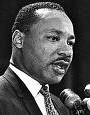
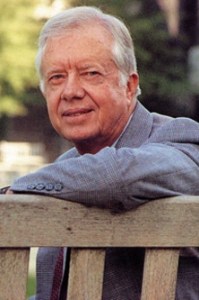
MLKThis study project  reaches far beyond the Presbyterian tradition to embrace all who want to shake their faith communities out of their “go slow” lethargy. It is a project that prepares the way for action like BDS.

This book confronts the stultifying grip the fear of offending our fellow Jewish religionists has over mainline Christians. The book uses “facts on the ground” to attack the “go slow” strategy which blocks actions against injustice.

Martin Luther King, Jr., confronted this “go slow until our people are ready” religious mindset when he sat in a Birmingham, Alabama, jail cell, writing a letter on April, 16, 1963, to Protestant, Catholic and Jewish leaders in the city.

He addressed them as “My Dear Fellow Clergymen” since they were all duly recognized as clergy leaders (five of them were bishops) and they were all male. In his letter, he wrote:

I am in Birmingham because injustice is here. Just as the prophets of the eighth century B.C. left their villages and carried their “thus saith the Lord” far beyond the boundaries of their home towns, and just as the Apostle Paul left his village of Tarsus and carried the gospel of Jesus Christ to the far corners of the Greco Roman world, so am I compelled to carry the gospel of freedom beyond my own home town. Like Paul, I must constantly respond to the Macedonian call for aid. . . .

I cannot sit idly by in Atlanta and not be concerned about what happens in Birmingham. Injustice anywhere is a threat to justice everywhere. We are caught in an inescapable network of mutuality, tied in a single garment of destiny. Whatever affects one directly, affects all indirectly. . .

You deplore the demonstrations taking place in Birmingham. But your statement, I am sorry to say, fails to express a similar concern for the conditions that brought about the demonstrations.

“Go slow; our people are not ready”. The church mantra of the 1960s was immoral then; it is immoral in 2009.

King used demonstrations. They put him in jail. Later he would be killed, shot down by an assassin while the man of peace stood on a hotel balcony. Fifty years later, some church members, joined by allies who are Jews, Muslims, and non-believers, have also used demonstrations.

They don’t go to jail; they are just ignored. Now they have begun to act in harmony on BDS.

Divestment draws the greatest cry of “go slow” because it works. To withdraw investment funds from corporations that are supporting the Israeli Occupation is painful to the Occupiers and their supporters, because it is a reminder of the effectiveness of the same tactic once used in South Africa. It carries with it the awful tag of “apartheid”.

The Occupiers have spent enormous sums convincing the media and members of Congress of the truth of their narrative that must include a Benign Occupation if it is to survive the scrutiny of history.

A Benign Occupation is an oxymoron of such magnitude that for anyone to accept it as a Truth is to guarantee a visit to the Penalty Box for anyone guilty of committing the foul of Believing False Oxymorons That Do Bodily Harm to God’s Children.

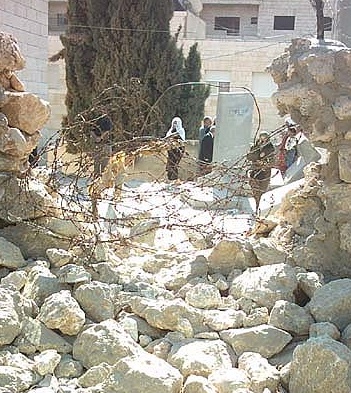
Divestment confronts the lie of the Benign Occupation, with its bulldozers tearing down family homes and building prison walls that run for hundreds of miles. Are you listening Caterpillar, down there in your Peoria, Illinois headquarter?

Divestment confronts the anguish and death of a young woman named Rachel Corrie, crushed to death by a bulldozer destroying a family home in Gaza, a death reluctantly “investigated” by Israeli authorities and dismissed as a an accident, a death ignored by the U.S. Congress which is normally agitated into swift action by the death of an American citizen in a foreign land.

It is time for American churches to act against Occupation by boycott, divestment and sanctions.  That means no buying of products made on Occupied soil, no more church investment in corporations guilty of supporting Occupation, and sanctions against the Israeli economy if the lighter penalties of boycott and divestment fail to end the Occupation.

Look outside the church windows, fellow believers. Pay attention to the recent essay in the Los Angeles Times, by Neve Gordon, a young Israeli scholar who is the author of Israel’s Occupation. He teaches politics at Ben-Gurion University in Beersheba, Israel.

Gordon includes “faith based organizations” in his direct call for boycott action. He writes:

Israeli newspapers this summer are filled with angry articles about the push for an international boycott of Israel. Films have been withdrawn from Israeli film festivals, Leonard Cohen is under fire around the world for his decision to perform in Tel Aviv. . . . Clearly, the campaign to use the kind of tactics that helped put an end to the practice of apartheid in South Africa is gaining many followers around the world.

In a clear indication that economic pressure is an effective tactic often used to defend Israel, Ha’aretz, a Jerusalem newspaper, reported:

Members of the Los Angeles Jewish community have threatened to withhold donations to an Israeli university in protest of an op-ed published by a prominent Israeli academic in the Los Angeles Times on Friday, in which he called to boycott Israel economically, culturally and politically.

Dr. Neve Gordon of Ben-Gurion University in Be’er Sheva, a veteran peace activist, branded Israel as an apartheid state and said that a boycott was “the only way to save it from itself.”

Gordon, a political scientist, said that “apartheid state” is the most accurate way to describe Israel today.

No official word on what impact the Los Angeles threat had on Ben Gurion University, but the President of  the university,  Rivka Carmi, told the Jerusalem Post that the “university may no longer be interested in his [Gordon’s] services.”  She added that “Academics who feel this way about their country, are welcome to search for a personal and professional home elsewhere.”

In a letter he is circulating to supporters of BDS, Sydney Levy, of Jewish Voice for Peace, called for support for Gordon through letters to President Carmi:

Is Prof. Carmi really calling on Professor Gordon to leave his country?  Several [Israeli] Knesset members from the right called upon Carmi and the Minister of Education to sack Neve Gordon, while Education Minister Gideon Sa’ar called the article “repugnant and deplorable.

Jewish author and activist Naomi Klein posted on her blog, January 8. 2009, her case for “Israel: Boycott, Divest, Sanction”:

On July 2005 a huge coalition of Palestinian groups . . . called on “people of conscience all over the world to impose broad boycotts and implement divestment initiatives against Israel similar to those applied to South Africa in the apartheid era.” The campaign Boycott, Divestment and Sanctions—BDS for short—was born.

Klein confronts a typical stalling tactic to the use of BDS with a sharp rebuttal to the argument that “punitive measures will alienate rather than persuade Israelis”.

“The world has tried what used to be called “constructive engagement.” It has failed utterly. Since 2006 Israel has been steadily escalating its criminality: expanding settlements, launching an outrageous war against Lebanon and imposing collective punishment on Gaza through the brutal blockade. Despite this escalation, Israel has not faced punitive measures—quite the opposite. The weapons and $3 billion in annual aid that the US sends to Israel is only the beginning. Throughout this key period, Israel has enjoyed a dramatic improvement in its diplomatic, cultural and trade relations with a variety of other allies.

A carefully researched case for BDS has been made in the Americans for Middle East Understanding (AMEU) publication, The Link, in its September-October 2009 issue. The essay, “Ending Israel’s Occupation”, was written by Link editor, John Mahoney.

At one point in his essay, Mahoney describes the death of Rachel Corrie, (referenced above), and then follows the Corrie family’s journey through the U.S. legal system:

Rachel’s parents, Cindy and Craig Corrie, filed a lawsuit against the American company, Caterpillar, the manufacturer of the armored bulldozer that crushed their daughter. In it they alleged that Caterpillar sold the D9 bulldozers to Israel knowing full well that they would be used to unlawfully demolish homes and endanger civilians in the occupied West Bank and Gaza Strip. The case was dismissed in November 2005.

The Corries appealed and, in July 2007, they argued before a judge in a Seattle, WA court that corporations must be held accountable for their corporate behavior. Lawyers for Caterpillar argued that Israel’s home demolitions were legal and that American judges do not have the jurisdiction to pass judgment on the state of Israel.

Lawyers for the Corries countered that the U.S. Government has publicly condemned Israel’s policy of building settlements, and that their case was not about the U.S. Government. Instead, they said, the suit was about a corporation’s selling equipment to a foreign country that was known to use that equipment in human rights abuses.

In August 2007, the federal appeals court rejected the Corrie’s appeal.

Meanwhile, Caterpillar has continued to sell armored bulldozers to Israel, and Israel continues to use them to demolish Palestinian homes, to destroy ancient olive gardens and to build Jewish-only roads, Jewish-only settlements, and an apartheid wall, all on confiscated Palestinian land.

The U.S. court system refused to  move against Caterpillar. The Israeli army and the Israeli court system blocked attempts by Cindy and Craig Corrie, to secure justice in the death of their 23-year-old daughter.

This leaves the task to groups like Jewish Voice for Peace, courageous scholars like Neve Gordon, and writers like Naomi Klein, to fight for justice from within the Jewish tradition. And from the Christian side of the aisle? There are strong voices, to be sure. But at the higher official levels?

The church leaders who received the Letter from the Birmingham Jail from Martin Luther King, Jr., were victims of the blindness of their own past, a blindness that plagued them to the end.

What then, may we expect from the Christian community today? More lukewarm resolutions, more stalling, more Cum Ba Ya? More waiting for President Obama to persuade the Israelis to “freeze” settlement building?  Or will there be a stirring of the Christian spirit, rising up in anger against an oppressive Occupation?

If that stirring fails to emerge soon, then we face a replay of that overwhelming sense of shame that burdened those church leaders and church members, who ignored Dr. King’s message in the 1960s that “Whatever affects one directly, affects all indirectly”.
Posted in Media, Middle East Politics, Politics and Elections | 18 Comments

A Civil Exchange With the NY Times On The IDF and Tom Friedman

By James M. Wall      09

This blog has received more immediate reaction to Is Thomas Friedman a Positive Voice for Peace? You Decide, than any other posting I have written since Wall Writings was launched in April, 2008.

One reader of the blog, unnamed here except as “Faithful Reader”, sent a copy of  that posting to Clark Hoyt, public editor of The New York Times. Hoyt responded to Faithful Reader, who then sent me Hoyt’s response.

I wrote Hoyt and asked his permission to print his note in my blog. He graciously gave that permission and then, just as graciously, told me why I was wrong in my reading of the visit of Thomas Friedman with officials of the Israeli Defense Forces headquarters.

I am reproducing below the exchanges that ensued. I apologize that the posting is longer than usual. I think it important to print all of the exchanges because civil discourse is sadly missing in our culture today. Hoyt’s regular column in The New York Times is a valuable contribution to this conversation, for which Hoyt and the Times should be commended.

We begin with Clark Hoyt’s initial note to Faithful Reader:

I didn’t see this blog post until you passed it along.  I inquired of Andrew Rosenthal, the editorial page editor, because I think it would have been inappropriate for Tom Friedman to give a lecture, as Haaretz reported, to the IDF general staff.  Rosenthal inquired of Friedman, who said he did not give such a lecture.  He did meet with Israeli military officials in his role as a columnist/reporter.  They were sources for him.  He said he learned a lot from them and did not say any more to them in his conversations than was in his columns. I don’t have any intention of addressing a false report. but feel free to share it. . .

Faithful Reader sent me Hoyt’s response, to which I responded with the following email:

In the email you sent to [my Faithful Reader] regarding my Wallwritings.com posting on Thomas Friedman, you told her to feel free to share your response with the friend who shared the blog information with her. . .

You told [Faithful Reader] you considered the Ha’aretz news story to be a false report and for that reason you saw no reason to address the report further.

I would like to be able to share your response in my next posting.  I am not persuaded by Tom Friedman’s response to Andrew Rosenthal. But clearly, Mr. Rosenthal, as Tom’s editor, and you, as public editor, are persuaded.

Let me tell you why . . . I am not persuaded.

Ha’aretz, as you know from reading my posting, was the media source of my blog. In my post, I included links to three other bloggers who read the Ha’aretz story and expressed their concerns about Friedman’s presentation to the IDF officials. I suspect you know their work: Philip Weiss, Helene Cobban, and Richard Silverstein.

Friedman says he “met” with the Israeli military officials as sources. Ha’aretz said he gave them a lecture.  I am not convinced  of the validity of Friedman’s repudiation of the Ha’aretz story.  A journalist often meets with individual officials, but when he speaks to them as a group, and the word is spread that he gave them a “lecture”, it is difficult not to conclude that what took place was a sharing of information gathered in meetings with Palestinian and other Arab leaders that provided Tom Friedman with data for his columns.

It is my conclusion in my posting that Friedman’s writing career, which I document in my posting, has been strongly pro-Israel. In my posting, I link to a column I wrote for the Christian Century magazine in November, 2002. I was the editor of the Christian Century from 1972 through 1999, and in 2002, I was writing still a regular column for the publication.

I have traveled to the region as a journalist since 1973.  If you will read my November 6, 2002, column you will see that it focuses on my concern that Tom Friedman’s writings are harmful to the peace process.

Friedman attempts to refute the Ha’aretz news story which reports on his meeting with the Israeli Defense Forces staff. He maintains as you report in your email, that ” he learned a lot from them and did not say any more to them in his conversations than was in his columns.”

With all due respect, I find that totally unconvincing.  And I am surprised that both you and Andrew Rosenthal are convinced by the argument.

What you choose to do in handling this matter, as editor and public editor, is entirely up to you.  But as a former editor, now a blogger, I believe I owe it to my readers to let them know that  the two of you have chosen to accept Tom Friedman’s refutation of Ha’aretz.  And I want my readers to know that I am not convinced that the refutation is sufficient.

Since I cite three other bloggers in my initial posting, I feel I also owe it to them to share your email response with them. May I have your permission to quote your email in my next posting. With appreciation for all you do for The New York Times.

Clark Hoyt responded to me, as promptly as possible for a person on vacation, with the following email:

Dear Mr. Wall:

Please forgive the delay in this response. I am on vacation and am only occasionally checking e-mail.

I have no objection to your quoting my response to [Faithful Reader]. However, I would appreciate it if you would also include what I am about to say:

I find it curious and troubling that you choose to believe an unsourced, anonymous report in Haaretz over Mr. Friedman’s version of what happened, and — forgive me — I can’t help suspecting that you are allowing your political views to color your journalistic judgment in this matter. You disapprove of Tom Friedman’s writings and believe he is not helpful to the Middle East peace process. So, when a news organization reports something anonymously that could reflect negatively on him, you choose to believe it. Frankly,and I don’t intend any personal disrespect, I find that irresponsible. If you have evidence that Mr. Friedman is not telling the truth, I would like to see it, and I would be open to persuasion. If you don’t have such independent evidence, I would conclude that you are just choosing to believe what is convenient for you to believe.

I also find it unpersuasive that, because three other bloggers have commented on this anonymous report, it somehow takes on greater significance. This is, in my view, a common weakness in the blogosphere. Unsubstantiated information gets repeated often enough that some people come to the unwarranted conclusion that it must be true.

Best, Clark, Public Editor, The New York Times

I then sent this email to Mr. Hoyt:

Dear Clark:

Thank you for your thoughtful response. It is especially good of you to take your vacation time to consider my letter and to respond in such a gracious manner.

In my next blog posting, I assure you that I will include your response to me. And I thank you for giving me permission to reprint the email you sent to the blog reader who initially called my blog posting to your attention.

May I begin by examining the facts before us.

First, we have my original Wall Writings posting which commented on Thomas Friedman’s visit to the Israel Defense Force headquarters, where he, by his own admission, spoke with his “sources” in that headquarters. Second, we have your note to the reader of my blog, in which you accept Tom Friedman’s version of his meetings with the IDF against the interpretation of the Ha’aretz report.

The original Ha’aretz story provides the following specific information:

“Friedman met personally with IDF Chief of Staff Gabi Ashkenazi during his visit, and spoke to the deputy chief of staff, the head of Military Intelligence, the head of the Home Front Command and the head of the planning branch.”

By my count, Ha’aretz identifies five IDF officials with whom Tom spoke. Ha’aretz describes Tom’s meetings as including a “lecture” to the staff. In your note to the reader of my blog, you insist Tom did not give a “lecture” to the IDF military officials.

You wrote to [Faithful Reader]:

“I inquired of Andrew Rosenthal, the editorial page editor, because I think it would have been inappropriate for Tom Friedman to give a lecture, as Haaretz reported, to the IDF general staff. Rosenthal inquired of Friedman, who said he did not give such a lecture. He did acknowledge that he met with Israeli military officials in his role as a columnist/reporter. They were sources for him. He said he learned a lot from them and did not say any more to them in his conversations than was in his columns.”

As I understand your position, had Tom given a lecture” to the IDF officials, that would have been inappropriate because it would have meant he was acting as a “consultant” to the IDF. Tom acknowledged to Andrew Rosenthal, after you queried Rosenthal, that he had, indeed, met with IDF officials. He said he had “learned a lot” from those conversations. He also assured Rosenthal that he “did not say any more to them in his conversations than was in his columns.”

Tom does not identify the officials with whom he met, although the Ha’aretz story is quite specific in identifying them by name and titles. Ha’aretz may have erred in calling those exchanges a “lecture”, but no one involved questions that Tom Friedman held conversations with IDF officials following his earlier meetings with Palestinian officials.

The issue is not whether Tom gave a “lecture”, but whether his conversations with five top officials in the IDF went beyond that of a columnist gathering information for his columns. I choose to believe those conversations were very helpful to the IDF officials in their own decision-making in dealing with the Palestinian officials.

Clark, I am surprised that you so willingly accept Tom’s word that his conversations with his “sources” did not go beyond what he wrote in his columns. His columns were written for readers of The New York Times. As I read them, I do not find new information that would be of significance to the IDF officials.

I must conclude, to use the term you applied to me, that it is “irresponsible” of you to accept Tom’s word that he repeated only information from his columns in his discussion with the IDF officials. You take his word on this in spite of the fact that you are aware of Tom’s strong affection for the state of Israel, which translates, in my personal opinion, to a lack of affection for those who “threaten”, in his judgment, the well-being of that state.

Tom Friedman is an experienced journalist who knows how to obtain information from friendly “sources”. It is naive, in my opinion, for you to conclude, and for you to expect me to agree, that Tom simply repeated his columns to the IDF officials, no more, no less. It is my opinion that what Tom Friedman brought to the IDF general staff, gleaned from his earlier discussions with Palestinian officials, would be of considerable value to the IDF general staff.

It is not unreasonable to conclude that Tom Friedman is capable of serving as a valuable conduit between Fatah and the IDF. As a friend to Israel, he could be valuable to the IDF by sharing with them his opinions on the thinking and planning of his Palestinian sources. There is considerable data, backed by sources, that Israel and Fatah are partners in resisting actions of Hamas.

It is insulting to have Tom Friedman dismiss his meetings with IDF officials as nothing more than friendly chats with sources. It is also insulting to attack my blog report as irresponsible because it is based on a report from a highly-respected Jerusalem newspaper.

I believe it is the role of the Public Editor to go much further than apparently you chose to go in your examination of the complaint regarding Tom’s meetings at the IDF headquarters, as reported in my blog, and acknowledged by Tom.

I do not know how closely you read my original Wall Writings posting, Is Thomas Friedman a ‘Positive Voice’ for Peace? You Decide, but I would appreciate your looking at it again and paying close attention to my Christian Century column to which I link in the posting. In that column, published November 6, 2002, I concluded that Tom Friedman’s bias toward Israel was not a positive contribution to the peace process..

Finally, Clark, in your note to me I do not feel you reflect a positive attitude toward bloggers. Like many bloggers today, I am new to the format, but also like many bloggers, I bring a history of media experience with me to the writing of my blog. You dismiss the “other three bloggers” I cite in my posting, Helene Cobban, Richard Silverstein and Philip Weiss, as mere “bloggers”. Surely you aware of the journalistic experience they bring to the blogs they currently write. I urge you to read them on a regular basis. They reach a very wide audience that is affecting public debate today.

I think it would be a mistake for you to dismiss, without further public comment, my blog’s complaint against Tom Friedman, and more importantly, since they reach a much larger audience than I do, the complaints lodged by the three other bloggers I cite.

I apologize for imposing further on your vacation time. I expect to post my next blog entry later today.

Within just a few hours, the following exchange took place.  First, Clark wrote to me:

Dear Jim,

Now that we’ve each agreed that the other is irresponsible, let me try to take it down a notch and explain more fully why I think you are pursuing a mistaken path in this case — at least without more first-hand knowledge than you have.

It continues to feel to me as though you are putting 2 and 2 together and getting 22:  Tom Friedman is a friend of Israel, therefore his conversations with IDF officials, in your view, must have some sinister implication beyond the kinds of exchanges that happen all the time between journalists and sources they cultivate for information.  In the case of Friedman,  he is an American and meets frequently with top officials of the U.S. government.  Does that mean he’s doing s something wrong in those instances?  I’ve never met Friedman, but I spent enough of my career in Washington to observe that his global influence is so strong that officials with whom he meets are almost certainly hoping to persuade him of their points of view, in hopes they will be reflected somehow in what he writes.

I find it odd that you use the word “admission” to describe Friedman’s acknowledgment that he met with the IDF officials.  Again, what”s he admitting to?  Meeting with sources?  What’s’ wrong with that?  You “choose to believe” — based on no reporting that you have cited to me — that Friedman was “very helpful” to the IDF officials.  You don’t know that, and nothing in the unsourced Haaretz report confirms that. I’m not even sure what very helpful means in this context and see nothing that reasonably supports a conclusion that Friedman stepped over a journalistic line.

I don’t think Friedman was insulting in his description of his exchanges with the Israelis.  I do see how you could take offense at my use of the word “irresponsible,” and please be assured that I meant no insult and should have expressed my views in better language.

Finally, I mean no disrespect toward bloggers.  I read them frequently and do some of it myself.  The point I was trying to make, obviously not well, was that just because three other bloggers opine on the same anonymous report, it doesn’t make the report true or any more worthy of attention.

Jim, I apologize for any harshness of tone.  This is something I feel strongly about — accepting an anonymous report as true and then reaching damning conclusions from it — but I mean no personal disrespect to you and recognize your considerable journalistic credentials.

Clark

I responded:

Clark,

Thank you for your quick response.  Tom’s “global influence”, as you put it, is certainly strong but it is for precisely that reason that he is so deeply distrusted by those of us for whom the injustices of the Israeli occupation is so overwhelming that we have no alternative but to suspect that in his dealings with this topic his strong feelings for Israel and against the Palestinians affect his reporting and his column writing.

You identify a reporter’s conversation with U.S. military officials to be the same as an American reporter’s conversations with Israeli officials. Does this not imply that Israel is to be seen as an extension of the Pentagon? I don’t think you want to say that.

I used the term “admission” in connection with Tom’s response to Rosenthal because he was being questioned as to what was behind the Ha’aretz story. Would “acknowledged” have been better? Perhaps so. What he was acknowledging was that he did, indeed, meet with sources in the IDF.

Tom’s record in this arena is so clearly pro-Israel that I find it puzzling that you are unable to concede that he would share more with the IDF officials than he might, for example, with Hamas, Fatah or Syrian officials? If we are to be accurate in our reporting, we must view all our sources with the same suspicious eye.

I used the word “insulting” in connection with Tom’s description of his talks with the IDF because I am insulted that you would think I am so naive and impressed with Tom’s “global influence”, that I would accept without question, his description of his dealings with the IDF.

I do not find your words harsh. You say yourself that you feel strongly about what you call “anonymous” sources. I use harsh language when Israel is allowed by the American media–of which the Times is the queen–to misuse language that suits the Israeli narrative while either distorting or ignoring the Palestinian narrative. Do you know how long it took to get Nakba into the Times? You have been the Public Editor long enough to know how angry it makes those of us who grieve over the injustices of the Occupation to keep reading the Israeli perspective in the Times and other American media.

I continue to be offended that you use the words “anonymous” and “false” reports when referring to the Ha’aretz story. A reporter gives the names of five IDF officials and he reports that Tom talked to them. What more sourcing do you need? Ha’aretz is, after all, a respected Jerusalem newspaper. Does Tom Friedman have sources that will support his contention that he limited his comments to the IDF to his columns?

With your permission I will add this exchange to the posting. Jim

This prompted one final response from Clark, with which I will end the posting, giving him the final word.

Thanks, Jim. By all means, add it.

I don’t in any way think I am implying that Israel is an extension of the Pentagon. I am merely making the point that a reporter talks to officials of many government’s, including his own, and there is nothing untoward about the mere fact of talking with them. In fact, it is his job.

As for Haaretz, I do accept Tom Friedman’s word that he didn’t give a “lecture” to the IDF, and there is nothing in the published report that substantiates its assertion that he did. I therefore view the report with a great deal of skepticism.

I think we’ve pretty well exhausted this one, but I appreciate your interest and hearing from you — and your civility in asking for permission to use our exchanges. Not everyone does that. Best, Clark

Thus endeth, for the moment at least, a civil exchange with The New York Times on the IDF and Thomas Friedman.

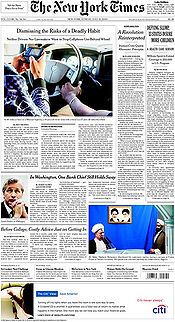
The picture above is a copy of the July 19, 2009 issue of The New York Times.  It is from the Wikipedia website for The New York Times.

Posted in Media, Middle East Politics | 10 Comments

Is Tom Friedman a “Positive Voice” for Peace? You Decide

by James M. Wall Friedman Wikipedia

Thomas Friedman is the Pulitzer Prize winning foreign correspondent and columnist for the New York Times. So what, in the name of all that is sacred in media land, are we to make of this news item that appeared August 12 in Ha’aretz:

Senior New York Times columnist Thomas Friedman gave a lecture last week to a number of members of the IDF General Staff. He spoke to them about his impressions of his recent visits to Arab countries.

Friedman visited Israel and the territories last week and published a two-part column on the situation in the territories after most IDF checkpoints were removed and Palestinian security forces moved in.

Friedman met personally with IDF Chief of Staff Gabi Ashkenazi during his visit, and spoke to the deputy chief of staff, the head of Military Intelligence, the head of the Home Front Command and the head of the planning branch.

Helene Cobban, a veteran of Middle East journalism, was furious. Cobban was a long time Middle East correspondent for the Christian Science Monitor. In her blog, Just World News,  she wrote:

Someone tell me why anyone should consider this guy a “neutral observer” of matters Middle Eastern?

Someone tell me whether him behaving like this is quite okay by the New York Times— sort of par for the course for the way they expect their very handsomely [paid] columnists to behave?

Someone tell me why anyone in the rest of the Middle East would even agree to meet with this guy, given that he sees his role as being a snoop for the Israeli generals?

Richard Silverstein is a tad more sardonic on his blog, Tikun Olam:

Now here I thought Tom “Terrific” Friedman was the Pulitzer-Prize winning journalist for the N.Y. Times. Little did I know he’s carrying on a nice little consulting business on the side giving lectures to the IDF staff and passing on intelligence information to them he gleaned from visits to Arab states.

Silverstein also wonders when the Times’ ombundsman, Clark Hoyt, and Friedman’s editors,  will explain to his readers how this doesn’t violate the paper’s ethics rules.”

They won’t fuss at Friedman unless the objections expand beyond the passionate core of bloggers for whom Friedman is a constant irritant. Friedman’s perspective has never been a secret to the Times.  Why correct him now for sharing with the Occupiers information he gained from the Occupied and their Arab neighbors?

Friedman was 15 years old when he first went to Israel. It was a trip, he writes in his first book, that “changed my life”. Man, did it ever.

Philip Weiss went back to that first book, From Beirut to Jerusalem, which Friedman wrote while he was serving as the Times Middle East correspondent.  One revealing item from Weiss: As a  high school senior young Tom “was giving lectures to his Minnesota classmates on Israel’s righteous tactics in the (four-year-old) Six Day War.”

For Friedman, then and now, reality in the Middle East is based solely on what is good for Israel. Such a passion is understandable in a 15-year-old.  It is a disaster in a professional journalist.

I was not surprised to learn that Friedman felt right at home lecturing the Israeli Defense Forces general staff.  I have long had my suspicions.

On November 4, 2002,  the Christian Century magazine, published a column I wrote under the title, “Prison of Hope”. The column focused on the damage I believed Friedman’s pro-Israel journalism was doing in the region.

In 2002, it should have been obvious to anyone who actually ventured into Gaza and the West Bank and talked with those who suffered under the Occupation, that Friedman was tightly locked into Israel’s narrative. He thought he knew the Palestinian narrative. But he only knew the words.  He did not know the music.

It was clear to me that Friedman saw the sufferings of an entire Palestinian population the way Southern Whites once viewed racial segregation: We will be good to you “Negroes” so long as you accept that we are the masters in this land.

Here are excerpts from my 2002 Christian Century column:

On the ground in Jerusalem, one can see how much [New York Times] columnist Thomas Friedman overlooks. Friedman, the premier media commentator in the U.S. on foreign affairs, would have us believe that–as a liberal Jewish thinker–he doesn’t think Israel should hold on to occupied lands, and he will indeed say that settlements in occupied lands are a bad thing.

But in fact he is not against all settlements–only against the “ideological” settlements in isolated pockets of the West Bank and Gaza. For him, the Israeli settlements in Gilo, Har Homa and Ma’ale Adummim (all built on land confiscated from Palestinians) are not really settlements; they are Israeli neighborhoods that conveniently surround the city of Jerusalem.

Friedman’s perspective haunted me as I traveled recently in Jerusalem, the West Bank and Gaza, talked with Palestinians who live under occupation, and met with Jewish officials who are a party to that occupation.

I thought about Friedman’s influence as my colleagues and I drove through a settlement [Ma’ale Adummin] with its swimming pool, shopping mall (Ace Hardware and Burger King signs prominently displayed), green lawns and palm trees transplanted from Palestinian farms.

I often receive copies of Friedman columns from readers who praise him as an American Jewish writer who is a voice for peace.  I don’t think he is a positive voice in the debate. On the contrary, he symbolizes what is wrong with American liberal thinking on this topic. Friedman is a voice of liberal political and media leaders who are intimidated and controlled by the propaganda machine of the American Jewish lobby in Washington. . . .

Defenders of Friedman would argue that he is a columnist, entitled to his strong opinions.  Which is certainly true.  But the hypocrisy in Friedman’s approach is that he begs the reader to accept him as someone who is genuinely concerned for the Palestinian people. Unfortunately, too many people believe him.

Consider the two columns he wrote for the Times before he briefed the IDF general staff.

Under the paternalistic heading, “Free Marriage Counseling”, Friedman began with one of his tortured metaphors, positing Israel and the U.S. as a married couple having “one of their marital spats they have had over the years”. Friedman assures us he knows “both families”.

Friedman claims to know both spatters, but he has a special fondness for Israel. This produces a myopia that guarantees failure.

The U.S., he writes, “is working on a deal whereby Israel would agree to a real moratorium on settlement building, Palestinians would uproot terrorists and the Arab states would begin to normalize relations — with visas for Israelis, trade missions, media visits and landing rights for El Al. If the president can pull this off, it would be good for everyone.”

Good for everyone? Friedman likes President Obama’s idea of a construction halt. He views a construction halt as a noble gesture. He fails to see that a construction halt is an insulting band aid over Israel’s real construction sins, settlements that have become cities of 40,000 people.

Israel, in Friedman’s view, longs for normal relations with Arabs, complete with “visas for Israelis, trade missions, media visits and landing rights for El Al.” Landing rights for El Al in Beirut and Damascus? Landing rights for El Al before refugee return, destruction of the Wall, and the end of home demolitions and stifling checkpoints.

Landing rights for El Al before family reunions for Palestinians? Landing rights for El Al before food and medicine is allowed to flow easily into Gaza? Visas for Israelis to travel to Beirut before visas for Palestinians to travel between Bethlehem, Jerusalem, Ramallah and Jenin?

Friedman wants to be taken seriously as an economic analyst. In a second column written before he briefed the IFD generals, Friedman tells his readers about a new Arab Human Development report, which worries about the lack of security in Arab states:

. . .[The report was] triggered by a desire to find out why the obstacles to human development in the Arab world have “proved so stubborn.” What the roughly 100 Arab authors of the 2009 study concluded was that too many Arab citizens today lack “human security — the kind of material and moral foundation that secures lives, livelihoods and an acceptable quality of life for the majority.” A sense of personal security — economic, political and social — “is a prerequisite for human development, and its widespread absence in Arab countries has held back their progress.”

Which army has deprived the Palestinian Arabs of their “sense of personal security” and “held back their progress”?  Could it be the army run by the same generals Friedman briefed after his talks with Arab leaders?

It is the IDF general staff, now fully briefed by Friedman, that is maintaining what the Times‘ current Middle East correspondent Ethan Bronner described recently as a “tight embargo” of Gaza.  Is the embargo designed to give Palestinians a “sense of personal security”? Hardly. According to Bronner, the embargo has two purposes:

Israel continues a tight embargo on goods entering Gaza, partly as pressure to get back a kidnapped soldier held there for three years and partly to increase the gap in living standards with the West Bank. The idea is that once the Fatah-run West Bank is secure and better off and Gaza remains stagnated and mired in poverty, Palestinians in both places will support Fatah and its negotiated approach.

Hear that, Thomas Friedman? Gaza is under a tight embargo run by your IDF friends for two reasons:

To force Hamas to release an Israeli prisoner and, to force the entire civilian population of Gaza to suffer until their government (Hamas) is shown to be inferior to the Fatah government of the West Bank.

Friedman chooses to forget that Hamas won the legislative election and its army defeated the Israeli-U.S. backed Fatah army. The next step? Lock the civilian population inside prison walls and apply pressure until Israel, like a cruel parent, gets what it wants.

Friedman must believe that the parent has an obligation to beat a child until he or she yields to parental orders. In a televised interview with Charlie Rose, Friedman told Rose the 2003 U.S. invasion of Iraq was a good thing.

This is the same Friedman who agrees with his Israeli friends that pushing for a “normalcy” for Israelis, is a good thing for the Middle East. A “normalcy” that is, that includes landing rights for El Al in all the Arab capitals.

Has it has come to this: Landing rights for El Al in exchange for our everlasting souls?

Photo above of Thomas Friedman is from Wikipedia.

Posted in Media, Middle East Politics | 7 Comments

Hard Right Zionists Try to “Freeman” Peace Activist Mary Robinson

+++++++++++++++

FRIDAY UPDATE:

The ceremony proceeded at the White House Wednesday without any interference.  Mary Robinson was one of 16 recipients of the 2009 Presidential Medal of Honor. The effort to “Freeman” Robinson, failed.  Read here what President Obama said about Robinson.

Wednesday Update:

Mary_RobinsonMary Robinson is scheduled to receive the Presidential Medal of Honor in Washington today. So far, there is no indication that the campaign to “Freeman” (see below) the Irish-born peace activist will have any impact on the ceremony.  Watch to see how the event is covered by Main Stream Media. Thus far, MSNBC’s lineup of liberal news stars has ignored the “Freeman” attacks on Robinson.

One alert reader of this blog (see below) points out that “Freeman” attacks are not confined to the U.S. The Jerusalem Post reports that strong criticism has been been raised by German Jewish organizations against German President Horst Köhler, who presented the Federal Cross of Merit, first class – the country’s most prestigious award, to noted Israeli human rights attorney Felicia Langer. A long time critic of Israel’s harsh treatment of Palestinians, Langer, 79,  moved to Germany in 1990.

Before her retirement, Langer devoted her career to defending Palestinians she believed to be wrongly accused by Israeli occupation authorities. She often compared Israel’s occupation to the white apartheid rule in South Africa. Ms. Langer received her award on August 6.

+++++++++++++++++

by James M. Wall

During a “private” Tel Aviv conversation, Prime Minister Bibi Netanyahu was reported to have denounced Rahm Emanuel and David Axelrod as “self-hating Jews”. Israeli officials immediately denied that the prime minister threw that ugly epithet at the two officials.

Whether Bibi used the term or not is not the issue. What is important is that someone in Israel’s ruling circles wanted the “self-hating Jew” term out there. The term fits into the campaign to undercut Barack Obama’s credentials as a friend of Israel.

The strategy is obvious. Hard right Israeli Zionists, and their American neocon Zionist colleagues (HRZs, for short), spend considerable energy intimidating western civilization into believing any negative criticism of Israeli policies is, in the case of non Jews, a sign of latent or overt anti-semitism,  or in the case of Jews, a sure sign that the guilty party is a “self hating Jew”.

With even the slightest hint that an anti-semite or self-hating Jew has been sighted, the culprit must be revealed and punished. The higher profile of the offending culprit, the more vicious the attacks.

The latest sighting involves two high-ranking White House officials, Emanuel and Axelrod, neither of whom are even remotely “self-hating Jews”. The ludicrous charge against two men I have known for more than three decades, was thrown at them because they are close to Obama. The Jewish online Forward has the sordid details on how the attacks unfolded.  Getty Images

Five months ago, in Febuary, just weeks after Obama’s inauguration,  the radar screen set up by the HRZs, detected a potential threat to Israel’s security when Charles Freeman was chosen to serve as Obama’s Director of the National Intelligence Council, the high-level interagency group that prepares evaluations for the president and other senior officials.

Before the Main Stream Media (MSM)  bothered to notice, Freeman, an experienced foreign policy expert with an impeccable record was hit with a firestorm of deceptive, fraudulent and vicious attacks on his record of public service.

After Freeman withdrew his nomination he was strongly defended by Washington Post columnist David Broder, who wrote that Freeman’s withdrawal was “the country’s loss”.

I wrote a series of postings on Freeman’s ordeal at the time, two of which are available here and here. A longer version of those postings is available here.

Which brings us to Mary Robinson, the most recent target of the HRZ zeal that eliminated Freeman from the Obama team.

On July 30, President Obama named Mary Robinson as one of 16 recipients of America’s highest civilian honor, the Presidential Medal of Freedom. The awards are scheduled to be presented at a White House ceremony Wednesday night, August 12.

Mary Robinson, is one of the Elders, the group of world leaders initially formed by South Africa’s Nelson Mandela. A former president of Ireland and a former UN human rights official, Robinson now lives in New York City, where she is currently the President of Realizing Rights: The Ethical Globalization Initiative.

Her full resume is available on the Elders page. The Realizing Rights web site sums up her current assignments:

Chair of the Council of Women World Leaders, Vice President of the Club of Madrid, honorary President of Oxfam International, Member of the Vaccine Fund Board of Directors and member of the Leadership Council the UN Global Coalition on Women and AIDS. She is a Professor of Practice at Columbia University and member of the Advisory Board of the Earth Institute, and Extraordinary Professor at the University of Pretoria.

Bear in mind that Robinson is being honored with the Presidential Medal. She is not being nominated to hold a position in the Obama Administration.  It would be inconceivable for the White House to withdraw Robinson’s name from the list of Medal of Freedom winners. But this has not stopped the HRZ attacks.

The HRZs are not likely to pull a Freeman on Mary Robinson, but they are determined to smear her and her supporters. Time is short, but already they have secured some friendly U.S. media attention for their smear attacks. The Chicago Tribune, for example, marching, as usual, to the beat of AIPAC’s spin, runs a story which begins:

Jewish congressional members and lobbying groups are protesting President Obama’s decision to award the Presidential Medal of Freedom to former Irish leader Mary Robinson, who they say has a long record of harshly criticizing Israel.

The award pronouncement prompted the first criticism of Obama by the powerful American Israel Public Affairs Committee, a group he courted during last year’s campaign. Jewish groups in the U.S. have been largely supportive of the president. But the Robinson award is the latest in a series of recent disagreements with Obama, and some Jewish leaders are growing skeptical of his commitment to Israel.

The attack machine used against Charles Freeman was not the same as the one now pursuing Mary Robinson. AIPAC pretended to stay out of the Freeman affair. But now the “all powerful” lobby group smears Robinson for her role as the UN Human Rights Commission chair and her “criticism” of Israel’s actions against Palestinians.

It is hard to escape the feeling that AIPAC  hauled out some of its congressional minions just to darken Robinson’s big day.  What AIPAC really did, however, was reveal the decline of fire power in its paranoia arsenal by attacking a woman with a distinguished record who fully deserves to be one of the honorees this Wednesday.

The White House announcement of the awards puts them into perspective:

The Medal of Freedom is awarded to individuals who make an especially meritorious contribution to the security or national interests of the United States, world peace, cultural or other significant public or private endeavors.

The awardees were chosen for their work as agents of change.  Among their many accomplishments in fields ranging from sports and art to science and medicine to politics and public policy, these men and women have changed the world for the better.  They have blazed trails and broken down barriers.  They have discovered new theories, launched new initiatives, and opened minds to new possibilities.

Joining Robinson among the honorees, presuming the AIPAC “protests” fail, are 15 other luminaries:

Harvey Milk, the San Francisco supervisor who led an early movement for gay rights in public life and was assassinated; the late Republican congressman Jack Kemp, a onetime pro football standout; ailing Democratic Sen. Edward M. Kennedy of Massachusetts; the Rev. Joseph Lowery, American civil rights activist; Desmond Tutu, the South African archbishop and Nobel laureate; tennis star Billie Jean King; first woman on the U.S. Supreme Court, retired Justice Sandra Day O’Connor; actor Sidney Poitier,singer Chita Rivera; British cosmologist Stephen Hawking; Nancy Goodman Brinker, founder of Susan G. Komen for the Cure, a breast cancer grass-roots organization; Dr. Pedro Jose Greer Jr., founder of an agency that provides medical care to more than 10,000 homeless patients a year in Miami; Joseph Medicine Crow, the last living Plains Indian war chief and author of major works in Native American history and culture; Dr. Janet Davison Rowley, an American human geneticist internationally renowned for her work on leukemia and lymphoma; and Muhammad Yunus, Nobel Peace Prize winner who has provided loans to help millions of people fight poverty by starting businesses.

A sample of the blog attacks against Mary Robinson is ugly to behold, but instructive as to the level of discourse to which the HRZ has descended. Here is Ed Lasky, writing for The American Thinker, evoking Nazi Germany in his tirade:

President Barack Obama’s decision to bestow the Presidential Medal of Freedom on Mary Robinson, who headed a United Nation Commission that condoned suicide bombing against Israelis and who also was in charge of the Durban Conference Against Racism that became an anti-Semitic hate-fest reminiscent of Nazi Germany (and that the United States and Israel boycotted, to Robinson’s consternation), has elicited some measure of controversy.

Michael Rubin weighs in on the American Enterprise Institute blog:

Robinson is a poor choice to receive the President (cq) Medal of Freedom. She may have dedicated her career to human rights, but she is also responsible for accelerating the politicization of that field and the growth of moral equivalency. She was a headline-seeker, rather than a sincere devotee of causes. Her stewardship of the Durban conference was atrocious and single-handedly blessed the resurgence of anti-Semitism. . .

Abraham Foxman, one of the HRZs best known generals, is quoted on Powerline, a conservative website which features U.S. and Israeli flags on its home page.

[Robinson] issued distorted and detrimental reports on the conditions in the West Bank and Gaza Strip and blamed Israel for the outbreak of Palestinian violence – the Second Intifada. As the convener of the 2001 U.N. World Conference Against Racism in Durban, South Africa, she allowed the process to be hijacked to promote the delegitimizing of Israel and pronouncements of hateful anti-Jewish canards, such as “Zionism is racism.” She failed miserably in her leadership role, opting to join the anti-Israel forces rather than temper them. . .

There is more out there in the blogosphere, nasty and distorted cannon fodder to inspire the MSM, like the Chicago Tribune, to treat the Robinson award as “controversial”.

It is not controversial, except in the HRZ circle of influence that thrives on hate language, distortions, and character assassinations. Fortunately, that circle is growing smaller, which could explain why its methods are even more obnoxious and ugly.

On the up side, it is an encouraging sign that, as a Jewish news agency reports, several Israeli human rights organizations wrote to President Obama to endorse his decision to award Mary Robinson the Medal of Honor.

The final word on Mary Robinson and the HRZs must come, however, from Robinson.  After reading criticisms of her career, she talked to The Irish Times:

Former President Mary Robinson has described as “unjust and unwarranted” criticism from American pro-Israel groups of President Barack Obama’s award to her of the medal of freedom, the highest civilian award in the US.

Mrs Robinson, who will receive the award with 16 others at a White House ceremony next week, told The Irish Times that she was “hurt and dismayed” by accusations that she had shown a consistent bias against Israel and failed to prevent anti-Semitic declarations at an anti-racism summit in Durban in 2001.

“I have made it absolutely clear and I’ve been totally consistent on this, that human rights is not on the side of either the Israelis or the Palestinians – it’s on the side of both,” she said.

“If you’re a human rights person, you have to be fair, you have to be unbiased when you’re addressing situations of human rights violations. That’s the pledge of my life and that’s what I live by.”

The picture above of Mary Robinson is from the Realizing Rights web site; picture of David Axelrod is by Chip Somodevilla/Getty Images

Posted in Media, Middle East Politics | 10 Comments

Bibi Told Mossad, “Kill Khalid”; Now Khalid is Key to Israel’s Future

by James M. Wall    Khalidi Mishal

Twelve years after he survived Bibi Netanhayu’s attempt to assassinate him, Khalid Mishal, the head of the Hamas political bureau, holds meetings with Jimmy Carter, and gives interviews to the Wall Street Journal.

Khalid Mishal is also key to a peaceful Israeli future, if only Netanyahu would pay attention to what he is saying.

When Mishal talked with Carter in Damascus, Syria, in April of this year, he told the former U.S. president that Hamas was ready to talk peace with Israel. On August 1, he sent the same message to President Barack Obama through an interview he gave to two Wall Street Journal reporters, Jay Solomon and Julien Barnes Daceu:

The chief of Palestinian militant group Hamas said his organization is prepared to cooperate with the U.S. in promoting a peaceful resolution to the Arab-Israeli conflict if the White House can secure an Israeli settlement freeze and a lifting of the economic and military blockade of the Gaza Strip.

In September, 1997, there was talk of peace between Israel and Palestine. Bibi Netanyahu was in his first term as Israel’s prime minister. Following the Oslo Accords, Yasir Arafat returned from Libya to his Palestinian national capital in Gaza. He had received clearance to return with the understanding that he would “keep his people under control”.

Working under the handicap of having to lead his people and to act, at the same time, as Israel’s”new sheriff in town”, Arafat struggled, a revolutionary ill-equipped to run a government. He got very little support from either the U.S. or Israel.

So little cooperation that instead of working to build bridges with the Palestinian people,  Israel continued its settlement building projects. In March, 1997,  construction began on a massive new Israeli housing settlement lining the  highway between Jerusalem and Bethlehem.

Bulldozers destroyed thick forests east of the road to Bethlehem, eradicating “green space” long cherished by Palestinians, and known to them as Jabal Abu Ghaniam,. What was once a mountain became, once stripped bare, another red-roofed, sprawling illegal Israeli settlement which Israelis call Har Homa.

Jordan’s King Hussein was outraged at the Har Homa construction. He had signed a risky peace agreement with Israel. His Jordanian Security Forces were cooperating with both Israeli and U.S. security forces. His attempts to cooperate were treated with disdain.

Into that environment of deception and duplicity, Israel launched another attack, this time on the life of a major Palestinian politial leader.

On Thursday, September 25, 1997, on a sidewalk in Amman, Jordan, a team of Israeli assassins tried, but failed, to kill Hamas political bureau director, Khalid Mishal.

The plan to kill the 42-year-old Mishal was virtually fool proof. The Mossad team had staged a practice attack on a Tel Aviv street in which two men walking on the sidewalk, would appear to have accidently bumped into the target, shoving him to the sidewalk. One of the killers was to inject poison into the target’s ear.

Bibi Netanyahu had seen a film of the rehearsal. He approved the assassination and gave the order to Mossad Director Danny Yaton, “Kill Khalid”.

This Spring, 12 years after the failed assassination attempt, Australian journalist Paul McGeough has published a meticulously well-crafted account of the street attack and its aftermath in  Kill Khalid: The Failed Mossad Assassination of Khalid Mishal and the Rise of Hamas. (The New Press, 2009).McGeough by Adas

The book races along like a spy thriller, starring real-life leaders like Israeli Prime Minister Bibi Netanyahu, President Bill Clinton, the King of Jordan, and Khalid Mishal, whose near-death experience in Amman projected him into his current role as the leader of the Hamas political bureau.

This is a story of intrigue, deceit, plot twists, villains and heroes that cries out to be made into a movie. And yet, just as the events of 1997 were largely ignored by mainstream media, McGeough’s 2009 book has received limited attention, with a few exceptions, all available on line: Jane Adas, in the Washington Report on Middle East Affairs; Adam Shatz, in the London Review; and Greg Myre, in the Washington Post.

Kill Khalid is actually two books in one, the failed assassination and its aftermath, and the history of Hamas, which McGeough tells through the life of Khalid, who was born in the Palestinian village of Silwad, sixteen miles north of Jerusalem.  Khalid was 11 in June, 1967 when Fatima, his mother, took her children across the River Jordan during the Six Day War.

Yelling over the noise of the rattling truck on which they found themselves, she attempted to give the frightened children a simple explanation for this upheaval. “The Jews have taken our land,” she said.

As they finally reached the river crossing, there was congestion and more panic when all were forced to abandon their vehicles.  The old Allenby Bridge had been bombed and gaping holes in the timber planking made it impassable to cars. . . Fatima and her children left their homeland on foot, inching across the river into Jordan.” (McGeough, page 5).

McGeough picks up the story 30 years later where by September, 1997, Mishal had become an important Hamas leader that Israel wanted to kill.

They struck on Thursday, September 25, 1997. It was just after ten AM–and they botched everything. Had they been successful, Mishal would have gone home and died quietly; the agents would have been on their way home too, over the Allenby Bridge on the Jordan River and back in Jerusalem for a celebratory lunch.

Instead, two of the Israelis were soon languishing in dank cells under an Amman security complex and the others were hunkering at the Israeli Embassy–which, incredibly for a supposedly friendly mission, was locked down by a menacing cordon of Jordianian troops.

King Hussein of Jordan could rise to the occasion in a crisis. Filled with rage, he fired a shot across the Israeli prime minister’s bow, warning Benjamin Netanyahu that his Mossad men would hang if Mishal died.

More deliberately, Hussein then picked up a phone and placed a call. It was answered across the world where a woman with a sweet voice answered:  “Good morning. Welcome to the White House.”

The attack on Khalid Mishal was an Israeli failure of  monumental proportions. In his book, McGeough not only exposes Israel’s failure at attempted murder; he also reveals the diplomatic morass into which the failed assassination plunged all the major players in the ongoing struggle for and against Palestinian independence.

Mossad’s decision to deliver the drug into Mishal’s ear was based on the assumption that while the team wanted Mishal dead, they also wanted the drug to act slowly. Mishal was supposed to die a few hours after the “innocent” street encounter and, ideally, at home or in a hospital.

But the plan had a fatal flaw.  The slow acting drug–a synthetic opiate called Fentanyl that leaves no trace in the blood stream– would cause Mishal to die hours away from the time of the attack. But those hours also became the hours during which he might be saved.

What would save Mishal’s life was an antidote that had to be injected immediately. The Mossad team was traveling with what would save Mishal, an antidote inside the medical kit of a female doctor traveling with the team. She was in Amman to save the life of  any of the Mossad assassins who might have been accidentally exposed to the drug.

During the critical hours after the attack, King Hussein was told the assassins had an antidote with them.

He demanded that Netanyahu provide the antidote to the Jordanian doctors then fighting to keep Mishal alive. Netanyahu hesitated. His approval would guarantee the failure of the Mossad mission. King Hussein was unrelenting. The antidote was delivered.

McGeough tells this story in such a chilling style that the book must be read to fully grasp the complex drama in which King Hussein was a central figure.

The King was not finished with Bibi. He demanded that President Bill Clinton give Jordan his absolute promise that not only would Israel be forced to deliver the antidote but Netanyahu would also be forced to accept whatever the King demanded before the Israeli Mossad agents would be allowed to return safely to Israel.

The demands were humiliating to Israel, a boost for Hamas, a loss for Arafat, Israel’s in-house ally, and a guarantee that King Hussein would be protected from appearing weak in his dealings with Israel and the U.S.

King Hussein knew, and Netanyahu should have known, that to kill a guest in the kingdom was not only damaging to the peace process, it was also an insult to King Hussein, It was a further insult for the act to be carried out by Mossad, the agency with which Hussein thought he was working in harmony.  The entire episode felt to the King like someone had “spit in my face.”

The King’s demands were absolute. In exchange for the antidote to save Mishal’s life and the release of the Mossad agents from their prison cells in Jordan, Israel was forced to agree to release their leading Hamas prisoner, Sheikh Ahmad Yassin, the spiritual founder of Hamas, who was at that moment sitting in a wheel chair in Israeli’s Kfr Yona Prison under a life sentence.  Other lesser known Palestinian and Jordanian prisoners were also to be set free.

Bibi Netanyahu paid a heavy personal and political price for Mossad’s failure.   He lost his next election as prime minister. Danny Yatom, was dismissed as Mossad director after Jordan’s intelligence chief, General Samih Battikhi, refused to work with Israel as long as Yatom remained as Mossad’s leader.

Netanyahu did not suffer greatly in the American media. which played down or ignored the story. But one that got through the Israel Lobby’s “wall of ignorance”  had to hurt. Under the heading, “Bibi the Bumbler”,  Jonathan Broder wrote in Salon.com, October 7, 1997, less than two weeks after the attack:

It is being called the worst fiasco in the history of Israel’s once-vaunted intelligence service, the Mossad. It raises, once again, serious questions about Prime Minister Benjamin Netanyahu’s mental fitness. It provoked unprecedented expressions of disgust from the Clinton administration — “we loathe him,” one White House official remarked — and left experienced observers to wonder what other disastrous pratfalls the Israeli leader has in store for the dying Middle East peace process.

Other than a few scattered attacks, the “worst fiasco” soon disappeared, shoved aside by Israel’s pretentious preening as peace makers, protecting the world from “terrorism”.

McGeough’s book does not end  with the failure and the aftermath of the failed assassination attempt.  He provides a valuable history of the Hamas as it achieved political status in the Occupied Territories. Despite Hamas’ success in politics, Israel and its U.S. allies still viewed Hamas as a terrorist entity.

In the early hours of March 22, 2004, six and a half years after they were forced to release him from an Israeli prison, the Israelis “finally succeeded in their attempts to assassinate Sheikh Ahmad Yassin with a spectacular dawn strike on his wheelchair by Israeli helicopters.”

He was an easy target. In his late sixties, Yassin rarely left home, except to be pushed and pulled in his wheelchair by family minders and bodyguards as they took him to pray five times a day at the nearby Islamic Associaton Mosque, which had been the first activist hub in Hamas’s early days in Gaza.

On this Monday morning the AH-64 Apache gunships swung in from the north, shredding Yassin’s body when he took a direct hit from one of their missiles fired as he left the mosque after dawn prayers.

Spitting short slivers of metal, which local children later rushed to gather for souvenirs, the missiles punctured sharp holes in the footpath, about the size of an American quarter. Lethal enough to cut through a steel door on a nearby building, they killed seven others who were close by.” McGeough, p 286).

Three weeks after Yassin’s assassination, Israel’s AH-64 Apache helicopter killed a second Hamas leader, Abdul Azziz Al-Rantisi, striking his white Subaru with two missiles “just before eight o’clock on a Saturday night. The car was mangled; two bodyguards and one of Rantisi’s sons were dead.” Rantisi was badly injured, and died a few hours later in Gaza’s Shifa Hospital.

Khalidi Mishal is now the uncontested leader of the Hamas political movement.  And he is ready to talk peace.

Barack Obama will face important choices on the Middle East in the next twelve months. He may choose to follow Israel’s lead and treat Hamas as nothing but a “terrorist” group, or he could acknowledge that Khalid Mishal and Bibi Netanyahu are meeting now as political foes at a moment of history which has the potential to enter a peaceful future.

If he wants help in making that choice, I urge him to read Adam Shatz’ review of Paul McGeough’s book, which concludes:

Hamas is part of the fabric of Palestinian politics, and neither force nor diplomatic isolation will make it go away. Its history is one of tenacity in the face of enormous odds: it has been nourished by the efforts to destroy it. No one is in a better position to appreciate this than Israel’s new prime minister who, once again, finds himself facing the martyr who would not die.

An Apology: In the initial posting above, the headline misspelled the name Khalid by adding an “i”, which is incorrect. The correct name of Khalid Mishal was used throughout the body of the posting.  This was a typo for which the writer sincerely apologizes.  Thanks to those alert readers who corrected the mistake. As you will see above, the correct spelling is now in place in the headline. Jim Wall

Pictures above: Khalidi Mishal from The Wall Street Journal; Paul McGeough picture by Jane Adas. from the Washington Review.

Posted in Middle East, Middle East Politics | 6 Comments

Bush Blessed Israel’s Assault on Gaza But the Aftermath Belongs to Obama

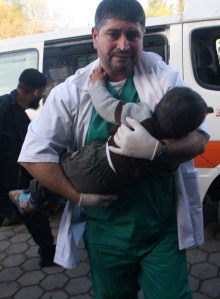
by James M. WallMedic holds child

Raise your hand if  you still believe Israel’s claim that its 23-day assault on Gaza was a necessary retaliation against Hamas for breaking a cease fire. Ok, put your hand down and listen up.

Consider the dates of the assault’s start and abrupt ending. The first Israeli air attack on Gaza came on December 27, 2008. Barack Obama was the president-elect. George Bush would be president until noon, January 20, 2009.

Israel had less than a month left to operate with impunity under the blessing of the out-going U.S. president.

Twenty three days after December 27, Israel’s prime minister, Ehud Olmert, announced that his government would  remove its forces from Gaza “at the greatest possible speed”.

The assault troops were out of Gaza by midnight, January 18. 2009. The Palestinian death toll had reached more than 1300. The injured totaled more than 5100.

Two days later, on January 20, 2009, Barack Obama was inaugurated president of the United States.

Before he entered the White House Obama knew what was happening in Gaza. His transition team remained in touch with the Bush White House. The London Guardian provided a daily death and injury report. Bloggers, like this one, also provided statistics on the wounded and dead.  Few U.S. papers bothered to even notice.

President-elect Obama insisted he had no control over what was happening in Gaza. That was true. As he put it, “we have only one president at a time”.

Now, six months later, President Obama has everything to do with the aftermath of Gaza, starting with some unfinished grisly and sad business involving the refusal of Israel and Egypt to allow heavy digging equipment to cross into Gaza.

Helene Cobban points to a Ma’an story on bodies still trapped in the Gaza rubble. Ma’an is a Palestinian news agency which reports:

The United Nations Development Fund (UNDP) officially began implementing its rubble removal operation on 9 July. About 420 tons of debris will be cleared at a cost of 12 million dollars, funded by Canada.

Gaza Ministry of Public Works vehicles have been used, but Israel’s and Egypt’s refusal to allow reconstruction materials into the area has forced many residents to dig, hoping to find lost loved ones on their own.

Ibrahim Radwan, undersecretary at the ministry, said that “the delay in finding the missing is due to a lack of necessary funds, estimated by the ministry at 16 million US dollars.” He also cited a lack of machines.

This is what the aftermath of a 23-day military Israeli assault looks like. The side with the machines, the one in absolute military control, determines when bodies may be dug up and given decent religious burials. Ma’an provides the names of the 59 still missing Palestinians. They range in ages from 12 to 79, men, women and children.

Ma’an would not object if you want to print this list of 59 and post it on your church bulletin board.  Their deaths were funded by U.S. tax payers which makes their deaths, and now their burials, partly our responsibility.

This is the aftermath of the Gaza assault which Barack Obama now faces. The good news is that in this aftermath, he is displaying a toughness, missing among recent U.S. presidents, in dealing with the Israeli government.  Consider these developments.

The Obama administration is making demands Israel is not accustomed to hearing from Washington. Obama is also playing a diplomatic game Israel hasn’t seen for a long time.

Nothing in the past sixteen years has appeared in the Jerusalem media with anything close to this ominous (to Israel) story which ran online July 24:

The US State Department rebuffed speculation that the administration of President Barack Obama was considering imposing economic sanctions against Israel in order to prevent it from continuing West Bank settlement construction.

Spokesman Phillip Crowley told reporters on Thursday that remarks made by deputy spokesman Robert Wood earlier this week had been “misinterpreted.”

Asked at a press briefing on Tuesday whether the US was considering putting financial pressure on Israel to get it to comply with US demands, Wood had said: “It’s premature to talk about that.“ (Jerusalem Post, July 24, 2009).

Blogger Richard Silverstein links to that “premature” denial story in his Tikun Olam blog:

What is deft about this particular series of statements is that the U.S. both plants the idea that it may be willing to consider sanctions if all else fails; and immediately denies the import of the statement in order to make it appear it was a mistake. But the seed has been planted. Now everyone in the Netanyahu government and the Israel lobby is aware of what the next step could be. They know what’s in store if they continue trying to play hardball regarding the settlement freeze and related issues.

On the same day, July 24,  Ha’aretz ran a story by Aluf Benn with this headline: “U.S. Warns Israel: Don’t Build Up West Bank Corridor”.

Nothing in the story about “unhelpful to the peace process”.  The language has changed. “Unhelpful” has been replaced by “stiff warning”. And this is a White House that actually knows where and what E-1 is and how Israel intends to use it.

The U.S. administration has issued a stiff warning to Israel not to build in the area known as E-1, which lies between Jerusalem and the West Bank settlement of Ma’aleh Adumim. Any change in the status quo in E-1 would be “extremely damaging,” even “corrosive,” the message said.

Prime Minister Benjamin Netanyahu has vowed in the past to finally build the controversial E-1 housing project – as have several premiers before him, though none has done so due to American pressure. He opened his recent election campaign with a visit to Ma’aleh Adumim in which he declared: “I will link Jerusalem to Ma’aleh Adumim via the Mevasseret Adumim neighborhood, E-1. I want to see one continuous string of built-up Jewish neighborhoods.”

Evidence is also piling up that the Israelis will have some scrambling to do to clean up the damage they left behind in Gaza, in destroyed lives, property, and Israel’s own international reputation. And more than scrambling will be needed to resist “stiff warnings” about “corrosive” behavior from the new American government.

Avi-Shlaim-Book-Launch-046_160And what about Israeli scholar Avi Shlaim, a loyal Zionist, IDF veteran, and sensitive soul? He is emerging as my new Israeli hero.  The first ten days of the assault on Gaza, which led to the deaths of many of those Palestinians still trapped in the rubble of their homes, prompted Shlaim to write a column for the London Guardian, with language rarely, if ever, found in print on the American side of the Atlantic.

Here are the opening lines from the column Shlaim wrote January 7, for the Guardian.

The only way to make sense of Israel‘s senseless war in Gaza is through understanding the historical context. Establishing the state of Israel in May 1948 involved a monumental injustice to the Palestinians. British officials bitterly resented American partisanship on behalf of the infant state. On 2 June 1948, Sir John Troutbeck wrote to the foreign secretary, Ernest Bevin, that the Americans were responsible for the creation of a gangster state headed by “an utterly unscrupulous set of leaders”. I used to think that this judgment was too harsh but Israel’s vicious assault on the people of Gaza, and the Bush administration’s complicity in this assault, have reopened the question.

I write as someone who served loyally in the Israeli army in the mid-1960s and who has never questioned the legitimacy of the state of Israel within its pre-1967 borders. What I utterly reject is the Zionist colonial project beyond the Green Line. The Israeli occupation of the West Bank and the Gaza Strip in the aftermath of the June 1967 war had very little to do with security and everything to do with territorial expansionism. The aim was to establish Greater Israel through permanent political, economic and military control over the Palestinian territories. And the result has been one of the most prolonged and brutal military occupations of modern times.

Shalim’s family immigrated to Israel from Iraq in 1950. He has served in the Israeli army, and is now a professor of international relations at the University of Oxford. He has written two highly-regarded books, The Iron Wall and Lion of Jordan: King Hussein’s Life in War and Peace. Another book, Israel and Palestine, will be published in September.

For more on Shlaim’s story as an Israeli scholar shattered by the Gaza attack, read Robert Fisk’s most recent London Independent column.

It gets better. Shlaim is not alone. There is a growing Israeli and international impatience and anger over what Israel did in Gaza.

UN official Richard Falk, for example, suggests that war crime charges could be involved.

Israeli soldiers, reflecting back on their part in the Gaza assault, have described the “excesses” of the army’s conduct.

Even the U.S. mainstream ‘s CNN has suggested that the original excuse Israel gave for launching the attack on Gaza collapses upon closer inspection.

To paraphrase Lyndon Johnson in his comment on the late Walter Cronkite and the war in Vietnam, “If CNN rejects our cover story, then Israel has lost Middle America.”

Surely, Middle America would want President Obama to inform Israel’s Prime Minister that there still 59 bodies lying beneath the rubble Israel left behind after its 23-day assault on Gaza, an assault that was conveniently/deliberately planned to keep it off Obama’s watch.

It is the Aftermath that now rests squarely and heavily on President Obama’s shoulders.

Picture in Gaza above is from Global Research and Rafah Today


Posted in Media, Middle East, Middle East Politics | 4 Comments

After 31 Years Jack Shaheen Still Helps Us See “Reel Bad Arabs”

Shaheen By James M. Wall

My first encounter with Jack G. Shaheen came in the summer of 1978. He was a professor of communications at Southern Illinois University, Edwardsville.

I was the editor of the Christian Century magazine in Chicago, Illinois. Jack sent me a manuscript entitled “The TV Arab”, which I immediately accepted for publication.

In October, 1978, the Wall Street Journal published an expanded version of the essay. In 1984, Shaheen expanded the article into a book with the same title.

In 2001, Jack Shaheen produced his break-through work: Reel Bad Arabs: How Hollywood Vilifies A People (Olive Branch Press, 2001), described by film scholar Henry Girous as a “pacesetting and courageous book”, focusing on “Hollywood’s production of long-standing racist stereotypes aimed at Arabs and Middle East culture.”

This publishing history is important as background for Jack Shaheen’s latest book, Guilty: Hollywood’s Verdict on Arabs after 9/11 (Northampton, MA: Olive Branch Press. 2008) because it became immediately apparent after the attacks of 911, that Hollywood would exploit the emotions evoked by the horrors of that day.

Shaheen is a careful scholar who writes out of a personal experience. His parents are from Lebanon. He was educated in the United States where, as he wrote in The TV Arab, his childhood television viewing included many programs featuring his favorite cartoon characters that relied on negative Arab stereotypes as comic foils.

Stung at an early age by the gross unfairness of these negative images, Shaheen began a lifetime of academic research into television and movies. Translating that research into mainstream culture became Jack Shaheen’s passion in life.

It has been a long and difficult struggle. I am pleased to report that, as an editor, I was able to play a small role in that struggle. I had no way of knowing it at the time, but Shaheen wrote the essay that I published in the Christian Century three years before he sent it to me.

When he later told me this story, I asked him to give me more information on his earliest publishing struggles.  This was  his response:

I had finished writing the essay you published in the Fall of 1975, after returning to Southern Illinois from Beirut where I had been teaching as a Fulbright scholar. I tried for three years to have someone publish this work. Somewhere in my hidden files I have all the rejection letters from 50-plus magazines/newspapers.

The most memorable rejection came from the editor [of a prominent publication]. She refused to publish it, using an excuse that it was too well-written. She told me other ‘minority’ writers would want her to publish similar essays, but their essays would not be as ‘good’ as mine. Honest!

After three years of rejections “‘the TV Arab’ essay appeared–for the first time ever–in the Christian Century in August, 1978.

Shaheen’s experience says far more about what can only be described as a “wall of ignorance” built in western culture to isolate the West from the East. The editors who turned down Shaheen’s article may have had one thing in common: They were themselves shaped by the builders of the “wall of ignorance” in Western culture who spent centuries shaping the self-understanding of a particular culture.

Living behind a “wall of ignorance” is easier than risking a look through the wall. Jack Shaheen, growing up as an Arab-American child, had a totally different self-understanding than his non-Arab-American classmates.  He took that self-understanding, combined it with his own personal intense interest in the power of movies and television to shape and sustain reality, and started researching and writing.

Thirty years after the publication of his first article on the damage negative stereotyping of racial groups inflict on member of those groups, Shaheen has now produced his newest book,Guilty: Hollywood’s Verdict on Arabs after 9/11.

In this book, prompted by the impact of 911 on American culture, Shaheen has followed the format of his earlier works. He first places current and recent films in historical context. Then he examines, film-by-film, those works that shape the American understanding of Arabs and Arab culture.

He does this by the analysis of a film scholar. He sees beneath the surface of the film, exposing blatant and subtle negative images of Arabs.  At times these images may be central to the plot of a film; in other films, the images are gratuitously inserted for comic relief with no connection to the plot.

Writing in the aftermath of 911, Shaheen looked for films that might be sensitive to the impact of 911, the opening to the West of the complex nature of Arab and Muslim cultures worldwide. In his new book, he does not dwell entirely on the negative. He looks for, and finds, films that reflect positive images and tell positive stories.

These positive films, a much smaller number, to be sure, suggest that Hollywood, or more likely, courageous directors and producers working outside of mainstream Hollywood, place honesty and artistic integrity above the exploitation of conventional prejudices.

In so doing, they break holes through the “wall of ignorance” behind which the West hides to avoid seeing the complex and ambiguous experience of non-Western cultures.

Shaheen’s first major book brought “Reel Bad Arabs” into our public dialogue.  From the beginning “reel” was a clever word play. He states at the outset of his “Guilty” book that he was motivated to write a sequel to “Reel Bad Arabs” after 911 for a very specific purpose:

I decided to follow Robert Frost’s wisdom—“more light, more light”–by offering fresh thoughts about reel Arabs, insights intended to stimulate thought and encourage discussion leading to a corrective.

Shaheen points out that Hollywood (a short hand term for the film industry) has employed simplistic movie language from the earliest silent films to the latest special-effects driven commercial films to lump together “Muslims and Arabs as one homogenous blob”  despite the reality that “only one-fifth of the world’s 1.3 plus billion Muslims are Arabs”.

Though faith plays an important role in the Arab world, just as it does here in the United States, it’s also true that much of the Arab world is quite secular.” Among Arabs worldwide, 20 million Arab Christians live in the Arab world.  The vast majority of Arab Americans [including the author] are Christians.

These are not facts that Hollywood wants us to worry about.  The film industry makes films for profit.. It is much easier to hide behind the “wall of ignorance” so long as there is an audience willing to live with that ignorance.

In his research, Shaheen has identified more than 1150 films that defile Arabs. Since 911 he has identified more than 100 post-911 films that continue this practice, as well has more than 100 additional films he has seen from the pre-911 era.

Among the worst since 911 is a grotesque animated film which was made as a satire on President Bush’s war against Iraq, Team America: World Police.

The cartoon images are ugly as they try to be funny.  As Shaheen points out, satire not understood as satire becomes an easy way to reinforce prejudice.

Babel (2006), in contrast, is a film released since 911 that appreciates the complexities of the Muslim world. In the detailed examination of the films in “Guilty”, Babel is given a Shaheen “recommended” tag.  He describes it as a “compassionate, heart-wrenching film [that] reveals universal human emotions, as well as cultural and racial identities”

Black Hawk Down (2002) was made with the cooperation of the U.S. Department of Defense, a not-uncommon practice when military equipment is needed. This film tells the story of the 1993 U.S. invasion of Somalia, and the heroic rescue of American servicemen trapped in Mogadishu. It is a war film but it treats the Somalia (Muslim) people as though, Shaheen writes, they were gang members in Los Angeles defying the Police Department.

This film makes Shaheen’s “worst” list because of its simplistic good-versus-evil plot that degrades Somalis.  Just before its release, Shaheen learned, 800 top officials and brass from the Defense Department were given a sneak preview of the film.  Then Secretary of Defense Donald Rumsfeld was reported to have described it as “powerful”.  The film was, of course, war propaganda released at a time when the U.S. government was starting its all-out campaign to attack Iraq.

One of the recommended films in Shaheen’s book is The Chronicles of Riddick (2004), an action-filled sci-fi film set in the future. This film draws on positive “humane Arabs, a devout Arabic-speaking Muslim cleric and his family to assist Riddick”  It was popular, especially, among action movie fans, and the positive Arab images are there to break through the “wall of ignorance” of American culture.

Flightplan(2005) is “recommended” by Shaheen because of its positive treatment of Arab Americans. Jodie Foster starred in the film which exposed prejudice and debunked it at the same time. This action film begins when Foster’s six-year-old daughter disappears while she and her mother are airborne in a jumbo jet.

Suspicion immediately falls on three Arab-American passengers because of their ethnicity. Their guilt is assumed; at the end of the film, they are revealed as innocent.  In a gentle closing scene, Foster offers one of the men an apologetic smile.

Director Ridley Scott’s film, Kingdom of Heaven (2005), is “recommended”, for very good reasons. It is an historic portrait of an important moment in Muslim-Christian history when the Christian Crusades army failed to defend Jerusalem from the Muslim leader Saladin, played in the film by Syrian-born saladin3Ghassan Massoud.

The film was not well-reviewed in the U.S., primarily because it dealt with an historic period unknown to American critics. Besides, American audiences were not in a mood for positive images of Muslims, even those who lived centuries ago.

Robert Fisk, the London Independent correspondent, wrote a long positive review after viewing the film in Beruit, Lebanon. Fisk wrote that it was a revelation to sit with an audience composed largely of young men in Lebanon–most of them in their 20s.

In the film, Fisk writes that Saladin and his Muslim soldiers, as well as the Christian leader Balian and his Christian soldiers, are honorable men; they show generosity as well as ruthlessness to their enemies.”

Fisk described a significant scene in the film in which Saladin enters the city of Jerusalem after the Christian king has surrendered. Saladin “sees a crucifix lying on the floor of a church, knocked off the altar during the three-day siege.  He carefully picks up the cross and places it reverently back on the altar.”

It was at this point during the Beruit screening, Fisk wrote, that “the audience rose, clapped and shouted their appreciation. They loved that gesture of honor.  They wanted Islam to be merciful as well as strong.”

With The Kingdom of Heaven (2005)Director Ridley Scott delivered a work of political art to world audiences. We should accept it with gratitude.  With his careful research and sensitive examination of how Hollywood shapes world perceptions, Jack Shaheen has given us a valuable tool with which to confront the evils of racism on screen. He too, deserves our gratitude.

An expanded version of this posting will appear in the next issue of  Media Development. a quarterly magazine published by the World Association of Christian Communications, based in Toronto, Canada.

Posted in -Movies and politics, Middle East, Middle East Politics, Movies | 4 Comments

Carter and the Elders Challenge “Injustice Wherever We See It”

See Update Below

by James M. Wall    Carter Rick Diamond Carter Ctr

Jimmy Carter is always busy, scurrying around below the line of public attention, doing what he does best, making a difference.

His friends, and they are many, are always glad to see him emerge into the light, taking aim at yet another difficult problem.

His enemies, and you know who you are, grab their propaganda weapons and take aim. They always miss.

An 84-year old former U.S. president who works to eradicate disease in Africa, monitor national elections, and push for peace in the Middle East, is not easy to bring down.

This week Carter surfaced again, this time as part of a group known as the Elders, retired world leaders who individually have found ways to continue to serve.

In a column for the London Guardian, Carter described one major problem the Elders have addressed to all faith traditions: Using religion to do massive harm to women. (To read the entire Guardian column, click here).

His title:”The words of God do not justify cruelty to women”.

Carter writes out of his own experience with the Southern Baptist Convention,  in which he spent more than six decades.

He left that particular religious body after a new group of Baptist leaders started using. . .

. . .  a few carefully selected Bible verses [that claimed] that Eve was created second to Adam and was responsible for original sin, ordained that women must be “subservient” to their husbands and prohibited from serving as deacons, pastors or chaplains in the military service. This was in conflict with my belief – confirmed in the holy scriptures – that we are all equal in the eyes of God. . . .

This distorted use of the Bible to force women into a subservient role in the church forced his own “painful” break.  He has written and spoken of this in recent years.

What is new in the Guardian column is that Carter is now working with a group of world leaders, the Elders. . .

. . .  an independent group of eminent global leaders, brought together by Nelson Mandela, who offer their collective influence and experience to support peace building, help address major causes of human suffering and promote the shared interests of humanity.

Elders, a term well known in Mandela’s native Africa, have a unique role to play in tribal society, and now, in the global society. This particular group of world Elders, at the moment twelve in number, was formed in Johannesburg, South Africa, on July 18, 2007.

ABC News described the formative event:

The Elders, a new alliance made up of an elite group of senior statesmen dedicated to solving thorny global problems, unveiled itself today in Johannesburg.

The rollout coincided with founding member Nelson Mandela’s 89th birthday.

After a grand entrance, Mandela, the former South African president, announced the rest of the Elders.

The members include Desmond Tutu, South African archbishop emeritus of Capetown; former U.S. President Jimmy Carter; former U.N. Secretary General Kofi Annan; Mary Robinson, former president of Ireland and Mohammed Yunus, the Nobel laureate and founder of the Green Bank in Bangladesh.

The group plans to get involved in some of the world’s most pressing problems — climate change, pandemics like AIDS, malaria, tuberculosis, violent conflicts.

It was an extraordinary gathering; a who’s who of famous international leaders, with enough emotion to move some of them to tears.

In his Guardian column, Carter explains why these particular Elders are now free to join together globally:

My fellow Elders and I, who come from many faiths and backgrounds, no longer need to worry about winning votes or avoiding controversy – and we are deeply committed to challenging injustice wherever we see it.

The Elders have decided to draw particular attention to the responsibility of religious and traditional leaders in ensuring equality and human rights. We have recently published a statement that declares: “The justification of discrimination against women and girls on grounds of religion or tradition, as if it were prescribed by a Higher Authority, is unacceptable.”

We are calling on all leaders to challenge and change the harmful teachings and practices, no matter how ingrained, which justify discrimination against women. We ask, in particular, that leaders of all religions have the courage to acknowledge and emphasise the positive messages of dignity and equality that all the world’s major faiths share.

Drawing from the Elders’ statement on the use of religion to discriminate, Carter begins from his own biblical tradition but he quickly moves to those areas where distortions of the Koran are also damaging to females of all ages. As he puts it, the influence of religion does not:

. . . stop at the walls of the church, mosque, synagogue or temple. This discrimination, unjustifiably attributed to a Higher Authority, has provided a reason or excuse for the deprivation of women’s equal rights across the world for centuries. The male interpretations of religious texts and the way they interact with, and reinforce, traditional practices justify some of the most pervasive, persistent, flagrant and damaging examples of human rights abuses.

At their most repugnant, the belief that women must be subjugated to the wishes of men excuses slavery, violence, forced prostitution, genital mutilation and national laws that omit rape as a crime. But it also costs many millions of girls and women control over their own bodies and lives, and continues to deny them fair access to education, health, employment and influence within their own communities.

The idea to form the Elders did not originate within the current twelve leaders. It came from two men well known in the world of music and business, British billionaire Richard Branson and rock star Peter Gabriel.

ABC News provides the history behind the Elders:

Seven years ago, Branson and Gabriel approached Mandela about the Elders idea, and he agreed to help them recruit others. “This group of elders will bring hope and wisdom back into the world,” Branson said. “They’ll play a role in bringing us together.

“Using their collective experience, their moral courage and their ability to rise above the parochial concerns of nations ? they can help make our planet a more peaceful, healthy and equitable place to live, ” Branson said. ” Let us call them ‘global elders,’ not because of their age but because of individual and collective wisdom.”

Calling it “the most extraordinary day” of his life, Gabriel said, “The dream was there might still be a body of people in whom the world could place their trust.”

Archbishop Desmond Tutu, who moderated the event and will serve as its leader, was moved to tears after Gabriel sang an impromptu accapella version of his hit song “Biko,” written about a famous South African political prisoner.

Branson and Gabriel have raised enough money — some $18 million — to fund this group for three years.

Who are Branson and Gabriel?  They are British, they are creative, and they have imagination. Like the Elders, they want to make a difference in the world.  So they invited Nelson Mandela to form the Elders.

Gabriel is an international rock star. Last year, he wrote the Oscar nominated,  “We’re Coming Down” that appeared in the film, Wall-E.

Other Elders include Indian microfinance leader Ela Bhatt and former Norwegian Prime Minister Gro Harlem Brundtland. Biographies of all twelve Elders may be found at the Elders website.

At the initial 2007 meeting in Johannasburg, the group left an empty seat onstage — symbolically — for an elder who was invited, but was unable to attend because she is under house arrest in Myanmar (Burma): Nobel laureate and human rights advocate Aung San Suu Kyi, who is currently in prison in Myanmar.

At the event that formed the Elders, Mandela and Carter stressed the fact that the Elders are free to talk to anyone without risk. ABC reported:

“We will be able to risk failure in worthy causes, and we will not need to claim credit for any successes that might be achieved,” said Carter.

Carter said the group does not want to step on or interfere with other positive work that nations or organizations are doing but wants to supplement that work.

Several members acknowledged that the actual activities and actions of the group remain to be determined. There are no titles, no ranking of the members. And it is not clear if they will travel as a group, deploy individual members to global hot spots, or simply sit in a room together to develop strategies or assist those who are suffering find help.

But they certainly have high hopes.

When Time magazine honored Peter Gabriel as one of its 100 “Heroes and Pioneers” leaders, the editors turned to one of Gabriel’s friends, Bishop Desmond Tutu, who confessed that before he met Gabriel he has never heard of him or of his major role as a musician.

In his tribute to Peter Gabriel, Tutu wrote:

What is his secret? He has a heart—in our part of the world, we would give him our highest accolade and say, “He has ubuntu.” It is that marvelous quality that speaks of compassion and generosity, about sharing, about hospitality.

So what is Jimmy Carter doing these days?

You might say he has joined a band called the Elders.  And you might also say the band was put together by rock star Peter Gabriel, record tycoon Richard Branson and South Africa’s former president, Nelson Mandela.

And now we know that Jimmy Carter has written his own song for the Elders: “We challenge injustice wherever we see it.”

Update July 25:

After this posting initially went online, it was picked up (with proper credit)  by my colleague Martin Marty, who did his own Sightings column on Carter and the Elders. Newsweek’s blog spread Marty’s column even further.

Many readers were unaware that President Carter had withdrawn from the Southern Baptist Convention in 2000. The Carter Center was deluged with queries prompted by the assumption that his move was a recent one.  The Center has helpfully passed along this link to the original news story from the year 2000, when Carter first announced his decision to leave the SBC.

Photo above by Rick Diamond, is used courtesy of the Carter Center, Atlanta, Georgia.

Posted in Religion and politics, Religious Faith | 6 Comments

A Man Kills His Parents and Begs for Mercy Because He Is an Orphan

By James M. Wall    Barrier in Bethany

Since its creation in 1948, the modern state of Israel has steadily stolen Palestinian land and driven Palestinians from their homes, cities and villages.

Nothing has been done to halt Israel’s steady march to tighten its absolute control of the Palestinian people with the obvious goal of ethnic cleansing, an historic fact well documented by Israeli scholar Ilan Pappe.

Under the protection of a security-obsessed military occupation, fully supported and underwritten by U.S. tax payers, Israel denies it has broken any laws. Israel makes its own self-preservation laws. It listens to no higher authority.

Israel has destroyed olive tree orchards and smothered stolen farmlands and pastures with modern malls where U.S. firms like Ace Hardware and Burger King enrich stock holders who don’t know, or don’t care, that they are taking part in the ugly crime of ethnic cleansing.

(The first time I saw an Ace Hardware store in a Ma’ale Adumim mall, I started my own personal boycott of Ace, an action unfair to employees of my  local Ace outlet, but one that has increased the receipts of my small neighborhood hardware store.)

Those poor benighted U.S. media readers/viewers who are unaware of this reality live in a bubble of ignorance, protected by AIPAC and its political, media and religious allies.

The narrative of Israeli governments heeding no call but their own, has been with us all along, but U.S. media readers/viewers have avoided having to think about it, or do anything about it.

They live comfortably within their bubble of ignorance which is created and sustained for them by their newspapers, news magazines, television outlets, radio broadcasts, government leaders and, alas, their religious leaders.

It does not have to be this way. During the last decade, the narrative of settlements like Ma’ale Adumim has been available on the internet in reports like this one from Electronic Intafada, which begins:

It is only a fifteen minute bus ride from Jerusalem to the Ma’ale Adumim settlement. After entering through guarded gates, one’s first impression is of a Miami-style suburb. The town at noon seems almost abandoned because the major part of Ma’ale Adumim residents head off to work in Jerusalem during the day. . . .

As soon as Barack Obama demanded from Israel the simple act of “freezing” its settlement expansion, Israel trotted out Public Relations Plan A for distribution to the media: Have a heart, settlement residents need room for their families to grow.

Israel operates on the logic of the man found guilty of killing his parents. The guilty man begged for mercy on the grounds that he was now an orphan.

To tell you about the Israeli settlers’ plea for mercy, the Los Angeles Times (July 6) delivered its version of the orphan story: “Israel’s settlements in West Bank present a major hurdle.”

The opening paragraphs of the Times story set the tone for the plea with weasel words (Lobby talking points) used by writer Edmund Sanders:

Reporting from Ma’ale Adumim, West Bank — This sprawling, well-manicured Israeli settlement — with its rows of red-tile roofs, palm trees and air-conditioned shopping mall — could almost pass for Orange County. Except the guards in this gated community sometimes pack automatic weapons.

Settlements such as the city-sized Ma’ale Adumim, about four miles east of Jerusalem in the West Bank,
are viewed by much of the world as illegal because they are built on land seized by Israel during the 1967 Middle East War. Many Israelis see Ma’ale Adumim as part of their country.

Now let us review the weasel words.

The reference to the illegality of Ma’ale Adumim is softened by the qualifying rhetorical device, “viewed by much of the world as illegal”.  The phase “viewed by” suggests that the issue at hand is open to debate among reasonable people.

Reasonable, as, for example, as a story that might have appeared in a Birmingham, Alabama, newspaper, circa 1939,  reporting that “segregation is viewed by many in the South as as a way to maintain harmony between the races and preserve our Southern Way of Life.”

Should such an analysis have been open to debate?  No, certainly not in the minds of a small number of courageous Southern liberals, and an increasingly impatient black population.

It required two more decades of U.S. racial oppression for that “debate”–for and against segregation–to reach a definitive conclusion with “all deliberate speed”.

Now we have a 21st century debate. The Times’ Monday story includes the phrase: “many Israelis see Ma’ale Adumim as part of their country.” Do they, indeed? How many Israelis?

Most polls suggest that sentiment is largely confined to the pro-settler community, while “security-minded” government leaders continue to demand the inclusion of Ma’ale Adumimin a future Israeli state

To other more fair-minded Israelis the phrase “many Israelis see Ma’ale Adumim as part of their country”, unpleasantly evokes the case of the parent-killer who begs for mercy because he is an orphan.

The Times story continues:

Now the long-simmering dispute over this and other fast-growing settlements has become a major obstacle to restarting peace talks.

Settlement building is not a long-simmering dispute.  It is part of decades of  immoral and illegal actions by Israel and is much more than a “major obstacle” to peace talks. It is an indisputable violation of  international law, which, if allowed to stand, will block any successful peace talks.

The parent-killer should mourn his Mom and Dad from his jail cell, not while sitting in the sun in his well-watered grass covered private backyard, shaded from the hot summer sun by a picnic umbrella purchased from a nearby Ace Hardware.

The LA Times reserves most of  its early sympathy for the illegal settlers of an illegal city with these touching “facts”:

“Why is President Obama interfering with our lives, telling us how many children we can have and whether we can get married?” asked Benny Kashriel, longtime mayor of Ma’ale Adumim. . . .

Talk about a possible freeze has many here worried.

“You can’t freeze a city,” Kashriel said. “If you freeze, you go backwards. Every month we are not building and people are not coming, it affects the economic situation of the city. . . . It’s punishing.”

A freeze, officials say, would threaten the opening of four new synagogues and seven sorely needed schools. Class sizes are already near the legal limit of 40 students per room.

An additional 400 units of housing in various stages of construction might also be shut down, leaving homeowners — many of whom have already taken out mortgages up to $300,000 — with monthly payments and no place to live.

The Times knew American readers would identify with those folks holding mortgages of up to $300,000 with monthly payments and no place to live. And those same readers can also identify with parents whose children are in schools “near the legal limit of 40 students per room”.

Further down in the story, the Times reports on the Arab village of Aziriyeh, (in biblical times, the village of Bethany), where Lazarus was called from his grave by Jesus. (Or as the Times writes, carefully avoiding any validation of a religious belief, “where the biblical Lazarus is said to have risen from the dead”).

The  comparison of Aziriyeh (Bethany) with Ma’ale Adumim is fact-filled. The comparison also strains for a “balance” that is impossible to achieve between occupiers and the occupied.

Since 1967, the story reports, the village of Aziriyeh has had three-fourths of its land stolen to enlarge Ma’ale Adumim. Its mayor, Issam Faroun, makes a comparison between his citizens and those of the illegal citizens of Ma’ale Adumim.  The facts are presented fairly. The comparative use of water is an example.

Mayor Faroun said:

. . . that as Ma’ale Adumim frets about the fate of its landscaped grounds or swimming pools, Azariyah residents receive water only once a week. The town gateway has turned into a junkyard of trash, scrap metal and old appliances. Schools have 45 students per class and unemployment is 50%, in part because the barrier prevents workers from reaching Jerusalem.

With no room to expand horizontally, families are adding second and third stories to their homes as children grow up and marry. Bassem abu Roomy, 31, still lives in his parents’ house, sharing two rooms with his pregnant wife and two children. His younger brothers are not so lucky.

“We can’t add any more stories because the foundation of the house can’t support it,” he said. “So they can’t get married.”

When did the relationship between Palestinians and Israelis in Aziriyeh (Bethany) and Ma’ale Adumim go wrong?   When that first brick was laid in Maale Adumim soon after 1967? When Ma’ale Adumim gobbled up three fourths of Aziriyeh’s farmland for its own use? Name your own moment in recent memory.

The LA Times wants us to look back no further than two decades when the biblical village of Lazarus and the modern Israeli city of  Ma’ale Adumim had, as the Times describes it, their harmonious relations “strained”.

A decade ago, the two communities lived somewhat harmoniously. Israelis shopped in Azariyah [Bethany] and Palestinians worked on housing projects in the settlement. But during the last Palestinian uprising, in 2000, two settlers were shot in the village and relations have been strained since.

The competing needs of these two communities have become part of the international debate.

So there you have it. Everything was fine until two Israeli settlers were shot. This is a case study on why the Israeli Lobby and the U.S. Congress are so grateful for news stories like this one that appeared in the Los Angeles Times.

For Sanders and the Times, the Arab village of Azariyah and the modern illegal city of Maale Adumim are merely playing a role in an “international debate”.

No wonder that parent-killer failed to get any respect with his request for mercy because he was now an orphan. He did not have the support of his own personal lobby making a case for orphans who have killed their parents.

The picture above is of  a barrier in the Arab village of Azariyah (Bethany). The break in the barrier has been covered by barbed wire. The wire is removed and replaced on a regular basis by Israeli authorities, who built the barrier in the first place. This photo is from the website of the World Council of Churches’ Ecumenical Accompaniment Programme in Palestine and Israel.

Posted in Middle East Politics | 6 Comments

The Thieves Pause: Israel “Open” to Summer Building Freeze

by James M. Wall                crop vineyard

“Israel Open to Settlement Freeze” was the New York Times headline over Ethan Bronner’s latest report from Jerusalem. How generous.

The occupiers who stole all that Palestinian West Bank land now offers to “freeze” construction for three months.  Why not? It is beastly hot in the West Bank from July to September.

The swimming pools and those “natural growth” houses next to grandma will just have to wait a little longer. The sheer absurdity of this latest Israeli governmental gesture boggles the mind.

Oh, but wait a minute. Even the freeze comes with caveats:

Israel would be open to a complete freeze of settlement building in the West Bank for three to six months as part of a broad Middle East peace endeavor that included a Palestinian agreement to negotiate an end to the conflict and confidence-building steps by major Arab nations, senior Israeli officials said Sunday.

The audacity of that offer is obscene.  As is the discussion being conducted this week by Ehud Barack, Israel’s Defense Minister, who will be meeting George Mitchell in Washington. (Bibi remained in Israel. He has settlement construction dust on his hands. His planned meeting last week with Mitchell in Paris was cancelled. Nothing to discuss.)

Barack will be pleading for a little family affection from Uncle Sam on this trip, as Ha’aretz reports:

Defense Minister Ehud Barak was set to head to the United States Monday in a bid to end a quarrel with U.S. President Barack Obama’s administration over Israel’s refusal to completely halt West Bank settlement construction.

Barak is expected to propose two potential compromises on the matter: Either a temporary complete settlement freeze, or the limiting of building in settlement blocs to high-rise construction only.

The defense minister, who is also the chairman of the center-left Labor party, will tell Obama’s special envoy to the Middle East, George Mitchell, that Israel cannot completely halt settlement construction.

To which Uncle Sam should respond: You got yourself into this fix with your support of the settlements. Now get yourself out. We have enough trouble already with our own right-wing domestic demands.

It will be enlightening to see how the New York Times‘ Ethan Bronner covers Barack’s trip. Bronner has clearly bought into the Israeli narrative which has long since forgotten some key moments in biblical history.

Which is why it is time for some biblical reflection on the theft of a neighbor’s vineyard.

Richard Silverstein, whose Tikum Olan blog is a reliable read on all matters Jewish, and Bronner, deeply rooted in Jewish culture, both know the biblical story of  ancient Israel’s King Ahab and Queen Jezebel, both of whom incurred the wrath of Jahweh for stealing Naboth’s vineyard and then killing him.

The theft of land is theft in the scriptures, in both ancient and modern Israel. Idolatry, worshipping the nation over Jahweh, also remains idolatry long after Jezebel was tossed from the Palace window for her leadership in the crime. Her body, by the way was left by a Wall, to be eaten by dogs.

“Thus says the Lord: In the place where the dogs licked the blood of Naboth, dogs shall lick your blood, even yours.And concerning Jezebel the Lord also spoke saying, The dogs shall eat Jezebel by the wall of Jezreel”.

For a summary of the story, click here.

Apparently fearing neither God nor man, Bibi Netanyahu’s government offers to take a summer break in its expansion of settlements on stolen land, selling it as another “generous offer”.

Meanwhile, Ethan Bronner keeps looking for hopeful stories to demonstrate that not all Israelis are thieves.

He finds a story that warms the heart in its generosity, although in its telling Bronner cannot avoid taking an unfair and misleading swipe at Jewish peaceniks.

Richard Siverstein explains:

I don’t know what it is with Ethan Bronner, the NY Times’ Israel correspondent. He’s clearly intelligent. He knows the issues fairly well. But his problem is he is conflict about the politics of the Middle East. With a child in the IDF and married to an Israeli it’s almost as if he has to pull his punches.

It’s not that he’s a horrible journalist. After all, as I said he’s articulate and intelligent and knows the issues. But rather than come right out and say something definitive, he beats around the bush and tempers his judgments. He wants everyone to like him and is shocked when many don’t.

Silverstein is a close reader of media, and he is quick to note the duplicity in Bronner’s feature story on Israeli peace activist Ezra Nawi, an Israeli worthy of considerable praise.  Nawi has “adopted” the Palestinian villages of the south Hebron Hills, “defending them from the marauding neighboring settlers.”

Ezra is up for sentencing on Wednesday (July 1), so, Silverstein notes, “the scrutiny on Israeli justice from a major U.S. media outlet is quite welcome.” He also urges his readers to sign a Jewish Voice for Peace petition “to pressure Israeli authorities to end this sham judicial process”.  For another take on Nawi’s case, see this report by Neve Gordon.

Silverstein, however, points out that Bronner has his own journalist caveat designed to “mollify his right-wing readers.” He writes on a progressive topic like the courage of Ezra Nawi but then he tosses in this slap at the Israeli political left:

Since the Israeli left lost so much popular appeal after the violent Palestinian uprising of 2000 and the Hamas electoral victory in Gaza three years ago, its activists tend to be a rarefied bunch — professors of Latin or Sanskrit, and translators of medieval poetry. Mr. Nawi, however, is a plumber.

No doubt, Joe the Plumber still resonates with the Times‘ right-wing readers, so why not do a little John McCain dance to contrast with the “rarefied bunch” to which the Israeli left has been reduced.

Silverstein acknowledges that in his story Bronner does quote an Israeli peace activist, David Shulman, a professor of Sanskrit at the Hebrew University.

But it’s as if this single source has somehow become emblematic of the entire Israeli peace movement. Not just emblematic, but in Bronner’s eyes the entire Israeli left has been reduced to David Shulman. While Prof. Shulman, a leader of Ta’ayush, IS an extraordinary scholar and human being, it is s deep disservice to him and the Israeli left to imply there aren’t many tens of thousands of others doing work equally valuable.

Silverstein then offers Bronner some examples:

Bronner: have you forgotten about B’Tselem, Gisha, Yesh G’vul, Combatants for Peace, Breaking the Silence, Rabbis for Human Rights, Hadash, Peace Now, the Israeli Committee Against Home Demolitions, Courage to Refuse, Parent’s Circle, Anarchists Against the Wall (just to mention organizations)?

And individuals like Uri Avnery, Rabbi Menachem Froman, the Sheministim, Michael Sfard, Jeff Halper, Shulamit Aloni, Robbi Damelin, Yitzchak Frankenthal, Rabbi Arik Ascherman, Dov Kheinin. Are these all nothing but effete European professors of obscure humanist subjects? The very notion is absurd and offensive.

Now, as always with Bronner’s howlers–there is a kernel of truth there. The organized Israeli left has shriveled and failed in a massive way since the first Intifada and especially during the Lebanon and Gaza wars. Note I said the “organized” left. I say this deliberately because Israeli NGOs and individual peace activists are doing work as vital as any done by the Israeli left when it was a more powerful political force. So for Bronner to dismiss the constituency of the Israeli left as he has done is deeply insulting and false.

Writing in the Los Angeles Times, Sarah Leah Whitson, Middle East director at Human Rights Watch, has a much better read on the “settlement freeze” than the New York Times’ Ethan Bronner. She also sees the thief parallel which appears to have eluded Bronner.

The debate over Israeli settlements in the occupied Palestinian territories is often framed in terms of whether they should be “frozen” or allowed to grow “naturally.” But that is akin to asking whether a thief should be allowed merely to keep his ill-gotten gains or steal some more.

It misses the most fundamental point: Under international law, all settlements on occupied territory are unlawful. And there is only one remedy: Israel should dismantle them, relocate the settlers within its recognized 1967 borders and compensate Palestinians for the losses the settlements have caused.

And there you have it, as plain as Yahweh’s anger at Ahab and Jezebeel, “all settlements on occupied territory are unlawful”.

Posted in Media, Middle East | 4 Comments