“What we got here is failure to communicate”

US Secretary of State John Kerryby James M. Wall

John Kerry’s April 29 deadline for a negotiated framework between Israel and the Palestinian Authority, is only a few weeks away.

Without waiting for what is still a “flexible” end point for this round of “peace talks”, the two negotiating parties have entered the “blame game” utilizing the weapons they have at hand.

One party has the military and police strength of a major world military power. The other has the power to sign 14 international treaties, which include the Geneva Conventions and treaties on racism, genocide, and civil and political rights.

Writing for Al Monitor on its Israel page, Ben Caspit offered his observation on the blame game. [Bold emphasis added]:

“Everything that has happened to Kerry’s initiative this week was smeared in block letters on every wall en route to this impasse that we have just reached.

 What we had here was a foretold chronicle of a breakdown on one hand, and a sweeping and somewhat childish enthusiasm with which Kerry sank his teeth into the negotiations on the other.

Had Kerry studied and examined the history of the last 20 years, he would have discovered that what he had undertaken was a mission impossible.”

Had Caspit studied and examined the two films he slips into his report, he would have discovered that Cool Hand Luke and the Mission Impossible series witness to the familiar reminder that “the arc of history bends toward justice”.

Luke’s spirit outlives the oppressive warden that treated him so brutally. Tom Cruise’s “missions impossible” all focus on one man’s victory over stronger adversaries.

Here is dialogue from a key Cool Hand Luke scene, followed by the scene on video:

Captain: Don’t you ever talk that way to me. (pause, then hitting him) NEVER! NEVER! (Luke rolls down hill; Captain speaks to other prisoners) What we’ve got here is failure to communicate. Some men you just can’t reach. So you get what we had here last week, which is the way he wants it. Well, he gets it. I don’t like it any more than you men.

Martin Luther King, Jr., who was assassinated at the Lorraine Motel, in Memphis, Tennessee, 46 years ago this past Sunday, referred to the “arc of history” in a speech he gave to the Southern Christian Leadership Conference on August 16, 1967, eight months before he was killed.

The arc reference was used earlier by Theodore Parker (1810-1860), a well-known American clergyman and a leading abolitionist. Predicting the eventual success of the abolitionist cause, Parker wrote:

“I do not pretend to understand the moral universe; the arc is a long one, my eye reaches but little ways; I cannot calculate the curve and complete the figure by the experience of sight; I can divine it by conscience. And from what I see I am sure it bends towards justice.”

Martin Luther King, Jr. made these words famous to a new generation a century later in his “Where Do We Go From Here?” speech to the Southern Christian Leadership Conference.

King ended his talk with his version of the Parker quote:

“Let us realize that the arc of the moral universe is long, but it bends toward justice. Let us realize that William Cullen Bryant is right: “Truth, crushed to earth, will rise again.” Let us go out realizing that the Bible is right: “Be not deceived. God is not mocked”.

Whatsoever a man soweth, that shall he also reap.” This is our hope for the future, and with this faith we will be able to sing in some not too distant tomorrow, with a cosmic past tense, “We have overcome! We have overcome! Deep in my heart, I did believe we would overcome.”

King’s enemies, and there were many, could not dim the spirit nor the influence of a man who reminded us that “God is not mocked”.

The movement King led brought down the walls of segregation. That “security wall” Israel claims it needs for its protection, will be brought down as well, along with the occupation it symbolizes and enforces.

This end of one more chapter of the “peace process”, is certainly a failure of the participating parties. It is not, however, the final word on the subject.

“The arc of the moral universe is long, but it bends toward justice.”

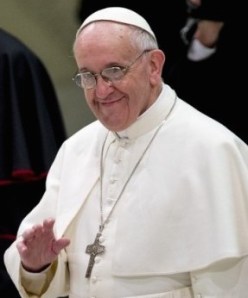
The picture of Secretary of State Kerry is from the Guardian. It was taken by Jacquelyn Martin/AFP/Getty Images.

Posted in John Kerry, Middle East Politics, Movies, Netanyahu, USA | 6 Comments

GOP Aspirant Christie Apologizes To Adelson

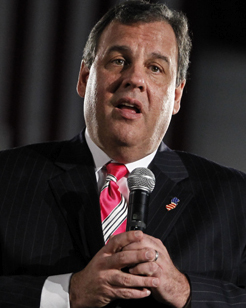
by James M. WallGov. Chris Christie Holds Town Hall Meeting In Belmar, New Jersey

Your heart has to go out to New Jersey Governor Chris Christie.

Last weekend Christie went to Las Vegas to roll the dice in the “kiss Sheldon Adelson’s ring”, Republican primary.

One of four Republicans who may enter the real presidential primaries for the 2016 nomination, Christie stumbled in Las Vegas.

Halfway through his public address to the Republican Jewish Coalition (RJC), a convenient cover event for Adelson’s ring-kissing primary, Christie uttered a huge Zionist “no no”.

Here is a poor guy doing his best to pivot from the grime and scandal of New Jersey politics to the sunny environs of Nevada, where he wanted to do nothing more than display his deep and abiding love for Israel.

Such a pivot should have been a welcome and easy transition for a man who has spent months fighting public and legal attacks over Bridgegate, “a scandal about a traffic jam”.

Desperate to connect to his Jewish audience, and of course, to kiss the ring of Zionist Casino Oligarch Adelson, Christie looked back fondly to a 2012 trip he made with his family to Israel.

Did  he not know? Had he not heard? A governor who has displayed considerable obfuscation skills while denying involvement in his staff’s possible use of a bridge barrier to punish a political opponent, Christie slipped up on this one, big time:

“I took a helicopter ride from the occupied territories across and just felt personally how extraordinary that was to understand, the military risk that Israel faces every day.”

His helicopter journey with his family was standard political jargon for his audience, except, that is, for one major “oops”.

Politics 101: “Occupied territories” is a term that aspiring politicos should never, ever use, when addressing a Zionist audience.

In the real world, as the Institute for Middle East Understanding (IMEU) documents, there is ample support for use of the term occupation:

In July 2004, while ruling that the wall Israel is building in the West Bank is illegal, the International Court of Justice also deemed Israel’s settlement enterprise to be in contravention of international law, and the West Bank, Gaza, and East Jerusalem to be under Israeli military occupation.

In 2005, Israel’s own Supreme Court also judged the West Bank to be under “belligerent occupation” by Israel.

In 2003, then-Prime Minister Ariel Sharon, known as a political hardliner and godfather of the settlement movement, stated “You cannot like the word, but what is happening is an occupation – to hold 3.5 million Palestinians under occupation. I believe that is a terrible thing for Israel and for the Palestinians.”

Always against such realities, colonialists create their own reality by controlling language to describe the land they seize.

Native Americans have the correct term for such control: “a forked tongue”.

The Urban Dictionary defines “forked tongue”:

A person who says one thing and does another as defined by Native Americans describing the first Illegal Aliens, the Anglo-Saxons breaking promises and treaties, with a snakes tongue for them taking their land by force with no compensation and forcing them to live in inhospitable areas like Oklahoma which Indians avoided before the advent of reservations.

Christie’s staff failed to provide their boss with a “forked tongue” Zionist dictionary.

Christie must have heard the ripples of disapproval and surprise that came from his National Jewish Coalition audience.  He then heard enough from his staff to rush over and apologize to Adelson.

The casino oligarch has yet to name his preferred 2016 Republican presidential candidate.

Who can say, the Christie apology for inadvertently speaking the truth, may turn out to be the apology that wins him the Adelson primary.

Adelson, who is chairman and CEO of Las Vegas Sands Corp., a casino and resort operating firm, has two major passions: Israel and casino gambling, especially Israel.

With these passions in mind, according to Media Mattershe reportedly spent nearly $150 million in an effort to influence the 2012 presidential election with donations to a super PAC aligned with Mitt Romney and other outside groups.

“Before switching allegiance to Romney, Adelson had donated millions to Newt Gingrich. He has also given generously in the past to super PACs associated with a variety of Republican politicians, including Scott Walker, John McCain, Rudy Giuliani, George W. Bush, and Eric Cantor.”

adelsonprimary-bloombergnewsLooking ahead to the 2016 Republican primaries, at Las Vegas, Adelson had private talks with Gov. Christie (R-NJ), Gov. Scott Walker (R-WI), Gov. John Kasich (R-OH), and former Florida Governor Jeb Bush. (Pictured here).

Another possible presidential aspirant, Kentucky Senator Rand Paul, was a no-show to the Las Vegas RJC event.

Time magazine offers this explanation for his absence:

Kentucky Senator Rand Paul is hard at work laying the groundwork for an almost certain presidential campaign in 2016, but as he broadens his support among libertarian and younger voters, there’s a budding counter campaign to take him down if he becomes a threat to actually win the nomination.

At the Republican Jewish Coalition (RJC) meeting in Las Vegas this weekend, Paul was nowhere to be found, but his presence was felt in the form of a straw man — and frequent worry. Speaker after speaker, from former Florida governor Jeb Bush to New Jersey Governor Chris Christie, laid into Paul’s more isolationist views on foreign policy.

They never mentioned the lawmaker by name, but the message came across loud and clear.

What was clear in Las Vegas, is that a presidential aspirant cannot possibly be blessed by Adelson unless he/she demonstrates a willingness for the U.S. to engage militarily in those places dictated by Israel.

Rashid Khalidi makes this point in his careful examination of the way in which U.S. policy makers have worked to give Israel what Israel demands.

In his book, Brokers of Deceit: How the U.S. Has Undermined Peace in the Middle East, Khalidi examines what he terms the “construct” of the “peace process”:

The construct is and was always designed by its Israeli architects (and their American subcontractors) to be an impermeable barrier against true Palestinian emancipation, rather than a route in that direction.

Thus, this construct does not, cannot, and is expressly meant not to address the roots of the conflict, which lie in the unending subjugation of the Palestinians, and their refusal to accept their lot.  

We should not be surprised: all of these elements are inextricably bound to a scheme originally devised by Menachem Begin to avoid such emancipation, and to ensure permanent Israeli control of, and settlement in, the occupied territories, the core of what Begin called ‘Eretz israel.’

Khalidi’s book is essential reading and rereading, as the 2016 presidential campaign begins.

If just one candidate of either party emerges and openly articulates the extent to which U.S. political leaders have served as “brokers of deceit”, that candidate deserves our attention

An unlikely development, of course, but strange things have emerged in political campaigns. Who could have anticipated that a “railsplitter” from Illinois would free the slaves near the end of the American Civil War.

The time has come for this nation to break from its Middle East policies, which are, in Khalidi’s words, “designed by its Israeli architects and their American subcontractors”.

George Washington warned us: “A passionate attachment of one nation for another produces a variety of evils”.

Those evils were much in evidence in the Sheldon Adelson Las Vegas primary.

The picture of Governor Christie (at top) appeared in Politico. It is by Getty . The pictures of the four presidential aspirants who attended the Las Vegas event, are from Bloomberg News. 

Posted in Middle East, Middle East Politics, Politics and Elections, United Nations | 4 Comments

The U.S. Cannot Resuscitate What Never Lived

by James M. WallPALESTINIAN-ISRAEL-POLITICS

The game must go on. John Kerry performs his negotiator role. Benjamin Netanyahu goes through his role as the leader of an “endangered” state.

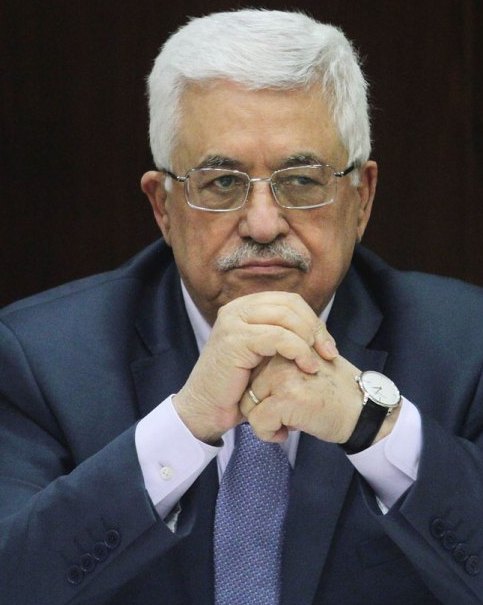
Mahmoud Abbas? Well, he (at right) is just sitting by at the peace table, with future diplomacy on his mind.

Trouble is, not even a hard-working John Kerry can resuscitate that which has not been suscitated in the first place

Suscitated?

Yes, that is exactly the word we need here, less than a month away from Kerry’s deadline for Israel and Palestine to agree on a framework to continue the current round of talks.

The Alpha Dictionary explains why:

“This word [suscitate] is not obsolete, just left behind in the dust of progress. .  .  Before you can resuscitate something, it should have originally been suscitated, [as in] “How do you suscitate curiosity in your students?”

Has there been a single Israeli prime minister who has ever been serious about giving Palestinians a viable state of their own?  Of course not. A colonial power does not give political power back to the people whose land it has stolen by force and by guile.

Unless that is, you are the white minority of South Africa which lacked the one thing it needed to continue to control the indigenous population which it had pushed into bantustans: A well-funded Lobby which owned the U .S. Congress.

How strong is the Israel Lobby? The Congress demonstrates its power when it cheers Netanyahu each time he shows up to ply his wares.

The Israel Lobby has such power that it even reaches into U.S. religious bodies when they debate resolutions critical of Israel.

Two of those religious denominations—The United Methodist Church and the Presbyterian Church USA—will bring up new resolutions against the occupation when they gather for regional and national meetings this summer.

The Israel Lobby will set up shop around and inside the two church assembly halls. They will not be discussing religious matters.

The modern state of Israel, created in 1948 at considerable cost to the Palestinian people, has never wanted to “suscitate” a peace process.

Every Israeli prime minister who agreed to “peace talks” did so because it was a handy place to nestle down and pretend peace while he or she swallowed up more Palestine land and stepped up Palestinian oppression.

Why else in this current round of “talks” would Netanyahu toss in two new demands, knowing they were deal-breakers?

“Recognize us as a Jewish state” and “give us the Jordan Valley to save us from marauding Arab armies” sounds suspiciously like a two-part package dreamed up by Madison Avenue to keep the talks going until the next U.S. presidential election.

To an uninformed American public and to an uncaring Congress, the two demands sound reasonable, in spite of the fact that they were dreamed up especially for this round of talks

Netanyahu knows that a Republican or a Clintonian Democratic White House will show little enthusiasm to confront the occupation.

Abbas knows Israel is stalling for time. Which explains why he is ready to “launch his own non-violent diplomatic assault” to confront Netanyahu’s stalling tactics.

Time magazine has the story:

Palestinian leaders are readying for a confrontation without violence. Once the talks fail — an outcome they regard as inevitable — the plan is to resume a diplomatic assault on Israel.

The main venue will be the U.N., where the General Assembly in 2012 granted Palestine state status. The institution, broadly supportive of Palestine, offers other levers to pressure Israel, including access to the International Criminal Court.

“The U.N. is one place where you can show respect for multilateralism, international law, where you can empower the Palestinians, check Israeli violations and give people hope,” [says Hanan Ashrawi, a Palestinian Authority executive-committee member].

Meanwhile, this weekend across the Atlantic, the 2016 presidential race gets underway. A very special Republican “primary” in Las Vegas will be hosted by an American oligarch with a strong affection for .Israel.

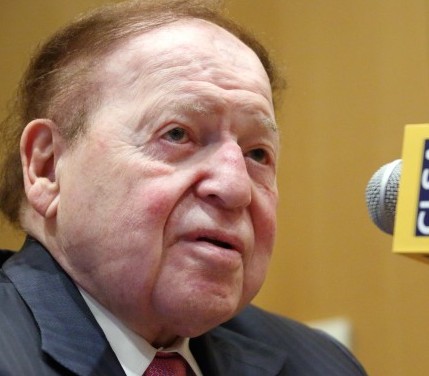
Tomohiro Ohsumi:Bloomberg News -That, of course would be billionaire casino magnate Sheldon G. Adelson (left), who, with his wife Miriam, poured more than $92 million into 2012 campaigns to elect Republican candidates, most of whom lost.

His strategy for 2016 will be pragmatic. The Adelsons intend to win the White House for Israel.

The Washington Post reports on the Adelsons’ 2016 strategy:

The Adelsons are plotting their investments based not on personal loyalty but on a much more strategic aim: to help select a Republican nominee they believe will have broad appeal to an increasingly diverse national electorate.

The change in attitude comes amid early jockeying by a lengthy list of aspiring Republican presidential contenders to win the affections of the billionaire, who is in the beginning stages of assessing the field.

“The bar for support is going to be much higher,” said Andy Abboud, Adelson’s top political adviser and an executive at the Adelson-run Las Vegas Sands Corp. “There’s going to be a lot more scrutiny.”

Four Republican hopefuls will audition for the Adelsons: Former Florida governor Jeb Bush, New Jersey Governor. Chris Christie, Wisconsin Governor Scott Walker and Ohio Governor John Kasich.

In what is essentially the “Sheldon Primary,” the auditions are the first step toward victory for the Republican party and for Israel.

The Post adds that:

Officially, the potential 2016 candidates will be at the Venetian for the spring meeting of the Republican Jewish Coalition, which begins Thursday with a golf outing, followed by a VIP dinner featuring [Jeb] Bush and hosted by the Adelsons in the private airplane hangar where Adelson keeps his fleet.

But some of the most important events will occur between the poker tournament, Scotch tasting and strategy workshops. That’s when Adelson is scheduled to hold casual one-on-one chats — over coffee, at dinner or in his private office — with the prospective candidates.

No doubt Israel will be at the top of the Adelsons’ agenda for discussion, followed by a friendly committment that the casino industry will be given clear sailing in its current battle against its major competitor, online gambling.

After 2016, with what Republicans like Adelson hope will be a Congress firmly in hand, and a Republican, or a Clintonian Democrat, in the White House, talk of resuscitating a peace process that has never been suscitated, will no doubt be trotted out in a new format, one that will enable Israel to proceed with further expansion.

And the most fervent effort for justice by a U. S. Secretary of State since Israel became a nation, will have reached an ignominious conclusion.

After which, President Abbas’ effort to launch a diplomatic assault on Israel’s occupation, will be tested in the court of world opinion, and just possibly, in the courts of international justice.

Meanwhile, Sheldon G. Adelson will be happy. And Israel, which calls itself the “start up nation”, will keep its economy booming, with the keys to the occupation firmly secure in its hands.  For a time, at least.

The picture at top of President Abbas, was taken by Issam Romawi for AFP/Getty Images. It appeared in Time magazine. The picture of Sheldon G. Adelson was taken by Tomohiro Ohsumi for Bloomberg News. It appeared in the Washington Post. 


Posted in John Kerry, Middle East, Middle East Politics, Netanyahu, Presbyterian Church USA, Religious Faith, United Methodist Church | 7 Comments

Will Abbas be Followed by Dahlan or Barghouti?

by James M. WallAbbas, Araft Dahlan

The headline on a New York Times story sounded innocent enough:

Palestinians Criticize Abbas for Public Fatah Feud at Delicate Time Diplomatically.

This is not an innocent story. It is a Times hasbara presentation that pretends to be “about” criticism by Palestinians of their president for starting a “feud” with Muhammad Dahlan.

Here are key paragraphs in the Times story:

Some of Mr. Abbas’s current difficulties are of his own making. Palestinians say they are baffled by Mr. Abbas’s decision to open up another front within his own Fatah movement by beginning a nasty, public campaign against a onetime ally who Mr. Abbas now sees as a rival, Muhammad Dahlan, a former Gaza strongman and Fatah security chief.

In the two weeks since Mr. Abbas’s opening salvo against Mr. Dahlan, who is living abroad, the Arabic media has been filled with unproved accusations by Mr. Abbas about the long-ago killings of prominent Palestinians, and by both men about collaboration with Israel and financial corruption.

Mr. Abbas even implied that Mr. Dahlan might have had a hand in the mysterious death of Yasir Arafat, the father of the Palestinian cause, in 2004. For the most part, the two camps have not offered detailed responses to all the accusations.

It makes more sense, based on what is in the story, to conclude that the Times is informing its readers that when the peace talks fail, as they most certainly will, the blame will fall on the “inept” leadership of President Abbas.

The story further carries the hidden message that just maybe Israel, and the Times, want President Abbas replaced by Muhammed Dahlan.

They figure it is time for a leader friendly to the Israel/U.S. imperium to take command of the Palestinian Authority.

Abbas tried hard, but he just did not turn out to be the loyal strong man the imperium wanted.

Isabel Kershner, who wrote the Times story, describes Abbas’ political fight with Dahlan as a “feud” inside Fatah, a feud the Times would have its readers believe is unwise because it comes during a “delicate time” in the peace negotiations.

Kershner, painting Abbas with pejorative language, sees the “feud” as “a nasty, public campaign against a onetime ally who Mr. Abbas now sees as a rival”.

Abbas now sees Dahlan “as a rival”?

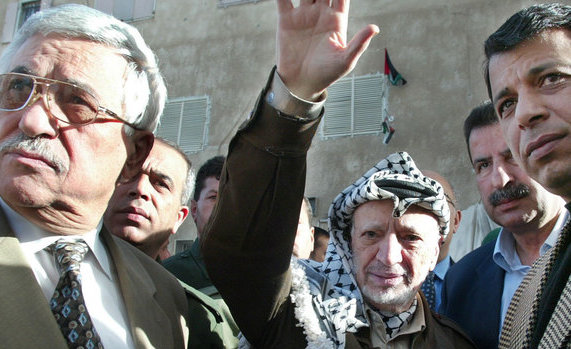
Dahlan has been a rival since at least 2003. The picture above was taken in 2003. It shows Abbas at left, Arafat, arm raised, in the middle, and Dahlan at right, greeting the public.

Who is Muhammed Dahlan?

In 2008, David Rose wrote an article in the April issue of Vanity Fair, entitled The Gaza Bombshell.

Vanity Fair described its story this way:

After failing to anticipate Hamas’s victory over Fatah in the 2006 Palestinian election, the White House cooked up yet another scandalously covert and self-defeating Middle East debacle: part Iran-contra, part Bay of Pigs. With confidential documents, corroborated by outraged former and current U.S. officials, the author reveals how President Bush, Condoleezza Rice, and Deputy National-Security Adviser Elliott Abrams backed an armed force under Fatah strongman Muhammad Dahlan, touching off a bloody civil war in Gaza and leaving Hamas stronger than ever.

The Guardian, commenting  on the Vanity Fair article, highlighted Dahlan’s role:

The central figure in Washington’s plan was Mohammed Dahlan, who had been Yasser Arafat’s security chief in Gaza and who had established close ties with the CIA as early as the 1990s. The magazine cites three unidentified US officials quoting Bush as saying: “He’s our guy.”

The New York Times chose not to remind its readers that Dahlan is far more than an Abbas political rival.  He is a former Fatah leader who was ousted from the party by Abbas.

In 2007, he was the U.S./Israel imperium’s chosen Fatah operative assigned to punish Hamas for winning a free and open democratic 2006 election, which Hamas won not just in Gaza, but throughout the Occupied Territories.

Ali Abunimah, writing in the Electronic Intifada in 2007, presented this disturbing Dahlan background, beginning with a quote from a letter that Dahlan wrote:

“Be certain that Yasser Arafat’s final days are numbered, but allow us to finish him off our way, not yours. And be sure as well that … the promises I made in front of President Bush, I will give my life to keep.”

Abunimah continues:

“Those words were written by the Fatah warlord Mohammed Dahlan, whose US- and Israeli-backed forces were routed by Hamas in the Gaza Strip last month, in a 13 July 2003 letter to then Israeli defense minister Shaul Mofaz and published on Hamas’ website on 4 July this year.

Dahlan, who despite his failure to hold Gaza, remains a senior advisor to Palestinian Authority chairman Mahmoud Abbas, outlines his conspiracy to overthrow Arafat, destroy Palestinian institutions and replace them with a quisling leadership subservient to Israel.

Dahlan writes of his fear that Arafat would convene the Palestinian legislative council and ask it to withdraw confidence from then prime minister Mahmoud Abbas, who had been appointed earlier in 2003 at Bush’s insistence in order to curb Arafat’s influence.”

In 2014 the New York Times has this view of  Dahlan“Mr. Dahlan, 52, rose from humble beginnings in a Gaza refugee camp to become a powerful figure in the Palestinian Authority who earned the trust of Israel and the United States. Some saw him as a potential successor to Mr. Abbas”.

To President Bush, strongman Mohammed Dahlan is “our guy”.

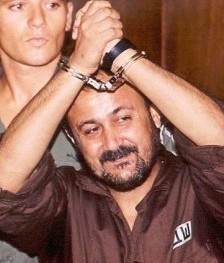
marwan Barghouti in court 2002 credit Flash 80It is with good reason that President Abbas is insisting that one of the conditions for the PA to remain in peace discussions after the late April deadline is the release of more senior Palestinian prisoners.

Among the prisoners he specifically names is Marwan Barghouti, (shown here in a 2002 court appearance) considered by many as  President Abbas’ preferred successor.

The Times of Israel writes that in his recent visit with President Obama in Washington, President Abbas indicated that he is reluctant to continue talks with Israel. He did offer, however, conditions that could influence his decision:

Abbas said he would need to receive something from the Israelis if he were to agree [to extend the talks]: a settlement freeze, and a further prisoner release — beyond the fourth group of terror convicts scheduled to go free on March 29. (“Terror convicts” are not Abbas’ words; they belong to the Times of Israel.)

And not just any prisoners, but, according to the London Arabic newspaper al-Hayat, The Prisoner, Fatah Tanzim leader Marwan Barghouti. Arab and Palestinian sources confirmed the reports to The Times of Israel

The 2003 picture at the top, is by Jamal Aruri/Agence France-Presse. It appeared in the New York Times. The picture of Marwan Barghouti is from Flash 80. It appeared in The Times of Israel.


Posted in Media, Middle East Politics | 5 Comments

Northeastern Joins Zionist BDS Campus Attacks

by James M. WallBryan MacCormack, Left in Focus

Forget about the so-called Peace Process, which Israeli Prime Minister Benjamin Netanyahu continues to use as a cover for Israel’s territorial incursions into Palestinian Occupied Territories.

Start worrying, instead, about Zionist incursions into American universities.

Truthdig columnist Chris Hedges reports on the latest example of how universities and colleges are kowtowing to Zionism by banning and blacklisting student groups that “challenge the official Israeli narrative”:

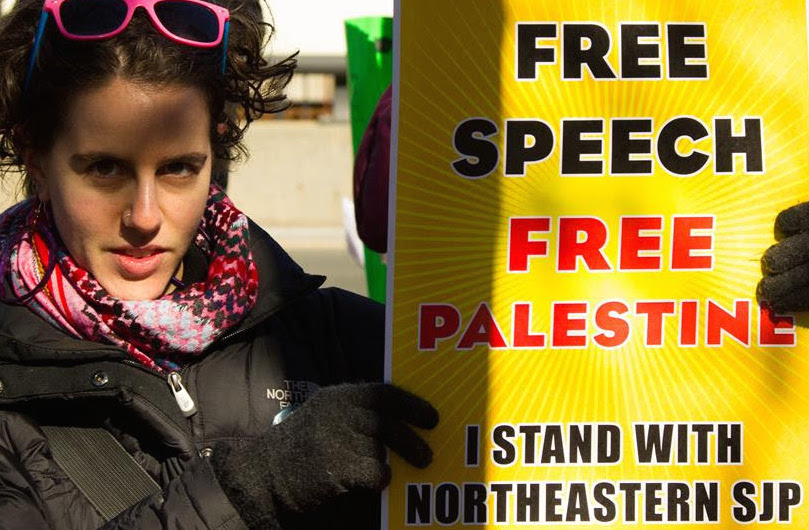
The banning of Students for Justice in Palestine (SJP) at Northeastern University in Boston on March 7, along with a university threat of disciplinary measures against some of its members, replicates sanctions being imposed against numerous student Palestinian rights groups across the country.

The attacks, and the disturbingly similar forms of punishment, appear to be part of a coordinated effort by the Israeli government and the Israel lobby to blacklist all student groups that challenge the official Israeli narrative.

Northeastern banned the SJP chapter after it posted on campus replicas of eviction notices that are routinely put up on Palestinian homes set for Israeli demolition. The university notice of suspension says that if the SJP petitions for reinstatement next year, “No current member of the Students for Justice in Palestine executive board may serve on the inaugural board of the new organization” and that representatives from the organization must attend university-sanctioned “trainings.” 

Northeastern is, no doubt, a university of considerable merit. It, no doubt, has faculty members who understand communications.

In a delicious irony, Northeastern, a private institution which relies heavily on private and corporate funding, prides itself on its communications program. That reliance is not unlike that of the U.S. Congress, whose members survive on a diet of private and corporate campaign contributions.

So why does Northeastern need to ban a student group which communicates its opposition to Israel’s occupation policies. Instead of commending the students for their communication skills, the university has deemed SJP to be “guilty of advocating sanctions against the state of Israel?”

hedges_op_0-1Who or what prompts Northeastern’s actions? Hedges (pictured  here) talked to Max Geller, a law student and a SJP member at Northeastern.

Geller accused the university of responding “to outside pressures,” including that of alumnus Robert Shillman, who is the CEO of Cognex Corp., and hedge fund billionaire Seth Klarman, both supporters of right-wing Israeli causes. Geller said:

“To prohibit students from holding leadership roles and student groups simply because they engaged in a peaceful political protest is antithetical to the university’s mission to educate students,” he said. “It erases any pedagogical value disciplinary process might seek.”

“In the last year,” Geller went on, “I have received death threats, been publicly and unfairly maligned, and have been threatened with disciplinary measures. This has made engaging in speech about an issue about which I care deeply, both as a Jew and an American, a fear- and anxiety-causing prospect.”.

Hedge fund billionaire Seth Klarman, referenced above by Geller, is a relative newcomer to Zionist cause. He made his first trip to Israel seven years ago.

Seth-A.-KlarmanHowever with the establishment of his new Jerusalem-based on-line newspaper, The Times of Israel, in 2012, Klarman (shown here) established himself as a major Zionist player in both the U.S. and Israel.

His possible role in influencing Northeastern University reflects his strong pro-Israel position, which has also prompted him to give major political support to Prime Minister Benjamin Netanyahu.

And where does the Prime Minister stand on the worldwide Boycott, Divestment and Sanctions movement?

Speaking to AIPAC in Washington, March 4, Chris Hedges reports that Netanyahu spent a surprisingly large amount of time attacking the nascent BDS movement, which he said stood for “Bigotry, Dishonesty and Shame.”

Hedges also notes that in his AIPAC speech, Netanyahu called for BDS supporters to “be treated exactly as we treat any anti-Semite or bigot.”

Despite this heavy array of opponents lined up against them, the Students for Justice in Palestine (SJP) at Northeastern University are not going down without a fight.  They have continued to protest against their banning by Northeastern.

Which brings us finally to two comments Robert Stiver wrote to Wall Writings. The first appeared at the end of an earlier posting, Does The IDF Target Palestinian Soccer Players?, which may be read in the comments on that posting.

Stiver has now sent Wall Writings a second comment pertinent to the Israeli campaign against Palestinian sports teams. This comment is also relevant to U.S. student organizations like the Students for Justice in Palestine (SJP).

With Bob Stiver’s permission, I am including his second comment as a conclusion to this Wall Writings posting.

Jim, your posting focuses powerfully on an important subset of the Zionists’ frenzy to commit culturecide-cum-genocide against the Palestinians. I’ve been increasingly convinced for years that the Zionists are engulfed in a massive psychosis, and I postulate that guilt is a major part of its root causes.

I see all their actions deriving from the invasion by European Jewish Zionists of a land to which they did not belong. Trying to build an edifice of legitimacy where no such edifice is possible has led to a prime component, criminality bounded by crimes against humanity and war crimes, of the psychosis. The impunity given the psychosis and its practitioners is mind-boggling.

As I writhe in empathic frustration and anger with the Palestinians, I’d like to add just one more plank of an indictment of the Zionist enterprise — an indictment and then the follow-on trial that are long overdue.

I ask you, Jim, and your readership, to link to and read the March 12, 2014, article by the indefatigable Dave Zirin. It is entitled Israel, Palestine, Pinochet… and a Soccer Jersey?. It appeared in LatinOpen Magazine, and was referred to me by my friend Helen Marshall (who also had a Comment on the posting, Does The IDF Target Palestinian Soccer Players? .

Helen’s State Department career included significant service in South America. Please consider my extract from Dave Zirin’s article and reflect, inter alia, that this Zionist frenzy is ever-present, global, and evil beyond any attempt to define its scope and boundaries:

“…the (Chilean soccer club) team was charged by the Simon Wiesenthal Center with “fomenting terrorist intent.”

Finally, I must add a reference to another article by Dave Zirin, which appeared on November 19, 2012, Killing Hope: Why Israel Targets Sports in Gaza.

Its setting is during the 2012 latest act of Zionist Israel’s “mowing the grass” atrocities in Gaza. The article is also from the Nation magazine, the publication in which Zirin publishes so many outstanding sports and political articles.

The links supplied above by Bob Stiver to Dave Zirin’s articles should serve as an important reminder to the SJP students at Northeastern University–and their supporters–that they are not alone in their struggle against secular Zionism, a political ideology which has invaded their campus.

The photo at top is by Bryan MacCormack, Left in Focus. It appeared on the Boston Jewish Voices for Peace blog .

Posted in Media, Middle East Politics, Netanyahu | 3 Comments

Does The IDF Target Palestinian Soccer Players?

by James M. Wallpalestine_soccer_ap_img

Two Palestinian youth soccer players were shot and badly wounded near a check point in the Palestinian West Bank on January 31.

Ma’an, the Palestinian news outlet, reported the shootings of Jawhar Nasser Jawhar, 19, and Adam Abd al-Raouf Halabiya, 17.

The players were shot by Israeli soldiers as they were walking home from practice in the Faisal al-Husseini Stadium in al-Ram in the central West Bank.

Medical reports indicated that “Jawhar was shot with 11 bullets, seven in his left foot, three in his right, and one in his left hand. Halabiya was shot once in each foot.”

Doctors at Ramallah governmental hospital said the pair “will need six months of treatment before they can evaluate if the two will even be able to ever walk again, at best.”

Ma’an also reported that “Israeli forces opened fire in their direction without warning as they were walking near a checkpoint. Police dogs were subsequently unleashed on them before Israeli soldiers dragged them across the ground and beat them.”

The story did not surface in western press outlets until Dave Zirin wrote in the Nation:

Their names are Jawhar Nasser Jawhar, 19, and Adam Abd al-Raouf Halabiya, 17. They were once soccer players in the West Bank. Now they are never going to play sports again. Jawhar and Adam were on their way home from a training session in the Faisal al-Husseini Stadium on January 31 when Israeli forces fired upon them as they approached a checkpoint.

After being shot repeatedly, they were mauled by checkpoint dogs and then beaten. Ten bullets were put into Jawhar’s feet. Adam took one bullet in each foot. After being transferred from a hospital in Ramallah to King Hussein Medical Center in Amman, they received the news that soccer would no longer be a part of their futures.

(Israel’s border patrol maintains that the two young men were about to throw a bomb.)”

A week later, Zirin described the reaction he received from his original report on the shooting of the two players.

One of the sports writers asked Zirin, “Do you have any sources that are not Palestinian?”

That obvious pro-Israel and clearly racist distrust of all matters pertaining to Palestinians, was quickly underscored by that same questioner when he sent a subsequent email to Zirin, saying, never mind, I have found a report of the shootings in Ha’aretz, a Jewish news outlet based in Jerusalem.

In his March 10 story, Zirin stated flatly that he believed “members of the Palestinian soccer community are being targeted for violence by the Israeli state.”

Some critics reacted to this theory by saying the targeting charge was  “laughable,” and “ridiculous,” One writer even wrote he would “reach out to The Nation directly to agitate for dismissal”.

Zirin’s response was fact-based and compelling:

maan-attack-dogYes it is certainly true that I don’t have a document signed by Benjamin Netanyahu calling for a systematic attack on the Palestinian national team. What I do have are names: real people, with real families, whose lives and deaths are testament to a story that needs to be told.

There was Ayman Alkurd. He was a 34-year-old member of the Palestinian national soccer team. Alkurd was killed during the 2009 Operation Cast Lead when a missile was sent into his home in Gaza.

There was Wajeh Moshtahe, another national team member. He was killed in his home during Operation Cast Lead as well. He was only 24. There was Shadi Sbakhe, another national team member who suffered the same fate. All three, in fact, died within seventy-two hours of one another.

They reminded many, at the time of their deaths, of Tariq Al Quto, described by the BBC as “a talented midfielder,” who was killed by the IDF in 2004.

Then there are the imprisoned. We can start with Omar Abu Rios, the former starting goalkeeper for the national team. He was arrested at age 23 for allegedly being part of an attack on Israeli troops at the Amari Palestinian refugee camp near Ramallah.

He was, according to Chairman of the Palestinian Football Association Jibril al-Rajoub, “arrested at work and taken to an unknown location.” Rajoub appealed directly to FIFA chief Sepp Blatter on Rios’s behalf, saying that his arrest “was in total disregard of all agreements signed by the Israeli side and in direct violation to the simplest right of our players.”

There was also Muhammad Nimr, a top 23-year-old striker and national team member, who had his house destroyed by the IDF and was then jailed without charges being filed. Nimr’s story echoed that of another striker, Zakaria Issa, who had been jailed for sixteen years before being released in 2013 when he was struck with terminal cancer.

Then there was Mahmoud Sarsak. Sarsak was a defender on the national team who was arrested and jailed without charges while trying to cross a checkpoint in order to join his teammates. His plight became an international cause when the Palestinian national team member went on a three-month hunger strike while being held in an Israeli prison.

He was released in July 2012. As he said at a meeting in England upon his release, “Israel actively attempts to stop sportsmen and women competing, and there are a large number of athletes in prison…. Since 2008 we have seen Israel detain a number of sportsmen who were arrested under the administrative detention laws—meaning no charges need be brought. They never have to go to trial.”

This is reality for the Palestinian national team: four dead by Israeli munitions and—at least—three jailed in Israeli prisons without trial over the last decade.

I have no idea whether people will see this as constituting a “targeting” of the Palestinian soccer players. I do believe that it is our job as sports journalists to ask the questions.

Zirin is not optimistic that the notoriously conservative FIFA will act to investigate the charge of targeted killings by Israel.

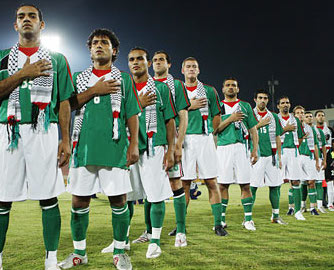
Natioanl-Palestine-Football-team-1But what is clear is that Israel has a well-documented record of targeting Palestinians it wishes to remove from action of any kind.

The 2014 FIFA (The Fédération Internationale de Football Association) is the international governing body of association football, futsal and beach soccer.

This summer’s World Cup will run from June 12 to July 13. The Palestine team did not qualify for this year’s Cup.

Because FIFA wants to “grow” soccer in all regions of the world, in December 2010, Russia and Qatar were chosen to host the 2018 and 2022 FIFA World Cups, respectively.

FIFA plans ahead, given the complicated logistics involved in holding World Cup Events.

Will FIFA dare look ahead to its next World Cup events in Russia and Qatar, without having first confronted the problem of the FIFA membership of Israel, a FIFA member which now stands accused of using attack dogs and deliberately targeting Palestinian soccer players?

The picture at top shows Jordan’s Baha’aldeen Alja’afreh, right, running by Palestine’s Oday Dabbagh at the Faysal al-Husseini stadium, in Ramallah. The AP Photo is by Nasser Nasser.

The second picture from Ma’an, shows Palestinian footballer Jawhar Nasser Jawhar, 19, in his hospital bed, following his attack by Israeli forces,Jan.31, 2014.

The third picture is a group photo of the 2013 Palestine National Team. It was taken on February 21, 2013. It is from anantasports.com.

Posted in Media, Middle East, Middle East Politics, Netanyahu, Soccer | 8 Comments

Pope Francis Plans Second Visit to Jerusalem

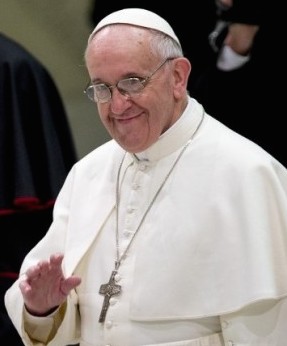
by James M. WallAP'Alessandra Tarantino

Pope Francis currently plans to visit Amman, Bethlehem and Jerusalem, May 24-26. This will be his second trip to Jerusalem.

The Pope’s first visit was 41 years ago. On that trip, he arrived in Jerusalem in October, 1973, just before war began between Israel and its Arab neighbors.  

That war was fought between a coalition of Arab states led by Egypt and Syria, against Israel. The war lasted from October 6 to October 25.

On his second trip to Jerusalem in May, 2014, there will be no war to interrupt the Pope’s journey. There is, however, a labor strike by Israeli diplomatic personnel which began this week. The unions are striking for higher wages and better working conditions.

At first it was believed the Pope’s trip would be delayed or cancelled, since diplomatic personnel are needed to handle such a high profile visitor. However, Cardinal Pietro Parolin, the Vatican’s Secretary of State, has said that while the strike has caused “some apprehensions”, the trip will not be delayed.

Despite objections from Israeli diplomatic personnel, the strike did not postpone a visit March 12-14 of British Prime Minister David Cameron, who arrived in Tel Aviv Wednesday. Cameron was accompanied by officials from 17 British firms, seeking stronger business ties with Israel. Cameron was expected to meet with both Palestinian and Israeli officials on the trip that had already been delayed because of flooding in Britain.

The timing of the Pope’s May visit is intended to coincide with the 50th anniversary of Pope Paul VI’s visit, the first in modern times. Since that 1963 visit, two more Popes have come to visit, Pope John Paul II in 2000 and Benedict XVI in 2009.

The Times of Israel reports that in October 1973, Jorge Mario Bergoglio, now Pope Francis, made his first visit to Jerusalem. Bergolio, then in his mid-30s, stopped in Jerusalem after completing training in Rome for his new job as the Provincial Superior of the Society of Jesus in Argentina.

When the war began, Father Bergoglio was confined to the American Colony Hotel, in East Jerusalem. The Vatican recalls he spent his time “studying the Letters of Saint Paul to the Corinthians.”  During his enforced stay at the American Colony, he read books he borrowed from the library of the Jerusalem branch of the Pontifical Biblical Institute. 

We may never know if young Father Bergoglio put aside his study of the letters of Paul long enough to cross the parking lot of the American Colony Hotel to visit the book store there. If he had done so, he could have discovered some important volumes about the political situation in 1973, and the history of the Arab-Israeli war that had started during his visit.

It happens that a few weeks after that Arab-Israeli war ended in late October, 1973, I made the first of my more than 20 trips to the region. Like Father Bergoglio, I stayed at the American Colony Hotel. I was originally scheduled to make my trip at the same time as Father Bergoglio, but I waited until the war had ended.

That is a choice I regret, if only because I missed my chance to meet the future Pope Francis.

american-colony-305x172-1With no war to distract me, and no future Pope still in residence, a few weeks after Father Bergoglio stayed six days at the American Colony in 1973, I arrived at the American Colony Hotel. I was there because as the new editor of The Christian Century  magazine, a trip was arranged  for me (but not financed) by the American Jewish Committee.

Like the future Pope Francis a few weeks earlier, I followed the usual Israeli-controlled schedule. Until, that is, with the help of an American Mennonite missionary stationed in Jerusalem I ditched my Israeli minder.

Together with Leroy Friesen, I traveled into the West Bank for a life-changing journey, first to Jericho and then to Birzeit College (now a university). There I met (for the first of many times) the school’s young president, Hanna Nasir, and a young college professor, Hanan Ashrawi, newly arrived from graduate studies in Virginia. (Click on the names of Nasir and Ashrawi to learn what happened to them after 1973)

One reason for my regret that I did not arrive at the American Colony when Father Bergoglio was there, is that had we been fellow residents in the cozy atmosphere of the American Colony, the two of us might have hit it off. We might have walked together across the parking lot to visit the book store a few steps from the front door of the hotel.

At the book store, a longtime resource for visitors, we would have found books to study that were not confined to religious tomes, like Paul’s letter to the Corinthians. We might have found books that offered ways to connect Paul’s letters to the Corinthians to a military occupation.

I speak here of books which force a reader to break free of the confinement of the institutional religious ghetto in which we religious types are easily tempted to hide.

I wrote about my own first 1973 trip to Jerusalem for Link magazine. That 2000 essay, “On the Jericho Road”, may be found on Link’s website.

In anticipation of the Pope’s May visit, the Vatican recalls that Father Bergoglio visited the “church-filled neighborhood of Ein Kerem”, which in 1973 had been converted into a Jewish colony for artists. Did Father Bergoglio wonder what had happened to the Christians who built those churches?

Ain Karem is described on an Israeli tourist web site as “one of Jerusalem’s most picturesque neighborhoods in a peaceful valley between mountains and hills, surrounded by the beauty of natural groves”.

The site description of Ain Karem continues:

“Like an island in a sea of green forest in southwest Jerusalem, Ein Kerem has charming stone houses adorned with arches, churches whose bells chime in the clear air and lovely paths paved with stone.


Ein Kerem is a pilgrimage site for many Christian visitors, who come here year after year. According to Christian tradition, this is where Elizabeth, the mother of John the Baptist, miraculously became pregnant. This is also where he was born. Tradition teaches that during her pregnancy, Elizabeth was visited by a family relative – Mary, who was also pregnant, with Jesus.”

It is only natural that a young Catholic priest would make two stops before being confined to his hotel for the rest of his 1973 visit, Bethlehem, where Jesus was born, and Ain Karem, where Mary met Elizabeth.  

On that visit Father Bergoglio would not have been told of the Nakba, which changed Ain Karem from a Christian village to a Jewish “neighborhood” of Jerusalem.  In May, on his second visit, will he want to return to Ain Karem? He would find that the churches are still there, but few parishioners remain. 

I missed encountering Father Bergoglio by just a few weeks in the autumn of 1973. Had we been there together, we might have discussed earlier visitors who came to the American Colony. Those visitors included significant figures like T.E. Lawrence (“Lawrence of Arabia”) and Lowell Thomas, the American journalist who helped make Lawrence famous.

Over the years I stayed in that hotel many times. I met a series of interesting visitors, like negotiators preparing for the Oslo talks. But, alas, I met no future popes.

I would have liked to have included Father Bergoglio on the trip with my Mennonite colleague along the Jordan River. The three of us would have just fit in Leroy Friesen’s modest-sized vehicle. It is not a long ride to Birzeit and Nablus and back to Jerusalem. Israel’s checkpoint madness had not yet begun. Manufactured paranoia had not yet made travel in the West Bank so dangerous and oppressive.

The only security barrier in the Jordan Valley in 1973 was a dirt road that ran beside the paved highway. That road was swept clean by IDF soldiers each morning. We were told the soldiers were looking for footprints made by unwelcome visitors from across the Jordan River.

That was then and this is now. Pope Francis, no longer Father Bergoglio, will return soon to Jerusalem after a 41 year absence. He returns in a different status, bringing with him the enormous  prestige and power of the Papacy.

I seriously doubt that the Israeli authorities will put him up at the American Colony Hotel in East Jerusalem. Perhaps he will suggest a stop there, just for old times’ sake.

When Pope Francis visits Bethlehem this May he will be exposed to the occupation wall. He will hear a different version of the impact of the Occupation from the people he meets in Bethlehem. It will not be new information but there is nothing quite like experiencing reality up close, even for popes.

We will have to wait until late May to learn whether or not Pope Francis will use his moral power and the prestige of the Papacy to address the occupation. We will have to trust that the Pope will not confine his reading on this trip to Paul’s Letters to the Corinthians.

Indeed, from what we have already learned about the social justice perspective of this Pope, it is even possible that in 1973 Father Bergoglio read more than Paul’s letters during his time at the American Colony Hotel. He appears to be a man who is curious and probing.

It is also possible that a few fellow Catholic priests might have come by the American Colony in 1973 to talk with their colleague from Argentina about the harsh realities that were then plaguing the Palestinians. That was a time when the settlement projects were already well under way.

Pope Francis could be an important player in the drama that is unfolding in the fading peace talks. He is certainly well informed about the increasing impact the Boycott, Divestment and Sanctions movement is having on Israel’s international standing.

In its story of the Pope’s May visit, The Times of Israel reminds its readers:

Since beginning his papacy last month, Francis I has told Jewish leaders that Catholics and Jews are “bound by a very special spiritual bond,” and pledged to work to further advance “the progress there has been in relations between Jews and Catholics since the (1960s) Second Vatican Council in a spirit of renewed collaboration.”

We will learn in late May whether or not that “very special spiritual bond” includes a greatly needed stern moral rebuke of Israel from Pope Francis.

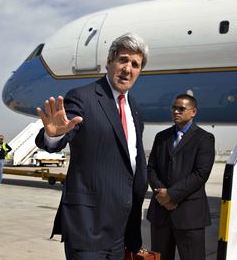
The picture at top of Pope Francis is from The Times of Israel. It is an AP photo by Alessandra Tarantino. The picture of the American Colony Hotel garden, taken from inside the hotel lobby, is from Magister/Wikipedia Commons.

Program Education Reminder:

On Friday, March 7, the National Summit to Reassess the U.S.-Israel ‘Special Relationship was held at the National Press Club in Washington. The Summit was hosted by four major Washington-based organizations:

The Institute for Research: Middle Eastern Policy, the Council for the National Interest, If Americans Knew, and the Washington Report on Middle East Affairs.

A diverse panel of experts examined the relationship between the U.S. and Israel, and the impact of lobbying groups on U.S. policy in the Middle East.

The day’s program was broadcast live on CSPAN Three. More than eight hours of informative observations, complete with questions from the audience, are now available on CSPAN Three’s web site.

The name of each presenter, in the order they spoke Friday, is listed on the National Summit program.

Posted in Middle East, Middle East Politics, Religion and politics | 7 Comments

Barack to Bibi: “Time is running out”

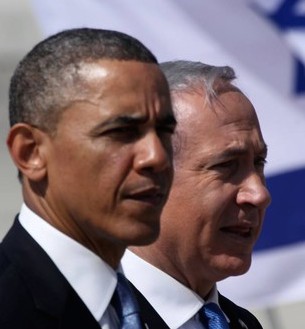
Obama and Net March 2013 in Jerby James M. Wall

When President Obama consented to an interview with Bloomberg columnist Jeffrey Goldberg,  the President sent an ultimatum to israeli Prime Minister Benjamin Netanyahu:
“Time is running out”.
Obama does not choose a reporter for an individual interview without a clear purpose.
In this case, his purpose could have been to use Goldberg as a journalist-messenger, trusted by Israel, but also a columnist for an American media outlet.
In his younger years, Goldberg served in the Israeli army as a prison guard.  He even produced a book out of the experience, Prisoners: A Story of Friendship and Terror.
The interview with Goldberg is the template President Obama keeps in front of his Israeli visitor, both in Washington and into the future.
Prime Minister Netanyahu came to Washington Sunday night. He met with President Obama Monday and on Tuesday he will address the American Israel Public Affairs Committee (AIPAC) Policy Conference,
The AIPAC conference customarily functions as a pep really for AIPAC funders and supporters. At this annual event, through speeches and small group meetings, attendees receive legislative marching orders, essentially a list of legislation AIPAC wants passed in the American Congress.
One key demand that was expected to be high on this year’s AIPAC list was pulled, as AIPAC yielded to intense pressure from the White House. The word from the Oval Office to AIPAC was that Congress must not pass tougher sanctions against Iran. To do so would doom U.S. efforts to reach a nuclear agreement with Iran.
It is of no small significance that neither President Obama nor Vice President Joe Biden, will attend the AIPAC Policy Conference. The Conference is a political rally;  Obama and Biden are focused on diplomacy.
The executive branch was represented at the Conference by U.S. Secretary of the Treasury Jack Lew, an Orthodox Jew, who spoke on Sunday. He reiterated the Obama administration’s opposition “to new Iran sanctions during the interim nuclear deal”.
In the Obama-Netanyahu meeting Monday, details of which will emerge over time, Netanyahu repeated his usual talking points, insisting “Israel has been doing its part” to forge peace, but that it’s been met with “incessant Palestinian incitement.”
Obama thanked Netanyahu for participating in what he called “very lengthy and painstaking negotiations” with Kerry over a framework for peace talks.
Netanyahu had also read and no doubt studied carefully, Obama’s pre-meeting interview with Goldberg. In that interview, which Bloomberg published Sunday night (March 2) Obama told Goldberg that the window for peace talks is closing.
He also said he believes “that ultimately it is still possible” to create a Jewish state of Israel and a state of Palestine”.

Obama will host Palestinian Authority President Abbas at the White House on March 17. He will no doubt engage in the same tough talk with Abbas.

in the Bloomberg interview, Goldberg reported that President Barack Obama planned to tell Netanyahu “that his country could face a bleak future — one of international isolation and demographic disaster — if he refuses to endorse a U.S.-drafted framework agreement for peace with the Palestinians”.

Obama also said in the interview that he will warn Netanyahu that “time is running out for Israel as a Jewish-majority democracy”.

In the hour-long Oval Office interview, which was conducted Thursday [February 27]  Obama used a famous saying from the first century Jewish sage Rabbi Hillel, one of the most influential scholars in Jewish history, that he planned to tell Netanyahu, “If not now, when? And if not you, Mr. Prime Minister, then who”?

The original Hillel quote, according to the Jewish Virtual Library is:

“If I am not for myself, then who will be for me? And if I am only for myself, then what am I? And if not now, when?”

The Jerusalem newspaper Ha’aretz noted an important reference to Palestinian Authority President Mahmoud Abbas in the interview. Goldberg writes that Obama described Abbas as “the most moderate leader Israel would encounter in the foreseeable future”.

According to Goldberg, Obama gave him the impression that Netanyahu was the one who had to be flexible in order to advance the peace talks.

The President also said that he intends to remind Netanyahu:

“There comes a point where you can’t manage this anymore, and then you start having to make very difficult choices. Do you resign yourself to what amounts to a permanent occupation of the West Bank? Is that the character of Israel as a state for a long period of time?

Do you perpetuate, over the course of a decade or two decades, more and more restrictive policies in terms of Palestinian movement? Do you place restrictions on Arab Israelis in ways that run counter to Israel’s traditions?”

Amnesty International has released its report, entitled, appropriately enough, “Trigger-happy”, on the conduct of Israeli forces that underscores the growing international awareness of Israel’s treatment of the Palestinian population it holds in its tight military-grip.

Amnesty’s web site begins its story on the latest investigation:

Israeli forces have displayed a callous disregard for human life by killing dozens of Palestinian civilians, including children, in the occupied West Bank over the past three years with near total impunity, said Amnesty International in a report published today.

The report, Trigger-happy: Israel’s use of excessive force in the West Bank, describes mounting bloodshed and human rights abuses in the Occupied Palestinian Territories (OPT) as a result of the Israeli forces’ use of unnecessary, arbitrary and brutal force against Palestinians since January 2011.

In all cases examined by Amnesty International, Palestinians killed by Israeli soldiers did not appear to be posing a direct and immediate threat to life. In some, there is evidence that they were victims of willful killings, which would amount to war crimes.

“The report presents a body of evidence that shows a harrowing pattern of unlawful killings and unwarranted injuries of Palestinian civilians by Israeli forces in the West Bank,” said Philip Luther, Middle East and North Africa Director at Amnesty International.

“Trigger-happy” and the Goldberg-Obama interview, were both available to Netanyahu before he met Monday with Obama. The Prime Minister had a long plane ride from Tel Aviv to Washington Sunday.

After arriving in Washington Sunday night Netanyahu was scheduled to meet with Secretary Kerry Monday morning before meeting with the president. On Tuesday morning Netanyahu was expected to address AIPAC, no doubt to thunderous applause.

The advance word from AIPAC indicated that as many as 400 members of Congress would be among the 14,000 in attendance.

Later Tuesday, the Prime Minister will fly to Los Angeles. He will have received his Obama ultimatum.

On the flight he will have more time to reflect on his future dealings with the Palestinian people, his international reputation, and on how he intends to lead Israel into the future.

The picture above of Obama and Netanyahu was taken in Israel, March, 2013, by Marc Israel, Sellem Pool Getty Images.

Posted in John Kerry, Middle East, Middle East Politics, Netanyahu, Obama | 6 Comments

“Lest We Forget” The Day Rachel Corrie Died

by James M. WallGetty:Images C 2jpg

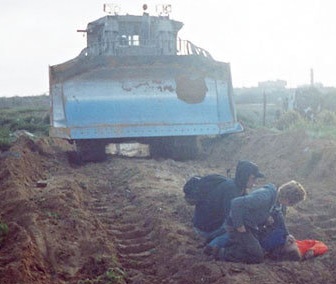
Rachel Corrie was killed March 16, 2003, by an Israeli soldier who crushed her to death with an American-built Caterpillar bulldozer.

Eleven years later, March 16, 2014, on the anniversary of her death, Rachel Corrie (right) will be remembered by her family and friends.

She will also be remembered on this anniversary, by those who celebrate and cherish a young American woman who said no to Israel’s occupation and no to the constant attacks on Palestinians and the destruction of Palestinian homes.

This year, the Rachel Corrie Foundation for Peace and Justice will hold a series of events in Olympia, Washington, to remember and honor Rachel. (Click here for details.)

What happened when an American citizen was killed by an Israeli soldier driving an American-built bull dozer? Mother Jones had Israel’s official reaction in 2003:

“The Israeli government, which rarely acknowledges the deaths of Palestinian civilians killed during its military operations, went into damage-control mode. Prime Minister Ariel Sharon promised President Bush a “thorough, credible, and transparent investigation.” Later Israel declared the killing a “regrettable accident” and blamed it on overzealous Corrie and the other activists working as human shields.”

Subsequent calls for Congress to investigate Rachel Corrie’s death were ignored. A civil lawsuit brought by her family against the Israeli military, was introduced in Israeli courts, March 15, 2005. The Israeli justice system responded slowly.

Seven years after the suit was filed, and nine years after Rachel Corrie’s death, an Israeli court reached a final verdict. Robert Mackey, a New York Times blogger reported:

As my colleagues Jodi Rudoren and Danielle Ziri report, an Israeli judge ruled on Tuesday that the state bore no responsibility for the death of Rachel Corrie, an American activist who was crushed to death by a military bulldozer in 2003 as she tried to block the demolition of a Palestinian home in Gaza.

Ms. Corrie, who was a student at the Evergreen State College in Olympia, Wash., joined the pro-Palestinian International Solidarity Movement in January 2003, and was killed two months later in the Gazan town of Rafah, which straddles the border with Egypt.

Photographs published by The Electronic Intifada on March 16, 2003, the day she died, showed that Ms. Corrie confronted heavily armored bulldozers that day wearing a bright orange vest and, until a few minutes before her death, using a bullhorn to amplify her voice. The same Web site also published sworn affidavits recorded within days of the deadly incident by three other international activists who were present when Ms. Corrie was killed.International Solidarity Movement AP.Cjpg

One of those witnesses, a Briton named Tom Dale, sent the following statement to The Lede on Tuesday from Cairo, where he now works as a journalist:

“The verdict in Rachel’s case is saddening for all those who knew Rachel, and for all who believe in what she stood for. It should be disappointing for all those who want to see justice done in Israel and Palestine.

On March 16, 2003, Rachel could not have been more visible: standing, on a clear day, in the open ground, wearing a high visibility vest. On that day, she had been in the presence of the Caterpillar D9 bulldozers used by the Israeli army for some hours.

She was standing in front of the home of a young family which was under threat of demolition by a bulldozer. Many homes were demolished in such a way at that time, and Rachel was seeking to protect her friends, with whom she had lived.”

In the picture at right above, shocked friends from the International Solidarity Movement try to revive a dying colleague. The blue bull dozer continues on its mission to destroy a Palestinian family home.

The juxtaposition of the anniversary of Rachel Corrie’s death and AIPAC’s annual Policy Conference, March 1-4, is repeated each year in Washington, DC. It is a coincidence of timing that epitomizes our nation’s shame.

American media rarely takes note of the March 16 anniversary of Rachel Corrie’s death. But it will provide ample coverage of AIPAC’s annual celebration of the long time love affair between Israel and the U.S. Congress.

Over 400 members of Congress are expected to attend this year’s conference. Some of the representatives and senators will be granted the honor of gaining additional media exposure when speaking to the assembled AIPAC members..

In return for their unswerving obsequiousness, these members of Congress pocket campaign cash contributions and perhaps more importantly, they take home a guaranteed AIPAC PPP (political protection plan).

The plan protects incumbents against primary opponents. The plan also guarantees campaign strategists who comb an opponent’s record for the slightest action or statement available to reshape and brand with the deadly anti-semitic designation.

Religious groups, like the Presbyterian Church USA’s Israel Palestine Mission Network (IPMN), operate without the protection of AIPAC’s political protection plan. So it was that when the IPMN produced an excellent and well-researched study guide (complete with DVD), appropriately named Zionism Unsettled, a storm of protest rose against them.

Modern Israel’s claim to the lands of Judea and Samaria is rooted in a political ideology called Zionism, a political movement formed in the late 19th century. It is not a biblical promise from the time of Jesus.

ZU-cover_DVD cThe  Zionism Unsettled study guide has both Christian and Jewish Zionists “unsettled”.

Chris Leighton, Executive Director of the Institute for Christian and Jewish Studies, produced an “open letter” on February 6, attacking his fellow Presbyterians for not uniting Zionism and Judaism..

He begins:

The Israel Palestine Mission Network (IPMN) and their allies have once again mounted initiatives that advance an extremist posture with respect to the Palestinian-Israeli impasse. Their agenda threatens to polarize our community, betray relationships with our Jewish colleagues, and ultimately undermine our credibility as “peacemakers.”

Brant Rosen, a congregational rabbi from Evanston, IL, began his response to Leighton on Rosen’s blog, Shalom Rav:

I believe your characterization of my sacred tradition is incorrect – and dangerously so. It is prejudicial in the extreme to equate Zionism with Judaism itself.

Zionism – that is, the movement to create a Jewish nation-state in historic Palestine – is in fact a political movement that was born in 19th century Europe.

As such, it was a conscious and radical break with centuries of Jewish tradition that strongly cautioned against the establishment of an independent Jewish state in the land.

While it is certainly true, as you write, that the yearning for a “return to Zion” is suffused throughout Jewish tradition, it is important to note that this yearning was pointedly directed toward a far off messianic future.

Rabbi Rosen closed his blog posting:

At the very least, there is a growing desire to allow non-Zionist voices to be part of the Jewish communal debate once more.

One notable bellwether of this phenomenon may be found in the Swarthmore Hillel student board’s recent unanimous decision to defy the guidelines of Hillel International and declare itself an “Open Hillel.” In a statement accompanying their resolution, these Jewish students noted:

“All are welcome to walk through our doors and speak with our name and under our roof, be they Zionist, anti-Zionist, post-Zionist, or non-Zionist. We are an institution that seeks to foster spirited debate, constructive dialogue, and a safe space for all, in keeping with the Jewish tradition.”

I trust you would never suggest that these Jewish students are driven by “anti-Semitism.” On the contrary, they are clearly motivated by sacred Jewish values and a courageous refusal to reduce Jewish identity to one political ideology.

The usually cautious J Street, which wants to be a friendly version of AIPAC, also weighed in against IPMN’s study guide. Ali Abunimah covered J Street’s surprisingly unfriendly reaction to Zionism Unsettled.

The Israel lobby group J Street has launched a blistering attack on the Presbyterian Church USA over its new study guide Zionism Unsettled, claiming that the publication promotes “polarization” and “intolerance.”

Zionism Unsettled, published last month by the church’s Israel/Palestine Mission Network (IPMN), is a 74-page study guide examining the role Zionism and Christian Zionism have played in shaping attitudes and events in Palestine and its region.

It is intended to help church congregations and others to learn and talk about Zionism and the devastating impact the practice of the ideology has had on Palestinians, as The Electronic Intifada previously reported.

In a statement yesterday, J Street said it was “deeply offended” by Zionism Unsettled, asserting that “one has to question the IPMN’s motives in publishing this ‘resource.’”

J Street claimed the guide’s authors “had no intention of encouraging thoughtful reflection on Zionism, the Israeli-Palestinian conflict, or Jewish perspectives on Israel. Instead, reductive and divisive thinking of this kind exacerbates polarization and intolerance, both of which are not in short supply in this conflict.”

When even the usually cautious J Street feels the need to vilify a highly respected Christian group like IPMN, it becomes obvious that the false linkage of Zionism, a political ideology, with classical religious Judaism, is a sagging reed on which the Zionists now attempt to lean.

Zionism Unsettled explains why that sagging reed will no longer bear the weight Zionists put upon it.

Rudyard Kipling wrote his poem, Recessional, on the occasion of Queen Victoria’s Diamond Jubilee in 1897.

Wikipedia reminds us that “The poem defied the celebratory mood of the time, offering instead a reminder of the transient nature of British Imperial power.

In the poem, Kipling argues that boasting and jingoism, faults of which he was often accused, were inappropriate and vain in light of the permanence of God.”

The first four verses of the poem repeat the line, “Lest we forget, Lest we forget”. The poem is often sung as a hymn in Christian churches.

Rachel Corrie was defying an American/Israeli empire when she stood against the destruction of a Palestinian home on March 16, 2003.

Here is verse three from Kipling’s Recessiona:

Far-called, our navies melt away;
On dune and headland sinks the fire:
Lo, all our pomp of yesterday
Is one with Nineveh and Tyre!
Judge of the Nations, spare us yet,
Lest we forget—lest we forget!

Rachel Corrie, “lest we forget, lest we forget”.

The picture of Rachel Corrie at top is a Getty Image. The picture of Rachel Corrie lying on the field after she was struck by the bull dozer, is from the Palestinian Solidarity Movement. 

Posted in Middle East, Middle East Politics, Presbyterian Church USA, Religious Faith | 7 Comments

The Spirit of Judah L. Magnes Lives On

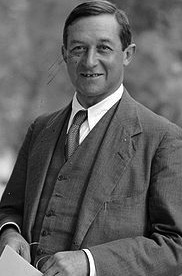
by James M. WallJudah L. Magnes c

New York Times column, A Conflict of Faith:  Devoted to Jewish Observance, but at Odds With Israel,” opens with an interview with Orthodox Jewish scholar Charles H. Manekin.

In his column, Mark Oppenheimer describes Professor Manekin as a “rarity”, an apt description because in addition to his academic tasks, Manekin writes a hard-hitting blog, which he calls, The Magnes Zionist., named for:

Judah L. Magnes, an American rabbi who, until his death in 1948, argued that a Jewish return to the Middle East did not require a nation-state.

Wikipedia recalls Judah Leon Magnes (1877 – 1948) (pictured above), as “a prominent Reform rabbi in both the United States and the British Mandate of Palestine”.

Magnes was a leader in the World War I pacifist movement and was “one of the most widely recognized voices of 20th Century American Reform Judaism”.

The spirit of Rabbi Magnes lives on in the work of Professor Manekin, who shares his “at odd with Israel” tab with a small group of observant Orthodox Jews interviewed by Mark Oppenheimer.

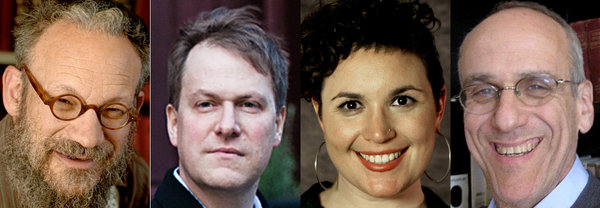
Observant Jews

Four who were interviewed are pictured above in a Times compilation. They are from left, Daniel Boyarin of Berkeley, Corey Robin of Brooklyn College, Rabbi Alissa Wise and Professor Manekin of the University of Maryland.

To paraphrase the urgent question from Butch Cassidy and the Sundance Kid, “Who are these people?”

The University of Maryland Department of Philosophy web site offers this description of Professor Manekin:

“The focus of Manekin’s research has been Aristotelian and humanist logic in Hebrew, the philosophy of Levi Gersonides, and the free will problem in Jewish philosophy.”

What makes Manekin a “rarity” is that he is both an observant Orthodox Jew and an outspoken critic of Israel. The Times:

There is no question that Charles H. Manekin is a rarity. Not because he is an Orthodox Jew who keeps the Sabbath, refraining from driving, turning on lights, even riding in elevators on Saturdays. Rather, this philosophy professor at the University of Maryland is rare because he believes that his Orthodox faith calls him to take stands against Israel.

Manekin, 61, became Orthodox in college and an Israeli citizen in the 1980s. In an interview with the Times, “he denounced Israel’s ‘excessive reliance’ on military force, its treatment of Arab citizens and its occupation of the West Bank.”

There is more on Professor Manekin as a modern-day Judah L. Magnes:

Although not a member of the American Studies Association, he was pleased when the group voted in December not to collaborate with Israeli academic institutions — the “academic boycott.”

He is “sympathetic” to B.D.S., as the global movement to boycott, divest from, and sanction Israel is known.

“As a religious Jew,” he said, “I am especially disturbed by the daily injustices perpetrated against the Palestinians.”

The day after the Times‘ story appeared, Manekin responded in The Magnes Zionist:

Marc Oppenheimer wrote a nice piece in his Beliefs column in the New York Times for which I was interviewed. The piece features Stefan Krieger, Corey Robin, Rabbi Alissa Wise, Danny Boyarin, Noam Pianko, and me.

The headline given to it was “A Conflict of Faith: Devoted to Jewish Observance, but at Odds With Israel.”

In my case that’s a bit misleading. I do have a conflict, but not between Jewish observance and Israel. I have a conflict because I am an Israeli; I live in a country that I believe is fundamentally flawed, despite the wonderful things it also possesses.

In my blog I only talk about the flaws, but that’s because they are fundamental. Perhaps I will post one day a list of my favorite things about Israel (hint: You won’t find most of them in Ari Shavit’s new book.) [link added]

The piece says my religion leads me “to oppose Israel.” That’s ambiguous; it could mean “oppose Israel’s policies” (yes) or “oppose how the Jewish state was envisioned and came into being” (yes), or “oppose the very idea of a Jewish state” (that depends).

No, I am not opposed to any Jewish state. As my colleague, Jerome Slater, has said, I don’t have a problem with a Jewish state – it’s this Jewish state I have a problem with.

Menekin called his May 12, 2008 posting, written during the 2008 presidential campaign, Leon Uris’ Influence on Barack Obama. Here is his opening:

Jeffrey (“You-Can-Dump-On-Israel-As-Long-As-You-Are-A-Liberal-Zionist-Like-Me”) Goldberg has an interview with Obama in Atlantic.Com that will trouble Obama supporters who are under the illusion that the US can still be an honest broker in the Middle East.

On the same day when my Shabbas-minyan-mate Joe Lieberman wonders out loud why a Hamas spokesman welcomes an Obama presidency, a wary Goldberg goads Obama into expressing his undying admiration for the Jewish state.

Goldberg: You’ve talked about the role of Jews in the development of your thinking.

Obama: I always joke that my intellectual formation was through Jewish scholars and writers, even though I didn’t know it at the time. Whether it was theologians or Philip Roth who helped shape my sensibility, or some of the more popular writers like Leon Uris.

So when I became more politically conscious, my starting point when I think about the Middle East is this enormous emotional attachment and sympathy for Israel, mindful of its history, mindful of the hardship and pain and suffering that the Jewish people have undergone, but also mindful of the incredible opportunity that is presented when people finally return to a land and are able to try to excavate their best traditions and their best selves.

And obviously it’s something that has great resonance with the African-American experience.”

Manekin adds this cogent observation on the power of the Israel Lobby (written, it is important to keep in mind, in 2008):

In that paragraph [from Obama], and in the entire interview, you see why Walt and Mearsheimer’s thesis of an Israel Lobby is so, well, irrelevant. There is an Israel Lobby in America, and it is called America (minus some leftwing churches and Muslims).

There is much more in the Times column on observant Orthodox Jews who care enough to testify against Israel’s treatment of Palestinians.

These courageous Jews demonstrate an “inosculation” of their Jewish Orthodoxy with their prophetic disavowal of Israel’s conduct

In case you were wondering, the Alpha Dictionary defines “inosculation”:

“To connect to, to connect with, to open into, as a blood vessel might inosculate with another. 2. To interpenetrate, to join so as to be a part of, to grow or be tightly intertwined, as some areas of philosophy inosculate with mathematics.

The small band of Observant Jews identified by the Times, are willing to stand against Israel’s embrace of injustice.  The time has come for the rest of us to join them in their struggle and inosculate our politics with our faith. 

Posted in Media, Middle East, Middle East Politics, Obama, Politics and Elections, Religious Faith | 6 Comments