Indyk Returns as Kerry’s Chief Negotiator

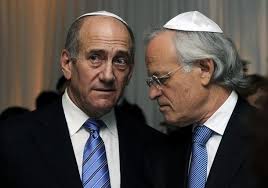
by James M. WallIndyk and ehud olmert

Secretary of State John Kerry is expected to name Martin Indyk as the U.S. Representative to the Israel-Palestinian peace negotiation. Indyk has been around this peace talk track before.

He belongs to a small group of Jewish diplomats who have specialized in Middle East negotiations. The same names come up with every new effort to reconcile Israel and the Palestinian Authority.

This time the key player is Indyk. Who is he?

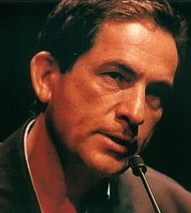
Indyk (shown above at right with former Israeli Prime Minister Ehud Olmert) began his Washington career as an AIPAC staffer, served as executive director of an AIPAC think tank offshoot, the Washington Institute of Near East Policy, and then served two short terms as the first foreign-born U.S. Ambassador to Israel.

Indyk was born to a Jewish family in London, England. The family moved to Australia where Indyk grew up in the Sydney suburb of Castlecrag. He graduated from the University of Sydney in 1972. He received his PhD in international relations from the Australian National University in 1977. Indyk imigrated to the United States and later gained American citizenship in 1993.

Indyk’s pro-Israel credentials are spelled out by Phillip Weiss, writing in Mondoweiss:

He wrote (in the book Innocent Abroad 4 years ago) that: “I was first drawn to the Middle East through my Jewish identity and connection to Israel.” Indyk now works at Brookings for a man he calls his “godfather,” Haim Saban. Saban has said that his “greatest concern… is to protect Israel.”

Indyk was described in 1992 by a former AIPAC president as AIPAC’s political asset in the Clinton campaign. After the spectacular failure of Camp David negotiations that he helped conduct in 2000, Indyk was characterized by former Palestinian negotiator Mohammed Dahlan as having a pro-Israel bias and “advanced negative attitudes toward Palestinians.”

While former Palestinian negotiator Nabil Shaath said that Indyk was “partial, biased, pro-Israel” and defended Israeli settlements more than Israelis.

And this is the man in whom we are to place our trust as Kerry’s point man for peace?

When Kerry was engaged in his recent travels to the region, he tried to make the case that this set of negotiations would be the final opportunity to bring the two opposing sides together.  Now the news from Palestine is that President Mahmoud Abbas is satisfied that Kerry and Indyk will be fair in reaching an agreement.

How could Abbas possibly reach such a conclusion?  There is nothing emanating from the Israeli side that would suggest that Benjamin Netanyahu can bring his right-wing government to accept a peace agreement anywhere near any reasonable position of fairness.

Is the Palestinian Authority president placing his trust in the upcoming negotiations because of specific promises? Word from Israel is that it is prepared to release some longtime Palestinian political prisoners, many of whom Israel classifies as “heavyweights”, whatever that could possibly mean.

Kerry has also dropped hints of financial incentives to the PA from outside investors who are eager to invest in the Palestinian economy.

That is the old “investment not divestment” trope which has been a part of Protestant church discussions in recent years.  It sounds nice but where is the meat? Where are the roadblocks opening up; where are the tough decisions on Israel’s illegal settlements?

Richard Silverstein is skeptical of the usual Israeli ploy to release Palestinian prisoners as a sign of good will. He writes:

They’ll supposedly be getting 100 freed Palestinian prisoners held in Israeli jails for decades. The Israel Broadcasting Authority says the prisoner release would happen in four stages and the first one would only happen during the second month of negotiations. A lot can happen in that time.

And I’d say a guarantee of this happening is pretty thin. Further, the Palestinians seem willing to overlook that Israel, after past prisoner exchanges, promptly rearrested whoever it still wants behind bars.

Another issue the Palestinians would apparently give up is their efforts to win international recognition in bodies like the United Nations. That’s giving up a whole lot in return for very little. The Guardian quotes a former PA official on the illusions that underpin the talks about starting talks:

Ghassan Khatib, former director of communications for the Palestinian Authority. “The thing that bothers me is that it seems that the resumption of negotiations is seen as an objective in itself. But the problem was never the lack of negotiations, direct or indirect. It is the huge gap between Israel’s stated position and its practices, and the lack of willingness by the US to put pressure on them.”

In these negotiation promises, there is not a single sign that oppression will be eased. Psalm 146:3 comes to mind: “Do not put your trust in princes” (NIV).  It would be wrong to believe that this new round of talks brings with them the slightest hope of success, if our only hope rests with U.S. political leaders who have thus far forfeited their leadership to the Zionist Lobby.

Which is why the real effort on the part of progressives in and out of religious communities, must be to persuade the American public that our only hope for peace in the region is in our ability to put pressure on U.S. political decision makers, from the White House to the Congress and out to the media.
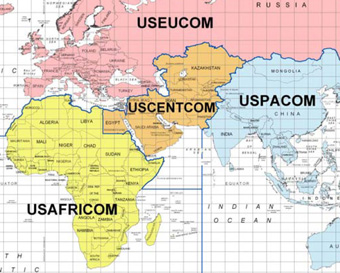
unified-command_world-map-smallWhich is why this could be the right moment to enlist retired military leaders in the cause of peace.

These are the front line leaders who are strongly in favor of negotiations that really succeed. The military generals who must work in the US Central Command are closer to the situation on the ground than diplomats visiting from outside.

This map of the different U.S. Central Commands show the Central Command stretching from Afghanistan into north Africa.

Max Blumenthal reported on a recent Aspen Institute conference in which:

Recently retired US Central Commander General James Mattis warned .  .  .   that if Secretary of State John Kerry’s attempts to broker a deal between Israel and the Palestinian Authority failed, Israel would be exposed as an apartheid state. Mattis pointed at the settlement enterprise as the source of Israel’s diplomatic crisis, declaring that “the protagonists” – Israel and the Palestinian Authority – might not be as interested in a deal as Kerry is.

Mattis’ warning follows an earlier warning issued by Israeli negotiator Tzipi Livni, who warned that Israel is in danger of a worldwide boycott if current negotiations fail.

General James Mattis spoke at the Aspen Institute’s annual Security Forum, in Colorado. He was far more direct than political leaders dare to be.

Mattis said that as a result of Israeli intransigence and the US special relationship with Israel, he and his troops have “paid a military security price.” His comments echoed those of his predecessor, General David Petraeus, who told the Senate Armed Service Committee in 2010 that “enduring hostilities between Israel and some of its neighbors” had damaged US interests in the region. Petraeus was hammered by pro-Israel forces for his remarks – Abe Foxman called him “dangerous” — and wound up walking them back.

Mattis, a 45-year military veteran, ended his assignment at CENTCOM on June 1. He appears to be speaking without much concern for domestic political pressure. The Abe Foxmans of U.S. domestic politics do not seem to trouble him.

We no longer have a significant and progressive ally on the media front at a time when a second term Obama administration shows signs of fatigue and what is worse, an unwillingness to defy Israeli demands.

Progressives worldwide are mourning the death of longtime journalist Helen Thomas, who died July 20 at age 92, in Washington. She threw hard questions at every president from John F. Kennedy to Barack Obama.

The Washington Post reporting on her death, wrote:

Thomas routinely questioned White House officials over U.S. policies toward Israel and the Middle East, which led some to complain she was too sympathetic to Palestinian and Arab viewpoints. Bush spokesman Tony Snow once famously answered one of her questions with, “Thank you for the Hezbollah view”.

She was a pioneer in breaking barriers for women. The Guardian reported:

At a time when US news media confined most female journalists to writing about cookery, fashion and “women’s interests”, Helen Thomas was one of the doughtiest warriors to storm the absurd barricade. Thomas, who has died aged 92, became a national icon as the senior correspondent at the White House for United Press International (UPI), with the privilege of saying to US leaders from John F Kennedy onwards, “Thank you, Mr President”, signalling that the press (and the television audience) had heard quite enough.

She was so hard on George W. Bush that he shut her out of his press conferences, refusing for three years to call on her for a question. When Barack Obama became president, he called on her during his first White House press conference, acknowledging that it was a risk.  He was not disappointed.

After three years of enforced silence, Thomas asked the new president about Israel’s nuclear arsenal, a topic which by tacit agreement is off limits to media and politicians. The policy of “deliberate ambiguity”  is followed, allowing Israel to keep their nukes a company secret.  Meanwhile, Israel continues to make demands on other Middle East countries to reveal all regarding their efforts to build their own nuclear arsenal.

Obama dodged the nuke question.

The Post headline was descriptive: “Helen Thomas, feisty scourge of presidents,  dies at 92”.

She died just as the latest round of Israeli-Palestinian peace talks are launched with little chance of success. We need more “feisty scourges” like Helen Thomas in the White House press room.
Posted in John Kerry, Middle East Politics, Obama, US govermemt | 8 Comments

Livni Warns Israel It Faces A Worldwide Boycott

by James M. WallKerry Miaden Antonov:Reuters 2

Justice Minister Tzipi Livni is the Israeli cabinet minister with the task of finding a way back to peace talks. At the moment, she is one more frustrated negotiator.

Livni was so frustrated that she kicked off the month of July with a speech in which she said that if negotiations with the Palestinians don’t start up again soon, Israel will face a worldwide economic boycott.  The Jerusalem Post reported on her speech:

Justice Minister Tzipi Livni warned Monday at an accountants’ conference in Eilat that lack of progress on the Palestinian track could lead to a potential disaster for Israeli exports.

“Europe is boycotting goods,” said Livni, head of Israel’s negotiating team with the Palestinians. “True, it starts with settlement [goods], but their problem is with Israel, which is seen as a colonialist country. Therefore, it won’t stop at the settlements, but [will spread] to all of Israel,” she said.

This is not what we expect to hear from an Israeli minister.  Nor it is usual for a minister to address the youth of her country with this reminder:

During her Eilat speech, Livni said she was impressed that youth in the country protested against the government decision to export natural gas.

“I appreciate the fact that they care and are thinking about the future, and obligating us to think about the future,” she said. “But the time has come for the same youth to ask, to what kind of state do they want to leave the gas reserves? To a Jewish democratic Israel? Or to a binational Arab state? Or to an apartheid state? It is impossible to deal with economic issues and to ignore the important diplomatic issues related to two states for two peoples.”

Colonialist country? Apartheid state? These are terms rarely attached to Israel by loyal supporters of the government. No wonder the political party, Bayit Yehudi, which is linked to Livni’s Hatnua Party in an “uneasy alliance” in the Netanyahu coalition, was quick to respond with an attack on Livni:

“The policy of sowing fear of boycotts is detached from reality. The Israeli economy is innovative and ground-breaking. The entire world comes here to learn from us, and business people are amazed at Israeli technology and innovations. We advise Livni and her friends not to panic.” 

Political realists who follow the shenanigans of Israel’s right-wing government suggest that Livni may be involved in a strategy to jump start the negotiations. She may also be playing the “good cop” to signal potential European boycotters that Israel does have a few reasonable leaders.

That, however, is an unrealistic rejection of hope in a time of darkness. If Livni, a major Israeli cabinet figure, recognizes the growing danger of a worldwide boycott, the least we can do is take her at her word and see what she and U.S. Secretary of State John Kerry are trying to work out.

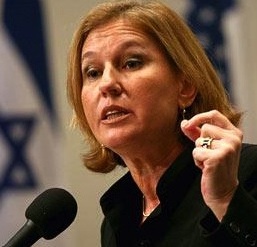
She acknowledged that Israel is its own worst enemy when it refuses to see the impact of boycotts on Israel.  It is in this sense that Livni (right) has a much stronger grasp of what is best for Israel than those U.S. religious leaders who still believe in the superiority of interfaith exchanges over working for justice.

Ha’aretz columnist Gideon Levy sees the value in Livni’s recognition of the power of boycotts. He  gives her a strong endorsement:tzipi-livni  AFP:GETTY_2

“Anyone who really fears for the future of the country needs to be in favor at this point of boycotting it economically.”

Levy, however, does not believe an indifferent Israeli public will be receptive to Livni’s warning:

As long as Israelis don’t pay a price for the occupation, or at least don’t make the connection between cause and effect, they have no incentive to bring it to an end.

And why should the average resident of Tel Aviv be bothered by what is happening in the West Bank city of Jenin or Rafah in the Gaza Strip? Those places are far away and not particularly interesting. As long as the arrogance and self-victimization continue among the Chosen People, the most chosen in the world, always the only victim, the world’s explicit stance won’t change a thing.

Turning the light of realism on that indifferent public, Levy adds:

It’s anti-Semitism, we say. The whole world’s against us and we are not the ones responsible for its attitude toward us. .  .  .  Most Israeli public opinion is divorced from reality − the reality in the territories and abroad.

Israeli’s right wing media, like its counterparts in the U.S., promotes the public’s “divorce from reality” by calling actions supporting Palestinian justice as anti-semitic attacks on Jews.

To the Times of Israel, opposition to Israeli self-absorbed policies are seen as ongoing battles in a theater of war.

This recent Times story was explicit: From the war in Iraq to the battle against Israel boycotters. In that piece, war strategy is transferred to a political strategy, designed to defend Israel from criticism.

Can an idea honed on the battlefields of Iraq and Afghanistan prove effective in defending against assaults on Israel’s legitimacy in North America? David Dabscheck, deputy managing director of the Israel Action Network [IAN], thinks so.

In 2005, Palestinian civil society issued a call for a campaign of boycotts, divestment and sanctions (BDS) against Israel until it complies with international law and Palestinian rights. A truly global movement against Israeli Apartheid is rapidly emerging in response to this call. 

The idea, in the words of General Stanley McChrystal — commander of the US Joint Special Operations Command — that “it takes a network to defeat a network” played a central role in his concept for fighting insurgents in the Middle East . .  .  .

“It became clear to me and to many others that, to defeat a networked enemy, we had to become a network ourselves,” McChrystal recalled in  Foreign Policy“We had to figure out a way to retain our… levels of knowledge, speed, precision, and unity of effort that only a network could provide.”

The two-year old Israel Action Network figured it needed to form a network to combat its own enemy network.

“We realized we were facing a different type of challenge,” reflected Dabscheck. “We faced a decentralized challenge originating from different groups. If this is a network challenge,” he said, echoing McChrystal, “it takes a network to defeat.”

Dabscheck is wrong, of course.  There is no war between networks.  The boycott strategy has won. It is the only pressure that works. Gideon Levy explains:

A boycott is the least of all evils, and it could produce historic benefits. It is the least violent of the options and the one least likely to result in bloodshed. It would be painful like the others, but the others would be worse.

On the assumption that the current status quo cannot continue forever, it is the most reasonable option to convince Israel to change. Its effectiveness has already been proven. More and more Israelis have become concerned recently about the threat of the boycott. When Justice Minister Tzipi Livni warns about it spreading and calls as a result for the diplomatic deadlock to be broken, she provides proof of the need for a boycott. She and others are therefore joining the boycott, divestment and sanction movement. .  .  .  .

Not a bad outcome for a non-violent movement which began when “In 2005, Palestinian civil society issued a call for a campaign of boycotts, divestment and sanctions (BDS) against Israel until it complies with international law and Palestinian rights. A truly global movement against Israeli Apartheid is rapidly emerging in response to this call”.

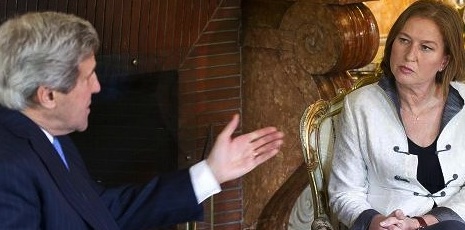
 The picture at top of John Kerry with Justice Minister Tzipi Livni was taken in Rome. It is from The Times of London. The picture is by Kerry Miaden Antonov/Reuters. The picture of Tzipi Livni is from AFP/Getty.


Posted in Middle East Politics | 10 Comments

“One Day Ramallah Will Rise Up”

by James M. WallRamallah in 2:12 crop

“One Day Ramallah Will Rise Up” is the title of a current column by the provocative Ha’aretz writer, Gideon Levy.

During this same week, Uri Avnery, another Israeli provocateur, entitled his Gush Shalom column, “The Human Spring”.

He sees, and clearly feels, the presence of a “hidden mechanism” pushing the world forward in this post-Arab Spring period.

I would not suggest Levy and Avnery conspired to deliver a common theme to our in-boxes during this first week of July.

But there is no doubt that Levy and Avnery have sensed the presence of a “hidden mechanism” of change in Palestine.  It is a change happening in Ramallah, Palestine’s temporary capital, and in the rest of the West Bank, the Golan Heights, and in Gaza.

Uri Avnery opens his “hidden mechanism” column:

When asked what he thought about the French Revolution, Zhou Enlai, the Chinese Communist leader, famously answered: “It’s too early to say.”

This was considered a typical piece of ancient Chinese wisdom – until somebody pointed out that Zhou did not mean the revolution of 1789, but the events of May 1968, which happened not long before the interview in question.

Even now it may be too early to judge that upheaval, when students tore up the cobblestones of Paris, confronted the brutal police and proclaimed a new era. It was an early forerunner of what is happening today all over the world.

It was in May of 1968 when young people demanded change they longed for, focused primarily on freedom.

The Arab Spring, and what follows it, is our current generation’s tangible response to this same demand for political freedom.

Gideon Levy’s Ha’aretz column connects the 1968 revolution to this generation’s Arab Spring and the major changes it is still in the process of developing:

gideonOne day the Palestinian people will rise up against their occupiers. I hope this day comes soon.

It’s true that this scenario seems unrealistic right now. The Palestinians are still bleeding from the second intifada, which only brought disaster upon them (and the Israelis). They are divided and torn, with no real leadership and lacking a fighting spirit, and the world has tired of their distress. The Israeli occupation seems as strong and established as ever, the settlements are growing, and the military is in complete control, with all the world’s governments silent and indifferent.

On the other hand, it is impossible to imagine that this scenario will not materialize. To our south, the Egyptian people are struggling over the nature of their regime, in a way that can only inspire awe. To the north, the Syrian people are also doing this, albeit in a much crueler fashion. Could it be that only the Palestinian people will forever bow their heads, submissively and obediently, to the Israeli jackboot? Don’t make the minister of history laugh.

We still do not know what progress John Kerry has made in his effort to negotiate Palestine and Israel into a semblance of peace. Diplomacy, however, deals with power politics. Decisions made by political leaders emerge from a process dependent on the limits of human actors.  The media reports it that way, writing and picturing how the past shapes the present.

Uri Avnery asks: “What is it that arouses so many different people in so many different cultures to do the same thing at the same time?” Avnery, who will celebrate his 90th birthday September 10, looks beyond power politics and reaches for that “hidden mechanism” that so mysteriously hovers about.

He identifies facts and curries meaning from them. Facts, like two interrelated phenomena in contemporary life that make the uprisings possible and probable: the thoroughly modern forces of television and social media.

Once upon a time, it took weeks for people in Piccadilly Circus in London to hear about events in the Place de la Concorde in Paris. After the battle of Waterloo, the Rothschilds made their killing by using messenger pigeons. In 1848, when revolution spread from Paris throughout Europe, it took its time, too.

Not any more. Brazilian youngsters saw what was happening in Gezi Park, Istanbul, and asked themselves: why not here? They saw that determined young men and women could withstand water cannon, tear gas and batons, and felt that they could do it, too.

The prime moving forces for communication that Avnery identifies as inevitable change units, are Facebook, Twitter and their other social media compatriots. For example:Avnery

Five young men sitting in a Cairo café and talking about the situation could decide to launch an online petition for the removal of the incumbent president, and within a few days tens of millions of citizens signed. Never before in history was such a thing possible, or even imaginable.

This is a new form of direct democracy. People don’t have to wait anymore for the next elections, which may be years away. They can act immediately, and when the groundswell is powerful enough, it can develop into a tsunami.

Revolutions, however, at bottom are not made by technologies. These are merely instruments. The people, Avnery writes, make revolutions. And those ruling elites that refuse to acknowledge this reality are doomed to repeat the sins of previous collapsing empires.

The people, led by the young, will not forever tolerate the absence of freedom and justice.

Like Avnery, Levy is a citizen of Israel. When he compares Israel with surrounding Arab nations, he does not see Israel in a positive light. He explains:

The regimes against which most of the Arab nations are rebelling were generally less brutal than the regime of the Israeli occupation.

They were also less corrupt, in the broad sense of the word. Most did not take over the lives of their subjects day and night, did not so drastically restrict their movement and freedom, did not systematically abuse and humiliate them in the manner of the Israeli regime. Moreover, they were not foreign regimes.

Therefore, the events at Tahrir Square will surely be replicated one day in Ramallah’s Manara Square. The masses will flood the Unknown Soldier’s Square in Gaza, push into Police Square in Hebron and storm all the checkpoints along their way. It is hard now to imagine it happening, but it is even more difficult to imagine that it will not. .. ….

As with other unjust and evil regimes, which are always destined to fall, this regime also will fall – it’s just not clear when and how.

Richard Silverstein, an American Jewish writer, working from Seattle, Washington, joins Uri Avnery and Gideon Levy in recognizing the “hidden mechanism” around us.

Silverstein writes a blog, Tikun Olam. His latest posting is Israel and Arab Spring: “Do Not Ask for Whom the Bell Tolls,  It Tolls for Thee”.

In that posting, Silverstein addresses, with disapproval, those writers who reject radical Islamists as potential government leaders.

Silverstein sees this disapproval as a “convenient conviction because it further bolstered Ehud Barak’s old saw that Israel was ‘a villa’ in the Middle East “jungle.” If the region could be portrayed as a nest of Muslim terrorists or terrorists-in-the-making, it would make Israel the only friend the U.S. would have left.Silverstein crop

As the Church Lady would say, “How conveeenient, indeed. Silverstein continues:

This, of course, was the same thinking that led Bibi Netanyahu to see 9/11 as good for Israel because of his certainty it would show that Israel and America were lone bastions of democracy amid a sea of Islamic terrorism.

Unfortunately, Netanyahu’s vision was largely realized, thanks to a Bush administration that played the terror card quite deftly and an Obama administration that inherited and expanded upon this sordid legacy.

But developments in Egypt and Turkey have shown beyond a shadow of a doubt that there is no such thing as an Islamic Winter. That the revolts of the Arab Spring are progressing toward more democracy and more openness. I won’t go so far as to say they’re progressing toward secularism, because that’s a loaded term in countries like Turkey. But there is a clear movement away from authoritarianism and toward something radically different.

Politicians who cling to power are driven to see the world as a reality of their making, not as it really is. That has led a columnist like the New York Times’ David Brooks to embarrass himself by writing a column, “Defending the Coup”, which denigrates radical Muslims as incapable of leadership.

Brooks made this outlandish assertion, for which he has been harshly criticized, in writing about the change of government in Egypt. One sample from his column will suffice to explain why he should be embarrassed (emphasis added):

“It’s not that Egypt doesn’t have a recipe for a democratic transition. It seems to lack even the basic mental ingredients.”

Brooks is wrong on all counts, so wrong that it hardly seems worth the time to point out to Brooks that the United States was initially led by a motley largely Protestant collection of farmers, lawyers, shop keepers, slave owners, and opportunists of all stripes. These citizens made mistakes at the outset.

Slavery and oppression of Native Americans through racial segregation are just the more blatant examples. Their current successors continue to do so. Governing is always a messy business.

Those first generation American white, male, largely Protestant citizens created a new union which, like all nations, remains a work in progress. In the same manner, new Islamic-led governments will be forced to find their way forward in a new modern environment in the 21st century.

These governments must be judged not by the “cut of their jib”, to use an old nautical term,  nor by the religion to which they adhere, but rather, by the way they treat their own citizens and how they relate to neighboring states.

The photo at top of a young protestor was taken during a demonstration in Ramallah in 2012. It is an Associated Press picture that ran in Ha’aretz.

Posted in -Movies and politics, Human Rights, Middle East Politics, The Human Condition | 8 Comments

Kerry Undertakes One Last Anti-War Mission

by James M. Wall

Kerry in 71 cropJohn Kerry is back in Washington after his fifth official trip to the Middle East. He is already planning his return to the region.

Despite the lack of any visible signs of success, the U.S. Secretary of State remains determined to resolve what is generally seen in official Washington as an intractable conflict between Israel and Palestine.

In a June 30 editorial, The New York Times saw little prospect for success, despite the fact that “Mr. Kerry keeps doggedly plowing forward.”

Indeed, as the Times reports, the Secretary is giving every impression that he sees progress ahead. He sure acts that way. Note his travel schedule:

“On Thursday [June 27], he met with Prime Minister Benjamin Netanyahu of Israel, then drove to Amman to confer with the Palestinian president, Mahmoud Abbas, on Friday. He later flew by helicopter back to Jerusalem for another meeting with Mr. Netanyahu, then one with President Shimon Peres of Israel. On Saturday and Sunday, he shuttled between the leaders again.”

This is not Kerry’s first political rodeo. There is nothing quite like rising from his role as an anti-war Vietnam veteran to become a U.S. senator, a U.S. presidential candidate and chairman of the senate foreign relations committee, to teach someone the art of politics.

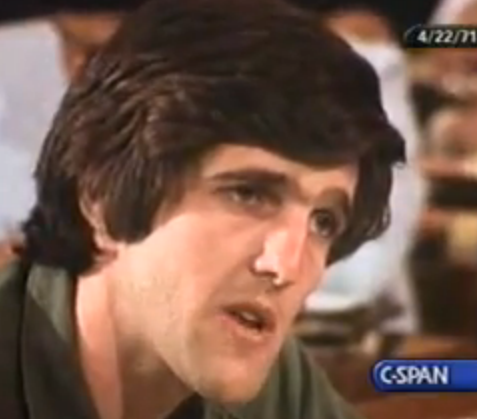
John Kerry’s first appearance on the American political scene was as a young Navy lieutenant appearing before the same Senate Foreign Relations Committee which he would one day chair. (1971 picture of Kerry testifying above).

It was in that senate committee testimony that a young navy veteran told the senators that he and his fellow veterans against the Vietnam war were “undertaking one last mission” to end a war. The website, Libertyinexile, recalls that testimony:

On April 22,1971, a young Lieutenant named John Kerry came before the Senate Foreign Relations Committee, being the first Vietnam veteran to testify before Congress on the subject of ending the war in which he served.

He appeared on behalf of the Vietnam Veterans Against the War (VVAW), a group of over 20,000 former military servicemen who collectively called for an end to the military operations and atrocities in Vietnam.

Lt. Kerry gave a prepared speech, eloquent and precise, poignant and riveting. He spoke of the crimes of the American soldiers committed in Vietnam, the mystic veil of communism which had justified such killing and destruction, the lies of the American executive which directed these immoral actions, and the convergence of all said injustice to yield the most grave mistake which had just then become realized to the majority of the American public.

After serving his country as a young naval officer in Vietnam, Kerry has been in politics most of his adult life, starting as lieutenant governor of Massachusetts in 1983, and then as a U.S. senator from the same state from 1985 until he was asked by President Obama to succeed Hillary Clinton as Secretary of State.

Kerry comes to this moment in history out of a rich history of service to his country.

The dogged pursuit of an agreement by a man who has seen war suggests that it is a real possibility that John Kerry knows something about the Netanyahu-Abbas talks that the rest of us do not know. In his dogged pursuit for an agreement, he is undertaking another “last mission” to prevent a permanent Middle East war.

How could we? This is a Secretary of State who is operating under the veil of secrecy. The Times editorial offers this explanation for the secrecy:

Whether there is any substantive narrowing of differences between the two sides is unknown. Mr. Kerry’s determination to maintain secrecy is frustrating to anyone following his mission but also tactical, since unveiling details prematurely is more likely to back Israelis and Palestinians into opposite corners.

It could be that Kerry is not just negotiating. It is quite possible that he is pressing Israel to take more than just token steps toward showing the Palestinian leaders that Israel is ready to ease its prison-like grip on a people whose land they illegally occupy.

Nelson Mandela, near death in a South African hospital, leaves behind a text which could serve as a guide for Kerry, a text related, perhaps, to Mandela’s painful experience as a political prisoner in South Africa.

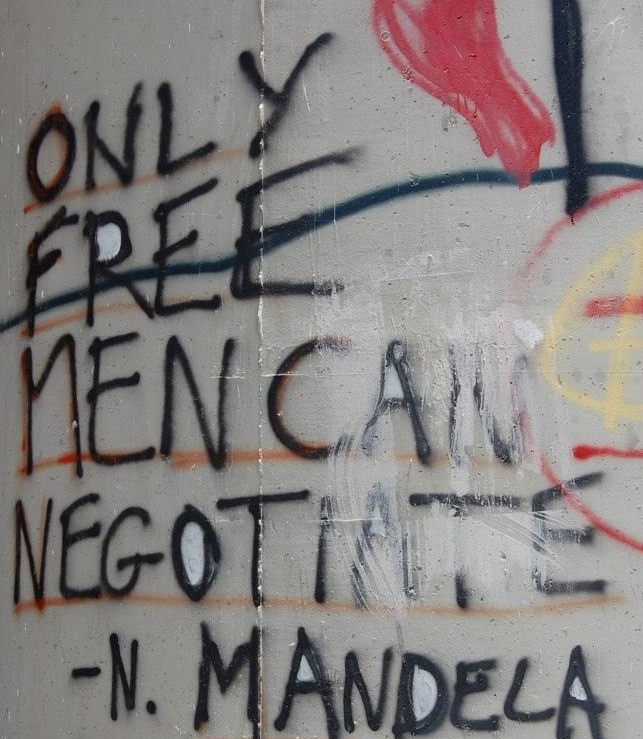
The Mandela text is well known in Palestine, enough so that it appears on posters and in one instance, is scrawled in paint on Israel’s illegal wall of separation.DSC_0466

“Only free men can negotiate; prisoners cannot enter into contracts. Your freedom and mine cannot be separated.” 

What lies ahead as John Kerry continues his shuttle diplomacy against impossible odds? With very little to go on except a recognition that Kerry is dogged in his determination to keep pushing to bring the two sides together, here is one possible scenario:

As a young man in 1971, John Kerry testified against an absurd war in Vietnam.

Now is Kerry’s moment to convince Netanyahu and Abbas that he is determined to end the permanent conflict between them. He is prepared to end that conflict and then walk with them over the rocky road that would follow a successful end to negotiations.

It would then be up to President Obama to stand with his Secretary of State in what would be a difficult period ahead.

Obama and Kerry will not have the backing of the U.S. Congress in this struggle, but what care Obama and Kerry about a Zionist-Tea Party controlled Congress when the executive branch of government offers Netanyahu and Abbas a way out of their permanent state of conflict.

Is something like this in Kerry’s thinking as he flies back and forth between Washington and Tel Aviv?

Or is it wistful thinking about the impossible?

This much we do know about John Kerry. We have the record. When he closed his formal testimony before the foreign affairs committee in 1971, this is what John Kerry said, recalling his service in the Vietnam war:

We wish that a merciful God could wipe away our own memories of that service as easily as this administration has wiped their memories of us. But all that they have done and all that they can do by this denial is to make more clear than ever our own determination to undertake one last mission, to search out and destroy the last vestige of this barbarous war, to pacify our own hearts, to conquer the hate and the fear that have driven this country these last 10 years and more and so when, in 30 years from now, our brothers go down the street without a leg, without an arm or a face, and small boys ask why, we will be able to say “Vietnam” and not mean a desert, not a filthy obscene memory but mean instead the place where America finally turned and where soldiers like us helped it in the turning. Thank you.

The photo of John Kerry is from a CSPAN screen shot in 1971. It appeared in Liberty in Exile. The picture of the Mandela quote is from Flicka on Photostream.

Posted in John Kerry, Middle East Politics, Netanyahu | 9 Comments

“Poor George, he can’t help it . . .”

by James M. WallRichards

“Poor George, he can’t help it — he was born with a silver foot in his mouth.”

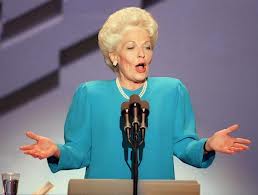
This memorable line from future Texas Governor Ann Richards was aimed at soon-to-be President George H. W. Bush. It was included in Richards’ keynote address to the 1988 Democratic National Convention, which nominated Michael Dukakis as its candidate to oppose Bush.

It is a superb Texas sweet-talking barbed description, dripping with sarcasm and righteous anger. It came to me that this is a term that fits all sizes of U.S. politicians who “can’t help it” when it comes to Israel. They were born into political life with the silver foot of the Israeli narrative dictating their every political move.

The video of Richards’ famous line is at the end of this posting.

I recalled the impact of that 1988 “Poor George” line when I read what former President Bill Clinton said at an event honoring Israeli President Shimon Peres on the occasion of Peres’ 90th birthday:

“The longer the Palestinian conflict remained unsolved, the more acute the demographic challenge would become for Israel. […] No matter how many settlers you put out there, the Palestinians are having more babies than the Israelis as a whole… You’ve got an existential question to answer.”

Poor Bill, he can’t help it.  He talks about Palestine and Israel as though Palestine is not in the room. He can’t help it. Demographics is the problem? Please.

Clinton’s speech was delivered on the opening night of the fifth annual Israeli Presidential Conference, held in Jerusalem. It was an upbeat look to the future by the famous guests. According to Ha’aretz, the opening night included a celebration of President Shimon Peres’ 90th birthday.  In addition to Clinton’s speech, Barbara Streisand (right) was on hand for a concert honoring Peres.Barbra Streisand  Dan Balilty, AP

There were at least 24 Emmy, Grammy, Nobel and Oscar winners at Jerusalem’s Internation al Conventions Center for the gala event. David Alexrod, former Obama advisor, showed up to engage movie actress Sharon Stone in a closing night discussion on leadership.

During Streisand’s concert, Ha’aretz reported that:

Streisand sang two songs: “People,” from Funny Girl, and, at the request of Peres, also Avinu Malkanu, a song based on the Jewish prayer recited during services on Rosh Hashana and Yom Kippur. “This is a song that asks God to have compassion for us and our children,” she explained.

Chicago mayor Rahm Emanuel, Rwandan President Paul Kagame, and actor Robert De Niro were among the many seen swaying to the tunes.

Stephen Hawking was nowhere to be seen. As I wrote for Wall Writings on May 14:

University of Cambridge physicist Stephen Hawking stunned Israel last week with his announcement that he would boycott the fifth annual Israeli Presidential Conference, scheduled to be held in Jerusalem, June 18-20.

Hawking was responding to an incongruity: He had been invited to attend an Israeli conference of scientific, economic and political world leaders under the lofty title: ”The Human Factor in Shaping Tomorrow”.

After the Streisand concert, USA Today wrote:

At a time when some of her fellow entertainers are bending to demands by pro-Palestinian activists to boycott Israel, Barbara Streisand – on a week-long visit here – proudly touted her Jewish roots and love of Israel.

USA Today gave more details later in the story about the “pro-Palestinian activists”.

A movement under the name Boycott/Divestment/Sanctions (BDS) has been pressuring artists, entertainers and academics not to go to Israel or even attend conferences where Israelis are participating as a show of solidarity with Palestinians.

The movement was begun by Palestinians and joined by European leftists and academics to cripple Israel’s economy and international standing to get it to bend to the position of Palestinians on political and security matters.

The writer Alice Walker recently banned an Israeli publisher from printing her novel, “The Color Purple,” in Hebrew. Musician Alicia Keyes was asked not to perform here this summer but like Streisand she intends to play on. Entertainers who have cancelled Israeli appearances include Elvis Costello, Coldplay and Snoop Dogg. Streisand did not say whether she was contacted by the BDS movement.

Editor’s note: The USA Today is incorrect when it reports that the BDS movement has been confined to Palestinians and left-wing European activists. In fact, the BDS movement is now a world-wide movement, reaching from South Africa to the U.S. The movement also has activists involved from religious institutions worldwide. 

Clinton, of course, has shown no signs that he has heard from the BDS movement.  He is, after all, a highly successful American politician who was brought up on the political doctrine that he must believe the Israeli narrative with all the fervor with which he believes the earth is round.

Bill Clinton loves Israel. He said as much in his speech for Peres, “I love this country more than I have words to say.”

Pause for a moment and think about the way these other Clinton sentences sound to Palestinians:”No matter how many settlers you put out there, the Palestinians are having more babies than the Israelis as a whole”.

For Clinton, as he speaks to an Israeli crowd, the “existential question” facing Israelis is not one of human rights. It is not a matter of justice. It is a matter of demographics.

Yousef Munayyer, Executive Director of The Jerusalem Fund and its educational program, The Palestine Center, has been quick to inform the former president that his statement about what Munayyer rightfully calls, “paranoid baby counting,” is a racist comment.

Yousef Munayyer

Munayyer (at right) put it this way:

Put aside for a moment the very racist notion of paranoid baby counting and consider the overall framing. The freedom of millions of Palestinians living under the yoke of Israel’s military occupation is portrayed as a matter that Israel should resolve because eventually they may be dealing with a larger problem: Having to accept Palestinians as equals. Palestinian rights are reduced to an Israeli prerogative.

Aaron David Miller, who has worked for Clinton and several other presidents, has added his diplomatic pro-Israeli spin on what his old boss sees as a “demographic challenge”. Miller, now a a public policy scholar at the Woodrow Wilson International Center for Scholars, wrote in a recent essay for The New York Times:

Israel has serious worries: The gaps between rich and poor are growing; the military conscription issue highlights the resentment toward the ultra Orthodox, their unemployment rate (60 percent for men) and the drain they place on state resources. The country’s demographics look bad — too many ultra-Orthodox Jews, Palestinians and Israeli Arabs and not enough secular Jews.

Miller believes the demographics “look bad” for Israel because there are too many “others” being born there.

To live under the control of the Israeli narrative is to ignore all other perspectives when facing issues affecting Israel. Clinton concluded his speech honoring Peres, according to The Times of Israel, by praising Israeli Prime Minister Benjamin Netanyahu:

Netanyahu in his first term as prime minister reached an agreement that, had the Second Intifada not erupted, would have given the Palestinians “more of the West Bank than they have today.” And Netanyahu, in his second term as prime minister, Clinton recalled, froze settlement building for several months. The Palestinians “made a mistake” at the time “in not entering talks,” Clinton said.

Spoken, of course, like a true believer in the Israeli narrative, a believer who was twice elected U.S. president, and was in the White House when the Palestinians refused to accept that “gift” of “more of the West Bank than they have today”. This is, of course, an Israeli narrative version of the “talks” to which Clinton refers.

The framing of the situation between Israel and Palestine today was repeated by President Barack Obama recently in a speech to the Israeli public. In the speech, Yousef Munayyer reports, Obama said:

You can be the generation that permanently secures the Zionist dream, or you can face a growing challenge to its future. Given the demographics west of the Jordan River, the only way for Israel to endure and thrive as a Jewish and democratic state is through the realization of an independent and viable Palestine.

Munayyer adds that while “Some believe that making this argument to the Israeli public advances the interests of peace. In reality, the opposite is true, it just makes things worse”.

It is worst, because by encouraging the Israelis to see Palestinian freedom “not as the legitimate and urgent right of Palestinians but as a choice Israelis can or cannot make when and if they get around to it”, Obama speaks entirely from the Israeli perspective of what is best for Israel.

Perspective is all. Look at Palestinian freedom from the Israeli perspective and what do you see? You see a challenge that must be met in Israel’s best interests.

But look at Palestinian freedom from the Palestinian perspective and you see not a challenge for Israel, but a responsibility placed upon an Israeli government that continues to rely on the occupation as its way of  “controlling” the neighborhood.

To describe Israel’s “problem” as one of demographics, is to turn Israel’s moral wrong into an accepted right. There is an historic reason why the demographics of a moral wrong has become an accepted right.  It was planned that way from the beginning. In a recent posting entitled, “How many is too many?’, Munayyer explains:

Demographic engineering is central to Zionism and has been through every stage of Zionist history. I suppose when a political movement seeks to transplant millions of non-natives into a land of indigenous Arabs, to borrow “father of Zionism” Theodore Herzl’s phraseology, demography must become a central obsession.

Munayyer adds:

An ideology that seeks to build a society around a certain type of people defined by ethnicity or religion is inevitably going to feature racism, supremacy and oppression—especially when the vast majority of native inhabitants where such an ideology is implemented are unwelcomed.

At the conclusion of Yousef Munayyer‘s posting on Clinton’s speech, he offered a few words of advice to Israel, to former President Clinton and to current President Barack Obama:

Palestinian freedom should not be framed as Israel’s choice. Rather, as the occupier of Palestinian territory and millions of stateless Palestinians, this is Israel’s obligation, an American obligation and an international obligation.  It’s about time we start talking about it this way.

The picture above of Barbara Streisand was taken by the AP’s Dan Balilty.

Posted in Human Rights, Middle East, Middle East Politics, Netanyahu, Politics and Elections | 4 Comments

Clinton and Netanyahu Not Good for Obama

Hassan Rohani.crop pngby James M. Wall

With friends like former President Bill Clinton and current Israeli Prime Minister Benjamin Netanyahu, what is a fellow like President Obama to do?

As a start, he could get a few second opinions.

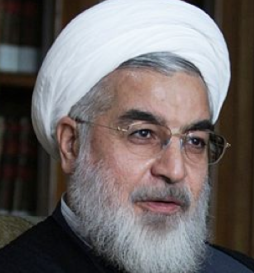
President Obama is struggling to help resolve an ugly civil war in Syria. He is also working to relieve U.S. tensions with Iran, which has just elected Hassan Rowhani (left), a moderate, as its new president.

For most observers who are not in Israel’s rapidly shrinking circle of  friends, the news of Rohani’s election is reassuring. The new president won with 50.7 per cent of the vote, avoiding a run-off with his closest opponent who had only 16 per cent.

Rowhani’s victory should be good news for easing tensions in the region. What is not so good for Obama is the advice and public shoving he is receiving from his two self-serving friends, Clinton and Netanyahu.

The only cleric in the list of six candidates, Rowhani has served in the past as an effective nuclear negotiator for Iran. He has shown that he is a man willing to negotiate.

The civil war between Syria’s government and its rebel opposition is the second Middle East crisis currently confronting Obama. Until now, President Obama has refrained from any military involvement in that war. Until, that is, former President Bill Clinton suggested it was time for Obama to look back at Clinton’s actions in 1999, and take his own bold action..

Maureen Dowd reports that Clinton, whose wife is almost certain to run for president in 2016, shoved Obama out of his previous cautious stance on military action in Syria.

In a rare act of disloyalty as a member of the club of former presidents, Clinton joined the chorus of war drum-beaters to persuade Obama to supply small arms to the rebel side of the Syrian civil war.

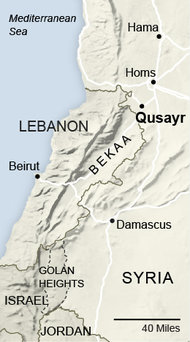
It is of considerable importance to pro-Israel U.S. politicians like Clinton, that anti-Israel Hezbollah forces helped Syrian government forces retake Al-Qusayr, a crucial border city between Lebanon and Syria. If Israel does not want any help to go to its enemy, Hezbollah, then Bill Clinton is with his Israeli friends.  There is, after all, money to be raised for Hillary’s race in 2016.

So what does Bill Clinton do?

Dowd wrote in her New York Times column that Clinton told Senator John McCain that Obama “should be more forceful on Syria and should not rationalize with opinion polls that reflect Americans’ reluctance to tangle in foreign crises.”

Citing his own experiences in Kosovo and Bosnia, Clinton said that if you blamed a poll for a lack of action, “you’d look like a total wuss.” He added that “when people are telling you ‘no’ in these situations, very often what they’re doing is flashing a giant yellow light” of caution.

For a former president to imply that a current president, of his own party, is in danger of looking like a “wuss”, is not exactly a supportive comment. It is, in fact, downright insulting.

It does not help that Clinton chose to convey his “wuss” message through McCain, the Republican that Obama defeated for president in 2008. (A wuss is, according to one dictionary, “a  person who is physically weak and ineffectual. Often a male person with low courage factor”.)

“Wuss” was not the only pejorative term Clinton tossed around so glibly in his discussion with McCain. Josh Rogin wrote in The Daily Beast:

In sharp remarks directed against his Democratic successor and his wife’s former boss, President Bill Clinton said Tuesday that President Barack Obama risks looking like a “wuss,” a “fool,” and “lame” for not doing more to influence events in Syria.

Clinton, speaking with Sen. John McCain Tuesday night in a closed press event sponsored by the McCain Institute, contrasted Obama’s inaction in Syria to his own action in the 1999 NATO intervention in Kosovo, which included the bombing of the forces of Serbian President Slobodan Milosevic.

For a man who served two terms as president, Clinton knows better than to compare apples to oranges in a sensitive political decision. Kosovo was then, Syria is now. In addition, the political dynamics in 1999 are totally different from 2013.

Obama knows the difference far better than his erstwhile presidential pal, which explains why the current President joined the Clinton-McCain war party so reluctantly. He said as much, as Peter Baker reported in The New York Times:

Coming so late into the conflict, Mr. Obama expressed no confidence it would change the outcome, but privately expressed hope it might buy time to bring about a negotiated settlement.

Obama should find new friends whose wives are not running for president. One place to start is to pay attention to someone like Ramzy Mardini, an adjunct fellow at the Beirut-based Iraq Institute for Strategic Studies, who wrote in The New York Times that even a tentative step toward military involvement in Syria is a “Bad Idea, Mr. President”:

Lacking a grand strategy, Mr. Obama has become a victim of rhetorical entrapment over the course of the Arab Spring — from calling on foreign leaders to leave (with no plan to forcibly remove them) to publicly drawing red lines on the use of chemical weapons, and then being obliged to fulfill the threat.

Obama would also benefit from reading veteran Middle East correspondent Robert Fisk who, after Obama’s announcement of small arms aid, wrote in The Independent:

The Western powers are dangerously close to flooding Syria with weapons and ammunition which will officially go to the nice rebels – but will quickly pass to the horrid rebels, who will sell some of them to al-Qa’ida, Iraqi insurgents, Syrian government troops, Malian militiamen, Taliban fighters and Pakistani hitmen. Guns are about money.

We must also assume that by now President Obama has been informed of what, if true, is a dangerous new development, also reported by Fisk, who writes that Iran will send 4,000 troops to assist Syrian government forces.

According to Fisk, the decision to involve Iranian forces in Syria was made before the Iranian presidential election. Why is this ominous? Iran’s entry into the Syrian civil war would place Shia forces against Sunni forces with the U.S. operating on the side of the Sunnis.  Fisk writes:

In years to come, historians will ask how America – after its defeat in Iraq and its humiliating withdrawal from Afghanistan scheduled for 2014 – could have so blithely aligned itself with one side in a titanic Islamic struggle stretching back to the seventh century death of the Prophet Mohamed.

The profound effects of this great schism, between Sunnis who believe that the father of Mohamed’s wife was the new caliph of the Muslim world and Shias who regard his son in law Ali as his rightful successor – a seventh century battle swamped in blood around the present-day Iraqi cities of Najaf and Kerbala – continue across the region to this day. A 17th century Archbishop of Canterbury, George Abbott, compared this Muslim conflict to that between “Papists and Protestants”.

Who are the players in this deadly game?

America’s alliance now includes the wealthiest states of the Arab Gulf, the vast Sunni territories between Egypt and Morocco, as well as Turkey and the fragile British-created monarchy in Jordan.

King Abdullah of Jordan – flooded, like so many neighbouring nations, by hundreds of thousands of Syrian refugees – may also now find himself at the fulcrum of the Syrian battle. Up to 3,000 American ‘advisers’ are now believed to be in Jordan, and the creation of a southern Syria ‘no-fly zone’ – opposed by Syrian-controlled anti-aircraft batteries – will turn a crisis into a ‘hot’ war. So much for America’s ‘friends’.

The reason President Obama needs to stop listening to Benjamin Netanyahu is obvious from Netanyahu’s immediate response to the Iranian election result. You can almost hear Netanyahu’s dismissive reaction, “nothing new here”.

Netanyahu’s comments on the outcome of the election were reported in The Times of Israel:

“Let us not delude ourselves, The international community must not become caught up in wishes and be tempted to relax the pressure on Iran to stop its nuclear program. It must be remembered that the Iranian ruler, at the outset, disqualified candidates who did not fit his extremist outlook and from among those whose candidacies he allowed was elected the candidate who was seen as less identified with the regime, who still defines the State of Israel [in an address last year] as ‘the great Zionist Satan.’”

This from the leader of a state that spent eight years attacking Iranian President Mahmoud Ahmedinejad as someone who wanted to “wipe Israel off the map”, a phrase which was mistranslated, but used, nevertheless, to demonize Ahmedinejad in western political and media circles.

That false translation was exposed as early as June, 2007, by Juan Cole:

Ahmadinejad did not use that phrase in Persian. He quoted an old saying of Ayatollah Khomeini calling for ‘this occupation regime over Jerusalem’ to ‘vanish from the page of time.’ .  .  .  It was apparently some Western wire service that mistranslated the phrase as ‘wipe Israel off the map’, which sounds rather more violent than calling for regime change. 

Martin Indyk, who most recently served as U.S. Ambassador to Israel, took Netayahu’s side, writing in the Financial Times.

Mr Rowhani has a long record of association with the moderate camp in Iranian politics, serving as national security adviser to the pragmatic President Akbar Hashemi Rafsanjani and, subsequently, the reformist President Mohammad Khatami. In that capacity, he headed Iran’s nuclear negotiations with the EU3 (Britain, France and Germany) a decade ago, and agreed to suspend Iran’s enrichment programme during that period.

Like Netanyahu, Indyk argues that there is nothing new here:

We should be careful, however, not to let our hopes get ahead of realities. The sanctions are indeed hurting; the Iranian people want an end to their isolation; and by winning a majority in the first round Mr Rowhani has received a resounding mandate for change.

But Ayatollah Ali Khamenei remains very much in command. Indeed, this election may have solidified his reign: rather than protesting against him as they did in such massive numbers four years ago, the people were celebrating in the streets after this election.

And his radical regime now has a moderate, democratically elected president to cloak his own extremism and paranoia.

Reading the standard Netanyahu-Indyk rejection of signs of hope from Teheran, calls to mind a scene from Stanley Kubrick’s 1964 film, Dr. Strangelove or: How I Learned to Stop Worrying and Love the Bomb.

Group Capt. Lionel Mandrake (one of several roles played in the film by Peter Sellers) rushes into the office of Base Commander General Jack Ripper (Sterling Hayden) with the good news that the base is not surrounded by enemy forces.

Ripper, who has just given the order for a fleet of U.S. planes to attack the Soviet Union, is the only person with the code to recall the planes. The general is no mood to listen to Mandrake’s good news that there is no immediate threat from enemy forces. Instead, he informs a terrified Mandrake that “commies” are not to be trusted.

President Obama does not need friends who are afraid of  fluoridation to tell him how to handle political decisions.

Posted in Middle East Politics, Netanyahu, Obama, Politics and Elections | 4 Comments

Kerry Delays Orwellian Trip to Middle East

20syria-map-articleInlineby James M. Wall

Secretary of State John Kerry has delayed his fifth “peace process” trip to Israel/Palestine.

The Secretary will remain in Washington to attend strategy sessions on Syria.

The delay in starting his fifth trip should give Kerry time to add the writings of George Orwell and Rashid Khalidi to his Tel Aviv flight reading assignment.

The Washington strategy sessions on Syria which delayed Kerry’s trip, were hastily arranged after a major military encounter at Al-Qusayr, Syria.

Hezbollah, which the New York Times recently described as “the powerful Lebanese Shiite Muslim organization”, (eschewing, surprisingly, the usual pejorative media phrase: “which Israel and the US consider a terrorist group”) joined President Bashar al-Assad’s regular Syrian army forces in a major military victory in the Syrian civil war.

Here is how the Times reported on that battle in the city of Al-Qusayr, which as the map above reveals, is a crucial border crossing point between Lebanon and Syria, which is a matter of considerable interest to Israel.

“Last week, Hezbollah fighters helped the Syrian government seize the strategic crossroads town of Qusayr, near the Lebanese border, from rebels who had held it for more than a year. .  .  .  Hezbollah’s core followers in Lebanon have been unwavering in their support for the group’s recent escalation of its role in Syria, even as dozens of Hezbollah fighters have been killed or injured fighting in Syria against fellow Arab Muslims — a new kind of battle for a group that was founded to fight Israel.”

Al-Qusayr complicates John Kerry’s task as a peace envoy when next he travels to Tel Aviv. The “peace process” of which this next trip is just the latest episode, has been built on decades of deceit.

Increasingly, that deceit has been exposed for all to see and, except in Israel, lament.

Syria’s and Hezbollah’s victory at Al-Qusayr leaves the US uncertain on what to do next in Syria in a civil war in which Israel and Palestinian loyalties are in opposition. Which side are we on, Mr. Secretary?

As the latest in a long line of US peace envoys stepping into the Middle East quagmire, Kerry will be required to carry out his unpleasant assignment of “defending the indefensible”, when he claims he is negotiating between Israel and Palestine in “good faith”.

“Defending the indefensible” is the phrase George Orwell used 67 years ago in his important 1946 essay, “Politics and the English Language”. That phrase stands today as harsh judgment of decades of deceit by US diplomats who claimed an “honest broker” role in peace negotiations.

Orwell’s essay was published between the publication dates of Orwell’s two major books, Animal Farm and 1984

In his essay, Orwell wrote:

In our time, political speech and writing are largely the defense of the indefensible. Things like the continuance of British rule in India, the Russian purges and deportations, the dropping of the atom bombs on Japan, can indeed be defended, but only by arguments which are too brutal for most people to face, and which do not square with the professed aims of the political parties. 

Thus political language has to consist largely of euphemism, question-begging and sheer cloudy vagueness. Defenseless villages are bombarded from the air, the inhabitants driven out into the countryside, the cattle machine-gunned, the huts set on fire with incendiary bullets: this is called pacification. Millions of peasants are robbed of their farms and sent trudging along the roads with no more than they can carry: this is called transfer of population or rectification of frontiers

People are imprisoned for years without trial, or shot in the back of the neck or sent to die of scurvy in Arctic lumber camps: this is called elimination of unreliable elements. Such phraseology is needed if one wants to name things without calling up mental pictures of them.

The “peace process” which John Kerry has continued on his previous four trips to the  region, is best understood in Orwellian terms as a “euphemism”. In this case the euphemism refers to a series of meetings which have been held for several decades, meetings which were never intended to produce peace, nor to move forward a process.

Instead, the “peace process” charade has provided Israel with a smokescreen behind which succeeding Israeli governments claimed “security” as justification for their expansion of Israeli settlements on occupied Palestinian land.

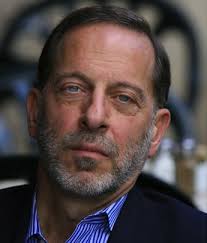
Rashid Khalidi’s book, Brokers of Deceit, which should be in the Kerry backpack on his flight to Tel Aviv, traces the history of Israel’s dominance over Palestine, a dominamce aided and abetted by the US.Rashid

Khalidi (right) finds a three-part pattern in this history: “An almost total lack of pressure from the Arab Gulf monarchies; the impact of US domestic politics, driven by the Israel lobby, and an unconcern about Palestinian rights.”

The central theme Khalidi develops is that “the United States has never really operated as an honest broker between the Palestinians and Israel”. This is exactly what secretary Kerry should be reading as he flies to Tel Aviv.

In his book, Khalidi writes that rather than serve as an honest broker in decades of negotiations, the US

has ended up operating as ‘Israel’s lawyer.’ These are the apt words of Aaron David Miller, who as one of the lead [US] negotiators with the Palestinians for many years, was a key participant in this charade.

Together with senior colleagues like Dennis Ross and Daniel Kurtzer, he features repeatedly in the pages that follow. From Camp David in 1978 onward, the United States posed as an unbiased intermediary between israel and the Palestinians, but in fact it operated increasingly in defense of Israel’s interests, and to the systematic detriment of those of the Palestinians. All of this dissembling was cloaked in high-sounding but dishonest language.

As a result, Israel consistently got what it wanted.  However, “a peaceful and just resolution of the conflict between the two peoples was certainly not the result.”

Khalidi’s book is especially timely this summer as Barack Obama moves forward into his second term. Since January, it is not encouraging that the President has  made foreign policy decisions more as an empire builder than as a change agent.   The president who promised change has been revealed as running a White House that veers dangerously close to becoming a Bush III administration.

It is still too early to determine if the Obama-Kerry team will break with past administrations and stand up to Israel’s domineering role not only in the Middle East but also in US domestic politics. In this regard, US actions following the Syrian strategy sessions will be revealing.  Will Israel be allowed to push the US into greater involvement with the Syrian rebels?  Or will Obama cautiously continue to provide only limited help to the rebels?

In Khalidi’s Brokers of Deceit, he writes:

Orwell tells us . . . that “political language is designed to make lies sound truthful and murder respectable, and to give an appearance of solidity to pure wind.”

If I have succeeded [in this book] I have shown how in American political discourse, lies about Palestine are made to sound truthful; how crimes—against a people and against humanity—are made respectable; and how the pure wind of terms like ‘peace process’ are given the appearance of solidity.

If Secretary Kerry will read George Orwell’s 1946 essay on political language, along with Rashid Khalidi’s book on this nation’s history of deceit as a so-called “honest  broker”, the Secretary will find that the Orwell-Khalidi duo will bring him greater wisdom, and just maybe more peace of mind, than all those State Department briefing papers his staff will have crammed into his carry on.

To add to the Kerry reading assignment, Rashid Khalidi has a May 23, 2013 essay which he wrote for the Middle East Channel of the Foreign Policy web site.

In that essay, Khalidi writes that the US should not assume it stands alone in dealing with the Palestine issue. He writes:

Firstly, there has to be a US willingness to consider the views of other consequential actors where the Palestine issue is concerned, from Europe and Russia to China, India and Turkey, and including countries farther afield like Brazil and South Africa. After three and a half decades of failed efforts to broker an Israeli-Palestinian settlement, going back to the 1978 Camp David Accords, the United States is in no position to insist on monopolizing peacemaking, or to claim that it is the only party qualified to offer constructive proposals.

Indeed, the enforced closeness between the US and Israeli positions on all substantive issues where Palestine is concerned (originating in a confidential 1975 pledge from President Gerald Ford to Israeli Prime Minister Yitzhak Rabin) makes the United States unfit to serve as an intermediary on this issue.

Secondly, all concerned, including the United States, must insist that a solution be grounded in first principles like international law, the Geneva conventions, and U.N. resolutions, and in basic notions of equity and comparable human, national and political rights for all.

This is necessary whether or not this pleases Israel and its claque in Congress and the media. A just and lasting settlement cannot result from inherently skewed frameworks concocted mainly to meet Israeli desiderata like the Madrid and Oslo formulas, and all of their deformed offspring. Indeed, these very formulae have produced the abysmal situation that worsens daily in Palestine.

As Secretary Kerry has said himself, there is only a small window of opportunity remaining for Secretary Kerry and President Obama to place their stamp on the complexities of the Middle East, much of which are the responsibility of earlier US administrations.   

The flight to Tel Avi is a long one.  But if Secretary Kerry will read the Orwell and Khalidi assigned material, he will emerge a stronger and wiser Secretary of State.

Posted in Human Rights, Middle East Politics, Netanyahu, Obama | 8 Comments

Have Church/State Leaders Endorsed Injustice?

by James M. Wall

Kerry Blair crop

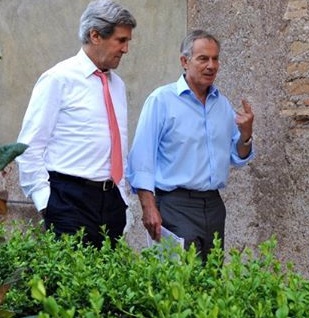
The two political leaders pictured here are U.S. Secretary of State John Kerry (left) and Middle East Quartet Representative and former United Kingdom Prime Minister Tony Blair.

The two men are walking next to a wall at the Villa Taverna, the U.S. ambassador’s residence in Rome, Italy, on May 9, 2013.

Less than a month later, Secretary Kerry spoke to the World Economic Forum in Amman, Jordan, where he introduced an initiative he hopes will break an “impasse” between Israel and Palestine.

Kerry called his initiative,“Breaking The Impasse.”  He claimed that his plan would:

triple tourism to the occupied Palestinian territories, double or triple Palestinian agriculture production, increase the Palestinian GDP by 50 percent, and foster the construction of a whopping 100,000 new, energy efficient Palestinian homes in the West Bank.

Tony Blair was to be in charge of the initiative.

This is the same Tony Blair who was given an assignment to organize for peace on behalf of the Quartet, which hired him for that purpose. The Quartet is composed of leaders from the United Nations, the United States, the European Union, and Russia.

We have to believe that Kerry’s “ambitious initiative” was developed  on walks like the one Kerry and Blair took last month in Rome. At some point, we must also assume a staffer hauled out a dictionary to make sure the parties involved (both English-speakers) understood that an “impasse” is a “road or passage having no exit; a cul-de-sac”.

Furthermore, a “cul-de-sac”, as we all know, is designed purposely not to be broken.

Communities build residential sections with “cul-de-sacs”, a street with only one entry point. A “cul-de-sac” is designed to keep the neighborhood secure and the children safe.

The specific political”impasse” between Israel and Palestine involves an occupying military power controlling an occupied population. The only way to break a “cul-de-sac” is to turn it into a straight road, an action which Israel has shown no inclination to support.

Since “breaking the impasse” is the goal Kerry seeks, it follows that he must know the only way to end this “impasse” is to tear down the occupation wall and end the occupation.

However, in his speech at the Jordan forum, Secretary Kerry said absolutely nothing about the occupation. He also made no reference to the separation wall that both enforces and symbolizes the occupation.

What Kerry did offer were hopeful points on what capitalism is prepared to do for Palestine. Here from his text are the optimistic predictions delivered to him by experts who studied Palestine’s future:

I raised this issue with the President of China, with the Prime Minister of Japan, with all of our European leaders, and everywhere – with the Brazilian Foreign Minister a few days ago, with the New Zealand Foreign Minister. All of them have on the tip of their tongues the idea that we can make peace in the Middle East and need to, and all of them are committed to be part of this effort in order to change life on the ground.

The fact is that we are looking to mobilize some $4 billion of investment. And this team of experts – private citizens, donating their time – are here right now. They’re analyzing the opportunities in tourism, construction, light manufacturing, building materials, energy, agriculture, and information and communications technology.

This group will make recommendations to the Palestinians. They’re not going to decide anything. The Palestinians will decide that in their normal course of governance. But they will analyze and make recommendations on a set of choices that can dramatically lift the economy.

Political realism demands that all parties face the reality of the problem they seek to solve. No panel of experts can lift a derailed train back on its tracks without heavy equipment to restore the derailed train to its rightful location.

Israel has derailed the Palestinian train and has the power to maintain the derailment. Israel and Palestine are not two equal parties discussing how to resolve their differences. All of the world leaders to whom John Kerry talked, know this. Kerry knows it. Barack Obama knows it.

It is impossible to “break an impasse” without first destroying the elements deliberately put in place to support the impasse.

This failure to face reality calls to mind the same struggle which U.S. mainline denominations fought a year ago .

You perhaps recall how “horror-stricken” the organized U.S. Jewish community was when it learned that there were delegates to church conferences who demanded an end to occupation. These church delegates chose the non-violent tactic of putting economic pressure on the occupying military power by divesting church funds from U.S. businesses that support Israel’s occupation.

That same tactic helped end apartheid in South Africa when outside forces applied economic pressure on the white South African government. In 2012 Anglican Bishop Desmond Tutu testified to the parallels between white South African’s treatment of its majority population and Israel’s occupational control of the Palestinians.

Fearing that the parallel between Israel and South Africa could undermine their pro-Israel campaign to replace the tactic of divestment with the softer tactic of investment, the organized U.S. Jewish community joined forces with their local church friends to denounce divestment.

They offered instead, the more positive (“can’t we all just get along”?) tactic of investing church funds in businesses that benefit Palestinians who live  under Israeli military control.

Two Lutheran authors took to the pages of the Christian Century magazine to make the case for investment as the appropriate way for churches to support Palestinians.

Thomas A. Prinz, pastor at Holy Trinity Lutheran Church in Leesburg, Virginia, and Karl-John N. Stone, assistant to the bishop in the Upper Susquehanna Synod (ELCA) in Lewisburg, Pennsylvania, made their case by pitting “positive strategy” against “punitive options”.

Here is part of their argument, published in the Christian Century, April 26, 2012, under the title: “Investment, Not Divestment: How to Help the Palestinians”.

Encouraging economic investment in Palestine is a positive, potentially transformative strategy, and it is to be preferred to the punitive options of encouraging divestment and boycotts of Israel or of companies doing business with Israel. Boycott and divestment are focused on tearing down and punishing one side in a complex conflict rather than on promoting constructive solutions to the conflict and improving lives.

The notion that divestment from Israel will somehow make peace and a two-state solution more likely is based on the misconception that one side bears all the blame and that the actions of one side alone control the future of negotiations.

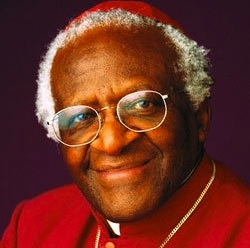
As the denominations debated the divestment-investment question, the Lutheran duo was up against Archbishop Tutu (belowright), who made it even harder on the Lutherans by citing another giant of the human rights struggle, Martin Luther King, Jr.

Tutu connected the dots in a piece he wrote for The Palestine Olive and other outlets,  May 1, 2012:desmond-tutu crop

 Within the past few days, some 1,200 American rabbis signed a letter — timed to coincide with resolutions considered by the United Methodist Church and the Presbyterian Church (USA) — urging Christians not “to selectively divest from certain companies whose products are used by Israel.” They argue that a “one-sided approach” on divestment resolutions, even the selective divestment from companies profiting from the occupation proposed by the Methodists and Presbyterians, “damages the relationship between Jews and Christians that has been nurtured for decades.”

While they are no doubt well-meaning, I believe that the rabbis and other opponents of divestment are sadly misguided.

My voice will always be raised in support of Christian-Jewish ties and against the anti-Semitism that all sensible people fear and detest. But this cannot be an excuse for doing nothing and for standing aside as successive Israeli governments colonize the West Bank and advance racist laws.

I recall well the words of the Rev. Martin Luther King Jr. in his Letter from a Birmingham Jail in which he confesses to his “Christian and Jewish brothers” that he has been “gravely disappointed with the white moderate … who is more devoted to ‘order’ than to justice; who prefers a negative peace which is the absence of tension to a positive peace which is the presence of justice; who constantly says: ‘I agree with you in the goal you seek, but I cannot agree with your methods of direct action;’ who paternalistically believes he can set the timetable for another man’s freedom. …”

King’s words describe almost precisely the shortcomings of the 1,200 rabbis who are not joining the brave Palestinians, Jews and internationals in isolated West Bank communities to protest nonviolently against Israel’s theft of Palestinian land to build illegal, Jewish-only settlements and the separation wall. We cannot afford to stick our heads in the sand as relentless settlement activity forecloses on the possibility of the two-state solution.

If we do not achieve two states in the near future, then the day will certainly arrive when Palestinians move away from seeking a separate state of their own and insist on the right to vote for the government that controls their lives, the Israeli government, in a single, democratic state. Israel finds this option unacceptable and yet is seemingly doing everything in its power to see that it happens.

How did that denominational struggle  turn out?  Episcopalians, United Methodists, Presbyterians, and Lutherans all joined forces with supporters of Israel to approve resolutions that pushed investment over divestment.

Back in the U.S., peace was restored to community interfaith dinners.

U.S. Secretary of State John Kerry has joined forces with capitalism to enforce an injustice. In Kerry’s version of  “breaking the impasse”, a version also adopted by major U.S. Protestant denominations, the U.S. will provide funding for an imprisoned people locked behind an occupation wall.

Does this mean U.S. church and state leaders have agreed to endorse injustice?

The picture at top of John Kerry and Tony Blair is from the U.S. State Department.  The picture of retired Archbishop Desmond Tutu is from The Palestine Olive.

Posted in Episcopal Church, Middle East Politics, Presbyterian Church, The Episcopal Church, United Methodist Church | 12 Comments

Why Gitmo Was Not Closed from the Get-Go

by James M. Wallwww.westernjournalism.com

On the morning of May 23, 2013, our still young, but now greying, President Obama delivered what he hoped would be “a change speech”.

The speech was delivered to National Defense University, at Fort McNair in Washington DC. Reuters began its report on the speech:

President Barack Obama on Thursday (May 23) shifted the United States away from a “boundless global war on terror,” restricting deadly drone strikes abroad and signaling that America’s long struggle against al Qaeda will one day end.

In a major policy speech, Obama narrowed the scope of the U.S. targeted-killing campaign against al Qaeda and its allies and took new steps toward closing the Guantanamo Bay military prison – controversial elements of the U.S. counterterrorism fight that have drawn condemnation at home and abroad.

The speech dealt with a larger policy of the Obama administration, a pledge to narrow the “scope” of the targeted-killing drone campaign which Obama inherited and which he has shown little sign of wanting to give up.  His progressive critics believe it is time Obama did more than narrow the “scope” of the drone program.  They want it ended.

Obama also dealt with a more specific action, closing the US military prison at Guantanamo, Cuba.  Obama has promised to close Guantanamo during his campaign for president. He failed to do so in his first term.

Reluctant to criticize specific actions of his presidential predecessors, Obama missed an opportunity to appropriately lay the blame for the existence of the Guantanamo prison squarely at the feet of President George W. Bush.

How are we to understand this moment in history? We may start by thinking of an earlier moment in our history, captured by Henry Wadsworth Longfellow in a poem entitled, The Midnight Ride of Paul Revere.

A remarkable teacher in my small Georgia grade school taught me history in those uncertain days between  the Great Depression and World War II.  She did not teach dates; she taught poetry.

Based on what I retained from those early classes, what she embedded in my consciousness are snatches of poems that gave me a sense of the importance of history. Some of them remain with me to this day.

The adult writer who retains those lines now struggles to understands the ambiguity of modern life and the ambiguity of  modern president who wants to do the moral thing.

In his writings the author of these postings is blessed to have retained familiar poems from a Georgia classroom of long ago, still demanding attention.

These are snatches of poems now easily verifiable as to context, date and author. How to apply those remembered sounds to a particular modern moment, remains the challenge. One poem that seeks to insert itself in so much of what I write these days, opens this way:

Listen my children and you shall hear
Of the midnight ride of Paul Revere,
On the eighteenth of April, in Seventy-five;
Hardly a man is now alive
Who remembers that famous day and year.

The Midnight Ride of Paul Revere is the work of Henry Wadsworth Longfellow, 1807-1882. He wrote the poem April 19, 1860, as part of his Tales of a Wayside Inn, first published in 1863.

The “Seventy-five” in the poem is 1775, when the American colonies were seeking to establish themselves as a nation independent of England.  The day on which Longfellow wrote the poem was April 19, 1860.

Longfellow was writing in a time of war fever. The “War Between the States” (as my 1940s Georgia teacher would most certainly have called  it) began on April 12, 1861.

In his poem, Longfellow was celebrating the courage of Paul Revere (above, in a modern illustration), an early American revolutionary who alerted his fellow citizens that the British were coming. Revere carried the message for the farmers and merchants that they must to be ready for the attack.

Reinhold Niebuhr is a theologian whose work helped shape President Obama’s keen sense of the ambiguity of political power, before and after change. As I noted in a previous posting, Niebuhr made an important point that applies to leaders who are called to employ coercion in the course of their duties.

Niebuhr wrote in Moral Man and Immoral Society that “moral reason must learn how to make coercion its ally without running the risk of a Pyrrhic victory in which the ally exploits and negates the triumph”.

When Barack Obama was elected president in 2008, he inherited a war machine President George W. Bush had assembled in response to attacks on this nation on September 11, 2001. It was a machine barreling down history’s highway powered by fear, patriotism, revenge, and a genuine need to protect the American people.

It was not a machine easily slowed down nor turned around.

The way of the KnifeIn his new book, The Way of the KnifeMark Mazzetti writes that the special prison in Cuba is entirely the creation of this nation’s post 9/11 war fever. Mazzetti gives credit for Guantanamo to former CIA official Jose Rodriguez, director of the Bush administration’s Counterterrorism Center from 2002 to 2004.

George Tenet was CIA director in that same period. Tenet held daily 5 p.m. meetings in his office where senior CIA officials “received daily battlefield updates about operations in Afghanistan and elsewhere.”  Mazzetti writes:

“It was during one of those sessions that Rodriguez made an offhand suggestion that would lead to one of the most fateful decisions of the Bush Administration”.

The discussion on that occasion centered on how the American military should deal with the Taliban fighters “American troops and CIA officers were picking up in Afghanistan” where they could be held “over the long term”.

Various suggestions from officers were offered, including “the Ushuaia prison, on Argentina’s Tierra del Fuego, a desolate facility at the bottom of the world.  Another suggested the Corn Island, two tiny specks in the Caribbean Sea off the Nicaraguan coast. But all of these suggestions were dismissed as unrealistic options. Finally Rodriguez offered up an idea, almost in jest, ‘well, we could put them at Guantanamo Bay’, he said”

This evoked laughter around the table as US CIA officials thought “how much it would anger Fidel Castro if the United States were to jail prisoners of its new war on the American military base in Cuba.”

After more discussion, the idea of Guantanamo gained support:

It was an American facility and the fate of the prison would not be jeopardized there as it could be in another country if the government changed leadership and decided to kick the American prisoners out.  And the CIA officers figured a prison at Guantanamo Bay would be outside the jurisdiction of American courts. A perfect location, it seemed.

Cuba became the top recommendation for the new American prison, and soon enough the agency would build its own secret jail in one corner of the Guantanamo Bay prison complex. A maximum security facility, it was dubbed Strawberry Fields by CIA officials because the prisoner presumably would be there, as the Beatles sang, “forever”

Thus did Barack Obama inherit, as part of the burden of his new office, a US prison in a foreign country, on soil under the control of the US. As an added bonus for a post 9/11 nation and its leaders, it was a US prison outside the jurisdiction of US courts.

When Obama took office in 2009, the opportunity lay before him to close Guantanamo prison. But as Josh Rogin writes in The Daily Beast, Obama and his team stumbled coming out of the gate.

In the first weeks of his first term, the Obama team “dropped the ball on closing the controversial military prison by failing to come up with a plan in time, refusing to help House Democrats who were fighting for its closure, and then abandoning the plan altogether and blaming Republicans.”

Rogin places much of the blame on Obama’s newly appointed chief of staff, Rahm Emanuel, a fellow Chicagoan, who is now the mayor of Chicago.

Historians will need to examine more closely this chapter in the Obama first term, but for the moment, we have Josh Rogin’s interviews with lawmakers who indicate they tried to help close Guantanamo, but were undermined by the failure of the White House to provide political support for the fight.

According to lawmakers, officials, and experts who were closely involved in that 2009 fight, the White House, led on the issue by then-chief of staff Rahm Emanuel, was late in coming up with a plan to close the prison and then made a political decision not to help House Democrats who were fighting tooth and nail with Republicans over the policy. According to Rogin:

The fight over restrictions to fund the closure of the prison was led on the Democratic side by then-House Appropriations Committee Chairman David Obey (D-WI), and Reps. Jack Murtha (D-PA) and Jim Moran (D-VA). In an interview Thursday with The Daily Beast, Moran said that when fight was on, the White House was nowhere to be found.

“They left all of us twisting in the wind,” he said. “Rightly or wrongly, they gave us a very clear impression, ‘You’re on your own on this issue.’”

White House and Justice Department officials refused congressional requests for briefings, talking points, and other statistics that would have helped Democrats dispute Republican claims that transferring prisoners from the island prison facility increased the threat to national security. Moran argued with Justice officials at the time, but the policy was being made at the White House and was handed down by Emanuel specifically, he said.

“The administration could have weighed in more consistently and more aggressively. They pretty much gave up on getting the Congress to act responsibly on the issue,” Moran said. “It was politically expedient not to use up chips on this issue… Eventually it wasn’t worth fighting anymore because we didn’t have the White House beside us.”

Rogin writes  that while White House Counsel Greg Craig was initially given the assignment to work on closing Guantanamo, by the fall of 2009, it became apparent that the closure was not gaining traction. Again, Rogin blames Emanuel:

Craig was repeatedly overruled by Emanuel when it came to implementing the president’s policy. Emanuel saw Guantánamo as a lower priority than other pressing matters such as Iraq, Afghanistan, the economic crisis, and the health-care bill.

Emanuel was the politician closest to Obama in the White House.  It is quite likely Emanuel saw Guantanamo as a political liability, a battle not worth fighting at that  moment. Democrats have carried a reputation of not being tough enough on foreign enemies, and perhaps Emanuel was afraid any action that enhanced the “weakness” image, was not good for the president’s reelection in 2012.

Whatever the case, the chance to close “Gitmo” from the “get-go” (from the beginning) was lost in 2009, postponed to a later day.  Obama’s May 23, 2013, speech indicates he is once again ready to put the weight of the White House behind closing Guantanamo.

Now in the safety of a second term, Obama is in a position to right the wrong of Guantanamo.

Congressman Jim Moran told Rogin, “Congress is not going to move unless the White House is engaged and the president uses his own personal power to force lawmakers to implement a policy they may not like”.

Moran adds:

“I believe the president genuinely wants to do this, but he needs to prove it and he needs to be prepared to use his leverage to make it happen.“If he doesn’t achieve it, it’s going to be one of those things that will bother him for the rest of his days.”

This is the moment for President Obama to ride through the streets with his moral message that “Guantanamo must be closed and justice must be found.”

That will bring the moment for President Obama to deliver his own midnight message, bringing the word that “a symbol around the world for an America that flouts the rule of law” has been removed. When that happens, in Longfellow’s closing passage, “the people will waken and listen to hear”:

And a word that shall echo for evermore!
For, borne on the night-wind of the Past,
Through all our history, to the last,
In the hour of darkness and peril and need,
The people will waken and listen to hear
The hurrying hoof-beats of that steed,
And the midnight message of Paul Revere.

 The portrait of Paul Revere above is from http://bit.ly/18p3HT6
Posted in Obama | 6 Comments

Ten Years After US Invades Iraq, Israel Eager to Take the US Into Round Two

By James M. WallCivilians Flee Basra

Ten years after the US invaded Iraq in 2003, another Middle East war looms large between the West and Muslim states.

Signs point to the strong possibility that Israel, and its US Zionist supporters, remain determined, first, to draw the US into the Syrian Civil War, and second, to lead Israel in a joint attack against Iran.

All from the skies, of course. Boots on the ground have not served well in the past, too visible, too costly in “our” lives lost.

At a cabinet meeting Sunday, Israeli Prime Minister Benjamin Netanyahu announced that Israel was prepared to attack Syria for the third time this month “to stop the transfer of advanced Fateh-110 missiles to the Lebanese terror group Hezbollah.”

Why not? He got away with it before, using the “self defense” righteous rationale that empires employ as they increase their power one step at a time. This is the way empires grow.  It is also the way they die, one pyrrhic victory after another.

Secretary of State John Kerry is doing his best to persuade Russia to help the US pull the Syria parties to peace talks before a civil war extends beyond its boundaries.

He will find little support from US domestic Zionist forces who are as hungry for war as is Israel

Prime Minister Netanyahu’s continued “defense” actions threatens another war between the West and Muslim states, ten years after the US invasion of Iraq on March 19, 2003.

The ostensible reason for that invasion was to eradicate Iraq’s non-existent WMDs. The American public was primed for the war.  The Bush-Cheney-Rumsfeld leadership team had whipped the American public into such a post-911 war fever that all normal reason and logic had been drained away.

In the picture  above, Iraqi citizens are walking around tanks on a bridge near the entrance to the besieged city of Basra. The picture was taken ten days after the war began. It was a time of great  uncertainty as Iraqis struggled to adjust to the presence of another foreign army on their soil.

These Iraqi citizens are caught in the middle of an empire’s over reach, a moment in time when the US, still reeling from the attacks of 9/11, goaded by its Israeli ally and its own domestic Zionist patriots, entered a war against  Iraq, a nation that had nothing to do with the horrors of 9/11.

 The invasion was a classic example of an empire ignoring voices of morality, caution and reason, to once again send tanks moving across borders. Empires in decline have long reached numerous end points in their lust for power.
Instead of heeding warning signs, it is the nature of empires to ignore all warning signs. Instead, they travel one bridge too far and win one “pyrrhic victory” too many.
For the term “pyrrhic victory”–a victory that costs far more than it is worth–we are indebted to Greek King Pyrrhus of Epirus, whose army suffered irreplaceable casualties in a battle in which Pyrrhus’ forces defeated the Romans at Heracleain in 280 BC and at Asculum in 279 BC.

After the Asoulum battle, the historian Plutarch conveyed words and wisdom that live on:

“The armies separated; and, it is said, Pyrrhus replied to one that gave him joy of his victory that one more such victory would utterly undo him.”

When empires recognize they are losing too much in battles they win, it is past time to stand down.  Unfortunately, empires become blind to reality and instead of withdrawing from battle, they plunge further downward toward their own demise.

Patrick J. Buchanan and Eric S. Margolis, two intrepid columnists, found a warning from King Pyrrhus as they reflected on the tenth anniversary of the Iraq war . Their columns were linked together in the Washington Report. Read both columns here.

Here is how Buchanan ended his column on the tenth anniversary of the US invasion of Iraq:

What makes the question more than academic is that the tub-thumpers for war on Iraq a decade ago are now clamoring for war on Iran. Goal: Strip Iran of weapons of mass destruction all 16 U.S. intelligence agencies say Iran does not have and has no program to build.

This generation is eyewitness to how a Great Power declines and falls. And to borrow from old King Pyrrhus, one more such victory as Iraq, and we are undone.

John LeCarre’s recently published novel, A Delicate Truth, is a perceptive and clear-eyed presentation of the period before the US led Britain and a loose coalition into a war that strikes LeCarre as insane.

Early in A Delicate Truth, Second Secretary Toby Bell has arrived in Berlin on his first diplomatic assignment for Her Majesty’s government. Bell reaches Berlin in the weeks before the launching of the “shock and awe” assault against Iraq.

LeCarre’s novel captures the moment through Bell’s anger and frustration:

The neophyte diplomat [Toby] Bell, Second Secretary (Political), has just arrived at the British Embassy on his first overseas posting. The Iraq War looms. Britain has signed up to it, but denies it has done so. Germany is dithering on the brink. Giles Oakley, the embassy’s eminence grise – darting, impish Oakley, dyed in all the oceans, as the Germans say – is Toby’s section chief.

Oakley’s job, amid a myriad others less defined: to supervise the flow of British intelligence to German liaison, Tobys: to be his spear-carrier. His German is already good. As ever, he’s a fast learner. Oakley takes him under his wing, marches him round the ministries and opens doors for him that would otherwise have remained locked against one of his lowly status. Are Toby and Giles spies? Not at all! They are blue-chip British career diplomats who have found themselves, like many others, at the trading tables of the free world’s vast intelligence marketplace.

9780670014897_ADelicateTruth_CVF.inddThe only problem is that the further Toby is admitted into these inner councils, the greater his abhorrence of the war about to happen. He rates it illegal, immoral and doomed. His discomfort is compounded by the knowledge that even the most supine of his schoolfriends are out on the street protesting their outrage.

So are his parents who, in their Christian socialist decency, believe that the purpose of diplomacy should be to prevent war rather than to promote it. His mother emails him in despair: Tony Blair – once her idol – has betrayed us all. His father, adding his stern Methodist voice, accuses Bush and Blair jointly of the sin of pride and intends to compose a parable about a pair of peacocks who, bewitched by their own reflections, turn into vultures.

Little wonder then that with such voices dinning in his ear beside his own, Toby resents having to sing the war’s praises to, of all people, the Germans, even urging them to join the dance. He too voted heart and soul for Tony Blair, and now finds his prime minister’s public postures truthless and emetic. And With the launch of Operation Iraqi Freedom, he boils over.

Bell’s religiously-committed parents had it right: “The purpose of diplomacy should be to prevent war rather than to promote it.”

Ten years after the Iraq War began, the American/Israeli empire appears hell-bent on its own destruction. To launch a war that makes no sense ten years after a war that made no sense in 2003, can only be understood as blind empirical arrogance.

Israel produces and sells more drones than any other nation in the world, while the US has refused to give up the drone as its weapon of choice in fighting forces of “terror”.  With our use of drones, our nation’s use of coercion is sliding down a dangerously dark slope.

In Moral Man and Immoral Society theologian Reinhold Niebuhr was aware of the ambiguity of nations forced to employ coercion to preserve “the course of justice”. However, Niebuhr was quick to warn, “moral reason must learn how to make coercion its ally without running the risk of a Pyrrhic victory in which the ally exploits and negates the triumph”.

Coercion is a dangerous ally. It is also one we must keep under strict control. Moral reason demands no less. If we want to apply moral reason to our nation’s action, our leaders must be warned that war is always a sign of failure.

(The photo from Basra, Iraq, above. is by Spencer Platt/Getty Images) from the Denver Post.

Posted in Middle East Politics, Netanyahu, War | 6 Comments