Will Congress Fund Iron Dome Over Head Start?

by James M. WallUS congresswoman Rep. Ileana Ros-Lehtine

More than 13,000 delegates to the annual policy conference of the American Israel Public Affairs Committee (AIPAC) descended on Washington this week.

AIPAC, a lobby organization with no equal in American politics, had assembled its usual list of high-profile political leaders to address the delegates.

US President Barak Obama was not among the speakers. He had a good excuse. The president is up to his neck in what Washington calls,”sequestration”, a federal budget agreement that will bring pain to American citizens.

AIPAC does not want that pain to involve anything related to Israel’s “security”.

And so it came to pass that two pro-Israel Florida lawmakers — Reps. Ileana Ros-Lehtinen (shown above), a Republican, and Ted Deutch, a Democrat — introduced a bill in the House of Representatives just in time for delegates to deliver copies of the bill to congressional offices during AIPAC’s Washington lobby week.

The Ros-Lehtnen/Deutch bill, if passed, would designate Israel as a “major strategic ally,” a one-of-a-kind label. JTC, a Jewish news agency, explains:

The legislation enshrines much that is already in existence, including $3.1 billion in annual defense assistance to Israel and missile cooperation programs. But the redundancy is precisely the point.

At a time when the president and Congress are considering how best to distribute across-the-board 8.5 percent spending cuts, AIPAC wants Congress to keep its funding for Israel as is.

Ester Kurz, AIPAC’s top congressional lobbyist, told the activists just before they headed for the Hill that “despite growing budget pressure, it is critical that Congress fully funds this aid.” She cited “the growing instability in the region and the mounting threats on Israel’s borders.”

AIPAC lobbyists were not the only messengers visiting congressional offices this week. Advocates for US groups certain to feel the pain of the spending cuts were described by Anna Simonton in a blog posting for Waging Non-Violence:

To counter the influx of pro-Israel lobbyists attending AIPAC’s annual conference, a much smaller number of people organized by the U.S. Campaign to End the Israeli Occupation and Code Pink will visit members of Congress with a simple message: “If you aren’t saving Head Start, don’t save Iron Dome”. 

Head Start is “a federal program that promotes the school readiness of children ages birth to five from low-income families by enhancing their cognitive, social, and emotional development”. It has a proven track record of support for preschool children.

The Iron Dome is a military project designed to make Israel invulnerable to air attacks. It is touted as highly successful. Richard Silverstein begs to differ in his posting, “Iron Dome System Failed Miserably”.

Anna Simonton writes that the Ros-Lehtinen/Deutch bill, which names Israel as a “major strategic ally” of the United States, would be “a  designation bereft of actual legal meaning, but powerful in that it could distinguish Israel from all other recipients of foreign aid and thereby spare it the chopping block. Israel receives upwards of $3 billion of American taxpayers’ money every year, more than any other country except Afghanistan.”

End the Occupation and CodePink are part of a coalition of groups that organized Expose AIPAC, an umbrella organization that conducted a series of events, prior to, and during, the AIPAC conference, starting with a day of workshops on Saturday, which concluded with a keynote address by Phyllis Bennis, a fellow at the Institute for Policy Studies and writer for The Nation. 

Other speakers at Expose AIPAC included Palestinian human-rights lawyer Jonathan Kuttab and Robert Naiman, policy director at Just Foreign Policy.

Josh Ruebner, writing for The Hill web site, quotes a NAACP estimate that predicts some of the specific impacts on government programs designed to benefit Americans who are most in need:

Across-the-board sequestration cuts, according to NAACP predictions,

“will result in 100,000 fewer low-income children being prepared for school through Head Start, 17 million fewer “Meals-on-Wheels” delivered to seniors suffering from food insecurity, and 1.6 million fewer unemployed Americans served through job training, education, and employment services”.

The Jerusalem Post describes how the sequestration budget cuts are seen from Tel Aviv:

Israel is concerned that the broad US budget cuts that went into effect Friday evening [March 1] will affect the economy, [Israeli] Finance Minister Yuval Steinitz (pictured here) said at Sunday’s weekly cabinet meeting.Finance Minister Yuval Steinitz photo Hadas Parush

“The economic difficulties in the United States worry us.

The across-the-board budget cuts, known as sequestration, are expected to have negative repercussions for the US economy as a whole, and could potentially cut military aid to Israel and defense cooperation on programs such as the Arrow and David’s Sling missile defense systems.

The threat of such wide-ranging cuts was originally intended to force a fiscal agreement between Democrats and Republicans, but failed to produce results. I hope that we will not be hurt by them,” he said.

“The international environment is very tough and it is required of us to act responsibly and boldly and to work hard to maintain all of Israel’s economy and Israel’s citizens,” Steinitz said, adding a plug for parties to drop resistance to joining the government in ongoing coalition talks to ensure a “strong, stable Israel.”

The exact implications of the cuts affecting Israel remain unknown, because the specifics of how each agency will cut its budget have yet to be spelled out.. . . the total could be as high as $729 million for the year, though sources on Capitol Hill estimated that military aid cuts would be about $85m.

AIPAC’s message to Congress, according to the Post, includes “a push to provide Israel with its full $3.1 billion in military aid for 2013 and 2014, as well as $211m. in additional funding for the Iron Dome missile-defense system.”

The proposed House bill which would designate Israel as a “major strategic ally”, elevates the “new alliance” to a status intended to help Israel retain its promised financial aid.

AIPAC’s campaign in Congress calls for:

a push to provide Israel with its full $3.1 billion in military aid for 2013 and 2014, as well as $211m. in additional funding for the Iron Dome missile-defense system. 

The Post acknowledges that there may be consequences within the American public “that attempts to exempt Israel from painful budget cuts while the rest of the US was forced to absorb them would cause a political backlash.”

In his examination of how the cuts on each side of the Atlantic will impact American voters, Josh Reubnen adds:

Israel stands to lose approximately $250 million of its $3.1 billion military aid package from the United States under the terms of the sequestration. The Jewish Week calls AIPAC’s gambit to exempt these cuts a “very risky strategy at a time when millions of Americans will be feeling the bite of the sequestration debacle,” which “could easily backfire and damage Israel far more than any cuts in its very generous grant aid program”.

But will it?

Is the US Congress so beholden to AIPAC and so insensitive to the impact on programs like Head Start for children, that it will give Israel’s self-designated “defensive needs” priority over US domestic needs?

Thanks to End the Occupation and Code Pink, the American voters have an easy-to-understand marching order for their congressional representatives: “If you aren’t saving Head Start, don’t save Iron Dome.”

Posted in Media, Middle East Politics | 18 Comments

Hagel Confirmed Despite Petulant Senators

by James M. WallHagel salutes cropped

Former Republican Senator Chuck Hagel assumed command of the Pentagon this week.

Hagel was sworn in after an extended and contentious encounter with neocon, petulant Republican senators, each in his or her own way, determined to damage both the nominee and President Obama.

Not since Wisconsin Senator Joe McCarthy hunted non-existent communists in Dwight Eisenhower’s executive branch, has the country seen such a vitriolic legislative performance.

Paul Craig Roberts wrote for Global Research, “lawmakers owned by the Israel Lobby” shamed America by their attacks on Hagel.

The most embarrassing behavior of all came from the craven Lindsay Graham, who, while in the act of demonstrating his complete subservience by crawling on his belly before the Israel Lobby, dared Hagel to name one single person in the US Congress who is afraid of the Israel Lobby.

If I had been Hagel, I would have written off the nomination and answered: “You, Senator Graham, and your 40 craven colleagues.”

This would have indeed, “written off his nomination”. Hagel, however, refused to take the bait Graham offered. 

The morning after the Senate approved his confirmation, Hagel went to his Arlington, Virginia, headquarters, where he was greeted (picture above) by USMC Lt. General Thomas Waldhauser, who will serve as Hagel’s Senior Private Military Assistant.

Jonathan Tobin put his neoconservative spin on Hagel’s confirmation process, writing in Commentary

The pressure put upon Hagel during the lead-up to his confirmation hearing as well as the difficulty he found himself in when questioned by the Senate Armed Services Committee wasn’t merely the usual grind nominees are subjected to.

The process reaffirmed a basic truth about the strength of the pro-Israel consensus that was placed in doubt by the president’s choice: support for the alliance with the Jewish state isn’t merely mainstream politics, it is the baseline against which all nominees for high office are measured.

On his War in Context site, Paul Woodward described Tobin’s conclusions as evidence that the US alliance with Israel “is the sine qua non of American politics”.

Which is to say, the alliance is “something absolutely indispensable”. Religiously conservative pro-Israel voices affirmed the alliance with the fervor only absolutists could muster. One example:

The Family Research Council, formerly part of James Dobson’s Focus on the Family organization, warned supporters that Hagel’s confirmation shows America is forgetting about “God’s covenant with Abraham: to bless those who bless Israel and curse those who curse her.”

For Commentary, Tobin describes what the alliance involves in his above-the-radar language rarely used in public in US political discourse:

For anyone to be considered for high political office in the United States of America, they must first demonstrate their alliance with Israel.

Woodward explains the power of the alliance:

Alliance with Israel isn’t merely mainstream American politics — and the key word here is “mainstream”, which the dictionary defines as “a prevailing current or direction of activity or influence.”

The strength of the Christian Zionist movement notwithstanding, to identify alliance with Israel as mainstream in American politics says much less about the concerns of most Americans than it says about the way Washington works.

In other words, the degree to which alliance with Israel is mainstream says far more about the influence of the Israel lobby than anything else.

And to say that alliance with Israel is “the baseline against which all nominees for high office are measured” is to say that Washington has gatekeepers and their overriding concern is not what is good for America but what is good for Israel.

Dana Milbank writes in the Washington Post that in a political fight they knew they would not win, Hagel’s Republican opponents are elated over the attacks on Hagel:

“He will take office with the weakest support of any defense secretary in modern history, which will make him less effective on his job,” said Sen. John Cornyn (R-Tex.), pointing out that 15 senators had made the same point in a letter to President Obama.

Cornyn’s colleague, Tom Coburn (R-Okla.), told Fox News Sunday the good news about the next defense secretary:

You’re going to have 40 votes against him, or 35 votes [the final negative total was 42], and that sends a signal to our allies as well as our foes that he does not have broad support in the U.S. Congress, which limits his ability to carry out his job.

Neoconservative Republicans are rejoicing because the Pentagon is now in the hands of a leader they claim to have personally weakened.

What led such arch patriotic politicians to reach this conclusion?

Juan Cole offers an answer:

The GOP senators have their own foreign policy, and it isn’t the same as that of President Obama or Secretary of Defense Chuck Hagel.

For them, the US is a 900 pound behemoth that can boss the world around with its high-tech military at will. Their foreign policy is to shoot first and ask questions later, to cowboy it all alone, to never have regrets and never question American supremacy. They believe in a civilizational hierarchy, with Americans at the top of it, and for some of them ‘Americans’ means white Americans.

The final confirmation success for Hagel was a foregone conclusion when it became clear that influential members of the Zionist left would support him.

New York Democratic Senator Chuck Schumer announced he was satisfied that Hagel was not an enemy of Israel, and New York Times columnist Thomas Friedman wrote an endorsement he called, “Give Chuck a Chance”.

Friedman’s column appeared Christmas Day, 2012. In the spirit of the season he was charitable while clearly retaining his liberal Zionist stance..

Friedman begins his analysis this way:

In case you haven’t heard, President Obama is considering appointing Chuck Hagel, a former United States senator from Nebraska and a Purple Heart winner, as the next secretary of defense — and this has triggered a minifirefight among Hagel critics and supporters.

I am a Hagel supporter.

I think he would make a fine secretary of defense — precisely because some of his views are not “mainstream.” I find the opposition to him falling into two baskets: the disgusting and the philosophical. It is vital to look at both to appreciate why Hagel would be a good fit for Defense at this time.

The disgusting is the fact that because Hagel once described the Israel lobby as the “Jewish lobby” (it also contains some Christians). And because he has rather bluntly stated that his job as a U.S. senator was not to take orders from the Israel lobby but to advance U.S. interests, he is smeared as an Israel-hater at best and an anti-Semite at worst.

If ever Israel needed a U.S. defense secretary who was committed to Israel’s survival, as Hagel has repeatedly stated — but who was convinced that ensuring that survival didn’t mean having America go along with Israel’s self-destructive drift into settling the West Bank and obviating a two-state solution — it is now.

I am certain that the vast majority of U.S. senators and policy makers quietly believe exactly what Hagel believes on Israel — that it is surrounded by more implacable enemies than ever and needs and deserves America’s backing.

But, at the same time, this Israeli government is so spoiled and has shifted so far to the right that it makes no effort to take U.S. interests into account by slowing its self-isolating settlement adventure. And it’s going to get worse. Israel’s friends need to understand that the center-left in Israel is dying.

When the hearings and voting ordeal finally ended, Hagel was sworn in. On his first day on the job he spoke to his Pentagon staff in words that demonstrated a man determined not only to reach out to current allies, but to find new allies.

Next up for final confirmation, John Brennan as new CIA chief. Senate members want to hear more from Brennan about the US government’s drone program as a method for assassinating terror suspects.

The drone program is our latest technological method used to kill those we believe seek to do us harm.

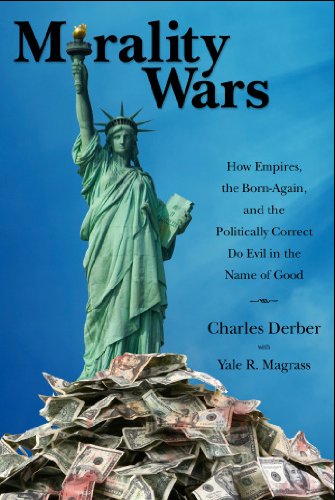
morality warsIn their book, Morality Wars: How Empires, the Born Again, and the Politically Correct Do Evil in the Name of GoodCharles Derber and Yale R. Magrass introduce the concept of “immoral morality”, which empires have used to justify their conduct as empires.

The authors of this book have studied the hegemonic behavior of three empires, Roman, British and American. They conclude that each of the three empires had its own unique moralization rationale to justify its behavior, because an empire is:

“inherently exploitable and unaccountable. Naked force—the barrel of a gun—can secure such force but not sustain it: only moral and spiritual stories captivating hearts and minds can do that.”

Derber and Magrass maintain that as “hegemonic power grows, so, inevitably must the moral stories we describe in this book”.

It must be noted that the Bush-Cheney wars were carried out to “spread democracy for the good of the nations under attack”, just one of the moral stories utilized to mesmerize the American public.

Morality tales are used to justify the existence of hegemonic power. To illustrate this practice, Derber and Magrass write:

Think of the slave South, one of the most moralistic American regimes. Southern moralists filled Southern churches and town halls with ringing affirmations of the goodness of slavery.

One Southern author wrote: “Although they are inferior, we took them to our homes and taught them Christianity and how it protects, supports and civilizes him”.

Moral stories that justify immoral behavior are cover stories for the practice of “immoral morality”.

During the Vietnam war, the US destroyed a village to save it. Death by drones, a Bush practice which continues under Barack Obama, will neither save a village nor win any “hearts and minds”.

Obama’s continuation of the Bush assassination drone program has been a major blot on his record of moral leadership.

No amount of transparency, and no moral stories of the “good that drones do”, will change the fact that drone warfare is immoral.

The start of Obama’s second term is the right time for him to instruct his new team at Defense, State and the CIA, to terminate this  practice of technological, sophisticated delivery of death.

The photo above of Chuck Hagel is by Drew Angerer/Getty Images

Posted in Middle East Politics, Politics and Elections | 9 Comments

Right Wing Media Pushes “Friends of Hamas” Rumor

UPDATE Tuesday, February 26:

The Hill reported Tuesday afternoon:

The Senate on Tuesday voted to confirm former Sen. Chuck Hagel as Pentagon chief in a 58-41 vote, ending the most contentious confirmation fight for a Defense secretary in U.S. history.

Only four Republicans backed Hagel, a former GOP senator from Nebraska whose controversial statements on Israel, Iran and other issues made him a lighting rod on the right and led to the first-ever filibuster of a nominee to lead the Pentagon. GOP Sens. Thad Cochran (Miss.), Richard Shelby (Ala.), Mike Johanns (Neb.) and Rand Paul (Ky.) voted to confirm Hagel.

Hagel Chip Somodevilla:Getty Images

by James M. Wall

One rumor in the anti-Chuck Hagel campaign started as a joking question that quickly swept through the right wing media machine until it reached Fox News business guru, Lou Dobbs.

It was such an outlandish charge that it should have been ignored and tossed into the “birther” trash can. The rumor “implied” that Hagel might have received funds from an organization called “Friends of Hamas”.

Dan Friedman, the New York Daily News reporter who inadvertently launched the “Friends of Hamas” rumor, was shocked to see how quickly a joking question he posed casually over the phone, went from nowhere to everywhere. He tells his sad tale in the Daily News:

On Febrary 6, I called a Republican aide on Capitol Hill with a question: Did [Chuck] Hagel’s Senate critics know of controversial groups that he had addressed?

Hagel was in hot water for alleged hostility to Israel. So, I asked my source, had Hagel given a speech to, say, the “Junior League of Hezbollah, in France”? And: What about “Friends of Hamas”?

The names were so over-the-top, so linked to terrorism in the Middle East, that it was clear I was talking hypothetically and hyperbolically.

No one could take seriously the idea that organizations with those names existed — let alone that a former senator would speak to them.

Friedman was wrong.

The right wing media machine swung into action, sending Friedman’s joking question on its mission to destroy Hagel.

The aide Friedman had initially called, promised to get back to him. He did not call, so Friedman followed up with a reminder e-mail to the aide that asked:  “Did he get $25K speaking fee from Friends of Hamas?”  The aide still did not respond.
One day later, Friedman was shocked to see that his joking question had reached the Breitbart News website, under the headline: Secret Hagel Donor?: White House SPOX Ducks Question on ‘Friends of Hamas’
The Brietbart author, Ben Shapiro wrote:
On Thursday, Senate sources told Breitbart News exclusively that they have been informed one of the reasons that President Barack Obama’s nominee for Secretary of Defense, Chuck Hagel, has not turned over requested documents on his sources of foreign funding is that one of the names listed is a group purportedly called ‘Friends of Hamas.’
Shapiro added that a White House spokesman hung up on him when he called for comment, an action Shapiro included in his story, buttressing “the assertion that the White House didn’t deny the claim”.

Shapiro tweeted the link to his Breitbart story to his nearly 40,000 Twitter followers. The joke had become a serious story, treated as such by commentators who did not check to see if it was true. Friedman reports what happened next:

Blogs like RedState.com and the National Review’s The Corner linked to it. In Israel, Mike Huckabee said “rumors of Chuck Hagel’s having received funds from Friends of Hamas,” would, if true, “disqualify him.”
Noting that Slate.com was one of the first main stream web sites to raise “big doubts whether ‘Friends of Hamas’ even exists,” Friedman continued his narration:
On Monday, I reached my source. The person denied sharing my query with Breitbart but admitted the chance of having mentioned it to others.

When Friedman spoke to him on Tuesday, Shapiro acknowledged “Friends of Hamas” might not exist. But he said his story used “very, very specific language” to avoid flatly claiming it did. Friedman’s joking question had gone very, very wrong.

He concludes his role in the rumor story:
I am, it seems, the creator of the “Friends of Hamas” myth. Doing my job, I erred in counting on confidentiality and the understanding that my example was farcical — and by assuming no one would print an unchecked rumor.
If anyone didn’t know already: Partisan agendas, Internet reporting and old-fashioned carelessness can move complete crocks fast. If you see a story on Hagel addressing the Junior League of Hezbollah, that’s fake too.
The rumor, by this time, had taken on a life of its own. A single rumor became “rumors abound”, in The National Review On Line, where Andrew Stiles wrote:
Rumors abound on Capitol Hill that a full disclosure of Hagel’s professional ties would reveal financial relationships with a number of “unsavory” groups, including one purportedly called “Friends of Hamas.” The GOP aide said it was “noteworthy” that the White House has yet to deny the association. “Maybe it’s not true, but why not provide a list of groups he spoke to and remove all doubt?” the aide said. 
Veteran columnist David Wiegel was the first to do the obvious: He checked out “Friends of Hamas”. On February 14, he wrote that he could find no evidence of its existence.
There’s no proof that “Friends of Hamas” actually exists. At best, it’s an organization so secret that nobody in government has thought to mention its existence. At worst, it’s as fake as Manti Te’o’s girlfriend.
The Treasury Department, which designates sponsors of terror, has done so to many charities tied to Hamas. “Friends of Hamas” is not among them. The State Department doesn’t designate it, either. And a bit less holistically, a Lexis search for the group reveals absolutely nothing.
Lou Dobbs, on his Fox News program, interviewed National Review columnist Andrew McCarthy about the Hagel quandary, and “Friends of Hamas” came up again. (Click here for a video from the Dobbs Fox program. It runs four minutes)
The following interview excerpt provides a flavor of Dobbs as an eager purveyor of the “Friends of Hamas” rumor.
MCCARTHY: There was a report that came out last week-not confirmed yet, but we’re [i.e., the White House] also not denying it very vigorously-that one of the groups behind the speeches may have been an outfit called Friends of Hamas. That is not going to-

DOBBS: That has a ring to it, doesn’t it?

MCCARTHY: Catchy.

Catchy, indeed, and entirely made up from a false rumor created out of a joking question. The rumor spread quickly because the right wing media machine wanted to promote a falsehood for political purposes.  No one in that machine bothered to check out the story .

The Senate hearings on Chuck Hagel’s nomination as defense secretary will resume next week. The Armed Services Committee has approved the nomination on a party line vote, 14 to 12.

Democratic leaders in the Senate want to present the nomination before Wednesday, February 27, to the full Senate for a final confirmation.

Opponents of Hagel on the Republican side of the aisle continue to mumble against a wounded Viet Nam veteran with extensive government and business experience, purely on spurious grounds.

Hagel’s chief adversaries, John McCain and Lindsay Graham, appear however, to have given up any further thought of a filibuster against Hagel.

The sooner the better. The obvious fakery of the charges leveled against Hagel exposes the pettiness of Hagel’s opponents, both in the right wing media and in the increasingly hard-right leadership of the Republican party.

The photo of former Senator Hagel (above) is by Chip Somodevilla/Getty Images.

Posted in Media, Middle East, Politics and Elections | 8 Comments

Republicans Block Hagel for Ten More Days

mccain:Grahamby James M. Wall

The agreement Democratic Senate leader Harry Reid (NV) thought he had reached with Republican leader Mitch McConnell (KY), died a slow, angry and ugly death Thursday.

When this new Senate held its first session in January, younger and more progressive Democratic members of the Senate wanted Harry Reid to take advantage of having a Democratic majority.

They urged him to make changes in the senate’s archaic rules while he had a Democratic majority vote. That action may only be taken at the start of a new congress.

Reid loves the senate and he loves its traditions. He refused to take advantage of his majority. Instead he trusted Mitch McConnell to keep his Republican minority caucus in line without any real rule changes.

Don’t they trade horses in Reid’s Nevada? Doesn’t Harry know that if a horse trader offers you a “too good to be true deal on a mare”, look closely at the animal’s past history and then study her teeth?

Harry Reid was snookered (tricked, fooled) by Mitch McConnell, who promised him a good deal on a mare in a deal that was “too good to be true” to run the senate, the old way.

Reid was also snookered by John McCain (AZ) and Lindsay Graham (SC), (above) two veteran members of the senate who claim all they want is “more information” on what happened at Benghazi before they would allow an up or down vote on the confirmation of Chuck Hagel as defense secretary.

That is Republican-speak that has nothing to do with Benghazi and everything to do with their awareness that Hagel does not meet their “I love Israel” taste test.

A snookered Reid was so angry about what was obviously a move to a Republican filibuster, that he called for an up or down cloture (“closure”) vote on whether or not to end debate on Hagel’s confirmation.

The Republicans knew he would lose that vote. They politely suggested a delay in the vote until February 25 (or 26) giving them more time to find something, anything, that would disqualify Hagel as defense secretary. They have been looking since December and they have always come up empty-handed.

Hagel is backed by virtually everyone but Fox News, Rush Limbaugh and Republican party “I love Israel” senators.

Reid is not only a lousy horse trader, he also failed the test of a savvy legislative leader: Know your vote total before you call for cloture.

Under those archaic senate rules Reid refused to change back in January when he had his chance to do so, a cloture vote still needs a 60 vote majority.

To reach his required 60 votes to defeat cloture, Reid started with 55 affirmative Democratic votes. Even conservative Democratic senators in danger of neoconservative primary opponents, stuck with Reid. After that, Reid needed five more senators to win the cloture vote and end debate.

Reid picked up four Republican votes in favor of cloture, Senators Mike Johanns (NE), Susan Collins (ME), Thad Cochran (MS) and Lisa Murkowski (AK).  voted present. An affirmative Orrin Hatch (R-UT)  vote would have put the total at the winning total of 60.

Instead, Hatch voted present, making the final cloture vote 58 for and 40 against. Reid had reversed his yes vote to no, making it possible for him to call for another senate vote when the senate returns February 25.

When Reid spoke on the senate floor Thursday afternoon, he expressed frustration over the tactics of the obstructionists–led by  Senators James Inhofe (OK), John McCain (AZ) and Lindsay Graham (SC)–which forced the cloture vote that Reid lost.

But be not fooled, this whole process has been a charade to snooker the public into believing the Republicans speak the truth when they say they only want to know about Hagel’s finances, or Benghazi, or organization boards on which he sits, or speeches he has given throughout his career.

What really drives the Republicans is a desire to undermine a sitting Democratic president. Mitch McConnell famously said at the start of Obama’s first term that the Republicans would spend four years of non-cooperation with Obama. What the McCain-Graham-Inhofe filibuster is all about is a continuation of McConnell’s anti-Obama strategy from the first term.

In moving toward the cloture vote and the filibuster, Republicans threw up a variety of reasons for opposing Obama’s nominee for defense secretary. The reason menu had changed as often as your local restaurant changes its daily specials.

The current obstructionist rationale du jour is an old favorite, the special that first delighted the Republican conservative base’s palates when Susan Rice’s name was initially suggested as Obama’s next secretary of state, what happened at Benghazi.

First, with Rice and now with Hagel, Republicans are dishing out familiar questions: What does the White House know–and when did the White House know–the “full truth” about the four tragic American deaths at Benghazi.

That demand is leveled at President Obama, of course, since neither Hagel nor Rice had any responsibility in the events surrounding the Benghazi deaths.

To attack and smear Hagel, Republicans have falsely questioned his character and his integrity, including the absurd implication that he has the backing of Iran in his quest for confirmation.

MSNBC’s Rachel Maddow has recently leveled her playful commentator style at Republicans who have been obstructing Democratic nominees.

When hearings began on the now-confirmed Secretary of State John Kerry, and the still-pending Chuck Hagel, Maddow skewed Texas Republican Senator Ted Cruz for his aspersions against both Kerry and Hagel. The clip below includes a section of a speech Cruz made during an event sponsored by a media powerhouse of the conservative movement, the National Review.

http://youtu.be/yemmZu2hAzw

The Republican congressional obstructionists, including Ted Cruz, have delayed the confirmation of Chuck Hagel for another ten days. When they return to work on February 25 or 26, they will have a pile of clippings to read, including these opening lines from an editorial in the New York Times that ran the day after they left town:

For the last four years, Senate Republicans have used the power of the filibuster to block legislation, bottle up nominees to courts and government departments, and strangle federal agencies, even though they are in the minority.

On Thursday, they hit a new low. They successfully filibustered Chuck Hagel, President Obama’s nominee for defense secretary, the first time a cabinet nominee for this post has been prevented from receiving an up-or-down vote.

These next ten days may well be the darkest moments in the life of the Republican party, and its allies in the right-wing government of Israel. Sometimes, winning leads to a much larger defeat.  This could be one of those times.

Posted in Middle East Politics, Obama, Politics and Elections, US govermemt | 11 Comments

GOP Descends Into Its Winter of Discontent

Kevin Spacey as Richard III crop

“Why, I in this weak piping time of peace
Have no delight to pass away the time,
Unless to spy my shadow in the sun
And descant on mine own deformity.”

William Shakespeare: Richard III

by James M. Wall

A major archaeological discovery was announced in Leicester, England this week.

Experts have confirmed that skeletal remains found during the excavation of a Leicester parking lot are those of Britain’s King Richard III,  the last of the Plantagenet kings.

Richard (at right portrayed by Kevin Spacey) was killed in 1485 by Tudor enemies during the Battle of Bosworth Field.

British officials authenticated the remains through the thoroughly modern method of DNA “fingerprinting”  connecting King Richard to a 21st century male descendant of Richard’s sister, Anne.

The serendipitous timing of this archeological discovery has prompted Michael Hirsh, writing in The National Journal, to engage in a nifty bit of colligation, a 17th century word rarely used today, but one most appropriate this week, since colligation refers to “the abstract tying together of things not previously seen as connected”.

Hirsh does not refer to colligation (I take full blame), but he does embody the term when he connects what he “ranks as one of the most titillating archaeological discoveries ever” to  the current US Senate Armed Services Committee hearings on the confirmation of Chuck Hagel to be defense secretary.

Pointing out “that history is a fluid thing, and it’s invariably the winning side that writes it,” he continues:

Sure, now we can say these are King Richard’s bones, curved spine and all, but we still know little else about him. The victorious Tudors killed King Richard in 1485—apparently with an ax through the head at the Battle of Bosworth Field—and then induced a first-rate spinmeister, William Shakespeare, to paint him as one of history’s worst villains. What we don’t know is whether that is true.

The fluidity of history brings Hirsh to the current Washington stage on which Chuck Hagel does battle with his Republican inquisitors:

Which history are we to believe coming out of last week’s brutal Chuck Hagel hearing, and which will dominate in the next four years?

Because this is what the current conflict over America’s next defense secretary—and the future direction of the administration’s foreign policy—is really about: two different readings of history.

It is what Sen. John McCain, R-Ariz., an erstwhile Hagel friend who turned into a caustic critic, was referring to when he said that “fundamental” differences remained between him and President Obama’s nominee to run the Pentagon.

William Kristol final cropOn one side are fierce Hagel critics such as McCain and Bill Kristol (left), Washington’s neocon-in-chief, who refuse to back down from their belief that the Iraq invasion of nearly a decade ago was just, and who continue to support the aggressive projection of U.S. military power abroad, especially in Syria.

On the other side are Obama, Hagel, and others who warned—quite presciently—of the pitfalls of that policy, and who are running away from military intervention abroad at full speed, even as they ratchet up the “small footprint” use of drones.

And now the neocon hawks fear that, like Shakespeare’s Richard III, there will be no place for them at all in Obama’s “weak, piping time of peace.” It is truly the winter of their discontent.

On Thursday of this week, the scheduled Hagel confirmation vote was cancelled after the Republican committee members demanded that Committee Chairman Carl Levin delay the final confirmation vote to give them more time to “study” Hagel’s record.

Still not satisfied after their earlier committee attacks which focused almost exclusively on Israel (will you be faithful to our special relationship until death do you part?) and Iran (Israel’s current arch enemy), the senators wanted another go at Hagel.

With their obsession with Israel and Iran, the Republican senators gave the public a reminder of the power of the Israel Lobby in Washington. They proved to be more dedicated to the state of Israel than to the country which they are supposed to serve.

Their questions expose them.

Brandon Friedman, a veteran of Iraq and Afghanistan, has the numbers to show the exposure. He writes in Time’s blog:

In nearly eight hours of interrogation and testimony, Israel and its interests were referred to by the Senate Armed Services Committee a total of 106 times. On the other hand, there were a mere 24 references made to Afghanistan and the Americans fighting there—most by Democratic Senator Carl Levin, chairman of the committee.

Nuclear-armed Pakistan—where the U.S. frequently targets militants with drone-launched Hellfire missiles—barely merited mention at all.

It’s difficult to interpret this message any other way: the Senate Armed Services Committee—particularly its Republican membership—is more concerned with the apparent American defense secretary’s relationship with Israel than with the future of Afghanistan, Pakistan, and the fate of U.S. troops engaged in both locations.

Expanding further to the Israel-focus of the hearing questions, Walter Pincus has his own question in the Washington Post:

What has all this got to do with Hagel being Defense secretary? As others have pointed out, few senators raised the more serious issues that would immediately confront Hagel should he be confirmed, as he probably will be.

Defense Secretary Leon E. Panettta, appearing on “Meet the Press” on Sunday, put it concisely: “What disappointed me is that they talked a lot about past quotes, but what about what a secretary of Defense is confronting today? What about the war in Afghanistan? What about the war on terrorism? What about the budget sequestering and what an impact it’s going to have on readiness? What about Middle East turmoil? What about cyber attacks?”

I would add one that will come up the first time Hagel as secretary faces the military in a town-hall meeting: What does he expect to be done about military pay, benefits, retirement and health care?

In his Richard III piece, Michael Hirsh warns the GOP hawks that they are making a mistake by continuing  to attack Hagel with their failed, flawed GOP war strategy:

Hagel’s policy views are invariably well-thought-out, and he himself qualifies as quite a profile in courage when it comes to the anti-Iraq war side of history. Obama’s famous dismissal of the Iraq invasion as a “dumb” war, and Hagel’s distinguished record of defiance toward his own party to oppose the war, amount to a living refutation of McCain’s and Kristol’s entire worldview.

A decade ago, McCain and Kristol were leading hawks who claimed that Saddam Hussein had connections with al-Qaida and that weapons of mass destruction would certainly be found, and that George W. Bush could do it all and still preside over a strong economy.

While Kristol was agitating for war and saying things like, “I think we’ll be vindicated when we discover the weapons of mass destruction and when we liberate the people of Iraq” (March 5, 2003), Hagel was warning accurately that there was no evidence of Saddam’s links to al-Qaida, that his possession of WMD were in doubt, and that America was in danger of strategic overreach and enraging the Arab world.

The war the Republican minority on the Armed Services Committee has waged against Hagel/Obama, is one they lost when they entered the hearing room. Hirsh further warns the senators that things “are likely to get much worse for the hawks in the second Obama term”.

First, despite Kristol’s fulminations, Hagel is highly likely to be confirmed. Second, government sources tell me that one reason that John Brennan took the CIA job is that he wants to ease the agency out of the drone business.

Hagel, based on his own worldview and his deep concerns about the moral use of U.S. power and the bad precedents that can be set by its misuse, is likely to also want to ratchet back or at least to exercise more caution about the drone attacks.

Jimmy CarterA growing number of critics, including former President Carter (right), say the drone program has badly undermined America’s moral position, and it supplies a dangerous precedent to other nations that are developing their own drone programs, in particular China and Russia, and could cite Washington’s policy to justify, say, political assassinations.

Henry Siegman, former AIPAC staffer, writing in the Huffington Post, displays his battle-scarred wisdom with this response to Hagel progressive critics who complained that the future defense secretary had “backed down” on his previous stands.

He did not “back down”; he played the political game and refused to take the bait his former Republican senate colleagues threw at him.

Here is Siegman’s take on how best to maneuver through the political swamp:

Of the many controversial statements made by Senator Chuck Hagel over the years, none seemed to enrage Senator Lindsey Graham more than his remark that the Israel lobby intimidates U.S. Congressmen into advocating “stupid” policies. He challenged Hagel to name one such senator and to identify one such stupid policy.

The challenge created an unusual opportunity for Hagel, for there could be no better and conclusive evidence of the Israel Lobby’s power of intimidation of U.S. senators on the subject of Israel than these hearings themselves, and most particularly Senator Graham’s own behavior.

Unfortunately, Hagel could not take advantage of that opportunity. Had he done so, his nomination by President Obama to head the Department of Defense would undoubtedly have been dead in the water, for his former Democratic colleagues are no less guilty of yielding to that intimidation than Hagel’s former Republican colleagues.

The Armed Services and Intelligence committees hearings will soon be over. Meanwhile the GOP’s “winter of discontent” has just begun.

Posted in -Movies and politics, Politics and Elections | 8 Comments

CUFI and the Ugly Face of Hagel’s Opposition

by James M. WallChip Somodeville:Getty Images

This nation’s foreign policy is, for this weekend at least, in the pious hands of John Hagee, a  Christian fundamentalist preacher from Texas.

To be sure, Hagee is not the only policy-shaker whose minions are roaming the hallowed halls of the nation’s capitol. But he is certainly the most conspicuous and overt religionist participating in the US senate battle over President Obama’s nominee for defense secretary, former Senator Chuck Hagel.

Hagee created Christians United  for Israel (CUFI) in February, 2006. Seven years later (a divine period which in biblical years led to the release of slaves), CUFI is buying television ads in four states, each of which has a Democratic senator who could be vulnerable to defeat in 2014.

That reads more like the creation of, rather than the release of, slaves, but then, divine commands may more often than not, be in the minds and hearts of the divine command transmitters.

At any rate, it is not seven years, but six years (the term of office for a US senator), which John Hagee assumes is on the minds of four Democratic senators who are up for reelection in 2014. The states and the senators are Arkansas (Mark Pryor), Louisiana (Mary Landrieu), Colorado (Mark Udall) and North Carolina (Kay Hagan).

The goal of CUFI’s ads running in those states, and the strong Christian fundamentalist religious pressure behind them, is quite simple: Threaten, intimidate and warn these four Democrats that they could pay a price for voting in favor of Hagel.

And, it must also be noted, the ads let other senators know CUFI is watching.

JTA, the Global News Service of the Jewish People, describes the Washington political/religious scene this week:

CUFI’s affiliated Action Fund also has rallied hundreds of Christian pastors and leaders to Washington this week to lobby against the former Nebraska senator’s bid to succeed Leon Panetta.

And on Tuesday, as the pastors were swarming Senate offices, CUFI published four ads in states where Democratic senators are thought to be vulnerable in 2014: Arkansas, Louisiana, Colorado and North Carolina.

“We pray you vote against confirming Senator Hagel,” said the ads, addressed to each state’s senators.

CUFI is not targeting Republican senators with prayers and threats. No need, prayers and threats have long since done their work.

No CUFI ads ran in Texas, for example, a state already safely in CUFI’s clutches. Indeed, the Lone Star state, which has sent two Bushes to the White House, has two Republican senators now leading the vitriolic political/religious charge against Hagel.

Sen. John Cornyn, the senior Texas senator, was the first senator to come out against Hagel’s nomination. He did so, he acknowledged, at John Hagee’s behest during a meeting this Monday.

Cornyn set the tone for the Hagel hearing with his egregious declaration, “I cannot support a nominee for defense secretary who suggests we should be tougher on Israel and more lenient on Iran.”

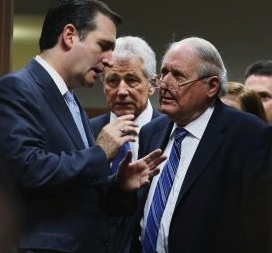
The second Texas senator, Ted Cruz, now beginning his first term, is shown in the picture above, talking to Democratic Senate Armed Services Committee chairman Carl Levin, right (with Hagel behind them). During Thursday’s hearings, Cruz fired a series of prosecutorial questions at Hagel in the eight hours the nominee endured in his grilling before the committee.

Some Democrats on the Armed Services committee were supportive of Hagel, but they were careful not to give any hint that they had any doubts about their love and devotion to Israel.

They are, after all, fully aware of the leitmotif (an anglicization of the German Leitmotiv, literally meaning “leading motif”, or perhaps more accurately, “guiding motif) constantly ringing in their political ears back home through media, donors, voters and alas, religious groups from mainline Protestants to the right wing fundamentalist CUFI crowd.

From the Republican side in the Senate committee hearings, there was only polite deference displayed for Hagel’s Vietnam military and senate service.  Instead, adopting the style of another prosecutorial senator, Arizona’s Republican Senator John McCain, Cruz demanded yes or no answers, or the order of “do you or do you not stand behind this quote from 1999 (or 2002, or whenever)”.

It was, over all, an ugly scene in the nation’s capitol as Republican senators bolstered their Israeli bona fides to demonstrate just how much they love the Zionist program that occupies a Palestinian population and elevates Israel above criticism or blame.

If there has been any senatorial concern that Israel became the first country to boycott a UN Human Rights Council review of its rights situation this week, it did not surface in any format I could locate.

During the Hagel hearings, Republicans focused exclusively on loving Israel as they leveled blistering attacks on a former senate colleague,  forcing him to explain, clarify and at times, appear to reverse statements made over the past decade. The senators tried to get him to give yes or no questions to some of the more complex issues this nation will confront during his term as defense secretary.

In spite of these highly personal attacks, Hagel remained cool, maintaining his composure to such a degree that, if you are pulling for him, he succeeded in making his attackers look both nasty and petty.

In preparation for the hearings, Hagel did his political homework. He bolstered his support among pro-Israel Democratic senators. Once he convinced Chuck Schumer of New York, that he (Hagel) was not anti-Israel, he passed the Schumer litmus test.

Here is JTA’s reading of the groundwork Hagel and his White House counselors, laid prior to the hearings:

In his efforts to tamp down the pro-Israel opposition to his nomination, Hagel has won support from some of the leading Jewish pro-Israel Democrats in the Senate: Carl Levin (D-Mich.), who chairs the Armed Services Committee, as well as Charles Schumer (D-N.Y.), Barbara Boxer (D-Calif.) and Frank Lautenberg (D-N.J.).

The Vietnam War hero also has the support of liberal Jewish groups, including Americans for Peace Now, the Israel Policy Forum and J Street. On Wednesday, J Street was set to join Sen. Jack Reed (D-R.I.), a veteran and a member of the Armed Services Committee, on a conference call backing Hagel.

Hagel also has met with leaders of centrist pro-Israel groups, several of which had expressed concerns about his candidacy, including the Anti-Defamation League, the American Jewish Committee, the Conference of Presidents of Major American Jewish Organizations and the American Israel Public Affairs Committee. The groups described the meeting as “an important opportunity for a serious and thorough discussion.”

In his fight against Hagel, John Hagee’s CUFI had the support of co-religionist groups in the Jewish community, none of which, however, to my knowledge, ran ads “praying” for senatorial votes

The Republican Jewish Coalition (RJC) did contribute a web video which the JTA describes as “featuring Democrats and Jewish organizational leaders expressing concern about Hagel.

“Expressing concern” is Zionist polite parlor talk for “we don’t like you or what you stand for”.

No prayer talk either from the Emergency Committee for Israel which ran a full-page ad in the New York Times, January 15, joining the Zionist Organization of America in opposing Hagel.

And of course, it would not be a pro-Israel alley fight without the presence of casino magnate Sheldon Adelson, described by JTA as “one of the GOP’s most generous donors and an RJC board member”. Adelson made his pitch directly by calling senators who appreciate his fondness for Israel as well as his generous deep pockets.

Matt Brooks, the RJC’s executive director, went all down-home-like on us with his comment, “We’ve made a strategic decision to gin up as much support among our leaders to reach out to the folks.”

As was to be expected, the progressive political left was harshly critical of Hagel’s testimony.  Philip Weiss, major domo of Mondoweiss, reacted to the Thursday hearings:

The first few hours of Chuck Hagel’s confirmation hearing have been sickening. I thought he was named to be United States Secretary of Defense, not Israel’s defense. The most urgent questions were about Israel, and many came from liberal Democrats insisting that Hagel is pledged to going to war against Iran if it acquires a nuclear weapon.

Hagel was suitably craven. “I’ve said that I’m a strong supporter of Israel… I’ve said that we have a special relationship with Israel… Ive never voted against Israel in my career… I’ve been to Israel many times,” he told Jack Reed of Rhode Island.

David Weigel writing for Slate, saw something bogus in the questions thrown at Hagel by Senator Ted Cruz, who came to the hearings with

three—count ’em—visual aids to his interrogation of Defense Secretary nominee Chuck Hagel. He played two clips from Hagel’s interviews on Arab-language media, attempting to prove that Hagel agreed with callers who accused Israel of “war crimes” and the United States of “bullying,” because he quickly agreed with the questions and moved on. The third aid was a chart blowing up a July 31, 2006 quote from Hagel, during Israel’s conflict with Hezbollah.

“In a speech on the floor of the Senate you referred to Israel’s military campaign against the terrorist group Hezbollah as a, quote, ‘sickening slaughter,'” said Cruz. “Do you think it’s right that Israel was committing, quote, a ‘sickening slaughter,’ as you said on the floor of the Senate?”

As with so much else today, Hagel was caught short, and tried to explain why “slaughter” might occur if “war crimes” didn’t. It was another hit he should have seen coming; the Weekly Standard, in a morning cheat sheet of Hagel quotes, reported that Hagel “accused Israel of carrying out a ‘sickening slaughter’ in Lebanon.”

But it’s misleading. Hagel’s full speech is available on C-SPAN.

The larger context of the quote, Weigel reports, is here:

“How do we realistically believe that a continuation of the systematic destruction of an American friend, the country and people of Lebanon, is going to enhance America’s image and give us the trust and credibility to lead a lasting and sustained peace effort in the Middle East?

The sickening slaughter on both sides must end, and it must end now.”

The final vote may come Monday. In spite of the hostile hearings, it still appears Hagel will win confirmation. That vote will end yet another political episode when the ambiguity of democracy is put on full display.

It is not always pretty; at times it is downright ugly. But it is what we get when flawed political leaders struggle to govern.

               The picture above is by Chip Somodeville/Getty Images, from Slate.

Posted in Middle East Politics, Politics and Elections, Religion and politics | 20 Comments

Are Liberal American Zionists “Delusional”?

by James M. WallYair Lapid Oliver Weiken:European Pressphoto Agency

Shortly after the polls closed in Israel’s Knesset election this past Tuesday, two American Liberal Zionist groups, J Street and Americans for Peace Now (APN), were out with triumphant emails to their peace-oriented members:

Israel voters have chosen a new government that will “revive the peace process with the Palestinians and make vital moves to “save” Israel”.

Writing for Mondoweiss, the website co-edited by Philip Weiss and Adan Horowitz, Alex Kane bluntly rejects that optimistic conclusion:

In his scathing criticism of the optimism of J Street and APN, Kane sets the stage for what will most certainly be an intense struggle within the American peace camp over the meaning of this Knesset election:

The liberal Zionist wing of the American Jewish community are deluding themselves about the results of the Israeli elections.

They see the Israeli elections as a triumph for politicians who are going to revive the peace process with the Palestinians and make vital moves to “save” Israel, in their words, from the scourge of apartheid or a one-state solution with equal rights for all.

But their rhetoric about the outcome of the elections represents a fantasy with little bearing in the reality of what the Israeli government is and will continue to be: a settlement expanding, occupation supporting right-wing government that is committed to the suppression of Palestinian rights within the Green Line and in the West Bank and Gaza.

The Israeli government, in other words, will remain committed to the status quo of apartheid.

Ha’aretz  columnist  Ari Shavit  joins the optimistic J Street amd APN crowd with his cry of relief that the election results benefit Israel’s identity:

This week the idiotic march of the right to the right wing of the right came to an end, and the renewed march of the right toward the center began.

But above all, the election results have significance for our identity. The dramatic headline of the election is short: Israel is not right-wing. This week proved that as opposed to the impression both here in Israel and in the world, Israel is not messianic and not racist and not anti-democratic. We are not all Moshe Feiglin [referring to a newly elected Likud Knesset member well-known for his extremist anti-Palestinian views.]

Contrary to many pre-election stories that promised a surprise increase to as many as 15 seats for the Bayit Yehudi (Jewish Home) party, led by Naftali Bennett, Bayit Yehudi was not the surprise of this week’s election.

The surprise of the election Tuesday was the Yesh Atid  (There is a Future) party, led not by a “charismatic” figure, but by a “handsome” former television personality turned politician in time to run in this 2013 election, Yair Lapid (shown above).

The most likely result of the election will be for Israeli President Shimon Peres to instruct Benjamin Netanyahu to form a new government, one which will place leadership in the months ahead in a coalition led by the right-wing Netanyahu-Liberman parties with Yair Lapid’s Yesh Atid party.

Several reports from Israel predict that unless Avigdor Lieberman demands his Foreign Ministry post back (he resigned earlier because of legal problems) that post could go to Yair Lapid.

It is worth noting that Lapid’s parents moved their family to Israel when Lapid was a small child. Lapid learned his English from his American-born parents.  He later worked in New York City, improving his American-made accent, a great advantage for an Israeli foreign minister.

Does Lapid as a partner with Netanyahu offer hope for a creative approach to peace with Israel’s Palestinian neighbors? Is he truly the hope for peace that J Street and APN claim?

The evidence is not promising. Lapid’s campaign was focused on winning support from those Israeli voters who took to the streets last year to protest against Netanyahu’s poor handling of the economy.

His campaign largely ignored  “the Palestinian issue”, but on the Sunday before the election, Lapid shared his views on “Arabs” in a media interview, leaving no doubt as to his attitude toward Palestinians:

Yair Lapid, the head of the Yesh Atid party, explained Sunday that he has no expectations from negotiations with the Arabs. “I do not think that the Arabs want peace,” he wrote on his Facebook page.

Lapid said that he does not care what the Arabs want. “What I want is not a new Middle East, but to be rid of them and put a tall fence between us and them.” The important thing, he added, is “to maintain a Jewish majority in the Land of Israel.”

This is the man who is expected to form a new government with Netanyahu.  The New York Times confirms that union:

The last votes counted, mostly those of active-duty soldiers, gave the right-wing and religious factions that make up Mr. Netanyahu’s current coalition a one-seat majority. But the prime minister has indicated that he wants to form a broader government, partnering first with Yair Lapid, the leader of the new, centrist Yesh Atid party, whose second-place finish stunned Israel

Mr. Netanyahu and Mr. Lapid, who together control 50 of Parliament’s 120 seats, met for two and a half hours on Thursday in Jerusalem and “discussed the challenges facing the nation and the ways to deal with them,” according to a statement from Mr. Lapid’s party.

Yousef Munayyer, executive director of The Jerusalem Fund and its educational program, The Palestine Center, underscores Alex Kane’s judgment on Liberal Zionism’s overly optimistic reading of the election. Munayyer wrote on his blog:

If you haven’t noticed, the Liberal Zionist brand is desperate to portray the outcome of the Israeli election as the salvation of the Israel they know is down there somewhere.

Alex Kane agrees with Munayyer when he concludes his Mondoweiss rejection of the unrealistic optimism of J Street and Americans for Peace Now:

The liberal American Zionists are utterly delusional, grasping at any straw to try and convince the world that there is a possibility for a two-state solution and that Israel can make peace.

The start of a second term for Barack Obama is not a time for false optimism about peace that might arise from a new Israeli government. It is rather, a time for the realism of Palestinians like Hanan Ashrawi, writer, scholar and political activist, who brings a Palestinian realistic reminder to the world in an Ha’aretz piece she wrote before the election.  

She writes:

In many elections, politicians are accused of stealing public resources. In Israel, in addition to stealing Palestinian land and natural resources, most Israeli politicians are bent on confiscating the last hope for a two-state solution. Most Israeli political parties are guilty of the deliberate omission of peace from their agenda.

They talk about negotiations when they mean dictation. They talk about “managing” the occupation rather than putting an end to it. While there is a global consensus for a two-state solution, the main Israeli electoral lists see no room in historic Palestine for two states.

Are Liberal Zionists trapped in a delusion that leads them to protect their “Zionist identity” instead of seeking the justice which Zionism, as a political entity, has conspired to deny Palestinians?

It is a fair question, and it is a realistic question. Certainly, it is the kind of moral question that theologian Reinhold Niebuhr would demand that we examine. 

The picture above of Yair Lapid is by Oliver Weiken of the European Pressphoto Agency.

Posted in Middle East Politics, Netanyahu, Politics and Elections | 12 Comments

Election Could Push Israel Further To The Right

by James M. Wall

Bayit Yehudi leader Naftli Bennett Pix Marc Israel Sellem the JP

Israel’s 19th general election, Tuesday, January 22, is almost certain to be won by Prime Minister Benjamin Netanyahu’s Likud party.

There is no serious Liberal election opposition to Likud. What is serious, however, is the very real possibility that after this election, the Israeli government could turn even harder to the political right.

In the final weeks of the campaign, Likud has been losing votes to a party even more conservative than Likud. The brash newcomer is the previously little-noticed Bayit Yehudi (Jewish Home) party.

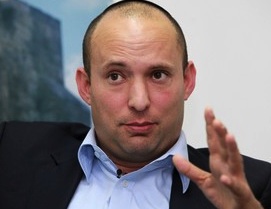
The leader of Bayit Yehudi is a 40-year-old charismatic newcomer to Israeli politics, Naftali Bennett (shown above), who has emerged as the hottest new personality on the Israeli political scene.

Bayit Yehudi has languished in the shadows of recent Israeli elections. It currently has three members in the Knesset. Some polls indicate that number could rise to as many as 15 seats, elevating Bayit Yehudi to a third place finish among the 20 parties currently represented in the Knesset. The two leading parties are expected to be the right-wing alliance of  Likud and Avigdor Lieberman’s Yisrael Beiteinu.

Joel Greenberg, reporting for the Washington Post, noted the combination of religious and nationalist themes in one Bayit Yehudi campaign event:

It was a mostly young crowd that turned out on a chilly winter night to hear Naftali Bennett, the leader of the religious nationalist party Jewish Home [Bayit Yehudi], deliver an appeal for understanding — not between Israelis and Palestinians, but among Israelis themselves.

“If it’s important for you to return to Jewish values, to connect and break down barriers, then you have a home,” Bennett told the audience gathered in a neighborhood synagogue. “The minute we lower the level of hate, we can solve many problems.”

The appeal was tailored for a society where fierce debate often pits secular Israelis against ultra-Orthodox Jews, ideological settlers in the West Bank against liberals from places such as Tel Aviv, and the political right against the left.

But Bennett’s pitch was also unabashedly nationalist, and its popularity — demonstrated by his party’s strong showing in polls ahead of the January 22 elections — reflects the rightward drift of the Israeli electorate. Both secular and religious voters have given Jewish Home [Bayit Yehudi] a boost at the expense of the front-running rightist ticket led by Prime Minister Benjamin Netanyahu.

To form a majority in the 120-seat Knesset, Netanyahu may be forced to add Bayit Yehudi to Likud (Netanyahu) and Yisrael Beiteinu (Lieberman).

If Bayit Yehudi does vault from three to as many as 15 Knesset seats, be prepared to hear more from Naftli Bennett. Based on his well-publicized positions, what we hear will not bode well for peace in the Middle East. And it most certainly would not not bode well for a Palestinian population’s desire for political justice.

The New Yorker’s David Remnick describes Bennett as “a settlement leader, a software entrepreneur, and an ex-Army commando. Bennett is “a man of the far right”, who was elected director general of the Yesha Council, the main political body of the settler movement.

Bennett is not a political newcomer. He worked as chief of staff for Benjamin Netanyahu before running into opposition from Netanyahu’s wife, a clash that has upended other chiefs of staff for political leaders.

Bennett showed a flare for political leadership that played well in the current restlessness of those Israeli voters weary of being told they have to yield land that many feel “belongs” to them.  Bennett developed a strong set of conservative convictions which Remnick explains:

Closer to his ideological core is an unswerving conviction that the Palestinian Arabs of Gaza, the West Bank, and East Jerusalem might as well relinquish their hopes for a sovereign state. The Green Line, which demarcates the occupied territories from Israel proper, “has no meaning,” he says, and only a friyer, a sucker, would think otherwise.

As one of his slick campaign ads says, “There are certain things that most of us understand will never happen: ‘The Sopranos’ are not coming back for another season . . . and there will never be a peace plan with the Palestinians.”

Bayit Yehudi’s political program unites the settler movement with the religious/nationalist conservatives who share the party’s rejection of any further talk of a two-state “solution”.

Bennett does not live in a settlement. It is ideology and nationalism, not residence, that unites Bennett to his party. He lives in Ra’anana, a small city north of Tel Aviv that Remnick says is full of “programmers and executives”, many of whom share his pro-settlement views.

Remnick:

To Bennett, there is nothing complex about the question of occupation. There is no occupation. “The land is ours”: that is pretty much the end of the debate.

“I will do everything in my power, forever, to fight against a Palestinian state being founded in the Land of Israel,” he said. “I don’t think there is a clear-cut solution for the Israeli-Arab conflict in this generation.”

During the recent assault on Gaza, Bennett was a proponent of a ground invasion and criticized Netanyahu when he limited the conflict to a week of air strikes.

This kind of talk has apparently electrified younger, prosperous and ideological conservative voters, who embrace the settlements as righteous claimants to the land that “belongs to Israel”.

Looking ahead, Remnick reflects on a possible scenario for Israel and Bennett:

If Bennett becomes Prime Minister someday—and his ambition is as plump and glaring as a harvest moon—he intends to annex most of the West Bank and let Arab cities like Ramallah, Nablus, and Jenin be “self-governing” but “under Israeli security.”

What would Chuck Schumer, the Israeli clearance officer for President Obama’s cabinet appointments, think about that development?

The picture above of Bayit Yehudi leader Naftli Bennett, is from the Jerusalem Post. It was taken by Marc Israel Sellem.

Posted in Middle East Politics, Netanyahu, Politics and Elections, Religion and politics | 10 Comments

Take It to the Bank, Hagel Will Win

Obama and Leon PanettaBy James M. Wall

The war against Chuck Hagel followed a predictable pattern. It will end soon when the U.S. Senate votes to confirm Hagel as President Barack Obama’s next defense secretary.

This is one of those rare occasions in American politics when you may “take it to the bank“, that in a struggle between a U.S. presidential nominee, and the pro-Israel lobby, the presidential nominee will win.

The political war the Lobby will lose began when Lobby forces launched their initial attacks against former Republican Nebraska Senator Hagel’s rumored nomination.

Led by its media and political “myrmidons”  (myrmidon: A faithful follower who carries out orders unquestioningly) the Lobby’s plan followed the usual pattern:

Strike early, suggest a safer nominee, provide liberals with political cover, and then, to whip up emotions from the dark side, play the anti-Semitic card.

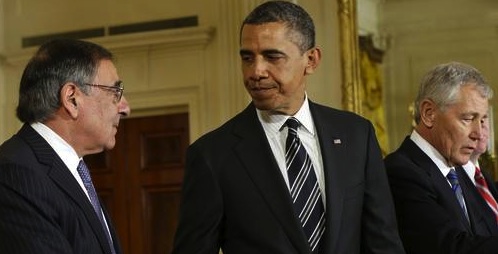
Obama made the nomination at the White House on Monday, January 7, where he is shown above with outgoing Defense Secretary Leon Panetta, left and Hagel, right.

In spite of the attacks the Lobby began against Hagel in mid-December, it failed to block the nomination. What led to this Obama victory?

Take notes because it is a predictable pattern (remember Chas Freeman) and it will, no doubt, be repeated the next time the Israel Lobby giant senses “danger”.

The “block Hagel” war was officially launched December 18, 2012, when the Washington Post  editorialized that President Obama should not nominate former Nebraska Senator Chuck Hagel as his defense secretary because the President ” has available other possible nominees who are considerably closer to the mainstream and to the president’s first-term policies.”

Got that, Politics 101 students?  To block a nominee before she/he is named, accuse the possible nominee of being”out of the mainstream”.  Then, in the same opening salvo, bring in a safer, more desirable choice.

The Post offered its “consensus” candidate, Michele Flournoy, a former undersecretary of defense, who was described by the Post as “a seasoned policymaker who understands how to manage the Pentagon bureaucracy and where responsible cuts can be made.”

The vote on Hagel, as with other new cabinet appointments, will go first to a Senate committee. (You can tell your Uncle Charlie that the Republican-controlled House of Representatives has no say in these matters.  Sorry, Charlie.)

When the nomination of Hagel reaches the Senate floor, a debate will proceed and a vote taken among 53 Democrats, two Independents (both of whom caucus with the Democrats), and 45 Republicans.

What will drive the debate?

Fred Kaplan writes that opponents of Hagel have ” four main concerns” in their disapproval of Hagel.

The first three of their concerns, that he will cut the military budget, “roll over” and let Iran build a nuclear weapon, and be “reluctant” to use military force, are quickly refuted by Kaplan.

The major reason the Lobby has been pushing this war, of course, is Israel, “the third rail” in foreign policy. Kaplan sums up the case the Lobby made against Hagel.

As a senator, Hagel once complained to a reporter that “the Jewish lobby” intimidates many lawmakers on Capitol Hill. And he once intoned that he was a senator from Nebraska, not a senator from Israel. These may have been impolitic remarks, but they weren’t false – either in strict substance or in spirit.

No one could deny that AIPAC has an overpowering influence on many lawmakers. Hagel’s sin, in the eyes of some, was to call it the “Jewish lobby” instead of the “Israel lobby.” If this is a sin, AIPAC and its allies have brought it on themselves. For decades, they have thundered that criticism of Israel is thinly disguised anti-Semitism.

MJ Rosenberg, who writes that “I worked at AIPAC for four years and in Congress for 20”, sees the outcome of the war against Hagel from the perspective of one who “knows how the game is played”.  He predicts that AIPAC, his old organization, will signal to the anti-Hagel forces that the war is over, so stand down. Rosenberg writes:

AIPAC will claim it was not involved in the effort to prevent Hagel’s nomination. That is a lie. AIPAC never operates in the open. It uses cutouts in Congress, the media and smaller fringy organizations like the Republican Jewish Coalition and the Emergency Committee For Israel to do the dirty work so it can keep its hands cleans.

Anyone who thinks that Commentary, the American Jewish Committee, the Free Beacon, the “pro-Israel” bloggers, pundits and Alan Dershowitz do not get their marching orders from AIPAC is living in a dream world.

When Hagel’s name was floated, New York’s Democratic Senator Charles Schumer said  he would wait and see how the debate proceeded.  The possibility of a party leader of the stature of Schumer going against President Obama is quite unlikely, especially after New York Times columnists Nicholas D. Kristof, Thomas Friedman and Roger Cohen, wrote their pro-Hagel columns.

Here is Kristof:

Kristof_Damon Winter NYTCritics are pounding President Obama’s choice for defense secretary, Chuck Hagel, as soft on Iran, anti-military and even anti-Semitic. This is a grotesque caricature of a man who would make a terrific defense secretary.

It’s true that Hagel harbors a healthy skepticism about deploying American troops. That’s because he also harbors shrapnel in his chest from Vietnam and appreciates the human costs when Pentagon officials move pins on maps.

In Vietnam, Hagel rescued his unconscious brother (who served in the same unit) from a troop carrier that had hit a mine. The incident left Hagel with blown eardrums, bad burns and an important take-away.

“I’m not a pacifist. I believe in using force, but only after a very careful decision-making process,” Hagel later told Vietnam magazine.

Roger Cohen sees the choice of Hagel as an essential moment in provoking a needed debate:

Obama’s decision to nominate Chuck Hagel, a maverick Republican with enough experience of war to loathe it, as his next secretary of defense is the right choice for many reasons, chief among them that it will provoke a serious debate on what constitutes real friendship toward Israel.

That debate, which will unfold during Senate confirmation hearings, is much needed because Jewish leadership in the United States is often unrepresentative of the many American Jews who have moved on from the view that the only legitimate support of Israel is unquestioning support of Israel, and the only mark of friendship is uncritical embrace of a friend.

Friedman wrote a recent column, “Give Chuck a Chance” that included this declaration:

I am a Hagel supporter. I think he would make a fine secretary of defense — precisely because some of his views are not “mainstream.

Outside the Times orbit, Josh Marshall, of Talking Points Memo, poses political questions and provides direct answers:

Will Republicans uniformly oppose a former member of their own caucus when the issues at stake are complaints that look comical when held up to the light of day? One who was one of the top foreign policy Republicans in the Senate? I doubt it.

Will Democratic senators deny a reelected President Obama his choice for one of the top four cabinet positions when he is quite popular and the expansion of their caucus is due in significant measure to his popularity? Please. Chuck Schumer will oppose the President? Not likely.

A final word on Hagel comes from long-time Israeli anti-war activist Uri Avnery, who writes in support of Hagel from a shared view drawn from actual war experiences.

I find Chuck Hagel eminently likeable. I am not quite certain why.

Perhaps it is his war record. He was decorated for valor in the Vietnam War (which I detested). He was a mere sergeant. Since I was a mere corporal in our 1948 war, I find it elating to see a non-commissioned officer become Minister of Defense.

Like so many veterans who have seen war from close up (myself included), he has become an enemy of war. Wonderful.

Now Hagel is violently attacked by all the neocon warmongers, almost none of whom has ever heard a bullet whistle in the wars to which they sent others, and the combined political regiments of the American Jewish establishment.

His main sin seems to be that he objects to war against Iran. To be against an attack on Iran means to be anti-Israeli, anti-Semitic, indeed to wish for the destruction of Israel if not all Jews. Never mind that almost all present and past chiefs of the Israeli army and intelligence community object to an attack on Iran, too.

Hagel will be confirmed.  You may take it to the bank.

Posted in Media, Middle East Politics, Politics and Elections | 10 Comments

The Hagel Narrative the Neocons Want

by James M.Wall

UPDATE Friday, 6 p.m. CST:

The Daily Beast and the Los Angeles Times are reporting that President Obama will name Chuck Hagel as his next Defense Secretary. Sources in Washington say that the nomination will be announced Monday or possibly Tuesday, of next week. 

Hagel I policy forum crop

Al Jazeera has purchased the struggling U.S. network, Current, which was created by former Vice President Al Gore and Joel Hyatt. Current has failed to compete in the American market but it does have outlets which Al Jazeera covets.

Al Jazeera has developed a world wide reputation as a responsible non-ideological network, a fact that must have made the sale more acceptable to Gore and his partners. In addition, according to the New York Times story on the sale:

“There’s a major hole right now that Al Jazeera can fill. And that is providing an alternative viewpoint to domestic news, which is very parochial,” said Cathy Rasenberger, a cable consultant who has worked with Al Jazeera on distribution issues in the past

For an example of why a less-fettered voice like that of Al Jazeera is needed in our national media landscape, look no further than the mainstream media battering Chuck Hagel (above) has received since word floated from the White House that President Obama was considering him as defense secretary.

The cabinet appointment of a highly qualified Republican senator would normally have been a no-brainer, until, in Elizabeth Drew’s perceptive phrase, “the press fed the narrative that the neocons wanted.”

Writing in a December 28, 2012 blog posting for the New York Review of Books, Drew explains how the narrative is fed:

Controversy is so much more fun than balance. Meaningless statements by some politicians are accorded great significance and foreboding: thus a big deal was made in the press of the supposedly devastating comments made by two of  [Republican Senator John] McCain’s closest buddies—Joe Lieberman, who will be gone from the Senate shortly (“very tough confirmation process”), and Lindsey Graham (“it would be a challenging nomination”) on the Sunday talk shows just before Christmas.

Of course, the narrative works best when it is carried forward from both sides of the political divide. Democratic Senator Chuck Schumer of New York had “no persuasive reason to commit on a nomination that hadn’t been made”. Nevertheless, knowing he was speaking against the putative preference of a Democratic president, said that Hagel’s “record will be studied carefully”.

This was “interpreted as a serious blow to Hagel’s confirmation”.  Schumer has played this part before in an earlier dissembling drama when he led the charge that forced the withdrawal of Chas Freeman from his appointment in the early weeks of Obama’s first term in office.

NBC’s Meet the Press host David Gregory has remained faithful to the narrative. On December 23, he led a discussion which reflected the narrative’s concern over criticism from Israeli supporters.

A week later, Gregory scored an exclusive Sunday morning interview with President Obama, primarily to discuss the nation’s fiscal crisis.

After the President gave Gregory his reassuring thoughts on the nation’s economic future, there was just time left for Gregory to ask a political question about the President’s second term cabinet.

As a good newsman who works for one of the major news networks, David Gregory had to pose the question: What about Chuck Hagel as a possible defense secretary? He did not mention the objections and support Hagel has received for his stands on Iran and Israel.  Instead, Gregory asked the President about a 14-year-old objection Hagel had offered to a gay appointee.

The President noted that Hagel has since apologized for that mistake. This ended Gregory’s chance to make news by asking Obama what he thought of the objections raised against Hagel by extremist pro-Israel voices.

The narrative dictated by the neocons prefers to “persuade” President Obama to look away from Hagel and turn to a neocon approved candidate.  The next two possible appointees,  Ashton Carter and Michele Flournoy, are currently in the defense department hierarchy.

Philip Weiss, cofounder of Mondoweiss, has followed the Hagel story on a daily basis. On January 1, he reported:

Rightweb, which maintains dossiers on militarists in foreign policy, has just posted new profiles of Hagel’s purported rivals Ashton Carter and Michele Flournoy. They are both neocon-friendly; the dossiers remind us that neoconservatism is deeply engrained in the D.C. establishment . . .

The profile of Carter makes him out to be an Iran hawk with deep ties to the defense industry. “Carter has been adamant in his insistence that the United States consider the use of force in its efforts to prevent the proliferation of nuclear weapons programs.”

He was part of a 2008 report on Iran, coauthored by a bunch of neoconservatives, that Jim Lobe characterized as a “roadmap to war.”

Elizabeth Drew concluded her blog posting on Hagel and his senatorial critics, by calling them out for duplicity.

 [T]hese senators, employing one of the talking points that had been circulated on the Hill and published in [Bill] Kristol’s Weekly Standard, had simply indicated that the Senate Armed Services Committee’s consideration of a Hagel nomination would be rough. These innocuous statements, devoid of any real meaning, were strictly tactical. Not a single one of them said that they would vote against Hagel. (As of this writing exactly one senator, John Cornyn of Texas, has said that he would vote against the nomination.) 

The neocons driving this “controversy” prefer to have Hagel’s name dropped before senate hearings are held. A few hard-core senators (starting with John Coryn) would oppose a respected former colleague.  But what the neocons want to avoid is to have Hagel’s name go forward.

Elizabeth Drew explains:

Hearings could also expose the emptiness of their charges and put on display Hagel’s considerable array of supporters. That such substantial Senate figures as Carl Levin, chairman of the Armed Services Committee, and Jack Reed, also a major figure on defense issues, have announced that they strongly support Hagel has gone almost without notice.

In addition to a senate committee and full senate vote which Hagel would very likely win, the neocon driving this narrative would not want to have to admit to the American public just how much support Hagel has in what Drew describes as “a much larger and more peace-oriented segment of pro-Israel opinion [which] strongly supports Hagel’s nomination.”‘

Drew adds:

These organizations do not assume that particular policies of the Israeli government of the day are necessarily in Israel’s interests.

Hagel has had quite friendly relations with J Street, founded a few years ago to try to offset AIPAC’S influence, and with the Israel Policy Forum, and has given keynote speeches to both organizations.

A wide swath of former national security officials also support Hagel’s nomination as Defense Secretary, including Brent Scowcroft and Zbigniew Brzezinski, as well as most of the former US ambassadors to Israel. Hagel also holds the highly prestigious position of co-chair of the President’s Foreign Intelligence Advisory Committee.

President Obama made Hagel co-chair of that Intelligence Advisory Committee.  To fail to nominate him now as defense secretary would be a sign that the President listens more to the neocon narrative feeders than he does to knowledgeable peace-oriented Jewish groups and the established foreign policy leadership community.

The President must make his decision soon.  Before he does, he would benefit from considering how the current narrative looks to veteran Jewish journalist James Besser, Washington correspondent for The Jewish Week from 1987 to 2011.

In a New York Times column, December 27, Besser looked back over his years in Washington:

Fifteen years ago, Mr. Hagel — whose sins include advocating dialogue to thwart Iran’s nuclear ambitions and suggesting that many on Capitol Hill are afraid of the “Jewish lobby” — would have been deemed someone Israel’s supporters in Washington could work with.

Today mainstream Jewish groups, including the Anti-Defamation League and the American Jewish Committee, are either silent about the mounting controversy or offering cautious support for those who want to kill Mr. Hagel’s nomination. They have been driven into silence and submission by a radical fringe that in no way represents the American Jewish mainstream.

Groups like the American Israel Public Affairs Committee were created to foster strong American-Israeli ties and to promote the idea that a vibrant, democratic Israel is a critical American ally in an undemocratic region — a job they have done remarkably well in recent years.

But as the debate over the best route to peace for the Jewish state has become more bitterly polarized, groups like Aipac, the A.D.L. and the A.J.C. have undercut and obscured that message by refusing to distance themselves from extremists.

Intimidated by pro-settler zealots, right-wing donors and those who liken the slightest criticism of Israeli policy to Israel-bashing (or even anti-Semitism), pro-Israel leaders are increasingly allowing the fringes of their movement to set the pro-Israel agenda in Washington.

President Obama’s choice would appear to be simple, go with his initial preference and nominate Hagel, or allow the neocon narrative to prevail.

It is not an exaggeration to see this one appointment as one that will define who will run the Obama White House for the next four years.

The picture of Hagel above was taken by the Israel Forum.  It appeared in the New York Review of Books.

Posted in Media, Middle East Politics, Obama | 16 Comments