“A Budget is Always a Moral Document”

Revised and Updated

By James M. Wall

The Chicago Hearing, a “mock Congressional Hearing” sponsored by the American Friends Service Committee, attracted a standing room only crowd to the campus of the University of Chicago this past weekend.

In addition to the crowd assembled in Ida Noyes Hall for four hours on Sunday afternoon, April 18, the Chicago Hearing was viewed live in a streaming video internet broadcast to a worldwide audience of individuals and “listening groups” on campuses, in churches, and in private homes.

The Chicago Hearing was modeled after a Congressional Hearing. Veteran Middle East correspondent Helena Cobban served as chair of the Hearing.

Four Illinois area members of Congress were invited to attend, either in person, or by sending a staff member.  Let the record show that only one of those invitees, Senator Richard Durbin, bothered to send a staff member.

The No-Shows for the Hearing were outgoing Illinois Senator Roland Burris, and two Illinois House members whose districts are in or border on the University of Chicago neighborhood: Congressman Jesse L. Jackson, Jr. (son of the Civil Rights leader) and Congressman Bobby Rush.

The absence of the No-Shows was highlighted by Moderator Cobban, who placed empty chairs in front of the stage. I hope the No-Shows will soon receive a deluge of emails asking each of them, “where were you on the day when the question was asked, “Does U.S. Policy on Israel and Palestine Uphold Our Values?”

Thoughtful and informed answers to that question were offered by an impressive international panel of witnesses, including Jeff Halper, Amer Shurrab, Jad Isaac, and Mezna Qato, from Palestine,  and Cindy Corrie, the mother of Rachel Corrie, from the Seattle, Washington, area.

Other witnesses were Lisa Kosowski from the Arab Jewish Partnership, and Josh Ruebner, from the US Campaign to End the Israeli Occuption.

It was Rush, a former Black Panther leader turned mainstream, who handed State Senator Barack Obama his first defeat in politics when the former community organizer thought he was ready to jump from the state senate to the US House. The Hearing was held a short distance from President Obama’s Chicago home.

The entire hearing is now posted on the Chicago Hearing website, conveniently numbered by segments.

If you choose to join Burris, Jackson and Rush as a No-Show, and do not download this presentation, then I have a Shakespearean reminder for you from the famous Crispin Day speech from Henry V.

And gentlemen in England, now a-bed

Shall think themselves accursed they were not here,

And hold their manhoods cheap whiles any speaks

That fought with us upon Saint Crispin’s day.

The Chicago Hearing was important because it joined together leading figures of the Palestinian Peace and Justice movement in one time slot and one location. The event provided basic information and analysis for anyone engaged in the struggle.

Topics for the Hearing were familiar: Property Rights; Freedom of Movement, Association and Speech, and Military Aid. But rarely will we have found such in-depth examinations of these topics, all under one roof.

“Listeners” who were invited to ask questions to the “Witnesses” were drawn from the Chicago area:

Cantor Michael Davis, from Jewish Fast for Gaza; the Rev. Cotton Fite, Episcopal priest; John J. Mearsheimer, a University of Chicago professor and co-author of the book, The Israel Lobby; Barbara Ransby, a professor at the University of Illinois, Chicago;  Ghada Talhami, Professor Emerita, Lake Forest College; and Zaher Sahloul, Chair of the Council of Islamic Organizations of Greater Chicago.

On the Chicago Hearing website, you may access Section six, in which Josh Ruebner, National Director of the US Campaign to End the Israeli Occupation, offers a succinct statement on the military aid the US provides to the state of Israel, past, present and into the next decade.

His statement, “A budget is always a moral document”, was testimony to just how far American values are alienated from US policy. That statement also provides a strong slogan for use by American churches who have adopted the Palestinian-inspired program of BDS (Boycott, Divestment, Sanctions), to help educate their members.

Within the next few weeks, at denominational meetings, delegates will be asked to support a variety of strategies to implement BDS. Perhaps the national meeting which has drawn the most attention and the strongest opposition from supporters of Israel, is the General Assembly of the Presbyterian Church USA.

How the churches spend their money and invest their pension funds is a moral question. The Presbyterians have been asked by supporters of selective divestment to divest church funds from companies that provide materials and support for continuing the Occupation.

How the American government spends US tax dollars on military aid to Israel is also very much a moral question. US administrations, both current and in the future, are living with a financial agreement reached during the presidency of George W. Bush:

On August 16, 2007, Israel and the US signed a Memorandum of Understanding promising $30 billion in military aid to Israel over the following decade.

Israel is the largest cumulative recipient of military as well as total U.S. aid since World War II. Israel has received over $106 billion from the U.S., including $58.6 billion in military aid.

The US Congress approves this aid, while the Department of Defense, with assistance from the Department of State, is responsible for transferring the weapons.

Direct military aid from the US to Israel comes in two forms: money and weapons.

Foreign Military Financing (FMF) is the way money changes hands between the two nations. FMF is money transferred directly to Israel for the purchase of military products and services.

A total of $30 billion in FMF has been promised by the US for Israel  for the decade 2008-2018. Since 2008, all US aid to Israel has been, and will be, exclusively FMF. No more domestic program funding; from now on it will be all military funding.

Since 2010, Israel has received more than half of all FMF the US provides to nations of the world. As a special benefit, Israel is the only country allowed to use FMF (around 25%)  on its own domestic defense industry.

Israel is required, by its agreement with the US, to spend 75% of its FMF $30 billion between 2008 and 2018 on either US government weapons or private US producers of weapons.  All non-government purchases must be approved by the US.

In short, 75% of  FMF monies are spent within the US. Which leads to the obvious conclusion: It is not only the Israel Lobby, with its political and ideological loyalty to Israel, that drives American support for Israel.

American support for Israel is also driven by what President Eisenhower termed, the “military-industrial complex”.

As I let this reality sink in during the Chicago Hearing, I suddenly remembered Michael Apted’s 2006 film, Amazing Grace, which traces the struggle, led by William Wilberforce, to outlaw the slave trade in Britain. The parallel between the Apted film and the Chicago Hearing was strong.

I recalled  that in that film, the most passionate defenders of the slave trade were members of Parliament whose constituents benefited from the shipping trade.

This You Tube preview of Amazing Grace, provides an overview of Wilberforce’s battle over the slave trade.

The parallel between the two experiences is not, by any means, exact. No historical parallel ever is. But the sense of having been there before, after the Chicago Hearing was, for me, profound.

The film follows the same outline as the Chicago Hearing. Facts are laid out in both Amazing Grace and the Hearing that demonstrate the ignorance of two publics that hide behind a Wall of Indifference to the suffering of people who remain unknown to the “outside world”.

Testimonies from those who have suffered at the hands of those who hold the guns or the whips, are deeply disturbing and gripping.

In Amazing Grace, Wilberforce is a member of the House of Lords. He is angry and frustrated by the indifference and deliberate ignorance of Britain’s ruling class. These are the holders of power who benefit from economic growth.

It is that ruling class in the 21st century that excites Tom Friedman who writes so much about the “economic miracle” he finds in Israel’s booming economy. Those who profit from this economy have benefited from remaining aloof from the ugly reality of the Occupation.  It is easier to blame Palestinians for not cooperating more with Israel than it is to face that reality.

In one dramatic encounter in Amazing Grace, Wilberforce takes members of the Parliament, their wives, and their financial backers, on a boat ride around the harbor. He halts the ship next to an empty slave ship and forces his passengers to smell “the death” rising from the ship. The ship has just returned with a cargo of raw sugar. On the trip to Jamaica, the ship carried human cargo into slavery.

The film’s title comes from the hymn written by a remorseful John Newton (Albert Finney), now working in a church mopping floors. Newton had been a slave trader with a fleet of ships, until his dramatic conversion.  Repentant, Newton wrote the words to Amazing Grace, which is sung several times in the film,  and played, very slowly, by a Scottish marching band.

As a young man, Wilberforce had known Newton as a preacher, which is what led him to seek support and spiritual guidance from Newton after Wilberforce encountered increasingly strong resistance to passage of his bill to outlaw the slave trade.

Britain did not have slaves of its own.  It simply benefited from the shipping trade that raided Africa and shipped slaves to the Americas.

This parallel makes sense to me. Commercial interests and deliberate ignorance about the suffering of others were present in Britain’s Parliament, just as the military-industrial arms trade and deliberate ignorance about the inhumane practice of Occupation, force the Palestinian people to live behind prison walls erected by the Israeli occupiers, out of sight and out of mind of the Israeli and American publics.

National headquarters for Caterpillar Inc is in Peoria, Illinois, a small city not far from the campus of the University of Chicago, where the Chicago Hearing was held.

Among Caterpillar’s products is the famous earth-moving tractor which is used extensively in the Occupied Territories for demolishing Palestinian homes, constructing Jewish settlements, building Jewish-only highways, and completing the so-called “security wall” which separates Israel from the Occupied Territories.

The earth-moving tractor is not the only product in the Caterpillar line, but it is most certainly a big-seller in Israel. The company is flourishing, as this recent news story reports.

Caterpillar has been a target of the BDS campaign. Thus far Caterpillar has ignored the protests, a clear decision that the use of its tractors to support the Occupation is not hurting either Caterpillar’s public image or its bottom line.

Cindy Corrie, one of the presenters at the Chicago Hearing, told a worldwide audience the story of the death by Caterpillar tractor of her daughter, Rachel, while she stood in full view of the tractor driver, an IDF soldier.

Her testimony runs 19 minutes (about the time of a Friday, Saturday or Sunday sermon). It may be downloaded for use next week. For access, click on section seven on the Chicago Hearing website.

Rachel Corrie was standing on a mound of dirt with a bull horn, asking the driver not to continue toward her and the Palestinian home behind her.

This young American citizen was in Gaza as a volunteer. Her self-imposed task on the day she died was to stand between a Palestinian family whose home was being demolished by a Caterpillar tractor.

After her death in 2003, the Israeli army investigated the incident; it took no action against the driver. The US  Congress refused to call for its own investigation into the death of an American citizen on foreign soil.

The Corrie family is seeking redress in Israeli civilian courts. The case is pending. Meanwhile, Caterpillar’s business is booming.

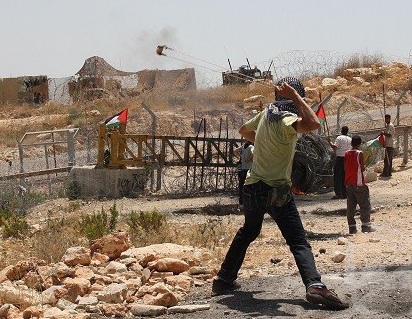
The picture above is a Ma’an photo. It shows young Jewish settlers placing boulders on a Palestinian highway.  They do this to impede civilian traffic.


Posted in Middle East Politics, Movies | 7 Comments

Barack Obama: “I’m Not Going to Comment” on Israel’s Nukes

by James M. Wall

During the closing press conference at the Nuclear Security Summit in Washington Tuesday, The Washington Post’s Scott Wilson, asked President Obama:

“Will you call on Israel to declare its nuclear program and sign the Non-Proliferation Treaty?”

The President dodged the question:

“I’m not going to comment on their program, but what I’m going to point to is the fact that consistently we have urged all countries to become members of the NPT.”

The kindest thing to be said about that response is that it shows our president has chutzpah. It also demonstrated that his determination to be firm with Prime Minister Bibi Netanyahu is just so much sound and fury, signifying nothing

Netanyahu had put out the word that he would not attend the Summit because he had heard that Egypt and Turkey would ask him about Israel’s nuclear arms program, generally believed to be the sixth largest stockpile of nukes in the world.

Both Scott Wilson’s question and the President’s response, were reported fully in the Jerusalem Post. Both question and answer received almost no attentionin the US media. Here is Wilson’s question:

You have spoken often about bringing US policy in line with its treaty obligations internationally to eliminate the perceptions of hypocrisy that some of the world sees toward the US and its allies.

In that spirit and in that venue, will you call on Israel to declare its nuclear program and sign the Non-Proliferation Treaty, and if not why wouldn’t other countries see that as an incentive not to sign on to a treaty that you say is important to strengthen?

Summit participants Egypt and Turkey did not raise the “hypocrisy”question.

Scott Wilson did it for them.

Here is the full text of the President’s cautious non-answer:

Initially we’re talking about US behavior, and then, suddenly we’re talking about Israel. Let me talk about the United States. I do think that as part of the NPT, our obligation as the largest nuclear power in the world is to take steps to reducing our nuclear stockpile.

And that’s what the START treaty was about, sending a message that we are going to meet our obligations.

And, as far as Israel goes, I’m not going to comment on their program, but what I’m going to point to is the fact that consistently we have urged all countries to become members of the NPT.

So there’s no contradiction there. We think it is important that we have an international approach that is universal and that rests on three pillars, that those of us who have nuclear weapons are making serious efforts to reduce those stockpiles.

Scott Wilson’s own newspaper, The Washington Post, buried Wilson’s exchange with the president deep inside its longer story on the slow pace of peace negotiations.

In its coverage, The New York Times reports that Obama issued a specific warning to Iran, which had not been invited to the conference.

After four years of failed efforts on sanctions, the penalties he was trying to win at the United Nations Security Council had to be significant enough to get the attention of the Iranian leadership.

Speaking to reporters, Mr. Obama said he had insisted to President Hu Jintao of China that in dealing with Iran: “Words have to mean something. There have to be some consequences.”

Words, both spoken and unspoken, do have consequences. Does President Obama neither see nor hear how empty his declaration sounds to the people of the world who had looked to him to break Israel’s dictatorial grip on the region?

The picture above is by Doug Mills for The New York Times.

Posted in Media, Middle East Politics | 5 Comments

Bibi Skips Obama Nuke Meeting; Still Not Ready to Confess Dimona

by James M. Wall

Israeli Prime Minister Netanyahu accepted President Obama’s invitation to attend this week’s nuclear arms discussions. After further reflection he told Obama he would send a substitute, Deputy Prime Minister Dan Meridor.

Word had reached Bibi that Turkey and Egypt might demand that Israel sign The Nuclear Non-Proliferation Treaty.

The Prime Minister was shocked at such impertinence. He accepted the invitation because the talks were to focus on nuclear terrorism. He claims he did not anticipate that anyone would ask him about Israel’s nuclear arsenal, which has existed since the 1960s in the Dimona desert.

Too bad, because now the world will be deprived of hearing the PM give his version of Jack Nicholson’s response from the witness chair in A Few Good Men: “You can’t handle the truth!”

This little pirouette on the world stage was performed in front of an audience that knows full well that Israel is not going to sign any treaty that forces it to admit the truth about its own nuclear arsenal.

According to The Voice of America web site:

Israel has two nuclear reactors, including one in the city of Dimona that is believed to be used to build the country’s stockpile of atomic weapons. The Jewish state has never confirmed nor denied that it possesses nuclear weapons.

Israel also has not signed the Nuclear Non-Proliferation Treaty, which aims to halt the spread of nuclear technologies that can be used to produce atomic weapons.

In recent weeks, Israel has humiliated the Turkish prime minister, assassinated an Hamas official in a neutral country, embarrassed the US vice president, and traveled to Washington to be glorified by AIPAC, after refusing Obama’s request that he put a temporary freeze on settlement expansion.

This would have been a good time for Netanyahu to change his image from international pariah to the latest member of the nuclear arms club.

It was left to National Security Chief James Jones, the most neutral Middle East advisor in the White House, to respond to Bibi’s sudden switch. Jones played the dutiful diplomat’s role, as reported by the Los Angeles Times:

We obviously would like to have the prime minister, but the deputy prime minister will be leading the delegation and it will be a robust Israeli delegation,” US national security advisor James L. Jones told reporters on Air Force One while returning with President Obama from Prague, Czech Republic, where the president signed a nuclear arms limit agreement with Russia.

The White House has been pushing next week’s summit as the capstone of a week of activity on limiting nuclear weapons, including the signing of the arms treaty by Obama and Russian President Dmitry Medvedev.

The administration also released its latest nuclear profile, which for the first time said the United States will not use nuclear weapons against a non-nuclear state if it abides by the 1970 Non-Proliferation Treaty– a warning to Iran and North Korea, which have some form of nuclear programs.

Paul Woodward, who writes the blog, War in Context, points to a little known action taken by the US State Department to signal “that Israel’s days of ‘nuclear ambiguity’ may be numbered: Israel’s nuclear scientists are now being shut out of the United States.”

The Hebrew-language NRG/Maariv website, reports, under a headline, “Dimona reactor workers not welcome in the US”, that workers at Israel’s Dimona nuclear research reactor who submitted visa requests to visit the United States for ongoing university education in physics, chemistry and nuclear engineering, have all been rejected, specifically because of their association with the Dimona reactor.

According to the report, this is a new policy decision by the Obama administration, since reactor workers were until recently being issued visas to study in the US.

Is this a very quiet first step by Obama to say to Israel that it is well past the time for Israel to stop the charade that it has no nukes?

Israel does have a nuclear arsenal it refuses to acknowledge. The US is a party to Israel’s continued denial of its long established nuclear program. Barack Obama has inherited a situation in which his nation is a co-conspirator in deception.  He cannot be comfortable with this situation. It is hard to believe that he intends to continue to participate in the deception much longer.

Plans for this week’s Washington conference were announced several months ago. Did the visa ban on Dimona scientists lead Bibi to fear a conference tribunal in which he would have to either admit, evade, or outright deny his nuclear program?

Whatever his motivation, Bibi has bailed out on the conference. That does not, however, end the matter.

Barack Obama’s visa ban has sent a strong signal which will not go unnoticed when the 47 nations gather in Washington April 12-13 to discuss how they can work together to prevent nuclear war heads from falling into the hands of militant groups.

Bloomberg News reports that in a conference call with reporters, US administration officials said that the Washington conference will focus on separated plutonium and highly enriched uranium that could be smuggled or sold on the black market to groups such as al-Qaeda.

“Those are the two materials that could be used for nuclear explosives,” said Gary Samore, senior director for non- proliferation at the National Security Council. “If we’re able to lock those down and deny them to non-state actors, then we have essentially solved the risk of nuclear terrorism.”

What we are witnessing with Bibi’s periot is a split in Israel’s own internal politics. The right wing leadership under Bibi has isolated Israel from the world’s political community. At the same time, the world’s business community sees Israel as a young business partner with strong growth potential.

Ironically, Israel’s nuclear arms industry has long been an important part of the ever-expanding economic growth in Israel.

In their book,Start-Up Nation, The Story of Israel’s Economic Miracle, co-authors Dan Senor and Saul Singer write that shortly after Israel emerged as a modern state, Charles de Gaulle “forged an alliance with the Jewish state and nurtured what Israeli leaders believed to be a deep personal friendship”

The alliance included a French supply of critical military equipment and fighter aircraft, and even a secret agreement to cooperate in the development of nuclear weapons (page 178).

Senor served as media spokesman for the US army during the early years of the Iraq war. Until he withdrew from the race recently, he was a declared candidate for the Republican nomination for the US Senate in New York State. Singer is a columnist and former editorial page editor of the Jerusalem Post.

The two authors, an American and an Israeli, give considerable credit for Israel’s “economic miracle” to David Ben Gurion, Israel’s founding parent, and current Israeli President Shimon Peres for launching “start ups” for Israel’s economic growth.

Peres wanted to secure government funds to develop a nuclear industry. His finance minister refused to cooperate; he argued that the future was in textiles. Even the nation’s leading scientists saw Peres’ plan as “too ambitious”.

With Ben Gurion’s backing, Peres funded the project “off budget”. He sent students from Technion (Israel’s Institute of Technology), to France for further training.

The result was the nuclear reactor near Dimona, which has operated since the early 1960s without mishap and has reportedly made Israel a nuclear power. As of 2005, Israel was the world’s tenth largest producer of nuclear patents.

From the outset, Israel has maintained an “ambiguity”  policy regarding its nuclear program. Estimates within the scientific and political communities indicate that beginning in the late 1960s, Israel’s stockpile of nuclear warheads has range between 80 to 200 nuclear warheads.

Israeli leaders refuse to comment on the “ambiguity” policy, other than to maintain a silence on its program at Dimona. In its pre-conference story, Reuters observes:

The official reticence, and its tacit acceptance by the United States, has long aggrieved Arab and Muslim powers. Like India and Pakistan — both also slated to attend the NSS — Israel is outside the NPT and thus avoids mandatory international inspections of its nuclear facilities. Unlike them, it has not openly tested or deployed atomic weapons.

It is time for Obama to say to Israel, we will still be your friend, but we will no longer be your patsy.

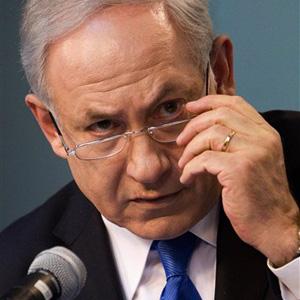
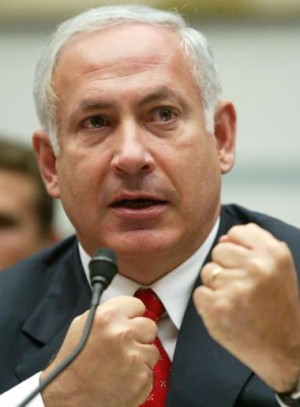
The picture of Bibi Netanyahu, above, is an AP photograph from Voice of America.

Posted in Middle East Politics | 8 Comments

Nabi Saleh Has Endured Land Confiscation Since 1977

by James M. Wall

If your understanding of the current contretemps between Israel and the United States is limited to what you read or see in the Main Stream Media, then the village of Al Nabi Saleh (the Prophet Salih) should be of interest to you. So gather round.

This particular contretemps has been described euphemistically, by the New York Times‘ Jerusalem bureau chief Ethan Bronner, as a gaff over an announcement of  plans for  more “Jewish housing” to be built on occupied land in the Palestinian West Bank.

The “Jewish housing” in Bronner’s story is the most recent step in Israel’s long range settlement plan for the West Bank and Jerusalem. These plans are most certainly known to Vice President Joe Biden.

The vice-president is an old school politician who expects his side to play by the rules. And Rule Number One is don’t surprise your teammate while he is in Israel to make nice-nice with a staunch ally.

If the Main Stream US Media would study the settlement maps and the charts identifying future  plans for additions to existing settlements it could report the real story of the “Jewish housing” plan.

The latest announcement, which was not a surprise to anyone who had been paying attention, calls for Israel to construct 1600 new housing units inside East Jerusalem. It was soon joined by another step already in the pipeline, a plan to construct 20 new apartments on land adjacent to the Shepherd Hotel in East Jerusalem.

These 1600 (plus 20) new families will join 300,000 Jewish settlers who already live, illegally, on occupied Palestinian land. (A reminder: One of those settler residents is Israel’s right-wing foreign minister, Avigdor Lieberman, who, since 1988, has lived in the Jewish settlement of Nokdim in the West Bank.)

Information on past and future settlement plans is available from a web site run by the Washington-based Foundation for Middle East Peace, which, since its formation in 1979, has performed a valuable service by tracking and reporting on Israel’s settlement project.

Daily news reports on Palestinian resistance to the settlements are available at the Palestinian Ma’an News Service, which has bureaus in Gaza and Bethlehem.

The photo above, of a modern-day David, is a Ma’an image. An estimated 95 percent of Palestinians in Gaza and the West Bank, who have internet access, check Ma’an on a daily basis. Few of them were surprised by the announcement of 1600 (plus 20) new settler family units.

Thumb through your local Western newspaper and you might see the occasional small reference to “rioting” Palestinians confronting Israeli soldiers. What you will not see is an acknowledgment that the IDF is in the West Bank to guard settlements built on land confiscated from Palestinians.

In the US,  little attention is paid to these frequent David-Goliath encounters,  Outside the US, however, there is a steady drum beat of media coverage of Palestinian protests, reports that further erode what little international support that remains for Israel’s policies in the West Bank and Gaza.

In an attempt to shut down media coverage of protests in the villages of Bil’in and Ni’lin, the IDF has designated the two villages as “closed military zones”every Friday (at least) for the next six months.

American media, moving in lock step with its customary Zionist ideology, attaches little significance to the darkness that has descended on Israel, in sharp contrast to the courageous voices within Israel who cry out to the world, pay attention.

In an Ha’aretz Passover column entitled, The Plague of Darkness Has Struck Modern Israelites, Jewish columnist Aklva Eldar wrote:

One of the harshest of the 10 plagues has smitten the children of Israel this Passover, and they are stumbling about in pitch darkness, bumping blindly into anyone in their way as they head toward the edge of the precipice.

Warm friends, cool friends, icy enemies: Jordan and Turkey, Brazil and Britain, Germany and Australia – it’s all the same. And if that’s not enough, the myopic Jewish state also has gone and collided head-on with the ally that offers existential support.

Israel has become an environmental hazard and its own greatest threat. For 43 years, Israel has been ruled by people who have refused to see reality. They speak of “united Jerusalem,” knowing that no other country has recognized the annexation of the eastern part of the city.

They sent 300,000 people to settle land they know does not belong to them. As early as September 1967, Theodor Meron,then the legal adviser to the Foreign Ministry, said there was a categorical prohibition against civilian settlement in occupied territories, under the Fourth Geneva Convention.

Meron – who would become the president of the International Criminal Tribunal for the former Yugoslavia, and is now a member of the Appeals Chamber for both that court and a similar one for Rwanda – wrote to prime minister Levi Eshkol in a top-secret memorandum:

“I fear there is great sensitivity in the world today about the whole question of Jewish settlement in the occupied territories, and any legal arguments that we try to find will not remove the heavy international pressure, from friendly states as well.”

In addition to the criticism from Israel’s media columnists, the western world (except in the US) is reading reports like this one from the International Solidarity Movement (March 26):

In recent weeks there has been an escalation of Israeli military violence against the weekly demonstration in the village of An Nabi Saleh, which last week led to 25 injuries, as well as attacks on 12 homes and 3 cars.

Despite this, approximately 100 villagers joined the demonstration on Friday and attempted to reach their land, much of which has been stolen by the nearby illegal settlement of Halamish.

The Israeli army prevented the demonstration from leaving the village by surrounding it on all sides, and firing large amounts of tear gas and rubber coated steel bullets directly at the demonstrators.

The confiscation of Nabi Saleh land began in 1977. I first visited Nabi Saleh in November, 1977, traveling inside the West Bank with a group of journalists. We were there during the week Egyptian President Anwar Sadat made his surprise visit to Israel. Sadat delivered his historic address to the Israeli Knesset on November 20.

Our group of journalists–definitely not members of the Main Stream Media–met with the mayor of Ramallah the day after Sadat’s speech.  I wrote in the Christian Century magazine, in an essay published in December, 1977:

The Mayor–Karim Khalaf — a landowner in the area, was first elected in 1972 and surprisingly re-elected in 1976 when most other mayors on the West Bank were turned out of office for reflecting not enough sympathy for Palestinian nationalism, specifically a commitment to the Palestine Liberation Organization (PLO). . . .

In our interview with Khalaf, he vigorously criticized Sadat’s failure to identify the PLO as the proper Palestinian representative for peace discussions. He seems not to trust the Israelis to give the West Bank its sovereignty.

In his modern city hall office we listened as Khalaf alternately boasted of the future West Bank state and deplored Israeli actions that appear to go counter to that future.

“Just last week,” he said, “the Gush Emunim put up another fence around a large area and moved in a contingent of settlers.”

The Gush Emunim (bloc of the faithful), an orthodox Jewish group, has been establishing its own settlements in the West Bank, insisting that it has a commission from God to recapture the biblical lands of Judea and Samaria.

The settlement that was disturbing Khalaf was the most recent of six which Prime Minister Begin had sanctioned the week after his return from his initial meeting with President Carter this summer.

Our group, which included four Americans and a European journalist, decided to visit the settlement. With the mayor’s help we studied the map and then drove north. Unlike the other 44 established Jewish settlements in the West Bank, this one is not on a map, and it has no name.

But we knew that the settlers had been given permission to live in an abandoned “Taggart Fort,” one of a series of military installations placed on strategic hills by the British during the Mandate period.

Formerly used by Jordan as a police station, this fort near the village of Al Nabi Saleh had been empty until Prime Minister Begin persuaded a group of Gush Emunim members not to take over open land but to reside instead within the more secure walls of the fort.

We drove to the fort, located on the hill overlooking the village of Nabi Saleh. One of our party, who speaks Hebrew, asked the soldier guarding the gate if we could come in and talk with the civilian settlers. In a country obsessed with security checks, I was surprised that he waved us through, carefully replacing the chain that blocked the road behind us.

Two men who greeted us promised an English-speaking occupant, and we were soon welcomed by Schomit Abramowitz, a pleasant dark-haired woman in her late 20s, who invited us up to her family quarters for tea.

Born in Israel, she lived for 12 years in Chicago, so we talked briefly about her time there. (She wondered if I had known Mayor Daley.) When we asked if we could tour the fort, she proudly showed us around.

Eighteen orthodox Jewish families have joined with about 25 nonorthodox Israelis to establish this community, which will soon move out of the fort into concrete block houses nearby. A contingent of soldiers, tents pitched beside the fort, are apparently on hand for protection.

Our English-speaking hostess has three small children — two of them in diapers, which she must wash with boiling water on a portable stove. The children, two of whom slept through our talks, share a 12-by-12 foot room with their parents. Water from the fort’s old well is still unsafe for drinking, so much of their water is brought in by truck.

My story was reprinted in the Chicago Sun Times, a decsion by the paper which, I suspect, had more to do with the local Chicago family angle than it did with a desire to educate readers on the settler movement.

The fort stood on a hill overlooking the village of Nabi Saleh.  There is a mosque in the village which honors Samuel. Tradition suggests that Samuel was buried on the ground where the village now stands.

The abandoned Jordanian fort soon became the Jewish settlement of Halamish, which today has around 1000 residents.

Over the decades, Halamish has expanded its land control, Most recently the Halamish settlers confiscated a natural spring,  a water source for the village.

For the past six years, nearby villages Bil’in and Ni’lin have conducted weekly marches to protest the construction of Israel’s “security” wall, which snakes deep into Palestinian land just west of the area where Bil’in, Ni’lin and Nabi Saleh are located.

In my 1977 story I concluded my report of the trip to the Jordanian fort and the village of Nabi Saleh:

From Nabi Saleh we drove back down to Ramallah, where we went to the home of Raymonda Tawil, an outspoken Palestinian nationalist recently put under house arrest for two weeks by Israeli authorities for “inciting actions against the occupation.”

Ms. Tawil, with her husband, David, a banker, moved to Ramallah from Nablus several years ago. The home in which they live would suggest that they are among the upper-class members of West Bank society.

We visited in the Tawil living room drinking tea and eating fruit, served by two attractive teen-age daughters.

Years later, after Yasir Arafat returned to Palestine and set up his capital in Gaza, I went with a group of religious leaders to Gaza to meet with Arafat. I knew that he had married one of  Raymonda Tawil’s “attractive teen-age daughters” who had served tea to our group of journalists.

Her name is Suha. Her mother’s home was a favorite gathering place for visiting journalists. Madame Suha confessed she did not remember our particular visit, even after I reminded her that it was the day after the Sadat speech.

We had tea, once again, with Madame Suha in her residence, before our group went to meet with Arafat. It was a brief time of optimism and hope, which was soon dashed by the failure of the negotiations between President Bill Clinton, Arafat, and Israeli Prime Minister Yitzhak Rabin.

Rabin was offering to concede land to Arafat, which the old revolutionary wisely recognized was an empty gesture.  If he did not know of Israel’s long range settlement plans, he had his suspicions.

One thing is certain: The villagers of Nabi Saleh do know all about Israel’s plans for the future.  They have lived with the result of those plans for more than three decades.

The picture at top is a Maan image from the Maan news service. The map is from B’Tselm.


Posted in Middle East Politics | 5 Comments

Holy Week 2010: Sumoud, Check Points, Home Demolitions

by James M. Wall

Sumoud?

Sumoud is an Arabic word meaning “steadfastness”.  The occupied Palestinian people who live in Jerusalem this Holy Week, 2010, face check points, home demolitions, and the depressing news that the Congress of the United States sings the praises of a visiting Israeli prime minister who tells the world that ALL of Jerusalem belongs to Israel for the ages.

Translation: Get ready, folks, for a permanent occupation until you Palestinians agree to live as prisoners in cantons, or even better, move away to Jordan, Lebanon, or Kansas.

How do the Palestinians respond to such a threat? They respond with sumoud.

Sumoud is being heard these days in the Occupied Territories more than Nakba, the Arabic name for “catastrophe”, which Palestinians use to describe the 1948-49 colonization of their land by the newly created state of modern Israel.

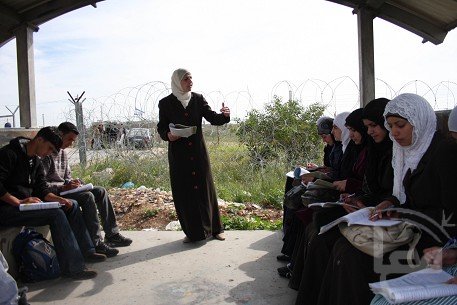
Sumoud occurs when a teacher set up her classroom at a checkpoint when students are unable to get through to the school building. (See picture above.)

And so it is that in Holy Week, 2010, while many American Christian families finally make their way to church after staying away since Christmas, in this week when we look back at the first Holy Week, we dare not let the week go by without giving thanks for the sumoud of the Palestinian people.

It is their sumoud that could save them, as it could save us. It is not only the Israeli people who must be saved from the blind arrogance of its leaders. US tax dollars support Israel’s practice of home demolitions, check points and permanent occupation. We too, must be saved, from our leaders’ blind arrogance.

US politicians may never have heard the word sumoud, but one day, friends, they will regret their ignorance.

One day they will face the horrors of historical judgment, a judgment which will condemn them as surely as they condemned those who came before them in the Halls of Congress who put their love for political power above the moral imperative to set free the enslaved.

One branch of my family lived in southern Alabama during the American Civil War. Several of them were clergy. I have been unable to find any sermon from any of them that cried out against the evils of slavery.

I do have a hand-written letter written after the war, bitterly attacking Northern occupation.  But that was a selfish expression, not a testimony for justice.

Some of my ancestors owned slaves, words I write with considerable familial guilt and regret, but the records are clear on this point. Slaves, designated by first names, were included in wills.

Some were public officials, as well as clergy. One of them handled the welfare checks for widows and orphans of the soldiers who died fighting for a Lost Cause. A public service, to be sure. But he did not speak nor act, so far as I know, against the evils of slavery.

The problem for public officials is that their actions are known to the public. So it is to them that we must point when we seek out the sinners of our day.  They, by their public standing, represent us all in our malfeasance.

Years from now, some families will recall that their grandparents served in the US Congress and they will point with pride at that accomplishment. But the horrors of history will still judge them and find them wanting.

We who helped elect members to Congress with votes, money, volunteer work, or silence, will escape their public historical scrutiny. But we will not escape the taint of having failed to say no when we knew that together we endorsed and supported evil.

John Wesley was the 18th century founder of the denomination to which I belong, the United Methodist Church.  He did not do enough to confront the evil of slavery in his day. No one ever does enough, but there is a sentence in one of his biographies in which we Methodists can take, not pride, but at least, solace,

John Wesley was among the first to preach for slaves rights, attracting significant opposition.

Which brings us back to Holy Week, 2010, when we celebrate the week in which Jesus rode into Jerusalem on the back of a humble animal.

Crowds cheered and waved palms. Jesus knew the shallowness of their praise because he knew what lay ahead. When he was nailed to a cross and left to die a long and painful death, there were few left that stood by and mourned his death on that mount of execution.

Perhaps a few stragglers hung around to stare at three dead bodies, but Roman soldiers on duty that day must surely have cleared the area with the command still in use, “Move along folks, there is nothing left here for you to see”

The soldiers would be wrong. This man who had just died unjustly did so because he followed a God who would not tolerate oppression and injustice. Did Jesus know the implication of his death? No one knows.

What we do know is that he set his face “steadfastly”–sumoud–toward the city of his death because he had no other choice but to follow God’s direction.

You do not have to be a Christian to know that this was a sacrifice, not to appease or pay for something, but a sacrifice that had to be made because to follow any other path would have been a betrayal of the God who loved him.

Holy Week, 2010, arrives at a time in the history of the city of Jerusalem, which demands an accounting.

The video, below, traces the steps that have taken Jerusalem from the city it was in 1967, as this New York Times map demonstrates. The facts are well documented. They cry out to us today with a simple command:

The horrors of history will judge you on how you respond to this slow, but steady, takeover of the city of Jerusalem.

You may click on the five and one half minute video, to see this horror.  Or you may turn away and follow the soldiers’ command, “Move on, folks, there is nothing left here for you to see.”  The choice is yours.

This presentation was adapted from data from the Applied Research Institute of Jerusalem, UN Office for the Coordination for Humanitarian Affairs, and the Foundation for Middle East Peace. To enlarge the video to full screen,click on the second button from the right at the bottom of the screen


Posted in Middle East Politics, Religious Faith | 7 Comments

They Differ on Health Care But Never, So Far, on What Bibi Wants


By James M. Wall

Bibi Netanyahu came to Washington and received a cool reception from President Obama.

But the Congress embraced him with its usual enthusiasm.

Did it matter that Bibi was still issuing “build, baby, build” orders for East Jerusalem?

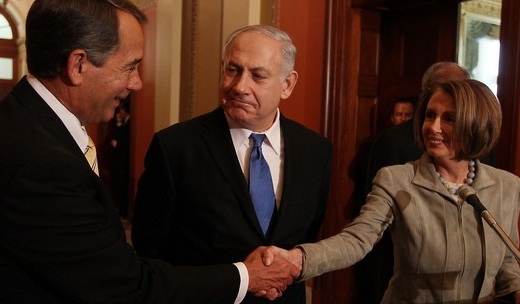
These two leaders of Congress, Rep. John Boehner (R-Ohio) and Speaker Nancy Pelosi (D-Ca) (above) did not think so.  When it comes to American foreign policy, these two embrace Israel’s leader, not their own president.

None dare call it treason.  But what should we call it when these two leaders of Congress defy their own president on a foreign policy matter with direct implications for American military personnel now fighting and dying in Iraq and Afghanistan?

This embrace of Bibi was not just embarrassing, it was a slap at the President of the United States. Israel announced 1600 new housing units in East Jerusalem as Vice President Joe Biden was in Israel to further strengthen the bond between “two allies”. Some bonding.

To embrace Bibi after his treatment of Biden was nothing less than an act of defiance by leaders of Congress who fawned over the prime minister of Israel just hours before he was ushered into the White House to hold a two hour discussion with President Obama.

This visit received none of the usual pomp and photographs that usually are provided for visiting foreign government poo bahs.

No pictures, no joint statement, nothing whatsoever, from the White House after Netanyahu and his staff were ushered out of the White House.

How eager was Nancy Pelosi to defy her president on this important foreign policy issue?

We in Congress stand by Israel,” House Speaker Nancy Pelosi, said, standing beside Netanyahu Tuesday. “In Congress, we speak with one voice on the subject of Israel.”

But while Congress was speaking publicly with one voice, behind the scenes Netanyahu seemed to be trying to drive a wedge between lawmakers and the White House.

As this moment of warmth shared by Bibi with Senate lion Chuck Schumer (D-NY), indicates, members from both houses of Congress, who consume daily doses of AIPAC kool-aide, were eager for face time with the visiting Israeli leader.

All these members of Congress either witnessed, or had read,  what Prime Minister Netanyahu said at the AIPAC meeting, a speech which should forever be known as Bibi’s “everyone knows” speech.

In his Foreign Policy Matters column, Senior Fellow MJ Rosenberg analyzes the speech, highlighting the part that received “the greatest cheers and guaranteed that the White House would give Netanyahu the coldest reception ever given an Israeli prime minister the next day.”

“Jerusalem is not a settlement. It is our capital…All these neighborhoods are within a five-minute drive from the Knesset… Everyone knows that these neighborhoods will be part of Israel in any peace settlement. Therefore, building in them in no way precludes the possibility of a two-state solution.”

Rosenberg refutes this:

The administration understands how utterly ridiculous Netanyahu’s statement is. It has never implied that Jerusalem is a settlement. Its position is that the final status of Jerusalem must be decided in negotiations between Israelis and Palestinians, just like every other piece of land added to Israel after the 1967 war.

As for Netanyahu’s “everyone knows” formulation, it is bogus. After all, “everyone knows” that Nablus, Hebron, Ramallah and dozens of other West Bank cities will be inside the Palestinian state after negotiations. Can they just annex them now?

“Everyone knows”, including Netanyahu and every one of his predecessors since Yitzhak Rabin, that totally Palestinian areas of Jerusalem will almost surely not be part of Israel after negotiations are completed, largely because Israel doesn’t want them and the Palestinians do.

The only way Netanyahu can get away with declarations like that at AIPAC is because he knows that his audience knows very little about Jerusalem, including the fact that Israel unilaterally tripled its size after the 1967 war to add entirely Arab areas to the city.

One of the reasons it annexed these territories was so that it could give them up in the context of negotiations and say, “hey, we even gave up parts of Jerusalem.” But Netanyahu is saying that even these Arab neighborhoods are off the table.

Another Foreign Policy analysis of the speech is entitled, Jerusalem Settlements and the Everybody Knows Fallacy. It includes valuable history, illustrating the long range Israeli plan to colonize Jerusalem.

In 1993, when the peace process was taking off, the settlement of Ramat Shlomo — which last week caused such a headache for Vice President Biden — didn’t exist. The site was an empty hill in East Jerusalem (not “no man’s land,” as some have asserted), home only to dirt, trees and grazing goats.

It was empty because Israel expropriated the land in 1973 from the Palestinian village of Shuafat and made it off-limits to development. Only later, with the onset of the peace process era, was the land zoned for construction and a brand-new settlement called Rehkes Shuafat (later renamed Ramat Shlomo) built.

If in 1993 you had asked what areas “everybody knows” would stay part of Israel under any future agreement, the area that is today Ramat Shlomo — territorially distinct from any other settlement and contiguous with the Palestinian neighborhood of Shuafat — would not have been mentioned.

Minutes before Mr Netanyahu’s fence-mending visit to the White House on Tuesday, the Jerusalem municipal government announced that it had approved another development. These new units will be on the grounds of the Shepherds’ Hotel.

That project, like the 1600 unit project which led to the Biden insult, has long been working its way through the pipeline. Israeli planning commissions think long range.

The Shepherd Hotel in the Sheikh Jarrah neighborhood was initially purchased by American Jewish tycoon Irving Moskowitz in 1985 for $1 million. Moskowitz is a long time and influential supporter of Israeli settlement in East Jerusalem. He had planned to tear down the hotel and build housing units for Jewish Israelis in its place.

The Jerusalem planning council issued its final approval for the project during Bibi’s trip.  The  approval now enables the settlers to begin their construction at once, though not exactly as Moskowitz had planned.

One existing structure in the area will be torn down to make room for 20 new housing units, while the historic Shepherd Hotel will remain intact. A three-story parking structure and an access road will also be constructed on site. Moskowitz’s 1985 purchase has finally produced what he wanted, more Jewish settlers in Arab East Jerusalem.

History is always important in understanding Jerusalem.

MJ Rosenberg offers some history of his own in his column. Clarifying an earlier reference he made to the leadership provided in the Middle East by US Presidents Johnson, Reagan and Carter, he writes:

The reference above to Presidents Johnson and Reagan referred only to the general perception of them as forceful, even uncompromising, presidents. I was not referring to their stances on the Middle East where Reagan, only once or twice, stood up to the lobby and LBJ never did.

On matters relating to the Middle East, the toughest president by far – and the one who saved tens of thousands of Israeli and Egyptian lives by his forceful leadership that produced the Israeli-Egyptian peace treaty – was President Jimmy Carter.

Carter was indeed the best US presidential friend the Israeli people ever had.  Too bad they failed to realize it. Now is the time for President Obama to show some of that same Carter tough love and save the people of Israel from a right wing Prime Minister who is on a disaster course to become a modern day Samson, determined to pull down the walls of yet another Philistine temple.

Step one for Obama was the cool reception he gave Bibi in the White House.

Whatever follows this latest Bibi-Barack encounter, this much is certain: Obama has said to Bibi, the Congress and AIPAC, I run US foreign policy, you don’t.


The pictures above of Republican leaders Boehner and Speaker Pelosi and of Democratic Senator Schumer are from the web site www.freerepublic.com.

Posted in Middle East Politics, Politics and Elections | 8 Comments

Who Gave Bibi Permission to Own Palestine? Where Do We Start

by James M. Wall

Christopher Dickey currently serves as Newsweek’s Paris bureau chief and Middle East regional editor. In a recent Newsweek online column, Dickey recalled a story from 1996.

“Back when Benjamin “Bibi” Netanyahu was elected Israel’s prime minister for the first time, in 1996, a Jordanian political scientist with a grim sense of humor said the only way to describe him was like a villain out of an old Western: “He’s a lyin’, cheatin’, deceitin’ son of a bitch!””

This is not meant to malign Bibi, alone. Any observer of the political class knows Dickey could find any number of politicians who deserve that same description. You know who I am talking about.

Think of all those Democratic members of Congress who piously waited until the final moment to say how they would vote on the health care bill. They said they were meticulously studying the bill, all 2000 plus pages of it, to see how it would best serve their “constituents”.

The further South the member’s district, the heavier the emphasis on the second syllable of that word, “con-stit-uents”

Morris Dees, director of the Southern Law Poverty Center, called me a few years back with a request. We had met earlier during Jimmy Carter’s 1976 presidential campaign. A teenage African American teen age boy had been found guilty of murder. Morris was the lawyer in the case. He was about to go before a Memphis, Tennessee, jury to argue against giving his client the death penalty.

“I need a preacher with a Southern accent who will testify against the death penality to my jury. You have to fly down to Memphis tomorrow.”

I demurred. “Morris”, I said, “I would like to help you, but I have to consider my role as a journalist. I can’t do anything that would compromise my journalist integrity”

Morris, who is from Alabama, was indignant. In his best Southern drawl, he responded, “I don’t give a damn about your journalistic in-teg-ri-ty. I just know I have to stop this jury from killing this young man.”

I agreed to fly down the next day. Turned out, Morris had worked out a plea agreement with the judge, so he didn’t need me. My in-teg-ri-ty survived.

Bibi Netanyahu is an Israeli, but his political instincts are universal. Unfortunately, in his case, what he does and how he does it, has a far greater impact on humankind than does a vote on the health care bill by an American congress member.

His persistent promise to “talk peace” is so empty of reality, so devoid of integrity, that we have to ask, who gave him permission to own Palestine?  My friends, the line forms at the left.  We are all in it.

The scary thing about Bibi is that he really does seem to have convinced himself that his drive to conquer all of Palestine is going to succeed because he has the American government entirely under his control.

In his column recounting the colorful description of Netanyahu, Christopher Dickey writes that Aluf Benn, diplomatic correspondent for Israel’s Haaretz newspaper, provides insights into what drives Bibi in his dogged determination to squash any future Palestinian state, or relieve any Palestinian suffering.

The Palestinians, who want East Jerusalem as the capital of their state, accuse the Israelis of using [their settlement building] projects to create “facts on the ground” that vastly complicate future negotiations—and, indeed, that is precisely the intent of many Israelis who support the building program.

But the problem as Benn presented it, was more complex than that: a combination of brinkmanship and blackmail in which Netanyahu’s government makes veiled threats to attack Iran, or not, depending on how much pressure it feels on the Palestinian issue.

U.S. military planners have little doubt that an Israeli air campaign against Iranian nuclear facilities would provoke Iranian retaliation against Saudi Arabia and other major oil producers allied with the United States.

American efforts to stabilize Afghanistan and Iraq, both of which border Iran, would come under threat. And there would be no way that any U.S. administration, after so many decades pledging undying support for Israel, could make a convincing claim in Muslim eyes that it was not complicit in the attack.

Netanyahu sounds suspiciously like Saddam Hussein as he continues with his dangerous game-playing. Hussein did not have any hidden WMDs in the months before George Bush launched his “shock and awe’ attack on Iraq seven years ago this past Friday (March 19, 2003).

But Hussein wanted Bush and the rest of the world to think he had the WMDs, the better to frighten them, you see, into leaving him alone, or at the very least, to negotiate with him.

It was a risky bluff that failed, at great cost to Americans and Iraqis alike. It was a bluff that Hussein thought was worth the risk. Right now, Bibi Netanyahu does not want to attack Iran, he just wants Middle America to continue to believe he might.

Middle America is sustained in its paranoia by the ever-faithful Main Stream Media, which reads all Middle Eastern developments through an Israeli perspective. Can you blame the MSM? Check the boards of directors of America’s corporate giants. Count the number of Muslim-sounding names you find there. The list will be a short one.

Right Wing America is on Israel’s side, no matter what Bibi does, thanks to AIPAC, which holds its annual love fest with funders and its loyal Congressional syncophants, in Washington this week.

Christian Zionists have consistently demonstrated a distinct lack of interest in the human rights of  all those Palestinians who remain locked down in their Israeli-enforced prison.

AIPAC is so blatantly serving the interest of a foreign power, that at least one law suit has been filed that would force the US Attorney General to make Israel register as a foreign lobbying agent. The chances of that succeeding are not high, certainly not during the current administration.

The connection between the White House and AIPAC grew even stronger this week after the election of the new AIPAC board president, Lee “Rosy” Rosenberg, a Chicago “jazz recording industry veteran and venture capitalist”. Rosenberg has been described by the Chicago Tribune as close to President Obama, David Axelrod and Rahm Emanuel. In Chicago that is known as knowing a guy who knows a guy.

Nor does Bibi have to worry about the MSM punditocracy, led by its genial dean, Thomas Friedman, the New York Times columnist, who American liberals, Jewish and Gentile alike, want so much to love. After all, ole Tom has written all those entertaining books about the Flat Earth which argue that countries like Israel, China and India make valuable contributions to the world’s economic elite.

This love affair of liberals for Friedman reached something of a personal boiling point for me recently when he wrote his latest screed “against’ Bibi, Driving Drunk in Jerusalem”.

Phone calls and emails from the liberal crowd sounded a single note: “Tom is making sense” No he’s not.

Friedman’s column drags out his typical half-truth approach to the land he loves dearly, Israel. He always appears to scold Israeli leaders but in this column, and in his earlier advice columns, he sounded like a kid fussing at an elderly uncle who embarassed the family (again) by getting drunk on Thanksgiving.

His sole concern was Bibl’s ill-timed announcement of those 1600 new housing units which were “embarrassing” to Joe Biden while Joe was in Israel to pay his customary homage to the country he also loves dearly.

Here are just a few of the usual Friedman–why don’t you fellows listen to me–canards, as he pretends to admonish Uncle Bibi:

Israel needs a wake-up call. Continuing to build settlements in the West Bank, and even housing in disputed East Jerusalem, is sheer madness. Yasir Arafat accepted that Jewish suburbs there would be under Israeli sovereignty in any peace deal that would also make Arab parts of East Jerusalem the Palestinian capital.

Israel’s planned housing expansion now raises questions about whether Israel will ever be willing to concede a Palestinian capital in Arab neighborhoods of East Jerusalem — a big problem.

Israel has already bitten off plenty of the West Bank. If it wants to remain a Jewish democracy, its only priority now should be striking a deal with the Palestinians that would allow it to swap those settlement blocs in the West Bank occupied by Jews for an equal amount of land from Israel for the Palestinians and then reap the benefits — economic and security — of ending the conflict.

Where should be start in deconstructing that logic. “A wake up call?” Talk to the soldiers you send to the West Bank to mistreat Palestinians trying to go to work, to school, to farm lands, or to hospitals. Those young people have information that will do more than wake Bibi up, Tom.

“Disputed” East Jerusalem? Please. It is in dispute only to Israel’s right wing government. And what is “sheer madness”, Tom, is that, along with the rest of us, you have watched the massive Israeli settlement expansion for decades.The most you can say now is, enough already?

The text in that passage from the Gospel of Thomas is, “Israel has already bitten off plenty of the West Bank”. You bet your bippy it has.

What Tom wants Uncle Bibi to do is sober up and “strike a deal” to lock in forever the  prime land, luxurious shopping malls, swimming pools, and housing complexes, in suburbs that completely surround Jerusalem, by trading them for equal land space in  less valuable parts of Israel that no one in Israel cares about.   Otherwise, why aren’t they already settled or farmed?

Friedman does not say the land he wants Bibi to agree to swap was stolen, and continues to be stolen, from Palestinians in violation of and utter disregard for, international law.

So, please, liberal friends, no more praise for Friedman until he is ready to confess that he has been a crucial part of the Israeli strategy to conquer Palestine.

He is not going to confess that, short of a mid life religious conversion to the values of the Hebrew bible. Besides, he does not want to give up his precious professional access to Israel’s power elites who run the state’s “economic and security” agendas, an elite that he visits regularly and for whom he has even been known to deliver formal lectures.

Also, liberal friends, while you are at it, you can stop believing that CNN’s Wolfe Blitzer is a neutral journalist. I suspect you will, once you hear his testimony on Zionism as central to his personal philosophy which he declared during a program in 1989. His fellow panelist was a scholar, Norman Finklestein, who is also Jewish, but who is not nearly as welcome at the Tel Aviv airport as is Blitzer.

I found this clip on the ever reliable Juan Cole’s web site, Informed Consent. It is seven minutes long. If you fail to click on it, here, or below, and pay close attention to both Blitzer and Finklestein, well, I will think less of you. In fact, it is required viewing for all those who wrote or called to tell me that Friedman is now their guy.

The panel was presented as “The Intifada within the American, Israeli, Islamic Triangle University of Pennsylvania.” The event was held November 8, 1989.

The conference was sponsored by The International Student Council, and co-sponsored by: Senior VP for Research and Dean of the Graduate School, Vice Provost and Dean of Undergraduate Education, School of Communications, Middle East Studies Comittee, University Office of International Programs, Department of Political Science, Department of History.

And while we are on the subject of journalistic in-teg-ri-ty, check out this Mondoweiss piece on how the New York Times gave the Israeli ambassador to the US, Michael Oren, space to twist the history of Israel’s conflict with Lebanon. There was no rebuttal, as is customary for the Times whenever it presents a pro-Palestinian piece.

The Times has also been under fire for continuing to employ, as its Middle Eastern correspondent, Ethan Bronner, whose wife is Israeli, and whose son is also Israeli, now serving in Israeli Defense Force.

The Times‘ Ombudsman Clark Hoyt, after receiving many complaints,wrote a column praising Bronner’s professionalism, but he also suggested it was time for the paper to transfer Bronner to another foreign post where his loyalty to Israel might not have such an impact on his reporting.

A newspaper of “record”, as the Times likes to call itself, should place reporters in the Middle East who are knowledgeable, but also sensitive to all sides of the issues about which they are reporting

As the Mondoweiss piece reporting on Ambassador Oren’s twisted treatment of history, illustrates, the Times’ own New York staff needs to approach their editorial responsibilities with the professionalism readers deserve.  These readers need to hear a less biased narrative about Israel’s own modern history:

Israel repeatedly manages to alter history in its favor, resulting in common acceptace that Israel won territory in a 1967 “defensive war” and that Arafat ordered the second intifadah in 2000 to win through terror what he could not negotiate at Camp David.

On the other hand, Palestinians are often unable to gain public recognition of actual realities, such as the massacres that precipitated the Nakba and Israel’s shamefully discriminatory treatment of its own non-Jewish citizens.

Oren’s false comment, which I am sure passed by the paper’s staff unnoticed, reflects the carefully cultivated assumption underlying mainstream discourse, that Israel is perpetually forced to defend its populace from attack.

The picture of Bibi Netanyahu is from the blog, War in Context.

Posted in Media, Middle East Politics, Politics and Elections | 8 Comments

“Joe, you shouldda left town and stopped payment on the check.”

By James M. Wall

Wish I could take credit for the quote in the above title. Can’t do it. Credit belongs to “Rick’s” response to Paul Woodward’sWar in Contextreaction to the treatment Vice President Joe Biden received from the Israeli government.

On the day the Vice President began his peace-making trip in Israel, his host country announced the start of 1600 new housing units for the exclusive use of  Jewish residents in East Jerusalem.

Eli Yishai is head of Israel’s right wing Shas party. He is also the Interior Minister in Bibi’s government, which controls settlement housing. Yishai–who obviously ignored the “Biden is coming to town memo”–insisted the announcement of the 1600 new units was not intended as an insult.

That excuse might be easier to swallow if it were not for the fact that the 1600 new units are but the latest in a long range construction Master Plan of 50,000 new units in East Jerusalem and the West Bank.

So, of course, Biden did not leave town. Why pretend he was angry at an insult when the expanding Master Plan of 50,000 housing units insults the Palestinian people 24-7.

Besides, Biden does not have any control over the checks the US sends to Israel. Those funds–$3 billion annually–are issued on orders from the US Congress, which in case you hadn’t noticed, is a wholly owned subsidiary of whichever government the people of Israel decide to put in charge of their future and ours.

Instead of flying home in a twit, Biden hung around long enough to give Bibi a dressing down. One Israeli journalist reported on the conversation Biden had with Prime Minister Bibi Netanyahu in a private meeting.

Shimon Shiffer’s revelation of that conversation appeared in the Israeli publication, Yedioth Ahronoth (March 11). It finally reached American readers through Laura Rozen on her Foreign Policy blog on Politco. Here is a sample:

People who heard what Biden said were stunned. “This is starting to get dangerous for us,” Biden castigated his interlocutors.

“What you’re doing here undermines the security of our troops who are fighting in Iraq, Afghanistan and Pakistan. That endangers us and it endangers regional peace.

The vice president told his Israeli hosts that since many people in the Muslim world perceived a connection between Israel’s actions and US policy, any decision about construction that undermines Palestinian rights in East Jerusalem could have an impact on the personal safety of American troops fighting against Islamic terrorism.

Mark Perry, writing on the Foreign Policy blog, gives an added dimension to Biden’s anger about his treatment in Israel. Perry writes that “Biden’s embarrassment is not the whole story”.

His posting begins:

On January 16, two days after a killer earthquake hit Haiti, a team of senior military officers from the U.S. Central Command (responsible for overseeing American security interests in the Middle East), arrived at the Pentagon to brief JCS Chairman Michael Mullen on the Israeli-Palestinian conflict. The team had been dispatched by CENTCOM commander David Petraeus to underline his growing worries at the lack of progress in resolving the issue.

The 33-slide 45-minute PowerPoint briefing stunned Mullen. The briefers reported that there was a growing perception among Arab leaders that the U.S. was incapable of standing up to Israel, that CENTCOM’s mostly Arab constituency was losing faith in American promises, that Israeli intransigence on the Israeli-Palestinian conflict was jeopardizing U.S. standing in the region, and that Mitchell himself was (as a senior Pentagon officer later bluntly described it) “too old, too slow…and too late.”

The January Mullen briefing was unprecedented. No previous CENTCOM commander had ever expressed himself on what is essentially a political issue; which is why the briefers were careful to tell Mullen that their conclusions followed from a December 2009 tour of the region where, on Petraeus’s instructions, they spoke to senior Arab leaders.

“Everywhere they went, the message was pretty humbling,” a Pentagon officer familiar with the briefing says. “America was not only viewed as weak, but its military posture in the region was eroding.”

But Petraeus wasn’t finished: two days after the Mullen briefing, Petraeus sent a paper to the White House requesting that the West Bank and Gaza (which, with Israel, is a part of the European Command – or EUCOM), be made a part of his area of operations. Petraeus’s reason was straightforward: with U.S. troops deployed in Iraq and Afghanistan, the U.S. military had to be perceived by Arab leaders as engaged in the region’s most troublesome conflict.

The Mullen briefing and Petraeus’s request hit the White House like a bombshell.

While Petraeus’s request that CENTCOM be expanded to include the Palestinians was denied (“it was dead on arrival,” a Pentagon officer confirms), the Obama Administration decided it would redouble its efforts – pressing Israel once again on the settlements issue, sending Mitchell on a visit to a number of Arab capitals and dispatching Mullen for a carefully arranged meeting with Chief of the Israeli General Staff, Lt. General Gabi Ashkenazi. .  .  .

Perry concluded his posting with this warning that Petraeus left with the White House:

America’s relationship with Israel is important, but not as important as the lives of America’s soldiers. Maybe Israel gets the message now. (To read the complete Perry posting click here.)

The day before the Vice President arrived in Israel, Bibi Netanyahu stood beside Pastor John Hagee at a Jerusalem rally at a celebration for Hagee’s Night To Honor Israel.

At that event, Hagee, the Texas fundamentalist evangelical minister, was bragging about his ministry’s millions in donations to Israeli organizations. He also used the occasion to blast away in his rhetorical bellicose style against Israel’s “perceived enemies”.

Demonstrating his gratitude to Hagee, Netanyahu spoke to the crowd of 1000 American evangelicals who had come to the rally, welcoming them to the city he described as “the undivided, eternal capitol of the Jewish people.”

“I salute you! The Jewish people salute you!” He used the rest of his speech to call for “tough, biting sanctions” against Iran that “bite deep into its energy sector.”

Biden was not set up, and the ministry report announcing an additional 1600 housing units in East Jerusalem, was not a surprise to Bibi.

The Prime Minister’s focus is not on peace making with the Palestinians, but on war talk against Iran, starting with “tough, biting sanctions” against Iran, as he told his 1000 visiting Christian evangelical supporters. For Bibi, it is sanctions or else.

Biden is now back in Washington, with nothing tangible to show for his mistreatment in Israel.

He will have an opportunity to continue his conversation with Bibi Netanyahu when the Prime Minister arrives on American soil to speak to AIPAC at its annual Washington confab on Monday, March 22.

Bibi speaks Monday evening. Will he repeat his apology? Or will he need to respond to Secretary of State Hillary Clinton’s speech Monday morning to Israel’s best US friends. Best, as in guardians of the Congressional coffers.

Clinton expressed her own displeasure with Netanyahu in a 43 minute phone conversation, which did not need to be overheard.  The Secretary ordered her media office to issue a statement about the heated exchange.

Secretary of State Hillary Rodham Clinton on Friday delivered a stinging rebuke to Israeli Prime Minister Benjamin Netanyahu for his government’s announcement this week of new Jewish housing in east Jerusalem, calling it “a deeply negative signal” for the Mideast peace process and ties with the U.S.

The State Department said Clinton spoke to Netanyahu by phone for 43 minutes to vent U.S. frustration with Tuesday’s announcement that cast a pall over a visit to Israel by Vice President Joe Biden and endangered indirect peace talks with the Palestinians that the Obama administration had announced just a day earlier.

Leaders of the US Congress will attend the AIPAC conference this week. Some will be speakers. All are expected to be laudatory.  After all, this is a pep rally.

Hillary Clinton and Joe Biden have already told Bibi Netanyahu what they think about his flagrant foot dragging on the peace front. The AIPAC is a perfect opportunity for the two of them to speak with one voice and tell AIPAC exactly what they said to Bibi.

And this time, why not bring up the matter of that $3 billion annual check from US tax payers.

The picture of Vice President Joe Biden is by Ariel Schalit for /AFP/Getty Images. It was published in the London’s Guardian. The picture of General Petraeus is from the War in Context web site.

Posted in Middle East Politics | 17 Comments

Finding Shared Communities In The Academy’s Final Ten Films

by James M.  Wall

The smartest thing the Motion Picture Academy did in its 82nd annual Academy Awards voting this year was to return to a practice it last used in 1943.

That was the year the Academy named Casablanca as best picture from a list of ten feature films.

For 2009, the Academy ended a 65 year hiatus and placed ten films on its ballot.

What took ’em so long. Double the number of films, and you double the conversation, especially in our new communications world of the internet, Facebook and Twitter, where everyone can talk, in real time, about films they saw twice and those they did not really like very much.

Six thousand voters had ballots for the best picture, six thousand active or retired members of the Motion Picture Academy.

The rest of us have to look on like touts crowding the rail at the Kentucky Derby, but because we are touts, we want to talk about our favorite horse.

Which is to say, for people who love film, and our numbers are legion, it matters not who wins or loses, but who gets to play in the big game.

Which is why it is the conversation about the final ten, not who wins or loses, that should bring joy to the hearts of film lovers.

What we say to one another about the final ten is nothing less than a world wide community Rorschach test where we declare what it all means.

We see in films what the film maker’s vision delivers to our hearts and minds. We rejoice when we discover that we are not alone in our responses. We have found our community surrounding a particular film experience

Start with the film chosen as Best Picture, The Hurt Locker, whose director, Kathryn Bigelow (pictured above) also won the Best Director award.

On my ballot her film would have fallen somewhere in the middle of the pack, terrific film, but not at the top of the list. What The Hurt Locker brings to the table is an artistic recognition of the burden we ask our military to carry. Bigelow is clear about this.

Avatar would have been my preferred best film, as I wrote earlier when it opened last fall.  I am not alone in my reading of Avatar as a portrait of colonialism.

I discovered a kindred spirit in my awareness that Avatar denounces colonialism on the morning after the Awards ceremony. I found a cinematic soul mate while reading the Beirut, Lebanon Daily Star.

Here is what Dr. Bouthaina Shaaban wrote for the Daily Star, about Avatar: Planet Pandora or Palestine?:

Despite the technological effects with which the director of Avatar crams his movie, the reason behind its popularity is not only these technological effects but the themes which touch every human conscience.

This is in addition to the symbolism of the movie: Details of the conflict between peoples and their invaders from Iraq to Afghanistan, Pakistan, and first and foremost, Palestine.

The source of all these conflicts is, as usual, the greed which is usually masked by other pretexts and justifications. It is not true that the theme of the movie is simple or that it addresses “the rupture in the link between man and nature,” as the movie director James Cameron says. .  .  .

Through this movie I lived the story of the Palestinian, Iraqi, Afghan and Lebanese peoples and the brutal wars waged against them; where the West treats these peoples as if they were the children of the “Navi” tribe with their blue clothes in their planet Pandora.

Of course, I am but a humble, movie-loving, politically-obsessed blogger from Illinois, while Dr. Shaaban is the Political and Media Adviser in the office of the Syrian Presidency. She is also the former Minister of Expatriates of Syria, a writer, and since 1985, a professor at Damascus University.

I have it on good authority that when an American church leader of my acquaintance takes a group to Damascus, Dr. Shaaban is available to discuss matters of common interest, which, in the future, I trust, will include Avatar: Planet Pandora or Palestine?

I have known Roger Ebert since he joined the Chicago Sun Times as film critic. He has had his health issues, but fortunately, those issues have not slowed his coverage of film.

On Sunday night, during the Oscar presentations, Roger’s twitter family totaled 99,000 readers, who joined together to bring in other readers so that by now that total should have reached 100,000.

I share Roger’s appreciation for  Quentin Tarantino’s work, including this week, Inglourious Basterds, one of this year’s top ten Award finalists.

Ebert’s appreciation of Tarantino reminds us that the community that cherishes film history and culture, is in a better position to receive and absorb, Tarantino’s vision. The man loves cinema. Here is a sample of Ebert’s review of Inglorious Basterds.

From the title, ripped off from a 1978 B-movie, to the Western sound of the Ennio Morricone opening music to the key location, a movie theater, the film embeds Tarantino’s love of the movies. .  .  .

Above all, there are three iconic characters, drawn broadly and with love: the Hero, the Nazi and the Girl. These three, played by Brad Pitt, Christoph Waltz and Melanie Laurent, are seen with that Tarantino knack of taking a character and making it a Character, definitive, larger than life, approaching satire in its intensity but not — quite — going that far. Let’s say they feel bigger than most of the people we meet in movies.

When Waltz appears on screen the film rises to a new level of excellence, most especially in the opening section in which, as Colonel Hans Landa, he reveals to a French farmer hiding Jewish refugees in his basement, his absolute dedication to his assignment as a “Jew hunter”.

His performance earned Waltz an Academy Award as this year’s best supporting actor.

On the matter of The Hurt Locker, feelings are mixed.  One Arab-American colleague admired Bigelow’s skill in making a thriller in a war film setting.

But he objects to her “colonial’ treatment of the local Arab population, all of whom are reduced to marginalized adults. “Why couldn’t the film have included at least one intelligent Arabic interpreter.” Why indeed?

Michael Moore, writing to his email list after the Award ceremonies, did not agree with critics who read The Hurt Locker as a film that focused on the bravery of the soldiers and avoided taking sides in the politics of the war.

The truth is The Hurt Locker is very political. It says the war is stupid and senseless and insane. It makes us consider why we have an army where people actually volunteer to do this. That’s why the right wing has attacked the movie. They’re not stupid — they know what Kathryn Bigelow is up to. No one leaves this movie thinking, “Whoopee! Let’s keep these wars going another 7 years!”

I agree with Moore.  The Iraq war is extremely unpopular; Bigelow’s message that war is terrible gets through because it is wrapped in a patriotic package.

Finally, I rejoiced over the increase to ten finalist films because without the increase,  Up, which also won the best feature length animation award, would have been confined to the animation ghetto.

Up is this year’s best family film. It also has substance and depth, starting with a remarkable montage of a marriage from courtship to death.

Up would never have made it into a truncated Big Five. Nor would A Serious Man, even though its creators are Academy Award veterans.

A Serious Man is the most auto-biographical work we have seen from the directing-writing team of  two brothers, Joel and Ethan Coen.

The Coens won an Academy Award for 2007’s best picture, No Country for Old Men, set in the modern, but wild, American West, where evil permeates a tale of greed.

There was none of the Coen’s dark humor in that picture, certainly nothing to compare with the way in which they blended violence with hope in Fargo, their 1997 film which was a finalist for best picture.

The Coens utilized their talents with considerable delight in O, Brother, Where Art Thou?, their 2001 film for which they won an academy award in the category of Best Writing, Screenplay Based on Material Previously Produced or Published.

The “previous material” was Homer’s epic poem, The Odyssey, to which the script was faithful whenever the Coens felt Homer was needed.

Good thing they found room for Homer’s narrative. Without it we would have been deprived of John Goodman’s one-eyed monster, beautiful sirens who lured men to their doom, or tried to, and a blind prophet who warns Everett Ulysses McGill and his companions Delmar and Pete, “The treasure you seek shall not be the treasure you find”. Wisdom for the ages.

These brothers are artists of the first rank, and this year, A Serious Man, took them back to their own youth as Jewish teens living in tract housing in a Minneapolis suburb.

The year is 1967. The film’s central figure is Larry Gopnik (Michael Stuhlbarg), a physics professor at a quiet Midwestern university, who, when the film opens. is told by his wife Judith (Sari Lennick) that she wants a divorce.

This announcement is the first in a series of repeated blows to Larry Gopnik, blows of such magnitude that the viewer is compelled to acknowledge that the Coens have tapped into the story of Job, a man who suffers at the hand of God (or Hashem, as God is referred to throughout the film).

Gopnik’s teenage children, a boy and a girl, do not respect him. They do not respond to his constant lament, “What’s going on?”.

What, indeed, in the world of Joen and Ethan Coen, is going on, when a man is about to lose his wife, has already lost his children, the son to pot, and the daughter to the cocoon life of a 15-year-old. What’s more, since he is a college teacher, of course, he is up for tenure.

A friendly colleague tells him he has nothing to worry about, but maybe Larry could identify some recent publications for his resume?  Does the committee grant him tenure?  What do you think?

The Coens are film artists, two men who look with wisdom, regret, and finally, with respect at their religious and cultural Jewish traditions. This is a journey into a tribal culture of flawed rabbis, lawyers, and tribal members, all of whom really, really, do want to help Larry.

The three rabbis to whom Larry turns for answers could be found in any Protestant, Catholic or Jewish clergy, it really doesn’t matter.

They are all utterly incapable of providing Larry with answers. Each rabbi fails him, starting with the youngest who urges Larry to look out the window at the parking lot and imagine that he is from outer space, seeing the lot for the first time.  If he looks hard enough he will be visited by Hashem. Be open to the “mystery”.

Doesn’t sound much like the Hashem Larry needs to hear from, but he will try anything because he desperately wants to be a righteous person – a mensch – a serious man.

The middle-aged rabbi tells him a rambling tale of a Jewish dentist who sees a message from Hashem enscribed inside a patient’s teeth. He decodes the message to mean: “help me”.

The dentist asks the patient to come back for another look, but does not tell him about the message.  It is still there. He starts looking in other mouths for other messages. No other patient has one.

Concerned,  Larry asks his rabbi what happened to the patient. Shrugging, the rabbi answers, “The goy? Who cares”. Dark humor, but it works in the hands of the Coens.

The senior, and very old,  rabbi, spends his time sitting at his desk, thinking. He doesn’t have time for Larry. But at the conclusion of his bar mitzvah ceremony, Larry’s son, Danny, 13, still stoned from the pot he smoked in preparation for his ceremony, is ushered into the aging rabbi’s office.

The scene of the rabbi and Danny just might restore your belief in Hashem’s grace, if you are open to that posssibility. Grace is often discovered in Coen films when you least expect it.  In this case, it couldn’t hurt if you know the Jefferson Airplane’s song, Somebody to Love.

I did not think A Serious Man would win in a ten-film competition.  The Academy Awards are not that much into religion, unless it is the more neutral, upbeat form found in The Blind Side,  the finalist film for which Sandra Bullock earned her Best Actress award.

I do rejoice in the positive media critical response to A Serious Man, (84% on the Rotten Tomatoes chart)which suggests that those of us who admire the work of the Coen Brothers, are members of a community that is formed across ethnic and religious boundaries.

The picture at the top is an AP photo of Kathryn Bigelow when she receives her Best Picture Award. The picture from A Serious Man is from Wilson Webb, Focus Features.

Posted in Middle East Politics, Movies | 5 Comments

Hasbara Worked for Israel Versus Gaza; Next in line, US Churches

by James M. Wall

Jane Adas has written an essay for Link magazine on the hasbara strategy  Israel used to spin a favorable image of its 23-day military assault on Gaza’s civilian population.

The Goldstone Report saw through the Israeli spin. The US Congress bought the spin and attacked Goldstone.   For a sample of the anti-Goldstone troops in action, have a look at this update which begins:

On February 24, Representative Ron Klein (D-FL) sent a letter to Secretary of State Hillary Clinton urging her to work to prevent the United Nations General Assembly from referring the Goldstone Report to the UN Security Council and, ultimately, to the International Court of Justice.

Jane Adas provides a closer look at  the hasbara spin that made the Gaza invasion so attractive to America’s leaders and to the US public.

Her research found that the Gaza assault was carefully planned to include  a public relations component, an hasbara strategy that would “explain” Israel’s actions in a positive light.

Her essay, “Spinning Cast Lead”, was published in the November-December, 2009 issue of Link, published by Americans for Middle East Understanding (AMEU)..

She found that Israel had employed the same hasbara double speak methodology which advertisers employ to persuade consumers to buy cat food, cosmetics, medicines, automobiles or cell phones.

Spinning does not rely on truth. It is a sales strategy that convinces a target audience to buy a product or accept a narrative which the sales person is peddling.

The next assignment for Israel’s hasbara strategy? Spinning the US church public with the same positive slant used to sell the Gaza invasion. That is why, as was noted in a previous posting on this blog, American church gatherings have begun to experience the attack of the Hasbara Spin.

To understand how the selling of Israel to American churches will unfold, we need to look back at how the Hasbara Spin for Gaza was planned and carried out.

Since hasbara is a Hebrew word meaning “explanation”, it is easy to see how hasbara is employed as a spinning tactic to “explain” Israel’s actions to its own public and to publics outside of Israel.

Two months before the military attack on Gaza was launched, the Israeli Foreign Ministry set up a press center in Israel. Where was it located? If you guessed Sderot, you are not only correct, you have begun to understand how hasbara works.

Prior to the initial bombardment and troop invasion of Gaza, American media focused its pre-invasion news coverage on the suffering of Israeli citizens living in Sderot, the Israeli village that was as far into Israel as the Hamas rockets could reach.

To be sure, the rockets were of a homemade variety, and while they could on occasion be deadly, they were fired with little certainty of where they would land. This, of course, made Sderot the perfect place for the press to wait for their daily media handouts. There were always local Sderot residents available for interviews, including families who had lost loved ones to rocket attacks.

When the attack on Gaza began, the US reaction was swift. The U.S. vetoed a draft UN Security Council resolution, written by Libya, which had outlined a proposed ceasefire. President George Bush accused Hamas of launching “terror attacks” on Israel and expressed his support for Israel’s military incursion

Foreign and Israeli media were prevented by the Israeli Defense Forces from entering Gaza to witness the death and destruction first hand.

On December 31, 2008, a week into the Gaza invasion, Anshel Pfeffer described in the Jerusalem Chronicle how Gaza would not go down like Lebanon.

The Gaza attack is the first major demonstration of Israel’s total overhaul of its ‘hasbara’ operation following the Second Lebanon War. While the military aspects of the operation were meticulously planned, a new forum of press advisers was also established which has been working for the past six months on a PR strategy specifically geared to dealing with the media during warfare in Gaza.

A year after that successfully planned PR campaign, Israel knows what works. This explains why delegations who come to Israel– most recently, five members of Congress, accompanied by representative of J Street and Churches for Middle East Peace (CMEP)–are taken to Sderot by their Israeli hosts to hear stories of the rocket attacks. That is hasbara strategy writ large.

In her Link article, Jane Adas traces the history of how Bibi Netanyahu’s hasbara strategy was built in the aftermath of Israel’s 2006 invasion of Lebanon invasion, which failed to produce a military victory. The invasion was also a massive public relations disaster for Israel.

The next invasion–Gaza–had to deliver a military victory. And it must be a military victory seen in a positive light. Israel had t0 recapture its public relations mojo. Enter the hasbara strategy.

After he assumed office as Prime Minister in February 2008, Netanyahu formed a National Information Directorate within the Prime Minister’s Office. The NID was handed the assignment to plan a media campaign for the Gaza operation under the director of Netanyahu’s “hasbara czar”, Yarden Vatikay.

Adas explains how hasbara melds nicely into consumer marketing terminology:

Hasbara can  best be thought of as problem solving through marketing techniques, like rebranding (Israel as the victim of Hamas’ aggression), product placement (hide the Goldstone Report in the darkest, least-frequented corner of the shop), and promotional lingo (“The side that seems to want peace more will win…” from The Israel Project’s 2009 Global Language Dictionary). (Bold face emphasis added)

The Gaza Assault was sold by the hasbara czar as a difficult but necessary action to destroy Hamas rockets to save Israeli lives.

The obedient American media accepted this rationale in spite of the disproportion of deaths on two sides.

The American hasbara campaign was carefully orchestrated. Seattle-based Jewish blogger Richard Silverstein found evidence. His column for the London Guardian was published January 9, 2009:

The hasbara brigade strikes again! You always hear about Israeli attempts at media manipulation. Everyone knows it’s going on but usually the process happens through cyber insurgents . . . .

Now, we know that the Israeli foreign ministry itself is orchestrating propaganda efforts designed to flood news websites with pro-Israel arguments and information.

A reader of my blog [Tikum Olan] has received the following email which documents both the efforts and the agency that originated them. The solicitation to become a pro-Israel “media volunteer” also includes a list of media links which the ministry would like addressed by pro-Israel comments:

Dear friends, We hold the [sic] military supremacy, yet fail the battle over the international media. We need to buy time for the IDF to succeed, and the least we can do is spare some (additional) minutes on the net. The ministry of foreign affairs is putting great efforts in balancing the media, but we all know it’s a battle of numbers.

The more we post, blog, talkback, vote – the more likely we gain positive sentiment. I was asked by the ministry of foreign affairs to arrange a network of volunteers, who are willing to contribute to this effort. If you’re up to it you will receive a daily messages & media package as well as targets.

If you wish to participate, please respond to this email.

Silverstein’s friend responded, and immediately received am official communique from the ministry with talking points about Operation Cast Lead to use in the propaganda campaign

Silverstein’s column continued:

.  .  .   The following were identified as “target sites”: the Times, the Guardian, Sky News, BBC, Yahoo!News, Huffington Post, and the Dutch Telegraaf. Also targeted were other media sites in Dutch, Spanish, German and French considered critical of the invasion.

Locally, here in Seattle, peace activists held a rally at our federal building attended by 500 protesters. In the foreign ministry communique issued the next day, activists were directed to comment in the Seattle Post Intelligencer’s article about the demonstration. .  .  .

If you fail to see this strategy for an hasbara assault now playing out in American church gatherings, well, you are just not paying attention, which, of course, is precisely what the hasbara spinners want you to do, stay asleep while they do their dirty work.

Soon the summer will arrive and the Presbyterian General Assembly, along with several other church bodies, national and regional, will gather to offer their collective prayerful appeals for justice in the Middle East.

Faced with this hasbara strategy, employed with such success in the selling of the Gaza war, American church members and leaders may wonder if it is time to ask themselves, are we facing what our fathers and mothers knew as a Fifth Column buried deep inside our sacred spaces and shaping our public consciousness?

Fifth Column?

Not a familiar term? Well, it was during World War II. Here is the history of the term, as offered by Wikipedia:

A fifth column is a group of people who clandestinely undermine a larger group, such as a nation, from within, to the aid of an external enemy.

The term originated with a 1936 radio address by Emilio Mola, a Nationalist General during the 1936–39 Spanish Civil War. As his army approached Madrid, he broadcast a message that the four columns of his forces outside the city would be supported by a “fifth column” of his supporters inside the city, intent on undermining the Republican government from within.

Throughout World War II, the term was used to describe agitators who sided with the enemy, agitators who were either indigenous or outsiders carrying the equivalent of hasbara kits produced by outside forces.

The task of the hasbara campaign directed at the US church community is to shape American public opinion in favor of one nation, Israel, and to draft language for church resolutions that are favorable, not to justice and peace, but to the policies of  the state of Israel.

That sounds like Fifth Column territory to me.

The World Council of Churches is doing its part to gird religious loins for the summer campaign.  Always a favorite hasbara target, the WCC has invited its member churches and related organizations “to join a week of advocacy, education and prayer for a just peace in Palestine and Israel”.

Participants are asked “to make a common international public witness” from May 29 through June 3, 2010. The loin-girding announcement includes a message to WCC member churches, “It’s Time for Palestine”, which includes this call:

It’s time to honour all who have suffered, Palestinians and Israelis.

It’s time to learn from past wrongs.

It’s time to understand pent-up anger and begin to set things right.

It’s time for those with blood on their hands to acknowledge what they have done.

It’s time to seek forgiveness between communities and to repair a broken land together.

It’s time to move forward as human beings who are all made in the image of God.

All who are able to speak truth to power must speak it.

All who would break the silence surrounding injustice must break it.

All who have something to give for peace must give it.

For Palestine, for Israel and for a troubled world,

It’s time for peace.

Let the people say, amen.

The art work at top appeared on line in edens works blog.

Posted in Media, Middle East Politics | 3 Comments