Has Clinton Made Her Second Pro-War Mistake?

by James M. WallAtlantic Jonathan Ernest: Reuters

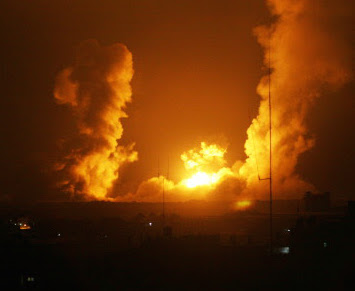
Cease fire talks between Israel and Hamas have been extended for an additional five days.

The extension in the talks was made possible because the Gaza Palestinians are standing firm in their humanitarian demand that Israel lift the siege on Gaza, while Israel is feeling the negative worldwide vibes over its massive military assault.

The vibes are negative everywhere, that is, except in the U.S., where in an Atlantic interview, former U.S. Secretary of State Hillary Clinton appeared to kick off her 2016 presidential campaign with a ringing endorsement of Israel’s massive assault on the Palestinians of Gaza.

For his part, as the man who holds the reins of responsibility, President Obama has called a halt to U.S. Hellfire missile shipments to Israel until arrangements are made to clear with the White House all future transfers of Hellfire missiles.

The President is clearly disturbed over his discovery of the free-flowing weapons pipeline from the U.S. to Israel via the Pentagon.

The story of his decision to halt sales, originated in the Wall Street Journal and was beamed into Israel and internationally on the internet by Haaretz.

The White House has instructed the Pentagon and the U.S. military to put on hold a transfer of Hellfire missiles that Israel had requested during its recent operation in the Gaza Strip, the Wall Street Journal reports.

According to the report, during Israel’s Operation Protective Edge, White House officials were dismayed to discover how little influence they wield over the topic of Israeli arms shipments, against the backdrop of the U.S. government’s unhappiness with the widespread damage inflicted upon Palestinian civilians.

During the Gaza war, the report said, White House officials came to realize that large amounts of weaponry are being passed to Israel via direct channels to the Pentagon, with little oversight by the political arena. .  .  .

Against the backdrop of American displeasure over IDF tactics used in the Gaza fighting and the high number of civilian casualties caused by Israel’s massive use of artillery fire rather than more precise weapons, officials in the White House and the State Department are now demanding to review every Israeli request for American arms individually, rather than let them move relatively unchecked through a direct military-to-military channel, a fact that slows down the process.

The extended cease fire negotiations, and the President’s decision to halt missile shipments, are the good news during cease fire negotiations.

Is there more bad news on the political front?  It depends on reactions to the big political story in the U.S., which is either good or bad, depending on one’s political preferences.

Former Israeli active-duty soldier Jeffrey Goldberg’s well-timed conversation with Hillary Clinton, has been published in the Atlantic magazine.

Goldberg now hangs his media hat at the Atlantic, his latest media stop following the completion of his IDF tour of duty during the first Palestinian uprising in 1990. Earlier Goldberg assignments included a stint at The New Yorker.

After his tour with the IDF, Goldberg wrote a book about his role as an Israeli guard, Prisoners: A Story of Friendship and Terror. The book received supportive reviews in the U.S.

Clinton could have given her interview to any media outlet in the country. It is no accident that she chose a well-known Jewish journalist who has never hidden his pro-Israel proclivities.

Which is why, depending entirely upon one’s views of Clinton, and her impending race to become Obama’s successor, the interview in the Atlantic will either delight or dismay readers.

The New Yorker‘s John Cassidy, in an essay entitled, Can Hillary Play This Game?, examined media responses to Clinton’s interview. His conclusion: If her intent was to bolster her conservative credentials, she succeeded.

As for “progressives and centrists, she might need to think again”. Here are Cassidy’s conclusions:

One goes to the substance of her chat with Goldberg, in which she struck a tone that was hawkish, interventionist, and fiercely pro-Israel. The reactions to what she said have been interesting, and it’s not clear whether they are what the Clintonites hoped for.

The editors of the Weekly Standard loved the interview, and [conservative New York Times columnist] David Brooks also approved. James Fallows and Kevin Drum {writing for Mother Jones] expressed serious reservations; so did I {in an earlier New Yorker piece.}.

If Clinton’s intention was to extend her political reach and attract the support of conservatives, she succeeded. If she was seeking to present a foreign-policy vision attractive to progressives and centrists, she might need to think again.

What could she, and her handlers, have been thinking? Clinton already has the pro-Israel votes, media and money, strongly embedded in the Clinton orbit. As for winning progressive and centrist support, she herself has acknowledged that her Senate 2003 pro-war Iraq vote was wrong.

Is her Atlantic interview her second pro-war stumble that could derail her 2016 road to the White House the way her 2003 Iraq pro-war vote helped Obama defeat her in the 2008 primaries?

Clinton has been in and around the White House long enough to have known that when the president is deeply involved in foreign policy decisions, from Ukraine to Syria to Gaza, it is not a good time for his former Secretary of State to launch her 2016 presidential campaign by attacking his foreign policy.

She did not just critique his policy, she told a pro-Israeli interviewer that Obama lacks a coherent foreign policy strategy. After waiting for the media feedback and the word to spread, Clinton told Politico’s  Maggie Haberman she did not mean to “attack” the President:

Hillary Clinton called President Barack Obama on Tuesday to “make sure he knows that nothing she said was an attempt to attack him” when she recently discussed her views on foreign policy in an interview with The Atlantic, according to a statement from a Clinton spokesman. 

That sounds like a not so artful dodge especially when describing an interview in which she:

 dismissed the Obama administration’s self-described foreign policy principle of “Don’t do stupid stuff.” And while she also praised Obama several times, Clinton nonetheless called his decision not to assist Syrian rebels early on a “failure.”

Earlier Tuesday, longtime top Obama aide David Axelrod took a swipe at Clinton on Twitter, writing: “Just to clarify: ‘Don’t do stupid stuff’ means stuff like occupying Iraq in the first place, which was a tragically bad decision.”

But wait, there is more from Politico.

In defending Israeli Prime Minister Benjamin Netanyahu’s deadly response to Hamas’s rocket attacks, she sounded almost like a spokesperson for the American Israel Public Affairs Committee.

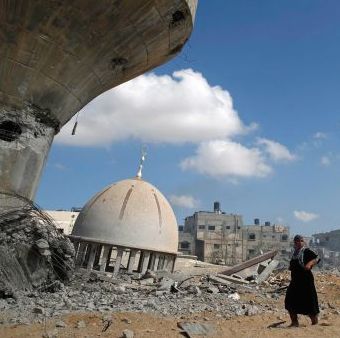
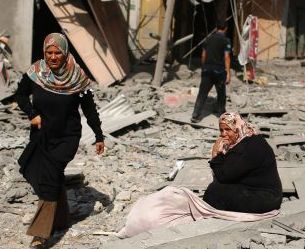
In talking about the threat of militant Islam more generally, her words echoed those of Tony Blair, the former British Prime Minister, who has called for a generation-long campaign against Islamic extremism—a proposal that one of his former cabinet ministers dubbed “back to the Crusades”.Palestinian women walk by mosque and water tower Israeli air strikes and shelling Khuzaa, east of Khan Younis, in southern Gaza Strip. August 3, 2014.  AFP

Glenn Greenwald, writing in his new media outlet, Intercept, lifted quotes from Hillary Clinton in her Atlantic interview with Jeffrey Goldberg that mirror almost precisely the line Prime Minister Netanyahu has followed since this current conflict began. These are all Clinton quotes:

1) “Israel has a right to defend itself. The steps Hamas has taken to embed rockets and command-and-control facilities and tunnel entrances in civilian areas, this makes a response by Israel difficult.”

2) “Israel did what it had to do to respond to the rockets.”

3) On civilian casualties in Gaza: “That doesn’t mean, just as the United States [tries to] be as careful as possible in going after targets to avoid civilians, that there aren’t mistakes that are made. We’ve made them. I don’t know a nation, no matter what its values are — and I think that democratic nations have demonstrably better values in a conflict position — that hasn’t made errors, but ultimately the responsibility rests with Hamas.”

4) Asked about the bombing of UN schools and killing of Palestinian children: “It’s impossible to know what happens in the fog of war. Some reports say, maybe it wasn’t the exact UN school that was bombed, but it was the annex to the school next door where they were firing the rockets. And I do think oftentimes that the anguish you are privy to because of the coverage, and the women and the children and all the rest of that, makes it very difficult to sort through to get to the truth.”

5) On civilian casualties in Gaza: “There’s no doubt in my mind that Hamas initiated this conflict. … So the ultimate responsibility has to rest on Hamas and the decisions it made.”

And there you have the essential Hillary Clinton commenting on Israel’s assault against Gaza.

One leading political voice responding to the Atlantic interview came from Independent Senator Bernie Sanders, of Vermont. Sanders has hinted he might run for president himself.

He spoke in an interview with ABC’s Jeff Zeleny a day after The Atlantic published the Clinton interview.  Sanders indicated his respect for the former Secretary of State, while at the same time he cautioned against “assuming that she will be the Democratic nominee before she’s even announced her candidacy”.

“She has accomplished a lot of positive things in her career, but I’m not quite sure that the political process is one in which we anoint people,” he said.

Michael Cohen, of the progressive Century Foundation, spoke for many progressives and perhaps centrists as well, when he noted:  “She basically seems to be taking positions that are very similar to the vision of America’s role in the world that [in 2008] Democrats rejected.”

Democrats rejected candidate Clinton in 2008 in favor of Barack Obama. Now the 2016 Democratic nomination is hers to lose.

Will her endorsement of Israel’s war strategy embellish her political credentials for 2016, or will that endorsement become her second major pro-war political stumble?

 The picture of Hillary Clinton above, ran with the Atlantic interview. It was taken by Jonathan Ernest for Reuters.

The picture of a Palestinian women walking by a mosque and water tower was taken following Israeli air strikes and shelling of Khuzaa, east of Khan Younis, in southern Gaza Strip, August 3, 2014. An AFP photo. 
Posted in Hillary Clinton, Media, Middle East, Middle East Politics, Netanyahu, Obama | 5 Comments

Hamas Cease Fire Terms Could Lead to “Normalcy”

UPDATED  on August 8, 2014

by James M. Wall

photo by Reuters Ha'aretz

During their temporary cease fire, Israel and Hamas are negotiating in Cairo, Egypt, for an agreement to end Israel’s third military assault since 2007, on Gaza.

Thursday night, Ha’aretz reported that the talks were “stalled”.

Friday morning, when the 72 hour agreement ended, the New York Times reported both sides resumed cross-border firing.

These shots could be “warning shots” to signal a resumption of the conflict, or they may be part of the negotiations strategy on both sides.

The conflict is asymmetrical, suggesting that more exchanges of fire would be especially harmful to the Palestinians in Gaza.

The one-sided nature of the now 30-day conflict, is seen in the human toll of Israel’s third “mowing the grass” project in Gaza. Thus far, Israel has killed 1900 Palestinians, the great majority of whom were civilians, including 400 children.

To agree to an extended cease fire with no more firing from either side, Hamas, the ruling government of Gaza, has laid out its simple requests. There is nothing radical nor threatening about them.

Israeli analyst Gershon Baskin says of the Hamas demands for an extended cease fire, “When Palestinians look at the Hamas demands, they say, ‘this is what we want, what all Palestinians want.’” (When firing resumed Friday, Baskin was interviewed by CNN.)

Ben Piven describes the Hamas proposal for a more permanent cease fire in America Al Jazeera:

“Hamas has focused its cease-fire terms on breaking the economic stranglehold imposed on Gaza by Israel with the help of Egypt, calling for an opening of border crossings and the expansion of areas where Palestinians may fish and where farmers may till their lands.”

On its side of the negotiations table, Hamas has asked for a return to the “normalcy” of 2007, opening the borders and allowing Palestinians to fish further out into the sea, and tilling their farm lands.

The Times of Israel is live blogging developments, as seen from Israel’s perspective.

If an extended cease fire agreement is reached, and Israel agrees to Hamas’ simple requests, the firing from both sides would end, at least for a time. Is there any hope that Israel will agree to the Hamas requests?

Based on Israel’s past record of negotiations, the possibility that Israel would relinquish its tight control over Gaza is slim, at best.

If Israel does reject Hamas’ simple request for normalcy, a request that would involve the removal of Hamas’ tunnels and rocket firing equipment, that rejection would testify to the world that Israel has no desire for the Palestinians of Gaza to ever again return to what was the normalcy of 2007.

But as America Al Jazeera’s Ben Piven notes:

Even if the siege is eased or lifted — and there’s no sign yet that the troubled search for a truce would produce such an outcome — rebuilding Gaza’s economy will remain a formidable challenge”.

Normalcy would still be a long way off, thanks to the ferocity of Israel’s invasion.

“You cannot say there is an economy right now,” Omar Shaban, director of the PalThink Institute for Strategic Studies, [told America Al Jazeera] last week.

“There was ongoing shelling 24 hours a day, and I hadn’t been out of my home for the past 24 days. This applies to everybody. Farmers can’t go out, and factories are not working.”

There is also formidable opposition to any proposals from Hamas among Israel’s American loyalists who share Israel’s lack of interest in granting normalcy to a Gaza under Hamas leadership.

Former AIPAC staffer MJ Rosenberg, now a harsh critic of Israel, points to one of those formidable opponents: The blind obedience the U.S. Congress displays whenever it is told to jump through an AIPAC hoop.

Rosenberg reports that because AIPAC wanted the Congress to endorse Israel’s attack on Gaza, a vote was taken to send additional funds to strengthen Israel’s Iron Dome defense.

Late last Friday night, the House of Representatives considered the Senate bill that allocated the additional $225 million to Israel. The bill passed the House 395-8. There was no debate.

The vote was overwhelmingly in favor of the bill, but the vote was irrelevant, because the funds were already approved and were being sent to Israel.  All but 8 members went home where they would be able to campaign with the boast, “I voted for Israel in its time of need.”

New York Times columnist Thomas Friedman, crown prince of the media’s liberal Zionist kingdom, took to his pulpit with a sermon that “explained the Israeli invasion”.

His August 4 column, Dear Guests, Revelations in the Gaza War, was one of his sermons from Father Tom, neatly encompassed in a traditional three points homiletical rendition, to wit,

“Since the early 2000s, Iran and its proxies Hezbollah and, until recently, Hamas, have pursued a three-pillar strategy toward Israel.”

Friedman has completely absorbed the Israeli version of reality. His sermon drips with the jargon of Benjamin Netanyahu.

He opens his sermon with a cute Friedman introduction, displaying no awareness to the fact that nearby in Gaza, 1.8 million Palestinians were being battered and brutalized from what became a 29-day assault:

KIBBUTZ EIN HASHLOSHA, Israel — At 6:02 a.m. on Saturday, the air raid siren sounded over Tel Aviv. I was rousted by the hotel staff from my room and ushered into the windowless service elevator area with two French families, everyone in their pajamas.

After 10 minutes, when the Hamas missile threat had passed, we were allowed to go back to our rooms. As I slipped back into bed, the hotel loudspeaker bellowed, “Dear guests, you may return to your routine.”

On the same Saturday morning Thomas Friedman slipped beneath his blanket in the hotel room he occupied near the Gaza border, an Israeli  bomb destroyed the home of a large Gaza family.

Amira Hass, columnist for Ha’aretz, returned to Gaza during the temporary cease fire and wrote this report of that destruction:

Despite the cease-fire, A.(name redacted) remained in her home yesterday and did not travel with her husband to the Shabura refugee camp in Rafah. She couldn’t bear the thought of the emptiness she would find there instead of the three families of relatives who had lived there in their simple asbestos dwellings until a single bomb fell on them Saturday morning.

“Did you know that Fathi’s [Abu Ita] three children who were killed were geniuses? Like their father, like their uncle Yakoub, the mathematician,” she said yesterday, as she delivered a lengthy report about her relatives who were killed, her work colleague who was killed, those who were wounded, those whose houses were destroyed this time, those whose houses were destroyed for the second time, those who were buried with their bodies whole, and the children killed whose body parts had to be collected.

The contrast between Friedman and Hass demonstrates why liberal Zionism has lost all credibility.  Friedman is oblivious to the suffering near by,  while Hass reports the evidence of what she sees and hears in a devastated Gaza.

In contrast to Friedman, BBC television host Jon Snow was in Gaza during the height of the Israeli invasion.

He was horrified by what he saw. Before his heartfelt report, delivered to his viewers from London, Jon Snow interviewed Israeli Prime Minister spokesman Mark Regev after the killing of four Palestinian boys playing soccer on a Gaza beach.

It is broadcast journalism at its best.

The two short videos are below, first, Snow’s testimony to the devastation of Israel’s invasion Gaza, followed by his interview of the Prime Minister’s spokesman:

Will Hamas get its desire to return normalcy to the Palestinians of Gaza?  Will the cease fire be extended?

Only Israel, and its Washington allies, know the answer to those questions, because Israel is the military power dictating the future.

The picture above of a Palestinian woman sitting in front of what was once her home in Beit Hanoun, appears in Ha’aretz.  It is a Reuters picture.


Posted in Media, Middle East, Middle East Politics, Netanyahu, War | 5 Comments

Israeli Officer Missing; 70 More Palestinians Die

by James M. WallGaza child

The situation in the city of Rafah in southern Gaza at mid-afternoon Friday (U.S. CST; 11 p.m Gaza time), is both chaotic and horrifying.  This posting will be updated as further reports become available.

Amy Goodman’s current report on Democracy Now is broadcast  from Washington and Gaza. This edition of Democracy Now, posted early Friday afternoon, runs for roughly ten minutes. The link to the program is below.

It includes an on the scene set of interviews with two Palestinians, Raji Sourani, award-winning human rights lawyer, and Gaza City-based Palestinian journalist Mohammed Omer, award-winning Palestinian journalist who is originally from Rafah.

The New York Times identified the missing Israeli as Second Lt. Hadar Goldin, a 23-year-old officer in an infantry brigade. He was first reported by the IDF as captured. But on Saturday, Hamas said it had no knowledge of what has happened to Lt. Goldin.

Amy Goodman’s interviews provides the scene from the Palestinian side.  To view this up to the minute video report with a transcript, click here

Lt. Goldin’s disappearance provides Israel with its latest justification for continuing its all-out military assault on a largely civilian Gaza population, as it looks for Lt. Goldin, dead or alive.

The Times‘ story began the Israeli narrative for this latest rationale for the third assault on Gaza since 2006 with this emotional reaction from Lt. Goldin’s father, Simcha Goldin:

“Speaking to journalists outside his home in Kfar Saba, Israel, [Goldin] said he was confident that Israel’s military forces would ‘not stop under any circumstances until they have turned over every stone in Gaza and have brought Hadar home healthy and whole.'”

Israel always launches its military assaults with whatever rationale is currently available. This third assault in six years has thus far killed 1600 Palestinians, mostly civilians, women and children.

The young Palestinian girl in the picture above is Hajar Muharram, five, shown sitting in a classroom where her family of seven now lives. Their new home is a UN school, in Beit Lahiya, in the northern Gaza Strip.

The picture was taken during this current assault by Lefteris Pitarakis, of the Associated Press. It ran in the Guardian along with an editorial “on the killing of children in Gaza.”

The 1600 Palestinian death total since the current assault began, (63 Israeli soldiers have been killed in the same period) exceeds the death toll of the first Israeli assault on Gaza in 2008-09, when 1450 Palestinians were killed. That was the infamous assault Israel halted in time to avoid the Obama inauguration.

This current 2014 assault was launched, Israel claimed, to “halt rockets from Gaza into Israel”, rockets that were largely ineffective. When the ground war began, Israel’s official rationale shifted to a “search and destroy” mission to destroy Gaza’s underground tunnels.

We may assume that the latest rationale for continuing this assault against the Gaza civilian population and rejecting any further efforts at a cease fire, will involve the goal of finding Lt Goldin.

Lt. Goldin was captured prior to the cease fire, scheduled to begin Friday morning (Gaza time) when Hamas militants encountered a tunnel destruction unit in southern Gaza. Israel disagrees, claiming that the capture came after the cease fire began.

Lt. Goldin disappeared in the tunnel Israel was attempting to destroy. Hamas has denied any involvement in his disappearance.

Dead or alive, and until more details emerge about Lt. Goldin, Israel is sticking to its own “captured narrative”.

A missing IDF officer offers Israel its most compelling rationale with which to heat up its population, stir up its political, media and financial “base” in the U.S, and continue its recurring assaults on Gaza.

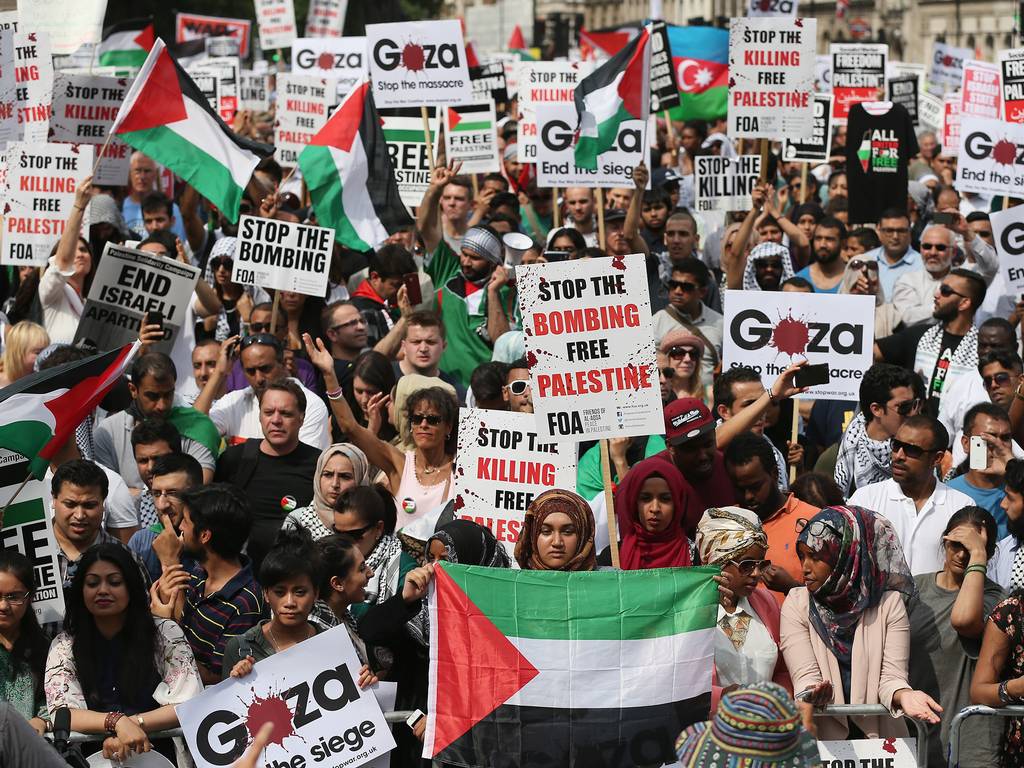
Getty IndependentShould world public opinion, expressed in public demonstrations (like the one in London shown here with 45,000 filling the streets) finally force a “cease fire”, and perhaps more importantly, if IDF fatalities exceed a “reasonable” limit, Israel will withdraw from this round in Gaza.

Until next time, of course.  And there will be a next time because the real reason for Israel’s constant attacks on Gaza, and its increasingly tight control over the West Bank, is to reach its long range goal.

Rashid  Khalidi, Middle East scholar at Columbia University, and in earlier days, a teaching colleague and friend of then Illinois State Senator Barack Obama, has laid out Israel’s long range purpose in his current essay in the New Yorker:

“Three days after the Israeli Prime Minister Benjamin Netanyahu launched the current war in Gaza, he held a press conference in Tel Aviv during which he said, in Hebrew, according to the Times of Israel,

“I think the Israeli people understand now what I always say: that there cannot be a situation, under any agreement, in which we relinquish security control of the territory west of the River Jordan.”

It’s worth listening carefully when Netanyahu speaks to the Israeli people. What is going on in Palestine today is not really about Hamas. It is not about rockets. It is not about “human shields” or terrorism or tunnels. It is about Israel’s permanent control over Palestinian land and Palestinian lives.

That is what Netanyahu is really saying, and that is what he now admits he has “always” talked about. It is about an unswerving, decades-long Israeli policy of denying Palestine self-determination, freedom, and sovereignty.

What Israel is doing in Gaza now is collective punishment. It is punishment for Gaza’s refusal to be a docile ghetto.”

So be prepared to hear whatever future rationale Benjamin Netanyahu uses to continue his military assaults on Gaza. Look behind the rational curtain and remember what Netanyahu told his Israeli public three days after this current assault.

Israel demands control over all the land from the Jordan River to the Sea. And never forget, he will do anything he wants to maintain that control.

What if other nations join those five Latin American countries and withdraw their ambassadors to Israel?  Why should he care?

Israel has relinquished its status as a moral nation. It knows it has the U.S. government in his back pocket. It knows the moral leadership of the U.S. still debates taking even mild actions of protest against Israel.

As long as that combination of American milk toast religion and political cowardice, continues, young Palestinian girls, like the one pictured above, must fear for their lives.

The picture of London supporters of the Palestinians is a Getty photo which ran in the Independent.


Posted in Middle East Politics, War | 6 Comments

Israel “Defends” Itself By “Mowing the Grass”

By James M. Wall

larger pix

Once every two years or so, depending on the U.S. and Israeli strategic and political calendars, Israel, the fourth largest military power in the world, descends on Gaza to “mow the grass”.

That obscene phrase, used to describe Israel’s military engagements with Gaza, was described by the Jerusalem Post as a legitimate Israeli tactic:

“Israel is acting in accordance with a “mowing the grass” strategy. After a period of military restraint, Israel is acting to severely punish Hamas for its aggressive behavior, and degrading its military capabilities – aiming at achieving a period of quiet.”

The “mowing the grass” image is an all-out Israeli air and ground attack on a largely helpless civilian population of 1.8 million Palestinians, all of whom are trapped inside prison-like Gaza walls.

Amira Hass, veteran Israeli writer for Ha’aretz, describes how difficult it is for Israel to understand that the Palestinians “refuse occupation”.

“There is method in madness, and the Israeli insanity, which refuses to grasp the extent of its revenge in Gaza, has very good reasons for being the way it is.

The entire nation is the army, the army is the nation, and both are represented by a Jewish-democratic government and a loyal press, and the four of them work together to stave off the great betrayal: the Palestinians’ refusal to recognize the normalcy of the situation.

The Palestinians are disobedient. They refuse to adapt. This is after we thought it was working for us, with VIP treatment for a few of them and an opportunity for swollen bank accounts for some, and with enormous donations from the United States and Europe that nurture the pockets of imaginary Palestinian rule.”

The current conflict is the third time Israel has “mowed the grass” in Gaza since 2007. There are no signs that Palestinians will stop being “disobedient”.

The  odious “grass mowing” tactic has worked before for Israel, calming things down to suit Israel’s agenda. But it is most certainly not a long term solution. It is also a tactic that always damages Israel’s image everywhere, it now seems, except in U.S. political, religious and media circles.

It is difficult to believe Israel lacks the ability to avoid excessive civilian casualties. Amira Hass reports one example that confirms Israel’s ability to identify, with precision, what and who, is being targeted. She writes:

The armed Hamas operatives who emerged from the tunnel shaft on Kibbutz Nir Am on Monday were dressed as Israeli soldiers. Haaretz’s Amos Harel writes that in the first moments, the field commanders were not sure whether they were soldiers or terrorists.

“Finally, thanks to an aerial photograph taken by a drone, they were found to be Hamas operatives,” writes Harel. “They were carrying Kalashnikov rifles, which the Israeli army does not use.”

So the photographs taken by the drone can be very precise when its operators wish. It can discern whether there are children on the seashore or on the roof — children who, even for the legal acrobats in the Justice Ministry and the army, are not a justifiable target for our bombs.

The drone can also discern that a rescue team has arrived to pull out wounded people, that families are fleeing their homes. All this can be shown in a close-up photograph taken by a drone, at high enough resolution that the operators of the bombs and the shells have no reason to press the “kill” button on their keyboards.

But for some reason, the eye of the drone that can tell the difference between various makes of rifles cannot tell that this figure over here is a child, and that is a mother or a grandmother. Instead, all are given a death sentence.”

Does Israel really believe “mowing the grass” is the best way to deal with its neighboring population? Is that a tactic to build a strong Israel for the future?

Years from now, Israeli veterans of this and other wars, will be asked, “what did you do in your war, Daddy”? The answer Daddy gives about “mowing the grass” will tell us what sort of nation Israel has built for the future.

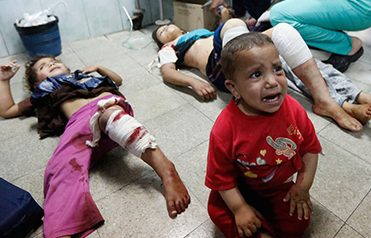
The children shown above were in an United Nations World Relief Agency (UNWRA) school during an attack.

Amira Hass writes further for Ha’aretz:

The Israeli military shelled a United Nations Relief Works and Agency (UNWRA) school today, killing and injuring some of the Palestinians who had gathered there after fleeing their homes following Israeli messages to do so.

CNN‘s Ben Wedeman, who is reporting from Gaza, said that medical sources told him 30 people were killed. Other reports put the death toll lower; the Associated Press reports that at least seven were killed, while Agence France Press reports nine dead.

UNWRA spokesman Chris Gunness has confirmed that there are “multiple dead and injured at designated UNWRA shelter in Beit Hanoun.” He said on Twitter that the Israeli military had been given “precise co-ordinates of the UNWRA shelter in Beit Hanoun.”

The children in the picture above are lying or sitting on the floor. This is not a hospital. It is clearly-marked UNWRA facility which hurriedly took in as many as 1500 Palestinians, seeking shelter from bombs.

Look closely in the upper right corner of the picture above and you will see the image of a green-clad nurse, offering what little help he can to one of the children.

This is how the world’s fourth largest military power “defends itself”?

Another way Israel defends itself is to raise questions about which side is responsible for attacks. In a factual report on the attack on the Gaza Beit Hanoun school converted to a temporary shelter, the New York Times gives the results of the attack.

“These days, even a school — clearly identified as a shelter run by the United Nations — cannot protect Palestinian civilians in Gaza from deadly attacks. Located in the northern Gaza town of Beit Hanoun, it was struck multiple times on Thursday as people who had taken refuge there were gathering in the courtyard and preparing to flee.

At least 16 of them were killed, bringing the total death toll in 17 days of war to more than 750, a vast majority being Palestinian civilians.”

The losses were so heavy and the ultimate responsibility for the explosion that caused the many losses, so damaging that it is quite possible that the Israeli hasbara team told its favorite New York city newspaper to proceed with caution.

Which the New York Times promptly did in the next paragraph:

“There are competing charges over who carried out the attack — Israel; Hamas, which controls Gaza; or one of Hamas’s allies — and that could take time to sort out. What really matters now is that some way be found to stop this carnage.”

Time to sort out, indeed. To even imply that Hamas could be responsible for this destruction in the Beit Hanoun school strains credulity.  Perhaps Israel is anticipating a need for cover in future war crimes trials.

NBC nightly television news did not waste any time debating responsibility for the  attack. It reported the grisly attack as an Israeli operation.

Even such an intelligent and sensitive leader like U.S. President Barack Obama, has learned to repeat the phrase almost as often as Netanyahu, “Israel has the right to defend itself”.

Palestinians, as any rational individual must know, also have the “right to defend themselves”.

Chris Hedges writes on the obvious limits of “rights”:

Israel does not have the right to drop 1,000-pound iron fragmentation bombs on Gaza. It does not have the right to pound Gaza with heavy artillery and with shells lobbed from gunboats.

It does not have the right to send in mechanized ground units or to target hospitals, schools and mosques, along with Gaza’s water and electrical systems. It does not have the right to displace over 100,000 people from their homes. The entire occupation, under which Israel has nearly complete control of the sea, the air and the borders of Gaza, is illegal.

The  current “lawn mowing” process started in 2008, nicely timed to fall between Barack Obama’s November, 2008, election, and Obama’s inauguration in January, 2009. Obama demanded from Israel that it end its invasion before Inauguration Day.

Israel, comrades in arms, always eager to play nice with a new president, met the deadline.

Like Israel’s subsequent invasions that followed in 2012 and 2014, the pattern has been the same.

Israel builds up its military stock pile for up to two weeks of all-out attacks, starting with devastating air strikes, followed by Israeli ground troops crossing into Gaza.

They rarely go beyond two weeks, fearing world disapproval and fading home front tolerance  for troops losses. That tolerance point may not be far away. The Washington Post reported this week:

“Seven more Israeli soldiers were killed in fierce fighting Monday [July 21], bringing the Israeli military toll to 27 dead, more than twice as many as in Israel’s last Gaza ground incursion in 2009 and the highest toll since Israel’s war with Lebanon in 2006. Two Israeli civilians have died in the conflict.”

As the weaker of the two parties involved, the Gaza civilian death toll (many women and children) has varied, but so far it has ranged from more than a thousand in 2009, to more  than 560 people in Gaza, in this 2014 incursion, many of them women and children, according to the Post.

This invasion, if it follows the usual plan, will lead to a “cease fire” orchestrated by pro-Israel, U.S, anti-Hamas Egypt, Israel, and presumably Hamas. The first run at a 2014  “cease fire” was proposed with no input from Hamas.  Hamas refused to be told to sign something on which it was not consulted.

A second effort is currently ongoing.

The Presbyterian Church in the USA (PCUSA) has just finished its every-two year General Assembly national gathering, which included a narrow vote to take the mild step of withholding investment funds from three U.S. corporations involved in Israel’s operations in the occupied territories.

The PCUSA will not meet in General Assembly for another two years. Perhaps they will meet during the next “lawn mowing” exercise when Israel finds an excuse to begin cutting anew.

The World Council of Churches, not as obsessed with “good relations” with local rabbis as the Presbyterians, took the justice route and demanded an end to Israel’s current invasion and its occupation of the West Bank and Gaza.

The U.S. National Council of Churches issued a press release on July 18 expressing its disapproval of the invasion.

These  Israeli “lawn mowing” exercises began after the 2006 elections in the West Bank and Gaza, to choose a new Palestinian parliament and later, a prime minister.

Israel and the U.S. did not like the results of that 2006 election. They did not like the fact that Hamas won the election fair and square, and gained control of all of the West Bank and Gaza.

In that election Hamas won in such Christian strongholds as Bethlehem, in the West Bank. The majority of Bethlehem’s legislative seats went to Hamas.

Former U.S. President Jimmy Carter headed an international group of monitors to help guarantee the 2006 election’s validity.

I attended a meeting of the Palestinian Election Commission the day before the election, at the invitation of President Carter and the Commission chair, Hanna Nasir, then the president of Bir Zeit University.

Hamas won the election in 2006. What followed was a brief moment of hope for a positive Palestinian future.

But what does the U.S. government (the congress and then President George W. Bush) and its Middle East mini-me empirical wanna-be, Israel, do about an election that does not follow the colonial template?

Simple, the U.S. and Israel told the losing political party in that 2006 election, Fatah, that it was time to go to war against Hamas. To help out, Israel locked up, on charges that are still not clear, the majority of Hamas’ victorious legislators.

With U.S. Army Lt. General Keith Dayton in charge of training—bringing with him U.S. money for military equipment—the Fatah army was organized and sent into battle to accomplish what the voters in the West Bank and Hamas had rejected.

In short, the colonial playbook was followed: Take power at the polls if possible, and by military force, if necessary. What followed was not meant to happen. The U.S and Israeli-backed Fatah lost that war as it had lost the earlier election.

Hamas quickly solidified its governmental responsibility on the Gaza area of the Palestinian territories. Israel promptly surrounded Gaza with its own version of the iron wall. Israel demanded that Fatah set up its own West Bank Palestinian government with Ramallah as its capital.

Maybe that came from a West Point class, “Divide and Conquer” on how best to build an empire. Great Britain perfected the tactic in the Middle East, India and Africa.

The Palestinian Authority (PA) has struggled since 2007 to govern the West Bank on its own, always under the watchful eye of the Israelis, who dole out tax money taken from Palestinians and return it to the PA to run its government.

Following the failure of the most recent round of peace negotiations, Fatah invited Hamas to join in a unity government.

That sounded promising. But it did not fit the colonial template. Thus followed the latest “grass mowing” Israeli exercise, and many children like those above, continue to suffer.

A “cease fire” to this current conflict could happen at any moment. But then what? Does Israel think the tunnels will not be restored? Of course, they will be restored. Or maybe another and more effective method will be developed to resist the occupation.

Israel is indeed surrounded by Arab states which do not think Israel is a good neighbor in the region. At some point in the future these states may find ways to assist Hamas.

Military might, will not suffice to hold down a captive Palestinian population forever.  World opinion has turned against Israel.  The next U.S. president will face the same hopeless situation that has been such a burden for President Obama.

It is sad to see a brilliant president with so much promise, like Barack Obama, have to grovel and utter Israel’s mantra of this year, “Israel has a right to defend itself”.

What sort of a neighbor will Israel be in the future?

“Mowing the grass” to routinely kill men, women and children, destroy their homes, hospitals and schools, and  deprive them of the freedom to enjoy a normal existence, sounds more like a 20th century Nazi tactic than a tactic appropriate for a 21st century democracy.

It is also a tactic that will fail, because Palestinians will find other ways to resist oppression.

And just maybe a future U.S. president, told to repeat another Israeli talking point on the order of the noxious, “Israel has a right to defend itself”, will gag, and refuse to do so.

Like Martin Luther, the father of the Protestant revolution, that future U.S. president just might refuse to degrade himself or herself, tear up the script, and say those words long attributed to Martin Luther, “Here I stand, I can do no other. God help me.”

The picture above is from the U.S. home page of UNWRA. It was taken by Letteris Pitarakis, for the Associated Press.

Posted in Middle East, Middle East Politics, Netanyahu, Obama, Presbyterian Church USA, Religious Faith | 6 Comments

Palestinian Children Have No Iron Dome

by James M. WallIslam Abdel Karim for The Washington Post

One day after a U.S. congressional committee voted to send more U.S. tax dollars to bolster Israel’s Iron Dome shield, four Palestinian boys were killed on an open beach by Israeli shelling from a naval ship offshore.

Defense for Children International  reported on the Israeli shelling:

“Eight children in Gaza were killed on Wednesday [July 16], including four boys who died as they were playing on the beach in Gaza City when they were directly targeted by the Israeli navy.  Israel’s military offensive on the Gaza Strip has killed at least 45 children according to DCI-Palestine documentation.”

DCI-Palestine identified the four boys killed, as Zakariya Ahed Subhi Baker, 10, Ahed Atef Ahed Baker, 9, Ismail Mohammad Subhi Baker, 9, and Mohammad Ramez Ezzat Baker, 11. The boys were all cousins from local families. They had been playing with a soccer ball on the beach in Gaza City’s harbor before they were killed in a missile strike just after 4 pm.

Hamada Baker, 13, was struck by shrapnel from one of the missiles fired from the Israeli ship. He and other boys ran or were carried, to the al Deira Hotel next to the beach where the four boys were killed.

Many western journalists. housed at the hotel, helped the wounded with first aid kits they brought down to the hotel terrace. One of them was William Booth of the Washington Post. Booth filed his account of the attack:

“I had just returned to the hotel to type up some notes and file inserts on the day’s news when there was a large explosion on the quay at the port, a little after 4 o’ clock in the afternoon.  .  . We saw a small fisherman’s shack on the quay, churning with gray smoke.

Then we saw a gang of kids running from the shack, down the breakwater and onto the sand, hurtling toward al-Deira.

A couple of waiters, the cook and a few journalists started waving at them. Run here!

Then a second strike landed right behind them. The staff were yelling, “They’re hurt!”

A half-dozen kids made it to the hotel. A young man also reached safety and fainted. He was bleeding from the abdomen. He was scooped up and carried to a taxi by a big, friendly bear of a bellman, room cleaner and night watchman named Mahmoud Abu Zbaidah.

Two young terrified kids (one of whom is pictured above) were bleeding and injured, and they were quickly bandaged on the floor of the terrace, where guests usually eat skewers of grilled chicken, suck on water pipes and watch the sun go down.

The kids suffered from shrapnel wounds, one to the head, one to the chest. They were treated by translators, hotel staff and journalists, who ran up to their rooms to grab medical kits.

On the quay, ambulances took away four more. They either died on the pier or at the hospital, I am not sure. The Gaza Health Ministry tweeted their names a few minutes later.  .  . .All cousins, we are told, scrawny fishermen’s kids whom we saw every day, running around on the beach, playing in the waves.”

Booth’s eye-witness account ran in the July 17 Washington Post, a daily newspaper which is a must-read for Washington elected officials and government personnel. In his story, Booth included the usual pro-forma response from the IDF:

“Later, the Israel Defense Forces issued a statement calling the civilian casualties “a tragic outcome, saying the target of the strike was ‘Hamas terrorist operatives.’ They promised that the incident would be investigated but blamed Hamas for its ‘cynical exploitation of a population held hostage.'”

Israel claims that its Iron Dome has successfully blocked more than 90 per cent of the Hamas rockets aimed at Israel.  Now the U.S. Congress is prepared to improve on that figure with an even stronger Iron Dome.

That narrative is shaped by Israel as are most details absorbed and passed on he western media.

The Christian Science Monitor has looked into these claims about the Iron Dome. It reports:

A popular narrative about the current face-off between Hamas and other Palestinian militants in the Gaza Strip and Israel is that the Israelis, confronted with withering volleys of rocket fire, have had no choice but to respond with overwhelming force and that the failure of the rockets to do much damage has largely been thanks to the country’s US-funded Iron Dome missile defense system.

But it turns out that compared to the last major escalation between the two sides, the Palestinians in 2014 are firing fewer rockets than in the past, and those rockets they are firing are proving less accurate.

Israel sells  its “in danger” narrative by manipulating facts.

The problem for Washington elected officials is that they live under their own self-imposed ethical shield that keeps them focused on the mantra, “is it good for Israel?”

Neither the American public nor its elected leaders  are likely to be exposed to an interview like the one which ran on London’s Channel 4 after the deaths of the four boys on the beach.

The interviewer is Channel 4 host Jon Snow. He spoke with Israeli Prime Minister Netanyahu’s  spokesman Mark Regev. To view the interview, click here. It runs for nine minutes.

Snow begins with a hard question: How does Israel defend the killing of four Palestinian boys on a Gaza beach as a way to “defend Israeli citizens.” Regev has no answer.

What he did have is the “cease fire rejection by Hamas” segment of Israel’s narrative which he utilized in his interview with Snow. Revisit the interview above and note how Regev plays the “cease fire” failure card.

Israel and the U.S. attempted to create a narrative of a “cease fire” which Hamas was told to sign on without having been a party to any “cease fire” conservations.

Hamas refused, of course. Jonathan Cook writes on why the refusal was Hamas’ only option. Here is the opening of Cook’s report:

“We now have confirmation from the Israeli daily Haaretz of what we should have suspected: that the idea for the so-called Egyptian “ceasefire proposal” was actually hatched in Washington, the messenger boy was arch-war criminal Tony Blair, and the terms were drafted by Israel.

The intention was either to corner Hamas into surrendering – and thereby keep the savage blockade of Gaza in place – or force Hamas to reject the proposal and confirm the Israeli narrative that it is a terrorist organisation with which Israel cannot make peace.

According to Haaretz, Blair secretly initiated his “ceasefire” activity after “coordinating” with US Secretary of State John Kerry. On Saturday he headed off to Cairo to meet with the US-backed Egyptian dictator Abdel Fattah al-Sisi to persuade him to put his name to the proposal.”

And just as the U.S. and Israel wanted, Hamas’ rejection of a “cease fire” Israeli-drafted proposal, becomes the official narrative for all future discussions of this summer’s brutal attack on Gaza.  It was an obvious fraud from the start but it served its purpose. 

Meanwhile, back in Israel’s motherland, the U.S, the decision by a U.S. congressional committee to add even more money to Israel’s Iron Dome funding, was reported by Kate Brannen on the Foreign Policy web page July 15. She writes, in part:

“Congress seems poised to give Israel, and one of the United States’ largest defense contractors, a jolt of good news: $175 million in new American aid that will help fund an expansion of the program.

The additional money for Iron Dome cleared one of its final hurdles Tuesday {July 15], when a key Senate appropriations subcommittee unanimously voted to double the Pentagon’s $175 million request for fiscal year 2015.

The full committee will consider the defense appropriations bill on Thursday. Meanwhile, three other panels have already signed off on the funding expansion, making it all but certain the additional money will be provided.

Iron Dome has received $720 million in American funding since 2011, when the United States became directly involved in the program. Iron Dome, which is built by the Israeli defense company Rafael, has kept Israeli casualties so low that it’s credited with bolstering the public’s support for a longer bombing campaign rather than an immediate ground invasion into Gaza.”

Even with more funding for the Iron Dome, Israel was determined to go ahead with its  ground invasion into Gaza on the night of July 17. Ha’aretz reported on the invasion:

“A large contingent of Israeli ground forces entered the Gaza Strip Thursday night for the first time since Operation Protective Edge began 10 days ago. 

The government made the decision after efforts to reach a cease-fire with Hamas collapsed.

Palestinian sources reported heavy IDF artillery fire throughout the entire Gaza Strip. A Gaza resident told Haaretz, “They’re firing from every direction, everything here is shaking.”

Prime Minister Benjamin Netanyahu said the ground operation’s main goal will be to deal with the threat posed by the tunnels Hamas has dug along the Gaza-Israel border.”

The robotic American political response to Israel’s ground invasion on top of its bombing attacks on Gaza? “Israel has a right to defend itself”.

That mantra is a con man’s twin to the other central Israeli narrative mantra, “Israel has a right to exist”. The fundamental flaw in both mantras is that Israel considers itself to be the only party with rights.

Congress does not operate on the “General Conception of Justice” outlined in the late Harvard Professor John Rawls’ ethical philosophy:

“All social primary goods—liberty and opportunity, income and wealth, and the bases of self-respect—are to be distributed equally unless an unequal distribution of any or all of these goods is to the advantage of the least favored.”

Israel chooses not to remember how Proverbs 24:24-25 speaks to those who claim they are always right:

“Whoever says to the wicked, ‘You are in the right,’ will be cursed by peoples, abhorred by nations, but those who rebuke the wicked will have delight, and a good blessing will come upon them.”

Israel is bombing and invading a small country whose only defense is an unwise use of ineffective rockets directed at Israel with little hope of doing any serious damage.

The rockets give U.S. and Israeli television news programs videos of Israeli civilians running toward shelters, incarnating another Israeli mantra, “the Jewish people are  permanent victims”.

Gaza Palestinians have no shelters to run to. They have no Iron Dome to protect their children. All they have are “roof knocking” Israeli shells landing on a roof to warn a targeted family, get out quickly because a deadlier bomb is on its way.

The message behind “roof knocking” is cynical in the extreme. After the early bombings, Jon Stewart addressed this very serious topic in his usual acerbic manner:

http://youtu.be/tmPJb6Mcu6g

What are the results of these asymmetrical attacks?  Since July 8, when Israel began daily bomb attacks, this summer’s round of asymmetrical bombing assaults on Gaza have killed more than 240 Palestinians, an estimated half of whom are women and children.

The ground invasion launched Thursday may be expected to add to that figure. Israel claims its air attacks target only Hamas militants. It is yet to say how it expects to avoid killing civilians in its ground assault.

Thus far the Israeli public appears to be in favor of the attacks on Gaza. The killing of four boys playing soccer on the beach however, could prove to be a tipping point against Israel in international public opinion.

The Washington Post’s account of the death of the four boys playing on the beach is one example.

On Thursday, the nation’s leading trend-setting media outlet, The New York Times, featured pictures and two stories about the deaths of the four Palestinian boys.

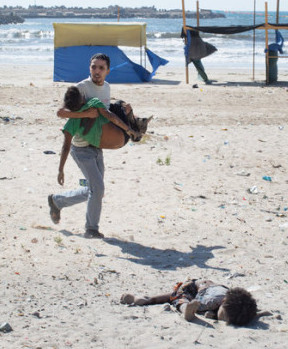
One of the Times stories is by Tyler Hicks, the Times photographer who took the picture (here) of a Palestinian man carrying the body of one of the four young boys killed.

Ahead of him in the picture is a second victim of Israeli naval fire.Tyler Hicks NYT

A second story that ran in the Times after the beach killings is by Anne Barnard, writing from Gaza City:

“The four Baker boys were young cousins, the children of Gaza fishermen who had ordered them to stay indoors — and especially away from the beach.

But cooped up for nine days during Israeli bombardments, the children defied their parents and went out Wednesday afternoon, the eldest shooing away his little brother, telling him it was too dangerous.

As they played on and around a jetty in the late-afternoon sun, a blast hit a nearby shack. One boy was killed instantly. The others ran. There was a second blast, and three more bodies littered the sand. One was charred, missing a leg, and another lay motionless, his curly head intact, his legs splayed at unnatural angles.”

At the moment, with the Israeli ground invasion under way, the  future looks bleak. Have we reached a tipping point?  Will the Gaza beach murders be the moment when the world wakes up?  

Or as Jon Stewart asks us in the clip above, “has the world gone mad?”


The picture above of the injured Hamada Baker, was taken on the terrace of the Gaza al Deira Hotel, where he was treated.  The picture was taken for the Washington Post by Islam Abdel Karim.  The picture further down of the man and the two dead  children was taken by Tyler Hicks of the New York Times. An editorial note: The Post spells the family name of the four dead boys as Baker.  The Tines uses Bakr, without the “e”. My Arabic authority says the name in Arabic is pronounced Baa keer, emphasis on the Baa.  The English transliteration is more properly rendered as Baker.

Posted in Human Rights, Media, Middle East Politics, Soccer, Television, USA, War | 8 Comments

Israel Destroys Gaza Home for Handicapped

by James M. WallWissam Nassar nyt

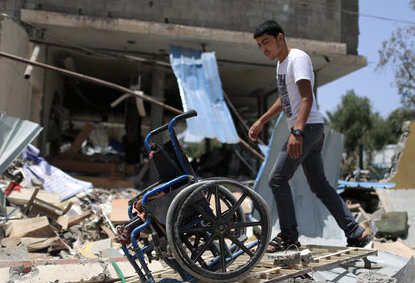
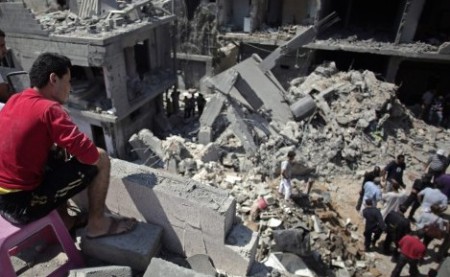
On the sixth day of its asymmetrical war against Gaza, Israel destroyed a home for the handicapped in Beit Lahiya, killing two handicapped residents, and wounding three others, including the caretaker.

The destruction of the home came on an early Saturday morning while only five of the 19 severely handicapped residents were in the building.

Jamila Elaiwa, who founded the center 20 years ago, told the New York Times the remaining 14 residents of the Mabaret Palestine Society home were visiting their families.

Ms. Elaiwa spoke to the Times at Gaza’s Shifa’s hospital’s burn unit. She was there visiting the wounded survivors of the building’s destruction, two of whom were Mai Hamada, 30, and Salwa Abu al-Qomssan, 53, the caretaker, both of them with severe burns.

Jamila Elaiwa, the founder of the Mabaret Palestine Society, suggested the attack must have been pre-planned, and was not one of Israel’s unfortunate “accidents”, as Israel claimed was the case with the bomb that killed nine Palestinians sitting on the beach watching a TV presentation of a World Cup football match.

She recalled a small explosion on the building roof a few minutes before the bomb hit that destroyed the home for the handicapped.

That smaller explosion would have been an Israeli “roof knocking” message, which Israel claims is meant to warn occupants to leave the building. These were occupants, however, who were not physically capable of making a fast exit.

Two other wounded survivors of the blast are in intensive care. Killed in the bombing attack were Ula Wisha, 31, and Suha Abusada, 39, whose family reports “had been born severely handicapped and unable to speak.”

In its story reporting the bombing of the home, the Times reports that Israel bombed a mosque which Israel claimed “aerial photos indicated was harboring a weapons cache”.

The mosque was destroyed. No casualties were reported.  What the Times did not report was that the “weapons cache” claim is a frequent Israeli excuse for bombing sacred buildings.

This is clearly an asymmetrical (as in excessively one-sided) war.  It is also an ongoing war that is renewed almost every two years or so.  Prime Minister Benjamin Netanyahu said he is not interested in a cease fire.  Of course he is not.

Mideast Israel Palestinians  APHe will stop this recurring devastation when he feels he has weakened Hamas for this round.  The bell will ring when he gives the signal for it to ring.

That is his pattern. After Hamas’ 2006 victory over Israel’s preferred US military-trained  Fatah army, Israel has found some convenient pretext to repeatedly launch vicious and highly destructive air, and sometimes ground, assaults against Hamas.

The assaults are like clockwork, starting in 2007. That assai;t was followed by the 2008-09 assault, then, after pausing during Obama’s first year in office, it was back to the attack in 2012. Now, right on schedule, in 2014,  we are in the midst of “Operation Protective Edge”.

Israel gives its Gaza recurring attacks, nice media-friendly, noble-sounding names.  In 2012, the attack bore the memorable monikers, “Pillar of Defense” or literally: “Pillar of Cloud”. In 2008-09, the name was “Operation Cast Lead”.

Like the Bob Gibson folk song, “The Thinking Man”, Israel is reported to have a department with the sole responsibility of “thinking up names” for its lethal incursions into Gaza and Lebanon.

Each round of violence on Palestinians is marketed with the same non accountable predictability, an Israeli-designed narrative that American mainstream media and American politicians, accept and then sell to the American public, performing their duties as Israel’s peddlers.

During the 2012 attack, in a Wall Writings posting, I described Israel’s handling of Gaza to be “the managing of a crisis”. The management involved the rationing of foodstuffs, medicine, and other vital human needs.  Israel has maintained its detailed management of “the crisis” since that 2012 war.

There are occasional signs that Netanyahu may be losing control of some in the main stream media.  Brian Williams, of NBC news, did a piece this week on his nightly report which he headed, “Gaza trapped in lop sided conflict”.

One major U.S. media star, ABC news anchor Dianne Sawyer, was doing her best “two sides” are suffering story in this asymmetrical conflict, when she put up two pictures of destruction which she said were from Israel.

Sawyer later apologized, but apologies for obvious errors never quite catch up to the first impression of “destruction on both sides” that ABC gave its viewers.

An alert journalist should have been aware that the two pictures ABC’s Sawyer displayed were not taken in Israel, but in Gaza

Some staffer in the production chain should have raised a red flag, shouting error, error.

Did these people not watch Aaron Sorkin’s brilliant cable television series Network? That fictional crew made its mistakes, but they would know which side has the more destructive arms.

Outside the U.S., crucial international support for Israel’s blank check to attack at will, may also be lessening. The United Nations Security Council, and just about every other international organization witnessing this one-way carnage, has called for a cease fire, an indication that Israel may have to end this round sooner than Netanyahu had planned.

Away from the main stream media, the alternative media is hitting hard at Netanyahu. The message there is seen by opinion makers, but they are slow to present it to the public.

A Real News Network interview of Jewish American journalist Max Blumenthal and Palestinian American journalist Ali Abunimah refutes Israel’s narrative with a discussion of “Israeli Propaganda and the Politics of Revenge against Gaza”.

Netanyahu knows that as long as he wants to drag out this 2014 assault, the U.S. Congress has his back.

The most recent example: Two U.S. Senate leaders, Republican Lindsay Graham, of South Carolina, and New York Democrat Chuck Schumer, the bipartisan pro-Israel twins of the upper chamber, demonstrated their undying loyalty to a sovereign foreign nation.

Together with fellow bipartisan pro-Israel senators Robert Menendez, Democrat, New Jersey, and Kelly Ayotte, Republican, New Hampshire, they introduced a “resolution expressing support for the State of Israel as it defends itself against unprovoked attacks from the Hamas terrorist organization”.

The resolution endorses Israel’s current assault, calls for Fatah to withdraw from its unity talks with Hamas, and most importantly insists “Israel has the right to  defend itself”.

For future reference, take note:

Each succeeding Israeli government prepares for its recurring Gaza attack by following the same script that always ends with the victim-oriented mantra that “Israel has the right to defend itself”.

During its two-year long pause between attacks, Israel plays the “peace process” game. However, after the dismal failure of this year’s proceedings, Israel and the U.S. will have to come up with a new reason to hit the pause button between Israel’s wars.

After the pause, Israel always begins its recurring (2007, 2009, 2012, and 2014) Gaza attacks by building up Israel’s ever-present “existential anxiety”— fear and anger–that seethes within its easily manipulated population.

Next, Israel grabs whatever provocative event that emerges. The event is then manufactured to serve Israel’s plan to play the victim card. In their need to defend the homeland, Israel starts another war.

For the 2014 attack on Gaza, an especially lurid provocation arrived with the deaths of three Israeli teen agers in IDF controlled territory in Hebron.  Israel knew from the outset that from the recording of gunshots behind a desperate cell phone call for help, the search for the three Israelis would be a search for three dead Israelis.

Nevertheless, Israeli Prime Minister Benjamin Netanyahu exploited the story of the missing teenagers to charge up the emotions of his population. He even sent the mother of one of the teen agers to Geneva to appeal to the United Nations Human Rights Council for help.

When the three bodies were finally found, buried by the side of the road under a few rocks, Netanyahu repeated his initial accusation that Hamas was behind the disappearance of the Israelis.

He also had the names of two Hamas operatives who lived in the area. They were deemed, by fiat, as guilty of kidnapping the teen agers. Netanyahu ordered the homes of both men destroyed. No evidence or charges have surfaced.

It was time to start the 2014 War on Hamas.

Cue the massing of troops on the border, artillery at the ready, and send the bombers aloft. Operation Knife’s Edge was ready to roll.

If this were a work of fiction, about this time in the story the reader would be demanding to know where the two so-called Hamas “killers” are hiding in an area swarming with Israeli police and soldiers.

The reader just may think, maybe, just maybe, Israel has found the two Hamas agents. If so, still with no evidence against them, they may be now be dead, their bodies hidden until a more propitious time when they will appear in the Israeli narrative, more likely dead than alive.

Who can say, but in the narrative according to Netanyahu, the two “missing” Hamas men have served their purpose. They were only the latest pair of provocateurs utilized by Israel to kick off its next act of war.

A number of Israeli journalists, many from Ha’aretz, know that Netayahu’s narrative is damaging Israel to within an inch of its future as a nation.

Unfortunately for the citizens of Gaza, this current round of the recurring War Against Gaza means many Gazans, as of this weekend more than 160, will die.

Richard Silverstein is reporting that “an invasion is imminent”, which means that an invasion could come at some time Sunday morning, Gaza time. The invasion threat is day to day, guaranteeing more Gaza deaths.

Hamas militants insist on firing rockets at Israel. It is a self-defeating action, one that hands Netanyahu his rational for going to war.  The rockets are largely ineffective. Yet the US mainstream media including the more “progressive” NPR and MSNBC, repeatedly report the rocket attacks as equally frightening as Israeli bombs and artillery shelling.

Pay close attention, you can usually hear at the end of a “progressive” broadcast report, come the good news, “some rockets got through the protective dome, but there were no injuries”.

The ineffective rockets from Hamas serve no one but Israel. Not a single Israeli death had been reported by this Saturday night.

What matters for Israel is that the rockets fired by militants in Gaza keep reaching targets deeper and deeper in Israel, sending Israelis fleeing for bomb shelters.  What better way to keep the Israeli public in perpetual fear and hatred.

CNN, which is trying to outdo Fox News in selling the Israeli narrative, has sent its ace journalist, former AIPAC staffer Wolf Blitzer, into Israel to report on those rocket attacks.

The problem for the stronger side in an asymmetrical war is that a case must be made that the stronger side is always in great danger.

Max Blumberg, an America Jewish journalist, has reported on Twitter that CNN’s favorite and oft-repeated visual from Israel’s home front is a scene of Blitzer in Israel when an Hamas rocket is reported to be on its way.

Blitzer races to the nearest bomb shelter, a CNN cameraman close behind showing the “danger” Israeli citizens face. No CNN visuals yet of the bombs falling in Gaza. Meanwhile, the asymmetrical bombing of Gaza, with the ultimate destruction of Hamas, and Israel’s complete control of all Palestinian land, as its goal, is about to enter its second week.

What about President Barack Obama in all this?

Obama has talked with Netanyahu. What does our President say after those “chats”. He says what  all American politicians say, “Israel has a right to defend itself”.

That is the height of absurdity.  In response to ineffective rockets, bombing a home for the handicapped, destroying mosques, eliminating an already battered Gaza water works, highways, cities, killing more than 160 Palestinians, a large number of whom are women and children, while keeping 1.7 million Palestinians locked up in a Gaza prison, is most certainly not “Israel defending itself”.

It is, rather, Israel destroying itself, and like Samson of old, Israel is pulling down the temple on the entire region, starting with Palestine.


The picture at top of the destruction left after Israel bombed Gaza’s Mabaret Palestine Society home is from the New York Times.  It was taken by Wissam Nassar.  The lower picture of the destroyed Mabaret home, with men in the basement where the bomb exploded is from AP. It was taken by Khalil Hamra.


Posted in Middle East Politics, Netanyahu, Obama, War | 6 Comments

Palestinian Boy Burned to Death

by James M. Wallfather of Muhammad

The headline for Jodi Rudoren’s July 5 New York Times story captures the ugly report in all of its appalling harshness.

“Autopsy Suggests Palestinian Teenager Was Burned to Death After Abduction”

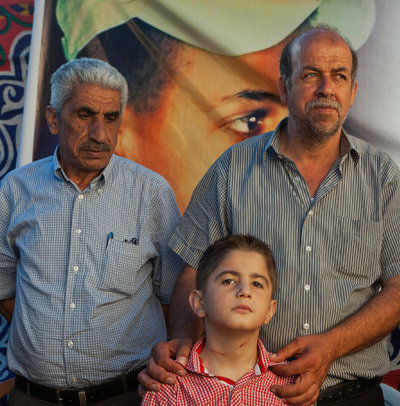
The picture at right, from the New York Times, is that of Muhammad Hussein Abu Khdeir’s father, greeting guests at his home Saturday.

Standing with him is Mousa Zaloum, 8, a boy from a neighbor’s family, whose neck was said to have been cut in a kidnapping attempt.

The Times story begins:

Muhammad Abu Khdeir, 16, spent his last hours before being abducted, beaten and most likely burned to death in one of his favorite places, doing some of his favorite things.

Until about 1 a.m. Wednesday, a close cousin said, Muhammad was at the recreation center named for his respected, expansive Palestinian family in the ancient section of the East Jerusalem neighborhood of Shuafat, impressing friends with his defensive prowess at the foosball table and watching World Cup matches on a flat-screen television he recently helped install.”

The Associated Press reported Sunday that Israeli police have arrested several “Jewish suspects” in connection with the crime. No names were released.

Palestinians believe the death of Muhammad Abu Khdeir, “was a revenge killing for the earlier deaths of three Israeli teens” near Hebron, in the West Bank.

The Jewish Voice for Peace web site reported this week that the Israeli government has responded to the recent rash of violence by sealing off Palestinian towns, arresting more than 400 Palestinian and raiding over 100 homes. Israel has also carried out bombing raids in the same time period.

At a time when American Protestant church leaders continue to debate how best to respond to the asymmetrical struggle between Israel, the military occupation power, and the Palestinian people, the cycle of violence builds with all the furor of a fierce storm.

The fierceness of that storm stands in contrast to the conversation within U.S. religious ruling circles in which leaders continue to float along above the immorality of this conflict.

Pete Seeger’s classic folk song asks, “when will they ever learn”? What needs to be learned in this conflict is that this is no ancient blood feud which has led to this suffering.

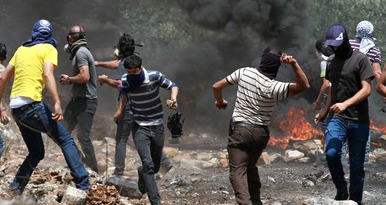
Palestinian protesters clash with Israeli security forces on the West Bank in June.The conflict derives from a military occupation in which thugs on the occupiers’ side of the conflict are allowed to increasingly spin out of control, roaming streets and forests to brutalize a captive population whose only weapons are stones and largely ineffective rockets.

The Times provides a medical report and describes  the immediate aftermath of the death of Muhammad Abu Khdeir:

“On Saturday, the Palestinian attorney general said that an autopsy had found soot in Muhammad’s lungs, suggesting that he had been burned alive before his charred body was found in a forest.

The preliminary autopsy findings, and reports that a 15-year-old, American-born cousin of Muhammad had been brutally beaten and then arrested by Israeli police officers during a violent clash in the neighborhood on Thursday, only increased the outrage Saturday in Shuafat and among Palestinians elsewhere.”

This is what happens in an occupation. Violence spirals and law disappears into chaos.

Superior military power solves nothing,  Rather,  it emboldens violent conduct.  As a consequence, that conduct evokes the memory of brown-shirted party members rampaging through the streets of Germany’s towns and cities as the Nazis came to power.

More from the Times:

“Today is my cousin, tomorrow my son,” said Abir Abu Khdeir, 45, one of scores of mourning women in the shaded courtyard outside Muhammad’s home. “All Shuafat is in danger, all the settlers around us. It’s like a monster — they want to eat us.”

Muhammad’s mother, Suha, sat in the center, interrupting interviews to cover her tears with an orange washcloth. Muhammad was the fifth of her seven children, a goofy jokester who danced the dabke, a traditional line dance, in a folk troupe. He was a devoted fan of the Real Madrid soccer team and went weekly to a barber to keep the sides of his head closely shaven.

His mother said she had just given Muhammad breakfast when he left at 3:30 a.m. Wednesday for the prayer that starts the daily fast during the Muslim holy month of Ramadan.

There is a stark contrast between this Jerusalem domestic tableau of community and family grief, and the game-playing of those U.S. religious leaders who refuse to take even minor economic steps to demonstrate solidarity with an occupied people.

When will they ever learn?  The answer is not until we learn to see ourselves as history will one day remember us.

Start with the ongoing conflict over divestment within the Presbyterian Church USA, and look at this conflict as a replay of an American southern religious struggles in the the early 1960s.

The horrific stories of this past week recall a development in the struggle for justice in Life Getty ImagesApril, 1963, when Dr. Martin Luther King, Jr., was confined in the Birmingham city jail. King, (right) and several colleagues had been arrested for demonstrating against racial segregation.

In April, 1963, a group of church leaders refused to take action to stop the brutality and killings of racial segregation in the American South.

Go slow, they advised King, a man who had lived in the state of Georgia under the tyranny of segregation his entire life. He was finished, he said, with “going slow”.

In his jail cell he sat down and wrote, at first on scraps of paper, the famous document that came to be known as the “Letter from Birmingham jail”.  That letter was first published in The Christian Century magazine.

American church leaders who want to “go slow” in Palestine in 2014, should spend this week contemplating the relationship of the 1963 church leaders’ counsel to King to “go slow”, to the “go slow” mindset of those 2014 U.S. denominational leaders who continue to “debate” what should be done to deal with the asymmetrical power struggle between Israelis and Palestinians.

The parallel between a U.S. segregated society in 1963 and the asymmetrical struggle between Israel’s occupation military force and an occupied Palestinian population should be painfully obvious.

Scholars who study the 1963 American segregation era concur that the only religious leader who later expressed regret over the 1963  religious “go slow” letter was a Birmingham Jewish leader, Rabbi Milton L. Grafman, of Temple Emanu-El,

There were divestment supporting Jewish observers at the 221st Presbyterian USA General Assembly—the denomination has been around more than two centuries—when that body voted to divest all financial holdings from three U.S. corporations doing business in the Occupied Palestinian Territories (OPT).

The vote was close but the GA did vote to get out of the business of financing military occupation.

The vote to divest from three companies, Caterpillar, Hewlett-Packard, and Motorola Solutions, was a political contest between Presbyterian delegates who favored the divestment resolution and pro-Israel  delegates and their Jewish Zionist-oriented observers, who opposed divestment.

One Jewish observer tried a tactic that smacked of good old fashioned U.S. political horse trading.

That observor, Rabbi Rick Jacobs, offered to guarantee the delegates a personal meeting between the PCUSA General Assembly moderator, Heath Rada, and Israeli Prime Minister Benjamin Netanyahu, if the delegates would vote down the divestment resolution. That ploy failed.

heath-rada Danny Bolin Assembly siteRada (shown here) maintained a good spirit during the debates. As votes were tallied, he had to respond to efforts to halt the voting through procedural maneuvers.

As each maneuver was tried, he said it looked like he might be packing his bags to fly to Tel Avi. When the maneuvers were rejected, he joked that he would have to unpack his bags.

During the Assembly, an attempt was made by the pro-Israel contingent in the GA to ban sales of the study book, Zionism Unsettled, from the denomination’s book stores. That effort was defeated by assembly delegates.

The Israel Palestine Mission Network (IPMN) web site gives the history of that parliamentary maneuver:

“At the 221st GA, in the commissioners’ resolution that was overwhelmingly approved in the plenary as part of the consent agenda, the GA clarified that the publication [Zionism Unsettled] “does not represent the views of the Presbyterian Church (U.S.A.)” and directed “all Presbyterian Church (U.S.A.) entities to express this statement in all future catalogs, print or online resources.”

Zionism Unsettled is, of course, a study guide that did not claim to be church doctrine. It was a guide designed by IPMN to explain the mysterious hold that a 19th century political ideology called Zionism holds over contemporary 21st Protestant church leaders.

Well after the General Assembly adjourned and the delegates returned home, IPMN received an unexpected shock.

The PCUSA executive committee announced that “since Zionism Unsettled was not in keeping with current church doctrine”, it would not be sold from the denomination’s book stores nor on the denomination’s website.

In short, despite the defeat of that action by the GA delegates, the defeated action became official church policy.

Despite this setback, IPMN reports that it will continue to distribute ZU through its web site.

The U.S-based United Methodist Church will meet during the summer of 2016. A  battle over divestment is expected

Delegates for that 2016 General Conference are already being elected in regional conferences. Predictions vary, but the Methodists are expected to be as divided on the issue of divestment as their Presbyterian colleagues.

In a recent posting, I called attention to a quote from Rashid Khalidi,  who quotes William Quandt.

Quandt sums up the Palestinian dilemma in past U.S. secular presidential decision-making with a simple declaration: “the Palestinians had no domestic constituency”.

Religious communities in the U.S. are supposed to function as the nation’s conscience, the moral center that speaks for the voiceless and the oppressed.

Unfortunately, in the matter of Israelis and Palestinians, with some scattered but notable exceptions, our religious communities  remain trapped in their own self-imposed political prison, euphemistically referred to as “interfaith dialogue”.

Despite its innocuous appearance,  the phrase, “interfaith dialogue” refers to the amazing assumption that to maintain friendly relations with people of the Jewish faith, Christians must overlook the atrocity of the modern state of Israel’s military occupation of the Palestinian people.

Or to put it in the vernacular, “Me and the rabbi, we go way back. Palestinians?  Don’t know any. What’s for lunch?”


The picture at top is by Rina Castelnuovo of The New York Times. The picture depicting stone throwing Palestinians is from The Guardian by Barcroft Media. The picture of Dr. King is from the History web site.  It is a Life/Getty Images.

Posted in Middle East, Middle East Politics, Presbyterian Church USA, United Methodist Church | 9 Comments

“When First We Practice to Deceive”

by James M. Wallunnamed

“Oh what a tangled web we weave
When first we practice to deceive.”

These words from Sir Walter Scott (1808) describe the political template of the modern state of Israel.

Israel is a nation built on deceptive lies, preserved by deceptive lies. Israel is a nation practiced in the art of using whatever is available to keep alive their carefully “tangled web” of deceptive lies.

The latest addition to this tangled web came June 12, when three Israeli teenagers disappeared in the occupied territory of the West Bank. The boys were from three Orthodox Jewish settler families living in illegal settlements in the Hebron area.

Their families had placed them in a danger zone. Juan Cole writes:

“It should be fairly obvious that if you take adolescents into the middle of the Palestinian West Bank and steal Palestinian land and build houses on it and shoot at Palestinians trying to harvest their crops nearby and bulldoze down their homes or dig tube wells so deep as to cause the Palestinian wells to run dry– if you engage in this settler-colonial enterprise, then you are exposing those adolescents you drag with you into it to danger.

It is still wrong. Violence in anything other than direct self-defense is always wrong, and innocent non-combatant life must never be taken. A resistance movement is legitimate, but its quarrel must be with soldiers.”

The latest narrative of Israel’s tangled web continued as Israel sent its occupying army on an extensive search for the teenagers.

The search extended well beyond the reasonable area where the boys might be found. Instead, it focused on homes and areas known to house Hamas supporters and leaders, the Palestinian party Israel wants to prevent from joining a unified Palestinian government.

From the outset the search was a deceptive lie.

The teenagers were not missing, they were dead.  What was missing were the bodies of the three boys.

Knowing this from the beginning, the government of Israel put a media “gag order” on news of the search.

The government of Israeli Prime Minister Benjamin Netanyahu allowed a narrative of national outrage and grief to grow, providing cover for a military assault on Hamas.

The teenagers had been dead since June 12. The government knew this. And yet, it allowed the lie that they might be found alive to fill the hearts of three grieving families and the collective heart of the nation.

Buzzfeed described what the government had known since shortly after the teenagers disappeared:

“Within minutes of stepping into the battered Hyundai i35 on the night of June 12, Israeli teens Gilad Shaar, Naftali Fraenkel, and Eyal Yifrach knew they were in trouble.

The three teenagers were squished into the backseat of the vehicle, which had picked them up in the southern West Bank’s Alon Shvut junction, just feet away from a nearby military base. It was just past 10 p.m. at night, and the three were making their way home to their homes in the West Bank settlement bloc of Gush Etzion.

They rang their parents to say they were hitching a ride, as they often did. But then, within minutes of entering the car, one of them managed to make a two-minute phone call to police at the local Kiryat Arba police station, and in hushed tones said, “We’ve been kidnapped.”

“They knew immediately what had happened to them,” said Yoav, one of two Israeli army officers involved in the kidnapping case who spoke to BuzzFeed on condition he be quoted with only his first name since many of the details are still under gag order. “They got into the car after 10 p.m., and at 10:25 they called police.”

The local officer on call, however, didn’t pass on the information about a possible kidnapping to his superiors for hours, and gave up trying to re-dial the cell phone after eight attempts. By the time anyone more senior had been notified, the three teens were dead.

“We don’t know yet what led the kidnappers to shoot the teens. But we know it happened quickly, within hours, maybe within an hour, of when they were taken,” said a second Israeli officer involved with the case. “They were shot. There was no chance they could survive.”

Previously under gag order were details that a shot could be heard in the background of the phone call to police, and that forensic evidence found in the Hyundai indicated that there had been foul play.

“We have been operating, for some time now, with evidence that these boys were killed,” said the officer in Hebron. “It is with a heavy heart that we realized we were looking for bodies.”

The Hyundai, which was abandoned, torched, in the Palestinian city of Hebron, shows that the three teens were shot at close range inside the car. The kidnappers then moved their bodies to a second vehicle, which they drove approximately 10 minutes down the road to an empty field in the north of the city.”

This truth could not surface, the web could not reach a new tangle, until the three bodies were located.

This finally happened June 29, when local volunteers and IDF soldiers dug into a pile of rocks by the side of the road where the teenagers had been traveling June 12.

Their bodies had been hastily buried under a pile of rocks. As one Israeli official admitted, “this was not a well-planned” abduction and killing.

An IDF statement on the discovery of the bodies, reported by Ma’an, ended with a final display of planned deception: “The families of the abducted teens have been notified.”

The Jewish families had been allowed to hope their sons were alive for 18 days, as the IDF looked not for live boys,  but for three dead bodies.

The deceit continued with further deception of the Israeli public. The Israeli government promoted a mass rally in Tel Aviv one day before the bodies were found, focused on the bogus hope that the boys might still be found alive.

Earlier, Israel, in an egregious exploitative use of a grieving parent, sent one of the Jewish mothers to Geneva to address the UN Human Rights Council, where she asked for help in finding her son and the two other teenagers.

This narrative of hope and grieving stretched out for 18 days; it ended only when volunteers, who had to beg to be allowed to help in the search, assisted the IDF in finding the bodies.

Responding to the news of the discovery, Prime Minister Netanyahu was ready with his statement of outrage. He had three weeks to polish his statement.

It was not, however,  a measured statement of a leader. It was rather, a statement to keep alive public anger and fear, the fuel on which his government depends for its existence.

The Jerusalem Post reported on the Prime Minister’s reaction:

“our hearts bleed, the entire nation cries” with the families of the deceased.  “They were kidnapped and murdered in cold blood by animals,” he said. “Hamas is responsible and Hamas will pay.”

These words were a part of the tangled web of deceit. They supported the ongoing attacks on Hamas, a “search” which served to justify military assaults intended to eradicate an important partner in a new Palestinian government.

By July 1, the “search” had led to the deaths of six Palestinians. This count was before the Israel Air Force struck more than 30 Gaza targets the day after the bodies were found.

Ma’an reports: “Israeli forces shot and killed a Palestinian teenager during a military operation in Jenin refugee camp in the northern West Bank early Tuesday, locals and medics said.”

“Palestinian Red Crescent medics told Ma’an, 16-year-old Yousef Abu Zagha was shot by Israeli fire in the chest during clashes with troops who raided the camp overnight.”

Richard Silverstein writes that “One day before the bodies were discovered Israel ordered armored units to report to the Gaza border where they are mobilizing for what may happen.

He quotes the words of Israeli Deputy Defense Minister Danny Danon: “Israelis have the willingness and the fortitude necessary to endure the hardships of a long-lasting operation aimed at eradicating Hamas. We will not stop until Hamas is completely defeated.”

Silvestein gives the context for these attacks:

“This is the same rhetoric that preceded the 2006 Lebanon war and the 2008-9 Operation Cast Lead. I predict one of two things: either there is a full-scale invasion of Gaza; or a punishing air assault accompanied by some dramatic targeted killings over the next six months which try to eliminate some of Hamas’ senior leadership.”

As part of the narrative, Israel identified its prime “suspects” before the discovery of the bodies. Two Hamas activists in the Hebron area, Marwan Qawasmeh and Amar Abu Aisha, were “fingered” by Palestinian security forces who reported to Israeli operatives that the two “suspects” had “disappeared” from Hebron “within 24 hours of the abduction”.

The Al Monitor web site suggested that Israel used the coincidence of two Hamas activists disappearing the day after the three Israeli teenagers disappeared as “the first clue” which prompted Israel to focus its assault against Hamas.

There is, however, an equally logical reason to assume that the two Hamas activists, if indeed they had anything to do with the murders (their disappearance being the only “evidence” against them), could have operated alone.

“According to Palestinian sources, Palestinian security forces had already reported to Israel that these two suspects had disappeared from Hebron within 24 hours of the abduction. That was the first clue in the investigation and the reason why Israel pointed an accusatory finger at the Hamas infrastructure in Hebron. 

While Israel continues to accuse the Hamas movement and its leadership of being responsible for the abduction [and subsequent deaths], Palestinian security forces attribute the abduction to the Qawasmeh clan of Hebron, specifically.

Though the clan is known for identifying with Hamas, it also has a well-earned reputation as troublemakers. Not only does it tend to ignore the movement’s leaders. It even acts counter to the policies being advocated by the movement.”

As of Tuesday, July 1, nothing further has been heard of the whereabouts of Marwan Qawasmeh and Amar Abu Aisha. One thing is certain to IDF, the two men are not in their homes. The army has made frequent and destructive visits to their homes and found no signs of the missing Hamas-related Palestinians.

Guilty or not, it is highly unlikely that they will be found alive.

They have already served their purpose, guilty or not.  They fit into Israel’s narrative of obsessive fear and anger, the detailed plot twists of which are orchestrated by Israel to fit its purposes.

Andrew Levine​, a Senior Scholar at the Institute for Policy Studies, wrote recently:

Israel thrives on what it calls “existential threats,” fabricated perils that are just plausible enough to be believed.  As social divisions mount, they help hold Israeli society together. They also keep “diaspora” Jews on board.  And they keep Western, especially American, diplomatic, military and economic support, coming.

These manufactured “existential threats” also keep alive the myth prevalent within American religious communities (most recently, the Presbyterian Church, USA), that Israel is a nation in peril.

Israel is not in peril, except from itself and its own self-destructive, paranoid narratives of deceptive lies, the latest of which exploited the deaths of three Israeli Jewish Orthodox teenagers.

The picture above, of Israeli bombing attacks on Gaza, is from Foreign Policy.


Posted in Human Rights, Middle East Politics, Netanyahu, United Nations | 8 Comments

PCUSA Divests from Occupation Support Firms

by James M. Wall

Observer Robert Ross reacts: Joshua Lott for The New York Times

Ten years after the start of their divestment campaign against Israel’s occupation of Palestinian land and people, the Presbyterian Church (USA) anti-occupation forces have finally removed that denomination’s funds from the occupation.

In their 221st biennial General Assembly Friday, PCUSA commissioners (delegates) voted 310-303 to divest all financial involvement in three U.S. corporations whose products are used to enforce Israel’s occupation: Hewlett Packard, Motorola and Caterpillar.

Hewlett Packard manufactures eye and face scanning devices used at Israeli checkpoints, Motorola provides communications facilities within the occupied areas; while Caterpillar makes bulldozers used by Israeli authorities to destroy Palestinian homes.

The removal of PCUSA investments in those firms will neither end the occupation nor change Israel’s tactics over a captive population.  Total PCUSA investment in these firms is but a tiny portion of the Israeli military budget, a substantial amount of which is derived from annual U.S. gifts and loans.

The vote was not about the money; it was a moral vote against the occupation.

Through their divestment vote, U.S. Presbyterians are telling Israel, we do not support your occupation, no matter how hard you try to incorrectly shape the conversation as anti-Israel and anti-Hewlett Packard, Motorola and Caterpillar.

What will be the impact of the vote on U.S. public opinion? As with most major changes in history, the impact is usually incremental.  This vote was a small vote for humankind, a vote that should be remembered the way the 1833 vote taken in the British Parliament to end the slave trade, is remembered.

Christian evangelical William Wilberforce was a leader in the fight against slavery through much of his life. He was fighting against a strongly-entrenched economic system that profited from the slave trade. . Here is one account of that British Parliament vote:

Despite the groundswell of public opinion, Parliament still refused to ban slavery, until parliamentary reform removed many of its supporters. Despite this, it was still not clear that Parliament would act. Wilberforce wrote a last petition. The Parliamentary debate lasted three months.

On the 26th July, 1833, the Abolition of Slavery bill passed its third reading in the House of Commons. A messenger rushed to Wilberforce’s house. They told him that slavery in British colonies would finally be abolished. Just three days later, on 29th July, William Wilberforce died.

Other denominations now have the Presbyterians as a moral bellwether. If they pay attention, they have also seen the Israeli narrative playbook in operation.

With approximately 1.76 million members in 2013, the PCUSA is the third largest denomination among the seven major U.S. mainline churches.

The largest denomination among the Big Seven is the United Methodist Church (UMC), which reported almost 8 million U.S. members in 2008. Anti-occupation UMC forces recently achieved a major divestment victory when its Pension Board withdrew church funds from G4S, a British firm that supplies equipment for use in Israeli prisons housing Palestinian prisoners.

Word on the church “street” is that the UMC is gearing up for its own divestment battle at its 2016 General Conference. The results of the USPCS vote should encourage Methodist anti-occupation leaders to prepare for their own exit from the immoral occupation business.

The Methodists can expect to encounter the same playbook in 2016 that the anti-divestment forces used in the PCUSA General Assembly.

That playbook may well have contributed to the narrowness of the Presbyterian vote Friday. The New York Times story at the end of the 2012 General Assembly in Pittsburgh, PA, echoes stories that swept through the media this year after the 2014 vote.

In 2012 the vote was even closer than it was in 2014. It also achieved the opposite result. The New York Times story reported in 2012 that the General Assembly voted 333 to 331, with two abstentions not to divest from Hewlett Packard, Motorola and Caterpillar.

As Yogi Berra once said, the 2014 vote was “deja vu all over again”, except with a different ending.  Here is Laurie Goodstein, who also covered the 2014 GA, writing in the Times, July 5, 2012:

The decision not to divest, the culmination of an eight-year process, was watched intensely by Christians, Jews and Palestinians in the United States and in the Middle East.

It is likely to bring a sigh of relief to Jewish groups in Israel and the United States that lobbied Presbyterians against divestment, and to dismay the international movement known as B.D.S. — Boycott, Divest and Sanctions — which advocates using economic leverage to pressure Israel to return occupied land to the Palestinians.

In 2012, the General Assembly voted “to toss out the divestment measure and replace it with a resolution to encourage ‘positive investment’ in the occupied territories.”

The anti-divestment playbook was very much in evidence in Detroit last week. Hanging over the commissioners as they debated and finally voted, were passionate pleas not to divest, from commissioners who were terribly afraid that relations with their Jewish friends would be damaged.

This should have been evident to those observing and voting in Detroit’s Cobo Center. It was certainly evident to those of us who spent many hours on Friday watching proceedings on a public live internet feed.

One young commissioner was so emotional over the impact of the divestment vote on employees he knew personally who worked for Caterpillar, that he could hardly speak. The presiding officer had to gently tell him his time had expired.

That is the pro-Israeli playbook: Step One, tap into the personal feelings of commissioners where they “live”, American workers and Jewish neighbors.  Step Two: hit the internal mute button on the suffering caused by the occupation.

The internal mute button kept the occupation out of most of the GA discussion, except for the occasional testimony from commissioners who have visited the occupied areas.

One commissioner, Paul Tallarico, moderator of the Presbytery of the Palisades in New Jersey, spoke from the floor and told of visiting a Palestinian shop keeper just off Bethlehem Square.

In their conversation, Tallarico said to the shop-keeper, “I know how you feel”. The shopkeeper asked him where he lived.. Tallarico answered, “in the United States”.  The shopkeeper responded, “Then you don’t know how I feel. I live in a prison all of the time”.

There was a poignant authenticity in that exchange. Did it change votes inside Cobo Center? Only the voting commissioners know.  But what it does do is to highlight the stark contrast between the pro-Israel playbook narrative, which keeps the discussion focused on American “feelings” and keeps it away from the sufferings of those who live under a tight military occupation.

There were many non-voting “observers” inside Cobo Hall, many of them people of all ages who belong to Jewish organizations opposed to the occupation.

The picture at top of this posting captures one of those “observers”, Robert Ross, as he reacts joyfully and in amazement just as the final divestment victory vote is posted on the big screen behind the podium. The picture is from the New York Times.

The battle is joined in this moment of victory against the occupation.

It will be a long battle. Not only will it be against the pro-Israel forces deeply embedded in all church bodies, but it will be a battle against an Israeli government that genuinely hates any criticism of their control of the occupied territories.

In its story on the anti-divestment vote, the Voice of America web site reported:

In a statement posted Friday night on its Facebook page, the Israeli Embassy in Washington called the resolution “shameful.”

“Voting for symbolic measures marginalizes and removes its ability to be a constructive partner to promote peace in the Middle East,” the statement said. “We would have hoped that (the Presbyterian church) would have joined us in promoting peace and denouncing terrorism.”

Mount up, you Methodists and you other five denominations in the Big Seven church bodies, the PCUSA has shown you how to fight the occupation. It has also shown you what you are up against.  It will not be easy.

When you think about the hard fight ahead, remember that Bethlehem shop keeper whose words are now in the hearts and minds of all who heard him quoted on the floor of the  2014 PCUSA General Assembly.

‘Then you don’t know how I feel. I live in a prison all of the time’.”

Words to fight by.


Posted in Media, Middle East, Middle East Politics, Presbyterian Church, Religious Faith | 14 Comments

PCUSA Tries Again to Divest From Occupation

by James M. WallLogo

The Presbyterian Church (USA) (PCUSA) is holding its biennial national General Assembly this week in Detroit, Michigan (June 14-21).

A number of overtures (resolutions) will be debated and voted on during the Assembly by 654 commissioners (elected representatives).

One overture before the Assembly will offer Presbyterian General Assembly commissioners the opportunity to have the denomination divest from three major corporations–Caterpillar, Hewlett-Packard, and Motorola–that profit from Israel’s occupation of Palestine.

As of December 31, 2013, the PCUSA Board of Pensions’ total investment assets were $9.2 billion. The PCUSA has a membership of over 1,800,000 members related to 10,262 congregations.

The overture on pension funds and the Palestinian occupation has been presented to the General Assembly by the PCUSA’s “socially responsible investment committee”. It is a hard-hitting overture that follows ten years of failed discussions with representatives from the three targeted companies.

Church holdings in those companies will not have a major impact on profit and loss statements, but a divestment decision would be a major blow to the public image of the corporations, that all-important public face which leads big corporations to spend considerable money, time and energy, to protect and polish.

A vote for divestment would also further tarnish Israel’s international reputation, that precious commodity which Israel’s hasbara (propaganda) programs also labor mightily to protect and polish.

Previous religious divestment actions have come nationally in the Mennonite Church, and within the Quaker retirement fund. Other divestment victories have been won in regional bodies of the United Methodist Church and the United Church of Christ.

Most recently, the Pension Board of the national United Methodist Church joined the Bill Gates Foundation in divesting from G4S, a British-based corporation which runs services for cash transportation and prison management in more than 125 countries.

Israel’s prison system in Palestine uses the services of G4S, a moral concern that played a part in the United Methodist Pension Board’s decision to withdraw portfolio funds from G4S.

Liz Ingenthron, writing in her pro-divestmenet Jewish Voices for Peace blog, emphasizes a point often misstated or ignored in pro-Israel media outlets: The divestment resolution does not call for divestment from Israel, from Israeli companies, or from Jewish-owned companies.

Rather, it mandates that the church’s pension board specifically divest from three multinational corporations doing business in Occupied Palestine.

Presbyterian layman Robert Ross is an Assistant Professor of Global Cultural Studies at Point Park University, in Pittsburgh, Pennsylvania. His research and teaching focus on the political-economic geographies of Israel, Palestine, Lebanon and the United States.

In his most recent posting for Mondoweiss, Ross provides background for the divestment vote:

The [PCUSA] does not invest in any companies that sell weapons, regardless of where, how, and by whom they might be used.

The three companies on the divestment docket this year—Caterpillar, Motorola Solutions, and Hewlett Packard—are in clear violation of this policy.

According to extensive research conducted by the Church’s Mission Responsibility through Investment (MRTI) committee,

Caterpillar provides weaponized bulldozers to the Israeli military, which are used to demolish farmland in Gaza and Palestinian homes in the occupied West Bank and East Jerusalem;

Motorola Solutions manufactures fuses for Israeli bombs, the communications system for Israel’s military, and surveillance equipment for illegal Israeli settlements;

and Hewlett Packard furnishes the computer hardware for the Israeli Navy and the biometric scanners for checkpoints, through which all Palestinians (but no Israelis) in the occupied West Bank must pass. .  .  .

The overture to divest is thus in line with Church policy and stands as a clear reaffirmation of the denomination’s commitment to the Christian ideals of peace, justice, and human rights.

In short, there is no reason the Presbyterian Church (USA) should vote against divestment.

MJ Rosenberg, a Jewish progressive journalist who once worked for AIPAC, succinctly describes the occupation work of the three corporations targeted in the GA overture:

Caterpillar manufactures the bulldozers used to demolish Palestinian homes to make way for settlements.

Hewlett-Packard supplies Israel with the hardware to maintain the blockade of Gaza and the software to enable Israel to segregate and separate Palestinians at West Bank checkpoints.

Motorola provides the surveillance equipment used to monitor Palestinian civilians throughout the West Bank.

These three are to the occupation what Dow Chemical was to the U.S. war in Vietnam.

Rosenberg has sound moral advice to offer pension board members:

I don’t understand why any religious group would invest in any of these companies in the first place. All three [Caterpillar, Hewlett-Packard, and Motorola] are members in good standing of the military industrial complex and have been involved in unsavory activities around the globe. But that argument is for another day.

Right now, the Presbyterian Church has the opportunity to say NO to the occupation in a tangible, concrete way. It has the opportunity to support Palestinians without harming Israelis.

I can hardly imagine any progressive voting NO on this resolution, choosing big corporations over the people of both Palestine and Israel.

In spite of the obvious morality of a YES divestment vote, there is still no guarantee that this year’s General Assembly will support this particular overture.

A General Assembly 2012 vote to divest investment funds from these same companies, , failed by two votes. Intense lobbying from both sides of this issue–including both Christian and Jewish activists–is expected on and around the Assembly floor.

The divestment vote is expected this week on Wednesday night or Thursday morning.

The illustration above is the official logo of this year’s 221st General Assembly.

Posted in Middle East, Presbyterian Church USA, United Methodist Church | 7 Comments