Hagel Defenders Battle Neocon Opposition

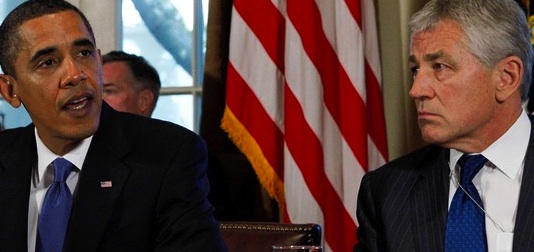
Senator Chuck Hagel (L) enjoys a laugh w

By James M. Wall

The Washington Post wrote in a lead editorial, December 18, that President Obama should not nominate former Nebraska Senator Chuck Hagel as his Defense Secretary because the President “has available other possible nominees who are considerably closer to the mainstream and to the president’s first-term policies.”

Daily Beast columnist Andrew Sullivan responded to the Post editorial in his best high dudgeon fashion:

“Considerably closer to the mainstream” is not a good thing if the mainstream (including the Washington Post) led us to endless, pointless, fruitless occupations and wars that have deeply wounded American credibility and credit, as well as costing up to a hundred thousand innocent lives. We need less mainstream thought in Washington, not more.

The Post editorial reads like a set of instructions to a pro-Israel media/political hit squad on how to block Hagel as Obama’s nominee for Defense Secretary.

Is Hagel doomed to suffer the Charles Freeman treatment? Freeman, an experienced diplomat, had displayed the same independence from Zionist pressure that Chuck Hagel has shown.

When Freeman was initially chosen by the new Obama administration in 2009 to serve as Chairman of the National Intelligence Council (NIC), the neocons swung into action. Politicians and media voices painted Freeman, unfairly, as a danger to Israel.

The White House did little to rally support for Freeman, who soon agreed to withdraw his name, though not without some strong words about the machinations of the Israel Lobby.  When Barack Obama hit his first term neocon stone wall, he capitulated.

In a new essay for Consortium News, Freeman recalls his earlier experience, noting that:

The tactics of the Israel Lobby plumb the depths of dishonor and indecency and include character assassination, selective misquotation, the willful distortion of the record, the fabrication of falsehoods, and an utter disregard for the truth.

Today, a second term awaits Obama. Once again the White House has floated a name that was bound to arouse opposition from the neocons.  What will Obama do this time?  Thus far, the White House appears to have left Hagel to the mercy of his opponents. Unlike Freeman, however, Hagel has begun to hear sounds of support, with the widely read Andrew Sullivan leading a growing media/political support effort for Hagel. Is some of this support generated behind the scenes from the White House? Possibly.

Robert Wright writes in his Atlantic blog:

Last night (December 25), the Washington Post published a letter in support of Hagel signed by four former national security advisers — James L. Jones, Brent Scowcroft, Zbigniew Brzezinski, and Frank Carlucci. They write:

“Mr. Hagel is a man of unshakable integrity and wisdom who has served his country in the most distinguished manner in peace and war. He is a rare example of a public servant willing to rise above partisan politics to advance the interests of the United States and its friends and allies.”

Note the bipartisan cast. These people held the top White House national security post in, respectively, the Obama, George H.W. Bush, Carter, and Reagan administrations. And they’re not alone. Hagel has also been endorsed by a slew of former U.S. ambassadors, from both Democratic and Republican administrations, including no fewer than five who have served as ambassador to Israel.

A week after Sullivan’s column on behalf of Hagel, and to the surprise of many, Thomas Friedman let it be known that a Hagel nomination would be in Israel’s best interest, always the bottom-line measure Friedman applies.

Friedman’s December 26 New York Times column sent word to Israel’s many friends in the U.S. that Friedman has their back.  More importantly, he has Chuck Hagel’s back:

I am a Hagel supporter. I think he would make a fine secretary of defense — precisely because some of his views are not “mainstream.” I find the opposition to him falling into two baskets: the disgusting and the philosophical. It is vital to look at both to appreciate why Hagel would be a good fit for Defense at this time.

The disgusting is the fact that because Hagel once described the Israel lobby as the “Jewish lobby” (it also contains some Christians). And because he has rather bluntly stated that his job as a U.S. senator was not to take orders from the Israel lobby but to advance U.S. interests, he is smeared as an Israel-hater at best and an anti-Semite at worst.

If ever Israel needed a U.S. defense secretary who was committed to Israel’s survival, as Hagel has repeatedly stated — but who was convinced that ensuring that survival didn’t mean having America go along with Israel’s self-destructive drift into settling the West Bank and obviating a two-state solution — it is now.

When someone of the stature of Tom Friedman rejects conventional mainstream wisdom,  it is hard not to recall the famous Walter Cronkite-Lyndon Johnson moment when a media icon spoke truth to the powerful.Cronkite crop

That moment took place  on February 27, 1968, after CBS newsman Walter Cronkite’s first visit to Vietnam. Cronkite’s concluding editorial comment that night, in which he declared that the war was futile, is supposed to have led President Lyndon Johnson to declare, “If I’ve lost Cronkite, I’ve lost Middle America”.

Johnson’s exact words, or when he actually heard Cronkite (shown here), have been debated, but the historic fact remains that Johnson soon announced to the nation that he would not run for reelection.

Will Friedman’s column supporting Hagel have a Cronkite-like impact on President Obama’s decision on his next defense secretary?  We will most likely have to wait for a post-second term memoir for an answer to that question.

There is also no indication that former President Bill Clinton has spoken to President Obama about Hagel.  What is known is that Clinton is fully aware of Hagel’s service in the Vietnam War, in the U.S. Senate and now, after he left the Senate, as president of the Atlantic Council.

In the picture at top, Senator Hagel (left) is shown in good spirits after Hagel presented the former president with the Atlantic Council’s Distinguished International Leadership Award on April 28, 2010.

A Washington Post news profile by Craig Whitlock appeared two days after the Post editorial. It provides compelling testimony from Hagel’s war experience:

Shards from a Viet Cong mine are still embedded in Chuck Hagel’s chest, 44 years after his infantry squad walked into a booby trap in the Vietnam jungle. Scar tissue marks the left side of his face from another mine explosion, barely a month after his first brush with death.

“I remember,” Hagel told an interviewer for the Library of Congress’s Veterans History Project in 2002, “thinking to myself, you know, if I ever get out of all of this, I am going to do everything I can to assure that war is the last resort that we, a nation, a people, calls upon to settle a dispute. The horror of it, the pain of it, the suffering of it. People just don’t understand it unless they’ve been through it.”

Today, Hagel, 66, heads President Obama’s shortlist of candidates to lead the Pentagon. If he is nominated by the White House and confirmed by the Senate, he would become the first defense secretary with a Purple Heart, the combat decoration for those wounded in battle, since Elliot L. Richardson, who held the job briefly during the Nixon administration.

In his column for the Daily Beast, Andrew Sullivan has strong words for what he calls the “agitators” who have attempted to smear Hagel as anti-Semetic:

They have every right to their opinion and to see the support for Greater Israel and the occupation as in the long-term interests of the US. They have every right to argue that just because they were grotesquely wrong about the Iraq war, they are obviously looking at Iran from the right perspective.

But that is not what these agitators have done. They have merely smeared Hagel already as an anti-Semite; they have described him as “having anti-Israel, pro-appeasement-of-Iran bona fides” or, in an echo of the WaPo, “out-of-the-mainstream” views.

Why? Because he is not a neoconservative who backs the permanent annexation of the West Bank, because he sees containment as an option for dealing with Iran, and wants to see if the U.S. can develop stronger ties throughout the region, rather than having one alliance destroy the ability of the US to retain any others. He is willing to talk to enemies, like Hamas, when there is no feasible, pragmatic way forward without their engagement.

Hagel has also drawn strong support from former Israeli New York consul general Alon Pinkas, who writes in Al Monitor, that the attacks on Hagel as “anti-Israel” are unfounded and do not serve the US-Israel relationship. He continues:

Even by the ugly and depressing standards of Washington’s [un]civility and character assassination as a beltway hobby, the recent attacks on former Senator Chuck Hagel seem venomous and iniquitous.  .  .  .

It is fine, acceptable and necessary to conduct a debate on past and present positions and policy preferences of a candidate to be Secretary of Defense. It is, however, quite another thing to tag, brand, defame and distort his record.

It is even worse to do what some, hiding behind the anonymity of “Concerned Jewish Leaders” or “The Pro-Israel Community,” have done: labeling Hagel as Anti-Israeli, and then stepping it up, almost casually, as an Anti-Semite. Chuck Hagel is neither: He is not anti-Israeli and he is not an anti-Semite.

Robert Naiman, Policy Director for Just Foreign Policy has issued a challenge to his progressive U.S. Jewish colleagues–whom he calls ” the pro-Obama Jews”–to resist the main stream media-run campaign to block Hagel’s nomination. Writing for the Huffington Post, Naiman asks:

What do we want the next four years to be like? Do we want to spend the next four years under the jackboot of the neocons, even though we beat them in the last three presidential elections, starting with the 2008 Democratic primary?

If we don’t want to spend the next four years under the jackboot of the neocons, then we have to stop the neocons from blocking the nomination of diplomacy advocate, war skeptic and decorated Vietnam combat veteran Chuck Hagel. .  .  .

If President Obama does not want “to spend the next four years under the jackboot of the neocons”, he should listen to Tom Friedman, Andrew Sullivan, and those four former national security advisers, and nominate Chuck Hagel as his second-term Defense Secretary.

The picture at top, from the Daily Beast, is by Leslie E. Kossoff/AFP/Getty Images.
Posted in Media, Middle East Politics, Politics and Elections | Tagged , , , , | 13 Comments

Will Israel Block Hagel as Defense Secretary?

Obama Hagel Reuters crop

by James M. Wall

Former Nebraska Senator Charles (Chuck) Hagel (above right) may be nominated by President Barack Obama to be secretary of defense.

The President is known to like his old Senate colleague, a Republican who, like Obama, considered running for president in 2008. Unlike Obama, Hagel decided not to run.

Hagel, a Vietnam War veteran, would provide Obama with a Republican in the upper echelon of his second-term cabinet, a nice touch in a season when the American movie-going public is discovering Abraham Lincoln’s 1865 “team of rivals” cabinet. The script for the film, Lincoln, is derived, in part, from Doris Kearns Goodwin’s book, Team of Rivals: The Political Genius of Abraham Lincoln.

What could possibly derail Chuck Hagel’s nomination? He meets all the qualifications in personal conduct, political experience, and friendship with the president and colleagues in the U.S. Senate.

None of this matters to the pro-Israel forces that have lined up with their attacks on Hagel. To them, the former Nebraska Senator does not meet the  test of being “100 percent  pro-Israel”. For the neo-conservatives, where Hagel is concerned, as Sherlock Holmes has said, “the game is on”.

The Washington Post’s Dana Milbank describes how vicously the neo-cons play their game. Milbank reported that neo-con guru, Bill Kristol, editor of the Weekly Standard, published a smear under the headline: “Senate aide: ‘Send us Hagel and we will make sure every American knows he is an anti-Semite.’ ”

In the posting, this anonymous aide went on to accuse Hagel of “the worst kind of anti-Semitism there is.” As evidence, the article included a quotation from Hagel referring to the “Jewish lobby.”

The Weekly Standard  writes that it has “obtained a fact sheet circulating widely on Capitol Hill”. The fact sheet, according to the Standard, “details the record on a number of issues of former GOP senator Chuck Hagel, a leading candidate to be nominated by President Obama as the next secretary of defense”.

The fact sheet focuses on issues neo-cons find unacceptable in a cabinet member. Of course, in any rational debate on Middle East politics, these same points could be seen as a positive reason to place Chuck Hagel in Obama’s cabinet.

Here is the National Review’s “fact sheet” with its reasons to reject Hagel:

1. In November 2001, Hagel was one of 11 Senators who refused to sign a letter requesting President Bush not meet with Yassir Arafat until forces linked to Arafat’s Fatah party ceased attacks on Israel.

2. In December 2005, Hagel was one of 27 Senators who refused to sign a letter to President Bush requesting the U.S. pressure the Palestinians to ban terrorist groups from participating in legislative elections.

3. In July 2006, Hagel called on President Bush to demand an immediate cease-fire when Israel retaliated against Hezbollah after the terrorist group attacked Israel, abducted two IDF soldiers, and fired rockets at Israeli civilians.

4. In August 2006, Hagel was only one of 12 senators who refused to sign a letter asking the EU to declare Hezbollah a terrorist organization.

Politico used the headline, “some Jews” object to Hagel, to summarize the case against Hagel. Some samples:

The Times of Israel reported that “the nomination of Hagel would likely worry Israel supporters, who have criticized the former Republican senator for what they see as a chilly stance toward the Jewish state.” The English-language Israeli publication cited Hagel’s past positions on issues including the second Lebanon War in 2006 and Israel’s dealings with former Palestinian leader Yasser Arafat. .  .  .  .

A top Israel advocate told The Daily Beast that “the pro-Israel community will view the nomination of Senator Chuck Hagel in an extremely negative light. His record is unique in its animus towards Israel.”

“He is one of the most hostile critics of Israel that has ever been in the Senate,” Morton Klein, president of the Zionist Organization of America, told the newspaper The Algemeiner.

Media responses to this onslaught from the neo-con right, have not been plentiful. Just in time, however, John Judis, writing in The New Republic, arrives with this gift for those of us who find the pro-Israel attacks on Hagel to be both abhorent and utterly without merit.

He starts by identifying the forces aligned against Hagel:

The stories of Hagel’s looming nomination have aroused intense opposition–but almost exclusively from individuals and organizations that back Israel’s right-wing government and find Hagel’s views on Israel repellent.

These critics include the Republican Jewish Coalition, which is funded by gambling mogul and greater-Israel proponent Sheldon Adelson; the Zionist Organization of America, which also opposes a two-state solution; and a sundry collection of fellow travellers, including the Weekly Standard, Commentary, and the Washington Post’s Jennifer Rubin.

Judis, a veteran reporter and columnist, comes to the Hagel story with sufficient information to reject the anti-Hagel uninformed smears from the neo-conservative right. He writes:

I know something about Hagel. I spent several months talking to him and to people who know him for a profile I wrote for The New Republic in 2007 when he was considering running for president. I can’t confidently say that he would make a good or great secretary of defense, but I can say with confidence that Hagel is an honorable man who served with distinction as a senator and that his foreign policy views, including his positions on Israel and its American lobby, are, if anything, a reason to support rather than oppose his nomination. . . . .

Unlike some Prairie Republicans, Hagel was a committed internationalist who saw NATO, the United Nations the World Bank, and the International Monetary Fund as essential to American foreign policy. He wanted the United States to exert influence internationally, but by working with other countries.

This is the man President Obama has hinted he wants as his next secretary of defense. He may or may not make the appointment. If  he does, the forces that want cabinet officials “100 percent  pro-Israel” will step up their attacks.

These forces will be described as the Israel Lobby. But perhaps the time has come to ask, are we doing a favor to the “Israel Lobby” by granting them  a U.S. “lobby” status?

In the American political system, a lobby is a U.S. group that pushes decision-makers to do what the lobby believes is best on a particular issue.The National Rifle Association (NRA), for example, has long used its political power to block laws that curb what the NRA and its members believe is a God-given right for American citizens to own and shoot fire arms, including assault military weapons.

That belief will be intensively debated in the next few months in the aftermath of the mass school slaughter in Newtown, Connecticut. The NRA now has the burden of arguing its political case against the backdrop of Newtown.

That is what lobbies do; they argue their cause.  Some lobbies hang on to their power too long, as was the case with the Tobacco Lobby,  that only now has become something of a pariah in American life.

It is important to keep in mind, however, as we consider a congressional debate over guns or tobacco, that our gun laws and our restriction on the sale of and advertising of tobacco, apply only in the U.S. They are domestic issues.

The political discourse over the President’s cabinet is very much a domestic issue. Let us be clear about this; input from a foreign power has no place in these decisions.

When Israel’s “myrmidons”  (myrmidon: A faithful follower who carries out orders unquestioningly) infiltrate every segment of our American culture, including our religious institutions, and our media, academic and political structures, they are exclusively promoting the interest not of this country, but of a foreign power, the state of Israel.

An Obama nomination and Senate confirmation of Chuck Hagel would be a major step in breaking the grip of Israel’s myrmidons in this country.

Pre-Christmas Note: Many readers have been returning to a link to a 2010 Wall Writings posting, Behind a 30 Foot Prison Wall, “Merry Christmas” Becomes a Media Lie. To revisit the link, click on the posting’s title.

The photo at top is from Reuters.

Posted in Media, Middle East Politics, Obama, Politics and Elections | 19 Comments

“The fate of human dignity is in our hands.”

by James M. WallRamadan

Writing for both Newsweek and The Daily Beast, Peter Beinart used a surprising phrase to describe how President Obama plans to deal with the Israel/Palestine issue during his second term.

Beinart took his clue from the “pro forma and bland” response the White House made after Israel’s defiant announcement that it would build 3,000 new housing units in an area of the West Bank known as E1.

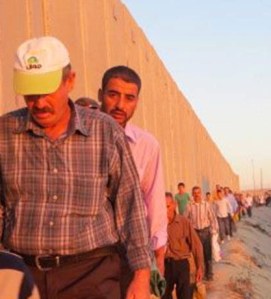
The announcement came just days after the U.N. elevated Palestine to a non-member state status. Some of those Palestinians are shown here, standing in a long line waiting to gain admission to visit Jerusalem during Ramadan.

Obama made no personal comment regarding the new E1 housing, not even the customary “the action is not helpful” reaction. What Beinart learned from “senior administration officials” was that this bland response was the “first sign” of what “may be a new approach to the Israeli-Palestinian conflict in Obama’s second term: benign neglect”.

Benign neglect?

There should be little doubt that President Obama is well aware of his responsibility to manage and improve Israel-Palestine relations. Repeatedly, in his first term, Prime Minister Benjamin Netanyahu was disdainful of the American president, often playing his “additional housing permits” card on Palestinian West Bank land, as a show of defiance.

“Benign neglect” will not be the policy of a president who has just won an election that returned him to the White House for the next four years.

The President’s problem with the Israel Lobby is another matter altogether. Obama will need to deal with the Congress on issues large and small.

He will be unable to make appointments if he cannot overcome the opposition from his opponents in Congress. Most of those opponents are Republicans, but in matters that concern Israel, he must also contend with pro-Israel members of Congress within his own party.

The Lobby is losing clout with the younger Jewish generation, as the Holocaust, long utilized as a tool of persuasion, fades into history. However, the Israel Lobby as a political power remains a strong presence to members of  the U.S. Congress, where senators and representatives have “grown accustomed to the faces” of their friendly AIPAC financial backers at two and six year intervals.

The power will be tested immediately as Obama names a new cabinet for his second term, all of whom will require Senate approval.

The President lost the opening round of the cabinet battle when Republican senators John McCain and Lindsay Graham, and  Independent Senator Joseph Lieberman, threatened an extended fight over the nomination of U.N. Ambassador Susan Rice, to succeed Hillary Clinton as Secretary of State.

That setback, in this case, was related not to the Jewish Lobby, but to the desire of the Republicans to continue to show their displeasure over the initial reports of the deaths of U.S. Libyan Ambassador Chris Stevens and three other State Department officials.

Ambassador Rice withdrew her name from consideration, even though it was clear that she had merely repeated the information to the media, which she had received from U.S. intelligence sources.

Senator John Kerry, chair of the Senate Foreign Relations Committee, became the strong favorite to succeed Hillary Clinton. He should have no difficulty winning the support of the Senate, a body in which he has long been a member.

The Israel Lobby, however, will most certainly come into play in the appointment of a new Secretary of Defense if the President appoints and asks for approval of  the former two-term Republican Senator from Nebraska, Chuck Hagel. (shown here).Chuck-Hagel-AP

President Obama would like a Republican in his cabinet and Hagel is an experienced political leader who has been close to the president since both men served together in the Senate.

Judging, however, from the immediate response from the pro-Israel media, Hagel is not in good standing with the Israel Lobby.

A conservative website, The Washington Free Beacon, which came on line a year ago, posted a story on December 6 about the possible appointment of Hagel as Secretary of Defense.

This is how the Free Beacon views the threat Hagel poses to Israel:

Democrats and Republicans are expressing opposition to President Barack Obama’s possible selection of former Sen. Chuck Hagel (R., Neb.) as the next secretary of defense.

Hagel, who is reported to be on Obama’s shortlist to head the Pentagon, has long raised red flags on Capitol Hill for his controversial foreign policy views, which include sharp criticism of Israel, supporting the elimination of America’s nuclear arsenal, and pushing for direct unconditional talks with Iran.

Hagel’s foreign policy views placed him in the minority of lawmakers on both sides of the aisle during his 12 years in the Senate. His recent work to strip the U.S. of its nuclear arsenal has isolated him even further.

Hagel’s ascension to the nation’s top defense post could imperil U.S. national security at a time when increased threats are emanating from a Middle East in flux, insiders warned.

This is the second time that Hagel has been placed on Obama’s shortlist for the post. It is believed that he “would be a comfortable ideological fit for the president,” according to Foreign Policy magazine’s Josh Rogin.

The White House’s 2010 effort to enlist Hagel drew outrage from Jewish leaders critical of Hagel’s stand on Israel. His current status as the frontrunner is no less controversial.

“It would be a very unwise and disastrous choice for U.S. policies and activities regarding the Middle East,” said Morris Amitay, a former executive director of the American Israel Public Affairs Committee (AIPAC).

“You could probably consider him last in the class,” Amitay said when asked to rate Hagel’s views on Israel. “He’s probably the worst.”

Hagel’s efforts to open up direct negotiations with Iran and its terrorist proxy Hamas have placed him at odds with the pro-Israel community and the majority of Congress.

The U.S. political right’s policy of sanctioning the conduct of the current Israeli government insures that Barack Obama will not be guilty of  “neglecting” his responsibility to side with the oppressed over the oppressors.

Stephane Hessel, now 94, has long been identified as an intellectual giant in the struggle to overcome oppression of any part of the human family.  In his latest book, The Power of Indignation, Hessel writes what he considers to be a continuation of his autobiography.  His message is simple and profound.

His book opens with these words:

IndignationSo what is it exactly that I have learned and must convey?  First, that it is necessary and possible to refuse the unacceptable.

He continued, a few lines later,

In 1948,when  those who drafted the Universal Declaration of Human Rights, attempted to characterize a human person, the term they deemed fitting to all religions, in all philosophies, and which they finally selected was, indeed, dignity.

It is also the concept which inspires the first article of the said Declaration and which sums up, in my eyes, the entire predicament in which our  contemporary  world finds itself:

“All human beings are born free and equal in dignity and rights. They are endowed with reason and conscience and should act towards one another in a spirit of brotherhood”.

Hessel has been active with the Russell Tribunal on Palestine. Near the end of his newest book, Hessel writes of his experience with the Tribunal:

The first session of the Tribunal took place in Barcelona in March of last year [2010].  The second took place in London in November. Between the two, I made my fifth trip to Gaza with my wife and leaders of La Voix de l’Enfant, [a French organization looking to promote the rights of children internationally]. .  .  . 

We were preparing for our third session that following November at the cape with a team of South Africans, who know what apartheid is and can help us contrast it to—without ignoring the differences of course—the fate of the inhabitants in the occupied territories.

In a scene from the current film, Lincoln, President Abraham Lincoln speaks to his cabinet during a tense period of negotiations in January, 1865. At stake is the elimination of slavery in the United States by the passage of the 13th Amendment to the U.S. Constitution.

His voice rising with emotion, Abraham Lincoln tells his cabinet, “The fate of human dignity is in our hands.” That moment is captured in the short clip below:

Human dignity to be gained in the American Civil War in 1865 was Lincoln’s goal, working through the complexities and the duplicities of the political system he led.

Human dignity for the Palestinian people is in the hands of the world in 2013. Barack Obama knows that he and his nation play an essential role in delivering  that dignity to the Palestinian people. Benign neglect will not be his policy.

The picture of Palestinian men, above, show them standing in line next to the “Security” wall surrounding Jerusalem during Ramadan. The picture is from Alternative News.

Posted in Middle East Politics, Obama, Politics and Elections, The Human Condition | 10 Comments

Israel Plans a “Doomsday Settlement” for E1

EI_settlement_zone_video

by James M. Wall

Israel’s response to the United Nations’ overwhelming vote to admit Palestine to the UN was easily predictable. Israel had been waiting for just this moment to announce it would build a settlement in Area E1 (East One).

Prime Minister Benjamin Netanyahu was harshly rejected at the UN General Assembly, a stinging defeat he knew was coming which explains why he did not attend the GA personally.

On November 29, 2012, the General Assembly elevated Palestine to a new status as  a non member observer state. Such a rejection of Israel could not stand for one simple reason: Israel has other plans for Palestine, a long envisioned series of “worker bee” Palestinian bantustans located within an expanded state of Israel.

Netanyahu retaliated for the UN vote by announcing he had authorized the building of 3000 new Jewish housing units in Area E1, a plot of land east of Jerusalem. The new settlement would be adjacent to the major settlement of Ma’aleh Adumim, forming a solid line of east-west Israeli settlements.

This move was no surprise. E1 has been a potential location for more Israeli settlements since 2005. E1 has been sitting on the “peace process” negotiation table for the past seven years, a “loaded gun” which, as any Hitchcock fan knows, has to be fired before the film concludes.

The “loaded gun” is Israel’s “Doomsday Settlement”. The reference, of course, is best remembered as the key plot moment in Stanley Kubrick’s classic film, Dr. Strangelove and How I Learned to Love the Bomb, in which the Soviet Union’s “Doomsday Machine” is triggered after a crazed U.S. Air Force General orders a nuclear attack on Soviet cities. (See below for a clip from the film.)

The Soviet response was designed to trigger an automatic nuclear response, bringing an end to the two nations.

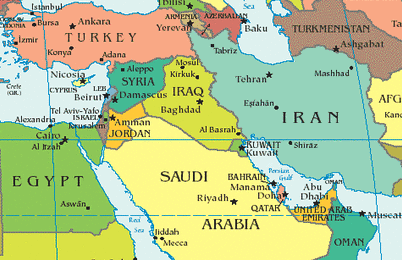
Israel’s “Doomsday Settlement” on E1 (see map above) “will render any prospective Palestinian contiguous state territorially impossible”, according to Daniel Seidemann, the Israeli founder of Terrestrial Jerusalem.

Daniel SeidemannSeidemann (at left), a highly respected Israeli settler expert on territorial expansion, has condemned settlement construction on Area E1 as “the doomsday settlement”.

Nicola Nasser, writing for Palestine Chronicle from his home in Bir Zeit in the West Bank of Palestine, explains the significance of Seidemann’s “doomsday” designation:

“The site of some 4.6 square miles (12 square km) of this settlement on the easternmost edge of eastern Jerusalem will close the only territorial link between the north and south of the West Bank and sever it from East Jerusalem, the prospective capital of the State of Palestine, thus undermining any viable and contiguous Palestinian state on the territories occupied by Israel in 1967 and turning the recognition of the UN General Assembly on November 29, 2012 as merely a Palestinian paper achievement.”

Both the U.S. and the European Union had opposed the E1 plan since Israel first produced it in 2005, because, in a series of objections since 2005, Nicola Nasser reports:

they were alert to its potential undermining effect on the “peace process.” Now, the five permanent members of the UN Security Council and the United Nations have all warned against the E-1 plan. The White House and U.S. State Department described the plan as “unilateral,” “counterproductive,” “sets back” peace efforts, “especially damaging to efforts to achieve a two-state solution,” “complicate efforts to resume direct, bilateral negotiations” and “risk prejudging the outcome” of such negotiations, and “contrary to US policy.”

This latest move by Israel calls to mind a dying Jimmy Cagney’s Cody Jarrett character in the film, White Heat, who shouts to his dead mother,”Made it, Ma! Top of the world!”.

With his latest gesture of defiance to the world, Benjamin Netanyahu could have been shouting to Israel’s founding father, David Ben-Gurion, dead since 1973, “Made it, Mr. Prime Minister, we have finally reached the Jordan River!”

No wonder Jordan’s King Abdullah II decided this week would be a good time to pay a visit to his new state neighbor. He became the first  leader to visit Palestine after its elevation to state status.

A closer look at the map (above) reveals what Israel has in mind for the future of the state of Palestine. The so-called “separation wall”, which is, in fact, a land-stealing wall built by Israel under the pretense cover of “security”, winds in the shape of a snake coiled to strike, with its head at the south of Jerusalem.

The tail of the snake coils around the northern part of Jerusalem, eating up rich Palestinian farm land, concluding west of Jerusalem.

Leaders of seven nations determined that following Israel’s second punitive military assault on Gaza in four years, the UN vote, and the Arab Spring hovering in the background, Israel had to be given a mild diplomatic reprimand.

Leaders of the seven nations,Australia, Brazil, France, UK, Sweden, Denmark and Spain, called in their resident Israeli ambassadors to demand an explanation for the timing of Israel’s announcement.

Germany, which usually does Israel’s bidding because of a shared history of the Holocaust, did not vote with Israel at the UN. Instead, Germany abstained. A long-planned visit from  Netanyahu to Berlin, went forward, ending in a mutual agreement “to agree to disagree”, not exactly a ringing endorsement for either nation.

U.S. and international media, on the other hand, posted a series of reprimands for Israel’s “doomsday settlement”. Phillip Weiss summarized these reprimands, casting it as a realization by the media observers that the “two state” solution is truly dead, which is, in actual fact, a long-overdue announcement.

It remains for the Guardian’s intrepid columnist, Glenn Greenwald, to post this indictment that the leader of the free world is still not willing to stand up to Netanyahu, even after this latest in a series of public face-slapping of the American government from Netanyahu.

And then finally, we have this, from Monday:

“The UN general assembly has overwhelmingly approved a resolution calling on Israel to open its nuclear programme for inspection.

“The resolution, approved by a vote of 174 to six with six abstentions, calls on Israel to join the Nuclear Nonproliferation Treaty (NPT) ‘without further delay’ and open its nuclear facilities to inspection by the International Atomic Energy Agency. Those voting against were Israel, the US, Canada, Marshall Islands, Micronesia and Palau. . . .

“The vote came as a sequel to the cancellation of a high-level conference aimed at banning nuclear weapons from the Middle East. All the Arab nations and Iran had planned to attend the summit in mid-December in Helsinki, Finland, but the US announced on 23 November that it would not take place, citing political turmoil in the region and Iran’s defiant stance on non-proliferation. Iran and some Arab nations countered that the real reason for the cancellation was Israel’s refusal to attend.”

So essentially, it’s the entire planet on one side, versus the US, its new right-wing poodle to the north [that would be Canada], Israel, and three tiny, bribed islands on the other side.

Israel’s nuclear arsenal has long been a pretend secret, so secret and so open, that no president has ever acknowledged the presence of Israel’s role as a nuclear military power. The secret is out now, thanks to another overwhelming vote in the UN General Assembly, a body which is apparently no longer willing to be repository of Israel’s private cache of immoral and illegal conduct.

Meanwhile, the “doomsday settlement” awaits its first construction tractors. As we wait, this short video from Dr. Strangelove is thought-provoking. The clip below opens with a conversation between the Soviet ambassador and the U.S. President.  It takes place in “the War Room”.  The ambassador and the president are soon joined by Dr. Strangelove:

The map above is from a newly-designed Palestine Chronicle web site. 

Posted in -Movies and politics, -Movies and Religion, Middle East Politics, Movies, Netanyahu, Obama | 16 Comments

Palestine Granted UN Observer State Status

by James M. Wall

History may well record what happened on November 29, 2012, as Mahmoud Abbas’ “finest hour”.
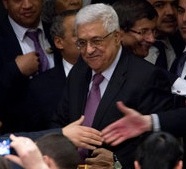
This was the day the Palestinian Authority president (right) announced to the world that he would no longer bow to blackmail from the West. A abbas-crop 2familiar political threat by Israel to withhold tax funds due the Authority, did not deter him.
Nor was he moved by the insulting British tactic that a pledge not to haul Israel before the world’s criminal court, would buy the Crown’s yes vote.
The U.S. State Department’s most recent contribution to the effort to force Abbas back onto the US-Israeli reservation, was both naive and arrogant.
Bill Burns, the U.S. deputy secretary of state, was sent on a last-ditch begging mission to Mahmoud Abbas’ New York hotel room to persuade the PA president to “reconsider” his request for statehood status.
Abbas ignored them all. As a result of President Abbas’ persistence, the resolution passed, granting Palestine a “non member observer state” status in the United Nations. The word “state” in that resolution is huge.  It opens doors for Palestine and it represents a step up into international status which is, as of 11/29/12, 65 years overdue.
The UN General Assembly (UNGA) approved the Palestinian resolution by an overwhelming majority, 138 in support with only 9 in opposition.  There were 41 abstentions. (The vote was an improvement over the October, 2011 vote that admitted Palestine to membership in UNESCO). At present, the Vaticanis the only other state that carries the designation of a “non member observer state status”. Switzerland held the status in 2002, prior to its achieving full membership.
President Abbas made his case for an upgraded status to the UN General Assembly. He delivered a passionate speech in which he centered on a theme he reiterated throughout his speech, “this is why we are here.” Thursday night, the UNGA continued in session. Until adjournment Thursday, live proceedings may be accessed here. Later this same web address will have the proceedings in its archive.
In his address, Abbas noted: “Sixty-five years ago on this day, the United Nations General Assembly adopted resolution 181, which partitioned the land of historic Palestine into two states and became the birth certificate for Israel.”
President Abbas added, “The General Assembly is called upon today to issue a birth certificate of the reality of the State of Palestine.”
Reporting from the UN, the BBC’s Barbara Plett pointed out that Palestine’s new status as a non member observer state, will allow the Palestinians to participate in debates at the UN and also open the way for Palestine to become members of other UN agencies. The new status will also make it possible for Palestine to have access to a body like the International Criminal Court, an independent agency established in 2002 “to address gross abuses of human rights anywhere in the world.”
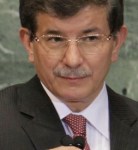
Speaking in favor of the resolution, Turkey’s foreign minister Ahmet Davutoglu (left), urged the GA members to support the resolution and then work to admit Palestine to the UN as a full member. Last year, President Abbas had asked the UN Security Council to admit the Palestinians as a member state, but that request was blocked by the U.S., which holds a veto on the Security Council, the UN governing body with the authority to admit new members.
Fearful of any Palestinian status advancement, Israel had been waging an intense campaign against the resolution that passed Thursday. As the voting day approached, Israel fell back on a strategy intended to put pressure on members of the European Union, calling on them to form a “moral majority” on Israel’s behalf.
In an email he sent following the vote, Francis A. Boyle, Professor of international law at the University of Illinois College of Law, suggested, “This can be the start of a ‘Legal Intifadah’ by Palestine against Israel.” Boyle is the author of Palestine, Palestinians, and International Law.  According to Boyle, Thursday’s vote opens the way for Palestine to:

1. Join the Rome Statute for the International Criminal Court and file a complaint with the ICC against the illegal settlements and settlers, who are committing war crimes; 

2. Join the Statute for the International Court of Justice, sue Israel at the World Court, and break the illegal siege of Gaza;

3. Join the Law of the Sea Convention and get its fair share of the enormous gas fields lying off the coast of Gaza, thus becoming economically self-sufficient;

4. Become a High Contracting Party to the Four Geneva Conventions [this deals with the laws of war];

5. Join the International Civil Aviation Organization and gain sovereign, legal control over its own airspace;

6. Join the International Telecommunications Union and gain sovereign legal control over its own airwaves, phone lines, bandwidths.

Anticipating the overwhelming “yes” vote for Palestine, John V. Whitbeck, an international lawyer who has represented the Palestinian negotiating team in negotiations with Israel, wrote in a posting for Huffington Post his reasons why the U.S. and other Western states, should vote in the affirmative:

For compelling legal, moral, ethical and practical reasons, the United States and other Western states should join the great majority of UN member states, encompassing the vast majority of mankind, in honoring the moral obligations and legal responsibilities of the international community toward the Palestinian people by formally recognizing that, 65 years after the General Assembly’s fateful recommendation to partition Palestine, the two states envisioned by the General Assembly do indeed exist, even though one state is, temporarily, under military occupation by the other state.

This is a situation which, in the interests of both justice and international legality, requires rectification through urgent and intensive state-to-state negotiations in accordance with terms of reference which are consistent with international law and relevant UN resolutions and with the full, active and determined support of the international community.

Prior to the UN vote, Hillary Clinton, the U.S. secretary of state, said that the U.S. believed the Palestinian move was misguided and efforts should focus instead on reviving the stalled Middle East peace process. She added:

“The path to a two-state solution that fulfills the aspirations of the Palestinian people is through Jerusalem and Ramallah, not New York,” she said. “The only way to get a lasting solution is to commence direct negotiations.”

Dr. Hanan Ashrawi, Senior member of the Palestine Liberation Organization’s Executive Committee and a elected member of the Palestinian Legislative Council, wrote on Wednesday before the vote.that negotiations do not work unless the negotiators want to find solutions:

It might seem stating the obvious that Palestinians and Israelis find solutions only through negotiation, until you look at the record. It is a story in which one side makes proposals for nothing in return; one side makes agreements that the other side breaks; and one side keeps commitments that the other side ignores.

Take a recent decision by Israel to approve 100 new homes for its Jewish citizens in the illegal settlement of Gilo, when the Israeli army was bombarding and shelling Gaza. This (along with numerous other settlement decisions by Israel) constitutes a clear breach of signed agreements and of international humanitarian law.

Today we return to the UN general assembly, the world’s largest multinational arena, where each of 193 states has a vote of equal value and none has a veto. Supporting our bid for enhanced status at the UN is a vote for the universal values of human rights embodied in the UN charter. Opposing it would make the Palestinian people the glaring exception to universal human rights, denying us the right to self-determination. Ironically, it would constitute a collective punitive measure against us for pursuing our freedom peacefully on the basis of international law and in adherence to what should be a global rule of law.

The question the international community should ask is not who wants negotiations, but who wants solutions. The answer is clear – one side wants to negotiate a permanent solution and the other wants permanent negotiations.

The vote has been taken. The overwhelming majority of the UNGA has rejected Israel’s continued occupation. How overwhelming was the vote?
John V. Whitbeck, cited above, looked closely at the Nine Negative votes against the resolution. In an email, he provides this analysis of the Nine, Israel, the United States, Canada, the Czech Republic, the Marshall Islands, Micronesia, Nauru, Palau and Panama. This is his conclusion concerning Israel’s friends:

The Marshall Islands, Micronesia and Palau, all former components of the U.S. Trust Territory of the Pacific Islands, are “freely associated states” of the United States, with U.S. zip/postal codes and “Compacts of Free Association” which require them to be guided by the United States in their foreign relations. They more closely resemble territories of the United States than genuine sovereign states – rather like the Cook Islands and Niue, “freely associated states” of New Zealand which make no claim to sovereign statehood and are not UN member states. They snuck into the UN in the flood of new members consequent upon the dissolutions of the Soviet Union and Yugoslavia, when the previous standards for admission were effectively ignored.

Nauru, a tiny island of 10,000 people in the central Pacific, has, since the exhaustion of the phosphate deposits which briefly made it the country with the world’s highest per capita income, had virtually no sources of income other than selling its UN votes (reliably joining the United States in voting against Palestine) and diplomatic recognitions (alone in joining Russia, Nicaragua and Venezuela in recognizing Abkhazia and South Ossetia) and housing in insalubrious tents aspiring illegal immigrants hoping to reaching Australia. I cannot begrudge Nauru. I have been there. It is an an appalling place, an island with no beaches, the world’s highest obesity rate and no real alternative to diplomatic prostitution.

Accordingly, only three “real” states joined Israel and the United States in voting against Palestine and the two-state solution: Canada, the Czech Republic and Panama. They must make their own excuses.

Israel’s declining support around the world has dwindled down to a tiny minority of Those Who Have Their Excuses.

The picture above of President Abbas, taken after the vote, is by Damon Winter of the New York Times. The picture of Turkish Foreign Minister Ahmet Davutoglu is from Reuters, taken by Brendan McDermid.

Posted in Middle East Politics, United Nations, USA | 25 Comments

Clinton In Middle East As Ceasefire Begins

by James M. Wall

UPDATE POSTED 3:20 PM CST WEDNESDAY

The Guardian reported at 15:57 EST that Israel and Hamas have agreed to end eight days of conflict between the two groups in the Gaza Strip. The conflict has claimed more than 160 lives, three of whom were Israelis. For further details on the ceasefire, click here.

     On her trip to the Middle East this Thanksgiving week, U.S. Secretary of State Hillary Clinton flew to Tel Aviv, Israel, to meet, first, with Israeli Prime Minister Benjamin Netanyahu. After this stop, the Secretary traveled to Cairo, Egypt, where Egyptian President Mohamed Morsi is attempting to negotiate a ceasefire to Israel’s “Pillar of Cloud” assault on Gaza’s population.

Of course, her first stop would be to set up a photo op with the leader of her government’s “best friend” in the Middle East.

Guardian columnist Glenn Greenwald, finds this friendship troubling:

A central premise of US media coverage of the Israeli attack on Gaza – beyond the claim that Israel is justifiably “defending itself” – is that this is some endless conflict between two foreign entitles, and Americans can simply sit by helplessly and lament the tragedy of it all.

The reality is precisely the opposite: Israeli aggression is possible only because of direct, affirmative, unstinting US diplomatic, financial and military support for Israel and everything it does. . . . .Pretending that the US – and the Obama administration – bear no responsibility for what is taking place is sheer self-delusion, total fiction. It has long been the case that the central enabling fact in Israeli lawlessness and aggression is blind US support, and that continues, more than ever, to be the case under the presidency of the 2009 Nobel Peace Prize winner.

The US is not some neutral, uninvolved party. Whatever side of this conflict you want to defend – or if you’re one of those people who love to announce that you just wish the whole thing would go away – it’s still necessary to take responsibility for the key role played by the American government and this administration in enabling everything that is taking place.

Hillary Clinton flew into a cauldron of death and destruction which the U.S. enabled to take place.  She is expected to play a role in bringing an end to this latest development in American Middle East policy.

Before the Secretary arrived in the region Tuesday, the New York Times reported:

Senior Egyptian officials in Cairo said Israel and Hamas were “very close” to a cease-fire agreement. “We have not received final approval, but I hope to receive it any moment,” said Essam el-Haddad, President Mohamed Morsi’s top foreign affairs adviser.

Khaled Meshal, the Hamas leader, said in Cairo that Israel needed to end its blockade of Gaza. Israel says the blockade keeps arms from entering the coastal strip.

Israel’s rationale for the blockade, of course, is a subterfuge which convinces no one but an American public lulled by a pro-Israel media, and a bought and paid for political leadership,  into believing the blockade is a purely defensive measure. The truth is that the blockade is one of Israel’s many forms of mass torture of the Palestinian population held down by a brutal military occupation.

Hillary Clinton would not be in the Middle East if she, and President Obama, did not have some assurance from Hamas and Israel that a “ceasefire” would be arranged. The Secretary plans to retire in January, 2013.  A failure to halt this current murderous assault from Israel soon, would not be the way she would want to end her diplomatic career.

Clinton and President Obama are sinking considerable political capital into their effort to halt the Israeli assault. Their efforts are badly handicapped by the burden of untruth they carry which pretends that the “conflict” between Israel and Gaza is a battle between equals. It is not. It is, rather, a struggle between jailer and prisoner, with all the power, except that of morally justified protest, is on the jailer’s side.

Outside the English-speaking nations of the U.S., Canada and Britain, support for Israel is evaporating rapidly with each new demonstration of immoral national conduct. As a notable example, Turkey’s Prime Minister Recep Tayyip Erdogan spoke in Cairo last week and harshly condemned Israel.

Erdogan told a Cairo University audience that “Israel would be held to account for the children among 40 people dead in three days of air strikes on Gaza.”  The Turkish leader leveled this significant charge:

“Everyone must know that sooner or later there will be a holding to account for the massacre of these innocent children killed inhumanely in Gaza.”

To Israel’s claim that its military assault on Gaza is an appropriate response to the rockets fired from Gaza into Israel, Orthodox Jewish academic Jeremiah Haber writes in his blog, The Magnes Zionist, that “IDF rockets and missiles have killed more innocent [Gaza] civilians in the last three days [of this current assault] than all the Hamas rockets combined in the last eight years!”

Little of this perspective is seen or heard in main stream U.S. media, but alternative media outlets are growing in number and influence. CounterPunch was up this week with an eloquent and sobering essay by Jennifer Lowerstein, a faculty associate in Middle East Studies at the University of Wisconsin-Madison. Her essay, Death in Gaza, Deja-Vu, includes a description of the impact of the Gaza assault.

All the sounds and sights and smells of slaughter verify the damage and danger of aerial assaults and targeted killings; apartment buildings still buzzing with human activity when missiles pierced through their ceilings offer up their dead and wounded to the deafening skies.

Progressive US President Barak Obama and his allies applaud Israel’s masterful techniques of preventive war as self-defense; its sophistication at using state of the art weaponry against mosques, homes, markets and schools; re-emphasize at press conferences the right of Israel to defend itself against the human cattle they have justly corralled into densely packed camps to be bound and slaughtered or starved and transferred elsewhere.

The alternative media web site, Mondoweiss, provided its viewers with a valuable example of one journalist, Associated Press Washington correspondent, Matthew Lee, who challenged the conventional pro-Israel perspective of Washington’s policy shapers.

In the short clip below, Lee engages in a lively exchange with State Department spokesperson Victoria Nuland,

An invaluable web site is produced by the Institute for Middle East Understanding (IMEU). Since the start of the Gaza assault, IMEU uses facts to refute Israel’s claim that it is waging a war against militants, not civilians.  In a November 18 report (the numbers  are now higher), the IMEU provides this analysis:

Although Israeli officials stress that the Israeli military carries out “surgical strikes” and goes to great lengths to avoid civilian casualties, evidence documented by human rights organizations shows that Israel has repeatedly and deliberately used disproportionate force – a war crime – as a tactic to kill enemy fighters, minimize the risk of injury to Israeli soldiers during military operations, and to establish “deterrence.”

In recent years, the Israeli military has formulated its “deterrence” as the “Dahiya Doctrine.”

A central tenet of Israeli military policy is “deterrence.” This is embodied in the so-called “Dahiya Doctrine,” which dictates the use of overwhelming and disproportionate firepower and the targeting of government and civilian infrastructure during military operations. It received its name from the Dahiya neighborhood of Beirut, a stronghold of Hezbollah, which Israel destroyed almost completely during its assault on Lebanon in the summer of 2006.

In October 2008, Gabi Siboni, Director of the Military and Strategic Affairs Program at Tel Aviv University’s Institute for National Security Studies (INSS), a quasi-governmental think tank with close ties to the Israeli political and military establishments, published a policy paper entitled “Disproportionate Force: Israel’s Concept of Response in Light of the Second Lebanon War.”

It stated:’ With an outbreak of hostilities [with Hezbollah], the IDF will need to act immediately, decisively, and with force that is disproportionate to the enemy’s actions and the threat it poses. Such a response aims at inflicting damage and meting out punishment to an extent that will demand long and expensive reconstruction processes.

The Dahiya Doctrine was developed by Israel to maintain its control of the Middle East, which it likes to describe as a “dangerous neighborhood”.

This is the doctrine which Barack Obama embraces when he allows Israel to carry out a military attack which violates international laws and which is, at its core, immoral.

It is this policy which President Obama endorsed when he sent Hillary Clinton to the region to help broker an end to the slaughter. We can only hope that she and leaders in the region will find a ceasefire solution.

To the essential question, what next, one thing cries out as an essential part of how this country should move forward.

When President Obama returns from his Asia trip, he must reflect on how much of the blame for the Gaza assault rests with him and his willingness to allow Benjamin Netanyahu to carry Israel, and the U.S. as a major enabler, into an ugly, brutal and immoral assault on a civilian population.

Barack Obama has a new four-year term before him. He will not run again for public office. In that sense, he is a free man.  Now is the time for him to be the courageous and moral leader he must surely want to be, and his public wants him to be.

To do this, he must take control of U.S. foreign policy away from both the Israel Lobby, and another Israel-enabler, the military-industrial complex that President Eisenhower warned us against. The Gaza assault, the second against Gaza in four years, is an immoral act that must not be repeated.

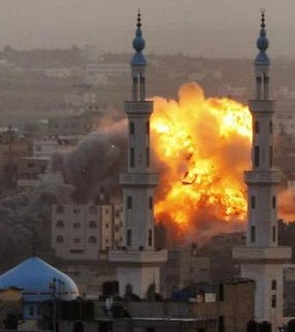
The picture at the top of the page of  a bomb strike in Gaza City, is from Mondoweiss. It was taken by Marah Elwadia.

Posted in Hillary Clinton, Middle East Politics, Netanyahu, Obama | 18 Comments

Israel Looks To Exodus In Gaza Invasion

by James M. Wall 

The Israeli Defense Force (IDF) selected two names for Israel’s current military assault against an imprisoned Gaza population. This is a military that thinks seriously about naming its military assaults.

The first name given the second Gaza invasion in four years is “Pillar of Cloud” (Amud Anan in Hebrew). It was intended for use in Israeli media and was for Hebrew-speakers. The second name,”Pillar of Defense” was designed for the rest of us, those who are, presumably, less biblically informed.

The Tablet magazine, a U.S.-based, openly Jewish, Israeli-friendly, publication, explains that “Pillar of Cloud” comes from “a direct biblical allusion to the divine cloud which guided the Israelites through the desert and shielded them from those who might do them harm”.

Exodus 14:19-20 is the biblical source:

“Then the angel of God, who had been traveling in front of Israel’s army, withdrew and went behind them. The pillar of cloud also moved from in front and stood behind them, coming between the armies of Egypt and Israel.”

From its pro-Israel perspective, The Tablet justified the use of the two terms with this rather supercillious explanation:

“For a campaign intended to halt the barrage of rockets currently raining down on southern Israel, “Pillar of Cloud” is thus a particularly apt title. Just as the cloud protected the Israelites from Egyptian projectiles, so too does the IDF hope to protect Israel’s citizens.

However, a literal translation of  a “Pillar of Cloud” fails to convey the meaning of the biblical allusion to a lay audience. As such, the IDF chose ‘Pillar of Defense’ as the campaign’s English designation, a conceptual translation which makes clear the intended meaning of the Hebrew.”

Non-Hebrew speakers, all of whom the Tablet brands as belonging to a “lay audience”, are not asked to think of the IDF as God’s avatar, as are Hebrew language speakers.

By not using the Exodus reference to “Pillar of Cloud” outside of Israel, the IDF appears to have forgotten that there is a segment of the U.S. population that strongly supports Israel on religious grounds. I refer not to the  U.S. Jewish voters who favored Obama over Netanyahu’s candidate, Romney, by a 70% margin, but rather, to the self-described white born-again Christian evangelicals who would be thrilled to connect present-day Israel with the ancient Israelites.

The Huffington Post reports that white born-again Christian evangelicals chose Romney over Obama by a 70% to 29% margin, ironically, the same vote difference Jewish voters cast in favor of Obama. The times, they are a-changing.

Not much change is in evidence in Israel’s conservative government, however, where leaders keep following the same old narrative to justify each new assault on its weakest Arab neighbor, the neighbor Israel has confined to an outdoor prison.

In both 2008 and now in 2012, the Gaza assault followed a U.S. presidential election and preceded the inauguration of the winner of that election. Israel’s rationale  for attacking Gaza in 2008 is exactly the same rationale Prime Minister Benjamin Netanyahu offers as the reason for Israel’s current “Pillar of Cloud” attack.

During the 2012 U.S. election campaign, Netanyahu tried unsuccessfully to bully candidate Barack Obama into pledging to follow Israel into an airstrike against Iran, which Netanyahu deemed a dangerous threat to Israel’s survival.

Once he failed to lead Obama into joining his Iranian folly, Netanyahu, who knows full well his own IDF lacks the ability to go to war against any of Israel’s strongest neighbors without U.S. backing, turned south to Gaza and discovered, what do you know, now it is Gaza which threatens constant rocket attacks against more than “a million Israelis every day”.

When did this current Gaza invasion begin?

The Institute of Middle East Understanding prepared a timeline of events leading up to Wednesday’s assassination of Hamas leader Ahmed Al-Jaabara in Gaza City, The killing of Hamas’ number two military leader was expected to bring a violent response from Hamas.

On Thursday, November 8, following a two-week lull in violence, Israeli soldiers invade Gaza. In the resulting exchange of gunfire with Palestinian fighters, a 12-year-old boy is killed by an Israeli bullet while he plays soccer. Shortly afterwards, Palestinian fighters blow up a tunnel along the Gaza-Israel frontier, injuring one Israeli soldier.

On Saturday, an anti-tank missile fired by Palestinian fighters wounds four Israeli soldiers driving in a jeep along the Israel-Gaza boundary.

An Israeli artillery shell lands in a soccer field in Gaza killing two children, aged 16 and 17. Later, an Israeli tank fires a shell at a tent where mourners are gathered for a funeral, killing two more civilians, and wounding more than two dozen others.

 Sunday, November 11, one Palestinian civilian is killed and dozens more wounded in Israeli attacks.

Four Israeli civilians are also injured as a result of projectiles launched from Gaza, according to the Israeli government. During an Israeli government cabinet meeting, Transportation Minister Yisrael Katz urges the government to “cut off the head of the snake… take out the leadership of Hamas in Gaza.” He also calls for a cutting off of water, food, electricity, and fuel shipments to Gaza’s 1.7 million people.

 Monday, November 12, Palestinian militant factions agree to a truce if Israel ends its attacks.

This is a timeline that provides a carefully orchestrated Israeli plan of escalation which by Friday afternoon, November 16, had led to three days of intensive airstrikes against Gaza.  More than 20 deaths had been reported throughout Gaza this week, according to the Palestinian news outlet, Ma’an. (The picture above is from Gaza City, taken during an Israeli air raid this week.)

On Monday, Benjamin Netanyahu played his role in softening opposition to his well-planned invasion. He spoke to 44 foreign ambassadors at a meeting Israel arranged in Ashkelon, in Southern Israel. The purpose of this event was to describe the rockets from Gaza as a dire threat against Israeli citizens.

What Netanyahu said to the ambassadors about Israel’s “right to defend itself” applies equally to the Palestinians who are held down by Israel’s occupation. Is Netanyahu so caught up in his own Israel First mindset that he does not grasp the reality that at least some of these 44 ambassadors might just be giving some thought to a perspective other than the one Netanyahu describes with such uncomprehending earnestness?

Some of these ambassadors must have come from countries that have gone through their own struggles against outside colonizers.

The clip below runs for six minutes. It shows Netanyahu in his most persuasive hasbara (propaganda) mode:

During his presentation, Netanyahu warned, referring to the rocket attacks Israel has provoked from one faction of militants inside Gaza, “We are going to take whatever action is necessary to put a stop to this. This is not merely our right, it is also our duty”.

Netanyahu had to be aware that one action he had already ordered was the assassination of Ahmed Al-Jaabari, the head of Hamas’ military wing. Two days later, on Wednesday, November 14, Jaabari was killed by an Israeli precision air strike as he was being driven down a crowded Gaza City street.

In its story on the death of  Al-Jaabari, the Palestinian newspaper Ma’an, reported:

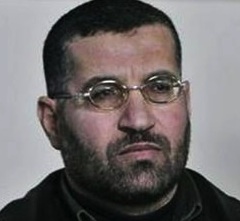
The military leader (pictured here) survived several Israeli targeted assassination attempts and was lightly injured in one of the attempts in 2004. His eldest son Muhammad, was killed in that attack, along with his brother and three other relatives when Israeli helicopters targeted al-Jaabari’s home in Shujaiyya. Al-Jaabari gained particular prominence for his role in capturing Israeli soldier Gilad Shalit who was seized in a cross-border operation by three Palestinian factions in 2006.

Jeremiah (Jerry) Haber is the nom de plume of an orthodox Jewish studies and philosophy professor who divides his time between Israel and the US.  On his blog, Haber wrote:

It has been clear for over a year that Israel would wait until after the American elections to launch some act of military aggression, and it was clear, to me, at least, that it would not be directed against Iran, Syria, or Lebanon. It seems likely that Israel had decided to conduct an operation in Gaza before the first rocket was fired from Gaza.

All military actions, indeed, all actions having to do with Gaza, have one goal in mind: the subjugation of the Palestinian people there with minimum cost to Israel. In hasbara speak this is called “protecting Israelis,” “defeating terror,” “defending national security,” even “protecting national honor,” but it boils down to the same thing — Israel cannot be secure if the Palestinians have real independence.

The ending of this assault will depend on a decision by Israel’s Prime Minister, the same leader who determined when it would begin.

Netanyahu may have misjudged Egypt’s reaction to “Pillar of Cloud”. By Friday, November 16, Egypt had sent its Prime Minister, Hesham Kandil into Gaza. Kandil met with Hamas leader Ismail Haniyeh and visited wounded Palestinians at a hospital.

The Egyptian prime minister told reporters in Gaza that Egypt would “save nothing to stop the aggression and achieve a continuous ceasefire on the way to having a Palestinian state with Jerusalem as its capital.”

During Israel’s 2008 invasion, Time magazine’s Tony Karon wrote this week, then-Egyptian President Hosni Mubarak served “as the wall at Hamas’ back in Gaza, tacitly supporting Israel’s efforts to break the grip of a movement aligned with his own Muslim Brotherhood nemesis”. 

Today, Mubarak no longer leads Egypt.

Instead, Karon notes, Egypt  “is governed by leaders from Hamas’ parent organization, the Muslim Brotherhood, and is far more responsive to Egyptian public opinion which is innately hostile to Israeli military action in Gaza. He adds, in his column for Time earlier this week:

Responding to the strikes, the Brotherhood’s Freedom and Justice Party demanded “swift Arab and international action” to stop the Israeli attacks, warning that Israel to “take into account the changes in the Arab region and especially Egypt,” vowing that the new Egyptian government “will not allow the Palestinians to be subjected to Israeli aggression, as in the past.”

Israel’s parliamentary election, January 22, will determine if Benjamin Netanyahu continues as prime minister. If things do not go well for Israel in this military endeavor, the voters might turn against their war-obsessed leader.

The Arab Spring continues to have a ripple effect that has already toppled several Arab leaders.  Will it bring down Netanyahu? Probably not, since Israeli voters have been traumatized by their leaders into believing Netanyahu is their only hope.

Meanwhile outside of Israel, the mantra, “Israel has a right to defend itself”, no longer has the cache Netanyahu thinks it has. World opinion is shifting, slowly, to be sure, but how many more Gaza deaths will the outside world tolerate?  Exodus 14:19-20 does not guarantee that the “Pillar of Cloud” will always defend the Israelites against the Egyptians.

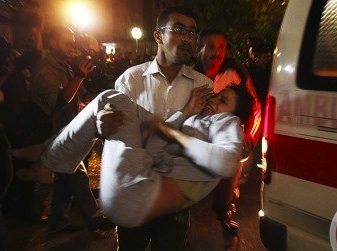
In the picture at the top, a Palestinian ambulance worker carries a wounded man after an Israeli air raid. The photo is from Ma’an. It is one of a series of pictures by Reuters photographers Ahmed Zakot, Ibraheem Abu Mustafa, Mohammed Salem and Ali Hassan.

Posted in Middle East Politics, Netanyahu, Obama, Politics and Elections | 12 Comments

Voters to Obama: Move Now on Palestine

by James M. Wall

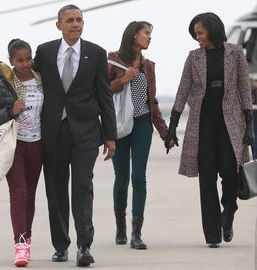
Joy and relief are evident on the faces of the Obama family, shown here arriving back in Washingtonthe day after the election. Obama’s victory over Mitt Romney November 6, was also a moment of deep satisfaction for that segment of the American voting public that longed for a happy ending to what has been a bitter, contentious presidential campaign.

The “dark moon” that rose after Obama’s dismal first debate performance, was finally blown away.   The people had voted, many standing in Republican-engendered long lines, lines that in Florida continued until 1:30 a.m., several hours after Mitt Romney conceded. Except for North Carolina, every swing state went for Obama.

The voters wanted Obama to have a second term. They made him the first second-term Democratic president to win a majority of the popular vote since Franklin D. Roosevelt. Bill Clinton won his second term with less than a majority of the popular vote.

This strong election victory sent two message to the President: The majority of voters did not trust Romney’s economic policies, and they are tired of fighting Israel’s wars. Implied in that second message is a demand: Move now on Israel’s decades-old occupation of the Palestinian people. In short, move now on Palestine.

To those who would say, there was no mandate on Palestine in this election, let them listen to the music, not just to the words. Israel’s wars come directly from its Occupation of Palestine.  End the Occupation, and you end Israel’s embrace of military solutions. Now is the time to move on Palestine.

Israeli loyalist and casino billionaire Sheldon Adelson does not believe this, which is why he gambled on a Mitt Romney victory over Obama. Adelson also gambled with heavy spending on carefully chosen congressional races. He was a big loser in this election.

Adelson lost the $20 million investment he gave to Romney’s super PAC.  In addition, the  Jewish publication, Forward, lists other Adelson loses in targeted congressional races. Adelson gave $1.5 million to the campaign of Republican George Allen, who lost his bid for a Virginia Senate seat to Democrat Tim Kaine. Other Adelson Republican congressional bets included a $1 million contribution to Florida Republican Connie Mack, who lost in his attempt to unseat incumbent Democratic Senator Bill Nelson.

In New Jersey, Democratic 9th District Congressman Bill Pascrell (shown here) faced a general election opponent, Orthodox Rabbi Shmuley Boteach, a Republican on a “fool’s errand” who chose to run against Pascrell in a district drawn as a Democratic district. Earlier this  year, Pascrell had won a primary race against his fellow Democrat and AIPAC–supported opponent, Steve Rothmand.

In spite of the unfavorable odds, Adelson gambled on Boteach in the general election, giving Boteach’s Patriot Prosperity PAC, $1 million. Adelson and his wife also gave Rabbi Boteach’s campaign, $10,000. Boteach lost to Congressman Pascrell.

These congressional races should be received as messages to President Obama. What these losses say to the President is that heavy spending from pro-Israel billionaires do not automatically produce election winners.

Another message to Obama comes in the dismal electoral failures of two Tea Party heroes, Joe Walsh and Allen West, two Republicans who drew criticism for implied and/or actual signs of Islamophobia.

In Illinois, Joe Walsh lost his Congressional seat to his Democratic opponent, Iraqi war veteran Tammy Duckworth.

Walsh received considerable outside Republican funding to hold on to his district seat.  His opponent lost both legs and a partial loss of one arm, after being shot down in her Apache helicopter in Iraq. Instead of acknowledging her sacrifice and moving on, Walsh criticized Duckworth’s references to her war experiences, not a good campaign move.

The Council on American-Islamic Relations (CAIR), reported on Walsh’s use of Islamophobic language in his campaign:

Earlier this year, when a town hall meeting attendee told him that he was “looking for some godly men and women in the Senate, in the Congress, who will stand in the face of the danger of Islam,” Walsh left the door open for suspicion of every Muslim living in Illinois when he responded saying radical Islam is more of a threat “now that it was right after 9/11”, and “it’s here. It’s in Elk Grove. It’s in Addison. It’s in Elgin. It’s here.”

A report on the Walsh charge, which he refused to withdraw, ran on a Chicago television station.(click to view.)

Congressman Allen West, an African-American Iraqi war veteran, is described in glowing terms in a book entitled, The Teavangelicals, written by conservative Christian journalist, David Brody. The title comes from an amalgamation of Tea Party and Christians evangelicals. Here Brody explains the appeal West has to evangelicals:

Specifically, evangelicals will be attracted to his strong defense of Israel and his absolute obliteration of radical Islam.  Be forewarned if you try to defend radical Islam through the Koran at a town meeting, you had better be ready to get a mouthful from West.  An employee for the Council on American-Islamic Relations (CAIR) showed up at a Pompano Beach, Florida, event asking him to point to a spot in the Koran where it tells Muslims to kill Americans.

West swatted the question away, telling him that it wouldn’t say that because America wasn’t even around when the Koran existed. But that wasn’t the end of it . . . . not by a long shot. West continued to point out a series of Muslim aggressive acts over the centuries and concluded by telling the questioner, “Don’t come up here and try to criticize me!  Put the microphone down and go home” (page 153).

Congressman West was defeated in his attempt to return for a second term to the House of Representatives. West initially refused to concede, even though a 2500 vote margin enjoyed by his opponent, was outside the state’s mandated vote percentage recount. Friday afternoon, a Florida judge rejected West’s appeal for a recount.

There was also a notable example in a Wisconsin election that attacks against political opponents as “anti-Israel”  no longer produce the automatic silver bullet of certain defeat. In the race for a vacant Wisconsin Senate seat, former Republican Governor and Republican Senate candidate Tommy Thompson, alleged that his Democratic opponent, Congresswoman Tammy Baldwin, was “anti-Israel”.

It didn’t fly very far. The charge was reported in local media but it did not gain much additional traction. The allegation also did not reach national prominence. Why would it? Congresswoman Baldwin was already known in the national media as the candidate who might become the first openly lesbian U.S. Senator. Baldwin won the Senate seat, another indication that being called “anti-Israel” is losing its potency.

One election does not a movement make.  But this one election sent a series of messages to President Obama. His victory should enable him to “conduct policy with much more vigor”, as Palestinian Journalist Daoud Kuttab explains in a posting for Huffington Post.

Reelected U.S. President Barack Obama is expected to be able to conduct policy with much more vigor. While on domestic and economic issues he will need to work with a Republican House (the Senate will be Democratic), foreign relations is where the executive branch (the White House and the State Department) has the ability to apply his policies.

America’s first African American president who grew up in several parts of the world should be able to produce a foreign policy much closer to his heart and beliefs without having to worry about another election. Second-term U.S. presidents, who naturally care about their legacy, often look overseas to find ways for history to remember them.

War and peace cannot be addressed in any part of the world more than in the Middle East, where the U.S. is fighting a war in Afghanistan and will continue to need to win the hearts and minds of Arabs and Muslims. Obama’s win also signals a clear vote of confidence from American Jews who voted for him. More than 70 percent of U.S. Jews supported the president (unlike American Israelis who supported Romney).

President Obama no longer has any need to bend to the will of the Israel Lobby. His reelection and a second term removes him from ever again having to raise campaign funds or to be swayed from his core convictions by political expediency. Now is the time for this reelected President to make peace in the Middle East his highest foreign policy goal.

The voters have spoken: Mr. President, you are free to move now on Palestine.

Special Note: If you are not now on a special Wall Writings Alert mailing list. and would like to make sure you receive each posting as soon as it is published, write to jameswall8@gmail.com with the message,  “Please add me”.  

The picture of the Obama family, at top, is by Doug Mills of the New York Times.

Posted in Middle East Politics, Netanyahu, Obama, Politics and Elections, Romney | 13 Comments

Memo To Obama: Bring Back Chas Freeman

by James M. Wall

Less than a month after his 2009 inauguration, President Barack Obama made a move that quietly told the Israel Lobby there was a new sheriff in town.

He selected an experienced diplomat, Chas Freeman, to serve as the new administration’s Chairman of the National Intelligence Council (NIC).

In retrospect, it it is clear that this was one appointment he did not clear with any lobbyists, no matter how much the special interest crowd hung around the White House armed with their own suggestions for important assignments.

Laura Rozen wrote the first story about Freeman on February 19, 2009, in The Cable, a Foreign Policy blog. Since the position of NIC Chairman did not require Senate approval, it was largely unnoticed among the large number of appointments made by the President early in his first term.

This was how Laura Rozen broke the story of Freeman’s appointment:

Sources tell The Cable that Chas W. Freeman, Jr., the former U.S. ambassador to Saudi Arabia, will become chairman of the National Intelligence Council, the intelligence community’s primary big-think shop and the lead body in producing national intelligence estimates.

Freeman has told associates that in the job, he will occasionally accompany Director of National Intelligence Adm. Dennis Blair to give the president his daily intelligence briefing.

Freeman’s appointment was slow to surface in the main stream media. But it was noticed by the Israel Lobby, which sprang into action. The new sheriff must not be allowed any deviation from the absolutist Washington obeisance to the Israel Lobby and its congressional loyalists.

One key call went from New York Senator Chuck Schumer to the newly-minted White House Chief of Staff, Rahm Emanuel: This must not stand.

There was something out of kilter with this picture.  Freeman’s appointments had been in China and in Saudi Arabia, a U.S. Middle East ally.  What could have riled the Lobby forces into such a fury?

Those who were keeping score as each new Obama appointee surfaced, were aware that Chas Freeman had made the occasional critical remark about Israel. This was, to the Lobby, unacceptable in the man who had been named NIC chair.

Few outside intelligence circles had even heard of the NIC, but in the close network of Israel’s defenders throughout Washington, 100 percent purity was demanded of anyone holding even minimum power that might relate to Israel.

Attacks on Freeman were personal and some were ugly.  The more benign attacks were veiled, as Richard Silverstein noted in his blog at the time:

[Freeman’s] critics veil their criticism in an attack on Freeman’s close ties to Chinese and Saudi business and government interests, but make no mistake–Freeman’s sin is his outspokenness on Israel and his sympathies for Palestinian suffering.

In a Wall Writings posting I wrote after the Lobby-generated campaign against Freeman was launched (Yes Virginia, There is an Israel Lobby and It is Still Fighting Charles Freeman), I cited an excellent posting from Stephen M. Walt, Professor of International Relations at Harvard University, a scholar who “knows the Israel Lobby quite well”.

Walt is the co-author, along with John J. Mearsheimer, of The Israel Lobby and U.S. Foreign Policy. I later wrote my own longer essay on the Freeman appointment, for Link magazine.

In his posting, Walt “identifies the cast of characters in the ‘get Freeman drama'”:

 . . As soon as the appointment was announced, a bevy of allegedly “pro-Israel” pundits leapt to attack it, in what The Nation’s Robert Dreyfuss called a “thunderous, coordinated assault.”  

Freeman’s critics were the usual suspects: Jonathan Chait of the New Republic, Michael Goldfarb at the Weekly Standard, Jeffrey Goldberg of the Atlantic, Gabriel Schoenfeld (writing on the op-ed page of the Wall Street Journal), Jonah Goldberg of  National Review, Marty Peretz on his New Republic blog, and former AIPAC official Steve Rosen (yes, the same guy who is now on trial for passing classified U.S. government information to Israel). . . .

Among Freeman’s “past crimes”, according to his opponents, was that he served as an able and respected US ambassador to Saudi Arabia where he developed a good relationship with the ruling family.  Along with many other non-profit American foundations, a foundation on whose board he sits has received donations from the Saudi government.  Good for the Saudis for plowing back oil profits into good causes in the country which buys so much Saudi oil.

Just for the record, in the unlikely event Mitt Romney is elected president, remember the names cited by Walt above.  They will be leading the media vanguard of the neoconservatives who will be riding herd on Middle East policy in a Romney White House. A Romney campaign that was run on outright lies (check the record) will not hesitate to develop a foreign policy strategy that ties U.S. “security” to that of Israel’s “security”.

Of course, the Freeman story has the inevitable ending.  The Obama team left Freeman to spin in the heat and fury of the Israel Lobby attacks. There was no public indication of support from the White House.

On March 10, 2009, Freeman withdrew his name from consideration. He did not, however, go quietly. This is what he said to Laura Rozen’s The Cable blog when he announced his withdrawal from the appointment:

I have concluded that the barrage of libelous distortions of my record would not cease upon my entry into office.  The effort to smear me and to destroy my credibility would instead continue.  I do not believe the National Intelligence Council could function effectively while its chair was under constant attack by unscrupulous people with a passionate attachment to the views of a political faction in a foreign country.

After Freeman withdrew his name, once again the main stream media failed to point to the Israel Lobby’s role in unfairly smearing a presidential appointee. The blogosphere, however, was quick to take notice.

Ben Smith named names when he wrote in Politico:

[T]he attacks on Freeman, in the end, hinged primarily on the question of Israel, something the Democratic senators who helped break the back of the nomination Tuesday made clear.

“His statements against Israel were way over the top and severely out of step with the administration,” said Senator Chuck Schumer in a statement. “I repeatedly urged the White House to reject him, and I am glad they did the right thing.”

Hours before the Director of National Intelligence, Dennis Blair, expressed his “regret” at Freeman’s withdrawal, Sen. Joe Lieberman (D-Conn.) told Blair he was concerned about “statements that [Freeman]’s made that appear either to be inclined to lean against Israel or too much in favor of China.”

In particular, Freeman has described “Israeli violence against Palestinians” as a key barrier to Mideast peace.   .    .   .

Which is why, assuming President Obama is reelected,  he has an opportunity to rectify a wrong from his first term.. He should bring back Chas Freeman to a position in his administration. Freeman has not lost any of his passion nor has he lost his ability to express that passion in the measured tones of a veteran diplomat.

On October 25, 2012, two weeks before the presidential election, Freeman delivered an address which he called, Change Without Progress in the Middle East, to the National Council on U.S. Arab Relations Policymakers Conference:

In his diplomatic realist style, Freeman presented a point of view to the Conference that must be heard inside the White House when a reelected Barack Obama enters his second term, determined to resolve issues he did not resolve in his first four years in office. The speech covered the entire region. This is what he said about Israel and the territory of Palestine:

Israel has now effectively incorporated almost all the territory of Palestine, if not its inhabitants, under its sovereignty. There is no longer any prospect for a two-state solution in Palestine, unless one considers Indian reservations or Bantustans to be states.

One state is a reality in Palestine. Within this state, Palestinians inhabit a jail administered by Palestinian trusties dependent on Jewish guards for their livelihood, personal safety, and authority.

The Palestinians face an unpalatable but unavoidable choice between the security of prison life and a struggle for their rights in the only state they will ever live in, which is Israel. In short, the two-state solution having been strangled by the success of scofflaw Israeli settlement policies, the Palestinian question has ineluctably become one of human and civil rights within the State of Israel, not one of self-determination.

The consequences of the death of the two-state solution for Israeli Jews are already apparent. Ensuring that Israel is a democratic state that provides a national home for both Jews and Palestinians – rather than a country based on ethno-sectarian apartheid – is now the only way to realize Zionism on a basis acceptable to the world, including the vast majority of non-Israeli Jews.

In default of this, Israel will suffer boycott, disinvestment, and sanctions in the West, escalating terrorism at home, rising tensions with ever more independent-minded and militarily-competent neighbors, and widening international isolation. The immediate danger is that, before civil rights and democratic liberties can be extended to the Palestinian inhabitants of Eretz Yisrael, Israeli Jews will have sacrificed these values to aggressive medievalism and racism.

We have to believe President Obama wants to achieve a peaceful and just resolution of the one-sided conflict between Israel and Palestinians in Gaza, the West Bank, and inside Israel. Chas Freeman’s experience, wisdom and counsel are badly needed in a second term to assist in that resolution.

After the election is over, the President should bring Chas Freeman back to active diplomatic duty.

The picture above is from the Foreign Policy web site.

Posted in Middle East Politics, Obama, Romney | 13 Comments

Romney’s “Peculiar Sense” of Geography

by James M. Wall

After eight years of running for president, Mitt Romney has yet to master the geography of the Middle East.

His knowledge appears limited to what he sees from his hotel room in Jerusalem, following the example of Sarah Palin, who is reputed to have said she understood Russia because she could see the country from her back porch.

To paraphrase Ann Richards’ memorable reference to George Bush the First, in her 1988 Democratic National Convention keynote speech, “Poor Mitt, he can’t help it, he was born in a country that has abandoned the study of geography”.

In a piece she wrote on the subject, Christina Salas lamented:

In the wake of the recent presidential election, an increased level of interest has surfaced in this country over foreign issues. While domestic economic issues arguably dominated the political scene, both candidates were repeatedly asked questions about Iraq, Afghanistan, Pakistan, North Korea and all of the other so-called rogue nations. . . .

[Unfortunately,] The education system in this country has never done a satisfactory job in pushing geographic knowledge. Just as U.S. students are losing ground in the international education rankings, so too is geography falling completely off the map in secondary education.

Sad to relate, that analysis appeared  four years ago on December 10, 2008, following the last presidential campaign in which Mitt Romney sought, but failed to gain the Republican nomination. Four years later, the Republican nominee is back, still lacking a basic grasp of Middle East geography.

This time, however, the candidate is his party’s nominee, traveling around the country (and to Israel) informed by a team of advisors, 17 out of 24 of whom are from George W. Bush’s presidency.

Now that there is close to a 50% chance that Romney will become the next president of the United States, this basic lack of knowledge by Romney, and worse, his refusal to learn the facts about the area of the world which is at the heart of our economic and security woes, is at the very least, troublesome.

Romney’s geographical ignorance surfaced once again this week when the candidate said during his third debate with President Obama,”Syria is Iran’s only ally in the Arab world. It’s their route to the sea.” The map above refutes that assertion. Study it carefully, and pray that if Romney becomes president, he will also look at it carefully.

The morning after Monday night’s foreign policy debate, Saeed Kamali Dehghan wrote in the Guardian:

During last night’s foreign policy debate, Romney said: “Syria is Iran’s only ally in the Arab world. It’s their route to the sea. In fact, Iran, a close ally of Bashar al-Assad’s regime, has direct access to international waters through its large coastline on the Gulf and is not even a neighbour to Syria in order to rely on it as a route to the sea. Instead, Syria gives Iran a physical access to Lebanon and its Hezbollah militia which is strategically important for Tehran leaders because of the group’s geographical position in respect to Israel.

It is not the first time that governor Romney has referred to Syria as a country that provides Iran with a route to the sea.

In March, Romney made the exact [same] gaffe at AIPAC conference.

“Maybe one of the few bright spots in the Middle East developments in the last year has been the rising of the people in Syria against Assad. Obviously, as you know, Syria is Iran’s only Arab ally in the region. Syria is the route that allows Iran to supply Hezbollah with weapons in Lebanon. Syria is Iran’s route to the sea,” he said, according to the Washington Post, which fact-checked his remarks back then.

What this Romney observation says about the candidate is that he is simply not ready for foreign policy prime time. During the Monday night debate, veteran journalist Robert Parry, writing for Consortium News, points out that Romney’s goal was “to downplay his warlike neoconservative stands”.

The national media praised Romney for “hugging close” to Obama’s position, but Parry correctly  notes that Romney’s “reference to the Syrian chaos as ‘an opportunity” suggests that his more moderate rhetoric is just another ploy to deceive voters and win the election, not a real abandonment of neocon strategies.”

In that sense, the new “moderate Mitt” is less a sign of a neocon retreat from his earlier bellicosity than a Trojan Horse to be wheeled onto the White House grounds on Jan. 20, 2013, so the neocons can pour forth from its hollowed-out belly and regain full control of U.S. foreign policy.

So, the neocons don’t really mind that Romney has suddenly abandoned many of their cherished positions, such as extending the Afghan War beyond 2014 and returning U.S. troops to Iraq. The neocons understand the political need for Romney to calm independent voters who fear that he may be another George W. Bush.

In Monday’s debate, Romney said, “Syria’s an opportunity for us because Syria plays an important role in the Middle East, particularly right now. Syria is Iran’s only ally in the Arab world. It’s their route to the sea. It’s the route for them to arm Hezbollah in Lebanon, which threatens, of course, our ally Israel. And so seeing Syria remove Assad is a very high priority for us. Number two, seeing a — a replacement government being responsible people is critical for us.”

The “route to the sea” comment – with its faint echo of a distant time in geopolitics – represented proof that Romney lacks even a rudimentary knowledge of world geography, since much of Iran’s southern territory fronts on the Persian Gulf and Iran could only reach Syria by transiting Iraq. Syria and Iran have no common border.

Another point that Parry emphasizes, one that was largely ignored by mainstream media was the revelation by Romney that he finds a “crucial connection between the neocon desire for ‘regime change’ in Syria and the neocon determination to strangle Israel’s close-in enemies, such as Lebanon’s Hezbollah”.  Furthermore, Parry writes:

Romney’s demand for a new Syrian government of “responsible people” further suggests that the Republican presidential nominee shares the core neocon fantasy that the United States can simply remove one unsavory Middle East dictator and install a pro-Western, Israel-friendly leader who will then shut off aid to Hezbollah in Lebanon and Hamas in Gaza.

In short, Romney’s foreign policy is not complicated.  It is simply “make the Middle East Israel-friendly”, the Bush-era neoconservatives’ mantra.

That mantra requires that Romney cling to what Parry calls, his “peculiar sense of geography”, which gives him the freedom to keep thinking, and saying that “Iran was some landlocked country that needed Syria as a ‘route to the sea’.”  The route phrase has a nice poetic feel to it.  So what if it is factually incorrect?

Why should Romney learn Middle East geography?  If he reaches the White House, Romney’s primary foreign policy advisor, Dan Senor, a Bush era holdover, will get his marching orders from Tel Aviv. Senor knows how to take orders.  He was the U.S. public relations officer in the early days of the Iraq occupation. Public relations people know they must tell the public what the bosses want people to hear.  Who need geography when you have Dan Senor serving as minister of the department of “make the Middle East Israel-friendly”.

And speaking of government ministers, here is one more thing before we enter the final week of this campaign. It is an insight that comes from the British-oriented cultural world of Harry Potter, where “ministers” of governments run things.

Who better to report on the American foreign policy debate than a Potter authority, who is, naturally, from the prime audience J.K. Rowlings had in mind when she wrote the Harry Potter books.

Writing in Slate, Katie Rolphe reports that her “Harry Potter-obsessed 9-year-old” daughter watched the Obama-Romney foreign police debate ” entirely through the lens of Harry Potter”.

It started in the last debate when she said of Mitt Romney, after hearing him talk for a few minutes: “He’s Umbridge!” And of course I saw exactly what she meant, the brittle, lacquered, self-satisfied smile of the ambitious Dark Arts professor and passionate ministry bureaucrat, Dolores Umbridge. The saccharine, almost-girlish chuckle. The proclamations she issues at Hogwarts, the self-important talk about “the ministry this” and “the ministry that.”

Of course, Romney is Dolores Umbridge. The former governor and Bain corporate executive was just one of the Republican pack of conservatives running for the nomination, until the Republican big money donors decided he was the most pliable candidate and rallied behind him.

He has not been on top long enough to develop a public image, which is why it is easy to link him to an established cultural figure like Professor Dolores Jane Umbridge (above).

For those unfamiliar with the Potter phenomenon, here is what you need to know about Dolores Jane Umbridge.

Madam Undersecretary Professor Dolores Jane Umbridge was a witch and Ministry of Magic bureaucrat who served as Senior Undersecretary to the Minister for Magic under Ministers Cornelius Fudge, Rufus Scrimgeour and Pius Thicknesse. By order of the Ministry, she was installed as Defence Against the Dark Arts Professor at Hogwarts School of Witchcraft and Wizardry, and then later Hogwarts High Inquisitor and Headmistress. In all three of these positions at Hogwarts she had enormous power over the students, teachers, and the curriculum, which she wielded despotically.

Umbridge and Romney have several things in common. To start, in Harry Potter’s world, Dolores Jane Umbridge served as Senior Undersecretary to the Minister for Magic.

Of course, Romney knows all about magic. Refusing to give details of his tax plan; refusing to release his own tax returns;  pretending to embrace Obama’s foreign policy in front of 59 million television viewers, Romney was doing what magicians do, fooling the audience with sleight of hand. His followers loved it. Good old moderate Mitt, keeps the magic to himself.

Who is Barack Obama in Harry Potter’s world? Katie Rolphe assumed, incorrectly, that her daughter would link Obama to Harry Potter, who in the novels is “the damaged hero. The chosen one. The boy who saves the world.”

Her daughter rejects such an obvious choice. Katie Rolphe explains:

“No, she said, impatiently. Like why can’t I see it? Why am I not receiving the message the universe is so clearly sending? Dumbledore! Wise, old, snowy-haired Albus Dumbledore (above). He has moral authority and gravitas, even when life at Hogwarts moves out of his control.

He is also a master of wryness, of sharp comments delivered dryly. You can easily imagine Dumbledore saying, “We also have fewer horses and bayonets.”

When the evil forces of the ministry come to take him to jail, a magnificent orange bird swoops down, and together they vanish in flame. One of the ministry members, Kingsley Shacklebolt, says, ‘You may not like him, Minister, but you can’t deny: Dumbledore’s got style.'”

Take it from Katie Rolphe’s nine-year old Potter authority, this election will be a choice between Dolores Jane Umbridge, former Senior Undersecretary to the Minister for Magic and “wise, old [in experience], snowy-haired Albus Dumbledore”, who posseses “moral authority and gravitas, even when life at Hogwarts moves out of his control”.

No question but that life in Barack Obama’s Hogwarts is constantly shifting “out of his control”.  But at least Obama can find Iran and Syria on a map.

Posted in -Movies and politics, Middle East Politics, Movies, Netanyahu, Obama, Politics and Elections, Romney | 10 Comments