New York Times Flacks for Jewish Groups Against 15 Major Christian Leaders

by James M. Wall

You have to know American Jewish leaders are really riled up when they call on the New York Times to flack for them against 15 leaders of Christian churches who had the audacity to send a letter to the US Congress, which said, with proper Christian indignation:

As Christian leaders in the United States, it is our moral responsibility to question the continuation of unconditional U.S. financial assistance to the government of Israel. Realizing a just and lasting peace will require this accountability, as continued U.S. military assistance to Israel — offered without conditions or accountability — will only serve to sustain the status quo and Israel’s military occupation of the Palestinian territories.

We request, therefore, that Congress hold Israel accountable to these standards by making the disbursement of U.S. military assistance to Israel contingent on the Israeli government’s compliance with applicable U.S. laws and policies.

Is that clear? These church leaders are saying it is their moral responsibility to tell the Congress that it must hold Israel accountable to U.S. laws and policies when it disburses money to Israel.

So what’s the big news angle in the New York Times story for Saturday, October 20, following the release of the letter from the 15 leaders to Congress?  The lead of the story should be that “American Jewish leaders defend the action of a secular state that receives more U.S. foreign aid than any other nation in the world”.

What these so-called “outraged” Jewish groups are saying is that their feelings are hurt. These American Jewish leaders have worked so hard over the decades to maintain “good relations” with their Christian colleagues, and just as they were about to have yet another “good relations” meeting between Christians and Jews (no mention of Muslims, it must be noted), here come 15 Christian leaders demanding accountability from a secular foreign state for human rights violations carried out with American money.

Horrors, what a thing for Christian leaders to say!

Man (and woman) the barricades, the fragile American relationship between Jews and Christians is under severe threat. In case you have missed this unfolding threat to fragile American relationships between Jews and Christians (still no Muslims involved), this is how the Times’ Laurie Goodstein began her not-so subtle attack on the 15 Protestant  leaders:

A letter signed by 15 leaders of Christian churches that calls for Congress to reconsider giving aid to Israel because of accusations of human rights violations has outraged Jewish leaders and threatened to derail longstanding efforts to build interfaith relations.

The Christian leaders say their intention was to put the Palestinian plight and the stalled peace negotiations back in the spotlight at a time when all of the attention to Middle East policy seems to be focused on Syria, the Arab Spring and the Iranian nuclear threat.

The church leaders did not ask Congress to “reconsider” giving aid to Israel. And note the use of the weasel word “accusations” of human rights, as though Israel’s violations of Palestinian human rights have not been amply demonstrated over the decades. The Times says the letter is intended to “put the Palestinian plight and the stalled peace negotiations back in the spotlight”.   That is balderdash, as Joe Biden likes to say.

The 15 leaders make no reference to a motive for writing the latter. They do not have to. The New Testament is their motive. Putting the Palestinian “plight” in the “spotlight” is Times speak, speculation without attribution. 

The Times failed to explain that the “Jewish groups” that are attacking the 15 Christian leaders, are being directed by a secular organization, the Jewish Council of Public Affairs (JCPA). The Times does not distinguish between religious Jews and political Zionist Jews, a fatal flaw in its coverage. How secular is the JCPA? You be the judge. Here is how the JCPA describes its mission:

The mission of the Council is to serve as the representative voice of the organized American Jewish community in addressing the principal mandate of the Jewish community relations field, expressed in three interrelated goals:

One: To safeguard the rights of Jews here and around the world. Two:  To dedicate ourselves to the safety and security of the state of Israel. Three: To protect, preserve and promote a just American society, one that is democratic and pluralistic, one that furthers harmonious interreligious, inter ethnic interracial and    other intergroup relations.

“To dedicate ourselves to the safety and security of the state of Israel” is not biblical, my friends, it is political. The Times should say so. Instead it puts the JCPA, a secular public affairs organization, under the same umbrella as the rabbis and the 15 Christian church leaders.

The planned Monday interfaith dialogue meeting was canceled by the JCPA, a secular organization. Here is the start of its news release making the announcement:

Canceling an interfaith dialogue meeting, the Jewish Council for Public Affairs and other Jewish groups, have called for a summit with the heads of Jewish organizations that have been engaged in the roundtable and the heads of the Christian denominations that penned a letter to Congress calling for an investigation into Israel’s use of the U.S. military aid.

“The letter signed by 15 church leaders is a step too far,” said JCPA President Rabbi Steve Gutow.  “The participation of these leaders in yet another one-sided anti-Israel campaign cannot be viewed apart from the vicious anti-Zionism that has gone virtually unchecked in several of these denominations. We remain committed to the enterprise of interfaith relations because it is central to the development of a just and righteous society”.

To be clear, some of the Jewish groups that signed the JCPA letter, have rabbis in their titles, making them religious. But others, like the American Jewish Committee, are not religious.

Jewish theologian Marc Ellis has warned Christian leaders that when they agreed to accept the “ecumenical deal” with their Jewish counterparts, they were opting out of any possible prophetic leadership in the Middle East.  The deal, by the way, was the tacit understanding between earlier generations of Christian and Jewish leaders that they would work in all sorts of common projects, ranging from cooperative civil rights struggles in the U.S. to mutual worship events in local communities.

That “deal” has always reminded me of what my father used to say about the Methodist and Baptist churches in our “dry” Georgia county.  Usually speaking so my teetotaling mother and aunt could hear him, he would declare, “The churches are in cahoots with the bootleggers in this county.”

He was right; the church folks, unwillingly, of course, kept the county dry while the bootleggers made enough illegal whiskey to satisfy the needs of the pious members of the community who wanted a “little pick up at the end of the day”.  At least, that’s what my teetotaling father always said.

The kicker in the Marc Ellis description of the “ecumenical deal” was the understanding that Israel always would be off limits to religious criticism by the churches.  Essentially, the deal was this: We work  together, but you leave Israel alone.

The deal was sweetened over the years by all-expenses paid clergy trips to the Holy Land and some shared breaking of bread among Jews and Christians (still no Muslims, of course).The deal between our contemporary churches and our contemporary bootleggers has held firm, until, that is, U.S. denominations started passing resolutions calling for boycotts, divestments and sanctions (BDS), to protest the continued violations of human rights in Palestine.

Those resolutions outraged the same Jewish leaders who are now upset by the letter to Congress from the church leaders. That’s why these Jewish leaders infiltrated religious denominational meetings to intimidate voters and water down resolutions as much as they could.

Now, in October, 2012, 15 U.S. Protestant church leaders are fed up with the lack of human rights action by the U.S. government. So it was that together they composed a remarkable statement and sent it off to the U.S. Congress.

Jewish leaders, and publications like the New York Times, were suddenly confronted by a new phenomenon from within the churches. You could almost hear them asking, like a puzzled Butch Cassidy, who are these guys, anyway? Who are these 15 U.S. church leaders with their outrageous defiance of the “ecumenical deal”?

To begin with, the 15 church leaders are heavyweights, top officials for their denominations. They include the leaders of the Presbyterian Church (U.S.A.), Evangelical Lutheran Church in America, the United Methodist Church, the National Council of Churches, the United Church of Christ, the Christian Church (Disciples of Christ), the American Friends Service Committee (a Quaker agency) and the Mennonite Central Committee. Two Catholic leaders also signed, not including the Catholic Council of Bishops.

These are not just leaders of a few religious groups, which a Protestant version of the Jewish Council of Public Affairs could corral into an interfaith dialogue meeting.

These are the major-domos of American Protestantism, which raises the question of what exactly gives the JCPA and its scattered letter signers, these “outraged Jewish groups” as the Times calls them,  the right to claim religious standing in this conversation. Many of these Jewish groups are secular and function as part of the Israel Lobby, a collection of lobbying organizations that have Israel, not Judaism as their primary client.

The false premise that Goodstein, and the New York Times operate from is that the 15 Christian church leaders are required to “get along” with the Israel Lobby, not the Jewish religious establishment of this nation.  Are church leaders required by the Times to “get along” with the National Rifle Association and the Chamber of Commerce?

This false premise is blending apples and oranges, nothing consistent about it.

A bit of history could be helpful here. When the modern state of Israel was created by the United Nations on November 29, 1947, the vote in the UN General Assembly was 33 to 13, with 10 abstentions. The General Assembly vote  was preceded by decades of dialogue within world Jewry. Many Jewish religious leaders reminded the Zionists in their midst that idolatry was prohibited by Scripture, citing the passage, ” Thou shall  have no other God before me (Exodus 20:3)”.

Zionism was a political movement that created a modern secular state.  It did so through force of military arms and by the blatant exploitation of the horrors of the Holocaust. They called their new state a “Jewish state”. That, however, is a secular ethnic designation, not a religious one. It also contradicts the foundation of a democracy, since at its formation the state contained a substantial number of non-Jews.

In the years leading up to 1947, there was considerable Jewish religious opposition to the creation of a secular state of Israel. The battle was between Zionists and non-Zionists. The biblical admonition that it is idolatry to equate a state with Yahweh, was ignored.

The 15 church leaders have declared that they believe it is their moral responsibility to question the continuation of unconditional U.S. financial assistance to the government of Israel. The cancellation of an interfaith meeting by the Jewish Council of Public Affairs was a political move which the New York Times helped to promote.

The JCPA and its letter signers have no dogs in this hunt. They can be as outraged as they want.  This is still a free country. But the 15 church leaders have made the right religious, not political, move. They are speaking the language of “moral responsibility” in a letter directed to the U.S. Congress on the matter of U.S. funds used by Israel to violate the human rights of the Palestinian people.

Interfaith dialogue has always been nothing more than a device used by American Jewish groups to intimidate the American churches into keeping the ecumenical deal. By this intimidation, these groups have followed the example set by the government of Israel which has long used the so-called “peace process” to sustain its occupation and expand its borders, always to the detriment of the Palestinian people.

It is the right time for the leaders of the American churches to make their moral demand to the Congress. With their letter, they have done so, courageously, considering the political climate of our time. Interfaith dialogue can wait.

One Final Update:

Senator George McGovern died early Sunday morning at the age of 90.  He was in hospice care in South Dakota at the time of his death. Eleanor Clift has the story, which includes this insight into McGovern’s approach to politics.

Losing the presidency, McGovern wrote, was “one chapter in a long, complex and richly happy life.” He grieved, he said, not for himself, but for the thousands more young Americans and Vietnamese destined to lose their lives in a war he would have brought to an end.

In light of the posting above about the 15 church leaders, one of whom is the current head of the United Methodist Church, it must be noted that George McGovern was the son of a Methodist preacher. He studied at a United Methodist seminary before changing his major to history.

Earlier Wall Writings postings on McGovern are here and here (scroll down on this one to the final half of the posting.)
Posted in Middle East Politics, Religion and politics | 26 Comments

Which Obama Will We See in the Third Debate?

By James M. Wall

The Barack Obama we saw in his second debate with Mitt Romney was the self-assured and experienced leader we have wanted to see glaring sternly at Benjamin Netanyahu.

Thus far, in his first term in office, that second debate Barack Obama has rarely been in evidence in matters pertaining to Israel. Will that President show up for the third presidential debate Monday, October 22?

Or will we see a more cautious Obama on stage for the third and final debate?

That debate will be held in at Lynn University, Boca Raton, Florida.  It will focus exclusively on foreign policy.

Foreign policy should be Obama’s strongest suit. He has much to point to in this field, most notably the ending of one war and the anticipated ending of a second. He is expected to acquit himself well Monday night, especially if he enters the debate with the enthusiasm and energy he displayed in the second debate at Hofstra University last week.

Romney, on the other hand, is a one-term governor from Massachusetts, who has spent most of his professional career as a business executive. He is a foreign policy neophyte, entirely dependent on largely Republican neoconservative advisors. Romney is woefully unprepared either to debate foreign policy or to lead the nation in foreign policy endeavors.

His long personal relationship to Israeli Prime Minister Benjamin Netanyahu has been highlighted by his campaign.  It does not, however, bode well for future negotiations between Israel and the Palestinians.

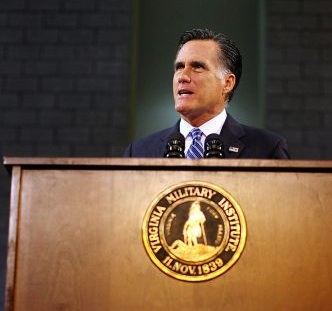
After hearing Romney’s speech to Virginia Military Academy cadets, Juan Cole had an epiphany about Romney’s career prior to this election campaign:

Apparently it is possible to sit in cushy big offices in companies like Bain, and to remain completely ignorant of foreign affairs. Romney’s speeches are all just a replaying for us of the prejudices of CEOs when they play golf together and complain vaguely about the Chinese, Russians, Arabs, and so forth. Or, maybe Romney has gotten so many campaign contributions from arms manufacturers that he can’t help see foreign affairs through the lens of new wars he wants to fight.

Obama, on the other hand, is determined to keep this country away from any further wars. Obama knows, however, that we have enemies who want to do  us harm. Which is why he was able to display leadership, not arrogance, in the debate “Libya moment” following Romney’s allegations about the Benghazi, Libya, attack.

The President was very much the commander in chief  as he displayed an appropriate balance of indignation and quiet fury, glaring at Romney for what Obama felt was a political manipulation of the loss of four American lives in Benghazi.  This is what the President said:

 “The suggestion that anybody in my team, whether the secretary of state, our U.N. ambassador, anybody on my team would play politics and mislead, when we lost four of our own, Governor, is offensive. That’s not what we do, that’s not what I do as president, that’s not what I do as commander in chief.”

What prompted this response was a verbal attack from Romney which the Republican candidate had expected would be his “gotcha” moment.  Unfortunately for him, he told 65 million television viewers that Obama had not used the term “terror” to the day after the attack. Instead, almost gleefully,  Romney added that the President had waited two weeks to call the Benghazi attack an “act of terror”.

That statement was blatantly wrong, as the debate moderator, CNN’s Candy Crowley, quickly pointed out. She told Romney that the President had, in fact used the term “terror” in the Rose Garden the day after the attack.

Below is clip of Romney’s “gotcha moment”, a moment that did not go the way Romney had hoped:

This debate moment could make a major difference in the thinking of that shrinking number of undecided voters in crucial swing states. Will they see that moment as an indication that   Romney is a wealthy corporate executive who is not ready for prime time presidential leadership?  Or will they forgive him as someone who had stumbled because of bad pre-debate briefings?

In Monday night’s final debate, President Obama should be in a position to affect those undecided voters by further exposing Governor Romney’s inexperience in foreign policy. To do this, Obama will have to ignore those advisors at his side who will have reminded him of the ever-present Israel Lobby, the “elephant in the room”. That Lobby controls the U.S. Congress and and also extends its tentacles deep into the executive branch.

Romney has no worries about the “elephant in the room”. He will enter the debate stage Monday night riding the elephant. Romney’s loyalty to Israel, which he made quite evident in his recent fund-raising visit to Israel, and in his campaign rhetoric, has brought him considerable cash and may well make the difference in the voting margin in the key swing state of Florida.

It was that summer visit to Israel that solidified Romney’s position as the elephant rider.  One of his chief financial contributor is U.S. casino mogul Sheldon Adelson, who funded Romney’s trip to Israel. That trip was arranged by Dan Senor, a neoconservative who has emerged as a key foreign policy advisor for the Romney campaign.

Senor is not a foreign policy expert. His experience and area of expertise is public relations. He was the chief PR official in Iraq during the occupation of Iraq. Later Senor wrote a book that praised Israel’s cultural superiority in the region, a position Governor Romney promoted in a speech in Jerusalem.

Senor did not serve Romney well in encouraging him to speak of Israel’s superior cultural qualities in the Middle East, a viewpoint that Senor pushed in his own book, Start Up Nation: Israel’s Economic Miracle.

What care he, if he can take back the White House for the neoconservatives. Both Senor and Adelson are so eager to have Romney ride that “elephant in the room” straight into the Oval Office, that they worry less about what the liberal media calls gaffes, and far more about key votes in swing states.

To be sure, Obama, influenced in part by having to deal with an Israel Lobby-controlled Congress, has also worked hard to curry favor with the Lobby, and to appease Israeli leaders. He has been both insulted by Prime Minister Benjamin Netanyahu, and he has rebuked the Israeli leader with some well placed snubs.

Which Obama will we see in the third debate, the appeaser of the Lobby or the President who glares at Netanyahu in righteous indignation?

Monday night, in the third debate, we could see Obama and Romney as two pro-Israel politicians trading jabs on who is Israel’s best friend. Or, just maybe, the Commander in Chief will be back on stage, confronting an elephant-riding Mitt Romney on behalf of the nation Obama was elected to lead in 2008/

A Closing Personal Political Note:

Former South Dakota Senator George McGovern has been admitted to hospice care in South Dakota. He is suffering from “a combination of medical conditions due to age that have worsened in recent months, his family said in a statement”.

“The senator is no longer responsive,” the statement said. “He is surrounded by his loving family and close friends.”

I have known George McGovern since 1971, when I was privileged to run, successfully, as one of his Illinois delegates to the Democratic National Convention. It was at that convention, held in Miami, Florida, when a young generation discovered that politics was a difficult but rewarding endeavor.

A World War II veteran who flew B-24 missions over Germany, McGovern was an anti-Viet Nam war presidential candidate who lost the 1972 election to Richard Nixon. He combined a love for life with a determination to defend his nation, when necessary.

His last official assignments allowed him to work in the area of world hunger. McGovern served as U.S. Ambassador to the United Nations Food and Agricultural Agencies in Rome, Italy, 1998-2001. He was awarded the Presidential Medal of Freedom on August 9, 2000, and was later appointed United Nations Global Ambassador on World Hunger in 2001. For more on McGovern’s biography, click here.

He studied theology for a  year at Garrett Seminary, Northwestern University, Evanston, Illinois. He earned his Ph.D., in political science at Northwestern. Over the years since 1971, McGovern became a good friend of mine. He was both a spiritual and political inspiration to me and to many of my generation, including the Nation’s John Nichols, who wrote of his friendship with McGovern on McGovern’s 90th birthday.

I last interviewed McGovern for a blog posting during the early years of Barack Obama’s administration. You will find the Wall Writings link here. In that posting,  I reported on a conversation McGovern and I had on the Palestinian-Israel situation, which he had followed closely for many years. I wrote this about our discussion:

What we lost when George McGovern did not make it to the White House might best be understood when we realize that McGovern not only reads and respects the work of Israeli peace activist Avraham Burg, he agrees with Burg”s statement on the conditions for a just peace, which Burg wrote in the Israeli journal, Yediot Aharonot in 2004:

“We cannot keep a Palestinian majority under an Israeli boot and at the same time think ourselves the only democracy in the Middle East. . . We must remove all the settlements and draw an internationally recognized border between the Israeli national home and the Palestinian national home.”

Marc Johnson, a veteran observer of South Dakota politics, has published a tribute to McGovern on his blog, The Johnson Post. While the posting should be read in full. I will lift up two paragraphs here:

The news this week that former South Dakota U.S. Senator George McGovern is in the last days of his 90 years is a reminder once again that even given our nasty, polarized, hyper-partisan politics one man can have an impact. The fact that McGovern, an unabashed liberal, made his impact for so many years in South Dakota, a state almost as conservative as Idaho, is remarkable. 

And Johnson’s final summary paragraph:

George McGovern – historian, politician, failing presidential candidate, hunger advocate – will be treated better by the history books than he has been by his contemporaries. If you believe, as Tom Brokaw has dubbed McGovern’s contemporaries, that the World War II generation was America’s greatest, then the gentleman – the gentle man – from Avon, South Dakota, was a genuine example of personal greatness. Dare I say it – the U.S. Senate could use a few like him.

The cause of peace, justice and fairness in domestic and foreign policy, and the deep sense of decency in public life, will lose a great champion when George McGovern leaves us.

Subscriber Note: If you are not yet on a Wall Writings Alert List, please write to jameswall8@gmail.com with “Please add me” in the subject line. This will assure that you will not miss a single posting.

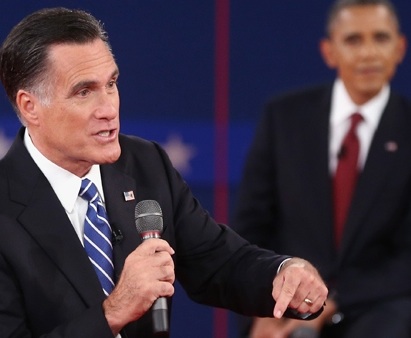
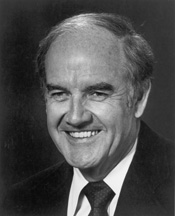
The photo above is from Time magazine. It was taken by Bruce Bennett, for Getty Images. The picture of George McGovern is from The Directory of the U.S. Congress. 

Posted in Middle East Politics, Netanyahu, Obama, Politics and Elections, Romney | 8 Comments

Romney’s Israeli Friends Desert Him

by James M. Wall

In a foreign policy speech delivered Monday at Virginia Military Institute (VMI), Governor Mitt Romney sounded, well, to be charitable, like a man in an echo chamber.

I will put the leaders of Iran on notice that the United States and our friends and allies will prevent them from acquiring nuclear weapons capability. I will not hesitate to impose new sanctions on Iran, and will tighten the sanctions we currently have.

I will restore the permanent presence of aircraft carrier task forces in both the eastern Mediterranean and the Gulf the region – and work with Israel to increase our military assistance and coordination. For the sake of peace, we must make clear to Iran through actions – not just words – that their nuclear pursuit will not be tolerated.

Sounds like the Obama plan to me. Romney was not specific about any action plan. Obama has been quite specific about his plan, informing Israeli Prime Minister Benjamin Netanyahu repeatedly, that Obama, not Netanyahu, would set the red line that would determine how the U.S. would deal with Iran’s nuclear program.

In an additional blow against Romney’s effort to build his foreign policy credentials, he was apparently unaware that a day after his speech, Ha’aretz, a leading Jerusalem newspaper, would report:

Iran has diverted much of its enriched uranium to scientific research, an aspect in the International Atomic Energy Agency’s latest report [to which] Israeli policy makers are giving greater emphasis . . . The new emphasis ostensibly justifies a delay in Israel’s timetable for possible military action against Iran’s nuclear program. That data was included in the IAEA’s August report; defense sources say additional information has been received that clarifies the report’s conclusions.

The key phrase in that statement  is, “justifies a delay in Israel’s timetable for possible military action”. Were there no staffers on Romney’s team assigned to read IAEA reports?  Was there no one in Jerusalem who could have alerted Romney what was about to be announced?

Why wasn’t Romney informed of what Ha’aretz planned for the Tuesday papers? The Romney-Netanyahu friendship began when they were young men working in Boston. It was no surprise that Netanyahu made what was essentially a pro-Romney television ad for the Romney Florida campaign. Florida is a swing state with a large Jewish voting population.

Romney staffers presumed, wrongly, many analysts felt, that Florida voters would respond positively to an implied Romney endorsement from Israel’s Prime Minister during the final weeks of a U.S. political campaign. Campaign veterans know that outside interference in U.S. politics is frowned on in most political and media circles.

It was also a major Romney stumble not to have known that Ha’aretz had been given information it would  use the day after Romney’s VMI speech. A friend should not let another friend drive steeped in ignorance during the final weeks of a campaign, especially when that friend was trying to embellish his limited foreign policy credentials.

This was the information Ha’aretz was holding for its Tuesday paper, as Romney was delivering his speech:

The report, which the Israeli intelligence community considers highly reliable, states that on a number of occasions in the recent past, Iran has allocated uranium enriched to 20 percent for another purpose: the manufacture of fuel rods for a research reactor in Tehran, where isotopes can be manufactured for cancer treatment. This information was behind Prime Minister Benjamin Netanyahu’s statement during his UN speech last month that Israel was extending its deadline for international action on the Iranian nuclear program until the spring of 2013.

Uranium enriched to 20 percent could help make an atom bomb if it were further enriched to 93 percent. But the moment 20-percent enriched uranium is allocated for scientific purposes, it is difficult to put it back on a bomb-making track.

Senior Israeli defense officials told Haaretz that “Iran has moved the wall back by eight months at least,” and Israel’s latest position is a consequence of this action.

If Romney had possessed this behind-the-scenes data befoe delivering his speech, he might have at least been able to appear like he was in Israel’s loop. If the Mitt-Bibi special bond is a Romney plus, it did not show itself in Romney’s VMI speech.

Israel was “standing down” until after the November 6 election. Romney was left to saber rattle alone. Next time fellows, give a friend an early warning.

To be sure, Obama’s sanctions program against Iran, now that it has continued for so long, is, by any moral standard, both onerous and immoral. The ongoing sanctions against Iran meet the standard of “terrorist” action, as defined, cogently, by Guardian columnis Glen Greenwald:

If “terrorism” means the use of violence aimed at civilians in order to induce political change from their government, what is it called when intense economic suffering is imposed on a civilian population in order to induce political change from their government? Can those two tactics be morally distinguished?

Yes, to me, the U.S. sanctions policy against Iran’s public, matches Greenwald’s “terrorist” definition. It is, however, a policy that has worked, in own devilish, cruel, and immoral manner. It is a “successful” policy that should be terminated.

Don’t expect any termination recommendations Thursday night during the Paul Ryan-Joe Biden vice-presidential debate on the campus of Centre College, Kentucky.

The moderator  for the only vice-presidential debate of the campaign will be Martha Raddatz, ABC’s chief foreign affairs correspondent. Unlike the first Obama-Romney debate, which was confined to domestic issues, the questions from Raddatz will cover both domestic and foreign policy issues.

Debate preparation has been intense for Paul Ryan and Joe Biden, each of whom has left the campaign to practice for Thursday night.  Beginning Wednesday morning, thanks to an unexpected announcement Tuesday night from Jerusalem, both vice-presidential candidates will have a new topic to examine which relates to Iran and Israel-Palestine.

The new topic will involve U.S. domestic and foreign policy. Prime Minister Netanyahu has called for early Israeli national elections early in 2013.

Edmund Sanders, of the Los Angeles Times, has the story:

Israeli Prime Minister Benjamin Netanyahu announced Tuesday night that he is disbanding his right-wing government and calling for early elections, blaming a coalition deadlock over how to slash nearly $4 billion from next year’s budget. Speculation has been rife for months that Netanyahu’s inability to pass a 2013 budget would force him to dismantle what has been one of Israel’s longest-serving coalition governments.

Parliamentary elections, which were expected to take place in October 2013, will probably occur by February. Although most polls suggest Netanyahu and his Likud Party will remain in power, the makeup of his next coalition could change if the budget becomes the driving issue, analysts say.

Sanders also reports that potential opponents who might contest Netanyahu in the election, are already shifting their focus to politics:

Signs of impending elections were apparent in recent weeks as leading Cabinet members, including Defense Minister Ehud Barak and Foreign Minister Avigdor Lieberman, began appearing to exert their independence and to distance themselves from Netanyahu’s policies, apparently in preparation for their own reelection campaigns.

Check out the Thursday night debate, which begins at 9 p.m. (EST). And watch Martha Raddatz, fresh from her own campaigns reporting on numerous foreign conflicts, as she demands that Vice President Biden and Congressman Ryan, adhere to the designated time limits and topics of the evening.

As Margo Channing famously said, “Fasten your seatbelt, it’s going to be a bumpy night”.

The photo above is from AFP (Agence France Presse ).

Posted in Media, Middle East Politics, Movies, Netanyahu, Obama, Politics and Elections, Romney | Tagged , | 2 Comments

A “Bad Moon Rising” Over An Obama Victory

by James M. Wall

Those voters looking forward to a second term for Barack Obama, were shocked by the President’s sub-par first debate performance.

A month before the election, it now appears that an Obama victory is no longer a certainty, pending a final judgment, of course, on the findings of post-debate polling.

If Obama continues his laid-back style in upcoming debates, Romney may persuade enough voters, especially in crucial swing states, that his vision of Republican conservatism, is superior to the current policies of the President.

In the first debate, the President displayed a surprising indifference  to attacks from Romney. One debate performance does not a defeat make, but it does remind Obama supporters that no politician can avoid the threat of “a bad moon rising”.

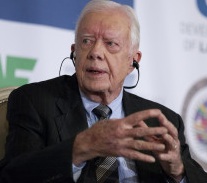
The President failed to bring up the fact that money is corrupting our politics. In a recent Carter Center speech, former President Jimmy Carter (above) provided him with his text. Carter issued “a blistering indictment of the U.S. electoral process”, saying the process “is shot through with ‘financial corruption’ that threatens American democracy.”

Carter’s indictment of the current Supreme Court is a reminder that the election of Romney would assure the continuation of a right-wing court well into the next quarter century.  Elections do have long-term consequences.

If Obama continues his lacidasical debate style, the neocons shaping Romney’s views on Israel and Palestine, will rejoice all the way through the November 6 General Election. There is, without a doubt, a “bad moon rising” over Obama’s campaign.

John Fogarty wrote Bad Moon Rising in 1969. He and his band, Credence Clearwater Revival, made it a staple of their concerts during those days when darkness constantly loomed over a generational longing for better days.

Bad Moon Rising was first a hit single. It became the feature cut on the Credence Clearwater Revival‘s album,  Green River. Bad Moon Rising was eventually recorded by over 20 bands and singers. It was featured in the 1983 film, The Big Chill. Fogarty said he wrote the song after watching the film, The Devil and Daniel Webster, which included the depiction of a destructive hurricane.

For those whose hearing is not attuned to the musical language of that era, the song’s opening lyrics may be found below the video. I thought of that song, one of my favorites from the 1960s and 1970s, at the beginning of this campaign. I have been holding it for the right time during this election, should the need arise. This week seems to be the right time.

http://youtu.be/_a83vvYhkjA

I see a bad moon arising
I see trouble on the way
I see earth quakes and lightnin’
I see bad times today

Don’t go around tonight
well, it’s bound to take your life
There’s a bad moon on the rise

I hear hurricanes a blowin’
I know the end is comin’ soon
I feel rivers over flowin’
I hear the voice from rage and ruin

Don’t go around tonight
well, it’s bound to take your life
There’s a bad moon on the rise

For Obama backers, the “bad moon on the rise” reminds them that debates can be deadly to candidates who perform poorly.

Moderator Jim Lehrer failed in his job as moderator. Igor Volsky is the deputy editor of ThinkProgress.org. In a posting on that site, Volsky identifies 27 “myths”  that Romney claimed were facts.  Did the viewers even notice how much Romney’s style was used to obscure his vagueness?  In his moderator’s role, early on in the debate, Lehrer lost control, a failure which Romney continually exploited.

President Obama, standing on the stage with Romney, was unwilling, or unable, to display the outrage that such “myths” would normally evoke from someone who knew that the facts Romney tossed about were either false or deliberate distortions.

Were viewers bored with all the numbers talk, or could they be guilty of just not paying attention? It is, after all, a time-honored American sports adage that voters “do not  pay attention to the election until after the World Series has ended”.

The President’s surprising, almost casual style left the impression that he seemed indifferent to what the New York Times reported as 67.2 million viewers who tuned into the debate. If the “time-honored American sports adage” about elections and the World Series, is still operative, the failure of voters to pay attention will prevail well into November.

The Big Money owners who run major league baseball have pushed the World Series well beyond its traditional date of early October. They did not do this to affect elections. They were motivated instead by another adage of America’s Big Money, “greed is good”, made popular by Michael Douglas (as Gordon Gekko) in Oliver Stone’s 1987 film, Wall Street

In the short clip below, Douglas’s speech opens a public service announcement in which Douglas campaigns against the “greed is good” quote he made famous:

President Obama missed a huge opportunity when he failed to link Romney to Gordon Gekko’s appeal to greed. It would also have been a nice segue into a discussion of Romney’s rejected 47%, those voters Romney described in a secretly taped fund-raising event in Florida, calling the 47%, “takers, not givers”.

Obama also missed a chance to point out that the real “takers” of our society are the one per centers at the top of the pay scale, who want their tax rate kept low, a clear celebration of  Gekko’s philosophy of greed.

In his address at the Carter Center, President Carter also said “we have one of the worst election processes in the world right in the United States of America, and it’s almost entirely because of the excessive influx of money.”

He was referring to the recent U.S. Supreme Court decision that allows “unlimited contributions to third-party groups that don’t have to disclose their donors”.

The dynamic is fed, Carter said, by an income tax code that exacerbates the gap between the wealthiest Americans and the rest of the electorate, allowing the rich even greater influence over public discourse and electioneering.

He added that he hopes the “Supreme Court will reverse that stupid ruling”.

Had Obama quoted Carter and Gordon Gekko during the debate, the media might have given him credit for two “zingers”, memorable moments that would be remembered long after the election is over.

There is a “bad moon rising”, when the President who burst onto the political scene through his inspiring oratory, missed too many opportunities to “zing” a former Bain corporate executive  who still keeps a portion of his fortune in off-shore investments.

The picture of President Carter, above, is from Huffington Post.

Posted in Media, Middle East, Middle East Politics, Netanyahu, Obama, Politics and Elections | 9 Comments

NYT to Obama v. Romney, “let’s you and him fight”

by James M. Wall

Scott Shane’s New York Times story Friday, linked President Obama to President Jimmy Carter. Shane maintains that Obama, like Carter before him, could also be a one-term president.

The New York Times must have gone into a panic mode for its editors to set Shane loose on such a comparison. There is a good reason for that panic.

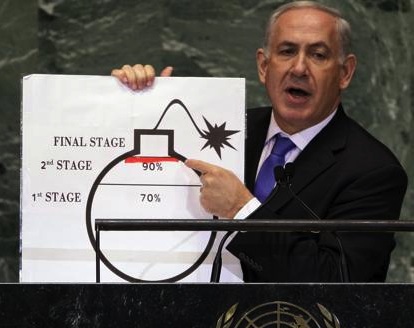
Polls show that, especially in crucial swing states, President Obama’s lead is increasing over his challenger, Mitt Romney. Even Benjamin Netanyahu (above, during his UN speech) has thrown in the towel, promising to hold off his attack on Iran until after the election.

The Times hit the panic button not because it wants Romney to win. What frightens the Times is the same realization that hits sports editors when a football team loses both its star quarterback and leading receiver just before the Super Bowl.

A month is a long time to cover a political fight when the outcome is already determined. What to do? What is a profit-oriented publication giant to do with all those political news pages to fill?

Not to worry, the Times knows narratives can be generated. It also knows the best narrative is the conflict narrative. As the old city editor always said, “conflict is what sells papers, kid, never forget that.”

So it is that the Times looks for ways to instruct candidates Barack Obama and Mitt Romney, “let’s you and him fight”. That old saying just happens to be the title of a great old movie cartoon starring Popeye (shown at left) during which Popeye’s faithful girl friend, Olive Oyl, knowing Popeye is doomed to lose, reaches for Popeye’s main source of energy, a can of spinach. 

Olive Oyle races to the boxing ring where Popeye is down for the count. She gives him his spinach, which, of course, brings him to life and gives him strength. Take a look at the six minute video to see Popeye and Olive Oyl in action:

http://youtu.be/1_m2WUFxnKU

What can the Times do to generate a fight in the political ring even though every political signal says, it’s over? Simple, just bring on the spinach.

Ignoring the polls that show the race virtually over, the Times sends Scott Shane to ringside, with his can of spinach, which is a story that links Obama to Carter as a one-term president. Never mind that the linkage is spurious and unfaithful to history. No one believes that spinach has that much energy-producing power, either. It is the story that matters.

The Times can tolerate a spurious comparison, so long as it brings life back into the fight. Scott Shane, begins his spinach story with the always useful, alarming phrase, he tells us a president is “struggling”.  Hey, everybody, listen up, the game is still on.

The Times, like the Broadway gamblers in Guys and Dolls, led by Nathan Detroit, (played in the movie by Frank Sinatra ), has been pleading, we “gotta have  a game, or we’ll die from shame”. Now the Times has its game:

A president struggling simultaneously to cope with anti-American tumult in the Middle East and fix stubborn economic trouble at home: Is President Obama replaying the one-term presidency of Jimmy Carter?  

So Mitt Romney and Paul D. Ryan have repeatedly suggested, trying to use the glum precedent of the Carter presidency to taint Mr. Obama’s record and produce the same electoral result 32 years later.

Shane cites unnamed “historians” who claim that  “broad parallels between Mr. Carter’s term and Mr. Obama’s make for legitimate comparisons”.

Perhaps a copy editor intervened, causing Shane to quickly acknowledge the weakness of his “fight” narrative with this substantial disclaimer: ‘But many of the details differ, and some tilt decisively in Mr. Obama’s favor, both factually and politically.”

Shane then turns to Frank J. Donatelli as he ignores that Obama decisive tilt. Shane calls Donatelli, “a veteran Republican operative who helped run Mr. Reagan’s 1980 campaign against Mr. Carter and later served as political director in the Reagan White House.”

A Reagan operative from the 1980 campaign is a reliable Times source? A Reagan operative turned amateur psychologist will bolster Shane’s case? Donatelli makes his case:

“Carter was dour, inward-looking, suspicious by nature. Obama’s not. Despite presiding over a terrible economy, Obama has remained pretty popular personally.”

Hey, I was an “operative” in that 1980 Jimmy Carter campaign, a small operative, to be sure. Shane’s unnamed “historians” would insist I admit that major decisions in the campaign were not made at the Illinois state level, where I was Carter’s campaign manager.

But I did know Jimmy Carter well. I knew then he was not, and is not now, “dour, inward-looking, suspicious by nature”. For the record, having known my fellow Georgian since 1974, I will testify that Carter was then, and is now, warm, out-going, and properly suspicious, by nature, of journalists and politicians who try to impose their own narratives on him.

(Memo to Scott Shane, if you ever need a quote from a low-level Carter operative from the 1980s, give me a call. I’m in the phone book.)

Meanwhile, Donatelli, the amateur psychologist turned political analyst”, tells Shane:

“What defeated Carter, was the public’s sense that he couldn’t handle the job. That’s the point Romney and Ryan and are trying to make about Obama — that however nice a guy he may be, he’s in over his head.”

Shane defends the Romney-Ryan case by using flimsy evidence which any Carter “operative” from the 1980 campaign, could have quickly refuted. Shane is repeating political tropes that have calcified into gospel truths, such as “in over his head”. What president is not “in over his head”. They all are. The job is too large and the chaos too overwhelming in any era, for any single individual to claim otherwise.

All each president can do it cope with the task at hand, a task that always includes having to deal with politicians ready to deal with anyone who will help them win a political fight.

To his credit, Shane brings in an historian who is willing to be quoted, to make the case that Jimmy Carter was capable of dealing firmly with an enemy who was holding American citizens as hostages in Teheran, Iran.

David Patrick Houghton, a political scientist at the University of Central Florida and author of a book on the Iran hostage crisis, said the Carter comparisons were “mostly unfair” — both to Mr. Carter and Mr. Obama. He singled out as “utterly false” Mr. Romney’s claim that Mr. Reagan’s tough reputation caused Iran to release the American hostages just as he became president; in fact, the Carter administration had negotiated their release.

“This campaign has become a kind of opportunity to fling around bogus history,” he said.

Romney’s claim is, indeed, “utterly false”, when he claims, “Reagan’s tough reputation caused Iran to release the American hostage just as he became president”. The release of the hostages on Reagan’s inauguration morning is also believed to have been part of a deal arranged by Reagan operatives to reach an agreement with the Iranian government that it would hold the hostages until after the election. For more on this deal, see Gary Sick’s detailed account of the events surrounding the delay of the release of the hostages in 1981, in his book, October Surprise.

As Historian Houghton noted, the Iranians had earlier agreed with Carter, after lengthy negotiations, that they would release the hostages. All that was left was a decision on the timing of the release. A pending timing decision was too tempting to duplicitous politicians not to negotiate their own side deal.

Together the Iranians and the Reagan operatives agreed on a “deal” which led to a delay in the release of the hostages until after the election. Many analysts agree that particular deal with the enemy ended any chance Carter had of winning the election. Carter had lost his fight to free the hostages, who had been held for almost 444 days of his presidency.

Fighting to gain the upper hand in a political battle emerged in the speech Israeli Prime Minister Benjamin Netanyahu gave to the United Nations General Assembly earlier in the week. Before he scaled back his threat to attack Iran before the November 6 election, Netanyahu made one final gesture of defiance against Barack Obama.

Unfortunately for him, his defiance included a decision to unwittingly emulate a movie comedy figure, Wile E. C0yote (shown here) by drawing a cartoon bomb to illustrate to the United Nations General Assembly what Netanyahu believed was line showing how close Iran was to having the capacity to produce a workable nuclear bomb.

Commentators like Richard Silverstein, have shown just how much Netanyahu, with his comic bomb drawing, (at top), looked like Wile E. Coyote  (shown here.) in the 1952 movie cartoon short, Operation: Rabbit

http://youtu.be/SoKA2OLJ8hs

Prime Minister Netanyahu’s final gesture of defiance may or may not, fare better in history than did Wile E.Coyote in his battle with Bugs Bunny. Politicians are unpredictable, and those that possess a nuclear arsenal, as Netanyahu does, are especially dangerous when they feel trapped.

Meanwhile, there are three presidential debates, and one vice-presidential debate, before the election on November 6. I await with great anticipation, just how the New York Times will cover the first debate Wednesday, October 3. Maybe they will have a fight story that depicts Wile E. Romney getting up from the canvas to score a decisive victory over the champ, Bugs Obama.

The picture at top of Prime Minister Benjamin Netanyahu is from the Boston Globe. It was taken by Richard Drew, of the Associated Press.

Posted in -Movies and politics, Media, Middle East, Middle East Politics, Movies, Netanyahu, Obama, Romney | 2 Comments

Obama’s UN Call For “the right to practice free speech” Does Not Embrace Beit Ommar

By James M. Wall

President Barack Obama was at his eloquent best when he addressed the United Nations General Assembly this week.

Until, that is, he inserted a jarring note that was anything but eloquent.  It sounded, in fact, like a left over paragraph from Obama’s last speech to AIPAC.

Note the following contrast between the President’s explanation of why the United States does not ban even ugly and demeaning speech like that which appeared in the recent movie trailer that blasphemed the Prophet Muhammed.

Americans have fought and died around the globe to protect the right of all people to express their views – even views that we disagree with.
We do so not because we support hateful speech, but because our Founders understood that without such protections, the capacity of each individual to express their own views, and practice their own faith, may be threatened. 

Near the end of his speech, the President shifted both his tone and content.  No longer did he wish to defend free speech; it was time to move from his statesman mode to that of a politician running for reelection, by adding an obligatory bow of obeisance to Zionism.

Among Israelis and Palestinians, the future must not belong to those who turn their backs on the prospect of peace. Let us leave behind those who thrive on conflict, and those who reject the right of Israel to exist. The road is hard but the destination is clear – a secure, Jewish state of Israel; and an independent, prosperous Palestine. 

As a statesman, Obama could have made a bold move and expanded Israel’s “right to exist” to include the “right to exist” of a new “independent, prosperous” state of Palestine. It did not happen.

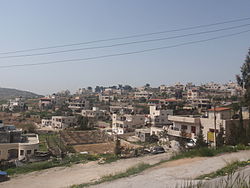
Obama’s “right to practice free speech”, did not embrace the citizens of  Palestinian communities like Beit Ommar (at left), a town of 17,000, located in the Hebron governate of the West Bank.

For the past three years non-violent Palestinian protests, in and around Beit Ommar, have been conducted against Jewish settlements, built, illegally, on Palestinian land. 

Beit Ommar, largely unknown in the United States, has found supporters in the European Union. This activism distresses Israel’s leaders, who, in reprisal,  have targeted communities like Beit Ommar. As is its custom, the Israeli occupying forces have imprisoned protesters and, at times, have focused on large families with young and teen-age children.

During this week, in which Obama spoke to the UN of “the right to practice free speech”, two of those Beit Ommar families received intense Israeli attention:

The Palestine Solidarity Project (PSP) reported:

On Monday 24th of September two Beit Ommar residents, Mohammed Abu Hashem (16) (see poster here) and Tarik Abu Maria (18), were arrested in a night raid by the Israeli occupation forces.

 The occupation forces accused Mohammed of using a sling shot and of participating in peaceful demonstrations, therefore they wanted to bring him to Gush Ezion for interrogation. The officers claimed they have pictures of him in both situations.

One and a half hour after storming the family home the occupation forces left with Mohammed. Neighbours threw stones at the soldiers who answered with tear gas and sound grenades. Despite his young age this is Mohammed’s third time in prison.

During the same raid Mohammed’s cousin and neighbour, Tarik Abu Maria, was arrested. He is 18 years old and this is his second time in prison. The officers told Tarik’s family that he will stay in Gush Ezion at least until the court meeting for Mohammed and Tarik which is scheduled to be Thursday 27th of September.

Monday morning Ahmed got a phone call saying Mohammed was to be transferred from Gush Ezion to Ofer prison outside Ramallah.

In another night raid Monday 24th of September the Israeli occupation forces raided the Beit Ommar home of the Ramzy Al Alamy family (shown in picture at top):

Their 15 year old son, Hossein Ramzy Al Alamy, was arrested on March 31st 2012 when he was attending a peaceful demonstration in Beit Ommar. When he was released the judge told Hossein that if he was seen at a demonstration the next four years he would be jailed for seven months.

Monday 24th of September the occupation force wanted to arrest Hossein again. They accused him of participating in peaceful demonstrations next to the [illegal Jewish] colony Karmei Tsur. The occupation forces did not find Hossein at home, and handed his father, Ramzy, an order for Hossein to meet with the military officers in the Gush Ezion colony.

PSP were informed that Hossein and his father went to Gush Ezion around noon Monday 24th. Ramzy returned without his son who now is imprisoned awaiting a court meeting which is not yet scheduled.

This is life under occupation in one town in the southern part of the West Bank, in the governorate of Hebron. These young Palestinians are not allowed to “practice free speech” by protesting against IOF oppression.

Barack Obama should know this even more than the rest of us. We will find out only if he gains a second term.

The picture of Beit Ommar is from Wikipedia. The others pictures are from the Palestine Solidarity Project.

Posted in Middle East, Middle East Politics, Politics and Elections | 4 Comments

The Video That Could Doom A Candidate

by James M. Wall

The presidential election is still four and a half weeks away, but the video that tells all about Republican Mitt Romney’s inner beliefs on Palestine and U.S. tax payers, may already have doomed his candidacy.

Mother Jones, a non-profit progressive publication, obtained the video of Candidate Romney speaking at a $50,000 per guest fund raiser on May 7, in Boca Raton, Florida. It is difficult to see how the Republican ticket can survive the fall-out from what it reveals about Romney.

Romney had started his current spectacular slide when he chose Clint Eastwood to speak before Romney’s nomination acceptance speech in Tampa. The off-color humor that Eastwood used was inappropriate and tasteless. It also upstaged Romney’s dull content-less speech.

Of course, Romney’s slide to a possibly doomed candidacy was already greased by Romney’s refusal to come clean on his personal finances, some of which have been stashed away in tax-free havens overseas.

Three presidential and one vice-presidential debates await the candidates. The Republican ticket of Romney and Paul Ryan could start a major comeback with those debates, but nothing in their campaign rhetoric thus far indicates they are ready to speak to any but their right-wing admirers.

Take a look at the 3 minute video clip above, lifted from the longer 70 minute video. The views he expresses indicate a low level of awareness of the issue that is at the heart of the unrest throughout the Middle East.

Because Romney is a devout Mormon, we assume he does not drink alcohol. So we should be on safe ground to say that the man we see waxing eloquently to his financial supporters is a sober adult male, revealing that he is as knowledgeable about world affairs as that tired business executive you were stuck with as a seat mate on your last long airline flight.

You know the man I mean, the one who saw you reading a book on the Middle East by Rashid Khalidi.

His first comment would be, “things are a mess over there, right?”  Then he would proceed to talk like a tired business executive who knew as much about the Middle East as anyone whose information was limited to the Wall Street Journal and Fox News. You doubt that he has even heard of Rashid Khalidi.

The host for the fund raiser was Marc Leder, a private equity manager, who lives in Boca Raton, Florida. The entire video runs for 70 minutes. The evening’s tab was $50,000 per diner, but as Candidate Romney knew, the guests were capable of giving, and raising, a great deal more money for him.  Romney is, after all, one of them.

Most of Romney’s comments caught on the video focused on the economy. The most revealing and damaging comment came when he explained that he would not even try to gain the votes of 47% of the voting public because they are the ones who are dependent on the government to support them. These are people, he said, “who don’t even pay federal income taxes”.

What Romney said in his off  the cuff, far-ranging remarks to his financial backers, was so outrageous that even members of his own party have been thrown into disarray. Here is a clip from, perhaps, the critical moment of the tape:

Even writers who know and like Romney are pained to criticize him, even as they do so.  He is, after all, as John McCain once said of Barack Obama, “a good family man”.

Which he no doubt is, but in the clip above, this “good family man” answered a question from a $50,000 donor guest about the “Palestinian problem”, with the wild assertion that the Palestinians have “no interest whatsoever in establishing peace, and that the pathway to peace is almost unthinkable to accomplish.”

How will that play if a President Romney sits down to talk with a Palestinian president?

Romney’s potential leadership on this crucial significant foreign policy issue revealed that what he knows about the topic comes from a narrow group of neoconservative Republican hardliners who fully intend to do with this candidate what they so successfully did with President George W. Bush. This crowd molds candidates to suit their pro-Zionist, pro-military industrial foreign policy.

With Vice-President Dick Cheney leading the way, this is the same crowd that led President Bush to invade Iraq. With Romney in the White House, they would be poised to join with Israel in an attack on Iran.

In speaking to his Boca Raton audience, as waiters moved about, Romney knew this was a group that shared his fondness for Israel. This led him to address the “Palestinian question” with a candor he would never use when speaking to a wider audience. As Juan Cole explained:

Romney typifies the American duplicity toward the 12 million Palestinians. His campaign speaks of a ‘two-state solution.’ But in private he admits that such a thing, involving giving Palestinians their own state, is “almost impossible to imagine.” So the talk of a two-state solution is just a smokescreen for keeping the Palestinians stateless.

Romney had already shown his hand on which “side” of the “Palestinian problem” he favors, when, during a recent trip to Israel, he said the Israelis have a culture that is “superior” to that of neighboring Arab states. That comment registers very high on the “racist” scale.

It is difficult not to begin to realize that Romney is an empty vessel waiting to be filled by foreign policy “guides” like Romney’s foreign policy consigliore, Dan Senor, who previously had served as the lead public relations official for the Bush Administration in Iraq after the initial “shock and awe” invasion.

Think Progress describes how Senor emerged as a key advisor in the Romney campaign:

Since his 2008 run for the presidency, Mitt Romney has gotten his foreign policy advice from a gaggle of moderates and neoconservatives and other hawks. In this election cycle, the neoconservatives and other “Cheney-ites” reportedly marginalized moderates on the staff. One of the neocons — Dan Senor, who has been advising Romney since 2006 — seems to have stepped into the breach.

Romney’s July, 2012, trip to Israel was the brain child of Senor and his friend, Ron Dermer, the American-born political operative who is Netanyahu’s chief strategist and speechwriter.  The Jewish Tablet reports on the trip:

Senor—who is famous in pro-Israel circles as the author of the best-selling 2009 book Start-Up Nation—has taken Romney to Israel twice before, once in 2007, before the governor’s first presidential bid, and again last year. This spring, he accompanied New Jersey Gov. Chris Christie, a Republican who has endorsed Romney, to the prime minister’s office in Givat Ram to meet with Netanyahu and Dermer.

But the current trip, coming so late in the campaign season, was planned quietly, for fear of provoking a possible last-minute visit by President Obama, who has been criticized by some Jewish groups for failing to return to Jerusalem since his inauguration. Late last month, while Senor was in Jerusalem for his niece’s bat mitzvah, he met Dermer for breakfast at the King David Hotel; a few days later, with the Romney campaign’s blessing, Dermer gave the scoop to the New York Times.

Senor’s book, the Start-Up Nation, praised the spirit and ingenuity of the Israeli people for the manner in which they have been able to “start-up” many businesses that have become the driving force of Israel’s economy.  He contrasts that with surrounding Arab states, which may have been the source of Romney’s comment on Israel’s “superiority” in matters cultural.

The media coverage of the Boca Raton video, which runs for 70 minutes, has been extensive. Most attention has focused on the class bias, which Romney admits to when he describes the 47% of  U.S. voters as essentially  moochers living off of the largess of the government that the “rest of us” have to finance.

Since the video surfaced, polls indicate a swing away from Romney. Republican candidates for the Senate and House have begun to distance themselves from their presidential candidate.  Worse yet, for Romney, even conservative media pundits have joined in the outrage.

Few have expressed that outrage as effectively and with such regret, as the New York Times‘ David Brooks. Evoking Thurston Howell, a television character who epitomized stuffy rich people, Brooks gave his piece the title, Thurston Howell Romney. Ouch. Brooks’ final words include this harsh indictment:

Romney, who criticizes President Obama for dividing the nation, divided the nation into two groups: the makers and the moochers. Forty-seven percent of the country, he said, are people “who are dependent upon government, who believe they are victims, who believe the government has a responsibility to take care of them, who believe they are entitled to health care, to food, to housing, to you name it.”

This comment suggests a few things. First, it suggests that he really doesn’t know much about the country he inhabits. Who are these freeloaders? Is it the Iraq war veteran who goes to the V.A.? Is it the student getting a loan to go to college? Is it the retiree on Social Security or Medicare? . . . .

Romney’s comment is a country-club fantasy. It’s what self-satisfied millionaires say to each other. It reinforces every negative view people have about Romney.

Brooks is at least a moderate, well-mannered conservative. AlterNet, a progressive blog, found ten reactions to the video from disappointed and angry conservatives. The survey begins this way:

Team Romney’s biggest problem continues to be Mitt Romney. It’s tough to build a campaign around a cartoonish 1-percenter whose CPU doesn’t appear to be programmed for human empathy and who lacks an effective filter between brain and gums.

Mark McKinnon, a John McCain staffer who withdrew from the McCain campaign before it was over, had this to say for The Daily Beast in his read on what is next for Romney, post-video.  McKinnon calls his post, Why Time is Running Out for Milt Romney.

I’m still a Republican. Trying to be, anyway. The progressive caucus is a lonely one these days. Nevertheless, we soldier on in hopes of regaining a voice in the party.

Well, the release of the Romney tape was a moment that certainly revealed something about him. But not what I was hoping for. Just the opposite. It reveals a deeply cynical man, who sees the country as completely divided, as two completely different sets of people, and who would likely govern in a way that would only further divide us.

The video that could doom a candidate was secured surreptitiously with a cell phone. It was delivered to Mother Jones by President Jimmy Carter’s grandson, James E. Carter IV.

The CBS station in Atlanta gave this Associated Press version of Carter’s work:

The grandson of former President Jimmy Carter says he persuaded the source who secretly taped Republican presidential nominee Mitt Romney at a fundraiser to release the full video to the media. James Carter IV of Atlanta says he was intrigued after seeing what he describes as a short, mysterious clip of Romney talking about Chinese factory conditions.

He told The Associated Press that he tracked the source down on Twitter in August and convinced them to trust a journalist at Mother Jones magazine with the clips.

The younger Carter has been looking for his niche in the political world.  He appears to have found a career on his own, tracking down obscure video tapes for wider, productive tasks. He has already received several job offers from prominent media outlets.

Various media reports on Carter’s work described his finding the video and placing it with Mother Jones to be “poetic justice”.  The reference, of course, to those who remember Jimmy Carter’s loss to his Republican challenger, Ronald Reagan.

Young Carter’s action constitutes poetic justice because his grandfather, President Carter, lost his bid for a second term bid when Reagan’s handlers created an “October Surprise”, by negotiating with Iran to delay release of American hostages until after the election. These were the hostages Carter had labored so long to set free.  They were set free on the morning of Reagan’s inauguration.

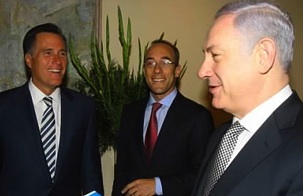
The picture of Romney, Dan Senor and Prime Minister Netanyahu is from The Jewish Tablet. The videos are from Mother Jones.

Posted in Media, Middle East, Middle East Politics, Netanyahu, Obama, Romney | Tagged , , , | 4 Comments

How A Hate-Driven Anti-Muslim Film Led to the Death of Four U.S. Diplomats

by James M. Wall

Leave it to Juan Cole to come up with just the right metaphor to interpret the events in Libya and Egypt this week.

Cole knows the Middle East and he has the writing skills to clarify the complexities of the region and how they interact with U.S. politics as they unfold.

Cole is a public intellectual, prominent blogger (Informed Comment) and essayist. He is also the Richard P. Mitchell Collegiate Professor of History at the University of Michigan.

After reflecting on the chaotic series of events that began with a clumsy, fraudulent YouTube preview of an anti-Muslim film produced in California, Cole offered “the butterfly effect” as the metaphor which explains how a small film led to the deaths of four U.S. diplomats in Libya, including the U.S. Ambassador to Libya J. Christopher Stevens.

Cole begins his blog posting:

The late science fiction writer Ray Bradbury authored a short story about time travelers. They were careful, when they went back to the Jurassic, not to change anything, but one of them stepped on a butterfly. When they got back to the present, the world was slightly different.

When scientists studying complexity put forward the idea that small initial events could have large effects in non-linear, dynamic systems like the weather, they chose the term ‘butterfly effect.” One of the images students of weather instanced was that a butterfly flapping its wings might set off minor turbulence that ultimately turned into a hurricane.

Cole’s butterfly metaphor begins this narrative describing the death of four U.S. diplomats, with a man initially known as “Sam Bacile”, who claimed to have directed the film, The Innocence of Muslims. The Associated Press traced the history of this “Sam Bacile”, and discovered that he most likely does not exist. The false name is a persona used by a convicted Coptic Egyptian fraudster, Nakoula Bassely Nakoula.

The AP found that Nakoula had both Coptic and evangelical Christian associates in the shooting of the film. One of his associates was Steve Klein, who is, as Cole explains,”a former Marine and current extremist Christian who has helped train militiamen in California churches and has led ‘protests outside abortion clinics, Mormon temples and mosques.'”

Cole suspects “that most of the Egyptian Copts involved are converts to American-style fundamentalism”.  The Egyptian Coptic church has roundly condemned the film.

Nor is this the first time that western anti-Islam sub-cultures have found ways to attack Islam and the Prophet Muhammad.

In a perceptive analysis of the effects of the trailer (apparently no one has even seen a longer version, which suggests it does not exist) for the hate-driven film on the politics of the Middle East and of the U.S. presidential race, the Cairo-based English-language web site, Ahram Online, made the connection between the dregs of western culture and the impact these dregs make on Islam.  Al-Ahram Online is published by Al-Ahram Establishment, Egypt’s largest news organization.

Chief Editor of Ahram Online, Hani Shukrallah, wrote after the Egypt and Libya uprisings:

We need only recall the 2005-6 Danish cartoons episode. The insignificant Danish newspaper that triggered the hullabaloo had been transparently out to trigger a reaction from Muslims, and a reaction it got. Nor do I have the least doubt that the [Florida] Christian fundamentalist preacher who publicly set a copy of the Qur’an on fire was also deliberately out to goad Muslims into a reaction.

The obvious, outward motive of such attempts is not difficult to discern: to show Muslims as irrational, violent, intolerant and barbaric, all of which are attributes profoundly inscribed into the racist anti-Muslim discourse in the West. And, it’s a very safe bet that there will be among us those who will readily oblige.

I can guess at two additional motives, one of an immediate, narrowly targeted nature, and the other considerably more general and strategic in nature.

America is hurtling towards presidential elections in which Barak Hussein Obama is running for a second term. For large sections of the American Christian Right (closely allied to rightwing Zionism), Obama is, if not the anti-Christ, then at the very least a Muslim mole planted in the White House.

For his part, Obama, from the very start of his presidency, had set out to douse the fires of the “clash of civilizations”, then still raging courtesy of Messrs Bush and Bin Laden, among others. An editorial in the New York Times commenting on Obama’s famous address to the Muslim world from Cairo University, lauded him for having “steered away from the poisonous post-9/11 clash of civilizations mythology that drove so much of President George W. Bush’s rhetoric and disastrous policy.”

To reignite “the clash” in some form serves to bolster the American Right as a whole, the American Christian Right (which is a mainstay of the Republican Party) in particular, while at the same time undermining Obama, who at best had acted to bring this clash to an end, and at worst is “a bloody Muslim” himself.

A much broader motivation, which does not exclude Obama as target, is to tarnish, even to deny the very existence of an Arab Spring.

Republican candidate Mitt Romney has refused to back down from his initial reaction to the attacks on the U.S. embassy in Cairo and the U.S. consulate in Benghazi, Libya. In his immediate response to the news, Romney attacked President Obama for “apologizing” for what Romney termed, “American values”.

This stubborn refusal by Romney suggests that he is locked into a playbook of the U.S. Christian right wing, no matter how much the main stream media scolds him for making political comments at the time of an international event that led to the death, in Libya, of the U.S. ambassador and three other staff members. Which leads to the further suspicion that this Romney is not his father’s son in neither political sagacity nor the ability to exercise national leadership at home or abroad.

President Obama responded to the attacks by pledging that “justice will be done”. Secretary of State Hillary Clinton described those responsible for the death of four Americans as “a small and savage group”. Obama also said the U.S. would cooperate with Libyan officials in bringing the members of that “small and savage group” to justice.

The Washington Post has reported that “senior U.S. officials and Middle East analysts raised questions Wednesday about the motivation for the Benghazi attack, noting that it involved the use of a rocket-propelled grenade and followed an al-Qaeda call to avenge the death of a senior Libyan member of the terrorist network.”

The uprisings were apparently also timed to coincide with the 9/11 anniversary. Advance planning, which U.S. officials are assuming, should help in the search for those responsible for attacking the U.S. Benghazi consulate. The deadly attack, according to Libyan officials, may have been planned to operate under the cover of citizens’ protests.

In Tripoli, Libya’s capital, the Libya Herald reported:

Libya today denounced the killing of US Ambassador Chris Stevens and three other US embassy staff. 

Speaking at a joint press conference in Tripoli, both Prime Minister Abdurrahman El Kib and Mohamed Magarief, president of the General National Congress, expressed sorrow for what they called “a criminal act”.

To return to Juan Cole’s analysis, the “butterfly effect” began with the appearance of an insignificant movie preview in California, which was ignored by everyone until the film was translated into Arabic and put on YouTube.

Immediately, social media had the expected impact the makers of the film intended. The insult to Islam and the Prophet Muhammad reached a world audience.

After tracing in considerable detail his analysis of the journey of the initial flapping of the butterfly wings to the death of four U.S. diplomats, Juan Cole offered this word of hope:

So the Butterfly Effect set off by a low-budget bad propaganda film gotten up by two-bit frauds and Christian supremacists, and then promoted by two-bit Egyptian and Libyan fundamentalists, has provoked some squalls and cost the lives of four good men.

The storm provoked by this butterfly has revealed character on an international scale. The steely determination of an Obama to achieve justice, the embarrassing grandstanding of a Romney, the destructive hatred of a handful of extremists in Cairo and Benghazi, and the decency and warmth toward the US of the Libyan crowds, all were thrown into stark relief by the beating of the butterfly’s wings.

In the end, the violence and extremism of the hardliners on both sides is a phantasm of the past, not a harbinger of the future. The wave of democratic politics sweeping the region has left the haters behind, reducing them to desperate and senseless acts of violence that will gain them no good will, no popularity, no political credibility.

In less than two months, American voters will have their moment to choose between two visions of how to respond when “violence and extremism” strikes.

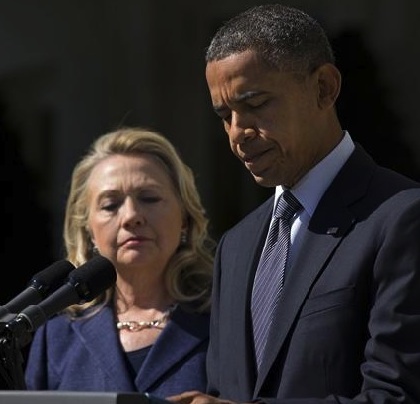
The picture above of Secretary of State Clinton and President Obama is by Evan Vucci of the Associated Press.

Posted in Middle East Politics, Obama, Politics and Elections | 13 Comments

The Night An Unscripted Moment of Democracy Surprised the Democrats

By James M. Wall

To have seen it, you had to be watching either a public or a cable network. You also had to be watching closely.

Otherwise, early Tuesday evening in the Democratic National Convention, you missed an ever-so fleeting unscripted moment of democracy at work.

The old axiom, “Never watch sausage nor legislation being made”, fits that moment perfectly.

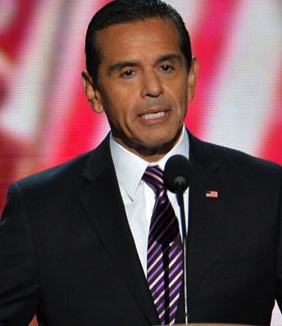
What happened was not pretty; in fact, it was downright ugly with a ruling from the presiding officer, Los Angeles Mayor Antonio Villaraigosa (right), saying the “ayes” sounded stronger than the “nays”, a dubious ruling, at best in a vote requiring a majority. If the vote needed more than a majority to pass–this is not made clear–then it is not just dubious, but obviously wrong.

The party platform of an incumbent president is dictated by the incumbent. It is intended to outline positions on which the party is in general agreement.  The platform committee that shapes the set of positions is appointed from among the delegates. It always contains delegates who can be relied on to deliver language the president wants.

The platform is a  largely ignored document with a shelf life of about 15 minutes. The only time the platform gets attention is when convention delegates strongly disagree on its wording, setting off a disruptive floor debate. This 2012 Democratic convention had no time for such a debate.

The floor debate that Mayor Villaraigosa blocked, has its genesis in what appears to have been platform committee action from Utah Democratic delegates.  Other Democratic delegates who were supposed to keep the Platform Committee in line were missing in action when the language was changed.

The platform language that was briefly changed was the deletion of “God” and “Jerusalem is the undivided capital of Israel”, both topics using boilerplate language that had been adopted four years ago in the 2008 platform.

That insurrection had to be corrected by party officials “at the top” as one delegate said. At the moment,  President Obama is locked in delicate negotiations with Israel over the future of the Palestinian people. He has to win re-election if those negotiations are to continue.  If Romney wins, there will be no negotiations, just capitulation by a Republican party heavily financed by wealthy Israeli-backers in the U.S.

Those Utah delegates, or whoever it was that managed to delete God and “undivided capital” from the platform, were, of course, on the side of the angels in this debate. But politics, like sausage, is conducted in the mire of the possible, not in the land of “what ought to be”

Putting ‘God’ in the platform is an insult to Americans who do not share that faith or whose religions refer to the Ultimate by other names, Allah and Yahweh, for example.  That argument, however, does not play well politically in a nation with so many voters firmly believing this nation’s founders were rock-ribbed Christians (which they were not).

The Democratic platform retains the magic phrase, “subject to negotiations with the parties involved”, which means that no matter what the platform infers, the future status of Jerusalem remains in the “final status” category. God, of course, is not subject to negotiations.

A video clip of Mayor Villaraigosa in the chair gaveling down rebellious delegates, is below. Note carefully shots of two delegates, who wear the Tee-Shirt worn by other Arab-American delegates. The shirt uses an Arabic phrase, “yallah, vote”, or “Hurry up, vote”, to rally other Arab American voters.  The woman at right in one shot in the video shakes her head in disappointment and disgust.

This race between Obama and Romney remains tight, though the Democrats continue to lead in the key swing states. The language of the platform will have little impact on voters.

What impact it does have is that God and “undivided Jerusalem” are handy tools for Republicans to use in their “know-nothing style” campaign ads that whip up their base against the Democrats.

Fortunately, for the Democrats, their unscripted moment came long before the major television networks begin airing the night’s proceedings. Only cable networks (which viewers have to pay for) and public television (smaller audiences) began broadcasting at 7 p.m. (EST) while the free (crammed with commercials) major networks waited until 9 p.m. to join the proceedings.

During the nightly two-hour commercial network air time, the Democrats ran a smooth convention, highlighting its stars. Not so the Republicans.

To the Romney forces’ later deep regret, convention planners unwittingly handed a showcase headline slot to movie actor-director-tough guy Clint Eastwood. Eastwood used his own unscripted time to speak in a condescending tone while he insulted President Barack Obama with Eastwood’s own middle-school level of gross, unfunny humor. (“He can’t do that to himself”.)

The Democrats dealt with their unscripted moment of democracy before a smaller audience, and fortunately for them, out of sight of the majority of viewers.

What they could not dispose of was the image of AIPAC once again playing the tune to which the Democrats willingly dance. No one knows this better than President Obama. What he needs is four more years in which to show that backbone Vice President Joe Biden spoke of in his glowing nomination speech for the President Thursday night.

The President, or those “at the top” who dictated the final 2012 Democratic platform, paid a price of one more small dance to the AIPAC tune, to help the President win his second term.

Words in the platform are easier to swallow than an Israeli attack on Iran before the November election. And thanks, it would appear, to the President’s resolve in standing firm against such an attack, Israel’s Prime Minister Benjamin Netanyahu now shows signs of standing down on his determination to attack Iran.

This news report from Israel appeared during the convention proceedings (on Wednesday). It suggests that the war drums in Israel are quieter now. The clue is in recent IDF appointments:

If anyone needed further proof that Benjamin Netanyahu has buckled under the pressure and will probably not be giving the order to attack Iran in the next few months, at least not before the U.S. elections, the latest reported IDF appointments seem to supply it.

Yedioth Ahronot reported Wednesday that two key appointments in the IDF that have been frozen for the past few weeks are going ahead. Maj. Gen. Yoav Har-Even, who was only promoted last week, will this week become the new head of the IDF General Staff’s operations directorate, replacing Maj. Gen. Yaakov Ayash who is moving to Washington to serve as the IDF military attaché. The other is of Col. A. (name withheld for security reasons), an air force operations chief who will assume command of Ramon airbase, replacing Col. Tal Kalman.

Both appointments were in the pipeline for a while and Yedioth surmises that both the decision to postpone, and now the decision to go ahead with the appointments, are due to fact that “the level of alertness and readiness in the IDF, which was at a record high in recent weeks, is about to go down.

As President Obama prepares for his final nine-week post-convention campaign run against his Republican opponent, he should be encouraged by these signals that Israel has resigned itself to a second-term Obama presidency.

The picture at top of Mayor Villaraigosa is by Kevin Dietsch of UPI for Newscom.

Posted in Middle East Politics, Netanyahu, Obama, Politics and Elections | 8 Comments

Israeli Court Blames Rachel Corrie: She “Put Herself in a Dangerous Situation”

by James M. Wall

An Israeli civil court’s decision to exonerate the Israeli Defense Force in the death of Rachel Corrie, was not a surprise.

Rather, the decision, written by an Israeli court, in standard Israeli narrative language, reinforces the obvious: Israel’s judicial system has become a legal front that protects the power of Israel’s military dictatorship.

The court’s verdict blames the victim with all the subtlety of a court describing a rape victim who invited trouble by wearing provocative clothing.

Gary Spedding, a Huffington Post blogger from Belfast, Ireland, writes:

After waiting for almost ten years for today’s court verdict the family of Rachel Corrie have left an Israeli court in Haifa this morning feeling the bitter sting of injustice from Israel’s politicized justice system.

Early Tuesday morning the Israeli court rejected accusations that Israel was at fault over the death of US citizen Rachel, who was crushed by an army bulldozer during a 2003 pro-Palestinian demonstration in the occupied Gaza strip.

Summarizing a 62-page verdict the Israeli Judge Oded Gershon noted Rachel’s “involvement with the International Solidarity Movement (ISM)” adding that “ISM activists had even defended Palestinian families involved in terror, aiding, even if indirectly the activities of terrorists”

Further into the court decision the Judge absolved the Israeli military of its actions by claiming in his decision that, “The army had not been involved in demolishing houses, just clearing an area of places from which IDF had been attacked”.

Ha’aretz, a Jerusalem-based Israeli newspaper, described the death of Rachel Corrie in language that assumes there is only one narrative that Israel accepts as “good for Israel”.

At the time of her death, during a Palestinian uprising, Corrie was protesting against Israel’s demolition of Palestinian homes in Rafah in the southern Gaza Strip.

Protesting during a Palestinian uprising?  That’s one way of describing her death. But what is a protest and what is an uprising?  Who defines these terms?  A different way of seeing her death was that Rachel Corrie was an American volunteer, working with the non-violent International Solidarity Movement (ISM), an organization that the state of Israel, the official keeper of the Israeli narrative, tries to smear with unproven “terrorist” connections.

Was Rachel Corrie protecting terrorists?  Was this 23-year old from Olympia, Washington defending the home of a Rafah, Gaza, family from an IDF bull dozer, or was she protecting “terrorists”? The Haifa court does not offer an answer to those questions.

An ISM photo (above) was taken just before Rachel’s death. Rachel is at the far right, wearing a brightly colored orange vest. She does not look like a “terrorist”, unless any American activist peaceably standing up against an IDF bull dozer, is automatically assumed to be a danger to the state of Israel.  This is not the  mindset of a modern democratic nation.  It is paranoia in its most malignant, dangerous and acute form.

According to the JTA, “The global news service of the Jewish people”, the “core issue” involved in the final verdict came down to a simple legal question.

The verdict by a court Tuesday in the case of Rachel Corrie, an American activist killed in Gaza by an Israeli bulldozer in 2003, may have captured international attention and touched on a range of ethical issues at the center of Israel’s military operations.

But at its core, the ruling on whether Israel was responsible for Corrie’s death nine years ago hinged on one simple question: Did the bulldozer driver who ran her over see her, or not? The court ruled that he did not. Corrie’s family maintains that he did.

Larger issues were part of the proceedings and their surroundings: What are the responsibilities of civilian activists in an armed conflict? Does a civilian area with terrorist activity count as a war zone? What distinguishes between an organization that peacefully opposed the Israeli occupation of Gaza and one that aided terrorists? However, those matters took a back seat to the actual reasoning of the legal ruling.

Who put “those matters” into that back seat? The answer is simple: “those matters” have already been decided by the people who carry the biggest guns and the exclusive means to deceive the public into believing that those “biggest guns” are protecting “the sacred Zionist narrative”.

“Those matters”, however, still remain in that “back seat”, waiting for the chance to break out into the open and challenge the Israeli narrative. It is not the Palestinian people that Israel fears. It is the threat of losing control of a carefully honed Israeli version of truth.

After the verdict was handed down, the Corrie family, including her parents and her sister Sarah, who were in the courtroom for the trial (pictured here) vowed to continue to seek justice for Rachel. They will continue to rescue “these matters” from their confinement to that back seat.

Thanks to the Corrie family, Rachel, as JTA admits, “has become a symbol for some American and other groups that oppose Israel’s occupation of the West Bank and its policies toward Gaza.”

She is one of a vast number who have suffered from Israel’s occupation. She is, however, one of the few Americans who has died on Palestinian soil in a peaceful effort to oppose the occupation of the  Palestinian people. A much larger number of Americans have died on other battlefields in Iraq and Afghanistan in U.S. military invasions promoted by the same Israeli narrative that led to Rachel Corrie’s death.

It is this narrative that is being assumed in the background of all foreign policy discussions in the Republican party’s national convention, and will most certainly be the dominant narrative during next week’s Democratic party’s national convention.

Engaging in peaceful actions against that narrative can be dangerous, as Rachel and her family discovered.  What makes their actions dangerous is that they are a threat to unrestrained military-enforced power structures that manage to remain in power through gullible American and Israeli publics easily pacified by the Zionist  narrative.

The court’s ruling did not rest solely on the simple question of who was telling the truth about Rachel’s death. The British-based newspaper, Guardian, offered this summary of the court’s finding:

in clearing the state of all charges, Judge Oded Gershon of Haifa’s district court said that Corrie voluntarily risked her life by entering a place where there was daily live fire. Moreover, Gershon said that the bulldozer driver did not see Corrie as she was standing behind a pile of dirt, and that Corrie did not move out of the way when she saw the bulldozer moving toward her – instead climbing on the pile of dirt.

Corrie “put herself in a dangerous situation opposite a bulldozer when he couldn’t see her,” Gershon said, reading the verdict. “She didn’t move away like anyone of sound mind would. She found her death even after all of the IDF’s efforts to move her from the place.”

Gershon also dismissed charges that the state tampered with the evidence in an investigation into Corrie’s death. The judge added that the IDF’s operations on the day of her death were an “act of war” and that the area was a closed military zone.

He reserved some of his harshest words, however, for Corrie’s organization, calling ISM “mixed up in terror” and accusing it of hiding aid to terrorists behind a façade of human rights activism.

“There’s a big gap between the organization’s declarations and the character of its actions,” Gershon read from the verdict. “ISM activities include placing activists as human shields for terrorists,” and “financial, logistical and moral assistance to Palestinians, including terrorists.”

At a press conference after the verdict was read, Rachel Corrie’s mother, Cindy said:

“A civil lawsuit is not a substitute for a legal investigation, which we never had. The diplomatic process between the United States and Israel failed us. Rachel’s killing could have and should have been avoided,” Mrs. Corrie said.

The New York Times reported after the verdict:

Bill Van Esveld of Human Rights Watch called the verdict “a missed opportunity” for the Israeli Defense Force to reform an investigative system that he characterized as deeply flawed.

Before the Haifa District Court ruling, even the U.S. Ambassador to Israel, Dan Shapiro, a long-time Israeli supplicant, told Rachel’s family that the IDF investigation into Rachel’s death, had not been “transparent”. Since the verdict, there has been no official American response to the ruling.

The diplomatic process between the United States and Israel continue to fail the Corrie family.

The picture of Rachel Corrie above, was taken in 2002, a year before she was crushed to death by an Israeli army bulldozer. The picture was taken by Denny Sternstein for the Associated Press. The family picture from the courtroom in Haifa, is used courtesy of the Rachel Corrie Foundation. The ISM photo earlier appeared on Mondoweiss.

Posted in Middle East, Middle East Politics | 6 Comments