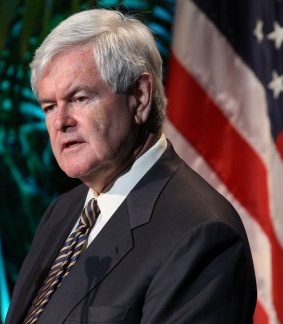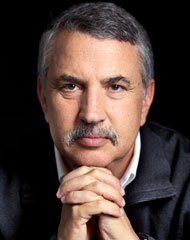
It is Time for Voters To Listen to Friedman

by James M. Wall

Before the South Carolina primary, casino mogul Sheldon Adelson gave $5 million dollars to an independent PAC supporting Republican presidential candidate Newt Gingrich.

That worked so well that a second $5 million dollar gift was soon on its way to that same pro-Gingrich PAC, Winning Our Future,  keeping the former House Speaker in a tight two man race with Mitt Romney.

There is more where that $10 million came from.

The Forbes 400 list of the wealthiest Americans ranks Adelson as number 8. Forbes’ list of billionaires ranks Adelson as the 16th wealthiest person in the world. His net worth is currently $21.5 billion. (Source: Wikipedia)

How does Robert Reich, former Bill Clinton cabinet member, and noted public policy analyst, respond to this pairing of Gingrich and Adelson? He claims not to know what lies behind the Adelson support for Gingrich.

I believe Reich feigns ignorance in his blog posting, rather than admit the obvious, the linkage of Jewish money to American politics, which we all know, is a taboo topic for establishment media types.

To be fair to Reich, he could have been joshing his readers when he wrote in his blog:

Do you know who Sheldon and Miriam Adelson are? Do you know what Gingrich has promised them, or what they think they’ll get out of a Grinch presidency? I don’t. But if Newt becomes President of the United States, they’ll be singularly responsible. And we better find out, because Newt will owe them big time.

Reich is right about the influence a rich contributor like Adelson will have on the President. If he thinks he is being funny, I am not laughing when he feigns ignorance about the tight bond between Gingrich and Adelson on their shared passions of conservative political ideology and devotion to Israel.

If Reich really is in need of some quick background information, here is what Paul Harris, of the British-based Guardian, wrote this weekend:

It is not just the American right that is Adelson’s great political passion. There is also Israel. Always proud of his Jewish heritage, Adelson’s activism took a pronounced leap when he married his second wife, Miriam, in 1991. She was an Israeli citizen who had been working in New York.

The Adelsons are friends of Israel’s prime minister, Binyamin Netanyahu, and Adelson purchased a Hebrew-language newspaper to support him.

Adelson is an impassioned opponent of an independent Palestine. He has given at least $60m to the charity Taglit-Birthright, which brings young Jewish Americans on trips to Israel. He has established a thinktank in Jerusalem and given large sums of cash to Yad Vashem, the Holocaust research centre.

In the US he has donated to the lobbying group the American Israel Public Affairs Committee, helping fund the trips of Republican congressmen to Israel.

All of this dovetails with Gingrich’s policies on Israel. Gingrich has vowed that on the very first day of his administration he would order America’s Israeli embassy to move from Tel Aviv to Jerusalem. He has called for regime change in Iran and repeatedly denied that Palestinians are a real people, saying instead they have been “invented”.

Sheldon and Miriam Adelson want to put Newt Gingrich in the White House to guarantee what they perceive to be Israel’s best interests. There is no doubt in Candidate Gingrich’s mind what links him to Adelson.

In a state where the Christian religious right does not look with favor on gambling, a voter in Winter Park, Florida, asked the candidate about his friend’s interest in gaming. The voter was concerned that Adelson might  introduce gambling into the state. Gingrich was ready for that one, as the New York Times reported:

“Sheldon Adelson’s passion in life is the survival of Israel,” Mr. Gingrich said. “And he and I are in agreement that Iran is in deep, immediate threat of posing the risk of a second Holocaust” with nuclear weapons. 

Writing in his Foreign Policy blog, Stephen M. Walt looked at what the American people believe to be the right thing to do regarding Israel. He found that:

Indeed, the evidence shows clearly that many Americans would be perfectly willing to play hardball with Israel when it acts in ways that are not in the U.S. national interest.

For example, back in 2002, a Time/CNN poll found that 60 percent of Americans supported cutting off aid to Israel if it did not respond to Bush administration demands that it withdraw from areas it had occupied (during the Second intifada). One year later, a survey by the University of Maryland reported that over 60 percent of Americans would be willing to withhold aid to Israel if it resisted U.S. pressure to settle the conflict.

So when Congress passes various “pro-Israel” resolutions by amazingly lopsided votes, when its members rise as one to give Netanyahu standing ovation after standing ovation, and when U.S. presidents feel compelled to backtrack from efforts to advance a two-state solution before it is too late, it is not because the “American people” are demanding these responses.

As in many other cases (such as financial regulation, gun control, health care, or farm subsidies), politicians are ignoring the will of the people because a well-organized minority (comprised of some but not all American Jews and some but not all Christian evangelicals) is making its support conditional on support for its hardline views.

It’s the classic story of interest-group politics: If a small minority cares passionately about an issue and the rest of the population cares less, politicians will pander to the few and ignore the many, even as evidence accumulates that the resulting policy is wrongheaded.

In this case, our present policy towards Israel is harmful to the long-term interests of both the United States and Israel.

Walt was responding to the New York Times’ Tom Friedman’s, column, when Friedman was accused of being anti-semitic for writing about the upcoming Republican campaign, on December 14, 2011:

As for Newt, well, let’s see: If the 2.5 million West Bank Palestinians are not a real people entitled to their own state, that must mean Israel is entitled to permanently occupy the West Bank and that must mean — as far as Newt is concerned — that Israel’s choices are: 1) to permanently deprive the West Bank Palestinians of Israeli citizenship and put Israel on the road to apartheid; 2) to evict the West Bank Palestinians through ethnic cleansing and put Israel on the road to the International Criminal Court in the Hague; or 3) to treat the Palestinians in the West Bank as citizens, just like Israeli Arabs, and lay the foundation for Israel to become a binational state. And this is called being “pro-Israel”?

Friedman is no dummy.  He is fully aware that Newt Gingrich would be a disaster for Israel if he makes it to the White House.  The one thing Israel does not need is to be indulged by the United States government in its increasingly paranoid view of the “neighborhood” in which Israel lives.

You can imagine the venom aimed at Friedman for that column, especially with this admonition:

I sure hope that Israel’s prime minister, Benjamin Netanyahu, understands that the standing ovation he got in Congress this year was not for his politics. That ovation was bought and paid for by the Israel lobby.

This Friedman column is a wake up call to America where polls, as Walt suggests,  tell us the public does not want to indulge Israel to the degree Israel’s “friends” believe is appropriate.

Friedman’s column, in a different time and under different circumstances, recalls earlier words, delivered on the night of February 27th, 1968, when Walter Cronkite, just back from a reporting trip to a post-Tet offensive Vietnam, concluded a CBS News Special Report:

It is increasingly clear to this reporter that the only rational way out then will be to negotiate, not as victors, but as an honorable people who lived up to their pledge to defend democracy, and did the best they could.
A PBS special broadcast later recalled:
President Lyndon Johnson listened to Cronkite’s verdict with dismay and real sadness. As he famously remarked to an aide, “If I’ve lost Cronkite, I’ve lost America.”
Thomas Friedman has not yet attained the stature of a Walter Cronkite, but on the subject of Israel, Friedman has the credentials to speak to what is best for both Israel and the United States. In this column he did so.
It is time for voters to listen to Tom Friedman.  For, as blogger and Middle East scholar Juan Coles, wisely notes, time is running out for Israel.

It is unrealistic to think that little Israel, with about 7.5 million people (20% of them Palestinian-Israelis), can forever dominate militarily some 400 million Muslims in its neighborhood–Muslims who overwhelmingly side with the Palestinians.

The alternative is to make peace, and peace requires a settlement of the issue of Palestinian statelessness and a drawing of final boundaries in Israel’s land disputes with neighbors.

On this point, I believe Walter Cronkite would concur.

Posted in Media, Middle East Politics, Politics and Elections | Tagged , , , , , , , | 9 Comments

With South Carolina Victory, Gingrich Rides Adelson Money Train Against Obama

by James M. Wall

Newt Gingrich is the current holder of the Republican crown. Saturday night, NBC projected Gingrich as the winner in the South Carolina Republican primary over his closet rival, Mitt Romney.

With 94% of the votes counted, Gingrich was winning by a 40% to 27% margin over Romney, much larger than advance polls has predicted.

The race for an opponent to run against incumbent President Barack Obama is down to two candidates, a former House Speaker, and a former Governor.

Romney, a wealthy Mormon (as we will see when he releases his IRS return), was second in South Carolina, a state with a Mormon population of less than one per cent (.08%), while Gingrich, a former Southern Baptist now a Catholic, won the primary in a predominantly conservative Protestant state.

The early South Carolina primary was pivotal for Gingrich and a major setback for Romney. After losing in Iowa and New Hampshire, Gingrich appeared on his way out of politics. He was a distant second  in polls the week before the South Carolina voting. Republican big money was lining up behind Romney.

Money dried up for Gingrich. It certainly did not help that he is a candidate who carries some of the heaviest political baggage this country has seen in these quadrennial shifts in American political power,  three wives, admitted infidelities, two divorces, and an ethics charge that led to disciplinary action during his time as House speaker.

Gingrich was not giving up. He turned for help from one of the richest men in America, Sheldon Adelson, a billionaire casino owner and Mr. Gingrich’s longtime friend and patron. The two men share a politically conservative ideology and a deep loyalty to Israel.

Adelson ignored other big money Republicans who begged him to stay out of the South Carolina race. They wanted the momentum to shift immediately to Romney. In response, according to a New York Times report, two weeks before Saturday’s South Carolina primary, a $5 million check from Mr. Adelson arrived at the offices of  Winning Our Future (WOF), a “super PAC” that supports Mr. Gingrich.

By Monday morning, January 9, WOF “had reserved more than $3.4 million in advertising time in South Carolina, a huge sum in a state where the airwaves come cheap.”  The money was used “to air portions of a movie critical of Mr. Romney’s time at Bain Capital, the private equity firm he helped found.”

This last minute injection, the Times points out,

underscores how the 2010 landmark Supreme Court ruling on campaign finance has made it possible for a wealthy individual to influence an election. Mr. Adelson’s contribution to the super PAC is 1,000 times the $5,000 he could legally give directly to Mr. Gingrich’s campaign this year.

The Times interviewed several sources “with knowledge of Mr. Adelson’s decision to donate to Winning Our Future”. They said the support of WOF comes from a two-decade friendship linking Gingrich to Adelson in a bond of a shared advocacy on behalf of Israel.

The friendship of the two men dates back to the mid-1990s, when Gingrich was in the House of Representatives. Adelson’s staff knew they would find a kindred spirit in Gingrich, who was known to have a personal animosity against labor unions.

Mr. Adelson was building his newest resort casino, the Venetian, and became embroiled in a battle with a local culinary union trying to organize his employees. The conflict soured further when Adelson helped finance a campaign in Nevada to pass legislation curtailing the ability of labor unions to automatically deduct money from members to finance political activities.

Gingrich helped Adelson’s team develop an anti-union pitch in support of the Nevada legislation. Gingrich supported the legislation and was honored with a Nevada fund raiser. Gingrich and Adelson became fortuitous pals out of this initial anti-union campaign.

Their friendship extended to their common support for Israel:

Both men have long been staunch American allies of Prime Minister Benjamin Netanyahu of Israel. Mr. Adelson owns a free daily newspaper in Israel [Israel Hayom] that is credited with helping Mr. Netanyahu return to power in 2009.

In May 2010, the cover of a special section of the paper featured a full-page photograph of Mr. Gingrich in front of an American flag, with Mr. Gingrich criticizing the Obama administration for not moving more aggressively against Iran’s nuclear ambitions.

After Obama’s election, the bond that centered on Israel grew deeper. In an interview he gave in December, 2011, Gingrich declared “that Palestinians are an “invented” people — meaning they had no historical claim to have their own state and that they remain committed to destroying Israel.

Mr. Adelson endorsed Gingrich’s comments a few days later in an interview with Haaretz, an Israeli newspaper in which he declared: “Read the history of those who call themselves Palestinians, and you will hear why Gingrich said recently that the Palestinians are an invented people.”

Adelson is the money man; Gingrich the political leader.  Together, once they get past Mitt Romney, they plan to confront Barack Obama in November about his failure  to provide Israel 100% support.

Adelson made his money initially in casinos. Gingrich honed his political skills in the very Red state of Georgia.

Gingrich is a former college professor who taught history, geography and environmental studies at West Georgia college before entering politics as a congressman from Georgia. He rose quickly in Republican power circles. He was the House Minority Whip from 1989 to 1995 and  the 58th Speaker of the US House from 1995 to 1998. A poor showing in the 1998 House elections led to his resignation in November, 1998.

The South Carolina primary was his last chance. Fortunately for him, Adelson’s PAC money, and a majority of South Carolina Republican voters combined to hand the former Speaker a significant victory.

Gingrich has once again proven that he is a politician who is smart, tough and attuned to the conservative political pulse, especially in a state like South Carolina, where loyalty to Israel has become a conservative Protestant White Christian biblical belief.

Voters, who once could not find Israel on a world map, have found Israel in their Bibles. This is not a group that will embrace Barack Obama’s reelection. They will go with whatever candidate the Republican Party hands them. Gingrich is, at the moment, that candidate.

Israel supporters form narrow, but strategically located voter blocs, dependable, to be sure, though not yet a national majority. But Gingrich is adaptable and shifty in a political fight. His next primary comes in Florida, January 31, where two dependable voter blocs should help him repeat the South Carolina pattern, once again overlooking his past sins and embracing his devotion to Israel and political conservatism.

The two voting groups in Florida are ethnic Jewish voters who live in the southern part of the state, and conservative biblical literalist Protestant White Christians in the middle and northern sections of the state.

Once campaign budget poor, and now funded by Adelson’s money donated through WOF, Gingrich can now turn for financial backing to those major Republican donors who wanted Romney when they thought he was the inevitable winner. These donors will have no difficulty shifting to the former Georgia college professor.

They do not like what they see currently in the  Obama White House. Unlike the younger Bush and Bill Clinton, this Democratic president is resisting orders from Tel Aviv. The latest sign of this White House resistance to Israeli bellicosity came at the end of 2011 when Israel enlisted an obedient US Congress to join in a major effort to force a halt to all nuclear power development in Iran.

Israel persuaded the US to enter into a joint military exercise as a show of solidarity of the two military powers. Obama appears to have been a reluctant participant, seeing it as too much of an emphasis on the threat of a military action when Obama’s team wanted to avoid another war in the Middle East. The government of Prime Minister Benjamin Netanyahu talked the negotiation game. Suspicion points to Israel’s Mossad for sabotaged Iranian nuclear development, and assassinated Iranian nuclear scientists.

After the early January assassination of  Iranian scientist Mostafa Ahmadi Roshan, Barack Obama took an action US presidents before him rarely dared consider. He informed Israel that the US would not take part in the planned joint military exercises with Israel. Finally, the Big Dog took command of its own tail. The US favored negotiations with Iran. Israel’s militant tactics were not conducive to peaceful negotiations.

It was clear that this was a response to Israel’s actions against Iran, actions they deny with an ambigious swagger, as former CIA analyst Ray McGovern explains for Consortium News:

On Jan. 11, just three days after [US Defense Secretary Leon] Panetta’s assertion that the Iranians were not trying to develop a nuclear weapon, assassins in Tehren attached a bomb to a car carrying Mostafa Ahmadi Roshan, an Iranian scientist connected with Iran’s nuclear development program. The attack killed Roshan, making him the fifth such victim in the last couple of years.

Suspicion immediately focused on Israel, which has historically engaged in cross-border assassinations of people it considers a threat. Usually in these cases, Israel offers some ambiguous semi-denial. This time, however, Israeli officials mostly swaggered. Israel’s chief military spokesman, Brig. Gen. Yoav Mordechai, posted a statement on Facebook, saying: “I don’t know who settled the score with the Iranian scientist, but I certainly am not shedding a tear.”

News of the cancellation of the joint US-Israeli military exercise reached Israeli readers of Israel Hayom (Sheldon Aldeson’s Israeli newspaper) which reported “the military drill with Israel entailing the deployment of thousands of American troops this spring has suddenly been canceled”. Mondoweiss informed its readers of the cancellation on its web site. President Obama had sent the message to Netanyahu that it was time to “stand down”.

Prime Minister Netanyahu gave his Defense Minister the crow-eating assignment to break the official news to the Israeli public. Ehud Barack put on his brave face and  told the Israeli public that there was a change in plans.

After months of intense warnings about the imminent danger of a nuclear armed Iran, Israel stood down. The threat had eased. The “mushroom cloud” disappeared.

On Tuesday night of this week, President Obama will deliver his annual State of the Union address. I, for one, will listen to that address with the same gratitude and pride I felt when Obama delivered his first State of the Union address in 2009.

We may not like every action our President has taken, or will take, but Barack Obama has clearly taken a stand on the future of the Middle East, a stand that is morally sound and politically courageous. An Israeli military option against Iran is currently off the table. Inshallah, it will stay off.

For those who wish to follow the President’s Tuesday night speech, here is a preview from the White House:

The picture above of President Obama is a White House photo taken by Pete Souza.

Posted in Middle East Politics, Obama, Politics and Elections | 8 Comments

Iranian Scientists Die as Bibi’s War Looms

by James M. Wall

On Friday, January 13, Eli Lake posed a question on Newsweek’s web site, The Daily Beast:

Has Israel Been Killing Iran’s Nuclear Scientists?

Lake does not have hard evidence to answer his question. But he speculates, using the old reliable “circumstantial evidence”, to point to Israel’s Mossad,”for a string  of slayings of Iran’s nuclear experts”.

The most recent Iranian to die is nuclear scientist Mostafa Ahmadi Roshan, killed in his automobile  in Tehran Thursday.

Eli Lake writes, “at the very least Israel’s defense establishment would like its allies to believe its spies have pulled off these ‘events that happen unnaturally'”. To take credit for their dark deeds, Israel’s narrative shapers put out the word in their usual sly fashion:

Six weeks ago in Washington, on the sidelines of a major U.S.-Israeli meeting known as the “strategic dialogue,” Israeli Mossad officers were quietly and obliquely bragging about the string of explosions in Iran. “They would say things like, ‘It’s not the best time to be working on Iranian missile design,’” one U.S. intelligence official at the December parley told The Daily Beast.
Consider the arrogance of this scene: Saber-rattling Israeli experts, joking about the “danger” of working on Iran’s nuclear sites.  They know deaths have been arranged. In their best tough-guy, B-movie swagger, they find the death of relatively low-level Iranian scientists to be a source of amusement.
These saber-rattling Israel nuclear experts are higher in rank than those US Marines who were caught on Youtube urinating on the bodies of dead Taliban fighters. Disdain toward a perceived enemy–and laughing and bragging about it–is dispicable, inhumane, and reprehensible, regardless of rank.

Michael Adler reports on the anti-Iran campaign in his Daily Beast report.

While no one will confirm that a covert campaign is being waged, many see such a strategy as just the sort of thing one would want to use against an Islamic Republic believed to be seeking the bomb.

The campaign would include the Stuxnet computer virus, allegedly unleashed in 2009 to destroy about a fifth of the centrifuges turning at Iran’s main uranium-enrichment plant in Natanz, and booby traps on equipment Iran buys abroad that ensure the equipment malfunctions once put to use.

And then there are assassinations. The facts from Wednesday: 32-year-old Mostafa Ahmadi Roshan (pictured below with his son) was killed when a motorcyclist attached a magnetized bomb to his car as he was driving to work. Roshan was director of commercial affairs at the Natanz plant. The attack was the fourth of its kind on an Iranian scientist in two years, with three of the men killed and the fourth surviving to become the head of Iran’s Atomic Energy Organization.

These attacks–past and future–are designed to intimidate and provoke.  They are not intended to impede any serious progress or nuclear design or production process. Many experts have concluded that Israel’s claim that Iran is creating a nuclear arsenal is as empty and false as the Bush-Cheney  “mushroom cloud” warning that justified the US attack on Iraq in 2003.
Israel is obviously doing its best to push for a war with Iran which it wants to  be “provoked” by Iran.
Israel wants absolute hegemony over the region, which is why it developed its own nuclear arsenal decades ago, and it is also why it insists it will not tolerate nuclear arms in the hands of its neighbors.

From at least one surprising corner, support for this Israeli war scenario has slipped. At the New York Times, reader complaints poured in after the Times and other media outlets promoted the Israeli reading of an assessment by the International Atomic Energy Agency (IAEA) that Iran’s nuclear program had a military objective. The Israeli reading of the report was a distortion of the facts.

The Times Public Editor Arthur Brisbane agreed that the complaints about this distortion were legitimate. He called on his own paper to “correct the story”.

Robert Naiman reported on Brisbane’s response to the complaints in his Truthout news analysis:

I think the readers are correct on this. The Times hasn’t corrected the story but it should because this is a case of when a shorthand phrase doesn’t do justice to a nuanced set of facts. In this case, the distinction between the two is important because the Iranian program has emerged as a possible casus belli.

In other words: it’s important to get this right, because getting it wrong unjustly promotes the cause of war.

After serving as a major cheerleader for the 2003 Iraq “shock and awe” invasion, the Times appears to have learned its lesson.  Perhaps, finally, it has discovered how US centers of power have moved into foreign hands.

MJ Rosenberg writes in Intifada Palestine that Israel. AIPAC and its US congressional hasbara troops are fighting back:

Wasting no time after its success in getting the administration to oppose Palestinian statehood at the United Nations, and still celebrating the UNESCO funding cut-off, AIPAC has returned to its #1 priority: pushing for war with Iran.

The Israelis have, of course, played their own part in the big show. In the last few weeks, it has been sending out signals that it is getting ready to bomb Iran’s nuclear facilities (and embroil the United States in its most calamitous Middle East war yet).

But most observers do not believe an Israeli attack is imminent. (If it was, would Israel telegraph it in advance?) The point of the Israeli threats is to get the United States and the world community to increase pressure on Iran with the justification that unless it does, Israel will attack.

Naturally, the United States Congress, which gets its marching orders on Middle East policy from the lobby which, in turn, gets its marching orders from Binyamin Netanyahu, is rushing to do what it is told. (If only Congress addressed joblessness at home with the same alacrity and enthusiasm.)

Accordingly the House Foreign Affairs Committee hurriedly convened this week to consider a new “crippling sanctions” bill that seems less designed to deter an Iran nuclear weapon than to lay the groundwork for war.

These “crippling sanctions” are intended to remove foreign policy decisions involving Iran from the White House to the US Congress. The sanctions have been pushed through the House by a bi-partisan pair: House Foreign Affairs Committee Chairwoman Ileana Ros-Lehtinen (R-FL) and Ranking Member Howard Berman (D-CA). (Shown here.)

Rosenberg explains how this would work:

It means that neither the president, the Secretary of State nor any US diplomat or emissary may engage in negotiations or diplomacy with Iran of any kind unless the president convinces the “appropriate Congressional committees” (most significantly, the House Foreign Affairs Committee which is an AIPAC fiefdom) that not engaging with Iranian contacts would present an “an unusual and extraordinary threat to the vital national security interests of the United States.”

To call this unprecedented is an understatement. At no time in our history has the White House or State Department been restricted from dealing with representatives of a foreign state, even in war time.

On May 20, 2011. Prime Minister Netanyahu came to Washington for a victory lap around Barack Obama’s track.

Philip Giraldi described Netanyahu’s May 20, 2011 visit for the website Uprooted Palestinians (see the photo at the top):

Israeli Prime Minister Benjamin Netanyahu arrives in the United States today for a much anticipated visit. He will do a little fund-raising, will speak before Congress and at the American Israel Public Affairs Committee (AIPAC) annual conference, and will meet with President Barack Obama. Netanyahu can expect the visit to go smoothly, with an adoring joint session of congress rising to its feet to applaud him and more adulation from the AIPAC gathering. 

The “adoring joint session of congress” outdid itself with thunderous applause and 29 standing ovations.

The revealing picture of the Prime Minister of Israel smirking in triumph at the President of the United States, was taken during Netanyahu’s visit with President Obama in May, 2011. It was taken by Jim Watson for Agence France-Presse. And this is the man who expects President Obama to join him in his war against Iran.

In the video below, Mark Perry is interviewed by Al Jazeera. The interview focuses on a column Perry published this weekend for the Foreign Policy web site. The report describes CIA memos from 2007 and 2008 that accuse Israel of running a “false flag” operation against the US. A “false flag” operation is an action in which Israeli agents pretend to be CIA agents conducting attacks against Iran.

The Firedoglake web site reported on Perry’s column:

A provocative article in Foreign Policy magazine suggests that Israeli Mossad officers recruited members of the Pakistani terrorist organization Jundallah to aid in the covert operations against Iranian targets, including bombings in the Baluchistan region and potentially the assassination of Iranian nuclear scientists. The Mossad officers, according to Mark Perry, posed as American intelligence agents during the recruitment, using US passports.

In his Foreign Policy column, Perry expressed a special concern for the damage a “false flag” can do to the US:

The report sparked White House concerns that Israel’s [assassination] program was putting Americans at risk,” the intelligence officer told me.

“There’s no question that the US. has cooperated with Israel in intelligence-gathering operations against the Iranians, but this was different. No matter what anyone thinks, we’re not in the business of assassinating Iranian officials or killing Iranian civilians”

Iran claims to have proof that this was not a “false flag” operation. Rather, Iran accuses the US of actually engaging in assassinations. The US “categorically”–to use Hillary Clinton’s term–denies the charges.

Perry’s interview suggests that if there any merit to the “false flag” operation,  Bibi Netanyahu may have finally pushed Barack Obama too far by employing a”false flag” operation against the only friend Israel has left in the community of nations.

As Chris Matthews finally acknowledged on his MSNBC program, the role of Israel as a deceptive partner could emerge as a political issue during the 2012 presidential campaign.

The picture above of Mostafa Ahmadi Roshan and his son, is an Iranian Fars News Agency Photo.

Posted in Media, Middle East, Middle East Politics, Netanyahu, Obama, Politics and Elections | 9 Comments

Adelson and Ross: Yin Yang of US Politics

by James M. Wall

What unites Sheldon Adelson and Dennis Ross? And why did both show up at the same time in the weekend news in two different locations?

Here is how it came down: Casino billionaire Sheldon Adelson gave $5 million to a Newt Gingrich PAC, a huge boost to Gingrich’s fading  presidential hopes.

Adelson is a strong Zionist supporter. He is described in the latest Forbes magazine issue as the eighth-richest person in America.

Dennis Ross, back on duty in a Washington pro-Israel think tank, wrote a Washington Post column with his usual solution for Middle East peace, that is, take whatever steps Israel will accept.

Still, there had to be something deeper in their connection on this particular weekend between the Iowa caucuses, which Mitt Romney “won” by 8 votes, according to media score keepers, and Tuesday’s upcoming New Hampshire primary, which home region guy Romney is expected to win by a large margin.

Finally, after hours of meditation, I remembered a phrase, yin yang. Normally, when I meditate, I reflect on the journals of John Wesley, the founder of my Methodist tribe of Protestants.

But this time I landed in new territory: Asian philosophy.

We have all heard the phrase, yin yang, but what does it mean, really?  And how does it relate to Adelson and Ross?

My knowledge of Asia philosophy is, shall we say, limited.  But there was Google, always ready with an answer.  So I asked Google what unites Adelson and Ross and why do they make me think of yin yang?

This is what Google told me:

Many natural dualities—e.g. dark and light, female and male, low and high, cold and hot, water and fire, air and earth— are thought of as manifestations of yin and yang (respectively).

Yin yang are not opposing forces (dualities), but complementary opposites that interact within a greater whole, as part of a dynamic system. Everything has both yin and yang aspects as light cannot exist without darkness and vice-versa, but either of these aspects may manifest more strongly in particular objects, and may ebb or flow over time.

The concept of yin and yang is often symbolized by various forms of the Taijitu symbol, for which it is probably best known in western cultures. (See symbol above).

That was it! Adelson and Ross, Ross and Adelson, money and politics, part of a dynamic system. The money comes from devoted followers with large bank accounts, casino magnates like Adelson, and Ross, who knows the politics of a cause and persuades politicians to follow his version of truth and wisdom.

Philip Weiss reported the Adelson $5 million story. He also points out how the main stream media heavyweights downplayed the Zionist connection which Weiss explains in detail:

A week or so after Newt Gingrich said that the Palestinians are an invented people, his Super PAC has received $5 million from Sheldon Adelson, whose central cause is Israel.

And lo, the Associated Press fails to mention Adelson’s cause in its coverage. The Washington Post broke the story but included just one sentence about Israel, buried in paragraph 8, and ungrammatically:

Adelson is a strong supporter of Israel and his views dovetail with Gingrich on Israel and the Palestinian conflicts.

Blackout artists at The New York Times write up the gift without a word about Adelson’s cause: Republican Jewish Coalition brags it gives ‘tens of millions’ every political cycle.

Dennis Ross appeared in the Washington Post  this weekend to “explain” the recent “resumption” of peace talks between Israel and the Palestinian Authority. Ross has once again left the government, but he is available for Israeli-friendly columns, looking very much like a football coach high in the press box sending messages down to the quarterback on what plays to run next.

His latest column sounded like his usual game plan:

But there should also be no illusions about the prospects of a breakthrough any time soon. The psychological gaps between the parties make it hard to resolve their differences and have bedeviled all the work for peace talks over the past few years.

I have been intimately involved in peacemaking efforts over the past 20 years under Presidents George H.W. Bush, Bill Clinton and Obama, and I know that Abbas and Netanyahu carry the weight of their peoples’ history and mythology, and face enormous political constraints. But those difficulties cannot be a reason to despair and accept a stalemate, particularly when those who reject peace will exploit any impasse to challenge the very idea of a two-state outcome.

A few days before Dennis Ross was in print with his Post column,  Palestinian-Jordanian editor Rami Khouri summed up the veteran diplomat’s views in a column he published in the Jordan Times.

The good news about the Jordanian-hosted Palestinian-Israeli-Quartet meeting in Amman to explore possibilities for resuming Palestinian-Israeli direct negotiations is that former US Mideast specialist Dennis Ross is not there to guarantee failure with the pro-Israel tilt of the US delegation.

The bad news is that the meeting is likely to fail because the Ross approach to guaranteeing diplomatic failure with the pro-Israel tilt of the US delegation still prevails.

The Ross approach to Arab-Israeli diplomacy has essentially rested on the premise that everybody must make Israel comfortable and design negotiations on the basis of Israeli security concerns in order for any progress to be made. This is precisely why no measurable progress has ever been made when Ross spearheaded or influenced American diplomacy on this issue.

Rami Khouri, who also holds US citizenship, divides his time between Beruit, Amman and Nazareth. He remains a close observer of American politics. He is also a superb reporter and a precise and stylish writer.

Note his summary of why US presidential politics remain mired in absolute devotion to Zionism:

The noble mission of achieving justice and peace for Israelis and Palestinians, and other concerned Arabs, remains hostage to the American political imperative of pleasing Israel first. (A derivative of this is the Ross approach to diplomacy with Iran, which, equally Israeli-centric, has also been a consistent failure.)

Ross — now back at his former base at the pro-Israel group the Washington Institute for Near East Policy — was always an operational symptom and symbol of this reality, rather than its driving force.

The deep official American tilt in favor of Israel is profoundly structural and political, and not the work of a few individuals. It has been building up for half a century, and now relies primarily on near stranglehold control of American members of Congress by pro-Israeli fanatics.

The yin yang of Zionist American politics has led to such an all-encompassing interaction  “within a greater whole, as part of a dynamic system”, that even much of the leadership of the American churches, presumably the guardians of the nation’s “moral imagination”, do not realize how totally they have been co-opted to promote Zionism rather than support social justice.

We will witness this soon when the United Methodist Church holds its international General Conference in Tampa, Florida, April 25-May 4. Close to 1000 delegates will gather in Tampa to set church policy, discuss budgets and consider resolutions on issues facing the denomination.

This denomination, whose founder, John Wesley, was outspoken against slavery in the 1700s, has a long tradition of supporting what we refer to today as social justice issues.  Wesley would have seen them as demands of the Gospel.

One resolution which will be brought to the Tampa General Conference will call for the delegates to pass a resolution that says, in part:

In light of our theological discernment of moral and biblical justice, the General Conference calls on The United Methodist Church to end its financial involvement in Israel’s occupation by divesting from companies that sustain the occupation.

On a matter that has been before previous General Conferences, the resolution adds specifics:

The General Conference instructs all United Methodist general boards and agencies to divest promptly from Caterpillar, Motorola Solutions and Hewlett Packard until they end their involvement in the Israeli occupation.  These companies have been engaged repeatedly by the United Methodist general agencies, boards and annual conferences on this issue.

Yin yang does not speak of a division between good and evil.  Rather it is a philosophy that presents yin yang not as “opposing forces (dualities), but complementary opposites that interact within a greater whole, as part of a dynamic system.”

The United Methodist General Conference that meets in Tampa, Florida, April 25-May 4 is both a political and a spiritual gathering.  It is the yin yang of a denomination at work.  Delegates will discuss and then vote on resolutions.

If delegates meditate on John Wesley’s journals and sermons, they should have no difficulty in making a decision to withdraw invested funds from companies that support Israel’s Occupation of the West Bank and Gaza.

Finally, politics in the long running television program, West Wing, were, at times, complicated, sort of the way yin yang works out in  real life.  This clip is from Season 3, Episode 10.

For those not familiar with the program, US President Jed Bartlett is a (fictional) liberal Democrat.  His aide, Charlie Young, gives him a gift of a map of the Holy Land from 1709.  The President wants to frame the map and hang it outside his office.  He runs into opposition.

http://youtu.be/1k9IlR3-_-A

Posted in -Movies and politics, Media, Middle East, Middle East Politics, Television | 12 Comments

This Is The Right Moment for Churches To Pay Attention to Israel’s Occupation


Cross posted from The Electronic Intifada

In his book Kairos for PalestineRifat Odeh Kassis deals with a topic that is as fresh as the destruction of a Palestinian home by Israeli-driven, US-built bulldozers, and as ancient as the use of the term kairos, derived from an ancient Greek word which refers to a specific moment in time.

Why does this wanton destruction of private Palestinian homes continue unabated? The answer is simple: Israel controls the narrative that justifies its conduct by reporting the demolition of a Palestinian home as a “necessary step” for the “security” and well-being of Israel. The Israeli narrative keeps the Western world locked into a permanent state of ignorance, following the pattern of previous Western colonial invaders and occupiers.

The Israeli narrative, carefully honed by Israel well before Israel’s 1947-48 war of conquest, has skillfully made the case that Israel is a state whose inhabitants deserve their own state as victims of oppression and genocide. They chose the ancient biblical lands of Judea and Samaria (the West Bank) on the grounds that the land was “given to them” by Yahweh (the Hebrew word for God).

That narrative — mixing ancient biblical beliefs with modern political strategy — has so totally dominated the perspective of the Western world outside the Middle East, that it has emerged as the only view of reality known to the West. It is in this narrative that Israel is the “victim” and the Palestinian people are an enemy that seeks to drive Israelis “into the sea.”

It has been Israel’s goal since it gained UN recognition as a state in 1949 to control this narrative and prevent any contrary narrative from obtaining a hearing. The occupation of the Palestinian people is sold to the West as a necessity. Palestinians in this narrative are perceived as a threat to the well being and security of all Israelis.

The large majority of Americans have accepted this narrative as the only available reality. They permit their government to function as a financial backer of Israel, and to politically support Israel in world forums. American politicians function within a bipartisan political operation which accepts and promotes the “Israel is a permanent victim” narrative. This narrative obscures the political reality that Israel serves as an important part of the American empire, which seeks to control the people of the Middle East through military power and political deceit.

The invasion of Iraq and Afghanistan and the current role the US plays in Libya and in the agitation for war against Iran, are the most recent examples of this power and deceit.

The Palestinian narrative traces its history through Arab history, from which Palestinians emerged as an important part of the Ottoman Empire. Following Arab support for the Western allies in their war in 1917-18 against Germany and Turkey, Palestinians were assured they would retain their homeland in their corner of the Ottoman Empire.

The Palestinian narrative in the modern era emphasizes the Nakba (catastrophe), the ethnic cleansing that led to Israel’s establishment. That narrative has been denied a part in American discussions of the Middle East.

It is the Israeli narrative that enables Israel to be an important American ally in the Middle East. That narrative saturates American society through the media, the economy, political structures, nongovernmental institutions involved in education and religious groups.

The Zionists were amongst the last of the western colonial invaders to arrive in the Middle East to conquer a land and exploit its population. This invasion was built on military power and deceit, the twin sins that continue to shape the US/Israel alliance in the Middle East.

Kairos for Palestine traces the history of what led to the Palestine Kairos Document that emerged from the situation created by that alliance. It tells the story of the Christian churches’ effort to communicate the suffering imposed by Israel on Palestinians and it does so from a Christian perspective.

The document originated within the Christian churches working inside Israel, the occupied West Bank and Gaza. It is a community-created document written out of the experience of the Palestinians. It calls upon Christians everywhere to wake up to the conditions under which all of the people of Palestine — Christian, Muslim and non-religious — and respond appropriately to gross injustice created by the US/Israel alliance of empire-building through oppression.

The political strategy of boycott, divestment and sanctions (BDS) is a separate project from the Kairos Document. (For more on BDS, see Omar Barghouti.) The Kairos Document and BDS run parallel, however, as two ways in which Palestinians address the outside world, one theological, the other strategic.

BDS is a strategy of nonviolence that advocates economic pressure on Israel to halt its oppressive military occupation. It calls attention to the manner in which outside corporations endorse that occupation and profit from it.

BDS originated as a political movement in July 2005 as a “call from Palestinian civil society.” It was signed and sent out from a large number of civil society groups within the West Bank and Gaza.

It is important to note that, unlike the Kairos Document, BDS is a strategy which the civil society of Palestinians has developed.

Kairos Palestine, which is the primary focus of Kassis’ book, originated in Bethlehem as a statement from Palestinian Christian leaders. The document was released in December 2009. It is a theological document of faith, not a proposal of strategy. Circumstances since the original document was written in 2009 have grown even worse as Kassis explains (9):

Jerusalem is being forcibly de-Arabized and systematically Judaized with unprecedented speed and aggression: Life for Palestinians there becomes less and less bearable as house demolitions, evictions, arbitrary arrests and interrogations, residency revocations, and the imprisonment and house arrests of children all increase. The siege on the Gaza Strip remains and intensifies unabated.

The Israeli government is forgoing its longstanding public relations campaign — its ongoing propaganda as the only ‘democracy’ in the Middle East — and reverting instead to openly racist laws like the one that seeks to criminalize individuals and organizations that call for boycott.

BDS, with its secular origins, is not promoted by the Kairos Document, but BDS has been adopted by some Christian groups as a practical strategy which Palestinians propose the West adopt as a means toward putting economic pressure on Israel to give up its oppressive control of the Palestinian people.

UPDATE: Since this essay initially appeared in The Electronic Intifada, some supporters of the BDS movement have written me to take exception to my statement that the “BDS is not promoted by the Kairos Document”.

I stand by that statement, though I would certainly concede that the Document has called for a positive “response” to sanctions and boycotts.

I did not, however, find in the Document any positive “response” to the strategy of divestment. Furthermore, the Document is a theological statement, not one designed to promote a political strategy.

Perhaps it comes down to how we define “promotion” in a heated, ecclesiastical political environment.  

As we begin a new year, it is important to keep in mind that in the US, the United Methodist Church and the Presbyterian Church, USA, will hold national (international for the Methodists) meetings in the spring and summer of 2012.  

At those meetings, endorsing the strategy of  BDS will be under consideration.  Advance word is that pro-Israel forces will make every effort to defeat or soften those pro-BDS resolutions.

Resistance of American churches to BDS illustrates how effectively the Israeli (“we are the victims under outside threat”) narrative works to prevent Americans from hearing the call of either the Kairos Document, or the economic strategy of BDS.

The modern use of a Kairos statement by an oppressed population dates back to the first edition of a statement from South African Christians in 1985, a document intended, Kassis reports, “to provide an alternative discourse to the dominant theological thinking” of the day.

This South African document confronted the apartheid structures maintained by the minority white population of that society.

Subsequent Kairos documents have emerged in Kenya, Zimbabwe, India and Latin America, each in ways appropriate to the historical moment addressed, all insisting that the Christian faith calls for the oppressors to acknowledge the sinfulness of their oppressive conduct.

The various Kairos documents all pursued the same goal, a prophetic call to those in power to acknowledge that the New Testament commands them to halt their oppressive conduct and identify with the oppressed.

Kassis writes (page 83) that these Kairos documents all emerged from similar contexts: oppression, injustice and the denial of equality and human rights.

They are also “united by their timing, by the kind of moment at which they came into being. They aren’t written at any time; rather they are created when there are no options than true participation in a process of collective change.”

To use a theological term, kairos “speaks to the qualitative, not sequential, form of time; for example, the New Testament defines it as “the appointed time in the purpose of God.”

Kassis adds that this moment is one in which God acts. It is a moment, as well, in political terms, that implies “a crucial time, an appointed time, in which the message of the text is delivered” (83).

Adopting a more modern form of expression, Kassis concludes that “the message of the Kairos is both the SOS signal of a sinking ship and a call for hope in the face of despair.”

The Palestine Kairos Document, Kassis explains, arose from a dialogue within Palestinian Christian communities, in short, not from outsiders, but from those who suffer under occupation, which is to say, oppression and captivity.

The Kairos Document emerged from a Palestinian dialogue among a group of 15 interdenominational Palestinian Christian leaders.

After two years of work, prayer, many meetings and discussions, along with debates and draft, the leaders produced a final draft of the document, which they called “A Moment of Truth: A Word of Faith, Hope and Love from the Heart of Palestinian Suffering.”

The final document was released to the public at an event in Bethlehem on 11 December 2009. Kassis was deeply involved in preparing the final document. With its release, Kassis was selected to serve as the General Coordinator of the Kairos Palestine Group.

The kairos moment places a demand not only on Christians, but on people of other religions or no religions, to pay attention to the message that Israeli occupation is “oppression” in the same way South African apartheid and Latin American economic oppression of the poor were oppressive.

However the reader understands the term kairos, the impossible-to-refute “facts on the ground” in Israel and Palestine, are clear; this is the “right moment” for the world to recognize and acknowledge that Israel’s occupation of Palestine is unjust, immoral, illegal and destructive.

Rifat Kassis’ book does not have an American nor UK publisher. It was originally published by Badalyl Alternatives in Palestine/India. For US readers Amazon does offer a long essay by Kassis on this topic.  Click here. 

The picture at top is from APA images. This posting originally appeared in  a slightly longer version on December 23, 2011, in The Electronic Intifada. It is cross-posted here with the permission of  The Electronic Intifada. The original posting also appears in Intifada Palestine.

Posted in Uncategorized | 15 Comments

GOP Candidates Wear the Jewish Kippah

by James M. Wall

On the 38th anniversary of the death of David Ben-Gurion, Israel’s first Prime Minister, the usual memorial event was held on December 1, at Ben Gurion’s graveside in Sdeh Boker, the Negev desert village where he lived during his retirement years.

Uri Avnery wrote in his Gush Shalom column, that Israeli newspapers published a picture of Benjamin Netanyahu, Israel’s current Prime Minister, speaking “under a big photo of the late leader gazing thoughtfully into the distance”.

Avnery noticed a small detail in the picture. Avowed atheist Netanyahu was wearing the traditional Orthodox head-covering of respect, a kippah, a head covering that reminds the wearer that he is always “under” Yahweh.

This surprised Avnery, the “grand old man” of Israel’s largely secular peace camp, who wonders, why was Netanyahu wearing a kippah?

Ben-Gurion (pictured above) was not religious. He was a convinced atheist. He refused to wear a kippah even at funerals. Avnery acknowledged that even though he is also a complete atheist he will sometimes, out of consideration for the feelings of others, wear a kippah at funerals.

Male believers wear a kippah, according to Jewish tradition, as a sign of respect for God.  Atheistic Jews do not wear the kippah not because they disrespect God; they just don’t believe in Yahweh. Specifically:

Wearing of a head covering (yarmulka, skullcaps, kippah [pl. kippot]) for men was only instituted in Talmudic times (approximately the second century CE). The first mention of it is in Tractate Shabbat, which discusses respect and fear of God.

Some sources likened it to the High Priest who wore a hat (Mitznefet) to remind him something was always between him and God.

But why was Netanyahu, also a secular atheist, remembering Ben Gurion by appearing in public wearing a kippah?

The place was not a synagogue, nor even a cemetery. So why for God’s sake (sorry) did the man put this black kippah on his head?

Not wearing a kippah is a statement of belief in Zionism, which was created initially as a revolt against Jewish Orthodoxy. The first Zionists were not religious; they were hardline socialist secularists.

Today, almost four decades after Ben Gurion’s death, in one of those major unintended consequences of history, the state of Israel is currently governed by a political coalition which relies heavily on the political power of Jewish Orthodox believers.

For Avnery, Netanyahu’s kippah is a sign of what Avnery calls “the re-Judaization of Israel”. The Israel that Ben Gurion helped establish as a secular state, has found political value in returning to religious Orthodoxy signs of belief.

The wily politician, Netanyahu has played the religion card. US political candidates, who are his staunch political allies, have dutifully followed his lead.

Ben Gurion did not anticipate this. He believed that the new state, located as a small minority in the midst of inhospitable community of Muslim states, could only survive as an ever-expanding modern, secular and militarily strong nation.

The irony of Ben Gurion’s vision of a modern Israel is that the Orthodox Jewish religion which he had rejected and which he thought would soon end as a religious force, has now become a major player in Israel’s governance.

Avnery explains this irony:

People of my age can remember the situation. Ben-Gurion, like all of us, believed that the Jewish religion was about to die out. Some old people, who spoke Yiddish, were still praying in the synagogues, but with time they would disappear. We, the young new Israelis, were secular, modern, free from these old superstitions.

Not in his darkest nightmares (or daymares) could Ben-Gurion have imagined a time when religious pupils, some of whom are not taught in their schools even the most basic modern skills, would amount to nearly half the Israeli Jewish school population.

Or that the number of religious shirkers now deprives the army of several divisions. [Orthodox men do not serve in the army, one of several concessions Ben Gurion granted Orthodox leaders in return for their political support.]

Step by step, the religious community is taking over the state. The religious settlers, the religious anti-Arab pogromists, their allies and ultra-right collaborators are gaining new footholds by the day.

Just now the army has announced that 40% of candidates for junior officers’ courses are wearing kippahs. In 1948, when our army came into being, I did not see a single kippah-wearing soldier, not to mention an officer.

In a second irony, male candidates in the US 2012 presidential race, will bring their more “militaristic than thou” campaigns, as they wear the kippah, the sacred symbol of an ancient religion that David Ben-Gurion did not expect to survive the 20th century.

The single female still in the race, Michelle Bachman, doesn’t wear a kippah but she did tell a Jewish Forum audience this week that the first thing she did after graduation from high school, was take off on a Young Life Christian mission trip on an Israeli Kibbutz.

Commenting on this youthful eagerness to volunteer to work in Israel, American television host Jon Stewart reminded his audience that Bachman, an arch conservative, began her post-college career working for a socialist farm community.

Rick Santorum, whose chances of winning the Republican nomination are virtually zero, informed the same Forum that he came home from his visit to the Holy Land, with “one of those tiles” that called for “peace in Jerusalem”.

It remained, however, for Newt Gingrich to draw the most media attention with his flat assertion in a Jewish television program interview that “Palestinians are an invented people”. He added they were just Arabs, like their neighbors, and could have settled anywhere else but Israel.

“Invented people” and Holy Land tiles, represent the low level to which the discussion of Middle East foreign policy has descended in the 2012 Republican caucus and primary races.

This is not weighty material, but, sad to recall, in US presidential races, voters want a savior, not a professor. Gingrich, who has been a professor in his pre-political life, knows this.

He should also have known, but may not care, that Shlomo Sand’s study of Jewish historiography,  The Invention of the Jewish People is currently under discussion in Middle East academic circles.

Sand, who is Jewish, and a professor of history at Tel Aviv University, has upset believers in the conventional history of the Jewish people with his assertion that Israeli Jews as well as those Jews who are citizens of other states do not descend from the people who inhabited the Kingdom of Judea during the First and Second Temple period.

Gingrich need not have cited Sands in his interview, but either he or a staffer should have been aware that the term “invention” hardly fits Palestinian Arabs whose ancestors have lived in the region for centuries.

A former Speaker of the US House of Representatives, Gingrich believes himself to have debating skills.

He has promised that when he wins (not if) the Republican nomination, he will challenge President Obama to seven, three-hour Lincoln-Douglas mano a mano, debates, no interviewers allowed.

In such debates, Professor Gingrich would be more likely to play the role of the red meat politician than the academic smoothie. He would play the same political tune that has resounded  in previous GOP-Tea Party attacks on President Obama.

Uri Avnery likes to employ metaphors in his columns.  In looking at the Netanyahu kippah-wearing appearance at Sdeh Boker,  Avnery concludes that for centuries Jews have played the role of the gazelle, escaping danger by running away at the first hint of trouble.

With their new state, the Jews decided to turn themselves into lions, or as Avnery put it, “Zionism wanted to turn the gazelle into a lion. It said: no more running away. When in danger, we stand and we fight”.

As a result, Avnery, the peace warrior, laments:

And, as seems to be human nature, we overcompensate for the past. We have become aggressive, militaristic, even brutal. The oppressed have become oppressors. Jews used to say: “If force does not work, try using your brain.” Israelis say “if force does not work, try using more force.” (I confess that I coined this phrase many years ago as a joke. Alas, a joke no more.)

Avnery also concludes that:

Netanyahu has invented (or adopted) a peculiar style of ruling: governing by playing on people’s fears.  Since coming back to power, he has been treating us to an endless series of fears. Fear mongering is the order of the day – every day.

Sound familiar?  The Netanyahu politics of fear prevails today in Tel Avi and in Washington. Money is raised for campaigns because of fear. Voters are promised a future without fear by politicians who run campaigns on fear.

Fear unites, but it also destroys, as our recent fear-driven wars will attest.

Will the American public wake up to this fact or will they vote their fears in 2012? We have less than a year to find out.

This will be the final Wall Writings posting for 2011. But I promise to return, after a brief hiatus, with a new posting in early January, 2012. Don’t go away. 

Posted in Middle East Politics, Netanyahu, Politics and Elections, Religion and politics | 10 Comments

How Iran Could Be The Next Neocon Target

by James M. Wall

The 2012 US presidential election will reach its quadrennial crescendo November 6, 2012, less than a year from now.

Should a Republican nominee win the election, it is most probable that he will be either former House Speaker Newt Gingrich (shown here) or Mitt Romney.

No less a Republican conservative authority than Pat Buchanan  ponders what such an outcome might produce:

Is a vote for Mitt Romney or Newt Gingrich a vote for yet another unfunded war of choice, this time with a nation, Iran, three times as large and populous as Iraq?

Buchanan finds an eagerness for war against Iran in Republican campaign rhetoric:

Mitt says that if elected he will move carriers into the Persian Gulf and “prepare for war.” Newt is even more hawkish. America should continue “taking out” Iran’s nuclear scientists — i.e., assassinating them — but military action will probably be needed.

Sound idiotic? Of course it does, but war fever corrupts the rational mind. We should remember that many Democratic liberals joined the last neoconservative military crusade launched by George W. Bush’s 2003 invasion of Iraq.

The drums of war have been pounding away against Iran since Barack Obama was elected president in 2008.  The Military-Industrial complex wants war, or the next best thing, a constant threat of war.

Why else would Barack Obama go against his human rights instincts and continue to feed the war-lovers with drone attacks that kill civilians and assassinate suspected enemies, at no risk to American personnel?

The ultra-Zionist politicians in Tel Aviv and Washington are pushing for military action that will solidify Israel’s role as the Middle East regional boss.

Obama’s most recent pandering “I love Israel” fund-raising speech was at the New York city home of  businessman Jack Rosen, chairman of the American Council for World Jewry.

This was one of many such events designed to hold on to pro-Israel funds and voters, a demeaning act, in light of Israel’s current Occupation actions, but an act he hopes his peace and justice supporters will understand as something he must do to land safely in neocon-free territory in 2013.

Whether enough of his progressive, non-PEP supporters, are open to giving the President slack during the campaign will be a factor in the success of his ultimate victory or defeat.

If Obama fails in his reelection effort, what could follow would not be a fictional horror story. It will be Iran: the Sequel, coming to a military  recruitment office near you in January, 2013.

The US Senate has already bought tickets for the sequel.

In a unanimous vote this week, the Senate adopted a provision as an amendment to Congress’ annual defense policy bill which would force the President to impose sanctions on countries and companies that do business with Iran’s central bank or purchase Iranian oil.

Israel has long had its front row seats for Iran: The Sequel.  In fact, additional tickets are already being printed in Tel Aviv. Two recent cases in point, dual explosions at  Iranian nuclear facilities. Were they accidents or attacks by Israel?

On November 30, the London Times broke the story about the second explosion:

An Iranian nuclear facility has been hit by a huge explosion, the second such blast in a month, prompting speculation that Tehran’s military and atomic sites are under attack.

Satellite imagery seen by The Times confirmed that a blast that rocked the city of Isfahan on Monday struck the uranium enrichment facility there, despite denials by Tehran.

The images clearly showed billowing smoke and destruction, negating Iranian claims yesterday that no such explosion had taken place.

Israeli intelligence officials told The Times that there was “no doubt” that the blast struck the nuclear facilities at Isfahan and that it was “no accident”.

The explosion at Iran’s third-largest city came as satellite images emerged of the damage caused by one at a military base outside Tehran two weeks ago that killed about 30 members of the Revolutionary Guard, including General Hassan Moghaddam, the head of the Iranian missile defence program.

Tehran sought to downplay the attacks, perhaps to avoid appearing incapable of protecting its facilities.

Assuming these explosions are not accidental, what nation might be behind them?

According to American blogger Richard Silverstein, several Israeli military officials were eager to take responsibility:

Among the more colorful and typically Israeli macho statements was by Maj. Gen. Giora Eiland who said coyly that he didn’t know if the Mossad did it, and that it could very well be “the hand of God:”

This candid bit of theological dark humor prompted this observation from Silverstein:

How many nations in today’s world do you know whose citizens would refer, even obliquely, to their spy agency unironically as the hand of God?

We have seen this dangerous reality show before. In an October 3, 2002, essay in the London Review of Books, five months before the 2003 US “shock and awe” attack against Iraq, Anatol Lieven wrote:

‘The road to Middle East peace lies through Baghdad’ is a line that’s peddled by the Bush Administration and the Israeli lobby.

It is just possible that some members of the Administration really believe that by destroying Israel’s most powerful remaining enemy they will gain such credit with Israelis and the Israeli lobby that they will be able to press compromises on Israel.

In his October, 2002 LRB essay, Lieven linked the invasion of Iraq to the eagerness of the neoconservatives running the war policy to solidify Israel’s control over the Occupied Palestinian Territories.

This is how Lieven described the linkage:

Most members of the Bush and Sharon Administrations hope that the crushing of Iraq will so demoralize the Palestinians, and so reduce wider Arab support for them, that it will be possible to force them to accept a Bantustan settlement bearing no resemblance to independent statehood and bringing with it no possibility of economic growth and prosperity.

“Annie”, writing in Mondoweiss, reports that “the most astonishing info I’ve read lately about Iran is revealed” in MJ Rosenberg’s article in the The Huffington Post with the headline, American Enterprise Institute Admits: Iran Threat Isn’t That It Will Launch Nuclear Attack:

The shift in the rationale for war was kicked off this week when Danielle Pletka, head of the American Enterprise Institute’s foreign policy shop, and one of the most prominent neoconservatives in Washington explained what the current obsession with Iran’s nuclear program is all about.

The biggest problem for the United States is not Iran getting a nuclear weapon and testing it, it’s Iran getting a nuclear weapon and not using it.

That seemingly contradictory statement is explained by the AEI foreign policy chief (click for a short video) when she says that the problem with Iran having a nuclear capability is that it gives Iran a ticket to join the international team of nuclear powers.

The real problem to Danielle Pletka is that the moment Iran has a nuclear bomb and doesn’t use it, the Iranians can no longer be dismissed as a second class nation, weak and cowering before its neighbors who possess nuclear military capability.

Instead, Iran will be seen as a “respectable” nation which possesses a military weapon to use in negotiating with its neighbors.

Horrors of horrors, according to this major neoconservative Washington leader, Iran would become just like the rest of us, a nation with nuclear weapons.

Did anyone believe Iran wanted the ability to destroy Israel and set off World War III?

No one of course, except the Zionist propagandists who have been peddling Iran as the next Nazi Germany and President Mahmoud Ahmadinejad, as the latest Hitler on the world scene.

All this talk about Ahmadinejad wanting to “wipe” Israel off the map, has been just so much rhetoric designed to conceal the real issue, which is basic Political Realism 101:

Who will control the Middle East, the indigenous populations, or the outside invaders?

The neocon doctrine that took us into Iraq in 2003 is very clear: International power decisions must be made by the enlightened West.

The danger of that doctrine returning to the White House in less than a year, is very real.

It is also true that such danger can be held up into the light of truth from individuals like Palestinian poet Rafeel Ziadah, whose poem, Shades of Anger (below), captures the indomitable spirit of a woman and a people, who refuse to permit outsiders to control and steal their freedom.

Another poem by Rafeel Ziadah may be accessed by scrolling to the end of an earlier Wall Writings posting here

The picture of Newt Gingrich is from The Cable Blog on the Foreign Policy site.

Posted in Middle East Politics, Politics and Elections | 7 Comments

What We Have Here Is A “Flagrantly Undemocratic Situation.”

by James M. Wall

In the words of Ha’aretz publisher Amos Schochken, Gush Emunim has seized control of power in Israel and driven the state into a “flagrantly undemocratic situation.”

How was it possible for this much power to be seized by “a right-wing ultranationalist, religio-political revitalization movement”, as it is described in Israel: A Country Study?

Gush Emunim was formed in March 1974, a few months after the October 1973 War, known in Israel as the Yom Kippur War and in the Arab world as the Ramadan War.

The outcome of the 1973 conflict ended in Israel’s favor, thanks to “an estimated US $5 billion in equipment, of which more than US $1 billion was airlifted by the United States during the war when it became apparent that Israel’s ammunition stores were dangerously low.”

A few months after the war, Gush Emunim was created by the National Religious Party (NRP). When NRP joined the Israeli Labor coalition, Gush Emunim joined with other religious groups and began building illegal Jewish settlements beyond the Green Line.

Gush Emunim increased its Jewish settlement activity between 1977 and 1984, encouraged by Prime Minister Menachem Begin’s right-wing government.

Since Jimmy Carter left the White House in 1981, succeeding American presidents have uttered increasingly weak protests against settlement expansion, gradually “believing” Israel’s claim that the settlements were not for expansion, but for security .

With the rise and departure of each new US president and congress, Gush Emunim grew stronger.

How strong has the Gush Emunim movement become? From the scattered Gush Emunim  settlements of 1974, the number of settlers now living beyond the Green Line has reached one half million residents, counting those who now live in what Israel considers its annexed areas.

The settlement movement has expanded to include large blocs of settler populations, such as the  settlement under construction in the picture above, which Israelis call Har Homa.

In the picture, Palestinian Said Eid stands next to his house, which is not shown, as construction continues.

With its growth in locations throughout the Occupied Territories, the Jewish settler population has emerged as a potent political force.

With the rise to power of Prime Minister Benjamin Netanyahu, the settler movement has gained control of not only the government of Israel, but by extension, now influences the US government and US power centers in the US media and the economy.

Some of this power is exercised by intimidation and money, and when needed, emotional appeals to such “trip lines” as The Holocaust and allegations of anti-Semitism.

The current campaign to agitate for war against Iran, for example, is well documented by Salon author Gary Kamiya, whose posting, The Boys Who Cry “Holocaust”, identifies the “boys” as “the same neocon hawks who lied us into Iraq [and are now] using the ultimate argument-stopper to push war with Iran”.

The early Gush Emunim settlers, living in their tents on West Bank hills, may have dreamed of this day, but they could not have imagined that the world’s greater power, the United States of America, would so easily fall into line and follow the dictates of what has become a settler-dominated Israeli government.

It was not easy, but it was carefully planned. At a heavy cost of the abandonment of the “shared values” of all religions, the plan was carried out.

Decades have passed, but the power of those early settlers and the half million who have followed, have brought us to the 2012 US presidential race, in which, as reported by London’s Daily Mail, Republican presidential candidates vie with one another to promise to go to war against Iran because that is what Israel wants them to say and do.

GOP frontrunner Mitt Romney and increasingly popular Newt Gingrich both used a presidential debate on foreign policy to back a pre-emptive military strike against Iran to stop the country obtaining nuclear weapons.

Former Massachusetts Governor Romney said that if ‘crippling sanctions’ failed, war would be an option because it is ‘unacceptable’ for Iran to become a nuclear power, while ex-speaker Gingrich argued the United States should covertly ‘take out their scientists,’ and ‘break up their systems’.

That is Gush Emunim, right-wing Zionist talk, and it is coming in a Republican presidential nomination debate between a Mormon and a former Southern Baptist, who is now a Catholic.

How did this happen?  How has Gush Eminum moved from a few radical religio-politco extremists hovering in tents on the hills of Palestine to become a powerful force in American elections?

Phillip Weiss, the insightful and wise US Jewish blogger, tackles this issue on a regular basis at his site, Mondoweiss.

This week, Weiss posted an entry which he entitled, “NBC and the Israel Lobby”.

In this posting, Weiss identifies David Cohen, of Philadelphia, who is, as Weiss puts it, “the longtime political guru of former Pennsylvania Governor Ed Rendell”.

David Cohen is also a media mogul, the executive vice president of Comcast, the company that bought NBC and MSNBC in 2009.

This makes him the boss of the MSNBC nightly lineup of television talk show hosts that include Chris Matthews, Ed Schultz, Lawrence O’Donnell, and Rachel Maddow.

One thing this quartet has in common: They are all PEPs (Progressives Except on Palestine).

Cohen’s influence, however, extends far beyond the broadcasters who work for him at MSNBC. Weiss writes that Cohen is also close to Barack Obama.

For example, a few months ago, Cohen raised $1.2 million for Obama at his Philadelphia home.

Like Ed Rendell, Cohen is pro-Israel. He is the former vice chair of the Jewish Federations in Philadelphia, a pro-Israel organization.

Cohen was described by a Philadelphia Jewish publication to be “genetically hard-wired” to serve that role:

He believes that there is historic precedent for Jews “rallying to Federation” during times of crisis. “Whenever Israel’s physical security is threatened, people turn to Federation to provide support,” he says, adding “we must ignite this same Jewish passion to meet local needs addressed by Federation and its partner agencies.”

Cohen represents the merging of Israeli passionate loyalty, economic reality, media power, and a realization that Israel has the backing of its own creation, the Israel Lobby.

Weiss then asks the question that always comes up in these discussions, “what is the Israel lobby?” His answer is one to clip and slip in your pocket to use the next time someone asks you that question.

[The Israel Lobby] is the force inside our discourse that defends the special relationship between the U.S. and Israel, forever. Are all Jews part of the Israel lobby? Of course not. There is growing diversity inside the Jewish community, bucking the commandment, Thou must support Israel.

But Ed Rendell is certainly part of the lobby.  .  .  And I think Cohen is part of it, too, given his former role at the Federations.”

Weiss concludes:

Call me cynical, but this proves the old adage, Freedom of the press belongs to he who owns one. And it explains why Chris Matthews keeps his mouth shut on Israel/Palestine.

In Israel this week there were reports of the “activities of Israeli settlers who terrorize Palestinians in the West Bank and who have now turned against the Muslim residents of the state of Israel.

No American voices of influence in either political or media circles are raised against the power of the Gush Emunim over US and Israeli policies.

This is not the case in Israel, where Amos Schocken, owner of Haaretz, a major Jerusalem newspaper, is one of a group of Israeli moderates who know what Zionist ideology is doing to their country.

In an article in Ha’aretz this week, Schocken delivers a harsh indictment of Gush Emunim:

The ideology of Gush Emunim springs from religious, not political motivations. It holds that Israel is for the Jews, and it is not only the Palestinians in the territories who are irrelevant: Israel’s Palestinian citizens are also exposed to discrimination with regard to their civil rights and the revocation of their citizenship.

This is a strategy of territorial seizure and apartheid. It ignores judicial aspects of territorial ownership and shuns human rights and the guarantees of equality enshrined in Israel’s Declaration of Independence. 

Schocken notes that in the situation in South Africa, the term “apartheid” refers to “the undemocratic system of discriminating between the rights of the whites and  blacks”.  

He acknowledges that while there is a difference between South African apartheid and the situation today in the Occupied Palestine Territories, there are strong similarities. For example:

There are two population groups in one region, one of which possesses all the rights and protections, while the other is deprived of rights and is ruled by the first group. This is a flagrantly undemocratic situation.

Israel has long bragged that it was the “only democracy in the Middle East”. Schocken concludes that that designation is not true. The current state of Israel has allowed Gush Eminum to drive his country into a “flagrantly undemocratic situation.”

The picture above was taken on June 3, 2009. It is an AP Photo by Sebastian Scheiner. The picture is from Boston.com.

Posted in Media, Middle East, Religious Faith | 12 Comments

Dennis Ross’ Iran Legacy Continues At WINEP

by James M. Wall

In a rare public statement about a US political figure, AIPAC had this to say about the legacy of Dennis Ross:

“In his tireless pursuit of Middle East peace, Ambassador Ross has maintained a deep understanding of the strategic value of the U.S.-Israel relationship and has worked vigorously to prevent Iran from acquiring nuclear weapons.”

For True Believers in militant Zionism, AIPAC’s linkage is clear, the strategic bond of the US and Israel, very good; an Iran that even looks toward nuclear capability, very bad.

The Jewish US online Forward publication, which reported the Ross resignation, described him as “a veteran of four failed presidential pushes for Middle East peace”. (The picture of Ross, above, is from Forward.)

This is not a record of success, but an obvious absence of progress does not displease AIPAC, which, like the current right wing Israeli government, has a higher priority than peace; specifically, it desires a militarily powerful and expanding Israel.

Dennis Ross is leaving the White House as President Obama’s Middle East advisor, but he is not going far. He will move to the Washington Institute for Near East Policy (WINEP), the think tank created by AIPAC, which because of its loyalty to Israel, is currently pointing all of its rhetorical big guns at Iran.

Joining AIPAC’s praise of Ross’ career as Israel’s man in four successive US presidential administrations,  Alan Solow, a former chairman of the Conference of Presidents of Major American Jewish Organizations and a prominent Obama backer, offered this legacy description:

“[Dennis Ross’] legacy is going to be the unprecedented sanctions the United States imposed on Iran, which he worked tirelessly on.”

An American diplomat leaves public service after working for peace, unsuccessfully, for four US presidents, and his major legacy is what he did for Israel? There is something seriously wrong with this picture. This is not dual loyalty; this is Zionist loyalty.

Meanwhile, the action continues at WINEP, which Ross directed before he joined Obama, and which he will direct again, post-Obama.

On Saturday, the day after Ross made his resignation announcement to a luncheon of Jewish leaders in Washington, some news broke at WINEP.

That news involved Andrew Shapiro, US assistant secretary for political-military affairs, who chose WINEP as his venue to deliver the news that Israel and the US will embark on the “largest” and “most significant” joint exercise in the allies’ history.

The story was carried in Jerusalem’s Ha’aretz newspaper. It received virtually no attention in US media outlets.

In his statement, Shapiro said that “joint exercises allow us to learn from Israel’s experience in urban warfare and counterterrorism.”

He added ,”Israeli technology is proving critical to improving our Homeland Security and protecting our troops.”

The assistant secretary explained that Israeli armor plating technology and the specially designed “Israeli bandage”,  now used on American troops in Afghanistan and Iraq, are proven successes.

Shapiro also said the exercise will involve more than 5,000 U.S. and Israeli forces, and will simulate Israel’s ballistic missile defense.

He did not say, during his WINEP presentation, exactly where these activities will take place.

On Wednesday of this week, Natasha Mozgovaya, chief U.S. correspondent for Haaretz, reported on a WINEP-sponsored report by two US Middle East experts, Robert Blackwill and Walter Slocombe.

These days, when reporters are mercilessly grilling State Department spokeswoman Victoria Nuland over the United States’ funding cut to UNESCO following its approval of Palestine as member, the argument that Israel is a strategic asset to the U.S. might sound slightly presumptuous.

But according to the Washington Institute for Near East Policy – as expressed in their latest report, “Israel: A Strategic Asset for the United States” – the U.S.-Israel relationship is not a one-way street at all.

Its authors argue that Americans – starting with top administrative officials – should start acknowledging that Israel is a strategic asset for the U.S. They say the U.S.-Israeli relationship “stands equally on an under appreciated third leg: common national interests and collaborative action to advance those interests.”

One of the authors, Robert Blackwill, is the former deputy national security adviser for strategic planning and presidential envoy to Iraq, and currently serves as a senior fellow at the Council on Foreign Relations.

Blackwill said Tuesday that contrary to popular opinion, the U.S.-Israel relationship in no way weakens United States’ standing in the Arab world. 

Mozovaya asked Blackwill and his WINEP co-author, Walter Slocombe, whether they saw the recent vote approving Palestinian membership at UNESCO, as an unfavorable result of the U.S.-Israel relationship.  Both Blackwill and Slolcombe, exclaimed, “No!”

It is difficult to imagine two US experienced diplomats actually denying any impact of the US-Israel relationship on the attitude of those Arab and Muslim states who supported Palestine’s request for membership in UNESCO.

Unfortunately, they are not alone is their inability to see reality. Look no further than the US Senate.

Illinois US Senator Mark Kirk, who now occupies Barack Obama’s old Senate seat, has filed an amendment to the Fiscal Year 2012 National Defense Authorization Act, which would impose crippling sanctions on the Central Bank of Iran.

The Kirk Senate web site gives a rationale for the amendment which echoes the Bush-Cheney call to arms against Iraq. Does this man have no historical awareness of what that false alarm did to everyone it touched, from the Iraqi and US dead to the US taxpayers? The Kirk site states:

The Kirk amendment, which comes just days after a report by the International Atomic Energy Agency (IAEA) concluded that Iran is engaged in activities “highly relevant to a nuclear weapons program,” follows the bipartisan Schumer-Kirk letter sent to President Obama in August by 92 Senators urging crippling sanctions against Iran’s Central Bank.

“Without immediate and serious action, the Islamic Republic of Iran will have a nuclear weapons capability in the near future,” Senator Kirk said.

This is the AIPAC-dominated US Senate at work. The Senate bill, which Mark Kirk is amending with even tougher language than the original, provides for draconian sanctions against the Central Bank of Iran with the intent of collapsing “the Iranian economy.”

Kirk, who sold himself to Illinois voters as a “moderate” Republican, has transformed himself into a high profile neoconservative since he replaced Obama in the Senate.

He is playing on the same team with Reuel Marc Gerecht, a former C.I.A. officer, a senior fellow at the Foundation for Defense of Democracies (FDD). Mark Dubowitz is the executive director and head of  FDD’s Iran Energy Project.

Gerecht and Dubowitz are the co-authors of a New York Times op-ed piece, Don’t Give Up on Sanctions Against Iran, in which the authors mix greed with morality in a package designed to hurt the Iranian people while rewarding the Chinese economy.

Effective energy sanctions don’t have to raise oil prices; they can actually do the opposite. Washington just has to learn how to leverage greed.

We should bar from operating in the United States any European and most Asian energy companies that deal in Iranian oil and work with the Iranian central bank, Revolutionary Guards or National Oil Company.

At the same time, however, we should allow companies from countries that have little interest in Iran’s nuclear program, or its pro-democracy Green Movement, and that are willing to risk their access to American markets — mainly Chinese companies — to continue buying Iranian crude in whatever quantity they desire.

This would reduce the number of buyers of Iranian petroleum, without reducing the quantity of oil on the market. With fewer buyers to compete with, the Chinese companies would have significant negotiating leverage with which to extract discounts from Tehran. The government could lose out on tens of billions of dollars in oil revenue, loosening its hold on power.

This approach may seem distasteful to some, because it does, in a sense, reward bad Chinese behavior. But the objective of sanctions is to cause real economic pain in Tehran, not to make Americans feel moral.

This plan, which advocates punishing the Iranian people, does so with about as much concrete evidence as the Bush-Cheney neoconservatives had to attack Iraq in 2003. Do we really want to travel down that highway again?

The Foundation for Defense of Democracies  (FDD) thinks we should. The FDD was born during the nation’s war fever in the months following 9/11.  FDD pushed strongly for war against Iraq. When President Obama was elected in 2008,

FDD became a prominent opponent of the administration, pressuring for more aggressive action against Iran and criticizing efforts to negotiate with “enemy” states. FDD figures like Reuel Marc Gerecht and Michael Ledeen have been among the more vociferous hawks calling for U.S. military intervention in Iran and elsewhere, arguing that religious militants must be “defeated.”

In early December 2010, FDD hosted its annual forum on the theme of “Countering the Iranian threat.” The conference’s keynote speaker was then-newly elected Sen. Mark Kirk (R-IL).

Kirk and his neoconservative colleagues are joining a crusade to punish Iran’s citizens. They are doing so with no more evidence against Iran’s government than Bush and Cheney had against Iraq. And still they persist.

There is no way to read the Senate proposal and a companion House bill, other than to see them as emotion-driven actions, prompted by a neoconservative obsession with military force and a loyalty to the state of Israel.

These House and Senate bills are designed to crush Iran and its people. They “teach death”.

There is another way, which the video below demonstrates. It comes from Palestinian poet Rafeef Ziadah.

Ziadah, a Canadian-Palestinian spoken word artist and activist, was in Gaza during Israel’s attacks there during the winter of 2008-09. She was in Gaza to serve as a spokesperson for a Gaza coalition.

At one point a journalist asked her, “don’t you think it would all be fine if you just stopped teaching your children to hate?”

Her poem, “We teach life, sir,” was written in response to the question. The poem has become a part of her poetry presentations. This recording was made in London.

Rafeef Ziadah’s debut CD Hadeel is dedicated to Palestinian youth, “who still fly kites in the face of F16 bombers, who still remember the names of their villages in Palestine and still hear the sound of Hadeel (cooing of doves) over Gaza.”

Posted in Middle East Politics, Netanyahu, Obama | 7 Comments

Dennis Ross Resigns As Middle East Advisor

by James M. Wall

After working for five US presidents, Dennis Ross has resigned his position as President Obama’s chief Middle East advisor.

Presidents Reagan, Bush I, Clinton, Bush II and Obama, all arrived at the White House determined to recast the nation’s role in finding a permanent peace between Israel and the Palestinians.

Sometimes immediately, sometimes later, one man was involved in shaping how the US dealt with peace between Israel and the Palestinians. At first his role was small; but by the time he went to work for Bill Clinton, George W. Bush and Barack Obama, he had became the key player in the process.

That man is Dennis Ross, a non-lawyer, who has been called “Israel’s lawyer”, by former State Department official, Aaron David Miller.

Rashid Khalidi, Edward Said Professor of Arab Studies at Columbia University, and a former colleague of President Obama’s at the University of Chicago, was asked by the Institute of Middle East Understanding (IMEU) for his reaction to Ross’ departure. His response:

“Since the Reagan administration, Dennis Ross has played a crucial role in crafting Middle East policies that never served peace, which is today farther away than ever.

His efforts, which contributed to the growth in the number of Israeli settlers in the occupied territories from under 200,000 in the 1980s to nearly 600,000 today, were marked by a litany of failures.

It is long overdue for him and the bankrupt policies he represents to be shown the door.”

Diana Buttu, former legal advisor to Palestinian negotiators and a current Fellow at Harvard’s Kennedy School of Government, told IMEU:

“Dennis Ross has done more to undermine the rights of Palestinians and set back their struggle for freedom and equality than any other American official”.

Jim Lobe included this background information in his analysis of the Ross resignation story:

One senior U.S. diplomat, Ambassador Daniel Kurtzer, who took part in the Clinton-era negotiations, cited a number of anonymous officials who were critical of Ross’s mediation in the 1990s in his book co-authored with Scott Lasensky, entitled “Negotiating Arab- Israeli Peace”.

“The perception was always that Dennis started from the Israeli bottom line, that he listened to what Israel wanted and then tried to sell it to the Arabs,” one Arab negotiator told them. “…He was never looked at …as a trusted world figure or as an honest broker.”

Ross (pictured above) is a political in-fighter, a skill he employed to land his final post in the Obama White House. 

MJ Rosenberg wrote in January of this year, that President Obama’s special envoy George Mitchell and Obama’s White House adviser Ross, were engaged in a turf war to control Obama’s Middle East policy. Ross won.

After Mitchell resigned, Nathan Guttman wrote in the Jewish Daily Forward:

Ross’ strong ties to Israel now make him indispensable to the administration. Those ties include his previous role as head of the Jewish People Policy Institute, a Jerusalem-based think tank founded by the Jewish Agency for Israel.

Rosenberg points to another “money” quote in Guttman’s story from another Jewish leader, Abe Foxman:

“Dennis is the closest thing you’ll find to a melitz yosher, as far as Israel is concerned,” said the Anti-Defamation League’s national director, Abraham Foxman, who used the ancient Hebrew term for “advocate.”

Rosenberg concludes:

Think about it.. The lobby considers the guy in charge of US policy toward Israel an “advocate” for Israel, which he is. (Foxman’s honesty is a rare delight).

When Ross leaves the White House at the end of this month, he will return to the Washington Institute for Near East Policy, a spin-off agency created by AIPAC.

Ross worked with a variety of titles for five US presidents. But wherever he hung his hat, his Zionist loyalties were clearly evident to those he served and shaped, in the media/religious/political leadership bubble that shields American decision makers and decision-shapers, from seeing any Middle East reality except the Zionist version.

An Associated Press story from Jerusalem, published in Ha’aretz this week, reports the conclusion of one of Ross’ final tasks for Obama, blocking President Abbas’ path to the Security Council and protecting Obama from having to cast a UN veto.

The Palestinians are slated to receive some 200 million dollars in U.S. security assistance after a top House Republican ended her hold on the money.

Rep. Ileana Ros-Lehtinen, the chairwoman of the House Foreign Affairs Committee, informed the Obama administration in recent weeks that she no longer would block 50 million dollars in economic support funds for the Palestinian Security Forces and 148 million dollars in other assistance.

In separate letters to the State Department and USAID, Ros-Lehtinen cited President Barack Obama certification that the funds were in the national security interests of the United States as well as word that the government of Israel did not object to the assistance. The letters were sent in September and October.

Rep. Ros-Lehtinen has the power to block funds that do not answer “yes” to her question: “Is it good for Israel?” The question is narrow. It reflects her limited vision of what is good for America.

The Congresswoman put a “hold” on the funds because Palestinian President Mahmoud Abbas had the audacity to secure an overwhelming victory in a vote for Palestinian admission to UNESCO.  It is not nice to “fool” Mother Ros Lehtinen. For doing that, Abbas had to be punished.

An earlier vote in Congress in the 1990s, had already automatically put into law an automatic blocking of funds to any UN agency that grants membership to a Palestinian “entity”. Once UNESCO embraced the Palestinians, the money stopped.  That 1990s vote comes under the heading of  “AIPAC’s long-range planning”.

President Obama asked Ros-Lehtinen to lift the block on the funds she was holding back.

Obama, Ross or another underling, explained to the Congresswoman what she already knew, there was another important vote on Palestinian membership coming up in the Security Council.

Obama spent considerable US chips to make sure that President Abbas would not be able to win that Security Council vote. Abbas needed nine votes to force an inevitable US veto.

He had a good reason to believe he might find that total.

The Security Council voted 14 to 1 earlier this year on a resolution condemning Israel’s settlement building expansion , requiring that single voter, the US, to cast its veto.

The word went out from Washington to the Security Council members that Obama does not want to have to cast another veto.

Another message had to be conveyed to Ros Lehtinen to sweeten the deal with wavering members on the Security Council. The message: Let the money go.

The President assured Ros-Lehtinen, so says the AP story , that she could sell this sudden change of heart as dollars well spent because it is “in the national security interests of the United States”.

The Congresswoman most likely had another question, the one that must always be asked when  the US takes any action that affects the State of Israel: “Do we have Netanyahu’s blessing?” The answer came back, yes we do.

With this much pressure on the Security Council members, President Abbas realized he could not get his nine votes in the Security Council.

He decided to shift his strategy to securing an upgrade to an observer “non-member state”, the same status currently held by the Vatican. This would not  be “full membership” but implicitly, it would recognize Palestine as a state.

Without the work of Dennis Ross and his colleagues during five US presidential administrations, Israel, AIPAC and  the Israel Lobby, might still be struggling to solidify Israel’s total control over Washington. Dennis Ross performed his task well.

Elliott Abrams writes a blog within the friendly confines of the Council of Foreign Relations, where he is a senior fellow for Middle Eastern studies.  Abrams sees Ross’ resignation as a plus for the Republicans:

Ross’s departure is not a diplomatic problem for the White House; it is instead a problem for the Obama re-election campaign.

For Ross was the only official in whom most American Jewish leaders had confidence. As most of them are Democrats who have long accepted Ross’s faith in the “peace process,” they viewed his role as the assurance that a steady, experienced, pro-Israel hand was on or near the tiller.

When the White House did something that clearly harmed U.S.-Israel relations (such as the recent Sarkozy-Obama exchange on how difficult it is to deal with Prime Minister Netanyahu, where Sarkozy called Netanyahu a liar and Obama appeared to agree), or made foolish demands of Israel (such as the 100 percent construction freeze), and when the tone of the relationship clearly became far worse than it had been under Clinton or Bush, Jewish leaders comforted themselves that Dennis was still there.

Abrams previously served in the administrations of two Republican presidents, Ronald Reagan and George Bush II.

Unlike Ross, who crossed party lines in his diplomatic posts, Abrams is a staunch Republican. Should President Obama lose in 2012, Abrams would be an early favorite for a position under the next Republican president, none of whom have any expertise in Middle East affairs.

Abrams knows the territory from his neoconservative perspective. Abrams’ as the next Israeli loyalist in the White House, is a strong possibility. Wikipedia has this to say about Abrams’ previous work with Republican presidents:

During the Reagan administration, Abrams gained notoriety for his involvement in controversial foreign policy decisions regarding Nicaragua and El Salvador. During Bush’s first term, he served as Special Assistant to the President and Senior Director on the National Security Council for Near East and North African Affairs.

At the start of Bush’s second term, Abrams was promoted to be his Deputy National Security Advisor for Global Democracy Strategy, in charge of promoting Bush’s strategy of advancing democracy abroad. His appointment by Bush was controversial due to his conviction in 1991 on two misdemeanor counts of unlawfully withholding information from Congress during the Iran-Contra Affair investigation.

Abrams’ fingerprints are all over the Hamas-Fatah conflict, as David Rose explains in an April, 2008 essay he wrote for Vanity Fair.

Under the heading, The Gaza Bombshell, Rose introduced his essay with this summary:

After failing to anticipate Hamas’s victory over Fatah in the 2006 Palestinian election, the White House cooked up yet another scandalously covert and self-defeating Middle East debacle: part Iran-contra, part Bay of Pigs.

With confidential documents, corroborated by outraged former and current U.S. officials, the author reveals how President Bush, Condoleezza Rice, and Deputy National-Security Adviser Elliott Abrams backed an armed force under Fatah strongman Muhammad Dahlan, touching off a bloody civil war in Gaza and leaving Hamas stronger than ever.

George Bush II’s Deputy National Security Adviser would like nothing better than to see Dennis Ross’ departure from the Obama White House open the way for a new Republican president in 2012.

Where does this saga of negotiations delayed while Israel expands in land holdings, leave us? I suggest it leaves us in John Steinbeck country.

Steinbeck understood what power does to the powerful. He wrote his classic 1939 American Depression novel, The Grapes of Wrath, after making a trip to the Dust Bowl. He was shocked by the poverty and suffering he saw there.

Steinbeck wrote furiously, and in anger. He gave himself 100 days to finish the book.

As he wrote, his wife Carol typed his manuscript. She suggested the book’s title from the lyrics of of “The Battle Hymn of the Republic” (“Mine eyes have seen the glory of the coming of the Lord; He is trampling out the vintage where the grapes of wrath are stored… “)

In his novel, Steinbeck wrote (on page 249):

And the great owners, who must lose their land in an upheaval, the great owners with access to history, with eyes to read history and to know the great fact: when property accumulates in too few hands it is taken away.

And that companion fact: when a majority of the people are hungry and cold they will take by force what they need. And the little screaming fact that sounds through all history: repression works only to strengthen and knit the repressed.

The great owners ignored the three cries of history. The land fell into fewer hands, the number of dispossessed increased, and every effort of the great owners was directed at repression.

That sounds a great deal like Occupied Territories, in Palestine, and on the Wall Streets of the world.

The picture of Dennis Ross is from the Ma’an News Agency. The girls leaving an UNRWA school above, are in Gaza. They are not celebrating Ross’ resignation.  They are just happy to be in the sunshine.  Of course, every morning they are happy to have arrived safely at school.  

Posted in Middle East Politics, Netanyahu, Obama, Politics and Elections, The Human Condition | 18 Comments