The Demonization of an American Soldier

Sean Smith The Guardianby James M. Wall

My experience as a member of the U.S. armed services was a long time ago.  It was also far removed from a battlefield. I was an Air Force public information officer during the Korean War.

I was part of a team, serving my country. All these decades later, I still feel a loyalty to, and a deep respect for, anyone who signs up for active military duty.

For this reason, though far removed from my own active duty days, I can still feel an intense fury toward the journalists and politicians who have stumbled over themselves to demonize a U.S. army sergeant who has just been saved from enemy captivity through a prisoner exchange orchestrated by his Commander in Chief.

Do these people have no shame? Do they not see that because of their need to either attack or stand apart from the President’s decision, they are acting as jury and judge against an American citizen?

Do they, some of whom have also served on active duty, like Senator John McCain, Republican of Arizona, realize that those who judge U.S. Army Sgt. Bowe Bergdahl, expose themselves as political sycophants?

The majority of the politicians who have rushed to demonize a 28-year-old army sergeant, are Republicans, egged on by the Republican party’s media bull horn, Fox News.

It was on Fox that one talking head, angered by the long beard Sgt. Bergdahl’s father has grown, blurted out, in a display of religious bigotry, “he looks like a Muslim”.

Another Fox commentator added racism to her religious bigotry by saying “if his skin were darker, he would look like a Muslim”.

These Fox commentators were also disturbed that Bergdahl’s father had been studying a major Afghani language.  Why would a father learn a language his son has been been forced to use for five years?  Why, indeed.

Democrats were more discreet, but just as self-serving, when they quickly turned on President Obama with whining complaints that had more to do with their political egos and political security, than with the rescue of an American soldier.

Senate Intelligence Committee Chair Dianne Feinstein, Democrat of California, says she was disturbed that the prisoner exchange was conducted without final consultation with her congressional committee, as mandated by recent congressional action.

Two things are wrong with her demand.  One, she knows that the negotiated agreement with the Taliban would fall apart if word of it leaked; and two, she knows the congress leaks like a sieve.

The President and his leadership team, including the head of the Joint Chiefs, determined that Bergdahl was in a seriously deteriorating health condition.

Feinstein told Politico that she had seen no evidence that Sgt. Bergdahl’s life was in any danger.

Senator Joe Manchin, Democrat from the conservative state of West Virginia, after seeing a video of the soldier, disagreed with the decision to move quickly on Bergdahl’s release. He did not think Bergdahl’s condition was fragile enough to justify a swift swap.

Senator Mark Kirk, Republican from Illinois, who recently was hospitalized for a stroke, and who returned to duty in the senate with a courageous walk up the senate steps, had a different take on Bergdahl’s situation.  He found him to be in a shaky fragile condition.

Who you gonna believe, a senator protecting her committee prerogatives, a senator fearful of losing his Senate seat, or the President and his leadership team, who are responsible for the life of an American soldier?

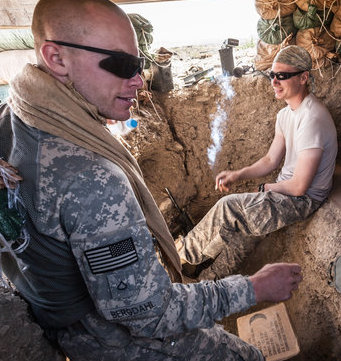
The New York Times, which earlier used the term, “demonizing” to describe opponents of Obama’s rescue action, offered a report on the platoon in which Sgt. Bergdahl (pictured at left above) served:

The platoon was, an American military official would assert years later, “raggedy.”

On their tiny, remote base, in a restive sector of eastern Afghanistan at an increasingly violent time of the war, they were known to wear bandannas and cutoff T-shirts. Their crude observation post was inadequately secured, a military review later found. Their first platoon leader, and then their first platoon sergeant, were replaced relatively early in the deployment because of problems.

But the unit — Second Platoon, Blackfoot Company in the First Battalion, 501st Regiment — might well have remained indistinguishable from scores of other Army platoons in Afghanistan had it not been for one salient fact: This was the team from which Sgt. Bowe Bergdahl disappeared on June 30, 2009.

After Bergdahl’s disappearance, he spent five years in captivity, held by the Taliban in the mountains of Afghanistan.

On May 31, he was turned over to the U.S. army in exchange for five Taliban prisoners who had been held since 2002 in the U.S. military prison in Guantanamo Bay, Cuba.

How the sergeant (promoted from the rank of private during his captivity) was captured by the Taliban is unclear.  But, for the moment, that does not matter.  The army will determine, through its own legal system, what placed this particular soldier in the control of the Taliban.

At the moment, Sgt. Bergdahl is under medical care, preparing to return home to his parents in Hailey, Idaho. The military justice system will have to determine what comes next for Sgt. Bergdahl.

For now, this nation can rejoice that our last remaining soldier held by enemy forces, is finally free.

As for the 30-day stipulation requiring congressional notification, congressional leaders, including Senator Feinstein, are well aware, as The Nation magazine recently wrote:

The administration’s legal authority to move the men who’ve been cleared for release is much clearer than it appears in the Bergdahl swap. According to the National Defense Authorization Act passed last year, the secretary of defense needs only to notify Congress of any prisoner transfers thirty days beforehand.

Secretary of State John Kerry defended the prisoner exchange against political and media criticism. Appearing Sunday on the CNN program “State of the Union”, Kerry said

that he felt confident the five Taliban detainees freed in a swap for Sgt. Bowe Bergdahl posed little risk to Americans, adding that Qatari officials were not the only ones monitoring them — and that while the five might be able to return to the battlefield, “they also have the ability to get killed doing that.”

Mr. Kerry, in some of his first public remarks on the exchange, struck a decidedly tough tone, dismissing as “baloney” the suggestion that terrorists would have new incentive to kidnap Americans.  .   .  .

Broadly defending the swap, Mr. Kerry said that it would have been “offensive and incomprehensible” to leave Sergeant Bergdahl in the hands of people who might torture him or “cut off his head.”

Zoe Carpenter, writing in The Nation, put the Bergdahl exchange in the larger context of the future of Gitmo:

Just weeks ago the president of Uruguay, Jose Mujica Cordano, offered to accept six of the cleared men as refugees. Secretary of Defense Chuck Hagel said on May 28 that he would decide to reject or accept the proposal “fairly soon.” Now that Obama has shown a willingness to push legal boundaries in order to move detainees whose designation as a threat seems at least plausible, the circumstance of men like Diyab, who the government never intends to charge with a crime, is even more indefensible.

“What’s changed is that the president has finally taken the initiative,” said Wells Dixon, a senior attorney at the Center for Constitutional Rights, which represents eight Guantánamo detainees. “What we’re hoping is that he will continue to take bold steps to transfer the remaining men, who are not nearly as complicated or as controversial.”

“Leave no one behind on the battlefield” is a sacred and long-standing U.S. military commitment.  President Obama honored that commitment with his carefully-negotiated prisoner swap for Sgt. Bowe Bergdahl. 

Presidents are fair game for criticism. When they get it right, we must say so.

The picture at top of Sgt. Bergdahl, taken in 2009 on the battlefield in Afghanistan, is by Sean Smith of  The Guardian.
 

Posted in John Kerry, Obama, Politics and Elections, The Human Condition, War | 12 Comments

Searching for Justice In Church and On Campus

by James M. WallAP

In less than two weeks, elected representatives of the Presbyterian Church USA, will gather in Detroit, Michigan, June 14-21, for their biennial General Assembly.

Meeting in solemn assembly, they will debate and vote, again, on how best to speak to the state of Israel.

To  those who do not follow American church politics closely, it pains me to report that, yes, the Presbyterians still remain divided on the issue.

Israeli Ha’aretz columnist Gideon Levy has delivered to the Presbyterians, and indeed, to the entire world, one of the most eloquent messages to Israel I have yet to encounter.

The fact that the statement comes from a native Israeli journalist, written for a mainstream Israeli newspaper, makes it even more compelling.

Written in a tone of sadness tinged with hope, Levy’s recent column is entitled, “International Kowtowing to Israel Must End Now”. He begins:

If there is a world, let it appear immediately. For now, there’s the sense of an ending of the international intervention in Israel. The Americans folded, the Europeans gave up, the Israelis rejoice and the Palestinians are lost.

As a result, he writes, those who depart “leave the conflict to the sighs of the Palestinians and the occupation in the hands of Israel, which is sure to perpetuate it and to ground it even more firmly”.

Levy writes, of course, not only to the Presbyterians, but to the entire world, which he believes is in danger of turning its collective global back on the Palestinians when he writes:

The world’s withdrawal is unacceptable: The international community does not have the option to leave the status quo as is, even if that is Israel’s most fervent wish.

To call the world back from withdrawal, Levy says we must embrace “a new way, one that has never been tried before”.

Both the message and the medium must change, to a message of civil rights and the medium of punishment. The previous route included sycophancy toward Israel, one carrot after another in order to please it. It was a resounding failure. It only gave Israel an incentive to further entrench its policy of disinheritance.

Levy tells the world that it cannot “lend its hand” to Israel’s “policy of disinheriting” the rights of Palestinians.

It is unacceptable in the 21st century, for a state that purports to be a permanent member of the free world to keep another nation deprived of rights.

It is unthinkable, simply unthinkable, for millions of Palestinians to continue to live in these conditions. It is unthinkable for a democratic state to continue to oppress them in this way. It is unthinkable that the world stands by and allows it to happen.

The two-state discussion must now become a discussion of rights. . . .Equal rights for all; one person, one vote – that should be the message of the international community. After all, what could Israel say to this new message? That there cannot be equal rights because the Jews are the chosen people? That it would endanger security? .   .   .   .

At the same time, the entire approach to Israel must be changed. As long as it does not pay the price for the occupation and its citizens go unpunished, they will have no reason to end it, or even to deal with it. .  .  .   .

For this reason, only punitive measures will remind us of [occupations’s] existence. Yes, I mean boycotts and sanctions, which are greatly preferable to bloodshed.

Levi’s case is both overwhelmingly moral, and it is unassailable. And yet, the Presbyterian Church U.S.A. will once again argue among themselves on the matter of Israel’s right to occupy and oppress the Palestinian people.

Nor will the argument be limited to representatives of the Presbyterian Church. They will be backed by a campaign of Israeli hasbara (propaganda) which infects every U.S. major denomination, and which makes itself heard on U.S. college and university campuses.

The strongest voices against supporting “punitive measures” against Israel’s occupation  have been liberal Zionists.

One consistent voice exposing the role of liberal Zionism in these church and campus debates, has been that of Charles H. Manekin, an orthodox Jewish studies and philosophy professor, who divides his time between Israel and the US.

Manekin writes the blog, Magnes Zionist, under the nom de plume, Jeremiah (Jerry) Haber.

Haber notes that liberal Zionists are able to “influence the mainstream from within”, operating as liberal Zionists who are more Zionist than liberal.

Reporting on a recent Washington campus debate and vote, Haber writes:

Optimist that I am, I thought the younger generation of liberal Zionists was different.  These young activists seemed to have none of the self-induced neuroses of the 1967-generation, those of us who had been taught to believe that Israel was on the brink of extinction before the Six Day War,  a tiny David surrounded by murderous Arab states  (a myth put to rest by historian Avi Shlaim, inter alia, in The Iron Wall.)

Unlike their parents, the millennial generation of liberal Zionists had grown up with a powerful Israel that built illegal settlements, collectively punished Palestinians, erected walls ostensibly for security, but actually for more expropriation of land.  

These young people listened avidly to the testimonies of the soldiers of Breaking the Silence, and in some instances were willing to cosponsor events with Students for Justice in Palestine and other Palestinian rights group.

This generation of liberal Zionists may not have endorsed the global BDS movement, but it was not shocked or scandalized by that movement, nor did it see it as anti-Semitic or illegitimate.

Reporting on the campus debate and vote at the University of Washington, in Seattle,  Washington, Haber writes that “the scales have fallen from my eyes”.

At stake in Seattle was:

“a divestment to examine [the U of W’s] financial assets to identify its investments in companies that provide equipment or services used to directly maintain, support, or profit from the Israeli occupation of Palestinian land” and “instruct its investment managers to divest from those companies meeting such criteria within the bounds of their fiduciary duties.”  

This was a rather modest proposal, not calling for divestment from Israel companies per se, only divestment from companies that profit from the Occupation.

One would have thought, one would have hoped that J Street U would have linked arms with over fifty Palestinian civil society organizations on this one point, despite its disagreements with them on other points.  

A group calling itself J Street U in a campus BDS debate ? Where did that come from?  It came, of course, from that parental liberal Zionist lobby group which calls itself J Street and goes by the slogan, “Pro Israel, pro peace”, without any reference to Palestinians.

J Street has sold itself as the anti-AIPAC liberal Jewish alternative, reaching out to moderate and progressive Jewish voters, organizations and funders.

Now we find that J Street has formed campus chapters, J Street U, with the same orientation. Hasbara is an operation run from Israel and the U.S. It is highly sophisticated and extremely knowledgeable about American culture, religion and politics.

As Haber notes, despite its parentage, “One would have expected that J Street U would stand with the oppressed, even if it meant being barred from the communal tent”.

That did not happen.  The recently-born J Street U at the University of Washington went straight home to the communal tent. It joined, as Haber writes, “not with the oppressed, not even with Jewish organizations like Jewish Voice for Peace,  but rather with AIPAC and with StandWithUS,”

In a remarkable show of Jewish unity, J Street U combined with the other “pro-Israel” forces.”

To the cheers of the right-wingers, another BDS battle had been won by Israel, and now, certainly, J Street U had earned its place at the Jewish communal table.  “Mazal tov, J Street U at U Wash!”

To those who are keeping score, the final student Senate vote was 59 to 8 with 11 abstentions.

Haber records in dismay,

Just like their parents and their grandparents generations, the progressive Zionists of J Street U wimped out, preferring tribal loyalty to fighting for justice, preferring it even to their own principles. Or perhaps tribal loyalty is their principle.

After the campus vote, Jerusalem-based Ha’aretz reported from the U.S. campus battle front:

In marked contrast to the seemingly intractable Israeli policy-related divisions that have plagued internal debates at Hillel and Jewish organizations throughout the United States and Canada in recent years, the University of Washington’s pro-Israel community was able to overcome disagreements among its students due to a combination of preplanning, student-driven activism and open dialogue.

“The campaign to defeat divestment had to be student-driven. I was not going to take part in a response that positioned students as puppets of outside Jewish organizations,” said University of Washington Hillel rabbi and executive director Oren J. Hayon.

So, be forewarned you Presbyterians, stay on the alert, you equal rights pro-Palestinian campus political leaders, you face a formidable foe, highly trained to win hasbara battles right in your own backyard.

Finally, in concluding this update on the struggle in churches and on campuses for Palestinian justice, it is appropriate that we conclude with the words of an Olympia, Washington native, Rachel Corrie, who died in the struggle for justice on May 16, 2001.

In the video clip here, famed civil rights activist, Maya Angelou. who died at age 86 on May 28, 2014, reads from an email written by Rachel Corrie, just before Rachel left her home in Olympia, Washington for Gaza.

Two women, one young, another much older, both with a common purpose, the search for justice.

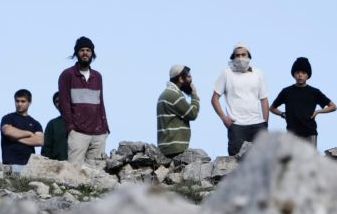
The picture above is of Israeli settlers from the settlement of Yitzhar during a confrontation with Palestinians over an area in Burin village in the West Bank. It was taken on January 14, 2014. The photo is an Associated Press picture from Ha’aretz.  

Posted in Middle East Politics, Politics in Religion, Presbyterian Church USA | 4 Comments

What the Pope Did Not Say

by James M. Wallpope-quds

It is what the Pope did not say that should disturb the world.

The Turkish World Bulletin’s New Desk  points to crucial words missing from his Holy Land Papal trip May 25-26:

“Although the Pope has prayed at the separation wall in Bethlehem and called for a Palestinian state during his visit to the Al-Aqsa Mosque compound in occupied Al-Quds (East Jerusalem), he has not commented on Israeli abuses or on the blockade on 1.7 million Palestinians in Gaza.” 

Also missing was the essential point that the Pope’s visit was made in a political environment in which Israel and the U.S. have once again insisted on their “two sides” recurring diplomatic dodge.

President Obama repeated the dodge following the collapse of the latest round of “peace talks” between Israel and Palestine:

“What we haven’t seen is, frankly, the kind of political will to actually make tough decisions, and that’s been true on both sides.”

Not so, by any standard of political realism.  The prisoner is never equal to the jailer.

Naim Ateek, the Palestinian Anglican priest who founded Sabeel, told Time magazine before the Pope’s trip:

“I would hope that the Pope will show great courage to speak against the injustice of the Palestinians, that he will speak against the occupation.  I mean if he will just talk about the occupation, it will reflect the prophetic stance.”

Ateek was identified by Time as:

founder of Palestinian liberation theology, a movement that for three decades has identified Palestinian occupation with Jesus’ suffering and response to injustice.

Ateek’s 1989 book, Justice and Only Justice: A Palestinian Theology of Liberation, is the movement’s foundational work, and he runs the Sabeel Ecumenical Center in Jerusalem.

As yet, no Papal prophetic reflection and no condemnation of occupation, has emerged.

What we have, instead, is an invitation to Palestinian President Mahmoud Abbas and Israeli President Shimon Peres, to visit the Vatican where the Pope and the two leaders will pray for peace.

Israeli peace activist Uri Avnery, a modern Jewish prophet, had more than prayers on his mind when he wrote this past week:

When one says that “both” did not . . . make the “necessary hard decisions” . . . one consciously or unconsciously assumes that they are equal. Nothing is further from the truth.

Israel is immeasurably stronger than Palestine in every material respect. One resembles a sleek American skyscraper, the other a dilapidated wooden shack.

Palestine is under occupation by the other half of “both”.

Palestinians are totally deprived of all elementary human and civil rights.

Average income in Israel is 20 times higher than in Palestine. Not 20%, but a staggering 2000%.

Militarily, Israel is a regional power, and in some respects a world power.

In this reality, speaking of “both” is at best ignorant, at worst cynical.

Anyone who uses the term, “both sides”, is saying there is only one version of reality, the Israeli version.

The Pope was on his three day trip to the Holy Land, his first as a pope, when Israeli soldiers shot and killed two Palestinian teen-agers on May 15, 17-year-old Nadim Siam Nuwara and 16-year-old Muhammad Abu al-Thahir.

The Pope is most certainly aware of the deaths of these two teen-agers, both of whom were shot near the Ofer military prison in the West Bank on the 66th anniversary of the Nakba.

Parents of the two young boys  appealed directly to the Pope to “speak out against their murders and to watch video footage of the killings”.

The Abu al-Thahir and Nuwara families said in their joint statement to the Pope:

“We appeal to Your Holiness as a religious and spiritual leader to call on international human rights organizations to seek justice in the prosecution of the perpetrators and hold their leaders accountable for the murder of our sons,” the parents say in a message issued through Defence for Children International-Palestine Section (DCI-Palestine).

“Our hearts are torn in anguish for the loss of our sons, whose young lives, dreams, and hopes were cut short by the bullets that struck them…they were murdered with the utmost cruelty and disregard for human life, at a time when our people were recalling the tragedy of the Nakba that befell upon us at the hands of the Israeli occupation.

“We attach high hopes to your historic visit to our holy and blessed land, and we hope it will be a good start to exert every possible effort at the international level to end the occupation, so that our children may live in peace and security in the land of love and peace.” 

The murders of the two teen-agers did not occur in darkness, away from the prying eyes of television eyes of modern media.  Instead they took place in daylight. A security camera, and an alert CNN cameraman. were there to film their deaths.

The Electronic Intifada posted the videos with an accompanying story:

CNN has an important break in the story of the deadly shooting by Israeli occupation forces of two Palestinians teenagers.

As this report by Ivan Watson shows, CNN’s cameras were apparently trained on the Israeli occupation soldier who shot one of the boys.

(Click here for the story and video, in addition to an interview with one boy’s father, and pictures of the two boys)

CNN adds a warning to viewers that the video may be disturbing to some viewers.  It is indeed, disturbing.  What matters now is how Israel will react to the charge that the deaths of the two teenagers could not be blamed on them because they only used rubber bullets.

Both teen-agers were killed with live ammunition. As the video footage from CNN and from Israel’s Ha’aretz, indicate, they posed no threat to the Israeli soldier or soldiers who shot them.

How will Pope Francis respond to the letter from the Abu al-Thahir and Nuwara families?

What will he say to them and to the thousands of other Palestinian families whose children have been imprisoned, tortured, beaten and killed in the name of a false “both sides” peace talk charade?

Those upcoming Vatican prayers involving the Pope and his Israeli and Palestinian guests, are not without merit.

It is neither presumptuous nor unreasonable to hope that the Pope will include in his prayer the names of two Palestinian teen-agers, 17-year-old Nadim Siam Nuwara and 16-year-old Muhammad Abu al-Thahir, both shot to death on the 66th anniversary of the Nakba.

 The picture of the Pope above is from the Turkish World Bulletin. The video is from CNN by way of the Electronic Intifada. 

Posted in Middle East, Middle East Politics, Obama, Television | 4 Comments

Israel Hides Behind its Own Special “Catch 22”

by James M. WallAlan Arkin

Following yet another round of failed peace talks, Palestinian leaders  have seized the initiative to create their own future.

Knowing that Israel has consistently demonstrated no interest in reaching a peace accord, Palestinian leaders defied pressure from Israel by signing their own reconciliation agreement.

The agreement is between the mainstream PLO faction, Fatah, and the Islamic Liberation group, Hamas.  

Not only Palestinian leaders, but the Palestinian people appear ready for their own Palestinian unity, not one designed by Israel.

The unity government agreement was reached in Gaza City, April 23, after talks between Hamas leaders and a Palestine Liberation Organization (PLO) delegation headed by Azzam al-Ahmad, a senior figure in president Mahmud Abbas’s Fatah party.

Immediately, Israel threatened to adopt “draconian measures” against the Palestinian Authority (PA) in case the latter dared implement the agreement with Hamas on the ground.
 
The punitive measures include (the usual) halting the transfer of tax revenues to the Palestinians as well as a series of other restrictions and harassments.

Israeli Prime Minister Binyamin Netanyahu was quoted as saying on Friday (May 16) that the PA would have to choose between Hamas and the peace process.

Veteran Palestinian journalist Khalid Amayreh describes the situation in the Voice of Palestine:

Israeli leaders repeatedly argued that the Jewish state could not make peace with the Palestinians as long as the Palestinian house remained divided against itself.

But when Fatah and Hamas reached the reconciliation agreement, Israel was visibly furious as Israeli officials reiterated long-standing but spurious arguments about resistance and terror as well as Hamas’s refusal to recognize Israel.

So there we have it, Israel’s right-wing government takes yet another step into the depths of absurdity by informing divided Palestinian leaders that they cannot make peace with Israel unless they are unified.

Unified how? Unified only in the way Israel says they can be unified.

This is nothing less than Israel’s version of a Catch 22.

Travel back to 1970 and recall the Joseph Heller novel that inspired the Mike Nichols-directed film, Catch 22.

The title is explained, and it fits Israel’s current stance, in this exchange, from the film, which is set during World War II.

The dialogue is between “Doc” Daneeka (Jack Gillford), the base doctor, and Yossarian (Alan Arkin, above right), who insists he does not want to fly any more combat missions:

Dr. ‘Doc’ Daneeka: Catch-22. Anyone who wants to get out of combat isn’t really crazy, so I can’t ground him.

Yossarian: Ok, let me see if I’ve got this straight. In order to be grounded, I’ve got to be crazy. And I must be crazy to keep flying. But if I ask to be grounded, that means I’m not crazy anymore, and I have to keep flying.

Dr. Doc’ Daneeka: You got it, that’s Catch-22.

Yossarian: Whoo… That’s some catch, that Catch-22,

Dr. ‘Doc’ Daneeka: It’s the best there is.

Israel’s Prime Minister Benjamin Netanyahu has come up with his own “best there is”, a Catch 22 which says that in order for Palestinians to talk peace they must be unified, and the unification must be Israeli-certified.

Yossarian could not be grounded unless he was crazy. And yet, if he wants to avoid combat he cannot be certified crazy.

This is the logic Israel uses, and despite its deliberate obscurantism, it continues to work in its favor. Or so the present Israeli government thinks. There are signs that Israel’s ability to dictate its own terms is slowly ebbing away.

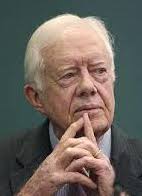
images-1Former U.S. President Jimmy Carter, who knows his way around the Middle East mediation front, wrote in the Washington Post:

With the suspension of U.S.-sponsored peace talks on April 29, dangerous unilateral steps are likely to continue. During the previous nine months of negotiation, 14,000 new Israeli settlement units were approved, more than 3,000 Palestinians were arrested and 50 were killed, provoking troubling examples of Palestinian retaliation, including the deaths of three Israelis.

Carter sees  “Palestinians’ plans for the coming months  to form a new unity government and expand involvement in the United Nations” as steps that could become “a positive development”.

He recognizes that “in the past, similar efforts have been abandoned because of strong opposition from Israel and the United States”.

But, he also sees a strong “resolve to succeed” by leaders in the West Bank and Gaza”.

“This reconciliation of Palestinian factions and formation of a national unity government is necessary because it would be impossible to implement any peace agreement between Israel and just one portion of the Palestinians.”

Israel’s own special Catch 22 is a subterfuge that cannot sustain Israel forever. Next up, Israel must confront a new Vatican leader when Pope Francis arrives for a whirlwind  24 hour visit to Israel and parts of Palestine (not Gaza).

The new pontiff will return for his second visit to the region (he was last there in 1973) well aware that, according to the Institute for Middle East Understanding (IMEU) Fact Sheet:

There are roughly 200,000 Christian Palestinians in Israel and the occupied territories, descendants of some of the oldest Christian communities in the world.

The majority of Christian Palestinians are Greek Orthodox, with smaller numbers of Roman Catholics, Armenian Orthodox, Copts, Episcopalians, Ethiopian Orthodox, Greek Catholics, Lutherans, Maronites, Syrian Orthodox, and several other Protestant denominations.

There are no official figures on the number of Christian Palestinians in the occupied territories, but according to the Lutheran ecumenical institution the Diyar Consortium in 2008 there were 51,710 Christians in the West Bank, Gaza, and East Jerusalem. They are concentrated mainly in Bethlehem, East Jerusalem, and Ramallah.

Israel’s official claims that all is well with the indigenous Christians in the Holy Land, will not fool this Pope. He knows poverty and oppression when he sees it. And he will talk with Christians on the ground.

The Pope will arrive in Tel Aviv four days after the start, on May 21, of yet another effort to find justice in the Israeli courts by the family of American (state of Washington) peace activist Rachel Corrie.

Israeli lower courts have absolved the IDF soldier who drove the bull dozer which killed Rachel Corrie in Gaza. She was there to protest the destruction of a Palestinian home.

The Israeli courts have shown no willingness to seriously consider an earlier decision which ruled that the IDF soldier was not responsible for her death.

The Pope will also arrive in Tel Aviv a few weeks after a prominent Israeli academic returned to Israel to receive an award.

His name is Saul Friendlande. He is a Jewish historian of the Holocaust, During a recent short stay in Israel, where he was being honored, Friendlande was clearly in distress over what he knows is happening there.

In an interview with Ha’aretz he spoke of his views of Israel today:

“For personal and family reasons I’m happy to see the captivating human fabric of Israel,” he says. “But it’s important to put aside this pleasant Tel-Aviv life and to go to Jerusalem where things are a bit more complicated. When you forget the pleasant daily life, think for a bit and read the paper, you get into an angry frame of my mind.

Professor Friedlander could be excused for sitting back and enjoying his vacation. The foremost Israeli and Jewish veteran historian of the Holocaust, he has been writing and teaching history for over 50 years in Switzerland and Israel, and since 1988, at the University of California. .  .  .

“I am connected to this country. My eldest son and grandchildren live here but I can’t call myself a Zionist. Not because I feel estranged from Israel but because Zionism has been taken, kidnapped even, by the far right.”

“Kidnapped by the far right” are the words of a man who refuses to call himself a Zionist.

The Israel he had hoped would develop, has become a nation that has lost its moral compass, a loss which involves the arrest of Palestinian children from their beds at night and subjecting them to total isolation in Israeli prisons.

Posted in Middle East, Middle East Politics, Movies, Netanyahu | 5 Comments

“Zionism Unsettled”: Neither False Nor Misguided

by James M. Wall

The battle has begun over Zionism Unsettled.Photo Paul Rahm Times Union.com

The Christian Century opened round one by publishing an attack on Zionism Unsettled, a study guide developed for the study of Zionism, a secular ideology formed in the 19th century, which has had a major impact on Jewish–Christian relations.

The battle will continue June 14, when the General Assembly of the Presbyterian Church (U.S.A.) gathers for national deliberations in Detroit, Michigan.

The attack ran under the headline, False witness: A misguided ‘study guide’. The guide was developed, and published in January of this year, by The Israel/Palestine Mission Network (IPMN), one of 40 networks approved by the Presbyterian Church (U.S.A.) and funded by each network’s church members.

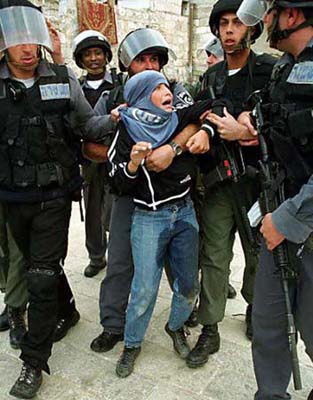
The picture above is not from Zionism Unsettled. It is from an Amnesty International blog that appeared in the Albany, NY, Times Union. It was taken in Hebron, Palestine, during a “round-up” of Palestinian children by the Israeli Defense Force (IDF).

The picture was taken by Paul Rehm, a reservist with the Christian Peacemaker Team. The Times Union blog writes:

One Israel Defense Force soldier involved in a massive sweep through the West Bank city of Hebron,  told international observers: “We don’t arrest normal people. They are not normal people.” Reporting on that mass arrest of 27 Palestinian children – 18 under the age of 12 – on their way to school, the Israeli newspaper Ha’aretz demanded only, “The IDF must stop arresting children.”

The picture above of a child bound by the wrists, is pertinent to the discussion of the issues raised by the battle over Zionism Unsettled.  (How strong is the Zionist influence in your community? Ask your local newspaper to run the blog posting and picture that ran in the Albany Times Union.)

In round one of  the Zionism Unsettled battle, much to the credit of The Christian Century, the magazine has thus far run six comments as responses to False Witness, all agreeing to the basic point that the study guide is neither false nor misguided.

The print edition of the Century, in the mails this weekend, did not include the six comments, which were all responses to the web posting.  Presumably these, and other responses, will surface in future print editions

False Witness was written by Christopher M. Leighton, executive director of the Institute for Christian and Jewish Studies in Baltimore (ICJS).

The article is a classic hasbara (propaganda) tactic, skillfully projecting a seemingly compassionate acknowledgement that Palestinians have had it rough since 1948, followed quickly by the author’s rather desperate effort to argue for Israel’s righteous claim to the land which it occupies.

It also makes the classic Zionist “equal sides” argument, as though a massive military force occupying a captive population could be described as anything remotely related to “equal”.

Leighton skirts that anomaly by shifting the discussion to what is “wrong” with the non-violent protest movement, Boycott, Divestment and Sanctions (BDS).

BDS began in the Palestinian civil society, with strong religious support. The movement is gaining political strength everywhere on the planet except among Israel’s rapidly diminishing “allies”, most notably the U.S., where both the Congress and the executive  branch have been intimidated into submission to whatever Tel Aviv wants.

One of the four False Witness responses on the Century web site is from Nahida Halaby Gordon, a retired Case Western Reserve University professor. She was born in Palestine and now lives in Wooster, Ohio.  She begins her comment:

Reading your article False Witness it is clear that your acquaintance with Palestinians is minimal and is a result of decades long Israeli hasbara. The article is full of misstatements that are contrary to facts recognized by the majority of experts writing on the conflict and it would take similarly long comments to restore truth.

I am a survivor of the 1948 ethnic cleansing of Jaffa. I experienced the terror of the Israeli forces attack on the civilian areas of Jaffa. My father was wounded in such a terror attack and buildings around our house were hit by Israeli bombardment.

From my personal experience, the practices of the government of Israel have constituted apartheid since the creation of the State in May of 1948.

In Leighton’s article, he insists that the Boycott, Divestment, Sanctions (BDS) movement is promoted at length in the study guide. He also implies that the study guide pushes for a BDS policy that would extend beyond the Occupied Palestinian Territories to include the entire state of Israel.

I can find no such case being made in the guide. Nine writers contributed to the guide. My research has thus far turned up only three references to BDS.  Not one of these references mentions nor implies anything like a delegitimization of the state of Israel, which appears to be Leighton’s greatest fear.

Christopher Leighton was involved in the founding of ICJS in 1987.  He  has served as its executive director since its founding.  ICJS is unrelated to the Presbyterian Church (U.S.A.), though Leighton is an ordained Presbyterian clergyman.

A perusal of the ICJS board shows no familiar Presbyterian names, though some may be there, unknown to me. Not that any Presbyterian names are required. ICJS claims no Presbyterian connection.

But based on his False Witness analysis of Zionism Unsettled, Leighton wants to do whatever he can to prevent his denomination from “damaging” Israel’s “right to exist”.

Zionism is as an ideology at war with an enemy. When the pressure increases from the Zionist side of the battlefield, as for example, with the appearance of False Witness in a major national Christian publication, it is safe to assume Zionist operatives see Zionism Unsettled as a danger looming to Israel’s “existence”.

PhotoPalChildmanyIDFarresting1Zionism Unsettled is not a danger to Israel’s “existence”. Modern nations do not “cease” to exist, unless they are militarily destroyed and conquered.  Backed by more than 200 nuclear war heads tucked away in the desert,  defeat does not appear to be an immediate threat to Israel.

The danger posed  to the state of Israel by Zionism Unsettled is that the study guide has the potential to build momentum in the U.S. which could, over time, help release the Jewish people from their current bondage to an increasingly paranoid right wing government.

How? By persuading them to listen to different Jewish and Christian voices and discover that their future does not lie in greater and greater political paranoia coupled with increased military strength. Their safe and productive future lies in reaching a fair and just relationship with their neighbors.

Twenty-six years after it was formed, The Institute for Christian Jewish Studies (ICJS)  decided that 2013 was the right time to broaden its inter-faith study program to include Muslims. In the summer of 2013, ICJS brought in a visiting Muslim scholar, Dr. Homayra Ziad, to lecture and to discuss how best to include Islam in future ICJS programs.

On the surface, the “inter-faith” movement has sold itself as a theological and cultural sharing effort. But dig deeper and the state of Israel (and its “precarious” existence) is at the core of these conversations.

Look more closely at this rationale and you find yourself in idolatry territory. This was the warning that leading anti-Zionist Jewish scholars sent to the fledging state of Israel in 1948: When the state trumps God, the state becomes God.

Leighton’s piece in The Christian Century was written entirely from the perspective of the Zionist narrative, the perspective that shapes the worldview of most Israeli Jews and  a heavy preponderance of Westerners, especially among the leadership classes.ZU covert

Zionism Unsettled boldly presents a different perspective on the history and current reality of the Palestinians. “It is the occupation, stupid”, is so clearly at the heart of the difference between these two narratives, that the issue of justice overwhelms all conversations on the topic.

It is the long muted voice of the Palestinians that Zionism Unsettled is designed to communicate to Western Christians who are so saturated with the Zionist narrative, that even after all the evidence of the Palestinians suffering under occupation, the Presbyterian Church (U.S.A.) will still conduct a “debate” on how to deal with Palestinian occupation at its General Assembly in June.

I was asked to write a pre-publication comment on Zionism Unsettled. This is what I wrote:

“This is a well-timed and important book. It was written and produced by people of the church for the benefit and growth of the people of the church. I urge you to read it carefully and make it priority reading and study for all those you know.

We must understand how the people of Palestine suffer injustice and oppression. It is a problem and a challenge that demands our attention. With the wisdom and insight shared in this book we have an opportunity to take actions that are essential to bring long-overdue justice to the people of Palestine and Israel.”

Now that Zionism Unsettled has reached its public and a discussion of its content has begun, I can only repeat my pre-publication endorsement above, with an added, Amen and Amen.

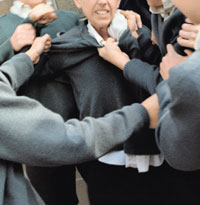
The picture of IDF soldiers arresting a young girl is from
http://www.derryfriendsofpalestine.org/2012/04/the-caged-bird-sings-for-freedom/

Posted in Human Rights, Middle East, Middle East Politics, Politics in Religion, Presbyterian Church USA, Religion and politics | 10 Comments

Time for Obama To Earn His 2009 Nobel Prize

by James M. WallMINOLTA DIGITAL CAMERA

President Obama has suggested a “pause” following the failure of the most recent Israel-Palestine peace negotiations.

A pause is an option, of course, but it needs to be a “pregnant pause”, defined by one source as: “A pause that gives the impression that it will be followed by something significant.”

It was Edmund Burke who once wrote, “Those who don’t know history are doomed to repeat it.”

During his peace talks pause, Obama should look back to 2006, the last time the U.S. and Israel “trusted” the Palestinians to speak for themselves. That was the year of the remarkable 2006 parliamentary elections in the Occupied Palestinian Territories.

The U.S and Israel did not actually trust the Palestinian voters, they tolerated them. Their “experts” on the ground assured them the election would end in victory for the Fatah party, known then for its loyalty to the Israeli-U.S. axis. The election was won by Hamas. Wikipedia provides the election results:

Elections for the Palestinian Legislative Council (PLC), the legislature of the Palestinian National Authority (PNA) were held on 25 January 2006. The result was a victory for Hamas, who won with 74 seats of the 132 seats, whilst the ruling Fatah won just 45. In terms of votes received, Hamas took 44.45% of the vote, whilst Fatah received 41.43%[1] and of the Electoral Districts, Hamas party candidates received 41.73% and Fatah party candidates received 36.96%.

I covered that January, 2006, Palestinian parliamentary election from a Bethlehem polling place. President Jimmy Carter was also there for the election. He was the head of the international election monitoring group.

across the streeIt was a moment of great potential in Palestinian history. Unfortunately, Israel and the U.S. were not interested in any political steps that enhanced Palestinian history.

Rather than bow to the will of the voters throughout all of Palestine—the election was held in Gaza and in the West Bank—Israel and the U.S. did what empires do, they refused to accept the results.

The election of a new Palestinian government caught the Bush White House “by surprise”, or so the White House claimed at the time. It has always been difficult to believe that the vaunted spy agencies  of Israel and the U.S. did not know, from inside sources, that the final election results would go against them.

“Surprise” appears to be the automatic empirical response when Palestinians deviate from the prepaid script. Eight years after the 2006 “surprise” election outcome, the Obama White House was “surprised” by the latest Palestinian 2014 surprise.

In a story from AP, posted by Times of Israel, U.S. Secretary of State John Kerry

“said a deal announced last week for Palestinian authorities to create a unity government with the militant group Hamas — and which spurred Israel to withdraw from peace negotiations — took the US by surprise.” 

The 2006 election that gave Hamas legislative control of both Gaza and the West Bank, drove Israel and the U.S. over the brink. Israel immediately imprisoned a large number of newly-elected Hamas legislators.

After losing at the polls, the U.S. sent military trainers to prepare Fatah militias to attack Hamas. Those attacks led to a military defeat of Fatah, adding insult to political injury.

Eight years later, either surprised or just disappointed in the 2014 Hamas-Fatah unity government proposal,  President Obama wisely chose not to follow the 2006 Bush script. Instead, still clinging to a peaceful solution, Obama called for a pause in the peace negotiations.

Five months after that earlier January 25, 2006, internationally monitored election, I wrote a column in The Christian Century magazine, on June 13, 2006, entitled “Unilateral Proposal”. The column cited articles by, among others, President Jimmy Carter.

In a column Carter wrote in the International Herald Tribune (May 7, 2006), the former president provided a rare look at the actual reality on the ground in 2006. Carter wrote:

Innocent Palestinian people are being treated like animals, with the presumption that they are guilty of some crime. Because they voted for candidates who are members of Hamas, the United States government has become the driving force behind an apparently effective scheme of depriving the general [Palestinian] public of income, access to the outside world and the necessities of life.

How well did the new Palestinian government, under the duly-elected Hamas party, conduct itself in 2006?

Hamas was keeping its pledge to allow no violence against Israel civilians. That pledge of non-violence had been kept for more than 18 months.  And yet, as I wrote in my June, 2006 column in The Christian Century:

both Israel and the U.S. continue to describe Hamas as a terrorist organization and refuse to talk with Hamas until it accepts Israel’s “right to exist”—a diplomatic demand that Virginia Tilley, professor of political science and international relations at Hobart and William Smith Colleges, finds less than compelling.

In the online newsletter Counterpunch (May 12, 2006), Tilley identifies a logical flaw in the “right to exist” demand that has led to the international isolation of Hamas. “Diplomatic recognition of a state routinely requires one bit of vital information: ‘right to exist’ where? Israel’s borders are not set. 

Rumbles of criticism of the Israel/U.S. response to Hamas’ political victory, were beginning to emerge in the U.S. in 2006, most notably, as my Century column indicates, from two academics, Stephen Walt of Harvard, and John Mearsheimer of the University of Chicago.

Robert Fisk had interviewed Stephen Walt for the Independent, on April 27, 2006. I wrote at the time that the interview focused, “on a report on the Israel lobby that Walt coauthored with John Mearsheimer”.

Originally published as an essay in the London Review of Books, in March, 2006, that report was later expanded into the Walt-Mearsheimer book, The Israel Lobby and U.S. Foreign Policy.

How will the Lobby respond when Barack Obama yields the White House to the next president?

The best way to answer that question is to consider the two front-runners now contending for the presidency.  Hillary Rodham Clinton appears almost certain to win the Democratic nomination, and for the moment, former Florida Governor Jeb Bush is the leading mainline Republican candidate.

Either of these candidates would find favor with the Israel Lobby, especially  Clinton.  President Obama has until January, 2017, to break the Israel Lobby’s presidential winning streak.

His current peace pause is the opportunity for him to make a sudden, unexpected and dramatic shift in his handling of the Middle East.

Looking back at President Bush’s deliberate scuttling of the unified Palestinian government that emerged in January, 2006, President Obama could pivot from automatic subservience to the Lobby and seize this moment in history to support a unified Palestinian government.

Asharq Al-Awsat is a pan-Arab daily newspaper, printed simultaneously each day on four continents in 14 cities. It recently published an analysis of the new Hamas-Fatah agreement (called the Gaza Agreement) by Barakat El-Farra, Palestine’s ambassador to Egypt and permanent representative to the Arab League.

In his analysis, El-Farra provides details of the steps that could lead a new Palestinian unity government. This is the essence of his presentation:

The new Gaza Agreement stipulates operational mechanisms to implement the Cairo Agreement and the Doha Declaration. Such mechanisms include the formation of a government of national consensus, headed by President Mahmoud Abbas, within a five-week timeframe.

Specialists and technocrats are to prepare for legislative, presidential and National Council elections. President Abbas set the date of simultaneous elections for all three bodies for at least six months in the future, after the formation of the government in consultation with the Palestinian factions. 

What would be the impact of of the implementation of the Gaza Agreement?

It would enable the Palestinians to better confront the Zionist occupation, restore the Palestinian cause to its rightful status on the world stage, and strengthen Palestine’s position at the negotiating table. It would also ease the suffering endured by the Palestinian people as a result of their divisions, and renew their executive and legislative frameworks.

By embracing this Agreement, and by bringing the EU and other world leaders with him in his support, President Obama would announce to the world that he was the man of peace he claimed to be when he ran for election in 2008.

After winning that election, and to the surprise of many, President Obama was awarded the 2009 Nobel Peace Prize after less than eight months in office.

Critics at the time said it was too early for such an award to be presented on promise rather than on performance.  President Obama acknowledged this reality when he said in his Nobel speech accepting the award:

“Let me be clear: I do not view it as a recognition of my own accomplishments, but rather as an affirmation of American leadership on behalf of aspirations held by people in all nations. To be honest, I do not feel that I deserve to be in the company of so many of the transformative figures who’ve been honored by this prize.”

A dramatic move this summer, a move in which he would display his support of a unified Palestinian government, would be the moment in which Barack Obama finally earns that 2009 Nobel Peace Prize.

The 2006 picture at top shows a city street in Bethlehem with campaign posters widely displayed. The picture was taken by Connie Baker. The picture further down shows voters waiting to go into a Bethlehem polling place, also in 2006. This second picture was taken by the author.

Posted in Hillary Clinton, Jeb Bush, Middle East Politics, Netanyahu, Obama, Politics and Elections | 5 Comments

A Tale of Two Tapes

by James M. Wall

UPDATED: Tuesday, April 29

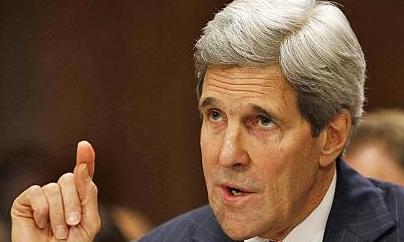
Kerry

Two tapes have surfaced in recent days. Thereby hangs a modern tale of the “best of times and the worst of times”.

It is a bit of a stretch to use Charles Dickens to link the best of times represented by John Kerry, and the worst of times, embodied in the owner of an American professional basketball team.

But stretch is required in a world gone awry with both power and money much more than usual in the wrong hands. Hence, we have a tale of two tapes.

Tape number one is getting considerable media play because it involves the racist ravings of the owner of the Los Angeles Clippers, one of the better teams in the National Basketball Association.

Tape number two draws less attention, of course, but it happens to be of far greater significance, because it reveals U.S. Secretary of State John Kerry telling a group that Israel is in danger of heading toward international isolation as an apartheid state.

Charles Dickens begins A Tale of Two Cities: A Story of the French Revolution, in this manner:

It was the best of times, it was the worst of times, it was the age of wisdom, it was the age of foolishness, it was the epoch of belief, it was the epoch of incredulity, it was the season of Light, it was the season of Darkness, it was the spring of hope, it was the winter of despair.

Al Jazeera reported Kerry’s reference to the threat of apartheid  looming in Israel’s future. 

US Secretary of State John Kerry has said that Israel risks becoming “an apartheid state” if there is no two-state solution to the Israeli-Palestinian conflict.

Kerry’s comments were published on Sunday by The Daily Beast news website, which obtained a recording of his remarks on Friday to the Trilateral Commission, a non-governmental organisation which includes senior officials and experts from the US, Western Europe, Russia and Japan.

Israel supporters who are deeply embedded in the U.S. government and its Israel Lobby satellites, reacted immediately to Kerry’s use of the word “apartheid”.

The attack on Kerry was predictable, lamentable, and further proof that Zionism rules our land in this the worst of our times.

Kerry, alas, was forced to walk the plank for his team, issuing a statement that he wishes he could rewind the tape and use a different word.

But use it he did, to the delight of folks like Aaron David Miller, a loyal Zionist in and out of government, who had his response ready when the New York Times called:

Aaron David Miller, a former American peace negotiator now at the Woodrow Wilson International Center for Scholars, said that Mr. Kerry’s comment had drawn him into an “unproductive fight with a close ally.”

“Baker and Kissinger used tough language when they thought they would not only be able to make a point, but would be able to make a difference,” Mr. Miller said of James A. Baker III and Henry A. Kissinger, both former secretaries of state. “But Kerry’s closed-door comment was ill timed, ill advised and unwise.”

Tape number two captures the ugly face of racism in a different arena. It is drawing considerable media attention this week during the first round of the NBA playoffs.

Professional sports in the U.S. has increasingly emerged as a corporate enterprise in which millionaires play games to entertain millions for the benefit of billionaires. One of the owners in the National Basketball Association was caught on tape recently talking to a young female friend.

Ronald Martinez:Getty Images SportSports Illustrated.com reports that the NBA “is investigating an audio recording in which [Los Angeles] Clippers owner Donald Sterling can allegedly be heard making a series of racist remarks to his girlfriend”.

The tape was initially released by TMZ.com. On the tape Sterling can allegedly be heard:

“scolding V. Stiviano, his girlfriend, for bringing African-Americans to Clippers games and for posting photos of herself and African-Americans to her Instagram account.

“We are in the process of conducting a full investigation into the audio recording obtained by TMZ,” the NBA said in a prepared statement. “The remarks heard on the recording are disturbing and offensive, but at this time we have no further information.”

TMZ posted excerpts of the audio conversation in which Sterling, who is married, is allegedly upset with Stiviano — who identifies herself as “black and Mexican” — for posting a photo with Hall of Famer Magic Johnson.

“It bothers me a lot that you want to broadcast that you’re associating with black people. Do you have to? You can sleep with [black people]. You can bring them in, you can do whatever you want. The little I ask you is not to promote it on that … and not to bring them to my games.”

The Clippers team, composed primarily of African American players, protested against their owner’s racist rant Sunday night by wearing their warm-ups inside out.

Tuesday UPDATE:

The National Basketball Association has banned Sterling “for life”, for his racist remarks. It will also fine him $2.5 million and push to have him sell the Clippers. Click here for the AP story.

These two tapes provide remarks which were not intended for public consumption. Each tape, however, speaks of racism from different ends of the international racist divide.

In Kerry’s remarks there is the overt warning that apartheid looms for Israel, a future status that Israel vigorously refuses to acknowledge, hiding behind a wall of deceit and oppression.

In the case of Clippers’ owner Donald Sterling, his racism is blatant and open in private conversation, employing words that reveal him to be indifferent to the inherent racism in what he says to his African American/Mexican female friend.

The investigation by the NBA league owners has lead to the league seeking to force Sterling to sell his team. One report says former Los Angeles star Magic Johnson has indicated his willingness to consider buying the team. Johnson denied the story.

Sterling has already had his share of legal problems. The New York Times reports:

In 2009, Mr. Sterling paid $2.725 million to settle a housing discrimination suit brought by the Justice Department, which accused him of systematically driving African-Americans, Latinos and families with children out of the apartment buildings he owned. In the settlement, Mr. Sterling did not admit wrongdoing.

Mr. Sterling was also sued unsuccessfully over accusations of racial discrimination by the Clippers’ former longtime general manager, Elgin Baylor.

The second tape in this “best of times, worst of times” scenario, involved remarks from John Kerry to the Trilateral Commission, an international organization which provides a forum for world leaders to speak among themselves.

This time, Kerry’s remarks did not stay in-house, but were shared with the world. As it turns out, this was a fortuitous sharing, evoking the usual Israeli and American Zionist outrage at the sound of an American Secretary of State using the dreaded A-word (apartheid).

The deadline Kerry initially set for finding a framework for the Israelis and Palestinians to follow in future months arrived Tuesday, April 29.

No framework has been found, for which each side blames the other.

Blame, however, is not the issue.  Apartheid and occupation are the two major issues that will continue to haunt both sides in the post-April 29 period. And blame for those issues, as John Kerry makes clear, rests with Israel.

Meanwhile, Israel tightens the screws on its occupation enforcement, while the Palestinians prepare to join United Nations agencies that will introduce the UN to the mix  as an even more significant player in the future.

Thus ends this “tale of two tapes”, a tale which features two Americans, John Kerry, the first U.S. Secretary of State to employ the term “apartheid” while still in office, and Donald Sterling, who emerged as this week’s American poster boy for racial bigotry.

The picture of John Kerry above, is from Al Jazeera. The picture of Clippers’ owner Donald Sterling, is from Getty Images/Sports. It appeared in Sports Illustrated.com.

Posted in John Kerry, Middle East, Middle East Politics, Television | 3 Comments

Unity Agreement Evokes Israeli-U.S. Threats

by James M. Wallwww.historiann.com:2008:06:

We all remember the schoolyard bully, the girl or boy who set the rules and forced the rest of us to play by those rules, enforced by threats of the loss of backpacks and lunch money.

In the past few years I have found it impossible to look at the current Israeli government as anything other than that bully on the Middle East playground.

The latest example arrived this week when the Jewish Telegraph Agency reported:

The Fatah party, led by P.A. President Mahmoud Abbas, on Wednesday signed an agreement with Hamas that would lead to a unity government within five weeks.

Actually, that news lead was in the fifth paragraph of the JTA story. Setting the tone for all international mainstream media coverage, JTA’s solemn report began:

Israel formally suspended peace talks with the Palestinian Authority over the P.A.’s national unity accord signed with the Hamas authority in the Gaza Strip.

“The Cabinet today unanimously decided that Israel will not negotiate with a Palestinian government backed by Hamas, a terrorist organization that calls for Israel’s destruction,” said a statement by Israeli Prime Minister Benjamin Netanyahu released Thursday afternoon.

Oh, the irony: Israel “formally suspended peace talks” they were determined to destroy from the outset.

This is Jon Stewart Comedy Central humor territory. He knows how to make fun of news reports in which the bully is the focus of the story, who stands in the playground corner and shouts, “Hamas is a terrorist organization that calls for Israel’s destruction.”

Pity the poor new kid in town who shouts in response, “so’s your old man; takes one to know one”. In an instant, that will be a kid without a backpack or lunch money.

The JTA has more to report from from the playground: “In addition, Israel will respond to unilateral Palestinian action with a series of measures.”

And what, pray tell, would those responses be?

JTA wants to be helpful, suggesting the obvious, “In the past, responses have included accelerated settlement building and suspending tax transfers to the Palestinian Authority.”

More Israeli settlement building and no Palestinian tax transfers? Nothing new there.

The Elders, an international group of veteran leaders, which includes former U.S. President Jimmy Carter, weighed in on the story in more measured tones:

The Elders welcome the reconciliation agreement signed in Gaza on 23 April by Hamas and Fatah representatives. Since 2007, the Fatah-Hamas division has been the source of a rift between the West Bank and Gaza, making a viable peace between Israelis and Palestinians more challenging.

Shorn of schoolyard language, the Elders described the agreement:

The parties have agreed to form within five weeks an interim, technocratic Palestinian National Authority government and six months thereafter prepare for presidential and legislative elections in Palestine.

The Elders issued a comment from Jimmy Carter, which in the context of schoolyard bullying banter, reads like a calming word of reassurance from a school grown-up:

51+RXdWiHNL._SY344_BO1,204,203,200_“I commend the Palestinians for having secured this agreement, and I urge all parties to implement it swiftly, and in good faith. Any remaining differences must be resolved peacefully. When the Palestinians elect a new leadership – provided the elections are conducted in accordance with international standards – I strongly urge the international community to respect the democratic choices of the Palestinian people.”

These words are not welcome in the ruling circles in Israel nor the U.S. government, as was made obvious when, on cue from their Zionist handlers, congressional leaders rushed onto the playground to retaliate with their “instant call”.

Al Monitor has the congressional story:

Wednesday’s announcement of a reconciliation between the rival Palestinian factions Hamas and Fatah triggered an instant call for retaliation on Capitol Hill.Ros-Lehtinen speaks to media before attending a closed meeting for members of Congress on Syria in Washington

Rep. Ileana Ros-Lehtinen, R-Fla., the author of the Palestinian Anti-Terrorism Act, called for an immediate suspension of US aid to the Palestinian Authority (PA).

The 2006 law, passed after Hamas won that year’s legislative elections, prohibits support for a “Hamas-controlled Palestinian Authority.”

“The Administration must halt aid to the Palestinian Authority and condition any future assistance as leverage to force Abu Mazen [Mahmoud Abbas] to abandon this reconciliation with Hamas and to implement real reforms within the PA.”

You want your school lunch money? You want your backpack?  Then play by our rules, kid, or go home.

In conclusion, take three minutes to consider the scene below from Hebron, where the Israeli Defense Forces control the civilian population, from the old to the young.

The Israeli soldiers in the video below, taken by the International Solidarity Movement, are not the bullies.

They are the minions who do the will of their Bully bosses and pay masters in Tel Aviv and Washington.

Weep for the soldiers, as you most certainly will weep for their 6-year-old victim, who has been detained on his way to school.


Posted in Human Rights, Middle East Politics | 7 Comments

It Is Time to Bury the “Honest Broker” Deception

by James M. WallBrokers cover

In John Ford’s film, The Searchers, Ethan (John Wayne) is talking with his bother Aaron. Ethan has been away from the family for several years.

AARONHow’s California?

ETHAN: How should I know?

AARONBut Mose Harper said…

ETHANThat old goat still creakin’
around?…Whyn’t someone bury him?

It is time for President Barack Obama to be the leader who steps forward and finds a presidential way to “bury the old goat”.

The “Peace Process” is finished. The U.S. charade as an “honest broker” has been on its death bed for decades.

There has never been anything even closely resembling honesty in this U.S. charade.  The U.S. was never a broker; it has always been”Israel’s lawyer”, to recall the description originally coined by Henry Kissinger.

Of course, should you prefer the guidance of the Gospel of Matthew rather than that of the Gospel of John Ford, here is a biblical version of the same burial recommendation:

Woe to you, scribes and Pharisees, hypocrites! For you are like whitewashed tombs which on the outside appear beautiful, but inside they are full of dead men’s bones and all uncleanness.” Matthew 23:27.

In his book, Brokers of Deceit: How the U.S. has undermined peace in the Middle East, Obama’s onetime University of Chicago colleague, Rashid Khalidi, has conveniently delivered the funeral oration for the Fordian “old goat”, and Matthew’s hypocrites. 

Khalidi describes the process of deceit that has enabled Israel to continue its steady settlement growth backed by increasingly right-wing Israeli governments.

In a review of Khalidi’s book, Stephen Zunes, professor of politics and coordinator of Middle Eastern Studies at the University of San Francisco, writes:

Khalidi analyzes three distinct periods in the U.S.-led “peace process.” He acknowledges omitting some other important historical moments, but these three typify the betrayal by successive administrations of their responsibilities as the principal mediator in the conflict.

The first case is the Reagan Plan of 1982, a failed initiative to interpret, in a more balanced manner, the sections of the 1978 Camp David accords dealing with the Palestinians.

The second failure covers the two-year period following the 1991 peace conference in Madrid, in which the United States brokered talks between the Israeli government and Palestinian representatives.

The third is President Barack Obama’s failure to follow up on his initial calls for Israel to halt the expansion of illegal settlements in the occupied West Bank and East Jerusalem.

President Obama now has slightly more than 32 months left in his second term. That is more than enough time for him to stand up to Benjamin Netanyahu and his robotic allies in the U.S. Congress, and take whatever executive action he can devise to expose the criminal occupation Israel enforces on the Palestinians of Gaza and the West Bank.

Enough already, as his Jewish friends in Chicago should have told him months ago, with this pussy-footing around with Israel’s pretense that it wants a “peace accord”. It doesn’t, and Obama knows it.

Israel wants to extend its Middle East colonial empire from the sea to the River Jordan. Only an American president can slow that process.

The president recently signed an order to give Israeli travelers special visa privileges for entry to the U.S.

Obama could exercise his executive authority to control American borders, by removing that privilege for Israeli travelers until Israel ceases its harassment of U.S./Palestinian citizens who travel to Israel.

The New York Times, which favors same-sex marriages almost as much as it favors Israel, gives Obama a template to follow in his next policy shift.

With the catchy title, “How the president got to I do on Same Sex marriage” the Times traces the evolution of Obama’s change of mind on marriage equality, from his cautious hints of support to the moment when he gave equality his full support:

In his Inaugural Address on Jan. 21, 2013, Obama drew a straight line from the civil rights fights based on race and gender to the current struggle for marriage equality.

“Our journey is not complete until our gay brothers and sisters are treated like anyone else under the law,” the president said, “for if we are truly created equal, then surely the love we commit to one another must be equal as well.”

Equality should extend to all human kind, he is saying, and that extension should be easy for him to make that apply to the people of Palestine whom he has failed so miserably to rescue from their occupation tyranny.

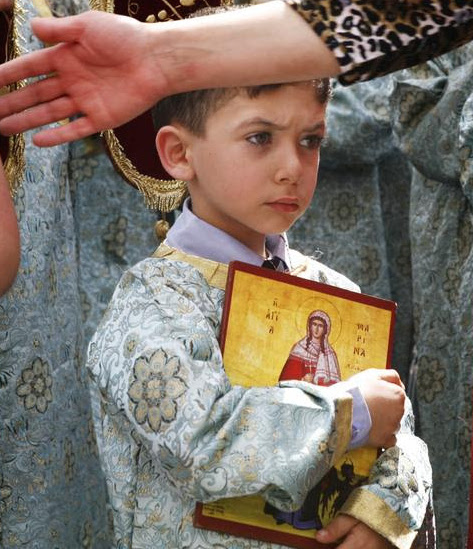
Ramallah Holy FireAl Jazeera covered the Holy Fire ceremonies in Ramallah Easter week-end.

(The picture here is that of a young Palestinian Christian boy who is shown watching the ceremony. It was taken in Ramallah for Al Jazeera by Silvia Boarini.)

Al Jazeera’s story of the Holy Fire ceremonies described the tradition:

Palestinians lined the streets of Ramallah to watch scouts (kashaf in Arabic) march in the traditional Sabt al-Nour parade on Sunday, marking the arrival of the Holy Fire from the Church of the Holy Sepulchre in Jerusalem.

According to Christian tradition, every year, on the day before Orthodox Easter, a flame lights itself at the site of Jesus’ burial. The fire is then transported from Jerusalem to Orthodox communities across Palestine, and around the world.

There are 50,000 Palestinian Christians living in the West Bank and Gaza. The festival serves as a celebration of Palestine’s rich history and national identity in the context of a protracted Israeli occupation and increased fragmentation of Palestinian land.

“The community is getting smaller and smaller,” Father George Awad of the Greek Orthodox Church of Jifna, told Al Jazeera. “Most families have a relative who emigrated to America or Australia. The situation is very difficult here. There are checkpoints and no jobs and it’s hard to care for your family.”

The Palestinian Liberation Organization (PLO) found that Palestinian Christians are increasingly unable to complete pilgrimage to Christian holy sites in Jerusalem during Easter or Christmas.

Israel occupied East Jerusalem in 1967 and unilaterally annexed it in 1980, declaring the city the undivided capital of the State of Israel. Palestinians’ entry to Jerusalem has since been regulated by a strict permit regime.

Israel reportedly issued 20,000 permits for Palestinian Christians to attend Easter festivities in Jerusalem this year. While Israel claims restrictions are implemented to guarantee public security and avoid overcrowding, it has been repeatedly criticised for not guaranteeing full Palestinian access to the city’s religious sites.

Does Obama want to be remembered as a president who allowed this tyranny to continue for eight years? Does he want to be remembered as the president that tolerated treatment of Palestinian children such as the boy above, who could not travel to Jerusalem to follow the movement of the Holy Fire?

Israel is the spoiled child of the American empire who has stolen the father’s keys and refuses to heed any advice to put the car back in the family garage.

No U.S. leader or mainstream commentator has the courage to tell him what he already knows but is unwilling to act upon.

The New Yorker adds its burial encouragement in a blog posting, What now for the Honest Broker?

From James Baker to Madeline Albright and now Kerry, senior U.S. diplomats have tried to present the United States as an “honest broker” between the two sides, interested only in the promotion of peaceful coexistence. About the only people who take this idea seriously are U.S. officials and commentators.

The United States isn’t, and can’t be, a neutral mediator in the Middle East. It has long acted as Israel’s closest ally, biggest benefactor, and ultimate guarantor of its security.

In an op-ed in the Times earlier this year, Avi Shlaim, the eminent Israeli historian who teaches at Oxford, pointed out some awkward realities:

The simple truth is that Israel wouldn’t be able to survive for very long without American support. Since 1949, America’s economic aid to Israel amounts to a staggering $118 billion and America continues to subsidize the Jewish state to the tune of $3 billion annually.

America is also Israel’s main arms supplier and the official guarantor of its “quantitative military edge” over all its Arab neighbors.…

In the diplomatic arena, Israel relies on America to shield it from the consequences of its habitual violations of international law.… America poses as an honest broker, but everywhere it is perceived as Israel’s lawyer.

The American-sponsored “peace process” since 1991 has been a charade: all process and no peace while providing Israel with just the cover it needs to pursue its illegal and aggressive colonial project on the West Bank.

In his book, Rashid Khalidi quotes William Quandt, “who dealt with this issue on the National Security Council staff during the 1970s.”

Quandt sums up the Palestinian dilemma in presidential decision-making: “the Palestinians had no domestic constituency”.

The religious communities in the U.S. are supposed to be the source of the nation’s conscience, the moral center that speaks for the voiceless.

Unfortunately, with some scattered exceptions, our religious communities are still trapped in their own self-imposed political prison, euphemistically referred to as “interfaith dialogue”.

Posted in Human Rights, Middle East, Middle East Politics, Movies, The Human Condition | 10 Comments

“I Once Was Blind . . . But Now I See”

by James M. Wallwilberforce_large

In a scene from the 2006 movie, Amazing Grace, set during the lifetime (1759 – 1833) of William Wilberforce (Ioan Gruffudd, right), Wilberforce presents his anti-slave trade bill to the  British Parliament.

It is a task he performs annually.

Wilberforce is following the advice of his former preacher, John Newton (played in the film by Albert Finney), author of the hymn, “Amazing Grace”, who tells him that sometimes change occurs only through steady drips.

The purpose of Wilberforce’s annual legislative “drip” is to eventually persuade the majority of the Parliament to make it illegal for British ships to transport slaves from Africa to the New World.

At a crucial turning point in the film, speaking to an indifferent body of law-makers, many of whom have financial ties to the shipping industry, Wilberforce begins his annual plea:

“It is with a heavy heart that I bring to the attention of this House a trade that degrades men to the level of brutes and insults the highest qualities of our human nature. I am speaking of the slave trade.”

Immediately he is greeted with shouts of disapproval. Wilberforce continues:

I know that many of my honorable friends in this House have investments in the Indies. Others are ship owners. And I believe them to be men of humanity. I believe you all to be men of humanity.

If the wretchedness of any one of the many hundreds of slaves stowed in their ships could be brought to view there is no one among you who could bear it.”

The bill fails. Wilberforce invites a few select members of the House to join him and a few  of his abolitionist supporters for a meeting at his home.

The response is slight. Only one other Member of Parliament (MP), shows up.

That man is Sir William Dolben, who represents a constituency which does not depend on the slave trade for its economic well-being.

Wilberforce thanks Dolben for his presence. He then asks him to explain what prompted his  decision to accept Wilberforce’s invitation.

Dolben tells the group “he recently took  passage from Sierra Leone aboard a slave ship”.

“What I saw during those 15 days (he pauses, unable to describe what he saw. Then he continues) “I believe there are plenty of others in the House of Commons who share your feelings, Wilberforce. They are just afraid to show it.”

Wilberforce knows it is time to do more than drip away at the problem.

“Perhaps we should begin this journey with the first step. We are talking about the truth. So we should hand it out to people. Drop it from the church roofs. Paint pictures of it. Write songs about it. Make bloody pies out of it. (he pauses, speaks more quietly, and starts again.) There is a slave ship at dock at Tilbury with twice the slave berths it is insured for. I know that for a fact. But how do we prove it.”

Wilberforce already has his answer. He will trick members of the House into a moment of revelation.

Sir William Dolben, not yet known as an ally in the anti-slave movement, charters a boat and invites a number of MPs, and their wives, for an afternoon boat ride with food,  drinks and music.  They are enjoying themselves, until their boat suddenly halts next to what they discover is a slave ship.

William Wilberforce appears on the ship’s deck and speaks to the surprised MPs and their wives. He informs them that this ship has just returned from the Indies after unloading 200 slaves, all of whom had been confined for three weeks below deck chained in boxes.

The journey began with 600 slaves, men, women and children. The remaining 400 died during the trip. Their bodies were tossed overboard.

The MPs and their wives, dressed in their finest, reached for their handkerchiefs. They had begun to smell odors from the slave ship.  Wilberforce tells them to remove their handkerchiefs from their faces. “Breath deep. What you smell is the smell of death”.

Reluctantly, they do so. Wilberforce’s strategy has worked.  Previously, far removed from the smell of the deaths the Parliament has funded and sanctioned for many decades, this particular group of MPs and their wives, encounter their existential moment of reality.

A two minute preview of Amazing Grace (below) captures the essence of the film, including a brief scene of Wilberforce’s meeting in the church with John Newton.

Wilberforce is fighting an evil that has been embedded in the British economy for centuries. Wikipedia explains:

“The British initially became involved in the slave trade during the 16th century. By 1783, the triangular route that took British-made goods to Africa to buy slaves, transported the enslaved to the West Indies, and then brought slave-grown products such as sugar, tobacco, and cotton to Britain, represented about 80 percent of Great Britain’s foreign income.

British ships dominated the trade, supplying French, Spanish, Dutch, Portuguese and British colonies, and in peak years carried forty thousand enslaved men, women and children across the Atlantic in the horrific conditions of the middle passage. Of the estimated 11 million Africans transported into slavery, about 1.4 million died during the voyage.”

Israel’s Zionist leaders have long been aware that if enough American voters smelled the death and suffering of the Palestinian occupation, Israel’s propaganda campaign to present itself as a victim, would collapse.

Like Sir William Dolben, Americans must travel on a 21st century slave ship. They must go to Gaza and the West Bank where they will hear, feel, and smell the brutality imposed on Palestinian families, who are locked in an occupation prison.

Israel’s Zionist leaders have always known they were riding into their carefully planned future on a weak platform of deception and lies. Their strategy was to disguise  this platform by pretending to be humane and willing to compromise.

The U.S. allies of these Zionist distorters have their own strategy. Take, for example, the recent comments by former South Carolina Senator Jim DeMint, now executive director of the conservative Heritage Foundation.

DeMint was interviewed by a right-wing conservative radio host. At one point he was asked about slavery.  His answer:

Well the reason that the slaves were eventually freed was the Constitution, it was like the conscience of the American people. Unfortunately there were some court decisions like Dred Scott and others that defined some people as property, but the Constitution kept calling us back to ‘all men are created equal and we have inalienable rights’ in the minds of God.  But a lot of the move to free the slaves came from the people, it did not come from the federal government. It came from a growing movement among the people, particularly people of faith, that this was wrong.

People like Wilberforce who persisted for years because of his faith and because of his love for people. So no liberal is going to win a debate that big government freed the slaves. In fact, it was Abraham Lincoln, the very first Republican, who took this on as a cause and a lot of it was based on a love in his heart that comes from God.

A former U.S. senator, DeMint appears to have a rather limited view of the legislative process. He also appears to know very little about Wilberforce, other than the fact that he was an evangelical Christian who worked against slavery.

Of course, Wilberforce’s arena was the British parliament, not the U.S. Congress. Wilberforce died in 1833, thirty years before slavery ended in the U.S.

Most U.S.  Zionist leaders are no doubt better informed on British history, and perhaps DeMint also knows that Wilberforce was British, not American. But the need to keep things simple appears to have led DeMint astray.

In Israel itself, Zionist leaders also rely on their ability to reshape history to their own purposes. They have long been devoted to shaping the historical narrative of the creation of the modern state of Israel.

To accomplish this  they have twisted and distorted their own biblical narrative for their own modern political ends.

To build a modern state that is exclusively Jewish, these Zionists have been guilty of falsifying doctrine. Creating a nation from scratch was a challenge even larger than one faced by the British shipping industry. In both cases, deception was paramount.

No single individual ended the slave trade, nor, for that matter, ended slavery in the U.S.  The right thing to do was forced upon the British and the Americans through the legislative process.

William Wilberforce finally achieved his goal.  Before the final vote on the British slave trade act, William Wilberforce visited his old preacher, John Newton, the former slave ship captain, who has been tormented by his memories of “20,000 ghosts” of slaves he took to their deaths.

At this point in his life, and in Amazing Grace, Newton is totally blind. In the film, he greets his former parishioner with the cry, “I once was blind, but now I see”.

He asks Wilberforce, “did I write that?”. Wilberforce answers quietly, “yes, you did”.

Freed from his years of torment after having finally been able to dictate his memoirs, what he refers to as his “confession”, Newton cries out to Wilberforce, “Now it is true!”

Wilberforce was the political leader of the abolitionist movement.  What he accomplished, however, he did not do alone.

He was supported in his legislative struggles by a team of abolitionists, which included his wife, Barbara Spooner, two clergymen, John Ramsay and Thomas Clarkson, and of course,  his”old preacher”,  John Newton, who was his initial spiritual guide.

Another key member of the Wilberforce team was a former African slave, Olaudah Equiano, who wrote a book of his life during, and after, his enslavement.

With Wilberforce’s dogged legislative leadership, and the joint educational and activist efforts of the abolitionists, the British Parliament finally outlawed the slave trade, in 1807.

In the final year of Wilberforce’s life, 1833, the Parliament outlawed slavery in all of its forms throughout the British empire.

Wilberforce’s close political ally, Prime Minister William Pitt, known as “the younger”, played a significant role in ending the slave trade. Pitt, the youngest man ever to become a British prime minister at age 24, died in 1806.

Pitt and Wilberforce are interred, side by side, in London’s Westminster Abbey. They understood that each had a role to play in the game of politics. At one point in the film, Amazing Grace, Wilberforce asks for advice from his friend and now prime minister.

Pitt responds: “As your prime minuter, I urge caution”.  Wilberforce then asks, “what about as my friend?”  Pitt’s response, “Oh, to hell with caution.”

Thus far, there is little evidence of a Wilberforce or a Pitt in the U.S. Congress who both understands the imperative of ending the Palestinian occupation, and who has the courage and the political sagacity to lead a Wilberforce-like struggle to make it happen.

That leadership is required, because, as Sir William Dolben said to Wilberforce, “There are plenty of others in the House of Commons who share your feelings, Wilberforce. They are just afraid to show it.”

Posted in -Movies and politics, -Movies and Religion, Middle East Politics, Movies | 4 Comments