What Ike Feared “Has Come Upon Us”

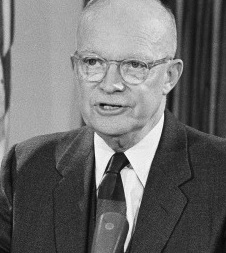
by James M. WallPresident Dwight D. Eisenhower is shown during his farewell television address to the nation made from the White House in Washington, Jan. 18, 1961.  (AP Photo/Bill Allen)

On February 3, Illinois Sixth District Republican Congressman Peter Roskam introduced a bill in the U.S. Congress that would defend Israel against any criticism from U.S. academics.

Roskam is responding to the December, 2013 vote of the American Studies Association (ASA) to boycott Israeli academic institutions for their role in the illegal Israeli occupation of the West Bank and Gaza.

The American people were told this day would come. In his Farewell Address, delivered on January 17, 1961, U.S. President Dwight Eisenhower (above) warned the nation to guard against the “unwarranted influence” of “the military-industrial complex”.

Fifty-three years later, to paraphrase Job, “that which Ike feared has come upon us.”

Melvin A. Goodman, a 24-year veteran of the CIA, and now a professor himself, was an undergraduate student at John Hopkins University in 1961. In his book, National Insecurity: The Cost of American Militarism, Goodman writes:

“In 1959 President Dwight Eisenhower began a dialogue with his brother, Milton, the president of Johns Hopkins University, regarding U.S. military policy. In the spring of 1961, a small group of undergraduates met with Milton Eisenhower to discuss the president’s farewell address.

Eisenhower informed us that he and a John Hopkins professor of political science , Michael Moos, played major roles in the drafting and editing of the farewell speech of January 1961″.

Milton Eisenhower explained that one of the drafts of the speech referred to the ‘military-industrial-congressional complex’, with the president himself inserting the reference to the role of Congress, When the farewell address was given, the reference to Congress did not appear. (p 31)

Milton asked his brother why he had not included his specific reference to the Congress. Eisenhower responded: “It was more than enough to take on the military and private industry  I couldn’t take on the Congress as well.”

This is the key sentence in Eisenhower’s address: “In the councils of government, we must guard against the acquisition of unwarranted influence, whether sought or unsought, by the military-industrial complex. The potential for the disastrous rise of misplaced power exists and will persist.” 

That misplaced” power takes many forms. The bill Congressman Roskam presented to the Congress is a direct attack on the freedom of speech. The bill proposes to “amend the Higher Education Act of 1965 to prohibit an institution that participates in a boycott of Israeli academic institutions or scholars from being eligible for certain funds under that Act”.

Roskam calls his bill the “Protect Academic Freedom Act”, an oxymoronic title which contradicts itself by making it illegal for members of the academic community to exercise their academic freedom.

Gerald_Kaufman.c jpgIn contrast to Congressman Roskam’s subservience to Israel’s demands, a Jewish Member of England’s Parliament, Sir Gerald Kaufman (left), told the Parliament, “we must impose sanctions”. On February 5, Kaufman spoke during a debate in the British Parliament on the humanitarian situation in Gaza.

“I once led a delegation of 60 parliamentarians from 13 European parliaments to Gaza. I could no longer do that today because Gaza is practically inaccessible. The Israelis try to lay the responsibility on the Egyptians, but although the Egyptians’ closing of the tunnels has caused great hardship, it is the Israelis who have imposed the blockade and are the occupying power.

The culpability of the Israelis was demonstrated in the report to the UN by Richard Goldstone following Operation Cast Lead. After his report, he was harassed by Jewish organizations. At the end of a meeting I had with him in New York, his wife said to me, “It is good to meet another self-hating Jew.”

“Again and again, Israel seeks to justify the vile injustices that it imposes on the people of Gaza and the West Bank on the grounds of the holocaust. Last week, we commemorated the holocaust; 1.7 million Palestinians in Gaza are being penalized with that as the justification. That is unacceptable.”

Roskam’s bill was routinely referred to a committee, where it will no doubt linger long enough to gather the usual Zionist loyalists to add their names to the bill and curry favor with the likes of AIPAC. Chances of passage are nil. Proposed bills like this one are not meant to be; they are meant to send a message.

Ali Abunimah reports that Congressman Roskam got the idea for his bill/message from Israel’s former ambassador to the United States, Michael Oren, who made the suggestion a few weeks ago.

Former Ambassador Oren was once a U.S. citizen, a designation he gave up to become an Israeli citizen, a requirement for him to become an Israeli ambassador.

The symbiotic relationship between the U.S. and Israel is especially close in diplomatic interaction between the two nations.

Martin Indyk, for example, John Kerry’s current mediator in peace talks between Israel and Palestine, was born to Jewish parents in England. He was raised and educated in Australia before he moved to the U.S. and became a citizen. Subsequently he was named U.S. ambassador to Israel. Today he never leaves Kerry’s side as they struggle through the negotiations morass.

Making Kerry’s job more difficult, the U.S. Congress provides legislative support for Israel whenever Israel and its American lobbyists determine it is needed. After the ASA December vote, the Israel Lobby wanted action.

Prodded by Ambassador Oren, Congressman Roskam rushed to Israel’s rescue. The bill proposed by Roskam “would deny federal funding to any institution that participates in a boycott of Israeli universities or scholars or even whose departments issue statements in support of a boycott”.

This is how all encompassing the sanctions bill would be:

The proposed law defines “an institution of higher education to be participating in a boycott” if “the institution, any significant part of the institution, or any organization significantly funded by the institution adopts a policy or resolution, issues a statement, or otherwise formally establishes the restriction of discourse, cooperation, exchange, or any other involvement with academic institutions or scholars on the basis of the connection of such institutions or such scholars to the state of Israel.”

Meanwhile, as Congress defends Israel at every opportunity, the Boycott, Divestment, Sanctions (BDS) movement is gaining momentum, especially in Europe. The British Economist reported this week that BDS is turning “mainstream”, reaching into power circles that were once assumed to be immune to boycott pressure.

Financial institutions and some national governments are moving toward the BDS position.  The Economist reports:

Some European pension funds have withdrawn investments; some large corporations have cancelled contracts.  .  . BDS has begun to grab the attention of some of the world’s largest financial institutions. PGGM, a big Dutch pension fund, has liquidated its holdings in five Israeli banks (though the Netherlands’ largest has affirmed its investments). Norway’s finance ministry has announced that it is excluding Africa Israel Investments and its subsidiary, Danya Cebus, a big building firm, from a government pension fund.

.  .  .  Romania has forbidden its citizens from working for companies in the West Bank. More churches are backing BDS. An American academic association is boycotting Israeli lecturers. The debate turned viral after Scarlett Johansson, a Hollywood actor, quit her role as ambassador for Oxfam, a charity based in Britain, in order to keep her advertising contract with SodaStream.

Throughout his book, Goodman adds “congressional” to the “military-industrial-complex”, an acknowledgement that President Eisenhower had initially had “congressional” in his thinking.

The former president was very much aware of legislative power in the “military-industrial” complex. He knew this from his own experience as Supreme Commander of the Allied forces in the invasion of Europe in World War II, and of his dealings with Congress during his eight years in office as president.  

The following video of Congressman Roskam illustrates the influence of the “military-industrial-congressional” complex on the U.S. government.

Addressing Roskam’s proposed bill, noted First Amendment lawyer, Floyd Abrams told Buzz Feed, “The notion that the power to fund colleges and their faculties may be transformed into a tool to punish them for engaging in constitutionally protected expression is contrary to any notion of academic freedom and to core First Amendment principles.”

This is precisely what President Eisenhower warned us against.

The picture at top of President Eisenhower speaking from the Oval Office on January 17, 1961, is from the Associated Press.

Posted in Media, Middle East, Religious Faith | 8 Comments

Super Bowl Ad Pits BDS Against SodaStream

by James M. WallScarlett-Johansson_Black-Widow-Capt  ain-America-2-Poster-crop

A television ad which ran during the fourth quarter of the Denver Broncos-Seattle Seahawks Super Bowl game Sunday, featured Hollywood film star Scarlett Johansson (shown here in a poster picture).

The ad, for which the company SodaStream, paid $4 million, features Johansson as a sexy, convincing sales person for SodaStream’s home carbonation product.

Johansson should be easily recognized in the TV ad by younger viewers who would know her from her featured role in the movie series, The Avengers. In that series Johansson plays the Black Widow, one of several Marvel Comic characters who fight evil powers as a team.

The picture of Johansson is from a poster for the yet to be released Captain America: The Winter Soldier, in which she plays the Black Widow. That picture will be in theaters, April 4.

Johansson has been in many other films, most recently as the off-screen voice of Samantha, the computer-generated “her” in the film Her. In that film, the unseen Samantha establishes a love relationship with a lonely man played by Joaquin Phoenix. The film is set in the future when computers, supposedly, have developed human emotions.

A more recent Johansson film, Under the Skin. premiered in 2013 at the Toronto Film Festival. It will be released to theaters later this year. Two more Black Widow films will be released over the next two years.

The Black Widow, that is, Scarlett Johansson, is also engaged in a real life fight, now being fought largely out of sight of the average Super Bowl viewer.

That fight is being waged in a BDS (Boycott, Divestment, Sanctions) campaign against SodaStream, an Israeli company that operates one of its factories in the occupied Palestinian West Bank. BDS is gathering steam as an effective, non-violent program designed to call world attention to business and companies that illegally operate in Occupied Palestine.

SodaStream is no mom and pop operation eager to be of service to Palestinians who need jobs.  It is a worldwide profit-oriented corporation, described by Wikipedia as “the maker of a consumer home carbonation product based on the principles of making a carbonated drink.”

Wikipedia explains further: “The device, like a soda syphon, carbonates water by adding carbon dioxide from a pressurized cylinder to create soda water (or carbonated water) to drink. The company also sells more than 100 different types of concentrated syrups and flavourings to make carbonated drinks”.

SodaStream went public on the Nasdaq stock exchange in November 2010. The company is headquartered just outside Tel Aviv. It currently has 13 production plants. Its principal manufacturing facility is located in the long established and still illegal, under international law, settlement of Ma’ale Adumim, the sprawling settlement located along the highway from Jerusalem to Jericho.

Why Ma’ale Adumim? The answer is easy if you think for a moment like a corporate executive responsible to stock holders. Such an executive would figure out that a new plant in an area close to Israel with a labor force desperate for jobs and willing to work for limited wages is a profit-maker. Not only that, but the labor force, so desperate for work, is also living under Israeli military occupation.

And there is more: The work pool in the villages surrounding the exclusively Jewish population of Ma’ale Adumim is all Palestinian, where there are workers who are in no position to bother SodaStream with talk of things like unions, higher wages and better working conditions.

The BDS campaign against SodaStream is only one of many such campaigns conducted by supporters of the BDS movement. SodaStream is operating a plant in an Israeli occupied Palestinian area which, while it may profit the stock holders, still projects an ugly image to outsiders. To clean up that image, SodaStream hired a public relations team to respond to the BDS pressure.

SodaStream looked around for an established, yet still young, movie star to change the subject away from unpleasant topics like occupation and Palestinian exploitation.. SodaStream’s public relations team settled on Hollywood film star Scarlett Johansson, who it just so happened, was already serving as the public face of the British-based non-profit international aid organization, Oxfam.

Johansson agreed to add SodaStream to her portfolio.

Was she aware of the BDS campaign against SodaStream? You may bet your retirement bonus that her public relations handlers were very much aware of that campaign. Did they tell this to Johansson? You know PR people don’t work like that. Maybe the PR people had other ways to persuade Johansson that it was in her best interest to take the job, or maybe Johansson really believes what her press release said, that she wants to foster better Israeli-Palestinian relations.  Only Johansson knows.

She could have stayed with Oxfam. Her movie career is picking up; she has two more Black Widow Avengers films in the works. Her role as the voice of Samantha in the film Her, has been nominated for an Academy Award. 

Instead, Johansson not only took the SodaStream gig, she soon withdrew from Oxfam.

What led her to take this action? It was a subjective personal decision by a movie star with decades of film-making ahead of her. Johansson is not yet established as a movie star with enough power to reject a gig that, we may assume she assumes, benefits Israel.

After all, she works in Hollywood, the movie-making capital of the world, which is well-known as a center of pro-Israel sentiment. It is also known as a place where politicians like Barack Obama go to raise money from leaders of the film community, who are not known as BDS types.

Hollywood is also a place where the film press can be unforgiving for stars who do not play the game as it is expected to be played.  Notice how the Hollywood Reporter tells its readers how quickly Johansson developed an intense devotion to SodaStream. Notice especially the use of the Hollywood adjective, “beloved”.

When it comes to our love affairs with modern-day conveniences, Scarlett Johansson’s devotion to her beloved SodaStream rivals even that of Her‘s Theodore Twombly to, well, her. But it’s unlikely that the star anticipated quite what she was getting into when she signed on as that company’s first spokeswoman and agreed to star in a TV ad that will air on Sunday’s Super Bowl.

The seltzer appliance company is headquartered in Israel, with its biggest manufacturing plant located in the West Bank settlement of Mishor Adumim — a territory seized by Israel in 1967’s Six-Day War that Palestinians lay claim to. Critics of Israel have for years demanded a boycott of the company, and those calls have grown louder than ever in the days leading up to the commercial’s TV debut.

The Hollywood Reporter also gave some attention to a statement issued in Johansson’s name. Public relations people do not ask stars to issue statements; they know it is best for her image for them to control such statements.

Which is why last Friday, according to the Reporter, the public heard that Johansson “issued a statement in response to the mounting criticism, saying, “I remain a supporter of economic cooperation and social interaction between a democratic Israel and Palestine. SodaStream is a company that is not only committed to the environment but to building a bridge to peace between Israel and Palestine, supporting neighbors working alongside each other, receiving equal pay, equal benefits and equal rights.”

The Hollywood Reporter also, to its credit, reported from an Oxfam media release which states, “While Oxfam respects the independence of our ambassadors, Ms. Johansson’s role promoting the company is incompatible with her role as an Oxfam Global Ambassador.”

Movie stars do not normally get on the wrong side of the conservative media, where the point of view on the Middle East is demonstrated in the coverage of Johansson’s decision to jump from Oxfam to SodaStream, an Israeli-based profit-making international corporation.

Under the headline: “SodaStream ignores anti-Israeli critics to quench Palestinian thirst for jobs”, Fox news reporter Paul Alster gave the SodaStream version of its differences with BDS.  Alster makes the case for Ma’ale Adumim as a SoftStream job creator center for Palestinians in need of steady work

Haifa, Israel – Jews and Palestinians might think an Israeli company providing hundreds of jobs in Palestinian territory is a way to promote peace and prosperity, but some international groups think they know better.

SodaStream, the company whose home-based soda-making machines have become an American sensation, is under pressure to close down a factory in the West Bank, where more than 500 Palestinians work, reportedly earning up to 10 times the area’s prevailing wage. The campaign has reached a fever pitch, after Hollywood star Scarlett Johansson ended her alliance with an international aid group miffed that she would endorse the company.

But the boss of SodaStream said he’s not going anywhere just because some global critics want him out.

“We will not throw our employees under the bus to promote anyone’s political agenda,” SodaStream CEO Daniel Birnbaum told the Jewish Daily Forward. “[I] just can’t see how it would help the cause of the Palestinians if we fired them.”

Birnbaum said Palestinians and Jews work in complete harmony at his plant, which has a mosque on the premises, allowing workers to meet for prayers during their shifts. Those lucky enough to land jobs with the company are the envy of neighbors who labor for less, or can’t find work at all. 

Fox News ended by including an Oxfam statement:

Oxfam believes that businesses, such as SodaStream, that operate in settlements further the ongoing poverty and denial of rights of the Palestinian communities that we work to support,” the charity explained in an official statement. “Oxfam is opposed to all trade from Israeli settlements, which are illegal under international law.”

Faced with the choice, Johansson sided with SodaStream, and not Oxfam, which has a well-publicized relationship with SodaStream rival Coca-Cola. Johansson said SodaStream is doing more than its share to promote peace and create jobs in the West Bank.

Morning television talk shows prefer to ignore the BDS campaign. Here is how ABC treated the SodaStream ad which aired during the Super Bowl.  It is the “happy news” approach that gives Johansson a comfort cover which she might not have received had she rejected SodaStream and stuck with Oxfam.

As you view the following video keep in mind, this is the world in which Johansson lives and works.

Juan Cole, writing on his blog, Informed Opinion, sums up all the things Johansson’s PR people and no doubt, her agent, did not want her to know:.

The determination of the Likud Party to annex the Palestinian West Bank is damaging the interests of world Jewry. This harm is clearly visible in the controversy that has engulfed movie star Scarlett Johansson, who was a global ambassador for the Oxfam charity and who also agreed to become a spokesperson for the Israeli company Sodastream, which has a factory in the Occupied West Bank. She will star in a Superbowl commercial for the company.

Oxfam points out that the Israeli occupation of the Palestinian West Bank is illegal, and it is opposed to trade with settler commercial enterprises based there. The Sodastream factory in set in a 40,000-strong Israeli squatter settlement designed to cut East Jerusalem off from the West Bank and make a Palestinian state impossible. Israel squatters divert most of the West Bank’s water and other resources to themselves, leaving Palestinians impoverished.
In the end, Ms. Johansson had to choose between the two, and she gave up her association with Oxfam.

What would you have done if you had never heard what Juan Cole has written? If your movie career, at age 29, depended on playing the game the way your PR people told you to play it, what would you have done? In other words, to quote a biblical source, “she who is without sin, let her cast the first stone”.

Posted in Middle East, Middle East Politics | 6 Comments

Village Destruction in the Jordan Valley

by James M. WallKhirbet Makhoul, Jordan Valley, West Bank, 09.10.2013

British journalist and author Victoria Brittain traveled to the Jordan Valley to see the actual conditions and latest developments in one of the areas under discussion in the peace negotiations John Kerry is conducting between Israel and the Palestinian Authority.

A people under military occupation, prisoners in their own land, controlled by outside forces, live in the area in which Victoria Brittain traveled.

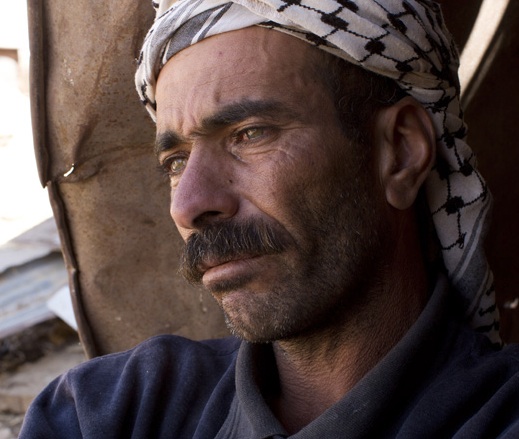
She later wrote of her mid-January trip and the people she met in Open Democracy. One man she interviewed was Burhan Bisharat (above), whose home in the village of Kirbet al Makhoul has been destroyed four times.

Brittain began her trip northeast of the Palestinian city of Nablus, traveling along a road toward the northern Jordan Valley and the international border with the country of Jordan. The area through which she traveled contains rocky brown hills, riddled with what she describes as “concrete posts every hundred yards inscribed ‘DANGER’ Firing Zone”.

Her journey covered one part of Area C, designated as land under Israeli total control under an earlier agreement reached under President Bill Clinton known as Oslo 2. One particular part of Area C in which Brittain traveled is described on UN maps with the occupier’s euphemism, “Israel’s Nature Reserve”. Much of the area map is shaded with the equally euphemistic identification, “an Israeli closed military area”.

In her trip report, entitled The Fourth Destruction: Stolen Land and Childhood, she writes:

Every few miles there are tents or simple structures of Palestinian farms with sheep and cows in makeshift pens visible, set back below the hills. In recent weeks and months defenseless families in this remote place have had their homes and farms repeatedly destroyed by military bulldozers in dawn raids.

Traumatised barefoot children, silent exhausted mothers, desperate fathers, now living in new shelters, spoke of their every-present fear of army and settler violence.

Main stream media reports on the Kerry negotiations do not include references to Area C, nor are there any references to the suffering of Palestinians under occupation. Instead, the MSM focuses almost exclusively on Israeli demands which shift as often as a carnival con man shifts his three cups under which he claims he has hidden a pea.

You know the game: At the con man’s invitation, the sucker chooses one of the three cups. The sucker bets on which cup contains the pea. He or she, always loses because the cups and pea are under the control of the fast moving hands of the con man.

Who are the suckers in the current peace negotiations? Start with the American government and travel down the chain of command to the American tax payer. U.S. tax money floods annually into Israeli coffers. Your tax dollar at work, busily destroying villages in the Jordan Valley.

In this current game of cups and the pea, also called peace negotiations, Israel had introduced two new, never before included in negotiations, demands.

The two new Israeli demands are, first, the Palestinians must acknowledge Israel as a “Jewish State”, in spite of the obvious fact that a large minority of citizens in any “Jewish State” would be non-Jewish.

The Washington Post pushes the “security claim”.

The Israelis are insisting that their troops remain in the Jordan Valley corridor in any future Palestinian entity, and since this demand is new — and was not a core issue in the last serious negotiations in 2000 and 2007 — it represents a real test for the Obama team’s diplomatic ingenuity.

The second new Israeli demand is the retention of a large chunk of the Jordan River Valley, a “necessity” for Israel’s “security”. The land Israel claims to need for its “security” expands with each new move of the negotiation cups.

In her Open Democracy report, Victoria Brittain (right), a former associate foreign editor of the Guardian, describes conditions that now prevail in the Jordan Valley’s Area C:c Victoria Brittain

In Area C construction is prohibited, no water or electricity connection allowed, schools and water pumps put up by aid agencies are destroyed, health care is almost absent. Israeli settlements, outposts and military bases proliferate. Five thousand Palestinians live in 38 communities in parts of Area C, like these designated as “firing zones” for military training.”

Burhan Bisharat’s village of Kirbet al Makhoul was destroyed four times in two weeks in late September last year. With no warning or demolition notices the bulldozers drove up the dirt road before dawn and brought down tin homes, hay sheds, animal pens, water troughs and a playground with swings belonging to the twelve families.

Today Bisharat, his wife, and youngest daughter, are visibly traumatised and he spoke softly of how the psychological pressure, especially of the fourth destruction [of his home], was very, very difficult for him. He saw relief tents brought by the ICRC put up and immediately brought down by a bulldozer in front of the aid agency staff.

[The picture at the top shows Bisharat sitting in his ruined home. It was taken in October, 2013]

The three now live in another almost empty replacement home half the size of what they had before and which Burhan built himself in two days, bringing an aluminium roof from Nablus. But every day is lived under the shadow of another onslaught that they know can hit their lives any time.

This is a father who took the very difficult decision to send his seven older girls to live a few miles away in a small town where they go to school. His oldest daughter is 17 and in the twelfth grade and is in charge of the little household of children.

“I want my children to have a better life through education…it is best to keep them away, though it is very tough for them to be alone, and (with a gesture to his silent wife) for their mother.” Burhan is only 38, but the harshness of his life has made him look and seem a generation older.”

Israel repeatedly, and illegally, destroys the Basharat home because Israel wants to clear the land for what it wants as a future Israeli state. This repeated action takes place at the time when negotiators are discussing the future “ownership” of the land.

Palestinian right to this land is not in dispute; it is land that is illegally occupied by Israel. Furthermore, the mistreatment of Palestinians like Basharat and his family is illegal.  In a world where justice has meaning, such mistreatment is considered to be a crime.

Who are the guilty parties in this crime? Israel, of course, but Israel is aided and abetted by every U.S. President and Congress and  every American tax payer who elects pro-Israel governments. We are all guilty because we tolerate or encourage the permanent  intimidation of our public officials by Israel and its American allies.

There was a time when a few major U.S. political leaders spoke against that intimidation.

In his new book, The Brothers, Stephen Kinzer offers a remarkably candid quote from one of the brothers in his book, John Foster Dulles, then the U.S. Secretary of State in the Eisenhower administration. Israel took advantage of the Suez Crisis in 1956-57, sending its army across the Sinai Desert toward the Egyptian border. Dulles angrily insistsx that Israel withdraw.

In response, Dulles used words no recent Secretary of State would dare use:

“I am aware how almost impossible it is in this country to carry out a foreign policy not approved by the Jews. . . . The Israeli embassy is practically dictating to the Congress through influential Jewish people in this country.” (p. 244).

Kinzer does not offer a source for this quote, so before using it, I checked Google, which promptly led me to the ever-valuable and always reliable Washington Report on Middle East Affairs (WRMEA). I found a report published in WRMEA’s February/March 1996 issue.

Donald Neff cThe writer was Donald Neff, (at left) who worked for Time magazine for 15 years. From 1975 to 1978, Neff was Time’s Jerusalem bureau chief. After leaving Time, Neff wrote extensively on the Middle East for magazines like WRMEA. He also wrote a Middle East war trilogy, Warriors Against Israel, Warriors for Jerusalem, and Warriors at Suez.

A collection of his WRMEA columns is available in another book, 50 Years of Israel. His WRMEA report from February/March 1996, looked back at a significant moment in history. It includes the Dulles quote, and a good deal more.

Donald Neff wrote about the Israeli-Palestinian situation with a veteran journalist’s passionate need to tell the full story. It was headed, Ike Forces Israel to End Occupation After Sinai Crisis. It begins:

It was 29 years ago, on March 16, 1957, that Israel withdrew under unrelenting U.S. pressure from all the territory it had occupied in the Sinai peninsula during its invasion of Egypt less than five months earlier. As Israeli forces pulled out, they ignored pleas from U.N. Secretary-General Dag Hammarskjold and displayed their contempt for U.S. President Dwight D. Eisenhower’s policy by systematically destroying all surfaced roads, railway tracks and telephone lines. All buildings in the tiny villages of Abu Ageila and El Quseima were destroyed, as were the military buildings around El Arish.

Israel’s dogged insistence on keeping by military occupation parts of the Sinai had led to increasingly tense relations between Eisenhower and Israeli Prime Minister David Bed-Gurion. From the very beginning of what became known as the Suez crisis, Eisenhower had forcefully opposed the secret plot by Britain, France and Israel to invade Egypt. Against great political pressures, Ike had managed to stop the ill-considered invasion – but not before Israeli troops grabbed Egypt’s Sinai Peninsula in a lightning surprise attack starting Oct. 29, 1956.

Britain and France followed Eisenhower’s firm advice and quickly removed their troops from Egypt. But Israel insisted on retaining parts of the peninsula. Despite repeated U.S. urgings, Ben-Gurion refused to withdraw Israeli troops. In retaliation, Eisenhower joined with 75 other nations in the U.N. General Assembly in passing a resolution on Feb. 2, 1957, “Deploring” Israel’s occupation. Only two nations opposed: France and Israel.

Still, Ben-Gurion refused to move his troops. On Feb. 11, Eisenhower sent a forceful note to Ben-Gurion to withdraw. Again Ben-Gurion refused. At the same time, the influence of Israel’s supporters became intense. The White House was besieged by efforts to halt its pressure on the Jewish state; 41 Republican and 75 Democratic congressmen signed a letter urging support for Israel.

In reaction to mounting pressures against his policy, Eisenhower on Feb. 20 called a meeting of the congressional leadership to seek their support for his position. But the lawmakers, sensitive to the influence of the Israeli lobby, refused to help, causing Secretary of State John Foster Dulles to complain to a friend.

“I am aware how almost impossible it is in this country to carry out a foreign policy [in the Middle East] not approved by Jews.” In other conversations around the same time, Dulles remarked on the “terrific control the Jews have over the news media and the barrage which the Jews have built up on congressmen…I am very much concerned over the fact that the Jewish influence here is completely dominating the scene and making it almost impossible to get Congress to do anything they don’t approve of. The Israeli Embassy is practically dictating to the Congress through influential Jewish people in the country.”

Disgusted with Congress’s timidity, Eisenhower boldly decided to take his case directly to the American people. He went on national television on the evening of Feb. 20 and explained:

“Should a nation which attacks and occupies foreign territory in the face of United Nations disapproval be allowed to impose conditions on its own withdrawal? If we agree that armed attack can properly achieve the purposes of the assailant, then I fear we will have turned back the clock of international order.”

Ike’s concluding paragraph asks a question that demands to be heard again as negotiations continue over Israel’s withdrawal from occupied territory.

The picture (at top) of Burhan Basharat, is from Activestills.org.

Posted in Human Rights, John Kerry, Middle East, Middle East Politics, United Nations, US govermemt | 7 Comments

16 Dem Senators Join AIPAC Against Iran Deal; Feinstein and TV’s Chris Hayes Support Obama

by James M. Wall

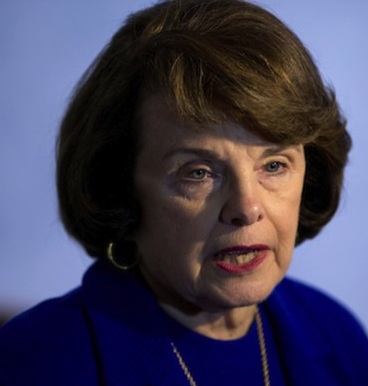
C Dianne Feinsein (D-CA) AP:Evan VucciSixteen Democratic U.S. Senators, including two with higher political aspirations, have joined Republican senators as co-sponsors of Senate legislation which might better be described as “the kill the Iranian nuclear pact” legislation.

The legislation was presented to the Senate by Senators Mark Kirk (R-IL) and Robert Menendez (D-NJ), major AIPAC Senate leaders for their respective political parties..

The Senate bill, labeled the Nuclear Weapon Free Iran Act. would impose additional sanctions against Iran, thereby destroying the carefully negotiated nuclear pact Secretary of State John Kerry has worked out with Iran.

On January 15,  Chris Hayes devoted a segment of his MSNBC All In television program to a heated attack on the 16 Democratic senators who have turned away from President Obama and followed, instead, the marching orders of the Israel Lobby, led by AIPAC.

To view Hayes’ four minute segment on the 16 Democratic senators who follow AIPAC’s bidding, click here(Not counting the ad, sorry about that, stop the video after 4:03 minutes unless you want to hear more about New Jersey Governor Chris Christie, and who needs more of that.)

Hayes is not alone in opposing “the kill the Iranian nuclear pact” Senate legislation. He provides media backing to California Democratic Senator Dianne Feinstein, (above left) who spoke on the Senate floor against the Kirk-Menendez legislation.

Senate Intelligence Committee Chairwoman Dianne Feinstein faced criticism Wednesday for comments that some thought implied a new Iran sanctions bill could put Israel in charge of U.S. foreign policy.

Feinstein objected to moving forward on a new Iran sanctions bill sponsored by 59 senators, including 16 Democrats, and co-authored by Sen Robert Menendez (D-NJ) and Mark Kirk (R-IL). The California senator said the bill could imperil ongoing negotiations between Iran and the West, harm U.S. diplomatic credibility, break up the current international sanctions coalition, and allow Tehran to argue “we are interested in regime change.”

“Candidly, in my view, it is a march toward war,” she said, echoing the White House argument that senators who support the Iran sanctions bill have a secret pro-war agenda.

Feinstein took direct aim at a provision in the new bill that states, “If the Government of Israel is compelled to take military action in legitimate self-defense against Iran’s nuclear weapon program, the United States Government should stand with Israel and provide, in accordance with the law of the United States and the constitutional responsibility of Congress to authorize the use of military force, diplomatic, military, and economic support to the Government of Israel in its defense of its territory, people, and existence” Feinstein worried that this language might hamstring American foreign policy decision makers as a result.

“While I recognize and share Israel’s concern, we cannot let Israel determine when and where the United States goes to war,” she said.

Senator_Gillibrand_Economic_Summit_2011-10-17_08-57-30_IMG_4359_-_AbdulSmith_2011Two of the sixteen Democrats supporting Kirk-Menendez, Senators Cory Booker, of New Jersey (right), and Kirsten Gillibrand, of New York (left), are widely assumed to be eyeing White House futures.Booker c

In his MSNBC segment, Hayes recalls the recent history of two veteran Democratic senators who cast votes in the Senate in favor of invading Iraq. The two, Hillary Clinton and John Kerry, must cringe today when they see themselves in the Hayes report. Both have done well in their post-senatorial careers, but so far, no White House.

Booker and Gillibrand are in safe Democratic states, so their need for AIPAC’s largess and muscle is not as crucial as it could be for their 14 pro-AIPAC fellow Democrats, most of whom are in states that lean toward the Republican political brand.

A New York Times report on January 13, set the stage for the Obama-Senate struggle:

With the United States and Iran about to embark on a critical phase of nuclear talks, President Obama is waging an intense rear-guard action to prevent Senate Democrats from supporting strict new sanctions that could upend his diplomatic efforts.

Sponsors of the bill, which would aim to drive Iran’s oil exports down to zero, have secured the backing of 59 senators, putting them within striking distance of a two-thirds majority that could override Mr. Obama’s threatened veto. Republicans overwhelmingly support the bill. So far 16 Democrats have broken with the president, and the bill’s sponsors hope to get more.

The Booker-Gillibrand duo can no doubt anticipate long careers in the senate. They present themselves as Progressive Democrats. Their early media coverage supports this belief.

Here, both from the Huffington Post, are two earlier glowing reports on Booker and Gillibrand. First, Booker:

Booker, the 44-year-old Democratic former mayor of Newark, N.J., came into Congress as a rare freshman senator with celebrity status. He has been dubbed a rock star mayor by Oprah Winfrey, been called a hero for pulling a neighbor out of her burning home in 2012 and hobnobbed with Matt Damon.

And here is a Gillibrand press clip:

New York Senator Kirsten Gillibrand is a smart, hardworking passionate public servant, who is focused on the difficult economic challenges that are facing New York and the country. Since joining the U.S. Senate, Kirsten has helped expand health insurance for millions of uninsured children, stood with President Obama to ensure America’s economic recovery, and secured billions of dollars to create jobs in New York and make sure New York taxpayers get their fair share.

This move to stand with AIPAC and Israel in a matter of foreign policy, has turned Progressives against both Booker and Gillibrand. The New Republic is not happy with Booker’s position on Kirk-Menendez.

The bill’s supporters insist that they’re simply trying to improve the U.S. negotiating posture. On Twitter, Booker insisted that he favors a peaceful solution, adding, “I’m 4 additional sanctions if current negotiations fail 2 start or fail 2 work.”

A senior Democratic aide told Joshua Hersh and Ryan Grim, “The goal isn’t to disrupt things, it’s to make Iran even more willing to make serious concessions by making them aware of what will happen if they don’t.”

This isn’t credible. First of all, the administration presumably has some idea of what’s best for its negotiating position, and it has been lobbying furiously against new sanctions. Second, the timing is suspect—these senators hurriedly drew up this bill only after the breakthrough in negotiations was announced. Third, Iranian Foreign Minister Javad Zarif himself said new sanctions would signal a lack of good faith that would kill any long-term agreement.

No, this bill is an attempt to kill the Iran deal, whether Booker and company admit that or not. No other explanation makes half as much sense.

Booker, Gillibrand and their 14 Democratic senate colleagues will soon have to decide whether to stand with AIPAC and support Israel’s desire to kill the Iranian nuclear deal, or will they stand with Obama.  

Posted in Middle East, Middle East Politics, Netanyahu, Obama | 6 Comments

Ariel Sharon Dies After Eight Years in a Coma

by James M. WallAP photo Sharon Begin cropped 2

Ariel Sharon died January 11, 2014, eight years and one week after he suffered a stroke January 4, 2006. At the time of his stroke, Sharon was the 11th Prime Minister of Israel.

The stroke left him in a permanent, brain dead, vegetative state. It was not the final chapter of life a proud man could have wanted.

A medical blog described Sharon’s final years: “With the help of modern medicine, his body soldiered on. His kidneys no longer worked, and he received dialysis to keep them operating. In 2013, he even underwent surgery to treat an infection related to his kidney failure”.

Deprived of dignity, his body systems sustained by modern technology, Sharon lingered for eight years, largely forgotten by the world. Ramifications of his legacy, however, remain very much alive in Israel. Sharon embodied and acted on the worst elements of intolerance, racism and greed a nation can embrace.

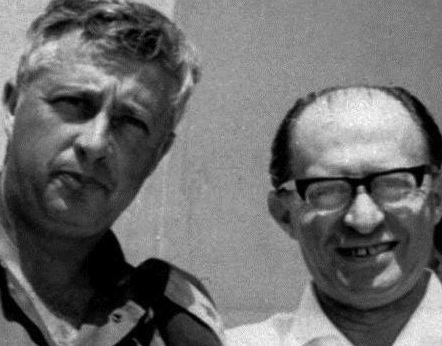
The impact of the path on which Sharon set Israel resulted in today’s self-imposed isolationism. Thanks to a the legacy of right wing leaders like Sharon, and Menachem Begin (shown together above in a 1967 photo) Israel has been unable to resist the impact of a boycott movement that has attacked Israel’s economy and undermined its world image.

As a demonstration of this isolation, no foreign leaders attended his final service, which was conducted Monday in front of the Knesset. The highest ranking world figure at the service was U.S. Vice President Joe Biden, a politician with an eye on 2016, who appeared as concerned about Israel’s close bond to  the U.S. as he was about Sharon.

Former British Prime Minister Tony Blair was there, not as a public official, but as the staff director of the Quartet (the United Nations, the European Union, the United States and Russia), itself a lingering, dying effort to sustain and monitor peace efforts between Israel and the Palestine Authority.

It is a measure of how far Israel has fallen in world esteem that when the assassinated Israeli Prime Minister Yitzhak Rabin was buried in 1995, a sitting U.S. President and two former U.S. presidents were in attendance. Egypt was the only Arab state to send a low level representative to Sharon’s service. The last eight years have not been good for either Israel or a comatose Ariel Sharon. If you read or look beyond the main stream media, It is not hard to see why.

Max Blumenthal sums up Sharon’s legacy forThe Nation:

A central player in Israeli affairs since the state’s inception, Ariel Sharon molded history according to his own stark vision. He won consent for his plans through ruthlessness and guile, and resorted to force when he could not find any. An accused war criminal who presided over the killing of thousands of civilians, his foes referred to him as “The Bulldozer.” To those who revered him as a strong-armed protector and patron saint of the settlements, he was “The King of Israel.”

Months prior to his stroke, Sharon “stunned” the world by forcibly withdrawing 10,000 Israeli settlers (and their military protectors) from Gaza. “Stunned” is the word used by Israeli narrators and repeated endlessly by media sycophants. It paints Sharon as a strong leader willing to work for peace. The Gaza withdrawal was not stunning; it was a shrewd, calculating, strategic military move to end a Gaza occupation that was not benefiting Israel.

Eight years later, the “stunning” step has led to an open air prison, periodically attacked by the IDF in what might be correctly identified as a “stunning” silence by the rest of the world. The withdrawal was not magnanimous; it was a typical power play by Sharon which led to the situation today, writes Blumenthal, in which:

Gaza suffers under a joint Israeli-Egyptian siege, while Israel shrugs off any responsibility for its inhabitants. Though Israel controls the entrances, exits, airspace and coast of Gaza, and effectively regulates the caloric intake of each resident of the coastal territory, the occupation is over as far as its government is concerned.

Meanwhile, a few miles away from Gaza’s open air prison:

Israeli settlements are firmly entrenched in the West Bank and encircle East Jerusalem, reducing Palestinian areas to the “pastrami sandwich” of non-contiguous bantustans that Sharon had originally envisioned. With the peace process effectively embalmed in political “formaldehyde,” right-wing elements have achieved unfettered dominance over the Jewish state’s key institutions. 

Sharon’s contribution to the future of Israel and the Palestinians provides Blumenthal with a metaphorical image he could not resist::

Now that Sharon’s unilateral vision appears to have been consolidated, Israel’s government must perpetually manage an occupation it has no intention of ending. It has no clear strategy to achieve international legitimacy and no endgame. Its direct line to Washington has become a life-support system for the status quo. Like Sharon, who spent his last years in a comatose state without any hope of regaining consciousness, Israel is only buying time.

History will not recall Sharon with favor. Mainstream media feels compelled to refer to his career as “controversial”, a term even Joe Biden felt he had to reference in his otherwise laudatory funeral remarks. “Controversial” is media code word for “we know there is bad stuff out there but you did not hear it here”.

Juan Cole gives body to “controversial” when in his Informed Comment blog, he offers “Top Ten Ways Ariel Sharon Ruined Israel and the Middle East”. Number six is probably Sharon’s darkest career hour:

Sharon crafted the invasion of Lebanon in 1982. It was intended to allow him to put Christian allies of Israel in power in Lebanon. Likewise, he wanted to destroy the Palestine Liberation Organization, then headquartered in Beirut.

The invasion, which had no basis in international law, resulted in the indiscriminate shelling of Beirut and the loss of some 20,000 Lebanese and Palestinian lives. . . During that war, Sharon bore responsibility for the massacre of women and children at the Sabra and Shatila refugee camps during the Israeli occupation. Remember that these Palestinians were refugees from Sharon and his fellow Israeli hawks in the 1948 war, when some 720,000 Palestinians were expelled from their homes and land and made penniless refugees.

Now he had come after them and empowered far right wing Christian militiamen, who massacred them. Sharon hated the Palestinians because they refused to evaporate, and stood as a reproach to his ideology of Israelis’ birthright to Palestinian land.

Raja Shehadeh (right) a Palestinian lawyer and novelist who lives in Ramallah, continues the story in a posting he wrote for The New Yorker:

“In 1982, after the Israeli invasion of Lebanon and the massacre at Sabra and Shatila, the largest protest in the history of Israel came out against rajSharon. A commission of inquiry headed by the Chief Justice of Israel’s Supreme Court, Yitzhak Kahan, determined that Defense Minister Sharon was negligent, and should have foreseen that permitting Lebanese Phalangist forces to enter the Palestinian camps carried the potential for catastrophe. Sharon was forced to resign.

This could have been the end of his political career. It was not. Shehadeh continues:

“The man did not have a social vision for his country; economics bored him. He must have known that he would only get a second chance when the drums of war began to beat again. It is not surprising, then, that when the Oslo Accords were concluded—promising peace at the end of an interim period—Sharon provocatively waged a fierce battle against the agreement.

His return to power came after he deliberately walked with a large contingent of armed guards into the Dome of the Rock compound in September, 2000, helping to ignite the second Palestinian Intifada.”

With Dyan in 1955In March, 2001, Sharon was elected prime minister, the position he held until he suffered his stroke in January, 2006, ending a long military/political journey which, except for the occasional downturn, like Sabra and Shatila, continued from early military success to the prime minister’s post.

In 1955, he was photographed (at left) with Moshe Dayan, then the IDF Chief of Staff and later Israeli Defense Minister and Foreign Minister.

Avi Shlaim, (shown at right below) professor emeritus of international relations at St. Antony’s College, Oxford University, is the author of Israel and Palestine: Reappraisals, Revisions, Refutations and The Iron Wall. He remembers Sharon this way in The Guardian:

“President George W Bush famously described Sharon as “a man of peace”. For the last 40 years the Arab-Israeli conflict has been my main research interest, and I have not come across a scintilla of evidence to support this view. Sharon was a man of war through and through, an Arab-hater, and a pugnacious proponent of the doctrine of permanent conflict. Following his rise to power Sharon therefore remained what he had always been – the champion of violent solutions.

The dominant preoccupation of Sharon’s premiership was the “war on terror” against militant Palestinian groups. No peace negotiations with theAvi-Shlaim Palestinian Authority took place between 2001 and 2006, and Sharon regarded this as something to be proud of. To his way of thinking negotiations necessarily involve compromise, and he consequently avoided them like the plague.  .  .  .

His enduring legacy has been to empower and embolden some of the most racist, xenophobic, expansionist, and intransigent elements in Israel’s dysfunctional political system.”

Sharon’s legacy will long be a topic of “controversy”.  The question remains, however, as to why Sharon was kept on life support for eight years and one week.  That is a societal and finally, a theological, question, which every society needs to face:

Time‘s posting by Alice Park is appropriately entitled Life vs. Living: Lessons from Sharon’s Last Years in a Coma. It provides background for that discussion:

Traditionally,[in Israel] the concept of brain death didn’t exist, as death is considered the simultaneous shutting down of the body’s primary functions—from the pumping of blood to breathing and thinking. But with the introduction of technology to keep some body systems working—such as the heart and lungs—the need to redefine death became critical.

And the idea of brain death—similar to a death caused by a heart that stopped beating or lungs that stopped breathing—seeped into the culture and legal system as Sharon hung on. In 2009, the Israeli government passed the Brain-Respiratory Death Law that addressed religious concerns about defining the line between life and death and the latest medical knowledge.

It required that several brain scans and other techniques would have to verify an irreversible lack of brain activity in order to declare the patient brain dead. The law was an attempt to encourage organ donation from patients whose bodies were otherwise healthy, but whose brains had all but ceased to function.

Even with the new medical criteria, however, some Israelis found it hard to relinquish religious concepts of life and death, and continued to find any life, even in a vegetative state, worth preserving.

Posted in Middle East Politics, Netanyahu | 12 Comments

Netanyahu’s “Shibboleths” Scuttle Peace Talks

by James M. WallNetanyahu

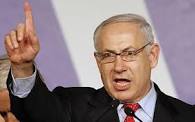
“No partner for peace” is one of several “shibboleths” Prime Minister Benjamin Netanyahu (right) and his cabinet are now using to scuttle any peace agreement with President Mahmoud Abbas, no matter how often U.S. Secretary of State John Kerry travels to Tel Aviv.

As readers of Judges 12:6 are well aware, pronunciation of the word “shibboleth” is used to separate friends from enemies.

In episode eight of the second season of the television series West Wing, for example, President Josiah Bartlett used “shibboleth” to determine that Chinese immigrants were truly Christian and therefore deserved admission to the U.S. To assert that Israel “has no partner for peace” is a verbal signal,  a “shibboleth”,  which quickly certifies that the speaker is “with Israel”, without reservations.

When John Kerry returned last week to the Israeli-Palestinian peace talks for his tenth visit, he brought with him a proposal to discuss “four core issues” with the peace negotiators. Because he is a master diplomat (another reason to regret his failure to defeat incumbent President George W. Bush in 2004), Kerry knew Netanyahu would find ways to defer progress toward peace.

Kerry’s “four core issues” were quickly expanded by Netanyahu and members of his cabinet, to “six core issues”.  Added to the negotiation table were two tried and true Israeli “shibboleths”,  “Israel must be acknowledged as a Jewish state” and Israel must maintain military control over the Palestinian Jordan Valley.

Both are what negotiators refer to as “poison pills”, demands certain to be rejected by President Abbas.  “No partner for peace” is used to add icing on the cake, since negotiations are simply not a part of Israeli leaders’ DNA.

The Zionists who planned the Nakba, village by village, prior to the outbreak of war in 1947, were there as colonial conquerers. The intent was to move steadily from the Mediterranean Sea in the west to the Jordan River in the east.  Thanks in large measure to the horrors of the Holocaust, the world both tolerated and encouraged this march to the east.

There were always signs that this march would be unrelenting and not subject to negotiations. This has been obvious in subsequent Israeli governments that employed “peace talks” as diversions for expansion and additional military control. Even when Israel pretended to move in a positive manner, it was for its own security purposes, as was the case of its “withdrawal” to the Israeli-controlled borders of Gaza.

Early in President Jimmy Carter’s term in office, I traveled with President  Carter to the United Nations where he met with Israeli Prime Minister Menachen Begin.  When I was very briefly introduced to Begin, I knew he had been briefed by his American aides who assumed, correctly, that because I was with President Carter, I would behave.

“Oh yes”, he said to me, “You are with us”. I mumbled an answer that I hoped was both diplomatic and accurate. Since I was not whisked away, I must have  passed the “you are with us” test.

It was not a proud moment for me, having by that time made enough visits to the occupied areas to know this was an grossly uneven struggle between the occupier and the occupied.  But knowing President Carter, I knew he would say “there is a time to be silent and a time to speak”, I responded to Begin in polite no-speak platitudes.

The encounter, however, was revealing to me of the Israel leader’s strong “us against them” mindset.  After that,  I responded often to the prime minister and his successors, through whatever avenue of communication I was able to commandeer.

I have no idea how Israel identifies frequent visitors who are either “with us” or “against us”, but I do know that all my subsequent arrivals and departures in Tel Aviv have not been greeted with warm smiles. Maybe the Israeli border computer records have a “smiley face” that stands for “with us” and a “frowny face” for those who are “against us”.

I do know that one attempt I made to travel to Tel Aviv hit a snag when I flew from Chicago on American Airlines and changed planes in Rome to fly on El Al to Tel Aviv.

Israeli officials had their own little corner security operation in the airport basement in Rome. Because the Israelis felt I had not given them sufficient time to have all my bags (including my laptop) thoroughly examined, I was required to spend a night in the Rome airport hotel. That cost me some money and it may also have earned me two “frowny faces”.

In Jerusalem the next day,  I complained about this experience to a American Jewish Committee staffer who spoke to the group I was leading. His “with us” or “against us” answer was blunt. He told me that earlier (I knew it was at least several years earlier) a Catholic or maybe it was an Orthodox priest, had been apprehended driving into Israel with a trunk load of rifles.

But I digress. John Kerry has no trouble getting in and out of Tel Aviv. He is on a mission for peace. The Secretary, however, was greeted with anything but smiles by Israeli leaders who were supposed to be discussing steps toward a peaceful future.  They greeted him with Netanyahu’s demand that Abbas “recognize Israel as a Jewish state” and the promise of more housing startups in Israeli settlements.

Netanyahu also used the early part of January to attack President Abbas for “failing to curb” what Netanyahu claims is hate propaganda aimed at Palestinian children and young people.  These charges have long been a staple in Israel’s hasbara campaigns. The charges are hardly effective generators of hatred compared to frequent IDF night raids into Palestinian homes and the arrests of children on the streets. These heartless attacks are more than adequate generators of youthful and intense dislike of Israel by Palestinian children.

On his tenth peace visit, Kerry used his time well. He traveled between Tel Aviv and Ramallah, reaching for consensus for an outline for peace which he wants to have finalized by his deadline of mid-year.

When Kerry departed for home, there was speculation in the Israeli media that he might be open to pushing Abbas toward accepting the “Jewish state” shibboleth. Richard Silverstein reports that Kerry may be using Arab leaders to pressure the Palestinians into giving Israel this particular “shibboleth”..

For Kerry’s sake and for the sake of peace in the region, we can only hope these reports are a misreading of Kerry’s thinking.

Bernard AvishaiMeanwhile, Bernard Avishai, (left) Israeli author and academic, wrote a posting in a January 2 blog in the New Yorker, which offers a wise and thoughtful perspective on the “Israel as a Jewish state” issue.

Avishai teaches at Dartmouth College as a visiting professor of government, and at the Hebrew University as an adjunct professor of business. He is the author of “The Tragedy of Zionism” and “The Hebrew Republic”. His most recent book is “Promiscuous: Portnoy’s Complaint and Our Doomed Pursuit of Happiness.”

The core of Avishai’s blog posting covers three layers of the “Israel as a Jewish state” issue.  The excerpt below is long but access to the full posting may require a subscription. The posting should best be read in full.

Netanyahu’s demand has at least three layers to it. The first is symbolic, without practical significance—understandable, but superfluous. The second is partly symbolic, but is meant to have future practical significance; it is contentious but resolvable. The third, however, is legal: it has great practical significance, and is, for any Palestinian or, for that matter, Israeli democrat, deplorable. We are no longer debating resolutions at fin-de-siècle Zionist congresses. Making laws requires settled definitions, and what’s being settled in Israel is increasingly dangerous. Netanyahu’s demand is a symptom of the disease that presents itself as the cure.

On the first, symbolic point: Israel is obviously the state of the Jewish people, in the sense that vanguard Jewish groups in Eastern Europe dreamed of a Hebrew revolution, which launched the Zionist colonial project, which engendered a Jewish national home in Mandate Palestine, which earned international backing to organize a state after the Holocaust—a state that became a place of refuge for Jews from Europe and Arab countries—that is, a state with a large Jewish majority whose binding tie (to bring things back to Zionism’s DNA) is the spoken Hebrew language.

When Palestinians say they recognize Israel, they are implicitly recognizing this reality; they are acknowledging the name of a communal desire. The state is not called Ishmael, after all.

At the most visceral level, when we Israelis insist that Israel be recognized as Jewish, we mean that we want this narrative recognized, the same way in which Palestinians implicitly want acknowledgement of their particular formative sufferings at the hands of Zionism when they say “Palestinians” rather than “southern Syrians.” To say, as Yair Lapid, Israel’s Minister of Finance, does, that he doesn’t care what Palestinians think is rude. When Palestinian spokespeople speak to Israeli reporters in Hebrew, they are recognizing Israel in the most poignant possible way. To ask for more is tactless.

That leads to the second, partly symbolic, partly practical aspect. Why does Netanyahu insist that this recognition is not enough? Because, he claims, in any negotiation with the Palestinians, it must be understood in advance that there can be no “right of return” for Palestinians to Israel—and, therefore, accepting this formulation, “the state of the Jewish people” signifies a joint decision to preclude a flood of Palestinian refugees into Israel’s borders and onto its electoral rolls.

But Netanyahu’s claim is false, and puts a stumbling block where a pathway needs to be cleared. You can certainly find a formulation for the refugees that does not ruin Israel’s Jewish/Hebrew character—one that preserves the Palestinian “right of return” as a seminal piece of the Palestinians’ narrative, the name of their desire. It might say, for example, that refugees have a right of return to their homes, but that the forms of compensation, the number of returnees, etc., must be agreeable to Israel, and that, in any case, the majority will exercise that right by returning to a future Palestinian state.

The contradiction between “the recognition of Israel as a Jewish state” and “the right of return of Palestinians” may sound intractable. In fact, it was pretty much resolved at Taba, in January, 2001. Why resort to distracting principles when a little useful ambiguity will do?

Unfortunately, however, Netanyahu cannot, or will not, simply leave things there. For the phrase “Jewish state” also has a third meaning, with legal ramifications dear to the heart of Israeli rightists (including old Labor Zionists in love with the saga of the settler state); laws that derive from the historical application (some would say misapplication) of neo-Zionist ideas and Ben Gurion’s rash compromises with rabbinical forces over two generations ago; laws that have left Israel a seriously compromised democracy.

As the New Year begins, where do we look for signs of hope?  Start with John Kerry, who may yet find a way to break through Benjamin Netanyahu’s stubborn exterior. And look to authors like Bernard Avishai, who found his way into the pages of The New Yorker to enlighten information-starved American readers.  Added tip: Avishai also writes on occasion for Harpers and the Nation.

Posted in John Kerry, Middle East Politics, Netanyahu, Religious Faith | 5 Comments

Israeli Aggression Leaves Little Hope for Peace

by James M. WallJordan Valley settlements Reuters crop

The year 2014 marks the 100th anniversary of the start of the First World War. That conflict began on July 28, 1914. It did not end until November 11, 1918.

Keep those dates in mind because by July 28, 2014, it is possible that we will witness the start of another conflict, driven by the same stupidity, greed and lust for power that produced the First World War.

That repeat of history was evident in the bad news for the Palestinians that preceded the arrival in Tel Aviv on Thursday of U.S. Secretary of State John Kerry. The bad news came in the verbal bluster and actions of Israeli political leaders who insist Israel will continue to aggressively build settlement housing on Palestinian territory.

The demand by Israel that IDF units must continue to patrol the Palestinian Jordan Valley is one more egregious step Israel is taking to guarantee that Kerry’s attempts to form a peace agreement will never succeed.

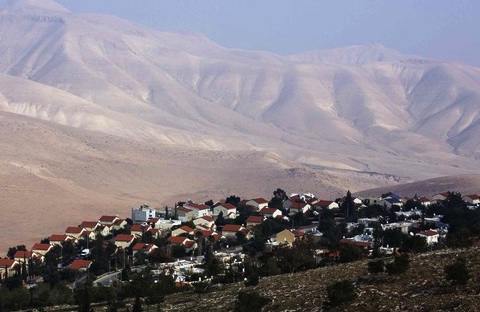
The houses shown above are in the Jewish settlement of Maale Efrayim in the Palestinian Jordan Valley where, Foreign Policy reports,

Israel’s interior minister will on Thursday inaugurate a new neighbourhood in a Jewish settlement in the Jordan Valley, in a gesture of defiance that will coincide with US secretary of state John Kerry’s latest visit to the region to push forward peace talks.

Into this atmosphere of Israeli expansionism, the Secretary returned to the region this week for his tenth visit, bringing plans for discussion by Israeli and Palestinian leaders. Specific details have not been fully revealed, but the actions of Israel and the failure of the U.S. to object to those actions, suggest that Secretary Kerry brings with  him proposals  as toxic to justice as were those artificial western-imposed Middle East borders drawn by western powers after the First World War.

In his book, A Peace to End All Peace, David Fromkin examines the “peace” that emerged from the First World War that began 100 yers ago this coming July.

In the Middle East, Fromkin writes, decisions “made by the Allies during and after the First World War,”  led to the creation of a new map for that region, a map drawn not for the well-being of the indigenous populations, but a map designed to satisfy the greed and lust for power and obsession for control by outside powers.

Those post First World War decisions were not made in the open. They were, rather, made under the nightmarish haze of propaganda and lies. Fromkin explains:

British officials who played a major role in the making of those [post First World War] decisions provided a version of events that was, at best, edited and, at worst, fictitious. They sought to hide their meddling in Moslem religious affairs and to pretend that they had entered the Middle East as patrons of Arab independence—a cause in which they did not in fact believe.

The ominous parallels between 1914 and 2014 should be obvious to justice-minded political leaders today, except for the fact that justice is not on the table in Tel Aviv nor Ramallah this week.

Israel, a major colonial power imposed on the region with help from western powers, is using the long drawn out “peace process” as a decoy from reality.  Meanwhile, by force and guile, new borders are drawn around expanding settlements, borders that are designed to complete Israel’s control of what it has long seen as Greater Israel, stretching from the Jordan River to the Mediterranean Sea.

These actions are clearly post First World War redux.

As with the British at the end of the First World War, Israel has accomplished this by providing “a version of events” that are “at best, edited and, at worst, fictitious”.

Even a loyalist Zionist like New York Times columnist Roger Cohen, knows that Israeli Prime Minister Benjamin Netanyahu has created what David Fromkin described as a “version of events” with his demand that the Palestinians recognize Israel as a Jewish state, a ploy designed merely to delay and prolong a peace process  which Netanyahu has no intention to ever let reach a fair and just conclusion.

Cohen calls his column, “My Jewish State”, a not so subtle acknowledgement that he considers Israel to be his second home. (Does this not border on “dual loyalty”?) Cohen is typical of Liberal Zionists who try their best to “see both  sides” in the conflict, but whose loyalty to Israel leaves little doubt as to where their heart lies.

Here is Cohen trying his journalistic best—and he is one of the better Times‘ columnists—-when he strongly suggests that Netanyahu’s stalling tactics are acts of destruction for the peace talks:

Then there is the rebounding Israel-is-a-Jewish-state bugbear: Netanyahu wants Palestinians to recognize his nation as such. He has recently called it “the real key to peace.” His argument is that this is the touchstone by which to judge whether Palestinians will accept “the Jewish state in any border” — whether, in other words, the Palestinian leadership would accept territorial compromise or is still set on reversal of 1948 and mass return to Haifa.

Mahmoud Abbas, the Palestinian president, says no; this “nyet” will endure. For Palestinians, such a form of recognition would amount to explicit acquiescence to second-class citizenship for the 1.6 million Arabs in Israel; undermine the rights of millions of Palestinian refugees; upend a national narrative of mass expulsion from land that was theirs; and demand of them something not demanded from Egypt or Jordan in peace agreements, nor of the Palestine Liberation Organization when, in 1993, Yasir Arafat wrote to Yitzhak Rabin that it recognizes the right of Israel “to exist in peace and security”.

Even as a loyal Zionist, Cohen dismisses Netanyahu’s demand for recognition as nothing but a diversion:

This issue is a waste of time, a complicating diversion when none is needed. As Shlomo Avineri, a leading Israeli political scientist, put it to me, “It’s a tactical issue raised by Netanyahu in order to make negotiations more difficult.”

(Photocrop by Pool:AFP Brendan SmialowskiWhich leads to the conclusion, the “recognition” diversion is not only making negotiations more difficult, it is guaranteeing that the negotiations will fail.

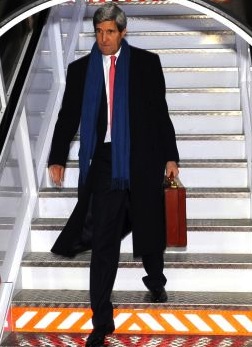
And that, of course, is Benjamin Netanyahu’s reason for all his game-playing with John Kerry’s plans for peace, which the Secretary  once again is trying to explain in Tel Aviv. (at left)

In this year 2014, supporters of Israel in the U.S., both secular and religious, should look long and hard at this strategy of delay and defeat employed by the Israeli Prime Minister.

Case in point, national Christian church governing bodies will meet during the next two years. The United Methodist (2016)  the Presbyterian (2014) and the Episcopal (2015) denominations will all  “debate” their actions and attitudes toward Israel and Palestine. What’s to debate?

The church leaders who will vote in those conferences and assemblies should begin now, at the start of 2014, to examine Israel’s consistent acts of dissemblance.

My definition sources describe dissemblance as an action that wants to leave “a false or misleading semblance of something”. Those who dissemble conceal their “true motives, feelings or beliefs”. In short, they “mislead, deceive, misguide, or fake.”

It was dissemblance that led to the creation of a western-designed Middle East almost a century ago.  And it is dissemblance that Benjamin Netanyahu will continue to employ to build his kingdom from the Jordan River to the Mediterranean Sea. Is this the man the United Methodists, the Presbyterians and the Episcopalians want as their guide for peace in the Middle East?

The picture of Israeli housing in the Jordan Valley is by Reuters.  It appeared on the Foreign Policy web site. The picture of Secretary Kerry is from Ma’an. It is a pool photo by AFP’s Brendan Smialowski, taken at the Secretary’s first public appearance this week in Tel Aviv.

Posted in Episcopal Church, John Kerry, Middle East, Middle East Politics, Netanyahu, Religion and politics, United Methodist Church, War | 8 Comments

Iran And The Season of Peace and Goodwill

by James M. WallBethlehem today Wikipedia

This is the season which celebrates the hope of peace and good will among humankind. The New Testament testifies to this hope in Luke 2:8-20.

“Now there were in the same country shepherds living out in the fields, keeping watch over their flock by night. And behold, an angel of the Lord stood before them, and the glory of the Lord shone around them, and they were greatly afraid.

Then the angel said to them, “Do not be afraid, for behold, I bring you good tidings of great joy which will be to all people. For there is born to you this day in the city of David a Savior, who is Christ the Lord. And this will be the sign to you: You will find a Babe wrapped in swaddling cloths, lying in a manger.” 

And suddenly there was with the angel a multitude of the heavenly host praising God and saying: “Glory to God in the highest, And on earth peace, goodwill toward men!” Luke 2:8-20 New KJV

The key to this passage is the announcement, “You will find a Babe wrapped in swaddling cloths, lying in a manger.”

The Babe is Jesus, born of Mary, in the town of Bethlehem (modern city shown above). In the time recorded by Luke, the Babe lies in a manger, helpless and vulnerable. When we speak of the Babe we see him as an embodiment of future hope, a promise of what could be.

Today, in the land where Jesus was born, there is another fragile and vulnerable hope for peace. A nuclear peace agreement between Iran and major western powers waits to grow into a mature reality. Unlike the child described by Luke, this peace agreement is not perfect; it was created by political leaders, not by God.

Israel stands in strong opposition to the agreement on the grounds that it believes Iran is moving toward developing a nuclear arms system that Israel feels threatens its security. Israel is known to have at least 200 nuclear warheads; Iran has none.

Israel stands alone in this belief, except for its allies in the United States Senate, 27 of whom are sponsoring the Nuclear Weapon Free Iran Act, a Senate proposal designed to undermine the Iranian peace efforts by President Obama.

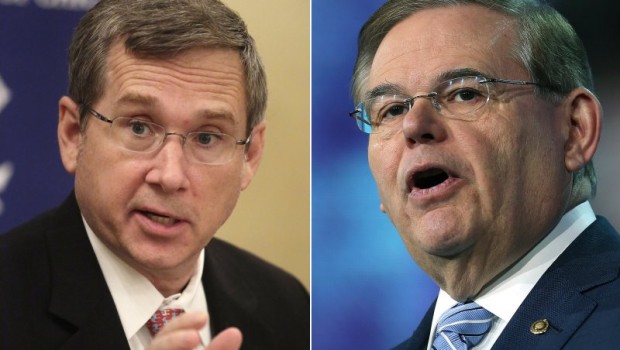
80042-620x350The leaders of this effort are Senators Robert Menendez (D-N.J.) (pictured at left on the right) and Mark Kirk (R-IL). (also at left).Their bill is described by a release from Senator Menendez’ office as “bipartisan legislation proposing prospective sanctions on Iran should the regime violate the interim Joint Plan of Action agreed to in Geneva or should Iran fail to reach a final agreement.”

Co-sponsors of the bill are Senators Menendez, Kirk, Schumer, Graham, Cardin, McCain, Casey, Rubio, Coons, Cornyn, Blumenthal, Ayotte, Begich, Corker, Pryor, Collins, Landrieu, Moran, Gillibrand, Roberts, Warner, Johanns, Hagan, Cruz, Donnelly, Blunt and Booker, an “honor roll” of pro-Israel senators, politicians who do not hesitate to stand against the U.S. President when his policies are opposed by Israel.

The last name on the “honor roll” list is newly elected New Jersey Senator Cory Booker, who entered the Senate this fall with strong pro-Israel credentials. He and his fellow senators who have offered the new sanction bill have begun their Christmas break with the full awareness that in this season of “peace and good will” they have called for a nuclear agreement action already rejected by Iran.

Jay Carney, Obama’s press secretary, told reporters that should the Senate pass the Nuclear Weapon Free Iran Act, President Obama would veto the bill.

A veto may not be necessary because while the hard line pro-Israel senators from both parties are standing against the President’s sanctions agreement, he has strong Senate support.  Senate Democratic committee chairs have sent Obama a letter of support.

In their letter they indicate that they are opposed to imposing new restrictions on Iran. They also ask the President to inform them “before any attempt is made to pass sanctions legislation.” This is procedural protection from senators who often try to pass legislation by a unanimous consent vote at the end of long work periods or at the end of the year.

The letter that supports the current Obama-Kerry negotiated agreement is signed by Senate Banking Chairman Tim Johnson of South Dakota, Senate Intelligence Chairwoman Dianne Feinstein of California, Armed Services Chairman Carl Levin of Michigan, Appropriations Chairwoman Barbara Mikulski of Maryland, Environment and Public Workers Chairwoman Barbara Boxer of California, Commerce Committee Chairman Jay Rockefeller of West Virginia, Homeland Security and Government Affairs Chairman Tom Carper of Delaware, Judiciary Chairman Patrick Leahy of Vermont, Energy Chairman Ron Wyden of Oregon and Health, Education, Labor and Pensions Chairman Tom Harkin of Iowa.

During a recent press conference, President Obama spoke to his support for the original negotiated agreement:

http://youtu.be/-lpYYmUG5x0

The pro-Israel senators in this discussion have chosen s path against the vulnerable nuclear peace agreement, thereby working to kill the agreement.  They may think they are the Wise Men in this discussion, but given Israel’s increasing isolation on the world stage, alongside its decreasing ability to stave off international economic boycotts, it would appear their wisdom is flawed.

They may soon find that they have listened to the wrong voices when they rejected the Obama-Kerry nuclear agreement.

The picture of modern day Bethlehem at top, is from Wikipedia, also a modern development. 

Posted in Iran, John Kerry, Middle East, Middle East Politics, Obama, Religious Faith | 5 Comments

If Talks Fail, Boycotts Will Arrive “On Steroids”

by James M. WallC2Photo by Matty Stern:U.S. Embassy Tel Aviv

John Kerry returned for talks in Jerusalem and Ramallah this week, bringing a warning that if the peace talks fail, Israel could confront a “boycott campaign on steroids“.

The U.S. Secretary of State also brought a “framework agreement” for the two sides to discuss.

Learning of the contours of the proposed agreement, Palestinian President Mahmoud Abbas was quick to voice his  opposition.

The agreement reportedly calls for the stationing of Israeli military forces in the Jordan Valley under the noxious pretense that Israel needs that extra layer of protection for its security.

Ira Glunt, writing in Mondoweiss, offers more details on the Ramallah meeting:

As reported in Ha’aretz, according to a senior Palestinian advisor, the atmosphere at the meeting last night was not good because of “American pressure.”  

The Americans want an Israeli presence in the Jordan Valley for a period of 10 to 15 years.  The Palestinians have publicly stated that they would accept an international military presence in their future state, but would not agree to any Israeli military deployment on their territory. 

On his return to Jerusalem from Ramallah, the Secretary had his expected 30 minute drive delayed for more than two hours. Such a delay would be typical for Palestinians on the same journey, but it was not checkpoints that delayed the Secretary.  He was driving through the heaviest snowstorm to hit Jerusalem in decades.

Kerry’s proposed “framework agreement” is described by Ha’aretz as “an attempt to achieve a breakthrough in the impasse and to force leaders to reach decisions”.

Kerry has five months left in his self-imposed time frame to reach a peace agreement. He is trying everything in his diplomat notebook. He warns Israel’s Benjamin Netanyahu of a flood of boycotts he could face. He warned Abbas of a delay in the scheduled release of Palestinian prisoners at the end of December.

The two threats are hardly comparable, but then, the status of the occupied and the occupier are also anything but comparable.

Kerry has since backed off the prisoner release delay, a wise move considering that the world’s most famous political prisoner, Nelson Mandela, has just been honored and buried in South Africa.

Kerry flew from Tel Aviv to Vietnam after his short visit to Ramallah and Jerusalem.  Before his departure, Ma’an reported that he told reporters:

“We are working on an approach that both guarantees Israel’s security and fully respects Palestinian sovereignty,”

Kerry also insisted his goal was for both sides “to reach a final status agreement — not an interim agreement.” He added that Israel will release as planned a new group of Palestinian prisoners on Dec. 29.

This is hardly a propitious time for Kerry and Netanyahu to bring more world attention to Palestinian political prisoners.  This is especially true after Israel failed to send a top-level leader to attend the Mandela memorial service.

Marwan BarghoutThe next group of prisoners to be released will most certainly not include the name of Marwan Barghouthi (at left), the man many Palestinians feel could become the Palestinian Nelson Mandela.

Following Mandela’s death, linkage of Barghouthi to Mandela takes on a new impetus. A long-time friend and fellow prisoner of Mandela’s, an Indian-born South African, Ahmed Kathrada, is stepping up his campaign to free Barghouthi.

Kathrada and Mandela were both released from a South African prison in 1990. In 1994 Mandela was inaugurated as South Africa’s first post-apartheid President.

Ahmed Kathrada, an anti-apartheid leader, initially launched a Release Mandela Campaign, a project that lead to his imprisonment a year later. He joined Mandela on Robben Island and then spent a total of  26 years in apartheid jails.

On October 27, this year, Kathrada returned to Robben Island to launch the International Campaign to “Free Marwan Barghouthi and All Palestinian Prisoners”.

Kathrada wrote of his experience in prison and of Marwan Barghouthi, in the Africa Report:

I think of my cramped prison cell and I visualise my fellow freedom fighter Marwan Barghouti and other Palestinian prisoners. Since 1967, over 800,000 Palestinians have endured imprisonment at some point in their lives.

This is a very striking example of mass detention, aimed at breaking the will of an entire people. Some of them have spent over 30 years in Israeli jails, setting shameful world records for the longest period of political detention. Others have lost their lives due to ill-treatment or lack of healthcare. Children in Palestine experience detention and apartheid, as several generations did in South Africa.

Anticipating the release of Palestinian prisoners later this month, the South African Kathrada wrote in Aljazeera:

Marwan Barghouti, a leading Palestinian political prisoner being held for life in Israel, has spent nearly two decades of his life in Israeli jails, including the past 11 years.

Approximately 30 others, who later this month are expected to exchange prison cells for larger prisons in occupied Palestine, are returning to a very different world – grown children, an even more dire political landscape, and a West that denigrates them while ignoring the crimes of their jailers.

Only a political prisoner can fully comprehend the ordeal of a fellow political prisoner. The experiences of solitary confinement, ill-treatment, separation from the outside world, and the progressive erosion of the concept of time, cannot be fully translated into words. Imprisonment leaves behind deep scars, both in your flesh and in your soul.

Not only does Israel face the threat of a flood of boycotts, it has also created what veteran Israeli peace activist Uri Avnery calls its own “self-boycott” by failing to send any high-ranking officials to the Mandela memorial. Avnery wrote this week:

 By its voluntary no-representation or under-representation at the Mandela ceremony, it has declared that Israel is a pariah state.

Is there any possibility that John Kerry will bring the two negotiating parties to a peaceful solution? Avnery offers a reading of that possibility that is Neiburian in its mixture of hope and realism:

Netanyahu’s arguments presuppose that there will be no peace, not now, not ever. The putative peace agreement – which Israelis call the “permanent status agreement” – will just open another phase of the generations-old war.

This is the main obstacle. Israelis – almost all Israelis – cannot imagine a situation of peace. Neither they, nor their parents and grandparents, have ever experienced a day of peace in this country. Peace is something like the coming of the Messiah, something that has to be wished for, prayed for, but is never really expected to happen.

But peace does not mean, to paraphrase Carl von Clausewitz, the continuation of war by other means. It does not mean a truce or even an armistice.

Peace means living side by side. Peace means reconciliation, a genuine willingness to understand the other side, the readiness to get over old grievances, the slow growth of a new relationship, economic, social, personal.

To endure, peace must satisfy all parties. It requires a situation which all sides can live with, because it fulfils their basic aspirations.

Is this possible? Knowing the other side as well as most, I answer with utmost assurance: Yes, indeed. But it is not an automatic process. One has to work for it, invest in it, wage peace as one wages war.

Nelson Mandela did. That’s why the entire world attended his funeral. That, perhaps, is why our [Israeli] leaders chose to be absent.

As the song goes, is skipping the Mandela memorial a “lesson too late for the learning”?  Or is it an opportunity for Netanyahu to make a dramatic gesture and include Marwan Barghouthi in the prisoner release later this month?

Photo of John Kerry at  top is by Matty Stern/U.S. Embassy Tel Aviv

Posted in Middle East Politics | 5 Comments

Mandela Had “A Unique Moral Authority”

by James M. Wallc kufiya.mandela.algeria.may90

Nelson Mandela died at his Johannesburg home on December 5. The man who led South Africa out of the bondage of national apartheid, died at the age of 95.

The world has responded with an outpouring of praise for the man who served as South Africa’s first post-apartheid president.

Leaders from western nations, where Mandela was once scorned as a “terrorist” revolutionary, rushed to get in line to recall him as a great leader.

A public memorial service is planned for Tuesday in a Johannesburg outdoor soccer stadium. Mandela will be buried at his ancestral home in Qunu, Eastern Cape, on December 15.

The British newspaper, the Independent, took note of Mandela’s moral authority:

Nelson Mandela was the most respected, and probably the most loved of all world leaders in the late 20th century, and the most enduring of the heroes who emerged from the political convulsions of the 1980s. .  .  . 

For 27 years in jail he refused to compromise his principles, while for most of that time his own party, the African National Congress (ANC), was broken. But he emerged in February 1990 to become the dominant influence in his country, without whom peace was unlikely.

When he was elected President in April 1994, he was accepted by whites as well as blacks as the embodiment of his country’s new democracy, with a unique moral authority.

Among those who quickly announced that they will travel to South Africa to honor Mandela were U.S. President Barack Obama and two earlier U.S. presidents, George W. Bush and Bill Clinton.

Jimmy Carter, another former U.S. president, will travel to Johannesburg with a delegation of The Elders, a group of “independent, progressive leaders committed to peace, justice and human rights”.

The Elders group was founded by Nelson Mandela in Johannesburg on July 18, 2007, his 89th birthday.

According to the Elders’ web site:

When the group of Elders was launched in 2007, Mandela called on them to act as “a fiercely independent and robust force for good, tackling complex and intractable issues – especially those that are not popular.”

The Elders are Martti Ahtisaari, Kofi Annan (Chair), Ela BhattLakhdar Brahimi, Gro Harlem Brundtland (Deputy Chair), Fernando Henrique CardosoJimmy CarterHina JilaniGraça Machel, Mary Robinson and Ernesto ZedilloDesmond Tutu is an Honorary Elder..

After founding The Elders, Nelson Mandela did not play an active role, but he remained an Honorary Elder and the inspiration for The Elders’ work. In May 2010, the Elders were reunited with Nelson Mandela during one of the group’s biannual meetings, in Johannesburg.

Among the issues addressed by Mandela and the Elders, has been Israel’s occupation of the Palestinian people.

The Elders may be said to be Nelson Mandela’s “Band of Brothers and Sisters”, in his peaceful fight for justice throughout the world.

One of those efforts close to Mandela’s heart was, as he has said, to free the Palestinian people from the bondage of occupation.

He made this clear after he was released from a South African imprisonment that had lasted for 27 years. One of his first U.S. appearances came in 1990 when he appeared on an ABC television Nightline program hosted by Ted Koppel.

The tape of Ted Koppel’s 1990 Nightline program runs 20 minutes.  The first reference to Palestinians comes three minutes into the tape:

Koppel took questions from a town hall audience that included several prominent American Jewish leaders who were clearly “troubled” by Mandela’s insistence that he was supportive of Yasir Arafat’s leadership of the Palestinian struggle for independence.

Early in the taped interview (starting at 3:00), Mandela told Koppel:

“We identify with the PLO, because just like us, they are fighting for the right of self-determinatiion.”

At the time of this 1990 interview, the U.S. Congress was considering a decision to lift or retain economic sanctions against the South African apartheid state. Mandela was in the U.S. to fight for the continuation of the sanctions, the protest campaign that had helped Mandela gain freedom from prison.

In the televised town hall event, Mandela more than holds his own with Koppel, who suggested that Mandella, now that he was in the U.S., might want to consider the best “political” steps he might take to curry favor with members of Congress, where support for Israel was (and remains) strong.

Mandela said he had discussed the black/Jewish relationship in the U.S. and in South Africa, with blacks and Jews in both countries. But he insisted, to great applause from a friendly audience, that Jews in both the U.S. and Israel

“must know what our position is: Arafat is a comrade in arms.”

This week, as American political leaders and commentators, rush to make public statements of support for the life and work of Mandela, we are not likely to hear much of either the position of Mandela on Israel’s occupation, nor of the work the Elders, the world leaders group he founded.

Those leaders who travel from outside of Africa to praise and mourn Mandela , and who are still active in domestic politics, will be walking the delicate political line that Mandela refused to walk on his Koppel interview.

That delicate walk will be endlessly reproduced by U.S. mainstream media.  It will be a sight that would have drawn one of Mandela’s bursts of laughter. (See the video above.)

Nelson Mandela, who succeeded in setting his people free, was the South African leader who said, “We know too well that our freedom is incomplete without the freedom of the Palestinians”.

It is a long flight to Johannesburg. There will be ample time for world leaders to reflect on Mandela’s vision for the Palestinian people.

The picture of Nelson Mandela wearing an Arab kufiya, was taken in Algeria in May, 1990.

Posted in Human Rights, Middle East Politics, Obama | 8 Comments