Netanyahu’s Flawed Vatican Charm Offensive

by James M. WallLawrence In Arabia cover

With the U.S. Congress safely in his back pocket, Israeli Prime Minister Benjamin Netanyahu has turned his charm offensive on the Vatican. How is that working out for him?

It does not look promising. The Prime Minister forgot the first rule of charm school: Target your prey gently. Avoid all punches to the mid-section.

The international Jewish News Agency (JTA) reported on Monday’s meeting between Netanyahu and Pope Francis:

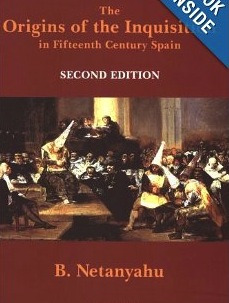
 Prime Minister Benjamin Netanyahu at a Vatican audience with Pope Francis reportedly invited the pontiff to visit Israel.  No date has been set for a visit by Francis to Israel, Vatican spokesman Father Federico Lombardi said.  Netanyahu on Monday presented the pope with a book about the Spanish Inquisition written by his father, the late historian Benzion Netanyahu.”

An invitation to drop by for a visit to Tel Aviv along with a gift to the Holy Father recalling the dark moments of the Spanish Inquisition?  Bad form, Mr. Prime Minister.

The book delivered to the Pope was written by Netanyahu’s father, Ben-Zion Netanyahu, who died recently at the age of 102. The pride of a son could be one justification for the gift.  The book, The Origins of the Inquisition in 15th Century Spain, is considered the elder Netanyahu’s finest work.

The Seattle Post-Intelligencer was quick to note the incongruity of a book as a gift to the Pope which denounces the sins of Pope Francis’ 15th century predecessor, one that “largely revolves about Spanish Catholics questioning, torturing, and punishing Jewish converts to Catholicism,” a practice first legally sanctioned by Pope Innocent IV in 1252.

The Seattle PI adds:

Origins of the InquisitionThe elder Netanyahu’s impact on his politician son is well-known within Israeli circles. In 1998, David Remnick of the New Yorker wrote that while Ben-Zion Netanyahu’s opinions frequently differed from his son, the pessimism of his right wing worldview influenced his son’s hawkish policies. “His dilemma is always to what degree he can, or should, remain true to the ideals, the stubbornness, of his father,” Remnick observed. The book given to the pope, Remnich adds, “reflects that deep pessimism”.
If the Pope accepts Netanyahu’s invitation and presents his own tit-for-tat gift to Netanyahu, there is a document in the Vatican library he could copy and take with him to Tel Aviv.

From what we are learning about this new pontiff, that Vatican document is not a gift Francis is likely to consider.  Tit-for-tat does not appear to be the style of this pope.

Nevertheless, the document resting in the Vatican library files is one the Pope might read closely before he engages in further dialogue with the Israeli leader.

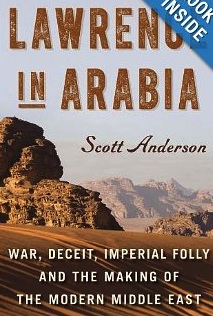
This Vatican document is referenced in an important new book by Scott Anderson, Lawrence In Arabia: War, Deceit, Imperial Folly and the Making of the Modern Middle East.

So important is this book that it received two laudatory views in The New York Times, one month apart.

In his Times review, Alex von Tunzelmann, capsules the narrative of the book:

Scott Anderson, a veteran war correspondent and an author of both fiction and nonfiction, gives Lawrence’s story a new spin by contextualizing him in a group biography. He weaves in the lives of three contemporary Middle Eastern spies: Curt Prüfer, a German conspiring with the Ottomans to bring down the British Empire; Aaron Aaronsohn, a Zionist agronomist of Romanian origin, settled in Palestine; and William Yale, an East Coast aristocrat and an agent of Standard Oil who ended up in the service of the American State Department.

A month later, Janet Maslin is back with her review, equally laudatory.  She writes:

As to why such acclaim elevated one renegade Briton and his feat of creating a guerrilla Bedouin army, Mr. Anderson writes that the short answer may seem anticlimactic. His reason: This was a time when the seed was planted for the Arab world to define itself less by what it aspires to become than what it is opposed to: colonialism, Zionism, Western imperialism in its many forms.'”

In their reviews, both Alex von Tunzelmann and Janet Maslin avoid mentioning a key moment in Scott Anderson’s book.  It is an important episode Pope Francis should be reminded of should he choose to visit Tel Aviv.

The episode, described by Scott Anderson (pages 298 to 305, your Holiness, if I may be so bold) describes a successful propaganda campaign orchestrated by, among others, Aaron Aaronsohn, described by reviewer Alex Von Tunzelmann as “a Zionist agronomist of Romanian origin, who had settled in Palestine.”

Scott Anderson (at right) tells the story in his superb history of the period, Lawrence In Arabia: War, Deceit, Imperial Folly and the Making of the Modern Andeson Robert Clark NYTMiddle East.

The In in the title is underlined to distinguish it from Lawrence Of Arabia, the 1962 David Lean film.

Here is how Anderson develops his narrative, summarized and quoted, in part:

In the spring of 1917, the Turkish Ottoman ruler of Syria was Djemal Pasha. When the British army was poised to strike Gaza City in February, Djemal Pasha ordered the evacuation of Gaza City’s entire population, a total of around 20,000 citizens.

He wanted to clear the area for his army to move in and defend Gaza. After defeating the British in a cleared out Gaza, Djemal Pasha and his German commanders looked north.

They suspected that the British would next attack Jaffa (now a modern Tel Aviv). The city had a population of 40,000, of which around 10,000 were Jews and around 4,000 were Arab Christians, living alongside Arab Muslims. After the defeat in Gaza, the Ottomans were afraid the British would attack Jaffa from the sea,using the city’s smooth beaches for easy access.

The British defeat at Gaza came on March 26, 1917. Two days later, assuming the British would turn north, Djemal ordered the evacuation of the entire population, Christians, Jews and Muslims. He gave the residents a week to prepare to move out.

When Jewish leaders protested that the sacred Passover holiday was about to begin, Djemal extended the evacuation order for an additional eight days.

Anderson writes: “By clearing the city, Djemal Pasha unwittingly set in motion one of the most consequential misinformation campaigns of World War I.”

Ignoring the fact that Jews were joined by Christians and Muslims in the forced evacuation, the Zionist propaganda machine went into action, building the movement of the Jaffa population into an attack on all Jews of Palestine. The British Jewish Chronicle newspaper led the way with a May 4 story that carried the subhead: “Grave Reports—Terrible Outrages—Threats of Wholesale Massacre”.

The Chronicle story continued:

“But even worse is threatened. For the Turkish Governor, Djemal Pasha, has proclaimed the intention of the authorities [sic] to wipe out mercilessly the Jewish population of Palestine, his public statement being that the Armenian policy of massacre is to be applied to the Jews”. That message swept “through Jewish communities in Britain, the United States and continental Europe and drew anguished appeals to their governments that some kind of action be taken”.

William Ormsby-Gore, a Conservative member of Parliament who had been favorably impressed with Aaron Aaronsohn, the Jewish spy leader in Palestine, cabled British War Cabinet member Mark Sykes (of Sykes-Pico fame) May 4:

“I think we ought to use pogroms in Palestine as propaganda. Any spicy tales of atrocity would be eagerly welcomed by the propaganda people here, and Aaron Aaronsohn could send some lurid stories to the Jewish papers.”

Aaronsohn gave Sykes the names of 50 Zionist leaders throughout the world, urging him to spread the word of the “dire threat” against the Jews of Palestine. Soon, The New York Times printed its story with this headline: “Cruelty to Jews Deported in Jaffa.”

The Turkish government was slow to respond to the false accusations, including one that claimed, falsely, that all the Jews had been evacuated from Jerusalem.

Finally, facing worldwide condemnation based on Jewish propaganda which spread rapidly, Djemal Pasha pointed out that the entire population of Jaffa, 40,000 residents, had been evacuated, only 10,000 of which were Jewish and 4,000, Christians.

Scott Anderson concludes his account of the successful misinformation campaign surrounding Jaffa’s Jewish population in 1917: (p. 304)

Spain, Sweden and the Vatican, all neutral entities in the conflict, sent envoys to investigate what had happened [in Jaffa]. Both the Spanish and Vatican envoys quickly concluded that the reports of Jewish massacres and persecutions were without foundation, while their Swedish counterpart went even further.

“In many ways,” he wrote, “the Jewish community of Jaffa had fared far better–and certainly no worse—than the resident Moslem population in the evacuation.” Shortly afterward, the U.S. consulate in Jerusalem also reported that the accounts of violence against the Jaffa Jews were “grossly exaggerated.”

It didn’t matter, of course. In war, truth is whatever people can be led to believe and Djemal Pasha had just handed his enemies a “truth” that would change Middle Eastern history.” The fiction of what happened in Jaffa in 1917–a fiction repeated as act by most historians writing on the period since—would now become the ur-myth for the contention that the Jewish community in Palestine could never be safe under Muslim rule, that to survive it needed a state of its own.

Pope Francis does not have to make a gift to Netanyahu of either the Vatican 1917 Jaffa report or Scott Anderson’s book, should the two leaders meet in Tel Aviv.  What he can do is prepare for his meeting by reading both the Vatican document and Lawrence In Arabia.

Having read the document and the book, he will be prepared to confront the Prime Minister with some hard truths about a history that is more recent, and certainly more pertinent to this moment, than the 15th century Spanish Inquisition.

               The picture above of Scott Anderson, is from The New York Times.
Posted in Middle East Politics, Netanyahu, Politics in Religion, Religion and politics | 9 Comments

The Secret Mission of William J. Burns

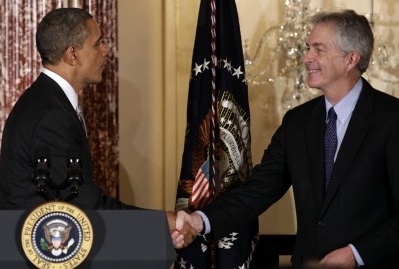
by James M. WallU.S. President Barack Obama shakes hands with Deputy Secretary of State William Burns at the Diplomatic Corps holiday reception at the State Department in Washington

“The Secret Mission of  William J. Burns” is a true story that begins in Amman, Jordan. The year is 1983.

William J. Burns, a 27-year-old U.S. Foreign Service officer, is on his first overseas post to Amman, Jordan.

War is raging between Iran and Iraq. Burns volunteers to drive a truck load of communications equipment across the desert from Amman to Baghdad, Iraq,  a distance of 500 miles.

As soon as the freshly-minted diplomat reaches the Iraqi border, he is arrested and held for two days before being escorted to the capital by police.

As Burns would later recall, his career “didn’t exactly get off to a rocket-propelled start.”  After that two-day delayed mission to Baghdad, however, the career of William J. Burns has taken off like a rocket.

Currently serving as the U.S. Deputy Secretary of State, Burns (pictured above with President Obama) has just completed a far more significant secret mission. He has led  “a secret U.S. back channel to Iran going back to before the June election of Iranian President Hassan Rouhani”.

Laura Rosen has the story on her Back Channel news blog for Al Monitor:

Burns was tapped to lead the US diplomatic effort to establish a bilateral channel with Iran, which gained momentum after the exchange of letters between US President Barack Obama and Iranian President Rouhani in early August, US officials said.

Led by Burns, the US’s second highest ranking diplomat and a former lead US Iran nuclear negotiator, the US effort to form direct contacts with Iran also includes two officials from the Obama White House: Jake Sullivan, the national security advisor to Vice President Joe Biden, and Puneet Talwar, the National Security Staff senior director for Iran, Iraq, and Persian Gulf affairs, US officials confirmed.

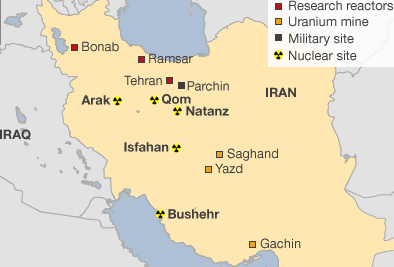
The agreement reached to cover the next six months, according to Al Monitor’s Laura Rozen, “was painstakingly assembled during four days of marathon negotiations”. The agreement calls for Iran:

 to halt most of its uranium enrichment efforts, eliminate its stockpiles of uranium already purified to near weapons grade quality, open its facilities to daily monitoring by international inspectors and significantly slow the construction of the Arak plutonium reactor.

Nuclear weapons can be assembled using either enriched uranium or plutonium, and the new pact is designed to make it difficult, if not impossible, for Iran to gain enough of either material for a bomb.

In exchange, Iran would gain some relief from the punishing economic sanctions that had been leveled by Washington and its allies in recent years, freeing up roughly $6 billion.”

Israeli Prime Minister Benjamin Netanyahu did not know of Ambassador Burns’ bilateral channel with Iran until September 30 when he learned of it directly from President Barack Obama. After the story became public, the Israeli conservative newspaper The Times of Israel, reported how the news had reached Netanyahu:

In the confines of 1600 Pennsylvania Avenue on September 30, just after the Jewish high holidays, Obama revealed to Netanyahu that his administration had been engaged in secret, high-level diplomatic talks with the mortal enemy of the Jewish state.

Netanyahu’s immediate public reaction betrayed no surprise, but a day later he launched a full-frontal attack on Iran, delivering a blistering speech at the UN General Assembly in which he said the Islamic Republic was bent on Israel’s destruction and accused Rouhani of being a “wolf in sheep’s clothing.”

Netanyahu’s allies in the U.S. Israel Lobby, including members of Congress, led by New York Senator Charles Schumer and his Republican colleague from Illinois, Senator Mark Kirk, in concert with pro-Israel media, and conservative Jewish organizations, have all joined Israel’s side in an effort to scuttle the agreement with Iran.

This is not the first time Benjamin Netanyahu has encountered William J. Burns. Sixteen years after his first low-level posting in Amman, Burns returned to Jordan in 1998 as the U.S. ambassador.

Speaking to the Senate committee considering his nomination in 1998, Burns said:

“It is a special honor and pleasure to have been nominated to return as Ambassador to Jordan, where I began my diplomatic career sixteen years ago.”

The new ambassador began his second tour in Amman a few months after September 25, 1997, when, on a sidewalk in Amman, a team of Israeli assassins unsuccessfully tried to kill Hamas political bureau director Khalid Mishal, by injecting poison in his ear.

Burns was not serving in Jordan at the time. He was, however, the U.S. ambassador who had to deal with the diplomatic aftermath of the failed Israeli assassination attempt.

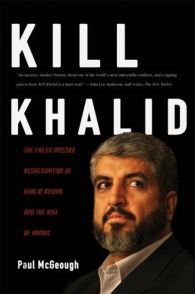
That connection calls for consideration of a book that appeared twelve years after the failed assassination attempt. Australian journalist Paul McGeough published a meticulously well-crafted account of the street attack and its aftermath, Kill Khalid: The Failed Mossad Assassination of Khalid Mishal and the Rise of Hamas. (The New Press, 2009).

In my August 2, 2009 Wall Writings posting on the book, I described it this way:

Kill KhalidThe book races along like a spy thriller, starring real-life leaders like Israeli Prime Minister Bibi Netanyahu, President Bill Clinton, the King of Jordan, and Khalid Mishal, whose near-death experience in Amman projected him into his current role as the leader of the Hamas political bureau.

This is a story of intrigue, deceit, plot twists, villains and heroes that cries out to be made into a movie. And yet, just as the events of 1997 were largely ignored by mainstream media, McGeough’s 2009 book has received limited attention, with a few exceptions, all available on line: Jane Adas, in the Washington Report on Middle East Affairs; Adam Shatz, in the London Review; and Greg Myre, in The Washington Post.

The story itself quickly faded from western consciousness.

For this reason, it is important to recall the story of the failed Israeli assassination attempt on Hamas leadeer Khalid Mishal at this time, when William J. Burns,  the former U.S. ambassador to Jordan, once again enters and troubles Benjamin Netanyahu’s tightly controlled universe.

Kill Khalid provides considerable insight into an important moment in history for anyone wishing to comprehend the unbridled passion of Benjamin Netanyahu, a passion that heats up whenever he is confronted by anyone who fails to give him precisely what he demands.

Paul McGeough’s book should also be read as background for recent findings on what is now widely accepted as the poisoning death of Palestinian President Yasir Arafat.

Note the similarities:  Israel’s method of killing an opponent, which was ordered in Khalid Mishal’s case by the then Israeli Prime Minister Netanyahu, was planned to be carried out in secret.

The poison used on Mishal was slow working and almost impossible to detect. The plan was for Mishal to receive the poison in what was to appear to be an accidental encounter with a man on the street.

According to the Massad plan, the Palestinian Hamas leader would proceed on his way until the poison did its deadly damage far removed from the street location where he had been poisoned.

Fortunately for Mishal, Jordanian police captured two of the assassins immediately after the street attack. Jordan’s King Hussein  (father of the current Jordanian King Abdullah) telephoned Netanyahu with the news that he was holding his Israeli agents, all of whom he was prepared to execute for attempted murder.

Hussein had learned from the captured Israeli team members that they had brought with them an antidote that could save Mishal. They admitted they carried the antidote in case one of the assassins was accidental poisoned.

To underscore his anger and determination to save Khalid Mishal, who was a guest in the King’s nation, King Hussein called U.S. President Bill Clinton to deliver the same warning.

The  word to Washington was blunt: Israel must save Khalid or Israel’s agents will die. Clinton called Netanyahu. An humiliating (to Israel) agreement was reached. Israel would produce the antidote immediately, which it did.

Furthermore, Israel was forced to release a number of Israeli-held Palestinian prisoners, most notably Sheikh Ahmed Ismail Hassan Yassin (1937- 2004), a founder of Hamas, who served as the spiritual leader of Hamas. The Sheikh, who was almost totally blind and wheel-chair bound, was released and returned to Gaza to great acclaim by the Palestinian public.

Netanyahu lost his reelection bid in July, 1999, defeated for Prime Minister by Ehud Barak. Netanyahu returned to politics in 2002 as Foreign Affairs Minister (2002–2003) and Finance Minister (2003–2005) in Ariel Sharon‘s governments.

It was during Netanyahu’s term as Finance Minister that Ahmed Yassin was killed in an Israeli attack on March 22, 2004. Israeli AH-64 Apache helicopter gunships fired Hellfire missiles that killed Yassin and both of his bodyguards. The attack came while he was being wheeled out of an early morning prayer session in Gaza city.

The period of time after that humiliating failure by Israel’s Massad agents to kill Khalid Mishal, was a dark period in the career of Israeli Prime Minister Benjamin Netanyahu.

Jordan and the U.S. were the instruments of his humiliation in that dark period.  And just  across the Jordan River, starting a few months after Netanyahu’s humiliation, there sat William J. Burns, the U.S. ambassador to Jordan, two countries that humiliated Netanyahu in 1997.

Netanyahu returned to power as prime minister in 2009. Khalid Mishal is still an Hamas leader.

In the Burns-Netanyahu story that began with a 27-year-old William J. Burns driving communication equipment across a desert to Baghdad, Benjamin Netanyahu has suffered a major political setback due in large part to the work of William J. Burns.William J. Burns

Burns (at right), the man who was the US. ambassador to Jordan in 1999 when Netanyahu lost his election, has now negotiated an agreement with Iran, worked out in secret, to lift crippling sanctions on the Iranian economy.

He was chosen for the assignment by Secretary of State John Kerry, who describes his Deputy this way:

Bill is the gold standard for quiet, head-down, get-it-done diplomacy,” Kerry said of Burns.

“He is smart and savvy, and he understands not just where policy should move, but how to navigate the distance between Washington and capitals around the world. I worked with Bill really closely from the Senate Foreign Relations Committee, and I’m even more privileged to work with him now every single day. He has an innate knack for issues and relationships that’s unsurpassed.”

Israeli leaders are accustomed to working with U.S. presidents and their diplomats, who are expected  to represent Israel’s best interests, William J. Burns  does not fit that mode. He has been described as a man with a “brilliant mind, unflappable demeanor and flair for self-effacement in a field where titanic egos often clash make him the fastest-rising career diplomat of his generation,”

That accolade came from Time magazine writer David Van Biema, in a 1994 profile of Burns he wrote for the magazine’s list of 50 people under-40 who will make a difference.

Burns is a U.S. diplomat who has distressed Benjamin Netanyahu by working, initially in secret, to hammer out an agreement that is designed to relieve the suffering of the Iranian people, and curb the further spread of nuclear weapons.  He did not do this to distress Netanyahu, but to  save him from further humiliating himself and his nation.

One final word on William J. Burns from Shilbey Telhami, a Middle East expert with the University of Maryland:

“Bill Burns is probably and arguably the most respected and effective U.S. diplomat. Period. He is universally acclaimed in the region and within the department and by Republican and Democratic administrations.”

Who is Shilbey Telhami, this academic and author, who sings the praises of William J. Burns?

Here is an insight that should help us understand Telhami, who is the author of The World Through Arab Eyes.  Before the Israeli-Palestine peace talks were resumed , Telhami wrote an essay on peace in the Middle East for Brookings. He begins:

As Secretary of State John Kerry continues to give much time and effort to the Palestinian-Israeli issue, with plans to convene negotiations in Washington this week, his critics have come from right and left: With all the pressing issues, why is Mr. Kerry focused on this one?

Critics miss the point: No issue is more central for Arab perceptions of the United States — even as Arabs are focused on their immediate local and national priorities.

America has little influence in the events unfolding in the Arab world, from Egypt to Syria. More centrally, Arab perceptions of Washington are less dependent on short-term American policy and more a product of deep-seated Arab mistrust that ties everything the United States does to helping Israel and controlling oil.

Shilbey Telhami has Arab street cred*. When did we last hear someone with authentic Arab street cred sing the praises of an American Deputy Secretary of State?  These are, indeed, remarkable times.

In the picture at top, U.S. President Barack Obama shakes hands with Deputy Secretary of State William Burns at the Diplomatic Corps holiday reception at the State Department in Washington on December 19, 2012.The picture appeared on an Atlantic blog. It was taken by  Yuri Gripas for Reuters.

*Street cred: “  Commanding a level of respect in an urban environment due to experience in or knowledge of issues affecting those environments. As in: He’s been thru it all. His street cred is undeniable.

Posted in Iran, John Kerry, Middle East Politics, Netanyahu, Obama | 7 Comments

Menendez to AIPAC: You Have My Hand in Friendship and the Power of My Office, Shalom

by James M. Wall

When President Barack Obama named Senator John Kerry as his Secretary of State, he opened the door for a new chair to assume control of the Senate Foreign Relations Committee: New Jersey’s Democratic Senator Robert Menendez.Mendenze

Menendez (at right) replaced Senator Kerry as chairman on February 1, 2013. On March 5, the new chairman spoke to the annual AIPAC policy council in Washington.

His talk concluded  with this ringing promise: “You have my hand in friendship and the power of my office. Shalom”

He is keeping that promise. This week, speaking with the “power” of his office,  he took a strong position against  President Obama’s effort to reach a nuclear agreement with Iran.

When word went out from Israeli Prime Minister Benjamin Netanyahu to the U.S. Congress, that this was the time to stand with Israel, Senator Menendez was ready with his op-ed.

Menendez wrote in USA Today, “We cannot substitute wild-eyed hope for clear-eyed pragmatism given Iran’s record of deception.”

In demeaning Iran’s “so-called charm offensive”, the Senator used a phrase initially voiced by Benjamin Netanyahu.

A so-called Iranian charm offensive is simultaneously matched by an actual offensive to cross the nuclear weapons threshold. It is incompatible for Iran to pursue true diplomacy while installing any new centrifuges, including advanced centrifuge technology, and developing a heavy water reactor in Arak in defiance of the international community, most vocally this weekend by France.

This week on the eve of another round of talks with Iran and the five permanent members of the UN Security Council, Britain, China, France, Russia and the US, plus Germany, Senator Menendez chose sides.

His op-ed drew a predictable response, published on the web site of the Iranian news agency, Press TV:

“The US Congress has recently been seeking to approve a bill to increase sanctions against Iran. It has been decided that the negotiations be suspended if the bill gets through the US Congress,” said Mohammad Hassan Asafari who sits on the National Security and Foreign Policy Committee of Majlis.

The Iranian lawmaker made the remarks after a meeting in which Iran’s nuclear negotiating team briefed the parliamentary committee on two rounds of nuclear talks with the [P5 plus one] nations.

The US Senate Banking Committee is mulling over whether to move ahead with a new anti-Iran sanctions bill it had delayed before the latest round of talks between Iran and the group of six world powers which was held in the Swiss city of Geneva on November 7-10.

An Act Blue fund-raising appeal for Menendez emphasized the senator’s devotion to Israel:

Senator Menendez’s work in the Senate parallels the issues of concern of the American Jewish community. Menendez recognizes the political, economic, and strategic significance of the US-Israeli alliance, and has been vocal in his support of the relationship. He is truly a friend to Israel and New Jersey’s Jews.

The senator is now acting on that friendship. He is also standing by his speech to AIPAC.  The closing minutes of those remarks are here:

http://youtu.be/hJ4RB3u-lwk

James Traub, a contributing writer for The New York Times Magazine, responded to Menendez on the Foreign Policy website:

In an op-ed in USA Today, Democratic Senator Robert Menendez, the chairman of the Senate Foreign Relations Committee, explained why he had defied the administration’s urgent request that Congress hang fire on further sanctions:

“Iran is on the ropes because of its intransigent policies and our collective will…. Tougher sanctions will serve as an incentive for Iran to verifiably dismantle its nuclear weapons program.”

. . . it’s an unarguable fact that sanctions on Iran’s oil sales and financial system, imposed by the European Union as well as Congress, have forced the Iranians to take the nuclear negotiations more seriously than they have in the past, and may even have helped elect the moderate president Hassan Rouhani.

So why is the White House insisting that Menendez and his colleagues on the left and right are provoking “a march to war”? The obvious answer, furnished by Secretary of State John Kerry, among others, is that Iran would view additional sanctions imposed in the middle of the most delicate negotiations as a sign of bad faith.

More to the point, a punitive response by the West would undermine the moderates on Rouhani’s team, and prove to Iranian hard-liners — including the supreme leader, Ayatollah Khamenei — that the United States and its allies are an intransigent adversary intent on humiliating Iran and ultimately overthrowing its Islamic regime.

. . .. The reason why Menendez and others really are marching on a path to war is that they are demanding an outcome which Iran manifestly will not accept: zero enrichment.

As Daryl Kimball, director of the Arms Control Association, puts it, “This is a strategy based upon hope that is not supported by the evidence of Iranian actions over the past decade, its past statements, or common sense.”

On the British web edition of  Guardian, Michael Cohen points to “flash points” that have “strained” U.S.-Israel relations:

The most notable flash point between the US and Israel is quite obviously Iran. Since taking office, President Obama has sought a deal to end Iran’s efforts to build a nuclear weapons. While this is clearly in Israel’s interest, it’s the outlines of a possible agreement that is the problem.

The Israeli position of no uranium enrichment, even for peaceful purposes, the removal of all enriched uranium from Iran and the shutting down of all enrichment facilities is a negotiation non-starter – and stands in sharp contrast to the US position. .  .  Netanyahu appears focused on trying to torpedo any chance of an agreement, altogether. This is a dangerous game that if successful would not only create a fundamental breach between the US and Israel, but would almost certainly increase the likelihood of Iran actually getting a clear nuclear capability.

By choosing Israel’s side in these negotiations, Senator Menendez accepts Israel’s negotiating methodology: Make impossible demands to guarantee that no agreement is possible.

This is the same method Israel uses in the second “flash point” that Michael Cohen identifies in his Guardian column, the Palestinian-Israeli peace talks.  Israel has participated for decades in these talks while stealing Palestinian land and tightening its control of the Palestinian population.

The “impossible scenario” is Israel’s modus operandi. Will it work with Iran? Senator Menendez must believe it will.

Act Blue assures us Senator Menendez “is truly a friend to Israel”. Is promoting war with Iran a friendly act? Maybe it is time for Act Blue to tell the Senator that “friends don’t let friends drive drunk”.

Posted in Uncategorized | 7 Comments

Congress and Israel Against Obama and Kerry; “Which Side Are You On?”

by James M. Wall

This week, two intrepid American Jewish journalists, Richard Silverstein and MJ Rosenberg, reminded somnolent Americans that Israel’s Benjamin Netanyahu has declared diplomatic war against the White House.Amos Ben Gershon GPO:Flash jta

It is not a new war. What is different this time is that Israel’s leader has openly enlisted the U.S. Congress in his campaign.

It is that simple,  Congress and Israel on one side; Barack Obama and John Kerry on the other. On his website, Tikun Olan, Silverstein explains why this is a different level for this diplomatic war.

The Obama administration proposes to soften “some parts of the anti-Iran sanctions regime” in order to reach a workable nuclear agreement with Iran. The Israeli government has a different scenario in mind for Iran. It wants war. President Obama, John Kerry, and the American people do not want another Middle East war.

This is open diplomatic warfare, not the usual back room maneuver of Israeli lobbyists slipping copies of pro-Israel legislation to congressional staff members.

Israel’s Iranian marching orders to the U.S. Congress  have been issued: Squeeze the Iranian economy with even harsher sanctions.

This new diplomatic warfare surfaced this week at a meeting of the U.S. Senate Banking committee, where, the New York Times reports:

Secretary of State John Kerry and Vice President Joseph R. Biden Jr. pressed senators on Wednesday to give the Obama administration some breathing room to reach an accord withIran to freeze its nuclear programs, warning that a new round of sanctions could mean war instead of diplomacy.

Right on cue, one Republican member of the Banking Committee, Illinois Republican Senator Mark Kirk, openly embraced Israel’s side in delicate U.S. negotiations to secure a nuclear agreement with Iran. Silverstein writes:

Sen. Mark Kirk was even more forceful in criticizing the [U.S.] officials’ presentation:…“It was fairly anti-Israeli,” Kirk said to reporters after the briefing. “I was supposed to disbelieve everything the Israelis had just told me, and I think the Israelis probably have a pretty good intelligence service.” He said the Israelis had told him that the “total changes proposed set back the program by 24 days.”

Time to strike up a chord and sing the old labor union song, “Which Side are You On?”.

http://youtu.be/msEYGql0drc

Silverstein has chosen his side. He is troubled by congressional dependence on Israeli sources. He continues:

There are a number of very troubling issues here: first, that Israel’s government has taken upon itself to lobby intensively for policies opposed by the current administration; second, that U.S. senators would readily attend such lobbying sessions with foreign government officials and use the briefing material offered them in order to shape their own views; third, that a U.S. senator would admit that he’d been briefed, even indirectly, by a foreign intelligence service; fourth, that a U.S. senator believes the Mossad’s views about the Iranian nuclear program represent those of a “pretty good intelligence service.”

Buzz Feed reported that Sen. Kirk drew parallels between Nazi Germany and Iran, the British and the U.S.

“Today is the day I witnessed the future of nuclear war in the Middle East,” Kirk said, also comparing the administration to Neville Chamberlain, the British prime minister who signed away the Sudetenland to Hitler’s Germany in 1938. “How do you define an Iranian moderate? An Iranian who is out of bullets and out of money.”

Bad joke, Senator. It even falls below AIPAC’s standard. This is not a time for a U.S. senator to undercut two important  peace-oriented Obama-Kerry initiatives.

A well-known political adage speaks of foreign policy stopping at the nation’s water edge.  The adage has many incarnations, the earliest of which may have originated in 1814 with Daniel Webster’s “Even our party divisions, acrimonious as they are, cease at the water’s edge”.

Senator Kirk would do well to restore any version to his senatorial playbook.

Kirk’s support for the policies of a foreign nation against that of his own president, does not measure well against Secretary Kerry’s recent candid interview with two journalists in Jerusalem where Kerry spoke of the importance of reaching a peace agreement between Israel and Palestine, an agreement forged in the best interests of, and the values of, the American people.

Kerry demonstrated his consistent diplomatic candor in his testimony on Iran before the Banking Committee. What he faced was at least one senator who takes his marching orders from beyond the water’s edge.

Buzz Feed reports:

A Senate aide familiar with the meeting said that “every time anybody would say anything about ‘what would the Israelis say,’ they’d get cut off and Kerry would say, ‘You have to ignore what they’re telling you, stop listening to the Israelis on this.’”

MJ Rosenberg, a Jewish-American columnist who once worked for AIPAC, is the second intrepid American Jewish journalist to issue a warning to the American public. In this week’s column, he writes:

The President of the United States and, according to the polls, 75% of Americans, want the United States to reach a nuclear deal with Iran. That view is as universal as any can be in a democracy like ours. Americans want an Iran deal to avoid U.S involvement another monstrous war in the region. And because they know that only negotiations can prevent a nuclear armed Iran if that is the goal of its leaders.

Only one group opposes a deal. It is the Israel lobby following orders it receives from Israel’s government. Members of Congress who oppose a deal are doing so in order to please the lobby and continue to receive campaign donations from it. Writers, columnists, reporters, bloggers and media personalities who oppose a deal are all (with no exceptions) associated with the lobby. In short, American interests are all arrayed on one side and Netanyahu’s interests are on the other.

A few days before the Senate Banking Committee took up the issue of Iranian sanctions, leaders of the American Jewish Federation received their inspiration from the Man Himself, Benjamin Netanyahu.

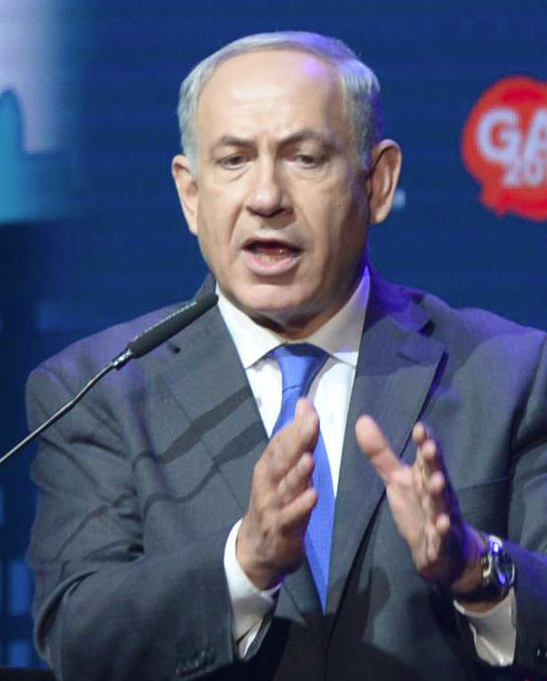
Speaking November 10 in Jerusalem to the Jewish Federations of North America General Assembly, Netanyahu (pictured speaking to the Assembly above) stated his case against the U.S. on two issues, Iran and Palestine.

He repeated his demand that Palestinian leaders “recognize Israel as a Jewish state”, a deal breaker in the negotiations. He knows that, which is why he has added the demand to the talks.

He also told his American Jewish audience they must reject their own government’s move toward a nuclear compromise with Iran because the compromise is a “bad deal”.

Netanyahu received “loud cheers from the crowd” as  he combined the two demands with his emotional call for Jewish worldwide unity

“When it comes to Jewish survival and the survival of the Jewish state, I will not be silenced, ever. We are the Jewish state. We are charged with defending ourselves and speaking up. All of us, all of us, have to stand up and speak up.”

 It is not hard to see “which side” the Chicago Tribune is on. In his November 14 story on the Bank Committee hearings, Tribune Washington bureau reporter Paul Richter dealt with Netanyahu’s cohabitation with the U.S. Congress in tortured euphemistic terms:

“Netanyahu, like many Congress members, fears the White House may accept too lenient a deal and is urging stronger sanctions in hopes of making Tehran more willing to yield.”

The Israeli Prime Minister, “like many Congress members”? Does the Tribune’s Richter see it as a mere coincidence that the Congress and Netanyahu are reading from the same script?

Surely, he knows that Netanyahu wrote the script, delivered it to the Jewish Federation leaders last Sunday and then dispatched his agents to Washington to deliver the word directly to the U.S. Senate.

The Banking Committee will presumably vote on the Iranian “tougher” sanctions this week.  Which side will it choose?

The picture of Netanyahu above, speaking at the Jewish Federation of North America is by Amos Ben Gershon for GPO/Flash. It is from the Jewish Telegraph Agency.

Posted in Iran, Media, Middle East | 9 Comments

John Kerry: Unfiltered In His Own Words

by James M. Wall

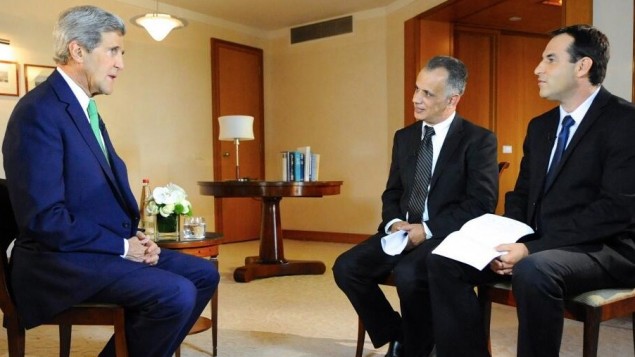
US State DepartJohn Kerry took the unusual step of agreeing to a November 6, Jerusalem television interview with two reporters, an Israeli and a Palestinian.

He did so in order to send a public message to Israeli Prime Minister Benjamin Netanyahu.

An Israeli writer for the right-wing Jerusalem web site, Times of Israel, got the message. He did not, however, like what he heard. He relayed his negative reaction in his story:

For the first time since he managed to restart the [Israel-Palestine peace] talks in July, Kerry dropped his statesman-like public impartiality, and clearly spoke from the heart — and what emerged were a series of accusations that amounted to a forceful slap in the face for Netanyahu. It was a rhetorical onslaught that the prime minister cannot have expected and one he will not quickly forget. (emphasis added by blogger)

The writer with that perspective is Raphael Ahren, diplomatic correspondent for the Times of Israel, a Web-only, English-language Israeli newspaper, launched in February earlier this year by Seth Klarman, a wealthy American Jewish investor.

Klarman, according to Wikipedia, has also been the longtime chairman and a financial supporter of The David Project, a Boston-based group which sponsors pro-Israel advocacy programs on American college campuses.

Using words from Kerry’s TV interview, and then filtering them through the Times‘ right-wing perspective, Ahren continues:

A very frustrated Kerry basically blamed the Israeli government for stealing the Palestinians’ land and the Israeli public for living in [a] bubble that prevents them from caring much about it. If that wasn’t enough, he railed against the untenability of the Israel Defense Forces staying “perpetually” in the West Bank.

In warning that a violent Palestinian leadership might supplant Mahmoud Abbas if there was not sufficient progress at the peace table, he appeared to come perilously close to empathizing with potential Palestinian aggression against Israel.

As to tone and intent, Ahren got it about right. The problem is, what he heard as a “slap in the face” were words intended not as an insult, but as a wake-up call.

Kerry spoke as a friend of the state of Israel, but more importantly, he warned Netanyahu that his adamancy was damaging the chance for peace in the region.

In his Times story, Ahren focused on Kerry’s responses that clearly disturbed Ahren.

If we do not resolve the question of settlements, [Kerry] continued more dramatically, “and the question of who lives where and how and what rights they have; if we don’t end the presence of Israeli soldiers perpetually within the West Bank, then there will be an increasing feeling that if we cannot get peace with a leadership that is committed to non-violence, you may wind up with leadership that is committed to violence.”

He later elaborated, expressing apparently growing dismay over continued Israeli settlement expansion:

“How, if you say you’re working for peace and you want peace, and a Palestine that is a whole Palestine that belongs to the people who live there, how can you say we’re planning to build in a place that will eventually be Palestine? So it sends a message that perhaps you’re not really serious.”

The New York Times juggled two Netanyahu stories simultaneously, the Prime Minister’s response to Kerry’s interview, and his attack on the carefully constructed Iranian nuclear agreement.

Responding to Kerry’s interview in Jerusalem, Netanyahu said “pressure has to be put where it belongs, that is, on the Palestinians who refuse to budge.” The Times adds that Netanyahu “was in no mood to compromise”.

The Times asked Hanan Ashrawi, a member of the Palestine Liberation Organization’s executive committee, for her reaction to Netanyahu’s attack on Kerry’s efforts to reach a nuclear agreement with Iran.

Ashrawi “denounced Mr. Netanyahu’s statements on Iran as ‘arrogant,’ ‘childish” and ‘an insult’ to Mr. Kerry, and said they reflected a relentless focus on Israel’s security that has prevented progress in the peace talks.

“His temper tantrum response to an Iran agreement is just an extension of that mentality,” Ms. Ashrawi said. “I want to do what I want to do, I want to get away with everything, and I want to dictate to everyone, including the U.S., how they should behave regarding Israel’s security the way Israel exclusively defines it.”

Many other U.S. media outlets, including National Public Radio, relied on the Associated Press story of Kerry’s interview by Matthew Fox. The AP story went with the heading, “Kerry Warns Of Violence If Peace Talks Fail”. That heading stayed with the story in its many incarnations. It began:

 U.S. Secretary of State John Kerry issued a stark warning to Israel on Thursday, saying it faces international isolation and a possible explosion of violence if it does not make progress in peace efforts with the Palestinians.

Kerry issued the blunt remarks in a joint interview with Israeli and Palestinian television channels, ensuring the message would reach its intended audience.

“The alternative to getting back to the talks is the potential of chaos. I mean does Israel want a third intifada?” Kerry said, using the term for past Palestinian uprisings against Israeli occupation.

The settlements and a warning to Israel that a peace agreement will not wait forever, were not the only highlights of Kerry’s Jerusalem television interview with the two journalists, Udi Segal of Israeli Channel 2 and Maher Shalabi of Palestinian Broadcasting Corporation.

To move beyond the “stark warning” and pending “violence”, the full text of the interview is available here. It is posted by the U.S. State Department website, which also sent out the picture of Kerry and his two interviewers.

Selected highlights of the interview, separated by topics, and gleaned from the State Department text, are below for those who wish to have an upclose and personal view of what upset Benjamin Netanyahu. Other highlights will emerge upon close reading.

“Warning” and “violence” are not words that dominate the interview.

On the demonization of Israel

SECRETARY KERRY: I believe that if we do not resolve the issues between Palestinians and Israelis, if we do not find a way to find peace, there will be an increasing isolation of Israel, there will be an increasing campaign of de-legitimization of Israel that’s been taking place in an international basis, that we if we don’t resolve the question of settlements and the question of who lives where and how and what rights they have, if we don’t end the presence of Israeli soldiers perpetually within the West Bank, then there will be an increasing feeling that if we cannot get peace with a leadership that is committed to nonviolence, you may wind up with leadership that is committed to violence.

MR SEGAL (Israeli Channel 2): Mr. Secretary, you spoke about what signaling does those things send. So let me ask you this. How do you think a picture of Mahmoud Abbas, the President of the Palestinian Authority, hugging murderers that killed children 20 or 30 years ago and say that they’re heroes of the Palestinian people – what kind of message do you think this is sent about peace process or peace atmosphere to the Israeli people?

SECRETARY KERRY: It’s very difficult. I have no illusions. I know that the vast majority of the people in Israel are opposed. I understand that. Prime Minister Netanyahu understands that, and it is a sign of his seriousness that he was willing to make this decision. The alternative to getting back to the talks is the potential of chaos. I mean, does Israel want a third intifada? .  .  .

I know there are people who have grown used to this. And particularly in Israel – Israel says oh, we feel safe today, we have a wall, we’re not in a day-to-day conflict, we’re doing pretty well economically. Well, I’ve got news for you. Today’s status quo will not be tomorrow’s or next year’s. Because if we don’t resolve this issue, the Arab world, the Palestinians, neighbors, others are going to begin again to push in a different way. And the last thing Israel wants to see is a return to violence.

Palestinian Economic Plan

SECRETARY KERRY: . . . . if you want to make peace with people, if you want people to believe in the possibilities of peace and the benefits of peace, you need to show them the benefits. If the life of Palestinians continues to not have opportunity, not see economic opportunity, not find jobs, not improve their lives, it’s hard for them to believe in the government, it’s hard for them to believe anything anybody says. But if their lives are beginning to improve, then they have a stake in the future, and they begin to believe in the possibilities of peace. And you have a better chance of making peace if life is improving and things are happening on the ground. .  .  .

We’re trying to help prove that there can be improved living conditions. More water is coming into the West Bank on a daily basis. We’re improving the Allenby Bridge movement. We’re improving the number of work permits so that more Palestinians will be able to come into Israel and be able to work. I mean, these are the ways in which you break down the barriers and you begin to show people what peace could possibly look like.

Recent agreement on prisoners and settlements

MR. SEGAL: Can you confirm that the two sides – Israeli [and] Palestinian – agreed to free murders [sic] versus building in the settlement deal as part of the resumption of the negotiation, i.e., every time that Israel will release the prisoner, there will be a wave of construction?

SECRETARY KERRY: No, I cannot confirm that, because that is not true. . . . The agreement specifically was that there would be a release of the pre-Oslo prisoners, 104, who have been in prison now for many, many years, who would be released in exchange for the Palestinian Authority not proceeding to the UN during that period of time.

The Palestinian leadership made it absolutely clear they believe the settlements are illegal, they object to the settlements, and they are in no way condoning the settlements. But they knew that Israel would make some announcements. They knew it, but they don’t agree with it, and they don’t support it. . …

We do not think you [Israel] should be doing settlements. We, the United States, say the same thing. We do not believe the settlements are legitimate. We think they’re illegitimate. And we believe that the entire peace process would, in fact, be easier if these settlements were not taking place. Now, that’s our position. . . .The United States policy has always been that the settlements are illegitimate, and we believe this process would be much easier if we didn’t have the tension that is created by settlements.

One state versus two states

SECRETARY KERRY: Well, there is no one-state solution. There’s no such thing as a one-state solution. You cannot have peace on any one side with the concept of a one-state solution. It just won’t happen. You can’t subsume other people into one state against their will. And it simply is not a reality. And anybody who’s talking about it doesn’t know really what – it’s just not possible. So you’ll have a perpetual state of conflict if somebody tries to achieve that. . . .

Importance of non-violence

MR. SHALABI (Palestinian Broadcasting Corporation): Maybe you know, Mr. Secretary, that in 2012 not one —

SECRETARY KERRY: I do know that. Not one Israeli in 2012 was killed in the West Bank. And that’s a huge step forward. And the reason I’m so urgent about this is because the Palestinians and President Abbas have committed themselves to nonviolence. So it is important for Israel to strengthen them, to help provide this peace so that the nonviolence is rewarded. Because if nonviolence is not rewarded, the alternative will be that people go back to the other.

You need to provide the security for Israel and you need to provide certainties about certain things, what happens with refugees, how you deal with the land.

The Palestinians need to know that they will have a real state, not a Swiss cheese, but a state that is contiguous, that allows them the opportunity to be able to have their sovereignty respected.

Kerry’s final two paragraphs have been highlighted because I believe they offer the essence of the Secretary’s goal for Israel and Palestine.  He cannot achieve that goal alone.  Remember his words, “a real state, not a Swiss cheese”.

A real contiguous state with respected sovereignty, is a goal that demands patience and hard work. 

Posted in John Kerry, Media, Middle East Politics, Netanyahu | 19 Comments

Do Peace Talks Point to a Carthaginian Peace?

meged oil fiends reserves of about 1.5 million barrelsby James M. Wall

On December 24, 2009, the Israeli oil exploration company Givot Olam, posted two media announcements a few hours apart.

Givot Olam’s first announcement revealed that “significant quantities” of oil had been found in the mud of Meged 5, a drill site close to the Palestinian village of Rantis, north west of Ramallah.

Rantis is located  close to the Green Line, the 1967 line that initially separated Israel from the West Bank. Israel had been searching for oil around Rentis since at least 2002, an action in violation of international law as well as a violation of the Oslo Agreement, which required that Israel and Palestine refrain from any unilateral exploration of national resources in the occupied territories.

Oil development in the West Bank would boost the Palestinian economy. It could also help develop a strong Palestinian nation on the east side of the Green Line.

The game Israel has played with its decade long development of an oil field that clearly extends well into the West Bank, is a game Israel intends to win.

The Applied Research Institute of Jerusalem (ARIJ), describes the village of Rantis where the game is being played.

Rantis, is a small Palestinian village located to the northwest of Ramallah district in the Palestinian West Bank. It has a total population of 2688 inhabitants and a built up area of 458 dunums (115 Acres). The village is inhabited mostly by 6 clans (Wahdan, Hallaf, Ballot, Dar Abo Salim, Al Yahee, Hawashe. Most of Rantis villagers depend on agriculture as their main source of income. . . . In 1967 the Israeli forces confiscated most of the Palestinian agricultural lands in the village for colonizing purposes, and hundreds of olive trees were uprooted.

Today, the village of Rantis is surrounded by a set of settlements and Israeli military areas, such as Ofrim and Beit Arye settlements which are located to the east of the village in addition to a military area located to the northwest of the village. Recently, the village lands became threatened by Israeli land confiscation activities for constructing the Segregation Wall.

Israel has worked hard to build its “security-focused” future. It has been constructing its segregation wall (a “security” wall in Israel’s narrative) since 2002.  The segregation wall runs deep into great sections of the West Bank. The wall moves in directions that have nothing to do with security and everything to do with Israel’s long-range economic planning.

Givot Olam had been told by the IOF that those eager television crews that had rushed into the West Bank could not film in the area because the Meged 5 oil well (picture above) “is located in an IDF firing zone”.

After a few hours of excitement over Meged 5’s oil-filled mud site, a second media announcement appeared.  Posting number two announced that the Israeli Occupation Forces (IOF) had closed the Meged 5 area to the media. For the moment at least, Meged 5 was another Dimona, Israel’s not-yet-admitted nuclear arms site, with its details hidden from public view.

Even without pictures, and no doubt to the delight of Givot Olam’s share holders, the company’s stock rose 177% by market close December 24, 2009 .

Israel’s peace negotiators have been sitting around a peace table with Palestinian leaders and U.S. mediators. Meanwhile, there is no halt to Israel’s settlement development on Palestinian land, nor its oil exploration around the village of Rantis.

Israel’s march toward total domination of the land between the sea and the river, plays like a bad dream from which the victims cannot wake up.  Unfortunately, it is not a dream but a well orchestrated game of pretense designed to extend the Nakba into the 21st century.

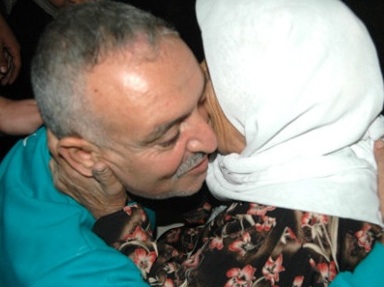
Incremental prisoner releases by Israel’s occupying military power bring brief moments of  Palestinian family reunion joy  but along with the joy is the reality of a powerless Palestinian population, trapped in an open air prison, watching its land, and natural resources stolen, while too many of its young men grow old in Israeli prisons.Allison Deger crop prisoner return

In August of this year, I suggested in Wall Writings that we study the ominous signs that indicate Israel seeks neither fairness nor justice in its dealings with its neighbors in the Middle East region.  I suggested that Israel’s policies appear to be pushing for a carthaginian peace imposed on Palestine.

The context of that posting was the development of natural gas fields off the coast of Gaza.  Israel wants control of those gas fields because, under its present government and with its current strong backing from the U.S. Congress, Israel’s economic future depends on its total destruction of a viable Palestinian state. And that is the definition of a carthagenian peace, the reduction of a defeated enemy to utter destruction.

In that posting, I suggested the possibility that Israel’s current government is pushing toward a modern day carthaginian peace.  This is part of that posting:

The term, “carthaginian peace” entered history after Rome defeated Carthage in the Punic Wars, fought from 254 BC to 146 BC.

A carthaginian peace is the imposition of a very brutal peace that crushes an enemy. If such a disastrous conclusion is reached by the Kerry-run peace talks, we will face a modern version of the end of the Punic Wars, which were, according to Wikipedia:

“a series of three wars fought between Rome and Carthage from 264 BC to 146 BC. At the time, they were probably the largest wars that had ever taken place. The term Punic comes from the Latin word Punicus (or Poenicus), meaning “Carthaginian”, with reference to the Carthaginians’ Phoenician ancestry.[3] The main cause of the Punic Wars was the conflict of interests between the existing Carthaginian Empire and the expanding Roman Republic.”

The term carthaginian peace, was most recently used to describe the peace terms the U.S. and its Allies imposed on Germany in the Treaty of Versailles, at the conclusion of World War I. Ironically, it was this unjust and vengeful carthaginian peace forced upon a defeated Germany that contributed to the rise of Hitler and the Holocaust in which six million Jews died.

If the U.S and Israel succeed in forcing Palestine to endure a carthaginian peace, it will be a peace sold to the world as necessary to protect the “security needs” of Israel, which will, on cue, claim that the peace agreement is needed to prevent the annihilation of the Jewish people, a trope that has lived well past its expiration date.

Fast forward from 2009 to Friday, January 13, 2012, when Mohammed Mar’i wrote from Ramallah for Arab News:

The Palestinian Authority Thursday accused Israel of drilling a new oil and natural gas well in the West Bank.

Jamil Al-Mutawer, vice chairman of the [Palestinian] Environmental Quality Authority, said that Israel started unilateral exploration activities in a gas and oil well near the West Bank village of Rantees (Rantis), to the west of Ramallah. He added that the Israeli security forces had beefed up presence in the area, preventing villagers from reaching their lands and farms to keep the exploration work a secret.

Al-Mutawer said the well is part of the Meged oilfield that is located alongside the wall that separates Israel from the West Bank. 

Al-Mutawer added that the Israeli Givot Olam Oil Ltd company “started the exploration activities in the field in 2004 without consulting or coordinating with the PA.”  He estimated that the field contains 1.5 billion barrels of oil and about 1.82 billion cubic meter of natural gas.

Givot Olam said that it discovered the Meged oilfield in 2004. The company said it produces 1,000 barrels every day and it is scheduled to develop the production by 2012.

Rantis has been on Israeli’s “security” radar screen for some time. Most recently, the website Occupied Palestine reported (June, 2013) that “Informed Palestinian official sources revealed that the Israeli occupation authority (IOA) changed the path of its segregation wall in Rantis village, northwest of Ramallah city in order to drill oil and gas wells”.

Which brings us to this first week of November, 2013, where the story of the village of Rantis enters its current chapter.  Student activists in Rantis have posted pictures of oil drilling in the  Rantis area.

The Middle East Monitor describes the problem Israel faces as it tries to deny its history of stealing Rantis land by using its “security wall” ploy.

The Israeli Meged-5 Oil Well is located on the edge of the Palestinian village of Rantis, which falls within the governorate of Ramallah. When the path of the Wall was amended by Israel to take in even more Palestinian land, it was supposedly done for “security reasons”.

Later it was discovered that an Israeli oil company, in cooperation with an American company, is developing and exploring the potential of an oil field which was found in the 1980s. The well was abandoned in the belief that it was not going to be commercially viable.

Givot Olam, the only Israeli company licensed for oil drilling, discovered Meged-5 in 2004 and said that it was a “commercial discovery”. In 2007 the company signed an agreement with US-owned Shire International to invest $50 million. Two years later the partnership announced that it had found signs of significant quantities of oil at the site.

On November 3, 2013, Jonathan Cook provided the economic details for Al Jazeera.

Shares in Givot Olam, an Israeli oil exploration company, rallied on reports that it had located much larger oil reserves at its Meged 5 site than previously estimated.

The company, which says it has already sold $40 million worth of oil since the Meged field went operational in 2011, now believes that the well is sitting on exploitable reserves of as much as 3.53 billion barrels – about a seventh of Qatar’s proven oil reserves.

Only one cloud looms on the horizon. It is unclear how much of this new-found oil wealth actually belongs to Israel. The well sits on the so-called Green Line, the armistice line of 1948 that formally separates Israel from the occupied Palestinian territories.

According to Palestinian officials, Israel has moved the course of its concrete and steel separation wall – claiming security – to provide Givot Olam with unfettered access to the site, between the Israeli town of Rosh Haayin and the Palestinian village of Rantis, north-west of Ramallah.

Dror Etkes, an Israeli researcher who tracks Israeli activities in the West Bank, said the Meged site was “a few dozen metres” inside the Green Line.

Israel and Givot Olam, however, have made access difficult, arguing that Meged 5 is affected by an Israeli military firing range next to it on the other side of the Green Line, in occupied Palestinian territory. In the past, Israeli media have been barred from filming or photographing the site.

Israel has been consistent in its exploitation of Palestinian natural resources, including its water, natural gas and oil. And it has been consistent in its expansion into Palestinian land with is steadily expanding settlements.

In an especially egregious act carried out during the U.S. mediated peace talks. Israel refused to even enter the peace talks unless Palestine and the U.S., agreed to Israeli demands that staggered releases of Palestinian prisoners from Israeli prisons had to be “balanced” with additional illegal Israeli settlement growth in the West Bank.

That act is just one of many which suggests that what Israel seeks for its “secure future” could be a carthaginian peace with Palestine, a peace brokered by and enforced by, a compliant U.S. government.

We will not know this for sure until the peace talks reach a stopping point and the conditions for peace are announced. One Israel political leader from the Meretz party, has indicated that a final peace plan will be announced in January, 2014.  So far, the conduct of Israel’s government points more to a carthaginian peace, than to a peace that is fair and just.

The picture of a returned prisoner was taken by Allison Degan in the early morning hours of October 30. Her story and her pictures appeared in Mondoweiss. The picture from Meged 5 at top is from Middle East Monitor.

Posted in John Kerry, Middle East Politics, Netanyahu, Obama, US govermemt | 4 Comments

“Laying by time” Gives Diplomacy a Chance

by James M. Wall

UN-GENERAL ASSEMBLY-US-OBAMAIn the rural South of the 1930s, “laying by time” usually came, according to one writer, “when the last weed-hoeing was done, marking the start of a down-time until harvest”.

It was also a time of anxiety as “farmers looked for second jobs or, as James Agee put it in Let Us Now Praise Famous Men, ‘hung as if on a hook on his front porch in the terrible leisure.'”

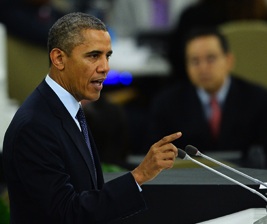
President Obama was thrust into his own foreign policy “laying by time” September 24, when he went before the United Nations General Assembly and delivered what New Republic writer John B. Judis called “his most significant foreign policy statement since becoming president”.

The UN speech also began a “time of anxiety” for the president’s foreign policy team which found itself hanging on Agee’s hook on their own “front porch in the terrible leisure”.

Susan Rice, Obama’s new national security advisor, seized the “terrible leisure” time the president gave her by setting up a series of Saturday morning policy review meetings with a small number of administration officials.

Their assignment was “to plot America’s future in the Middle East”.  The New York Times’ Mark Landler describes the policy review:

At the United Nations last month, Mr. Obama laid out the priorities he has adopted as a result of the review. The United States, he declared, would focus on negotiating a nuclear deal with Iran, brokering peace between the Israelis and the Palestinians and mitigating the strife in Syria. Everything else would take a back seat.

That includes Egypt, which was once a central pillar of American foreign policy. Mr. Obama, who hailed the crowds on the streets of Cairo in 2011 and pledged to heed the cries for change across the region, made clear that there were limits to what the United States would do to nurture democracy, whether there, or in Bahrain, Libya, Tunisia or Yemen.

The Saturday morning meetings Rice chaired focused on several key questions: “What are America’s core interests in the Middle East? How has the upheaval in the Arab world changed America’s position? What can Mr. Obama realistically hope to achieve? What lies outside his reach?”
The discussions led to the UN speech in which Obama outlined “a more modest approach — one that prizes diplomacy, puts limits on engagement and raises doubts about whether Mr. Obama would ever again use military force in a region convulsed by conflict”.
It was, in short, and fortunately, “laying by” time for U.S. diplomacy, a sharp reversal from what had almost been a major Obama military strike on Syria. That strike was avoided when, on September 11,  Syria announced that:

It will declare its chemical weapons arsenal and will sign up to the Chemical Weapons Convention to avoid US military action. In a statement shown on Russian state television, Foreign Minister Walid al Moallem said Syria was ready to co-operate fully with a Russian proposal to put its chemical weapons under international control and would stop producing more.

He added that Syria would place the locations of the weapons in the hands of Russian representatives, “other countries” and the UN.

Obama’s three major foreign policy agenda items—Syria’s civil war and its chemical weapons cache; the Israeli-Palestinian peace talks; and nuclear talks with Iran—has the potential to make a distant bad memory of President Bush’s “shock and awe” foreign policy.

The New Republic’s John B. Judis praised Obama’s commitment to diplomacy when he wrote:

President Barack Obama’s speech Tuesday [Sept 24] to the United Nations was his most significant foreign policy statement since becoming president.

It showed he had clearly learned something from the recent “red line” fiasco in Syria. The speech also displayed what has always been the most attractive feature of Obama’s foreign policy, one that clearly sets him off from his predecessor—his willingness to court erstwhile enemies and adversaries, or to put it in negative terms, his not possessing what my former colleague Peter Scoblic called an “us versus them” view of the world.

Under the headline, “Give Diplomacy a Chance”,  New Yorker blogger John Cassidy, gives the Syrians (and their Russian allies) credit for enabling Obama to embrace diplomacy.

Whatever else it accomplishes, Syria’s agreement to disclose its chemical-weapons stockpiles and, eventually, destroy them, made President Obama’s address at this year’s United Nations General Assembly much easier.

Rather than having to explain why U.S. bombs had been dropping on targets in Damascus, he was afforded a friendly environment in which to talk up the diplomatic efforts that are under way to resolve the Syrian crisis, and to encourage a similar effort addressed to the Iranian nuclear question.

Mindful of the criticism that, under his leadership, U.S. foreign policy has sometimes appeared to zigzag from one crisis to another, with no common thread, he was also keen to provide an over-all rationale for U.S. actions. To some extent, he succeeded. 

Cassidy concluded his posting:

Still, the larger point holds. Obama was reminding the world that for now, at least, the days of the United States engaging in foreign adventurism, and using the Pentagon to pursue political crusades, are over. In concert with others, America will do its bit for defending liberal values and preventing mass killings by repressive regimes, but its main focus will be on protecting its own economic and strategic interests. And if anybody wants to challenge that policy stance, they will have to talk to the U.S. public.

Thanks to the strong impression the new Iranian President Hassan Rouhani made with his visit, and speech, to the UN, Iran emerged from the world’s penalty box. The telephone call between President Obama and President Rouhani solidified that impression and gave Obama an opportunity to not-so-subtly repudiate Israel’s war-talk regarding Iran.

As expected, the diplomatic path Obama took drew U.S. congressional ire at the suggestion that Iranian sanctions could be eased through diplomacy. Nevertheless, defying Israel and the Israel Lobby, Obama’s lead negotiator in nuclear talks with Iran “called for a delay in any new sanctions on the country, in order to let negotiations take hold”.

Friday, the Guardian reported that U.S. undersecretary of state Wendy Sherman told Voice of America, the U.S. foreign media service, “”We think that this is a time for a pause, to see if these negotiations can gain traction”.

The U.S. Senate banking committee was debating “whether to take up legislation, passed by the House last July, which could end Iranian oil exports”.

The White House promptly hosted a meeting of Senate aides on Thursday, “to argue against the measure”. Sherman’s public statement “was seen as a significant gesture to Tehran”.

Iranian officials liked what they heard.

“I thought it was a very positive statement,” said Reza Marashi, research director at the National Iranian American Council. “On this particular point about the sanctions, I think that’s the most forward-leaning statement that I can recall an Obama administration official using, when discussing sanctions, at any time over the past four to five years.

“It was very specific. That not only sends a message to Congress but it also sends a message I think to the Iranians as well. That shows a certain level of seriousness to make these kinds of statements publicly.”

The New York Times’ Jodi Rudoren and Michael R. Gordon reported the quiet that has settled around the Israeli-Palestinian peace talks.  Under strict instructions from U.S. Secretary of State John Kerry, neither side has leaked stories on the talks to the media.

Nearly three months into the latest round of Washington-brokered peace talks in what has been the Middle East’s most intractable conflict, Mr. Kerry met with Prime Minister Benjamin Netanyahu of Israel in Rome on Wednesday, having said the process had “intensified” over 13 negotiating sessions, including three in the past week. Another is scheduled for Monday.

After years of stalemate, the very fact that the talks are continuing — and, perhaps even more important, that the participants have adhered to Mr. Kerry’s admonition not to disclose their content — is something of an achievement, especially in light of the turmoil raging in the region.

During the “laying by time” of these talks, mum has been the word. Not even the location of meetings have been revealed.

In contrast to previous rounds of Israeli-Palestinian talks, little has leaked from the negotiating room. Even the timing, location or duration of meetings has rarely been revealed. Several people close to the process said the sessions so far have alternated between Jerusalem and Jericho — they said they were not allowed to disclose the specific locations — and have each generally focused on a single subject, like sharing water resources, or whether Israeli or international forces should patrol the Jordan Valley.

Four people regularly attend all the meetings, Tzipi Livni, Israel’s justice minister, and Saeb Erekat, the Palestinian chief negotiator, as well as Isaac Molho, a lawyer close to Mr. Netanyahu, and Mohammed Shtayyeh, a senior adviser to President Mahmoud Abbas of the Palestinian Authority.

Other participants join the discussions  “on an ad hoc basis depending on the agenda”. After the Palestinian side complained that “Mr. Kerry’s special envoy, Martin S. Indyk, was not sitting in on the sessions, he has attended recent ones”.

All is quiet on the negotiations front, which is what President Obama wanted.  The Obama team, captained by national security advisor Rice, has been making good use of its “laying by time”.

The harvest ahead will not be easy. There are extremist forces in Israel, Iran, Syria, and the U.S. Congress, that have their own reasons for wanting to upset diplomatic efforts.

Obama knows the American public is weary of war. The Bush days of shoot first and talk later, should be behind us.  At least it looks that way as we hang on Agee’s hook on our “front porch in the terrible leisure”.

Laying by time has never been easy; It has always been a pause for rest and reflection before taking up the hard work of the harvest.

The picture of President Obama speaking to the UNGA, is by Stan Honda/AFP/Getty.

Posted in Iran, Middle East Politics, Netanyahu, Obama, United Nations | 11 Comments

U.S. Jews Battle Over Blumenthal’s “Goliath”

by James M. WallBlumenthal

Max Blumenthal is a young Jewish American journalist whose father, Sidney Blumenthal, was a senior adviser to President Bill Clinton from August 1997 until January 2001.

Preparing to write his latest book,  Goliath: Life and Loathing in Greater IsraelMax Blumenthal (shown here) spent four years reporting from Israel and occupied Palestine.

His father’s political connections did not pave the way for his interviews.  All the son needed was his American passport and Jewish identity. Both Palestinians and Jews wanted to tell their stories.

In his research Blumenthal had easy access to major Israeli literary figures like Israeli novelist David Grossman. In his interview with Grossman, which he reports in his book, Blumenthal refers to his father’s earlier career in the Clinton administration.

What provoked this rare reference to his father was Grossman’s emotional defense of Israel as an essential safe haven for Jews.

Blumenthal writes:

For Grossman and liberal Zionists like him, the transformation of Israel from an ethnically exclusive Jewish state into a multiethnic democracy was not an option. 

“For two thousand years”  Grossman told me when I asked why he believed the preservation of Zionism was necessary, “we have been kept out, we have been excluded.  And so for our whole history we were outsiders. Because of Zionism we finally have the chance to be insiders.”

In response, Blumenthal had an answer few are more qualified to give.

“I told Grossman that my father had been kind of an insider. He had served as a senior aide to Bill Clinton, the President of the United States, the leader of the free world, working alongside other proud Jews like Rahm Emmanuel and Sandy Berger. I told him I was a kind of insider and that my ambitions had never been obstructed by anti-Semitism.

“Honestly, I have a hard time taking this kind of justification seriously,” I told him. “I mean, Jews are enjoying a golden age in the United States.”

Blumenthal-Goliath-384x580Blumenthal then reports that Grossman, a man of words, “found himself at a loss. He looked at me with a quizzical look. Very few Israelis understand American Jews as Americans, but instead of belonging to the Disapora. But very few American Jews think of themselves that way, especially in my generation, and that too is something very few Israelis grasp.” (p. 276)

The gap is wide, and growing wider, between American and Israeli Jews, a fact that Blumenthal, with his cultural and political background, is uniquely qualified to understand and describe.

Blumenthal knows radical politics however it is disguised. Before he began exploring the Israeli-Palestinian divide, Blumenthal wrote Republican Gomorrah: Inside the Movement that Shattered the Party“, an examination of the takeover of the Republican Party by its right wing faction.

Blumenthal’s book has suffered the twin burden of being ignored by mainstream media and, at the same time, drawing harsh criticism from within the liberal Zionist faction of American Jewry. Losing exposure in mainstream media is regrettable, since Blumenthal’s book, as one non-mainsteam reviewer writes, “is erudite, hard-hitting, and with the potential to influence American public opinion on Israel”.

When he appeared on Amy Goodman’s Democracy Now, Blumenthal offered his take on his book. Click here for a ten-minute video clip from that program.

In the Goodman interview, Blumenthal gives details of his journey through Israel and Palestine. Since he searched over a period of four years for the personal impact of the occupation on its Palestinian inhabitants, his highly negative reportorial conclusions are both enlightening and not surprising.

Writing in Mondoweiss, Rayyan Al-Shawaf  gave the book this positive endorsement:

Erudite, hard-hitting, and with the potential to influence American public opinion on Israel, Goliath: Life and Loathing in Greater Israel, by Max Blumenthal, avoids mainstream liberals’ hand-wringing about the extent to which the occupation may at some point in the future adversely affect Israel’s much-vaunted democracy.

Instead, Blumenthal, the investigative American journalist who authored the bestselling Republican Gomorrah, focuses on how the ongoing occupation has, since its inception, destroyed Palestinian lives – and already whittled away much of Israel’s brittle democracy.

Goliath, the title of which implies that Israel resembles the giant Philistine warrior felled by the Jewish David in the Bible, also demolishes positive Western stereotypes about Israel’s treatment of its Palestinian citizens (so-called Israeli Arabs), a subject that rarely receives media coverage in the West.

Liberal Zionist and journalist Eric Alterman reached a totally different conclusion. He was greaty agitated when The Nation published a favorable review of the book.

His agitation led to two emotional pieces in The Nation. In his first column, Alterman writes as though he expected more balance on the topic from The Nation, a venerable liberal publication for which Alterman has been a regular contributor and columnist for several decades.

Here is a sample from Alterman’s first column.

Max Blumenthal’s Goliath, published by Nation Books, consists of seventy-three short chapters, each one devoted to some shortcoming of Israeli society and/or moral outrage that the Jewish state has perpetrated against the Palestinians. Some are titled to imply an equivalence between Israel and Nazi Germany (“The Concentration Camp,” “The Night of Broken Glass”); others merely evidence juvenile faux-cleverness (“How to Kill Goyim and Influence People”).

Israel is rarely wholly innocent in the stories Blumenthal tells. Its brutal military occupation of Palestinian land, now entering its forty-sixth year, has not only deeply damaged Israel’s democracy, but also desensitized its citizens to the daily humiliations it inflicts on the Palestinians. But Blumenthal proves a profoundly unreliable narrator. Alas, his case against the Jewish state is so carelessly constructed, it will likely alienate anyone but the most fanatical anti-Zionist extremists, and hence do nothing to advance the interests of the occupation’s victims.

Alterman’s insistance that the “other side” is missing from Blumenthal’s reporting is the standard Zionist argument that any conversation on this topic must never be conducted without the “other side” present and participating.

Haunted by the ever-present, and Zionist-encouraged, fear of appearing anti-semitic, Christian denominations and church leaders, as just one example, have embraced this “other side” argument by rushing to invite Jewish leaders to enter into church in-house conversations on Israel-Palestine.

Ira Glunts writes in Mondoweiss that in his second column on the book,  Alterman became even more personal in his attack on Blumenthal:

I expected to disagree with its analysis. I did not expect it to be remotely as awful as it is. Had the magazine not published its excerpt it would have been easy to ignore. It is no exaggeration to say that this book could have been published by the Hamas Book-of-the-Month Club (if it existed) without a single word change once it’s translated into Arabic. .  .  .

Goliath is a propaganda tract, not an argument as it does not even consider alternative explanations for the anti-Israel conclusions it reaches on every page. Its implicit equation of Israel with Nazis is also particularly distasteful to any fair-minded individual. And its larding of virtually every sentence with pointless adjectives designed to demonstrate the author’s distaste for his subject is as amateurish as it is ineffective.

As I said, arguments this simplistic and one-sided do the Palestinians no good. There will be no Palestinian state unless Israel agrees to it. And if these are the views of the people with whom Israelis of good will are expected to agree, well, you can hardly blame them for not trusting them.

Glunt adds: “This over-the-top indictment of Blumenthal and his book is more reflective of Alterman’s impassioned devotion to Israel than the contents of the work under review. Anyone familiar with Alterman’s copious writing on Israel would know that he would react angrily to the arguments presented by Blumenthal”.

Jeremiah (Jerry) Haber is the nom de plume of Charles H. Manekin, an orthodox Jewish studies and philosophy professor,  In his blog, Magnes Zionest , he writes:

I read half of Max Blumenthal’s new book Goliath on Shabbat, and I would like to send a copy to every Jew I know, especially every PEP Jew I know (“PEP” means “progressive except for Palestine.” ) This is the sort of book that even if you want to diss it, you can’t dismiss it. To quote PEP critic, Eric Alterman, the book is “mostly technically accurate”. And that should be enough to make anybody’s hair stand on end.

Clearly, Alterman and other leftwing American secularists can’t accept the unstated conclusion of the reportage that some of the fundamental problems of Israel are not due to a bunch of right-wing religious fanatics and nationalist Russians – not even due to Bibi and his crowd – but that, on the contrary, to core Zionist principles of the Ben Gurion school.

As Ari Shavit put it bluntly in this week’s [October 21, 2013] New Yorker, there could not have a Jewish state without inducing the mass departure of the native Palestinians in strategic areas like Lydda and elsewhere.

The story of how Israel was born as a modern state out of the horrors of the Nakba has been subsumed in the story of the Holocaust. Blumenthal found that even a small reference to the Nakba in a third-grade Israeli text was deleted.  When Prime Minister Benjamin Netanyahu returned to office he ordered all textbooks with Nakba references immediately confiscated.

The narrative of the Palestinian Nakba threatens Israel’s self-understanding as a democratic state. What liberal Zionists don’t like to face is that the modern state of Israel is fast becoming an ideological Zionist state, driven by, in Haber’s phrase above, “core Zionist principles of the Ben Gurion school”.

Posted in Middle East Politics, Netanyahu, Obama | 6 Comments

Israel Hides Nukes Behind “Ambiguity” Wall

by James M. WallIran plant Natanz Hassan Sarbakhshian :AP

This week’s Geneva nuclear table talks pit Iran against the Big Five Security Council members, plus Germany.

Iran sits alone at the table, seeking release from its “sanctions jail” incarceration from its jailers, the Big Five plus one nations.

Israel will not be in the room, even though the region’s self-proclaimed “only democracy”, is Iran’s chief accuser in these talks.

Israel’s leaders will be back home, hiding behind what Israel calls its “ambiguity wall”, a metaphorical entity which hides at least 80 Israeli nuclear war heads, plus the material to build hundreds more.

The ambiguity wall has protected Israel’s growing nuclear arsenal from the world’s eyes since the 1950s. In 1986, Mordechai Vanunu, an Israeli nuclear technician working in Dimona, breached the wall  when he leaked the country’s nuclear secrets to a British newspaper.

Vanunu said Israel had at least 100 nuclear weapons. He was kidnapped by Israeli Mossad agents in Rome and quickly convicted of espionage and treason. He served a jail term of 18 years, 11 of which were in solitary confinement.

After his release in 2004, Vanunu was forbidden to leave the state of Israel or speak with journalists. Born in Marrakech, Morocco, to a Sephardi rabbi, Vanunu learned the hard way that it is not nice to talk about what goes on behind Israel’s “ambiguity wall”.

The wall continues to be accepted as “ambigious” by world media and governments, thanks to the powerful influence of the United States, Israel’s big brother protector and financial sugar daddy. Thanks to big brother, the talks in Geneva are proceeding as though Iran’s major accuser is not needed in the nuclear table talks.

Iran, sitting as the “accused” in Geneva, does not put its nuclear facilities behind an “ambiguity” wall.  The BBC offers a close look at Iran’s various nuclear production sites. This report relies on Iran’s open stance regarding its program, in contrast to Israel’s lack of transparency.

1155 New Scientist Global SecurityIran resumed uranium enrichment work at Natanz in July 2004, after a halt during negotiations with leading European powers over its program.

It announced in September 2007 that it had installed 3,000 centrifuges, the machines that do the enrichment. In 2010, Iran told the IAEA Natanz would be the venue for new enrichment facilities – construction of which would start around March 2011.

This is the facility at the heart of Iran’s dispute with the United Nations Security Council.

The Council is concerned because the technology used for producing fuel for nuclear power can be used to enrich the uranium to a much higher level to produce a nuclear explosion.

Of course fuel produced for nuclear power can be used to produce a nuclear explosion. There is no secret about this reality. Iran wants what every developed nation wants, a developed nuclear power system, and the option to build stronger, more lethal, stuff.

Were it not for a desire to compete for military power among nations like the Big Five, plus Germany, all of whom are well armed with nuclear weapons, the world would have moved decades ago to eliminate all nuclear weapons.

They have not, so we are left with the larger powers working hard to limit nuclear arms to those who have already crossed into nuclear arms territory.  Once into that territory, nations are asked to sign the Nuclear Non-Proliferation Treaty.  Israel, of course, has never signed the treaty, nor has it been pressured to do so.

Meanwhile, in Geneva, The Guardian reports the not-yet-public opening proposal from Iran to the peace talks:

 The Iranian delegation to international talks in Geneva has presented proposals which it claims will end the longstanding deadlock over its nuclear program.

Iran’s foreign minister, Mohammad Javad Zarif, gave an hour-long PowerPoint presentation of the proposals, entitled “Closing an unnecessary crisis: Opening new horizons”, to senior diplomats from the US, UK, France, Germany, Russia, and China at the Palace of Nations in Geneva on Tuesday.

The presentation was not made public, but it is believed to lay out a timetable for a confidence-building deal that would place limits on Iran’s nuclear program in return for relief from sanctions and international recognition of the country’s right to enrich uranium.

A recent story in the Los Angeles Times, published September 15, 2013, demonstrated that Israel’s media protection had begun to slip.

Israel has 80 nuclear warheads and the potential to double that number, according to a new report by U.S. experts.

In the Global Nuclear Weapons Inventories, recently published in the Bulletin of the Atomic Scientists, proliferation experts Hans M. Kristensen and Robert S. Norris write that Israel stopped production of nuclear warheads in 2004.

But the country has enough fissile material for an additional 115 to 190 warheads, according to the report, meaning it could as much as double its arsenal.

Previous estimates have been higher but the new figures agree with the 2013 Stockholm International Peace Research Institute yearbook on armament and international security. The yearbook estimated 50 of Israel’s nuclear warheads were for medium-range ballistic missiles and 30 were for for bombs carried by aircraft, according to a report in the Guardian.

The Times story included the usual boiler plate caveat required in covering Israel’s nuclear arsenal.

Although widely assumed a nuclear power, Israel has never acknowledged possessing nuclear weapons or capabilities and continues to maintain its decades-old “strategic ambiguity” policy on the matter, neither confirming nor denying foreign reports on the issue.

Foreign Policy carried a report September 9, that on the chemical weapons front, Israel does not have clean hands.

Syria’s reported use of chemical weapons is threatening to turn the civil war there into a wider conflict. But the Bashar al-Assad government may not be the only one in the region with a nerve gas stockpile. A newly discovered CIA document indicates that Israel likely built up a chemical arsenal of its own.

It is almost universally believed in intelligence circles here in Washington, that Israel possesses a stockpile of several hundred fission nuclear weapons, and perhaps even some high-yield thermonuclear weapons. Analysts believe the Israeli government built the nuclear stockpile in the 1960s and 1970s as a hedge against the remote possibility that the armies of its Arab neighbors could someday overwhelm the Israeli military. But nuclear weapons are not the only weapon of mass destruction that Israel has constructed.

Reports have circulated in arms control circles for almost 20 years that Israel secretly manufactured a stockpile of chemical and biological weapons to complement its nuclear arsenal. Much of the attention has been focused on the research and development work being conducted at the Israeli government’s secretive Israel Institute for Biological Research at Ness Ziona, located 20 kilometers south of Tel Aviv.

But little, if any, hard evidence has ever been published to indicate that Israel possesses a stockpile of chemical or biological weapons. This secret 1983 CIA intelligence estimate may be the strongest indication yet.

According to the document, American spy satellites uncovered in 1982 “a probable CW [chemical weapon] nerve agent production facility and a storage facility… at the Dimona Sensitive Storage Area in the Negev Desert. Other CW production is believed to exist within a well-developed Israeli chemical industry.”

Meanwhile, as the Geneva talks proceed, President Obama appears to be ready for the U.S. and Iran to work toward more cordial relations.  That telephone call the President shared with Iranian President Hassan Rouhani has begun to pay dividends.

This has not been well received in Saudi Arabia, one of the few remaining Middle Eastern countries still friendly with Israel. Iran’s Fars News Agency reported the Saudis response to the improved Washington-Teheran relationship:

Saudi officials have reportedly become deeply upset and anxious over the Iranians’ success during President Hassan Rouhani’s recent visit to New York and the possible start of rapprochement between Tehran and Washington, and are seeking a way to sabotage the trend, a source said.
“The Saudi officials are highly distressed over this rapprochement and have held a meeting on September 24 in the presence of President of the Royal Court Khalid al-Tuwaijri, Commander of the National Guard Mutaib bin Abdullah, Interior Minister Prince Mohammed bin Nayef and National Security Council Secretary and Intelligence Chief Prince Bandar Bin Sultan,” an informed source close to the Saudi Royal family told FNA on Sunday.

“At the meeting the relations between Iran and the US and the settlement of Iran’s nuclear issue with the Group 5+1 (the five permanent UN Security Council members plus Germany) came under study and Iran’s growing chances of success on this path were assessed to be much dangerous to Saudi Arabia’s national security,” the source added.

The source said that the Saudi officials have decided to use all their diplomatic and intelligence capabilities and possibilities as well as their lobbies in the US to blockade a rapprochement between Tehran and Washington and Bandar bin Sultan was assigned to study possible ways of stirring tension between Iran and the US.

“The meeting also decided that any plan developed in this regard should be coordinated with the Israeli lobbies, which are also angry at the positive atmosphere created between Iran and the US,” the source concluded.

The times they really “are a-changin'” when Israel’s U.S. lobby forces are forced to make common cause with those of Saudi Arabia.

The picture at top of the nuclear facility in Natanz, Iran, is by the Associated Press’ Hassan Sarbakhshian. The map of Iran, with nuclear locations noted, is from 1155 New Scientist, Global Security.

Posted in Iran, Middle East, Middle East Politics, United Nations, US govermemt | 8 Comments

Bob Dylan: “For the times they are a-changin”

by James M. WallThe Times album original version

“For the times they are a-changin”, is a line from the third verse of Bob Dylan’s 1964 classic American protest hymn, released as the title track of Dylan’s 1964 album.

In 1985, Dylan told Cameron Crowe, who was writing cover copy for a later Dylan album:

“This was definitely a song with a purpose. It was influenced, of course, by the Irish and Scottish ballads …’Come All Ye Bold Highway Men’, ‘Come All Ye Tender Hearted Maidens’. 

I wanted to write a big song, with short concise verses that piled up on each other in a hypnotic way. The civil rights movement and the folk music movement were pretty close for a while and allied together at that time.” (Wikipedia)

I was reminded of Dylan’s “song with a purpose” while attempting to decipher the reaction to two recent United Nations General Assembly speeches, specifically, one from Iranian President Hassan Rouhani, and another from Israeli Prime Minister Benjamin Netanyahu.

The positive response to Rouhani is startling compared to the surprisingly negative reaction evoked by Netanyahu.  Times are most certainly changing when an Israeli leader is trumped on the world stage so decisively by a leader of Iran.

Bob Dylan’s 1964 poem (sung below in a 1997 clip by Bruce Springsteen) was not intended as a description of what has fully arrived, but is rather an alert to what is now unfolding.

The signs are clear, the times are a-changing.  But as Matthew 16: 2-3 reminds us, the general public is slow to read them:

“When it is evening, you say, ‘It will be fair weather; for the sky is red.’ And in the morning, ‘It will be stormy today, for the sky is red and threatening.’ You know how to interpret the appearance of the sky, but you cannot interpret the signs of the times.”  

Bob Dylan makes this point with remarkable precision in these lines in the second verse of “The times they are a-changin”. (For a full set of lyrics, click here.)

Come writers and critics Who prophesize with your pen
And keep your eyes wide The chance won’t come again
And don’t speak too soon For the wheel’s still in spin
And there’s no tellin’ who that it’s namin’
For the loser now will be later to win
For the times they are a-changin’

These words are directed to “writers and critics” whose prophecies are as distorted and uninformed as those of Benjamin Netanyahu, who has just concluded what Phillip Weiss describes as “Bibi’s alienation tour”. On this tour, Weiss notes:

Amazingly, Netanyahu has managed to offend: Charlie Rose, David Harris of the American Jewish Committee, Roger Cohen, and Ali Abunimah.

Charlie Rose is no MSNBC lefty. He is an establishment media figure from PBS, who is now with the very establishment CBS network. Harris is, well, he is with the American Jewish Committee, a front line AIPAC warrior group.

Roger Cohen is the New York Times columnist who is clearly tired of Netanyahu’s insensitivity to the truth.  Ali Abuminah’s response? Well, that was to be expected. But Rose, Harris, and Cohen?

Weiss describes how Netanyahu riled up leading pro-Israel media establishment figures:

The prime minister did fireside chats with Charlie Rose and NPR.

Rose grew more and more impatient with the prime minister. At minute 33, {of the 53 minute program} he busts Netanyahu over the settlements, as undermining the security of the Jewish state. {click here for the Rose interview}

Rose: You can’t make the case that settlements, which you have continued… are essential for the security of the Jewish state. They may do damage to the security of the Jewish state… The question is, most people want to ask… Why is it necessary… I still don’t understand why you think that building settlements in East Jerusalem is necessary… when the world believes its stand in the way…

Netanyahu: The world believes a lot of things, but the world doesn’t get it.

Rose: I think the American president believes that….They stand in the way of a solution…

Netanyahu: Charlie you’re not going to escape this..I gotcha.

Rose, bristling: No you don’t have me….

David Harris, the executive director of the American Jewish Committee, wrote in the Israeli daily Haaretz about  the new Iranian president, Hassan Rouhani: 

“Simply implying, for instance, that anyone who sits down with Rouhani is a modern-day Neville Chamberlain or Édouard Daladier won’t do the trick. To the contrary, it will only give offense and alienate.

Roger Cohen has had just about enough of Netanyahu’s “tired Iranian lines”.   He began his column on Netanyahu’s speech at the UN:

Never has it been more difficult for Prime Minister Benjamin Netanyahu of Israel to convince the world that, as he put it in 2006: “It’s 1938. Iran is Germany.” He tried again at the United Nations this week. In a speech that strained for effect, he likened Iran to a 20th-century “radical regime” of “awesome power.” That would be the Third Reich.

To these troubled respondents, add the name of John B. Judis, who wrote in the New Republic these carefully honed condemnations of Netanyahu.  The most scathing of Judis’ bill of particulars against Netanyahu is his assertion that Netanyahu “echoes” the rhetoric of former Iranian President Mahmoud Ahmadinejad.

Over the next year, Netanyahu could be proven correct in his apocalyptical assessment of Rouhani and the Iranians. But his speech was inflammatory, deeply one-sided, and hyperbolic in its assessment of Iran’s recent history.

If there is a genuine chance for fruitful negotiations between the G5+1 and Iran over Iran’s nuclear program—and President Obama clearly thinks there is—then Netanyahu’s bellicose rhetoric probably made success less likely by giving credence to the fears of Iran’s hardliners.

In its tenor, Netanyahu’s denunciation of Iran and its new president echoed former Iranian President Mahmoud Ahmadinejad’s denunciation of the United States and Israel before the UN in September 2011.

These are strong signs, to those who will listen, that Netanyahu and his present government’s policies, are no longer selling well on the U.S. media market. 

Change is in the air.  In a touch of diplomatic irony, history will record that the word “change”, in this current moment, originated with Iranian President Hassan Rouhani. as I reported in a previous Wall Writings posting:

Before he spoke to the General Assembly, President Rouhani had set the agenda for a thaw in relations, writing that “the world has changed”, in a column published in the Washington Post.

If all of these signs are not sufficient as a warning signal to Israel’s defenders, perhaps the results reported in a recent Pew poll, reported in The New York Times, will alert them to the signs of these times.

The survey, by the Pew Research Center’s Religion & Public Life Project, found that despite the declines in religious identity and participation, American Jews say they are proud to be Jewish and have a “strong sense of belonging to the Jewish people.”

While 69 percent say they feel an emotional attachment to Israel, and 40 percent believe that the land that is now Israel was “given to the Jewish people by God,” only 17 percent think that the continued building of settlements in the West Bank is helpful to Israel’s security.

When Charlie Rose pounded Netanyahu for his defense of the indefensible settlements, he was speaking for the vast majority of American Jews who do not think the settlements are “helpful to Israel’s security”.

Which brings us back to January, 1964, when Bob Dylan produced his third album, featuring the title song directed both to the defenders of justice and to those who refused to see and act against injustice.

This song, and many more that followed, brought Dylan to a moment in 1997 when he was honored by President Bill Clinton at an event at the Kennedy Center.

At Dylan’s request, his friend Bruce Springsteen was asked to sing “The times they are a-changin”  to the Kennedy Center audience, which included Clinton, his wife, Hillary Clinton, and to Bob Dylan, all seated in box seats.

At the end of this song, take note of Dylan’s hand raised in appreciation to Springsteen, two musical fighters for justice, saluting one another.

Posted in Iran, Iran, Middle East Politics, Netanyahu, United Nations | 8 Comments