Netanyahu and Obama Seek “The Truth”

by James M. WallJeru pm residence March 13 Pete Souza:Official White House

Israeli Prime Minister Benjamin Netanyahu is in the United States this week, vowing to expose “the truth” about Iran.

The exposure vow from Netanyahu was just the opening barrage in what is expected to be a four-day visit with ample diplomatic fisticuffs.

Obama spoke last week to the United Nations General Assembly and pledged to turn his attention to a pursuit for peace in the Middle East. Specifically, he said he would focus on resolving the issue of Iran’s nuclear development and finding a path to peace between Israel and Palestine.

In Obama’s UN speech he forcefully pointed to the two issues which will consume his diplomatic energies “in the near term”:

America’s diplomatic efforts will focus on two particular issues: Iran’s pursuit of nuclear weapons and the Arab-Israeli conflict. While these issues are not the cause of all the region’s problems, they have been a major source of instability for far too long, and resolving them can help serve as a foundation for a broader peace.

The United States and Iran have been isolated from one another since the Islamic revolution of 1979. This mistrust has deep roots. Iranians have long complained of a history of U.S. interference in their affairs and of America’s role in overthrowing the Iranian government during the Cold War.

On the other hand, Americans see an Iranian government that has declared the United States an enemy and directly or through proxies taken American hostages, killed U.S. troops and civilians, and threatened our ally Israel with destruction.

I don’t believe this difficult history can be overcome overnight. The suspicions run too deep. But I do believe that if we can resolve the issue of Iran’s nuclear program, that can serve as a major step down a long road toward a different relationship, one based on mutual interests and mutual respect.

Say this for Obama, he knows how to slip AIPAC’s talking points into the middle of a peace speech. He did so when he said that Americans see an Iranian government that “has declared the United States an enemy and directly or through proxies taken American hostages, killed U.S. troops and civilians, and threatened our ally Israel with destruction.”

To put the best spin on this statement, we might conclude that Obama is referring to what Americans think about Iran (thanks to Israel’s propaganda that Iran’s primary interest is not its economy but its desire “to wipe Israel off the map”, a false statement.)

Whatever he had in mind by including the misleading, inflammatory bromide that Iran threatens “our ally Israel with destruction”, it was not an appropriate statement for a world leader seeking to bridge a gap that has extended over 34 years.

Look at the facts, Mr. Obama. Iran wants what every other nation wants, a nuclear power system.  Does it want a nuclear arms system? Most likely it does, with one good regional reason.

Israel probably has as many as 200 nuclear war heads.  It has long been understood that nations have no intention of ever using a nuclear bomb. Nukes are deterrents. A nation foolish enough to use one against a nuclear-enemy can expect equal or more response, hence, what kept the peace in the Cold War between the U.S. and the Soviet Union was MAD, mutually assured destruction.

The irrationality of a small country like Iran building a single bomb and using it to “destroy Israel”,  thereby evoking enough nuclear bombs into Iran to eradicate forever a country that until 1924 was the Persian Empire, staggers the imagination. When Netanyahu spoke Tuesday to the United Nations General Assembly. he made  assertions like this sentence from the transcript reported by MJ Rosenberg:

“Today our hope for the future is challenged by a nuclear-armed Iran that seeks our destruction.”

In this one sentence, Netanyahu lays out his full-fledged paranoia, a belief that Iran would commit national suicide because it hates Jews.   He also fails to support his allegation that Iran is “nuclear-armed”. It is not.  Pray for the Israeli people who have reelected a man with these views.

The fact that Netanyahu continues as prime minister of a major industrial power is frightening. Paranoia on a scale this large, with at least 80 nuclear bombs awaiting use, is a major, major argument for eradicating all nuclear arms worldwide.

The New York Times asked veteran diplomat Gary Sick for a comment on Netanyahu’s speech.  Sick was polite but obviously surprised:

Gary G. Sick, a former National Security Council staff member who specializes in Iran and who is now a research scholar at Columbia University, said he saw in Mr. Netanyahu’s speech a somewhat ineffective attempt to abort the momentum that Mr. Rouhani had sought to build.

“He was so anxious to make everything look as negative as possible he actually pushed the limits of credibility,” he said, noting that it seemed incongruous after Mr. Rouhani’s diplomatic overtures and President Obama’s cautious responses. “It really is jarring to see that, the extreme element, and how far he was willing to push it. He did himself harm by his exaggerations.”

The nuclear arms race is the most destructive, immoral, impractical, suicidal components of the world’s military obsessions.  All nuclear arms should all be banned. Unfortunately, in the realpolitik of the 21st century, the chances of a nuclear arm ban are slim to none.

Barack Obama has to be aware of the irrational views of Netanyahu.  So it is that when Obama enters the world political boxing ring, he enters with an 800-pound gorilla on his back, a potent political force that keeps whispering in his ear, “is this good for Israel”?

A gorilla? Yes, a gorilla, which is one way to describe a particular reality whose name must not be spoken, even though it influences whatever is going on in the room of world politics, corporate strategy meetings or a marriage counseling session. The gorilla is always there, but as in the Harry Potter books, his name “must not be spoken”.

The leader of the world’s sole remaining super power functions in politics, domestic and foreign, with no reference to Israel’s political prisoners, its checkpoints, its home demolitions, or its repressive occupation. Because President Obama does not speak “the name” except in the lofty phrase, “our ally”, Obama focuses on Iran’s nuclear program as something that concerns him.

Of course, the nation it really concerns is Obama’s 800-pound gorilla which succeeded in getting Iraq neutered as a troublesome neighbor and is eager to do the same now with Iran and Syria.
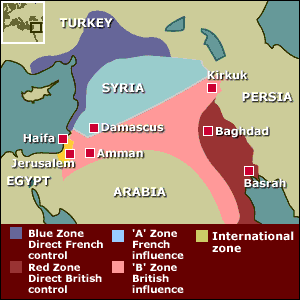
Sykes-Picot agreementrIsrael seems to be redrafting the Sykes-Picot agreement originally written at the close of World War I.  It was a plan (shown at left) which two Western diplomats, Sir Mark Sykes, of Great Britain, and Georges Picot, of France, designed to create new Middle East national borders for the benefit of victorious Western colonial powers.

Israel, one of the world’s leading nuclear powers, wants to make the Middle East nuclear-free, with the exception of Israel, of course.

The best way to accomplish this, from Israel’s perspective, is to break up many states into smaller, weaker “tribal states” which would pose no military threat to the reigning Middle East power, Israel.

Obama’s speech did not deal with new borders. Rather he revealed a distressing willingness to provide preferential treatment to Israel in the region:

Since I took office, I’ve made it clear in letters to the supreme leader in Iran and more recently to President Rouhani that America prefers to resolve our concerns over Iran’s nuclear program peacefully — although we are determined to prevent Iran from developing a nuclear weapon.  .  . So these statements made by our respective governments should offer the basis for a meaningful agreement. We should be able to achieve a resolution that respects the rights of the Iranian people while giving the world confidence that the Iranian program is peaceful.

But to succeed, conciliatory words will have to be matched by actions that are transparent and verifiable.  After all, it’s the Iranian government’s choices that have led to the comprehensive sanctions that are currently in place. .  .  .

Obama does not call for the abolishment of all nuclear weapons in the Middle East or the world, for that matter, though he has spoken of the need for just such an ideal development.

He only wants to keep Iran from having its own private stash. And to pressure Iran into voluntarily giving up its nuclear ambitions the U.S. government has implemented, along with other world powers, increasingly stringent economic sanctions against Iran.

As a result, Iran’s economy is feeling the pressure. In his speech, which had many positive elements, Obama adopted a parental or empirical tone, telling Iran it had brought those ugly “comprehensive sanctions” on itself.

But I want to be clear. We are encouraged that President Rouhani received from the Iranian people a mandate to pursue a more moderate course, and given President Rouhani’s stated commitment to reach an agreement, I am directing John Kerry to pursue this effort with the Iranian government in close cooperation with the European Union, the United Kingdom, France, Germany, Russia and China.

The roadblocks may prove to be too great, but I firmly believe the diplomatic path must be tested.

MJ Rosenberg knows that the U.S. and Iran leaders are on the “same page” at this moment in history. He is also a realist who understands Israel’s political ambitions.

Both leaders would like to see the nuclear issue resolved and the crushing sanctions removed. Rosenberg, a former AIPAC staffer who long ago departed from AIPAC’s clutches, writes about the thawed U.S.–Iranian relationship:

This is a major breakthrough – as anyone who has paid even a little attention over the past 34 years knows.

However, I do not see this process leading anywhere because the Netanyahu government and its lobby, the American Israel Public Affairs Committee (AIPAC), are determined to end the process and they have the ability to do it.

They intend to use the United States Congress to cause Rouhani to abandon negotiations by making clear that Congress will accept nothing short of an Iranian surrender on nuclear issues. Unlike President Obama who wants to ensure that Iran’s nuclear program is not used to produce weapons, the lobby, which writes the laws imposing sanctions on Iran, insists that Iran give up its nuclear program entirely.

AIPAC listed its demands in a statement last week. Its bottom line is this:

Congress must not consider lifting economic sanctions until the Iranians stop uranium enrichment, stop work on installing new centrifuges, allow international inspection of nuclear sites, and move out of the country its stockpile of highly enriched uranium. In contrast to the administration which, recognizing that Iran (like every other country) has the right to nuclear power for peaceful purposes, AIPAC says that Iran has no such right. (Israel, of course, has a large stockpile of nuclear weapons but, hey, that’s different.)

Not only that, if Iran does not agree to total nuclear surrender, “The United States must support Israel’s right to act against Iran if it feels compelled—in its own legitimate self-defense—to act.”

In his essay for Foreign Policy, “Maximum Bibi”, Daniel Levy writes about the new Iranian leader who gives strong signals that he is ready to negotiate the nuclear issue:

This debate has taken on a new urgency given the diplomatic opening seemingly created by the election of Rouhani. It is no secret that Netanyahu has been dragged out of his comfort zone by the possibility of a U.S.–Iran rapprochement. Former President Mahmoud Ahmadinejad’s aggressive and insulting behavior made him a convenient adversary for Israel; Rouhani and his diplomatic team, notably polished Foreign Minister Javad Zarif, present a challenge of a very different order of magnitude. 

Levy clarifies the obvious: Ahmadinejad, who has a Tea Party “shoot from the mouth” political style, enjoys the limelight as a troublemaker. Israel’s talented propagandists took advantage of Ahmadinejad’s barnyard strutting, and gleefully made him the face of all things Iranian.

Ahmadinejad was easily Israel’s favorite leader.  He was tailor-made for generating the Israel-as-victim trope.

But today, Ahmadinejad is old news. Better that we focus this week on President Obama who wants to revolve conflict without war, facing off against Prime Minister Netanyahu, who wants to shove the U.S. into yet another Middle East war, for Israel’s benefit

Sykes-Picot was a colonial, exploitative agreement that guaranteed instability in the Middle East for generations to come. Reshaping the same region for Israel’s benefit would be nothing less than Sykes–Picot Redux.

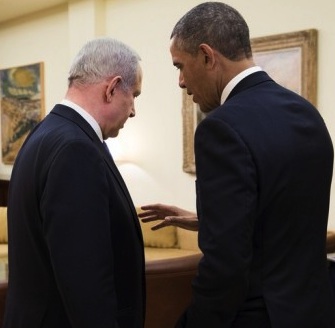
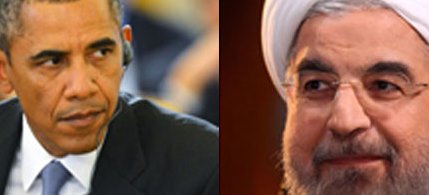
The picture above of President Obama (right) and Prime Minister Netanyahu was taken at the Prime Minister’s residence in Jerusalem, March 13, 2013. It is an official White House photo taken by Pete Souza.
Posted in John Kerry, Media, Middle East, Netanyahu, Obama, United Nations | 13 Comments

Iran’s Rouhani: “The World Has Changed”

by James M. Wall

On July 30, 2009, conservative columnist Pat Buchanan  wrote a column in the American Conservative.  He called it, “Tell Israel No”. Here is a key paragaph:Rex:Sipa Reuters

“Israel has been saying for years an Iranian bomb is months away. Where is the proof? Where is the evidence to justify a new U.S. war in the Middle East to destroy weapons of mass destruction that may not exist in Iran, as they did not exist in Iraq?”

This column appeared four years ago. Nothing has changed except the date. Israel continues to cry nuclear wolf. The U.S. consistently indulges Israel in its desire to make Iran a pariah among nations.

This indulgence could start to change this week when, and if,  President Obama meets with Iranian President Hassan Rouhani. The two leaders are scheduled to speak to the United Nations General Assembly Tuesday.

There are strong signs they will meet somewhere at the UN.  The meeting could be serious, or it could just be accidentally on purpose. But it will happen.

Before he spoke to the General Assembly, President Rouhani had set the agenda for a thaw in relations, writing that “the world has changed”, in a column published in the Washington Post.

CNN reported on the column:

Iranian President Hassan Rouhani made his case Thursday to the American people and the world for “a constructive approach” to contentious issues including his nation’s nuclear program, arguing that failing to engage “leads to everyone’s loss.”

“We must work together to end the unhealthy rivalries and interferences that fuel violence and drive us apart,” Rouhani said in an op-ed published Thursday evening on the Washington Post’s website.

Letters had earlier been exchanged between Washington and Teheran, a correspondence Israel has greeted with its customary cries of dismay, followed by a call to action by Israel’s U.S. political/media troops.

This effort by Israel to arouse U.S. public opinion against Rouhani appears certain to bring a second defeat to Israel and its U.S. hardline backers. The first defeat came when the U.S. chose diplomacy over a military assault on Syria’s chemical weapons sites.

Assuming any sort of Rouhani-Obama meeting does take place, score this round: Diplomacy, two wins, War, zero wins.

Diplomacy as the better of the two options was highlighted in a recent interview on the  Bill Moyers weekly television broadcast,  September 6.

This interview was taped on the weekend before a joint U.S.–Russia diplomatic agreement postponed and hopefully derailed, any U.S. cruise missile strikes against Syria.

In this Moyers segment, which may be seen in its entirety by clicking above, guest host Phil Donahue interviewed historian and military scholar Andrew Bacevich about America’s role in the world and the possible repercussions of our current relationship to Syria.

In the interview, Bacevich tells Donahue,

“[T[ick off the number of military enterprises that we have been engaged in that part of the world, large and small, you know, Beirut, Afghanistan, Iraq, Yemen, Somalia — and on and on, and ask yourself, ‘What have we got done? What have we achieved? Is the region becoming more stable? Is it becoming more Democratic? Are we enhancing America’s standing in the eyes of the people of the Islamic world?’ ‘The answers are, ‘No, no, and no.’ “

Military solutions have failed in the region. Why has the U.S. ignored the failures of these “military enterprises” and continued to follow the lead of Israel’s demands?

Columnist–academic Juan Cole points to U.S. hawkish hubris as one culprit in The Hubris of the Interventionists:

The hawks who are deeply disappointed that diplomacy has likely forestalled a US military intervention in Syria in the foreseeable future often attempt to tug at our heart strings by pointing to the over 100,000 dead and the millions of displaced, implying that the US has a responsibility to intervene to stop the carnage on humanitarian grounds.

If the world were such that the US could in fact do so, perhaps they might have a point. The problem is that social engineering on that scale is currently beyond even a superpower. We need a humanitarian realism to forestall the utopians from taking us into quagmires. There is nothing wrong with doing good where you realistically can. Trying to do good by military means where you cannot, can be deadly to both you and the victims.

Republican Congresswoman Ileana Ros-Lehtinen (R-FL), chair of the U.S. House Mideast Subcommittee, did her best to undermine any rapprochement between the U.S. and Iran.  Writing in the Times of Israel  Haviv Rettig Gur reported her story:

Within hours of the Obama administration’s tentative indication on Friday that President Barack Obama might be willing to meet with new Iranian President Hassan Rouhani, an influential Republican member of Congress cautioned that the administration should not put much faith in Tehran’s recent diplomatic overtures.

The congresswoman was harsh in her criticism of Rouhani. She issued a statement about the new Iranian president, which the Times  of Israel reported. This is a part of her statement:

Rouhani is a master of deceit who has been putting on an all-out charm offensive since he took office.

In many ways Rouhani is much more dangerous than [former Iranian president Mahmoud] Ahmadinejad. At least with Ahmadinejad you get what you see – his hatred for Israel and the United States is not disguised with rhetoric or spurious gestures of goodwill,” added Ros-Lehtinen, who is considered a staunchly pro-Israel member of the House of Representatives.  .   .   .

Rouhani will use any opportunity he can to try to fool the US and the West into offering concessions and to stall for time while Iran completes its nuclear weapons program, as he had bragged about doing once before. Believing that he has any other agenda is folly.

The Administration must not fall for this charm offensive, and must increase the pressure on the regime with more sanctions until Iran completely abandons its nuclear pursuit and dismantles its program.

What the congresswoman sees as a shallow “charm offensive” will have to be judged on President Rouhani’s words and, as President Obama insists, his actions. Meanwhile, the American public will want to reflect on what Rouhani calls “a constructive approach to diplomacy”.

With a possible meeting pending between Obama and Rouhani, these insights from Rouhani’s Washington Post column, demand our further attention:

Three months ago, my platform of “prudence and hope” gained a broad, popular mandate. Iranians embraced my approach to domestic and international affairs because they saw it as long overdue. I’m committed to fulfilling my promises to my people, including my pledge to engage in constructive interaction with the world.

The world has changed. International politics is no longer a zero-sum game but a multi-dimensional arena where cooperation and competition often occur simultaneously. Gone is the age of blood feuds. World leaders are expected to lead in turning threats into opportunities.

The international community faces many challenges in this new world — terrorism, extremism, foreign military interference, drug trafficking, cybercrime and cultural encroachment — all within a framework that has emphasized hard power and the use of brute force.

We must pay attention to the complexities of the issues at hand to solve them. Enter my definition of constructive engagement. In a world where global politics is no longer a zero-sum game, it is — or should be — counterintuitive to pursue one’s interests without considering the interests of others. A constructive approach to diplomacy doesn’t mean relinquishing one’s rights.

It means engaging with one’s counterparts, on the basis of equal footing and mutual respect, to address shared concerns and achieve shared objectives. In other words, win-win outcomes are not just favorable but also achievable. A zero-sum, Cold War mentality leads to everyone’s loss.

Time alone will tell what they mean for future Iranian actions, but these words sound like they might have come from a young Illinois state senator named Barack Obama, way back in 2007. That was the state senator who promised change.  

This week, the now-President Obama will have an opportunity to speak face to face with a world leader who sounds, for this moment at least, like a man who wants change.

The pictures above are by Rex/Sipa. They are from Reuters.

Posted in Middle East Politics, Obama, United Nations, US govermemt, War | 14 Comments

Peaceful Pause Delivers “Stunning” News

by James M. Wall

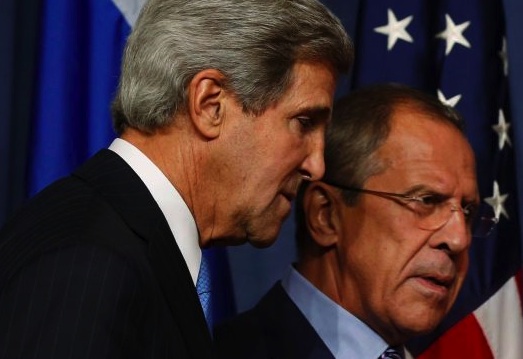
Kerry Lavrov in Geneva Reuters from Ha'aretzNo one ever said diplomacy was easy. Many have said it is messy. But one thing is certain: Diplomacy is better than destruction.

Thanks to diplomacy, which weathered recent negative media cries of incompetence, the U.S. Secretary of State John Kerry has announced that the U.S. and Russia have reached what one news outlet called a “stunning” agreement.

The Secretary made the announcement from Geneva mid-day Saturday, after meeting with Russian Foreign Minister Sergey Lavrov. The Daily Beast report by Christopher Dickey, begins:

“In a stunning agreement that could lead to the end of the Syrian crisis, Russia and the U.S. announce a plan to eliminate Assad’s chemical arsenal. 

The diplomatic breakthrough in Geneva today is simply stunning. The “framework agreement for elimination of Syrian chemical weapons” reached by Secretary of State John Kerry and Russian Foreign Minister Sergey Lavrov delivers, in writing at least, just about everything President Barack Obama demanded when he threatened to attack the Assad regime earlier this month.

The agreement calls on Syria to declare in detail its entire chemical arsenal within weeks and destroy it – along with everything involved in making it – within five or six months.”

The agreement,  Framework for Elimination of Syrian Chemicals, was released by the U.S. Department of State in Washington.

The Framework begins:

Taking into account the decision of the Syrian Arab Republic to accede to the Chemical Weapons Convention and the commitment of the Syrian authorities to provisionally apply the Convention prior to its entry into force, the United States and the Russian Federation express their joint determination to ensure the destruction of the Syrian chemical weapons program (CW) in the soonest and safest manner.

For this purpose, the United States and the Russian Federation have committed to prepare and submit in the next few days to the Executive Council of the OPCW a draft decision setting down special procedures for expeditious destruction of the Syrian chemical weapons program and stringent verification thereof. The principles on which this decision should be based, in the view of both sides, are set forth in Annex A. The United States and the Russian Federation believe that these extraordinary procedures are necessitated by the prior use of these weapons in Syria and the volatility of the Syrian civil war.

A major storm of political negativity is expected  to greet the news in Israel, which had earlier massed its U.S. lobbying troops (AIPAC leading the charge) in a desperate effort to gain congressional support for a U.S. military assault on Syria’s chemical weapons sites.

AIPAC failed to move even its most ardent admirers in a U.S. congress that knows its voters are weary of wars, and especially unwilling to become involved in Syria’s two and one half year old civil war.

Secretary of Kerry was expected to fly from Geneva to Tel Aviv to brief Israeli leader Benjamin Netanyahu on the Framework. As he well knows, the issue with Israel is not so much Syria as it is Iran. Israel, with its own heavy arsenal of nuclear weapons stashed away in the desert, wants the U.S. to force Iran to give up any plans for building its own nuclear stockpile.

Not attacking Syria, but turning the assignment over to diplomacy, was not what Israel, with Iran as its major target, wanted to see.

Republican war hawks and Israeli-backers in the Senate were quick to join Israel’s complaints about the peace agreement.  The Washington Post reported:

News of the agreement drew immediate criticism from prominent Republicans in Congress,some of whom had supported the idea of airstrikes against Assad after last month’s use of chemical weapons, putting them briefly on the same side as Obama.

“What concerns us most is that our friends and enemies will take the same lessons from this agreement — they see it as an act of provocative weakness on America’s part,” Republican Sens. John McCain (Ariz.) and Lindsey O. Graham (S.C.) said in a statement Saturday. “We cannot imagine a worse signal to send to Iran as it continues its push for a nuclear weapon.”

Aware of the criticism ahead, but clearly pleased with the Framework Agreement, Kerry’s announcement in Geneva was forceful.

He also knows there are more storms ahead. And for this reason, it is appropriate that we close, on this day of stunning news, with James Weldon Johnson’s hymn that calls on us to:

“Sing a song full of the faith that the dark past has taught us, sing a song full of the hope that the present has brought us.”

The picture of Kerry and Lavrov is by Reuters. It  is from Ha’aretz.

Posted in Media, Middle East Politics, USA, War | 6 Comments

Obama Pauses Again; Peace Wins, AIPAC Loses

by James M. Wall

Obama at G20Monday, September 9, was planned as a day for the White House to persuade Congress to support military strikes on Syria. The highlight of the day’s “persuade Congress” plan was a White House appearance by former Secretary of State Hillary Clinton.

After a luncheon meeting with President Obama, Clinton pledged her every effort to gain “yes” votes from Congress for a military attack.

Midway through her statement she had to shift, however, from attack mode to peace mode. A rapid series of “surprise” developments swept through London, Moscow and Damascus before dark in Washington Monday.

We may not know until the tell-all book on President Obama’s second term is published.  But it sure looks like the Obama team spent this past weekend changing its “persuade Congress” plan to a “further pause for peace” plan.

Whatever it was, something led to the weekend shift in White House plans.

The Obama team had read the polls. It was obvious that the majority of the American public wanted no part of more U.S. military presence in the Middle East.  Members of Congress read the same polls.

At first only the most hard line pro-Israel members of the House and Senate raised their hands to give a yes vote for an attack. A strange assortment of Republicans, Democrats, progressives and conservatives lifted their hands to defiantly vote no to an attack.

Against such odds, it is rare for AIPAC, Israel’s chief Washington lobbying team, to go all out in support of a vote it was going to lose.  But AIPAC must have been hearing from Tel Aviv. Israel’s government wanted that military strike.

In Israel’s view, the greatest threat to its own security—or as some see it, to its military control of the Middle East—runs from the road to Damascus straight through to Teheran, the place where Israel wants to convince the world Iran is building its own stock pile of  nuclear weapons.

If Iran has plans to develop a nuclear arsenal, and it denies that it does, it would take decades to catch up to the stock pile of nuclear weapons Israel has stored away in a secure desert hiding place.

AIPAC threw its usual caution to the wind and turned up the heat on Congress for a “yes” vote in support of a strike.  It did not work, not even with Hillary Clinton leading the charge.

It was time for the White House to give peace a chance.

The shift from “persuade Congress” to another Obama “pause for peace” was launched in London Monday morning when Secretary of State John Kerry made what he attempted to pass off as an off-handed remark.

How off-handed a remark would a U.S. Secretary of State: toss to a hungry band of journalists just hours before the U.S. Congress is set to debate an air strike? It is quite possible the Secretary knew exactly what he was doing, deliberately setting in motion a series of events toward the easing of tensions between the U.S amd Syria.

The series of events reads like a Hollywood script that moves far too fast to be plausible. But they happened.

Monday’s events may have been purely random, events  that started like a snowball rolling downhill after a morning speech by Secretary of State Kerry and ending with an history-changing Monday night announcement by Senate leader Harry Reid that he was postponing a Senate vote because of events of the day.

Or was it planned, this shift to peace from John Kerry in London to a proposal by Sergey V. Lavrov, the Russian foreign minister that was quickly adopted by officials in Syria, leaders in Britain, France, and the United Nations?

President Obama told PBS that he had earlier talked to President Putin during the G20 conference held in Russia. The picture above of the President was taken by AFP at the Conference. The picture comes from Ha’aretz.  Were seeds planted there for the Monday plan shift?

Of course, there have been few reports of many positive exchanges between Obama and Putin of late. So were these Monday events serendipitous?  Might they have been another event on the road to Damascus like the one the Scriptures tell us happened to change the life of Paul of Tarsus?

Or, for the less religiously inclined readers, was the plan shift purely pragmatic,  planned by Obama when a congressional rejection of an air strike became imminent?

Whatever lay behind the moment when Harry Reid postponed the Senate vote, the New York Times tells us what events led to Reid’s decision:

Senator Harry Reid of Nevada, the majority leader, said Monday evening that he would not take the procedural steps to force an initial vote on authorization of force Wednesday, slowing Senate consideration of the resolution.

A senior Democratic aide that the developments with the Russian proposal were a significant factor in the delay, which will allow members to consider the plan and also hear from the president, who is scheduled to meet with them at the Capitol on Tuesday in advance of his nationally televised speech to explain his rationale for military force.

Sergey V. Lavrov, the Russian foreign minister, made the proposal that could avert a strike earlier in the day, seizing on a seemingly offhand remark by Secretary of State John F. Kerry. Traveling in Britain, Mr. Kerry said that Bashar al-Assad, the Syrian president, could avoid strikes by agreeing to give up his chemical weapons.

“He could turn over every single bit of his chemical weapons to the international community in the next week — turn it over, all of it, without delay and allow the full and total accounting,” Mr. Kerry said.

Mr. Kerry’s remarks, especially the reference to the short window of time, underscored the urgency of the administration’s preparations for a strike, and it did not appear to signal a shift in policy. The State Department’s spokeswoman, Jen Psaki, later clarified in an e-mail to reporters that Mr. Kerry was simply “making a rhetorical argument about the impossibility and unlikelihood of Assad turning over chemical weapons he has denied using.”

But Mr. Lavrov followed up on the idea, with a proposal that offered a compromise that could avert an American-led strike in response to a poison-gas attack near Damascus last month.

Officials in Syria embraced the idea, as did Britain, France, the United Nations and even some Republican lawmakers in Washington.

Jerusalem’s Ha’aretz made sure its readers were aware that President Obama still has some doubts over what may emerge from the Kerry/Lavrov proposal.  As Obama likes to say, “nothing in life is ever certain”.

U.S. President Barack Obama said Monday that while the Russian proposal to put Syria’s chemical weapons under international control is “potentially positive,” his administration is looking at it with skepticism.

“I think you have to take it with a grain of salt initially,” he told “NBC Nightly News” in an interview. “This represents a potentially positive development,” he said, adding that Secretary of State John Kerry would explore with Russia how serious the offer is.

Obama gave six television interviews on Monday, and was due to visit the Capitol on Tuesday to make his case to lawmakers from both parties before making a televised address from the White House in the evening. The media blitz was meant to turn up the pressure on Congress to support U.S. military action in Syria.

In an interview that aired simultaneously, the president told CNN that any diplomatic effort to resolve the conflict in Syria must be serious.

“And we don’t want just a stalling or delaying tactic to put off the pressure that we have … right now,” he said.

“We have to maintain this pressure, which is why I’ll still be speaking to the nation tomorrow about why I think this is so important,” he added.

The president added that a breakthrough on control of Syrian chemical weapons would not solve “the underlying terrible conflict inside of Syria. But if we can accomplish this limited goal without taking military action, that would be my preference.”

The Washington Post emphasized that the President saw the events on Monday in a positive light:

President Obama on Monday called a Russian proposal for Syria to turn over control of its chemical weapons to international monitors in order to avoid a military strike a “potentially positive development,” that could represent a “significant breakthrough,” but he said he remains skeptical the Syrian government would follow through on its obligations based on its recent track record.

“Between the statements that we saw from the Russians — the statement today from the Syrians — this represents a potentially positive development,” Obama said in an interview with NBC News, according to a transcript provided by the network. “We are going to run this to ground. [Secretary of State] John Kerry will be talking to his Russian counterpart. We’re going to make sure that we see how serious these proposals are.”

The Post added that the President said in a separate interview with ABC news “if Assad were to give up his chemical weapons, a military strike would “absolutely’ be on pause.

The President paused earlier when he involved the Congress in the decision to attack Syria. Now he appears ready to pause again, “absolutely”.

Whatever the real story is behind Monday’s series of events that unfolded in the direction of peace, we can be thankful that Obama has listened to his own public and is now choosing peaceful “pauses” rather than displays of shock and awesome military power.

Posted in Hillary Clinton, John Kerry, Middle East Politics, Obama, War | 9 Comments

Obama Pauses; Calls for Debate in Congress

by James M. WallObama AFP Jim Watson

In a surprise move Saturday afternoon, President Barack Obama announced  he would ask for a Congressional debate before he would order any air strikes on Syria.

Speaking at a hastily-called press conference in the White House rose garden, the President said: “I will seek authorization for the use of force from the American people’s representatives in Congress.”

Ma’an, the Palestinian news service, notes that the decision to take the issue to Congress “represents a significant gamble for Obama”.

He “risks suffering the same fate as British Prime Minister David Cameron, who on Friday lost his own vote on authorizing military action”.

The television network, MSNBC, reported that White House officials point to Cameron’s defeat in the Parliament as one reason the President decided to delay action against Syria until Congress could return and hold its debate.

The U.S. House of Representatives confirms it will consider a measure on military action against Syria the week of Sept. 9, according to House Speaker John Boehner.

In his Friday New York Times column, “A Much Less Special Relationship”, Roger Cohen wrote:

It has been a very long time since a British prime minister lost a war-and-peace vote in Parliament, as David Cameron did on Syria in a stinging personal defeat. He paid the price for the “dodgy dossier,” “Bush’s poodle” and all the other damning epithets that came to accompany Tony Blair’s support a decade ago of the war America fought in Iraq on false pretenses.

In addition to David Cameron’s defeat in Parliament, President Obama could not avoid the fact that he was already on record regarding a president’s need to obtain congressional approval for an attack on another nation.

Speaking in a Q and A session with the Boston Globe on December 20, 2007, then presidential candidate Obama was asked about talk of potential strikes against Iran:

In what circumstances, if any, would the president have constitutional authority to bomb Iran without seeking a use-of-force authorization from Congress?”

Candidate Obama responded:

“The President does not have power under the Constitution to unilaterally authorize a military attack in a situation that does not involve stopping an actual or imminent threat to the nation.

As Commander-in-Chief, the President does have a duty to protect and defend the United States. In instances of self-defense, the President would be within his constitutional authority to act before advising Congress or seeking its consent.

History has shown us time and again, however, that military action is most successful when it is authorized and supported by the Legislative branch. It is always preferable to have the informed consent of Congress prior to any military action.

When President George W. Bush built his “coalition of the willing” nations before his 2003 attack on Iraq, he secured the backing of the Arab League, a support that President Obama failed to gain in recent months.

Juan Cole writes that it is most likely the new military government of Egypt that cost Obama the support of the Arab League this time around.  Egypt, according to Cole, has also refused to support an American assault on Syria. Cole writes:

The newly assertive Egyptian military and the civilian transitional government in Egypt are helping make President Obama’s life difficult. Likely it was Egypt that blocked the Arab League from calling for intervention against the Syrian regime despite its condemnation of Damascus for using chemical weapons.

Egyptian foreign minister Nabil Fahmy rejected a Western strike on Syria. He said that no country could attack another save in self-defense or in the case of a UN Security Council resolution authorizing the use of force.

Members of Congress in search for more lucid arguments to take to the House and Senate, would do well to pay attention to the bill of particulars that Richard Falk has drawn up to remind us that the U.S. does not enter this discussion with clean hands.

The U.S. Government rains drone missiles on civilian human targets anywhere in the world, continues to operate Guantanamo in the face of universal condemnation, whitewashed Abu Ghraib, Bagram, and the torture memos, committed aggression against Iraq and Afghanistan, and invests billions to sustain its unlawful global surveillance capabilities.

Still, it has the audacity to lecture the world about ‘norm enforcement’ in the wake of the chemical weapons attack in the Ghouta suburb of Damascus. Someone should remind President Barack Obama and Secretary of State John Kerry that credibility with respect to international law begins at home and ends at the United Nations.

For eloquence and passion in delivery, opponents of an attack against Syria  will find an experienced model in the presentation below by British parliamentarian George Galloway made against David Cameron’s request for support for a U.S.-British attack on Syria. 


Meanwhile, for the next ten days, the world, along with President Obama, must wait for a congressional decision on what the President is certain was a Syrian chemical weapon attack.

The picture above, of President Obama, was taken during his Saturday press event. It is by Jim Watson for AFP.

Posted in Middle East Politics, Obama, United Nations, US govermemt, USA, War | 11 Comments

Is Israel Serious About Peace?

by James M. Wall

alamari-refugee-camp-2Is Israel serious about peace? Recent events say the answer is no.

A few weeks after a new round of U.S.-sponsored talks began between Israelis and Palestinians, Israel activated its plan to construct 1,500 apartments in East Jerusalem.

The new construction will be in the neighborhood of Ramat Shlomo, the project initially announced by Israel during U.S. Vice President Joe Biden’s 2010 visit to Israel.

Early Monday morning, a few hours before another peace talk session was scheduled to be held at the Jericho home of chief Palestinian negotiator Saeb Erekat, IDF soldiers entered the Palestinian Qalandia refugee camp.

The IDF said it was looking for a “terrorist” suspect, Yousef al-Khatib, a recently-released prisoner who had been incarcerated for ten years in an Israeli army prison.

These nighttime searches for “terrorists” have long been routine in Palestine refugee camps like Qalandia.

Aljazeera reports that Israeli forces have killed 14 Palestinians in the occupied territory this year, most of them in what Israel describes as “clashes”. Three Palestinians were killed in the same period in 2012. In the Qalandia camp, three Palestinian men were shot and killed during Monday’s raid.

UNRWA said one of those killed on Monday was Robin al-Abed, a 34-year-old father of four, who worked for UNRWA. He was walking to work when he was shot in the chest. The agency condemned the killing.

To protest the killings, Palestinian President Mahmoud Abbas cancelled Monday night’s peace session.  Meanwhile, the question persists: Does Israel have a government that is serious about peace?

Perhaps a more pertinent question would be: Why should Israel even pretend to be serious about peace when it already has the peace it wants.

That peace is called “occupation”, a state of affairs in which an invading army assumes total and permanent control of an occupied population.

Israel’s occupation is sustained, encouraged and funded by the United States.  U.S. public opinion tolerates, ignores and in some sectors, strongly supports the occupation, thanks in no small measure to Israel’s propaganda assistant institutions in the U.S., including the media and the churches, agencies which are supposed to be holding the public to higher moral standards.

Note to future empire builders: Your best Fifth Column operatives will be in institutions that shape public opinion.

Israel’s occupation is not about security. It is all about maintaining what we should have long ago admitted is a “Carthaginian peace”.

A Carthaginian peace describes a deceptive agreement that over the centuries has emerged as synonymous with any plan enforced by a winning side in a conflict which leads to nothing less than the total submission of a defeated enemy.

The Versailles treaty that followed World War I is the most recent example. That treaty is a Carthaginian peace because the victorious Allied nations designed a “peace” intended to leave Germany as a weakened state. That action, of course, led to the rise of Hitler and the Holocaust.

A Carthaginian peace is not without its consequences.

The term originated in 146 BC after the Roman army  totally destroyed Carthage, a destruction that left behind only ruins to be visited by tourists.

The Third Punic War  (149 BC to 146 BC) was the third and last of the Punic Wars fought between the former Phoenician colony of Carthage, and the Roman Republic. The Punic Wars were named because of the Roman name for Carthaginians: Punici, or Poenici.

The [third Punic] war was a much smaller engagement than the two previous Punic Wars and primarily consisted of a single main action, the Battle of Carthage, but resulted in the complete destruction of the city of Carthage, the annexation of all remaining Carthaginian territory by Rome, and the death or enslavement of the entire Carthaginian population. The Third Punic War ended Carthage’s independent existence.

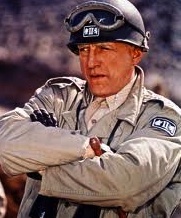
We don’t hear much about Carthage these days.  Except when a movie script remembers. The 1970 movie Patton,  includes a scene in which General George S. Patton (George C. Scott, right) ordered his young aide to drive him to the ancient Carthage battlefield in present-day Tunisia. Patton tells his aide:Patton

“It was here. The battlefield was here. The Carthaginians defending the city were attacked by three Roman Legions. Carthaginians were proud and brave but they couldn’t hold. They were massacred. [Local] women stripped them of their tunics and their swords and lances. The soldiers lay naked in the sun, two thousand years ago. . . .”

Of course, the John Kerry-moderated peace negotiations will continue. Public opinion wants it that way.

Can we expect new Israeli housing construction in the West Bank to stop during these talks?  Will there be a halt to night raids that terrify Palestinian children and kill their parents? Don’t count on it.

The peace talks are a good gig for Israel.  They pretend a dictatorial ruler’s quest for peace without having to take any actual steps  to make peace possible.

Of course, the talking will proceed.  When they finally stop, Palestine will have received a few scattered crumbs to bolster its economy. Sources within Palestine do not envision major industries like the Palestinian natural gas fields to be among the crumbs shared after the peace talks.

It sounds, in short, like the current peace talks–as we now know from a nighttime raid on Qalandia and the construction of Israeli housing in the West Bank—will end with yet another peace agreement, a Carthaginian peace agreement.

Sam Bahour, a Palestinian-American business development consultant from Youngstown, Ohio, now living in the Palestinian city of Al-Bireh in the West Bank, described in his blog, ePalestine, how he discovered the plan.

The first proclaimed leak, (in Arabic) from Secretary John Kerry’s efforts to resolve the Palestinian-Israeli conflict, as it is so often called, were published last week in the reputable London-based daily Arabic newspaper, Al-Hayat.

The source is said to be a posting on the website of the Palestinian Islamic Resistance Movement, Hamas, who claim the information was leaked to them by someone attending the tightly closed negotiating sessions.

The validity of this claim and the contents of the leak are unverifiable and the infighting between Hamas and Fatah give both a vested interest to publicly damage the other.

Here are just the opening proposals in the peace plan Bahour discovered and posted:

“The Separation Wall will serve as the security borders of the ‘Jewish’ state, and the temporary border of the ‘Palestinian’ state… Both parties will acknowledge and announce this.”   There will be “an exchange in disputed territories within the plan of the Separation Wall noted above, as agreed to by both parties and with the blessing of the Arab League Follow-up Committee, as specified by this Committee to Mr. Kerry during their last visit to Washington, ranging in size from eight to ten percent of West Bank lands.” There will be also be a “freeze in the settlement projects at a number of outposts, as approved by the Israeli government, which does not apply to existing projects in large settlement communities located in the vicinity of Jerusalem and in the Jordan Valley, including the settlements of Ma’ale Adumim, Givat Ze’ev, Har Homa, Gilo, Neve Yacov, Ramat Shlomo, Ramat Alman, Kiryat Arba’, and other densely populated settlements.”

There is more to this leaked plan, all of which may be read here. 

Until John Kerry and his boss in the White House reject such Zionist extremism, this nation will continue to fund and endorse more IDF nighttime raids in refugee camps like Qalandia.

The picture above is from UNRWA. It was taken in the refugee camp of Al Am’ari. 

Posted in John Kerry, Middle East Politics, US govermemt | 3 Comments

Will Palestine Retain Its Natural Gas Fields?

by James M. Walloffshore technology.com

For the moment, all is quiet on the Israeli-Palestinian peace front. Is it “too quiet”, as they once asked in movie westerns?

That depends entirely on what kind of peace is being discussed. Does danger lurk, or does a just peace lie ahead?

U.S. Secretary of State John Kerry could be working furiously behind the scenes for a just peace. If so, he would be demanding that the natural gas fields off the Gaza coast remain under Palestinian control.

An industry web site , offshore technology.com, describes the potential of the Gaza coast gas fields:

Gaza Marine gas field is located 30km off the coast of the Gaza Strip, in the eastern Mediterranean Sea. It lies at a water depth of 603m. The development of the Gaza field has been on hold for several years due to disputes between Israel and the Palestinians.

Not surprisingly, Israel has already treated the gas fields as its personal property. On June 16, 2011, Oil Price.com wrote:

Earlier this week Israel’s Ministry of National Infrastructure authorized Noble Energy, a crude oil and gas exploration U.S. based company based in New York, to begin developing a natural gas field off the Gaza Strip coastline, the Palestine News Network reported. . . .

British Gas has already established two offshore natural gas wells, Gaza Marine 1 and Gaza Marine 2. (above) According to British Gas, the natural reservoir off Gaza is estimated to contain 1.5 trillion cubic meters of natural gas with an estimated net worth of approximately $4 billion.

At the time, Palestinian official Dmitry Dliani said “that the Israeli Ministry of Infrastructure’s decision was in fact a license to steal Gaza’s natural gas reserves and demanded international protection for the Palestinian natural gas reservoir off Gaza.”

Two years later, in the quietness of the peace talks, the U.S. is in a position to cancel Israel’s illegal seizure by affirming that Palestine’s natural gas fields belong to Palestine.

In addition to enabling Palestine’s economic potential through its own natural resources, a just peace would end Israel’s illegal occupation of Palestine. The end of the occupation would remove Israel’s control over Palestine’s borders and give Palestine responsibility for its own internal security.

A just peace would deliver an international airport that is a necessity for a new Palestine. A seaport large enough to handle Palestinian tourism and economic traffic will have to be developed.

A just peace would provide Palestine with access to  the profitable tourism trade and the rich mineral deposits on the shore of the Dead Sea. That shore line area is shared by Israel and Palestine, according to the 1967 Green Line border.

On the other hand, and this is the bad news, the code of silence that currently hovers over the peace talks may also be harboring a darker vision of Palestine’s future.

Secretary Kerry, acting as something less than an “honest broker”, could be devising a token economic and freedom bucket list of promises that would be nothing less than a “carthaginian peace” imposed by the U.S. and Israel on Palestine, a “peace” which conquering armies impose on a defeated population.

The term, “carthaginian peace” entered history after Rome defeated Carthage in the Punic Wars, fought from 254 BC to 146 BC.

A carthaginian peace is the imposition of a very brutal peace that crushes an enemy. If such a disastrous conclusion is reached by the Kerry-run peace talks, we will face a modern version of the end of the Punic Wars, which were, according to Wikipedia:

a series of three wars fought between Rome and Carthage from 264 BC to 146 BC.  At the time, they were probably the largest wars that had ever taken place. The term Punic comes from the Latin word Punicus (or Poenicus), meaning “Carthaginian”, with reference to the Carthaginians’ Phoenician ancestry.[3] The main cause of the Punic Wars was the conflict of interests between the existing Carthaginian Empire and the expanding Roman Republic.  

The term, carthaginian peace, was most recently used to describe the peace terms the U.S. and its Allies imposed on Germany in the Treaty of Versailles, at the conclusion of World War I.  Ironically, it was this unjust and vengeful carthaginian peace forced upon a defeated Germany that contributed to the rise of Hitler and the Holocaust in which six million Jews died.

If the U.S and Israel succeed in forcing Palestine to endure a carthaginian peace, it will be a peace sold to the world as necessary to protect the “security needs” of Israel, which will, on cue, claim that the peace agreement is needed to prevent the annihilation of the Jewish people, a  trope that has lived well past its expiration date.

Rashid Khalidi, in Brokers of Deceit,  points out that this “trope of imminent destruction effectively constitutes a sort of free pass for Israel that covers a multitude of sins and allows it to get away with behavior that otherwise would be considered outrageous and impermissible”.

Far from being defenseless, Israel has for most of its existence struck fear into its weak, relatively poorly armed, underdeveloped, and disorganized neighbors. None of these neighbors, without exception, singly or united, are particularly dreaded by Israel’s tough and seasoned generals, however much fearmongering Israeli, and American, politicians may engage in. (p. 75)

If Kerry and his team are to design a just peace, rather than a carthaginian peace, Israel would have to give up its “free pass” for its multitude of sins and learn to live like the good neighbor it claims it wants to be.

As long as the code of silence continues around the peace talks we may only speculate: Will the U.S. rid itself of its Zionist propaganda shackles and demand a just peace for Israel and Palestine?  Or is the U.S. busy preparing a glossy cover for a carthaginian peace which would brutalize Palestine and assure no peace for decades to come.

A carthaginian peace would be a disaster for Palestine and Israel. A just peace is the only way to bring peace to the entire region.

The picture at top is from offshore technology.com.

Posted in John Kerry, Middle East Politics | 8 Comments

Peace Talks Begin Despite Political Resistance

by James M. WallHouses are seen in the West Bank Jewish settlement of Har Gilo, near Jerusalem

The first session of the Israeli-Palestinian peace talks began Wednesday evening in Jerusalem’s King David Hotel.

Israeli Justice Minister Tzipi Livni and Palestinian chief negotiator Saeb Erekat are representing their respective sides.

U.S. envoy Martin Indyk, a former U.S. ambassador to Israel, is chairing the meeting. A second working session is planned for “later this month” in the West Bank city of Jericho.

In the hours leading up to Wednesday’s opening session, signs were not good for a successful conclusion to the talks.

Possibly with encouragement from the U.S., Israel agreed to release a proposed 104 Palestinian prisoners currently held in its military prison. This action made it difficult for the Palestinian Authority to stay away from the talks.

The release of prisoners was resisted within the Israeli public, which is still chafing over the release of 1027 Palestinian prisoners in 2011 in exchange for Gilad Shalit, an Israeli soldier held for five years by Hamas.

To demonstrate that Israel was in no danger of giving away the store, Prime Minister Benjamin Netanyahu announced on the eve of the talks that the Israeli goverment would issue 2000 housing permits for construction in existing Israeli settlements on Palestinian land.

The first 26 Palestinian prisoners who were released Tuesday night were all arrested, charged and imprisoned by military courts at some point between 1985 and 2001

Palestinian released  prisoners are well aware they will not be entirely free.  They remain in constant danger of being returned to prison at the slightest provocation.

Mairav Zonszein, a Jewish journalist who moved from New York to Israel, is blunt in her assessment of the prisoner release:

Releasing Palestinian prisoners is primarily symbolic – considering that Israel remains the controlling power, choosing who and when it releases and re-arresting as it pleases, whenever it pleases.

At the same time it announced the names of the first prisoners to be released, Israel displayed a disdain for the talks by announcing new construction in a wide range of settlements.

Zonszein, who writes for the Israeli liberal 972 website, provides the sordid details:

Something like 2,000 new units in the West Bank and East Jerusalem – some in final approval stages before building begins and others at the start of the tender process – have been announced in the last few weeks. The construction published today enumerates 400 new units in Gilo, 210 in Har Homa and 183 Pisgat Ze’ev — all settlements beyond the Green Line in East Jerusalem. In the West Bank, it was made up of 117 units in Ariel, 149 in Efrat, 92 in Ma’aleh Adumim and 36 in Beitar Ilit.

With details like these, it should be obvious that plans for this new settlement building were developed over a long period of time.  The government’s formal announcement was timed to assuage the right-wing politicians who strongly oppose the release of Palestinian prisoners,  an old political tactic of releasing good and bad news on the same day. 

It is also important to note that the Gilo’s 400 new units and Har Homa’s 210 units increase the populations in settlements on each side of the highway that connects Jerusalem and Bethlehem.  Ma’aleh Adumim, a much older settlement, is on the highway between Jerusalem and Jericho. (Additional earlier Gilo constuction is shown in the photo above.)

Instead of delaying or postponing the talks, Secretary of State John Kerry gave Israel the usual diplomatic pass in spite of Israel’s arrogant and self-defeating behavior.

Traveling in Colombia, according to the Reuters news service, Kerry “told reporters that while some movement on the settlement front had been expected, the wave of announcements may have been ‘outside of that level of expectation'”.

Palestinian chief negotiator Saeb Erekat was less sanguine. Stunned by the size of the new construction, he warned:

“If the Israeli government believes that every week they’re going to cross a red line by settlement activity … what they’re advertising is the unsustainability of the negotiations.”

The New York Times editorial page deplored the Israeli tactic of pairing the prisoner release with the housing expansion announcement:

This balancing act may have made sense in the narrow world of the Knesset. But, in the broader world beyond Israeli domestic politics, giving the green light to more settlement construction in contested territory is not just untimely but a fresh cause for pessimism about the prospects for successful peace negotiations.

One of the main reasons Prime Minister Netanyahu agreed to the “peace talks” was to demonstrate to an increasing number of outside critics that he was willing to reach out to the Palestinians.

Announcing the housing settlement “tenders” (permission to construct) did not play well on the world stage that Netanyahu hoped to cultivate. The Omar Tribune reports:

Palestinians, Russia and the European Union (EU) on Monday slammed the Israeli approval of new settlement construction as a move aimed at “preventing” peace talks to be resumed on Wednesday.

“It is clear that the Israeli government is deliberately attempting to sabotage US and international efforts to resume negotiations by approving more settlement units three days before the … Palestinian-Israeli meeting,” Palestinian negotiator Mohammed Shtayeh said.

“Israel is attempting to prevent negotiations from taking place on Wednesday.”

“Israeli settlements in the West Bank are illegal under international law and threaten to make a two-state solution to the Israeli-Palestinian conflict impossible,” EU foreign policy chief Catherine Ashton’s spokesman Michael Mann said.

Stephen Walt, veteran foreign policy analyst, is not optimistic about the talks.  He does, however, hope for the best. In a recent piece for Foreign Policy, Walt offers words of encouragement to Secretary of State Kerry.  Here are excerpts of Walt’s analysis:

What does U.S. Secretary of State John Kerry think he’s doing? Kerry may not be Mr. Charisma, but he’s not stupid. So why has he chosen to put himself on this well-worn path to failure? No doubt it is partly because he knows unconditional U.S. support for Israel and the continued colonization of Palestinian land is deeply damaging to broader U.S. interests. No doubt he understands that current trends threaten Israel’s long-term future. . . . . .

Here’s what I think may — repeat, may — be going on and why it is still misguided.

First off, even hawkish Israelis are worried about the “demographic problem,” and Prime Minister Benjamin Netanyahu’s recent warnings about the “one-state solution” reflect that concern. Serious Israelis are also worried about their eroding image worldwide, and the European Union’s largely symbolic decision to ban grants to Israeli entities on the West Bank is an important bellwether in this regard. Even a passionate advocate of “Greater Israel” — which Netanyahu surely is — might see some value in cutting a deal now, especially if he thinks he can get one that is heavily skewed in Israel’s favor. . . . . .

My fear: Even if a deal is somehow reached and the doves fly across the White House lawn nine months from now, it won’t be a true end to the conflict. If the terms are blatantly one-sided and if Israel continues to seek concessions from its far weaker Palestinian neighbors, the deal will not produce a lasting peace. Instead, it will be but a temporary respite, and conflict is likely to resume at whatever point in the future the balance of power shifts.

In his The Second World War, Winston Churchill summarized the “Moral of the Work” in four Churchillian phrases: “In War: Resolution. In Defeat: Defiance. In Victory: Magnanimity. In Peace: Goodwill.”

The victors in the long conflict between Zionist Israelis and Palestinian Arabs would be wise to heed those maxims, and if I were John Kerry, I’d spend a lot of time over the next nine months reminding them about the last two.

As the peace talks begin, it is important, I believe, to give John Kerry as much room to maneuver as he needs to reach his goal of a successful peace agreement in nine months.

He is on a difficult assignment.  He must persuade Palestinians to settle for less than they fairly deserve. And he must deal with a recalcitrant Israeli Prime Minister Netanyahu who knows he has the U.S. Congress in his hip pocket.

That control of the U.S. legislative body by the leader of a foreign nation was confirmed with all of its dark implications when on May 26, 2011, Netanyahu spoke to a joint session of the U.S. Congress.

Gideon Levy, a courageous Israeli columnist for Ha’aretz, wrote a column in which he told his Israeli readers, and those American readers who ought to be paying attention, just what he felt about his prime minister’s performance in his address to the U.S. Congress.

Here is the opening section of what Levy had to say about that May 26, 2011 Netanyahu speech:

It was an address with no destination, filled with lies on top of lies and illusions heaped on illusions. Only rarely is a foreign head of state invited to speak before Congress. It’s unlikely that any other has attempted to sell them such a pile of propaganda and prevarication, such hypocrisy and sanctimony as Benjamin Netanyahu did yesterday.

The fact that the Congress rose to its feet multiple times to applaud him says more about the ignorance of its members than the quality of their guest’s speech. An Israeli presence on the Jordan River – cheering. Jerusalem must remain the united capital of Israel – applause. Did American’s elected representatives know that they were cheering for the death of possibility? If America loved it, we’re in big trouble.

The fact that the only truth spoken in the Capitol was that of a former Israeli shouting “equal rights for Palestinians” is a badge of honor for us and a mark of shame for America. Netanyahu’s “speech of his life” was the speech of the death of peace.

This is the Israeli leader about whom Levy writes, the leader with whom John Kerry must relate as he works toward an Israeli-Palestinian peace agreement.  Kerry needs our prayers and our support. The way forward is dark. Godspeed, Mr. Secretary.

        The picture at top is from the Gilo Settlement. It appeared in Jewish journal.com.  It was taken by Baz Ratner for Reuters. The posting above was updated at 1 p.m., CST, August 14. 


Posted in John Kerry, Middle East, Middle East Politics, Netanyahu, USA | 11 Comments

“God of our weary years, God of our silent tears”— James Weldon Johnson

by James M. Wall

This blog has an internal statistics page which reports a daily compilation of the number of “visits” to the current posting. The same page also reports on visits to previous postings.

A few days ago I noticed a few “visits” to the January 20, 2009, Wall Writings posting.lowery_190

That posting, entitled, “Lift Every Voice and Sing”, began:

After Barack Hussein Obama became the 44th president of the United States, he delivered a stirring inaugural address that called on Americans to join with him in addressing the problems facing the nation.

“Today I say to you that the challenges we face are real. They are serious and they are many. They will not be met easily nor in a short span of time. But know this, America — they will be met.”

Further along in the 2009 posting, I added this about the inauguration:

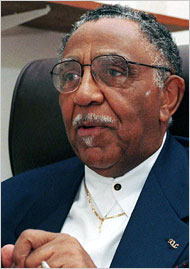
Obama’s speech was followed by a benediction from 87-year-old [The Reverend] Joseph Lowery (above), from Atlanta, Georgia, whose opening words must have sounded familiar to the millions of African Americans in the crowd and around the nation.

Lowery’s prayer began with the third verse of James Weldon Johnson’s hymn, “Lift Every Voice and Sing”, which, since it was written in 1920, has emerged as the “national anthem” of the African American community.

During these late summer weeks, as we await the closely-guarded news from the ongoing “peace talks” between Israel and Palestine, the third verse of “Lift Every Voice” appears even more relevant today than it was in 2009. Here are the words that begin the third verse:

“God of our weary years, God of our silent tears,

Thou who hast brought us thus far along the way;

Thou who hast by Thy might Led us into the light,

Keep us forever in the path, we pray.”

James Weldon Johnson’s words are significant today because pessimism surrounds the peace talks. Until we hear further from the negotiations participants, we must wait to see how the occupier and the occupied resolve, for the time being at least, how they will live together. 

It is in this time of waiting that I decided to set out on a journey that begins with Johnson’s hymn. On the internet journey I followed a path that led to another eloquent African-American author, Alice Walker.  Novelist and poet, Walker has written more than thirty books, the best known of which is her Pulitzer Prize winning novel The Color Purple.

In one of the speeches she delivered to a Palestinian audience during a visit to Ramallah, Walker described her encounter with Israeli border guards when she traveled from Amman to the West Bank by way of the Allenby Bridge.

As the hours of interrogation dragged by at the Allenby Bridge, Walker finally asked one of the young Israeli soldiers peppering her with the usual irrelevant questions, have you ever heard of the novel,  The Color Purple.

The soldier had not heard of the novel nor the film based on the novel, even though the film was directed by Steven Spielberg, an Israeli favorite.

After that visit, which was organized by TEDxRamallah, Walker tried to enter Gaza on a different mission.

In June, 2011, Walker was among 38 people aboard the ship, Audacity of Hope, one of  the ships which tried, and failed, to sail from Greece to Gaza to break the Israeli maritime siege of Gaza. Israel prevailed on Greece to prevent the ships from sailing.Alice_Walker_Ana Elena

In a 2011 conversation with Ali Abunimah, Walker (right) pointed to the parallels “between the [planned] Gaza Freedom Flotilla and the Freedom Rides during the US Civil Rights movement when black and white Americans boarded interstate buses together to break the laws requiring racial segregation.”

Former CIA analyst Ray McGovern, was one of the activists who tried and failed, to sail from Greece to Gaza. Of that effort, McGovern wrote:

My co-passengers [including Alice Walker] and I, of the U.S. Boat to Gaza. have now gone from “High-Seas Hippies,” according to the right-wing Washington Times, to participants in a flotilla full of “fools, knaves, hypocrites, bigots, and supporters of terrorism,” says Alan Dershowitz in his usual measured prose.

Poor Alan, he seems upset at our audacity not only to hope for humane treatment of the 1.6 million Gazans, who currently live under a cruel blockade, but to force the issue. To stop our boat before it could leave Greek waters, Israel’s Likud government gave itself a self-inflicted black eye and again brought the oppression of Gazans to worldwide attention.

Phillip C. Wilcox, Jr., president of the Foundation for Middle East Peace, sees a connection between attention drawn to Israel’s occupation and the current peace talks. In this summer’s issue of the Foundation’s “Report on Israeli Settlements”, Wilcox wrote:

In Israel, there is credible speculation that Netanyahu agreed to new peace talks, notwithstanding the strident rejectionism of his closest coalition allies, because he is beginning to grasp the growing alienation of the international community over Israel’s unyielding occupation and settlement policies.

The recent decision of the European Union to cease all EU expenditures for Israeli activities in the occupied territories was a shock to Netanyahu. It may have prompted his sudden willingness to yield to negotiations.

Not a bad day’s work for a group of what Alan Dershowitz calls,  “fools, knaves, hypocrites, bigots, and supporters of terrorism,” since we may assume that anyone working to end the occupation falls into the Dershowitz condemned bucket.

Since I began this posting by violating scholar and author Martin Marty’s cardinal rule against a writer quoting himself or herself, I will jump into Dershowitz’s bucket by quoting from another recent Wall Writings posting, “One Day Ramallah Will Rise Up”, in which I wrote:

There is no doubt that [Israeli columnists] [Gideon] Levy and [Uri] Avnery have sensed the presence of a “hidden mechanism” of change in Palestine.  It is a change happening in Ramallah, Palestine’s temporary capital, and in the rest of the West Bank, the Golan Heights, and in Gaza.

My journey following the path of Alice Walker turned up many examples of the gentle manner in which this remarkable woman stands for justice for the Palestinian people. For example, she is an avid supporter of the BDS (Boycott, Divestment, Sanctions) movement.

When she learned that Alicia Keys, another African-American woman active in public life, had accepted an invitation to perform in a music concert in Israel on July 4, Walker wrote to Keys, as an older sister would write to a younger sister. Part of the letter includes this request:

If you go to my website and blog alicewalkersgarden.com you can quickly find many articles I have written over the years that explain why a cultural boycott of Israel and Israeli institutions (not individuals) is the only option left to artists who cannot bear the unconscionable harm Israel inflicts every day on the people of Palestine, whose major “crime” is that they exist in their own land, land that Israel wants to control as its own. Under a campaign named ‘Brand Israel’, Israeli officials have stated specifically their intent to downplay the Palestinian conflict by using culture and arts to showcase Israel as a modern, welcoming place.

This is actually a wonderful opportunity for you to learn about something sorrowful, and amazing: that our government (Obama in particular) supports a system that is cruel, unjust, and unbelievably evil. You can spend months, and years, as I have, pondering this situation. Layer upon layer of lies, misinformation, fear, cowardice and complicity. Greed. It is a vast eye-opener into the causes of much of the affliction in our suffering world.

For those who would like to earn extra credit in this journey to discover more about Alice Walker, there are two in-depth interviews of Walker by Amy Goodman on Democracy Now. You may access these interviews, Part One here and Part Two, here.

Finally, in following the path of Alice Walker through the internet, our journey brought me home to Georgia, to my own alma mater, Emory University.

Alice Walker placed the archive of her work in the Manuscript,  Archives,  and Rare Book Library of Emory University in 2008. The Walker Archive was opened in 2009.

One video from the evening honoring Walker features historian-activist Howard Zinn who initially met Alice Walker at Spelman College in Atlanta where he was her teacher during the 1960’s. To view that video, click here.

The Emory event honoring Alice Walker closed with the singing of James Weldon Johnson’s “Life Every Voice and Sing,” the African-American “national anthem” with which we began this journey.  In this way, the circle closes, from James Weldon Johnson, to the Rev. James Lowrey, to President Barack Obama, and finally to Alice Walker.

The young man who leads the singing that closes the evening is an Emory graduate, class of 2011. His name is Garrett M. Turner. He is currently pursing further graduate work at the University of St. Andrews in Scotland.

The circle grows, regardless of the outcome of the current “peace talks” negotiations.


Posted in -Archive 2008, Middle East, Middle East Politics, Netanyahu, Obama | 7 Comments

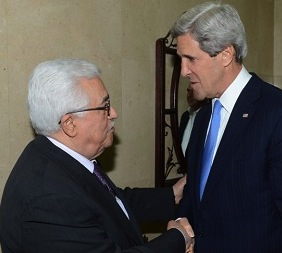
Kerry Stumbles Into a Peace “Bully” Role

by James M. WallKerry Abbas WAFA photo

Nicola Nasser, a blogger from Bir Zeit, Palestine, has delivered a stinging rebuke to John Kerry on the eve of the meetings with the U.S., Israeli and Palestinian negotiators.

Nasser’s blog,  allarabi. exposed a “new tactic” in Kerry’s preparation for the peace conference, scheduled to begin Monday.

When preparations for the talks began, Kerry asked Israel’s Benjamin Netanyahu and Palestinian leader Mahmoud Abbas not to comment on the conversations they had with Kerry prior to the Washington meeting.

Sorry, Mr. Secretary, but If the Edward Snowden/NSA fiasco has taught us anything, it is this:  There are no secrets in the internet age.

The U.S. Secretary of State cannot meet with a delegation from the 22-member Arab League in Petra, Jordan, as Kerry did on July 17, and expect his strategy to remain confidential.

Certainly not with bloggers like Nasser writing under this blunt headline, “Kerry Uses Arabs to Bully Palestinians”,

This is how Nasser began his posting:

A new tactic by US Secretary of State John Kerry is causing a split within the Palestine Liberation Organization (PLO) ranks regarding further talks with Israel. Kerry is apparently using the Arab League’s Follow-Up Committee on the Arab Peace Initiative (FCAPI) to bully the Palestinians into accepting new ground rules for the talks to which they had objected in the past.

In his sixth tour of the region as secretary of state, Kerry did something unusual. Instead of visiting Israel, as he always does, he left it out of his itinerary, deciding instead to hold most of the talks in the Jordanian capital Amman. While there, he conferred with Palestinian President Mahmoud Abbas as well as members of the FCAPI.

As the talks progressed, it became clear that Kerry was no longer focusing on Israel, the country that has torpedoed all previous attempts at peace, but on the PLO. His aim is to get the latter to offer more concessions than any they have accepted in the past. . . . .

The tactic is not totally new, for it resonates with the manner in which US diplomats have used the Arab League to justify foreign intervention for the sake of regime change in countries such as Iraq and Libya in the past.

The Petra meeting was hosted by Jordan’s Minister of Foreign Affairs and Expatriate Affairs Nasser Judeh. When the Jordan News Agency reported on the meeting, It remained faithful to the western narrative:

The delegation, which included Arab foreign ministers and permanent representatives at the Arab League of Bahrain, Saudi Arabia, Morocco, Palestine, Qatar, Kuwait, the United Arab Emirates and Secretary General of the Arab League, praised the efforts made by US President Barak Obama and Secretary Kerry, and their commitment to achieve peace.

The FCAPI delegates also remained in western mode:

Speaking after a meeting with Kerry in Amman, FCAPI diplomats voiced their “great support” for Kerry’s efforts to revive the talks. Their remarks were seen as a “victory” for Kerry, said the Associated Press. It was a “success” for his diplomacy, added The New York Times.

Meanwhile, Nasser’s posting from Bir Zeit swept through the Middle East.

The posting first surfaced outside of Palestine in Cairo, Egypt’s  Al-Ahram. Other postings , with the same harsh headline, quickly went on line in Tripoli, Libya, London’s Middle East on Line, and Russia’s Pravda, and Palestine’s The Palestine Chronicle. Across the Atlantic, it ran on CounterPunch and on Montreal, Canada’s  Centre for Research on Globalization (CRG)‘s site. (Click on each link to tour through Nasser’s posting).

When Kerry initially asked participants for confidentiality, he appeared to be dropping a hint that he was working for a surprise ending.  This lured some of us into hoping Kerry might revert to the fairness approach of the first President George Bush and his Secretary of State, James Baker.  The choice by Kerry of Martin Indyk, former AIPAC staffer, as his point person pretty much scuttled that dream.

Of course, long gone were, dare we say it, the halcyon days of President Jimmy Carter, when a U.S. President could act as an honest broker.

MJ Rosenberg recalls those days:Carter courtesy Carter Center crop

The only successful U.S. mediation between Israelis and Arabs was conducted by President Jimmy Carter (right) at Camp David in 1978. Carter managed to bridge the gaps that had led Israel and Egypt to go to war three times previously by being the ultimate honest broker.

In his book about Camp David, Gen. Moshe Dayan, who was then Israel’s foreign minister, described how Carter would keep the pressure on both sides equally, telling President Sadat and Prime Minister Begin, in turn, that if the talks failed, he would publicly name who was responsible.

All during the long arduous process that produced a peace treaty that has survived 34 years, Carter refused to act as either side’s advocate. His only client was peace and that is how he achieved an agreement.

For a time, it appeared that when he brought new leaders back to Camp David, Bill Clinton would keep his promises to Israel and the PLO.  Alas, political expediency appears to have led Bill Clinton astray. Israeli peace activist Uri Avnery recalls what happened:

In the past, the US has broken such promises without blushing. For example, before the Camp David meeting, President Bill Clinton gave Yasser Arafat a solid promise that he would blame neither side for a failure. (Since the meeting was convened without the slightest preparation, failure was predictable.)  After the conference, Clinton put the blame squarely – and wrongly – on Arafat, a vile act of political opportunism, designed to help his wife get elected in New York.
As it turns out, Clinton’s wife did get elected to that Senate seat from New York, from which she moved on to serve as Secretary of State. She was succeeded by John Kerry, who is a victim of a changing, and increasingly dark, political landscape in which the Israel Lobby and the U.S. Congress leave him and President Obama little room to maneuver.
In his posting, Nicola Nasser referred to “concessions” Kerry asked of Abbas.  This strongly suggests that Kerry had already gained what few “concessions” he could pry out of Netanyahu.
For his part, President Abbas has, no doubt, given John Kerry his wish list for any future peace accord.  The easiest wish Netanyahu could grant is a grudging release of Palestinian prisoners.  Netanyahu will play with the prisoners like they are poker chips. He will hold them until he decides to release some “in stages” throughout the negotiations.
John Kerry should be able to deliver his promises of Palestinian economic development, which is certainly needed. But what sort of economy can be developed under the restraints of an internationally illegal military occupation? What about the rebuilding of the Palestinian airport in Gaza? An airport is always helpful for a nation’s trade purposes. Don’t count on it.
A major Palestinian demand for agreeing to a peace plan is for Israel to end its illegal settlement growth.  Not a chance.  Israel plays the peace process game not to give away ill-gotten gains, but to protect them.
So given these handicaps and differences between the sides, where can this peace gathering go? It remains an outside possibility that strong voices within the Palestinian leadership will refuse to let Abbas give in to the U.S. bullying tactic. But thus far, limited prisoner release and additional economic development are strong incentives to send Mahmoud Abbas on yet another hat-in-hand journey to pick up what benefits are promised him.
Earlier this month, I wrote in this space a posting headed, “One Day Ramallah Will Rise Up“, a title from a column by Israeli columnist Gideon Levy.  In that posting, I wrote:
 “There is no doubt that [Israeli columnists] Levy and [Uri] Avnery have sensed the presence of a “hidden mechanism” of change in Palestine.  It is a change happening in Ramallah, Palestine’s temporary capital, and in the rest of the West Bank, the Golan Heights, and in Gaza.”
On the day before the Washington talks were set to begin Monday, Ramallah began to rise, as demonstrators voiced their disapproval of the Washington talks.  The Palestinian news agency Ma’an reported the demonstrations in Ramallah.

Hundreds of Palestinians marched in Ramallah on Sunday to protest a return to negotiations with Israel. Demonstrators marched from the city center towards President Abbas’ headquarters in the Muqata, chanting slogans condemning the Palestinian Authority’s decision to return to talks.

Four Palestinian Authority police officers and three protesters were injured when both sides clashed during the march, which was organized by the Popular Front for the Liberation of Palestine. 

The Palestinian street could be a serious problem, or an important ally, for Mahmoud Abbas.  If he falls any further in Palestinian public esteem, no baubles he picks up in Washington will satisfy an angry public, except for the release of prisoners.

By rejecting economic assistance, and then gaining releases on all the prisoners he can get his hands on, he just might go home with no “peace accord”. After all, any “peace accord” dictated by Israel and the United States will be neither a peace nor an accord.

   The picture at top of Abbas and Kerry, is by WAFA. It ran in The Palestine Chronicle.

Posted in John Kerry, Media, Middle East Politics, USA | 4 Comments