Corrie Family Waits For Tuesday Verdict

by James M. Wall

Rachel Corrie’s parents, Craig and Cindy (above), and her sister, Sarah, are in Israel this week, waiting for a verdict from the Haifa District Court on the family’s suit against the government of Israel. The verdict from Judge Oded Gershon, is expected to be announced Tuesday.

The civil suit was filed two years ago over Rachel’s 2003 death when an Israeli Defense Force bull dozer killed her as she stood with a bull horn protesting the IDF’s destruction of a Palestinian home in Gaza. Israel’s official response was that the death was an accident.

Amira Hass, West Bank and Gaza correspondent for Ha’aretz, reported Thursday that U.S. Ambassador to Israel, Dan Shapiro, told the Corrie family that

Israel’s investigation into the death of American activist Rachel Corrie was not satisfactory, and wasn’t as thorough, credible or transparent as it should have been.

The U.S. government position is “not new” to the Corries, but their attorneys told the family that hearing it only a few days before the verdict was “important and encouraging [to the family],” because it signals to the Corrie family that the U.S. government will continue to demand a full accounting from Israel about their daughter’s killing, regardless of how Judge Oded Gershon rules”.

The ruling will mark the end of the latest chapter in the Corrie family’s long ordeal as they seek justice over their daughter’s death.

Rachel Corrie came  to Gaza in 2002, where, as Amira Hass explains,  “she joined a group of International Solidarity Movement activists who had been living among Palestinians in the West Bank and Gaza, in areas that were subject to Israel Defense Forces incursions and attacks”.

A statement of support from Ambassador Shapiro suggests that he is not optimistic that the Tuesday verdict will be good news to the Corries. But the fact that Shapiro chose to issue this supportive statement prior to the verdict, has to be a good sign that the Obama administration will continue to demand a more complete and thorough investigation into Rachel’s death.

An ultimate judgment in this case rests in the hands of Israeli courts. There is little, other than diplomatic pressure, that the U.S. can do to support the Corries.  But the fact  that President Obama, during his reelection campaign, is willing to signal to the Corries that, regardless of the outcome of the Tuesday ruling, an Obama government will continue to support their family’s quest for justice.

It would have been an easy call simply to remain silent in the face of a possibly unfavorable court decision.  But Obama was not silent. This is an indication that Israel’s control over the White House is not as firm as it was in 2003, during the Bush administration, especially in the emotional climate during the period right after 9/11 when Rachel was killed.

We may expect influential pro-Israeli U.S. citizens to respond negatively to even the slightest sign from President Obama that is not supportive of Israel.

We have advance warning from one such pro-Israeli citizen.

He is  Ronn Torossian, a New York based public relations executive, who took one look at the Republican party’s choice of Paul Ryan as its vice-presidential candidate to ask the inevitable question on his blog: “Is Paul Ryan good for the Jews?” Ryan will be nominated as Mitt Romney’s running mate during next week’s Republican National Convention in Tampa, Florida

Is Paul Ryan good for the Jews?

Torrossian turned to Ryan’s website for his answer. There  he found, for him, encouraging comments:

I believe at least one thing is clear: we cannot advocate for a solution to the Israeli-Palestinian conflict that jeopardizes Israel’s safety or legitimizes terrorism. Hamas, which is one of the two major Palestinian political factions, is an Islamist terrorist group whose charter calls for Israel’s destruction, refuses to recognize Israel’s existence, and calls Osama Bin Laden a “martyr.”

America should not pressure Israel to agree to a peace deal that is unlikely to result in peace and security. Real peace will require Palestinians to recognize that Israel has a right to exist, even as it will require two states for the two peoples.

Torossian followed up that strongly pro-Israel observation from Ryan, by concluding on his blog: “Owning a PR firm, I know that only now does the spin begin, but clearly Paul Ryan is good for the Jews.”

The PR firm to which Torossian refers is 5W Public Relations , The firm’s website describes itself this way:

Founded by Ronn Torossian, the firm has grown into 1 of the 25 largest U.S. PR Agencies, as we believe communication is the key to success. The staff of 5WPR are experts in effectively communicating clients’ messages to their target audience. We listen to our clients’ needs, gain insight, and create a trusted extension of their C-suites and marketing departments. 5W Public Relations’ PR specialists work everyday to place strategic stories in a wide array of markets and sectors. Whether the goal is to drive web traffic, introduce a new technology or product, or clutter-bust a crowded marketplace, we are a PR agency that understands our clients’ business models and how to generate measurable results.

Torossian is but one loyal Israel Lobby warrior among many who carries a loud bullhorn to inform those within the sound of his blog that he finds Paul Ryan to be good for the Jews.

Barack Obama knows this, of course, which might have tempted the President to hold his fire on instructing his Ambassador to Israel to wait for the verdict in the Rachel Corrie suit. He also did not need to have been so firm in his assurance of support to the Corrie family, regardless of the final verdict this Tuesday.

Finally, a gentle reminder to those voters who still might be tempted to cast a “plague on both your houses” vote for a third party this November.. That Obama stood by the Corries in the midst of a reelection campaign, is all the more remarkable.  Did George W. Bush, or would Mitt Romney, have done that?

The picture above of the Corrie parents, standing with a poster and a large photograph of Rachel, was taken in 2003 as the Corrie family began its long battle on behalf of Rachel.  It was taken by the Associated Press, and appears above the Ha’aretz story cited above.
Posted in Middle East Politics, Obama, Politics and Elections | 10 Comments

Israel Delivers “Or Else” Demands to Obama

by James M. Wall

A message from Israel arrived on our shores this week. It came from the prime minister and defense minister of Israel.

The message was not sent in a diplomatic pouch.  Nor did it come in a private conversation between Prime Minister Benjamin Netanyahu and President Barak Obama, though we have to assume the same message had already been sent to the White House.

The message was a warning that the Strong Man of the Middle East will go to war against Iran before Election Day, November 6, unless Barack Obama meets two Israeli demands. The warning was delivered by the New York Times in a news analysis, “Israeli Leaders Could Be Dissuaded From Striking Iran”, by the Times’ Jerusalem correspondent, Jodi Rudoren.

A former Israeli national security adviser said Wednesday that the prime minister and the defense minister told him this week they had not yet decided to attack Iran’s nuclear facilities and could be dissuaded from a strike if President Obama approved stricter sanctions and publicly confirmed his willingness to use military force.

Got that Mr. President? Only you can prevent this forest fire from engulfing the Middle East. Israel has lit the flame. Netanyahu has sent the warning: Either you do exactly what we demand—stricter sanctions and a public statement that the U.S. is willing to use military force against Iran—or else we will ignite the deadly flame of war against Iran.

The message carries the ominous deadline language Israel puts on the table in all of its threats. The warning came from Israel’s Prime Minister Benjamin Netanyahu and Defense Minister Ehud Barak through a credible source, Uzi Dayan, who met with the two Israeli leaders Monday.

“There is a window of opportunity,” said the official, Uzi Dayan, a former deputy chief of staff in the military. “This window is closing, but if the United States would be much clearer and stronger about the sanctions on one hand and about what can happen if Iran won’t make a U-turn — there is not a lot of time, but there is still time to make a difference.”

Dayan is currently chairman of the national lottery. 

He was being considered for the post of minister of the military’s Home Front Command, which he said he turned down, and therefore extensively discussed with the two leaders the security threats that Israel is facing, particularly from Iran. (Another leading security official, Avi Dichter, is expected to be confirmed by Parliament as the home front minister on Thursday.)

Netanyahu has experience setting conditions that end with the bully’s growl, “or else”. For their part, the Palestinians are accustomed to Netanyahu’s tactics. He has successfully prolonged the failed peace talks with the Palestinian Authority by making new demands that move the goal post further down the field to failure.

“Recognize Israel’s right to exist” was not on the peace talk table until after a few years into the negotiations. Netanyahu decided he would play the “right to exist” card as a demand he knew the Palestinians would refuse to accept.

When the Palestinians make progress toward stability on the world stage with steps like negotiating for recognition as a state, Netanyahu offers some crumbs if the PA would delay its talks with the UN. The PA wisely ignored him.

Tony Karon, veteran Middle East observer for Time magazine, described the intense discussion within Israeli media, for and against an Israeli attack.

One of Israel’s most senior columnists, Maariv’s Ben Caspit, sought to calm the media frenzy. “You can all relax,” wrote Caspit. “In the last two weeks, nothing new has happened with regards to an attack on Iran.

The Cabinet hasn’t convened, the Defense Minister hasn’t summoned the IDF general staff, and no new information has been received. Everything that is known today was also known two weeks and two months ago.”

Caspit suggested that the new “bomb Iran” talk wasn’t based on any qualitative shift in the nature of Iran’s nuclear work. The U.S. intelligence assessment until now has been that despite steadily accumulating the means to build nuclear weapons, Iran has not thus far moved to enrich uranium to weapons grade or to begin the process of actually building a bomb. Nor has it taken a strategic decision to do so as yet.

The problem is that the “red lines” adopted by Israel and the U.S. for triggering a military response are different: President Obama has vowed to take military action to stop Iran from acquiring a nuclear weapon, whereas Israel has insisted that Iran can’t be allowed to maintain the capability to build such weapons — a technological capacity it essentially already has.

Despite this difference in perspective described by Karon, Netanyahu is depending on his allies in the U.S. to support him as he makes his demands on Obama during the politically sensitive final months of President Obama’s reelection campaign.

Should Obama be reelected, Netanyahu’s threat may prove to be a major misstep. A second term Obama would be free to proceed at his own pace to make his own demands on Israel. Assuming that is, Obama does not give in to the arrogance of Netanyahu’s demands, which appears unlikely, given the strong lead Obama currently has over his opponent.

Of course, anything could happen between now and November 6. Elections do have consequences.

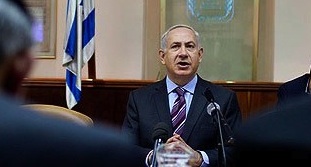
The picture of Netanyahu at a cabinet meeting above, is a pool photo taken by Abir Sultan. It is from Reuters.

Posted in Middle East, Middle East Politics, Netanyahu, Obama, Politics and Elections, Uncategorized | 17 Comments

Ten Swing States Could Decide the 2012 Election; Obama Leads in Nine of Them

by James M. Wall

With less than three months left before voters decide between President Barack Obama and his Republican opponent,  Mitt Romney, Obama has a strong lead in the latest Politico poll figures.

Politico identifies ten swing states that will most likely decide the 2012 election. Obama leads in nine of them: Colorado, Florida, Iowa, Michigan, Nevada, New Hampshire, Ohio, Virginia, and Wisconsin. Romney leads Obama by one percent in the swing state of North Carolina.

If these swing vote states hold up in an election that requires 270 out of 538 electoral votes to win a majority, Obama would gain 111 electoral votes to Romney’s 15.  States that appear solid or leaning for Obama give him an addiitional 221 electoral votes. Romney’s solid or leaning state electoral votes total 191. These figures add up to 332 for Obama and 206 for Romney, more than enough to give Obama the winning total.

A major reason we might safely assume these numbers will hold up can be found in an ABC-Washington Post poll which found that only 40 percent of voters “hold a favorable view of Romney”. In a late May poll, that number was 41, suggesting a downward trend.  Low favorability numbers this late in the campaign does not portend well for the challenger.

Romney’s unfavorable rating increased from May to August by four percentage points, an increase from 45% to 49%. Say what you will about their actions in office (and I would have many unfavorable things to say about the damage they did), Ronald Reagan and George W. Bush were “liked” by a majority of the voting public, enough to help bring them to the White House.

Michael Tomasky, writing for Newsweek’s The Daily Beast, predicts a possible Obama landslide in November.  Tomansky points to a winning trend, beginning with Pennsylvania’s shift from a swing state to a strong or leaning Obama state.

There’s a secret lurking behind everything you’re reading about the upcoming election, a secret that all political insiders know—or should—but few are talking about, most likely because it takes the drama out of the whole business. The secret is the electoral college, and the fact is that the more you look at it, the more you come to conclude that Mitt Romney has to draw an inside straight like you’ve never ever seen in a movie to win this thing. This is especially true now that it seems as if Pennsylvania isn’t really up for grabs. Romney’s paths to 270 are few.

First, let’s discuss Pennsylvania. There has been good reason for Democrats to sweat this state. True, Obama won it handily in 2008, by 10 points. But it’s a state that is older and whiter and more working-class than most of America. Obama benefited from all the unique circumstances of 2008 that helped him across the country, but if ever there were a state where the “well, we gave the black guy a chance and he blew it” meme might catch on, it’s the Keystone State.

In Pennsylvania the incumbent Obama benefits from a jobless rate of 7.5 percent, well bellow the national average. In addition, the Republican national strategy to suppress voting by minorities has run into a judicial roadblock in Pennsyvlania.

This odious voter ID law is facing meaningful challenges. A hearing on the law’s validity has just been concluded. A state judge says he’ll rule on the law’s constitutionality the week of Aug. 13. It sounds as if the law’s opponents made a stronger case at the hearing than its supporters. In any case, the losing side will appeal to the state Supreme Court.

The one thing that could seriously halt an Obama landslide would be interference by outside forces. That may well have been the case with the Iranian government in the Carter-Reagan election in 1980.  Whether Republican campaigners made a secret deal with Iran to hold American hostages until after the election, is still hotly debated.

But the fact that the hostage release was timed by Iran to fall on Reagan’s 1981 inauguration day offers strong circumstantial evidence that the Iranians did not want Carter to get any credit for negotiating the hostage release. A release of the hostages prior to the election would have greatly enhanced Carter’s chances of reelection.

Gary Sick’s book, October Surprise, offers strong support to the belief that Reagan’s campaign staff interfered in delicate international matters for their own partisan political reasons.

Is Israel’s Prime Minister Benjamin Netanyahu offering Mitt Romney another October surprise? His bellicose threats to attack Iran would impact the election, even as it set in motion a series of events destructive to the region.

Why would he put the lives of his own citizens in such danger?

One strong reason could be his belief that a Romney victory would return Israel to the glory days of George W. Bush. During his recent fund-raising speech in Jerusalem, Romney said Israel’s culture was “superior” to that of the Palestinians.

In what was received by many not at the luncheon at the King David Hotel as a racist statement, Romney was following the guidance of his foreign policy advisor, Dan Senor, a former Bush neo-conservative public affairs officer in Iraq

Romney was so caught up in his culture pandering to his Israeli and American pro-Israel audience, that he completely ignored the impact of the occupation on the Palestinian economy.

Netanyahu enjoyed eight years of his relationship to Republican President George W. Bush, who essentially gave Israel a green light to carry out its plan to take control of what Netanyahu calls Judea and Samaria, but which the international community correctly identifies as the Occupied Territories of the West Bank, Gaza, East Jerusalem and the Golan Heights.

Jeff Halper’s essay in the April-June issue of Link magazine, Is the Two State Solution Dead?  should bring an end to the fiction that Israel is sincere in its claim to support a “two state solution”.  Here are key paragraphs in Halper’s essay:

Israel and its supporters also know full well that the two-state solution is dead, and good riddance because it gave too much land and sovereignty to a collection of people whose national rights Israel has always denied.

But it nevertheless plays a key role in perpetuating Israeli control of the Occupied Territory, holding everything in place until the Occupation is normalized, the Palestinians pacified, and the world moves on to the next urgent conflict.

By playing along with variations of a two-state solution that it knows are unacceptable to the Palestinians—for example, a “two-state solution” in which the Palestinians are locked into a non-viable, semi-sovereign Bantustan—Israel is able to avoid any genuine solution to the conflict, since any genuine solution would require either too large a concession of land or shared sovereignty with the Palestinians.

But while Israel endeavors (with the U.S., Europe and, for its own reasons, the Palestinian Authority) to keep the two-state charade going on indefinitely, it has already moved on to the next stage: putting in place an apartheid regime or—its preferable solution—simply warehousing the Palestinians forever.

With US polls showing the strength of Obama’s lead three months before the election, would Netanyahu dare risk starting a war with Iran which he may think would guarantee a Romney victory?

If that is the thinking in the Netanyahu war cabinet, it is wrong.

Israel’s standing with the American public is not nearly as strong as the Congress, and Israel’s U.S. backers, think it is. Americans are tired of war and they do not like Romney. If Netanyahu attacks Iran over Obama’s objections, there is every reason to believe the American people would reject Israel’s action and stand behind their own president.

As a second-term president,  Obama would be in a strong position to start terminating Israel’s control of  the American government.

The picture of Obama is by Jim Mone of the Associated Press.  It appeared in the New York Times. The picture of Halper is from Link.

Posted in Middle East, Middle East Politics, Netanyahu, Obama, Politics and Elections | 3 Comments

Romney Visits Culturally “Superior” Israel; Totally Ignores the Occupation

by James M. Wall

Mitt Romney traveled to Jerusalem earlier this week. He was not there on a fact-finding mission. He was raising money for his presidential campaign.

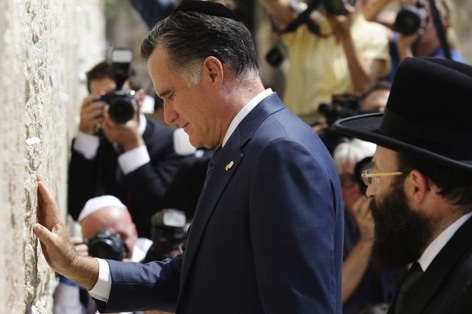
He was also cultivating American voters who live in Israel, while stroking his pro-Israel voters back home with pictures like this one (right) of the candidate praying at the Western Wall.

The only attention the Palestinians received came in a back-handed slap delivered by Romney when he spoke to a luncheon sponsored by his wealthy U.S. backer, casino owner Sheldon Adelson.

Romney told 40 wealthy donors at Jerusalem’s King David Hotel that Israel has a far superior GDP per capita than “the areas managed by the Palestinian Authority”.

Displaying a total ignorance of the prison-like occupation under which the Palestinian people must struggle, Romney explained that the “dramatically stark difference in economic vitality” was due to Israel’s superior culture.

Grossly misstating the 2009 GDF figures available on the United Nations website, Romney said:

As you come here and you see the GDP per capita, for instance, in Israel which is about $21,000 dollars [actually $27,060], and compare that with the GDP per capita just across the areas managed by the Palestinian Authority, which is more like $10,000 [actually $1,367] per capita, you notice such a dramatically stark difference in economic vitality.

Romney did not cross over into what he called “the areas managed by the Palestinian Authority”. He did not see for himself the so-called “security wall”. Instead like the average American tourist traveling under Israeli guides all he appeared to know about the region came from books he or his staff had read.

That reading prompted Romney to say that “some economic histories have theorized that ‘culture makes all the difference.'”

Zooming in on the financial backers he spoke to at the King David Hotel, Romney added:

And as I come here and I look out over this city and consider the accomplishments of the people of this nation, I recognize the power of at least culture and a few other things [including] an innovative business climate, the Jewish history of thriving in difficult circumstances and the “hand of providence.” He said similar disparity exists between neighboring countries, like Mexico and the United States.

Back in Boston, Romney was asked about such comments. He told ABC News: “You know, I tend to tell people what I actually believe.”

Future polls will have to reveal how much damage among U.S. voters Romney’s amazing display of ignorance about the history and politics of this region,  has done to his political standing.

One thing is certain, however. The immediate response to Romney’s fund raising speech at the King David Hotel has been overwhelming negative, except among the candidate’s extremist U.S. and Israeli backers.

Saeb Erekat, a senior aide to Palestinian President Mahmoud Abbas, told the Associated Press:

It is a racist statement and this man doesn’t realize that the Palestinian economy cannot reach its potential because there is an Israeli occupation. 

It seems to me this man lacks information, knowledge, vision and understanding of this region and its people. He also lacks knowledge about the Israelis themselves. I have not heard any Israeli official speak about cultural superiority.

Palestinian-American business leader Sam Bahour wrote a Religious News Service column, which also ran in the Washington Post:

Mitt Romney made history on Monday. In a single speech from Jerusalem, he proved beyond a reasonable doubt that to qualify to be a U.S. presidential candidate one needs precious little understanding of history, economics, or reality. Romney has just enough to be dangerous.

With no sense of the impediments Palestinians labor under, Romney compared Israel’s economic success to that of its Palestinian neighbors and claimed the discrepancy was due to “cultural” differences and the “hand of providence.” Such blatantly racist and bigoted references to the conflicting parties are only occasionally rivaled by Israel’s most right-wing politicians.

Television host Cenk Uygur wrote for the Huffington Post site:

Mitt Romney recently said in Israel that Palestinians don’t have as high a GDP per capita as Israelis do because their culture is not as good as Jewish culture. That is both deeply racist and deeply stupid.

American academic blogger Juan Cole wrote on his blog, Informed Comment:

Mitt Romney, a privileged white man worth a quarter of a billion dollars who has sheltered his money from taxes in Bermuda, the Cayman Islands and Switzerland, and who never misses a square meal, stooped to a new obscene low in blaming the victim on Monday by slamming the Palestinians for not being richer. Palestinian politician Saeb Erekat characterized Romney’s remarks as “racist,” but even that was charitable. Evil, is more like it.

UK Guardian’s Rachel Shabi described Romney’s whirlwind three-country tour as “an insult-the-world tour, during which he’s constantly trying to outdo his previous personal best.”

How else to explain the Republican presidential candidate’s horribly offensive comments about Palestinians during his recent trip to Jerusalem, so soon after the clunking insults levelled at his British hosts in London last week?

Over a £16,000-a-plate campaign fundraiser breakfast with Jewish donors in Jerusalem, Romney aired his deep thoughts on “the dramatic, stark difference in economic vitality” between the Palestinian and Israeli economies. These thoughts were obtained by reading books, he prefixed, before surmising that Israeli accomplishments were down to “at least culture and a few other things” – oh, and also, “the hand of providence”.

Even the New York Times knew that it dare not remain silent in the face of Romney’s outrageous display of ignorance. In its editorial page, the Times wrote:

Mr. Romney did American interests no favors when he praised Israeli economic growth while ignoring the challenges Palestinians face living under Israeli rule in the West Bank and Gaza. He showed troubling ignorance by understating the income disparity between Israel and those areas. Israel, in 2009, had a per capita gross domestic product of roughly $29,800, while, in 2008, the West Bank and Gaza had a per capita gross domestic product of $2,900, according to the Central Intelligence Agency.

Times columnist Tom Friedman took note of the politics of the trip:

The question is this: Since the whole trip was not about learning anything but about how to satisfy the political whims of the right-wing, super pro-Bibi Netanyahu, American Jewish casino magnate Sheldon Adelson, why didn’t they just do the whole thing in Las Vegas? I mean, it was all about money anyway — how much Romney would abase himself by saying whatever the Israeli right wanted to hear and how big a jackpot of donations Adelson would shower on the Romney campaign in return.

After Romney returned to Boston, he wrote a column for the conservative magazine National Review, not yielding an inch on his belief in Israel’s “superior culture”,

During my recent trip to Israel, I had suggested that the choices a society makes about its culture play a role in creating prosperity, and that the significant disparity between Israeli and Palestinian living standards was powerfully influenced by it. In some quarters, that comment became the subject of controversy.

But what exactly accounts for prosperity if not culture? In the case of the United States, it is a particular kind of culture that has made us the greatest economic power in the history of the earth. Many significant features come to mind: our work ethic, our appreciation for education, our willingness to take risks, our commitment to honor an oath, our family orientation, our devotion to a purpose greater than ourselves, our patriotism.

But one feature of our culture that propels the American economy stands out above all others: freedom. The American economy is fueled by freedom. Free people and their free enterprises are what drive our economic vitality.”

Somewhere in one of Ray Bradbury’s short stories, a young boy stops on the sidewalk, looking up at the top of the town hall. He is troubled because he realizes he is seeing the town clock for the first time.  He thinks to himself, “If I haven’t seen the clock before, what else have I missed?”

It is a scary thought that our next president could be Mitt Romney, who traveled to Israel and ignored the obscene wall Israel has built to guarantee that the Palestinian people will have none of the freedoms he claims to espouse.

If Romney failed to grasp the obscenity of Israel’s “security wall”, what else has he missed?

Posted in Middle East Politics, Politics and Elections | 10 Comments

Israel Creates A Settler “Samaria” University

by James M. Wall

Few developments shout stability and permanence quite as loudly as the establishment of a university.

There is something about those green-covered campus lawns growing in a water-starved desert land interspersed with eager young students hurrying to class, that stirs pride in the hearts of citizens of an expanding city.

That pride was turned up another notch this week after ABC news reported an Associated Press story which began:

A settler body voted Tuesday to grant university status to Israel’s only West Bank settlement college, overruling objections by Israel’s Council on Higher Education and potentially stirring a new round of international condemnation against Israeli policies in the West Bank.

Upgrading the college in the Ariel settlement has touched off a debate inside Israel, where Prime Minister Benjamin Netanyahu’s government has been driving a string of pro-settler measures — including a state panel’s recent conclusion that Israeli settlement of the West Bank is legal.

Let the international condemnations rain down. And pay no heed to that debate inside Israel.

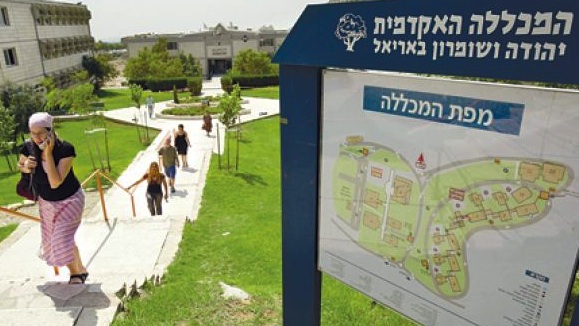
What matters to Ariel and the politically potent settler movement, is that Israel has firmly planted its first “Samaria” University on Palestinian soil.

The New York Times treated the story with great caution, offering this brief explanation of what happened:

Most of the world views the areas that Israel conquered from Jordan in the 1967 war, and where the Palestinians want to establish a future state, as occupied territory, and the Israeli settlements there as a violation of international law. 

To those who do not ascribe to the Zionist narrative as the only true version of history, “the areas that Israel conquered from Jordan” is, in fact, not the biblical land of Samaria. It is called the  Palestinian West Bank of the River Jordan.

The Times, reluctant to acknowledge that a distorted biblical interpretation is being used by the modern state of Israel, shifts its reportorial focus to politics, international and academic:

Critics denounced the decision as a political move aimed at bolstering the settlement project.  The presidents of Israel’s seven other universities and other state bodies opposed the upgrade, saying that the competition for limited budgets and resources was already severe.

Reuters was more specific on the funding and political dimensions of Ariel’s elevation:

The Ariel University of Samaria’s new status will entitle it to more state funding, and some see the move as designed to strengthen Israel’s stake in the West Bank, territory it captured along with the Gaza Strip and East Jerusalem in 1967.

“This decision is not a decision to promote the education system in Israel,” said Yariv Oppenheimer, head of the Israeli anti-settlement organisation Peace Now. “(It is intended) to gain the support of the settlers.”

The university can use the government funding. Founded in 1982, the school now has 13,000 students. Currently, around 311,000 Israeli settlers and 2.5 million Palestinians live in the West Bank.

Speaking for domestic consumption, the modern state of Israel has long referred to the West Bank and Gaza as Judea and Samaria,  employing a biblical literalism to justify a modern colonial military invasion of Palestine.

Using biblical literalism to describe modern state borders is a neat linguistic trick that appeals to Israel’s right-wing expansionists and land developers. In this reading of the scriptures, Yahweh becomes a property manager who dispenses land titles.

Changing indigenous names is a long-established strategy employed by invading powers. One of the first things the British army did in dealing with Northern Ireland was rename its streets, dropping the Gallic designation for proper English terms.

I encountered this “name changing to fit the narrative” strategy during the First Intifada when a group of us crossed over into Israel from Palestine to visit a government center for the instruction of new citizens. During a break, I asked an Israeli official about the recent unrest in the West Bank.

He adopted a wounded look of disappointment over the ignorance of his American questioner. His response:

“West Bank? I know nothing of this West Bank. I know about Leumi Bank, but I don’t know about any West Bank.”

Leumi Bank is based in Israel, with banking branches world wide, including one in Chicago. Smart fellow; he must have known I was from Chicago.

On another visit to Israel, which preceded the First Intifada, an Israeli Foreign Ministry official told his U.S. media visitors we should be “paying attention” to the positive influence of “this Hamas group” in Gaza.

At the time, the Palestinian Liberation Organization (PLO), headed by Yasir Arafat, was considered Israel’s “enemy”.  Hamas, on the other hand, was Israel’s newly-minted “friend”, a social service organization that cared for the poor. Ironically, the First Intifada, which ran from 1987 to 1993, began in the Jabalia refugee camp in Gaza.

The Zionist  narrative shifts, as needed, to serve the Israeli expansion plan, relying, at times, on the Arab proverb, “the enemy of my enemy is my friend”.

With the official establishment of Israel’s first  university in Samaria, that expansion plan has attained its long-sought standing of respectability and permanence. The final step, since it is a settler project, should be easy.  The Israeli Defense Force remains as the final authority over all West Bank affairs.  The IDF will need to give its final seal of approval.

Israel’s style is to pay no attention to what “most of the world” thinks, other than to stir American religious guilt with allegations that Israel is being constantly demonized through “anti-semitic” church resolutions.

The promotion of Ariel Institute to the status of a university in Samaria is the end of a long Israeli development process, which proceeded along an expansionist track while the “peace process” game traveled a second, entirely unrelated, subterfuge track.

We know where the subterfuge track traveled; it got extensive media coverage. Here are highlights of the expansionist track.

On Jan 29, 2010, the Israeli newspaper Ha’aretz reported on a tree-planting ceremony in Ariel during which Prime Minister Netanyahu “reaffirmed the town’s historic and strategic significance.”

Without the backing of the U.S. Israel Lobby and its control over the major U.S. institutions, Netanyahu would not have been able to speak so defiantly against world opinion as he laid this claim on Ariel as a permanent Israeli city:

Anyone who understands the geography of the Land of Israel knows how important Ariel is. The settlement enterprise here is the heart of our land.

Here is where our forefathers dwelled and here is where we will stay and build. We want to strengthen the peace and co-existence with our neighbors but this will not stop us from continuing with our lives here, where we’ll continue to plant trees and to build.

Ariel, the capital of Samaria [the northern West Bank], will be an integral, inseparable part of the state of Israel in any future arrangement.

Ariel was created as a settlement near Jerusalem. After a few years of growth, it was surrounded by the “security wall”, which has nothing to do with security and everything to do with land theft. The city grew, its citizens housed in modern red-roofed structures, so colored, it is rumored, to serve as a marker for Israeli military aircraft in future wars.

During the summer of 2011, the Israeli government, which had refused even to consider President Obama’s 2009 request for a settlement building halt, approved another 277 housing units for Ariel.

This growing city needed its swimming pools and its shopping malls. Their garbage disposal, however, was not a problem. Settlers in Ariel send their garbage down hill toward surrounding villages, where it pollutes Palestinian water supplies and fouls their fields.

Ariel was designed to expand. Educational institutions grew rapidly, culminating in the final approval of Israel’s first university within the West Bank.

International travel plans for Mitt Romney, the Republican presumptive nominee for the U.S. presidential November election, includes a stop in Israel, July 28-29, where he is expected to meet visit with Israeli Prime Minister Benjamin Netanyahu. In what should not have escaped Romney’s trip planners, a few days before Romney began his trip, the Israeli Attorney General Yehuda Weinstein  asserted that the “Al-Asqa Mosque is part of Israeli territory”.

This inflamatory assertion immediately drew “unprecedented condemnation from across the Islamic world.” Of course it did, and knowing just how far into the Zionist camp Romney has already moved, we will not hear the slightest complaint on this absurd anti-Islam Israeli statement from the Republican candidate.

As we move toward the U.S. November elections, a look back to early 2009 is instructive:

As James Mann tells the story in his book, The Obamians: The Struggle Inside the White House to Redefine American Power:

Obama’s mentor Abner Mikva, other Chicago friends, and several members of his new administration, such as Rahm Emanuel, had all emphasized the importance of persuading Israel to stop building new settlements in the occupied territories claimed by the Palestinians. once in the White House, Obama moved fairly quickly to put this idea in effect.

In his Cairo speech in June, 2009, he said, without qualification, “It is time for these settlements to stop.”

As we have seen in the steady march of Ariel to university status, the settlements did not stop.

Obama was asking the Israeli government to give the peace track a serious effort.  Instead, the newly-elected Benjamin Netanyahu abandoned any pretense of seeking peace and focused entirely on expanding his Middle East empire.  (picture at left)

Along the way, Netanyahu drew raves from the U.S. Congress and insulted any American diplomat who came his way.

Now while Netanyahu pushes the U.S. toward war with Iran, five Israeli citizens riding a tourist bus are killed  in Burgas, Bulgaria, by what appears to be a suicide bomb attack. Netanyahu’s response is to blame Iran.Tikun Olam has an early analysis, which urges caution in the blame game. Phillip Weiss reported Friday morning, July 20, that the White House was not yet prepared to point to any group as the responsible agent.

Whoever was responsible, as long as the settler movement continues to control Israeli politics, there will be more horrors like the tourist bus deaths.

Meanwhile, the grass grows on the new Ariel University campus and the Ariel city garbage continues to flow downhill and pollute Palestinian water and farm fields.

Where do we find hope in this darkness?

Posted in Middle East Politics, Netanyahu, Obama, Politics and Elections | 7 Comments

What Protestants Could Learn from Ron Paul

by James M. Wall

When the gavel fell on the Episcopalian convention, July 10, three major U.S. Protestant denominations had formally ended their 2012 discussions on how much religious support they were willing to give Palestinians under occupation.

The most charitable answer for all three gatherings is, not much.

Judging by the degree of hostility stirred up inside the Zionist opposition, the Presbyterians and United Methodists, took the most advanced pro-justice positions in the Sturm und Drang religious political struggles.

The last of the three to meet, the Episcopal Church, ran pretty much in place, sticking with investment over divestment.  According to the Episcopal News Service, the Episcopalian “House of Bishops, concurring with deputies, have overwhelmingly supported a resolution on positive investment in the Palestinian Territories”.

The Episcopalians also “agreed to postpone indefinitely the conversation on corporate engagement,” hardly a prophetic call to arms against injustice.

Indeed, all three denominations have come very close to invoking the divine thunderbolt promised in Revelation 3:16, an action best left in divine hands.

Meanwhile, in Washington, DC, before the church gatherings even began, there had been action on the secular political front. No surprises there, either.

The U.S. House of Representatives, with very little disagreement and virtually no media attention, embraced with great fervor, U.S. House Bill 4133.

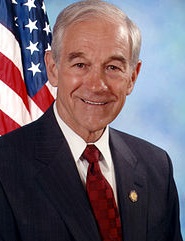
When the votes were cast on HR 4133, Texas Congressman Ron Paul (pictured above) voted against it. In fact, Paul cast one of only two negative votes against the bill, blandly entitled, “the United States-Israel Enhanced Security Cooperation Act”.

The second negative vote in the House against the bill, came from Congressman Paul Dingell, who is a Democrat from Michigan.

Ron Paul is a Libertarian and a Republican. As a Libertarian, he is an avid supporter of minimalist government. But on the matter that has recently engaged the churches, Ron Paul is a rare voice of reason in the U.S. House, from which, alas, he is retiring in January, 2013.

In a depressing contrast to Congressman Ron Paul, with their lukewarm response to the Kairos Document, a passionate plea for justice from Palestinian Christian Church leaders, the three major U.S. Protestant churches literally turned their collective backs to Palestinians under occupation.

Ron Paul did not turn his back on the Palestinians. He knows injustice when he sees it. In his speech on the floor of  the House, on May 9, just before the House voted on HR 4133, Congressman Paul said:

The bill calls for the United States to significantly increase our provision of sophisticated weaponry to Israel, and states that it is to be US policy to “help Israel preserve its qualitative military edge” in the region.

While I absolutely believe that Israel – and any other nation — should be free to determine for itself what is necessary for its national security, I do not believe that those decisions should be underwritten by US taxpayers and backed up by the US military.

Concluding his House speech, which he delivered with the passion of a prophet, Paul said:

More than 20 years after the reason for NATO’s existence – the Warsaw Pact – has disappeared, this legislation seeks to find a new mission for that anachronistic alliance: the defense of Israel. Calling for “an expanded role for Israel within the North Atlantic Treaty Organization (NATO), including an enhanced presence at NATO headquarters and exercises,” it reads like a dream for interventionists and the military industrial complex. As I have said many times, NATO should be disbanded not expanded.

This bill will not help the United States, it will not help Israel, and it will not help the Middle East. It will implicitly authorize much more US interventionism in the region at a time when we cannot afford the foreign commitments we already have. It more likely will lead to war against Syria, Iran, or both. I urge my colleagues to vote against this bill.

Philip Giraldi, (at right) executive Director of the Council for the National Interest (CNI) , wrote an analysis for Anti War on how HR 3311 reached the floor of the U.S. Congress:

The American Israel Public Affairs Committee (AIPAC) reportedly helped draft the bill, and its co-sponsors include Republicans Eric Cantor and Ileana Ros-Lehtinen and Democrats Howard Berman and Steny Hoyer. Hoyer is the Democratic whip in the House of Representatives, where Cantor is majority leader. Ros-Lehtinen heads the Foreign Affairs Committee.

The House bill basically provides Israel with a blank check drawn on the U.S. taxpayer to maintain its “qualitative military edge” over all of its neighbors combined. It requires the White House to prepare an annual report on how that superiority is being maintained.

The resolution passed on May 9 by a vote of 411–2 on a “suspension of the rules,” which is intended for non-controversial legislation requiring little debate and a quick vote.

Giraldi, an authority on international security and counterterrorism issues, and a former CIA counter-terrorism specialist and military intelligence officer, described the impact of H 3311:

It is interesting to note what exactly the bill pledges the American people to do on behalf of Israel.

It obligates the United States to veto resolutions critical of Israel, to provide such military support “as is necessary,” to pay for the building of an anti-missile system, to provide advanced “defense” equipment (including refueling tankers, which are offensive), to give Israel special munitions (i.e., bunker-busters, which are also offensive), to forward deploy more U.S. military equipment to Israel, to offer the Israeli air force more training and facilities in the U.S., to increase security- and advanced-technology-program cooperation, and to extend loan guarantees and expand intelligence-sharing (including highly sensitive satellite imagery).

The bill gives Israel carte blanche to do its will with Iran, which is, of course, the reason for the bill’s introduction at this point.

Several pro-Israel web blogs, including Israpundit, shared this analysis which embraces HR 4311:

Nine members did not vote for the bill, but simply voted ‘PRESENT,” including Earl Blumenauer (D-OR), André Carson (D-IN), Donna Edwards (D-MD), Keith Ellison (D-MN), Walter Jones (R-NC), Barbara Lee (D-CA), Betty McCollum (D-MN), Pete Stark (D-CA) and Lynn Woolsey (D-CA).

Israpundit added this description of  the House member who did not vote to embrace the bill:

All but one of the eleven representatives who made a point of not voting for the bill are aligned with the extremist, far-left, pro-Arab ‘J-Street.’ ZOA [Zionists of America] is distressed and disappointed that according to Adam Kredo of the Washington Free Beacon, J-Street itself remained “neutral” on the bill, and declined an opportunity to comment further on this matter.

Philip Giraldi concludes his examination of the passage of HR 4311, with this ominous warning:

If historians 100 years from now seek to explain how a great power committed seemingly intentional national suicide, they will have to look no further than the voting record of the U.S. Congress.

The same historians may also wonder, where were the churches while the United States government was financing and thereby, embracing, the Zionist ideology of a foreign power?

Posted in Episcopal Church, Middle East, Middle East Politics, Politics in Religion, Presbyterian Church USA, Religion and politics, Religious Faith, United Methodist Church | 20 Comments

Pro-Divestment Presbyterians Win By Losing

by James M. Wall

Do you really want to know what happened at the just-concluded 220th General Assembly of the Presbyterian U.S.A. denomination?

As a veteran watcher of Protestant church political struggles, I urge you to remember that neither the cross nor the crown are free of an eagerness to grasp deliberate obfuscation in struggling to win each political battle.

The winner of the obfuscation battle in Pittsburgh was, hands down, the anti-divestment crowd. The pro-divestment crowd, on the other hand, won by losing a key vote in the Assembly.

The presumed “winners”, the anti-divestment forces, operated with a strategy that set up a “stalking horse” to enter the field of battle.

Faced with the huge problem of how to persuade delegates to vote against basic human rights for Palestinians living under occupation, the anti-divesment forces created a “stalking horse” of “investments that will benefit Palestinians”.

Seriously, that is what they put forward. Bring American money into the prisons that are the West Bank and Gaza. This will make life a little easier for the prisoners, extra deserts for lunch, you know, that sort of thing.

So it was that the battle was joined, investment, a positive sounding action for those who worship the market, versus divestment, a negative sounding word because it is a non-violent action that goes to the heart of the sin of occupation.

The anti-divestment leaders at Pittsburgh had to avoid letting three U.S.corporations–Caterpillar,Motorola Systems and Hewlett-Packard–become targets of church censure through church divestment.

The church leaders who have great respect for corporate America are motivated in part, by the wisdom of Willie Sutton, who once said, “I rob banks because that’s where the money is”.

Maintaining harmony with local rabbis is one of those motherhood and apple pie certainties.

The violation of the human rights of an entire population, versus harmony with one’s neighbors, is not a case you want to have to make. Turns out, however, a factor working for the pro-harmony forces at Pittsburgh was the mindset of American voters, religious and secular.

Harmony promoters had a huge advantage. They were dealing with voters who are conditioned to believe what they see in the movies. What the American movie-going public has seen of Arabs since the movies were born, is a steady stream of anti-Arab propaganda, from the mysterious wealthy sheiks to the more recent linking of “terrorists” with Muslims.

Jack Shaheen (pictured here) has documented this phenomenon is a remarkable series of books, the best known of which is his marvelously titled, Reel Bad Arabs.

Shaheen’s influence extends beyond his lectures and books. He was a consultant on two Hollywood films which broke from the anti-Arab pattern which Shaheen has documented in most Hollywood fare.

Check out two of the films on which Shaheen consulted, Syriana and Three Kings, both of which show Arabs as fully human.

Shaheen, whose family is from Lebanon, has been a lone voice in American film criticism and scholarship fighting against the negative connotations of Arabs in American culture.

Pro-Palestinian forces at Pittsburgh were fighting an uphill struggle to win support for divestment from Presbyterian delegates who had been shaped from childhood to think that Muslims are simply not “one of us”, a false representation which is easily exploited by political strategists, both religious and secular.

Think, for example of the “search” for Barack Obama’s birth certificate.

Which brings us to the remarkable chain of events that transpired during this year’s 220th General Assembly when.

What happened, as one Presbyterian participant explained, was “complicated”.

The Associated Press described the key GA vote this way:

By a razor-thin margin, the largest Presbyterian group in the United States rejected a proposal Thursday to divest from three companies that do business with Israel. Pro-Palestinian advocates vowed to try again.

The Presbyterian General Assembly voted 333-331, with two abstentions, to reject the divestment plan. A second vote instead affirmed a policy of investment in support of peace in Israel and the Palestinian territories. That proposal passed by a much wider margin, 369-290 with eight abstentions.

This was the AP story used by ABC News. AP gives the anti-divestment spin with this incorrect description of what was in the resolution, “to divest from three companies that do business with Israel”, dropping the major point of contention.

The resolution was not directed against all companies that do “business with Israel”. It was aimed at three companies that directly support Israel’s occupation, a fact which AP did not include in its story.

The AP story also says nothing about the occupation. Israel does not like to call what they do an “occupation”.

This, of course, is what leads to bloggers like Robert Naiman, who works as policy director for Just Foreign Policy, a progressive web site, to give us his version of how the anti-divestment spin is so totally shaped by the Israeli narrative.

The headline in his Huffington Post blog says it all: “Likudniks Losing Middle America”. Naiman explains:

“No doubt many among what Peter Beinart calls “the American Jewish establishment” celebrated the result. They had pulled out the stops to block the Presbyterians’ selective divestment move. 1300 rabbis and 22,000 other Jews wrote to the Presbyterians, falsely seeking to characterize the proposed move as “the use of economic leverages against the Jewish state.”

Yet as The Rev. Gradye Parsons, stated clerk of the PCUSA General Assembly, explained in the Washington Post, the resolution was opposed to specific actions of particular companies linked to the occupation, leaving investments in many other companies doing business in Israel untouched. And therefore, claims that the Presbyterians were contemplating “divesting from Israel” or “boycotting Israel” were disinformation; disinformation that, in the short-run, may have proved successful.

But as the Sergeant said to the Pirate King [in The Pirates of Penzance],

‘To gain a brief advantage you’ve contrived/But your proud triumph will not be long-lived.'”

The fact that the “American Jewish establishment” could only muster a two-vote majority at the PCUSA General Assembly shows what the future holds for the Likudniks if they do not change their policies towards the Palestinians.

“Losing Middle America” is not the way Israel wants the GA Assembly story to read. Little of that sentiment is found in the main stream U.S. media.

As one astute veteran of General Assembly politics observed, there really was no vote on the majority report that came before the General Assembly. The 333-331 vote was on the minority report.

The leaders of the pro-investment forces at the GA succeeded in technically refusing to allow a debate on the majority report by substituting the minority motion for “positive investment”, a term favored by the anti-divestment forces.

As a result, the substitute motion was the only resolution voted on by the GA.
This was hardly the victory for Israel and its American backers which was claimed by main stream U.S and Israeli media. A more important defeat for Israel came when the GA voted 457 to 180 to call on Presbyterians to boycott Israeli businesses operating on occupied territory
Two Israeli companies the GA voted to boycott, Ahava and the Hadiklaim Dates Co-op, were identified, indicating that 70% of the delegates wanted to name names when they are Israeli names, but turned away, narrowly, when U.S. companies targeted for divestment were named.
This is nativism, clear and unvarnished.
The Presbyterians fell far short of being social justice prophets in the distinction they were quick to make between supporting divestment of the church’s own funds, which lost by two votes, and a boycott of Israeli companies, which is an individual conscience thing, a strong statement to be sure, but still not one with fiscal teeth.
Ironically, a final resolution did pass that instructed the church’s Pension Board to work out a system through which individual pensioners could opt out of having their pension funds used  in the targeted three U.S corporations.
That resolution was reported in some media outlets as binding, until it was ruled out of order because the resolution ran afoul of GA parliamentary rules. The “conscience” clause was well-meaning, but obviously unworkable.  Pension funds are in a large pool. They are not invested as individual accounts.
These 2012 GA Assembly votes on Israel/Palestine were, at bottom, a win for the church’s pro-Palestinian faction.  The victory is not yet complete, however, until the GA takes action with fiscal teeth.
Fortunately, the Assembly meets every two years, unlike the United Methodist General Conference which meets every four years.  The 2014 GA will be held in Detroit, Michigan, an urban area which has a large number of Palestinian-American citizens.
Get ready for organizations like the Israel/Palestine Mission Network (IPMN) which will no doubt be back again armed with resolutions that will again have fiscal teeth.
We close with the wisdom of  Gilbert and Sullivan, cited above by Robert Naiman:

To gain a brief advantage you’ve contrived,
But your proud triumph will not be long-lived.

The picture above is from the 220th General Assembly
Posted in Middle East, Middle East Politics, Movies, Politics and Elections, Presbyterian Church, Religious Faith | 26 Comments

Presbyterians Next Up for Divestment Vote

by James M. Wall

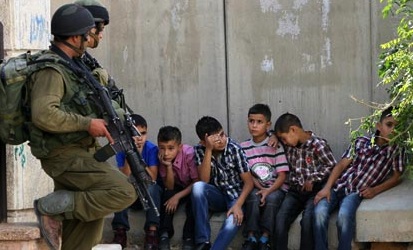
 (Two Israeli soldiers guard Palestinian children in Hebron.)

Jimmy Carter wrote a New York Times op-ed piece this week, A Cruel and Unusual Record, which states flatly:

“The United States is abandoning its role as the global champion of human rights.

Revelations that top officials are targeting people to be assassinated abroad, including American citizens, are only the most recent, disturbing proof of how far our nation’s violation of human rights has extended. This development began after the terrorist attacks of Sept. 11, 2001, and has been sanctioned and escalated by bipartisan executive and legislative actions, without dissent from the general public.

As a result, our country can no longer speak with moral authority on these critical issues.”

Carter’s focus is on “moral authority”.  This is the same authority that must, in all cases, motivate the nation’s churches.

Less than a week after the publication of Carter’s powerful call for “moral authority”, the Presbyterian Church, U.S.A., a major US Protestant denomination, meets in Pittsburgh for its General Assembly. During the week of June 30-July 7, delegates will conduct church business, develop church policy, and consider action on moral issues.

One of those issues is whether or not the Presbyterian Church’s investment portfolios should divest from three U.S. corporations which support, with their products, Israel’s occupation of the West Bank and Gaza.

The Presbyterian General Assembly follows a similar national meeting of the United Methodist Church, where the same issue was presented to delegates attending the denomination’s quadrennial General Conference. The Methodists chose to continue their relationship to the occupation, rejecting a divestment resolution.

The Methodists did advocate a boycott of Israeli products produced in occupied areas. This action, however, did not have the specificity of withdrawing investment of the denomination’s own funds from the occupation.

For the next week, delegates to the 2012 Presbyterian Church General Assembly will have their opportunity to take their own moral stand on occupation, by voting for or against the conduct of three US corporations, Caterpillar, Hewlett-Packard, and Motorola Solutions, the same trio that escaped Methodist divestment.

Only a few of the delegates, or most likely, none of them, will recall votes taken, or not taken, in the 1923 and 1924 Presbyterian General Assemblies.

Any delegate who did look back to 1923 and 1924, would be reminded that each of their votes will be recalled in history as a personal “moral authority” decision.

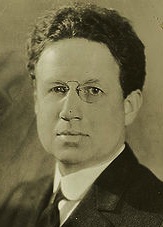
It was 87 years ago, at the 1924 Presbyterian GA meeting in Indianapolis, that GA delegates awaited the result of an investigation of one of their most prominent preachers, Harry Emerson Fosdick. (pictured here).

Ordained a Baptist, Fosdick had been called in 1915 to preach in the pulpit of New York City’s First Presbyterian Church. Fosdick continued as a professor at Union Theological Seminary in New York, and agreed to preach at First Presbyterian with the understanding that he would have only preaching duties there.

On May 21, 1922, during the height of the fundamentalist-modernist controversy, which involved, among other issues, the evolution-creationism conflict, Fosdick peached a pro-modernist sermon, Shall the Fundamentalists Win? In his sermon, Fosdick, by then a leading modernist proponent, insisted  that the bible was not to be taken literally, but was rather, a record of the unfolding of God’s actions.

The 1923 General Assembly ordered an investigation of Fosdick’s “views”. When it became a strong probability that delegates to the 1924 GA would censure Fosdick after the commission’s investigation, he resigned from First Presbyterian and returned to his own Baptist fellowship. He was immediately called to the pastorate of the New York Park Avenue Baptist church, where John D. Rockefeller, Jr., was a member.

Rockefeller, one of the world’s richest men, provided funding to construct the non-denominational Riverside Church in the Columbia University neighborhood, which still stands as one of the nation’s most significant religious centers.  When the church building was completed in October, 1930, Fosdick became its preacher, a position from which he preached, lectured, wrote books, and became one of the major Protestant voices of the 20th century.

Fosdick also wrote the words for a hymn which became a rousing liberal Protestant rallying call, God of Grace and God of Glory.

Any delegate who reflects back on Fosdick’s period of service as a Presbyterian preacher, should take a careful look at the opening line of the fourth verse of that hymn, words that should resonate with General Assembly delegates. That verse begins:

Save us from weak resignation to the evils we deplore.”

The vote between investment and divestment by the Pittsburgh General Assembly will involve a decision on whether or not the Presbyterian Church will continue its financial support of Israel’s occupation.  From Fosdick’s perspective, whose sermon on fundamentalism ended his career as a Presbyterian preacher, if there is an evil we deplore out there, we should never resign ourselves to it. 

It is hard not to conclude that Fosdick would have vigorously opposed a permanent military-enforced occupation of  another people. He would certainly have been appalled at the story that appeared in the Guardian newspaper a few days before the 2012 GA opened.

The story involved a delegation of eminent British lawyers who reported to the Foreign Office their findings from a trip to the West Bank and Israel.

The report concluded that Israel treats every Palestinian child “as a potential terrorist”. This belief, the report notes, may be leading to a “spiral of injustice”. It also “breaches international law in Israel’s treatment of child detainees in military custody”.

The nine-strong delegation, led by the former high court judge Sir Stephen Sedley and including the UK’s former attorney-general Lady Scotland, found that “undisputed facts” pointed to at least six violations of the UN convention on the rights of the child, to which Israel is a signatory. It was also in breach of the fourth Geneva convention in transferring child detainees from the West Bank to Israeli prisons, the delegation said.

Its report, Children in Military Custody, released Tuesday, June 26, was based on a visit to Israel and the West Bank last September funded and facilitated by the Foreign Office and the British consulate in Jerusalem.

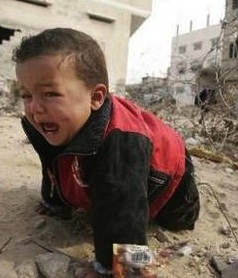
Pictures like the one above, and distributing findings of the mistreatment of Palestinian children, provide a troubling background against which one segment of the GA Presbyterian delegates will attempt to make their case against divestment by promoting “investment” in the Palestinian economy. That case is on shaky moral ground. 

As a start,  investment in an occupier’s prison economy sanctions an illegal occupation, which is immoral and evil at its core.  

Those church bodies that refuse to divest from Israel’s occupation support Israel’s oppressive treatment of the prisoners of that occupation.  They are also failing in their moral duty to confront the American public and the American government with a prophetic proclamation that, as Jimmy Carter wrote in the New York Times, we have since September 11, 2001, “extended our nation’s violation of human rights”.

Israel’s occupation began long before 9/11. Since 9/11, the occupation has increased in its brutality, its size and its unrelenting mistreatment of the Palestinian people. The occupation is a prime example of the violation of human rights described by Carter, who does not mention Israel, since his Times essay is focused on his own government.

There is no question in my mind, however, that Israel, supported by its American lobby allies and its Zionist Israel-firsters in the American media, government, education circles and the churches, has served as a role model for the American government.

As a result, a small Middle Eastern nation, obsessed with “terrorism” and masters of political spin,  has successfully led a world superpower to abandon what Carter properly describes as its “role as the global champion of human rights”.

It is not as though the Presbyterian General Assembly is alone in debating how it should confront the occupation. Secular bodies have moved in rapid succession on the eve of the Presbyterian General Assembly, to distance themselves from further financial involvement in the occupation.

This week the Rachel Corrie Foundation on Socially Responsible Investment, reported:

Morgan Stanley Capital International (MSCI) removed Caterpillar from its World Socially Responsible Index, a list that socially responsible investment (SRI) funds use to determine their investments.

This was followed by a decision by TIAA-CREF to divest “its socially responsible fund, the Social Choice Fund, of the Caterpillar stock held, worth over 73 million dollars.” A month earlier, $900,000 of Caterpillar stock was dumped by the Friends Fiduciary Corporation (FFC), the financial arm of the Quakers.

For those of us who do not follow such matters closely (unless you have a teacher or a librarian in the family), TIAA-CREF is described by Wikipedia as a “financial services organization that is the leading retirement provider for people who work in the academic, research, medical and cultural fields.”

Further support for a decision to divest by the Presbyterians came in a personal letter  addressed to “All Commissioners and Advisory Delegates 220th General Assembly, Presbyterian Church (U.S.A.)”. The letter was signed by a long list of Palestinian Christians in the U.S. and in the Middle East.

The letter begins:

We, the undersigned Palestinian Christians, write to express our strong support for those Presbyterians urging the church to divest from Caterpillar, Hewlett-Packard, and Motorola Solutions, companies that profit from and enable Israel’s military occupation of our land and violations of our human rights.

This past June witnessed the 45th anniversary of the start of Israel’s occupation of the West Bank, Gaza Strip, and East Jerusalem. Since that time, Israel has denied millions of Palestinians living in the occupied territories the most basic civil and political rights, while relentlessly colonizing our land to build Jewish-only settlements in contravention of international law.

In the process, Israel has been systematically destroying the two- state solution that for decades has been the cornerstone of international efforts to make peace between Israelis and Palestinians.

Somewhere, I like to think the spirit of Harry Emerson Fosdick is joining in this chorus to encourage the Presbyterian General Assembly delegates to take the human rights path called for by former President Jimmy Carter.

And just maybe, former Presbyterian preacher Fosdick will lead the Presbyterians in singing, God of Grace and God of Glory.

****      ***     ***     ***     ***

Readers who want to receive updates on the activities of this year’s General Assembly, will find telephone reports available each day. The reports will be provided by Presbyterian News Service Coordinator Jerry L. Van Marter, who will recap each day’s events and decisions, beginning Saturday, June 30.

To reach the VoiceLine reports ― a partnership between PNS and Presbytel, the denomination’s toll-free telephone information service ― call 502-569-5000, extension 2012 or toll-free at 800-728-7228, extension 2012. A five-minute recap of the entire Assembly will be available shortly after adjournment at noon on Saturday, July 7. 

The picture above of a young Harry Emerson Fosdick, is from Wikipedia. The photograph of soldiers and children from Hebron, appeared in the Guardian and is from Abed Al Hashlamoun/EPA.

Posted in Middle East, Middle East Politics, Presbyterian Church USA, Religious Faith, United Methodist Church | Tagged , | 10 Comments

44 Senators Tell Obama To Do Israel’s Bidding

by James M. Wall

War, as General Sherman once said, is hell. It is also widely perceived to be a failure of diplomacy.

Which would explain why it is, that when war-promoting lobbyists want to generate congressional enthusiasm for the next war, all short-term congressional memories must be wiped out.

Wiped out, that is, with the efficiency of that “cricket clicker” used by Agents Kay and Jay, played by Tommy Lee Jones and Will Smith (shown here), in the Men in Black film series.

In the films, one click aimed at a targeted subject erases all recent memory; the clicker also works amazingly well in US elections.

Which is one explanation of why after yet another click-call from AIPAC, 44 US senators found that they no longer remembered what happened the last time the neocons took us to war against a Middle East nation, a war that has thus far cost 4,000 American military dead at a cost of more than $800 billion.

That war further secured Israel’s role as the tail that wags the dog of the US government in all matters pertaining to the Middle East.

Thus it was that with no apparent memory of the last time this nation went to war, 44 US senators dutifully sent a letter to President Obama, telling him what the US must do after the inevitable failure of last week’s round of negotiations with Iran.

These 44 senators forgot about the terrible reviews of the 2003 Shock and Awe production. They just know Shock and Awe: The Sequel, will be a success.

Their June 15 foreign policy letter is reproduced here, complete with signatures.

The signees include 25 Democrats and 19 Republicans. These senators represent AIPAC’s honor roll of loyalists.

Democrats: Menendez NJ; Schumer NY; Cardin MD; Blumenthal; CT Lieberman I-CT; Wyden OR; Lautenberg NJ; Pryor IL; Casey PA; Gillbrand NY; Brown; Stabenow MI; Klobuchar MN; Merkele OR; Coons DE; Nelson NE; Bennet CO; Inouye HI; Mikulski MD; Tester MT; Hagan NC; Nelson FL; Warner VA; Levin MI; Beegich AK. (25)

Republicans: Blunt MO; Collins ME; Isakson GA; Ayotte NH; Risch ID; Vitter LA; Moran KS; Coryn TX; Boman AR; Sessions AL; Scott Brown MA; Crapo ID; Hoeven ND; Coats IN; Murkowski AK; Toomey PA’ Lee UT; Portman OH; Heller NV (19)

The P5+1 negotiators (representatives of the five members of the UN security council plus Germany) delivered an ultimatum to Tehran in the Moscow talks, demandng that Iran agree to three demands, all of which the P5+1 negotiators knew would be non-starters for Iran. The demands:

One, close the Fordow facility, Iran’s major nuclear development underground project..

Two, freeze enrichment above 5%, a figure far below weapons-grade enrichment. (19.5% is a more reasonable enrichment, a figure still below weapons grade.)

Three, ship all uranium enriched above 5% out of the country

Viewing the negotiations from outside the actual negotiation circle, Israel smugly holds tight to its own nuclear arsenal developed in faux secrecy with the help of western powers.

In his web site, Informed Comment, Juan Cole wrote this week that strong evidence has emerged demonstrating how Israel employed the threat that it would use  nuclear weapons against Iraq if the US did not act on its own in 2003.

Cole reports on the newly serialized memoirs of Alastair Campbell, who in 2002, was then British Prime Minister Tony Blair’s communications director.

Cole writes that, according to Campbell,  in conversations with President George W. Bush in late 2002, Israeli’s then Prime Minister Ariel Sharon “threatened to nuke Baghdad if Saddam Hussein hit Israel with rockets again.”

It is an astonishing threat. The Iraqi SCUDs that hit Israel during the Gulf War of 1991 were primitive and hardly the sort of threat to Israel that would trigger a nuclear response among sane people.

It is also clear that the threat was intended to force George W. Bush to act aggressively against Saddam.

Cole speculates that the current Israeli Prime Minister, Binyamin Netanyahu might very well be behind the scenes, once again pushing the US toward an attack on Iran. He adds:

 I have long wondered why western leaders pay so much attention to Netanyahu, the leader of a small country of 7.5 million with a gross domestic product only a little bigger than that of Portugal. Is it because, behind closed doors, they still talk the way Sharon did?

Does Israel regularly use its nuclear warheads to blackmail the US and the West more generally?

Good question, which leads to a second question: If Israel is using its stockpile of nuclear warheads as blackmail, who is to blame? The US and the West are to blame. We enabled and supported Israel’s nuclear arms program during a period when the US and the West were engaged in a Cold War with the Soviet Union.

This short-term solution was short-sighted. It was a solution that turned Israel into a nuclear military entity that can no longer be controlled by the US and the West.

In an earlier, more innocent time, we assumed Israel could be trusted to act responsibly with the weapons we helped them develop. Israel was, we believed then, the “only democracy” in the region, right?

That was then, this is now. And now we must deal with a nuclear armed Israeli government falling increasingly under the control of the West Bank settler movement with its dangerous ethnic exceptionalism and its Masada-complex.

Uri Avnery describes the settler-dominated government under which he, a longtime Zionist loyalist turned radical leftist, must live out his final years. He is not pleased:

The whole raison d’être of the settlements is to drive the Arabs out of the country and turn the whole land of Canaan into a Jewish state. In the meantime their shock troops carry out pogroms against their Arab “neighbors” and burn their mosques.

These fundamentalists now have a huge influence on our government’s policy, and their impact is growing.

Here is just a recent example of that impact: Amy Teibel, who writes for the Associated Press from Jerusalem, reports that Russia president Vladimir Putin (shown here) will visit Israel next week, where “the steely Russian president [is] widely viewed as coddling the Iranians”.

Yacov Livne, head of the Russia desk at the Israeli Foreign Ministry, offered this threat to Putin in advance of his visit:

“The message they (the Russians) will receive is that Israel can’t tolerate a nuclear Iran. Of course we prefer a diplomatic solution, but we will use all means to protect Israel’s survival.”

President Obama must now cope with a nuclear-armed Israeli government which has the absolutist backing of 44 AIPAC-guided senators who collectively ignored the old political adage that “foreign policy stops at  the water’s edge“. The senators sent an Israel-First letter to the president, which concludes with this stern demand:

If the sessions in Moscow produce no substantive agreement, we urge you to reevaluate the utility of further talks at this time and instead focus on significantly increasing the pressure on the Iranian government through sanctions and making clear that a credible military option exists. As you have rightly noted, ‘the window for diplomacy is closing. Iran’s leaders must realize that you mean precisely that. 

Did these 44 elected government office-holders meet in solemn assembly in a Senate conference room and reflect prayerfully on what should follow the negotiations on what Iran must do to avoid further economic punishment and a possible military attack?

Did they seriously reflect on the overwhelming evidence that Iran is not an immediate threat to emerge as a nuclear arms power? Evidence like this:

Director of National Intelligence James Clapper confirmed in a Senate hearing – following the release of the classified National Intelligence Estimate in 2011 – that he has a “high level of confidence” that Iran “has not made a decision as of this point to restart its nuclear weapons program.

Mohamed ElBaradei – who spent more than a decade as the director of the IAEA, [the International Atomic Energy Agency]

– said that he had not “seen a shred of evidence” that Iran was pursuing the bomb.

Six former ambassadors to Iran within the last decade say that there is no evidence that Iran is building nuclear weapons, and that Iran is complying with international law.

Former AIPAC staffer turned progressive blogger, MJ Rosenberg, knows a great deal about AIPAC pressure on Congress. He concludes:

The letter is pure AIPAC/Netanyahu. One, it offers the other party nothing except (2) negotiations themselves which are viewed as a concession to the other side. The offer is designed to be rejected. Why would Iran give up something for nothing?

The letter is also an AIPAC device for scoring senators in an election year. Those who sign will be rewarded or left alone. Those who don’t will hear from AIPAC and its friends. Not a pretty possibility.

This is foreign policy making at its worst, not policy at all but pure special interest politics designed by a lobby to advance Binyamin Netanyahu’s interests and agenda. Ugly stuff. But not surprising.  Just appalling.

Wait, there is more. Not to be outdone in the Iran-bashing, lust for war department, the US House of Representatives affirmed its own resolution of support for an aggressive position on Iran. The final vote was 401-11.

For those of you who only consider Republicans to be warmongers: 166 of 190 Democrats voted in support, including some of its ostensibly most progressive members, such as Barney Frank and Rush Holt.

The language used [in the resolution] bodes terribly for the United States’ already disastrous and destructive foreign policy. The House affirms not merely that Iran will not be allowed to manufacture nuclear weapons, but that it will not be permitted the capability of said manufacturing.

Seeking to create a high standard for the negotiators to follow prior to the Moscow meeting between Iran and the P5+1, negotiators the Britain’s Guardian newspaper offered this guidance:

All sides need to be courageous enough to recognize a fair exchange is a central tenet of dialogue.

Between ordinary people and governments alike, reciprocity can be expressed in many shapes; among them, in the form of mutual respect. In the context of Iran’s dialogue with the P5+1, this means considering the concerns of all sides as equal and being willing to give at least as much as one takes.

A lofty admonition, to be sure, but not one that the majorities of both houses of the US Congress nor the  P5+1 negotiators, want to embrace.

How will this White House respond? Will Shock and Awe: The Sequel, open soon in the homes of American parents and tax payers near you? You already know the answer if Mitt Romney is elected president. If you don’t know, check this out.

If Barack Obama is reelected in November, what can we expect in a second term? Well, so far, even in the midst of an election campaign, Obama has resisted AIPAC’s pressure to sanction a Shock and Awe: The Sequel.

Robert Wright wrote in The Atlantic that he feels Obama is letting the country “drift” into war with Iran. I don’t agree with that view. Obama does not strike me as a leader who lets thing “drift”.  War is still hell. The November election will go a long way toward determining if the American voters agree with General Sherman.

Posted in Media, Middle East Politics, Movies | Tagged , , | 15 Comments

Five Years and Counting: Israel Creates and Manages Its “Humanitarian Crisis in Gaza”

by James M. Wall

Drawing from a report by Save the Children, Electronic Intifada’s Managing Editor Maureen Clare Murphy, describes what she correctly terms, Israel’s managed “humanitarian crisis in Gaza”.

A humanitarian crisis that is managed? Wait a minute; “managing” means controlling what happens. Yes it does.

Which is how it comes about that Israel is managing “Gaza’s humanitarian crisis”.

Aided and abetted by the United States, Israel has for five years deliberately  and systematically blockaded Gaza with militarily-enforced “restrictions placed on the movement of people and goods in and out of Gaza”.

The humanitarian crisis in Gaza does not come from floods, hurricanes, or earthquakes. This on-going crisis comes from the official policy of Israel.

American tax payers are funding this evil and deliberate crime, through annual doles in the billions, and the continued presence of corporate US interests that support and contribute to the managed crisis. (And which American church leaders refuse to condemn.)

How could it be that American tax payers permit a blockade that “has been the single greatest contributor to endemic and long-lasting household poverty in Gaza”, an act that prevents families from access to food, medicine and medical care?

Americans permit and pay for this “managed cruelty”, as the Electronic Intifada’s Maureen Clare Murphy, correctly terms Israel’s blockade policy.

We are all “good Germans”, no different from those Germans who denied the reality of trains loaded with Jews that traveled through their countryside, bound for German-managed camps where Jewish men, women and children were starved, experimented on, and killed with modern efficiency.

Here is just a part of the Gaza report from Brtitish-based Save the Children. The report has gathered statistics on the effect of the blockade. These statistics reveal what we would rather not know:

Stunting, or long-term exposure to chronic malnutrition, remains high, found among 10% of children under five. Anaemia, usually caused by dietary iron deficiency, affects most children in Gaza (58.6% of schoolchildren, 68.1% of children 9-12 months) and one-third (36.8%) of pregnant women. If untreated, iron-deficiency anaemia adversely affects child development and pregnancy outcome.

Sanitation-related diseases with serious implications for child mortality, such as typhoid fever and watery diarrhoea in children under three years of age, have increased at clinics serving refugees in the Gaza Strip. Gaza’s polluted water supply will have long-term health implications, but current monitoring is insufficient to measure the impact of untreated sewage and poor water quality.

The full Save the Children report, with footnotes, written in the unemotional tone of an official report, may be accessed at this link.

It is an appalling situation for which Israel, the United States, and the rest of the “good Germans” in the world, are deeply liable and responsible.

What do we do about it? Nothing. When protesters attempt to “run the blockade”, Israel kills its passengers. When Rachel Corrie stands in front of a Caterpillar tractor and demands that it not destroy a home in Gaza, Israel kills her.

The American mainstream media ignores this blockade, accepting Israel’s pretense that the blockade is for security.  The US Congress takes funds from Israeli backers and underlines its approval of the long-term exposure of Gaza children to chronic malnutrition, by cheering Israeli leaders who come to Washington asking for more money to starve children.

Presidential candidates quake in fear that they will appear to be anything less than Israel lovers.

What keeps the Congress and the presidential candidates from saying what at least some of them, deep down, know to be true? Only they, and whatever God they follow, know for sure, but whatever it is that keeps them silent, they are complicit in an evil clearly condemned in religious scriptures

How bad is the “managed humanitarian crisis” these politicians continue to support? A news release on the report states:

Gaza’s only fresh water source is now too dangerous to drink and is contaminated with fertiliser and human waste, according to a shocking new report from Save the Children and Medical Aid for Palestinians (MAP).

On the fifth anniversary of the blockade, Gaza’s Children: Falling Behind, reveals desperate families are being forced to buy from private sources, not knowing that in most cases this water too is contaminated, often at ten times the safe level.

With 1.7 million people – including more than 800,000 children – crammed into just 365 square kilometers – an area roughly equivalent to the size of the Isle of Wight – Save the Children is concerned about the increasing threat of disease.

[The island of Wight, located off the coast of England, is 148 square miles. In the US, this is equivalent to the square miles in Wisconsin’s Marinette County, and Illnois’ Boone County.]

“Innocent children are living in inhumane conditions after five years under a blockade. They are now forced to drink dirty and dangerous water that will make them weak and sick. Diarrhoea which is easily treated here in the UK can be a killer in these conditions.” said Justin Forsyth, Chief Executive of Save the Children.

In this summer of 2012 while we look the other way, the children of Gaza live under an Israeli-managed program which systematically assaults children. This is official conduct that is illegal under any set of humane laws.  It is also immoral under all known religious standards.

It can be corrected. Justin Forsyth outlines some of the conditions under which the children of Gaza live:

There are only two crossings available for people to leave Gaza and people require select security permits to leave the heavily guarded exit. Crucial equipment needed to repair the sewage and water system remains blocked and on the restricted list of goods allowed in. Just one fifth of the equipment needed has been delivered to date, with the remainder sitting unused in warehouses.

“Gaza children are living in prison-like conditions, trapped and unable to dream of a better future. We must end the blockade and ramp up immediate projects to provide clean, safe drinking water and sanitation.”

Specifically, Save the Children calls for these actions:

Israel must lift the blockade in its entirety to enable the free movement of people and goods in and out of Gaza, including the West Bank and Jerusalem. All planned water and sanitation projects must be implemented immediately and a clear timetable provided by the Israelis for their completion. The International Community, along with relevant authorities must implement long term strategies to improve conditions for children. The Palestinian Authority must facilitate the impartial and rapid material provision and funding of medical supplies and services in Gaza. Donor must ensure that funding is available for long term projects and not just emergency, short term projects.

Nothing complicated there.  Nothing that has not been said in more elevated terms in Matthew 25, where some harsh things are said about those who deliberately create a humanitarian crisis and then professionally manage the crisis to keep it going.  At least that is what I see when I read about sheep and goats in my translation of Matthew 25.

The picture above is that of a child in Gaza. It is from The Guardian. The report cited is from Save the Children, based in England. 

Posted in Middle East Politics, Politics and Elections, Religion and politics, The Human Condition | Tagged , , , , | 7 Comments