Gunter Grass Exposes Israel As a Nuclear Power that “Endangers” a Fragile World Peace

Fby James M. Wall

A stunning new poem by German novelist Gunter Grass, has “broken the silence” on Israel as a nuclear power.

Western journalists and politicians have long enforced that silence by unspoken and unwritten common agreement.

The silence was successfully imposed for two reasons: The Holocaust and the fear of being called anti-Semitic.

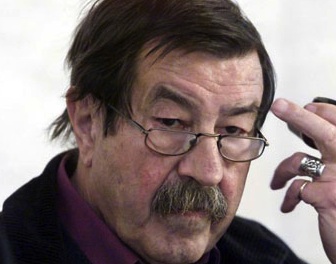
Gunter Grass (pictured above) has broken that silence with his poem, Was gesagt werden muss (What must be said).

Grass is a major figure in German literature. He speaks with considerable authority through his extensive and innovative writing. He is considered one of Germany’s major novelists.

The press release announcing his 1999 Nobel Prize for Literature begins:

When Günter Grass published The Tin Drum in 1959 it was as if German literature had been granted a new beginning after decades of linguistic and moral destruction.

Within the pages of this, his first novel, Grass recreated the lost world from which his creativity sprang, Danzig, his home town, as he remembered it from the years of his infancy before the catastrophe of war.

Here he comes to grips with the enormous task of reviewing contemporary history by recalling the disavowed and the forgotten: the victims, losers and lies that people wanted to forget because they had once believed in them.

In 1979, The Tin Drum reached a world audience through a film of the same title, by German Director Volker Schlöndorff. The novel, which was brilliantly reproduced in the film, was praised by the Nobel Committee because  of the way in which it:

Breaks the bounds of realism by having as its protagonist and narrator an infernal intelligence in the body of a three-year-old, a monster who overpowers the fellow human beings he approaches with the help of a toy drum.

The unforgettable Oskar Matzerath is an intellectual whose critical approach is childishness, a one-man carnival, dadaism in action in everyday German provincial life just when this small world becomes involved in the insanity of the great world surrounding it.

It is not too audacious to assume that The Tin Drum will become one of the enduring literary works of the 20th century.

Now, over a decade into the 21st century, Gunter Grass decides that Israel must be stopped from self-destruction before it is too late.

Through this deep concern, Grass wrote his poem, This Must Be Said,  breaking decades of silence. Grass, now 84, says in the poem that he wrote with his “last ink”.

The entire poem may be read, and should be read, in its entirety. Click here for an English translation, or scroll down to the Comment section for the full text of the poem.

Here, as an introduction, are the first three sections of the poem:

Why have I kept silent, silent for too long
over what is openly played out
in war games at the end of which we
the survivors are at best footnotes.

It’s that claim of a right to first strike
against those who under a loudmouth’s thumb
are pushed into organized cheering—
a strike to snuff out the Iranian people
on suspicion that under his influence
an atom bomb’s being built.

But why do I forbid myself
to name that other land in which
for years—although kept secret—
a usable nuclear capability has grown
beyond all control, because
no scrutiny is allowed.  .  .  . 

Later in the poem, Grass writes that the country with a nuclear arsenal that “has grown beyond all control, because no scrutiny is allowed”, is the modern state of Israel.

That lack of scrutiny of Israel’s nuclear arsenal has provided Israel with carte blanc to occupy Palestinian land, and to literally imprison the Palestinian people, all under the pretense of a need for the “security” of a nuclear armed Israel.

This same lack of scrutiny has also given Israel the freedom to function “behind the scenes” to shape the foreign policy of the West, a policy implemented by successive American governments trapped in the vise-like control of Israel’s two sacrosanct iron fists: The Holocaust and anti-Semitism.

How has Israel responded to Grass’ poem? It has followed their usual pattern, reacting with classic Israeli paranoid rhetoric.

First out of the box was Israeli Prime Minister Benjamin Netanyahu, who said Israel will not tolerate anyone with credibility and a public platform, who exposes the truth of Israel’s nuclear arsenal.

Only he does not say it that way, for that would be an admission of the unsayable, that Israel does indeed have such an arsenal.

In a statement, Israeli Prime Minister Benjamin Netanyahu condemned German Nobel laureate Gunter Grass for his “shameful moral equivalence”.

“Gunter Grass’s shameful moral equivalence between Israel and Iran, a regime that denies the Holocaust and threatens to annihilate Israel, says little about Israel and much about Mr. Grass,” Netanyahu said.

This reaction is the classic Israeli response when a cover story is exposed as false: Never deny, always attack and divert.

Netanyahu cannot deny the truth of  Grass’ poem, so he attacks the messenger, first by condemning him, and then declaring him persona non grata in Israel, a country which Grass says in his poem, is a country “to which I am and will remain attached”.

Grass also has his supporters. Jakob Augstein, a columnist for the leading German newspaper, Der Spiegel  writes:

The brief lines that Günter Grass has published under the title “What Must Be Said” will one day be seen as some of his most influential words. They mark a rupture.

It is this one sentence that we will not be able to ignore in the future: “The nuclear power Israel is endangering a world peace that is already fragile.”

It is a sentence that has triggered an outcry. Because it is true. Because it is a German, an author, a Nobel laureate who said it. Because it is Günter Grass who said it.

And therein lies the breach. And, for that, one should thank Grass. He has taken it upon himself to utter this sentence for all of us.

The New York Times reported the story entirely from Israel’s perspective. In the story on the poem, the Times ignored the truthfulness of the poem and focused instead on the “controversy” it stirred up.

Why should we expect anything different? It is the Times, after all, that has been a major player in the “protect Israel’s narrative” campaign.

We have seen before how Israel manipulates any story it deems a threat.

In 2009, the Goldstone Report revealed the details of Israel’s massive slaughter of citizens in Gaza, a three week assault carried out in the name of Israeli security.

In the initial report from a UN panel chaired by Judge Richard Goldstone an eminent South African jurist experienced in tackling war crimes cases and himself an avid Jewish Zionist, concluded “that Israel had committed multiple war crimes and possible crimes against humanity during its 2008-09 invasion.”

Did Israel deny the Goldstone Report? Of course not. The evidence was too overwhelming. Rather than confront the truth of Goldstone’s findings, Judge Goldstone was hauled off to South Africa, his native land, where he held personal meetings with rabbis there.

Soon, Judge Goldstone had second thoughts. He wrote a Washington Post op ed in which he famously said

“If I had known then what I know now, the Goldstone Report would have been a different document.”

The Palestine Chronicle examines further the aftermath:

Goldstone does not with any clarity explain what he means by this sentence. Paradoxically and shamefully for the judge, the more we know about the Gaza massacre, the more accurate the Goldstone Report appears – not less.

We may never know why Goldstone changed his position – it is certainly not the result of new revelations refuting the report’s validity, irrespective of what he implied in his article.

We know that he had been the subject of an international smear campaign of unprecedented dimensions and nastiness. Maybe the pressure was simply too much for him.

But even in this case, it is hard to understand why he caved in now. In fact, attempts to discredit the Goldstone Report themselves been been discredited over the past year.

Did Goldstone succumb to pressure or threats? No one knows.

What we do know for sure is that a US diplomatic cable released by WikiLeaks has Israel’s prime minister, Binyamin Netanyahu, saying that Israel was facing “three principal threats: Iran’s nuclear [programme], missile proliferation and the Goldstone Report.”

The Goldstone Report was the 2009-10 du jour “threat to Israel”.

Today the du jour “threat to Israel” is Gunter Grass and his poem, What Must be Said.

The threat is always there to Israel.  The threat changes as Netanyahu, or whoever governs Israel at the time, sees a new threat to Israel’s long-protected narrative of why Israel is never wrong.

Any sign that anyone is breaking ranks on the silence surrounding that  narrative, which has long included  development of a nuclear arsenal in Dimona, Israel, must suffer personal attacks.

Israel is all that matters to Israel, regardless of the consequences to others. Unfortunately, thanks to AIPAC and its army of strong-armed warriors assigned to control US government officials and church leaders, the silence is rarely broken in US domestic politics.

Three US Protestant denominations, the United Methodists, Presbyterian Church, and the Episcopal Church, in that order, will hold national decision-making conferences between April 24 and mid-July.

These denominational leaders will attend to church business, budgets, reports, and honoring their retirees, that sort of thing. This year each body will also take up the matter of Israel’s treatment of the Palestinian people. 

The United Methodists and Presbyterians will consider resolutions which are both the result of many years of conversation and study, and will then ask officials to agree to divesting church funds from three corporations which have refused church requests to stop providing products that enable the Occupation to continue.

The Episcopal Church is about five to eight years behind the United Methodists and Presbyterians.  All they are asking this time around is for Episcopalians to consider how Palestinians are suffering under Occupation. And of course, to celebrate the importance of Jewish/Christian relations.

Even that is too much for the Episcopalians, which seem thus far to be following the leadership of their Presiding Bishop, Katharine Jefferts Schori, who has encouraged her constituents to have conversations and break bread with their local Jewish neighbors.

What has rankled Episcopalians, however, is that in their mild resolution on Israel/Palestine, a special Episcopal version of a study book entitled Steadfast Hope, is recommended for local church study.

Steadfast Hope has something positive to say about the BDS (Boycott, Divestment, Sanctions) strategy. It does not call for adopting that strategy.  It simply suggests BDS  be studied.

For more on this discussion, see this recent posting from Wall Writings. I especially urge readers to scroll down for the follow-up comments.

I believe Gunter Grass, without knowing it, was speaking to all those gullible Protestants who still believe that the tactic of a nonviolent protest of divesting church funds from corporations that support the Occupation, is not good for Israel.

BDS (Boycott, Divestment, Sanctions) is also not a threat to the “fragile interfaith” relationship between Protestants and Jews.

Delegates to the upcoming church decision-making conferences should read Gunter Grass’ poem. He is speaking truth to you,  just as he is speaking truth to Israel. 

Like Sampson of old, Israel is agitating to have the US join with it to pull down those pillars and destroy huge sections of this planet in a nuclear holocaust.

Grass chose to break his own self-imposed silence because he believes Israel needs an “intervention”, a process whereby people who truly love their spiritual homeland, will persuade Israel that it is currently embarked on a suicidal course of action, harmful to itself and to others.

An “intervention” is designed to save that which we love.  At the moment, Israel is veering dangerously close to the Sampson Option.(See Seymour Hersh’s 1991 book of that name.

Grass does not want to see a nuclear-armed Israel destroy itself and threaten  further the already “fragile” world peace. 

Neither should we. A nonviolent step like BDS is the least we can do to play a role in Israel’s “intervention”.

Correction: Earlier versions of this posting described Grass as Jewish.  He is not. This error has been corrected in the version above.  I regret this error. JMW

Posted in Episcopal Church, Middle East, Middle East Politics, Netanyahu, Presbyterian Church, United Methodist Church | 17 Comments

Church Leader Tells Palestinians and Israelis “eat together and listen to each other’s stories”

by James M. Wall

(New Comments Posted Below)

An appalling shallowness has descended over Mainline Protestantism.

Episcopalians, United Methodists and Presbyterians are actually debating how they should deal with the Israeli Occupation

Martin Luther King, sitting in that Birmingham city jail, would most certainly inform these prelates that there is no debating evil. A brutal military occupation is not open to debate.

It is a disturbing spectacle. The collective ignorance displayed by many of the men and women—though, thank God, not all—who govern these denominations, boggles the mind.

The issue, my dear Christian friends, is justice, pure and simple. And yet, there they are, these robed religiosos, dripping with interfaith piety, proclaiming that the simple act of divestment of church funds is too harsh a tactic to use against Israel’s settlement obsessed, right-wing government.

What do they teach in seminary these days? Have those Old Testament professors who lead their Israeli-sanctioned “study groups” to the Holy Land removed the prophets from their syllabi?

Here is the Episcopal News Service report on the current presiding Episcopal bishop explaining why she, and the church that elevated her to denominational leadership, oppose the simple, non-violent tactic of targeting divestment of church funds from US corporations that profit from Israel’s military occupation:

Presiding Bishop Katharine Jefferts Schori urged Episcopalians to “invest in legitimate development in Palestine’s West Bank and in Gaza” rather than focusing on divestment or boycotts of Israel, during a March 25 “Middle East Peacemakers” luncheon in Los Angeles.

“The Episcopal Church does not endorse divestment or boycott,” the presiding bishop told more than 200 people gathered at the California Club in downtown Los Angeles. “It’s not going to be helpful to endorse divestment or boycotts of Israel. It will only end in punishing Palestinians economically.”

She also called for “a two-state solution with a dignified home for Palestinians and for Israelis” and for “deeper engagement, people of different traditions eating together, listening to each other’s stories,” she said, adding that the interreligious, multi-ethnic gathering hosted by Bishop J. Jon Bruno of the Diocese of Los Angeles was an example of what is possible.

Punishing Palestinians economically? That statement is an incredible display of ignorance of the political realities of a brutal military occupation.

Bishop Katharine Jefferts Schori wants investment in Palestine, not divestment from Israel’s occupation. Who proposed that approach?

Sounds very much like the warden of the world’s largest outdoor prison inviting church members to come inside the prison and do their good works.

Cottage industries in cell block six?

Starting April 24, delegates to the United Methodist Church General Conference will debate the issue of using targeted divestment as a legislative tactic against injustice.

The United Methodist and the Presbyterian national churches have labored for many years to develop resolutions that focus tightly on US corporations that profit from the Occupation.

One of these corporations, Caterpillar, produces heavy equipment that Israel uses to build its apartheid wall, a wall that has nothing to do with security and everything to do with stealing even more Palestinian land.

Caterpillar also produces those monstrous bulldozers that tear down Palestinian homes, another “security” measure that is really designed to tighten the Occupation noose.

An Israeli soldier drove one of those American-built bulldozers over an American citizen, peace activist Rachel Corrie, on March 16, 2003, as she tried to stop an attack on a Palestinian home. In death, this young woman has become a symbol of non-violent courage to Palestinians.

Not so in the US, where neither action nor formal government protest was taken against the army that killed her.

And yet, here is an Episcopal bishop, standing before 200 of her fellow Episcopalians actually calling for Palestinians and Israelis to “eat together and listen to one another’s stories”.

This is blatant Israeli propaganda. These words were not uttered in the spirit of Amos; they sound more like an American politician scrambling for Israel Lobby money than they do of a Christian leader who must at some point in her career reflected upon, and perhaps even preached on, the call from Amos 5:4 to “let justice roll on like a river, righteousness like a never failing stream!” (NIV).

The saddest thing about this failure of a church leader to grasp the reality of injustice is that she offers palliative words that sound more like a Southern bishop of the 1950s begging the segregated and segregator to live together peacefully.

Bless you bishop, but there are people in Palestine on protest hunger strikes. Others are dying under the boot of a brutal occupying army. This is not a problem that will be addressed by our “eating together and talking to one another”.

For an example of the pepper spray at work, see the Ammar Awad Reuters photo above of Israeli soldiers spraying a Palestinian protestor at Damascus Gate in the Old City of Jerusalem.

This attack on the protestor took place on Land Day, when Palestinians remember their land losses.

Richard Silverstein, who writes the Tikun Olam web site, posted this photo from the New York Times and adds:

The Times headline for the slideshow presentation of Land Day images that includes this one was: Protesters Scuffle With Forces.  

I don’t see protesters scuffling with Israeli forces.  I see Israeli border police mauling unarmed Palestinian demonstrators.  I see them pepper-spraying one at point-blank range.

That headline confirms once again that the New York Times is not just biased on this issue on behalf of Israel. It is simply an Israeli hometown paper. Its perspective is always that of the home team, that is, Israel.

Silverstein is Jewish, one of many Jews who knows the damage that the Occupation does to Israelis as well as to Palestinians. Fortunately, Silverstein is also a blogger with a large following.

Presiding Bishop Katharine Jefferts Schori knows better than to speak of the Palestinian issue in the language she used.   One of my sources who follows this issue with diligence, wrote to say:

It was she who, perhaps three years ago, visited Gaza, was duly appalled, and vowed to press with all of her and her church’s authority, to end the sadistic blockade and occupation of all of Palestine.

It mystifies me that she can ignore the precedent of, and successful use of BDS, in the closest parallel, South Africa. Schori has succumbed to expedience or the copout of “interfaith” wishy-washiness-cum-cowardice.

How can one have any hope for justice and a viable existence for the Palestinians in the face of such cavalier disregard for the well-known and often courageously expressed recitations of the “facts on the ground” created by the Zionist enterprise?.

Well stated, and true. Trips by church leaders, who finally see first -hand the ugliness of Occupation, are the best way to break through Israeli propaganda.

But, based on Bishop Schori’s public display of hasbara (propaganda) in Los Angeles, the power of the Israel Lobby trumps the truth.

All is not lost. Another source, who attended the bishop’s presentation, did not find the audience very receptive to her call for kum ba yah.

Two denominations will debate divestment resolutions over the next few months, first, the United Methodists and then, the Presbyterians.

The United Methodist supporters of targeted divestments are encouraged at the feedback they are hearing from the grassroots.

Blocking their way to the passage of a divestment resolution is the denomination’s General Board of Pensions, which objects to non-financial types interfering in their decisions to maximize pension profits.

This body has determined over the years that it will not invest in corporations that profit from, for example, South African apartheid, and that old reliable United Methodist staple, alcohol.

Faced with requests that it extend its no-no list  to include three companies supporting the Occupation,  the General Board of Pensions has adopted the Episcopal mantra of “eating together and sharing stories”.

Of course, the General Conference has the final say in this matter. Starting April 24, in their Tampa, Florida, meeting, the Methodists will have their chance to remember that its founding parent,  John Wesley was not a “get along” guy; he was a justice guy.

This is the same denomination, by the way, that moved its 2012 meeting from Richmond, Virginia, to Tampa, Florida, because Richmond has a baseball team named, “The Braves”, a no-no among United Methodists who have agreed not to patronize locations with sports teams the Methodists believe denigrate Native Americans.

Good for them. Now let us see what can be done about the denigration of Palestinians.

Posted in Episcopal Church, Middle East, Middle East Politics, Presbyterian Church, Religion and politics, Religious Faith, United Methodist Church | 38 Comments

The View From Israel/US In 1977 and 2012

The editorial comment below is reprinted from the Christian Century magazine of November 23, 1977. 

At the time the editorial appeared, I was the editor of the Century. This was the week’s lead editorial.   In 1977, I had been editor for five years, a position I held until 1999.

President Jimmy Carter was inaugurated in January, 1977. Menachem Begin was head of the Likud Party, which won a majority in the Knesset elections held  on May 17, 1977.

 Menachem Begin became Prime Minister in June, 1977.

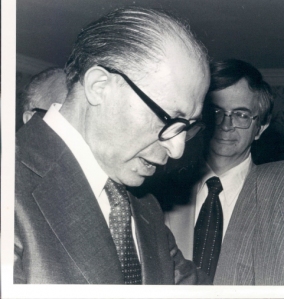
At the time this editorial appeared, the new American President had come to the United Nations to meet with the new Israeli Prime Minister. I was at the meeting in an editorial capacity. 

The picture was presented to me by the Israeli Counsel’s office. It shows this American editor waiting his turn to interview the Prime Minister.

I am reprinting this editorial 35 years after it first appeared. It was published under the title, “Israel and the Evangelicals”.  As you read this essay from 1977, remember, this editor  had made two earlier trips to the region (I would, in time, make 20 trips there). 

Since my first trip in 1973, I was aware that Menachem Begin represented  the extreme right-wing political perspective in Israel. Liberal Israeli Jews assured me the election of Begin was an unfortunate break in the Labor Party control of Israeli politics.

This too, they were certain, would pass.

The editorial appears exactly as written in 1977. It is my hope that readers will return to 1977, when a liberal ecumenical publication editor still believed that Prime Ministers of Israel meant what they said when they said it.  

“by James M. Wall, Christian Century magazine (November 23, 1977)

A recent full-page advertisement appearing in major US newspapers argues for support of the State of Israel and voices concern over “the recent direction of American foreign policy” in the Middle East.

The signers of the statement “are particularly troubled by the erosion of American governmental support for Israel evident” in the U.S. decision to include the USSR  in planning for the Geneva talks.

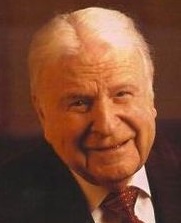
Israel has many supporters in this country, and ads of this sort are frequently carried in major newspapers. But this one is different. It comes from persons describing themselves as “evangelical Christians,” including W. A. Criswell (picture below), pastor of First Baptist Church, Dallas; entertainer Pat Boone; Harold Lindsell, present editor of Christianity Today; Kenneth Kantzer, editor-elect of that journal; Hudson Armerding, a past president of the National Association of Evangelicals; and Arnold Olson, coordinator and president emeritus of the Evangelical Free Church of America.

This overt evangelical support for Israel aligns a branch of American Protestantism that traditionally has frowned upon religious involvement in political matters with the traditionally liberal U.S. Jewish community.

These ads and this evangelical involvement in a complex political issue are a welcome addition to the dialogue, an indication that prominent evangelical Christians believe that the Christian faith has a word to say regarding secular decision-making.

The newspaper ads — under the heading “Evangelicals’ Concern for Israel” — oppose the joint US-USSR statement on the Geneva Conference. The ads assert that “most evangelicals understand the Jewish homeland generally to include the territory west of the Jordan River,” and oppose the creation of “another nation or political entity” within the historic Jewish homeland.

Since so many evangelicals have traditionally resisted involvement in secular politics — most notably in recent years during the Vietnam war and in the civil rights struggle — it is a reassuring sign to see this development in the Middle East discussion.

While we do not think the solutions to the three points raised in the ad are as simple as those proposed, we are encouraged that prominent evangelicals are joining the discussion, acknowledging that religious people have something to say to secular decision-makers.

The approach taken in the advertisement, however, is not a positive contribution to the discussion. The statement makes a strong case for evangelical empathy with the State of Israel, linking the Old and New Testament traditions, and reminding the public that the people of Israel have a very special place in Christian thought.

But the signers overlook an important difference between evangelical empathy evoked by the biblical tradition and the assertion of a specific territorial claim based on religious Scriptures. The use of religious validation to settle secular conflicts is a misuse of religion and a disservice to politics.

Ours is a multireligious world, filled with a rich variety of tribal, institutional and national beliefs, all yearning toward an understanding of ultimacy. Israel, surrounded by Arab nations that interpret Scripture in quite a different fashion from Jews or Christians, would lean on the weakest possible support if its claim to its 1967 border were to rest even partially on Scripture.

The Israeli Labor Party, which governed Israel from its beginning as a state in 1949 until Prime Minister Menachem Begin, took power in June, had avoided cultivating the kind of American evangelical support expressed in the recent newspaper ads because it knew that to engage in religious arguments over national boundaries would be self-defeating.

While Mr. Begin, on the other hand, has been more willing to employ biblical history to validate Israel’s borders, even his government hints at a willingness to negotiate within modern political realities.

Mr. Begin wants peace in the Middle East, and he wants security for his nation. Those are goals shared by most Americans.

There is strong indication that these goals are also increasingly shared by most Arab leaders, many of whom have been sending signals to the Carter administration that Israel’s right to exist is a foregone conclusion and that negotiations should be conducted with that fact of history in mind.

Even as Begin stakes out his strong beginning position of biblical sanction for Israel’s borders, it is reasonable to assume that his quest for peace and security will lead him finally to accept an agreement that involves borders determined on the basis of secular considerations.

Along with many others who talked to Mr. Begin during his highly successful U.S. trip this past summer, I noted the gleam of the politician in his eye when he said that while he would not permit the Palestinian Liberation Organization (PLO) to be represented at Geneva, Israel would not be “checking credentials” of Arabs who come from other countries.

This is a clear invitation which permits Arab participants to provide PLO representation through some face-saving procedural device. In short, Begin, despite his rhetoric, appears nonetheless to be a sensitive political leader who wants peace and security for Israel.

Ironically, then, Israel’s prime minister is being harmed rather than helped by this employing of biblical proof-texts on the part of Christian evangelicals to answer political questions in the Middle East.

The Christian faith, as communicated through tradition, Scripture and history, is a proper foundation for approaching all contemporary secular issues. However, the Bible is not a document that sets forth an international game plan.

Rather, as viewed from a Christian perspective, it embodies the faith of a people, who began with Abraham in their quest for God and who believe that they find God in Jesus Christ. We share with the deepest possible empathy the feeling the people of Israel have for the land they now occupy between the Jordan River and the Mediterranean Sea.

President Jimmy Carter, who learned his Middle East geography in a Southern Baptist Sunday school class, shares that empathy. But as President of the United States, and as a world leader, he dares not utilize religious texts for pluralistic secular solutions.

The American Jewish community is understandably anxious over the welfare of Israel. But its present campaign — through the so-called Jewish lobby — to influence Congress and the president to settle into a rigidly pro-Israel position before the convening of the Geneva Conference will, in the long run, be contrary to the best interests of both the State of Israel and American Jews.

The number of evangelical Christians who have empathy for Israel is large, but the number who would want to see political differences settled via biblical citations is relatively small. There is, therefore, no long-range political advantage to be gained by an effort to wrap Israel’s security in a blanket of evangelical biblical literalism.

With a Southern Baptist layman as president, the American Jewish community has a better friend in the White House than it apparently realizes. U.S. supporters of Israel generally assume that the State Department “tilts” toward a pro-Arab bias.

This is a familiar charge, often leveled at the National Council of Churches and the World Council of Churches.

There is truth in these allegations, in part because Middle East experience among Christians and among State Department staff members has involved exposure to Arab as well as to the current Israeli nation.

But the understandable anxiety of American Jews over the future of Israel — especially when they hear of rocket attacks by terrorists against villages in northern Israel (and of Israel’s massive retaliation) — should not lead American Jews to think that unceasing pressure against the president, the Congress and public opinion in this country represents the best means of ensuring Israel’s future security.

Only a negotiated settlement involving all parties in the Middle East will produce the peace we seek. American Jews are going to argue their case in every possible forum of decision-making.

But we would caution them to remember the important distinction between the strong empathy Christians feel with Israel and the realistic awareness that political decision-making must be shaped by political and not religious guidelines.

Biblical prophecy anticipates a future of hope for humankind; it does not, however, provide an atlas for establishing the geographical boundaries of the countries that seek that hope.”

Jump forward 35 years to March, 2012.

Thanks to the information flow from Palestine/Israel, Americans have been introduced to the Nakba, walls erected within more walls, administrative detention, house demolitions, check points, to name only a few results of Israel’s military Occupation.

Israeli settlements built illegally in the West Bank, housed 10,000 Jewish settlers in 1977. In 2012 that total now approaches 500,000 settlers.

In 2012, Israel’s hasbara (propaganda) operation reaches deep into American society, shaping the perspective of media and political leaders where money determines allegiance.

Hasbara has even reached deep into American religious communities, where it is not money that talks, but the ever-reliable religious sense of guilt (the Holocaust) plus the deep commitment to inter-faith dialogue between Jews and Christians, a dialogue that extends neither to Muslims nor liberal Jews. 

This spring and summer there will be national governing conferences in which United Methodists and Presbyterians will debate what position those official church bodies will vote on whether or not church investments should be used to support Israel’s Occupation. 

The United Methodist Church General Board of Pensions sends me a check each month to reward me for the service I rendered to that church as a clergyman pastor and editor.  

That Board has just voted to continue using my pension investment funds in three American corporations that support the Israeli Occupation.

The General Board of Pensions does not, under church law, invest in corporations that profit from the sale of either tobacco or alcohol products. But it has thus far refused to remove from its portfolios, any of its investments in the Occupation.

Such is the power of the Israeli hasbara, and such is the influence of a profit-minded General Board of Pensions, which chose the principle of profits over the principle of the prophets. 

This summer, the General Conference of the United Methodist Church will meet in solemn and prayerful assembly in Tampa, Florida to determine how it wants the Church to proceed in this matter.

How the UMC delegates vote will determine the success or failure of Israel’s hasbara campaign, and the degree to which the delegates agree with its General Board of Pensions that its fiduciary responsibility demands that it choose profits over prophets.

Will the UMC Board of Pensions prevail and get the backing of the General Conference? Which side will prevail?  Will delegates vote for a prophetic perspective over that of a profit perspective? Stay tuned.

Meanwhile, following a short hiatus, the next posting of Wall Writings will be uploaded on the first weekend of April. 

The 1977 editorial above is from the Christian Century. It is copyrighted, © 1977 by the Christian Century and reprinted by permission of the Christian Century Foundation. http://www.christiancentury.org.

Posted in Middle East Politics, Politics and Elections, Politics in Religion, Religion and politics, United Nations | 13 Comments

Should the US Go to War for Israel?

by James M. Wall

Israeli Prime Minister Benjamin Netanyahu spoke to the annual AIPAC conference earlier this week. He also held a private meeting with US President Barack Obama.

In his AIPAC speech, Netanyahu evoked the Holocaust as the source of  Israel’s special privileged status that permits Netanyahu to do whatever he decides to do to “control Israel’s fate”.

That, of course, includes bombing Iran’s nuclear facilities.

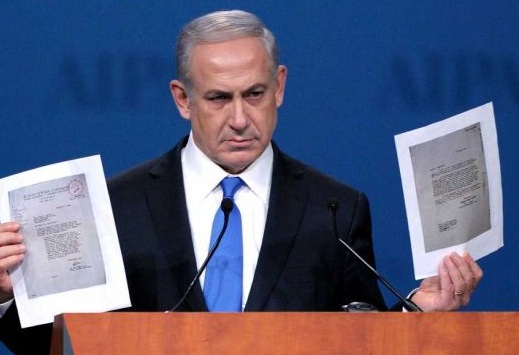
Netanyahu drew a parallel between the exchange of letters between  the US War department and the World Jewish Congress in 1944.

The Wall Street Journal described the scene at the AIPAC conference:

Netanyahu got out copies of two letters he said he keeps in his desk, between the World Jewish Congress and the War Department in 1944, when the WJC called on the United States to bomb the extermination camp at Auschwitz, and the War Department refused.

The refusal included the argument that attacking the camp might unleash even more “vindictive” behavior.

“Think about that,” Netanyahu said. “Even more vindictive than the Holocaust!”

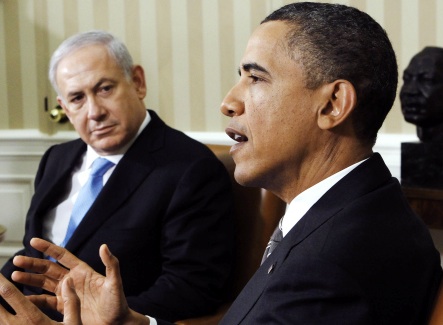
During his meeting with Obama, Netanyahu elaborated further:

“Israel must reserve the right to defend itself. After all, that’s the very purpose of the Jewish state, to restore to the Jewish people control over our destiny.

That’s why my supreme responsibility as prime minister of Israel is to ensure that Israel remains master of its fate.”

In a blog, the British Economist responded:

News flash: Israel is not master of its fate. It’s not terribly surprising that a country with less than 8 million inhabitants is not master of its fate. Switzerland, Sweden, Serbia and Portugal are not masters of their fates.

These days, many countries with populations of 100 million or more can hardly be said to be masters of their fates. Britain and China aren’t masters of their fates, and even the world’s overwhelmingly largest economy, the United States, isn’t really master of its fate.

What gives this leader of a foreign nation the license to speak in Washington with such confidence that he expects the US to join him in an attack on Iran, a nation that poses absolutely no threat to the US or its citizens?

Indeed, US intelligence agencies report that they have found no reason to believe that Iran poses an immediate threat to Israel.

So why should the US go to war for Israel over an issue that poses no more immediate danger to Israel than Iraq’s non-existent WMDs threatened its neighbors? That non-existent threat led to a disastrous and costly war for the US, a war that was strongly encouraged by Israel and its US allies in Congress.

Why is there even any serious discussion with a foreign nation over what the US should do regarding an attack against yet another Muslim nation that has made no threats against us?

There are two reasons why;  first, there is the US Congress, and second, there is AIPAC.

After Obama delivered his required speech to AIPAC, the Wall Street Journal reported:

Rep. Eric Cantor, the No. 2 Republican in the House of Representatives, said the speech was “a step in the right direction,” but  “we need to make sure that this president is also going to stand by Israel and not allow his administration to somehow speak contrary to what our ally thinks is in its best interest.”

No one in the US administration shall speak contrary to what our ally thinks is its best interest?  Where would Rep. Cantor hear such a thing? Surely not in a Tea Party rally where loyalty to God and country are paramount.

We must look to AIPAC as the source of Rep. Cantor’s courage to denigrate the President of the United States.

President George Washington warned the new American nation in his 1796  farewell address that a “passionate attachment of one nation for another produces a variety of evils”. He explained why:

“Sympathy for the favorite nation, facilitating the illusion of an imaginary common interest in cases where no real common interest exists, and infusing into one the enmities of the other, betrays the former into a participation in the quarrels and wars of the latter without adequate inducement or justification.”

The US has usually managed to adhere to Washington’s advice, until, that is, AIPAC was established.

On the Anti-War website,  Grant Smith described how, in 1948, AIPAC began to seize control of US foreign policy.

Recently declassified FBI files reveal how Israeli government officials first orchestrated public relations and policies through the US lobby. Counter-espionage investigations of proto-AIPAC’s first coordinating meetings with the Israeli Ministry of Foreign Affairs and the head of Mossad provide a timely and useful framework for understanding how AIPAC continues to localize and market Israeli government policies in America.

Although AIPAC claims it rose “from a small pro-Israel public affairs boutique in the 1950s,” its true origin can be traced to Oct. 16, 1948. This is the date AIPAC’s founder Isaiah L. Kenen and four others established the Israel Office of Information under Israel’s UN mission. It was later moved under the Israeli Ministry of Foreign Affairs.

AIPAC controls the US Congress through its network of Political Action Committees that follow AIPAC’s instructions on which candidates to politically and financially support, and which candidates to jettison.

The incumbent Israeli Prime Minister travels to Washington to personally lobby members of Congress. He also hosts visiting congressional delegations on their regular trips to Israel.  An annual address to AIPAC is an essential part of that lobbying campaign.

This year, Prime Minister Netanyahu had Iran at the top of his agenda.  He wants, and he fully expects, President Obama and the Congress to support Israel in its military assault against Iran’s nuclear installations.

There is no guarantee that Iran is even close to developing a nuclear capability, but in Netanyahu’s mind, even the possibility that Iran might one day develop an operational nuclear arms capability is sufficient cause for Israel, backed by the  US, to destroy Iranian nuclear sites.

In short, the prime minister is ready for war against Iran, and he expects the US to fall in line behind him.

The irony of this arrogance is that Israel may well be at its lowest point of support from the world community.

David Remnick describes the extent to which Israel has become isolated from the world community. He writes in a Talk of the Town essay in the February issue of the New Yorker:

Israel has reached an impasse. An intensifying conflict of values has put its democratic nature under tremendous stress. When the government speaks daily about the existential threat from Iran, and urges an attack on Iran’s nuclear facilities, it ignores the existential threat that looms within. . . .

The political corrosion begins, of course, with the occupation of the Palestinian territories–the subjugation of Palestinian men, women and children–tht has lasted for forty years.

Peter Beinart, in a forthcoming and passionately urged polemic, The Crisis of Zionism, is just the latest critic to point out that a profoundly anti-democratic, even racist, political culture has become endemic among much of the Jewish population in the West Bank, and threatens Israel proper. . . .

In 1980, twelve thousand Jews lived in the West Bank, “east of democracy,” Beinart writes; now they number more than three hundred thouand, and inlude Avigdor Lieberman, Israel’s wildly zenophobic Foreign Minister. .  .  .

To [Prime Minister Benjamin] Netanyahu, the proper kind of ally is exemplified by AIPAC and Sheldon Adelson–the long-time casino tycoon and recent bankroller of Newt Gingrich–who owns a newspaper in Israel devoted to supporting him.

Remnick correctly takes note of the degree to which support for Israel affects the current US presidential campaign.

We know pretty much all we need to know about Netanyahu’s feelings toward Obama. The Prime Minister orders the President about like he might order a lowly member of his Israeli cabinet.  He would be very happy to see the White House back in Republican hands.

No doubt, he is following the Republican presidential nomination fight as it unfolds state by state. He cannot be unhappy over the strong link between the Republican candidates and the Christian evangelical conservatives, a segment of the American population already safely ensconced within the Republican base.

The latest victory for the pro-Israel/Christian evangelical base came this weekend when Republican Candidate Rick Santorum won, as reported by The Wichita Eagle, an impressive caucus victory, two to one, over Mitt Romney.

Santorum won with the strong support of that state’s governor, Sam Brownback, a former two-two term member of the US Senate. Governor Brownback is both a conservative evangelical Christian, and a strong supporter of Israel.

Salon describes Kansas as “ground zero for the takeover of the GOP by Christian-infused movement conservatism and the extinction of middle-of-the-road Republicanism.”

Southern primaries Tuesday in Alabama and Mississippi should go to either Newt Gingrich or Rick Santorum, a political development that will force Romney to veer even deeper into the “Christian-infused movement conservatism”pro-Israel zealotry of his Republican base.

Israel’s media campaign about Iran as a threat was examined by Sheera Frenkel of McClatchy Newspapers. Among her conclusions:

Israeli officials acknowledge that the widespread acceptance in the West that Iran is on the verge of building a nuclear weapon isn’t based just on the findings of Israeli intelligence operatives, but relies in no small part on a steady media campaign that the Israelis have undertaken to persuade the world that Iran is bent on building a nuclear warhead.

“The intelligence was half the battle in convincing the world,” an Israeli Foreign Ministry official told McClatchy, speaking anonymously because he was not authorized to discuss the inner workings of Israel’s outreach on the topic. “The other half was Israel’s persistent approach and attitude that this was not something the world could continue to ignore.”

The official had recently returned from a trip to Washington and marveled at how the topic has become a major one in the United States. “U.S. politicians were falling over each other to talk about Iran,” he said. “In some ways, that is a huge success for Israel.”

If the US is led by Israel to participate in another war in the Middle East, these McClatchy findings suggest that this war could be one of the biggest sales promotion successes in modern political history.

As Prime Minister Netanyahu has said, in another context, “Think about that.”

The picture at top is of Prime Minister Netanyahu holding letters exchanged between the World Jewish Congress and the US War Department in 1944. The picture is by Cliff Owen, of the Associated Press.

Posted in Uncategorized | 11 Comments

Netanyahu Comes To Town To Push Attack on Iran; Obama Tells AIPAC Diplomacy Is Better

by James M. Wall

Sunday afternoon update following President Obama’s AIPAC speech 

When Israeli Prime Minister Benjamin Netanyahu makes his annual state visit this week to Washington he will be surrounded by sycophants and loyal political allies prepared to respond to his every demand.

I speak not of the Prime Minister’s traveling companions from Tel Aviv, but of the welcoming community of American politicians, fawning pro-Israel US media stars, and brain-washed interfaith-obsessed religious leaders, far right and mainstream, who have willingly traded their stewardship of the American Soul for a bowl of interfaith Zionist porridge.

I strongly suspect President Barack Obama knows this more than he is able to acknowledge.

What he must do between now and November is orchestrate the political game skillfully enough to make it clear he does not favor an attack on Iran any time soon. If he reelected, Obama will then, and only then, be in a position to use his second term to halt all this “bomb Iran” nonsense.

The AIPAC weekend did not start well for Obama.

It was depressing to see the President playing the political game in a carefully structured individual media interview with The Atlantic’s Jeffrey Goldberg.

Goldberg used his exclusive post-Netanyahu media interview with Obama to toss up questions which  sounded uncomfortably like an AIPAC’ script.

He pushed Obama to reaffirm his love for Israel, and, by extension, led him close to McCain-like “bomb, bomb, bomb” Iran campaign rhetoric.

Goldberg writes:

Obama told me earlier this week that both Iran and Israel should take seriously the possibility of American action against Iran’s nuclear facilities.

“I think that the Israeli government recognizes that, as president of the United States, I don’t bluff.”

He went on, “I also don’t, as a matter of sound policy, go around advertising exactly what our intentions are. But I think both the Iranian and the Israeli governments recognize that when the United States says it is unacceptable for Iran to have a nuclear weapon, we mean what we say.”

Why would Obama betray his own deep-rooted principles to sing the war talk song? In his AIPAC speech Obama revealed that he was traveling a tricky trail to keep his AIPAC voters on the reservation even as he acted like an adult who understood the merits of diplomacy.

Richard Silverstein has his finger on the Israeli political pulse.

He had strong misgivings over the militancy of part of Obama’s Atlantic interview. But he did find another dimension in the interview, which catches the nuance of the tricky game Obama is playing:

The other half of Obama’s message, and the one that I hope is operative and that Bibi hopes is window-dressing, is Obama’s warning that an Israel attack is a helluva bad idea:

The president also said he would try to convince Mr. Netanyahu, whom he is meeting here on Monday at a time of heightened fears of a conflict, that a premature military strike could help Iran by allowing it to portray itself as a victim of aggression. And he said such military action would only delay, not prevent, Iran’s acquisition of nuclear weapons.

But this leaves his argument fatally flawed. An Israeli attack would not prevent an Iranian bomb, but somehow an American attack at a later unspecified date would. Of course, it’s true that the U.S. could inflict a great deal more damage on Iran’s nuclear program than an Israeli attack.

But even the U.S. military likely could not entirely destroy an Iranian program. We heard a week ago or so that Leon Panetta does not believe that America’s most potent bunker buster can penetrate the Fordow facility.

Silverstein is on to something, as Obama made clear in his surprisingly tough talk to AIPAC Sunday.

It is not his eventual Republican opponent that concerns Candidate Obama. What threatens his chances for re-election in November is the American war party of all political flavors that remains dedicated to the proposition that Israel’s control of the Middle East is the best guarantee of a permanent American control of the world’s economy.

In his Saturday New York Times story, Mark Landler gave a preview of what drives the AIPAC crowd Obama had to face Sunday:

On the eve of a crucial visit to the White House by Prime Minister Benjamin Netanyahu of Israel, that country’s most powerful American advocates are mounting an extraordinary public campaign to pressure President Obama into hardening American policy toward Iran over its nuclear program.
From the corridors of Congress to a gathering of nearly 14,000 American Jews and other supporters of Israel here this weekend, Mr. Obama is being buffeted by demands that the United States be more aggressive toward Iran and more forthright in supporting Israel in its own confrontation with Tehran.

Those war party figures who are buffeting Obama are wrong, of course, horribly and dangerously wrong. A second term Barack Obama would have the vision and courage to say that. But if he loses the White House in November, he will do his post-presidential telling through op ed columns and think tank studies.

Out of office, a president can only talk. In power, he can act. Jimmy Carter experienced that reality in 1980 when Republican leaders, whose candidate was running behind the incumbent Carter, made a deal with Iran not to release their American hostages until after the election. (See Robert Parry’s analysis of how the Reagan campaign sabotaged Carter’s reelection campaign.)

As a result of the Iranian deal, Carter’s lead in the polls disappeared. On election day he was replaced by a washed-up Hollywood actor who read scripts like the experienced performer he had been. Several wars and a right-wing Supreme Court followed. The country continues to pay for that damage.

Noam Chomsky, writing for Truthout, asks his readers to view the current Iranian “crisis” from a different perspective:

Concerns about “the imminent threat” of Iran are often attributed to the “international community” – code language for U.S. allies. The people of the world, however, tend to see matters rather differently.

The nonaligned countries, a movement with 120 member nations, has vigorously supported Iran’s right to enrich uranium – an opinion shared by the majority of Americans (as surveyed by WorldPublicOpinion.org) before the massive propaganda onslaught of the past two years.

China and Russia oppose U.S. policy on Iran, as does India, which announced that it would disregard U.S. sanctions and increase trade with Iran. Turkey has followed a similar course.

Netanyahu counts on his troops within the US power structures to keep that perspective out of sight. It is not good to trouble the locals with the larger pictures.

This explains why Prime Minister Benjamin Netanyahu is using this annual visit to rally his American sycophants and loyal political allies to force Obama to fall into line and join Israel’s war strategy.

Ironic, isn’t it, that Israel, with its massive (some estimate as high as 200) nuclear weapons collection, secreted in Dimona, Israel, is the nation that is warning the world of what a great danger a nuclear-armed Iran presents to its neighbors.

This week into our midst comes this man, Benjamin Netanyahu, the leader of a foreign nuclear-armed power, determined to make the case that the US must join him in removing Iran from the potential list of nuclear powers.

In his speech to the opening session of AIPAC Sunday, President Obama answered Netanyahu.

Obama combined the usual rhetoric about the “unshakeable bond” between Israel and the US, with a warning to Netanyahu that he wants to be clear that the two men have a significant difference.

Trita Parsi, founder and president of the National Iranian American Council, a frequent media commentator, and the author of A Single Roll of the Dice: Obama’s Diplomacy with Iran, points to the significant dividing line between Obama and Netanyahu.

Call it the “red line difference”, as in “Warning, danger, do not cross”.

In an interview with The Institute for Middle East Understanding, following the Obama AIPAC speech, Parsi said:

Israel, like the Bush administration, considers a nuclear capability in Iran a red line. It argues that the only acceptable guarantee that Iran does not get a nuclear weapon is for Iran to have no enrichment program.

The Obama administration puts the red line not at enrichment – which is permitted under international law – but at nuclear weapons. This is a clearer, more enforceable red line that also has the force of international law behind it. (emphasis added).

While expressing his sympathy and friendship with Israel, Obama did not yield his red line at AIPAC. With the backing of the US military, he has stood firm behind weaponization rather than weapons capability as the red line.

He said: “I have said that when it comes to preventing Iran from obtaining a nuclear weapon, I will take no options off the table, and I mean what I say.”

This is crucial because it is essentially a question of war and peace. Critically, Obama’s rejection of containment at AIPAC was in the context of containing a nuclear-armed Iran, not a nuclear capable Iran.

The New York Times‘ Helene Cooper began her Obama AIPAC story by quoting Obama’s warning against “loose talk about war”. She then described the speech as a “political high-wire act”, and

an effort to demonstrate his commitment to Israel’s security without signaling American support for a pre-emptive strike against Iran. 

It was also an effort to confront the Republican presidential candidates “who have turned the Iranian nuclear issue into the top item in their litmus test for demonstrating support for Israel.”

Obama’s AIPAC speech says, in effect, Netanyahu does not have the support of either Obama or of his military advisors, for an attack on Iran unless the Obama “weaponization” red line is crossed.

In his analysis of the Obama AIPAC speech, Trita Parsi reports that Obama used the D word (diplomacy) more often than the M word (military action).

The President’s tough words regarding his readiness to use military action is all in the context of preventing a nuclear weapon in Iran, not a nuclear capability. Strikingly, the president uses the D word, diplomacy, more than the M word, military action, in his speech, even though he primarily presents it as a move that enabled greater sanctions on Iran.

The Israeli red line is a fast track to an unnecessary and counterproductive war. This is why the US military and Obama so adamantly opposes this red line – because it ensures both war and a nuclear-armed Iran down the road.

Political shorthand to Netanyahu, AIPAC and its American friends:  Stand down!

There will be plenty of time after the November election for a second term President Obama to resolve this matter peacefully.

The war option is not acceptable. No one has shown this more clearly nor with greater insightful passion, than Director Stanley Kubrick.

Here are the two closing scenes from Kubrick’s 1964 movie, Dr. Strangelove or: How I Learned to Stop Worrying and Love the Bomb.

The picture at top is from Reuters.

Posted in Media, Middle East Politics, Movies, Netanyahu, Obama, Politics and Elections | 21 Comments

Which Matters Most, AIPAC’s Power, or Rachel Corrie’s Death?

by James M. Wall 

Two events arrive next month on the American political calendar: The annual AIPAC Policy Conference, and the ninth anniversary of Rachel Corrie’s death.

These two events are related the way yin relates to  yang, a concept from Asian philosophy which “is used to describe how polar opposites or seemingly contrary forces are interconnected and interdependent in the natural world, and how they give rise to each other in turn”. (Wikipedia)

I have referenced this connection before, and it continues to resonate, for me, in the complex interconnection of contrasting approaches to political action.

Rachel Corrie was killed March 16, 2003,  by an Israeli soldier who drove an American-built Caterpillar bulldozer over her. When she died, Rachel, a 23-year old American from Olympia, Washington, was wearing a clearly visible orange vest. She was shouting at the driver through a bull horn, asking him  to stop.

She was crushed to death by the bulldozer. Mother Jones reported what happened next:

The Israeli government, which rarely acknowledges the deaths of Palestinian civilians killed during its military operations, went into damage-control mode. Prime Minister Ariel Sharon promised President Bush a “thorough, credible, and transparent investigation.” Later Israel declared the killing a “regrettable accident” and blamed it on overzealous Corrie and the other activists working as human shields.

Subsequent calls for Congress to investigate Rachel Corrie’s death were ignored. A  civil lawsuit brought by her family against the Israeli military, has been in Israeli courts since March 15, 2005. A final verdict on the suit is expected this spring.

UPDATE: Since this posting was initially posted, I received this Youtube video from Debbie Menon. The interview is with Rachel Corrie. It was conducted in Rafah, Gaza by the Middle East Broadcasting Company, two days before her death.  

Before this year’s ninth anniversary of Rachel Corrie’s death, the American Israel Public Affairs Committee, better known as AIPAC, will hold its annual Policy Conference, March 4-6, 2012, in Washington, DC. These two events recur every year.

The annual gathering of AIPAC receives considerable media attention, while the anniversary of the death of  a young American working for peace through a non-violent protest, registers hardly a blip.

The difference is easily explained. AIPAC is the power center lobby engine that drives American foreign policy. It reaches, rewards, and where needed, threatens, members of the US power elite.

This year AIPAC has Iran on its mind, prompted, of course, by Israel’s obsession over Iran. Enabling that obsession, Senate leaders sprang into action. Atlantic blogger Robert Wright writes:

Late last week, amid little fanfare, Senators Joseph Lieberman, Lindsey Graham, and Robert Casey introduced a resolution that would move America further down the path toward war with Iran. The good news is that the resolution hasn’t been universally embraced in the Senate.

As Ron Kampeas of the Jewish Telegraphic Agency reports, the resolution has “provoked jitters among Democrats anxious over the specter of war.”

The bad news is that, as Kampeas also reports, “AIPAC is expected to make the resolution an ‘ask’ in three weeks when up to 10,000 activists culminate its annual conference with a day of Capitol Hill lobbying.”

Israeli leaders Israeli Prime Minister Benjamin Netanyahu, and Israeli President Shimon Peres will attend this year’s AIPAC gathering. They are also expected to speak.

The partial list of the American power elite invited by AIPAC to speak during its March 4-6 conference, includes President Barack Obama.

From the US Congress, invited speakers include Senate Republican Leader Mitch McConnell (R-KY), House Democratic Leader Nancy Pelosi (D-CA), Senator Carl Levin (D-MI), Senator Joseph Lieberman (I-CT), and Senator Johnny Isakson (R-GA).

Senator Levin, a Democrat, is Chairman of the Senate Committee on Armed Services; Senator Joseph Lieberman, an Independent who votes with the Democrats, is Chairman of the Senate Committee on Homeland Security and Governmental Affairs; Senator Johnny Isakson, is a Republican from Georgia.

Among media notables invited to speak are CNN contributor and former advisor to President Bill Clinton, Paul Begala, Democratic Party strategist Donna Brazile, Fox News contributor Liz Cheney, and Jane Harman, former member of Congress, from California, now President of the Woodrow Wilson International Center for Scholars.

Cheney is the daughter of former Vice-President Dick Cheney. Harman, since the death of her husband, is an owner of Newsweek magazine. She is a longtime AIPAC loyalist.

From a political power standpoint, that is a lot of fire power. Which brings us to the question, which matters most, AIPAC’s political power or Rachel Corrie’s witness for peace?

Two Protestant denominations will soon face that question in a most pragmatic and public fashion. The United Methodist Church and the Presbyterian Church, USA, will hold national decision-making meetings, starting in April and June.

At those meetings, delegates representing United Methodists and Presbyterians will be asked to instruct their leadership to divest or not divest their denominational funds from corporations that are currently supporting Israel’s occupation of the Palestinian population.

It is times like this, for these two church bodies, when the rubber really hits the road. To be specific,  decision time for AIPAC or for Rachel Corrie, will come for United Methodist General Conference delegates, between April 24 and May 4, in Tampa, Florida, and for the Presbyterian Church, USA, General Assembly delegates, in Pittsburg, PA, from June 30 to July 7.

The 2012 United Methodist conference was originally scheduled for Richmond, Virginia, until it was discovered that Richmond violated a United Methodist church policy “regarding meeting in cities that are home to professional sports teams with Native American names”.

According to the United Methodist press office:

At the time of the initial selection, commission members were unaware that Richmond is home to the Richmond Braves, a minor league baseball team affiliated with the Atlanta Braves.

These United Methodists have their standards, which they adhere to closely, John Wesley would expect no less.  This could portend something about how they will vote between April 25 and May 4, depending, perhaps, on whether they go with their yin  or their yang.

The Presbyterian Church USA, General Assembly in Pittsburg, PA, will consider resolutions on divestment from corporations involved in Israel’s occupation.

Like the United Methodists, the Presbyterians will target three specific corporations, Caterpillar, Motorola Solutions and Hewlett-Packard.

The Presbyterians will be asked to vote for or against a resolution instructing the denomination to stop investing in the three companies “until they have ceased profiting from non-peaceful activities in Israel-Palestine.”

In their two national assemblies, United Methodists and Presbyterians will choose between the way of AIPAC , and the way of Rachel Corrie.

When the Presbyterians meet in their General Assembly, they will have as a biblical theme for their deliberations, Isaiah 40:31 (NIV):

“But those who hope in the Lord will renew their strength. They will soar on wings like eagles; they will run and not grow weary, they will walk and not be faint.”

In the name of all that John Wesley and John Calvin held to be holy and sacred, why is the choice between AIPAC and Rachel Corrie so difficult to make?

The picture above, of Rachel Corrie, is taken from a poster produced and distributed by If Americans Knew, a program and web site, developed and directed by Allison Weir. Copies of the posters and other material related to Rachel Corrie, may be ordered from this site.

Posted in Middle East Politics, Netanyahu, Obama, Presbyterian Church USA, Religion and politics, United Methodist Church | 18 Comments

Khader Adnan Is A Requested Palestinian Gandhi; Yet They Saw Him Not

by James M. Wall

Khader Adnan has reached an agreement with the Israeli military authorities.  He promises to end his hunger strike, but only if Israel guarantees to give him back his freedom April 17.

Israel blinked, saying, in effect,

“Yes, you may go free April 17, four months after we put you in prison without charges. Your administrative detention will end and you may return to your wife and two daughters.”

Israel blinked because it feared its own Supreme Court might go outside the Zionist box and expose the inherent inhumanity codified in administrative detention.

In a remarkable exchange on CNN International, Hala Gorani grilled Israel spokesman Mark Regev before Israel made public its latest “generous offer”. Regev stalled and squirmed  under Gorani’s relentless questioning. It is highly probable that he was aware at the time that the Israeli strategy of avoiding a Supreme Court  ruling was about to be announced.

The ten minute grilling is a classic display of what a good journalist can do to a duplicitous government spokesperson. Don’t look for this interview on CNN US. The interview became available on the internet through a posting by Adam Horowitz on the ever-valuable Mondoweiss web site.

Rest assured Israel was thinking less about the life of Khader Adnan, and more about its own image as a democracy, when it acted on its own to avoid having administrative detention fully exposed for what it is by its own Supreme Court.

Prime Minister Benjamin Netanyahu will soon speak to AIPAC, Israel’s American support system, when he visits Washington for AIPAC’s annual meeting, March 4-6.  He will also sit down with President Barack Obama who may have influenced him to “get rid of this Khader Adnan problem before you come to the White House”.

A massive outpouring of Palestinian grief for a dead hunger striker would not be good background for an Obama-Netanyahu confab.

But be cautious. The Israeli government is not known for straight shooting when it makes agreements either with Palestinians or with the American government.  IMEU has gathered comments on what we might expect next.  This was the reaction from Ali Abunimah, co-founder of the Electronic Intifada:

“While we await final confirmation from Khader Adnan himself that he has ended his hunger strike, reports of the deal to free him early from detention without charge or trial represent a big victory.

Israel made two concessions that met minimum conditions set by Adnan to end his strike: counting his 4-month administrative detention from the date of his arrest, rather than the date the order was issued — meaning he will be released 3 weeks early, and secondly, Israel agreed not to renew the order as it so often does.

The fact remains, however, that Adnan is still in custody without charge or trial, along with more than 300 other detainees, including 21 elected members of the Palestinian Legislative Council. It is also worth noting that while Israeli officials continue to insinuate that Adnan is ‘violent’ and a ‘terrorist,’ they have still not charged him with any crime. It is simply inconceivable that if they believed their own claims, that Israel would have agreed to this deal”.

Meanwhile, in the main stream media, three of  MSM’s major pundits have yet to address the Khader Adnan story. They missed the fact that he was the answer to their collective call for a Palestinian Gandhi.

Peter Hart, activities director of FAIR (Fairness and Accuracy in Reporting), a New York-based web site, noticed a symmetry among three of these major media pundits.

During Adnan’s nearly ten week hunger strike, and before Israel backed down on administrative detention, Hart wrote in Huffington Post, that he found columns by Joe Klein, Time magazine, and the New York Times’ Tom Friedman and Nicholas Kristof, all sounding suspiciously like a well-rehearsed media trio singing in perfect harmony from the same page in the same hymn book. Hart explains:

For years prominent corporate media pundits have told us that the world — and the media — would embrace a dramatic, non-violent Palestinian resistance movement.

If only such a movement — perhaps led by a Gandhi-like figure — were to finally emerge, we are told, the media coverage will come, and sympathy from across the world will strengthen support for the Palestinian cause.

This is nonsense — there has been non-violent Palestinian resistance for years.

The three columns by Klein, Friedman and Kristof, were consistent on two important points. One, they made no reference of the long tradition of Palestinian non-violent protests. And two, they all came up with the same solution to the problem, a Palestinian-Gandhi who would draw immediate worldwide television coverage.

Time’s Joe Klein wondered  why no Palestinian Gandhi-like figure had appeared. New York Times columnist Nicholas Kristof, wrote on July 7, 2010, that if Palestinians would finally pursue nonviolent resistance, “Those images would be on televisions around the world.” New York Times columnist Tom Friedman insisted on May 5, 2011, that if Palestinians would simply adopt peaceful resistance, “it would become a global news event. Every network in the world would be there.”

The non-violent model cited by all three pundits was India’s Mohandas Gandhi, who led successful non-violent protests against Britain’s colonial empire which had been occupying Gandhi’s native India.

Known as ‘Mahatma’ (great soul), Gandhi was the leader of the Indian nationalist movement against British rule, and is widely considered the father of his country. His doctrine of non-violent protest to achieve political and social progress has been hugely influential.

Sixty-three years after Gandhi’s death, another Palestinian Ghandi challenges the curse of invisibility. He is a citizen of an outpost of the American empire called Israel, which poses a problem for our pundit trio. Their corporate masters approach with great caution any opponents of Israel. 

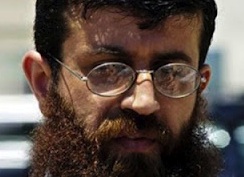
The Palestinian Gandhi, Khader Adnan, (pictured above) is a 33-year-old Palestinian husband, with a pregnant wife and two daughters, who was placed under administrative detention in Israel’s military prison system December 17, 2011. 

(I wrote earlier about Adnan, here and here.)

The  hunger strike Adnan began on the day after his arrest, was in protest against his own administrative detention, and on behalf of all those Palestinian prisoners who suffer under administration detention, the  legal subterfuge under which Israel says it has the power to hold a prisoner for an indefinite period without having to bring any charges against him or her.

On February 19, the End the Occupation blog issued this news update, from Ramallah:
Israel’s High Court of Justice has today scheduled a petitions hearing regarding the case of Khader Adnan to take place Thursday, 23 February 2012 at 11:30am. The petition was filed by Khader Adnan’s lawyers on 15 February.The High Court of Justice was provided with a detailed medical report prepared on 14 February by an Israeli-accredited doctor on behalf of Physicians for Human Rights-Israel (PHR-Israel).
Despite the elaborate medical report, which confirmed that Khader Adnan “is in immediate danger of death,” and that “a fast in excess of 70 days does not permit survival,” the Israeli High Court appointed the petition session for 23 February with no guarantees that a decision will be made on the same day.
It may well have been this scheduled hearing that forced Israel’s hand. The government of Israel had two choices: Either wait to see if the Count undermined administrative detention, or make a deal with Khader Adnan.  The third option, of the Israeli military renouncing administrative detention on its own, was never on the table.
“The Only Democracy” in the Middle East made the deal with Adnan.
So far, almost ten weeks after Khader Adnan began his hunger strike, the three media pundits who sang in harmonious longing for a Palestinian Gandhi, have remained silent on the hunger strike. There is still time for them to admit they may have missed seeing their Palestinian Gandhi.

He was here, alright, chained to an Israeli military hospital bed, yet they saw him not.

Amy Goodman’s Democracy Now web site, is one important exception to how easily the US media accepts any and all Israeli versions of reality. She is a hidden treasure. For her take on the hunger strike, which was still in process at the time.

And finally, the media silence on Israel’s treatment of Palestinians like Khader Adnan, reveals the degree to which main stream media’s silence exposes the unpleasant fact that MSM’s primary loyalty is not to its readers, but to its corporate masters.

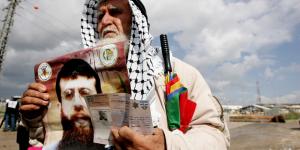
The Twitter social media– one important factor that made Israel decide to pay serious attention to Khader Adnan’s hunger strike–is described by in a posting by Jalal Abukhate, on the website al-akhbar, published before Israel reversed itself on Adnan. (The picture here is from that web site.  It shows Adnan’s father holding his own poster asking for his son’s release.)

Abukhater describes Twitter and its potential to support movements of protests. Twitter’s presence was an important factor in Egypt and Libya at the outset of the Arab Spring.

Organizing a trending hashtag for Khader Adnan is just like organizing a large protest on the corner of the busiest and most crowded street in a city.

As you read this, Khader Adnan is very close to death. It is high time the Israeli state respond to calls by Amnesty International,Human Rights Watch, the Carter Center, and many other human rights organizations to release Adnan immediately.

As Adnan enters the 65th day of his hunger strike, activists and human rights defenders have joined this campaign. In addition, Amnesty International is calling for Israel to abolish the system of administrative detention.

Adnan is the victim of arbitrary detention. He is one of 309 Palestinians who are currently being held under Israeli administrative detention. Adnan, an administrative detainee, has not been charged, he has not been tried, and he does not know when the period of detention will end. Indefinite detention without a trial or charge is not permitted under International Law. It is considered a form of arbitrary detention which no country should be practicing.

The silence of the world community is deafening. The late awakening of the mainstream media is inexcusable. Imagine if Adnan were an Iranian man on hunger strike in an Iranian jail. Would we have had to do this massive movement on Twitter to get the world’s attention? I don’t think so.

While the mainstream media has failed to cover Adnan’s story, Twitter is at the forefront of the campaign to pressure the Israeli government to act. Twitter users have taken on the responsibility of filling the void created by the mainstream media.

At this moment, according to Topsy Twitter statistics, the hashtag #KhaderAdnan has been mentioned about 40,000 times on Twitter. It should be noted that this statistic excludes other related hashtags which would count in the thousands.

A hashtag is a special tool used in Twitter to mark certain tweets as part of one conversation. In order to enter a hashtag, one must add (#) before any keyword. When a hashtag is selected the user is directed to a page where they are able to read all Twitter updates using this specific hashtag. Whenever there is a big news story, a popular event, or even a revolution, people use a certain hashtag to contribute to that conversation. That is what Palestinian and other activists are doing now for Adnan.

The picture of Khader Adnan at top, is from the End the Occupation blog.

Posted in Media, Middle East Politics, Netanyahu, Obama, Politics and Elections | Tagged , , , , , , , , , , , , | 6 Comments

The Destructive Madness of Extremism: First McCarthyism, Then Radical Zionism

by James M. Wall

(See Sunday afternoon update on Khader Adnan’s condition below.)

The right-wing government leaders of the state of Israel, bolstered by their powerful US allies, are trembling with excitement at the prospect of a military attack against Iran.

Everything is in place for Iraq Redux. This time the Extremists are determined to get it right. No ground troops, just highly sophisticated bombing runs that will target nuclear targets in Iran.

The American public is being manipulated by Israel’s Zionist extremists to believe that Iran is on the verge of developing nuclear arms which will be able to “wipe Israel off the map”.

Time to choose up sides, folks: Are you with us or against us?

Republican candidates for president, congressional Republicans and conservative Democrats, with the active encouragement of the always predictable Israel Lobby, are all spoiling for a fight for “our side”.

Truth of the matter, as Paul Pillar reported in the website , The National Interest, Israel has already launched its war with Iran through stealth assassinations of Iranian scientists, who may have, or more likely, did not have, a part in developing nuclear military capability. Pillar’s source is a report by Richard Engel and Robert Windrem, developed for NBC news:

Although the assassinations of Iranian scientists have until now been followed by no indication of responsibility other than smug comments of satisfaction from officials of the most likely foreign state perpetrator, now NBC offers something more specific.

According to a report by Richard Engel and Robert Windrem, the assassinations have been the joint work of Israel and the Iranian cult-cum-terrorist group Mujahedin-e Khalq.

According to the report, the partnership has involved Israel providing financing, training and arms to the MEK to accomplish the hits, as well as to commit other acts of violent sabotage inside Iran. The story tracks with accusations from officials of the Iranian government, who say they base most of what they know on interrogations and captured materials from a failed assassination attempt in 2010.

Such accusations by themselves would be easy to dismiss, of course, as more of the regime’s propaganda. But the NBC story cites two senior U.S. officials, speaking anonymously, as confirming the story. A third official said “it hasn’t been clearly confirmed yet,” although like the others he denied any U.S. involvement. The Israeli foreign ministry declined comment; the MEK denied the story.

No one is fooled by the Israeli denials. In fact, as the NBC report suggests, Israel deflects attention away from its involvement in all things nefarious, by suggesting that Iran is the aggressor here with its “attacks” on Israeli diplomats, a case dutifully made by the Washington Post here and here.

Juan Cole, a Middle East scholar, writing on his Informed Comment blog, is not persuaded by the Israeli spin. He finds Indian sources more credible than Israeli Foreign Minister Avigdor Lieberman:

American media that just parrot notorious thug, Israeli Foreign Minister Avigdor Lieberman in [these] unlikely allegation are allowing themselves to be used for propaganda. Why not interview Indian authorities on this matter? They are on the ground and have excellent forensic (“CSI”) abilities. Stop being so lazy and blinkered; that isn’t journalism.

Deflect attention from reality, create fear, and take the “high road”. This is the way extremists operate. It has always been so. We need only to travel back to the post WWII days of the 1940s and 1950s, when the US public was transfixed by a Washington drama that pitted suspected Communists against the American Way of Life.

The drama was launched in 1947 Congressional hearings.

Looking back to those days,the extremist side of that conflict became known in 1950 as McCarthyism, after Wisconsin Senator Joe McCarthy, a Republican who served in the US Senate from 1947 until 1957. He became a media star because he was horribly simplistic as he peddled fear. Finally, the Senator overreached and ran afoul of an honest judge named Joseph Welch. After that he spiraled downward.

But for a time it was the McCarthy era, where the sides were clearly defined, no room for ambiguity. The times demanded good versus evil, darkness against light, the powerful against the weak. This 4 minute film clip below, from the 1947 hearings, shows both “friendly” and “unfriendly”  witnesses. One of the friendly witnesses was an actor named Ronald Reagan, who later became President of the United States.

Those with the power of the Law behind them asked the question: “Are you now or have you ever been, a member of the Communist Party”? It was a question which, with the wrong answer, could send a person to jail.

Ten of those who testified as “unfriendly” witnesses, became known as the “Hollywood Ten.” Because they originally refused to cooperate with House UnAmerican Activities Committee (HUAC) they were cited for contempt of congress.

They were subsequently fired and blacklisted by the Motion Picture Association of America. All ten served up to a year in prison, were fined $1,000 and faced great difficulty working in Hollywood again.

Some worked under assumed names. The blacklist was finally broken in 1960 when Dalton Trumbo, an unrepentant member of the Hollywood Ten, was publicly acknowledged as the screenwriter of the films Spartacus and Exodus. (Could Trumbo have anticipated that the Israel he celebrated in his script for Exodus, would one day be asking “Are you now, or have you ever been”?)

The oppression of the Hollywood Ten operated on a McCarthyite battle of simplistic good versus evil. The battle is repeated whenever extremists hold absolute power, or think they do. Give the “wrong” answer and you are doomed to an indefinite time of incarceration, or at the very least, a permanent banishment from polite society.

Fast forward to the Palestine of 2011-12, where a dying young Palestinian man  who now lies chained to a hospital bed in the Galilee Medical Center in Safed, Israel.. In an earlier Wall Writings posting, I examined what happened to bring this young man into the Israeli military prison system.

After he was seized on December 17, 2011, Kahder Adnan was asked the contemporary variation of the 1940s’ Communist question, under torture in an Israeli jail nine weeks ago this weekend.

Adnan was asleep with his 5-month pregnant wife and two children, when he taken by the Israeli Occupation Forces from his home near Jenin, in Area A, that part of the Palestinian Occupied Terrorities which the Oslo Accords mandated “the Palestinian Authority has sole civil jurisdiction and security control, while Israel retains authority over movement in and out of the area”.

The questions put to the 33-year old baker and Bir Zeit University graduate, are probably not recorded. Israeli officials have made no effort to be specific as to why Adnan had been placed in “administrative detention”, the bland terminology used by Israel for “disappearing” a Palestinian into the darkness of the absolute control of its military prison system.

Israeli occupation forces subsequently have let their friends in the media know that the question put to Adnan was a variation of the old 1940s American “Are you now or have you ever been a member of the Communist Party”. I am  reasonably certain no one asking that question had ever heard of Joe McCarthy.

For Khader Adnan, the question was more along the lines of, “Are you now, or have you ever been a member of Islamic Jihad”?

(Sunday, February 19, 2012 update: The Palestinian news service, Ma’an, reported today from Ramallah:

“The Israeli Supreme Court will hear a petition on Thursday against the continued administrative detention of hunger-striking prisoner Khader Adnan, the prisoners society said Sunday.  The military secretariat informed lawyer Jawad Bulus that his appeal against Adnan’s administrative detention order will go before the court in four days, the group said.”

At the time of the next Israeli Court hearing, the hunger strike by Khader Adnan will have continued for 68 days. Adnan’s strike, which began December 17, 2011, is an act of non-violent resistance to Israel’s “administrative detention” procedures, which are used by Israel against Palestinians.  

Ma’an also reported: “A doctor from Physicians from Human Rights who examined Adnan, said he would not survive beyond 70 days without food. 

From the McCarthy era to the time of Israel’s military occupation, the questions resonate through the decades.  We, the all powerful, the all good, demand that you confess that you belong to a “party” that is evil. How does the public know that the Islamic Jihad is evil?  Because the “only democracy in the Middle East”, declares it to be so.

Communism in the 1940s and 1950s did bad things; the 2012 Islamic Jihad is fighting military occupation by the means it has, none of which are attractive. Extremism from the top of the power pyramid, engenders extremism from below.

In Israel, and indeed, in the United States, where the definition of evil is dictated by Israel, Islamic Jihad is an “illegal terrorist organization”.  But is Khader Adnan a “member” of Islamic Jihad?  He might have answered with a biblical statement, “you say I am”. Or maybe he simply remained quiet, waiting to be charged with membership is an illegal organization, a charge that is yet to come.

Khader Adnan is no stranger to an Israeli jail cell. He has already spent six years in one. He had, however, been a free man until nine weeks ago when he was once again hauled away into “administrative detention”, a colonial means of control the British, the original colonial power,  bequeathed to Israel, the current colonial power.

Israel has put in jail more than 40% of the male Palestinian population, at one point in their lives. The purpose is to subdue the population. Sometimes they sit for years in administrative detention.  At other times, they serve prison terms, and then reenter society under the watchful eyes of Israeli soldiers and informers.

Khader Adnan responded the only way left to a prisoner whose future rests entirely in the hands of his jailers; he began a hunger strike that could lead to his death. In spite of numerous calls from Israeli and Palestinian organizations that Adnan be charged or released, the state of Israel remains silent, watching a man dying in one of its military prisons.

Most Americans are ignorant of Adnan’s impending death. If, or when, he dies, the American media may record his death as a small news item that will almost certainly, identify him as a leader of the “radical terrorist Islamic Jihad group”, a charge never leveled against Adnan except by implication.

And most Americans will not see that yet another Palestinian has died because the powerful are in control with the power to ask the question: “Are you now or have you ever been”, a member of whatever group that is not approved by the rulers

Variations of the McCarthy Era question will continue as a part of our national discourse. It crops up even within the American Jewish community, as it did in a strange bit of inter-tribal conflict reported this week by Adam Horowitz on his blog, Mondoweiss.

Someone has said that great minds run together.  I don’t know about that, but I say to you that by all things sacred, earlier in the week I was working on this post which links the McCarthy Era to Zionism.

I had even searched for, and found, the short congressional grilling of the Hollywood Ten, including Dalton Trumbo, above. Suddenly, there was Horowitz beating me into on line with the McCarthy connection. The least I can do is permit him to  give the background of the story.

It all started when the New York Times transferred Ethan Bronner, its long-time Jerusalem bureau chief, back to the US. The irony of this personnel shift lies in the fact that Bronner finally may have become too much of a Zionist for even his editors to tolerate. For his part, Bronner says he had requested the transfer.

Bronner had been criticized by peace activists for his softness in covering the Occupation, soft that is, as in not being critical enough of the Israeli IDF tactics. When the story broke that his son had, until last year, served in the Israeli Defense Forces, even the Times‘ Public Editor suggested it was time for a transfer.

Jodi Rudoren, the new Jerusalem bureau chief is, like Bronner, Jewish. But her ethnicity was not enough to satisfy some on the Zionist team. Acting as a journalist should, she had reached out to sources on both sides of the issue in Israel/Palestine.  Talking to the “enemy” immediately triggered a radical Zionist reaction.

Adam Horowitz on Mondoweiss, tells what happened next, writing under the headline: “Right wing to Rudoren: Are you now, or have you ever been, a Zionist?”

Judi Rudoren continues to hold her ground against the right-wing onslaught against her for tweeting Mondoweiss and Ali Abunimah, as well as recommending Peter Beinart’s new book (these are really the charges?). The Washington Free Beacon’s Adam Kredo interviews her and begins in the most (appropriately) McCarthyite way possible:

The New York Times’ incoming Jerusalem bureau chief, Jodi Rudoren, won’t say if she is a Zionist.

“I’m going to punt on that question,” Rudoren, who is Jewish, told the Washington Free Beacon in an interview yesterday. “I’m not really interested in labels about who I am and what I think.”

He later presses her on the fact that she retweeted a mention from Sami Kishawiof the “Love Under Apartheid” campaign:

On the issue of her journalistic objectivity, Rudoren said her tweets do not reveal an innate bias against Israel.

Asked if she considers Israel an apartheid state—as critics of the Jewish state so often do—Rudoren declined comment.

“I don’t have an assessment yet,” she said. “I’m not sure I’ll ever answer that question in the way you’ve just framed it.”

Adam Horowitz and his Mondoweiss site, along with Richard Silverstein’s Tikun Olan blog, have been two of the very few US-based web sites or publications, to provide a day by day account of the Khader Adnan ordeal as he lies chained to an Israeli military bed in the Galilee Medical Center.

Whether the unjust administrative detention of Khader Adnan ends in his last minute release or in his death by self-starvation, Adnan will have registered his protest against the injustice and humiliation of Israel’s military Occupation, and in his case, especially, its administration detention.

Somehow I have to believe that new New York Times Jerusalem bureau chief will report on the final outcome of Adnan’s protest. She should, because in a much less serious moment in her life, Rudoren has also been asked the McCarthy Era question by her inquisitors.

The drawing at the top of this posting originally appeared on the website of The Association for Human Rights in Israel. The video of the HUAC hearings is from this site.

This week’s Wall Writings posting is being released a few days earlier than usual because I wanted to add my voice to those around the world who have demanded that Israel release Khader Adnan before he dies in an Israeli military prison, where he was incarcerated without any charges made against him.

Posted in Media, Middle East, Middle East Politics, Netanyahu, Politics and Elections | 19 Comments

Khader Adnan Continues Hunger Strike

by James M. Wall

Khader Adnan is a 33-year-old Palestinian graduate student, who, until he was arrested by Israeli police on December 17, 2011, lived in the occupied West Bank with his wife and two young daughters.

Their home is in the village of Arrabe, near Jenin.

Adnan has not been charged with any crime. Instead, he has been placed under administrative detention, the set of laws that are hideous holdovers from the British Mandate era.

Israel uses administrative detention to arrest and hold Palestinians for any purpose. Eight weeks after his initial arrest, Adnan has still not been charged.

The day after his arrest, Adnan began a hunger strike to protest the administrative detention laws under which he was placed, literally, in chains.

Eight weeks later, he continues his hunger strike and by so doing has become a hero to Palestinians who know the power and brutality the laws inflict on persons under total control of the Israeli Occupation Authorities (IOA).

In The Palestine Monitor, Dylan Collins writes:

Khader Adnan has quickly become the focal point and symbolic face of the inherent injustice thousands of Palestinians face on a daily basis within the Israeli penal system. Entering into the 56th day of his hunger strike, Adnan is protesting the Israeli Occupation Authority’s (IOA) illegal application of administrative detention and its inhumane treatment of Palestinian detainees.

Israel bases its administrative detention laws, illegal under international law, on Mandate laws, which even Menachem Begin, when he was a political opposition leader before becoming prime minister, denounced as “worse than the Nazi laws.”

Under detention, Israel may hold a prisoner for up to six months without revealing any evidence against him or her.  Israeli NGO Physicians for Human Rights-Israel (PHR-I) considers indefinite detention without charge, to be a form of psychological torture.

According to B’Tselem spokesperson Sarit Michaeli, the number of Israel’s administrative detainees is on the rise. In January 2011, Israel held 219 Palestinians in administrative arrest; by December, 2011, that number rose to 307.

Khader Adnan has appealed his current four-month administrative detention order. On February 9, an Israeli court held a day-long special appeal session for Adnan at Zeif medical center. The Israeli military appeals Judge Moshe Tirosh concluded that she was unable to reach a decision on Adnan’s appeal.

The Addameer (Arabic for conscience) Association for Prisoner Support and Human Rights reports that Judge Tirosh is expected to make her decision soon, “though any delay may prove fatal.”

Addameer’s report indicates that Khader Adnan has not been allowed to shower, or change his clothes or underwear since his arrest. On February 7, Adnan’s wife, Randa, and his two young daughters were given permission to visit him for the first time.

His emaciated stature and the boils covering his face and tongue reportedly shocked the family, but he was “mentally aware” enough to “fully express his love.”

This weekend, Adnan will have been on his hunger strike for eight weeks. His health is now considered to have reached a seriously dangerous stage.

Physicians for Human Rights-Israel (PHR-I) denounced the fact that the Mayanei HaYeshua Medical Centerm has allowed Adnan to be hospitalized in chains, noting that in doing so the hospital is in violation of medical ethics, as well as the instructions of the Israeli Health Ministry and Israeli physicians organizations.

PHR-I’s president, Dr. Ruhama Marton, demanded that the chains be removed. She noted that “the chaining of a prisoner to bed is intended solely for the purpose of humiliating him and causing him physical and mental hardship. The security argument is invalid in this case. The chaining of a patient to a bed is contrary to international law.”

The medical center where Adnan has been chained to his bed, has this to say about itself  on its website:

Mayanei HaYeshua Medical Center was founded in Bnei Brak in 1990 by Dr. Moshe Rothschild, as a public/private hospital, in order to provide advanced medical services in the spirit of Halacha (Jewish religious law).

For Dr. Rothschild, a man rich in public service, the Medical Center was his life’s crowning achievement – a modern hospital meeting the highest standards of medicine and technology, and run, down to the smallest details, according to the most meticulous dictates of Halacha, which would provide a warm home for patients in many and varied fields.

In a letter Khader Adnan wrote this weekend from Zeiv Hospital, where he is now receiving treatment, Adnan vowed to continue with his strike.

“I started my battle offering my soul to God almighty and adamant to go ahead until righteousness triumphs over falsehood. I am defending my dignity and my people’s dignity and not doing this in vain.

“The Israeli occupation has gone to extremes against our people, especially prisoners. I have been humiliated, beaten, and harassed by interrogators for no reason, and thus I swore to God I would fight the policy of administrative detention to which I and hundreds of my fellow prisoners fell prey.” 

His letter, delivered by Jalal Abu Wasil, a lawyer from the Palestinian Ministry of Prisoner Affairs, who visited him in hospital, added that Adnan refused to be examined by doctors.

“Here I am in a hospital bed surrounded with prison wardens, handcuffed, and my foot tied to the bed. The only thing I can do is offer my soul to God as I believe righteousness and justice will eventually triumph over tyranny and oppression.”

I hereby assert that I am confronting the occupiers not for my own sake as an individual, but for the sake of thousands of prisoners who are being deprived of their simplest human rights while the world and international community look on.

“It is time the international community and the UN support prisoners and forces the State of Israel to respect international human rights and stop treating prisoners as if they were not humans.”

Administrative detention as an Israeli policy is the target of Adnan’s hunger strike. Young people (see picture at top) gather in Ramallah to protest Adnan’s detention. Musa Adnan, Khader’s father, had joined his son in the hunger strike. Musa Adnan is pictured at right, talking with a reporter.

On Friday, the Palestinian Authority’s prisoners affairs minister Issa Qaraqe told Ma’an News that Egypt was “intervening with Israel to free Khader Adnan”.

He added that the Palestinian leadership of Mahmoud Abbas and Salam Fayyad have made calls to several countries asking for their assistance in calling for Adnan’s release.

Issa Qaraqe also announced that Palestinian detainees held in Israeli prisons have announced that in support of Adnan, they will hold a hunger strike on Sunday

These detainees warned in a letter to the general director of Israel’s prisons, that the situation may escalate if anything happens with Adnan.

They also demanded his release, adding that the prison administration and the Israeli government would be held responsible for his fate. A court ruling on Adnan could be released on Sunday.

Meanwhile, Israeli authorities have refused to allow Qaraqe and Adnan’s family members “to check up on his health”.

Robert Serry, the UN special coordinator for the Middle East peace process, said he is following the case “with concern”. He said he is calling on Israel “to do everything in its power to preserve the health of the prisoner and resolve this case while abiding by all legal obligations under international law.”

There is no indication that any appeals have been made to, or have come from, US authorities.

The picture at the top, taken in Jenin, is by AP photographer Mohammed Ballas. The picture of Khader Adnan was published February 11, 2012, on The Ma’an News Agency web site. The Agency does not indicate the date on which the picture was taken. The picture of Musa Adnan is by Dylan Collins. It is from the Palestine Monitor. 

Posted in Middle East, Middle East Politics, Religious Faith | Tagged , , , , , | 15 Comments

Dershowitz Attacks Penn BDS Conference; Next In Line, The United Methodist Church

by James M. Wall

Israeli blogger Noam Sheizal writes in the US based, Foreign Policy’s The Middle East Channel, that the majority of voters in Israel currently have no interest in ending the country’s 44 year-long military occupation of the West Bank and Gaza.

Sheizal, a columnist for +972, a progressive Israeli website, concludes in his FP essay, that the “peace camp” has disappeared from Israeli politics.

For Israelis, according to Sheizal, the occupation of Gaza and the West Bank

remains a non-issue and will continue to be so, as long as the military is able to hold back any local Palestinian resistance, the prime minister is successful in resisting continued diplomatic pressure and regional isolation, and the internal and external boycott movement remains marginal.

What Sheizal describes as “the internal and external boycott movement” is better known in US peace circles as BDS, the Boycott, Divestment and Sanctions movement.
The indifference to BDS that Sheizal found among Israelis is unfortunately also found in the US voting public.

This indifference is not shared by those who gathered on the University of Pennsylvania campus this weekend for the first national meeting of BDS. According to the conference’s website, BDS’ goal is to “boycott, divest from and sanction (BDS) the State of Israel until it complies with its obligations under international and human rights law.”

The Israel Lobby and its US supporters took the BDS weekend event quite seriously, so much so that a heavy-hitter like noted criminal attorney Alan Dershowitz. was on the scene to employ his courtroom skills to make Israel’s case.

The presence of  Dershowitz in the University of Pennsylvania college newspaper prior to this weekend, was an early indication that the Israel Lobby is in such a belligerent paranoid mindset that any public display of criticism of Israeli policies must be resisted with heavy vitriolic rhetoric.

To the Lobby, there is never any room for indifference where Israel is concerned.

Who better than Dershowitz to set the agenda for the battle ahead.

“Why Israel Matters to You, Me, and Penn: A conversation with Alan Dershowitz,” was the title of Dershowitz’ lecture, an event co-hosted by Penn’s Political Science department, which had earlier refused to co-sponsor the BDS conference.

Advance attacks on BDS speakers were reported by Max Blumenthal, who was also a Conference participant.

Ali Abunimah, a renowned Palestinian writer and solidarity activist who will deliver the conference’s keynote address, was recently accused by Emily Schrader, an activist with the pro-Israel group StandWithUs, of “incitement to violence against Israelis.” Wayne Firestone, the president of the pro-Israel student group Hillel, accused the Penn BDS conference of advocating “warfare” and fomenting “hatred.”

The allegations leveled by Schrader and Firestone could not be further from the truth. Not one participant in the Penn BDS conference has “incited” violence against Israelis or anyone else.

Instead, BDS advocates have raised their voices in support of an expressly non-violent movement that takes its inspiration from the American civil rights struggle against Jim Crow bigotry and the international campaign against South Africa’s apartheid regime.

Thursday night one day before the conference opened, Dershowitz spoke to a full house at the Zellerbach Theater at the Annenberg Center for the Performing Arts. His audience included  people from the university and from the larger community.

Dershowitz’ invitation to speak came from the Jewish Federation of Greater Philadelphia, Hillel of Greater Philadelphia and Penn Hillel.

David Cohen, Chairman of the Penn Board of Trustees, introduced Dershowitz with a message from University President Amy Gutmann, which included this pro-Israel sentiment:  “We are unwavering in our support of Israel. We do not support the message or the goals of BDS.”

Cohen is the chairman of the board of Comcast, which recently purchased the NBC television network, which includes MSNBC.

As faithful viewers are aware, MSNBC has a progressive stance. However, as Philip Weiss points out on his Mondoweiss website, the progressive MSNBC anchors do not reflect a progressive outlook in matters related to the Israel/Palestine issue. The lineup of Chis Matthews, Ed Schultz, Rachel Maddow and Lawrence O’Donnell, are four of television’s leading PEPs (Progressive Except on Palestine).

In his talk Thursday, Dershowitz praised the University for “championing free speech”. He added, however, according to the news report, that If Penn had banned BDS. he would have been forced to defend them in the name of free speech, something he wouldn’t want to do.

After that nod to free speech, Dershowitz told his appreciative audience, “We are going to win this encounter.” Dershowitz was critical of  Penn professors who support BDS, describing them are “complacent with evil.”

Penn for Palestine co-president, sophomore Sarah Shihadah, explained that their BDS group opted to watch the live stream of the event instead of attending the event because of Dershovitz’s “hostile rhetoric” against BDS supporters.

“[We] hope the balance of the two events,” — Dershowitz’s talk and the BDS conference — “will stimulate honest academic discourse,” Shihadah said.

She added, however that she felt Dershowitz “misrepresented and omitted some of the human-rights issues faced by Palestinians, such as the millions of Palestinians living under occupation and millions more in diaspora whose rights Israel fails to uphold as recognized by the United Nations.”

During his talk, Dershowitz’ comment that the UN is a “house of hypocrisy” was greeted by loud cheers and applause. Also in his speech, Dershowitz charged: “BDS hypocrites [are] interested in de-legitimizing Israel.”

Ali Abunimah earlier wrote in a guest column for the Philadelphia Inquirer:

We are coming together to push forward an inclusive movement that supports nonviolent action to promote the human rights of the Palestinian people, because only full respect for these rights can lead to peace. Today, millions of Palestinians live without basic rights under Israeli rule. This intolerable situation is at the root of problems that affect the whole world.

This is a theme that will move forward as both secular and religious groups gather,step by determined step, to make the case for BDS.

Next in line, the quadrennial General Conference of the United Methodist Church, which meets in Tampa, Florida, from April 24 through May 4, 2012. On the Conference agenda will be a resolution that would make it official church policy to divest United Methodist funds from three US corporations–Caterpillar, Motorola and Hewlett Packard–which the denomination has determined  are using church investment funds to support the Occupation of Palestinian Territories.

Delegates who support the divestment resolution will be able to declare that United Methodists will not allow its funds to participate in the Occupation.

Specifically:

The resolution calls for the General Conference to instruct all United Methodist general boards and agencies to divest promptly from Caterpillar, Motorola and Hewlett Packard, which have been engaged repeatedly by United Methodist agencies and annual conferences on this issue, until these companies end their involvement in the Israeli occupation.

The Penn BDS Conference was the opening salvo in 2012 in the campaign for Palestinian, and in the long run, Israeli, justice. In April, United Methodist delegates will be able to choose either to support the Palestinians who have asked for their help in ending Israel’s Occupation, or they may choose to reject that Palestinian request.

The vote will be the moment in time, Kairos time, when United Methodists will answer the question, “Which side are you on?”

The picture at the top of this posting is of a ceremonial space honoring indigenous people, by artist Bob Haozous. It is located in Fort Brooke Park on the Riverwalk in Tampa, Fla. The United Methodist Church will hold an Act of Repentance and Healing for Indigenous Persons, during its 2012 General Conference, which will be held a few blocks away at the Tampa Convention Center April 24-May 4. The United Methodist News Service photo is by Mike DuBose. 

Posted in Middle East Politics, Religion and politics, United Methodist Church | Tagged , , | 17 Comments