Tony Judt Still Fights to Expose Israel’s “Inconvenient Truths”

by James M. WallJudt cropped

On October 23, 2003, exactly six years ago this week, Professor Tony Judt published an essay in the New York Review of Books entitled, Israel: The Alternative.

The essay was the culmination of a journey he began as a teen-ager on an Israeli Kibbutz during the Six Day War.

Judt was born in London in 1948. His parents were secular Jews. His mother’s parents were immigrants from Russia; his Belgian-born father came from a long line of Lithuanian rabbis. By the time he reached the age of 24, Judt had earned a PhD in history from Cambridge University.

Earlier, the young scholar had followed a pattern that came naturally to a secular Jewish teenager in the 1960s.. At age 15, according to his biography in Wikipedia, he “helped promote the migration of British Jews to Israel.”

At 18, he worked for a year on Kibbutz Machanaim in Israel. During and after the 1967 Six Day War, Judt,worked as a driver and translator for the Israeli Defense Forces. When the war ended, Judt began to have doubts about the Zionist project.

“I went with this idealistic fantasy of creating a socialist, communitarian country through work,” Judt has said. He began to realize that this “idealistic fantasy” was “remarkably unconscious of the people who had been kicked out of the country and were suffering in refugee camps to make this fantasy possible.”

On September 11, 2001, Judt was a professor at New York University, where, in addition to his academic achievements, he had become known as a “combative writer and reviewer”.

In an article on Judt, the London Guardian writes, “his early opposition to the Iraq war threw him out of alignment with his usual [liberal] allies, who were still rallying around the president following the terrorist attacks.”

Judt had more to say. Seven months into the Iraq war, he wrote Israel: The Alternative. It begins:

The Middle East peace process is finished. It did not die: it was killed.

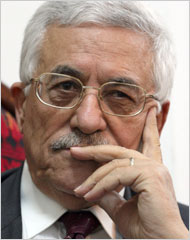
Mahmoud Abbas was undermined by the President of the Palestinian Authority and humiliated by the Prime Minister of Israel. His successor awaits a similar fate.

Israel continues to mock its American patron, building illegal settlements in cynical disregard of the “road map.”

The President of the United States of America has been reduced to a ventriloquist’s dummy, pitifully reciting the Israeli cabinet line: “It’s all Arafat’s fault.” Israelis themselves grimly await the next bomber.

Palestinian Arabs, corralled into shrinking Bantustans, subsist on EU handouts. On the corpse-strewn landscape of the Fertile Crescent, Ariel Sharon, Yasser Arafat, and a handful of terrorists can all claim victory, and they do. Have we reached the end of the road? What is to be done?

The essay was stunning in its audacity. It attacked two American sacred cows: the patriotic zeal behind the Iraq war, and Israel’s absolute right to exist as a Jewish state. Judt was saying the unsayable: The Iraq war was a tragic mistake, and the “two state solution” was dead.

This was 2003, when few Americans dared to voice either of these opinions. The essay was so removed from the conventional wisdom promoted by Main Stream Media, that it was quickly shoved into a corner reserved for eccentric professorial nonsense.

But the Israel Lobby noticed. Tony Judt immediately became a prime target for the Lobby, a man who had spoken a truth that would undermine Israel’s carefully constructed narrative designed to protect “inconvenient truths”.

Judt had written what many thought, but few dared express.

Later in his essay, Judt wrote:

The problem with Israel, in short, is not—as is sometimes suggested—that it is a European “enclave” in the Arab world; but rather that it arrived too late. It has imported a characteristically late-nineteenth-century separatist project into a world that has moved on, a world of individual rights, open frontiers, and international law.

The very idea of a “Jewish state”—a state in which Jews and the Jewish religion have exclusive privileges from which non-Jewish citizens are forever excluded—is rooted in another time and place. Israel, in short, is an anachronism. In one vital attribute, however, Israel is quite different from previous insecure, defensive microstates born of imperial collapse: it is a democracy.

Hence its present dilemma. Thanks to its occupation of the lands conquered in 1967, Israel today faces three unattractive choices. It can dismantle the Jewish settlements in the territories, return to the 1967 state borders within which Jews constitute a clear majority, and thus remain both a Jewish state and a democracy, albeit one with a constitutionally anomalous community of second-class Arab citizens.

Alternatively, Israel can continue to occupy “Samaria,” “Judea,” and Gaza, whose Arab population—added to that of present-day Israel—will become the demographic majority within five to eight years: in which case Israel will be either a Jewish state (with an ever-larger majority of unenfranchised non-Jews) or it will be a democracy.

But logically it cannot be both. Or else Israel can keep control of the Occupied Territories but get rid of the overwhelming majority of the Arab population: either by forcible expulsion or else by starving them of land and livelihood, leaving them no option but to go into exile.

In this way Israel could indeed remain both Jewish and at least formally democratic: but at the cost of becoming the first modern democracy to conduct full-scale ethnic cleansing as a state project, something which would condemn Israel forever to the status of an outlaw state, an international pariah.

Judt was prophetic. Six years later, the Iraq war is now generally understood to have been a tragic mistake. And with Israel’s steady “settlement” march across the Occupied Territories, the One State solution is emerging as the only viable and just alternative. (See Ali Abunimah’s One Country: A Bold Proposal to End the Israeli-Palestinian Impasse)

Six years later, Judt’s prophetic voice is no longer eccentric.

When Stephen Walt of Harvard and John Mearsheimer of the University of Chicago were targets of the Lobby, he wrote an op ed piece for the New York Times after Walt and Mearsheimer’s initial appearance on the media stage with their essay in the London Review of Books, an essay that was quickly expanded into a book, The Israel Lobby.

As they must have anticipated, the essay has run into a firestorm of vituperation and refutation. Critics have charged that their scholarship is shoddy and that their claims are, in the words of the columnist Christopher Hitchens, “slightly but unmistakably smelly.” The smell in question, of course, is that of anti-Semitism.

In a New York Times column, written in June of this year, Judt cut to the heart of the phony diplomatic game the US and Israel have been playing over “freezing” settlement growth.

He concluded his column:

President Obama faces a choice. He can play along with the Israelis, pretending to believe their promises of good intentions and the significance of the distinctions they offer him. Such a pretense would buy him time and favor with Congress.

But the Israelis would be playing him for a fool, and he would be seen as one in the Mideast and beyond. Alternatively, the president could break with two decades of American compliance, acknowledge publicly that the emperor is indeed naked, dismiss Mr. Netanyahu for the cynic he is and remind Israelis that all their settlements are hostage to American goodwill.

Judt can also be gentle. In a brief appearance in Charlie Rose’s “Green Room” in July of this year,  he spoke poignantly of his earlier years.

When Israeli author Amos Alon died on May 25 at age 82, Judt wrote:

It is for his writings on Zionism and Israel, and his lifelong engagement with the country and its dilemmas, that Amos Elon will be best remembered. In The Israelis: Founders and Sons (1971) he offered a critical history of Zionism, its practitioners, and its heirs; an account that directly confronts the shortcomings of the Zionist project and its outcome.

Today such critical accounts are common currency in debates in Israel; in those days they were rare indeed. Amos Elon’s commitment to Israel, the country where he lived and worked for most of his life, was never in question.

On Monday night, October 19, an audience of more than 2000 waited expectantly for the appearance of Tony Judt, who was to deliver the annual Remarque Lecture, at New York University’s Skirball Center.

Philip Weiss described the emotional evening:

Tony Judt rolled on to the stage at NYU last night in a wheelchair, with a breathing tube strapped to his head and a blanket over his form, and began his lecture in a surprisingly strong voice by “shooting the elephant in the room”.

A year ago he was diagnosed with a form of amyotropic lateral sclerosis, or Lou Gehrig’s disease, a degenerative disease of the muscle, and it had progressed to the point that he was now paralyzed below the neck.

Some friends had urged him to make the subject of the Remarque Lecture the nature of his disease, so as to advance the health care debate, but he had concluded there was no point in show and tell.

The show was obvious: this is what the disease did to a body, left him quadriplegic “wearing facial Tupperware,” a machine breathing for him, making a rhythmic wheezing. The hope others had that he would give an uplifting lecture about what a body can do under these circumstances he must also disappoint: “I’m English, we don’t do uplifting.”

In his lecture, which lasted for 100 minutes, in spite of his physical limitations, Judt was still the articulate fighter.  Weiss’ report concludes:

I admire Judt no end. . . A man of great intellectual courage, he broke with the so-called liberals of the New Republic over Zionism, then took Walt and Mearsheimer’s side when it mattered in 2006, and joined Mearsheimer on stage at Cooper Union to explain to Shlomo Ben-Ami and Dennis Ross and Martin Indyk that just because anti-Semites agreed with something you said doesn’t mean you are wrong. . .

There was real grief in seeing a great man so reduced by an illness that he has approached with a stiff upper lip. . . . A huge community of leftleaning New Yorkers turned out because Judt has been so important, and this public act was one of leadership.

As he has done on other occasions, he pulled aside the curtains and the wings to show that the little world we are used to accepting is not necessarily the world of history. It is the world of recent “opinion.” . . .

It was in the end a thrilling spiritual message, forged by Judt’s own misery, and a challenge to our creativity, to break the chains of established opinion and tell a different story about history.

Picture above is from Radio Free Europe/Radio Liberty

Posted in Middle East Politics | 9 Comments

Why Are Palestinians Losing Faith in Obama? Ask Rahm Emanuel

By James M. Wall

I read an online report on Gentleman’s Quarterly (GQ)‘s latest issue, and discovered why Palestinians are losing faith in President Obama.Obama

There at the top of a list of the 50 Most Powerful People in Washington, DC, was my old political colleague from Chicago, Rahm Emanuel.

I quickly scrolled the entire list of the MPPs in DC and discovered folks who are close to Obama, or who are engaged in running his wars in Iraq and Afghanistan, or who are advising the president on how to rescue the economy.

There are even some Republicans, in or out of office, who are dedicated to seeing Obama fail. There is even a media heavyweight, former Bill Clinton White House aide, George Stephanopoulos.

But there is no one who really knows and feels the Palestinian narrative.

And there, right up there at the top of the GQ list was ole Rahm, Chief of Staff to President Obama.  This is a man who knows how to wield power.  Don’t take my word for it, read GQ’s description of why Rahm is the Number One Most Powerful Man in Washington:

More, much more, than just the gatekeeper to the president. In addition to his five years as senior adviser in the Clinton White House, Rahm served six years in the House and, more importantly, engineered the Democratic takeover of Congress in ’06. He knows procedure, he’s ruthlessly pragmatic about what is politically achievable, and he knows how and when to twist arms and call in the many favors he’s owed.

All of which has helped him wrangle fence-sitters when it came to ponying up for the stimulus package, negotiate with the Senate Finance Committee on health care, and keep the liberal and conservative elements of his own party in line. Obstruct the White House and at some point Rahm will come calling.

Says Senator Lindsey Graham, a man not known for agreeing with the administration: “The president is lucky to have him.”

Chris Matthews, MSNBC’s Rush Limbaugh of the Left, dissed the list, while reporting it to his national audience, as “just a fashion magazine”.

That did not bother me. I take GQ as seriously as I take all other voices from the Main Stream Media, all of whom are beholden in advance to someone or something else. Why not fashion?

Besides, Rahm is one of the classiest dressers in DC. Charming as all get out, if you can get by his fondness for salty language.

And now, there is Rahm, sitting down this week to use his political charm and muscle on members of Congress as they fight among themselves to write a final health care bill. Trust me, put your money on Rahm in that dog fight.

I have had my differences with Rahm, from the day he walked in my campaign office in 1983 and announced that he was there to raise money for Congressman Paul Simon’s primary race for the US Senate.

I was managing Simon’s campaign, and told this cocky young man I was not ready to hire a 24 year old kid I did not know. He said, check with Paul. I did, and the future Illinois senator told me, “Don’t worry about it;  his salary is covered.”

Veteran Illinois journalist Robert E. Hartley has just published his latest book, Paul Simon: The Political Journey of An Illinois Original, Southern Illinois Press. I am biased. I have known Bob since he covered politics from his base in Decatur, Illinois.  This is his seventh book.

It is a well documented work (he interviewed me at length).  It is also an example of how the Israel lobby was able to influence one of the most moral men ever to serve in both the US House and Senate.

It was in the Simon campaign that it became obvious to me that Rahm could raise money. He was also a dedicated Zionist whose presence in the campaign delighted the hearts of Simon’s dedicated Zionist supporters.

Rahm’s rolodex (not a watch; if you are under 50, a rolodex is “a rotating file device used to store business contact information”) played no small role in his fund-raising success, a success he repeated in Bill Clinton’s two campaigns, and in subsequent congressional campaigns for the Democratic National Committe.

A few years later, Rahm and I were volunteers in Bill Clinton’s first run for the White House.

Rahm knew I was not a dedicated Zionist, so each day at the staff meeting, he delighted in calling me Yasir, as in Arafat, for readers who may not remember.  For Rahm, linking me to the Palestinian leader was intended as an insult.  This is a man who uses humor as a weapon.

I have followed Rahm’s career since 1983 in both awe and dismay. He’s good, no doubt about it. And now he wields power in the White House.  In an earlier posting, I expressed the hope that Rahm would use his clout to reassure the Palestinian public and talk tough to the Israelis. So far, no such luck.

The Palestinians have the Cairo speech to hold on to, but I have bad news for them.  Bibi is eating Obama’s lunch. No one in that top 50, or the top 500 have any loyalty to the oppressed residents of the West Bank or Gaza. Official Washington has been drinking the AIPAC kool-aid for so long they don’t know what all the fuss is about.

Frankly, I doubt that any of them has ever witnessed the humiliation of a Palestinian at a check point or a witnessed the demolition of a Palestinian home, or walked along the Security Wall, on the Palestinian side. I also doubt if any has read Edward Said or ever heard of Rachel Corrie, whose family’s appeal for justice to the US Congress was ignored.

Have they read the Goldstone Report, a UN commissioned study of  possible war crimes committed by Israeli forces in Gaza? And yes, I know that the same report found fault with Hamas conduct in that period, which is about the only fact about Goldstone the MSM made sure reached Official Washington and the American public.

Which brings us to the news that Robert Wexler, will resign from his safe Florida Democratic seat in Congress, to become director of the Washington-based Center for Middle East Peace and Economic Cooperation (CMEPEC).

What, you may wonder, will this have to do with official Washington’s treatment of the Palestinians.  Not much, but it will play a role. State legislators in Wexler’s south Florida district are scrambling to replace him.  The next Congressman will also be a pro-Israel Democrat, thanks primarily to a heavy Jewish voting population in the district.

But will it be an AIPAC or a J Street winner?

Let me explain:

Wexler was one of Obama’s earliest supporters in Congress. Unlike Rahm, who waited to see who would win the Democratic nomination, Wexler, a self-described  “fire-breathing liberal,” and defender of Israel, was all over the country during the Democratic primaries assuring Jewish audiences that they could trust Obama to look out for Israel.

You may recall Wexler as that fire breathing liberal who led the battle in DNC’s Rules and Bylaws Committee meeting where Candidate Clinton failed in her effort to take 185 Florida delegates she had “won” in the Florida primary.

In a nationally televised committee meeting, Wexler said his own state had violated the party’s rules–“The Florida primary vote was not a ‘normal’ primary and cannot be treated as one”–so Clinton’s claim on the 185 delegates could not stand.

In the committee meeting, Wexler prevailed over Harold Ickes, Clinton’s delegate guru, who had tried to steal delegates from Jimmy Carter on behalf of Ted Kennedy at the 1980 Democratic Convention.. Ickes lost that one too.

Wexler is a formidable political figure. He is taking over as director of the Center for Middle East Peace and Economic Cooperation (CMEPEC), which was founded in 1989 by the very wealthy Zionist, Slim Fast Foods Chairman S. Daniel Abraham.

If CMEPEC is playing nice with J Street, this would be good news for the J Street branch of the Pro-Israel Washington community.

J Street has built a moderate reputation as an alternative lobby group against AIPAC. Wexler was an early recipient of J Street funds, back when it was not easy for members of Congress to take J Street money instead of remaining loyal to AIPAC.

On the scale of moderation, J Street is well to the left of AIPAC. Except, I am not encouraged when I see hard line pro-Zionists like Dennis Ross, US Special Middle East Coordinator; Uri Savir, former Chief Israeli negotiator for the Palestinian and Syrian tracks; Dore Gold, Israeli Ambassador to the United Nations, and few “safe” Palestinians on the current CMEPEC board .

The Americans on that list may be “moderates” but they still bleed Zionist red. And, by now we have learned just how little influence moderates have over the likes of Bibi Netanyahu and Avigdor Lieberman.

Wexler has his enemies in the pro-Israel DC community.  The right wing, pro-Israel blog, The Force of Reason, attacked Wexler’s move to the CMEPEC in less than temperate language, under the headline: Rep. Wexler (D-emented) Resigns to Be J Street Shill.

JTA [Jewish Telegraphic Agency] reports that [Wexler] resigned from Congress to head the Center for Middle East Peace and Economic Cooperation, which is a J Street front. Not only is he endorsed by J Street, but he’s working for them now, too. . .

The Center for Middle East Peace and Economic Cooperation engineered the second Intifada by being one of the primary backers of Oslo, back in their heyday.

The Center’s former head, Stephen Cohen, was the sincere genius who made Assad and Arafat out to be peacemakers, rather than the Islamonazi savages they always were.

Wow, and it gets worse. So you have to admire Wexler for taking the side of the good guys on the DC Israel team. But even that news should not be welcome in Ramallah.

The moderates in Washington have Obama’s ear.  Rahm talks to them.  But what looks like moderation to the pro-Israel Washington doesn’t look very moderate to a people who have lived under an increasingly harsh military occupation since 1967.

Adam Horowitz, who writes on the pro-Palestinian Jewish blog, Mondoweiss, explains, under this headline:

Hope in Obama is ‘evaporating’ in the Middle East as the peace process goes nowhere.

Seems like everyone is losing faith in Obama nowadays, and the Middle East is no different. While Israelis never seemed to like him much, the rest of the region is beginning to grow weary, starting with Palestinians.

The AP is reporting on a leaked memo from Fatah’s Office of Mobilization and Organization that says, “All hopes placed in the new U.S. administration and President Obama have evaporated,” because the White House, “couldn’t withstand the pressure of the Zionist lobby.”

Although some think this might only be Abbas trying to rehab his nationalist bona fides, it would be hard to disagree with the gist of the memo.

The “nationalist bona fides”, of course, refers to the Palestinian president’s mistake in listening to the US and Israel and pulling back the Goldstone Report from the UN Human Rights Commission agenda. Abbas has since reversed that mistake. He asked that the Report be put back on the agenda. But the damage has been done.

Mark Lynch reports for Foreign Policy on the change of mood toward the peace process in the country of Jordan:

When I was last in Jordan about six months ago, I found a great deal of optimism over the appointment of George Mitchell and the high profile Obama gave to the Israeli-Palestinian problem. But now those hopes seem to have largely evaporated.

The launch of Israeli-Palestinian talks which they had expected by June continue to drift in limbo, while Obama’s failure to deliver on the settlement freeze has — just as so many predicted — eroded his credibility. How could the Americans have allowed Netanyahu to not only defy U.S. demands on settlements but to not even pay any significant price?

Again and again, from all sectors of Jordanian political society, I heard the same refrain: Obama’s heart is in the right place and we want him to succeed, but he’s just not getting it done.

Rahm Emanuel is Obama’s point man on bringing hope to the Palestinians. So far “he’s just not getting it done”.  Is there any wonder why the Palestinians and their supporters in the Arab states (and in the US) are losing faith in Obama?

Pro-Israel Jewish factions in Washington are fighting among themselves over whether AIPAC or J Street is Israel’s best friend in the US.

But where, o where, are the supporters of justice for the Palestinians? This much we know. They are not among the 50 most important people in Washington.

Unless, that is, Mister Number One himself, Rahm Emanuel, recognizes that it is in the best interests of the American people, Israelis and the Palestinian people, to stand up to the right wing rulers of Israel and say: “Enough, already.”

Picture above of Rahm Emanuel and David Alexrod is an AP Photo by Gerald Herbert.

Posted in Middle East Politics | 14 Comments

Leipzig 10/9/89: The Day Prayers and Candles Ended an Occupation

By James M. WallNikolaikirche cropped

Twenty years ago, October 9, 1989, East German citizens marched to a prayer service at Leipzig’s St. Nicholas (Lutheran) Church. In a ritual they had repeated many nights before, they marched  to the church holding lighted candles.

There were 70,000 marchers in the streets of Leipzig that night. Communist East German officials waited for the signal from Berlin and Moscow to disperse the crowd by force. The signal never came.  Two weeks later, the Berlin Wall fell, and the Soviet Union began its total collapse.

The Leipzig Communist security chief wanted very much to subdue the rebellion.  His police force was well armed. Soldiers with machine guns stood on top of nearby buildings.

In a final scene from the East German movie, Nikolaikirche, the security chief stares out at the crowd, his defiance now gone, and says, “”We planned everything. We were prepared for everything, except for candles and prayers.”

I attended the premier showing of Nikolaikirche (St. Nicholas Church) at the 1996 Berlin International Film Festival. Thirteen years later, Nikolaikirche remains for me one of strongest cinematic demonstrations I have ever seen of the power of peaceful, non violent protest against an occupying force.

I opened my Berlin Film Festival report by placing Leipzig in a religious context:

One could not visit Berlin in the 450th anniversary year of Martin Luther’s death without making a pilgrimage to Wittenberg, the city in which Luther began the Protestant Reformation.

His tomb lies in a place of honor in the Schlosskirche, where Luther posted his 95 defiant challenges to the pope’s authority. To reach Wittenberg from Berlin, one travels south on the autobahn past now-empty Soviet army barracks, passing at highway speed through areas where border crossings once delayed travelers for hours.

After an hour and a half on the autobahn, a smaller highway takes the pilgrim to the Elbe River, not far from the spot where American and Soviet troops met in the final days of World War II. One passes outmoded, nearly vacant chemical plants in what was once East Germany’s thriving industrial region. The more efficient factories in the western part of the country have replaced many of these plants.

At one operation near Wittenberg, the number of employees has been cut from 8,000 to 700. Wandering through Luther’s city and reflecting on the strife in Luther’s career, I saw similarities to more recent struggles in Germany that led to the collapse of the Berlin Wall.

In Luther’s life, religion regularly interacted with politics. His initial success in reforming the church was possible in part because he cultivated the support of political leaders who protected him, and who eventually separated their states from the authority of the Roman Catholic Church. . . .

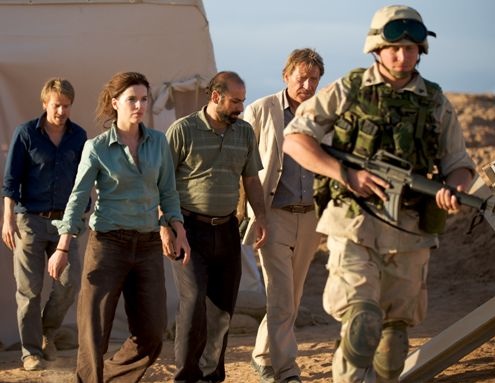
leipzig-nikolaikirche-wc-pd-300Nikolaikirche, directed by Frank Beyer and based on a highly respected novel by East German author Erich Loest, records some decisive moments in “Die Wende”, the “turning” from communism to freedom. The movie re-creates events at Leipzig’s St. Nicholas (Lutheran) Church during the peaceful revolution of 1989.

Communist officials in Leipzig came very close to applying the “Chinese solution”–using massive force to put down public demonstrations. Those demonstrations began as prayer meetings across the city. . . .

Many if not most of those who prayed in the churches and then walked the streets with lighted candles to express opposition to communist policies were not committed Christians. But they found in the church a place where opposition to oppression could be voiced. The pastor at St. Nicholas acknowledged that the church was open to nonbelievers as well as believers.

On one occasion, the pews were filled with government officials and university students who had been sent to foil the demonstration. But the pastor shrewdly “reserved” the balconies for the demonstrators.

On the night of October 9, 1989, more than 70,000 citizens mobilized in the streets of Leipzig. Before the march, the St. Nicholas pastor admonished the demonstrators to be nonviolent: “Put down your rocks.”

Meanwhile, security officials waited for instructions from Moscow and Berlin on using force to subdue the demonstrators. The orders never came, and the police gave up. A month later the Berlin Wall fell. The security chief who wanted to subdue the rebellion is shown in the film staring out at the crowd in front of his headquarters.

“We planned everything,” he says. “We were prepared for everything, except for candles and prayers.”

When a colleague wrote to remind me of the 20th anniversary of the beginning of the end of Communist control over East Germany, I had just read Ali Abunimah’s essay,”After Goldstone, Hamas Faces Fateful Choice”, in the Electronic Intifada.

The parallel with Leipzig, while different in many historical circumstances, suggests that out of crisis moments, opportunities for new options may emerge. I am especially alerted to the parallel when I recall the instruction from the St. Nicholas pastor, “Put down your rocks.”

Abunimah begins:

The uproar over the Palestinian Authority’s (PA) collaboration with Israel to bury the Goldstone report, calling for trials of Israeli leaders for war crimes in Gaza, is a political earthquake.

The whole political order in place since the 1993 Oslo accords were signed is crumbling. As the initial tremors begin to fade, the same old political structures may appear still to be in place, but they are hollowed out.

This unprecedented crisis threatens to topple the US-backed PA leader Mahmoud Abbas, but it also leaves Hamas, the main Palestinian resistance faction, struggling with fateful choices.

Abbas, accustomed to being surrounded by corrupt cronies, sycophants and yes-men, badly misjudged the impact of his decision — under Israeli and American instructions — to withdraw PA support for the resolution at the UN Human Rights Council in Geneva, forwarding the Goldstone report for further action. . .

Torrents of protest and outrage flowed from almost every direction. It was as if all the suppressed anger and grief about PA collaboration with Israel during the massacres in Gaza last winter suddenly burst through a dam.

“The crime at Geneva cannot pass without all those responsible being held accountable,” the widely-read London-based Al-Quds Al-Arabi stated in its lead editorial on 8 October. The newspaper called for the removal of Abbas and his associates who betrayed the victims of Israel’s massacres and “saved Israel from the most serious moral, political and legal crisis it has faced since its establishment.”

After an extended analysis of the choices now facing Hamas, which has been working through Egypt to work toward unity with Fatah, Abunimah concludes that  the PA government of Mammoud Abbas is now too weak and subservient to the US and Israel, to be a valid partner for Hamas.

Abbas’ disastrous Goldstone response, Abunimah argues, should lead to a totally new government in Gaza and the West Bank, specifically, he concludes:

The political collapse underway offers all Palestinians — including Hamas — a new opportunity: to build a broad-based, internationally legitimate popular resistance movement that mobilizes all of Palestinian society as the first intifada did, and to reconnect with Palestinians inside Israel who face an existential threat from escalating Israeli racism.

This movement must work with and enhance the global solidarity campaign to put maximum pressure on Israel — and its collaborators — to end their repression, racism and violence, and hasten the emancipation of all the people of Palestine.

Abunimah implies this new opportunity for a unified Palestinian government might be seized not through violence, but through non-violent methods  At least that is one option open to Hamas, one the Gaza leaders should be encouraged to choose.

Israel’s military superiority is so overwhelming that, like the East Germans of Leipzig in 1989, only a peaceful confrontation makes any sense. It would require an Israeli willingness to put down its guns as well.  And given the militant track record of the current Israeli government, that option is impossible without pressure from the United States government.

The section cited from Nikolaikirche is adapted from my essay from The Christian Century magazine, March 13, 1996, Copyright 1996 The Christian Century Foundation amd Copyright 2004 Gale Group

The picture at the top of this page is from the cover of the novel on which the film Nikolaikirche is based. The book is out of print, but a paperback edition is available on line. I have been unable to locate a DVD of the film.


Posted in -Movies and politics, -Movies and Religion, Middle East Politics | 4 Comments

After Public Outrage, PA Says Blocking Report Was a “Mistake”

by James M. WallAbbas NY Times George Azar

Ha’aretz reported Wednesday:

The Palestinian leadership made a mistake by suspending action on a U.N. report on Gaza war crimes, a member of President Mahmoud Abbas’ inner circle said Wednesday – the first such acknowledgment after days of protests in the West Bank and Gaza. . . .

Excerpts from the Ha’aretz story:

Abbas made the [original decision to postpone consideration of the Report] under heavy U.S. pressure, Palestinian and Israeli officials have said. U.S. officials told Palestinian leaders that a war crimes debate would complicate efforts to restart Israeli-Palestinian peace talks, according to participants in such meetings.

Abbas’ aides have defended the step, saying the Palestinians needed more time to win international support for the U.N. report. They said deferring action did not mean burying the report. But Abbas apparently underestimated the angry response at home.

With every day, there were more protests, marches and statements of condemnations, not only from his Hamas rivals, but also from human rights groups and intellectuals.

On Wednesday, senior Abbas adviser Yasser Abed Rabbo told the Voice of Palestine radio that the Palestinian leadership had erred. “What happened is a mistake, but [it] can be repaired,” said Abed Rabbo, secretary general of the Palestine Liberation Organization. “We have the courage to admit there was a mistake.”

In Gaza, public outrage at Abbas reached a new level on Wednesday, when hundreds of posters criticizing the Palestinian president appeared in public areas around Gaza City. Abbas and Hamas have been bitter rivals since the Islamic group violently seized control of Gaza from pro-Abbas forces in June 2007. . . . . . .

On Tuesday, a close associate of Abbas told Haaretz that if Israel does not soften its positions on the peace process, the Palestinian Authority will resume pushing to get the Goldstone report moved to the Security Council, and thence to the International Criminal Court. . . .

Chief Palestinian negotiator Saeb Erekat told the French media Tuesday that Abbas is now considering asking Arab states to raise the Goldstone report in the Security Council themselves. Erekat also threatened to reveal the names of all the countries that pressured Abbas to pull the motion and instead negotiate with Israel without preconditions. . . .

On Monday, Palestinians poured into the streets of Ramallah to protest their government initial decision to “postpone” any action on the Goldstone Report.

The protests came as a surprise to the Palestinian leaders. Over the week-end Karin Laub (Associated Press) described Abbas as rushing “to limit the fallout from his decision”.

What led Abbas to make such a mistake? Is he that removed from the Palestinian people not to be aware that rejecting the Report would have a negative impact?

The Sabeel Ecumenical Liberation Theology Center, based in Jerusalem, issued a statement September 30, which began with a prophetic warning about present conditions in the Occupied Territories. (The statement is being distributed to a wide audience in the US by Friends of Sabeel North America (FOSNA).)

The situation in the Occupied Territories, including the Gaza Strip and East Jerusalem, is dire and desperate. Israel continues to jeopardize any opportunity for a peaceful negotiated settlement by creating facts on the ground in defiance of the international community.

It is becoming increasingly clear that Israel has already finalized its intended objectives in the Occupied Territories and has a blueprint for a final resolution of the conflict, which it aims to achieve unilaterally. . . .

The Sabeel statement concluded by denouncing the decision of the Palestinian Authority to postpone further attention to the Goldstone Report:

Sabeel strongly denounces the postponement of the discussion of the Goldstone Report on Israel’s war on Gaza, at the UN Human Rights Council in Geneva. The report must be followed up, Justice must take its course and the guilty must not get away with impunity. (To read the full Sabeel Statement, “Choose Life”, click here.)

President Abbas has lost the respect of  his public by allowing his actions to be dictated  by the US and Israel. As Ha’aretz columnist Amira Hass reported, Abbas decided to postpone consideration of the Goldstone Report after he met in Ramallah with the American consul-general.

In a single phone call to his man in Geneva, Mahmoud Abbas has demonstrated his disregard for popular action, and his lack of faith in its accumulative power and the place of mass movements in processes of change.

For nine months, thousands of people – Palestinians, their supporters abroad and Israeli anti-occupation activists – toiled to ensure that the legacy of Israel’s military offensive against Gaza would not be consigned to the garbage bin of occupying nations obsessed with their feelings of superiority. Thanks to the Goldstone report, even in Israel voices began to stammer about the need for an independent inquiry into the assault.

But shortly after Abbas was visited by the American consul-general on Thursday, the leader of the Palestine Liberation Organization got on the phone to instruct his representative on the United Nations Human Rights Council to ask his colleagues to postpone the vote on the adoption of the report’s conclusions.

Such a meeting would not have taken place without direct orders from the Obama White House, where Obama’s advisors continue to show little sensitivity to the deep resentment the Palestinian public justifiably harbors toward the Israeli government that conducted such a brutal three-week invasion of Gaza earlier this year.

President Obama’s image in the Middle East has been badly battered by his mishandling of the Goldstone Report, a 500-page carefully-documented report that was written under the direction of Richard Goldstone, a South African Jewish judge.

Obama did more than make his own mistake in rejecting the Report. He also forced Mahmoud Abbas to follow Obama’s order to postpone UN consideration of the Goldstone Report.

What is the impact on Abbas’ standing within the West Bank and Gaza?

A leading Palestinian journalist, Rami Khouri, has called on Abbas to resign. Before news broke that PA officials had acknowledged  that Abbas made a “mistake”,Khouri wrote in the Beruit Daily Star:

In one move Abbas can help rebuild the credibility of the Palestinian presidency while simultaneously strengthening overall Palestinian national unity and political cohesion.

He should simply call early elections for the Palestine Authority presidency, not stand as a candidate, and instead devote time to using his other position as head of the Palestinian Liberation Organization’s Executive Committee to achieve a critical need absent from Palestinian life for decades: namely, building a national consensus by giving voice to all groups of Palestinians and especially to refugees living in camps throughout the Middle East.

Khouri describes the Goldstone Report as a missed opportunity for President Abbas:

Here was a rare case of a credible international judge making strong accusations against both Israel and Hamas, and suggesting that their conduct be considered by the UN Security Council.

It was an opportunity to bring pressure to bear on Israel through the institutions of the United Nations. However, Abbas caved in to US pressure, making it clear that he was more concerned about his relations with Washington than relations with, well, his own people.

Khouri recalls Abbas’ years of service in the Palestine cause and concludes:

Abbas is a spent force, lacking both serious legitimacy and perceptible impact. He hangs on to some thin threads of credibility from his long association with Yasser Arafat and the Fatah leadership from the days when they represented a Palestinian national strategy, and mattered because they retained some self-respect. Sadly, this is no longer the case.

Khouri acknowledges the deep Palestinian split between Hamas and Fatah, but he points out:

There is still a national consensus that all Palestinians agree on, as expressed in the seminal Prisoners’ Document that came out of the agreement a few years ago among leading Palestinian factions who negotiated it during their stay in Israeli jails.

Looking to a post-Abbas future, Khouri sees an opportunity for Abbas to redeem himself:

Mahmoud Abbas has failed his people, but he can partially redeem himself and set the stage for his successor to play a more effective role. He should act with honor and confidence by stepping down as Palestinian president, calling a new election to bring in a more legitimate and capable leadership, and focusing his energy on where he started his days decades ago when he still had credibility and courage – by reconstituting the PLO as the coordinating body for all Palestinians.

Khouri has the credentials to call on Abbas to resign. He is currently Director of the Issam Fares Institute of Public Policy and International Affairs at the American University of Beirut as well as editor-at-large of the Daily Star. In October, 2006, he was a visiting scholar at Stanford University, and in November 2006, he was the co-recipient of the Pax Christi International Peace Award for his efforts to bring peace and reconciliation to the Middle East.

President Obama badly mishandled the Goldstone Report.  He allowed his White House advisors to mislead him into thinking the Palestinian public would sit quietly by while their president  followed instructions from the White House to reject the Goldstone Report.

Obama is surrounded by staff members who are strong supporters of Israel.  He is smart enough to recognize that, like Abbas, he also made a mistake, not only by rejecting the Goldstone Report, but by believing he could operate in the Middle East with no Palestinian input into his decision-making.

Mr. President, the White House switchboard will find Rashid Khalidi’s number in New York City.

I am sure he will be happy to talk with you. I am also confident he has Rami Khouri’s Beruit number.

Both men will tell you that Palestinian leaders expect to be treated with the same respect you give other world leaders.

Picture above of President Abbas is by George Azar, from the New York Times

Posted in Middle East Politics, Politics and Elections | 4 Comments

US Churches Must Stop Following Israel Down the Trauma Trail

by James M. WallAljazeera re child n Gaza cropped

Avraham Burg , former Israeli Chairman of the Jewish Agency and former Speaker of the Israeli Knesset, has written a book with the provacative title, The Holocaust is Over; We must Rise from Its Ashes.

In a PBS interview with Charlie Rose, Burg told Rose why he wrote the book.

I realized that we must deal with the psyche of the place. And the psyche of the place goes back to the trauma. We’re a traumatized society. My suggestion in the book is a suggestion for a new strategy for the Jewish people, and maybe a new strategy for the West in general, and this is to move from trauma to trust.

Rose: Traumatized by?

Burg: By everything, but mainly the Holocaust. It goes like this. Whenever there is a victim in Israel, whenever somebody is killed in a terror activity or whatever it is, that’s one victim on top of seven wars, on top of 6 million, on top of 2,000 years of problems. So it always the history, nothing is just contemporary state of affairs.

In his book and in his conversation with Rose, Burg, a well-known figure in Jewish political life, offers his explanation as to what leads otherwise rational, compassionate people to cling tightly to the certainty that the 1948 “invasion of Arab armies” grants permission to the state of Israel to use whatever methods are at hand to defend their “newborn Jewish state”.

American churches are filled with “otherwise rational, compassionate people” who remain oblivious to the reality that they are sponsors of Israel’s Occupation of Gaza and the West Bank.  They are a people who are living in the darkness of their ignorance.

Fortunately, Burg is not alone in calling for an end to this ignorance. Right here, on this very modern computer you are reading, you are just one click away from Mondoweiss.

Mondoweiss is a website committed to a pursuit of social justice from a Jewish perspective, both religious and cultural. Under the watchful eye of veteran New York journalist Phillip Weiss, the site conducts a lover’s quarrel with Judaism and Israel, deploring the bad and praising the good.

Pay attention, folks, Mondoweiss has a message for all of us.

Recently, Mondoweiss writer Susie Kneedler turned the site’s attention to a statement issued by leaders of the Christian community.

She harshly criticized the statement from the National Council of Churches and Churches for Middle East Peace, which calls for “bold American leadership to end the conflict” in the Middle East.

What constitutes “bold” action by the US government for these Christian leaders?  Here is a sample:

Both sides must take steps to move the process forward, and we support the President’s efforts to end Israeli settlement growth, to halt Palestinian violence and incitement. It is now time to move to the next stage of diplomacy and to address the tough issues that must be resolved to bring this conflict to an end. (emphasis added).

Appalled at the statement, which any serious student of the conflict will immediately recognize as a pro-Israel statement, Kneedler asks:

Why do “concerned,” supposedly well-intentioned, people, not study the problem more? The American churches finally support the two-state solution when Israel has stolen so much Palestinian property that all Palestine is now crushed into a single state, yet the churches intone the reductive [Likud] mantra that, solemnly pronounces:

“We support the President’s efforts to end Israeli settlement growth, to halt Palestinian violence and incitement.” . . . .We heard more calls for reparations in one twelve-minute 60 Minutes segment about Bernard Madoff’s victims, than . . . “mainstream” [Christian] groups [have] ever [said] about the land that the Israeli government has taken from the people of Palestine.”

Three days after the the two Christian organizations were exposed as Lukidniks, a Mondoweiss posting by David Samel, a criminal defense attorney in New York City, reported on an event at New York’s Sarah Lawrence College.

Two Israeli women who had refused military service were the speakers.

Maya Wind and Netta Mishly of the Shministim, a group of young Israelis who refuse mandatory military service, and are often sentenced to repeated prison terms until they either change their minds or obtain a recognized deferment.

Maya and Netta both served several weeks in jail before being found mentally unfit for military service. To me, the phrase sounded like a declaration of sanity. . . .

. . . Maya and Netta observed that a country that requires mandatory military service and sends its young recruits into the Occupied Territories to exert authority over Palestinians will necessarily become a breeding ground for racism.

From an early age, Israelis are trained to rule over Arabs, who are viewed as inferiors to be dominated and distrusted. The corrosive effects of this socialization result in favorable election results for avowed racists like Lieberman, while those who actually view Palestinians as equal human beings are marginalized as extremists.

During the question and answer period,  Samel writes about an exchange between a member of the audience and the two women.  It was an exchange familiar to anyone who has ever spoken to an audience that includes supporters of both Palestine and Israel.

Questions from the audience were almost entirely favorable, but one notable exception was from a member of Rabbis for Human Rights.

The rabbi noted that he agreed with much of the presentation, but politely challenged Maya and Netta’s brief historical introduction, as he rehashed the old propaganda line blaming the outbreak of violence in 1948 on the invasion of Arab armies to destroy the newborn Jewish State.

The women chose not to engage in a lengthy debate with the rabbi, but pointed out that his version of history was far from undisputed. It was somewhat disappointing to see a genuinely concerned rabbi spouting such a simplistic and conventional view. It reminded me of Michael Lerner’s occasional forays into the realm of pure nonsense.

“A simplistic and conventional view” would also be an appropriate description of the manner in which Christian leaders have dealt with this issue.  The contrast between the two Israeli women and the collective wisdom of the NCCC and the CMEP is stark and sad.

Where does it come from, this conviction that leads otherwise moderate American Jews, and “concerned, supposedly well-intentioned” Christians, to cling so tightly to the Jewish narrative that the 1948 war was started by the “invasion” of Arab armies determined to “destroy the newborn Jewish state”?

The Ethnic Cleansing of Palestine, by Israel scholar Ilan Pappe, researched official Israeli government papers, and produced a book that rejects that conclusion as a myth with no foundation in reality.

Read it and you will have information to share with the next “concerned, supposedly well-intentioned” Christian you encounter. And you will understand why Pappe was booted out of his academic post in Israel and is now teaching in England.  Israel’s government needs to sustain the myth for its people and for its American cousins.

The Jewish narrative is, of course, existentially rooted in modern Judaism. It was, after all, their tribe that suffered the horrors of the Holocaust. Christians were not the victims of the Holocaust. Instead, Christians helped create and sustain it. There is no denying Christian culpability.

This involvement in the crime immediately created a deep collective guilt within the Christian community, a guilt encouraged and sustained by successive Israeli governments. Victims need allies to keep their victimhood alive.  Guilt-ridden Christians are easy targets.

This guilt and the ease with which the American Jewish community encouraged, and paid for, trips to the “Holy Land”, was one factor in developing a strong bond between Christians and Jews in the US, who do, after all, share part of scripture once known as the “Old Testament”, now renamed “the Hebrew scriptures” to avoid insulting one half of the Judeo-Christian bond.

That bond has virtually guaranteed that most Christians would agree to live by what Marc Ellis has so perceptively labeled, “the ecumenical deal”, the understanding that shared worship meetings and social justice battles would remain joint, so long as the Palestinian issue remained off the table.

Christian prophetic voices in the religious academy and the denominational leadership, rarely call on Christians to stop with this “both sides” foolishness. They just as rarely call down the wrath of God on Israel’s treatment of the Palestinian people. Poverty and health care reform are easier targets.

In this void of prophetic leadership, there are, fortunately, Jewish voices speaking out:

This conviction seems to emerge from a deep tribal need to cling to a narrative that has hardened into an historical myth that no amount of contemporary harsh reality can shake. It is this same myth that Israel has grafted onto the American psyche.

That “grafting” leads to an automatic US rejection of the important Goldstone Report.

We also forced Palestinian President Abbas to reject the Report, a shameful act on his part, and an even greater shameful act on our part for battering him down with our financial fist.

Ali Abunimah and Babil, a Palestinian news source, have the sordid details, which include the depressing report that, among other considerations, Abbas traded preservation of Palestine’s telephone service in return for agreeing to reject, under Israeli and US pressure, the Goldstone report.

Abbas is facing the wrath of his own public for his failure to endorse the Report.  On Monday (August 5), Palestinians poured into the streets of Ramallah to protest their government’s actions.

What price do we pay for letting Israel shape our Middle Eastern policy? We continue to repeat Israel’s lies to the world.

President Obama, if we are to believe the Washington Times, has assured Israel’s leaders that the “secret” of Israel’s own nuclear arsenal, never officially admitted and never opened to international inspection, will remain just that, our little “secret”.

This places the US in the position of demanding that Iran open its nuclear facilities to inspection, while continuing to deny that Israel has its own nuclear arsenal hidden away in a still not acknowledged site in Dimona, Israel.

US Christian churches must insist that our government stop blindly following Israel down the trauma trail.

The scriptures demand it. And if you won’t listen to the scriptures, try thumbing through your hymnbooks. You should be able to find these words from Harry Emerson Fosdick:

Grant us wisdom, grant us courage,
For the facing of this hour,
For the facing of this hour.

Save us from weak resignation,
To the evils we deplore.

Picture above of a Gaza child during the invasion, is from Al Jazeera

Posted in Middle East, Religious Faith | 15 Comments

Bibi Spins Obama Again; Pushes Iran as a Nuclear Threat to Israel

by James M. Wall Iranophobia

IMPORTANT TUESDAY 3 P.M UPDATE BELOW

Haggai Ram teaches the history of the Middle East at Israel’s Ben Gurion (Negev) University. The most recent book to emerge from his research and teaching is Iranophobia: The Logic of an Israeli Obsession (Stanford University Press, 2009).

This week, just before a United Nations Security Council committee was to discuss Iran as a “nuclear threat”, Ram offered a brief overview of his book in a column he wrote for Juan Coles’ Informed Comment.

In his book and in his online essay, Ram describes the ways in which Israel has “time and again (ab)used the specter of the ‘Iranian threat’ in order to cover up, and divert attention away from, both domestic oversights and the continuing apartheid regime in the Palestinian territories.”

Ram points to Avigdor Lieberman, Israel’s incumbent Foreign Minister, as an example of how the Israeli government uses Iran as a diversion, spinning a tale of imminent threat that frightens its own population and increases support from the US.

He reports on a media interview with Lieberman after the devastation that the Israeli military “had sown in Gaza last year”. In the interview, Liberman was asked: “What [do] you think is the first most strategic threat to Israel.”

Lieberman responded: “Iran, Iran, Iran… As long as there’s no solution to the Iranian problem we will deal with neither the settlements nor the settlers… Only after we will have taken care of … Iran it will become possible to talk about… the problem in Judea, Samaria, and the Golan Heights.”

Ram frequently uses a phrase in his book and his column, “radical alterity” or radical otherness, that captures Israel’s attitude in dealing with Iran and the Palestinians. It is “otherness”–a term also used frequently by Edward Said–that describes how a colonial empire like the US, and its partner in the region, Israel, always perceives “revolutionaries” on the “other side”.

The 1979 revolution that threw out the Shah of Iran, long a western puppet, and brought in a religiously-oriented government, stirred a great fear in Israel and the US, that power in the region was getting away from their military control.  They chose not to understand the desire of a people to rule themselves, and instead branded all rebellions against the West as inherently evil.

“Radical alterity” as Ram notes, became the only way the US and Israel could see Iranian or Palestinian or Lebanese indigenous populations, who were in fact people who dared to claim authority over their own lives.

Ram concludes his Informed Comment column with this challenge to the government of Israel:

These fanciful expressions concerning the existential threat posed to Israel by Iran are misleading for two reasons: First, because when compared to the extraordinary misery and depredation which the Iranian government has exacted on its own people, the actual threat which it poses to the Jewish state pales into insignificance; and second, because such expressions have thus far enabled the Jewish state to exacerbate, rather than help to alleviate, the Palestinian problem. It is this yet-to-be resolved problem — and not Iran — that presents the Jewish state with the most serious challenge to its survival.

Pundits and politicians may argue all they like over why Bibi Netanyahu is defying Barack Obama and world opinion by refusing to grant Obama even a small peace gesture as modest as a “freeze” of Israel’s decades-long settlement building program in the Occupied Territories.

They can stop arguing. Bibi won the “spin” battle by selling the paranoid narrative that Israel remains dangerously vulnerable to “outside” forces.

In order to protect its “security”, Israel goes after public support where it matters–the US Congress, North American Religious Zionists, and a compliant American media. Israel produces whatever “spin” works at the moment to keep its tight grip on US public opinion. The “spin” changes, depending on the season–e.g. “no partner for peace”, or the ever-faithful demand that Israel must be recognized as a “Jewish state”.

But since 1979, when revolutionary Iranian forces overthrew a US-backed government, the major spin used to protect Israel’s “security” has remained, as Avigdor Lieberman insists, “Iran, Iran, Iran”.

When Barack Obama became president,  it appeared that, finally, after Reagan, Bush I, Clinton, and Bush II, a US president would bring some Niehburian realism to the Israel-Palestine struggle. Or at the least, Obama would refuse to be bullied by Israel’s spins.

In recent years, Israel’s actions as a powerful occupying military force have been so overwhelmingly brutal and oppressive that Israel’s spinmeisters have had to work overtime to protect the world’s fourth largest military power from attacks by “outsiders”.

Surely, Obama would change that. As a new president he tried mightly, starting slowly with an easy request to Israel’s right wing government, “please stop settlement building for at least a few months”.

Instead of giving Obama a few crumbs by accepting his softball request, Bibi and his American backers watched US domestic politics long enough to conclude that the new president’s popularity had declined, thanks to the health bill fiasco and Obama’s inability to bring stability and/or success to the two wars he inherited in Iraq and Afghanistan.

Uri Avnery, the elder statesman of the Israeli peace movement, reached the pessimistic conclusion that Obama was badly defeated in this round with Bibi.

Netanyahu has won, and in a big way. Not only did he survive, not only has he shown that he is no “sucker” (a word he uses all the time), he has proven to his people – and to the public at large – that there is nothing to fear: Obama is nothing but a paper tiger.  The settlements can go on expanding without hindrance. Any negotiations that start, if they start at all, can go on until the coming of the Messiah. Nothing will come out of them.

The automatic rejection by the US of the Goldstone Report followed. Bibi did not even say “thank you”.  He expected nothing less.

The Report found fault with both sides in the Gaza invasion. The Report’s nod to the unlawful rocket attacks from Hamas against Israel, however, did not mask the overwhelming one-sided nature of Israel’s all out assault on the Gaza civilian population (more than 1400 killed, including at least 250 children under the age of 16).

The Report’s findings evoked Israel’s usual paranoia. Obama’s UN representative, Susan Rice, quickly pushed it aside, with the dismissive comment that it was “time to look forward, not backward”. Rice’s words had an unpleasant ring to them since it was the same excuse that the Obama administration used to avoid any torture prosecutions of high level Bush officials.

The freeze fight, and the US failure to give the Goldstone Report any traction, represent two major US setbacks. But if President Obama will look beyond his team of advisers and narrow-minded policy wonks, he would see that there remains signs of hope for justice for both the Palestinians and the Israelis.

That hope comes from “the spirit of resistance” against injustice, inspired by Israeli Haggai Ram, and US Palestinian-Americans like Ali Abunimah, who wrote recently on his website, Electronic Intifada:

This spirit of resistance is expressed in millions of daily acts and refusals by individual Palestinians, but also in highly directed, creative and organized ways such as the weekly demonstrations against Israel’s apartheid wall in the West Bank, or the rapidly expanding Palestinian-directed international campaign of boycott, divestment and sanctions (BDS).

Official complicity with Israel’s crimes — such as the Obama Administration’s despicable decision to attack and quash the Goldstone report — are likely only to spur further support for BDS. These sources of power are still comparatively small compared to Israel’s military and diplomatic might, but their momentum is increasing and official Israel’s panic in the face of the growing challenge is palpable.

Let Israel keep its spin machine going. Spinning only goes so far. The American public is stirring. When it finally wakes up and discovers the lies it has been fed for so long, the change in American foreign policy could be swift. Inshallah.

UPDATE 3 P.M. TUESDAY:

Glenn Greenwald was a guest on MSNBC’s Morning Show with Huffington Post founder and editor Arianna Huffiington earlier today.  She was introduced as “just back from Israel”, which tells you all you need to know about her perspective. Her trip was to Israel, true enough, but she also made a brief pit stop in Palestine.  Her columns from Israel have been in the Tom Friedman “Israelis who love me” camp. She supports, endorses and shills for,  Bibi’s and Israel’s spinning about Iran’s intentions.

Greenwald makes the case, very effectively, that the media’s drumbeating for attacking Iran is irresponsible and dangerous. Huffington exposes herself as a true blue PEP (Progressive Except on Palestine). You owe it to yourself, your children, and your grandchildren, to take ten minutes to watch the MSNBC exchange (linked at the opening of this Update).

And, while we are on the topic of PEPs,  if you have any connection to the Protestant and Orthodox churches, or are curious as to how organized religion is dealing with social issues these days, take a look at what Mondoweiss does to the National Council of Churches‘ most recent foray into advising “both sides”–a favorite straddle technique of the NCCC–on how God wants us to approach this issue.  The NCCC statement is shameful.  All who participated in this “both sides” straddle,  are hereby formally moved to the top of the PEP honor roll of shame.


Posted in Media, Middle East Politics | 3 Comments

Stand up to Bibi, Mr. President; The World is Watching

children n Gaza

Updated three times below

by James M. Wall

The UN Report on Israel’s attack on Gaza, December 27, 2008-January, 18, 2009, found that the attack was “directed at the people of Gaza as a whole,” not just at Hamas militants.

This was just one of the conclusions reached in the massive UN report, written after public hearings and site visits in June and July by a four-member panel chaired by South African Judge Richard Goldstone. (Israel refused to participate.)

Judge Goldstone came to his assignment with impeccable credentials. He was the chief prosecutor with the war crimes tribunals for Yugoslavia and Rwanda.

In releasing the Report, the judge said: “As a Jew with a long-standing affiliation with Israel, it’s obviously a great disappointment to me, to put it mildly, that Israel behaved as described in the report.”

There was nothing mild in the Report’s conclusion that the assault on Gaza reached the level of “war crimes and possibly, in some respects, crimes against humanity.”

US media has given little attention to the report. Those that do refer to it, usually focus on one finding, Hamas also may have committed war crimes by rocketing Israeli civilian areas.

The scattered Hamas attacks on Israel from across the border hardly compares, however, with the destruction inside Gaza from an Israel assault that continued for three weeks.

The attacks that continued from December 27 to January 18, were obviously planned by Israel well in advance of December 27. Armies do not move tanks, supplies and troops, spontaneously.

The dates are cynical in the extreme. The massacre in Gaza was begun two days after Christmas. It ended just before Barack Obama was sworn in as president. Word in Washington at the time was that president-elect Obama told Israel, “no killing on my watch”.

The Report concluded that Israel’s sustained attacks inside Gaza were

carefully planned in all their phases as a deliberately disproportionate attack designed to punish, humiliate and terrorize a civilian population, radically diminish its local economic capacity to work and to provide for itself, and to force upon it an ever increasing sense of dependency and vulnerability.

The attacks were so well planned that they even had a template, first formulated in Israel’s 2006 invasion of Lebanon.

In that invasion, Israel followed what its own commanders referred  to as Israel’s Dahiya Doctrine, “the application of disproportionate force and the causing of great damage and destruction to civilian property and infrastructure, and suffering to civilian populations.”

Jonathan Cook, writing in the Electronic Intafada, two days after the assault was halted, January 20, reported that “Israel’s ‘Dahiya Doctrine” had come to Gaza:

Palestinian Authority (PA) officials in Ramallah estimate the damage so far at $1.9 billion, pointing out that at least 21,000 residential apartment buildings need repairing or rebuilding, forcing 100,000 Palestinians into refugeedom once again. In addition, 80 percent of all agricultural infrastructure and crops were destroyed. The PA has described its estimate as “conservative.”

None of this will be regretted by Israel. In fact the general devastation, far from being unfortunate collateral damage, has been the offensive’s unstated goal. Israel has sought the political, as well as military, emasculation of Hamas through the widespread destruction of Gaza’s infrastructure and economy.

This is known as the “Dahiya Doctrine,” named after a suburb of Beirut that was almost leveled during Israel’s attack on Lebanon in summer 2006. The doctrine was encapsulated in a phrase used by Dan Halutz, Israel’s chief of staff, at the time. He said Lebanon’s bombardment would “turn back the clock 20 years.”

The commanding officer in Israel’s south, Yoav Galant, echoed those sentiments on the Gaza offensive’s first day: the aim, he said, was to “send Gaza decades into the past.”

This was not, as Israel claimed, and the US public was told, a spontaneous attack to punish Hamas for rocket attacks on Israel.  It was a deliberate act that the Goldstone Report spent eight months studying before concluding that Israel actions reached the level of “war crimes and possibly, in some respects, crimes against humanity.”

Following the same Doctrine it employed in Lebanon, Cook writes:

Israel’s destruction of Gaza continued with unrelenting vigor to the very last moment, even though according to reports in the Israeli media the air force exhausted what it called its “bank of Hamas targets” in the first few days of fighting.

The military sidestepped the problem by widening its definition of Hamas-affiliated buildings. Or as one senior official explained: “There are many aspects of Hamas, and we are trying to hit the whole spectrum because everything is connected and everything supports terrorism against Israel.”

That included mosques, universities, most government buildings, the courts, 25 schools, 20 ambulances and several hospitals, as well as bridges, roads, 10 electricity generating stations, sewage lines, and 1,500 factories, workshops and shops.

Palestinian Authority (PA) officials in Ramallah estimate the damage so far at $1.9 billion, pointing out that at least 21,000 residential apartment buildings need repairing or rebuilding, forcing 100,000 Palestinians into refugeedom once again. In addition, 80 percent of all agricultural infrastructure and crops were destroyed. The PA has described its estimate as “conservative.”

The Goldstone Report is being attacked as “biased” by Israel and its supporters in the U.S. Anything negative against Israel is, in Israeli eyes, “biased”, and if is written by a Jewish jurist loyal to Israel, it must be the work of a “self-hating Jew”. These two terms have lost their ability to intimidate critics, thanks to their overuse in any critical responses to Israeli policies.

The more serious problem facing the Goldstone Report’s ability to bring Israel’s conduct to the attention of the American public, is the ability of Israel to fire back at the Report with its usual “Israel never does anything wrong” reaction. The day after the Report was released, theNew York Timesreported from Jerusalem:

Israeli officials on Wednesday bluntly dismissed one of the main recommendations of the United Nations fact-finding mission’s report on the three-week war in Gaza last winter: a call for the Israeli government to begin an independent investigation of “serious violations” of international humanitarian and human rights law, including evidence of war crimes, during the military campaign.

Mark Regev, a spokesman for the Israeli prime minister, Benjamin Netanyahu, said that the internal military investigations into the Israeli Army’s conduct in Gaza already under way were “a thousand times more serious” than the investigation just completed by the United Nations mission led by Richard Goldstone, a respected South African judge.

Shimon Peres, also harshly criticized the report, calling it “a mockery of history” for failing “to distinguish between the aggressor and a state exercising its right for self-defense.” Mr. Peres, a Nobel Peace Prize laureate, added that the report “legitimizes terrorist activity, the pursuit of murder and death.”Goldstone at UN

Judge Goldstone (shown in a UN photo with a colleague at right) saw a different reality. In a New York Times column, he explained what led him to direct the panel and write the UN Report:

I accepted because I believe deeply in the rule of law and the laws of war, and the principle that in armed conflict civilians should to the greatest extent possible be protected from harm.

In the fighting in Gaza, all sides flouted that fundamental principle. Many civilians unnecessarily died and even more were seriously hurt. In Israel, three civilians were killed and hundreds wounded by rockets from Gaza fired by Hamas and other groups. Two Palestinian girls also lost their lives when these rockets misfired.

In Gaza, hundreds of civilians died. They died from disproportionate attacks on legitimate military targets and from attacks on hospitals and other civilian structures. They died from precision weapons like missiles from aerial drones as well as from heavy artillery. Repeatedly, the Israel Defense Forces failed to adequately distinguish between combatants and civilians, as the laws of war strictly require.

President Obama must pay attention to this report. It is a serious indictment of a US ally, supported and funded by Washington. What is preventing him from acknowledging and then acting upon the Goldstone Report?  The answer is simple:  Bibi Netanyahu

Obama has failed to stand up to the US Congress, which takes its marching orders on all things Israeli from AIPAC and Netanyahu. Now, on a world stage, President Obama must stand up to Bibi Netanyahu.

Stephen Walt explains, in a Washington Post column,  how difficult this will be:

Unfortunately, Israeli Prime Minister Binyamin Netanyahu has no interest in a two-state solution, much less ending settlement expansion. He and his government want a “greater Israel,” which means maintaining effective control of the West Bank and Gaza. His response to Obama’s initiative has ranged from foot-dragging to outright defiance, with little pushback from Washington.

This situation is a tragedy in the making between peoples who have known more than their share. Unless Obama summons the will and skill to break the logjam, a two-state solution will become impossible and those who yearn for peace will be even worse off than before.

To counter that pessimistic forecast, Middle East scholar and University of Michigan professor Juan Cole, suggests that Obama should confront Bibi with the harsh reality that Israel has emerged on the world stage as an “international pariah” (Note the boldface links within this link which provide an overview of the boycott movement.)

Israel’s continued inhumane blockade of the people of Gaza and its drive to further colonize the Palestinian West Bank, as well as its tendency to launch wars at the drop of a hat, are increasingly making it an international pariah and impelling a boycott movement, especially in Europe but also Canada.

The recent World Council of Churches resolution in favor of some boycotts is also a bellwether. (Nor can such boycotts be avoided by Jewish nationalists’ attacks on the academic freedom of boycott proponents such as Neve Gordon; or by Stern Gang character assassination tactics deployed against US academics who protest the policies of the Israeli rightwing.)

Israel is deeply dependent on trade and technological sharing with Europe, and the Goldstone report will give a fillip to the boycott movement. It will also cast a long shadow on future Israeli wars on its neighbors and how they are perceived, as Aluf Benn argues in Haaretz. . . .

. . . No Israeli official publicly presents a plausible end-game for Gaza and the West Bank. You can’t just go on economically strangling 4 million people for decades. Unlike other world conflict situations, Israel is not striving to incorporate the Palestinians as citizens (unlike the case in Sri Lanka, which wants the Tamils as citizens, or in Tibet, where China wants the Tibetans as citizens).

In contrast, Israel is keeping the Palestinians stateless, and stateless people have no property or human rights. It is governments that guarantee rights. For those lacking citizenship in a real country, the only glimmer of justice that ever appears is in the form of blue ribbon commissions. Hence Justice Goldstone’s report.

So look beyond your own shores for support, Mr. President.  When you do, you may be surprised that you have a greater support base in the United States than you realize.

Richard Falk wrote in the Electronic Intifada that:

[T]he weight of the [Goldstone]report will be felt by world public opinion. Ever since the Gaza war the solidity of Jewish support for Israel has been fraying at the edges, and will likely now fray much further. More globally, a very robust boycott and divestment movement has been gaining momentum ever since the Gaza war, and the Goldstone report will clearly lend added support to such initiatives.

There is a growing sense around the world that the only chance for the Palestinians to achieve some kind of just peace depends on shaping the outcome by way of the symbols of legitimacy, what I have called the legitimacy war. Increasingly, the Palestinians have been winning this second non-military war.

Such a war fought on a global political battlefield is what eventually and unexpectedly undermined the apartheid regime in South Africa, and has become much more threatening to the Israeli sense of security than has armed Palestinian resistance.

The legitimacy war is your kind of war, President Obama.  Israel is losing that war. With your leadership, the Palestinian people could win it.  You must make Bibi realize this before it is too late to prevent what Andrew Sullivan calls, “Israel’s long assisted suicide”.

FIRST UPDATE Wednesday 9 a.m.

An Australian version of the 60 Minutes television program aired this past weekend with some strong footage on Jewish settlers in the West Bank. Note carefully the opening narrative explaining the settler problem.  Also note carefully, this program is not being shown on the US version of 60 Minutes. The world outside the US is watching and talking.

Inside the US, however, there was good news on the settlement front.

This Associated Press story in the Jerusalem Post reports on an endorsement of one of the very few American political figures willing to speak honestly on the Palestinian issue, former President Jimmy Carter. Along with his wife Rosalynn, President Carter was honored by Virginia’s James Madison University.

President Carter told an audience of 6500 that there would be no peace in the region until all settlement construction in the occupied territories is halted.

SECOND UPDATE, Wednesday 1:10 p.m.

In his address to the United Nations General Assembly today, President Obama called for both Palestinians and Israelis to make progress toward peace.  Notice the careful manner in which his speech refers to the impact of the conflict on the children from both sides.

“We must remember that the greatest price of this conflict is not paid by us. It’s not paid by politicians. It’s paid by the Israeli girl in Sderot who closes her eyes in fear that a rocket will take her life in the middle of the night. It’s paid for by the Palestinian boy in Gaza who has no clean water and no country to call his own”.

A touching reminder, to be sure. But President Obama is projecting a “suffering equivalency” for Israelis and Palestinians that is morally indefensible. A better way to compare the suffering of the two sides is to recall the comparative death toll from the December 27, 2008-January 18, 2009, Gaza war.

B’Tselem is an Israeli-based non profit organization. Two of its Gaza-based researchers “went from home to home to record 320 non-combatant deaths in under-18s, of which 252 were under 16. Nineteen fighters under the age of 18 were also killed, it said, and 111 women over the age of 16. The military say only 89 children died. Altogether, B’Tselem said 1,387 Gazans were killed in the shelling and fighting, including 773 civilians, 330 combatants, and 248 police, the latter mostly killed in the bombardment on the first day of military action prior to ground forces moving in at the beginning of January”. Source: London Telegraph, September 9, 2009.

President Obama does neither himself nor his nation any good by employing an equivalency Israeli spin before a world audience. “The Israeli girl in Sderot” has replaced “the Palestinian suicide bomber in the Tel Aviv pizza parlor”, as Israel’s symbolic fear du jour. In Gaza and the West Bank, Palestinian children are not symbols; they die every day in far greater numbers than do Israeli children.

A world audience knows this. President Obama’s American constituents do not know the factual falseness of his “suffering equivalency”. This means that either the President is clueless as to the equivalency (God forbid), or he does not wish to offend either Israel or the US Congress. This is not a good sign.

THIRD UPDATE, Wednesday, 5:27 p.m.

A late breaking afternoon report from Phllip Weiss on his website, Mondoweiss, is only a report.  But, if true, it is very ominous.

Weiss writes that the Jewish website, JTA, is reporting that the White House has called Jewish leaders to assure them that the Goldstone Report will be “vetoed”. It is not clear just what is meant by “vetoed”. The Obama administration may find another procedural ploy with which to bury the Report.  Whatever method is used, this would be very bad for all concerned parties, if the report is true. To find the link to JTA, click here to go to Mondoweiss. Weiss has the bad news, which, remember, is still only a report.

Posted in Media, Middle East Politics | 10 Comments

Jimmy Carter Explains Racism to the White House; It is Not Pretty

by James M. Wall    Hitler was a socialist

President Obama’s health care hopes are floundering. So are his dreams for a Middle East agreement. Remember that triumphant election night victory, celebrated by a cheering, weeping, crowd in Chicago’s Grant Park?

That one shining moment gave us hope that racism had been defeated. The entire world rejoiced with us. In January, a new president and his family would be living in the White House. This president would bring peace and justice into the darkest corners of the planet.

What happened? Racism was not defeated last November. It was only stunned briefly, and was quickly resurrected by forces for whom profit and greed are far more important than delivering health care services to all.

The hope for equality and justice for all was battered down by a democratic system that deceived us into believing that Barack Obama’s election was a paradigmatic moment, the dawning of a new day.

Instead of letting Barack Obama seize that joyous moment and take command of his priorities, affordable health care for all, a just peace in the Middle Peace, and the end of our military presence in Iraq and Afghanistan, the White House played clumsy politics with these priority issues.

By giving the Congress a free hand to write a health care bill, the Obama team lost that battle before it began. They turned the process over to Senator Max Baucus, Democrat of Montana and chairman of the Senate Finance Committee.

Baucus, a politician whose existence in Washington is almost totally dependent on the health care industry, proceeded to deliver a bill designed for the wealth and security of the health care industry.

How did they do this? How did they destroy the dream of last November? They did what unscrupulous men and women have always done when their own security was threatened.

They stirred the fears and hatreds of a vulnerable population by playing the racist card. No, not just the card, make that the entire deck.

The White House staff, Obama’s advisors, and the president himself, failed to recognize how easily the reality of an African American family living in the White House, could be manipulated into serving the desires of the highly paid Powerful who have never wanted anything close to “change we can believe in”.

“Give me back my America”, is an easy slogan to exploit with people whose latent racism is easily aroused. It worked with the Ku Klux Klan; it worked with McCarthyism, and now it works to benefit a health care industry that insists on using the same “socialism” lie that delayed for decades the adoption of Social Security and Medicare.

Those so-called town hall protest meetings were orchestrated for the benefit of a 24 hour media monster that wants red meat with every meal and snack. And through that media, members of Congress were reminded of their duty to the deep pockets that keep them in Washington.

Those protests culminated in a march on Washington that displayed to the world just how easily the genuine fears of a vulnerable public can be twisted into expressions that are ugly in the extreme.

Bury slogan Max KagnanovThose signs that looked so spontaneous were not painted in Grandma’s basement. They were produced by public relations professionals as instruments of hatred, and then doled out to willing sign wavers. They smeared not only our president, but the very core of decency and civility in American life.

Which was the ugliest? The list of candidates is long. Start with the tasteless sign at left: “Bury Obamacare with Kennedy”. Or how about, “Hitler was a member of the National Socialist Party”, shown above? This linkage of Obama with Hitler began in the 2008 campaign and persists with even greater fervor. The level of the health care debate has not been informative; it has been ugly because at its heart is the ugly reality of racism.

Former President Jimmy Carter spoke of that ugly reality when he explained racism to the nation, and to a White House that has, thus far, failed to listen to the counsel of a man who knows a great deal about racism.

Carter was referring to the “You lie” incident during President Obama’s recent speech to the nation. He speaks with the authority of a man who was born into, and grew up with, the evil of segregation. This is how he responded to Congressman Joe Wilson’s outburst:

Former President Jimmy Carter said Tuesday that U.S. Rep. Joe Wilson’s outburst to President Barack Obama during a speech to Congress last week was an act “based on racism” and rooted in fears of a black president. . . .”Those kind of things are not just casual outcomes of a sincere debate on whether we should have a national program on health care,” he said. “It’s deeper than that.”

Yes, this openly expressed fear and anger is much deeper than the health care demonstrations.  Carter knows this, from childhood through his years of political life. What people say and do with great fervor, often reflects a deeper reality than even they realize.

Carter read Reinhold Niebuhr and learned much from his theological insights about the nature of human existence. But more importantly, Carter lived with racism, existentially, because he lived with it as a child, a young man, and now as an older man. He experienced a racism that infiltrated the core of his society, draining it of its sense of right and wrong.

Anyone born in the South as close in time to slavery, as Carter did, knows how easily racism shapes a culture. He knows that to be born into a racist society is to carry that taint within one’s own soul forever.

Carter was blessed by having a mother who knew the world into which she had brought this child. By example and moral authority, she was determined to show him that he could overcome that handicap. He did.

In his inaugural address as Governor of Georgia in 1971, Carter addressed a public that had chosen him as their governor:

At the end of a long campaign, I believe I know our people as well as anyone.  Based on this knowledge of Georgians North and South, Rural and Urban, liberal and conservative, I say to you quite frankly that the time for racial discrimination is over.  Our people have already made this major and difficult decision, but we cannot underestimate the challenge of hundreds of minor decisions yet to be made.  Our inherent human charity and our religious beliefs will be taxed to the limit. (Bold face added for emphasis).

Carter became the governor of Georgia, and later the president of the United States, out of a background of experience that showed him the way slavery, and its children, segregationists, could retain their power not by promising peace and prosperity, but by promising to keep “segregation now, segregation tomorrow, segregation forever”, as George Wallace did when he was sworn in as governor of Alabama in 1963.

What does racism provide to leaders who want to seize and retain power?  It gives the insecure citizen a sense of a false power granted to them because they are superior to Others.

Thanks to the manipulations of the entrenched forces in charge of the nation’s economic future, a white minority in the nation has been handed pitchforks in the form of marches, town hall meetings, and uncivil and ugly signs that proclaim a racist hatred that threatens to destroy the hope we felt with Obama’s election.

Of course, some of the anger expressed in those town hall meetings reflect genuine fears of citizens who are ill-informed and easily shaped into an army of the ignorant. It is the distortion of those fears on behalf of the forces that do not have their best interests at heart, that makes the fear and smear campaign so reprehensible.

An African American who had the audacity to be elected president, is being demonized by the rich and powerful who pretend a patriotism they clearly do not feel, in order to retain the same power as that maintained by the White Power structure in Jimmy Carter’s childhood South.

Don’t compromise on health care for all, President Obama.  You are better than that. Listen to Jimmy Carter. Do the right thing.  That is why this nation elected you.

Copyrighted pictures above are from Talking Point Memo; the photographer is Max Kagnanov.

Posted in Media, Politics and Elections | 5 Comments

Obama Regrets, Bibi Fights, Fayyad Has a Program

by James M. WallSalam Fayyad Two

Previous U.S. presidents offered “regrets” for Israeli actions so many times the phrase entered the Middle East diplomatic playbook as a signal to Israel: “Build, baby, build”.

A close reading of Spokesman Robert Gibbs’ response to Israel’s decision to start construction on 455 additional housing units in the West Bank suggests this White House follows its “regrets” with sterner language.

In his White House statement Gibbs said:

We regret the reports of Israel’s plans to approve additional settlement construction.  Continued settlement activity is inconsistent with Israel’s commitment under the Roadmap.

As the President has said before, the United States does not accept the legitimacy of continued settlement expansion and we urge that it stop.  We are working to create a climate in which negotiations can take place, and such actions make it harder to create such a climate.

The Israeli statement (which comes from the Defense ministry, not the Housing ministry) is precise as to the housing units in specific settlements.

Translation: “President Obama, you can demand all the freezing you like, but this is an Israeli “security” decision. It has long been on our planning board, down to construction in the individual settlements in Fortress Israel which we have no intention of ever giving up.”

In the Jerusalem Post story, the Defense Ministry makes the Israeli settlements sound like military units, adding strength for future warfare, describing the West Bank as “Judea and Samaria”, names from Israel’s ancient warrior king past.

Defense Minister Ehud Barak approved on Sunday evening the construction of 455 new housing units in Judea and Samaria settlements, a Defense Ministry statement confirmed on Monday morning.

The Gush Etzion settlement of Har Gilo, which is just south of Jerusalem, will receive a major boost to its population with 149 units winning the ministry’s approval.

Ma’aleh Adumim received a boost of 89 new units. The haredi city of Modi’in Illit will see an additional 84 units, the Agan Ha’ayalot neighborhood of Givat Ze’ev is to grow by 76 units, and the small settlement Kedar, which is near Ma’aleh Adumim, has received Barak’s okay for 25 new units.

The defense minister also approved 20 units in Maskiot in the Jordan Valley, and 12 additional units in the veteran Gush Etzion settlement Alon Shvut.

Bibi Netanyahu has his units in place as he gears for his fight with the new American president. Working very much in Bibi’s favor is the pending defeat of Obama’s health care bill. A weakened American president is Bibi’s preferred opponent.

In his confrontation with Obama, Netanyahu will rely on additional backing from his right wing American political allies, supportive units growing in their own arrogance, trained and funded by the Israel Lobby.

What keeps those U.S. units in fighting strength in the battle against the American president? Training trips to Israel, of course.

Philip Giraldi reports in a September 3 posting on the Anti-War site, that 13% of the U.S. House of Representatives spent part of their summer recess in Israel, all expenses paid by AIPAC:

Hoyer croppedMany Americans who thought that the health care debate was important must have wondered where their congressmen were in early August during the first two weeks of the House of Representatives recess.

It turns out they were not hosting town hall meetings or listening to constituents because many of them were in Israel together with their spouses on a trip paid for by the American Israel Public Affairs Committee (AIPAC).

Fully 13% of the entire US House of Representatives, 56 members, traveled to Israel in the largest AIPAC-sponsored fact-finding visit by American politicians ever conducted.

And the leaders of the two congressional groups, 25 Republicans for a week starting on August 2nd followed by 31

House Minority whip Eric Cantor headed the Republican group and House Majority leader Steny Hoyer (pictured at left above) led the Democrats.

All those supportive warriors from the U.S. Congress bolstered Bibi and his Defense Minister in their “build baby, build” fight with the President of the United States.

The presence of such a large army on Israeli soil from the U.S. Congress, provide Bibi and Ehud with false hope. Signs are emerging that “truth crushed to earth” is rising again.

Signs, for example,  like the column in the Washington Post, September 6, which former President Jimmy Carter wrote after he returned from a trip he made to Israel and Palestine.

The column was praised by Philip Weiss on his Mondoweiss blog.

I bash the Washington Post op-ed page all the time. Well today they do an important service, publishing the great Jimmy Carter, summing up his four recent trips to the Middle East, the last as a member of the “Elders,” a group of statesmen who are trying to calm the waters.

In this piece, Carter acknowledges a reality that Barack Obama, Rahm Emanuel and progressive Zionists too are resisting, but that Netanyahu/Sharon/Olmert/Barak have established, a single state between the river and the sea and, yes, a struggle for democracy and an end to the dream of a Jewish state.

Is Israel ready to deal with the long range implications of the One State Solution?

A Palestinian population rapidly approaching equality in numbers with Israeli Jewish citizens will not accept second-class status in a One State of Israel.

Traveling with Jimmy Carter on his trip with the Elders, Bishop Desmond Tutu was a living testimony that a democratic State can only succeed if all its citizens receive equal treatment.

Tutu’s presence on the Elders trip was also a vivid reminder that a world economic boycott and divestment campaign does work. Even Bibi and Ehud know what happened to the white minority South African government.

The anger the word “apartheid” stirs in right wing U.S. and Israeli circles testifies to nothing less than fear of the truth.

Another encouraging sign is the program Palestinian Prime Minister Salam Fayyad (pictured above) has developed, a lengthy document describing a future Palestinian state alongside Israel, with borders along the 1967 Green Line.

In his Post column, President Carter referred to the Fayyad program. Javier Solana, secretary general of the Council of the European Union, for the United Nations is a strong supporter of the two-state solution:

. . . Solana proposes that the United Nations recognize the pre-1967 border between Israel and Palestine, and deal with the fate of Palestinian refugees and how Jerusalem would be shared.

Palestine would become a full U.N. member and enjoy diplomatic relations with other nations, many of which would be eager to respond. Palestinian Prime Minister Salam Fayyad described to us [the Elders traveling with Carter] his unilateral plan for Palestine to become an independent state.

Fayyad’s program was published under the optimistic title, “Palestine: Ending the Occupation, Establishing the State.” It was described in the Huffington Post by Palestinian Journalist Daoud Kuttub, as “brilliant”:

Palestinians have finally started to act in a different way. Instead of cursing the occupation, the new strategy is aimed at building up the desired Palestinian state.

The idea is to force the Israelis to the negotiating table rather than beg them to come. The way to do that is to work for a state as if there were negotiations. This idea has been brilliantly developed by the Palestinian prime minister.

Salam Fayyad proposal for the de facto creation of a Palestinian state within two years is a brilliant idea that is hard to ignore or oppose it.

Fayyad’s blueprint includes plans to end the Palestinian economy’s dependence on Israel, unify the legal system and downsize the government. The idea, submitted by him after weeks of meetings with his ministers and staff, also involves building infrastructure, harnessing natural energy sources and water, and improving housing, education and agriculture.

As a recent London Guardian column puts it: “If you build it, the state will come”.

An established Palestinian state would force Israel to give up the settlements it has established as a “security” barrier, but which, in fact, is nothing less than forced Palestinian ethnic cleansing.

Israel’s right wing politicians are engaging in a security-obsessed death dance which the nation’s economic stability cannot survive. It needs a stable Palestine as a neighbor.

The Court of World Opinion has turned against Israel, a reality Israel’s politicians ignore. A state initially built on religious principles has became so obsessed with security and ethnic cleansing, that its ethical idealism has been replaced by nation state arrogance.

Israel’s right wing politicians do not seem to care, but more pragmatic Israeli economic leaders recognize this erosion of national ethical standards as a serious threat to Israel’s future.

Richard Silverstein, writing in his blog Tikun Olam, calls attention to the impact economic divestment has in Israel.

Silverstein points to an Ha’aretz story, in which Dov Weissglas, former advisor and bureau chief to prime minister Ariel Sharon claims that Sharon, before his career ended,  had recognized the power of the European Union to enforce divestment.

In a September 6 speech. reported in Ha’aretz, Weissglas said:

Israel had been ignoring the European Union and European Economic Area (EEA) demand that it mark such products out of “national pride, and based on the position that all our producers are citizens of Israel, and we must not yield to the political discrimination Europe was demanding.”

“This pride evaporated when Sharon learned that millions of dollars worth of goods had been returned by Marks & Spencer.

Divestment is working. Are you paying attention, you American denominations, with your own obsession with “relationships” over justice?

Ilan Pappe reports in the Electronic Intafada, on a second major divestment blow that has shaken Israeli’s economic community.

The Norwegian government has withdrawn its investments in the Israeli hi-tech company Elbit (due to the latter’s involvement in the construction and maintenance of the apartheid wall). Pappe writes:

We have to keep a proportional view on this: only one section of Elbit, Elbit Systems, was affected. But the significance is not about who was targeted, but rather who took the decision: the Norwegian ministry of finance through its ethical council.

No less important was the manner in which it was taken: the minister herself announced the move in a press conference.

A major British company, and the Norwegian ministry of finance, are hitting Israel where it hurts, in its world image as a democracy and in its economic dealings with the world.

Does Bibi Netanyahu care? We do not know.  But we do know he is still acting as a politician following a decades-old ethnic cleansing plan.

The question Americans must raise is whether or not Barack Obama is prepared to make bold moves toward forcing Israel to halt its rapid spiral into world isolation.

Obama did not handle health care with anything like the skill he demonstrated in his campaign for the presidency. As a result he is facing a disastrous defeat by Republican senators and Blue Dog Democrats in Congress.

If Obama follows his same path of health care caution in dealing with Israel, he will lose his fight with Bibi.

Now is the time for Barack Obama to stand up to Bibi Netanyahu and his right wing American congressional and media allies.

He must confront them with the harsh truth that Israel can no longer count on Obama administration support for Israeli actions that destroy a peaceful, secure future for both Palestinians and Israelis.

Time is running out, Mr. President.

Posted in Middle East | 6 Comments

At the Montreal World Film Festival: A 24-Hour “Ceasefire” in Fallajuh

Ceasefire team

(Tuesday Update: Ceasefire was honored with the Ecumenical Jury prize as the best competition film in the Montreal World Festival at ceremonies, Monday, September 7.   The prize was presented to Director Lancelot von Naso by Jury chair Julia Laggner, an Austrian documentary film maker. (For more on the festival awards, see Update below.)

by James M. Wall

A van travels on an isolated road connecting Baghdad to Fallujah. It is a few days after Easter, 2004. Until a 24-hour ceasefire was agreed to by both sides, U.S. forces and Iraqi Sunni fighters had engaged in a fierce battle for control of the city.

The ceasefire would end at dawn.

The van on the road to Fallujah is carrying five people with food and medical supplies for a small hospital in Fallujah. What the passengers will not know for several hours is that before the ceasefire, the U.S. had bombed the hospital.

Two of the passengers in the van work in the hospitals in Fallujah and Baghdad. One is a surgeon, the other a relief worker who is also a nurse. Two other passengers are German journalists, a young television reporter eager for an exclusive story, and his cameraman, eager for little other than his personal safety.

The driver of the van is an Iraqi who has his own reasons for signing on for this dangerous mission.   He believes he knows which roads to take to avoid U.S. army checkpoints. He soon discovers he is wrong.

The mission’s leader, Kim (played by Thekla Reuten) tried, and failed, to get the army’s permission to deliver the supplies to the besieged Fallujah hospital.  She decides to ignore the orders and make the trip.

She confides in her medical colleague, Alain (Matthias Habich), a grizzled veteran of this war. He wants to return to his patients and medical staff he left behind in Fallujah. Oliver, the TV reporter, needs his story and he wants to believe Kim. Only Ralf, the cameraman, is more cautious. Under group pressure he sticks with the group.

The driver leaves the main highway, a risky decision which exposes the group to Sunni militants, who have placed snipers along the road.

Coming over a hill, the van is greeted with a volley of shots.  The van stops.  They have run into a U.S. army checkpoint. The passengers are all dragged from the van and forced face down on the ground. An army sergeant appears and orders them into his tent.

This scene is just one of many unexpected and tense moments in the German-made film, Waffenstillstand (Ceasefire), one of 20 films in competition at this year’s 33rd annual Montreal World Film Festival.Lancelot von Nasdo

Ceasefire is directed by Lancelot von Naso, a 33-year-old teacher who has taught at universities in Heidelberg and Munich. Ceasefire is his first feature-length film.

Von Naso talked with the media after his film’s first screening, and before its official evening world premier at the Place des Arts auditorium.

He explained that the initial idea of his Ceasefire script came to him after he read a short newspaper article about a woman who came to Iraq and ended up organizing a medical transport on her own initiative.

After the press conference, I asked him about his chances of finding a U.S. distributor. He was cautiously optimistic. He has one thing in his favor: He has made a “war film” as experienced by non-combatants. And there is a large audience in the U.S. which should resonate to the vision of Ceasefire.

Von Naso presents his film as an aftermath story, following the actual fighting for control of Fallajuh in April, 2004, between Sunni Arabs and U.S. forces. The two armies were at it again when the U.S. attacked Fallajuh in November, 2004.

It was the November battles that drew Helen Thomas’ anger in her November 12, 2004 syndicated column:

Do Americans of good conscience really believe that we are making the United States more secure by bombing and killing the people of Fallujah?

That’s the justification President Bush and his hawkish circle have given for their brutal offensive against the Sunni stronghold as they push ahead for the total military occupation of Iraq.

Why are we killing Iraqis in their own country? And why are our forces being killed?

Of course it was convenient and the better part of valor for the president to wait until after the election to start dropping the 500-pound bombs on Fallujah as well as raking the streets with artillery and aircraft firepower.

Von Naso also drew inspiration for his film from an actual U.S. bombing attack on a small hospital in Fallajuh, which killed an estimated 16 civilians in 2004.

On Easter Sunday, April 11, 2004, an Associated Press news story, posted on the website, Iraq Body Count, gave the details of the civilian deaths:

More than 600 Iraqis have been killed in Fallujah since Marines began a siege against Sunni insurgents in the city a week ago, most of them women, children and the elderly, the head of the city’s hospital said Sunday.

Statistics and names of the dead were gathered from four main clinics around the city and from Fallujah General Hospital, said hospital’s director Rafie al-Issawi.

Bodies were being buried in two soccer fields, one of which was visited by an Associated Press reporter. It was filled with row after row of graves.

The death toll from the siege, which started early last Monday, may be even higher than the hospital’s tally. “We have reports of an unknown number of dead being buried in people’s homes without coming to the clinics,” al-Issawi said.

Residents started burying bodies in the soccer fields starting Friday, when there was a pause in fighting to allow people to tend to the dead.

It was this “pause”, or “ceasefire”, which gave Director von Naso, the factual event around which he could build his film.

There is very little actual fighting in the film. Ceasefire is a story of the aftermath of a battle, seen from the perspective not of the fighters, either Sunni or U.S. but of two journalists, risking their lives to tell a story as journalists should, without being “embedded” in a U.S. military unit. It is also a story seen from the perspective of two medical volunteers, both working for an NGO.

It is also a story told from the perspective of the Arab driver, who has his own personal motive for making the journey. The driver is played in the film by Husam Chadat, an Iraqi-born actor and an Al Jazeera correspondent in Berlin.

Von Naso said he relied heavily on Husam’s Arabic background to get “the Arab world and language” right. Another important source for von Naso was  Tomas Etzler, of CNN, who was in Fallajuh in 2004. Clearly, the director has done his homework.

The group’s encounter at the U.S. checkpoint had ambiguous results. The sergeant checked Kim’s story that she had permission to travel during the ceasefire. Headquarters did not back her up.

Kim reminds the sergeant she is carrying much-needed medical supplies to Fallajuh. She adds that a German television crew is on hand to report that the U.S. army did not want to let supplies through a checkpoint during a ceasefire.. The sergeant relents. He lets them continue on their journey with his own warning that they had better be out of Fallajuh before the ceasefire ends.

As they leave, he tells them: “If you get into trouble, don’t expect me to come save your sorry asses.”

With that encouragement. the journey continues.  What happens next deserves to be seen in the actual movie, which is packed with tension and the occasional surprise.

Several days later, on my own van ride to the Montreal airport, an attractive young woman was sitting in the front seat of the van. She turned around to introduce herself to me and another passenger.

It was Kim, or rather, the actress, Thelka Reuten, who is described in the press guide as “an attractive (33 year old) brunette Dutchwoman, born in Amsterdam.

I complemented her on her use of Arabic in the film. She said she had worked hard on understanding both the language and Iraqi culture in order to be authentic to Kim’s character.

As we made our way to the airpot, I suddenly had this uneasy feeling that I was back on the road to Fallajuh and Kim still did not have papers to get us through the checkpoints ahead.  I worked to get us back to reality by talking to Thekla Reuten about a director we both know, Margaretha von Trotta, who, I was pleased to learn, is still making films in Germany.

Thelka, of course, knows von Trotta much better than I do. I had met her briefly at a Denver Film Festival in 2003. We had flown back on the same plane to Chicago.  She had been at the Denver Festival to show her new film, Rosenstrasse.

Turns out, Thelka had a role in Rosentrasse. She promised to tell von Trotta that we had met and talked in a van on the highway into the Pierre Trudeau Airport in Montreal, or were we still delivering medical supplies and food to Fallajuh?

When people ask me why I have insisted on covering film festivals from Denver to Berlin to Montreal for so many years (28 years for Montreal this year, and counting) I tell them it is because I can always count on seeing festival films that provide cinema at its artistic best.

And, then, in the occasional serendipitous moment, I just might meet the real life Kim, riding shotgun in my van.

Tuesday Update: Ceasefire was honored with the Ecumenical Jury prize as the bestCeasefire postercompetition film in the Montreal World Festival at ceremonies Monday, September 7.   The prize was presented to Director Lancelot von Naso by Jury chairwoman Julia Laggner, an Austrian documentary film maker.

The ecumenical award is presented annually at the Montreal festival by a six member jury, chosen by the two international church film organizations Interfilm (Protestant and Orthodox) and SIGNIS (Catholic). This was the 31st year the Ecumenical Jury award has been awarded in Montreal.

Interfilm and SIGNIS also present annual prizes at festivals in Berlin, Bratislava, Cannes, Cottbus, Fribourg, Karlovy Vary, Leipzig, Locarno, Mannheim, Nyon, Oberhausen, Yervan, and Zlin.

At the Montreal festival, the international organizations are represented by Interfilm-Montreal, directed by the Rev. Andrew Johnston, of Ottawa, Canada, and Communications et Societe, a member of SIGNIS, under the direction of Niquette Delage, of Montreal.

At a press conference Monday, Chairwoman Laggner read the jury’s citation for Ceasefire as she formally presented the award to Director Lancelot von Naso, a 33-year-old director from Germany. This is his first feature length film.

The citation:

“… CEASEFIRE deserves the Ecumenical prize because of its focus on human suffering in war … von Naso skillfully places the viewer directly into the situation of the protagonists  … CEASEFIRE is a timely film where the physical journey parallels the inner transformation of the characters …. The movie challenges the audience to examine their perspective on the consequences of war and our responsibility in the face of human suffering.”

The Ecumenical Jury includes three Protestant and Orthodox film critics and scholars, and three film critics and scholars from the Catholic Church.

This year’s jury members, in addition to Chairwoman Julia Laggner, are Sister Marie Paul Curley, of the Pauline Order, Toronto, Canada, Niquette Delage, Montreal, Canada, Gabriella Lettini, from Italy, currently teaching in Berkeley, California, the Rev. Edward McNulty, of Cincinnati, Ohio, and Connie Purvis, of Ottawa, Canada.

Korkoro (Freedom), directed by French director Tony Gatlif, received the Montreal Festival’s major award, selected by an international jury chaired by Iranian director Jafar Panahi. The film also received a Special Mention prize from the Ecumenical Jury.

Korkoro is set in World War II Occupied France. It focuses on a large Gypsy family which travels through France to find work.

The family remains for a time in a village, working in the vineyards, as is their custom, only to discover that a new law has been passed that forbids them from continuing their nomadic existence.

They are befriended by a wealthy land owner who gives him part of his farm on which to live. This allows them to stay within the law prohibiting their traditional nomadic existence.

Director Gatlif, 61, has developed a reputation as a cinema specialist in Roma (Gypsy) life and culture. He currently lives and works in France.

Pictures above:  Copyright Marc Schmidheiny / Waffenstillstand – Ceasefire

Posted in -Movies and politics, Movies | 4 Comments