Hawking Stuns Israel With Conference Boycott

by James M. Wall

University of Cambridge physicist Stephen Hawking stunned Israel last week with his announcement that he would boycott the fifth annual Israeli Presidential Conference, scheduled to be held in Jerusalem, June 18-20.Hawking Wikimedia Commons
Hawking was responding to an incongruity: He had been invited to attend an Israeli conference of scientific, economic and political world leaders under the lofty title: “The Human Factor in Shaping Tomorrow”.

Many usual political suspects are expected to speak at the conference, including noted Israeli friends Bill Clinton and Tony Blair.

Also listed as speakers are Stuart Eizenstat, Larry Summers and David Axelrod. George W. Bush was a speaker for the 2008 inaugural conference.

As a matter of conscience, Hawking will not be there.

What makes this conference such an incongruous event is that it will hold its “Shaping Tomorrow” sessions in close proximity to what is essentially a prison wall built to separate an occupied, entrapped Palestinian population, from the rest of the world.

Is this the future Israel would have us shape? Prison walls enforcing ethnic cleansing?

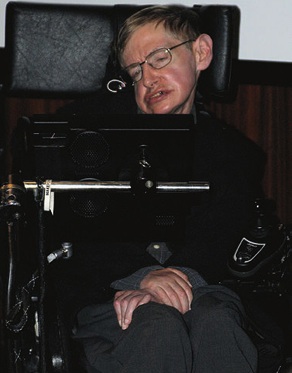
In his conference withdrawal statement Hawking (above) explained his boycott decision:

“I accepted the invitation to the Presidential Conference with the intention that this would not only allow me to express my opinion on the prospects for a peace settlement but also because it would allow me to lecture on the West Bank” 

“However, I have received a number of emails from Palestinian academics. They are unanimous that I should respect the boycott. In view of this, I must withdraw from the conference.

Had I attended, I would have stated my opinion that the policy of the present Israeli government is likely to lead to disaster”.

The term “boycott” is part of the Palestinian civil society’s Boycott, Divestment and Sanction (BDS) non-violent campaign, a grassroots movement launched in 2005 to non-violently bring an end to Israel’s occupation of Palestinian land and people.

Israel is holding its fifth conference in close proximity to the Israeli-built prison wall that enforces that occupation.

Stephen Hawking has not been known for political activism. His story unfolded in a different arena. It is a story of  his enormous personal courage and significant achievement as a physicist and cosmologist.

Hawking, who tells his personal story in “Living With ALS“, has to be the most high-profile invitee yet to boycott an Israeli Presidential conference, an event which in the past has attracted little media attention. Hawking has changed that.

In her 2012 Scientific American essay“How Has Stephen Hawking Lived to 70 with ALS?”, (on January 7, 2013, he turned 71) author Katherine Harmon provides background both on Hawking and his disease:

The famous theoretical physicist has helped to bring his ideas about black holes and quantum gravity to a broad public audience. For much of his time in the public eye, though, he has been confined to a wheelchair by a form of the motor-neuron disease amyotrophic lateral sclerosis (ALS). And since 1985 he has had to speak through his trademark computer system—which he operates with his cheek—and have around-the-clock care.

But like his mind, Hawking’s illness seems to be singular. Most patients with ALS—also known as Lou Gehrig’s disease, for the famous baseball player who succumbed to the disease—are diagnosed after the age of 50 and die within five years of their diagnosis. Hawking’s condition was first diagnosed when he was 21, and he was not expected to see his 25th birthday.

But his disease seems hardly to have slowed him down. Hawking spent 30 years as a full professor of mathematics at the University of Cambridge. And he is currently the director of research at the school’s Center for Theoretical Cosmology.

Hawking is the sort of high profile public figure whose boycott action is most feared by Israel.

The Guardian takes note of the blow Israel has received to its scientific prestige:

Stephen Hawking’s decision to boycott the Israeli president’s conference has gone viral. Over 100,000 Facebook shares of the Guardian report at last count. Whatever the subsequent fuss, Hawking’s letter is unequivocal. His refusal was made because of requests from Palestinian academics.

Witness the speed with which the pro-Israel lobby seized on Cambridge University’s initial false claim that he had withdrawn on health grounds to denounce the boycott movement, and their embarrassment when within a few hours the university shamefacedly corrected itself.

Hawking also made it clear that if he had gone he would have used the occasion to criticise Israel’s policies towards the Palestinians.

While journalists named him “the poster boy of the academic boycott” and supporters of the boycott, divestment and sanctions (BDS) movement celebrated, Ha’aretz, the most progressive of the Israeli press, drew attention to the inflammatory language used by the conference organizers, who described themselves as “outraged” rather than that they “regretted” Hawking’s decision.

That the world’s most famous scientist had recognised the justice of the Palestinian cause is potentially a turning point for the BDS campaign. And that his stand was approved by a majority of two to one in the Guardian poll that followed his announcement shows just how far public opinion has turned against Israel’s relentless land-grabbing and oppression.

The Times of Israel made a feeble attempt to defend conference organizers.

The Times quotes Israel Maimon, chairman of the conference, who “decried” Hawking’s withdrawal as “outrageous and inappropriate, especially for one so fundamentally associated with the spirit of independence as a person and an academic.”

There is considerable irony in Israel’s promotion of its scientific achievements within strolling distance of the “prison wall” it built to deprive Palestinians of their freedom.

This is an irony made doubly painful to sensitive and compassionate Jewish Israelis when they read a description of the Conference  from their 90-year old President Peres, included in his Conference introduction:

My experience has taught me that people tend to underestimate the tremendous ability within them, and yet mankind has the power to make a difference to ensure the betterment of our collective tomorrow.

What should be more reassuring, however, to those sensitive and compassionate Jews who live under a government based on lies and deception, is a Boston Globe editorial which found Hawking’s boycott decision to be a “reasonable way to express one’s political views”.

When the esteemed physicist Stephen Hawking announced his decision to boycott Israel’s Presidential Conference, a gathering of politicians, scholars, and other high-profile figures scheduled for June, the response was as predictable as the movement of the cosmos that inspired Hawking’s career.

The conference chair, Israel Maimon, called the move “outrageous and improper,” while Omar Barghouti, a founder of the boycott, divestment, and sanctions movement that advocates protests against Israeli policies, declared, “Palestinians deeply appreciate Stephen Hawking’s support.”

In fact, the decision to withdraw from a conference is a reasonable way to express one’s political views. Observers need not agree with Hawking’s position in order to understand and even respect his choice. The movement that Hawking has signed on to aims to place pressure on Israel through peaceful means.

In the context of a Mideast conflict that has caused so much destruction and cost so many lives, nonviolence is something to be encouraged. That is equally true of attempts to inspire cooperation on the Palestinian side.

Chances for a peaceful solution in Israel and Palestine are remote enough without overreactions like Maimon’s. Foreclosing nonviolent avenues to give people a political voice — and maybe bring about an eventual resolution — only makes what is already difficult that much more challenging.

Ali Abunimah was also encouraged by Hawking’s boycott action. Abunimah writes in The Guardian:

One of the most deceptive aspects of the so-called peace process is the pretence that Palestinians and Israelis are two equal sides, equally at fault, equally responsible – thus erasing from view the brutal reality that Palestinians are an occupied, colonised people, dispossessed at the hands of one of the most powerful militaries on earth.

For more than two decades, under the cover of this fiction, Palestinians have engaged in internationally-sponsored “peace talks” and other forms of dialogue, only to watch as Israel has continued to occupy, steal and settle their land, and to kill and maim thousands of people with impunity.

The Palestinian-led Boycott, Divestment and Sanctions movement (BDS) aims to change this dynamic. It puts the initiative back in the hands of Palestinians. The goal is to build pressure on Israel to respect the rights of all Palestinians by ending its occupation and blockade of the West Bank and Gaza Strip; respecting the rights of Palestinian refugees who are currently excluded from returning to their homes just because they are not Jews; and abolishing all forms of discrimination against Palestinian citizens of Israel.

Abunimah ends with a prediction:

When we look back in a few years, Hawking’s decision to respect BDS may be seen as a turning point – the moment when boycotting Israel as a stance for justice went mainstream.

What is clear today is that his action has forced Israelis – and the rest of the world – to understand that the status quo has a price. Israel cannot continue to pretend that it is a country of culture, technology and enlightenment while millions of Palestinians live invisibly under the brutal rule of bullets, bulldozers and armed settlers.

This Real News video provides a valuable visual summary of the Hawking boycott action:

If Israel is to have the future it desires, then Israel’s friends must firmly tell them:  “Give me your car keys; friends don’t let friends drive drunk”.  Ali Abunimah provides the text we need to set that axiom in motion:

Israel cannot continue to pretend that it is a country of culture, technology and enlightenment while millions of Palestinians live invisibly under the brutal rule of bullets, bulldozers and armed settlers.”

As they used to say in the American South where I grew up: “That will preach, brothers and sisters”.

The picture of Hawkin, above, is from Wikimedia Commons. It appeared in the Scientific American.
Posted in Human Rights, Middle East Politics | 8 Comments

Israel Claims Its Attack On Syria Was “To Stop Iranian Missiles Reaching Hezbollah”

by James M. Wallcrop SANA via European Pressphoto Agency fromNYT

The civil war in Syria between rebel forces and President Bashar Assad’s Syrian army, escalated this weekend when Israel bombed Damascus, the capital of Syria.

With its standard rationale familiar to Gaza residents, Israel released an official story that claimed the bombing was carried out for defensive purposes.

The Reuters story in the Jerusalem Postreported that the Israeli airstrikes, which killed “dozens of Syrian soldiers close to Damascus”, were “downplayed” by Israeli leaders.

The “downplaying” consisted of Israel’s claim it was not attempting to influence the Syrian civil war, but wanted only to “stop Iranian missiles reaching Lebanese Hezbollah militants”.

To bolster its official version of the raid, veteran Israeli lawmaker Tzahi Hanegbi, a confidant of Netanyahu, told Israel Radio that “Israel wants to avoid “an increase in tension with Syria by making clear that if there is activity, it is only against Hezbollah, not against the Syrian regime.” (It should be noted that Hezbollah and Assad’s government are allies.)

The Post rushed past the fact that “dozens of Syrian soldiers” were killed outside Damascus. There was no mention, not even a sympathetic nod to the possibility, that civilians may also have died in the attacks.

Instead, the Post story got to the heart of the matter, the heart, that is, for Israel:

Oil prices spiked above $105 a barrel, their highest in nearly a month, on Monday as the air strikes on Friday and Sunday prompted fears of a wider spillover of the two-year old conflict in Syria that could affect Middle East oil exports.

Major General Yair Golan, Israel’s commander on both the Syrian and Lebanese fronts, was quick to reassure “fearful” Israelis.

The general was out jogging with troops when a Reuters reporter caught up with him. He told the reporter, “There are no winds of war”. Then he added, “Do you see tension? There is no tension. Do I look tense to you?”.

Israeli Prime Minister Binyamin Netanyahu was also calm. The Prime Minister had already begun a a scheduled visit to Beijing, which the Post story indicated was “an apparent sign of confidence Syrian President Bashar Assad would not retaliate”.

Netanyahu received veiled criticism in Beijing where Chinese leaders urged “restraint without mentioning Israel by name”. China and Russia are the two major powers who are Syrian President Assad’s “protectors” in the UN Security Council.

Russia said the strikes by Israel “caused particular alarm”, a mild reprimand to a nation that has just bombed a neighbor with whom it is not officially at war.

President Vladimir Putin and US Secretary of State John Kerry were expected to meet Tuesday, the Jerusalem Post reported, “to try to tackle differences over the Syrian crisis”.

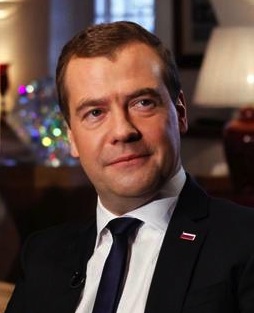
crop medvedev-syria-epaIn an Independent story that appeared January 25, before the Israeli bombing of Damascus, Russia’s Prime Minister, Dmitry Medvedev said that President Assad’s chances of retaining power in Syria are getting “smaller and smaller by the day”.

“The statement is the most explicit admission from the regime’s chief ally that its days may be numbered, but Mr Medvedev also reiterated that the regime must not be toppled by external forces.

As the political pressure on Damascus grows, so the scale of the humanitarian disaster in Syria could also be significantly greater than official figures show, according to analysis by The Independent. The latest UN figures say that 678,540 refugees have been registered or are awaiting registration although the true numbers are likely to be closer to one million.”

Beyond Jerusalem, the Jerusalem Post found different opinions on Israel’s bombing:

The Syrian Observatory for Human Rights, an opposition monitoring group based in Britain, said at least 42 Syrian soldiers were killed in the strikes and 100 others were missing.

Other opposition sources put the death toll at 300 soldiers, mostly belonging to the elite Republican Guards, a praetorian unit that forms the last line of defense of Damascus and is comprised mainly of members of Assad’s Alawite sect, an offshoot of Shi’ite Islam that has controlled Syria since the 1960s.

As well as the heavily-fortified Hamah compound, linked to Syria’s chemical and biological weapons program, the warplanes hit military facilities manned by Republican Guards on Qasioun Mountain overlooking Damascus and the nearby Barada River basin.

Residents, activists and rebel sources said the area is a supply route to the Lebanese Shi’ite militant group Hezbollah, but missiles for Hezbollah did not appear to be the only target.

Air defenses comprising Russian made surface-to-air missiles and anti-aircraft guns on Qasioun and overlooking the rebellious Damascus district of Barzeh were also hit, they said. Their statements could not be verified due to restrictions on media.

“The destruction appeared to be massive,” said one activist in Damascus, who did not want to be identified.

Beyond the conflict between major nations who have lined up on opposing sides in the civil war, the human cost of the war is also massive:

Millions of Syrian refugees face food rationing and cutbacks to critical medical programmes [cq] because oil-rich Gulf states have failed to deliver the funding they promised for emergency humanitarian aid, an investigation by The Independent on Sunday has found.

Arab states and aid groups, including Saudi Arabia, the United Arab Emirates, Qatar and Bahrain, have failed to deliver $650m (£420m) in pledges they made at an emergency United Nations conference in Kuwait four months ago.

The severe shortfall, together with predictions that the Syrian refugee crisis could triple by the end of the year, is forcing UN aid agencies to plan for food rationing and to scale back health programmes including vaccinations.

Akiva Eldar, former Ha’aretz columnist, introduced the notion of “Israel’s Moral Responsibility” in an Al Monitor column.
Israel’s concern and sensitivity to the transfer of munitions to Hezbollah is understandable; what’s hard to accept is the indifference toward the plight of its neighbors exhibited by the country that prides itself of being “a villa in the jungle” and “the only democracy in the Middle East.” Jordan. Iraq, Lebanon and Turkey, the other countries bordering Syria, have already taken in hundreds of thousands of refugees fleeing the Syrian inferno.
And Israel, the only country in the world that holds Syrian territory, keeps looking on from the sidelines. The policy of the Netanyahu government is reminiscent of the Begin government’s policy toward the horrible war between Iraq and Iran (1980-1988). Asked which side he supports, the late Prime Minister Menachem Begin answered with a smile: “We wish both sides the best of luck.” In Iran, by the way, they still remember this phrase.
In his hard-hitting, thoughtful, Guardian column, Glenn Greenwald expands on the theme of how both the US and Israel operate, with impunity, from their nationalist, tribalist stances toward their neighbors:

Few things are more ludicrous than the attempt by advocates of US and Israeli militarism to pretend that they’re applying anything remotely resembling “principles”. Their only cognizable “principle” is rank tribalism: My Side is superior, and therefore we are entitled to do things that Our Enemies are not. . . .

One could say quite reasonably that this is the pure expression of the crux of US political discourse on such matters: they must abide by rules from which we’re immune, because we’re superior.

So much of the pseudo-high-minded theorizing emanating from [Washington] think thanks and US media outlets boils down to this adolescent, self-praising, tribalistic license: we have the right to do X, but they do not.

Indeed, the entire debate over whether there should be a war with Iran over its nuclear enrichment activities, as Israel sits on a massive pile of nuclear weapons while refusing UN demands to permit any international inspection of it, is also a perfect expression of this mentality.

The ultimate irony is that those who advocate for the universal application of principles to all nations are usually tarred with the trite accusatory slogan of “moral relativism”. But the real moral relativists are those who believe that the morality of an act is determined not by its content but by the identity of those who commit them: namely, whether it’s themselves or someone else doing it.

As Rudy Giuliani put it when asked if waterboarding is torture: “It depends on who does it.”

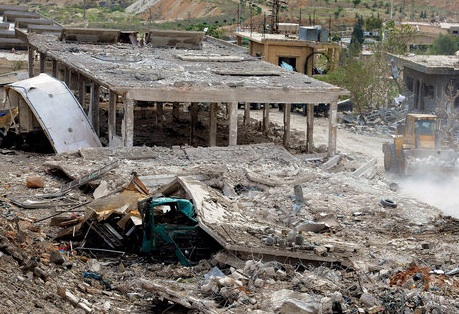
The picture at top is a handout picture released by the Syrian Arab News Agency which purports to show damage caused by an Israeli strike on May 5. It is an AFP/Getty Image that appeared in the Guardian.

The picture of  Russia’s Prime Minister Dmitry Medvedev, is from The Independent.

Posted in Middle East Politics, Netanyahu | 3 Comments

Conquerors from The Congo to The Jordan

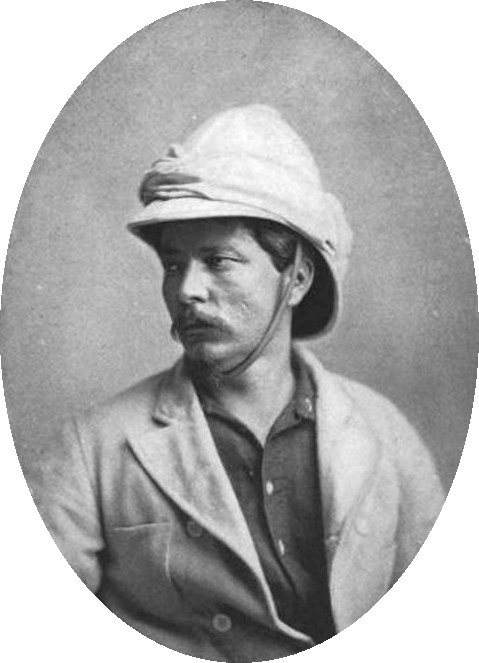
by James M. WallHenry_M_Stanley_1872

In the late 19th century, Henry Morton Stanley (of Stanley and Livingston fame), (right) was the “king’s man”—more accurately, a hired colonist conqueror—working for Belgium’s King Leopold II.

Stanley’s assignment: Seize and conquer for Belgium, the vast and unexplored territory surrounding Africa’s Congo River, a territory that stretched from Stanley Falls in the north to the mouth of the river, where it empties into the Atlantic Ocean.

Stanley and King Leopold worked with the conqueror’s template, one which the 19th and 20th century Zionist movement also utilized to create a Jewish homeland in Palestine.

The formula used by Leopold and the Zionists is a well-worn conquerors’ formula of deceit, deception, destruction and seizure.

In his book, King Leopold’s Ghost: A Story of Greed, Terror, and Heroism in Colonial Africa, Adam Hochschild tells the sordid and sad, but still illuminating, story of Stanley’s successful conquest of Central Africa in the 19th century.

One description of the book offers a dark portrait of King Leopold:

Carrying out a genocidal plundering of the Congo, he looted its rubber, brutalized its people, and ultimately slashed its population by ten million–all the while shrewdly cultivating his reputation as a great humanitarian. 

Hochschild’s book focuses on King Leopold, but the modern reader should see the historical parallel of Belgium’s African empire with the Zionist movement’s (still on-going) seizure of Palestinian land.

During his reign on Belgium’s throne, King Leopold never visited what was then commonly referred to as the “dark continent”. But as king of a tiny nation, he desperately wanted an empire of his own to rival those of his neighbors, England and France.

Hollywood’s version of the meeting between Stanley and Dr. David Livingston was a highly romanticized portrait of journalist and explorer Henry Morton Stanley. Livingston’s actual role in this drama is described by Hochschild:

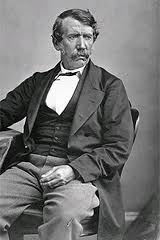
Livingston

“All those European impulses toward Africa—antislavery zeal, the search for raw materials, Christian evangelism, and sheer curiosity—were embodied in one man, David Livingston (left).

Physician, prospector, missionary, explorer and at one point even a British consul, he wandered across Africa for three decades, starting in the early 1840s. He searched for the source of the Nile, denounced slavery, found Victoria Falls, looked for minerals and preached the gospel.  As the first white man to cross from coast to coast he became a national hero in England.”

While on another long expedition inside Africa, Livingston disappeared. Sensing a major story, New York Herald publisher James Gordon Bennett hired Henry Stanley to “find Livingston”. He succeeded, though actual details of his meeting with Livingston are unclear. Stanley was a self-promoter who shaped the narrative of his exploits and the meeting of the two men. .

Stanley’s reputation soared. Now an expert on Africa, as well as master of deceit and deception, Stanley was courted, and then hired, by King Leopold, to prepare the way for a Belgian colonial  kingdom in Africa. Greed and personal aggrandizement hidden behind the elevated rhetoric of Christian zeal, were combined in a story which the media of the day embraced daily.

Again, Stanley controlled the narrative, appropriately enough for a man serving a king determined to build a colonial empire while keeping his enemies oblivious to his intentions. Stanley and Leopold were true soul mates.

The 19th century colonization of the Congo basin did, indeed, lead to the establishment of a series of Belgian colonies, “countries” on a map drawn by King Leopold. The area of the Congo basin, if placed on the map of the United States, would cover the area east of the Mississippi River.

Across that large expanse, two power-hungry men—a king and his conniving journalist-explorer partner—established the groundwork for “a confederation of free negro republics” along the Congo River.

The use of the term “free”, of course, as Hochschild writes, was “merely a prop to be removed as soon as the curtain closed”. The deceit and deception were easily employed during a period when racism and ignorance shaped the public’s understanding of the mysterious continent of Africa.

As one of Leopold’s subordinates wrote Stanley:

There is no question of granting the slightest political power to negroes. That would be absurd, the white men, heads of the stations, retain all the powers.

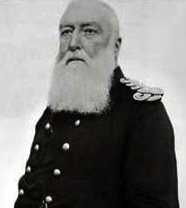
In a final message to Stanley, King Leopold (right) confirmed the true narrative behind Stanley’s journey. He wrote: Leopold II crop

I take advantage of a safe opportunity to send you a few lines in my bad english . . It is indispensable you should purchase . . . as much as you will be able to obtain, and that you should place successively under . . suzerainty…as soon as possible and without losing one minute all the chiefs from the mouth of the Congo to the Stanley Falls . . . .If you let me know you are going to execute these instructions without delay I will send you more people and more material. Perhaps Chinese coolies.

Deception is an essential ingredient in the steady march of conquerors. As he wrote his “suzerainty” note to Stanley, Leopold “piously” assured the British minister in Brussels that his venture in Africa “had no commercial character; it did not carry on trade.”

It is worth noting that “suzerainty”* (see definition below) is a term describing the absolute control of a larger state over a smaller one. The term  originated during the Ottoman empire era.

Which raises the question: Does Israel aspire to become a modern Ottoman empire?

In an ominous Leopold precursor to the current success of the Zionist invasion of Palestine, the King concluded his message to Stanley:

I also recommend you to establish barriers and tolls on the parts of the road you have opened. It is but fair and in accordance with the customs of every country.

The evil that men do lives after them in the actions of those who follow knowingly, or unknowingly, a formula of conquest that has worked in other centuries and in other lands.

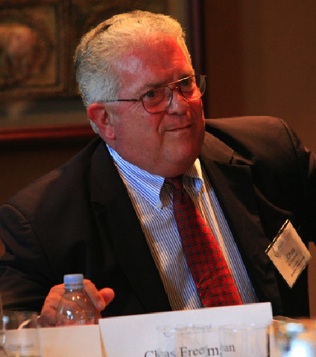
photo crop from chasfreeman.net  posted by buzzfeedWhich brings me to the ongoing work of a modern prophet, Chas Freeman, whose books and lectures provide a rare voice against Zionism’s unrestrained conquest of Palestine.

Freeman was an early Obama administration appointee whose forced withdrawal from a post for which he was clearly highly qualified, was an early indication that President Obama would be overly sensitive to Zionists in his administration when he made appointments and considered plans deemed unacceptable to Israel and its American AiPAC-led agents.

I wrote about that early period of disappointment with Obama and the Zionist influence in his administration, for Link, a publication of  Americans for Middle East Understanding (AMEU). A pdf of that essay is available here. 

Freeman survived his 2009 encounter with the Israel Lobby. Today, he continues to provide wise guidance on all matters related to Israel’s conquest of Palestine.

A most recent example may be found in an address he gave at a January 16, 2013, Washington conference convened by the Middle East Policy Council, entitled, “U.S. Grand Strategy in the Middle East: Is There One?”

Freeman was the opening speaker at the conference, the full text of which may be found here.

The opening of Freeman’s presentation put the US Middle East strategy in a moral context:

Over the past half century or so, the United States has pursued two main but disconnected objectives in West Asia and North Africa: on the one hand, strategic and economic advantage in the Arabian Peninsula, Persian Gulf, and Egypt; on the other, support for the consolidation of the Jewish settler state in Palestine. These two objectives have consistently taken precedence over the frequently professed American preference for democracy.

These objectives are politically contradictory. They also draw their rationales from distinct moral universes. U.S. relations with the Arab countries and Iran have been grounded almost entirely in unsentimental calculations of interest. The American relationship with Israel, by contrast, has rested almost entirely on religious and emotional bonds. This disconnect has precluded any grand strategy.

It is significant that Freeman does not refer to Israel’s “occupation”, but instead, stresses that what the US is supporting is “the Jewish settler state in Palestine”.

Occupation is the term Israel and the world media employs as Israel steadily and deceptively seized more and more Palestinian land, not unlike King Leopold’s deceptive strategy to set up a “confederation of free republics” along the Congo River.

Occupation is a euphemism, one of many employed in Israel’s hasbara (reeducation) campaign to rewrite the reality of a conquered people. Occupation is a word used to cover the truth of Israel’s long-range plans to seize all of the land between the Mediterranean Sea and the Jordan River.

Occupation is a term normally used to describe a temporary holding arrangement, as, for example, the US occupation of Germany following World War II. This so-called “occupation” has continued since Israel, under the United Nations first established its modern state in 1948. It is no occupation; it is, as Freeman writes, the creation of a “settler state in Palestine”.

Israel has pretended, with the help of its AIPAC-led allies in the Congress and White House, that it really wanted to participate in a “peace process”, a carefully orchestrated lie maintained by Western mainstream and alternate media alike.

It has been a lie successfully maintained with the support of the American public’s desire for a reality easily grasped in black and white terms, e,g, “savage” American Indians facing the Puritans; “inferior” black Africans trading land for a pittance to King Leopold; and more recently, the long-running Cold War between communists and the “free world”.

Israel has effectively manipulated public opinion to make Islam the new communism, a new enemy to engender fear of constant imminent danger.

Eager to engender more fear, our politicians and media have together elevated the alleged Boston Marathon bombers into Islamic-driven zealots, following every lead that might link the Boston bombers to a dark, foreign, Islamic organization.

The Zionist campaign to see any and all designated “enemies” of Israel as the action of “terrorists”, is the ongoing effort to retrieve The Clash of Civilizations, a theory “that people’s cultural and religious identities will be the primary source of conflict in the post-Cold War world.”

The Clash concept was proposed by political scientist Samuel P. Huntington in a 1992 lecture at the American Enterprise Institute, which he then developed in a 1993 Foreign Affairs article titled “The Clash of Civilizations?“, in response to Francis Fukuyama’s 1992 book, The End of History and the Last Man. (Wikipedia).

Ours is a public that prefers not see the evil that is inherent in conquering other nations, preferring, instead, to grasp any excuse to divide the world between Us and Others, with Us as the good guys and Others as the bad guys.

Chas Freeman offers historic parallels for conquerors and their goals:

The increasingly blatant racism and Islamophobia of Israeli politics, the Kafkaesque tyranny of Israel’s checkpoint army in the Occupied Territories, and Israel’s cruel and unusual collective punishment of Gaza have bred hateful resentment of the Jewish state in its region and throughout the Muslim world. One has to look to North Korea to find another polity so detested and distrusted by its neighbors and with so few supporters among the world’s great powers.

Just as the book and movie, The Exodus, were peddled for decades as the “true story” of Israel’s creation as a state, the movie version of Stanley and Livingston created the narrative that Stanley (as portrayed by Spencer Tracy) was a dedicated journalist  looking for a “man of God” who went to Africa to do good.

In this clip, we see and hear the famous quote, “Dr. Livingston, I presume.”

With Hollywood’s support and the power of political Zionist in American culture, the “blatant racism and Islamophobia of Israeli politics” has successfully made its insidious way into the American psyche.

Until we realize this, we will continue to function as a nation without the moral compass that should lead us. Absent that moral compass, we will continue to yield to the Zionist racist-driven conquerors’ worldview of the Clash of Civilizations.

* From Wikipedia:

Suzerainty (pron.: /ˈsjuːzərənti/ or /ˈsjuːzərɛnti/) occurs where a region or people is a tributary to a more powerful entity which controls its foreign affairs while allowing the tributary vassal statesome limited domestic autonomy. The dominant entity in the suzerainty relationship, or the more powerful entity itself, is called a suzerain. The term suzerainty was originally used to describe the relationship between the Ottoman Empire and its surrounding regions. It differs from sovereignty in that the tributary enjoys some (often limited) self-rule. (emphasis added.)

Posted in Media, Middle East, Middle East Politics, Movies | 1 Comment

Kerry Forgot Rule Number One: Never Question the Sacred Israeli Narrative

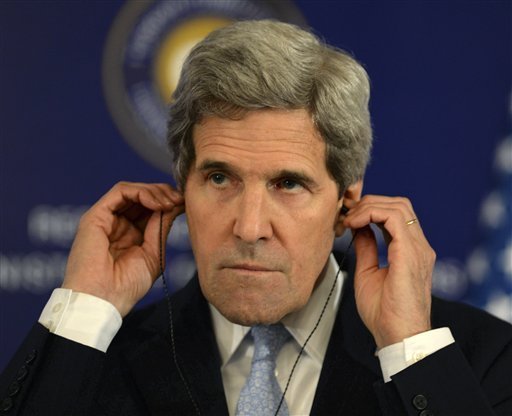
by James M. WallKerry in Istanbul photo by AP

If you believe the Israeli and US pro-Israel media, the new US Secretary of State, John Kerry (right) is “confused” in his new job.

What led to the confusion? To those who embrace his negative media coverage, the Secretary forgot the rules.

He forgot what US Diplomats must never forget. What is that? To paraphrase a quote from the movie Fight Club:

The First Rule of US diplomacy: You do not question the Sacred Israeli Narrative.

The Second Rule of US diplomacy: You DO NOT question the Sacred Israeli narrative.

Kerry was attacked by defenders of these Rules when in a fit of compassion, he questioned one verse in one chapter from the Book of The Sacred Israeli Narrative. Annie Robbins explains:

Under the headline: Kerry likens Boston victims to ‘Mavi Marmara’ victims, Robbins reports:

At a press conference in Istanbul, Turkey, US Secretary of State John Kerry referred to the deaths of nine Turkish citizens on board the Mavi Marmara in [May] 2010.

Kerry responded to a question from Bloomburg’s Nicole Gaouette, who asked him about “the importance of a rapprochement between Turkey and Israel”.

Behind the question are these facts:

Turkey broke diplomatic relations with Israel following the 2010 Mavi Marmara incident in which nine passengers, including one Turkish-American citizen, were killed when Israeli soldiers attacked the Mavi Marmara, a Turkish ship carrying peaceful protesters attempting to reach Gaza to protest Israel’s blockade.

Turkey responded by breaking relations with Israel.

Kerry connected the deaths aboard the Mavi Marmara with the dead and wounded in last week’s Boston Marathon explosions. Both experiences brought grief and anger to their respective nations.

Kerry’s response was personal, an expression of compassion from a Bostonian to the people of Turkey, linking the Mavi Marmara to the City of Boston. Here is his response which comes late in the press conference text, released by the US State Department:

I think Turkey is working in very good faith to get there [i.e., restoring broken relations between Turkey and Israel]. I know it’s an emotional issue with some people [i.e.,Turkey’s decision to break with Israel after the Mavi Marmara deaths]. I particularly say to the families of people who were lost in the incident we understand these tragedies completely and we sympathize with them.

And nobody – I mean, I have just been through the week of Boston and I have deep feelings for what happens when you have violence and something happens and you lose people that are near and dear to you. It affects a community, it affects a country. We’re very sensitive to that.

Those are the words of a compassionate man making a connection to others. What could possibly be wrong with that?

The literalist keepers of the Sacred Israeli Narrative knew what was wrong.

Annie Robbins writes:

The response from Israel was swift. Israel’s Deputy Defense Minister Danny Danon responded by implying the Turkish victims of the Israeli attack were terrorists and that Kerry was confused.

The Times of Israel led the attack on Kerry, continuing the “confusing” line:

It is never helpful when a moral equivalency is made confusing terrorists with their victims,” Danon told The Times of Israel. ”As our American friends were made all too aware once again last week, the only way to deal with the evils of terrorism is to wage an unrelenting war against its perpetrators wherever they may be,” he said.

Note the assumed sub-text of the Sacred Israeli Narrative in the Times story: Any protest, any opposition to the state of Israel, is, ipso facto, a “terrorist” action. And since Israel has infected the rest of the Western world with its ideology, the term “terrorist” is now automatically attached to any acts of violence against Israel’s Mother nation, the United States.

How bad is this infection in some corners of the US media? According to the Huffington PostBob Beckel had his say on Fox News Tuesday:

Fox News liberal Bob Beckel had some policy ideas about Muslims on Tuesday’s [April 23] edition of “The Five.”

Beckel and his co-hosts were talking about the Boston bombing suspects, who are Muslim. The general consensus seemed to be that, by probing into their lives and their possible motives for the attacks, members of the media were avoiding the main issue.

“You find the big argument, which is Muslim supremacy, isn’t that all you need?” Greg Gutfeld asked. “Why do you have to delve into their psychosis?”

“We know that In the Muslim communities around the world, they do not like us,” Beckel replied. “They recruit people from poor areas and turn them into terrorists.” He didn’t say how this thesis was connected to the Tsarnaev brothers, who came legally with their family when they were 9 and 16.

“I think we really have to consider…that we’re going to have to cut off Muslim students from coming to this country for some period of time so that we can at least absorb what we’ve got, look at what we’ve got and decide whether some of the people here should be sent back home or sent to prison,” he continued.

Fox News refers to Beckel as a “liberal”. He used to be. He was national campaign manager for 1984 Democratic presidential candidate Walter Mondale.

Meanwhile, outside the bubble of the Sacred Narrative, it is important to keep in mind that in 2010, the Turkish ship, the Mavi Marmara, was on a peaceful protest journey.  Not so, of course, from the perspective of the Sacred Israeli Narrative, as the following attacks on Kerry emphasize.

The Blaze, a pro-Israeli sitedescribes the attacks on Kerry under this headline:

Confusing Terrorists with Their Victims’: Kerry Slammed for Comparing Families of Gaza Flotilla Incident with Boston Bombing Families

In defense of the Mavi Marmara, Annie Robbins looks back on Israel’s military attack on Turkish citizens, aboard the Mavi Marmara:

Furkan crop“One of those Turkish citizens was also an American, young Furkan Dogan (left). Perhaps John Kerry read the United Nations Human Rights Council (HRC) report describing his killing as a “summary execution”.

Meanwhile the attacks on Kerry from the Sacred Narrative camp, were continued by Barry Rubin, Director of the Global Research in International Affairs (GLORIA) Center.

He tells The Blaze,

To call Kerry’s statement incredibly ignorant, insulting to Israel, and counterproductive is an understatement. Those killed on the Mavi Marmara were terrorists, aiding a group (Hamas) like those who committed the Boston atrocity.

Now he labels Israel as terrorist for defending itself from terrorists. Kerry’s statement gave the Turks justification for not conciliating. Would Americans accept an apology from those who staged the Boston attack? Of course not.”

US media outlets, spurred on by political conservatives, continue to search for “terror” motivations in the Boston attacks.

They need look no further than Israeli reactions to the Boston attacks:

Ali Abunimah wrote on his Electronic Intifada blog:

In comments reminiscent of Benjamin Netanyahu’s own on 11 September 2001, a senior advisor of the Israeli prime minister has expressed confidence that Israel will benefit from the 15 April Boston Marathon bombing.

Speaking to US Jewish leaders, the advisor, Ron Dermer, praised Netanyahu’s leadership before stating:

“I’m pretty bullish about the prospects for strengthening cooperation with the United States. Support for Israel – you all can tell me yourselves – I see polls that show that its almost at record highs… The American people stand firmly with Israel. I think they identify with Israel.

I think if you look historically, there’s a big change after 9/11. I’m sure that after the bombing, the tragic bombing in Boston, I believe that people will identify more with Israel’s struggle against terror and I think we can maintain that support.”

Dermer can be heard making the comments in a two and a half-minute video tweeted by Haaretz diplomatic correspondent Barak Ravid

Dermer’s comments are remarkably similar to ones his boss, then Israeli opposition leader, made on 11 September 2001 as the world watched in horror as the Twin Towers came down in New York.

The New York Times reported in 2001:

Asked tonight what the attack meant for relations between the United States and Israel, Benjamin Netanyahu, the former prime minister, replied, “It’s very good.” Then he edited himself: “Well, not very good, but it will generate immediate sympathy.”

He predicted that the attack would “strengthen the bond between our two peoples, because we’ve experienced terror over so many decades, but the United States has now experienced a massive hemorrhaging of terror.”

Abunimah writes further that it is unclear if “Dermer’s comments were intended for public consumption, given that they reveal a fairly cynical and calculated Israeli government assessment of how to exploit an American tragedy for nakedly political purposes.”

Cynical and calculated or not, there is no doubt that purveyors of the Sacred Israeli Narrative are quite effective in finding ways to evangelize their political goals.

The picture of Secretary of State John Kerry, above, is an Associated Press photo, taken during his recent press conference in Istanbul, Turkey.

Posted in Media, Middle East, Middle East Politics, Movies | 4 Comments

At Boston Interfaith Service, Obama Calls for Justice and Compassion

by James M. Wall

(UPDATE BELOW)

Obama Business Week crop

A Boston Marathon Interfaith memorial service, “Healing Our City”, was held at Boston’s Cathedral of the Holy Cross Thursday, April 18.

It was a service that concluded with remarks delivered by President Barack Obama.

The National Journal’s Matthew Cooper called Obama’s remarks “an emotional rallying point for the city”. It was also, Cooper writes,

“a moment for Obama to speak to the nation and strike a tone between remembrance and optimism, a call for justice and a call for compassion.”

The service included a local children’s choir, prayers and remarks by political and religious leaders.

The service was held three days after two deadly explosions struck cheering bystanders at the Boston Marathon’s finish line. Three people died, two young women and an 8-year old boy, all of whom were spectators cheering for the runners. As many as 176 were injured, some of whom will lose one or both legs.

Thursday’s memorial service was held to mourn the dead and support the wounded.

The service included Christian, Muslim and Jewish religious leaders. Prominent state and local leaders were present, including Mitt Romney, the former governor of Massachusetts and Obama’s rival in last year’s presidential election.

Matthew Cooper, in his National Journal story, described Obama’s concluding remarks as:

“a stunning moment as President Obama brought parishioners to their feet at a memorial service for those killed and wounded in the Boston Marathon bombing and vowed “we will run again.”

Another speaker, current Massachusetts Governor Deval L. Patrick, set a positive tone when he said “we will have accountability without vengeance, vigilance without fear.”

Governor Patrick also praised the city for its “resilience and its compassion”.

“In a dark hour,” he said, “so many of you showed so many of us that darkness cannot drive out darkness, as Dr. [Martin Luther] King said; only light can do that.”

New Yorker blogger Amy Davidson reported the inevitable dark side of some conservative media coverage:

A twenty-year-old man who had been watching the Boston Marathon had his body torn into by the force of a bomb. He wasn’t alone; a hundred and seventy-six people were injured and three were killed.

This young man was the only one who, while in the hospital being treated for his wounds, had his apartment searched in “a startling show of force,” as his fellow-tenants described it to the Boston Herald, with a “phalanx” of officers and agents and two K9 units. 

“Let me go to school, dude,” the roommate said later in the day, covering his face with his hands and almost crying, as a Fox News producer followed him and asked him, again and again, if he was sure he hadn’t been living with a killer.

What made them suspect him? He was running—so was everyone. The police reportedly thought he smelled like explosives; his wounds might have suggested why. He said something about thinking there would be a second bomb—as there was, and often is, to target responders. If that was the reason he gave for running, it was a sensible one.

Juan Cole writes that CNN was especially egregious in its desire to finger a “dark skinned” man, media-speech for Muslims, a hint directed at Islamophobes among its viewers.

Conservative Rupert Murdoch’s The New York Post was specific in identifying the “Saudi man”. Two hours after the Monday explosion, the Post ran a story on its website under a headline that blared:

“Authorities ID person of interest as Saudi national in marathon bombings, under guard at Boston Hospital.”

The Post also quoted Fox News as saying, “Law enforcement sources said the 20-year-old suspect was under guard at an undisclosed Boston hospital.”

Continuing with Fox News as its source, the Post reported “the suspect suffered severe burns”

The so-called “Saudi man” was in the hospital. He may well have suffered “severe burns”. But that would be the only part of the Fox-Post narrative that proved to be correct.

By Thursday afternoon, the FBI reported that it had identified two suspects, both of whom were identified in video footage.  At right in a FBI picture is one of the suspects. 

2nd Suspect FBI photo

This was an emotional week for the nation, and especially for Boston. Grief-stricken and angry citizens must  be handled with care at such a time.

News reports that later must be corrected, have a way of feeding a false narrative that hangs around until they morph into “false flag” memes, stories that emerge as conspiracy theories.

As a nation, we have faced this darkness before, including in recent years, the bombing of the Oklahoma City federal building, the killings during the 1996 Atlanta Olympics, and the killing spree of Chicago-born Unabomber Ted Kaczynski, who bombed, killed and maimed innocent people for nearly eighteen years

What really matters in this week’s events is that once again indiscriminate evil struck. The impact of such attacks reaches all of us at some level, beginning with the immediate families of the dead in Boston, and then radiating outward to the entire human community.

President Obama and other speakers at Monday’s interfaith service, rose to the occasion to inspire the nation. In contrast, some conservative media outlets rushed to judgments that were irresponsible and damaging to the innocent.

It is better that we end this week lifted by the power of faith, not dragged down by the destructiveness of revenge.

UPDATE FRIDAY MORNING:

Early Friday morning, the New York Times reported that one of the suspects was dead, shot by police. That suspect’s brother was still at large. The Times also reported the suspects’ names:

The surviving suspect was identified as Dzhokhar A. Tsarnaev, 19, of Cambridge, Mass., a law enforcement official said. The suspect who was killed was identified as his brother, Tamerlan Tsarnaev, 26, the law enforcement official said. Investigators believe that both of the suspects were Chechens.

Prominent and highly respected Chicago Muslim leader Abdul Malik Mujahid, has posted the following helpful alert on his Facebook page:

Media is identifying both Boston suspects to be from a Russian region where about 20% population is Muslim. Islamopobes were already blaming Muslims. At least two Muslims in Boston including a physician were beaten and a popular imam Webb was not allowed to speak at the interfaith service in Boston.

Muslims need to be ready for another round of generalization of our community. If your masjid needs a press release, talking points, khutba notes, our team has prepared them for you.

If local media would like to interview a Muslim runner of Boston marathon, first medical responders or Muslims surgeons saving victims, we have at least seven such person willing to talk. please forward this message to your masjids, Islamic centers. Contact RadioIslam@SoundVision.com

Posted in Religion and politics, The Human Condition | 4 Comments

Cardoza Law School Ignores Dershowitz To Honor Jimmy Carter

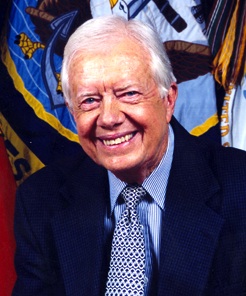
by James M. WallCarter courtesy Carter Center crop

Despite vicious opposition from the Alan Dershowitz conservative wing of the American Jewish community, Cardoza Law School honored former President Jimmy Carter April 10, for his career of work on peace and conflict resolution.

The International Advocate for Peace award was given to Carter by the student-run Cardozo Journal of Conflict Resolution.

The journal cited “Carter’s brokering of the 1979 peace accord between Israel and Egypt and the SALT II nuclear weapons treaty with the then-Soviet Union.”

The presentation ceremony was held at the Cordoza Law School, a part of New York City’s Yeshiva University.

Since it began as a university more than a century ago, Yeshiva, according to its website, “has been dedicated to melding the ancient traditions of Jewish law and life with the heritage of Western civilization”.

With that tradition, Yeshiva University was hardly an institution the Dershowitz radical wing of American Jewry, expected to honor Jimmy Carter. The Cardoza Law School took its name, at the time of its 1976 founding, in honor of Supreme Court Justice Benjamin N. Cardoza (1870-1938).

The loudest protest voice leading the demand that Cardoza “withdraw” Carter’s award, came from Professor Dershowitz, a law professor at Harvard University since 1967.

Dershowitz seldom misses an opportunity to demand that Carter confront him in a “public debate” on any campus where Carter is invited to appear.

The Wikipedia page on Dershowitz gives some of  “that debate that did not happen”, history:

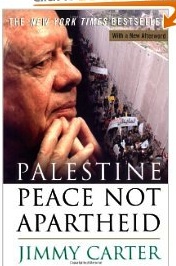
Carter book cropWhen former U.S. President Jimmy Carter had his book Palestine: Peace Not Apartheid (2006) published—in which he argues that Israel’s control of Palestinian land is the primary obstacle to peace—Dershowitz challenged Carter to a debate at Brandeis University.

Carter declined, saying, “I don’t want to have a conversation, even indirectly, with Dershowitz. There is no need to debate somebody who, in my opinion, knows nothing about the situation in Palestine.”

Dershowitz repeated his demand for a debate when Carter spoke at Brandeis in January 2007. Brandeis refused to invite Dershowitz to debate Carter, but the school did invite him to respond to Carter on the “same stage” after Carter had left.

USA Today reported that the award presentation “has drawn a harsh response from alumni, who called on graduates to withhold donations to the school.”

Confronted with this usual tactic of alumni opposition to a university decision, the Cardozo Law School leaders stood their ground and continued to support the award.

Yeshiva’s president, Richard Joel, and the university’s board of overseers, said in statements that they object to Carter’s views on Israel, but that the university is a “free marketplace of ideas,” as Joel put it, and the students had the right to invite the former president.

Alex Kane reported on the threats and protests against Carter that began the moment the award was announced. The previously loud opposition, however, was quiet on Wednesday, the day Carter received his award.

Cardozo Law School’s decision to honor former President Jimmy Carter generated a lot of bluster and outrage from the reactionary wing of the Jewish community. But after all that, the event with Carter came and went yesterday with a whimper.

There was no protest. Nobody blocked the door, as one alumnus had threatened to do to prevent Carter from entering. The former president strolled in through a side door without many people noticing.

An earlier Cardoza conflict resolution award was given to Dennis Ross, the former US government official who worked on Middle East issues within several presidential administrations, including the Carter administration. Another award was given to Desmond Tutu. Neither of these awards drew the attention and resistance of Carter’s award.

As it turned out, the “bluster and outrage” of the Dershowitz wing exhausted its fury in its losing battle to force the school to withdraw Carter’s award.

Kane described the calm that prevailed on award day:

The activists who did come out were a small group of supporters of Carter, most of them affiliated with the National Lawyers Guild. They sent a radically different message than the one Alan Dershowitz and others disseminated in the days leading up to the event.

“We wanted to make it clear that not all Cardozo alumni are comfortable with bullying,” said Maria Chickedantz, a graduate of the law school and a member of Jewish Voice for Peace who was there to support Carter. “The entire Alan Dershowitz style of bullying—that’s what we’re against.”

The Cardoza Law School’s support of its students is a testimony to the fact that it is also against the Dershowitz style of bullying.

The Jimmy Carter photo at top is from the Carter Center.

Posted in Middle East, Religious Faith | 7 Comments

Confronting the “Moral Bankruptcy” of Iraq War’s Liberal Supporters

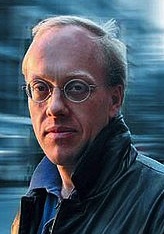
by James M. WallChris_hedges_3

Prior to the start of the Iraq War on March 19, 2003, New York Times journalist Chris Hedges (right) occupied a lonely perch among major media journalists. He opposed the war.

Today, Hedges, a Pulitzer Prize winner and now a columnist for the website Truthdig, continues to write with the passion of a man set free from corporate control.

His latest posting is a perceptive analysis of both the role this nation’s political and media “liberal hawks” played in launching the Iraq war, and the “rewriting of history” by those “liberal hawks” on the 10th anniversary of the start of that war.

In his Truthdig column, “The Treason of the Intellectuals, Hedges asks, how did the liberal Iraq war boosters react to the tenth anniversary of the war they initially supported?

Some claimed they had opposed the war when they had not. Others . . . argued that they had merely acted in good faith on the information available; if they had known then what they know now, they assured us, they would have acted differently. This, of course, is false.

[They] did what they always have done: Engage in acts of self-preservation. To oppose the war would have been a career killer. And they knew it. .  .  . 

Those of us who spoke out against the war, faced with the onslaught of right-wing “patriots” and their liberal apologists, became pariahs.

In my case it did not matter that I was an Arabic speaker. It did not matter that I had spent seven years in the Middle East, including months in Iraq, as a foreign correspondent. It did not matter that I knew the instrument of war. The critique that I and other opponents of war delivered, no matter how well grounded in fact and experience, turned us into objects of scorn by a liberal elite that cravenly wanted to demonstrate its own “patriotism” and “realism” about national security.

The liberal class fueled a rabid, irrational hatred of all war critics. Many of us received death threats and lost our jobs, for me one at The New York Times. These liberal warmongers, 10 years later, remain both clueless about their moral bankruptcy and cloyingly sanctimonious. They have the blood of hundreds of thousands of innocents on their hands.

The power elite, especially the liberal elite, has always been willing to sacrifice integrity and truth for power, personal advancement, foundation grants, awards, tenured professorships, columns, book contracts, television appearances, generous lecture fees and social status.

They know what they need to say. They know which ideology they have to serve. They know what lies must be told—the biggest being that they take moral stances on issues that aren’t safe and anodyne. They have been at this game a long time. And they will, should their careers require it, happily sell us out again.

Hedges writes that the initial war boosters included Senators Hillary Clinton, Chuck Schumer, Al Franken and John Kerry.

These Democratic political leaders who voted to give President Bush authority to launch the war, were joined by academics, writers and journalists, including Bill Keller, Michael Ignatieff, Nicholas Kristof, David Remnick, Fareed Zakaria, Michael Walzer, Paul Berman, Thomas Friedman,George Packer, Anne-Marie Slaughter, Kanan Makiya and the late Christopher Hitchens.

Despite their support for a war that proved to be a disastrous mistake, the academics, writers and journalists listed above—with the exception of Hitchens— have retained their positions as major commentators. Two of the political war boosters, Senators Clinton and Kerry, were later elevated to cabinet positions in the Obama administration.

A decade later, these liberal war enablers, their careers unhindered, remain leaders within the same liberal class that endorsed the Iraq war.  This means, of course, that they continue to promote the same dominant Israeli Middle East narrative of the nation’s liberal ruling class.

To support the Israeli dominant narrative, these media leaders became shock troops to assault war critics.  For example:

The liberal class, in fact, is used to marginalize and discredit those, such as Noam Chomsky and Norman Finkelstein, who have the honesty, integrity and courage to denounce Israeli war crimes. And the liberal class is compensated for its dirty role in squelching debate.

Hedges finds a valuable supporter in his research on the failures of the liberal ruling class in the work of the late Palestinian author and scholar, Edward Said,

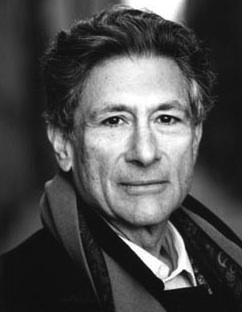
Saïd, who died at age 68 on September 25, 2003, six months after the start of the Iraq War, was a Palestinian–American literary theoretician who was an advocate for the political and the human rights of the Palestinian people.

British journalist Robert Fisk described Said as “the most powerful voice for the Palestinian people”. Said was the University Professor of English and Comparative Literature at Columbia University, and a public intellectual who was a founding figure of the critical-theory field of Post-colonialism.

Edward Said www.tumblr.comBorn a Palestinian Arab in the Jerusalem city of Mandatory Palestine in 1935, Said (left) was an American citizen through his American father, Wadir Saïd. (Source: Wikipedia)

Hedges searched for appropriate quotations on the liberal class avoiding social issues. He found one in the penultimate of the four British Reith Lecture series : Speaking Truth to Power, which Said delivered in July and August of 1993. The lectures were broadcast by the BBC. They have since been archived on the internet.

The Said passages Hedges includes in his Truthdig essay, offer a powerful indictment of intellectuals from any profession or area of responsibility who manage to find reasons to avoid disagreeing with the prevailing accepted narrative. Said writes:

Nothing in my view is more reprehensible than those habits of mind in the intellectual that induce avoidance, that characteristic turning away from a difficult and principled position, which you know to be the right one, but which you decide not to take.”

Said adds a list of self-serving excuses he found within all segments of the intellectual community:

You do not want to appear too political; you are afraid of seeming controversial; you want to keep a reputation for being balanced, objective, moderate; your hope is to be asked back, to consult, to be on a board or prestigious committee, and so to remain within the responsible mainstream; someday you hope to get an honorary degree, a big prize, perhaps even an ambassadorship.

For an intellectual these habits of mind are corrupting par excellence. If anything can denature, neutralize, and finally kill a passionate intellectual life it is the internalization of such habits.

Personally I have encountered [these habits] in one of the toughest of all contemporary issues, Palestine, where fear of speaking out about one of the greatest injustices in modern history has hobbled, blinkered, muzzled many who know the truth and are in a position to serve it.

For despite the abuse and vilification that any outspoken supporter of Palestinian rights and self-determination earns for him or herself, the truth deserves to be spoken, represented by an unafraid and compassionate intellectual.

Chris Hedges and Edward Said have traveled different paths to reach their shared passion regarding Palestine.

Hedges, 56,  is the son of an American Presbyterian minister. He  holds  a B.A. in English Literature at Colgate University. He later earned a Master of Divinity from Harvard Divinity School, where he studied under James Luther Adams.

Hedges is the author of Death of the Liberal Class The World As It Is: Dispatches on the Myth of Human Progress, and War is the Force that Gives Life MeaningHis 2012 best seller, written with the cartoonist Joe Sacco, is Days of Destruction, Days of Revolt.

An early critic of the Iraq War, Hedges delivered a 2003 commencement address at Rockford College in Rockford, Illinois, in which he said: “We are embarking on an occupation that, if history is any guide, will be as damaging to our souls as it will be to our prestige and power and security.”

The New York Times, for which he then worked, criticized his statements and issued him a formal reprimand for “public remarks that could undermine public trust in the paper’s impartiality.”

After receiving the reprimand, Hedges left the paper. He is currently a senior fellow at The Nation Institute in New York City. At the Times, he worked for nearly two decades as a foreign correspondent in Central America, the Middle East, Africa and the Balkans.

Paul Craig Roberts includes Hedges in his list of “rebels” who speak the truth to power by exposing as false, elements of the prevailing public narrative. Roberts describes his list as “offensive” to defenders of the establishment’s status quo.

While Edward Said, unfortunately, is no longer with us, Chris Hedges continues his “offensive” fight against the “might makes right” ideology that led to the Iraq War. One of his recent media appearances is available in a nine-minute video interview from the Real News Network.

The interview was prompted by Hedges’ decision to withdraw from a PEN speaking engagement and then resign from PEN, an international writers organization that “works to advance literature, to defend free expression, and to foster international literary fellowship”. He explains his decision here and in this video interview:

The photo of Chris Hedges at top is from Wikipedia. The photo of Edward Said is from http://www.tumblr.com.

Posted in Hillary Clinton, Media, Middle East Politics | 12 Comments

Obama: “Look at the world through [Palestinian] eyes”

by Palestinian childJames M. Wall

Many political progressives have harshly criticized President Obama’s recent trip to Israel and Palestine. They claim he was too warm toward Israel and too lukewarm toward Palestine.

Did these critics pay close attention to what the President actually said and saw on this trip? I don’t think so.

The president declined to speak to the Israeli Knesset, asking instead for a younger audience.

In his speech to Israeli youth, the President said:

[T]he Palestinian people’s right to self-determination and justice must also be recognized. Put yourself in their shoes — look at the world through their eyes.

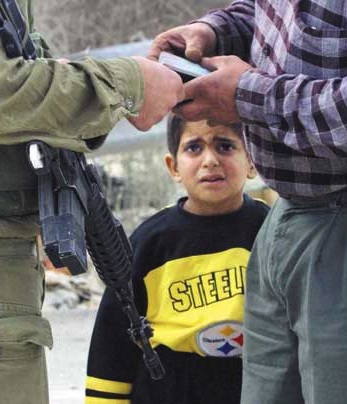
It is not fair that a Palestinian child cannot grow up in a state of her own, and lives with the presence of a foreign army that controls the movements of her parents every single day.

In the picture above one of those Palestinian children watches his father show his papers to an Israeli soldier at a checkpoint.

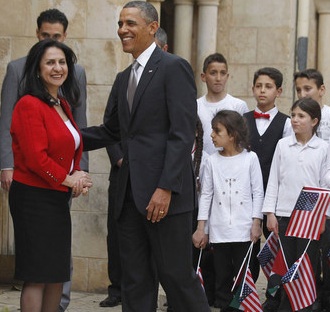
Bethlehem Mayor Vera Baboun (shown below with the President) told Daoud Kuttub she was especially pleased that the arrival of a khamsin* sand storm that hit the area on Friday, forced the president to forego an Israeli helicopter. She observed that:

By driving, Obama would have no choice but to see the wall surrounding the city. It was as if, she said, “God willed that Mr. Obama enter from the gate of reality, rather than from the sky of no reality.”

Mayor Baboun, the mother of five, is Bethlehem’s first woman mayor. A former Bethlehem University English literature professor, she was elected in October, 2012. She is also a professor who has a way with words.U.S. President Obama is seen next to Bethlehem Mayor Baboun at the Church of the Nativity in Bethlehem

MJ Rosenberg was one observer of the president’s trip who paid close attention to the fine print that emerged from the trip.

Rosenberg, a former AIPAC staffer, now a harsh (and well-informed) critic of both AIPAC and Israel, reported on the speech the president gave to young Israelis:

In words that must have shaken Netanyahu, Obama referred to “the moral force of nonviolence” to resist the occupation. Coming out of left field, this was probably an indication that Obama read the Sunday New York Times magazine cover story on non-violent resistance in the West Bank by Ben Ehrenreich.

Obama compared the Palestinian struggle to the civil rights movement in America, invoking his own daughters as beneficiaries of that struggle.

This presidential encouragement of the one form of protest that Israeli officials fear most as threatening their hold on the West Bank was significant. It is easy to imagine Palestinian protesters now marching against the settlements, waving photos of Obama along with his words endorsing non-violent resistance’s “moral force.”

Rosenberg adds that “the most significant part” of Obama’s speech came when the President referred to the Palestinians’ right to justice, specifically referencing settler violence that goes unpunished”

Rosenberg adds that he believes Obama is the first US president to use “the language of justice in discussing Palestinian rights, which is, of course, how Palestinians rightly see it”.

The introduction of the “language of justice” into the US public debate over Israel and Palestine, is, of course, long overdue.

The encouraging thing is that an American president has used “the language of justice” as a way of warning the Israeli people that their future depends on their leaders’ willingness to embrace that language. The discouraging thing is that the mainstream media covering the trip focused more on power politics than it did on what Obama said and saw in Palestine and Israel.

Alex Kane, writing for Mondoweiss, found a change message in Obama’s speech to the young Israelis:

Given the frustration in the international community, Israel must reverse an undertow of isolation. And given the march of technology, the only way to truly protect the Israeli people is through the absence of war.

This truth is more pronounced given the changes sweeping the Arab World. I recognize that with the uncertainty in the region – people in the streets, changes in leadership, the rise of non-secular parties in politics –it is tempting to turn inward. But this is precisely the time to respond to the wave of revolution with a resolve for peace.”

It is instructive to note that a few days after Obama’s trip, the US Supreme Court began their deliberations about two cases, both involving equal rights for gay and lesbian couples. The tide in favor of those rights has shifted dramatically.

On his MSNBC program this week, Lawrence O’Donnell noted the “sea change” taking place in this country regarding sexual equality.

He reported that North Carolina Democratic Senator Kay Hagan had joined a growing number of political leaders by endorsing marriage rights for gay and lesbian couples. What makes her endorsement particular noteworthy is that the seat she now holds once belonged to arch conservative Republican Senator Jesse Helms.

Given the passion and conflict generated by equal rights for gay and lesbian couples, and for Palestinians, why has support for Palestinian justice lagged so far behind support for marriage equality?  The answer lies in the power of grassroots support in US political decisions.

Politicians respond to political pressure from voters. In a prescient column he wrote for the Progressive magazine in January, 2009, John Nichols wrote:

Whether the previous, more progressive Obama still exists within the man who will take the oath of office on January 20, remains to be seen. But the only way to determine if Obama really is the progressive he claimed as recently as last summer to be is to push not just Obama but the public.

Nichols looks back to President Franklin D. Roosevelt:

Franklin Roosevelt’s example is useful here. After his election in 1932, FDR met with Sidney Hillman and other labor leaders, many of them active Socialists with whom he had worked over the past decade or more. Hillman and his allies arrived with plans they wanted the new President to implement. Roosevelt told them: “I agree with you, I want to do it, now make me do it.”

Supporters of gay marriage have developed a large grassroots movement which led to these court cases.

US supporters of justice for Palestinians, both religious and secular, have yet to build a strong grassroots movement to overcome an unjust occupation.

President Obama wants the American public to “make him do” the right thing. His progressive critics should remember that in a democracy, the president cannot change history alone.

http://youtu.be/PS7NSPsoheA

The video is from Palmedia. The picture of Mayor Baboun and President Obama was taken in front of the Church of the Nativity by Jason Reed  of Reuters. The picture of  the child and his father is from the Islamic Forum.

* A khamsin is a hot, dry, dusty wind in North Africa and the Arabian Peninsula that blows from the south or southeast in late winter and early spring. 

Posted in Media, Middle East, Middle East Politics, Netanyahu, Obama | 12 Comments

“We Have No 3G in Palestine”

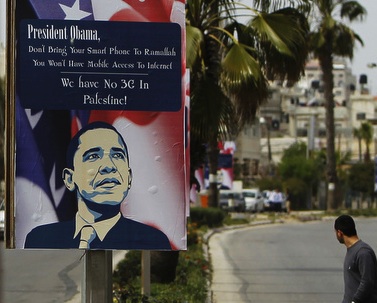
by James M. WallA Palestinian man walks near placards designed by an activist depicting U.S. President Obama, ahead of his visit to the region, in Ramallah

Unless security forces have torn it down, the poster (shown here) was one of the sights President Obama would see if his motorcade made its way to Ramallah, Palestine on a West Bank highway.

The poster was posted on a corner after the road passes through the Qalandia checkpoint separating the West Bank from east Jerusalem.

Of course, the President would miss the poster and miss seeing the highway if he traveled to Ramallah in a helicopter. That would be unfortunate because he would miss seeing the poster which says in Arabic and English:

“President Obama, don’t bring your smart phone to Ramallah. You won’t have mobile access to Internet — we have no 3G in Palestine!”

The poster would be one of more hospitable messages a disappointed Palestinian public would offer the visiting President on his visit to the West Bank this week.

Mahir Alawneh, a young Palestinian web consultant, designed, and placed a poster along the President’s route.

Alawneh told the Al Monitor web site he wanted to send a more gentle message to the American visitor.

It is well known that President Obama makes extensive use of his personal computer. The loss of a 3G connection should register on the President as a deprivation, albeit, one of the lesser items Israel withholds from the Palestinian population.

The largest Palestinian deprivation, of course, is the absence of freedom for a people living under occupation, an issue the President was not expected to address in any of his public utterances this week.

Mahir Alawneh understands this. In his Ramallah interview, Alawneh said: “Most of our people talk about the major issues, but not about our lifestyles.”

He added that “though 3G is a small issue for Palestinians, who have more pressing concerns, it serves as a point of comparison for Americans, who are likely to be very upset if it were suddenly banned in their country. So this is the point: If we don’t have this tiny thing, do you think we have the bigger things?”

An Israeli site explained the 3G problem:

The banner with Obama’s picture is among many hung by activists, seeking to raise the American president’s awareness of the lack of 3G frequencies in the West Bank.

Israeli authorities control cellular networks there and they have not granted Palestinian telecommunication companies 3G.

President Obama’s Middle East trip suggests nothing less than a man on a “hand-holding exercise” for Israelis, as one observer described the visit. It was also a journey that showed little concern or respect for a Palestinian people suffering under a military occupation which controls their every move, including their access to 3G.

If there is the slightest humane or moral value in this hand-holding exercise, it is hidden from the view of mere mortals.  Behind this trip is a purely Zionist political agenda.

The trip is nothing less than a blatant political effort to persuade Israelis, especially young adults, that Barack Obama wants to be their friend.

Jonathan Cook, writing in CounterPunch, explains one political reason why restarting the peace process is not on Obama’s agenda this week.

As [Prime Minister Benjamin] Netanyahu forms a new cabinet in his third term as prime minister, he has less control than he had in his previous governments.

The settlers’ dedicated party, Jewish Home, has been awarded three key ministries – trade and industry, Jerusalem, and housing – as well as control of the parliamentary finance committee.

The new political control exercised by settlement leaders and their supporters, will ensure, Cook writes, that the settlements will flourish during this government’s term, not a recipe for peace with the Palestinians.

Which brings us to a work of popular film art that has the potential to throw some small amount of light, and perhaps a dollop of wisdom, on this complex problem.

As Obama prepares to return home, we might pause a moment to revisit the classic film, Blues Brothers, a 1980 picture directed by John Landis, which just happens to be set in Obama’s hometown of Chicago, Illinois.

The film opens with one brother, Jake, leaving prison. He and his brother Elwood, are reunited around their determination to save the Chicago parish orphanage where they lived as children.

They learn from the Mother Superior (still at the orphanage, and still wielding a ruler) that their old home will have to close unless the Mother Superior can come up with $5000.

The brothers are determined to solve this problem. How will they do it? They will take it one step at a time. First:

Jake: We’re putting the band back together. 
Mr. Fabulous: Forget it. No way. 
Elwood: We’re on a mission from God. 

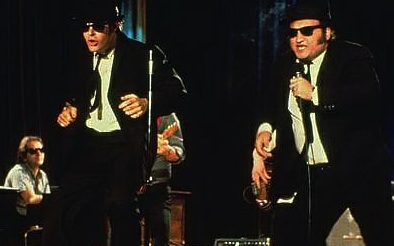
Jake is John Belushi, right, in the picture shown below. Elwood is Dan Aykroyd, at left. They are the Blues brothers.

Their mission from God is to save the orphanage.  The obstacles they face appear to be as insurmountable as the obstacles facing President Obama as he makes his first trip as president  to Israel and Palestine.

blues brothers

President Obama wants to solve what others see as an intractable problem.  Like the Blues brothers, he will take it one step at a time:

First, he will put the US-Israel band “back together”.

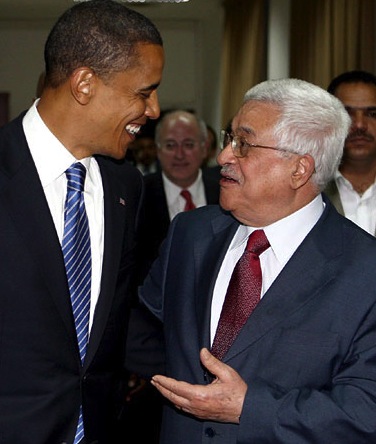
Can he do that without alienating the Palestinians, the other party to this intractable problem?  He will try, starting with his careful words following a two hour Thursday meeting with Palestinian President Mahmoud Abbas.

Ha’aretz reported on the meeting from Ramallah:

U.S. President Barack Obama said on Thursday that settlement building in the West Bank did not “advance the cause of peace,” but stopped short of demanding a construction freeze to enable negotiations to resume.

Speaking at a joint news conference with Palestinian President Mahmoud Abbas, Obama said he remained committed to the creation of an “independent, viable and contiguous” Palestinian state alongside a secure Jewish State of Israel, but said achieving that goal would not be easy.

“The core issue right now is how do we get sovereignty for the Palestinian people and security for Israeli people,” he told reporters following almost two hours of talks with Abbas.

A delicate balancing act, to be sure, but the speech does not erase the reality of this trip’s Israeli-focused schedule.On this trip Obama focused exclusively—with brief token stops in between—on Israel’s narrative.

He visitedd the Dead Sea Scrolls, an artifact discovered in the West Bank, which Israel has moved to a museum in Israel to symbolize its “historic homeland”. Obama will also lay wreaths at the tombs of major Israeli leaders.

He spoke to college students, an audience that should be more receptive to his personal style and message, more receptive, that is, than established politicians in the Israeli Knesset.

In his effort to win the hearts and minds of Israel’s publics, and thus to shape future political decisions, Obama is burdened by his own set of obstacles, an implacable Zionist-purchased US Congress, a propagandized American public, and a newly-elected settler-dominated Israeli government.

President Obama also receives little support from a highly agitated progressive base now starting to think of him as Bush II. With friends like these, the impossible becomes even more difficult.

In the Blues Brothers movie, Jake and Elwood do eventually  reach their impossible goal, as viewers discover at the film’s conclusion:

Cook County Assessor’s Office Clerk: Can I help you? 
[the brothers back him up and lift him onto the counter
Jake: This is where they pay the taxes, right? 
Cook County Assessor’s Office Clerk: Right. 
Elwood: This money is for the year’s assessment of Saint Helen of the Blessed Shroud Orphanage in Calumet City, Illinois. 
Jake: 5,000 bucks, it’s all there pal… 

They earned the money honestly, signing a contract with a record promoter, achieving their impossible dream. And, as they saw it, succeeding on their “mission from God”.

Will Obama accomplish his goal of peace between Israel and Palestine?  Will he be able to persuade an Israeli public (especially the younger citizens) that a war with Iran would be national suicide?  And what chance does he have that the Palestinian public will understand that his one-sided trip schedule is finally in the best interest of peace?

On both counts, success seems not just evasive, but impossible.

To Obama’s credit, he is trying. Maybe he feels he, too, is on a “mission from God”. And just maybe, he is right.

As we await the final hours and aftermath of Obama’s trip, there is a rousing song from the Blues Brothers film, that offers a simple, yet profound non political solution to a complex problem.

During the excitement of the concert where they perform, the brothers escape the clutches of the Illinois state police, and make their way to the Cook County’s Assessor Office Clerk with a $5000 check, thus demonstrating the marriage of hope with pragmatism.

That ought to be a solution right out of Barack Obama’s political playbook. Click, see and listen, below:

Posted in Middle East, Middle East Politics, Movies, Netanyahu, Obama | 3 Comments

Khalidi to Obama: Time For a New Course

by James M. Wall

Omar Rashid:European Pressphoto Agency

The New York Times performed a valuable service for its readers on Wednesday, March 13, exactly one week before President Obama is scheduled to arrive on his first-ever presidential visit to Palestine and Israel.

The Times contrasted the major media voice of  the liberal Zionism of the American ruling classes, with that of the voice of a champion for the Palestinian people.

Which of these voices do your leaders, political, media, or religious. respond to?  As President Obama prepares to fly to Tel Aviv, this would be a good time to visit, write or call those leaders and ask them.

The Times paired its resident liberal Zionist columnist, Thomas Friedman (Mr. Obama Goes to Israel), with Palestinian-American Middle East scholar  Rashid Khalidi (Is Any Hope Left…”?), Obama’s University of Chicago academic colleague and good friend.

In his column, Friedman reiterated liberal Zionism’s formulaic belief that the Middle East must be made over entirely in an empirical US/Israel image.

Friedman wants Obama to say to Israel’s leaders:

After all, you have a huge interest in trying to midwife a decent West Bank Palestinian state that is modern, multireligious and pro-Western — a totally different model from the Muslim Brotherhood variants around you.

Who defines “decent”?  And who determines if Israel qualifies as “multireligious”? The answer is, Thomas Friedman, the media maven of US liberal Zionism. (Wikipedia: “maven comes from Hebrew, via Yiddish, and means one who understands, based on an accumulation of knowledge.”)

Khalidi has his own abundance of “accumulated knowledge”, far more than enough to serve as a Palestinian maven for his old friend now in the White House. Khalidi is currently a professor of modern Arab studies at New York’s Columbia University. His latest book is Brokers of Deceit: How the U.S. Has Undermined Peace in the Middle East.

Khalidi begins his Times column with a question:

Brokers coverWhat should Barack Obama .  .  .   do about the Israeli-Palestinian conflict?

First, he must abandon the stale conventional wisdom offered by the New York-Washington foreign-policy establishment, which clings to the crumbling remnants of a so-called peace process that, in the 34 years since the Camp David accords, has actually helped make peace less attainable than ever.

The President traveled to Israel as a candidate in 2008. The picture of Obama and President Mammoud Abbas (above) was taken on that trip,

It was Obama’s second de rigueur trip to Israel, both taken for mandatory political purposes. His first presidential trip will set the tone for his entire second term foreign policy.

It is a far more serious journey this time because he is facing an international growing sense of outrage over Israel’s occupation, and its refusal to change course.

Earlier reports from Israel indicated that the President would not travel to Ramallah. During a White House press conference call with Deputy National Security Advisor for Strategic Communications Ben Rhodes (joined on the line by US Ambassador to Israel Dan Shapiro) it was announced that the President would travel to Ramallah Thursday morning.

The text from the press conference call continues:

In Ramallah, he will have a bilateral meeting with President Abbas of the Palestinian Authority. And then the two leaders will have a press conference and then they’ll have a working lunch together.

Again, the United States has supported the significant institution-building that the Palestinian Authority has undertaken in the West Bank. It’s a chance to discuss our continued support for the PA, as well as to discuss ways to advance Israeli-Palestinian peace going forward.

Following the working lunch, the President will join Prime Minister Fayyad at the Al-Bireh Youth Center, also in Ramallah.

Again, this is an opportunity for the President to see firsthand some of the work that’s being done to develop institutions on the West Bank, and also to meet with a range of Palestinian young people and hear directly from them as well. So that will complete that portion of his time in Ramallah.

The President will return to Israel Thursday afternoon to deliver a speech at the Jerusalem International Convention Center, followed by a dinner in his honor hosted by Israeli President Peres.

Israeli officials had wanted Obama to speak to the Knesset, but Obama’s trip planner said the President preferred to address a larger audience of Israeli citizens at the Convention Center.  There will be a special focus on having young Israelis at the Convention Center event.

Friday’s schedule will begin with ceremonial stops at special Israeli locations, which will involve the laying of wreaths in honor of two major Israeli historical figures. Events in Israel and Palestine will conclude in Bethlehem, in the West Bank, where the President will visit the Church of the Nativity.

These are details for the Friday, March 21, schedule, which were released during the press conference:

On Friday, the President will begin his day by going to Mt. Herzl, where he will lay a wreath at both the graves of  [Theodor] Herzl and [Yitzhak] Rabin, speaking, of course, to the significant contributions that both of those huge figures in Israeli history and Jewish history — to their contribution.

Following those wreath-layings, he will visit Yad Vashem and tour Yad Vashem, and have a chance to lay a wreath and make remarks there, of course, marking the very somber and powerful history of the Holocaust. The President was able to travel there previously in 2008 as a senator and was very deeply moved by that experience, and it’s an important opportunity to once again mark that particular tragic element of our shared history.

Following the visit to Yad Vashem, the President will travel to Bethlehem where he will tour the Church of the Nativity.

Both Bethlehem and the Church of the Nativity are obviously very important sights in the West Bank — important to the Palestinian people, also important to Christians in the region and around the world. And so it will be a very powerful experience for the President to be able to have the experience of touring the Church of the Nativity and observing firsthand that history and experience.

Of great symbolic significance is the fact that there is no word in the schedule that would suggest a wreath being placed at the tomb of Palestinian leader Yasir Arafat, while Obama is in Ramallah. No wreath and no parallel reference to the schedule’s description of the  Israeli leaders, “speaking, of course, to the significant contributions”.

Note to trip-planners: There are two “sides” here, and “significant contributions” were made on both sides.

If the meeting with President Abbas is in his headquarters, Obama will pass by the Arafat burial site, to his left, on his way into the building. Of course, it is also possible that the Obama-Abbas meeting will be held at a different location.

We will find out next week how this slighting of Arafat, in contrast to the honoring of Israeli historic figures, will be received on the Palestinian street.

One thing is certain, Israel cannot hide the sight of the wall that the President will experience when he travels to Bethlehem. Indeed, the wall will be a constant part of the landscape as the President’s party moves back and forth between the West Bank and Israel.

Which brings us around to the fact that the now-retired Benedict XVI made a 2009 papal visit to Bethlehem. Following the elevation of a new Catholic leader, Pope Francis, which has been much in the news, this is a good time to recall that when Benedict XVI visited Bethlehem, he was photographed standing in front of a wall with graffiti behind him, illustrating how locals feel about the the occupation wall.

The Guardian’s May 13, 2009 story, should be studied by President Obama’s trip planners.Peter Dammann:AFP:Getty Images

Pope Benedict XVI (right) held his hands out wide to greet a crowd of applauding Palestinian refugees in the afternoon sun. Behind him stood the most striking symbol of Israel’s occupation: a paint-spattered military watchtower rising above the tall, concrete wall that presses on Bethlehem.

All around him were paintings, posters and graffiti proclaiming the Palestinian cause and their hopes from their papal visitor. From an apartment block to his left hung a poster in English and Italian: “We need bridges not walls.”

On a balcony beneath, a Palestinian couple sat with their children, looking down as the pope waved back to them.

Today the pope made his strongest call yet for a “sovereign Palestinian homeland”. He said mass in Bethlehem’s Manger Square and offered his “solidarity” to the Palestinians of Gaza, telling them he wanted to see the Israeli blockade of the coastal strip lifted.

Later, he was driven in to the UN school in the Aida refugee camp on the edge of Bethlehem, home to refugees who in 1948 were forced out or fled their homes in what is now Israel.

What has happened to the birthplace of the Christ child is one of the reasons Rashid Khalidi used his New York Times column to remind President Obama that his administration continues a US policy which since 1993 has failed to prevent Israel, as Khalidi puts it, “from gradually gobbling up the very land the two-state solution was to be based on”.

Furthermore,  Khalidi writes, the number of Israel settlers living in illegally occupied land, has steadily increased under four successive presidents, growing from 200,000 in 1993 to almost half a million today.

Khalidi continues:

Rashis KhalidiToward the end of his first term, Mr. Obama essentially abandoned his already modest peacemaking agenda in exchange for a lull in Prime Minister Benjamin Netanyahu’s campaign for war with Iran. Palestine was again sacrificed, this time to bribe a belligerent Israel for temporary good behavior.

The American-led “process” has ultimately strengthened the Israeli far right and made Palestinian self-determination more unattainable than ever. Continuing with the Orwellian grotesquerie that is the “peace process” is contrary to any enlightened definition of American self-interest. . .

Khalidi concludes with this strong admonition to his friend:

For Mr. Obama, a decision is in order. He can reconcile the United States to continuing to uphold and bankroll an unjust status quo that it helped produce. Or he can begin to chart a new course based on recognition that the United States must forthrightly oppose the occupation and the settlements and support an inalienable Palestinian right to freedom, equality and statehood. There is no middle way.

It would be too much to expect President Obama to echo Ronald Reagan’s Berlin Wall speech with a passionate Bethlehem speech that would demand, “Mr. Netanyahu, tear down this wall”.

But it is not too much to expect Obama to inform Benjamin Netanyahu, who has just barely assembled his new government in time for this visit, that the United States government will now change to a new course in its dealings with Israel’s occupation.

Anything less would be a serious setback to the hopes of both Palestinians and peace-loving Israelis.

(Updated, since its initial posting.)

The 2008 picture (at top) of Candidate Obama and President Abbas was taken by Omar Rashid, for the European Pressphoto Agency. The 2009 picture of Pope Benedict was taken by Peter Damman for AFP/Getty Images.

Posted in Middle East Politics, Netanyahu, Obama | 18 Comments