New Jersey’s 9th CD Voters Say No to AIPAC

by James M. Wall

One election night victory in one New Jersey congressional district does not represent a major shift in American politics. But shifts do occur, and they must start somewhere.

On the night of June 5, 2012, this was the news the Star-Ledger reported from the Passaic County Community College in Paterson, NJ.

In an upset, U.S. Rep. Bill Pascrell has defeated fellow incumbent U.S. Rep. Steve Rothman in the Democratic primary for the 9th Congressional District.

What makes the news from Passaic County so surprising was that Pascrell’s election to a House seat from New Jersey’s new 9th district was not supposed to happen.

How could it, two years after the news broke that Bill Pascrell was one of 54 House members who signed a 2010 letter to President Obama urging him “to use diplomatic pressure to resolve the blockade affecting Gaza.” The letter reads, in part:

The unabated suffering of Gazan civilians highlights the urgency of reaching a resolution to the Israeli-Palestinian conflict, and we ask you to press for immediate relief for the citizens of Gaza as an urgent component of your broader Middle East peace efforts. . . . The current blockade has severely impeded the ability of aid agencies to do their work to relieve suffering.

Signing that letter was a risky political move for Pascrell. It was certain to stir pro-Israel forces, led by AIPAC, the powerful fund-dispersing and rhetorical master source of invective against any member of the US Congress who dares raise a voice on behalf of  “the citizens of Gaza”.

And stir them it did. The Israel Lobby left Pascrell alone in the 2010 election cycle because he had no serious opposition in either the primary or general election. Wolf packs don’t attack strong members of a deer herd. The pack waits for the opportunity to bring down victims perceived to be vulnerable.

Following the 2010 census, New Jersey’s population decline led to the loss of one congressional district, dropping the state from 13 to 12 districts. By law the House is allowed 435 districts, divided according to population, among the 50 states.

After new district lines were drawn, the new 9th CD New Jersey voters were forced to choose between two incumbents, Steve Rothman, the member from the 9th CD, who had held that seat since 1996, and Pascrell, who had served the 8th CD for the same number of terms.

In December, 2011, Rothman’s hometown of Fair Lawn was moved into the Republican-leaning district of U.S. Rep. Scott Garrett (R-5th Dist.).

Instead of running against an incumbent Republican, Rothman moved his residence to Englewood — the city he once served as mayor. He preferred to run against Pascrell in the new 9th District. Pascrell was at a disadvantage. The majority of voters in his new district had previously voted in Rothman’s old district.

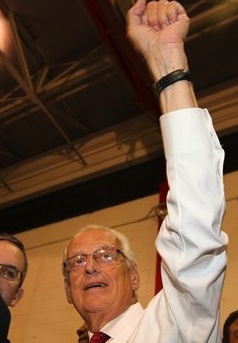
In a surprise development, even to many of his supporters, Bill Pascrell, (pictured above) raised  his arm in victory to celebrate his 61%-39% victory in the new 9th district, defeating Rothman by a strong margin of 30,227 to 19,228 votes.

How did this happen? It really is a simple story.

When two sitting members of Congress are forced to run against one another, AIPAC decides which one is best for Israel.

In the case of New Jersey’s new 9th CD, both Pascrell and Rothman had “good” voting records on behalf of Israel’s “security”. Votes cast, however, are not the only measure AIPAC examines. To win AIPAC’s endorsement, along with its fund-raising network and its carefully-honed rhetorical invective, the candidate must convince AIPAC leaders of his or her absolute loyalty to Israel.

In Pascrell’s case there remained the matter of Pascrell’s signature on the 2010 letter to Obama. Rothman had not signed the letter.

On January 13, 2012, AIPAC made its choice known through a story in the pages of the New Jersey Jewish Standard

The Standard reminded readers that Rothman “sits on two key appropriations subcommittees handling assistance to Israel: the state and foreign operations subcommittee and the defense subcommittee, where he has helped secure funds for Israeli missile defense systems”.

To bolster AIPAC’s case, The Standard’s story invoked two voices of authority to indicate just how important that defense subcommittee assignment, which, no doubt was arranged by AIPAC’s agents, is to Israel.

The first voice was an official of the Israeli embassy familiar with Rothman’s work on missile defense, who told the Standard,  “Steve Rothman has been instrumental in actively championing missile defense cooperation for years.”

The second voice of authority was that of Josh Block, “a former longtime spokesman for the American Israel Public Affairs Committees, who said that Rothman has a record of pro-Israel leadership second to none.”

The Standard concludes, “In the Democratic primary race between Rothman and Pascrell, ‘the differences couldn’t be clearer.'”

To underscore that difference, Josh Block harkened back to Pascrell’s signature on the 2010 letter. In his reading of the letter, Block accused Pascrell of  having “actually sided against American support for Israel’s right to defend herself against weapons smuggling and attacks by terrorists.”

Did the letter say that? Of course not. But from AIPAC’s perspective and from the perspective of the deep-pockets of the PACS it directs from a discrete distance, truth is not the issue, Israel is.
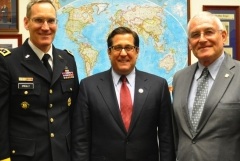
It was an easy decision for AIPAC to make. In a January JTA story, one congressional aide, whose boss previously served with Rothman on the House Appropriations Committee, said, “There are less than a handful of congressmen who bring the kind of passion, intensity and commitment to America’s security and Israel’s security that Steve Rothman does.”

“He has a laser beam-like focus on defeating the enemies of Israel, and he’s definitely not shy about holding the State Department accountable.”

The picture above, released by Congressman Rothman’s office, emphasizes the congressman’s pro-Israel credentials. In the picture, the congressman stands in his office between the director of the U.S. Missile Defense Agency, Lt.-Gen. Patrick O’Reilly, left, and O’Reilly’s counterpart at the Israel Missile Defense Organization, Arieh Herzog.

Voters in New Jersey’s new 9th CD were not sufficiently impressed by Rothman’s closeness to Israeli officials and his reliable votes favoring Israel.

Voters may also have been offended by attacks on Congressman Pascrell.

You would not know it from reading the local New Jersey papers, nor the New York Times, nor the Washington Post, none of which picked up on the beneath the mainline media-radar Zionist right wing attacks on Pascrell.

Reporting on Pascrell’s victory, the mainline media preferred the story line that former President Clinton endorsed and supported  Pascrell while President Obama’s chief strategist David Alexrod made a last minute appearance with Rothman to lend White House cache to Rothman, who had been  an early supporter of candidate Barack Obama against Hillary Clinton during the 2008 presidential primaries.

The right-wing attacks inspired by the Israel Lobby were led by Steve Emerson, a former AIPAC staffer.

Phillip Weiss wrote on his Mondoweiss site:

Steve Emerson, the rightist Islamophobe who formerly worked at AIPAC, put out a long vicious hit piece on Pascrell depicting the Roman Catholic Pascrell as an “Islamist Fellow Traveler.”  . . . Rothman embraced the lobby onslaught, doing everything he could to make the primary a referendum on Israel, Islam, Muslims, etc.

Then, well below the media radar, something surprising took place. Pascrell received strong support from an unexpected source.

James Zogby of the Arab American Institute, a Christian Lebanese-American and a strong supporter (like Pascrell) of Israeli-Palestinian peace,  came in to work with the district’s Arab-American population and help the local people organize  for Pascrell.

Weiss emphasizes that “the issue wasn’t Israel; it was Rothman’s Arab and Muslim-baiting which offended Arab-Americans as much as Jews would be offended by an openly anti-Semitic candidate.”

Weiss concludes and clearly wants to stress, that “Bill Pascrell did not win because of the Israel issue. He himself is pro-Israel, just not anti-Arab.”
As Weiss reads the campaign, Pascrell won because of his own strong Get Out The Vote campaign, his door to door effort and “because he is an effective and strong progressive from a district that appreciates that.”
Pascrell’s victory was a surprise and it could be only an anomaly. Or, it could be the beginning of a new spirit in American politics in which AIPAC no longer controls Congress.
In any event, Congressman Pascrell’s victory in New Jersey’s 9th CD, was a “bright shining moment” in American politics. In its own way it may mark the beginning of a new tectonic shift in the geological ground under our political landscape.
 The picture above of Congressman Pascrell is by John Munson, of  The Star Ledger (New Jersey).

Posted in Middle East, Politics and Elections | Tagged , , , , | 19 Comments

Obama Emerges as the US Warrior President

by James M. Wall

Memorial Day in the United States is a time for hot dogs, overcooked burgers, too much beer, and a massive dose of militaristic patriotism.

It is also a good time for Americans to begin thinking seriously of who should be elected president this November.

This year, President Obama kept his focus on his own reelection campaign and, at the same time, announced  himself as the US  warrior president. The president has apparently decided a warrior president is a better image to project  for his reelection in a downward spiraling economy.

Don’t take my word for it. Check out a story released on Memorial Day. It was orchestrated by the Obama White House for the New York Times. The story appeared in the Times‘ internet edition on Memorial Day, and in the print edition the next day.

With the help of White House operatives, past and present, the Times portrays the president as a man carrying the heavy moral burden of deciding when a US-designated suspected terrorist will die in a drone attack.

Since many of these US-designated suspected terrorists are frequently killed in their homes in crowded communities, others die in the attack, including, at times, women and children. On one recent occasion, the targeted victim was an American male citizen.

The Times reports that the President is given a chart with the names of potential targets:

He had vowed to align the fight against Al Qaeda with American values; the chart, introducing people whose deaths he might soon be asked to order, underscored just what a moral and legal conundrum this could be.

Mr. Obama is the liberal law professor who campaigned against the Iraq war and torture, and then insisted on approving every new name on an expanding “kill list,” pouring over terrorist suspects’ biographies on what one official calls the macabre “baseball cards” of an unconventional war.

This is an “unconventional war”, as the Times puts it. It is also an unprecedented war, which would not be considered a war at all, except for the steps taken by President George W. Bush after September 11, 2001. After the attacks, Bush essentially declared war on Islam.

The result of this strategy was to create a national fear of Islam, both foreign and domestic, feeding the Islamophobia that was already an American reality.  It also led to two wars against Middle Eastern pre-dominantly Islamic nations, Iraq and Afghanistan.

What should have been and still should be, a search for the criminal gang behind 9/11, became on George Bush’s watch, a holy war, a Global War on Terror (GWOT).

This global war was carried out under the tight control of a neo-conservative cabal of politicians, many of whom were strong Zionists eager to direct US military might against Israel’s neighbors.

A major weapon in the GWOT is the robot-controlled drone. After the Times‘ Memorial Day story appeared, the Guardian commented on Obama’s role in the drone attacks:

More than a decade after George W Bush launched it, the “war on terror” was supposed to be winding down. US military occupation of Iraq has ended and NATO is looking for a way out of Afghanistan, even as the carnage continues. But another war – the undeclared drone war that has already killed thousands – is now being relentlessly escalated.

From Pakistan to Somalia, CIA-controlled pilotless aircraft rain down Hellfire missiles on an ever-expanding hit list of terrorist suspects – they have already killed hundreds, perhaps thousands, of civilians in the process.

At least 15 drone strikes have been launched in Yemen this month, as many as in the whole of the past decade, killing dozens; while in Pakistan, a string of US attacks has been launched against supposed “militant” targets in the past week, incinerating up to 35 people andhitting a mosque and a bakery.

American drone warfare is rapidly increasing. Nick Turse, co-author of  the just-published book, Terminator Planet: The First History of Drone Warfare, 2001-2050, describes the sharp increase of drones in the US arsenal:

Washington’s post-9/11 military interventions have been a boon for drones. The numbers tell the story. At the turn of this century, the Department of Defense had 90 drones with plans to increase the inventory by 200 over the next decade, according to Dyke Weatherington, a Defense Department deputy director overseeing acquisitions of hardware for unmanned warfare. As 2012 began, there were more than 9,500 remotely piloted aircraft in the U.S. arsenal.

As Barack Obama enters the final months of his reelection campaign, he wants the American people to know that he is, to use an old George Bush term, “the decider”, as to which human target to strike.

The US has shifted its wars from the ground to unmanned drones in the sky. President Obama is slowly bringing the Bush wars in Afghanistan and Iraq to a conclusion.  Yet, for political purposes, he still wants to portray himself as a warrior president. He is doing this by releasing a detailed description of how the drone warfare is conducted.

One week after the Memorial Day Times story on the US drone war, the White House provided information for a second story in the Times.

This story describes Obama’s role in the cyber war against Iran that he inherited from President Bush. This second story is “based on interviews over the past 18 months with current and former American, European and Israeli officials involved in the program, as well as a range of outside experts.”

With White House support, the Times made the case that President Obama has pushed the cyber campaign against Iran from his earliest days in office.

Officials quoted in this story “gave differing assessments of how successful the sabotage program was in slowing Iran’s progress toward developing the ability to build nuclear weapons.”

Internal Obama administration estimates say the effort was set back by 18 months to two years, but some experts inside and outside the government are more skeptical, noting that Iran’s enrichment levels have steadily recovered, giving the country enough fuel today for five or more weapons, with additional enrichment.

Whether Iran is still trying to design and build a weapon is in dispute. The most recent United States intelligence estimate concludes that Iran suspended major parts of its weaponization effort after 2003, though there is evidence that some remnants of it continue.

This is war talk of the first order, the American empire leader standing astride the Middle East with the most sophisticated technology available to wreak havoc on those who oppose him.

The White House must have determined that these two stories served the best interests of the President.  They were not new stories. The cyber attacks on Iran and the drone attacks, have been on-going for the three years of Obama’s first term.

The two accounts stressing Obama’s role in these two campaigns portend problems for an Obama second term, assuming he prevails against Republican presumed nominee Mitt Romney.

The problems come in the fact that a warrior president will find it difficult to pivot quickly and emerge once again as the creative peace president he initially promised to be.

To be sure, and much to his domestic advantage, Obama’s cyber attacks and his increased use of drones, do not put American troops in harm’s way. But, it is also true that by his decision to use remote technology to attack other nations, Obama is setting an example for other nations to follow him down a dangerous and unpredictable path.

In a second Obama term, Obama will either have to continue his remote warfare and give up his desire to be a peace maker, or he will have to utilize his next four years to lead his nation out of its exceptionalist warrior mentality.

Stephen M. Walt, co-author with John Meirsheimer of  the Israel Lobby, wrote for the Foreign Policy web site a perceptive description of how others see us:

[An] unchallenged faith in American exceptionalism makes it harder for Americans to understand why others are less enthusiastic about US dominance, often alarmed by US policies, and frequently irritated by what they see as US hypocrisy, whether the subject is possession of nuclear weapons, conformity with international law, or America’s tendency to condemn the conduct of others while ignoring its own failings. Ironically, US foreign policy would probably be more effective if Americans were less convinced of their own unique virtues and less eager to proclaim them.

The US, as Stephen M. Walt knows well, has “friends” like Israel, who want the US to remain exceptional. Israel believes it is to its own advantage as an intruder, occupying power in the predominantly Muslim region, to maintain a military edge that allows it to continue to illegally expand its own empire ambitions.

President Obama, heavily burdened by his own Zionist-controlled Congress, will have to exercise considerable wisdom and courage to pivot away from his campaign image as a warrior president to that of a leader who means it when he says he wants to apply “American values” to  his foreign policy.

Those “American values” also reject Islamophobia, which unfortunately was ignited full force after 9/11 and which President Obama has done little to tamper down with his random killing of Muslim suspects, primarily in Pakistan, Yemen and Somalia.

How strong is Islamophobia and racism among America voters?

Go to the right wing web lists and list serves, or just spend two hours a day watching Fox News/Entertainment, and you get an understanding of the ignorance and fear promulgated from these corners, pouring more Islamophobia into the American public’s emotional bloodstream.

Islamophobia in its present form is not as old as anti-semitism, but it is easily ramped up in the hands of hate mongers with a political agenda.

In case you don’t have a conservative friend who emails you Islamophobic literature, Wikipedia offers this definition:

Islamophobia is prejudice against, hatred or irrational fear of Islam or Muslims. The term dates back to the late 1980s or early 1990s, but came into common usage after the September 11, 2001 attacks in the United States.

It is depressing to have to suggest that our “change we can believe in” president has adopted the mantle of a warrior president, outdoing George Bush in some quarters. 

But politics is a messy business which calls for twisted paths to victory.  Maybe President Obama is riding the warrior president chariot until his successful reelection. After that he will need considerable help to get off that chariot.

The story is told of a meeting at Franklin Delano Roosevelt’s home in Hyde Park, New York, attended by labor and civil rights leader A. Philip Randolph.

In the meeting, Randolph asked Roosevelt to speak out more on labor and civil rights issues. According to Eleanor Roosevelt, who was present for the conversation, the president responded,  “I’d like to ask you to go out and make me do what you think it is I should do. Go out and make me do it.”

Is it possible Barack Obama is asking his supporters to make him pivot away from remote technologically advanced attacks on Muslim targets and attacks on Muslim nations like Iran and Syria, both sources of Israel’s collective paranoia.

It was FDR’s strategy to ask for help to contend with the pressures he faced, including a recalcitrant Congress. Obama needs the same help now, some of which is already available in a New York Times editorial:

Mr. Obama has demonstrated that he can be thoughtful and farsighted, but, like all occupants of the Oval Office, he is a politician, subject to the pressures of re-election.

No one in that position should be able to unilaterally order the killing of American citizens or foreigners located far from a battlefield — depriving Americans of their due-process rights — without the consent of someone outside his political inner circle.

How can the world know whether the targets chosen by this president or his successors are truly dangerous terrorists and not just people with the wrong associations?

The Times editorial writer is being gentle. Others are less so. 

If Obama ever expects to regain the support of the more progressive political left in the US, he will have to make a strong case to writers and activists like Medea Benjamin, a cofounder of  Codepink, and the author of the book, Drone Warfare

Benjamin has been an advocate for social justice for more than 30 years. After the Times story on drone warfare appeared, Benjamin wrote in the progressive web site, Nation of Change:

On May 29, The New York Times published an extraordinarily in-depth look at the intimate role President Obama has played in authorizing US drone attacks overseas, particularly in Pakistan, Yemen and Somalia. It is chilling to read the cold, macabre ease with which the President and his staff decide who will live or die.

The fate of people living thousands of miles away is decided by a group of Americans, elected and unelected, who don’t speak their language, don’t know their culture, don’t understand their motives or values.

While purporting to represent the world’s greatest democracy, US leaders are putting people on a hit list who are as young as 17, people who are given no chance to surrender, and certainly no chance to be tried in a court of law.

Who is furnishing the President and his aides with this list of terrorist suspects to choose from, like baseball cards? The kind of intelligence used to put people on drone hit lists is the same kind of intelligence that put people in Guantanamo.

Remember how the American public was assured that the prisoners locked up in Guantanamo were the “worst of the worst,” only to find out that hundreds were innocent people who had been sold to the US military by bounty hunters?

Why should the public believe what the Obama administration says about the people being assassinated by drones?

Why indeed should the public, left or right, believe what the Obama administration says?

The answer to that question should concern Obama and his staff through November and beyond. If he expects to be the Obama we once thought we knew, he will have some serious explaining to do.

The montage photo above of President Obama and a drone is from the Nation of Change.

Posted in Media, Middle East, Middle East Politics, Obama | 11 Comments

Will Elections Penetrate Israel’s “Impenetrable, Dangerous, Ideological Shield”?

by James M. Wall

It has been 25 years since Jewish historian, and Israeli critic, Simha Flapan, described the dominant narrative of the Israeli-Palestinian conflict in his 1987 book, The Birth of Israel: Myths and Realities.

Even though Israel has the most sophisticated army in the region and possesses an advanced atomic capability, it continues to regard itself in terms of the Holocaust, as the victim of an unconquerable, bloodthirsty enemy. Thus whatever Israelis do, whatever means we employ to guard our gains or to increase them, we justify as last-ditch self-defense. We can, therefore, do no wrong. The myths of Israel forged during the formation of the state have hardened into this impenetrable, and dangerous, ideological shield.

At the time of its publication, Flapan’s book was exhilarating to anyone who by the mid-1980s, was running up against what Flapan termed, Israel’s ” impenetrable, and dangerous, ideological shield”

This summer, that impenetrable wall has begun to show cracks of possible penetrability. Elections are currently moving forward in Egypt and Palestine, two voting publics Israel does not want to see emerge as unpredictable democratic neighbors.

Egypt, a country which borders Israel from the south, has long been a key Israeli ally. President Hosni Mubarak, the last military strongman to run Egypt, was just the partner Israel needed as a close neighbor.

Palestine? Well, elections were most certainly not in Israel’s plans for the population which has refused to accept Israel’s occupation.

Egyptians began voting for a new president this past week to replace the military committee which succeeded the ousted Mubarak. Results are not yet official, but it appears that the runoff in June between the two leading candidates, will involve Mohammed Mursi, the Muslim Brotherhood-backed candidate and Ahmad Shafiq, Mubarak’s last Prime Minister.

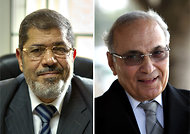
Egyptian scholar and greatly respected blogger, Juan Cole, describes Shafiq (shown at right here) as a former Air Force general and aeronautical engineer who wrote a dissertation on the military uses of Outer Space.

Shafiq is also a former Egyptian minister of aviation. He brags, with justification it appears, about “the good job he did with Cairo’s international airport”.

Cole adds that “Shafiq is considered by many Egyptians, especially in the countryside, as the law and order candidate. Many voters dislike him because of his close association with the overthrown Mubarak regime.”

Shafiq’s presumed opponent in the next round of voting, Mohammed Mursi, (at left) is described by the Guardian as the candidate selected by the Muslim Brotherhood’s Freedom and Justice party. Morsi is seen, according to the Guardian, as an uninspiring figure. He is backed, however, “by the best-organized political force in the country.”

Mursi, 60, is an engineer who has taught in the US as well as at Egyptian universities. An expert on precision metal surfaces, he worked at the US agency, NASA, on the development of space shuttle engines in the early 1980s.

This will be Egypt’s first democratic election. Palestinian elections are scheduled at some point later this year. That election will be the second exercise of democracy by Palestinians in the past decade.

The first was in 2006. (The picture above from Ma’an, is a ballot box from the 2006 election). When the outcome did not suit either Israel or the US, many elected Hamas legislators were promptly jailed by Israel. This was followed by a military conflict, encouraged by the US and Israel. As a result of that conflict, Hamas seized control of Gaza, while the Palestinian Authority became the ruling force in the West Bank.

Six years later, the governments of Gaza and the West Bank are prepared to hold their second legislative and presidential elections, under the watchful eye of the Palestinian Election Commission, which is chaired by retired Bir Zeit University president Hanna Nasser. The process of voter registration began Monday when Nasser met with Gaza Prime Minister Ismail Haniyeh.

Ma’an, the Palestinian News Agency, reported Monday that Nasser met with Gaza Prime Minister Ismail Haniyeh to discuss final plans for the election.

In an earlier Saturday story, Ma’an provided this background on election plans:

The [Palestinian] Central Elections Commission will begin operating in the Gaza Strip on Monday [May 28], officials said. Yasser al-Wadia, the general coordinator for independent political figures, told Ma’an on Saturday that a delegation from the CEC will add between 250,000-300,000 new Gazan voters to the electoral register. The CEC would undertake its work with impartiality, al-Wadia added.

Hanna Nasser, the head of the Central Elections Committee, told Voice of Palestine radio this week that the CEC would prepare offices and train employees ahead of necessary preparations to register voters.

After the commission starts work in the Gaza Strip, President Mahmoud Abbas will begin consultations on a consensus government as previously agreed.

Members of the new cabinet will be agreed upon within 10 days from the start of consultations. Then the unity government will operate for six months, during which time it will set a date for general elections.

Nasser, it should be noted, held the same position as chair of the CEC,  in January, 2006, when the elections in Gaza and the West Bank were essentially nullified by the US and Israel.

Thomas Friedman, the New York Times columnist who roams the world looking for exciting business developments, paused this past week to offer his report on the current conditions facing Israel and the Palestinian Occupied Territories. He appears either uninterested or, horrors, not even aware, that Palestinian elections are in the final planning stages.

In his column, Friedman stuck to the current Israeli narrative with this overview paragraph:

The Palestinians are divided between Hamas in Gaza and the Palestinian Authority in the West Bank, and both populations are tired. Moreover, economic conditions have improved in the West Bank in recent years, and the Palestinian Authority’s security forces are keeping a tight rein on anti-Israeli violence. Aid from the U.S., Europe and the Arabs pays a lot of the authority’s budget. Israel’s security wall keeps Palestinian suicide bombers out. The U.S. election silences any criticism coming from Washington about Israeli settlements.

This is a narrative paragraph which begs for closer analysis:

Yes, the Palestinians are separated in Gaza and the West Bank, with power held by Hamas, in Gaza, and the Palestinian Authority in the West Bank. But tired? Well, yes, about as tired as you would expect from prisoners locked up for what threatens to become a permanent incarceration.

Friedman writes that PA forces are keeping tight rein on anti-Israeli violence. He should have said Israeli occupation forces are attempting to maintain their oppressive control over non-violent demonstrations by Palestinians, jailing those who are too effective.

And he actually says, in print, that “Moreover, economic conditions have improved in the West Bank in recent years.”  Economic conditions are better in Cell Block C?  Not likely,

Is this where all that talk in religious circles about “invest, not divest” started? Living conditions for a few Palestinian millionaires have, no doubt, improved. Maybe Friedman has been reading too many Romney speeches where one learns that the rich want the rest of us to benefit from the market economy.

Finally, all you Friedman fans out there in the American peace camp (you know who you are), take careful notice of this casual, but revealing, sentence tossed into the middle of Friedman’s column:

“Israel’s security wall keeps Palestinian suicide bombers out.”

Security wall, suicide bombers? Friedman accepts that old Israeli narrative trope, a “security wall”, which is not for security, but is a land-grab of monstrous proportions, well beyond the original Green Line. He also continues to cling to the belief that the wall prevents “suicide bombers” from entering Israel.

That shows us that Friedman does not understand political tactics of the oppressed.  When something doesn’t work, stop doing it.

For Friedman and Israel, if something “works” it is always due to something Israel has done, an echo of Israeli-born scholar and critic, Simha Flapan’s phrase from 1987, “We [meaning Israel] can, therefore, do no wrong.”

Further into his column Friedman cites an April 23 New York Times op-ed which repeats the “security wall” canard in a discussion of peace, using the familiar “Peace Without Partners” theme. Lest we forget, this one surfaced in the 1980s with the mantra, “there are no partners for peace on the Palestinian side”.

The authors of the piece cited by Friedman are Ami Ayalon, Orni Petruschka and Gilead Sher, who are, respectively, a former commander of the Israeli Navy and head of the Israeli domestic security agency (Ayalon), an Israeli entrepreneur (Petruschka) and a peace negotiator and chief of staff to the Israeli prime minister from 1999 to 2001 (Sher).

Here is the revealing (for those willing to take notice) paragraph by these Israeli would-be peace-makers. Highlighted emphasis added:

Israel should first declare that it is willing to return to negotiations anytime and that it has no claims of sovereignty on areas east of the existing security barrier. It should then end all settlement construction east of the security barrier and in Arab neighborhoods of Jerusalem. And it should create a plan to help 100,000 settlers who live east of the barrier to relocate within Israel’s recognized borders.

The security barrier has become Israel’s latest Big Lie, replacing the “Green Line” because Israel did not draw the “Green Line”. It did draw the “security barrier” by building a concrete wall on and through Palestinian land. This wall is designed to secure Israel’s latest “facts on the ground”. What it does is cut off villagers from farmlands, workers from work sites and medical personnel from hospitals. That is not security for Israelis.

The problem for Thomas Friedman, the New York Times, Israel, and Israel’s friends in the US ruling classes, is that, in Secretary Don Rumsfeld’s memorable phrase, “stuff happens” when you don’t see the stuff coming.

This summer, elections are the stuff which are breaking out all around Israel. Ironically, Israel was planning its own election this fall, but Israel’s Prime Minister Benjamin Netanyahu postponed his elections until after November with some cabinet adjustments. In November, US voters will either return President Barack Obama to the White House or replace him with Mitt Romney.

It is hard to measure which candidate will bring Netanyahu the most joy.  But it is a good guess that a second term president would be more stubborn in dealing with the Israel Lobby than a first term president.

What should worry Netanyahu is that election “stuff” could happen in ways not  his liking in the US, Egypt, and in Palestine.

What should worry the rest of the world is if elections that Netanyahu cannot nullify, do not go his way, there is always Israeli’s threat to attack Iran.

The picture above, left, of the two Egyptian candidates, is a Getty photograph by Khaled Desouki/Agence France-Presse.

Posted in Media, Middle East, Middle East Politics | Tagged , , , | 8 Comments

The Incompatibility of Nakba and Neutrality

by James M. Wall

Neve Gordon, a 47-year-old Israeli-born professor and author, greeted this year’s 64th anniversary of the Nakba with an essay for CounterPunch that included this revealing confession:

I first heard about the Nakba in the late 1980s, while I was an undergraduate student of philosophy at Hebrew University. This, I believe, is a revealing fact, particularly since, as a teenager, I was a member of Peace Now and was raised in a liberal home.

I grew up in the southern [Israeli] city of Be’er-Sheva, which is just a few kilometres from several unrecognised Bedouin villages that, today, are home to thousands of residents who were displaced in 1948.

How is it possible that a left-leaning Israeli teenager who was living in the Negev during the early 1980s (I graduated from high-school in 1983) had never heard the word “Nakba”?

It is an honest question. It is also a question that every one of us must confront if we are ever to grasp what is at the core of the so-called “debate” within American churches about the role Christians must play in ending the agony of the Israeli occupation.

For the religious establishment there can be no such thing as neutrality in dealing with how humans treat one another.  It is immoral under any religious system to remain neutral in the face of evil. “Little children, love one another” is not just a bumper sticker; it is a divine command.

Al-Nakba is the Arabic word for “the catastrophe”.

Hannah Ashrawi, a Palestinian activist and government leader, describes the annual May 15 day of remembering Al-Nakba:

Every year, Palestinians mark Al-Nakba, or the Catastrophe, of 1948, to remember how our vibrant society was physically and politically crushed by violence and forced expulsion.

It was not a natural disaster. Indeed, we have no doubt that it was a detailed plan of systematic destruction carried out with chilling efficiency. It was the biggest assault and threat Palestinian heritage has ever endured and the beginning of a deliberate effort to suppress the Palestinian narrative.

When Israel was created by the United Nations as a modern state in 1948, as later scholarship has revealed, the new state had a fully-developed plan to eradicate a culture and depopulate the land.

Hannah Ashrawi recalls the Palestine that existed before Israel was created:

By 1948, Palestine was one of the most developed Arab societies, boasting one of the healthiest economies under the British mandate and a high school enrolment rate, second only to Lebanon. Commerce, the arts, literature, music, and other cultural aspects of life were thriving in Palestine.

We remember that between 1911 and 1948, Palestine had no less than 161 newspapers, magazines and other regular publications, including the pioneer “Falastin” newspaper, published in Jaffa by Issa al-Issa.

Suppressing the narrative of an occupied people is the strategy of a colonial conquerer

Neve Gordon is an Israeli parent. In 2009, already a well-known writer and teacher in Israel, Gordon called for a boycott of Israel products in an article he wrote for the London Guardian. He wrote with his children in mind:

It is indeed not a simple matter for me as an Israeli citizen to call on foreign governments, regional authorities, international social movements, faith-based organisations, unions and citizens to suspend co-operation with Israel. But today, as I watch my two boys playing in the yard, I am convinced that it is the only way that Israel can be saved from itself.

I say this because Israel has reached a historic crossroads, and times of crisis call for dramatic measures. I say this as a Jew who has chosen to raise his children in Israel, who has been a member of the Israeli peace camp for almost 30 years and who is deeply anxious about the country’s future.

In an August, 2009, Wall Writings posting, I cited an article Neve Gordon wrote for the Los Angeles Times, endorsing the Boycott, Divestment, Sanctions (BDS) non-violent movement.

At the time, BDS, begun by Palestinian leaders, was just beginning to find limited traction. Gordon found few supporters within Israel and, of course, virtually none in the American media nor among mainline religious leaders.

I called that August, 2009, posting, “MLK: “Whatever affects one directly, affects all indirectly”; Time to Embrace BDS”.  The title was adapted from Martin Luther King, Jr’s, “Letter From Birmingham Jail”.

That was almost three years ago. The Israeli plan to built more settlements in the West Bank, and its parallel military assaults in Gaza have continued. The most recent Gaza assault the day after May 15, was reported by Mondoweiss.

Each year, the western media continues to follow the Israeli narrative slavishly, pushing May 15 as Israel’s Independence Day, an act of “collective amnesia” that ignores the Palestinian commemoration of May 15 as Al-Nakba, the day Palestinians remember the forced expulsion or deaths in 1948, of almost 70% of the Palestinian population living then in what has become the state of Israel.

Meanwhile, Neve Gordon refuses to stand down. He continues to register his witness on the importance of the Nakba, fully aware of how long it took for the Nakba to penetrate the collective consciousness of the Israeli peace community.

It will take much longer for the average Israeli citizen to grasp the importance of the Nakba to the Palestinians. As Gordon recalls his experience of growing up in a liberal Jewish family:

To be sure, the Nakba existed in the landscape. There are hundreds of ruined Palestinian villages throughout Israel, many of which are still surrounded by the sabra cactus. . .  .

Despite the Nakba’s immediacy, many tactics have been successfully deployed to hide its traces. Often critics mention in this context Israel’s ongoing scheme of planting forests on ruined Palestinian villages, but in my view the severe segregation characterising Israeli society has a much more profound impact.

The actual geographical distance separating me from Bedouin youth my age was negligible, but the social spaces we occupied were worlds apart. The segregation was so intense that I never actually met, needless to say, played with, Bedouin children. I accordingly did not have any opportunity to hear their stories.

In contrast to Neve Gordon’s late awareness of the Nakba as he approached adulthood, Palestinian mother and activist Julie Holm describes how the Nakba is always a constant presence for Palestinian families:

In a posting Holm wrote May 16 for MIFTA (The Palestinian Initiative for the Promotion of Global Dialogue and Democracy) Holm described the Nakba and how it impacts the children of Palestine:

Yesterday Palestinians all over the world marked Nakba-day, which commemorates the forced exodus of hundreds of thousands of their kin after the establishment of the Israeli state in 1948. It is a day when Palestinians remember the fatal events 64 years ago and remind each other that they will not give up until Palestine is free.

Together with thousands of people I took to the streets of Ramallah, joined by a group of amazing women and their children.

Even my colleague and friend who is very pregnant and passed her due date defied the sun and the crowds of people to be part of this day. The children had only half a day of school which was reflected in the crowd where children, dressed in school uniforms, carrying Palestinian flags looked like they had done this a hundred times before.

A little girl walked by me wearing a hair band with a piece of yellow cardboard attached that had “We will return” written on it in Arabic.

Palestinian children grow up in a very politicized reality; they are affected by the occupation even before they are born. They grow up in a world of checkpoints and walls, a world where every family has had a family member who is or was in prison and where the only tool these prisoners have to get fair treatment is their empty stomachs.

They experience their land being stolen from underneath them and from a very early age have to deal with realities that no one should have to go through. Sometimes children themselves are arrested by the Israeli military, accused of throwing stones at heavily armed soldiers who are put there to prevent the children and their families from taking back the land that is rightfully theirs.

The stories Palestinian children hear from their grandparents are often memories of the villages they used to live in; villages they can no longer even visit, if they are there at all.

As a college student, professor and author, Neve Gordon has discovered the reality of the Nakba. His writing and teaching reflects this awareness.

In the Nakba piece he published May 15, he writes that he fears for the future of his children growing up in Israel. He knows now what Julie Holm has always known. They are two parents on two sides of an ugly Wall of Separation who want only what is best for their children. 

American church leaders who believe they can be neutral on the future of the children of Israel and Palestine, should reflect carefully on what Neve Gordon, an Israeli, and Julie Holm, a Palestinian, have told them.

There is no such thing as neutrality in a military-enforced occupation.

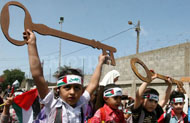
The picture at top is that of  young children in Palestine on Nakba day, holding large keys to symbolize the actual keys many Palestinian families continue to keep in their homes until the day when they are free to return to their original villages. It is from MIFTA.

Neve Gordon’s essay has also appeared in the Palestine Chronicle and Aljazeera

Posted in Media, Middle East Politics, Religion and politics | 12 Comments

Your Hard-Earned US Tax Dollars and Church Pension Funds at Work for Israel (With Update)

by James M. Wall

Monday Update:  

Hunger strike agreement reached

BETHLEHEM (Ma’an) — Detainees on Monday signed a deal with the Israeli prison authority to end their mass hunger strike, officials told Ma’an.

Prisoner representatives from each of the factions agreed to the deal in Ashkelon jail, prisoners society chief Qaddura Fares said in a statement.

Israel’s internal security service Shin Bet confirmed the deal, the Israeli news site Ynet reported.

Senior Hamas official Saleh Arouri, who was a member of the negotiations team, said Israel agreed to provide a list of accusations to administrative detainees, or release them at the end of their term.

In comments to the Hamas-affiliated news site Palestine Information Center, he said that under the Egypt-brokered deal Israel agreed to release all detainees from solitary confinement over the next 72 hours.

Israel will also lift a ban on family visits for detainees from the Gaza Strip, and revoke the “Shalit law,” according to the official.

The “Shalit law” restricted prisoners’ access to families and to educational materials as punishment for the five-year captivity of Israeli soldier Gilad Shalit in the Hamas-controlled Gaza Strip. Shalit was freed in October in a prisoner swap agreement.

Previously, published Saturday

Mass demonstrations in support of 2500 Palestinian hunger strikers swept through the West Bank this weekend.

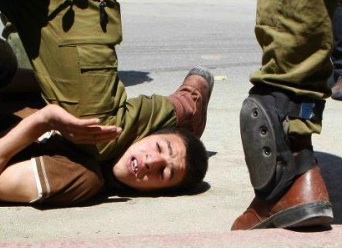
Marchers moved through the streets of Hebron, Kafr Qaddoum, Nablus, Nabi Saleh, Ni’lin, Ramallah, al-Walaja and outside of Ofer prison. The picture above was taken in Hebron.

It shows an Israeli soldier with his knee firmly planted on a young Palestinian’s neck.

The picture also shows how American tax dollars and church pensions are at work on this Mothers Day weekend, a commercially-driven event in which American teenagers and their families annually  honor mothers with gifts and family meals.

On this particular American Mothers’ Day weekend, a large contingent of  Palestinian teenagers joined their mothers and other family members to offer their support to prisoners on lengthy and dangerous hunger strikes.

Laura Kacere wrote in A Nation of Change, that Mothers Day had a different meaning when it was initially launched.  In fact, the Palestinian mothers who marched this weekend in support of hunger strikers, some of whom may have been their children, are demonstrating in a manner more akin to the original purpose of Mothers Day.

Mother’s Day began in America in 1870 when Julia Ward Howe wrote the Mother’s Day Proclamation. Written in response to the American Civil War and the Franco-Prussian War, her proclamation called on women to use their position as mothers to influence society in fighting for an end to all wars. She called for women to stand up against the unjust violence of war through their roles as wife and mother, to protest the futility of their sons killing other mothers’ sons.

Amira Hass, the Ha’aretz columnist who has watched Israeli duplicity at work for decades, explains how Israel makes use of  “administrative detention”:

Administrative detainees have been held without trial for years under emergency regulations inspired by the British Mandate. It’s not important. Hundreds of prisoners from the Gaza Strip haven’t seen their families for six or more years. Why should anyone care?

American tax-payers and church members should care. But do they?  The record is not good.

The Methodist General Conference ended its once-every-four-years confab in Tampa last week with a small step toward caring. They will not have this opportunity again for four years in a governance system first established in the early 1800s by John Wesley.

In their 2012 Conference the Methodists voted to call for a boycott of US companies supporting the occupation. They failed, however, to pass a specific divestment resolution removing church pension funds from three US corporations, Caterpillar, Hewlett Packard and Motorola Systems.

Why did the 2012 Methodists only hit .500?  The Methodist Board of Pensions and their allies roamed about the floor of the conference spreading the lie that divestment from these companies would threaten Africa University’s funding. Those prevarications were aimed at Central Conferences (overseas) delegates, who are very protective of their continent’s Methodist University.

There were even reports that some Methodist delegates were told they could be sued if they voted for divestment. Would church leaders act in this manner? Hard to imagine, but then, there have also been reports (a tape recording to be exact) that Mitt Romney cannot recall a teenage incident which his classmates insist involved young Mitt cutting the hair of a classmate suspected of being gay.

Now it is the Presbyterians’ chance to divest from three US corporations that support the Israeli occupation. Will they join the Episcopalians and urge tea and cookies with their local rabbis, or will they look more closely at how the Israelis are spending their pension funds?

Meanwhile, the Palestinian hunger strikes continue.

Why hunger strikes?  How else does a prisoner reach the outside world, at least that part of the outside world willing to look up from its tea and cookies long enough to notice?

There are currently 2,000 Palestinian inmates on a mass hunger strike in the Nafha, Ashkelon, Gilboa and other prisons around Israel. Amira Hass writes that it is “the very fact of their decision to refuse food and their willingness to risk being punished by the authorities [that] stands as a reminder of their humanity”.

The US public remains blissfully ignorant during this Mothers Day weekend that 2000 Palestinians hunger strikers, some near death, are refusing food to protest their treatment and their unfair and unjust incarceration.

The bulk of the Israeli public, safe and secure behind a massive Security Wall, remain largely indifferent to the strikers.

Amira Hass explains:

The Israel Prison Service does not have to make much of an effort to conceal this mass action from Israeli eyes. The great majority of Israelis label all incarcerated Palestinians as conscienceless murderers or common terrorists, at the least. They have little interest in acts of personal or collective courage on the part of Palestinian detainees that serve as reminders that they are human beings.

Richard Falk and Noura Erakat have written about the history of the Israeli use of administrative detention, which in case you have not noticed, is a practice the US Congress is currently planning to add to the American legal arsenal against its own citizens.

Administrative detention has constituted a core of Israel’s 1,500 occupation laws that apply to Palestinians only, and which are not subject to any type of civilian or public review. Derived from British Mandate laws, administrative detention permits Israeli Forces to arrest Palestinians for up to six months without charge or trial, and without any show of incriminating evidence. Such detention orders can be renewed indefinitely, each time for another six-month term.

Ayed Dudeen is one of the longest-serving administrative detainees in Israeli captivity. First arrested in October 2007, Israeli officials renewed his detention thirty times without charge or trial. After languishing in a prison cell for nearly four years without due process, prison authorities released him in August 2011, only to re-arrest him two weeks later. His wife Amal no longer tells their six children that their father is coming home, because, in her words, “I do not want to give them false hope anymore, I just hope that this nightmare will go away.”

Twenty percent of the Palestinian population of the Occupied Palestinian Territories have at one point been held under administrative detention by Israeli forces. Israel argues these policies are necessary to ensure the security of its Jewish citizens, including those unlawfully resident in settlements surrounding Jerusalem, Area C, and the Jordan Valley—in flagrant contravention of the Fourth Geneva Convention’s Article 49(6), which explicitly prohibits the transfer of one’s civilian population to the territory it occupies.

And how does the US government view the hunger strikes?

When one persistent journalist (identified as “Said”) demanded, politely, that US State Department spokesperson, Victoria Nuland, answer a question about the Palestinian hunger strikes, this is how Nuland handled his query, according to the transcript from the State Department:

QUESTION: Okay. And one – a couple more. On the Palestinian prisoner issue, I wonder if you are aware of the situation of striking – hunger striking Palestinian prisoners?

MS. NULAND: I don’t have anything for you on that, Said.

QUESTION: Well, do you have a position on the hunger strike of prisoners who have not been charged with anything and they have been held for a long time? They’ve gone today – their 70th day of a hunger strike. Thaer Halahla and many others, five others, are probably – are likely to – they could face – I mean, they could die in the next day or so. Would the United States Government take a position on that?

MS. NULAND: Well, let me take the question, Said, because frankly, I don’t have anything one way or the other. I don’t know if we have a comment on it.

QUESTION: Because, lastly, I mean, it – if something happens to these prisoners, it could be a flashpoint between Israelis and the Palestinians.

MS. NULAND: No, I understand the question. Let me take it, okay?

QUESTION: Thank you.

If, or when, a hunger striker dies in an Israeli prison, the US State Department will have an answer ready to go. It will express regret at the death and urge “all parties involved” to resolve their differences.

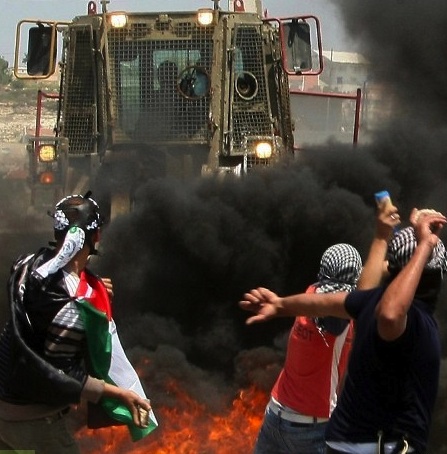
One “party” involved is the IDF, shown in action in the pictures above and below. In this picture, smoke makes it difficult to determine if the IDF vehicle is a Caterpillar product. Perhaps not, since it is smaller than the Caterpillar tractors that built the Wall, and continue to demolish Palestinian homes.

But there is no question that the battle between the rock-throwing teen aged Palestinians and their IDF enemy serves as a metaphor for a US and church supported occupation force and a defiant civilian population.

Karl-John N. Stone and Thomas A. Prinz have just written an article for The Christian Century magazine, “Invest, Not Divest” which argues just what the title suggests it would argue, a misguided solution which embraces a market faith rather than a religious faith.

Stone is assistant to the bishop in the Upper Susquehanna Synod (ELCA) in Lewisburg, Pennsylvania. Prinz is pastor at Holy Trinity Lutheran Church in Leesburg, Virginia. They ask:

What better way for the church to act as peacemakers than to engage in actual investment, building up Palestinian society and infrastructure, thereby helping to ensure a sound and viable sovereign state when a political solution is found and potentially hastening that political solution?

Stone and Prinz close their argument for “hastening that political solution” with this bit of capitalist stock market cheer leading:

The New York Times reported in February that the Palestinian Stock Exchange has been one of the best-­performing markets in the Arab world in recent years. In 2011, a year marked by great political upheaval in the region, the Palestinian exchange was second only to that of Qatar, falling only 2.58 percent over the course of the year.

The Times quoted Fayez Husseini, manager of Abraaj Capital’s $50 million Pales­tine Growth Capital Fund, as saying: “Strong stock market performance proves that these Palestinian companies are well managed, resilient and adaptive.”

They conclude their market-driven argument:

Investment moves churches beyond a black-and-white concept of justice and a conflict model of advocacy toward a model of empowerment and reconciliation. This move represents the best hope for churches to contribute to long-term peace and justice for Israelis and Palestinians.

Give our Lutheran brothers credit, they do offer us a choice between “a black-and-white concept of justice”, and “a model of empowerment and reconciliation”.

Prinz and Stone may think they are channeling Reinhold Niebuhr with that division. I suspect they are really channeling the Episcopal Church’s Presiding Bishop Katharine Jefferts Schori, who is quoted in their piece.

Speaking of quoting, there is no sign that Prinz and Stone discussed this matter with any Palestinians under occupation. They do cite the New York Times‘ quote from Fayez Husseini, manager of Abraaj Capital’s $50 million Pales­tine Growth Capital Fund.  But  that doesn’t count.

Next time Prinz and Stone offer advice to Palestinians, they might want to talk with Palestinian Baptist pastor, Dr. Alex Awad, who told Methodists when they were debating their divestment resolution:

“We are asking for divestment for our freedom, not investment to improve our lives in prison.”

The picture at top is by Mussa Qawasma. It was used in a Mondoweiss article by Allison Deger. The picture of the teen agers confronting IDF fire power is by Jaafar Ashtiyeh. It is from Agence France Presse  (AFP).

Posted in Middle East Politics | 13 Comments

Methodists Boycott Settlement Products

by James M. Wall

By a vote of 558 to 367, a strong majority of lay and clerical delegates to the United Methodist General Conference called this week for a boycott of Israeli companies operating in Occupied Palestinian Territories (OPT).

The resolution denounces the Israeli occupation and the settlements in a sweeping indictment.

It calls for “all nations to prohibit the import of products made by companies in Israeli settlements on Palestinian land.”

The resolution was focused specifically on the settlements, not on the state of Israel. It states:

“The United Methodist Church does not support a boycott of products made in Israel. Our opposition is to products made by Israeli companies operating in occupied Palestinian territories.”  

That was not an easy vote. It also was an important victory for anti-occupation forces in Tampa since it calls attention to one of three actions in the growing Boycott, Divestment and Sanctions movement that Palestinians have adopted as a non-violent way to attack the occupation.

The vote on a resolution calling for the UMC to divest its pension funds from three US Corporations, Caterpillar, Hewlett Packard and Motorola Systems, was brought to the floor on Wednesday afternoon.

That resolution was a long shot from the outset. It lost after a series of votes that  ended in a final 685 to 246 decision that the UMC would continue to finance the occupation.

One loss and one victory will prepare the United Methodist Church to take the next step in ending United Methodist support for the occupation. Like the segregated church it was until 1964, the United Methodist church can change.

In 1964, a United Methodist layman, W. Astor Kirk, demonstrated how that change can happen. His life story was distributed by United Methodist News Service after his death eight months ago. The full story may be found at the end of this posting.

Kirk and his fellow activists led Methodism out of the darkness of the “go slow” attitude which Martin Luther King, Jr., deplored.

Kirk suffered setbacks in his struggle against segregation within Methodism. Looking back on 1964, after a church union commission voted to continue the segregated conference for African Americans, Kirk wrote:

On the morning of May 5, 1964, when the Church Union Commission made its report … I was completely dumbfounded. My emotions ranged from deep anger to almost uncontrollable outrage to profound sorrow. I could not believe that as late as 1964 … the Church Union Commission would be so ethnically insensitive to the feelings of United Methodist Blacks that it would offer a repetition of the tragic mistake of 1939 [when the denomination adopted a segregated structure].”

This sense of outrage and anger is currently being felt by a new generation of United Methodists activists like Kirk as they proceed in 2012 to win some battles and lose others. They are planning for a long, and ultimately successful battle.

The United Methodist General Board of Church and Society, which Kirk once directed, and which is now under the direction of Dr. Jim Winkler, came to the 2012 Conference armed with resolutions from six difference annual conferences.  They came prepared.

These UMC anti-occupation leaders coupled a boycott resolution that lacked specificity, with a divestment resolution that named names. They hoped to win on both resolutions, but they knew they could lose one or both.

The boycott resolution passed, while the divestment resolution lost. But the open discussion that followed the introduction of both resolutions exposed the issue to the wider church and to the secular public in ways that Israel does not appreciate.

None of this is really a political debate over money. It is a media war with a moral bite, a public image struggle which Israel is desperate to win and which they most certainly lost in Tampa, in spite of all the spinning by Israel’s US allies.

A boycott is a recommendation to members and churches and a moral call to the larger public. Divestment, even in the comparatively smaller sums involved in the national church’s investment funds, is the greater danger to Israel’s image. Think apartheid and South Africa.

During the heated debate over the UMC pension divestment from three corporations, speakers defending Israel warned that the Methodist church might be subject to law suits for choosing to move funds from one company to another.

That is patently false, of course, but political speeches in secular and religious circles are the same; they are designed to deceive and distort. And Methodists do like to protect the bottom line.

Then there is the matter of finally voting on a resolution. Delegates arrive at the every-four-years gathering after being elected  to represent their regional conferences; they sit together under the watchful eye of their presiding bishop, men and women with the power to transfer preachers to larger–or smaller–churches once a year.

Lay delegates also arrive after achieving personal standing in church affairs back home. Unofficial racial and age  categories are in play, though unlike the Democratic political conventions, the categories are not mandated.

But these lay delegates do reflect the perspective of the communities where they live. Imagine an attorney from a small Georgia town returning home to tell his clients he just voted to endorse same-sex marriage.  You get the picture.

The divestment vote was always a long shot.  Consider the regions–annual conferences they are called–that sent the original divestment resolutions to the General Conference: California-Pacific, Minnesota, Northern Illinois, West Ohio, New England, and Baltimore-Washington.

None of these are from what became known after the 2008 General Election as “red states”. They are all from the eastern, mid-western and far western, sections of the country, states that were called “blue states” after the election of Barack Obama.

The United Methodist Church is not a monolithic body. It is a collection of small units of churches, organized by states or sections of states, ruled over by a bishop.

The rest of the assembled 600-plus representatives backed down from supporting a strong resolution that would have divested the church’s pension funds from three US corporations, Caterpillar, Hewlett Packard and Motorola Systems, each of which is deeply involved in supporting Israel’s occupation of the West Bank, Gaza and Jerusalem.

That resolution failed after an afternoon of heated passionate speeches, and a set of parliamentary maneuvers that never gained more than 372 votes from the almost 1,000 delegates present.

By a resounding victory of 685 to 286, the Conference endorsed the UMC’s financial committee resolution which was the final shameful expression by the heirs of John Wesley that wanted to continue to embrace Israel’s theft of the land promised them back in the dim days of biblical history.

I checked with several attorneys. They assured me that there is not a court of law in the United States that would honor a biblical promise as a legal claim.  But there they were, the occasional UMC delegate, embracing that concept and voting against divestment.

Of course, not every vote against divestment came from biblical literalists. But at least one literalist got on to the floor during the debate and embraced the promise as a reason to support the occupation.

Wednesday would have been a dark day for Methodism, except for the smart move by anti-occupation delegates to add a boycott resolution to the Conference docket. The side favoring the end of occupation won one, a step forward in what is still a long journey.

Organized religion is, by definition, cautious and distressingly slow. Consider the Catholic Church, still ruled by a Pope in Rome, with rules that bar female clergy and beliefs that are far behind progressive views of human sexuality.

But as this General Conference proved, progress is possible, even in slow-moving established church bodies. Eight years ago the occupation would not have been part of the floor debate. And eight years ago, resolutions counter to the conventional and cautious attitude toward Israel would have been relegated to the final hours of the Conference where time demands would have rushed through meaningless substitute resolutions.

In 2012, a boycott resolution prevailed. A small number of church leaders and conference lay and clerical delegates found a far more receptive gathering of 1000 delegates than has ever been the case in previous General Conferences.

This slowly moving decision-making body has begun to listen to those willing to defy the majority.

All of which calls to mind an earlier United Methodist layman, and a friend of mine, W. Astor, “Bill”, Kirk, an African American church leader who made himself a courageous agitator until the Methodists finally broke the shackles of institutional racial segregation.

His story is that of a Methodist hero who saw evil for what it was and would not give up until his church agreed with him.

Bill Kirk was 89 when he died on August 13, 2011. He had served as a director of the public affairs department of the Board of Church and Society of The United Methodist Church from 1961 to 1966 and as the board’s interim top executive in 1987 and 1988.

It is this board, now directed by Jim Winkler, which was a sponsor of the divestment resolution that was presented to the 2012 General Conference just eight months after Kirk died.

In a story prepared for United Methodist News after Kirk’s death , the Rev. Dean Snyder wrote,”Bill Kirk played an historic role in ending institutional segregation in The United Methodist Church.”

Kirk’s story is that of an African-American layman determined to teach and lead his fellow Methodists to understand the evil of racial segregation.

His story, as it is told by Snyder, needs to be read in full as the 2012 United Methodist General Conference adjourns. Keep in mind that the US Supreme Court unanimously declared segregation illegal on May 15, 1954, in Brown vs. the United States.

In 1960, while serving as a professor at Huston-Tillotson College in Austin, Texas, [Kirk] was elected secretary of the Committee of Five, a group established by the Central Jurisdiction of the Methodist Church with a mandate to end racial segregation within the denomination. The Central Jurisdiction was a structure created in 1939 to segregate African-Americans within the Methodist Church.

Overcoming discrimination was a fight he knew well. He had earned a doctorate in political science at The University of Texas at Austin — the university’s first Ph.D. awarded to an African-American.

Kirk wrote numerous papers and studies for the committee analyzing the history of segregation within the denomination and recommending strategies for ending it.

He took a decisive step against institutional racism during a discussion concerning the merger of the Methodist and Evangelical United Brethren denominations at the 1964 General Conference of the Methodist Church.

Kirk, serving as an alternate delegate, moved an amendment to the proposed plan of merger, which included the continuation of the segregated church. Kirk’s amendment asked that “the Central Jurisdiction structure of the Methodist Church not be made a part of the Plan of Merger.”

In his autobiography, Kirk wrote: “On the morning of May 5, 1964, when the Church Union Commission made its report … I was completely dumbfounded. My emotions ranged from deep anger to almost uncontrollable outrage to profound sorrow. I could not believe that as late as 1964 … the Church Union Commission would be so ethnically insensitive to the feelings of United Methodist Blacks that it would offer a repetition of the tragic mistake of 1939.”

After lengthy debate, the motion, known as “The Kirk Amendment,” passed 464 to 362, establishing the denomination’s commitment to end institutional segregation.

After the 1964 General Conference, when the chair of the Committee of Five, the Rev. James S. Thomas, was elected a bishop, Kirk was elected its new chair. As chair of the Committee of Five, he helped negotiate the mergers of the Delaware and North Carolina-Virginia annual conferences of the Central Jurisdiction with overlapping annual conferences.

In 1965 when southern church leaders argued before the denomination’s Judicial Council that Jurisdictional Conferences had the right to preserve segregated conferences within their boundaries, Kirk took a three-month leave of absence from the Board of Church and Society to prepare a brief arguing that the denomination did have the authority to end segregated conferences. In his brief and oral argument, Kirk argued that the issue of segregation had become a “distinctively connectional matter.”

The Council’s 1965 Judicial Decision No. 232 states: “We have no doubt that the creation of a racially inclusive church is now a matter ‘distinctively connectional’.

In due course, a future Judicial Council (the church’s “Supreme Court”) will rule that the “issue of funding the occupation is a distinctively connectional matter.”

Bill Kirk would be pleased.

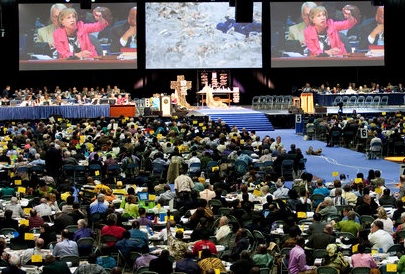
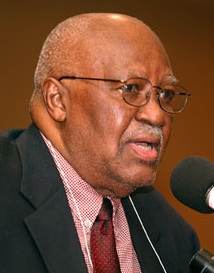
The picture of W. Astor Kirk, above, is from United Methodist News Service. The picture of the UMC General Conference was taken by Edward Linsmier for the New York Times.

Posted in Media, Middle East Politics, Politics in Religion, United Methodist Church | 16 Comments

Methodists Delay Vote Until Later This Week

by James M. Wall

The United Methodist Church has delayed a vote on a resolution on divestment from three US companies which “aid and abet”* Israel’s occupation of the West Bank and Gaza.

The vote was initially set for Tuesday, but has been delayed until later this week.  There is speculation among General Conference delegates in Tampa, that a move will be made to limit debate on the final resolution to two short speeches on each side.

Supporters of divestment are hopeful they will prevail. Prominent Palestinian visitors have made convincing speeches in meetings around the Conference. The outcome, however, remains uncertain.

Meanwhile, while we wait, let us use our time creatively by pondering another vote scheduled in the US in November.

That would be the election between the incumbent US President, Barack Obama, and the presumed Republican nominee, Mitt Romney.  That election offers an ominous connection to the resolution process currently facing  United Methodist delegates in Tampa.

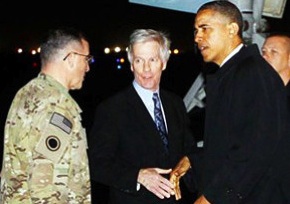
The November election campaign has begun. President Obama made a surprise trip to Afghanistan overnight Tuesday where he was greeted by US Ambassador Ryan Crocker and Lt. General Mike Scaparrotti, Deputy Commander of U.S. Forces in Afghanistan. (picture above.)

The President addressed an American television audience from an American air base in Kabul, Afghanistan, Tuesday night. He said that he had “traveled here to herald a new era in the relationship between the United States and Afghanistan, “a future in which war ends, and a new chapter begins.”

In Kabul, Obama signed a ten-year strategic partnership agreement with Afghanistan. That agreement has been the subject of extended discussions over the past several months.

No doubt, the trip was also designed to bring attention  to the one year anniversary of the successful US removal of Osama bin Laden from the political scene.

Monday, presumptive candidate Romney, eager to downplay the one-year anniversary, exposed his gross ignorance of the politics of the Middle East in an off the cuff response to a journalist’s question about  bin Laden.

His quick response, while shaking hands with supporters, was a flippant remark about former President Jimmy Carter.

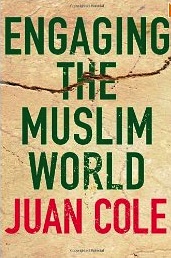
His comment was too much for one of America’s leading Muslim authorities, Juan Cole, who blogs at Informed Comment. Cole, author of  Engaging the Muslim World,  is a Professor of History at the University of Michigan.

Professor Cole wrote on his blog:

“Mitt Romney said Monday that of course, he would have taken out Bin Laden and that “even Jimmy Carter would have made that call.’

Since Jimmy Carter ordered a brave and risky but failed military mission into Iran, that was a cheap shot on the part of someone who has never had anything to do with the military.

Moreover, Jimmy Carter made peace between Egypt and Israel and played a major role in reducing the number of Africans stricken by the Guinea worm from 3.5 million to 1,100. So Romney, who has mainly been sending our jobs overseas, isn’t good enough to shine Carter’s shoes.”

Cole is not a partisan politician. He is a careful, passionate scholar. But he is obviously worried about the 2012 presidential campaign, which could lead to a President Mitt Romney. In his blog, Cole offered this Romney gem from a Republican primary debate in 2007:

Romney: We’ll move everything to get him. But I don’t want to buy into the Democratic pitch that this is all about one person — Osama bin Laden — because after we get him, there’s going to be another and another.

This is about Shia and Sunni. This is about Hezbollah and Hamas and Al Qaida and the Muslim Brotherhood. This is a worldwide jihadist effort to try and cause the collapse of all moderate Islamic governments and replace them with a caliphate.

They ultimately want to bring down the United States of America.

Mull over the political ignorance and simplicity exposed in that comment. To Romney, Muslims are all alike, “Shia and Sunni, Hezbollah and Hamas and Al Qaida and the Muslim Brotherhood.’

There is more from Tuesday ‘s blog posting from a clearly agitated Professor Cole as  he considers the presence of  a President Romney in the White House:

The real problem with Romney is not that he would not have taken out Bin Laden. It is that he sees the Muslim world as in the grip of a congeries of pan-Islamic Caliphate movements against which he wants to wage a Mormon jihad with trillions of dollars of taxpayer money.

But in fact almost none of the movements he mentions has anything to do with al-Qaeda or a Caliphate. Romney supported Hosni Mubarak to the hilt and opposed the Arab Spring. He doesn’t understand the youth movements sweeping the Arab world. He lumps all kinds of unrelated, and changing, Muslim movements together with al-Qaeda.

He doesn’t even seem to understand that if he works to get rid of the al-Assad regime in Syria, he likely will be bringing the Muslim Brotherhood to power there, one of the groups he is sworn to fight as fiercely as he would Bin Laden.

The problem with Romney is that when it comes to the Muslim world, he doesn’t have the slightest idea what he is talking about, and seems intent on alienating 1.5 billion Muslims, a fifth of the world. He wanted to substitute a crazy conspiracy theory for a tactical approach to getting Bin Laden and the al-Qaeda leadership.

In this regard, the Obama campaign has correctly nailed him, but they haven’t gone far enough in emphasizing the truly creepy character of his [Romney’s] obsession with Muslims in general, far beyond the fringe al-Qaeda element.

How does this political campaign resonate with the United Methodist General Conference?

As a start, the two issues are joined with strong feelings on each side.

Delegates to the General Conference prepared a divestment resolution to submit to the committee responsible for considering financial matters. The resolution had been developed from resolutions from several national agencies and seven regional conferences.

The divestment resolution offered a small step toward supporting Palestinian freedom from Israel’s occupation. The resolution was narrowly focused to avoid entering a complex political issue with a simplistic solution.

As submitted, the resolution says:

The 2012 General Conference calls on The United Methodist Church to end its financial involvement in Israel’s occupation by divesting from companies that sustain the occupation.  The 2012 General Conference:

*calls for all United Methodist general boards and agencies to divest promptly from Caterpillar, Motorola Solutions, and Hewlett Packard until they end their involvement in the Israeli occupation. These companies have been engaged repeatedly by the United Methodist general agencies, boards and annual conferences on this issue.”

Unlike Candidate Romney, there was no off-handed display of ignorance. Instead, the resolution was a forthright request that United Methodist pension funds be withdrawn from three US companies which had refused to cease participating in the occupation.

The response from the financial committee–I kid you not, gentle readers–was to gut the original and deliver to the General Conference a resolution that sounds familiar from previous Protestant “go slow” resolutions:

The 2012 General Conference calls on the General Board of Pensions and Health Benefits to explore serious peacemaking strategies in Israel and Palestine, including positive economic and financial investment in Palestine.

Delegates who shaped the original divestment resolution promptly brought back their original resolution as a minority report. The conflicting resolutions, the Financial Committee solution–invest in Palestine, not divest from Israel’s occupation–and he original divest resolution, will do battle later this week.

President Jimmy Carter, by the way, has expressed his support for the original divestment approach. He is a Southern Baptist, which means he is not in attendance at the United Methodist General Conference. But his spirit remains with the divestment delegates.

Back on the political campaign trail, Mitt Romney continues with his personal attacks on President Obama, while the President uses Air Force One and his bully White House pulpit to strike back.

We can look forward to a long and  hot summer of shallow charges and counter charges designed to play on the emotions of competing factions.

And, oh yes, don’t forget to prepare for the next national religious gathering where another divestment resolution (citing the same three US companies) will be considered by the Presbyterian Church in the US.

The Episcopal Church will meet later this summer in its national gathering. Thus far, there is no sign that a resolution on divestments will trouble the Episcopal Church’s sedate waters.

The photograph above of President Obama arriving in Afghanistan, is from the AOL home page.

*–The term “aid and abet”, used in the opening paragraph above, is defined by West’s Encyclopedia of American Law, as

“To assist another in the commission of a crime by words or conduct. The person who aids and abets participates in the commission of a crime by performing some Overt Act or by giving advice or encouragement. He or she must share the criminal intent of the person who actually commits the crime, but it is not necessary for the aider and abettor to be physically present at the scene of the crime. An aider and abettor is a party to a crime and may be criminally liable as a principal, an Accessory before the fact, or an accessory after the fact.”

Posted in Middle East Politics, Obama, Politics and Elections, Presbyterian Church USA, Religion and politics, United Methodist Church | Tagged , , | 9 Comments

Methodists Face Moment of Occupation Truth

by James M. Wall

The mainstream media does not know it, and far too many high steeple church folk do not want to know it.

But in Tampa, Florida, this week, the General Conference of the United Methodist Church will make a decision.

They will spend the week writing and rewriting. Some, like  Alissa Bertsch Johnson, a campus minister at Washington State University (at right), will passionately state their case.

Before the gavel falls on the last session of the 2012 General Conference, the people called Methodists will have responded, one way or another, to the call from Palestinian Christians that they take one small step toward ending the Israeli Occupation.

They may vote to endorse a targeted divestment resolution.

Or, they may declare that such action is not needed, forgetting that in doing so, they follow the path of those segregation-tolerating Birmingham church leaders who wrote to Martin Luther King, Jr., in words to this effect, “it is too soon to attack this evil. We must wait until our people are with us.”

A half century since King died in his battle with the evil of racism, we are still waiting for the end of  yet another manifestation of racism, one which continues to be tolerated, and even worse, financially sponsored, by the spiritual heirs of those earlier Birmingham church divines to whom King wrote his historic letter from a Birmingham jail.

In Martin Luther King, Jr’s, time, the “go slow” church leaders tolerated the evil that was in Selma, Alabama, the suburbs of Chicago, and the dark, frightening country roads of Mississippi.

In our time, “go slow” religious leaders refuse to see the evil of a so-called security barrier, a wall built not for Israel’s security, but as a land-stealing, prison enclosure, of the Palestinian people.

The “go slow” church leaders, and the parishioners they lead, choose not to acknowledge that the evil of Selma, Alabama, the South Side of Chicago, or the country roads of Mississippi, are still with us in Palestine where US church funds are used to build and maintain an Occupation.

The final United Methodist divestment vote will involve a resolution that instructs the church’s financial managers to divest from three American corporations that have refused to cease from profiting from the Occupation.

Israel’s supporters who have infiltrated the United Methodist legislative body, both as delegates and observers, are waging the divestment effort with half truths and outright lies, the same tactic used by secular politicians for whom  truth-speaking is an unknown language.

During the first week of the General Conference, delegates met in committees and sub committees to hassle over the wording of the final resolution. Occupation supporters want language in the resolution they can spin in their favor.

Above all, they want to remove the term “divestment”, which evokes the image of Israel as a modern day South Africa. In the past, one way to avoid this image is to employ evasive language like “constructive engagement”.

The winner of the resolution game will be the side that can spin the final action with its own special twist that produces a victory headline.

No matter how you spin it, as James Carville once said in an earlier political conflict, “its the Occupation, stupid”.

Opponents of the divestment resolution claim the church is endorsing a “boycott” of Israel. On the contrary, this resolution has nothing to do with boycotting. It is a divestment resolution that controls how the church invests its own funds, period.

Remember well the names of the three corporations which refused to listen to those for whom “going slow” has meant a continuation of humiliation and suffering.

They refused to listen to the case delegations of United Methodists have made to them to stop supporting the Occupation. Call this step, the failure of “constructive engagement”.

After several of these failed efforts to persuade the three corporations to cease and desist from  causing the suffering of others, activist United Methodists decided  to write specific divestment resolutions.

These resolutions were debated in local churches, then taken before regional conferences, and finally, this week, presented  to the United Methodists’ highest legislative body, the General Conference.

The three US corporations targeted by this resolution are Caterpillar, Hewlitt Packard and Motorola, each of whom heard the pleas for support from Palestine, and hearing, passed by on the other side of the road.

United Methodists cannot halt the brutalization of the Palestinian people carried out by the Occupation.

Nor can they end the downfall of the state of Israel, a downfall most certain to take place unless this illegal and inhumane Occupation ends. No one knows this better than Jews who love Israel and hate what the Occupation does to both the Israelis and Palestinians.

Look not to the mainstream media for news of the internal conflict within world Judaism over this issue. Go instead to the internet and foreign media, and there you will find that the conflict is joined.

A respected Jewish writer and former New Republic editor, Peter Bienart, wrote a book he called The Crisis of Zionism, a plea for Israel to wake up from its nightmare of Palestinian oppression. He was viciously attacked by  neo-conservatives and right-wing Jews.

Ha’aretz knows that New York Times columnist and Nobel Prize winner Paul Krugman steers clear of  this topic. His speciality is economics, not politics. But Ha’aretz reported a blog comment from Krugman which revealed his support for Beinart.

Paul Krugman believes that the policies of the current “narrow minded” Israeli government “are basically a gradual long-run form of national suicide.”

Writing in his New York Times blog “Conscience of a Liberal” about Peter Beinart’s controversial book The Crisis of Zionism, Krugman writes, “Like many liberal American Jews I basically avoid thinking about where Israel is going.

It seems obvious from here that the narrow-minded policies of the current government are basically a gradual, long-run form of national suicide – and that’s bad for Jews everywhere, not to mention the world.”

The battle also rages within the highest Israeli political circles.

Ha’aretz reports that former Shin Bet chief Yuval Diskin harshly criticized Prime Minister Benjamin Netanyahu and Defense Minister Ehud Barak on Friday during a meeting with residents of the city of Kfar Sava, Israel.

Diskin said the pair “is not worthy of leading the country”.

“My major problem is that I have no faith in the current leadership, which must lead us in an event on the scale of war with Iran or a regional war,” Diskin told the “Majdi Forum,” a group of local residents that meets to discuss political issues.

He also addressed the issue of racism in Israel.

“Over the past 10-15 years Israel has become more and more racist. All of the studies point to this. This is racism toward Arabs and toward foreigners, and we are also become a more belligerent society.”

Why do United Methodist delegates have to ponder more than a few seconds to realize that for the UMC to continue to support Israel’s Occupation with church funds, places the denomination on the wrong side of  the battle for Israel’s soul.

Israeli blogger Larry Derfner writes a post this week, “Israelis are living in a fear society, not a free society”, which is another reminder that the Occupation is not in the best interest of either Israelis or Palestinians.

Enabling a “fear society” is not the way American religious communities can best serve the cause of either peace or justice.

British Parliamentarian William Wilberforce, whose political activism had been influenced by John Wesley, did not end slavery, but he did finally persuade  the British Parliament to end the slave trade from British seaports.

It took him several decades to end the trade. During those decades, many slaves were transported to America from Africa as the British Parliament followed the political “go slow” policy in which evil flourishes.

American politicians, bought and paid for by forces that reward them for their absolute loyalty to the current right-wing Israeli government, have closed their minds, and most certainly, their hearts, to the injustices of the Occupation.

One day, when these politicians look back on their period of political service, they may recognize the evil they sponsored.  And one day, when United Methodist delegates to the 2012 General Conference look back on how they voted on the divestment resolution, they will realize how their vote will follow them into the Hereafter.

And there, I truly do hope they will be invited to one of Brother John Wesley’s heavenly society meetings where they will be confronted by the reality of the evil Occupation they tolerated for the sake of what they liked to call, “the delicate fabric of interfaith relations”.

What Wesley will say to them about that delicate fabric is chilling to contemplate.

A good preparation for watching how the United Methodist General Conference delegates will conduct themselves in the week ahead, is to spend some time attending to a 25 minute newscast discussion produced by Al Jazeera.

You will find appearances by former President Jimmy Carter, two Jewish panelists, Max Blumenthal and MJ Rosenberg, and Walt Davis, a major leader in the Presbyterian Church, the second Protestant denomination to vote on a divestment resolution during their national meeting this summer.

In his brief appearance at the start of the newscast, President Carter corrected the Al Jazeera host who surprisingly used the lie that Israel wants the world to hear, “boycott”, in describing the United Methodist and Presbyterian resolutions, neither of which use the term.

Carter points out, in his careful manner, that the two denominations are calling on their own leaders to divest from three US corporations. He quietly notes that they are not calling for a boycott of the Israeli economy. It is obvious that Carter follows this issue closely.

Click on the screens below to view two videos. Watch them in segments, if you prefer. But watch them.

The picture at the top of this posting of Alissa Bertsch Johnson, a campus minister at Washington State University, is from the United Methodist News Service.

Posted in Middle East Politics, Politics in Religion, Presbyterian Church USA, Religion and politics, United Methodist Church | 8 Comments

“Throw Their Dirty, Filthy Ships Out of the Water!”

by James M. Wall

“Throw Their Dirty, Filthy Ships Out of the Water!”

In the 2006 movie, Amazing Grace, John Newton shouts these words at William Wilberforce, a member of Parliament who was the leader of  a 19th century fight to  force the British government to bar British ships and ports from participating in the slave trade.

The “dirty, filthy ships” to which Newton refers are slave ships which sailed from England to Africa and then to the New World.

Newton (Albert Finney) delivers his demand to his younger friend Wilberforce (Ioan Gruffudd) at a time when the younger man was faltering in his struggle against pro-slavery members of  Parliament

This conflict is captured in precise and dramatic detail in the film, as Wilberforce and his allies in the Parliament, and from anti-slavery groups, visit slave ships and meet with former slaves.

John Newton had been the owner and captain of one of those ships. Following a major storm in the Atlantic that almost sank his ship, Newton repented of what he knew was a great sin, the mistreatment of fellow human beings.

Newton returned to England to become what he later termed, “an old preacher”.  He also wrote hymns, the most famous of which was Amazing Grace, which contains the line, “I once was lost but now I am found, was blind, but now I see”.

Newton had known Wilberforce for many years, constantly encouraging him to continue his long struggle to bar all slave ships from English ports.

Pro-slavery members of Parliament resisted Wilberforce’s demand to end the slave shipping trade. Their reasons? The practice provided economic benefit to England, while other   members maintained that slaves were content with their lot. The more extreme opponents with whom Wilberforce had to contend, made the argument that slaves were sub-human.

Britain had never permitted slavery within its borders.  Any slave who landed in Britain was immediately set free.

Slavery was permitted  in overseas British territories until Parliament passed the Act of Abolition in 1833, abolishing slavery in all British territories.

There was little demand for slaves in England. There was, however, considerable demand for slaves to work on Britain’s large farming plantations in the territories.

Amazing Grace, directed by Michael Apted, traces the friendship of Wilberforce and Newton.  It also examines Wilberforce’s growth as a political leader, and not so incidentally, as a friend of William Pitt, his friend who became Prime Minister at the age of 24.

Pitt was a cautious politician. He was also a supporter of Wilberforce’s idealism. Another important historical figure who is not portrayed in the film, is John Wesley

When I revisited the film this week, less than a week before the United Methodist Conference opens, I was struck by a historical parallel, and most especially, I was moved by Newton’s violent outburst to Wilberforce. (Click on the video at top to see a trailer for the film, Amazing Grace. The full length film is available on DVD.)

I found myself thinking, we are well past time to “throw this dirty, filthy Occupation out of United Methodist waters”.

Of course, historical parallels are never exact. But it is not unusual for us to see moments from the past resonating with moments of the present.

The current Israeli Prime Minister, Benjamin Netanyahu, is never reluctant to link the Holocaust as a moment in time which constantly threatens to reappear whenever a political action fails to go to his liking.

The matter of Iran’s alleged development of nuclear arms, is a case in point.

I find sufficient evil in Israel’s Occupation to justify a connection between Britain’s 19th century approval of slavery, on economic grounds, and the American support of an Israeli Occupation which continues to imprison the Palestinian population.

On Tuesday of this upcoming week, April 24, the United Methodist Church (UMC) begins its ten-day Quadrennial General Conference (GC) in Tampa, Florida.

High on the legislative agenda of GC is a resolution, Aligning United Methodist Investments with Resolutions on Israel/Palestine.

Contrary to the many deliberately misleading descriptions of this resolution, it is designed to do exactly what it says in its title, “align its church investments with previous resolutions on Israel/Palestine”.

The divestment resolution does not call for a boycott of the state of Israel. It is narrowly focused,  an internal church document which mandates that the church’s financial managers (the General Board of Pensions) divest all church fund investments in three American companies that directly support Israel’s occupation of the Palestinian West Bank.

The three companies are Caterpillar, Hewlett Packard and Motorola, a specificity that emerges from more than eight years of study, dialogue with these companies and considerable debate in local “annual conferences”, many of which sent their own versions of the divestment resolution to the GC.

The process is quite methodical, appropriately enough, for a denomination that mirrors the practices of the 18th century Methodist societies which were derisively labeled “methodists” by the Anglican hierarchy, which branded “methodists” as outliers to the established Church of England.

It was this Church that, among other things, banned John Wesley from pulpits of the Church of England, the body in which John and his brother Charles Wesley (author of many hymns) were ordained.

This led the Wesleys to take to fields and tree stumps to proclaim a fresh, new message of salvation and methodical practices that emphasized discipline,  personal spiritual growth and social action against sin.

The Wesley brothers instructed their followers to see the Christian faith as an instruction manual for social justice, including Wesley’s strong opposition to the immoral practice of slavery.

Wesley despised slavery. He also knew the work of Wilbur Wilberforce and had followed his career as a politician fighting an uphill battle against the evils of slavery.

The last letter that John Wesley wrote before his death in 1791, was to William Wilberforce, who earlier had been converted under Wesley’s ministry.

Wesley wrote to Wilberforce on February 24, 1791, eight days before Wesley’s death on March 2, 1791. The letter encourages Wilberforce to continue his fight against slavery.

The letter begins with a Latin phrase, Athanasius contra mundum, which translates as “Athanasius against the world”.

Wesley was a theologian to the end. Even in his final letter, he could not resist recalling one of his favorite themes.

Athanasius of Alexandria (c. 296-373 AD) was a early church father who was a vigorous opponent of Arianism (an early Church heresy that taught that Jesus was a subservient and created being).

Here, in its entirety, is Wesley’s final written words, addressed to William Wilberforce:

Dear Sir:

Unless the divine power has raised you us [sic] to be as Athanasius contra mundum, [emphasis added] I see not how you can go through your glorious enterprise in opposing that execrable villainy which is the scandal of religion, of England, and of human nature.

Unless God has raised you up for this very thing, you will be worn out by the opposition of men and devils. But if God be fore you, who can be against you? Are all of them together stronger than God? O be not weary of well doing! Go on, in the name of God and in the power of his might, till even American slavery (the vilest that ever saw the sun) shall vanish away before it.

Reading this morning a tract wrote [sic] by a poor African, I was particularly struck by that circumstance that a man who has a black skin, being wronged or outraged by a white man, can have no redress; it being a “law” in our colonies that the oath of a black against a white goes for nothing. What villainy is this?

That he who has guided you from youth up may continue to strengthen you in this and all things, is the prayer of, dear sir,

Your affectionate servant,
John Wesley

I propose no firm historical linkage between slavery and Occupation, but I do propose a linkage between the demand for action called for by John Newton against slavery, and the passage of a divestment resolution by United Methodist General Conference delegates as a 21st century demand for the UMC to halt its financial support of Israel’s occupation of the Palestinian people.

It is well past time to “throw this dirty, filthy Occupation out of United Methodist waters”.

The clip from the film Amazing Grace, may be found at http://www.amazinggracemovie.com/ .

Posted in Middle East, Middle East Politics, Movies, Religious Faith, United Methodist Church | 15 Comments

Does Israel Interfere in US Elections?

by James M. Wall

Israel’s ambassador to the US, former American citizen Michael Oren, (at right) trotted out a classic Zionist strategy when he sent a letter to the New York Times  denying that Israel is “interfering” in the American presidential campaign.

Oren’s letter was reported in the Israeli newspaper Ha’aretz on April 12, under the headline:

“Israeli ambassador to New York Times: Netanyahu does not interfere in U.S. elections”

This Ha’aretz headline was followed by a sub headline, stating:

Michael Oren, Israel’s ambassador in Washington, submits letter to the editor to NYT, complaining about  an article detailing the close relationship between Netanyahu and likely Republican presidential nominee Mitt Romney.

The problem with Oren’s attack is that the Times story did not use the term “interfering”. The ambassador denies something the story does not claim.

Oren’s letter skillfully ignores the facts of the story under a theoretical cloud of his own making. He also manages to bring attention to his Israeli public to a story which promises good things ahead if Romney is elected.

The facts of the Times story which Oren distorts are that Prime Minister Benjamin Netanyahu and Republican presumptive presidential nominee, Mitt Romney, have a long-standing personal relationship.

The implication of the Times story is that if Romney is elected US president, the Israeli Prime Minister will have a pal in the White House. To Israelis and to Israeli loyalists in the US, this is good news.

By calling attention to the story with his faux outrage, the Ambassador is playing the role of police official Captain Renault (Claude Rains) who confronts his friend, nightclub owner, Rick (Humphrey Bogart) in the 1942 World War era film, Casablanca.

Captain Renault tells Rick he will close his club.

Rick: How can you close me up? On what grounds?
Captain Renault: I’m shocked, shocked to find that gambling is going on in here!
[a croupier hands Renault a pile of money]
Croupier: Your winnings, sir.
Captain Renault: [sotto voce] Oh, thank you very much.
[aloud]
Captain Renault: Everybody out at once!

Of course the Israeli government interferes in US politics and the presidential race is the big kahuna. Israel’s domestic US warriors, led by the heavy-hitters from AIPAC, are deeply embedded in the 2012 elections.

Ambassador Oren knows it; everyone who pays attention knows it. But like the nuclear arsenal Israel has built in the Israeli desert, the media and politicians do not speak of it. They do not want to be branded as anti-Israel.

Who better than an American-Israeli academic turned government official than Michael Oren, to carry Israel’s cause into US domestic politics even as he does not speak openly of the patently obvious.

Why is Michael Oren a natural for his job as ambassador?

A flattering Times profile of the new Ambassador described his background when he was appointed in September, 2009.

Born in upstate New York, raised in suburban New Jersey and educated at Columbia and Princeton Universities, Mr. Oren considers himself genuinely American.

But having lived most of his adult life in Israel — serving multiple tours in the Israeli Army, once as a paratrooper during the 1982 Lebanon war — he also considers himself genuinely Israeli.

Prime Minister Netanyahu, who also spent parts of his youth in the US, chose Oren for his new position for moments like this one, as the presidential race is finally narrowed down to Obama versus Romney. 

Oren’s training for this post began in childhood.

The Times profile looks back to those early formative years:

Mr. Oren’s fervent Zionism dates from his childhood, though it was hardly inevitable. He grew up as Michael Bornstein in a conservative, but not politically active, family in West Orange, N.J. His father was the director of Newark Beth Israel Medical Center.

At 15, Mr. Oren told his parents he wanted to move to Israel to work on a kibbutz. His parents were aghast, but they did not stop him when he talked his way into a job on an alfalfa farm, even though he was two years shy of the minimum age.

A job as a cowboy on the Golan Heights followed, as well as athletic glory as an oarsman in the Maccabiah Games, where thousands of Jewish athletes from around the world compete every four years.

Steeped in the double speak of US politics, the Ambassador is skilled at the classic political tactic, which Zionist operatives have long utilized, of denying facts that do not exist, and then diverting attention from those manufactured facts to a different topic.

I once worked for a charming editorial director who had his own unique style in pursuing the same tactic.

Faced with unpleasant facts he would say, “What else do you want to talk about?” As the boss, he set the agenda, especially when he spoke with younger underlings.

Ambassador Oren had to renounce his American citizenship to accept his appointment as Israel’s man in Washington. Was that difficult?  You be the judge.

This is how Oren explained his decision in the 2009 Times profile by Mark Landler:

For Michael B. Oren, the hardest thing about becoming Israel’s ambassador to the United States was giving up his American citizenship, a solemn ritual that involves signing an oath of renunciation.

He said he got through it with the help of friends from the American Embassy in Tel Aviv who “stayed with me, and hugged me when it was over.”

After those reassuring hugs in Tel Aviv, newly recruited Israeli citizen Oren has dutifully adhered to whatever script his Tel Aviv bosses dictate, which is what an ambassador is supposed to do.

Oren’s background and his intense loyalty to his new country, provide the right mix of Zionism and American savvy which Israel needs as pressure builds on Israel to finally embrace the democratic ideals it claims to possess.

Ambassador Oren has yet to weigh in on the German Nobel prize winning author Gunter Grass episode.

But rest assured, if Time and Newsweek had not adhered to the Zionist script when reporting on the “furor” over the Grass poem, This Must be Said, Oren would have been all over the editors of those leading national weeklies.

Those two publications already knew how to respond. They joined with the international media mob that presented the Grass story as a battle between the righteous Israeli government and a “Nazi-tainted” Grass.

To Israel and the media mob that covered the story, the fact that Grass, as a 17-year-old soldier entered the SS, rules him ineligible to criticize Israel.

The Time and Newsweek stories followed the script by omitting the central point of  This Must Be Said, the fact that a prominent German author chose to risk his public reputation by writing and publishing a poem that reveals in public, that which is not to be said.

Israel has built a nuclear arsenal that contains between 200 and 400 deliverable nuclear bombs.

This arsenal was developed in secret with no outside inspection, exactly the same inspection the West is demanding Iran allow as it develops its own power-oriented nuclear program.

That was obviously the big news out of the Grass poem. Instead the media mob focused on whether or not Grass had written a “good poem” (over night, journalists have become art critics?), or whether Grass had, like many young men of his generation, served in an SS unit.

The lead to the Grass story is the fact, which news reports and analysis still refused to acknowledge, namely, the revelation by a prominent German artist, that Israel has conspired with the rest of the world to hide the fact that it is a major nuclear threat to world peace.

At the moment, US public opinion is still far behind  the rest of the western world, though elites–those who run and shape media, politics, and religion– in the US and elsewhere, remain largely under the spell of Zionism.

Ambassador Oren’s job in Washington is not as difficult as the task facing Israel’s European ambassadors who must explain Israel’s conduct to a growing dubious public.

Nicholas Kulish began his New York Times analysis with this description of the growing division between elites and the general German public.

To judge by the outpouring of comments from politicians and writers and from the newspaper and magazine articles in response to the Nobel laureate Günter Grass’s poem criticizing Israel’s aggressive posture toward Iran, it would appear that the public had resoundingly rejected his work.

But even a quick dip into the comments left by readers on various Web sites reveals quite another reality.

Mr. Grass has struck a nerve with the broader public, articulating frustrations with Israel here in Germany that are frequently expressed in private but rarely in public, where the discourse is checked by the lingering presence of the past.

What might have remained at the family dinner table or the local bar a generation ago is today on full display, not only in Mr. Grass’s poem, but on Web forums and in Facebook groups.

The US public is stirring, but remains largely indifferent to the conduct of Israel.  That inattention makes it easier for Prime Minister Netanyahu to take advantage of the fact that US public attention is currently diverted to the presidential campaign.

Taking advantage of the diversion, Netanyahu is doing what he always does. He steps up his settlement program in the West Bank.

The Christian Science Monitor reported this week:

Israeli Prime Minister Benjamin Netanyahu is moving to expand Israeli settlements in the West Bank at a time when international attention is focused elsewhere, with President Obama gearing up for reelection and the West targeting Iran’s nuclear program.

Last week, the Netanyahu government took a variety of steps that, taken together, amount to a significant strengthening of Israel’s hold in the West Bank, the biblically resonant territory occupied in 1967, which Palestinians claim as the heartland for their future state.

For Netanyahu, who heads a right-wing coalition with a strong pro-settler contingent, it was a delicate dance of one small step back and six larger steps forward for settlements.

Facts on the ground are always easier to establish as permanent realities while the media and its constituents are looking the other way.

The  picture of Ambassador Oren is by Brendan Smialowski for The New York Times.

The picture from Berlin shows a German citizen announcing his belief that “Grass hat recht (Grass is right)” It is by Boris Roessler/DPA, via Agence France-Presse – Getty Image.

The still picture of Bogart and Rains is from the film, Casablanca.

Posted in Media, Middle East Politics, Movies, Netanyahu, Politics and Elections | 10 Comments