Land of Opportunity for Testing Weapo

by James M. Wall

Fifty years after the June 5-10, 1967, Six Day War, Israel’s occupation of the Palestinian people offers a business opportunity for some, and massive oppression for others.

We will begin with the business opportunity, as it is seen from the perspective of New York Governor Andrew Cuomo. We will get to the oppression part a bit later from B’Tselem.

Alex Kane, writing in the alternative publication, Indypendent, sets the stage: “On March 5, Gov. Andrew Cuomo flew to Israel to show solidarity with Jews amidst an uptick in anti-Semitism in New York. But the trip also doubled as the kick-off for a new project meant to bring Israel and New York closer together.”

Smart man, that Cuomo; he does business that helps his city, while he makes nice, very nice, with his voters and donors.

After Cuomo arrived in Israel, he was driven on a secure, well-maintained Israeli highway, to Jerusalem’s King David Hotel where he held a press conference to announce “the creation of the New York-Israel Commission, an initiative to strengthen the already-robust ties between Israel and the state with the largest number of Jews in the United States.”

Among its assignments, the commission “will focus on connecting New York law enforcement with Israeli security forces.”

An hour later, “the New York governor stood outside Jerusalem’s Old City police headquarters alongside Gilad Erdan, Israel’s Minister of Public Security and Strategic Affairs, marveling at Israel’s ability to keep Jerusalem safe”.

Cuomo praised Israeli security forces for its use of technology as “something that we can learn from,” and also said that he wanted New York law enforcement to learn from Israel about combating “lone wolf” terror threats.

The New York Times offered its political rational for the trip:

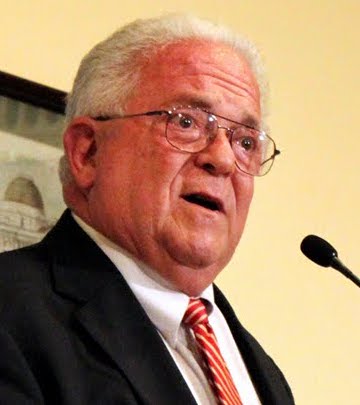
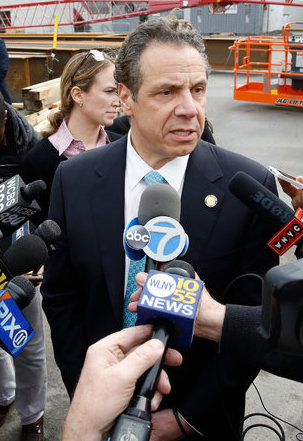
“The Jewish community, that is still very important in New York electoral politics,” said Gerald Benjamin, a professor of political science at the State University at New Paltz, “and in the financing of them and national campaigns.” Professor Benjamin was referring to speculation surrounding Mr. Cuomo (left), whose name has come up as a possible Democratic candidate for president in 2020. 
Stand at a window in the King David Hotel, where Cuomo held his press conference, and look eastward. Out there is the Hinnom Valley, the Gehenna of the New Testament, which the ancients associated with fire, judgment, the Lake of Fire, eternal fire and Hell. The valley was also the place where earlier pagan groups practiced child sacrifice.

Also out there is East Jerusalem and the West Bank, territory Israel captured fifty years ago this week, now occupied land on which’s Israel’s vaunted security forces are testing  technology which it uses to keep “its people safe”.

Cuomo’s New York police department is just one of many American departments whose police officers have flown to Israel, usually, as Alex Kane writes “on the dime  of pro-Israel groups to tour the country and speak with Israeli security forces about how they keep their country safe”.

Israel has a world-wide reputation as a leader in utilizing Israeli-build weapons, and developing successful surveillance companies.  Security is “a core part of the Israeli economy”, exporting “billions of dollars worth of armaments and spy tools to virtually every region in the world”.

Why is Israel so esteemed for its security equipment and techniques?

Shir Hever, an Israeli researcher and author of the book The Political Economy of the Occu­pa­tion, knows why. He says: “All of the Israeli companies would immediately answer the question: We have actual experience, and we have tested these weapons on human beings.”

This week marks the 50th anniversary of the Six-Day War, the conflict in which Israel defeated Arab armies from surrounding states, and completed its original capture of Palestinian land by overrunning the West Bank, Gaza and East Jerusalem, now all known as the occupied Palestinian territories.

That 1967 war also added the Egyptian Sinai Peninsula and the Syrian Golan Heights to Israeli control. Israel has since withdrawn from Egypt’s Sinai Peninsula.

Israel has pretended for the past 50 years that its occupation was temporary, part of its false narrative. During those five decades Israel has built an occupation force of its army  (the Israeli Defense Force), border guards and police.

What matters to New York Governor Cuomo are Israel’s security skills. He gives no sign that he is aware that Israel’s security needs are self-inflicted. Palestinians living under occupation know Israel’s security proficiency was developed to imprison the Palestinian people.

For this to change, Israel itself will have to change. Politicians like Governor Cuomo answer largely to what voters want, or what he thinks they want. If Israelis themselves woke up to what the occupation is doing to the Palestinians and to Israel, they would have no problem persuading the American politicians that 50 years of occupation has led to disaster for the Jewish people.

One of the Jewish organizations in Israel that knows this and works to do something about it, is B’Tselem, ​t​he Israeli Information Center for Human Rights in the Occupied Territories.

​B’Tselem issued a statement on June 6, which describes how what happened 50 years ago on June 5, 1967, began the creation of a “reality” from Israel’s perspective. Its statement sums up the real-life occupation which Governor Cuomo managed to ignore in his eagerness to curry favor with his Jewish consistency.

This statement of current Palestinian reality, from B’Tselem, is addressed to the Israeli public:

​It is a reality in which a third and fourth generation of Palestinians don’t know what it’s like to live free; and a third and fourth generation of Israelis don’t know what it’s like not to be occupiers.

It is a reality in which Israel controls 13 million people in the land between the Mediterranean Sea and the Jordan River, but only eight million of them actually count or can take part in determining the future here. It is a reality that no matter how you tilt your head at it means that Israel cannot be called democratic.

How has the occupation managed to reach the 50-year mark?

Perhaps because we manage to convince ourselves that it’s all temporary: it’s just another “bout of fighting”, just another election campaign, just “until there’s a Palestinian partner”, and besides, the signing of a final status agreement is just around the corner.

But Israel’s governments have never considered the occupation temporary. For years and years, Israel has been acting as though the land – without the Palestinians living there – is ours forever, and is there for us to use as we please.

Perhaps it’s because the occupation doesn’t really affect us in our day-to-day lives as Israeli citizens: we created a law enforcement system that ensures that none of those responsible for the continued occupation or its attendant human rights violations will be held accountable.

We’ve also managed to amend the law so that we almost never have to pay out damages to any Palestinian harmed by our actions. Then, so that we can also feel that we’re completely in the right, we get a legal stamp of approval, mostly from the Supreme Court, greenlighting everything that happens under occupation: the land grab, roadblocks, home demolitions, a ten-year blockade on the Gaza Strip, to name but a few.

Or perhaps it’s because none of this stands in the way of continued widespread international support for Israel. This international context also plays a role in us not having to bear any costs for the occupation: the fact that there is no price to pay is the basis underlying the past fifty years.

B’Tselem was established in February 1989 by a group of prominent academics, attorneys, journalists, and Knesset members.

Its mission statement describes the work of B’Tselem this way: “It endeavors to document and educate the Israeli public and policymakers about human rights violations in the Occupied Territories, combat the phenomenon of denial prevalent among the Israeli public, and help create a human rights culture in Israel.”

“The phenomenon of denial” applies as well, to Israel’s enablers in the U.S. This onerous occupation now enters its 51st year. Political leaders like the governor of New York deny the suffering of an imprisoned people. Instead, they laud the occupiers for their efficient, profitable, policing.

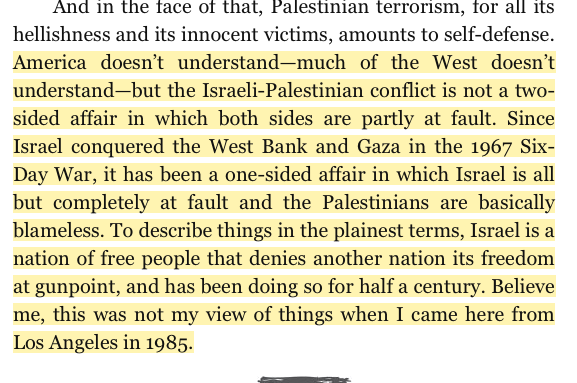
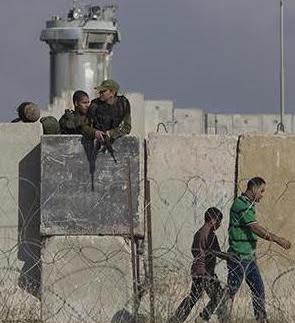
The picture at top of a manned-watch tower, and a Palestinian man and boy is from the Occupied Territories. It is by Oren Ziv from Activestills.org. The picture of Governor Cuomo is by Kathy Willens, for the Associated Press.

 

Posted in Human Rights, Israel, Palestinians | 6 Comments

Hillary is Back

By James M. Wall

Hillary is back; the Hillary who ought to be in the White House instead of the man our archaic electoral system gave us November 8, 2016.

The Hillary Clinton who is back, relaxed and at ease, was interviewed for more than an hour on a California stage Wednesday, telling the world in clear understandable language, what she perceives to have happened in her 2016 election loss.

I report on this interview because I want citizens like my grand daughters and my great grand daughters, to look with justified pride at this woman who broke the glass ceiling as the first female nominee for president from a major political party, and who won the popular election by almost 2.9 million votes. 

She is back after taking a few months to reflect on the national train wreck which put Donald Trump in the White House.

The outcome of that train wreck, and the players who toyed with the mechanism of our constitutionally-mandated electoral system, will soon be examined through the courts and in the congress.

This process will hit max speed when former FBI Director James Comey is expected to testify June 8, before the Senate Intelligence Committee.

Over the weeks and months ahead, we will discover how Russian operatives recruited and manipulated American accomplices in a nefarious scheme to betray their country.

“In the best of all possible worlds”, the election would be nullified. The nation would start over.

But as the elder George Bush might say, “not gonna happen”. There is nothing currently available in our system to make it happen, certainly not with this current Republican crowd in control of all three branches of the government.

What should result next is that Russia’s American accomplices will be exposed for what they did. And Hillary, whom I have known since we first met in the living room of the Arkansas governor’s mansion decades ago, has explained just how she believes the dastardly deed was done.

Listen up, Pilgrims, to the story as she lived it.

Hillary Clinton was a special guest this week at Code 2017, an event sponsored by Recode at the Terranea Resort in Rancho Palos Verdes, California, May 30-June 1.

Walt Mossberg and Kara Swisher, co-founders of Recode, host an annual invitation-only Code Conference “to bring together a global community of the biggest names in the business, executive leaders and startups with bright futures for networking and in-depth conversations about the current and future impact of digital technology”.

After some opening banter that began a one hour-17 minute interview, with the former candidate, former Secretary of State, former Senator, and former First Lady, Clinton signaled it was time to get down to business.

Clinton utilized her decades of high-level political experience to speak the  language of her audience.

She began by describing the findings in a declassified report by seventeen agencies of the U.S. Intelligence community that was made public in early January.

They concluded with high confidence that the Russians ran an extensive information war campaign against my campaign, to influence voters in the election.

How did they conduct this “information war campaign”? Her response:

They did it through paid advertising we think, they did it through false news sites, they did it through these thousand agents, they did it through machine learning, which you know, kept spewing out this stuff over and over again. The algorithms that they developed. So that was the conclusion. . . .I think it’s fair to ask, how did that actually influence the campaign? And how did they know what messages to deliver?

Who told them? Who were they coordinating with, or colluding with?

Because the Russians historically in the last couple of decades and then increasingly, you know, are launching cyber attacks, and they are stealing vast amounts of information, and a lot of the information they’ve stolen they’ve used for internal purposes, to affect markets, to affect the intelligence services, etc.

So this is different because they went public, and they were conveying this weaponized information and the content of it. .  .  

The Russians — in my opinion and based on the intel and the counterintel people I’ve talked to — could not have known how best to weaponize that information unless they had been guided. . . . by Americans and guided by people who had polling and data information.

Clinton offered an example of how coordination between the Russians and their American accomplices, worked. She pointed to the leak of the Hollywood Access tapes, which in earlier presidential elections. would have immediately ended the Trump campaign.

Within one hour of the tapes being leaked, the Russians — let’s say WikiLeaks, something — dumped the John Podesta emails. Now, if you’ve ever read the John Podesta emails, they are anodyne to boredom [laughter].”

John Podesta was campaign chair of the Hillary Clinton campaign. He is a long-term associate and close friend of the Clintons and was President Bill Clinton’s Chief of Staff from 1998 until 2001.

Clinton describe the Podesta emails as “run-of-the-mill emails, especially run of the mill for a campaign”.

They were personal emails, which made them attractive to the media. Clinton speculates that the Podesta emails had been hacked and were being held for a propitious moment to release.

Since the Hollywood Access tapes, in which Trump bragged that he liked to “grab” female genitals (his word was harsher) as his form of greeting, had leaked, it was the right time for the Podesta tapes to surface.

Clinton explained how she saw what happened next:

Within one hour they dumped them, and then they began to weaponize them. And they began to have some of their allies within the internet world, like Infowars, take out pieces and begin to say the most outrageous, outlandish, absurd lies you could imagine.

Clinton described how an enemy could prepare for future developments: “They had to .  .  .  have a plan and they had to be given the go-ahead, saying, Okay, this could be the end of the Trump campaign, dump [the Podesta emails] now. And then let’s do everything we can to weaponize it.”

And we know it hurt us. Because as I explain in my book, you know, the Comey letter, which was, now we know, partly based on a false memo from the Russians. It was a classic piece of Russian disinformation, which Russians call kompromat [compromising material used to discredit rivals in politics or business], So, for whatever reason, and I speculate, but I can’t look inside the guy’s mind [Comey’s], you know, he dumps that on me on October 28th, and I immediately start falling.

But what was really interesting, since the mainstream media covered that, as I say like Pearl Harbor, front pages everywhere, huge type, etc. And all of the Trump people go around screaming, “Lock her up, lock her up,” and all of that.

At the same time, the biggest Google searches were not for Comey, because that information was just lying out there, it was for WikiLeaks. And so voters who are being targeted with all of this false information are genuinely trying to make up their minds.

The “lightly-edited” transcript of Clinton’s appearance at the Recode conference on May 31 is available here.

And there you have it, your homework to prepare for the summer-long–or longer–examination of how weaponized information in our digital age is targeted to gain media attention, create public distress, and above all, affect election results.

Posted in Donald Trump, Hillary Clinton, US govermemt | 9 Comments

“For I was in prison and you visited me not’”

130408-children-prisoner-protest

by James M. Wall

The full text of Matthew 25:42-43, condemns the sins of those who neither see, hear, nor care about those who suffer.

.  .  .  For I was hungry, and ye gave me no meat: I was thirsty, and ye gave me no drink: I was a stranger, and ye took me not in: naked, and ye clothed me not: sick, and in prison, and ye visited me not. (KJV)

Do not think for a single moment that Jesus was referring solely to a “brief, but helpful visit” to a prisoner’s cell. 

“Visit” in this context means attention must be paid and action must be taken. 

With absolute power in its hands, and only scattered opposition from outside, Israel is especially hard on Gaza families.

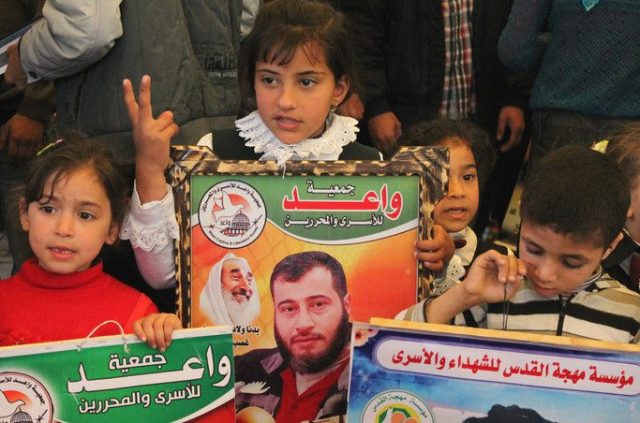
The picture above of children from those families, is by Joe Catron. It appeared in The Electronic Intifada, over a anger-inducing report by Catron, with the headline, “Children of Palestinian prisoners in Israeli jails are barred from family visits”. 

Catron’s report opens with quotes from one of the children:

“I dream of my father,” eight-year-old Hamze Helles said in his family’s house in Gaza City’s al-Shajaiyeh neighborhood. “I miss him a lot, and am very eager to visit him. For five years, I have never seen him.

Hamze is one of two young sons of Majed Khalil Helles, a fighter in Fatah’s al-Aqsa Martyrs’ Brigades who was captured by Israeli forces on 8 August 2008 and sentenced by an Israeli military court to five years’ detention in Nafha prison.

Fourteen months before its military detained Helles, Israel imposed a comprehensive ban on family visits to Palestinian political prisoners from the Gaza Strip. Addameer, the prisoner advocacy organization, called the measure “part of [Israel’s] policy of treating the Gaza Strip as an enemy entity following the 2006 Palestinian legislative elections and the capture of Israeli soldier Gilad Shalit one year prior.

The ban met wide criticism as an illegal act of collective punishment, Addameer said. “Israel’s policy has been condemned, among others, by Palestinian and Israeli human rights organizations, the International Committee of the Red Cross and the UN Fact-Finding Mission on the Gaza Conflict in its report on the 2008–2009 Israeli offensive.”

On Saturday, May 20, Marjorie Cohn, wrote in Truthout, that the prisoner hunger strike, which began on Palestinian Prisoners’ Day, April 17, will enter its 36th day on Monday. The strikers consume only salt water.

The 1500 who began the strike are “about a quarter of all Palestinian prisoners being held by Israel”.

The demands of the strikers include:

“increased visitation rights with humane treatment of family visitors; installation of a public telephone to communicate with families; and an end to medical negligence, solitary confinement and administrative detention”.

Marwan Barghouti, the imprisoned Palestinian activist who called for the hunger strike, made his case in a New York Times op-ed, which included this rationale:

Hunger striking is the most peaceful form of resistance available. It inflicts pain solely on those who participate and on their loved ones, in the hopes that their empty stomachs and their sacrifice will help the message resonate beyond the confines of their dark cells.  . . .

Palestinian prisoners and detainees have suffered from torture, inhumane and degrading treatment and medical negligence.

Barghouti added these damning statistics in his Times piece:

Approximately 40 percent of the Palestinian territory’s male population has been imprisoned or detained by Israel at some point. Hundreds of the 6,500 Palestinians who are currently incarcerated are women, children, journalists and elected officials.

“There is hardly a single family in Palestine that has not endured the suffering caused by the imprisonment of one or several of its members”.

In her Truthout report, Cohn writes that in one its rare public statements, the International Committee of the Red Cross (ICRC):

Decried the “systematic suspension” by Israeli authorities of family visits for hunger strikers, and of permits for their families. Citing the Fourth Geneva Convention, the ICRC said Palestinians have a right to these visits, which can only be limited on a case-by-case basis for security reasons, not just for punitive or disciplinary purposes. .  .  .

“Family contact must be improved, not further restricted,” said Mr de Maio, head of the ICRC delegation in Israel and the occupied territories, referring to the systematic suspension by Israeli authorities of family visits for detainees on hunger strike, and of the permits for their families. According to the Fourth Geneva Convention of 1949, Palestinians are entitled to these visits, which can only be limited for security reasons, on a case by case basis, but never for strictly punitive or disciplinary purposes.

“The families are paying the price for this situation,” said Mr de Maio. More generally, Palestinians are detained in Israel, rather than within the occupied territory as required by the law of occupation. As a consequence, family members have less access to their detained relatives. They need special permits and have to undertake long trips to see their loved ones, with checks and waiting times when crossing terminals or at the prison.

Palestinian author, grandmother, and political leader Samia Khouri, posted her own witness to the hunger strike, under the title, Starving for Justice. She expresses a pained awareness of how little attention the world pays to the strike. Her posting, in full, is below:

“How would you feel if your son or daughter went on a hunger strike demanding justice for more than a month, and nobody bothered to call you or check on you and your beloved one?

The silence is so loud that our hearts bleed with those mothers who are gathering daily in various areas including the Red Cross offices in the Palestinian Territories. Yet there is no reaction or action from the Israeli authorities or the international community to respond to their demands for basic rights as political prisoners, in accordance to the Geneva Convention.

So many of those political prisoners have been under administrative detention without any charge or trial.

In fact the only action taken was to move most of those prisoners to prisons near hospitals so that they can be hospitalised if need be or force-fed without any intention of starting a dialogue with them. How long will Israel continue to ignore the basic demands of those prisoners, and continue to get away with treating them with contempt void of any human dignity. Do they need to die before anybody cries out Enough is Enough?”

The focus this week has been on the visit of Mr. Trump to the region. And Israel claimed a couple of days ago that it is introducing easier measures for the Palestinians. Is this a gimmick? Or is the occupation authority trying to pull wool over the eyes of the American administration and the international community? How about introducing easier measures for those prisoners, and starting a dialogue with them?

Please, we appeal to you, our friends, to raise your voice before it is too late to save the lives of those young men and women incarcerated for no other reason than for their legitimate right to resist an illegal occupation.”

As President Trump travels through the region, and the hunger strikers suffer each day, our U. S. Congress should hear from us, not in anger, but in a demand for justice. 

Tell your member of Congress to read this basic request for fairness and justice from the strikers:

“increased visitation rights with humane treatment of family visitors; installation of a public telephone to communicate with families; and an end to medical negligence, solitary confinement and administrative detention”.

Then ask them to ask someone under the age of ten if those requests are fair and just. And don’t tell them, “its complicated”. Those requests are not complicated. Any ten-year-old knows that. 

Posted in Human Rights, Israel, Palestinians, The Human Condition | 7 Comments

On Nakba 69, Israel Kills a Palestinian Fisherman

by James M. Wall

His name is Muhammad Majid Bakr. He was a 23-year-old Palestinian fisherman killed by an Israeli rifleman patrolling on a naval boat in the Gaza Sea.

When he was shot, Muhammad Majid Bakr (left) was fishing at 8:30, Monday morning, 69 years since the day the Nakba began. 

Muhammad was shot in the chest when he and his brother Umran Majid Bakr, were in their small fishing boat in the waters of the Gaza Sea.

Bleeding profusely, Muhammad was taken to an Israeli hospital where he died, the latest Palestinian victim whose death came, Israeli officials claim, because his boat had “deviated from the designated fishing zone”.

The Bakr brothers had entered the Gaza Sea the morning of the day Muhammed died, to fish for food to eat, to share, perhaps to sell.

They had traveled from their home in al-Shati, refugees in their own land, a land which has suffered under colonial occupation since the army of a newly-formed state of Israel began its invasion of Palestine on May 15, 1948, 69 years ago.

Al-Shati is now a city with a population in excess of 80,000. It was created in 1948 as a refugee camp for about 23,000 Palestinians, all of whom had been driven from their homes in the cities of Jaffa, Lod and Beersheba. 

Palestinians have designated May 15 as the Day of the Nakba, an Arabic word for catastrophe. Palestinians in Israel and the current state of Palestine, marked Nakba 69 with rallies, marches and candlelight vigils.

Thousands of Palestinians in the cities of Ramallah and Bethlehem marched in the streets carrying Palestinian flags and keys symbolic of the “right of return” for refugees who lost their homes during the Nakba.

Israel continues to make it difficult for Palestinians to commemorate Nakba. It has passed a Nakba law” that “authorises Israel’s finance minister to revoke funding from institutions that reject Israel’s character as a ‘Jewish state’ or mark Israel’s ‘Independence Day’ as a day of mourning”.

Nakba Day 69 is also the 29th day of the hunger strike of 1,500 Palestinian political prisoners in Israeli jails, a hunger strike designed to draw world attention to the injustice of Israel’s occupation. The strike has been largely ignored by American media.

Outside the Zionist iron dome that smothers American culture, scattered attention is paid to the occupation. You American readers, raise your hand if your local church or synagogue remembered the suffering of the hunger strikers in their prayers this weekend. Anyone? Didn’t think so.

The capital city of Ireland did more than offer prayers. 

Last month, a Dublin City Council sub-committee passed a motion to fly the Palestinian flag over Dublin’s City Hall.

The action was applauded by BADIL, a Palestinian legal rights NGO. Underlining the importance of this symbolic act of solidarity to the Palestinian people, BADIL quoted Tamir, a 13-year-old child from the Palestinian Aida refugee camp in Bethlehem as saying:

“Wow… imagine what would happen if all people around the world become like Irish people… We will get our freedom”.

Nada Elia is a Palestinian scholar-activist, writer, and grassroots organizer, currently completing a book on Palestinian Diaspora activism. In a Mondoweiss posting this week, “On Nakba Day I want the right to be angry“, Elia thinks of Nakba 69 and other milestones of 2017:

I am angry at the fact that this is a year of milestones, each adding to the previous one’s devastation, with none celebrating a major victory.  2017 marks one hundred years since the Balfour Declaration, 69 years since al-Nakba, 50 years since al-Naksa.  And yet for many, it is only that most recent blow, ‘the occupation,’ that registers as wrong, as if imperialism, settler-colonialism and genocide were perfectly acceptable.  2017 marks 50 years of al-Naksa, which is Arabic for ‘the setback,’ an assertion of previous harm.

That harm continues with Israel’s continuing “imperialism, settler-colonialism and genocide”.

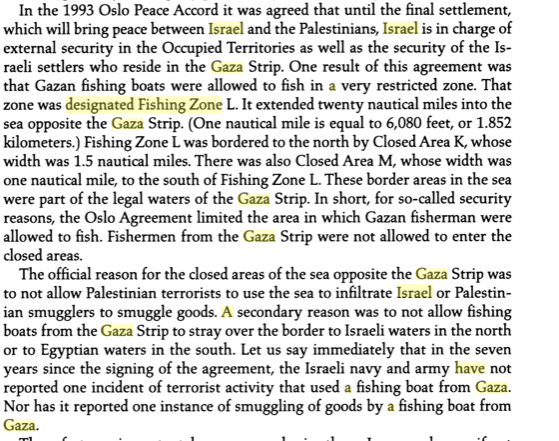
Muhammad Majid Bakr died because, Israel claims, his fishing boat “deviated from the designated fishing zone”. Who determines the size of that zone? The answer starts with the Oslo Accords, one of those international depraved steps the great powers of the West took to enable Israel to expand its colonial state into absolute control of Palestine.

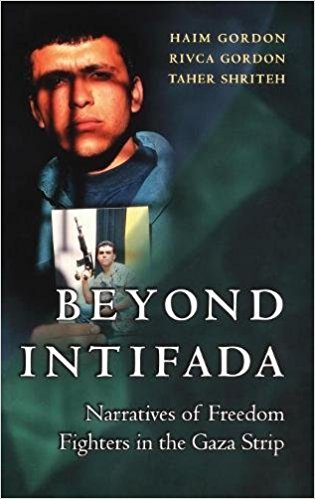
In their 2003 book, Beyond Intifada: Narratives of Freedom Fighters in the Gaza Strip, Palestinian author Taher Shriteh, and two Israeli authors, Haim and Rivca Gordon, examined the history of Israel’s “designated fishing zones”.

Like every other purely arbitrary imposition Israel establishes over Palestinians, the “designated fishing zones” shift through Israel’s whims. And, the zones are always imposed in the name of that most precious tool in Israel’s control system, “the security of the Israeli people”.

Such an absurdity and such a deprivation of Palestinian freedom, led to the death of Muhammad Majid Bakr. 

In the picture above from Mondoweiss, the granddaughter of 97-year-old Abdul Hadi Qudeh, holds keys that belongs to a house his family were forced to leave after the establishment of Israel in 1948. His granddaughter posed for the photograph in her grandfather’s field ahead of Nakba Day in Khan Younis in Gaza, May 14, 2014. (Photo: Mohammed Talatene/ APA Images).

Posted in Gaza, Israel, Middle East | 5 Comments

“O for a Muse of fire, that would ascend. . . !”

by James M. Wall

In the Prologue (below) to Shakespeare’s Henry VThe Chorus speaks:

         O for a Muse of fire, that would ascend
The brightest heaven of invention,
A kingdom for a stage, princes to act
And monarchs to behold the swelling scene!

Has there been a moment in recent history like the “swelling scene” which struck with such force May 9?

The headlines shouted, “Trump Fires FBI Director”.

The Chorus speaks of France and Henry’s England. We speak here of the American states, red and blue. We speak of Rachel, Chris and Lawrence against the Mighty Fox. We speak of the Times and the Post. We speak of The Nation confronting Breitbart and Conway.

And let us, ciphers to this great accompt,
On your imaginary forces work.
Suppose within the girdle of these walls.

Are now confined two mighty monarchies,
Whose high upreared and abutting fronts
The perilous narrow ocean parts asunder:

The chorus knows you can’t re-enact a battle within a “cockpit” (theater), and so he calls  upon us to rely on imagination. 

. . . can this cockpit hold
The vasty fields of France? or may we cram
Within this wooden O the very casques
That did affright the air at Agincourt?”

We seek our muse here among the experienced, the respected, and the learned.

Muse the First, the Editorial Board of the New York Times:

By firing the F.B.I. director, James Comey, late Tuesday afternoon, President Trump has cast grave doubt on the viability of any further investigation into what could be one of the biggest political scandals in the country’s history.

The explanation for this shocking move — that Mr. Comey’s bungling of the investigation into Hillary Clinton’s private email server violated longstanding Justice Department policy and profoundly damaged public trust in the agency — is impossible to take at face value.

Muse the Second, the more conservative Chicago Tribune editorial board:

President Donald Trump took office with half of Americans expecting greatness and the other half gravely suspicious of the presidency that would unfold. Generously feeding that suspicion: an FBI investigation of Trump’s moot presidential campaign. That probe is ongoing, but James Comey will not be the FBI director who completes it. And whatever its conclusions, droves of citizens will see them as dubious. All because on Tuesday the president fired Comey — a drastic, legal but highly problematic action.

No matter the justification from the White House, this looks like a politically motivated hatchet job, designed to purge the investigation of the official who ran it and owned it.

Muse the Third, David Rothkopf, CEO and editor of the FP Group:

We have all the makings of a banana republic. But worse, we are showing the telltale signs of a failing state. Our government has ceased to function. Party politics and gross self-interest has rendered the majority party oblivious to its responsibilities to its constituents and the Constitution of the United States.

On a daily basis, Republicans watch their leader violate not only the traditions and standards of the high office he occupies, but through inaction they enable him to personally profit from the presidency, promote policies that benefit his cronies and his class to the detriment of the majority of the American people, and serially attack the principles on which the country was founded — from freedom of religion to the separation of powers.

Muse the Fourth: Dan Rather, veteran CBS broadcaster, now retired, who wrote on his Facebook page,

Future generations may mark today as one of the truly dark days in American history, a history that may soon take an even more ominous turn.

President Trump’s sudden firing of FBI Director James Comey is a matter that should deeply concern every American, regardless of party, partisan politics or ideological leanings.

The independence of our law enforcement is at the bedrock of our democracy. That independence, already grievously shaken under the brief tenure of Attorney General Jeff Sessions, is now shattered by uncertainty.

The firing of an FBI Director is always a very serious matter in normal times. But these times aren’t normal. Far from it. The Bureau is engaged in one of the most important and perilous investigations of this or any other presidency—the investigation of connections between the Trump election campaign and the Russian government.

Muse the Fifth: Garrison Keillor, the long-time NPR star now a syndicated columnist, wrote shortly before what he anticipated as the “next shoe to drop”, 

What is so remarkable this spring, as we all wait for the next shoe to drop, is how completely the Republican virtues we grew up admiring — caution, respect for history, attention to the fine print — have been thrown to the winds and the party has united behind an aging New York playboy with no fixed principles except an insatiable urge to be on the front page every single day including weekends and holidays.

Muse the Sixth: Jay Michaelson, writing in the New York-based Jewish Forward.

It’s clear what Donald Trump got rid of in his “midnight massacre” firing of FBI Director James Comey: an investigation into his ties to Russia that is somewhere between pesky and a prelude to impeachment.

Less well observed is what he gained: the weaponization of the FBI, soon to be headed by a Trump loyalist, which will further cement the power of the president to investigate enemies, settle scores, and replace the truth with alternative facts.

At what point, one wonders, will some Trump supporters jump ship? We should force them to say so now, before we normalize, bit by bit, the erosion of our democracy and societal norms. .  .

The Jewish tradition is quite familiar with tyrants, and quite suspicious of them. From Pharoah to Ahasuerus to Nero to Hitler and Stalin, we have suffered under the yoke of authoritarians unrestrained by law.

Moreover, the notion that no one is above the law is perhaps the single greatest contribution of the Jewish civilization to the human race. No one: not a prophet nor a king nor a judge nor a wealthy man.

We close our journey with our chosen muses by asking, how might this weaponization proceed?

One model may be found in Israel where at times the weapon of choice is the computer. If you do not remember Tom Cruise in the 2002 movie, Minority Report, this report from Israel’s Ha’aretz should jog your memory:

Channel 10 reported earlier this month that the Israel Defense Forces and Shin Bet security service had arrested 400 Palestinians who were seen as lone-wolf terrorists. They were “arrested before they set out to carry out terror attacks.” The suspects were identified through the use of a computerized program that analyzed social media posts.The station’s military correspondent, Or Heller, attributed the drop in the number of terrorist attacks to the cyberprogram.

 Stephen Spielberg’s 2002 film, Minority Report, was based on a short story by Philip K. Dick. In the film, Tom Cruise is John Anderton, chief of the Department of Pre-Crime in the District of Columbia, where there has not been a murder in six years.

The film is set in the year 2054.  “Anderton’s job is to preside over an operation controlling three ‘Pre-Cogs,’ precognitive humans who drift in a flotation tank, their brain waves tapped by computers. They’re able to pick up thoughts of premeditated murders and warn the cops, who swoop down and arrest the would-be perpetrators before the killings can take place” (Roger Ebert).

What happens in Israel does not stay in Israel. Think American border walls, religious and ethnic border restrictions, and airport security procedures. Then remember to ask if your local police chief has had his or her way paid to study security procedures in Israel.

Shakespeare’s Chorus anticipates what is to come with the warlike Harry: 

Then should the warlike Harry, like himself,
Assume the port of Mars; and at his heels,
Leash’d in like hounds, should famine, sword and fire
Crouch for employment.

Posted in -Movies and politics, Donald Trump, Israel, Media, Middle East, Palestinians, War | 2 Comments

Trump Deletes Arafat From Accord Signing

by James M. Wall

It is a well-known fact of history that to the victor belongs the spoils.

And one of those spoils is the ability to reshape history. Donald Trump has won the presidency. He is now busy reshaping history.

On Wednesday, President Trump met with Palestinian President Mahmoud Abbas at the White House.  The usual “we want peace” talking points were exchanged. The word “justice” was not included.

Palestinian prisoners on hunger strike were ignored by Trump. Sean Spicer, Trump’s press spokesman, later claimed the President suggested to Abbas that he cease funding families of political prisoners held in Israeli jails. 

Since that would be both inhumane to the prisoners and politically devastating to President Abbas, he most certainly would have brushed aside such an idea. 

President Trump began his cordial welcoming words to President Abbas with one of those blatant distortions of history that good staff work might have avoided. Unless, that is, the distortion was deliberate.

This is the way President Trump welcomed President Mahmoud Abbas to the White House: “Almost 24 years ago, it was on these grounds that President Abbas stood with a courageous peacemaker, then-Israeli Prime Minister Yitzhak Rabin. Here at the White House, President Abbas signed a Declaration of Principles — very important — which laid the foundation for peace between the Israelis and Palestinians.”

Not content with this shading of truth, Trump sought to link the Oslo Accords to what he believes could be his own Trumpian contribution to history:

“Mr. President, you signed your name to the first Israeli-Palestinian peace agreement. You remember that well, right? And I want to support you in being the Palestinian leader who signs his name to the final and most important peace agreement that brings safety, stability, and prosperity to both peoples and to the region.”

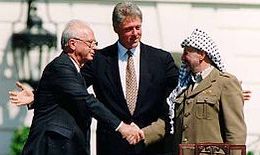
There is a problem with this recall of history. It writes former Palestinian President Yasser Arafat out of a major moment of history. 

Abbas was, indeed, a member of the Palestinian delegation which traveled to the White House for the historic September, 1993, signing ceremony.

Abbas was certainly in the Palestinian delegation headed by then-PLO leader Yasser Arafat. He most certainly did not sign with “a courageous peacemaker, then-Israeli Prime Minister Yitzhak Rabin”.

And, he did not stand with Yitzhak Rabin. That would be Yasser Arafat, as the historic picture (above), clearly demonstrates.

Rabin did not sign the statement. Arafat did not sign it. They had representatives to do the signing for them. 

The BBC remembers the signing: “The leaders did not sign the declaration themselves. Instead, Israeli Foreign Minister Shimon Peres, and his Palestinian counterpart did the signing.

“His Palestinian counterpart” was indeed, Mahmoud Abbas.

Wikipedia has a more detailed story about the signing.

The Oslo I Accord officially called the Declaration of Principles on Interim Self-Government Arrangements was an attempt in 1993 to set up a framework that would lead to the resolution of the ongoing Israeli–Palestinian conflict. It was the first face-to-face agreement between the government of Israel and the Palestine Liberation Organization (PLO).

Negotiations that led to the agreement were an outgrowth of the Madrid Conference of 1991. They were conducted secretly in Oslo, Norway, hosted by the Fafo institute, and completed on 20 August 1993.

The Oslo Accords were officially signed “at a public ceremony in Washington, D.C., on September 13, 1993, in the presence of PLO chairman Yasser Arafat, Israeli Prime Minister Yitzhak Rabin and U.S. President Bill Clinton”.

The documents themselves were signed by Mahmoud Abbas for the PLO, foreign Minister Shimon Peres for Israel, U.S. Secretary of State Warren Christopher for the United States and foreign minister Andrei Kozyrev for Russia.

With the historic photo above vivid in memory, I naturally turned to the usually reliable White House Office of The Historian website to check the details.

Here is the inaccurate description on that White House website:

On September 13, 1993, Israeli Prime Minister Yitzhak Rabin and Palestine Liberation Organization (PLO) Negotiator Mahmoud Abbas signed a Declaration of Principles on Interim Self-Government Arrangements, commonly referred to as the “Oslo Accord,” at the White House. Israel accepted the PLO as the representative of the Palestinians, and the PLO renounced terrorism and recognized Israel’s right to exist in peace.

The Office of The Historian site has rewritten history to first remove Palestinian leader Yasser Arafat from that White House signing ceremony, and to replace him with Mahmoud Abbas.

Who outside of Washington’s Israeli-loyalists would believe such distortions? 

The site incorrectly reports that Israel’s Rabin signed the document. He did not; Shimon Peres signed for Israel, along with Mahmoud Abbas for the PLO, Warren Christopher, for the U.S., and Andrei Kozyrev, for Russia.

All of which leaves questions: Was this the source that President Trump, or his speech-writer, relied on for the Trump-Abbas meeting? Who rewrote history for the Office of the Historian website?

It would be a massive undertaking to write Yasser Arafat out of world history, so why was
this one moment in his career rewritten?

In George Orwell’s futuristic dystopian novel, 1984, currently growing in popularity, the Ministry of Truth is one of four ministries in the government of the nation Oceania .

In 1984, the Truth Ministry serves as the propaganda ministry and spreads a new language called Newspeak. Wikipedia adds a disturbing reminder of the manner in which the Ministry of Truth doctors “historical records to show a government-approved version of events”.

Is President Trump not even familiar with the historic photo above of the handshake between then-PLO leader Yasser Arafat and Israeli Prime Minister Yitzhak Rabin?

There is good reason to believe that he is not a student of history, not even when he is seeking to make history himself. 

Mahmoud Abbas will remain here for several more days. When he does return to Palestine, he will have the long flight home to wonder if he has been conned into another journey down “peace talks” lane?

He has heard Trump delete Yasser Arafat from the events of September, 1993. How can he possibly be expected to believe the empty promises he heard uttered from this U.S. President?

The picture above is from Wikipedia.


Posted in Donald Trump, Israel, Middle East, Middle East Politics | 6 Comments

“Salt and Water” As a German Leader is Rejected

by James M. Wall

Ma’an reported Thursday that a general strike has begun in the occupied West Bank and East Jerusalem. 

As part of the strike, Palestinians shut down their shops and businesses in solidarity with the more than 1,500 Palestinian prisoners now enduring the 11th day of their “Freedom and Dignity” hunger strike.

The Arabic graffiti above means, “Salt and Water,” the only nutrients striking prisoners allow themselves. Placed on the locked door of a Palestinian shop, “salt and water” signals support for the strike which was organized by imprisoned Palestinian leader Marwan Barghouthi.

The general strike calls for a Day of Rage on Friday, April 28, during which Palestinians are expected to show their solidarity with the Palestinian prisoners’ movement.

The deserted streets and closed shops evoke memories of the First Intifada, which began in 1987, when Palestinians held general strikes as part of a civil disobedience campaign against Israeli forces.

A few miles away from those deserted streets an entirely different drama unfolded when German Foreign Minister Sigmar Gabriel arrived in Jerusalem for a prearranged meeting with Prime Minister Benjamin Netanyahu.

Before his meeting with the Prime Minister, the German Foreign Minister first met with the Israeli NGO, Breaking the Silence, an organization of Israeli army combat veterans against the occupation.

Gabriel’s planned meeting with Netanyahu was immediately canceled.

The Prime Minister’s Office defended the sudden cancellation with an official statement, reported by Anshel Pfeffer, in Ha’aretz:

The United States or Britain wouldn’t meet with foreign diplomats who met with NGOs calling American or British soldiers war criminals.

The last part of that defense was a lie.

Breaking the Silence does not call its fellow IDF members “war criminals”. What the organization does is tell their stories of having served as soldiers in the occupied territories.

Breaking the Silence also take visitors to the West Bank. One of their earlier visitors, Irish writer Eimear McBride, reported on her first visit to the occupied territories for the Irish Times, a report shared in an earlier Wall Writings posting.

In that report she wrote: “All that is human in me recoils from this.”

The headline over the Ha’aretz story carried the revealing and stinging title, “Israel Not a Regular Democracy”. Pfeffer agreed with the first part of Netanyahu’s rationale:

Foreign leaders visiting Washington and London don’t meet with those kinds of NGOs − not because Israeli soldiers are worse offenders than any offenders in those countries, but because Israel isn’t the United States or the U.K.

When foreign ministers, prime ministers and presidents of democratic nations, visit “functioning democracies”, as Pfeffer puts it, it is not unusual for the visitor to meet with the host country’s “opposition leader”. The only times they meet with “leaders of civil-society and human-rights groups” is in countries where “there is a special concern over these issues that they want to emphasize”.

The problem for Israel is that on the issue of the occupation, there is no opposition political party. 

The U.S. has a consistent record of visiting with dissident groups on trips to countries which are not functioning democracies.

Barack Obama made a point of this on his historic visit to Cuba last year to meet with Cuban dissidents at the U.S. Embassy. As secretary of state, Hillary Clinton and John Kerry did so often as well, making a point of this on visits to the capitals of Egypt and Russia, for example.

As a Western diplomat once stationed in Israel says, “these are the kind of meetings we have only in nondemocratic countries. So you can understand why Netanyahu is angry”.

Israel doesn’t like to be reminded that while it thinks of itself as a functioning democracy, it also has this unusual issue of the occupation.

So true, Israel does have this occupation thing on, which just happens to echo an exchange in the Coen brothers film, O Brother, Where Art Thou?

Everett: (George Clooney) Pete’s cousin turned us in for the bounty.

Pete: (John Turturro) The hell you say! Wash is kin!

Wash: (Frank Collison) Sorry, Pete, I know we’re kin, but they got this depression on. I got to do for me and mine.

Pete: I’m gonna kill you, Judas Iscariot Hogwallop!

Pete was angry. Cousin Washington Hogwallop had allowed three escaped prisoners to sleep in his barn. Then he notified the sheriff.

Netanyahu was also angry, Pfeffer acknowledged, not just because German Foreign Minister Gabriel met with an organization critical of the occupation, but because Netanyahu realized he was not being treated with the respect he desperately wants as the prime minister of a democracy.

The problem facing Israel and the U.S., is that they do not want to acknowledge that a democracy is not acting as a democracy when it militarily occupies and controls an entire population for more than five decades.

Israel and the U.S. want the world to accept Israel as a functioning democracy, but Israel refuses to allow open discussion of the occupation, the single factor which is plunging Israel deeper into international isolation.

The graffiti picture is from Maan.  The Israeli soldier pictured is on occupation duty, patrolling a Palestinian road. It was taken by Connie Baker. The picture of Foreign Minister Gabriel is by Sebastian Scheiner/AP. 

Posted in Israel, Middle East, Middle East Politics, Movies | Tagged , , | 6 Comments

An Irish Writer and a US Scholar Walk Into a Bar

by James M. Wall

The Irish writer is Eimear McBride. The scholar is a fellow named Chas Freeman. They did not actually walk into a bar together. Most likely they have never met. But they are soul-mates.

Chas and Eimear have each recently offered readers a deeper look into the evils of Israel’s occupation. The old “walk into a bar” line is merely a device to entice you to read what they want to share.

Eimear McBride speaks first. She is back from her first visit to  Palestine. She is angry. She has brought many pictures with her. She slams one of them on a table.

In the picture, a Palestinian boy stands on the tiled floor of what had been his bathroom. The roof and the walls are gone.

The house was not bombed. It was destroyed, one might say to the boy, by some bad people who didn’t want him to live there.

After she returned to Ireland, Eimear McBride wrote an essay which appeared April 15, in The Irish Times, under the headline: “Eimear McBride in the West Bank: ‘All that is human in me recoils from this’.” 

In the essay she gives the background of the picture of the boy: 

As I took a photo of a man’s goats grazing in the rubble of what had been his house, he said: “Hey take a picture of my son”. But when I did, he said: “No, where his kitchen should be, where his toilet was.” When he put the child down, his baby shoes soaked up the wet from the tile fragments surrounding the skeletal remains of a squat loo and the thin line of debris dividing it from where a kitchen must have been. I took the photo and looked at the little sodden feet. I couldn’t imagine how they would ever get dry in that tiny tin shack where this little boy, along with his whole family, now lived, and hoped would not be torn down again soon.

From where I stood I could easily see into the warm, well-built homes of the settlers beside, who were obliging their close neighbours to live in this foulness, who must’ve looked out every day through the well-fitted glass of their comfortable kitchens on to this shameful site.

Eimear McBride’s essay will appear in early June in the anthology, Kingdom of Olives and Ash, edited by Michael Chabon and Ayelet Waldman. McBride’s visit to the West Bank came after an invitation from Breaking the Silence, an organisation of Israeli army combat veterans against the occupation.

McBride’s novel, A Girl Is a Half-formed Thing, won the inaugural Goldsmiths Prize in 2013 and the 2014 Baileys Women’s Prize for Fiction. She is 41 years old.

Her opening words in the Irish Times essay begin:

I had not thought about the world for a very long time and, of all places, this place had seemed easier to ignore. I am driving down to Jericho now and, for the first time in a week, I breathe.

Not because I have become accustomed to the hassle of checkpoints or seeing young men and women, still teenagers some, looking out at me from behind guns that they know how to use. Not because I have stopped noticing how grown men and women close themselves up behind a mask of quietude in order to cope with their every movement being at the whim of those same youngsters.

The red signs at every turn off into the West Bank, warning that the Israeli government forbids entry and that entry is dangerous, have not ceased, in a whole variety of selfish and unselfish ways, to alarm me. Quite to the contrary, I am only beginning to see, learning how to look, and my sense of alarm is off the charts.

“Learning how to look” is a clarion call from a writer who came  to Palestine because of an invitation from former Israeli soldiers. These soldiers want the outside world to know the ugly reality of occupation, a reality ignored by far too many who do not want to look.

It is time now for Chas Freeman to speak. This veteran US scholar and diplomat was Barack Obama’s initial 2009 choice for chairman of the National Intelligence Council. Immediate and intensive lobbying by Israel, working through its Israel lobby and its media allies, led to Freeman’s forced withdrawal.

After his removal from Obama’s leadership team, Freeman continued his career in academia. He is currently Senior Fellow, Watson Institute for International and Public Affairs, Brown University.

Freeman, a man accustomed to Zionist vitriol which keeps American politicians in line, undergirds Eimear McBride’s “sense of alarm” from his perspective.

On April 6, Freeman delivered the third in a series of lectures at Brown University on the theme: “Reimagining the Middle East”. He began: “U.S. wars in the Middle East are — without exception — wars of choice. These wars have proven ruinously expensive and injurious to the civil liberties of Americans. They have poisoned American political culture with various manifestations of xenophobia.”

The lecture was delivered just hours before President Trump’s Syrian Tomahawk attack was launched without any consultation with Congress. Freeman told his Brown audience that none of the ongoing U.S. wars in the region have been “authorized by a congressional declaration of war that justifies the commitment of U.S. forces, sets parameters and objectives for their uses of force, and establishes a legal state of war”.

All of these wars are in violation of Article I, Section 8, Clause 11 of the United States Constitution. That article requires a congressional declaration to make wars of choice legal. “The Constitution’s assignment of the war power to the Congress is unequivocal and fundamental to the separation of powers”.

Freeman added:

Notwithstanding this, all current American wars are presidentially ordained, permitted but not forthrightly endorsed by Congress, and subject to no effective oversight by anyone other than the nation’s generals. Such is American militarism. None of these wars has a coherent purpose. In none is the United States now in a position to determine the outcome. In none is any end in sight.

The central objective of US policy in the Middle East has long been to achieve regional acceptance for the Jewish settler state in Palestine.

It is this “Jewish settler state in Palestine” that so alarmed Irish novelist Eimear McBride on her first visit to the settler-controlled state of Israel.

Freeman, a former US ambassador to Saudi Arabia, turned his attention to the charade that the US “doggedly sought a political basis for a reconciliation between Israelis and Palestinians”, a so-called reconciliation which “was never designed to reach a fair nor a just conclusion”.

The US as an “honest broker between Israel and Palestine”, has been a lie of such enormous consequences that even the lies of Donald Trump, up to this point, can not compete. The difference, of course is that the “honest broker’ set of lies were peddled for decades with the slick smugness of skilled US and Israeli spin masters.

Chas Freeman said more in his lecture, much more, but we bring to a close his contribution, with these words which seem especially apt for a Palestinian child who wonders why the house that was his home is no longer there:

The Jewish state has evolved since its founding. It has left behind it both the humanism that inspired Zionism and the universal moral precepts traditionally espoused by Judaism.

The perception that Israel no longer shares values it once aspired to exemplify is increasing its international isolation, especially from Jews in Europe and the United States.

But American diplomacy no longer even pretends to seek to halt Israel’s triumphant march toward existential implosion despite the obvious negative consequences of this for the security and international influence of the United States. 

The pub is closing. Eimear McBride and Chas Freeman have had their say, for the moment.  Those who have listened are left to wonder why a child’s home has been destroyed by the Jewish state.

In Israel on the 18th day of April, more than one thousand Palestinian prisoners have begun a hunger strike to accomplish two things: Better treatment from their jailers, and a wider international understanding of Israel’s unjust and evil military occupation.

Marwan Barghouti, (left) who refused to recognize the Israeli court that sent  him to prison, is spearheading the strike.  He managed to smuggle out an oped to the New York Times, which ran in the Times’ international edition and on line.

If your media of choice ignores that hunger strike, this is one thing we can all do: Ask that media outlet why a child in Palestine who now lives in a shack, and the protests of strikers in Israeli jails, imprisoned by an occupier’s military system, are not important to them.  

The picture of the child in his destroyed home and the Israeli warning sign are by Eimear McBride. The Barghouti picture is from 2002, from Flash 90.

Posted in Uncategorized | 4 Comments

Trump at The Movies: “Put an Amen to It”

by James M. Wall

A raid has killed members of a frontier family. Ethan Edwards, portrayed by an angry, unforgiving John Wayne, was secretly in love with one of the victims. The quick burial in a nearby hillside cemetery is conducted by a family friend, the Reverend Captain Samuel Johnston Clayton (Ward Bond).

Mourners sing, “Shall we gather at the river”. The Reverend Captain Clayton, formerly of the Confederate army, stands beside three wooden crosses. He prays.

Ethan Edwards abruptly ends the service with an angry shout, “Put an amen to it. There’s no more time for praying.”

A posse prepares to ride out in search of the raiders.

These moments below from John Ford’s 1956 classic western film, The Searchers, begin a long search driven by the dark emotions of hatred and revenge.  

https://www.youtube.com/watch?v=pV2JPv1EFww

It is now Holy Week in America, a time when Christian America prays in its solemn assemblies.

“Putting an amen” on those prayers, our angry new president has ordered his navy to fire 60 Tomahawk missiles at an airbase in Syria.

It was from that base the U.S. claims Syrian President Bashar al-Assad launched a deadly chemical attack on a rebel-held town in northern Syria.

What prompted this first American attack on Assad’s forces in the seven-year civil war? The official rationale: “Vital national security interests”.

Main stream media responsed to the Tomahawks by praising President Trump for finally acting “presidential”. Even New York Times columnist Nicholas Kristof, a media champion for oppressed children worldwide, concluded the Tomahawk attack was the right thing to do:

President Trump’s air strikes against Syria were of dubious legality. They were hypocritical. They were impulsive. They may have had political motivations. They create new risks for the United States.

But most of all, they were right.

I’m deeply suspicious of Trump’s policies and competence, but this is a case where he is right and Barack Obama was wrong. Indeed, many of us believe that Obama’s worst foreign policy mistake was his passivity in Syria.

Nicholas Kristof’s newspaper, the Times, published a lead story on Friday, by Michael R. Gordon and Michael D. Shear, which described the American missile attack on Syria’s Al Shayrat airfield.

The missiles were aimed at Syrian fighter jets, hardened aircraft shelters, radar equipment, ammunition bunkers, sites for storing fuel and air defense systems.

Robert Parry turns to a different movie to signal his conviction that blaming Syria for the initial sarin attack in northern Syria was a flawed “rush to judgment”.

Parry suggests that the eagerness with which US neocons in the US  “treated the Syrian government’s responsibility for the poison-gas incident as flat-fact”, might be Donald Trump’s Wag the Dog moment.  

It may have been Assad or it may have the rebels. Or maybe it was an accident. In any event, the Trump response did not reflect careful deliberation.

Parry began his analysis of Trump’s Wag the Dog moment with a different reading from that of the main stream media.

Just two days after news broke of an alleged poison-gas attack in northern Syria, President Trump brushed aside advice from some U.S. intelligence analysts doubting the Syrian regime’s guilt and launched a lethal retaliatory missile strike against a Syrian airfield.

Trump immediately won plaudits from Official Washington, especially from neoconservatives who have been trying to wrestle control of his foreign policy away from his nationalist and personal advisers since the days after his surprise victory Nov. 8.

Parry also points out that the New York Times’ “lengthy story did not even deign to include the denials from Syria and Russia that they were responsible for any intentional deployment of poison gas.”

Parry maintains that the Times story was as emotionally flawed as was the President’s decision to fire the missiles.

Logic and respect for facts no longer prevail inside Official Washington, nor inside the mainstream U.S. news media.The mainstream U.S. media has presented the current crisis with the same profound neocon bias that has infected the coverage of Syria and the larger Middle East for decades.

Parry also finds that the eagerness of the Times to bring Trump into the neocon orbit, and move him away from his previous nationalism, is consistent with its 2003 cheer-leading for George Bush’s “shock and awe” attack on Saddam Hussein’s Iraq forces.

The two films, The Searchers and Wag the Dog, do not offer exact parallels to the initial chemical attack and Trump’s eagerness to attack Syria. The two films, each in its own way, however, do point to two certainties: Trump’s irrational grab for revenge and the ability of government officials and the media to “change the narrative” for the President.

Michael Gordon, who was one of the authors of the Times piece about Trump’s attack, has long served as a reliable Times neocon advocate.

The use of military power is the preferred neocon change method.

This was evident in 2002 when Gordon was “the lead author with Judith Miller of the Times’ bogus “aluminum tube” story in 2002 which falsely claimed that Iraqi leader Saddam Hussein was reconstituting a nuclear-weapons program”.

That 2002 Gordon-Miller article was cited by President George W. Bush’s aides as a key argument for invading Iraq in 2003. That war is now generally acknowledged to be one of this country’s worst and most tragic foreign policy decisions.

On Friday, August 30, 2013, President Barack Obama faced a similar choice Trump has just faced early in his administration.

Should Obama punish Assad for using chemical weapons on his own people, a violation of the red line Obama had drawn, or should he, as Jeffrey Goldberg wrote in the Atlantic, “step back from air strikes and allow the violation of a red line he himself had drawn to go unpunished”.

Obama told Goldberg that “today that decision is a source of deep satisfaction for me”.

“I’m very proud of this moment,” he told Goldberg. “The overwhelming weight of conventional wisdom and the machinery of our national-security apparatus had gone fairly far. The perception was that my credibility was at stake, that America’s credibility was at stake. And so for me to press the pause button at that moment, I knew, would cost me politically.

And the fact that I was able to pull back from the immediate pressures and think through in my own mind what was in America’s interest, not only with respect to Syria but also with respect to our democracy, was as tough a decision as I’ve made—and I believe ultimately it was the right decision to make.”

This was the moment President Obama believes he finally broke with what he calls, “derisively”, the “Washington playbook.”

“Where am I controversial? When it comes to the use of military power,” he said. “That is the source of the controversy. There’s a playbook in Washington that presidents are supposed to follow. It’s a playbook that comes out of the foreign-policy establishment. And the playbook prescribes responses to different events, and these responses tend to be militarized responses.

Where America is directly threatened, the playbook works. But the playbook can also be a trap that can lead to bad decisions. In the midst of an international challenge like Syria, you get judged harshly if you don’t follow the playbook, even if there are good reasons why it does not apply.”

Finally, former British Ambassador to Syria, Peter Ford, suggested that one cause of the initial chemical explosion in northern Syria could have been a bomb that struck chemical weapons stored by rebel troops.  Here is his interview with BBC:

Obama made the right decision in 2013. Trump has just made the wrong decision, embracing both the revenge of The Searchers, and the media manipulation of Wag the Dog.  

The photo above of President Trump is from Shutterstock, taken during his 2016 campaign. The scenes from The Searchers are from Youtube.

Posted in Donald Trump, Israel, Middle East, USA, War | 6 Comments

This Israeli Memoir Will Shake Up Jewish Liberals

by James M. Wall

Larry Derfner’s memoir, No Country for Jewish Liberals, is must reading for anyone even slightly interested in the “issue” of Palestine and Israel. Read it before he arrives at a location near you.

The author is expected to arrive in the U.S. soon to begin a book tour arranged by his American publisher, Just World Books.

He should be seen and heard on any platform from which word can go out to decision-makers, tax-payers, and devotees of honest, probing, revealing and inspired writing.

His memoir tells the personal story of an Israeli journalist working in a society which is living a lie, a society that extends from Derfner’s birth state of California, to his present home in the Jewish settlement city of Modi’in.

His title, No Country for Jewish Liberals, echoes the opening line from William Butler Yeats’ poem, Sailing to Byzantium”, “No country for old men”, a title also utilized for a 2005 book by Cormac McCarthy and a 2007 film, No Country for Old Men.

Yeats wrote his poem in 1926 when he was in his early 60s. Wikipedia writes that the poem “uses a journey to Constantinople (Byzantium) as a metaphor for a spiritual journey”.  Derfner is now in his early 60s. His life journey began in California as the son of  Holocaust survivors. He worked as a journalist during the upheavals of the 1960s before moving to Israel in 1985.

Derfner’s publisher accurately describes his book as an exploration of his personal and political life, which views “Israel’s moral decline through the lens of his own experiences”.

In reviewing the book for Mondoweiss, James North writes:

No liberal Zionist who reads this 260-page, sprightly-written book will be able to close it with their complacency intact. And among what Derfner calls the “right-wing chickenhawks of organized American Jewry,” there will be teeth-gnashing and a dilemma: should they ignore Derfner and hope that few notice him, or should they launch a campaign to try and smear him?”

Derfner initially arrived in Israel as a “true-blue” Zionist. He confesses he had little awareness of the history that ushered in the modern state of Israel. His change to a new reality as he worked as a journalist, was gradual. His experience as a journalist and his obligatory service in the IDF led to an awakening to what had happened to the country he continues to love.

He recalls one particular incident in the West Bank when he drove with a fellow soldier to transfer a large pile of trash to another location, any location. The driver found the “right site” and dumped the trash next to a large Palestinian garden next to the road.

An outraged Palestinian woman charged the truck, screaming at them in Arabic. The driver used what little Arabic he knew to call her “a whore”. He told her to shut up as he drove away.

Repeated moments of such cruelty led to darker topics and changes in the content and tone of Derfner’s increasingly caustic columns for the Jerusalem Post, a conservative Israeli newspaper.

Finally, at the age of 60, in one column he tried to explain what had led to Palestinians “fighting back” violently. He was fired by the publisher. Derfner understood that he had finally crossed the economic fence that kept journalists from writing what smacked them in the face on a daily basis.

He regretted the column and even offered an apology on Facebook. The publisher refused his request to run the apology in the Post. Derfner confessed he had failed to consider his column’s impact on a reading public that lived under a dome of denial, a dome he had finally escaped.

One key paragraph in his memoir outlines his understanding of the distorted reality Israel and Israelis have created to live as occupiers. Below is a screen shot of that paragraph:

Larry Derfner began his journalistic journey in 1981 with City News Service of Los Angeles.  After moving to Israel, he had a long career as a columnist and feature writer with the Jerusalem Post. He has also worked as a correspondent in Israel for U.S. News and World Report, and as a contributor to the Sunday Times of London, Salon, The Nation, Tablet, Forward and many other publications.

After he was fired by the Post, he began work as a copyeditor and op-ed contributor for Haaretz. He continues to live in Modi’in, Israel with his wife and sons. In his memoir, Derfner says he and his wife have attempted to instill in their sons both a love for Israel and a recognition of the impact of the Palestinian occupation on the morality of their nation.

Larry Derfner has performed a great service by writing No Country for Jewish Liberals, the story of his journey to the painful discovery of how a entire population continues to live under a dome of deceit.

Posted in Israel, Palestinians | 4 Comments