Two States Never an Option for Netanyahu

by James M. Wall7:10:15 wsoctv.com (AP Photo:Matt Rourke, File)

Juan Cole reports that President Jimmy Carter was “brutally frank” in a recent interview with England‘s Prospect magazine.

Carter was on a tour for his new book, A Full Life: Reflections at 90, when he told journalist Bronwen Maddox, “all hope for a two-state solution to the Israel-Palestine conflict has ended. At this moment, there is zero chance of the two-state solution.

Cole wrote in Truthdigthat while most analysts have agreed that the two-state solution is no long viable, Carter went further with an assertion that the solution died when:

“The Netanyahu government decided early on to adopt a one-state solution … but without giving them [the Palestinians] equal rights.”

Cole adds that Carter “accused Israeli Prime Minister Benjamin Netanyahu of having pursued, upon his election in 2009, a deliberate policy of relentlessly annexing and colonizing the Palestinian West Bank, ensuring that it will end up as part of Israel.”

Since 2009, Carter said:

“Netanyahu conspired to ensure that the 4.2 million Palestinians under Israeli occupation remain stateless and without rights.

As Cole sees it, “Carter is simply stating the obvious”. 

The obvious, however, is not the prevailing narrative in “the world of international diplomacy”.

Carter’s “brutally frank” interview violates the conventions of the standard “two sides” political discourse. Carter blames Israel, “the occupying authority, for its illegal actions, rather than [blaming the Palestinians] the helpless, occupied population.”

Far too many secular and religious U.S. leaders have embraced the “two sides” subterfuge by while turning their backs on the harsh occupation reality and ignoring  the truth-telling of moral leaders like Carter.

Fortunately there are exceptions. A growing number of religious leaders have abandoned the conventional “two sides” nonsense and joined the BDS movement launched by Palestinian religious and civic leaders.

One notable religious breakthrough came this summer when the United Methodist Kairos Response, co-chaired by Susanne Hoder and the Rev. Michael Yoshi, sent an open letter to United Methodist laywoman Hillary Rodham Clinton, currently the leading candidate for the presidential nomination of her Democratic Party.

The letter begins:

“As a United Methodist, you know that our church has had a long history of defending oppressed people, both at home and abroad. As our founder, John Wesley, famously said, ‘The World is my parish’, and we consider that to be true today.”

In this letter, the UMKR asks Clinton to “acknowledge the moral nature of the Boycott, Divestment and Sanctions [BDS] movement to end the human rights abuses taking place against the Palestinian people by the government of Israel”.

This is not “tea and cookies”, or “can’t we all just get along” talk. Rather, these United Methodists call on Hillary Rodham Clinton to reverse her earlier anti-BDS position expressed in her letter to Haim Saban, the Israeli-American entertainment mogul who has been a longtime major Clinton donor.

Clinton’s letter says BDS “seeks to punish Israel and dictate how the Israelis and Palestinians should resolve the core issues of their conflict. This is not the path to peace.”

“I know you agree that we need to make countering BDS a priority,” Clinton wrote. Then she adds,  “I am seeking your advice on how we can work together – across party lines and with a diverse array of voices – to reverse this trend with information and advocacy, and fight back against further attempts to isolate and delegitimize Israel.

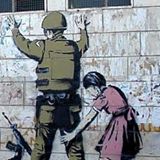
Art of occupied PalestineThe mind boggles to think of the mean ole BDS “punishing” poor little nuclear-armed Israel with a non-violent tactic that was effective against apartheid South Africa. 

Clinton has been around this track before. She knows better than to write that BDS is “punishing” Israel. BDS does not punish; it shames. 

Palestinians also use shame against the occupation with art as a major weapon. The example above is one of many available on the Facebook page, The Art of Occupied Palestine.

Clinton’s fawning letter to Saban closes with her hand-written note — “look forward to working with you on this.”

Think about it, the woman who could be this nation’s next president, has promised to work with Israeli-American Haim Saban to further subdue an occupied population.

Enough with the fawning. Clinton must listen to her fellow American United Methodists who have “implored” her to reconsider her opposition to BDS.

As a senator, Clinton was wrong when she supported the 2003 Bush invasion of Iraq. She is wrong again on BDS.

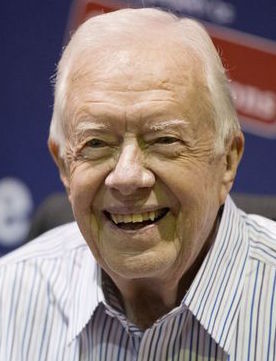
The picture of President Carter at top is an AP Photo by Matt Rourke.

Posted in Hillary Clinton, Israel, Jimmy Carter, Netanyahu, Palestinians, United Methodist Church | Tagged , , , , | 6 Comments

Jimmy Carter Has Cancer

LAT Sara Saundersby James M. Wall

The news came from NPR: A loved one has cancer.

Former President Jimmy Carter made the announcement from the Carter Center in Atlanta.

He did not mince words. He has cancer and it has spread.

His announcement was candid and truthful.

The cancer, which was first identified in his liver, has “spread to other parts of his body”. He expects to hang around for a while; his travel schedule is only cut back, not canceled. How long will a “while” last? We will just have to wait and see.

In Georgia where I grew up, a “loved one” is a family member, or someone who has joined the family circle.

Jimmy Carter, this nation’s 39th  president, is an adopted “loved one” in our family. He is also a fellow Georgian.

It was my great blessing and privilege to work for him through his two campaigns for the White House. Since he and Rosalynn left the White House, we have stayed “in touch”.

After learning of the cancer, I wrote immediately to inform him it is too early for him to leave the battlefield. And, God willing, he won’t leave anytime soon.

I have been reading stories of his cancer announcement. I have also perused the reviews and interviews from his most recent book tour.  

One interview in the Los Angeles Times, was especially well done. Written by the Times‘ Carolyn Kellogg, it was on target, with this headline: “In ‘A Full Life,’ Jimmy Carter at 90 remains a wise truth teller”.

Carter’s book demonstrates his consistent “truth telling”.  It is entitled, A Full Life: Reflections at Ninety.  

Kellogg’s interview lifts up the truth-telling characteristic of Carter’s that is at the center of his life as a man and as a world leader. She writes:

“One challenge of Carter’s presidency was that he spoke the truth, even though during his years in the White House (1976-80), the truth was often bad news. He faced an energy crisis, a capsizing economy, opposition from Congress, and the revolution in Iran than led to American hostages being held captive 444 days.”

Kellogg concludes her interview:

 “In A Full Life, Carter puts the long arc of his story together the way he sees it. The book includes his accomplishments as a negotiator and peacemaker in the humblest way — as a man who was at work on a larger project, something he continues to be. A primer for the generations who don’t know his work and a personal retelling for those who do,  A Full Life may herald the reappraisal he deserves.”

In the months and years ahead, as the nation and the world reflect on Carter’s life, “the reappraisal he deserves” should dominate the reflection.

When you travel with a candidate, as I did with Jimmy Carter through two campaigns in Illinois, where I served as his state chair, you come to know him. How well you know him will depend on his openness, his candor and his patience.

From my experience, I can testify that he has an abundance of all three. 

Thinking back on our first Illinois campaign together in 1976, one incident stands out. It is not an important incident. But it taught me all I needed to know about this nation’s next president.

Carter was a former governor of Georgia when he launched his 1976 Illinois campaign. I had arranged a campaign stop in the south side of Chicago where the Reverend Jesse Jackson was a dominant political figure. 

I had made the very major political mistake of taking Carter to an African-American church without clearing the location with Jackson. A leading political figure in Jackson’s circle, a strong woman with a forceful manner, called me several days before the stop. 

She was adamant.  “You cannot go to that church without my approval” was the gist of her message to me. I told her it was too late to make a travel change. I remember her words vividly, and they taught me a political lesson: “You can’t come into our house without first coming through the kitchen”.

I apologized for my ineptness. She remained adamant.  

I spoke to Governor Carter. “Call Andy”, was his response, referring to African-American civil activist and political leader, the Rev. Andrew Young, in Atlanta, Carter’s home base.

Carter already knew Chicago politics better than his state chairman.  Young was later a Carter appointee to the United Nations, a congressman and a future mayor of Atlanta.

Andy mollified the strong personalities involved. We stuck to our original plan. 

The night Carter spoke at the church, one of our staff members talked to the crowd as it assembled, a crowd not as large as Jesse Jackson would have produced, but adequate.

I was holding Governor Carter “backstage” until he was introduced. Chicago Sun Times political writer Basil Talbott cornered Carter with a question about our choice of that particular church.

Basil also had another political question about the Illinois campaign, which was just in its early stages.

Carter said nothing. He merely nodded to me to handle the mess I had gotten him into. I said not a word about the “kitchen” I had failed to enter earlier.  I mumbled a few words about campaign plans unfolding.

Carter smiled, and then went out and wowed the crowd.

Incidents like that one either destroy a relationship or solidify it.  I remain thankful to this day for Jesse Jackson, and for his lady advocate. I also remain thankful for Andy Young, Basil Talbott, and above all, for Jimmy Carter, for helping me survive a major stumble.

We survived because Carter knew when to ride behind error-prone associates, and when to stand alone, if needed, to speak the truth when the truth was largely hidden.

Carter’s courageous truthfulness is interwoven with his stubbornness and his determination to see a larger picture as it unfolds. When he sees the truth, he follows it, regardless of the consequences.

We all saw that later in his achievements against heavy opposition during his White House years, and throughout the remarkable career he has had as a truth-teller and problem-solver in troubled regions of the world.

51+RXdWiHNL._SX315_BO1,204,203,200_It was Carter’s truth-telling in his book Palestine: Peace Not Apartheid, which forced the Israel-Palestine issue into the light of the world’s attention.

Without that book, which cost him dearly in the circles of power in the nation he led for four years, the truth of Palestinian occupation might still be struggling to gain a hearing in the court of world opinion.  

I am grateful for the opportunity I had to play a small part in getting Carter safely through the Illinois political shoals. So many others took him the rest of the way to the White House. 

Carter’s struggle is not over, which it is why it is far too early for Jimmy Carter to leave this earthly battlefield. The pending freedom of both Israelis and Palestinians from the bondage of conflict, owes a great deal to this man. 

There is work yet to be done, sir.

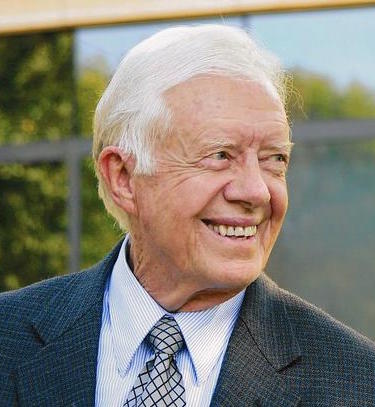
The picture of Carter is from the Los Angeles Times. It is by Sara Saunders.

Posted in Cancer, Jimmy Carter | 9 Comments

Iran Political Fulmination Versus Diplomatic Deal

by James M. Wall1809923496

Blessings upon New York Times columnist Nicholas Kristof for pointing out that “fulmination” is the right word to describe opposition to the diplomatic deal President Obama and Secretary of State John Kerry have just reached with Iran and the P5+1 major world powers. 

Fulmination is exactly the term to describe the political and pundit “arguments” now being used against the agreement.

That’s right, fulmination, as in “to issue a thunderous verbal attack or denunciation”.

Or, if your thinking runs more to the ecclesiastical, fulmination is the best way to describe “a sermon that was one long fulmination”.

In an internet introduction to his Times column on his support for the deal, Kristof testified with the quiet dignity of a man who comes to the altar after sitting through “one long fulmination” which he finds totally unconvincing.

“I’ve covered Iran and North Korea for years, and have been to each country a number of times. One of the things I’ve seen is that American politicians want to practice fulmination rather than diplomacy, but fulmination doesn’t block a nuclear program.”

In his column, on line and in print, Thursday, July 30, Kristof wrote:

“The U.S. didn’t get all it wanted (and neither did Iran) in an imperfect compromise. True, we didn’t achieve anywhere, anytime inspections, yet the required inspections program is still among the most intrusive ever.

Remember too that this deal isn’t just about centrifuges but also about the possibility that Iran will come out of the cold and emerge from its failed 36-year experiment with extremism”.

The cool, rational language with which Kristof explains “why I think the deal makes us safer”, contrasts with the bombastic, irresponsible language employed by politicians and pundits who prefer to fulminate to the voting masses, in language eagerly broadcast by media outlets.

Fulmination is mindless language shouted against the mindful expressions of a thoughtful analyst like Nicholas Kristof.

During the 60 day period Congress has to consider the deal, polls offering to describe public opinion on the deal John Kerry reached with representatives of Iran and the P5+1 major nations should be read with several tons of salt.

The P5+1 offers a strong array of international powers. The term P5+1 refers to the UN Security Council’s five permanent members (the P5); namely China, France, Russia, the United Kingdom, and the United States; plus Germany.

One conservative poll operation fed the fulmination fervor with a misleading question that skewed its findings against the deal.

“A poll by Secure America Now in coordination with Caddell Associates and McLaughlin & Associates suggests that 54 percent of voters agree with opponents of the Iran nuclear deal, based on a misleading question that falsely likens the deal to ‘the one North Korea violated to build nuclear weapons'”.

Yes, that is the same Pat Caddell who was George McGovern’s pollster in McGovern’s 1972 failed try for the presidency. Sad to say, from one who worked with Caddell on that campaign, the Pat Caddell of today appears to me to be as politically far right as he was politically far left in that 1972 campaign.

Viewers and readers should question polls, whether reported by CNN or Fox or MSNBC with the same vigor the old Chicago News Bureau once counseled, “If your mother says she loves you, check it out”.

Public displays of support or opposition to the Iran deal are more reliable.

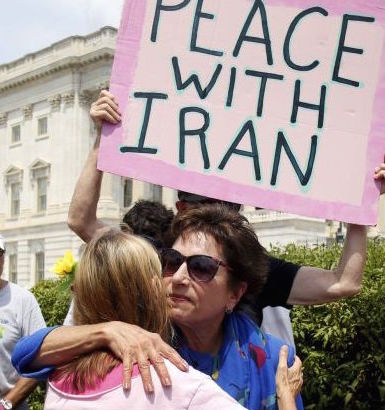
Witness, for example the picture above from Thursday’s New York Times, capturing the moment when Congresswoman Jan Schakowsky, who has served Illinois’ 9th district since 1999, hugs a young Code Pink demonstrator in Chicago, in an expression of common agreement supporting the the deal.

Schakowsky is Jewish;  her district has a heavy Jewish constituency. She is recognized as one of Israel’s strongest supporters in the Congress. She did, however, signal her caution in giving Israel the doubt in every issue, when she chose not to attend Israeli Prime Minister Benjamin Netanyahu’s anti-Iran deal speech to Congress in March.

In a press release this week, Schakowsky points to a poll from Public Policy Polling which reaches a different conclusion from the Caddell poll.  

The PPP poll finds that “there’s strong support nationally for the Iran deal, that voters want their members of Congress to let it move forward, and that there’s no potential political backlash for members who do support the deal”.

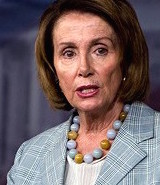
Schakowsky stands with her Democratic Minority House leader, Nancy Pelosi, who has represented California’s 12th congressional district for 27 years.

 The Hill reported Thursday:The Hill Getty

House Democrats will provide the necessary support to finalize President Obama’s nuclear deal with Iran, House Minority Leader Nancy Pelosi (D-Calif.) predicted Thursday.

Asked if the Democrats could sustain a promised veto of the Republicans’ expected disapproval measure, Pelosi didn’t hesitate.

“Yes,” she replied.

Pressed about the reason she’s so confident, she said: “Because of the nature of the agreement.”

She added that the agreement is a “diplomatic masterpiece”.

Prominent figures in the world of entertainment and world politics have joined the battle between fulmination and diplomacy. In a video released by Global Zero, they make the case that diplomacy is the only answer to the present crisis.

Included in the video are Jack Black, Morgan Freeman, Natasha Lyonne, Farshad Farahat, Valerie Plame, Queen Noor of Jordan, and former U.S. Amb. Thomas Pickering.

For those who do not respond well to fulmination, the testimonies above, beginning with the New York Times‘ Nicholas Kristof, make a strong case for diplomacy.  

The picture at top is from the New York Times. It is by Reuters.. The picture of Nancy Pelosi is from The Hill.  It is a Getty photo.

Posted in Iran, Israel, John Kerry, Middle East Politics, Netanyahu | 4 Comments

Thirteen Senators Who Could Make History

by James M. Wallimages

Most U.S. media attention is focused this summer on Donald Trump and the latest outbreak of domestic violence in movie theaters. But look carefully at the internet and you will find Roland Nikles reporting for Mondoweiss on a story of far-ranging significance.

He finds Peter Beinart in Ha’aretz explaining the pending congressional vote on the Obama-Kerry negotiated Iranian nuclear deal:

“Israel and the United States (and the other members of the P5+1) have conflicting interests at stake when it comes to the Iran deal. Meanwhile, many in Congress are behaving like they represent Benjamin Netanyahu instead of the American people.

The P5+1 have negotiated with Iran in order to take an Iranian nuclear bomb off the table indefinitely, and to prevent a nuclear arms race in the region.

Israel and the Saudis have a different interest. For Israel and the Saudis, the primary goal has been to keep sanctions in place indefinitely in order to cripple Iran as a regional competitor.”

In an analysis for Forward, Nathan Guttman, writes: “Thirteen U.S. Senators is all President Obama needs to ensure that the nuclear deal with Iran does not get derailed by Congress”.

Do the math:

There are currently 54 Republican senators, all of whom are expected to oppose the deal.  The Republicans will need only 13 Democrats to cross party lines and vote against the deal to reach the 67 votes required for an override.

To prevent that veto override, President Obama needs 34 Democratic senators to support him; otherwise the  deal collapses. 

Among the 34 undecided Democratic senators (including two Independents) Obama needs to sustain the deal, the Republican majority needs to pick off thirteen Democrats to vote against the diplomatic option.  If they successfully add thirteen more Democrats to their side, the deal is dead.

Nathan Guttman gives the details:

With Republicans controlling both the House and the Senate, Congress is likely to reject the Iran deal. Not one Republican has expressed support for the deal. But that is only the first round. Obama has already made clear his intention to veto any legislation rejecting the Iran deal.

If that happens, Republican leaders will have to come up with a two-thirds majority in both chambers to override Obama’s veto. Most analysts focus on the Senate, where Republicans are expected to have a tougher time getting this super-majority.

There are currently 54 GOP senators, so Republicans will need 13 Democrats to cross party lines and vote against the deal to reach the 67 votes required for an override.

Political analysts have identified between 14 and 28 Democratic senators in the undecided column.

These include security hawks such as Virginia’s Mark Warner and Tim Kaine, or Michigan’s Gary Peters, as well as others who have been skeptical about Iran’s intentions from the get-go, and several senators with significant Jewish constituencies, including Florida’s Ben Nelson, Cory Booker of New Jersey and New York’s Chuck Schumer (pictured above), who is currently viewed as the biggest prize on the Senate floor.”

Guttman acknowledges that the security hawks in the Democratic caucus, all of whom have strong emotional ties to Israel, are dead set against the deal, falling in line behind Israel’s Prime Minister Benjamin Netanyahu.

The Hill’s “whip list” identifies five yes votes for diplomacy (including Independent Senator Bernie Sanders); 13 leaning yes votes (including Senator Elizabeth Warren); and 28 Democrats who say they are undecided. 

The Republicans need 13 of those 28 undecided Democrats to cross over and vote against the deal. 

“Advocates believe that Schumer’s decision, thanks to his senior position in the Democratic Party (he is slated to take over as majority leader next year) and to his standing in the Jewish community, could play a significant role in influencing other undecided Democrats.”

Undecided senators, including Schumer, will be watched carefully in the weeks leading to the final vote on the deal. Among the undecided Democratic senators, 13 could scuttle the Iran deal by crossing party lines.

Below are the thirteen U.S. Democratic senators identified by Forward as undecided on how they will vote on the Iran diplomatic deal. Some of the thirteen have not commented on the deal, others are studying it. 

The Democratic undecided senators below are identified by state. The Forward offers their current position on the vote. All are needed to sustain Obama. Voters in their states still have time to communicate to Senate offices locally or in Washington. 

The graphic of the thirteen senators is from the Forward http://forward.com/news/national/317812/iran-deals-undecideds/

Posted in Iran, Israel, Middle East Politics, Netanyahu, Obama, Palestinians | 6 Comments

Isaiah 21:6: “Go Set a Watchman”

by James M. Wallbook cover

Harper “Nelle” Lee, now 89, has published a second book. Her first, To Kill a Mockingbird, is considered a classic of American literature.

Her second, Go Set a Watchman, arrives this week as a timely gift. It reaches readers as our first African American president continues in the final two years of his presidency.

The new book draws its title from Isaiah 21:6, the King James version, of course, for this is a writer from southern Alabama who grew up in a Methodist church, where King James is sacred.

“For thus hath the Lord said unto me, Go, set a watchman, let him declare what he seeth.” 

In the early weeks of his presidency, Barack Obama tried to heed Isaiah’s biblically-rendered counsel. 

President Obama appointed Ambassador Chas W. Freeman, Jr., to an important office. A veteran diplomat, fluent in Arabic, and deeply sensitive to the politics of the Middle East, Freeman was ready to report to this new president “what he seeth”.

So powerful is the Zionist grip on the Congress, and so all encompassing is the octopus-like tentacles grip the Jewish lobby maintains on American cultural elites, Freeman was doomed from the outset. He withdrew his name as a possible appointee.chas_freeman4

Freeman (right) ran into the third rail of American politics. He had accumulated enemies in governing circles, enemies who were in place to keep a new president close to the Zionist line and ever protective of the modern state of Israel.

Freeman had his supporters, of course.

Jim Lobe described the news of Freeman’s pending appointment as “stunning”. He explained why on his blog at the time:

There are very few former senior diplomats as experienced and geographically well-rounded, knowledgeable, entertaining (in a mordant sort of way), accessible (until now at least), and verbally artful as Freeman.

He can speak with equal authority about the politics of the royal family in Saudi Arabia (where he was ambassador), the Chinese Communist Party — he served as Nixon’s primary interpreter during the ground-breaking 1972 visit and later deputy chief of mission of the Beijing embassy, and the prospects for and geo-strategic implications of fossil-fuel production and consumption over the next decade or so.

Freeman is still needed at the White House. Meanwhile, he continues to lecture and publish essays that reach a wider audience than that of the lecture hall. He continues to function as the watchman. He tells the nation what he “seeth”.

He most recently spoke in Sarasota, Florida. His lecture has been posted online.

The lecture begins as a watchman’s report should begin:

I want to speak with you today about the Middle East. This is the region where Africa, Asia, and Europe come together. It is also the part of the world where we have been most compellingly reminded that some struggles cannot be won, but there are no struggles that cannot be lost.

It is often said that human beings learn little useful from success but can learn a great deal from defeat. If so, the Middle East now offers a remarkably rich menu of foreign-policy failures for Americans to study.

Further along, Freeman delivers this powerful description of Israel’s current role in the Middle East:

Israel has come to enjoy military supremacy but it remains excluded from most participation in its region’s political, economic, and cultural life.

In the 67 years since the Jewish state was proclaimed, Israel has not made a single friend in the Middle East, where it continues to be regarded as an illegitimate legacy of Western imperialism engaged in racist removal of the indigenous population.

International support for Israel is down to the United States and a few of the former colonial powers that originally imposed the Zionist project on the Arabs under Sykes-Picot and the related Balfour Declaration. The two-state solution has expired as a physical or political possibility. There is no longer any peace process to distract global attention from Israel’s maltreatment of its captive Arab populations.

There is more, much more, from this watchman. For the complete lecture click here.

Israel, Freeman reminds us, is “an illegitimate legacy of Western imperialism engaged in racist removal of the indigenous population”.

Harper Lee’s Watchman is the work of an author who knows she is struggling with the agony of racism in the hometown she loves, Monroeville, Alabama, which she calls Maycomb in her novels. 

Reading chapter one, conveniently available on line, there is no doubt that this new book is in the familiar voice of Harper Lee, a writer deeply rooted in, and increasingly critical of, the cultural patterns of her native Monroeville, Alabama.

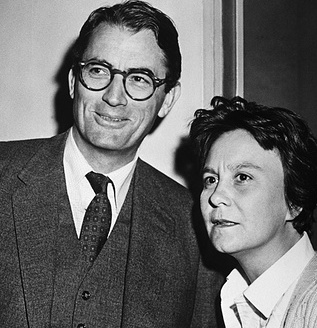
Mockingbird‘s continued popularity since its arrival in 1960, has been driven by English Peck and Harperliterature teachers and the immediate success of the 1962 film of the same name, featuring Gregory Peck as Scout’s father, Atticus Finch, a self-educated attorney very much a man of his time.

Atticus is no bigot; he was a segregationist. A bigot is someone whose life is devoted to hatred of another race. That is not Atticus.

As the Guardian notes in writing about critical reviewers::

Presumably these reviewers are relying on their memories of the film of Mockingbird instead of the actual book, given that Scout and Jem frequently use the N-word in the novel – as poor white children in Alabama in the 1930s, when the book was set, most certainly would have done.

Both Watchman and Mockingbird were written in the 1950s. Judging the racial attitudes in these books by today’s standards is as ridiculous as expecting a character, let alone an author, to behave exactly as you would like.

As the grown-up Scout had come to realize, however, by the time she wrote Mockingbird, her beloved home town, driven by public ignorance and deeply-embedded prejudice, was strongly resisting the closing of the racial divide.

Small town lawyers like Atticus Finch were unable to adjust to change. The times that were ‘achanging, had passed him by.

The time in which the original To Kill a Mockingbird is set, the early 1930s, was a time when the dominant white community members treated blacks with a conflicted, and inevitable unsustainable, mixture of condescending kindness and corrosive cruelty.

It was a mixture derived from a smug position of ignorant white supremacy. It is also, a mixture once again revived in the politics of the 21st century with new players, Tea Party extremists and  Zionist Christians, employing ugly racism to shape American politics.

It is into this mixture, that Lee has delivered her valuable gift.

The editor who worked with Lee persuaded the first-time author to lift an important segment from her longer work and tell the shorter story of incidents from Scout’s earlier childhood.

The editor was right, of course, To Kill a Mockingbird, is too delicate to insert into a larger portrait of the fictionalized life of Harper Lee. It would gain a wider reception by standing  on its own.

Harper Lee’s first novel possessed a wisdom and a sensitivity that captivated readers. If critical tradition prevails, her “second” novel will draw superficial, patronizing reviews from writers who fail to follow Atticus Finch’s advice to understand others by walking in their shoes.

Chapter one, conveniently available on line, begins with this opening line: 

“Since Atlanta, she had looked out the dining-car window with a delight almost physical.”

From this beginning, the reader knows Harper Lee is back, traveling by train from Atlanta to Monroeville.

Paired with Ambassador Chas W. Freeman’s Sarasota, Florida, lecture, Harper Lee’s second novel offers a strong reminder that racism is alive and well in the American political soul.

This pairing also reminds us that watchmen like Freeman and writers, like Harper Lee, continue to tell those willing to listen, that racism is a danger to us all. 

The picture of a younger Harper Lee with Gregory Peck is from The Guardian

Posted in Israel, Media, Middle East, Middle East Politics, Movies | 3 Comments

Bishops: Divestment Not in our “Best Interests”

by James M. Wall36-Gaza-Child-Shareef-SarhanCAFOD-v2

The Episcopal Church’s House of Bishops on Thursday condemned the BDS (Boycott, Divestment, Sanctions) strategy. 

The bishops spoke the language of the market place. They made no effort to theologically justify their condemnation.

Instead, they were pragmatic, not prophetic. Why? Because they have invested in institutions.

Matthew Davies, reporting for the Episcopal News Service (ENS), issued the official word from the Bishops in Salt Lake City, Utah, where the Episcopal Convention is currently in session.

Davies reported that the bishops sent “a strong and clear message that divestment from companies and corporations engaged in certain business related to the State of Israel is not in the best interests of The Episcopal Church, its partners in the Holy Land, interreligious relations, and the lives of Palestinians on the ground.”

That chilling passage is painful in its honesty. To the bishops, property and institutional structures, and the ability to operate Christian services within those structures, determine “the best interests of the Episcopal Church”.

Notice their pragmatic shopping list: Partners in the Holy Land, interreligious relations back home, and the lives of Palestinians “on the ground”. 

The Episcopal Church has invested itself in an area in which it provides religious care, both spiritual and physical, to the local residents. Experience has shown church leaders throughout history that it is not in their “best interests” to go against the controlling power. 

Some religious leaders have refused to accept that compliance. Others have compromised to keep their institutions as effective as possible.

Those in power know how to manipulate the powerless.

You want to enlarge or at least maintain your services, both spiritual and physical? You will need the permission of the ruling occupying power, in this case, an occupying military power, that governs your every institutional need.

The Episcopal lay and clerical delegates meeting in Salt Lake City this week, know this all too well.

In another corner of the Christian institutional world, the third denomination meeting this week voted to punt.

The New York Times reported Friday morning:

Delegates to the Mennonite Church U.S.A.’s convention in Kansas City, Mo., decided to postpone a vote on a similar resolution until its next convention in 2017.

Sponsors of the resolution said it had become clear during a debate on Wednesday that a number of delegates had questions about the resolution’s scope and intent.

“I think people were speaking out of a variety of fears,” Tom Harder, a pastor from Wichita, Kan., who had helped draft the resolution, said in a telephone interview.

“I think there are folks in the denominations who continue to believe that we need to support Israel at all costs, and so a resolution that is advocating for the Palestinian people specifically and the injustices they are facing — that is a vote against Israel and against the Jewish people,” Mr. Harder said.

He said supporters of the resolution would work over the next two years to amend it in ways “that address some of the concerns that we heard.”

The “concerns that we heard”?

The 95,000 member Mennonite Church has a long history of involvement in the region. Their leaders need to “study the situation” more?  

They will study for two years and meet again in 2017.

Those Palestinian mothers, fathers and children. who do not die from Israel’s constant military assaults, or who fail to survive the occupation’s economic stranglehold, will be two years older in 2017.

It is this reality the BDS strategy seeks to expose in order to end the evil of an occupation which Mennonite and Episcopal leaders still need to study.

The fact remains: Israel occupies Palestine. In this half-century established evil act, the occupiers have converted and/or bought allies who endorse their rationale for evil because it is to their pragmatic interests to do so.

These allies are in the halls of Congress, in the local pews and governing structures of religious institutions.

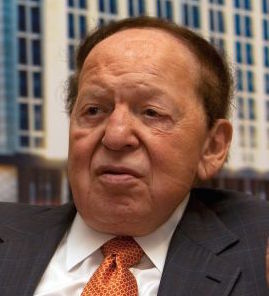
These allies include Jewish-American financial tycoons like Sheldon Adelson (below), who purchase Israel supporters in the Congress and the White House with dollars and media pressure.Bloomberg China 2012
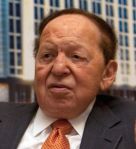
These allies are currently in the majority of the Episcopal House of Bishops and in the leadership structure of the Mennonite Church.

Rarely has such a pragmatic rationale been so openly acknowledged as it was this week when the Episcopal House of Bishops essentially acknowledged that their prophetic voices are silenced by their investment in institutions they require to service the needs of their people.

This admission followed by two days an entirely different response from delegates to the United Church of Christ General Synod, meeting in Cleveland, Ohio, who accepted divestment from businesses profiting from occupation, as a peaceful, but clearly effective, strategy, to use against the repressive conduct of the state of Israel.

For their prophetic stand, the United Church of Christ has been condemned by Jewish organizations in the U.S., whose path to interfaith cooperation demands capitulation to the Israeli narrative.

How did the Episcopalian ruling body bring their church to this sad moment in the life of their particular home of U.S. Christians. They did it with legislative maneuvers and defensive language clothed in religious piety.

The official Episcopal News Service announcement explained:

“The bishops rejected Substitute Resolution D016, which would have called on the Executive Council’s Committee on Corporate Social Responsibility (CSR) to develop a list of U.S. and foreign corporations that provide goods and services that support the infrastructure of Israel’s Occupation “to monitor its investments and apply its CSR policy to any possible future investments” in such companies”

That D016 Substitute Resolution was the legislative compromise the Episcopal convention had developed in an effort to get sufficient votes to pass the best prophetic stand it could find. 

This obviously watered-down compromise was a last minute effort to support “divestment” without naming it. No one seeking the sanction of the Israeli government wa buying it.

The ENS reported further:

“Although the resolution didn’t use the word “divestment,” some bishops expressed concern that it was heading in that direction”.

Outsiders, with no responsibility on the ground where institutions are forced to work under a military dictatorship, are asked to understand what locals must endure.

For Episcopalians, Archbishop Suheil Dawani is their leader in the line of fire.

“Others reminded the house that Archbishop Suheil Dawani of the Episcopal Diocese of Jerusalem has urged the Episcopal Church not to adopt a policy that would make it more difficult for him to manage his congregations and the more than 30 social service institutions throughout Israel, Jordan, Lebanon, Syria and the Palestinian Territories. Those institutions include schools, hospitals, clinics and centers for people with disabilities and serve people of all faiths.

“Any hint of divestment will hamper the ministry of Archbishop Suheil Dawani and his priests and congregations in the Middle East,” said Bishop Jay Magness, bishop suffragan for Federal Ministries who served on the Legislative Committee on Social Justice and International Policy that considered the resolutions.”

“We were assured by the treasurer that we don’t have any direct investments in the usually named companies,” such as Caterpillar, Hewlett Packard, G4S, and Motorola Solutions. Bishop Prince Singh of Rochester, chair of the committee, also confirmed that The Episcopal Church currently has no investments in corporations that negatively impact Palestinians on the ground.

Bishop Ed Little of Northern Indiana said the text of the resolution “clearly and unmistakably advocates boycott and divestment, and we must reject it.”

Then the Bishops’ official news release fell back on the Israeli narrative they have accepted, the accepted “truth”  that insists that “what we have here is a failure to communicate.”

Communication between unequals is always in one direction, where soldiers terrorize Palestinian children, (right) because they have the power to do so.al watan Jerusalem
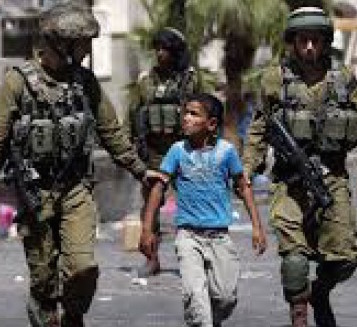
The Bishops, in their stumbling effort to justify their pragmatic relationship with evil, fell back on religious language they have already demeaned with their pragmatism.

“As Anglicans, we have the gift and ability to reach out to people on both sides in the conflict. That is what The Episcopal Church is doing in the Middle East. Our current leadership under the presiding bishop is allowing us to be peacemakers.

Presiding Bishop Katharine Jefferts Schori in January led an interfaith pilgrimage to the Holy Land as recommended by Resolution B019 from the 2012 General Convention that called for positive investment “as a necessary means to create a sound economy and a sustainable infrastructure” in the Palestinian Territories.”

To the homeless in Gaza, to the Palestinians in Israeli prisons for no reason other than their failure t0 adhere to the powers that control the occupation, the best way to “create a sound economy and a sustainable infrastructure”, is to be released from incarceration.

Did the interfaith pilgrimage led by the presiding bishop know that while they were on their pilgrimage, the number of Palestinians forced into Israeli prisons had increased by 26% since 2011.Eyal Warshawski
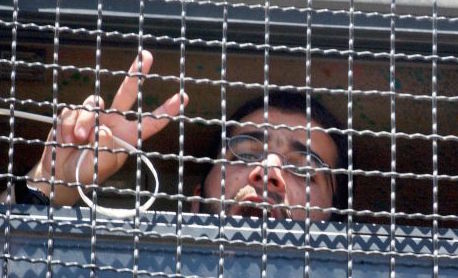
To the mothers who fear that at any moment their children will be shot for walking in the wrong direction, “a sound economy and a sustainable infrastructure” are words utterly without meaning.

Sound economy and a sustainable infrastructure in the Palestinian Territories?  

Leaders of the Episcopalian institutions in Palestine must be aware of the words from Corinthians, “If I speak in the tongues of men and of angels, but have not love, I am a noisy gong or a clanging cymbal”?

The Bishops’ final statement was far more honest, albeit pragmatic, though entirely without any sign they engaged in serious theological reflection to reach that honesty.

The Bishops have said, in effect, to their fellow Christians who favor divestment, “if you had invested in ministry and service inside this prison, you would have some understanding of how we must live under this dictatorship.”

They dare not say it that way, else their prison keepers would cut off their water supply, or keep their new medical equipment blocked at the border, or simply go hunting for more Palestinian children to shoot.

This is what happens when the prophetic voice confronts the reality of prison life. 

The progressive wing of the Episcopal Convention has labored for years to reach a point where prophetic voices could be heard over the religious establishment’s pragmatic investments.

They did their best in Salt Lake City. And they will not stop now, as the conciliatory words of one leader indicated after the House of Bishops vote.

Donna Hicks, convener of the Episcopal Peace Fellowship’s Palestine Israel Network, said after the Bishops voted to condemn divestment:

“We’re encouraged by the fact that bishops and deputies understand that this is a pressing issue, and that the discussion at this convention focused not on whether to take action, but rather what action would be most effective … We’re optimistic that today’s vote is just another step in our own process to ensure that we are not profiting from the occupation, and that divestment will pass at a General Convention in the near future.”

The Episcopalian progressives will be back. The arc of justice demands it.

The picture at top is of a Gaza child one year after the 2014 Israeli military assault on Gaza. The picture is from The Independent. It was taken by Shareef Sarhan. The  picture of the Palestinian man in prison is from Ha’aretz. It was taken by Eyal Warshawski.

Posted in Episcopal Church, Palestinians, Religious Faith | 29 Comments

UCC Says No to Occupation, Votes 80% to Divest

by James M. WallUCCvote

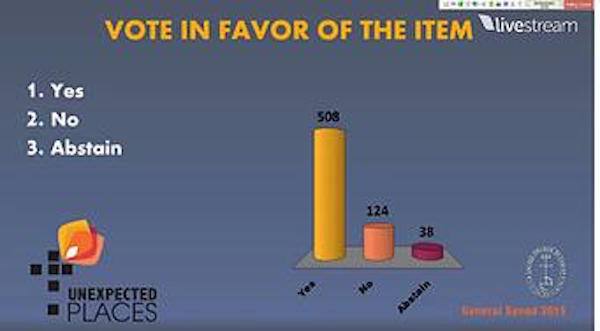
The United Church of Christ (UCC) General Synod has voted overwhelmingly in favor of resolutions that require UCC church funds to be divested from companies with business in the Israeli-occupied Palestinian territories.

The UCC General Synod vote was 508 in favor of divestment, 124 against, with 38 abstentions.

In this strong action in favor of divestment, the UCC placed additional pressure not only on the state of Israel’s fear of losing favor in world opinion, but also on delegates of the Episcopal Church General Convention, who are expected to vote Wednesday on resolutions similar to those endorsed by the UCC national body.

The divestment action covers businesses in illegally-occupied territories, not, contrary to Israeli propaganda, businesses within the state of Israel.

Since the 2005 start of the BDS (Boycott, Divestment, Sanctions) non-violent campaign to  pressure Israel to give up its illegal occupation, U.S. church national bodies have steadily moved from implied support for the occupation, to a series of actions that refuse to allow church funds  to invest in the occupation.

The secular media is taking notice.

Associated Press religion writer Rachel Zoll, reports:

Last year, the Presbyterian Church (U.S.A.) voted to sell stock in a few companies whose products are used by Israel in the territories.

The United Church of Christ resolution was broader. Delegates are calling on the denomination’s financial arms to sell off stock in any company profiting from what the church called human rights violations arising from the occupation. The church also voted to boycott Israeli products made in the territories.

Peter Makari, Area Executive for Middle East/Europe in the UCC’s Global Ministries agency, said after the vote that the resolutions “reflect our urgent concern for the worsening effects of the Israeli occupation on Palestinian people and lives, including the disparity in rights and power.”

Responding to the resolutions,  Israeli Foreign Ministry spokesman Emanuel Nahshon expressed his government’s displeasure over the resolutions.

Nahshon said the UCC’s policies have “reflected the most radical politics for more than a decade and in no way reflect a moral stance or reality-based position.”

The UCC has struggled, as a national body, on how to respond to this consistent barrage of attacks against any group or individual not endorsing Israel’s action in the occupied territories.

In 2005, the UCC passed a resolution seeking reconciliation, calling for “economic leverage” to resolve the Israeli-Palestinian conflict.

Ten years later, after three devastating invasions of a civilian Gaza population, after further Israeli settlement growth on Palestinian land, and after increased occupation procedures of routine military attacks on Palestinians, the UCC General Synod has finally said enough is enough.

To which, Israeli Foreign Ministry spokesman Nahshon offered this pious response:

“People of faith ought to be acting to help Israel and the Palestinians to renew efforts to achieve peace, rather than endlessly demonizing one party in the conflict — in our view, the aggrieved party.”

Prominent theologian and Palestinian clergyman, the Rev. Dr. Mitri Raheb, Pastor of Bethlehem’s Evangelical Lutheran Christmas Church, was a guest preacher at the UCC Synod, which is being held in Cleveland, Ohio. 

Responding to the vote, Dr. Raheb said that “in approving this resolution, the UCC has demonstrated its commitment to justice and equality”.

Pastor Raheb further emphasized the reality of occupation and the validity of the UCC action:

For Palestinians living under occupation or facing systematic discrimination as citizens of Israel, enduring the destruction of their homes and businesses, the theft of their land for settlements, and living under blockade and siege in Gaza, this action sends a strong signal that they are not alone, and that there are churches who still dare to speak truth to power and stand with the oppressed.

The strong vote for divestment came at the culmination of a process that began in 2005, to end the Church’s complicity in Israel’s nearly half-century-old occupation and other abuses of Palestinian human rights.

The 2005 Palestinian civil community’s initial call for Boycott, Divestment, and Sanctions, was endorsed by Palestinian Christian leaders who embodied the call in the Kairos Palestine document which seeks Palestinian freedom and rights through peaceful means.

BDS leaders make it clear that the movement was inspired by the US Civil Rights and South African anti-Apartheid movements.

The 78th General Convention of The Episcopal Church is currently in session in meetings that began June 26. Voting on similar resolutions to the one passed by the UCC General Synod, is expected to come on Wednesday, July 1 at the Salt Palace Convention Center in Salt Lake City, Utah.

The Episcopal Convention proposals were developed by a new group, the Episcopal Committee for Justice in Israel and Palestine.

The third national body considering specific action on the issue is the Mennonite Church USA Convention, which is currently in session from June 30 through July 5, in Kansas City, Missouri.

One pro-Palestinian Episcopal delegate was asked if the UCC vote Tuesday would have any  influence on how the Episcopal Convention might vote. The answer was cautious.  Maybe.

Posted in Episcopal Church, Middle East, Netanyahu, Presbyterian Church USA | 9 Comments

Emanuel Church Confronts Racial Violence

by James M. WallReuters:Randall Hill

When Barack Obama began his first term as the 44th president of the United States, he delivered a stirring inaugural address that called on  this nation to join with him in addressing the problems facing the nation.

It was an address of realism and challenges, as he noted:

Today I say to you that the challenges we face are real. They are serious and they are many. They will not be met easily nor in a short span of time. But know this, America — they will be met.

Racism was one of the major challenges our first African-American president had in mind. 

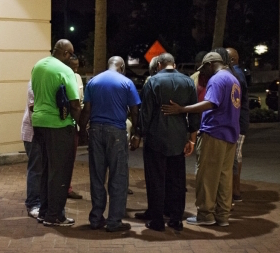
Racism, in all its violent hatred, exploded in Charleston, South Carolina during a Wednesday night Bible Study in the basement of Emanuel African Methodist Episcopal Church, June 17.

The picture above shows a gathering of men outside the church, shortly after the killings, praying together in their shock and grief. 

David Zirin describes the church which experienced that massacre and which evokes prayer as a response:

The more you read about Charleston’s Emanuel African Methodist Episcopal Church, otherwise known as “Mother Emanuel,” the more awe you feel for its historic resilience amidst white-supremacist terror.

This church is now known as the scene of a massacre, which is being investigated as a “hate crime.”  Nine are dead, but this institution will not fall. We know this because it has stood tall amidst the specter of racist violence for 200 years.

What happened in Charleston after the killing of eight parishioners and the church’s pastor, the Rev. Clementa Pinckney, was a miracle of grace. There was no rioting in the streets, no cries for revenge.

What happened in the aftermath of a senseless slaughter, was that “Mother Emanuel” church once again stood tall and looked upward with forgiveness out of the depths of a dark and tragic event.

The church congregation, the bereaved families of the church’s pastor and Cynthia Hurd, Susie Jackson, Ethel Lance, DePayne Middleton Doctor, Tywanza Sanders, Daniel L. Simmons, Sharonda Coleman-Singleton, Myra Thompson, all, as though in unison, set an example of how challenges are met.

They must be met through grace, as President Barack Obama so eloquently put it in the moving eulogy he delivered at the funeral for Pastor Clementa Pinckney at an overflowing auditorium of the  College of Charleston’s campus on Friday afternoon, June 26. The full text of his eulogy is here.

As he stressed the significance of grace as the means by which the believer is called to address such dark events, the President paused for a few seconds and then began singing Amazing Grace, words written by John Newton, a clergyman who had once been captain of a slave ship.

The President was joined by the congregation as he sang: 

https://youtu.be/WmRAxJIa0u8

The “historic resilience amidst white-supremacist terror” that David Zirin examines in his Nation report, is an indication of how “Mother Emanuel” has confronted the evil of slavery and racism. Zirin writes:

It was 1816 when the Rev. Morris Brown formed “Mother Emanuel” under the umbrella of the Free African Society of the AME Church. They were one of three area churches known as the Bethel Circuit. This means that a free church in the heart of the confederacy was formed and thrived 50 years before the start of the Civil War.

It had a congregation of almost 2,000, roughly 15 percent of black people in what was, including the enslaved, the majority-black city of Charleston. Because the church opened its doors to the enslaved and free alike, services were often raided by police and private militias for violating laws about the hours when slaves could be out among “the public.” They were also raided for breaking laws that prohibited teaching slaves to read at Bible study sessions.

In his Nation article, Zirin reminds his readers that “it was at one of these Bible study sessions that the shooter opened fire Wednesday night, after sitting among the people for over an hour.”

The response of what President Obama correctly calls “the miracle of grace”, is in the tradition of Mother Emanuel AME Church.

The church and its members did not lash out in fury against racist hatred, which led to the deaths of nine African Americans sitting quietly in a Bible study group. It did what had been its style for the 200 years of its existence.  

It came together in prayer and a resolve to go forward, surrounded by, and filled with, the miracle of grace. There is a power in that grace, an unexplained mystery. 

When words feel inadequate, there is always the poetry of music, as President Obama demonstrated in leading his Charleston congregation with Amazing Grace

Music has been with President Obama since he took office.

Following President Obama’s first inaugural address in 2009, Dr. Joseph Lowery, delivered the benediction. Dr. Lowery, a civil rights leader with Martin Luther King, Jr., began his prayer with words from another notable African American song.

Lowery’s prayer began with the third verse of James Weldon Johnson’s Lift Every Voice and Sing, which, since its composition in 1920, has become known as the “national anthem” of the African American community.

An Emory University event honoring Alice Walker, another icon in the African American struggle against racism, ended with the singing of Johnson’s Lift Every Voice and Sing. Leading the singing is Emory graduate Garrett M. Turner

In the days following the Mother Emanuel massacre, two hymns seem appropriate for religious or secular groups wishing to honor the memory of the nine who died in that historic church. A good opening hymn would be Lift Every Voice and Sing.  

A concluding hymn? Try all the verses of Amazing Grace.

The picture at top was taken outside the Emanuel African American Methodist Church in Charleston, SC. It is a Reuters photo by Randall Hill, from The Nation website.

Posted in Uncategorized | 6 Comments

“What Happens to a Dream Deferred?”

by James M. Wall014979_38

What happens to a dream deferred? 

The question comes from Langston Hughes’ poem, Harlem, which inspired Lorraine Hansberry to write her drama, A Raisin in the Sunthe first play written by an African American woman to be produced on Broadway. 

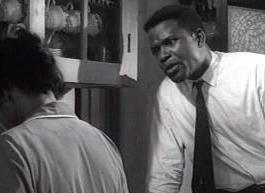
Her play was made into a 1961 movie which featured Sidney Poitier (above), as Walter Lee, the angry and ambitious son of a mother trying to give her family a safe and secure home.

Hughes’ poem, Harlem, is short and prophetic:

What happens to a dream deferred?

      Does it dry up
      like a raisin in the sun?
      Or fester like a sore—
      And then run?
      Does it stink like rotten meat?
      Or crust and sugar over—
      like a syrupy sweet?

      Maybe it just sags
      like a heavy load.

      Or does it explode?

Langston Hughes’ poem was an artistic cry of protest against racial injustice in the United States. He was addressing the increasing frustration and anger felt by African Americans whose dream of equality was continually being deferred.langston-hughes-1

Langston Hughes (1902-1967) (right) was known to possess a “strong sense of racial pride”. It was “through his poetry, novels, plays, essays, and children’s books, [that] he promoted equality, condemned racism and injustice, and celebrated African American culture, humor, and spirituality”.

Like all great art, Hughes’ poem transcends the context of immediacy. “A dream deferred”  applies wherever injustice exists.

Injustices, that is, such as Israel’s oppressive military occupation of the Palestinian people, an occupation that began either in 1948 or 1967, however one wishes to measure the history of stolen land and stolen lives.

Religious institutions have been notoriously slow in responding to that occupation, preferring instead to concentrate narrowly on their own institutional house keeping and growth.

In so doing, these institutions have followed the same plan of deferral practiced by an early generation that tolerated and encouraged racial segregation in U.S. life.

That deferral began to change when Palestinian Christians challenged these churches to denounce and attack Israel’s occupation with the non-violent campaign, Boycott, Divestment and Sanctions (BDS).

BDS began with a call by Palestinian civil society to pursue the same sort of non violent action that earlier worked in the US civil rights movement, and in the anti-apartheid movement in South Africa. 

Some critics have objected (in good deferral style) to lumping BDS into a single assignment. Never mind about that, individuals, institutions and nations can all boycott and divest. Sanctions are the tactic of nations against nations (e.g. Russia and Iran).

The important thing to remember for those who want a way to fight back, non-violently, against an illegal, brutal occupation, is that each institution and each individual has a weapon of choice.

U.S. institutional church bodies have chosen the divestment route, debating proposals to remove church retirement and other fund investments from U.S. companies that continue to conduct business within illegally occupied Palestinian territories.

And yes, the impact of divestment on major businesses is less against the bottom line of the affected companies, and far, far more against the public image of the company and, in this instance, the state of Israel.

Is Israel worried about its public image? Is the Pope a Catholic? Just look at the desperate way in which Israel and its allies are spending big dollars to fight the BDS campaigns. Even Sheldon Adelson has gotten into the act.

Palestine’s dream of freedom has been deferred far too long. It is time now to “conquer” Israel, not on the battlefield, but in the war that hits Israel where it hurts, in the world of public opinion.

Conquer is the right word.

 In the rarely heard fourth verse of the Star Spangled Banner, Francis Scott Key wrote, “Then conquer we must, when our cause it is just, and this be our motto: ‘In God is our trust.'”

Key’s poem, which became our national anthem in 1931, was written after a British flotilla attempted to capture the port of Baltimore, a battle that culminated in the bombardment of Fort McHenry throughout the night of September 13, 1814.

In that context, “conquer we must” referred to “conquer” not as the act of an established nation at war with a neighbor, but as the challenges a new nation faced.

Or, on a more personal note, the word “conquer” to my mother, meant to “rise above” a barrier, in order to overcome it. How many times did she tell me, “you can conquer this”? I lost count at age 14. 

Art, like the poetry of Langston Hughes, can inform us that dreams too long deferred, will wither up like “a raisin in the sun”, or maybe simply “explode”.

Dreams are deferred by barriers, like those legal barriers established by American segregationists or by Israeli occupiers who employ periodic acts of “mowing the grass”, routine night raids into Palestinian homes, and armed checkpoints for a single purpose, to maintain the status quo for those in power.

It is time to fight against that oppression with whatever weapons we  have in hand. Later this month, three U.S. Christian denominations–United Church of Christ, Episcopalian, and  Mennonite–will decide whether or not to seize the BDS weapon to fight against injustice.

When Shakespeare’s English King Henry V rallied his forces to battle against the French, he called on their pride and their dedication to God, king and country.

In Act 4, Scene 3, Henry says:

And gentlemen in England now a-bed
Shall think themselves accursed they were not here,
And hold their manhoods cheap whiles any speaks
That fought with us upon Saint Crispin’s day.

It is this same reminder that Christians in three U.S. denominations, and others who will follow, must hear: Fight against injustice or remain asleep in your beds.

Will these Christians fight injustice or will they continue to sip interfaith tea in an act that defers the dreams of Palestinian children in Gaza who have no beds in which to sleep because the Israelis have destroyed them?

Posted in Religious Faith | Tagged , , , , , , | 8 Comments

Adelson’s Anti-BDS Event Links Money To Action

by James M. Wallsouth africa

Stanford University professor David Palumbo-Liu alerted his Salon readers to a “secret” meeting held last weekend in Las Vegas, Nevada: 

If you did not know that this weekend some of the wealthiest and most powerful people in the world will meet in the Las Vegas desert to plot a massive and well-financed campaign against the Boycott, Divestment, and Sanctions movement, it’s not your fault.  

Palumbo-Liu notes that in order to be aware of this event, “you would have to be a reader of news sources such as the Forward or Haaretz, or Mondoweiss“.

Four days after the Salon posting appeared, The New York Times buried two paragraphs about the Vegas meeting inside a longer story which featured the success Israel was enjoying in gaining anti-BDS support in state legislatures in South Carolina and Illinois.

This campaign against American supporters of Palestinian freedom, was prompted by the alarmed awareness among Israeli leaders, and their U.S. allies, that the BDS movement is rapidly gaining ground.

The “secret” Vegas weekend focused on planning for, and funding, a campaign to kill BDS in its academic cradle.

This campaign links Israel, a foreign nation, with its U.S. “fifth column”, a term Wikipedia defines as “any group of people who undermine a larger group—such as a nation or a besieged city—from within.”

Wikipedia adds that “the activities of a fifth column can be overt or clandestine. Forces gathered in secret can mobilize openly to assist an external attack.”

The Vegas event took place away from the U.S. mainstream spotlight because U.S. mainstream media chose to ignore it.

With U.S. billionaires both funding and setting up its top down strategy with Israeli-inspired organizations on American campuses, Israel’s successful invasion of U.S. institutions takes another major step toward “occupying” American institutions. 

The meeting was held, appropriately enough, in Sheldon Adelson’s luxurious Venetian Hotel and Casino in Las Vegas, Nevada,  This gambling center has already become an important stop for Republican presidential aspirants in search of Adelson’s money and backing.

This anti-BDS weekend gathering followed the same call and response strategy as the 2012 and the upcoming 2016 Adelson primaries, to choose a Republican presidential nominee.

More than Adelson’s millions are involved. Adelson is not alone in feeling that, as Forward reported,  there are other major conservative billionaires who want in on the action and who want to dictate how their money is used. The Forward reported:

Leading Jewish mega-donors … summoned pro-Israel [anti-BDS] activists for a closed-door meeting in Las Vegas to establish, and fund, successful strategies for countering the wave of anti-Israel activity on college campuses”.

Casino billionaire Sheldon Adelson (right) was the host of the gathering which featured Bloomberg China 2012financial luminaries such as “Hollywood entertainment mogul Haim Saban, Israeli-born real-estate developer Adam Milstein and Canadian businesswoman Heather Reisman.”

The meeting was not exclusively Republican. Haim Saban, a Los Angeles billionaire, is a major Democratic donor who enjoys what the Forward terms “close ties to the Clintons”.

Those ties include Saban funding for the Clinton Foundation as well as for Hillary Clinton’s campaign for the White House.

Variety, the show business publication, reported that Saban declared his strong support for Clinton in May with a major fund raiser for her in his home.

Saban apparently has no qualms crossing party lines to join forces with Adelson where Israel is concerned.  Saban was an early prime mover behind the weekend strategy sessions. Accordimg to Forward:

“[Saban] has been discussing the idea for more than a year, one source with firsthand information of the initiative said. Saban has spoken to Israeli officials, including the former ambassador to Washington Michael Oren and top officials in the Israeli foreign ministry, about setting up a special task force to deal with increased calls on campuses to adopt measures of boycott, divestment and sanctions against Israel, measures commonly referred to as BDS.”

According to “an official in the Jewish community, it was another California philanthropist of Israeli background, [Adam] Milstein, who put together the initiative. He got mega-donor Adelson and [Heather] Reisman, who in recent years has been increasingly involved in initiatives to support Israel, on board.”

In his second analysis of the weekend’s goals, the Forward’s Nathan Gutman wrote that New Jersey Rabbi Shmuley Boteach, who has close ties to New Jersey’s two Democratic senators, “will act as the new initiative’s point man”, a further indication that both U.S. political parties have their strong Zionist components. 

In contrast to the grassroots beginnings of the BDS movement, the Vegas anti-BDS program is structured from the top down. Participant groups were asked to prepare a 10-minute TED-style presentation to donors. In effect the anti-BDS groups will make their case to the donors, seeking funds for their programs, which will be blessed by the donors who approve of the direction the groups promise to go.

At the end of the conference, the donors were expected to “develop the conceptual framework for the anti-BDS action plan, assign roles and responsibilities to pro-Israel organizations, and create an appropriate command-and-control system to implement it,” again a top to bottom structure. 

The donors attending the conference were expected to make a prior commitment for an “average donation of $1M over the next two years”.

David Palumbo-Liu (right) one of the few media voices to report on the Vegas gathering, From DPL twitter accountdescribes it as a “collusion of conservatives and Clintonites, and U.S. and Israeli state operatives, to heavy-handedly interfere in campus discussions is pernicious and distasteful.”

In keeping with Israel’s practice of naming its numerous wars after biblical events, this new organization will be called “the Maccabees”, a name derived from the Jewish group of “patriots who freed Judea from Seleucid oppression (168-142 bc)”.

Palumbo-Liu traces the more recent history of the BDS movement which began with “the nearly 200 civil organizations in Palestine who put out the call for Boycotts, Divestment and Sanctions in 2005, and those in the U.S. and elsewhere who have answered that call.

The organizations which heard and acted  on the call began with the Association for Asian American Studies, followed by “the American Studies Association and several other academic organizations, progressive Jewish groups such as Jewish Voice for Peace, student organizations throughout the country that have passed divestment resolutions (including the student government body representing the entire University of California system), and now labor unions”.

National U.S. religious organizations are slowly cranking up their peace and justice agendas to focus on the human rights brutality of Israel’s occupation. Mondoweiss continues to be virtually the only media outlet, religious or secular, to report on progress, or lack of progress, toward justice in the American church organizations.

Mondoweiss reported, “last year, the Presbyterian Church USA (PCUSA) and United Methodist Church (UMC) divested from several U.S. companies involved in the occupation. Various Quaker bodies have done the same.”

This month, three more U.S. churches—the Episcopal Church, the United Church of Christ (UCC), and the Mennonite Church USA (MCUSA)—will join the growing list of those denominations responding to the Kairos Palestine call and voting to end financial support for Israel’s occupation.

The 78th General Convention of The Episcopal Church will meet from Thursday, June 25 to Friday, July 3 at the Salt Palace Convention Center in Salt Lake City, Utah.

On the Episcopal Convention agenda will be a proposal developed by a new group, the Episcopal Committee for Justice in Israel and Palestine

The UCC General Synod will meet June 26-30, in Cleveland, Ohio where it will consider a Resolution of Witness which will call for “divesting from companies that profit from the Israeli occupation of Palestinian territories and for boycotting products produced in such territories by Israeli companies”.

The third national body considering specific action on the issue is the Mennonite Church USA Convention, which will meet June 30-July 5, in Kansas City, Missouri.

Anti-BDS forces, as usual, will arrive at the three assemblies with their Protestant religious allies (delegates who oppose BDS) to campaign against BDS among delegates. Some may even be granted time to speak to groups of delegates.

This may be the last chance for these three major U.S. denominations to fix themselves firmly on the side of justice alongside a growing number of other religious and secular groups who have finally faced the reality of the evil of occupation.

When delegates to the assemblies held by Episcopalians, the UCC, and the Mennonite church vote this summer on BDS resolutions, they will be choosing to endorse or “continue to discuss” the occupation of Palestinians. 

Before they vote, these delegates will want to reread Joshua 24:15, where it is recorded that “for me and my house, we will serve the Lord”. 

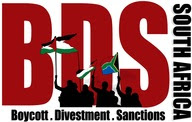
The picture of David Palumbo-Liu is from his website. The picture of Sheldon Adelson is from Bloomberg. The BDS poster is from South Africa.

Special Note: If you are not on a special Wall Writings Alert mailing list. and would like to make sure you receive each posting as soon as it is published, write to jameswall8@gmail.com with the message,  “Please add me”.  

Posted in Hillary Clinton, Israel, Media, Middle East, Palestinians | 8 Comments